Skip to content
  • Home
  • Subscribe / donate
  • Events calendar
  • News
    • Local
    • National
    • Israel
    • World
    • עניין בחדשות
      A roundup of news in Canada and further afield, in Hebrew.
  • Opinion
    • From the JI
    • Op-Ed
  • Arts & Culture
    • Performing Arts
    • Music
    • Books
    • Visual Arts
    • TV & Film
  • Life
    • Celebrating the Holidays
    • Travel
    • The Daily Snooze
      Cartoons by Jacob Samuel
    • Mystery Photo
      Help the JI and JMABC fill in the gaps in our archives.
  • Community Links
    • Organizations, Etc.
    • Other News Sources & Blogs
    • Business Directory
  • FAQ
  • JI Chai Celebration
  • JI@88! video

Recent Posts

  • Sharing her testimony
  • Fall fight takes leap forward
  • The balancing of rights
  • Multiple Tony n’ Tina roles
  • Stories of trauma, resilience
  • Celebrate our culture
  • A responsibility to help
  • What wellness means at JCC
  • Together in mourning
  • Downhill after Trump?
  • Birth control even easier now
  • Eco-Sisters mentorship
  • Unexpected discoveries
  • Study’s results hopeful
  • Bad behaviour affects us all
  • Thankful for the police
  • UBC needs a wake-up call
  • Recalling a shining star
  • Sleep well …
  • BGU fosters startup culture
  • Photography and glass
  • Is it the end of an era?
  • Taking life a step at a time
  • Nakba exhibit biased
  • Film festival starts next week
  • Musical with heart and soul
  • Rabbi marks 13 years
  • Keeper of VTT’s history
  • Gala fêtes Infeld’s 20th
  • Building JWest together
  • Challah Mom comes to Vancouver
  • What to do about media bias
  • Education offers hope
  • Remembrance – a moral act
  • What makes us human
  • המלחמות של נתניהו וטראמפ

Archives

Follow @JewishIndie
image - The CJN - Visit Us Banner - 300x600 - 101625

Images

The ideologies of war

The ideologies of war

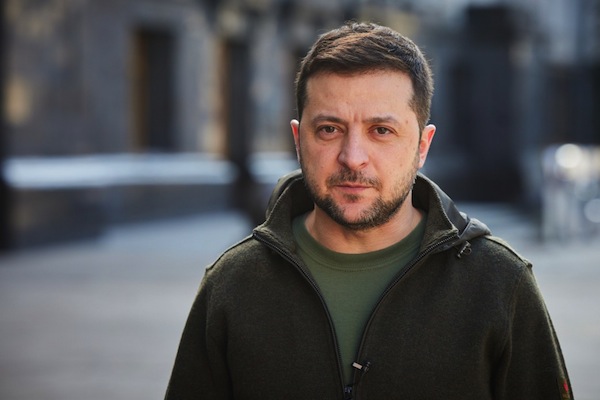
Hebrew University academic Samuel Barnai said Ukrainian unity extends beyond political parties and politicians, such as President Volodymyr Zelensky (pictured here), and the war is viewed as a great patriotic fight for Ukraine. (photo from president.gov.ua)

In the July 12, 2021, essay “On the Historical Unity of Russians and Ukrainians,” Russian President Vladimir Putin declares, “I am confident that true sovereignty of Ukraine is possible only in partnership with Russia. Our spiritual, human and civilizational ties formed for centuries and have their origins in the same sources. They have been hardened by common trials, achievements and victories. Our kinship has been transmitted from generation to generation. It is in the hearts and the memory of people living in modern Russia and Ukraine, in the blood ties that unite millions of our families. Together we have always been and will be many times stronger and more successful. For we are one people.”

This quote from Putin’s 2021 essay was shared by Prof. Yitzhak Brudny at a March 15 Hebrew University of Jerusalem webinar focused on “the ideological sources of the Russian-Ukrainian War.” The webinar featured Brudny, a professor of political science and history, and Samuel Barnai, an adjunct lecturer at the European Forum and at the HU’s Rothberg International School.

Brudny explained that Putin went even further in his claims just over a year after that essay. On Feb. 21, 2022, three days prior to the Russian invasion of Ukraine, Putin stated that “modern Ukraine was entirely created by Russia, more precisely, by the Bolshevik, communist Russia. This process began almost immediately after the 1917 revolution” and “Ukraine never had a tradition of genuine statehood.” Later in the speech, Putin points to Russia as being the main enemy in the eyes of the United States and NATO.

According to Brudny, these statements show a denial by Putin of Ukraine’s right to exist without an alliance with Russia and that the current Ukraine state is a “forepost of NATO” run by an “illegitimate, puppet government.” In Putin’s mind, he can justify the war because he sees it as rectifying an historical injustice caused more than a century ago, as well as remedying the security issues posed by a NATO-friendly state as Russia’s neighbour.

Brudny outlined the more recent history of Ukraine, from its 1991 independence from the Soviet Union (during its dissolution) to the present day. Ukraine stands in stark contrast to Russia in that it has accepted democratic electoral processes. Russia, meanwhile, has grown increasingly authoritarian and views a democratic state positioned between it and NATO countries, especially those that were part of the former Eastern Bloc, as a threat.

Barnai spoke to Russia’s military goals at the outset of the current conflict: destruction of Ukrainian air forces, destruction of Ukraine’s military headquarters, the besiegement of the capital Kyiv and the creation of a puppet government.

“Now that we are talking on the 20th day of the war, none of the targets have been reached,” said Barnai. “How can this be explained? In my opinion, one of the main reasons is the consolidation of Ukrainian society. There is widespread support for the president [Volodymyr Zelensky] and the government, which was not even the case two months ago. There is also support for accession to the EU and NATO, even in the Russian-speaking parts of Ukraine, which were less sympathetic to joining these alliances before,” he said.

In Barnai’s view, the present state of Ukrainian unity extends beyond current political parties and politicians, such as Zelensky, and the war is viewed as a great patriotic fight for Ukraine.

Barnai added that Putin, who has led Russia since Dec. 31, 1999, may have fallen victim to his own propaganda, “that Ukrainian-ness is an artificial tool to cause damage to the Russian people.”

The belief that Ukrainian culture is dangerous and must be eliminated runs deep in the Russian collective consciousness. Barnai gave several historical examples that illustrate this point. There was the suppression of the Ukrainian language by Czar Peter I in 1720. In 1763, Catherine the Great issued a decree banning the teaching of the Ukrainian language at the Kyiv-Mohyla Academy. In 1876, Alexander II prohibited the printing of all Ukrainian literature within the Russian Empire. And, in 1914, there was a decree by the last czar, Nicholas II, prohibiting the Ukrainian press. Despite a range of views on other historical matters, these and other Russian leaders shared a common desire to suppress Ukrainian cultural identity.

Barnai explained that there are close ties – historical, religious, and personal – between Russians and Ukrainians, and many have family connections to both countries. He said the real threat to Putin today is not NATO or the European Union, but “the success, even if it is limited success, of political and economic reform in Ukraine.”

This threat, Barnai concluded, plays out in the lack of true participation the Russians have in the political and economic processes of their country. “The main struggle of Putin for the last 22 years,” said Barnai, “has been to deprive Russians of their rights in the political arena.”

Sam Margolis has written for the Globe and Mail, the National Post, UPI and MSNBC.
Format ImagePosted on March 25, 2022March 24, 2022Author Sam MargolisCategories WorldTags CFHU, education, Hebrew University, history, ideology, politics, Rothberg International School, Russia, Samuel Barnai, Ukraine, Vladimir Putin, Volodymyr Zelensky, war, Yitzhak Brudny
Celebrating together

Celebrating together

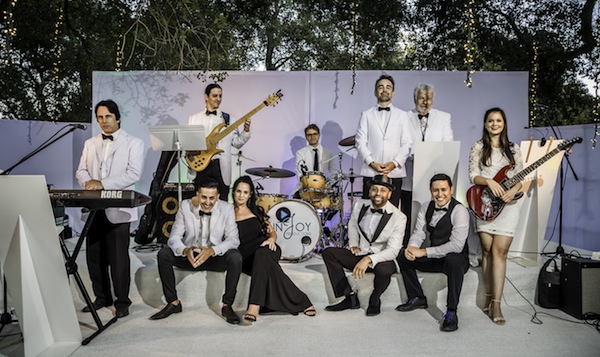
InJoy, led by Gilat Rapaport (centre), comes to Vancouver for the community’s Yom Ha’atzmaut celebration on May 4 at Vogue Theatre. (photo by Linda Kasian)

Tickets are now on sale for the community’s celebration of Israel’s 74th Independence Day. This year’s Yom Ha’atzmaut event will be held, COVID permitting, at the Vogue Theatre on May 4.

“The Yom Ha’atzmaut committee, Federation staff and I are really excited about our first large community gathering since before the pandemic,” said Pam Wolfman, chair of the committee. “This year also marks our 20th anniversary of this event, making it an extra special celebration for the whole community!”

Emcees Lu Winters, Kyle Berger and Adora Harel will guide attendees through the night’s festivities, which will include special guest performers Gilat Rapaport and the InJoy band, as well as local community dance groups, and Vancouver Talmud Torah and Richmond Jewish Day School students. Once again, a community song video will be screened – to participate, submit a video of yourself singing Jewish Federation’s version of “Salaam” by March 31. Video submissions will be edited into one that will première on May 4 at the Vogue. For details, including the audio and lyrics of the song, visit jewishvancouver.com/community-song-2022.

Rapaport was born and raised in Israel and has been performing on stages in Israel and around the world since the age of 12. After her service in the Israel Defence Forces’ entertainment groups, she moved to Los Angeles in 1998.

Rapaport began her career with classical training at the Israel Conservatory of Music in Tel Aviv and continued at the Rimon School of Music branch in Boston. She founded her company, InJoy Productions, just over 20 years ago.

Rapaport and InJoy have been touring – South America, South Africa, Australia, Europe and the United States – performing their joyful and energetic music for Jewish and non-Jewish communities around the world. For Metro Vancouver’s Yom Ha’atzmaut celebration, they will perform traditional and contemporary Jewish and Israeli repertoire, with the hope that audience members will dance and sing along.

For more information about Rapaport and InJoy, visit injoyprod.com. For tickets to the May 4 event, go to jewishvancouver.com/yh2022.

– Courtesy Jewish Federation of Greater Vancouver, and InJoy Productions

Format ImagePosted on March 25, 2022March 24, 2022Author Jewish Federation & InJoyCategories LocalTags dance, Gilat Rapaport, Independence Day, InJoy Productions, Israel, music, Yom Ha'atzmaut
CHW’s Fashion Blooms

CHW’s Fashion Blooms

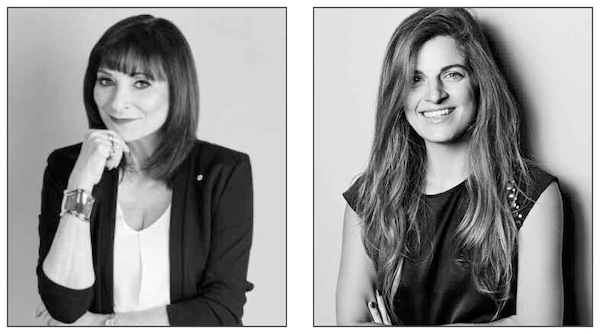
As part of Fashion Blooms on March 31, Canadian journalist, media personality and fashion entrepreneur Jeanne Beker, left, will interview Israel’s Sharon Tal, head designer of Maskit. (photos from CHW)

Canadian Hadassah-WIZO (CHW) presents the second annual Fashion Blooms on March 31. The national virtual fundraising event – highlighting innovation, sustainability and the future of Israeli fashion – will feature Canadian journalist, media personality and fashion entrepreneur Jeanne Beker interviewing Sharon Tal, head designer of Maskit.

Israel fashion house Maskit was conceived in 1954 by then-designer Ruth Dayan, as a contemporary luxury clothing brand. Known for its intricate ethnic embroidery, Maskit was revolutionary in advancing economic opportunities and bridging cultural divides by employing thousands of Jewish, Arab and Bedouin women artisans. Since Tal took over the helm in 2014, she and Maskit have launched collections that are shown internationally and adored by celebrities. One of Tal’s latest designs, a peacock-embroidered caftan, was created in close collaboration with Sarah Jessica Parker and featured in the first episode of And Just Like That, the HBO revival of Sex and the City. Tal continues to honour and innovate, revitalizing a brand while earning plaudits for Maskit’s designs.

“As the former head of embroidery at Alexander McQueen and intern under Alber Elbaz at Lanvin, Sharon’s appreciation for tradition is matched only by her diligence and willingness to reinvent,” said Beker, event emcee. “She has what it takes to build upon the Maskit dynasty while also creating a legacy of her own.”

Fashion Blooms is also the Canadian debut of two trailblazing female fashion designers based out of Tel Aviv: Maya Reik Belfer, founder and designer of Marei1998, a luxury brand focused on sustainability and eco-conscious materials; and Danit Peleg, founder and creative director of Danit Peleg, known for its disruptive and innovative approach that is revolutionizing the fashion industry through open-source designs and 3D printed technologies.

Restrictions permitting, CHW centres across the country will host VIP invitation-only in-person viewing parties for Fashion Blooms. The virtual event will include an exclusive online auction, featuring fashion accessories and luxury brands, and an online vendor marketplace for a virtual shopping experience.

To register, participants can visit chw.ca/fashion-blooms. Tickets start at $40. Fashion Blooms proceeds support the CHW Neri Bloomfield Academy of Design in Haifa, Israel, supporting student scholarships and ultramodern equipment to enhance the future of the Israeli fashion industry.

The CHW Neri Bloomfield Academy of Design awards academic degrees in a wide variety of creative fields, including graphic design, architecture and fashion. This institution is building academic excellence and becoming an influencer and innovator in the world of design. It nurtures individual creativity among its pluralistic student body while instilling a sense of community and coexistence.

For more information, contact Rebecca Bowslaugh, CHW director of marketing and communications, at [email protected] or 416-477-5964, ext. 111.

CHW is a non-political, nonpartisan national network of volunteers and professionals who believe that the advancement of education, healthcare and social services transcends politics, religion and national boundaries. Over the last century, CHW has been involved in all aspects of Israeli life, supporting women, children and families in Israel and here in Canada. Learn more about CHW at chw.ca.

– Courtesy Canadian Hadassah-WIZO

Format ImagePosted on March 25, 2022March 24, 2022Author Canadian Hadassah-WIZOCategories NationalTags CHW Neri Bloomfield Academy of Design, fashion, Fashion Blooms, fundraiser, Israel, Jeanne Beker, philanthropy, Sharon Tal
Climate action update

Climate action update

Seth Klein speaks at the Press Conference from the Future on March 12. (photo by Lorne Mallin)

On March 12, hundreds turned out for a creative event that imagined what could be accomplished by 2025 with climate movement leaders in government.

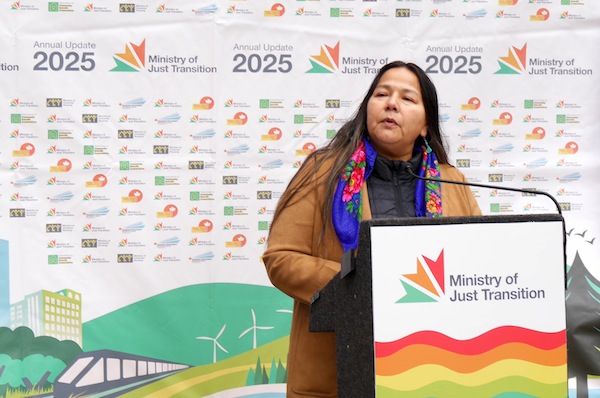
“With the money that would have gone to piping some of the worst oil in the world to the West Coast, we have instead unleashed a wave of investment in healthy people and healthy land,” Kukpi7 Judy Wilson told A Press Conference from the Future in front of Vancouver Public Library’s central branch.

Wilson, secretary-treasurer of the Union of British Columbia Indian Chiefs, was speaking as if the twinning of the Trans Mountain (TMX) pipeline had been scrapped in 2023 and a TMX reparations and healing secretariat had been created.

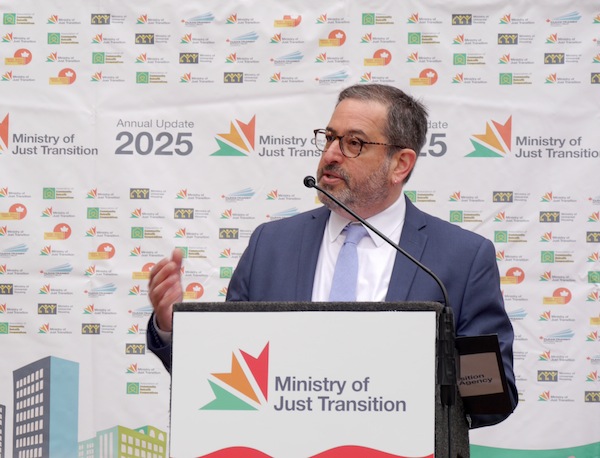
The press conference event was under the banner of a fictional ministry of just transition presenting an update on new programs and institutions slashing pollution, creating meaningful work, and addressing injustice and inequality in energy, Indigenous rights, housing, transit, public health and more.

There were two Jewish speakers: Seth Klein of the Climate Emergency Unit and filmmaker Avi Lewis as the minister of just transition, as well as Secwépemc/Ktunaxa filmmaker Doreen Manuel, director, Bosa Centre for Film and Animation, Capilano University; Rueben George, Sacred Trust, Tsleil-Waututh Nation; Khalid Boudreau, climate youth activist/organizer; Christine Boyle, Vancouver city councilor; Alison Gu, Burnaby city councilor; and Anjali Appadurai, Sierra Club BC.

photo - Kukpi7 Judy Wilson addresses the Press Conference from the Future
Kukpi7 Judy Wilson addresses the Press Conference from the Future. (photo by Lorne Mallin)

Klein, author of A Good War: Mobilizing Canada for the Climate Emergency, spoke as chief executive officer and commissioner of the fictional Just Transition Transfer Agency. “Winning [on emissions reductions] also means leaving no one behind,” he said, “especially the regions that have long relied on revenue and jobs from oil and gas.”

Klein said that, like the Bank of Canada’s qualitative easing policies in the first year of the COVID-19 pandemic, the just transition could be financed in a similar way.

“Most of that year, the Bank of Canada was buying up federal government securities to finance the COVID emergency response to the tune of $5 billion every week for a year,” said Klein. “Once we embedded our climate emergency goals within the mandate of the Bank of Canada, the bank proceeded to do this again for a mere four weeks a year, generating $20 billion for climate and just transition programs.”

Lewis said his government is committed to climate action, having carefully studied the conditions and capacities of Canada’s advanced industrial economy. “We conducted an inventory of our conversion needs to determine how many heat pumps, solar arrays, wind farms and electric buses we needed to electrify virtually everything and end our reliance on fossil fuels,” he said.

Lewis encouraged the audience to make the future presented in the event happen. “Do you want to live in this future? Are we ready to fight for this future? Because this future we described here today is the work of all of us – the fruits of our imagination and struggle – and that’s what we came here today to commune around: the future we can build together.”

Manuel, portraying the chair of the land back secretariat, updated progress of an imagined Land Back Act, whose goal is “to reverse the land theft that underlies the colonial nation state of Canada. That means that 80% is being systematically returned to Indigenous jurisdiction.”

After the speakers, and entertainment by the Carnival Band, volunteers engaged members of the audience on their thoughts and feelings about the climate emergency.

The March 12 event was part of a national day of action calling for the passage of a national Just Transition Act.

“The Just Transition Act is the most important missing piece of climate legislation in Canada and it needs to pass this sitting of the House of Commons,” said Katie Rae Perfitt, senior organizing specialist with 350.org, one of the press conference’s sponsoring organizations.

“We cannot tackle the climate crisis without rapidly phasing out fossil fuels,” said Perfitt. “Canadians deserve immediate action from our federal government to make that shift happen in a way that puts workers and communities first.”

– Courtesy A Press Conference from the Future ogranizers

Format ImagePosted on March 25, 2022March 28, 2022Author A Press Conference from the FutureCategories LocalTags Avi Lewis, climate crisis, Doreen Manuel, Judy Wilson, Just Transition Act, Katie Rae Perfitt, politics, Seth Klein, social justice
Snapshot of Jewish life

Snapshot of Jewish life

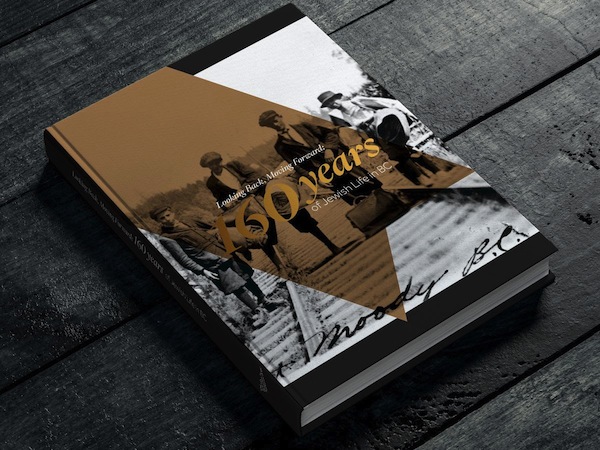
Looking Back, Moving Forward is available for purchase from the Jewish Museum and Archives of British Columbia. (photo from JMABC)

The first thing many readers will do upon opening the Jewish Museum and Archives of British Columbia’s Looking Back, Moving Forward: 160 Years of Jewish Life in BC is try and find their friends’ writeups and those of the organizations with which they volunteer or work. That is, if they didn’t submit their own writeup for the publication. If they did send in their bio or one for their family, then that’s the first page to find.

Even people who grew up in the province and have a multigenerational presence here will find novel tidbits in this 284-page hardcover (or soft) coffee table book. Published to celebrate the museum’s 50th anniversary last year, it is appropriately dedicated to Irene Dodek (1930-2019) and Cyril E. Leonoff (1925-2016). Leonoff was founding president of the Jewish Historical Society of British Columbia, which was established in January 1971. Dodek, also a founder of the museum and archives, “helped define its direction early on and conducted more than a hundred oral history interviews with members of our community.” More about Dodek and Leonoff can be found in the first pages of the book, before the greetings from Prime Minister Justin Trudeau and Premier John Horgan.

In her president’s message, Carol Herbert writes, “Our stories are fascinating, and demonstrate the evolution over time of our communities, from a few small clusters of Ashkenazi Jews from Eastern Europe in late 19th century to present-day diverse Jewish communities, comprised of individuals who originated from across the world; Sephardic, Mizrahi and Ashkenazi; secular and religious; leaders, activists and advocates for Jewish and general community causes.”

Both Herbert and the book’s editor, Michael Schwartz, director of community engagement for the JMABC, acknowledge that this publication is a partial snapshot of the community. They both encourage readers who haven’t done so yet “to share your memories of where we’ve been, celebrate with us where we are, and join us in envisioning where we might be headed,” writes Schwartz.

A chapter on the history of the JMABC begins the book proper. It is followed by brief regional histories – Victoria, Vancouver, Kootenay/Boundary, Okanagan, Prince George, Sunshine Coast, Central Vancouver Island and Whistler. The chapter on organizations is divided into those that work in advocacy and activism; religious observance; education; youth groups and camps; seniors; arts, culture and leisure; Zionism; Holocaust education; and anchor organizations. That last one, by the way, is where you’ll find the Jewish Independent (pages 126 and 127).

The Notables chapter is sorted chronologically: pioneers (1886-1945), postwar (1945-1970), modern (1970-2000), contemporary (2000-2010) and emerging (2010-present). Within each section, people are listed alphabetically by surname, as are the entries in the Family Album chapter. Rounding out the publication is a list of donors and an index.

Looking Back, Moving Forward offers a broad overview of many of the major players in the B.C. Jewish community over the 160 years since Jews first arrived here. It focuses on accomplishments and takes readers right up to 2021. It is easy reading, and no one need worry that any dirty laundry is aired. Given the celebratory nature of the book, none of the submitters (including the JI) talk about the challenges they’ve faced or controversies, and neither do any of the introductions to the various sections.

Some history is given only passing mention, such as what community fundraising structures were in place prior to the Jewish Federation of Greater Vancouver’s emergence in 1987, for example, but the book isn’t meant to be a comprehensive historical tome. Rather, it’s a fun, page-flipping community yearbook of sorts, which will hopefully motivate people to both learn more about the community and contribute their stories to its archival record.

Looking Back, Moving Forward is available in hardcover ($100) and softcover ($50). To place an order, contact the museum offices at 604-257-5199 or [email protected]. Shipping is available across Canada for a fee of $20 per book.

Format ImagePosted on March 25, 2022March 24, 2022Author Cynthia RamsayCategories BooksTags British Columbia, Carol Herbert, history, Jewish museum, Michael Schwartz
Gallery’s new guides

Gallery’s new guides

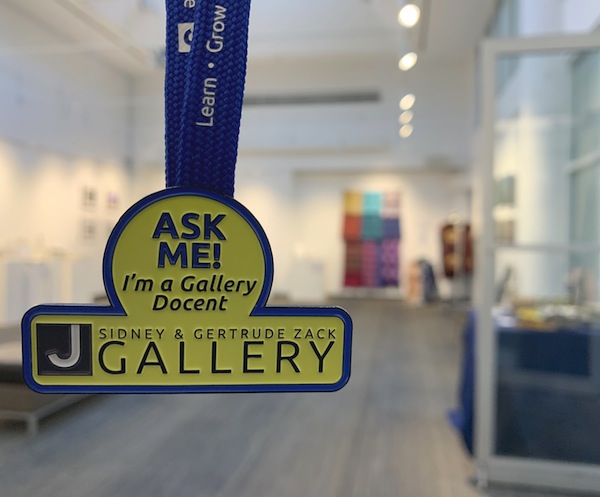
New docent program at the Zack gets underway. (photo from Zack Gallery)

Sidney and Gertrude Zack Gallery director Hope Forstenzer recently instituted a new docent program, to train guides for the art gallery.

“I came up with the idea of creating a group of volunteer docents for the gallery right after I got here, which means right before the pandemic,” Forstenzer told the Independent.

Unfortunately, the pandemic made it impossible to implement the idea at that time, and the initiative only became reality in the past few months.

“My job as the gallery director is only half-time,” Forstenzer said. “Even when I’m working, I’m frequently in meetings or visiting studios or doing other work that takes me away from engaging the people in the gallery. I created the docent program to make sure the gallery was staffed with friendly and available faces, with people who knew about the shows, could make sales, and could answer questions.”

Initially, about a dozen people responded to her invitation to become volunteer docents at the Zack. “Some dropped out for various reasons as we were getting underway,” she said. “Others have come along since.

Currently, we have six docents on our active roster.”

Before the docents could perform their assigned duties, they needed a certain amount of training on the gallery rules and procedures.

“The docents each attended two training sessions, both lasting about an hour,” said Forstenzer. “Sometimes, we’d do the whole training in one session, but it varied. The second training shift was usually about our sales system, which isn’t difficult, but isn’t something most of the docents have seen or used before. In the first training session, I explained what their responsibilities were, we discussed scheduling, and I’d either show them how to use our sales system or invite them back to learn it on a different day…. Then they did a shift with me in the gallery as backup. Then they were ready to go.”

The first docent started at the Zack last October. “Some of them have taken breaks due to the Omicron,” said Forstenzer, “but others have stayed throughout.”

She has lots of plans for her volunteer docents. “The primary purpose of having the docents in the gallery right now is to have a knowledgeable and friendly presence that welcomes visitors,” she said. “They can also make sales. As the restrictions due to COVID lift (hopefully), the docents will also help me run events in the gallery, both for kids and for adult groups. Eventually, I hope they’ll be able to run some of these events themselves. We might even schedule some docent-led viewings of shows.”

At the moment, most docents do one shift a week, each shift three or four hours long, but Forstenzer is flexible about that. “Some do two shifts a week. Some split their shifts and go for a swim or a workout in the middle and then come back. It is up to them, and I create a schedule based on their availability and the gallery’s needs.”

She added that all the docents take their volunteering seriously. “If someone can’t make their shift, they let me know,” she said. “If I can cover it, I will. If not, the gallery won’t have a docent that day.”

The docents vary widely in age and experience. Some are students. Others are retirees or people participating in various community centre programs. Gail Bloom shared with the Independent a bit about herself and why she became a docent at the gallery.

Bloom worked as a city planner in San Francisco. “I studied city planning in college and then worked as a practising planner,” she said. “I love cities and was interested in public utilities. My chief role for over a dozen years was sorting out public financing of major infrastructure projects in San Francisco.  It was very satisfying to see the fruition of that work across the city.”

She retired about 20 years ago. “My home is still in the Bay Area. I live there with my husband, and my son’s family also live nearby, but, last fall, I came to Vancouver for an extended winter visit with my daughter – she lives here and teaches at Emily Carr.”

Bloom, who turns 70 this month, has been volunteering in many fields since her retirement. “I lead the Board of Children’s Book Project and presently serve on a regional public health agency at the Marin/Sonoma Mosquito and Vector Control District,” she said. “I have also enjoyed working on state, local and federal election campaigns, mentoring youths, and helping with the major fundraising event for the Oakland Museum of California.”

She has always been interested in art. “I love cities, as I said, and the museums are a big part of that – especially art museums. In the last couple months, I visited the Vancouver Art Gallery and a small community gallery at the Deep Cove Cultural Centre. There is a show at the VAG now that I’d recommend – Emily Carr and Edith Heath. Heath was a local San Francisco ceramic artist; she started her iconic tile and pottery company out of her little apartment in San Francisco in the ’40s.”

Of course, when she visited the Jewish Community Centre of Greater Vancouver for the first time, the Zack Gallery attracted her. “As I’m interested in the arts personally and enjoy art museums, their new docent program seemed like a good fit,” she said. “And my family were thrilled that I found the gallery and something meaningful to do with my time. Now, I’m at the gallery every week. My docent days are Mondays.”

Besides volunteering, Bloom takes advantage of several other programs the JCC offers. “The aquatics program is pretty great,” she said. “I also attended several sessions of the book fair last month, and I just started watching VJFF [Vancouver Jewish Film Festival]. I’m fortunate to have time to participate in them all.”

Olga Livshin is a Vancouver freelance writer. She can be reached at [email protected].

Format ImagePosted on March 25, 2022March 24, 2022Author Olga LivshinCategories Visual ArtsTags art, docents, Gail Bloom, Hope Forstenzer, JCC, Zack Gallery
Get $5 off Ahed’s Knee admission at VIFF

Get $5 off Ahed’s Knee admission at VIFF

A still from Ahed’s Knee, which screens at Vancity Theatre March 25, 26 and 28. The movie – which won the Jury Prize at last year’s Cannes Film Festival – is about a celebrated Israeli filmmaker named Y, who arrives in a remote desert village to present one of his films at a local library. Struggling to cope with the recent news of his mother’s terminal illness, he is pushed into a spiral of rage when the host of the screening, a government employee, asks him to sign a form placing restrictions on what he can say at the film’s Q&A. Told over the course of one day, the film depicts Y as he battles against the loss of freedom in his country and the fear of losing his mother.

For $5 off the ticket price, use the promotional code VIFFKNEE22 at goviff.org/aheds-knee.

– Courtesy Vancouver International Film Festival

Format ImagePosted on March 25, 2022March 24, 2022Author VIFFCategories TV & FilmTags Ahed's Knee, Israel, movies, politics, Vancouver International Film Festival
Community milestones … Pikuah Nefesh Award, community food program, Klein-Thompson wedding, Jerusalem Talmud

Community milestones … Pikuah Nefesh Award, community food program, Klein-Thompson wedding, Jerusalem Talmud

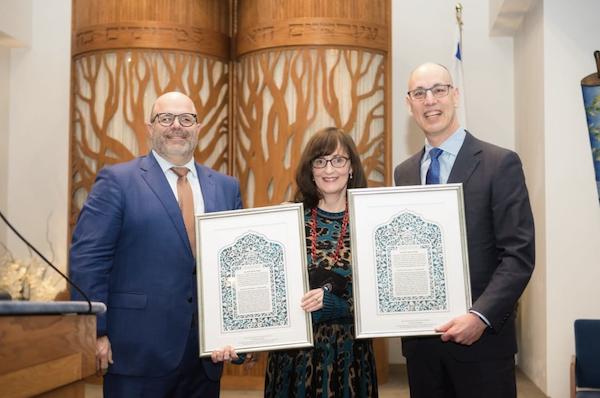
Rabbi Dan Moskovitz, left, Dr. Patricia Daly and Dr. Eric Grafstein (photo from Temple Sholom Twitter)

On Feb. 26, Temple Sholom awarded community members Dr. Patricia Daly and Dr. Eric Grafstein with the Pikuah Nefesh Award (to save a life) for their leadership and dedication to our community throughout the pandemic. Mazel tov to both of them! You can watch the presentation on the synagogue’s YouTube channel, along with the evening’s concert featuring Israeli cellist Amit Peled performing “Journeys with my Jewishness.”

* * *

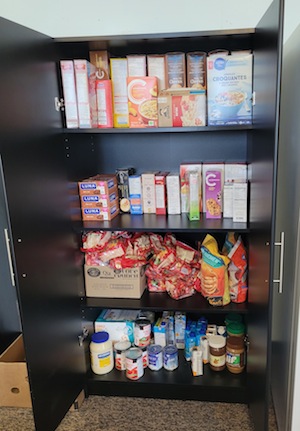
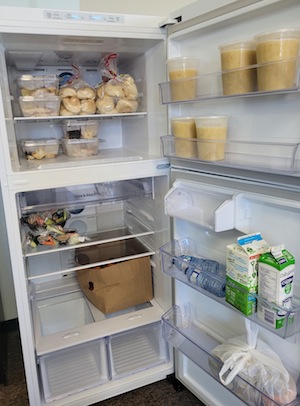
The community cupboard and fridge at Richmond Jewish Day School.

The pilot of the new Richmond Jewish Day School (RJDS) and Kehila Society of Richmond food program to enhance students’ access to healthy and nutritious food is now in progress. With start-up funds provided by Jewish Federation of Greater Vancouver and TD Bank, once a week, JFS Vancouver delivers hot meals to RJDS at no cost to the students or their families. In addition, the funds were used to purchase a community fridge and pantry cupboard that will be kept stocked by JFS, Kehila and the Richmond Food Bank. Students and their families can access healthy snacks, dry goods, fresh produce and meals, during school hours.

* * *

photo - Aden Klein and Nikki Thompson
Aden Klein and Nikki Thompson (photo from their families)

Denise and Wayne Thompson and Gerri and David Klein are thrilled to announce the engagement of their children, Nikki and Aden. A fall wedding is planned.

* * *

photo - Paul and Pamela Austin
Paul and Pamela Austin (photo from CFHU)

The Canadian Friends of the Hebrew University recently announced a transformative gift to establish the Pamela and Paul Austin Research Centre on Aging at the Centre for Computational Medicine at the faculty of medicine of the Hebrew University of Jerusalem.

The Pamela and Paul Austin Research Centre on Aging will implement an approach to combating disease by integrating computational data analysis into medical research and practice, and by preparing the next generation of computation-science-trained doctors and researchers. It will bring together leading researchers to leverage the power of data-driven analyses, applying computational methods to study and help combat a variety of age-related diseases, including Alzheimer’s and Parkinson’s; pain; psychiatric disorders; genetic disorders; congenital impairment; immune and inflammatory diseases; cardiovascular aging, and the effects of aging on cancer, osteoarthritis, pulmonary disease and metabolic disease.

The Centre for Computational Medicine and its research programs are specifically designed to enable data information flow and collaborative interdisciplinary research efforts with the most advanced equipment and a disease modeling unit, all in proximity to a major medical centre.

Globally, the number of people over the age of 60 is soon expected to outnumber children under the age of 5. As life expectancy rises, so does the prevalence of age-associated diseases, posing a central challenge to healthcare systems worldwide. The gift from the Austins will go beyond the centre, establishing scholarship opportunities for students and an annual lecture.

* * *

A new edition of the Jerusalem Talmud is now available in Sefaria’s free library of Jewish texts – available on sefaria.org and the Sefaria iOS and Android apps.

The Jerusalem Talmud, also known as the Talmud Yerushalmi or Palestinian Talmud, is the sister text to the better-known Babylonian Talmud. It was compiled in Israel between the third and fifth centuries from oral traditions. Like the Babylonian Talmud, the Jerusalem Talmud is a textual record of rabbinic debate about law, philosophy, and biblical interpretation, structured as a commentary on the Mishnah. However, a language barrier (it is written in a different dialect of Aramaic), reduced elaboration, and complex structure can make it difficult to study.

The new Jerusalem Talmud on Sefaria includes:

  • Complete English translation,
  • Fully vocalized text to assist learners in reading the distinctive Aramaic dialect,
  • Extensive interlinking to the Bible, Babylonian Talmud and other works, providing connections that help with understanding the work and placing it in context,
  • Topic tagging, so searches on Sefaria will surface references from the Jerusalem Talmud,
  • Six of the standard Hebrew commentaries included in the Vilna edition of the Talmud available and linked on Sefaria, including Korban HaEdah, Penei Moshe, Mareh HaPanim and others,
  • Standardized organization of the different published formats of the Jerusalem Talmud so readers can more easily find their place in the text.

The only fully extant manuscript of the Jerusalem Talmud was set down by Rabbi Jehiel ben Jekuthiel Anav in 1289, which formed the base for the first printing in Venice by Daniel Bomberg in 1524. Sefaria has manuscript images from both of these editions visible in the resource panel, to see the original format of the texts alongside the modern, digital version.

The English translation of the Yerushalmi was completed in 2015 by Heinrich Guggenheimer, a mathematician who also published works on Judaism. He spent the last 20 years of his life working on translating the Jerusalem Talmud. With his blessing, Sefaria approached his publisher, de Gruyter GmbH, who agreed to partner on this open access version of Guggenheimer’s historic work. Guggenheimer passed away on March 4, 2021, at the age of 97.

Format ImagePosted on March 25, 2022March 24, 2022Author Community members/organizationsCategories LocalTags Aden Klein, Canadian Friends of Hebrew University, CFHU, Eric Grafstein, Jerusalem Talmud, Jewish Vancouver, JFS Vancouver, Kehila Society, Nikki Thompson, Patricia Daly, Paul and Pamela Austin, philanthropy, Pikuah Nefesh Award, Richmond Food Bank, Richmond Jewish Day School, RJDS, Sefaria, TD Bank, Temple Sholom
The excitement of holidays

The excitement of holidays

As meaningful and fun as most of the Jewish holidays are, there’s a lot of running around, cleaning, cooking and other preparation that generally goes into them. Three recently published children’s books – two about Passover and one on Shabbat – capture the joys of the holidays, and the craziness that can sometimes precede them.

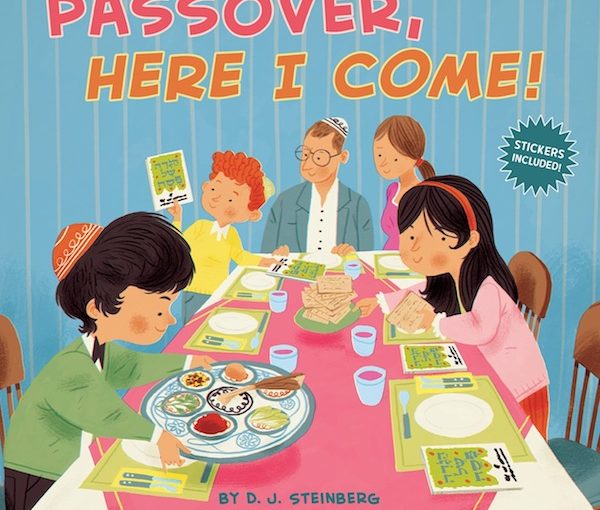
Passover, Here I Come!, written by D.J. Steinberg and illustrated by Emanuel Wiemans was put out this year by Grosset & Dunlap. It’s a compilation of short poems, all related to Passover, from “Scrub-A-Dub-Dub!” preparations to “Bye-bye, Bread!” and “Hello, Matzoh!” it goes through pretty much every aspect, including the Passover story, what’s for dinner and the search for the afikomen.

“Made by Me!” is about making up the seder plate, and all the plate’s items and their symbols are noted alongside the illustration. For the poem “Our Magic Table,” the drawings and words again combine to wonderful effect. We see the tables from set-up to guest-filled, and the typesetting, leaving gaps between the letters forming the words “g r o w s   a n d    g  r  o  w  s,” communicate the truly magic nature of a Pesach table that does seem to fit an enormous number of people, when we’re lucky to have many friends and family join in our celebrations.

Steinberg’s verse and Wiemans’ drawings work well together, simultaneously entertaining and teaching. The basics of Passover are all covered in Passover, Here I Come! which even includes a recipe for Mom’s Matzoh Brei after the four-line poem “World’s Best Breakfast.”

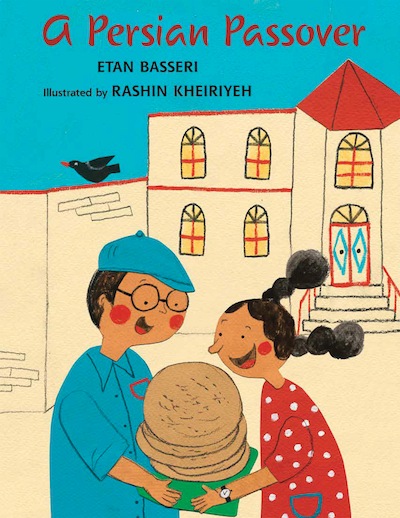
A Persian Passover (Kalaniot Books) by Etan Basseri with illustrations by Rashin Kheiriyeh, also contains a recipe – for hallaq, which is Persian-style charoset. In addition, the end of the book features a brief description of Passover and what goes on the seder plate, a glossary of Persian and Hebrew words used in the story, and a couple of paragraphs on Jews in Persia, known today as Iran, though, notes Basseri, “the culture and main language of this region is still called ‘Persian.’”

image - A Persian Passover book cover

Set in Iran in the 1950s, A Persian Passover follows siblings Ezra and Roza, who are helping their family get ready for the holiday. Everyone is put to work and Roza is finally old to enough to accompany older brother Ezra to the synagogue, where families bring their own flour “to be mixed, rolled and baked into soft, delicious matzah.” Though older, Ezra is not necessarily wiser and he’s still a kid, with energy to burn. Not having learned from an earlier collision with a neighbour – as he ran a lap around the house, being timed by Roza – Ezra once again asks Roza to measure how fast he can run to the next street corner, freshly baked matzah in hand.

“But he didn’t see the rut in the road up ahead. ‘Oof!’ yelped Ezra as he tripped and fell. Splat! went the bag of matzah as it dropped into a puddle.

“‘The matzah!’ they exclaimed together.

“‘That was all the matzah we had for the week. Now it’s gone. What will we tell Mama and Baba?’ asked Roza.” (The glossary notes that baba means dad in Persian.)

Ezra and Roza set out to find replacement matzah before the seder starts, and we meet more of the neighbourhood folk. Hopefully, it won’t be too much of a spoiler to know that the kids succeed – not only receiving kindness, but also showing kindness to others along the way.

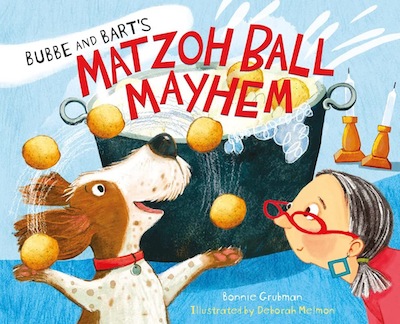
The last book that recently came out has to do with matzah, but not with Passover, which is why it’s included in this brief roundup even though it’s about Shabbat. Good for year-round reading, Bubbe and Bart’s Matzoh Ball Mayhem, written by Bonnie Grubman and illustrated by Deborah Melmon, was published by Seattle’s Intergalactic Afikoman last November. Created by two dog lovers, it begins, “This is Bubbe’s story. Believe me that it’s true. Her puppy loved each Friday night like Jewish puppies do.

image - Bubbe and Bart’s Matzoh Ball Mayhem book cover

“When Bubbe made her matzoh balls, Bart was at her feet, waiting for a ball to fall, and not some doggie treat.”

While Bart’s begging doesn’t achieve the desired result, he does get to eat all the matzah balls he’s able to catch. Bubbling away in the pot on the stove, the matzah balls grow so large that they blow off the lid and zoom all over the room. Not to be held back by “a better lid, and some very sticky tape,” the balls continue to fly. And we get to count them as they do. (Another spoiler alert: Bart gets to eat an awful lot of matzah.)

Eventually, with a little magic, calmness is restored and dog and house are cleaned up in time for Shabbat dinner with the family.

Bubbe and Bart’s Matzoh Ball Mayhem ends with a couple of paragraphs about Shabbat, “a very special day of the week,” and a short glossary.

Format ImagePosted on March 25, 2022March 24, 2022Author Cynthia RamsayCategories Books, Celebrating the HolidaysTags Bonnie Grubman, children's books, D.J. Steinberg, Deborah Melmon, education, Emanuel Wiemans, Etan Basseri, Iran, Judaism, matzah, Passover, Persia, Rashin Kheiriyeh, Shabbat
PJ Library resources

PJ Library resources

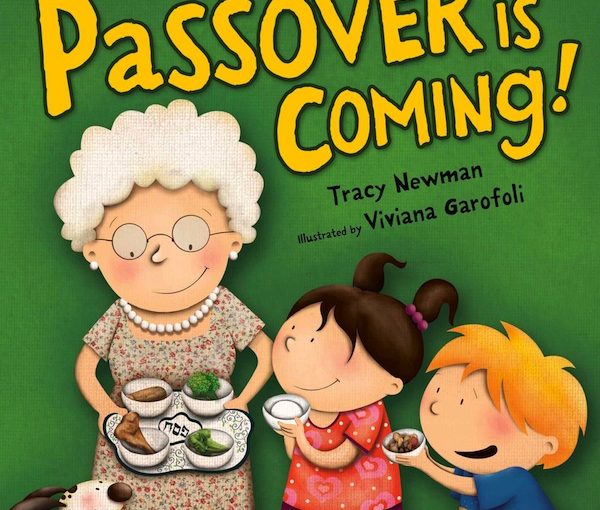
One PJ Library holiday offering is Passover is Coming by Tracy Newman and Viviana Garofoli.

Long a trusted resource for Jewish families in more than 35 countries around the world who receive their free books each month, PJ Library offers fresh reading, audio stories and tasty treats for families celebrating Passover this year, April 15 to 23.

Hundreds of thousands of children are receiving new books this month, each providing a carefully curated selection of age-appropriate reading related to Passover. New this year, families will also receive a colourful illustrated “Matzah Mania” fold-out that includes recipes for homemade matzah, matzah trail mix, and matzah pizza lasagna, along with ideas for serving a seder grazing board. The keepsake fold-out includes culturally inclusive information about seder traditions, and the Four Questions of the seder, which are printed in English and Hebrew.

image - In Every Generation Haggadah cover English
PJ Library’s Haggadah is available in five languages, including English and French. As well, PJ Library has many other Passover resources, such as children’s books about the holiday.

In the PJ Library program, which was created by the Harold Grinspoon Foundation, families who sign up may receive free books for children from birth through age 8. For kids ages 9 and up, PJ Our Way allows kids to select and review books on their own each month.

In April, two new Passover-themed episodes of the PJ Library Presents podcast network will launch. These new podcasts bring Jewish traditions, culture, holidays and values to life through audio storytelling. On April 4, Kiddo Learns about Passover will be the latest Afternoons with Mimi audio story, and Humpty Dumpty and the Passover Feast will be the newest tale in the Beyond the Bookcase series. Families may listen to the award-winning podcasts on all major streaming sources, and more information is at pjlibrary.org/podcast.

image - image - In Every Generation Haggadah cover FrenchPJ Library has become one of the leading sources for family-friendly Haggadot, with its illustrated In Every Generation: A PJ Library Family Haggadah. Since 2018, the organization has shipped more than 675,000 individual Haggadot to more than 110,000 PJ Library families for free. (For non-subscribers, the printed Haggadah is available for purchase via Amazon.) PJ Library also offers a digital version that can be downloaded in five languages: English, Spanish, Portuguese, Russian and French. This Haggadah is filled with songs, blessings and explanations and is available as a free printable PDF from pjlibrary.org/haggadah.

This year, PJ Library has updated its Passover hub – pjlibrary.org/passover – with new book lists and dozens of fresh ideas and resources for families, including stories and songs, games, activities and recipes.

– Courtesy PJ Library

Format ImagePosted on March 25, 2022March 24, 2022Author PJ LibraryCategories Celebrating the HolidaysTags children's books, Haggadah, Judaism, parenting, Passover, PJ Library

Posts pagination

Previous page Page 1 … Page 118 Page 119 Page 120 … Page 492 Next page
Proudly powered by WordPress