Skip to content
  • Home
  • Subscribe / donate
  • Events calendar
  • Business Directory
  • FAQ
  • News
    • Local
    • National
    • Israel
    • World
    • עניין בחדשות
      A roundup of news in Canada and further afield, in Hebrew.
  • Opinion
    • From the JI
    • Op-Ed
  • Arts & Culture
    • Performing Arts
    • Music
    • Books
    • Visual Arts
    • TV & Film
  • Life
    • Celebrating the Holidays
    • Travel
    • The Daily Snooze
      Cartoons by Jacob Samuel
    • Mystery Photo
      Help the JI and JMABC fill in the gaps in our archives.
  • Community Links
    • Organizations, Etc.
    • Other News Sources & Blogs
  • JI Chai Celebration
  • JI@88! video

Recent Posts

  • SFU honours Gloria Gutman
  • Lifting people’s spirits
  • Wedding a ray of light
  • Indigeneity and Zionism
  • Rule of law broken: councilor
  • Football and its roles
  • The burden of defence
  • Fish Café returns after fire
  • All right in what goes wrong
  • Nuns & mermaids at TUTS
  • Camp offers holiday retreat
  • Students and mentors inspire
  • Once-in-a-lifetime trip
  • 100 dancers, one heart
  • Money for the sciences
  • What “Jewish food” means
  • Have a cookie, schnitzel too
  • Federation now across BC
  • Israel fighting for its existence
  • Deal strengthens Iran
  • Patriotic belonging diminishes
  • A campaign to engage
  • Upstanders’ first live event
  • Responding to Carney
  • Having your own home
  • Music a family tradition
  • Musical to warm heart
  • Community milestones … June 2026
  • Sharing her passion for Israel
  • Or Shalom reopens its doors
  • JFS from past to future
  • Need holistic approach
  • Sharing stories, advice
  • Journalist shares fears
  • Skills to live together
  • Road to independence

Archives

Follow @JewishIndie
image - CJN box ad Rockowers 2026

Tag: mental health

Stand Up celebrates 20th

Stand Up celebrates 20th

Stand Up for Mental Health founder David Granirer. (photo from smhcomedysociety.org)

Stand Up for Mental Health (SMH), a program started in Vancouver that teaches stand-up comedy to people with mental health issues as a form of therapy and to destigmatize mental illness, celebrated its 20th anniversary this spring. 

“It feels like such an accomplishment. Helping so many people has been the highlight of my life,” said David Granirer, the founder of SMH. “One thing I am really good at is making other people into stars, and I feel like I have done that a lot. Over the past 20 years, I have trained about 700 comics. So, that’s a lot of stars.

“I had no idea what I was doing when I started out, so I had no expectations about the program being successful or not. I could never have imagined this,” he said.

Granirer, a counselor by profession, as well as a stand-up comic, told the Independent that the two-decade journey has been unforgettable. “Everything stands out,” he said. “Every show, every comic I have ever trained, every laugh we have gotten.”

When considering some of the more memorable bits over the years, he recalled writing a mental health version of the Beatles song “While My Guitar Gently Weeps.” In Granirer’s rendition, the guitar has dizziness, dry mouth and is too depressed to get out of bed.

Granirer, who is open about his own struggles with mental illness, has trained groups in more than 50 cities, in Canada, the United States and Australia, in partnership with various mental health organizations. He plans to continue the program and run it in more cities in the coming years.

The idea for SMH originated from a course Granirer has been teaching at Langara College since 1998 called Stand-Up Comedy Clinic. Occasionally, he would see people have life-changing experiences by getting on stage and using comedy to tell a club full of people who they were.

“One woman had a fear of flying and told me that the day after our event she had to get on a plane and she said, ‘My fear was gone. I felt like once I’d done stand-up I could do anything,’” Granirer said. “And I thought, wouldn’t it be amazing to be able to give this experience to people who wanted to do comedy but who also wanted to change their lives? And since I work in mental health and I also have a mental illness, I thought that would be the perfect place to start.”

For Filomena Black, a graduate of the course, SMH has been a lifeline. An introvert by nature, she said she has been able to be more comfortable around people.

“I’ve lost my self-conscious focus and become more engaged in enjoying other people’s company. I’m now looking forward to successfully meeting challenges in all aspects of my life rather than avoiding them,” Black said.

Asked to tell one of the jokes in her repertoire, Black responded, “I used to run away from home a lot, but my kids always found me.”

Another SMH graduate, April Soon, also speaks highly of the program, lauding Granirer for shining a light on what people with mental health issues can do and not letting finances be a barrier to participation.

Soon, a veteran of public speaking through Toastmasters, did not find standing up before a crowd as intimidating as others might have and, these days, she not only performs at SMH gigs but at other venues around Vancouver.

“When bad things happen to me now, I wonder how I can use it as material,” said Soon. “SMH has helped reframe my thinking and provided good resilience training.”

On a lighter note, she added, “Being involved with SMH has exposed me to many other mental illnesses I want to try out.”

Kevin Scow similarly expresses his gratitude, saying the program has given him his voice and was vital to his recovery.

“This came to me at exactly the right time,” he said. “Instead of seeming strange … now they know I am strange … and they love me all the more for it. Thanks to David and my fellow alumni for nurturing my voice and helping with making it funny. My First Nations side says thanks.”
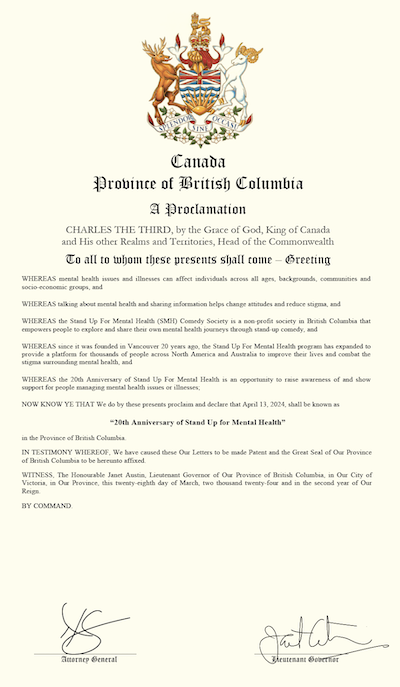
image - SMH’s 20th anniversary was recognized last month with a proclamation from the Province of British Columbia declaring April 13 as Stand-Up for Mental Health Day
SMH’s 20th anniversary was recognized last month with a proclamation from the Province of British Columbia declaring April 13 as Stand-Up for Mental Health Day.

SMH’s 20th anniversary was recognized last month with a proclamation from the Province of British Columbia declaring April 13 as Stand-Up for Mental Health Day. The proclamation reads, in part, that SMH provides a program for thousands of people “to improve their lives and combat the stigma surrounding mental health and … is an opportunity to raise awareness of and show support for people managing mental health issues or illnesses.”

Since 2004, Granirer and his comics have performed more than 500 shows for mental health organizations, government departments, corporations, universities, correctional facilities and the military. Granirer also gives “laughter in the workplace presentations” to organizations across North America, helping them use humour to lower stress, improve wellness and cope with change. Granirer, too, is the author of The Happy Neurotic: How Fear and Angst Can Lead to Happiness and Success.

SMH’s classes in Vancouver last for six months and students step on stage for two shows, a debut and a graduating performance. As Granirer says, “The comics go from knowing nothing about stand-up to killing it.”

Stand Up for Mental Health is currently recruiting for its next class, which starts July 30. For more information, visit smhcomedysociety.org. 

Sam Margolis has written for the Globe and Mail, the National Post, UPI and MSNBC.

Format ImagePosted on May 24, 2024May 23, 2024Author Sam MargolisCategories Performing ArtsTags April Soon, comedy, David Granirer, Filomena Black, health, Kevin Scow, mental health, milestones, performing arts, Stand Up for Mental Health
Highlighting seniors’ issues

Highlighting seniors’ issues

Berlin’s Nana Schewitz brings her show Florida! Ya Kill Me! to Vancouver May 31-June 2. (photo from Nana Schewitz)

Florida! Ya Kill Me! is a “love letter to aging,” says Berlin-based drag artist Nana Schewitz, who created the show with Josh Walker. But it’s also a “wakeup call,” she warned, about the systems we have in place for aging.

Florida! Ya Kill Me! comes to Vancouver for three nights, opening May 31 at the Dusty Flowerpot Cabaret.

“JQT is so excited to bring Nana Schewitz to both Toronto and Vancouver, as part of our JQT [Jewish Queer Trans] Mental Health Support Series in partnership with JFS Vancouver, a series supported by the 

Jewish Community Foundation of Greater Vancouver,” said Carmel Tanaka, executive director of JQT Vancouver, noting that the shows are being sponsored in both cities by Goethe-Institut Toronto, which is part of a global network that works to foster understanding of Germany’s cultural diversity.

“The content of her show addresses the challenges of Jewish queer trans seniors, which is a very near and dear topic to JQT,” Tanaka said of Nana’s Florida! Ya Kill Me! “We hope that, through drag and comedy, we will be able to raise awareness of the work our JQT Seniors Initiative is doing to create safer long-term care homes and spaces, so our aging JQT community members can proudly celebrate all their identities into their twilight years.”

Florida! Ya Kill Me! is a theatrical retelling of Nana’s 2021 trip to Florida in search of a final resting place, Nana told the Independent. The character is a feisty 96 years old.

“Josh and I traveled up and down the state in search of retirement paradise, visiting every bingo hall, craft fair and 55-and-up pool we could find along the way,” she explained. “We met some incredible seniors who really opened up to me about their experiences with aging, finding love, losing love, accepting change and finding joy. I have the privilege to share these words through both my own retelling, and some filmed interviews we took. You’ll meet Josie, the 109-year-old bingo master. You’ll meet Doris, born and raised in Berlin (my current home) who lives in Florida’s largest retirement city (with over 100,000 residents). You’ll even meet my dead Cuban grandmother!

“The ability to tell these often-overlooked stories and cement the legacies of some of my favourite friends is my favourite thing about what this show is,” said Nana. “It’s a love letter to aging, but also a wakeup call to its effects. The systems in place around aging are crumbling quickly while our average life expectancy is getting higher and higher. I don’t want us to have to sacrifice our quality of life as we age, and this show is a call to action to make that happen!”

The name Nana Schewitz was inspired by Manischewitz, perhaps after a few glasses of its sweet kosher wine. The 96-year-old – who doesn’t “look a day over 69” – was brought to life by almost-30-something Bryan Schall, who studied at Philadelphia University of the Arts and graduated in performance design and production.

She emerged as an entity “out of a little hole-in-the-wall disco in Philadelphia. She stayed dormant for awhile, as her ‘style’ didn’t really fit in my idea of what drag in the US was. When I got to Berlin, however, I said, ‘Ooooohhh!!! Nana totally could work here!’

“The drag scene of Berlin was very different,” explained Nana. “It was quirky, brash, silly – all the things I wanted out of a drag performer. And I found myself really missing this very specific branch of Ashkenazi-Americana Judaism that I took for granted at home. I didn’t realize how much I missed it until moving to Berlin.

“Being Nana really allowed for space to connect with my Judaism, while also allowing me to rewrite Judaic tradition in a way that serves queer people,” she added. “I’ve hosted Passover seders, Hanukkah shows, Rosh Hashanah events and more in Berlin, and it’s been a beautiful connective tissue to bring the Jews of Germany (yes, we’re here!) together in a meaningful and unexpected way.”

Nana moved to Berlin in 2016 and says she hasn’t looked back.

“I grew up in South Florida, and just could not do one more winter of beautiful, it was just getting to be unbearable,” she said. “I couldn’t take the beaches and the sunshine of Florida anymore. Call me a masochist, I guess.”

Berlin has her heart, Nana said, “But all cities change, and the Berlin I moved to looks very different than the city I currently live in. I’ve learned here how precious community is, but it is something that requires maintenance and care, and cannot be taken for granted. I’m able to live my most authentic life here, but that is not a forever guarantee…. I worry about the future of this city, especially as a Jew. Your life can be taken very quickly if you stop paying attention and take things for granted.”

Describing herself as “50% lighting designer and 50% drag queen,” Nana said, “I studied lighting design and do it professionally, but doing drag gives me the outlet and access to say and do the things that are really meaningful to me. The lighting design definitely pays for the drag, but I love to light up a room nonetheless. I actually just came off tour doing lights for Canadian-Jewish icon Peaches around the US and Canada! It was a blast, but I really feel the most myself when I’m dressed up as a 96-year-old Jewish grandmother, singing sexually perverse parodies of Barbra Streisand songs in a dark smelly bar.”

Joining Nana in the Vancouver performances will be co-creator Josh Walker.

photo - Josh Walker is an integral part of Florida! Ya Kill Me!
Josh Walker is an integral part of Florida! Ya Kill Me! (photo from Nana Schewitz)

“I’m always so grateful to have my life partner/grandson by my side,” she said. “I’ve been working on Nana with Josh Walker for almost 10 years now. He is my most treasured collaborator, and we actually just came back from another two-month trip to Florida where we (along with my new grandson, filmmaker Lucky Marvel) just filmed the Florida! You Kill Me! documentary. We’re in production now after having visited and filmed in different Jewish and queer retirement homes, RV parks, assisted living facilities, etc., around the Sunshine State. The show me and Josh are about to put on in Canada is just a small taste of the incredible shenanigans we got up to around the state. You can catch Josh playing some classic Jimmy Buffett tunes on the banjo during this show.”

Nana exudes confidence, but that doesn’t mean she doesn’t have concerns about people’s reactions.

“I’ve had to stop being afraid, it wasn’t doing anything for me! When we went to Florida, I was extremely nervous,” she admitted. “A lot of what Nana is about is being out on the streets, very public and very vocal. I’m not sure if you know this, but there was recently a drag ban in Florida, as well. I’m not exaggerating, ‘adult live performances featuring sexual content’ were banned in Florida. I’m not sure if you’d consider my matzoh ball titties to be sexual content, but that’s beside the point. So, I went there with my guard up, worried for my safety and for the safety of my team. We had an ‘in case Nana gets arrested’ plan and everything. I’m proud to say, the ban eventually got overturned due, in part, to the relentless work of some of the drag queens of Fort Lauderdale (my hometown). But the damage had been done.

“I came in expecting bigotry,” she said, “but I really believe in my heart of hearts that is not our human nature. I think a lot of people are confused these days. There’s a lot of anger and hurt in the world and lot of information, and people are looking for where to place it and what to do with it all. This ‘drag queens bad’ narrative is political propaganda, but people will think what they want to think. Lucky for me, this Nana can move fast. When some of these Floridians see me, they’re not sure if they should pull out a gun and shoot me dead on the street, or give me a five dollar bill! By the time they’ve made up their mind, I’m gone. Whoosh!”

All jokes aside, Nana and Florida! Ya Kill Me! have a serious message.

“A new friend told me this as I was filming my documentary, and I think about it all the time so wanted to share it here as well,” said Nana. “She worked at the McArtor senior centre [in Florida], taking care of LGBT+ patients with Alzheimer’s and dementia. She told me, ‘If I can get you to do one thing after speaking to me, it’s call an older loved one in your life. A parent, a grandparent, an aunt, whoever. There will come a day when you call them and they won’t remember who you are anymore. Don’t wait for that moment to reach out. Enjoy every interaction you can, while you still can.’”

For tickets ($18) to Florida! Ya Kill Me!, visit jqtvancouver.ca. 

Format ImagePosted on May 10, 2024May 8, 2024Author Cynthia RamsayCategories Performing ArtsTags cultural commentary, drag, Florida! Ya Kill Me!, LGBTQ+, mental health, Nana Schewitz, seniors

Ways to tackle anxiety

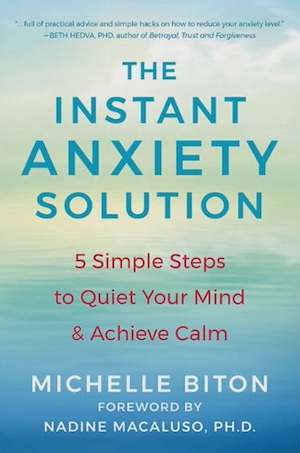
“Our thoughts are influenced by our core belief system. Our opinions are shaped from things we have seen and heard in the past and those opinions affect what we see. The problem is our thoughts are not always necessarily true,” writes Michelle Biton in her new book, The Instant Anxiety Solution (Hatherleigh Press).

“Our own thoughts and beliefs often cause us more anxiety than the actual emotion itself,” she writes. “And sometimes our beliefs are faulty or inaccurate. In order to get to the facts, it’s important to question your thoughts and not always believe everything you think.”

But this is jumping ahead to Step 5 of Biton’s five-step program ALARM, which starts with ways in which we can get our bodies “out of ‘the acute stress’ stage and into a calmer state so you can think properly” (activating the parasympathetic nervous system). It moves to labeling what you’re feeling, then acknowledging that emotions are temporary. Step 4 is about how to remember to avoid building narratives around your thoughts and emotions, and Step 5 is how to move forward and take action.

image - The Instant Anxiety Solution book coverOriginally from Vancouver, Biton is a Los Angeles-based coach, author and health educator. She has a master’s in holistic nutrition, a bachelor’s in psychology and a certificate in kinesiology, health and fitness studies. Her reasons for writing The Instant Anxiety Solution are personal.

“I had been trying to deal with anxiety as if it was logical, but anxiety is not logical. It’s primal and cannot be rationalized. My best friend helped me realize that, in order to manage mine and my daughter’s anxiety, we were going to have to look it in the eye and go through the discomfort of it,” writes Biton. “Going through the anxiety was the only way out of the vicious cycle.”

Biton’s own experiences with anxiety inform her approach. “You are re-learning ingrained patterns and behaviours that will take time to unlearn,” she acknowledges, “so be easy on yourself and give yourself time to go through the process.”

The Instant Anxiety Solution comprises a foreword by marriage and family therapist Nadine Macaluso; an introduction in which Biton lays out some of her reasons for writing the book; an overview of what anxiety is and its effects; a chapter for each of the ALARM steps; a brief conclusion; many exercises readers can do to learn how to better manage anxiety; and 20-plus blank pages for the purposes of journaling.

There are many causes of anxiety, including biological makeup, learned behaviour, lack of sleep, trauma, not eating properly, financial difficulties.

“When we get triggered by an event, our amygdala gets activated, causing the impulsive fight or flight response, and the prefrontal cortex, the logical thinking part of the brain, shuts off,” writes Biton. Our bodies focus on one thing: survival. The sympathetic nervous system is activated, “causing your heart rate, breathing and blood pressure to rise dramatically…. You’ll likely even feel shaky and nauseous.

“Many people make the mistake of trying to problem solve when anxiety hits, but it is absolutely impossible to do,” she writes. We can’t think until we have calmed down, and Biton offers many ways to shock the body out of its anxious state, such as splashing cold water on our face or putting a cold pack on the back of our neck; intense exercise, like a sprint to the end of the block or some push ups; and humming or singing.

There are ways a person can semi-instantly calm themselves, but the crux of tackling anxiety is self-awareness and, for that, there is no quick fix. Biton offers advice on how to identify and deal with feelings, but a main takeaway is to train ourselves to not act in those first moments. Apparently, an emotion lasts seven minutes max, then runs out of steam. It’s “the additional energy that is added in the form of our ‘extra’ thoughts and emotions that we ‘attach’ to the original emotion that keeps the feeling alive and the suffering occurring,” writes Biton.

“Do not act on impulse,” she warns, “you will only regret it afterwards.” But don’t numb yourself either. If you feel like crying, cry. Notice and acknowledge your emotions without judgment. When you’re calm, you can figure out what is really going on, consider both sides of the situation – what happened or was said and your reaction. 

We all have pain, she notes: “It is how we ‘react’ to the pain that determines our ‘suffering.’” Suffering, she says, is a sign that you’re not accepting the here and now. Some clues that you might be fighting against reality are that you’re feeling bitter or resentful, or you’re regularly unhappy or frustrated.

“A major reason that many of us suffer from anxiety today is because we have ‘felt unheard’ or ‘dismissed’ in our lives,” she writes. “We were told that we ‘weren’t good enough’ or that we ‘shouldn’t feel a certain way.’ This negative environment taught us not to trust ourselves, and not to trust our emotions. As a result, we have a lot of self-doubt and anxiety.

“On top of that, many of us project fears from the past into the future. Very rarely do we go into a situation without the ‘baggage’ and ‘opinions’ that we have carried from past experiences.”

Biton believes it possible to “become unstuck from the past.” The advice and exercises in The Instant Anxiety Solution may not result in instant results, but they do offer tangible steps to a solution. 

For more information, visit michellebiton.com.

Posted on May 10, 2024May 10, 2024Author Cynthia RamsayCategories BooksTags anxiety, health, mental health, Michelle Biton
Freedom and friendship

Freedom and friendship

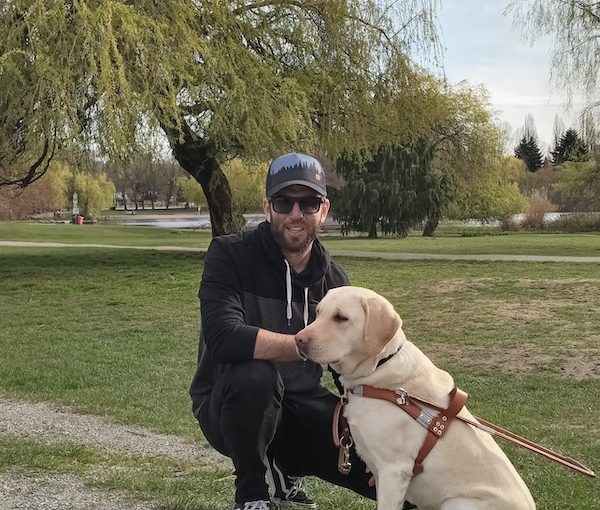
Achiya Klein and Joy at Trout Lake Park in Vancouver April 4. Klein and Joy were brought together by the Israel Guide Dog Centre for the Blind. (photo by Cynthia Ramsay)

“The Israel Guide Dog Centre is not just a centre,” said Achiya Klein. “It’s like a family.”

Klein and his assistance dog, Joy, came to Vancouver from Toronto earlier this month with Atarah Derrick, executive director of Canadian Friends of the Israel Guide Dog Centre for the Blind. The Independent met with them at Trout Lake Park April 4.

It was an educational experience to see Klein and Joy interact, like a unit. Even when Joy was off leash, clearly enjoying the freedom of running around on her own, meeting other dogs, she would respond to Klein’s occasional check-in whistles or calls. Being a Hebrew-speaking dog, one wonders what she had to say to her Canadian compatriots. Only once, enticed by the lake, did Joy hesitate to return to Klein, but she did – and before taking the plunge she so obviously wanted to take. On our walk, Derrick explained that all the 

Israeli guide dogs have English names so that the animals will know it’s them being called – imagine, she said, if a client called out a name like Yossi in an Israeli market, for example.

Klein has had Joy since the end of last October, since his first guide dog, Night, passed away at the age of 8.

“Having a guide dog is my way to get my independence again,” said the Israel Defence Forces veteran, who was injured in 2013. “I can do whatever with a guide dog because I can walk alone, with no fear, and being comfortable.”

Klein has serious visual impairment. “I have some sight,” he said, “but it’s minimal.”

A team commander in Yahalom, a special unit of the IDF that deals with the handling of dangerous ammunition and weapons, Klein was injured in a Gazan tunnel. “I was on a mission to demolish the terror tunnel that crossed into Israel,” he explained, “and, when we were walking in the tunnel … there was a booby-trap, and I got injured from that when it exploded.”

Klein moved to Canada with his wife, who is Canadian, in 2023. Noach Braun, the founder of the Israel Guide Dog Centre, personally brought Joy to Klein, where he worked with the pair for 10 days. The training period was shorter than usual because Klein had already had a guide dog. Normally, after matching a client with a dog, the pair train together for a few weeks at the centre, which then provides more training in the client’s home environment.

“It’s not like they just give you a dog and say, ‘OK, good luck,’” said Klein. “It’s more than that, and I think that one of the best examples is, after Night passed away, even though I was in Canada and I was supposed to go to Israel to receive a new dog, because of Oct. 7, I couldn’t make it to Israel, so Noach … came here during the war. He came here with Joy and I think that’s a beautiful story, to show what it means to be a part of the family.”

According to Derrick, who has been leading the Canadian Friends of the Israel Guide Dog Centre for the Blind since 2021, the centre has placed 796 guide dogs, 39 post-traumatic stress disorder (PTSD) dogs and 442 emotional support dogs, for a total of 1,277 since its founding in 1991. In 2023, there were 176 puppies being raised by centre volunteers, she said.

“The IGDCB (as it is known in Israel) serves Israel’s blind community by providing them with mobility, independence, self-confidence and companionship through the faithful assistance of guide dogs specially trained in Hebrew to meet Israel’s rigorous and challenging environment,” Derrick explained in an email. “We also breed and train service dogs for IDF veterans who have service-related PTSD and provide emotional support dogs for children on the autism spectrum.”

Canadian Friends of the Israel Guide Dog Centre for the Blind was established almost 20 years ago and Canada accounts for 6.6% of donations, according to its 2022 annual report. It is one of Derrick’s goals to increase that amount.

“I have always been passionate about community service and working in the charity sector, raising funds for vulnerable communities,” she said. “I’m a real dog person and, when the opportunity opened at Canadian Friends of the Israel Guide Dog Centre, it was the perfect match for my skills, interests and passions – helping people, Israel and dogs!”

Last year, Derrick and Braun visited Vancouver to visit donors and meet others interested in the centre’s work. “Everyone asked us to come back soon, preferably with a client and their dog, so they could see our work in action,” said Derrick, which was why she came this spring with Klein – who has become, she said, since being injured, “a Paralympic rower, a dedicated skier, a father and an asset to the IDF” – and Joy.

“We visited Vancouver Island first, with a meeting in Ladysmith to meet new friends there,” said Derrick. “We then headed south to Victoria, specifically Chabad of Vancouver Island. Then we moved east to Vancouver, where we met with Schara Tzedeck, the Kollel, and held a parlour meeting at the home of new friends. It was such a lovely visit, and we got to meet terrific people with whom our work really resonated.”

Initially, former Jewish National Fund shaliach (emissary) to Vancouver Mickey Goldwein, his wife Lili and her dog, Zita, were to accompany Derrick on the BC visit. Unfortunately, they couldn’t make the journey from Israel.

Lili Goldwein was partnered with Zita in 2018, explained Derrick, “because Lili’s vision had significantly deteriorated. Mickey joined the Israel Guide Dog Centre for the Blind’s board in 2022.”

The need for the centre and its services has increased since Oct. 7.

“Due to this war, we altered the criteria for receiving an emotional support dog to provide an immediate response to those injured or suffering due to the war,” said Derrick. “Since then, we have provided our emotional support dogs to children and adults with special needs whom the war has immensely impacted. Some of these people fought on Oct. 7 and were discharged immediately because of the trauma they endured. Some are widows of fallen soldiers. Some have been afraid to leave the house for months. 

“We are aware of some soldiers who have lost their vision in this conflict, and we need to be ready for them when they need us. This is in addition to the current clients on the waitlist,” she said.

The war also has disrupted the centre’s training, which may impact the number of guide dogs it can provide this year. “But we are doing our best to meet the challenge,” said Derrick.

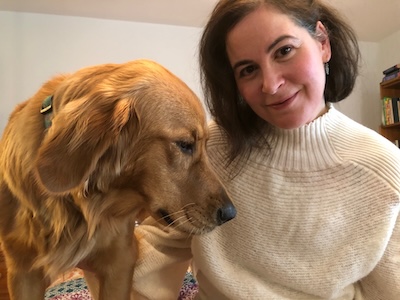
photo - Atarah Derrick, executive director of Canadian Friends of the Israel Guide Dog Centre for the Blind, with Cookie
Atarah Derrick, executive director of Canadian Friends of the Israel Guide Dog Centre for the Blind, with Cookie. (photo from Atarah Derrick)

And they are meeting the challenge while still feeling the effects of the pandemic.

“COVID had two major impacts on our training,” said Derrick. “The first was in the socialization of our puppies. In their first year, it’s crucial to expose them to as many environments as possible. The office or university, the mall and the train station are all places where our pups get to experience lots of people, noises and smells and become more comfortable navigating those environments. Because of the lockdowns, most were cut off from those experiences, and many were not ready to take on service work. So, our success rate through COVID dropped, and our clients had to wait longer periods for their dogs. This was the case worldwide. 

“The second was that we were not able to open our residences to clients in guide dog courses. When a person is partnered with a guide dog, they live in residence with us for two weeks while they train together with our professionals. This was impossible during COVID, so our trainers went to the clients and worked with them at home, one-on-one, to complete the course. We put a lot of mileage on our vans during those years.”

Now, it is hospital visits that account for some of the mileage being put on the centre’s vans, with puppies and guide-dogs-in-training traveling to offer comfort to injured soldiers and civilians across Israel. 

“As the war rages on, we’re committed to continuing this mission of love and compassion,” reads the centre’s latest blog. “Because no matter the circumstances, a little bit of puppy love can go a long way in healing hearts and bringing people together.”

Seeing Klein and Joy together at Trout Lake Park and getting a glimpse of what having a guide dog has meant to Klein, the importance of the IGDCB’s work seems clear.

“They provide you with one of the most basic tools that you use every day,” Klein said. “But it’s not just a tool, it’s also a friend.”

To learn more about the Israel Guide Dog Centre for the Blind, visit israelguidedog.ca. 

Format ImagePosted on April 26, 2024April 26, 2024Author Cynthia RamsayCategories Israel, LocalTags Achiya Klein, Atarah Derrick, COVID, dogs, health care, IDF, Israel Defence Forces, Israel Guide Dog Centre for the Blind, Israel-Hamas war, mental health, pandemic, terrorism, veterans

Making meaning in diaspora

“We’re planning a family event in June.” That’s how I start nearly every contact with vendors while trying to arrange it. Sometimes, I say a “party with family and friends.” I avoid saying b’nai mitzvah. It’s just easier and safer.

One of my twins has a locker at junior high near a student who uses her body as a sign of protest. “Free Palestine” is written on her cheek. Other days, messages are emblazoned on a sweatshirt. My kid says she seems to stare at him, but I recommended he just stay away, don’t stare back, and don’t cause any kind of confrontation. “Do you know this person?” I ask him. “No,” he says, “she doesn’t know us.” What he meant is perhaps more obvious to us now – he doesn’t think she knows we are Jewish.

The transition from a bilingual Hebrew/English public elementary school to a junior high where Jewish kids are few and far between has been a big one. To my surprise, it went smoothly, but, over time, the ramifications have become clear. We knew our kids would figure out that we were, in fact, a small minority in Canadian culture. In elementary school, they would choose surprising moments to discuss Jewish things or use words in Hebrew with people at the dentist’s office or on public transportation. At first, our explanations about how people were different, with various religions and backgrounds were confusing. In their minds, they still believed everyone was Jewish.

On one hand, I loved that they didn’t have to learn to code-switch as early as I did. Code-switching is a way to describe how we switch between dialects, languages or personae in different settings. That is, a person might speak one language at home and another at work. In Jewish settings, one might use what linguists call “Jewish English,” English interspersed with Yiddish or Hebrew or other Jewish languages. At home, we might be encouraging someone to “daven at shul” with friends. We might shout “Dai, maspik!” (“Stop, enough!”) when someone misbehaves. In public, we might say “go to services” or “Behave yourself!”

Some people say that learning this kind of nuance takes maturity, but that doesn’t always ring true. I knew, by age 5 or 6 when my ethno-religious identity needed to be kept to myself. During times of extreme antisemitism, children were forced to keep this hidden, or even not told they were Jewish until old enough to manage the information. Giving my kids this extended time of safety felt like offering them a special oasis, a honeymoon that I missed.

Years ago, I worked with an editor and writer who shared with me that she had a Jewish background, although she was adamantly secular. I often felt the need to code-switch with her, as something made me feel like I was “too Jewish” for her comfort level. Since Oct.7, things have changed. She has become public in her Jewish identity, speaking out against antisemitism. Recently, she has been reading history and research for a book-length project. Today, she said, reflecting on an historic “golden age” for Jews in Polish history: “There is no safety in America now just because it’s been a golden age for my lifetime.” Yeah, I responded. I know.

Everyone copes differently. On social media and among friends, some dig into their Jewish identities. They’re consistently posting about their Jewish pride or activities and asking others to do so as well. One local friend who regularly attends synagogue told me that, if anything, this war has made her want to “do Jewish” even more, so she’s physically attending more services and gatherings than she had previously. Others decide to keep their kids home from school on days where there might be safety issues or have stopped attending anything at all connected with the Jewish community. They keep a low profile. Being loud and proud isn’t their way.

I have seen all these approaches (and many variations) from the Jewish people I know. And there are the minority Jewish viewpoints, too, on the political right and left. Those who claim more of an affinity with their progressive causes than with Jewish ones are often vocal on social media and at pro-Palestinian protests, either finding ways to disown their background or use their Judaism to explain their activism. Some particularly outspoken ones demonstrate, at least to me, that they don’t have a solid grounding in Jewish history and tradition, particularly as it relates to Israel, but instead embrace narratives around colonialism and apartheid instead.

Lately, I have been longing to ask where these “land back” Canadian Jewish activists live, if not in homes on occupied land taken from Indigenous communities. If homes here are on occupied ground, where do they believe it would be acceptable for Jews to live? I wonder how they mesh these theories with their everyday lives, or the archeological, historical and literary references to the Jewish past.

Living in grey areas of nuance is exhausting. There are so many references in Jewish texts to back this up. We have, after all, been struggling with these identity issues for millennia. We’re the ethnic group for whom the Greek word of “diaspora” was invented. Yet, this is one time where more evidence seems pointless. For those of us who feel this discord and disconnect, it’s not news. For others, who either manage to live wholly in the Jewish world or outside of it, these retellings of history aren’t useful. So many people have made their place, and it’s not in the margins of subtlety.

There’s no one response that suits. For me, I understand the value of having a rich interior and family life. The moment I’m absorbed in braiding challah and reciting the blessing blocks out some of this noise. Although I’m alone, it’s meaningful spending that small moment to send love and prayers for the hostages, the Jewish community and my family. I knit sweaters for ever-growing twins, anticipating their big birthday ahead this spring. I fall deep into intellectual arguments online, or into gazing at a pileated woodpecker whose rat-a-tat vibrates throughout the neighbourhood.

Finding one’s authentic self, the comfort zone where all the discord falls away, offers a brief respite. As we meet this complex moment in time, finding small outlets of escape can enable us to keep on going. Perhaps this is about good mental health or, as generations before us have explained, it’s nothing new. It’s about making a meaningful life in a diaspora, amid struggle. 

Joanne Seiff has written regularly for the Winnipeg Free Press and various Jewish publications. She is the author of three books, including From the Outside In: Jewish Post Columns 2015-2016, a collection of essays available for digital download or as a paperback from Amazon. Check her out on Instagram @yrnspinner or at joanneseiff.blogspot.com.

Posted on March 22, 2024March 21, 2024Author Joanne SeiffCategories Op-EdTags antisemitism, code-switching, education, Israel-Hamas war, mental health, Oct. 7, terrorism
Mishpacha comes together

Mishpacha comes together

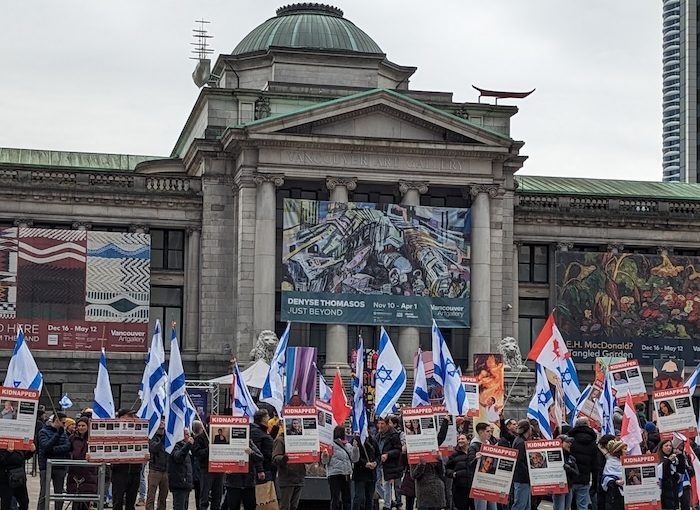
The weekly rally for Israeli hostages at the Vancouver Art Gallery Sunday, Feb. 18. (photo by Pat Johnson)

Family was the theme at the weekly rally for Israeli hostages at the Vancouver Art Gallery Sunday, Feb. 18, the day before British Columbians marked the Family Day holiday. Speakers took to a stage at the edge of the gallery’s north face out of respect for a makeshift memorial to Alexei Navalny, the Russian opposition leader who died in custody two days earlier.

“Family Day will be celebrated here tomorrow,” said Daphna Kedem, organizer of the weekly vigils for the hostages. “But this year casts a heavy shadow over the day for some families of our community here and in Israel…. It is difficult to be happy when families are waiting to be reunited with their loved ones, or for many families who have lost their loved ones.”

Dr. Michael Elterman, a psychologist, spoke of the psychological effects of what is happening in Israel and worldwide.

“We see the indescribable anguish in the families and we easily feel ourselves in their shoes and intuitively imagine what we might feel if that happened to us,” he said. “There has developed a related construct of post-traumatic stress disorder over the past decade … this is the sadness, anger and sometimes spiritual distress that arises from moral outrage. It is a broader set of reactions that arise even when the individual themselves were not present at the trauma but rather are morally outraged and left furious and depressed by events. This is even more likely where we identify so strongly with those who are personally impacted by Oct. 7.”

This anxiety is heightened by increases in antisemitic rhetoric and attacks, including in Vancouver. 

“Some of you may be experiencing the symptoms of post-traumatic stress, such as disturbed sleep, intrusive thoughts, trouble concentrating and being easily startled,” Elterman said, adding that help is available through Jewish Family Services and other resources. Getting involved in the community response can help ease feelings of helplessness and he directed people to the Community Toolkit on the website of the Jewish Federation of Greater Vancouver. 

“Remember to practise self-care in small ways, like proper nutrition and sleep,” he said. “Continue to do the things you previously enjoyed, even if you don’t feel like doing them. Finally, hug each other a little longer and a little tighter.”

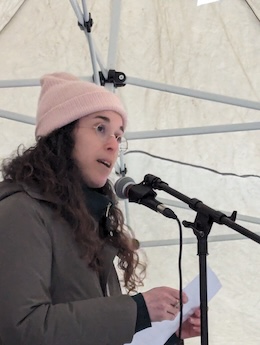
Aviya Kones, who works at Jewish Family Services, spoke not about the services offered by that organization, but about the people of Kfar Aza, where she grew up.

photo - Aviya Kones speaks about the people of Kfar Aza, where she grew up
Aviya Kones speaks about the people of Kfar Aza, where she grew up. (photo by Pat Johnson)

“Kfar Aza was a desert oasis,” said Kones. “It was home, it was love and life, it was filled with unique and quirky and hilarious traditions and it was generations of family. It was also savagely and brutally destroyed after countless and seemingly endless hours of horrors.”

Her own childhood home was destroyed on Oct. 7.

She shared memories of three people who died that day.

“Smadar, a year above me, was tall, slender, so elegant,” she said. “Even as a child, I recall looking up to her. She had big, beautiful brown eyes and thick brown hair. I remember being awed by her grace, kindness and gentle nature.

“Nadav was two years older than me,” she said. “He knew how to make everyone laugh in every situation – not at anyone’s expense but maybe his own.

“Yoav was my age group,” she continued. “He had blue eyes, blond hair and a genuine smile. All the girls thought he was cute and all the guys wanted to be his best friend. He was shy, kind, creative and athletic. He loved his family. He was so close with his parents, his siblings and the many, many cousins he had living on the kibbutz.

“All three, amongst many others, tragically, brutally and with unimaginable cruelty, lost their lives on Oct. 7,” said Kones. “They were living in our beautiful oasis, our safe place, our home. They are survived by a broken and mourning community, generations of family that absolutely adored them and … all three were also survived by their young children. Nadav had two daughters, Smadar had three children and Yoav was a first-time dad to a little girl who was only 10 days old on Oct. 7.”

Rabbi Jonathan Infeld, senior rabbi at Congregation Beth Israel and head of the Rabbinical Association of Vancouver, said that Oct. 7 was not just an attack on Israelis or those living in Israel.

“It was indeed the beginning of an attack on the entire Jewish people,” he said. “It was a catalyst for antisemitism across the world that we have felt even here in Vancouver…. Too many of us have felt the antisemitism that began to boil over on that day.”

Gordon Shank, a First Nations member, a business innovator and a survivor of the Sixties Scoop, which saw Indigenous children abducted from their families and placed with white families, spoke of the centrality of family and the trauma of separation. 

“I’ve known the pain of separation from family, being torn from the embrace of loved ones, albeit under different circumstances,” he said. “The Sixties Scoop and the current crisis in Gaza might stem from vastly different contexts yet, at their core, they resonate with the universal cry for the right to family, to unity and to belonging. This parallel is not to equate the experiences but to underline the shared understanding that every individual deserves to grow, to dream and to thrive within the warmth of their family’s love.” 

Of the hostages and their families, Shank said: “Their pain is our pain. Their hope is our hope. Let our gathering today send a powerful message that we stand together across cultures and histories, united in our resolve to bring the hostages home.”

The march through downtown streets that has been a feature of the weekly events since October will be a monthly activity only for the coming weeks, Kedem told those gathered. The crowd then moved to the sidewalk adjacent Georgia Street for a demonstration, with a brief disruption by an individual waving a Palestinian flag.

Kedem has organized the weekly events since October and, early on, affiliated with the ad hoc international group Bring Them Home which, in turn, is affiliated with the Hostage and Missing Families Forum, in Israel. 

Recently, Kedem also associated her activities with another international group, Run for their Lives, which encourages groups as small as a single individual to demonstrate solidarity with Israel and its hostages by walking, biking or running. 

Format ImagePosted on February 23, 2024February 22, 2024Author Pat JohnsonCategories LocalTags Aviya Kones, Bring Them Home, Daphna Kedem, hostages, Israel-Hamas war, Jewish Family Services, JFS, Kfar Aza, mental health, Michael Elterman, Oct. 7, Vancouver
Games help ALUMA counseling centre

Games help ALUMA counseling centre

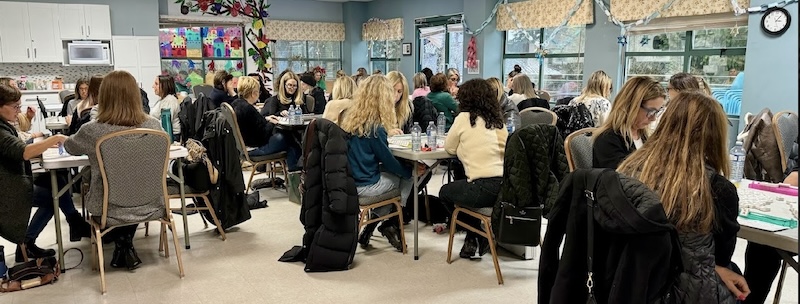
Some 130 women came out to play mahjong, bridge or canasta at National Council of Jewish Women Canada, Vancouver section’s Games Day on Feb. 15, raising almost $8,000 for the Israeli nonprofit ALUMA Counseling Centre. (photo by Adele Lewin Photography)

Last month, 130 women gathered for a Games Day Fundraiser for Israel, hosted by National Council of Jewish Women Canada, Vancouver section. Almost $8,000 was raised for the Israeli nonprofit ALUMA Counseling Centre.

The afternoon event on Jan. 21 was held at the Jewish Community Centre of Greater Vancouver and featured mahjong, bridge and canasta, offering participants a chance to connect with one another, while raising funds for ALUMA, so that help can be provided to the many families who need to start the healing process from the Oct. 7 terror attacks.

ALUMA, also known as IFCA, Israel Family Counselling Association, was established in Tel Aviv in 1954 and joined forces with NCJWC in 1973, said NCJWC national president Linda Steinberg.

“Golda Meir had the idea of twinning Israeli organizations needing financial assistance with women’s organizations abroad,” explained Steinberg. Dorothy Reitman, as president of NCJWC at the time, was contacted and this twinning was arranged through Carol Slater, who then lived in Israel. Slater was the chair of NCJWC’s Israel project ALUMA for 15 years.

ALUMA is a centre for counseling and treatment of couples, families and individuals, regardless of their place of residence, origin, religion or economic circumstances. It was a pioneer institution, the first such centre in Israel, said Steinberg. Most people receiving therapy pay what they can, if anything, and the professional therapists are volunteers, receiving little if any remuneration.

Steinberg noted that ALUMA is dependent on donations and NCJWC is the only Canadian organization providing financial support for the nonprofit. National members have supported ALUMA through fundraising teas, brunches and other events, and by yearly contributions as NCJWC members.

Oct. 7 has increased the need for trauma support in Israel and ALUMA has developed several models to meet this growing need, said Steinberg. “Most recently, their therapists have been training and mentoring new volunteers to help.”

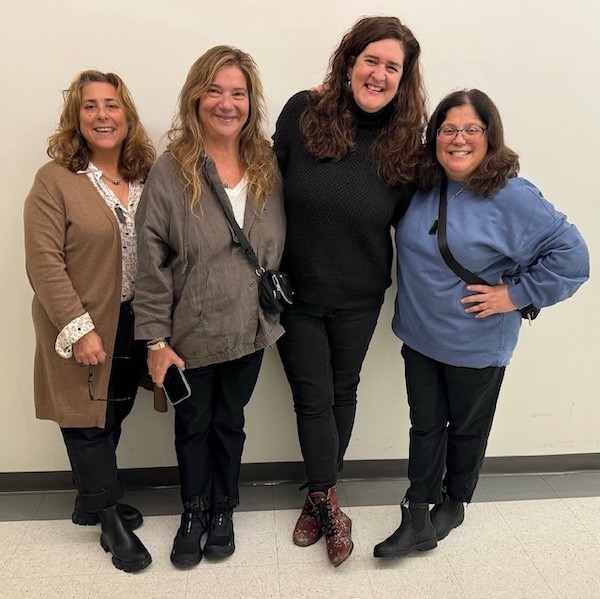
photo - Left to right are event co-chairs Lisa Boroditsky, Juleen Axler, Jordana Corenblum (NCJW Vancouver president) and Sandy Hazan. (Co-chair Jane Stoller is missing from photo)
Left to right are event co-chairs Lisa Boroditsky, Juleen Axler, Jordana Corenblum (NCJW Vancouver president) and Sandy Hazan. (Co-chair Jane Stoller is missing from photo.) (photo by Adele Lewin Photography)

Gadi Lifshitz, NCJWC’s contact and spokesperson for the staff at ALUMA, wrote a letter to Lisa Boroditsky, who was one of the chairs of the local games day event, along with Juleen Axler, Sandy Hazan, Lola Pawer and Jane Stoller. NCJWC Vancouver’s president is Jordana Corenblum.

“Dr. Orly Rubin, the director of the institute, and, on my own behalf, I want to thank your wonderful community for the continued contribution and support of ALUMA,” wrote Lifshitz. “First, I will tell you about a treatment process in which Dr. Rubin and I provided a group therapy to five friends in their 30s who, on that cursed Sabbath, simply decided to go to the kibbutzim that were under attack and help as much as they could,” wrote Lifshitz. “Without weapons and without orders from any official authority, they decided that they are going to help. During those hours, they witnessed terrible sights, helped evacuate the wounded and dead, and all this while helping each other and supporting each other.

“About two weeks after the events, they contacted us for help. We quickly developed for them a trauma intervention model for a group therapy. We accompanied them through several group and personal meetings until we felt that their emotional state had stabilized and that they could return to their day-to-day ‘life.’

“It was a very powerful process, which required a lot of commitment, sensitivity and thought from all of us,” wrote Lifshitz. “This is just one of the many examples of the effort we invest in ALUMA in supporting all the many trauma victims who contact us.

“We need your continued support in our journey to expand our services to those, the many, who need them and us today.”

To donate to the ALUMA Counseling Centre or other NCJWC projects, go to give-can.keela.co/NCJWCVAN. 

– Courtesy NCJWC Vancouver

Format ImagePosted on February 9, 2024February 8, 2024Author NCJWC VancouverCategories LocalTags ALUMA, counseling, fundraising, healthcare, Israel, Israel-Hamas war, mental health, National Council of Jewish Women, Oct. 7, trauma
Mental health series begins

Mental health series begins

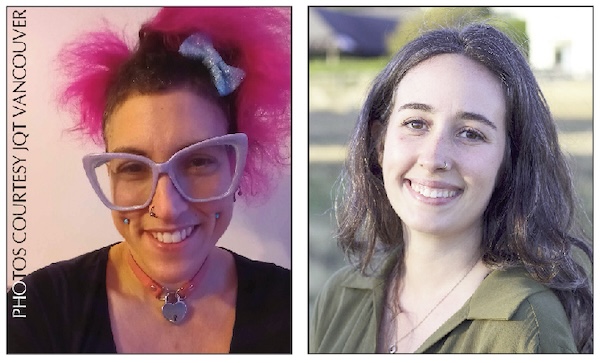
The first session in the new JQT-JFS mental health series will be facilitated by Alycia Fridkin, left, and supported by Anat Kelerstein. Listen & Be Heard takes place Feb. 11, 1 p.m., at Or Shalom.

“JQT and JFS are working together to answer the Jewish LGBTQ2SIA+ community’s explicit request for more mental health support in our newly launched JQT Mental Health Support Series,” said Aviva Rathbone, JQT chair. “This series will offer a steady flow of targeted workshops and events throughout the calendar year to get the JQT community talking, moving, crafting, laughing, vibing and healing together.”

The new JQT (Jewish Queer Trans) Vancouver and Jewish Family Services Vancouver program begins Feb. 11, 1pm, at Or Shalom Synagogue with Listen & Be Heard, a gathering for Jewish queers, transfolk and enbys in an intentional space for sharing and listening to each other’s perspectives on the Palestine/Israel conflict, including recent events in Gaza.

Facilitated by Alycia Fridkin and supported by Anat Kelerstein, the three-hour session will address “the elephant in the room – the Israel/Palestine conflict,” said JQT executive director Carmel Tanaka. “This was already identified in our 2022 community needs assessment as an extremely taxing topic that continues to negatively impact our community’s mental health, regardless of one’s stance. It is important that we create spaces that are not binary and welcome all perspectives.”

Fridkin is an equity and anti-racism consultant in health care. Kelerstein is a registered social worker and clinical counselor.

The JQT Mental Health Support Series, made possible with the support of the Jewish Community Foundation of Greater Vancouver and private donations, was developed in partnership with JFS Vancouver, following a 2022 community needs assessment that identified mental health support as a critical service gap for the Jewish LGBTQ2SIA+ population. The new mental health series as a whole answers nine of the needs assessment’s 13 calls to action. (See jewishindependent.ca/thirteen-calls-for-action.)

Future programs in the mental health series currently include (subject to change) a mindfulness kiddush cup clay workshop with Reuben King; a spoken word/music jam evening with fanny kearse; a screening of Sarah White’s documentary film Not Quite That; a cross-cultural history talk and demo of mahjong with Tanaka; a theatrical performance of Florida! You Kill Me! with Berlin’s Nana Schewitz (sponsored by the Goethe-Institut); a belly dancing workshop with Rathbone; a townhall conversation on the needs of parents of JQT youth; a JQT Pride Party; drop-in group therapy sessions; and the launch of the JQT Mental Health Toolkit.

The next session in the series is JQT Death Café at Mountain View Cemetery on Feb. 25, at 1 p.m. A townhall-style conversation on the status of Jewish queer trans dying and death services in British Columbia, people are invited to come learn, bring questions and voice their ideas at this hybrid event hosted by the JQT Seniors Initiative.

Registration for the mental health series events is free and required in advance. Details can be found at jqtvancouver.ca/events. To donate to the series, visit jfsvancouver.ca/donate and type in “JQT Mental Health” as the designated program. To learn more about the series, go to jqtvancouver.ca/jqt-mental-health. 

– Courtesy JQT Vancouver

Format ImagePosted on January 26, 2024January 24, 2024Author JQT VancouverCategories LocalTags Gaza, Israel-Hamas war, JFS Vancouver, JQT, mental health

Peer support’s long history

The Jewish Seniors Alliance of Greater Vancouver has invited Honoré France, a scholar on aging and expert on peer support, to speak via Zoom on Jan. 22. He will discuss the topic Discovering the Essential Importance of Seniors Supporting Seniors.

France, a professor emeritus in the department of educational psychology and leadership studies at the University of Victoria, will focus on the senior peer support training he developed. The training has been used by JSA for several years to help new volunteers learn how best to connect and liaise with isolated, lonely seniors in the community.

Among the topics France will cover are the early history of seniors peer support, strategies for self-care, information about memory, the value of exercise and the development of a healing presence.

Earlier this month, France shared some of his presentation with the Independent, including a peek at the origins of peer support during the beginning of psychiatry in the late 1700s – through French physician Philippe Pinel and hospital superintendent Jean-Baptiste Pussin. 

The talk will then move to more modern examples of senior peer support, including Indigenous approaches, and the development of group homes and inclusive treatment.

According to France, peer support is successful when various factors are in place, including effective approaches in helping aging populations and the promotion of the concept of self-help and independence among older people. 

Additionally, for peer support to be beneficial, people need to want to help themselves, there needs to be a reserve of talented older people who want to be helpful and, should someone have a problem or concern, there must be a willingness to seek out peers. 

After addressing various aging myths, such as the belief that dementia is inevitable, France will examine ways to stay mentally, physically and spiritually fit. He will explore nature as medicine, practices of letting go and cleansing, positivity (finding purpose and meaning), and mind-body activities like yoga, meditation, art and helping others.

France said he hopes that, by the end of the session, participants will “understand the developmental stage of aging and the central concept from Viktor Frankl about meaning and the crucial role it plays in healthy aging, and to follow their dreams as they age in the same way they did earlier in life.”

Frankl, an Austrian psychiatrist and Holocaust survivor, believed finding meaning in life to be the central human motivational force.

“Aging is natural and part of living,” said France, and people “can be in control physically, mentally, psychologically and spiritually. Aging is what you make of it and learning is a medicine and keeps you mentally fit.”

France emphasized that, no matter what a person’s condition in life is, they can live fully, consistent with their physical and psychological level. 

His talk will look at ways people can train themselves “to listen to others and to be like Frankl – optimistic, resilient, and always ‘moving.’ And, finally, [how to] develop a healing presence, as well as how to empathize at a deep level by bringing ‘light’ into the world to those in need.”

He added, “I will also provide some strategies for dealing with stress that I use. There will be a question period at the end, and Grace Hann will speak about the volunteer program at the Jewish Seniors Alliance along with one or two volunteers,” France said.

Hann is JSA’s senior peer support services trainer and supervisor.

Aside from his role at UVic, France is an artist, writer, therapist and consultant in the field of mental health. He has worked at the Shanghai University of Traditional Chinese Medicine, Addis Ababa University and the University of Massachusetts, where he graduated with a doctorate in counseling.

His academic interests include diversity, group processes and creative arts therapy. His current research involves reconciliation and residential schools, cross-cultural issues, creative arts, spirituality and eco-psychology (an intellectual movement to understand the relationship between humans and nature).

France has written several books and more than 75 academic articles on counseling issues and practices. Further, he has presented more than 80 scholarly book chapters around the world. He is currently re-writing and updating a 1989 publication on senior peer counseling, titled Senior Peer Support/Counselling Handbook: An Interactive Guide, which is set for publication this year.

On a personal level, he keeps active through gardening, playing squash and pickle ball, carving, building furniture and participating in strategic games, such as Go and chess. Currently, he is finishing up a novel based on his experiences hiking the West Coast Trail, his life teaching and backpacking around the world.

France’s talk is part of the JSA Snider Foundation Empowerment Series and the South Vancouver Seniors Network is a co-sponsor of the event. The Zoom starts at 11 a.m. The link to join it will be distributed through JSA’s email newsletter. Those interested in attending can also email [email protected] for the link. 

Sam Margolis has written for the Globe and Mail, the National Post, UPI and MSNBC.
Posted on January 12, 2024January 11, 2024Author Sam MargolisCategories LocalTags aging, health, Honoré France, Jewish Seniors Alliance, JSA, lifestyle, mental health, peer support

Mental wellness focus

For Jews everywhere, including here in British Columbia, recent weeks have been among the most painful in most of our living memories. Not only are we in deep grief from the events of Oct. 7 and in fear for the well-being of the 240 hostages and those we know who are serving in the Israeli army, many feel abandoned by some of our erstwhile friends, whose silence has been deafening, or whose confident utterances, lacking compassion or knowledge, have been galling.

We have been stunned at not just the moral equivocation between Israeli military actions and the deliberate atrocities perpetrated by Hamas, but by the implicit and explicit celebration of those atrocities by people locally and worldwide. Many of us are struggling to reconcile the critical need to end the reign of Hamas, whose main mission is to kill all Jews, with the losses of thousands of innocent lives in Gaza. We have few safe spaces to share our grief, frustration, confusion, to discuss what possibilities might exist for a better future not only for Israelis and Palestinians, but for all of us who are facing the incredible amount of antisemitism that has, apparently, been waiting for an excuse to be unleashed.

Every day, there is news coverage or social media comments that jerk us into another paroxysm of shock and disgust, be it the insensitive, lopsided remarks by a political leader or the online rantings of antisemites and terror supporters. Faced with this deluge, it is understandable to want to commiserate with like-minded people. In our experience, there has been a vast amount of sharing on email, social media and WhatsApp groups of the most atrocious and often grisly imagery, posts and ideas. For our own sake, and the well-being of those we care about, let’s stop doing this.

It’s time to recognize and correct habits that harm our mental wellness and that of those around us. Avoiding the darkness of feeling alone at times like these is one of the most important pieces of advice, as each of us struggles individually with assimilating the new world we inhabit.

The Vancouver community came together on Nov. 7 to mark 30 days since the brutal murder of more than 1,200 Israelis, mostly Jews, including a local young man and other Canadians, and the kidnapping of 240 others. Weekly vigils are continuing – and attendance is not waning, presumably because hundreds of people feel the necessity to unite in shared pain and for the inherent strength of community. Attending a rally or vigil is one way to harness the social support that is so important in times of struggle.

There are other steps that many of us could take to heart.

It’s important, of course, to remain aware, to be engaged citizens and activists, to be informed of current events. But there is a line between being informed and being unable to look away. We need to recognize the limitations and consequences of consuming endless amounts of information. It is neither necessary nor healthy to ensure that we – and everyone around us – are aware of every single outrage each and every day. Set aside time to review the news, but do not hit “refresh” repeatedly. Set a timer, if you think it would be useful. Stay accountable to yourself or ask someone who cares about you to remind you to set down the phone or remote. And be that person for your loved ones, when asked to assist them in being less fixated on the news. A crucial antidote to hopelessness is action. Be involved, for sure, but forwarding distressing emails to people who share your views (or not) is likely not constructive involvement.

Likewise, social media. Contesting and correcting false and hateful information on social media can feel important, but we need to put our abilities in perspective. The impacts that an individual can have on social media are a tiny ripple in the ocean, while the impact that social media can have on an individual is like a tsunami. Being bombarded by messages that remind us that there are many in the world who hold despicable views or are gleeful at the destruction of Israel and/or the Jewish people predictably impacts our emotional, psychological and spiritual wellness. If you are tempted to share horrendous posts with family and friends, consider what is to be gained by doing so.

Also, let’s pick our fights. We have plenty to be concerned about close to home. We do not need an incessant barrage of calls to sign petitions against things that are happening at universities in another country, or in response to offensive comments by never-before-heard-of activist groups or D-list celebrities. If we want to have an impact and have the internal resources for the fight, devote those resources to where they are going to have the most impact. Get involved with organizations doing work you believe in, join the many events taking place, both addressing the issues at hand, but also just finding comfort and strength in such things as the social and cultural events offered by our community, which allow us to come together without being completely gripped by fear and despair.

On an individual level, take time for quiet contemplation. Take a walk around the neighbourhood or in the park without headphones. Consider what your deeply held values are and find strength in that foundation. Stay open to hope, to possibilities not yet discovered and to finding paths to more compassion for yourself, for your loved ones, for your community and for those who are different from you or hold views that challenge your own. Do not exclusively dwell on the tragedies of the past and present, but spend time and effort to envision a future that is better for Israelis, Palestinians and all peoples – and how your values and actions today can hasten that better world. This, at root, is the heart of what it means to be Jewish. It is, perhaps, the only path through this pain.

Posted on November 24, 2023November 23, 2023Author The Editorial BoardCategories From the JITags Israel-Hamas war, mental health, wellness

Posts pagination

Previous page Page 1 Page 2 Page 3 Page 4 … Page 10 Next page
Proudly powered by WordPress