Skip to content
  • Home
  • Subscribe / donate
  • Events calendar
  • News
    • Local
    • National
    • Israel
    • World
    • עניין בחדשות
      A roundup of news in Canada and further afield, in Hebrew.
  • Opinion
    • From the JI
    • Op-Ed
  • Arts & Culture
    • Performing Arts
    • Music
    • Books
    • Visual Arts
    • TV & Film
  • Life
    • Celebrating the Holidays
    • Travel
    • The Daily Snooze
      Cartoons by Jacob Samuel
    • Mystery Photo
      Help the JI and JMABC fill in the gaps in our archives.
  • Community Links
    • Organizations, Etc.
    • Other News Sources & Blogs
    • Business Directory
  • FAQ
  • JI Chai Celebration
  • JI@88! video

Recent Posts

  • Eby touts government record
  • Keep lighting candles
  • Facing a complex situation
  • Unique interview show a hit
  • See Annie at Gateway
  • Explorations of light
  • Help with the legal aspects
  • Stories create impact
  • Different faiths gather
  • Advocating for girls’ rights
  • An oral song tradition
  • Genealogy tools and tips
  • Jew-hatred is centuries old
  • Aiding medical research
  • Connecting Jews to Judaism
  • Beacon of light in heart of city
  • Drag & Dreidel: A Queer Jewish Hanukkah Celebration
  • An emotional reunion
  • Post-tumble, lights still shine
  • Visit to cradle of Ashkenaz
  • Unique, memorable travels
  • Family memoir a work of art
  • A little holiday romance
  • The Maccabees, old and new
  • My Hanukkah miracle
  • After the rededication … a Hanukkah cartoon
  • Improving the holiday table
  • Vive la différence!
  • Fresh, healthy comfort foods
  • From the archives … Hanukkah
  • תגובתי לכתבה על ישראלים שרצו להגר לקנדה ולא קיבלו אותם עם שטיח אדום
  • Lessons in Mamdani’s win
  • West Van Story at the York
  • Words hold much power
  • Plenty of hopefulness
  • Lessons from past for today

Archives

Follow @JewishIndie
image - The CJN - Visit Us Banner - 300x600 - 101625

Tag: CIJA

Celebrating together

Celebrating together

CJPAC and CIJA Dreidels and Drinks reception Dec. 19. (photo by Rhonda Dent Photography)

British Columbia’s Jewish community welcomed elected officials, community partners and volunteer leaders to celebrate the second night of Hanukkah at the Jewish Community Centre of Greater Vancouver for the CJPAC and CIJA Dreidels and Drinks reception.

The Canadian Jewish Political Affairs Committee is a national, independent, multi-partisan nonprofit. Its mandate is to engage Jewish and pro-Israel Canadians in the democratic process and to foster active political participation. It is dedicated to helping community members build relationships within the Canadian political arena. 

The Centre for Israel and Jewish Affairs is the advocacy agent of Jewish federations across Canada. CIJA represents the diverse perspectives and concerns of more than 150,000 Jewish Canadians affiliated with their local Jewish federation. As the Canadian affiliate of the World Jewish Congress, representative to the Claims Conference and to the World Jewish Restitution Organization, CIJA is also connected to the larger organized Jewish community. 

The annual CJPAC-CIJA Hanukkah soiree drew a diverse crowd of attendees, including multi-partisan representation across federal, provincial and municipal governments, members of the diplomatic corps, Vancouver Police Department, Vancouver Fire Rescue Services, and guests from civil society, who lit their own menorah at the front of the room while Rabbi Philip Bregman, interfaith liaison for the Jewish Federation of Greater Vancouver and the Rabbinical Association of Vancouver, officiated the candlelighting ceremony. 

PJ Library books were sent home with elected officials, along with a menorah, candles and chocolate gelt for their home/office. 

With the help of various community members and partners, the event highlighted how CJPAC and CIJA work together to create meaningful experiences for the Jewish community. To see photos from the celebration, visit CJPAC and CIJA’s social media pages or contact [email protected] or [email protected] anytime for more information. 

– Courtesy CJPAC & CIJA

Format ImagePosted on December 23, 2022December 22, 2022Author CJPAC & CIJACategories Celebrating the Holidays, LocalTags Canadian Jewish Political Affairs Committee, Centre for Israel and Jewish Affairs, CIJA, CJPAC, Hanukkah
Stewart, Sim spar at forum

Stewart, Sim spar at forum

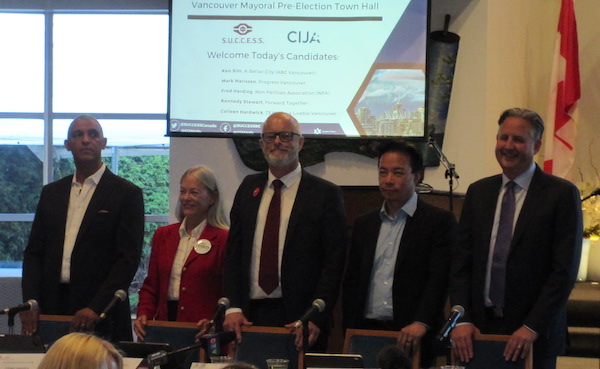
Left to right: Fred Harding, Colleen Hardwick, Mark Marissen, Ken Sim and Kennedy Stewart at the CIJA-SUCCESS Vancouver Mayoral Pre-Election Townhall last month at Temple Sholom. (photo by Pat Johnson)

A forum for Vancouver’s leading mayoral candidates briefly descended into mayhem when candidate Ken Sim criticized the current city council for failing to adopt the International Holocaust Remembrance Alliance Working Definition of Antisemitism.

The only other notable drama was the presence of a small group of protesters who had positioned themselves throughout the sanctuary at Temple Sholom synagogue. They rose and unfolded signs contending that anti-Zionism is not antisemitism. The protesters were ejected and the meeting continued.

In addition to the incumbent, Mayor Kennedy Stewart (who is running on the Forward Together slate), and Sim (with A Better City, or ABC), invitees included Fred Harding (Non-Partisan Association), Colleen Hardwick (TEAM for a Livable Vancouver) and Mark Marissen (Progress Vancouver).

There are 15 individuals running for mayor of Vancouver. The Sept. 7 forum’s organizers, the Centre for Israel and Jewish Affairs and SUCCESS, invited those  they viewed as frontrunners.

The election is a rematch after Sim was bested by Stewart in 2018 by just 984 votes. Each candidate repeatedly accused the other of misrepresenting their own record or positions and those of their opponent.

Among other conflicts, Stewart and Sim argued over comments Sim had made on CKNW radio, in which Stewart claimed that Sim had promised to cut $330 million from the city’s budget. Stewart characterized this as a “massive and radical cut,” while Sim replied that he was not speaking about cutting the budget but about reallocating funds within the budget.

Sim’s proposal to add 100 police officers as well as 100 mental health nurses to deal with crime and social problems on the street were dismissed by Stewart, who said the mayor of Vancouver does not have the authority to make those hiring decisions.

Housing was the hottest topic at the meeting, with Stewart touting the incumbent council’s record.

“Last year, we approved almost 9,000 units of housing,” Stewart said. “That is double what we approved just a decade ago. We’ve changed the way and the kind of housing we’re approving…. We used to approve about 75% of very expensive condominiums, but we’ve switched now to about 60% rental and social housing. That is a massive change.… Just last year alone, we opened and built 1,600 units of social housing, which is an absolute record.”

Sim slammed Stewart’s claim as quantity over quality.

“He believes in providing quantity of housing and having big headlines in the media,” Sim said of Stewart, “but he’s not focused on the quality. How bad do these units have to be where people would rather live in a tent on Hastings Street than in one of these unlivable units?”

Later, Sim went on the offensive again when the topic came to community safety.

“You can’t just warehouse people,” he said. “If you do not have support services, you set them up for failure, and that’s what we have done.”

Hardwick lamented that the cost of housing may be pushing her children and grandchildren away.

“I don’t want to be the last generation of my family that can afford to live in Vancouver,” she said. “I have two kids in their 30s and during this term on council I gained two grandbabies and I have to say that I’m not happy … that they are seriously considering moving to Nanaimo because they can’t see a future here. This is what we hear over and over again.”

Marissen said the city of Vancouver has lost 7,000 people in the last year, even as the province gained 60,000 new residents.

Housing, homelessness and community safety merged in the discussion. Hardwick said she, her daughter and her grandchildren went to the Chinatown Festival in July.

“We were pushing along the stroller and trying to navigate between people passed out on the sidewalk with needles in plain view,” she said. “How am I supposed to explain to my grandchildren what’s going on here? It’s just shocking.… It has been 30 years since the closure of Riverview [mental hospital] and we’ve just seen things get progressively worse. Yet we continue to perpetuate the same failed policies. We’ve seen zero improvement and I’d like to hear anybody here saying we have an improved situation. What’s the solution? If we’re spending $1 million a day down there, maybe we better analyze where that money is going.”

Marissen seconded Hardwick’s words, saying there should be an audit of what is being spent in the Downtown Eastside.

Harding, a retired police officer, positioned himself as the voice of experience on safety.

“You cannot have harm reduction and safer supply without access to treatment,” he said. “We have to increase the treatment for people who are addicted and going through a crisis on our streets. I’m here basically because of this issue. I spent 30 years as a police officer. I understand what we need to do and how we need to work on strategic targeting of criminals. We have to work on cleaning up the streets and we do that by targeting the 3% who commit 95% of the crime.”

Stewart said the city is providing “wraparound services, including complex care,” to people who require them and accused opponents of advocating policing where medical interventions are needed.

“There is no way we are going to arrest our way out of it and that’s what a lot of my colleagues here at the table are pointing to,” Stewart said.

“Don’t let Mr. Kennedy [Stewart] trick you into believing that we are trying to police our way out of this,” Sim responded, saying that a range of responses are needed to confront what has become a dangerous situation, including for visible minorities. “In the last four years, our city has become more unsafe. Mayor Stewart was on the news saying that he felt safe in our city. Being a person of Chinese descent, I don’t have that same experience. In fact, residents across the city have told me over and over again that they do not feel safe.”

Safety as it pertains to minorities, including the Jewish community, emerged repeatedly. Sim noted that it was Councilor Sarah Kirby-Yung, who is running on Sim’s ABC slate, who proposed the adoption of the Working Definition of Antisemitism during the current council’s term.

“And Mayor Stewart actually voted it down,” Sim said. “I think it’s incredibly important that council [adopt the definition] so VPD can actually define what an antisemitic hate crime is.”

“The rise in antisemitism and the rise of anti-Asian hate has been profound,” said Marissen. “It’s a tragedy. Leadership matters.”

He said it wasn’t long ago that local politicians were accusing Asian people of causing the housing crisis in Vancouver. He said he would adopt the IHRA definition of antisemitism and urged more diversity work in schools.

“We need to educate our kids,” Marissen said. “It’s really important that people understand the history of all of this. We also need to give support to interfaith and intercultural groups.”

Format ImagePosted on October 7, 2022October 5, 2022Author Pat JohnsonCategories LocalTags affordable housing, CIJA, Colleen Hardwick, elections, Fred Harding, Ken Sim, Kennedy Stewart, Mark Marissen, politics, poverty, safety, social housing, SUCCESS, Vancouver

Finding my “why”

As a former World Jewish Congress Ronald S. Lauder Fellow, I attended the first Ronald S. Lauder Fellowship Diplomacy Summit. The fellowship is an international cohort of top Jewish students with an interest in global Jewish advocacy who are invited to Europe to participate in high-level meetings with government institutions. From the moment I arrived at the summit in Brussels, the excitement felt by the other fellows and staff was infectious.

We began the trip in the European Union offices, hearing from EU members about the state of Europe and advocating for the European Jewish community. This was followed by a visit to NATO. The number of brilliant minds in these rooms was astounding, and it was such a privilege to watch as my small cohort of young Jewish students and professionals posed challenging questions to EU and NATO leaders regarding the state of European Jewry, global antisemitism and recent world tensions.

The same can be said about our visit to UNESCO in Paris the following day. As a media and information studies student with a niche interest in big tech policies, I was intrigued to learn about the organization’s recent report, History Under Attack: Holocaust Distortion and Denial Within Social Media, directly from its writers. I am hopeful that, combined with efforts to address online harms in countries such as Canada, the UNESCO report will spur positive change in hate speech regulation worldwide.

Once the summit concluded, with my Jewish pride at an all-time high, I hopped on a plane to Israel for a much-needed reunion with family and friends, celebrating Shabbat with my great-aunt and others at her beautiful Jerusalem apartment.

After we studied the week’s parashah (Torah portion), a neighbour began to translate a book written in Hebrew by our relative about our family’s history in Israel. Although I had heard these names growing up, I had not fully understood their weight or meaning. It was there, sitting with family and friends, and with the WJC experience fresh in my mind, that I began to appreciate their significance and what my Jewish heritage really means to me.

My great-great-grandfather was Zvi Pesach Frank, chief rabbi of Jerusalem during the end of the Ottoman Empire and the British Mandate of Palestine. He was instrumental in the creation of the Chief Rabbinate of Israel, and in the appointment of Rav Kook (Abraham Isaac Kook) as the first Ashkenazi chief rabbi. I learned more of his historic contributions and my family’s legacy of working to build and protect Israel.

My experience as a World Jewish Congress Lauder Fellow and attending the summit took on a new layer of meaning. Not only am I inspired and committed to continuing my work in global Jewish advocacy, but I have also developed a determination to follow this path, grounded in my profound pride in my family and their accomplishments over the generations.  For that, I am grateful to World Jewish Congress, to my great-aunt and to the Centre for Israel and Jewish Affairs. I look forward to what’s ahead, fully appreciating the rationale supporting my aspirations, and I will hold the summer of 2022 near and dear to my heart.

Following the conference and my visit to Israel, it became clear to me that, in high school – when I found my footing in Jewish leadership and learned more about my intersecting Muslim and Jewish background – I had found the “what” of my life’s passion. It was this summer that I found the “why.”

Tia Sacks is a Vancouver native going into her fourth year at Western University in the faculty of media and information studies. She participated in the World Jewish Congress Lauder Fellowship and is currently the vice-president of the Israel committee at Hillel Western and an intern at the Centre for Israel and Jewish Affairs.

Posted on September 2, 2022September 1, 2022Author Tia SacksCategories Op-EdTags Centre for Israel and Jewish Affairs, CIJA, education, family history, Judaism, politics, Ronald S. Lauder Fellowship, WJC, World Jewish Congress
Milestones … Chief Dr. Robert Joseph, KDHS students, Zac Abelson

Milestones … Chief Dr. Robert Joseph, KDHS students, Zac Abelson

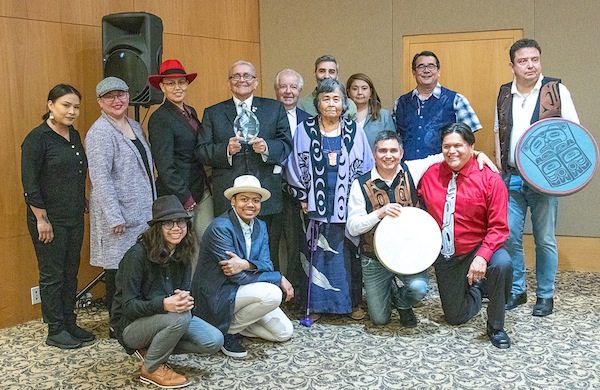
On May 25, the Centre for Israel and Jewish Affairs honoured Chief Dr. Robert Joseph (holding the sculpture) with the Victor Goldbloom Award for Outstanding Interfaith Leadership. (photo from CIJA)

On May 25, the Centre for Israel and Jewish Affairs honoured Chief Dr. Robert Joseph with the Victor Goldbloom Award for Outstanding Interfaith Leadership.

In memory of the late Dr. Victor Goldbloom, the Victor Goldbloom Award recognizes the contributions of leaders from various faith communities in advancing interfaith relations.

Joseph is a hereditary chief of the Gwawaenuk First Nation and the founder and current ambassador for Reconciliation Canada, an Indigenous organization dedicated to dialogue with multifaith and multicultural communities. He is also the former executive director of the Indian Residential School Survivors Society and a member of the National Assembly of First Nation Elders Council. As a result of his work, he has received numerous awards and recognition for bringing people of different faiths together.

Joseph is a dear friend to the Jewish community who has worked with Robbie Waisman, a Holocaust survivor, to make connections between survivors of the Holocaust and the residential schools.

On May 26, representatives from the Sikh, Roman Catholic, Evangelical, Ismaili, Muslim, Ahmadiyya, Ukrainian Catholic, Anglican, Baha’i and Black-Canadian communities, as well as Indigenous leaders, joined to celebrate Chief Joseph’s lifetime of work serving British Columbia, urging people of all faiths toward truth and reconciliation, and renewing relationships between Indigenous people and all Canadians.

***

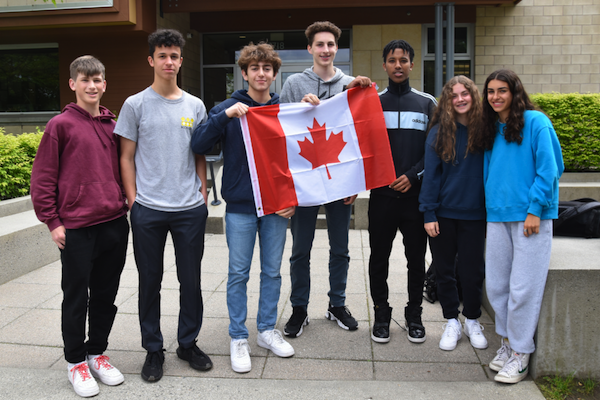
photo - Left to right: Emmett Simkin, Max Koenigbaur, Zachary Bordan, Joseph Gabay, Ezra Heayie, Sierra Brosgall and Ziv David
Left to right: Emmett Simkin, Max Koenigbaur, Zachary Bordan, Joseph Gabay, Ezra Heayie, Sierra Brosgall and Ziv David. (photo from KDHS)

The Maccabiah Games take place every four years in Israel, and the 21st Maccabiah will take place July 12-26, with some 10,000 athletes from 80 countries competing in more than 40 sports. Seven King David High School students were selected to play in a variety of sports and faculty member Matt Dichter is the coach for a basketball team. KDHS is so proud and wishes them all a successful time in Israel!

***

On May 31, Birthright Israel Excel selected 60 college students worldwide for its fellowship in business and technology, which began on June 7 and runs in Israel for 10 weeks. Forty participants are from the United States, while 20 come from Argentina, Brazil, Canada, Ecuador, France, Mexico, South Africa, Spain and the United Kingdom. Thirteen of them will be visiting Israel for the first time.

photo - Zac Abelson
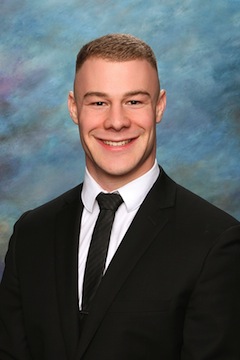
Zac Abelson (photo from Birthright Israel)

One of the participants is University of British Columbia Sauder School of Business student Zac Abelson, 21, who is majoring in commerce, with a double minor in operations and logistics, and entrepreneurship. He will be doing his internship with Deloitte.

Since 2011, the Birthright Israel Excel Fellowship has selected top students from hundreds of applicants for summer internships with leading business and tech companies in Tel Aviv. This year’s cohort features an equal number of women and men and the most first-time visitors to Israel. Their internships will be in such areas as environmental sustainability, software development, consulting, finance, venture capital, engineering, marketing, cybertech, biotech, business development and startup development. Students will intern each Israeli workweek, Sunday through Thursday, and attend an evening series of speakers from across Israeli society.

A core component is the one-on-one pairing between each Excel fellow and an Israeli, enabling the foreigners to acclimate quickly to the local culture and see the country through a more authentic lens than as typical tourists. Many peer-to-peer relationships grow into long-term friendships. Some have invested in each other’s business ventures.

Birthright Israel Excel fellows enjoy free time to explore Israel with their peers, and three weekend trips as a group bring them throughout the country: the north, typically including the Golan Heights, a winery tour and a rafting trip down the Jordan River; Jerusalem, including the Western Wall and the Machane Yehuda outdoor market; and the south, for a desert trek, a mud bath in the Dead Sea and a sunrise hike on Masada.

After their return home, the Excel fellows enter a network that provides resources for professional and personal development, Israel engagement and encouraging them as philanthropists.

Birthright Israel Excel fellows have gone on to positions at companies such as J.P. Morgan Chase, Bain & Company and Google. Others have developed strategic partnerships with Israeli companies and started their own companies, often hiring other fellows.

Format ImagePosted on June 24, 2022June 22, 2022Author Community members/organizationsCategories LocalTags Birthright Israel Excel, Centre for Israel and Jewish Affairs, CIJA, interfaith, KDHS, King David High School, Maccabiah Games, Robert Joseph, Zac Abelson
“Never again” still resonates?

“Never again” still resonates?

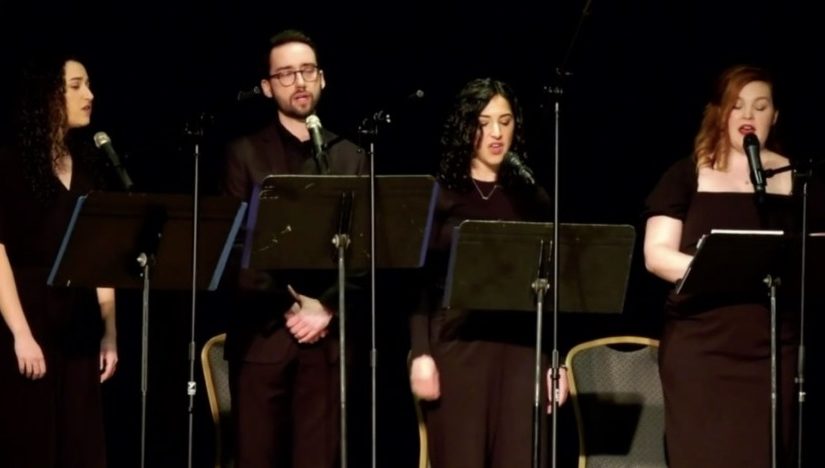
Left to right: Mia Givon, Lorenzo Tesler-Mabe, Kat Palmer and Erin Aberle-Palm. (screenshot from Kat Palmer)

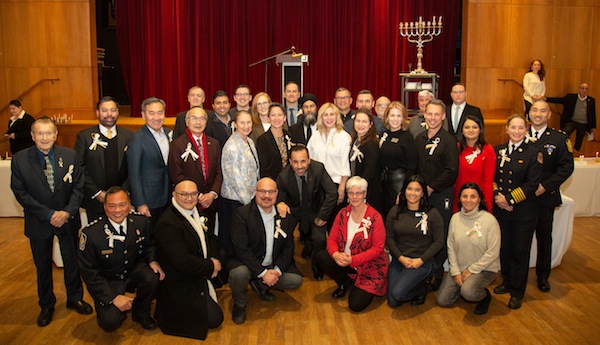
Holocaust survivors and their descendants were joined by top elected officials and Jewish community leaders in a series of commemorations marking Yom Hashoah, Holocaust Remembrance Day, across Canada last week.

In Vancouver, community members gathered together at the Jewish Community Centre of Greater Vancouver April 27, while scores more watched remotely as the traditional in-person ceremony returned for the first time since the beginning of the pandemic.

Marcus Brandt, vice-president of the presenting organization, the Vancouver Holocaust Education Centre, welcomed guests and invited Holocaust survivors to light Yahrzeit candles.

“On Yom Hashoah, we join as a community to remember the six million Jews who perished in the Holocaust at the hands of Nazi Germany and its co-conspirators between 1933 and 1945,” he said. “It is also a day to pay tribute to the Jewish resistance that took place during the Holocaust.”

This year marks the 79th anniversary of the Warsaw Ghetto Uprising, which is the most notable of many acts of Jewish resistance to Nazism.

Marsha Lederman, a journalist who is the daughter of two Holocaust survivors, spoke of the importance of telling our stories.

“When I was growing up,” she said, “the Holocaust was everywhere and nowhere. As far back as I can remember, there were hints and references. My parents talked about things happening in camp. What was this camp? I knew it wasn’t like the summer camp that I went to. I knew a lot of their friends were also at these camps, but I didn’t know the details.”

At the age of 5, Marsha met a new friend whose home was filled with laughter and extended family.

“One day, when I came home from a visit at my friend’s house, I asked my mother what was really a simple, innocent question,” said Lederman. “She has grandparents, why don’t I? My poor mother. She was caught off guard and her answer was truly horrifying – at least as I remember it, because I know memory is very faulty. But, as I recall, she said I didn’t have grandparents because the Germans hated Jews and they killed them by making them take gas showers.”

This response raised more questions than answers for the young girl, not least of which was: “What did we do to make the Germans hate us so much and do they still hate us? It was a horrible introduction to the details of the tragedy of my family and it taught me another terrible lesson: be careful about asking questions because the answers could be murder.”

As a result, much of Lederman’s Holocaust education was gained “through osmosis, rather than sitting down and asking questions,” she said.

Her father died when Lederman was a young woman and, in a tragic turn of events, her mother died just as Lederman had bought a ticket to visit her in Florida, armed with a recorder to finally ask the questions she had hesitated to broach in earlier years.

“It’s taken me years to try to figure out what I could have learned in an afternoon at my mother’s kitchen table,” she said. “I have no way of knowing these things because I didn’t ask. We need to ask and we need to tell.”

Lederman explores these questions in a book being released this month, titled Kiss the Red Stairs: The Holocaust, Once Removed.

Amalia Boe-Fishman (née van Kreveld) was the featured survivor speaker at the Vancouver event. Born in the Netherlands, she was less than a year old when the Germans invaded her country. Her grandparents were soon transported to Auschwitz and murdered.

In what is an extremely rare phenomenon, Amalia, her parents and her brother all survived the war years because a Dutch Christian resistance fighter, Jan Spiekhout, and his family hid members of the de Leeuw family in a variety of hiding places over the course of years. Amalia’s mother even gave birth to another child in 1944. (That child, as well as Boe-Fishman’s oldest son, are both named Jan in honour of their rescuer.) Their survival was a statistical miracle. The Netherlands had among the lowest Jewish survival rate of any country during the Holocaust. Of 140,000 Dutch Jews in 1939, only 38,000 were alive in 1945.

Boe-Fishman recalled the day Canadian forces liberated the Netherlands – it was one of the only times in three years that she had set foot outdoors.

“It was strange and frightening outside and close to so many strangers,” she said. “The Canadian soldiers came rolling in on their tanks, handing out chocolates, everyone smiling, dancing, waving Dutch flags. Then I was told I could go home to my real family. But who were these strangers? I did not want to leave the family Spiekhout. They were my family. After all, I had not seen my real family for three years.”

In 1961, she traveled to Israel to meet members of her family who had made aliyah before the war and to reconnect with her Jewish identity. There, on the kibbutz she was staying, she met a Canadian, whom she married and they subsequently moved to Vancouver and had three children.

In 2009, Boe-Fishman and her three sons traveled to The Hague for the investiture of Jan Spiekhout and his late parents, Durk and Froukje Spiekhout, as Righteous Among the Nations by Yad Vashem.

“To be together with my children, my brother, and the grown children of the Spiekhout family, this was such a moving event in our lives,” she said.

As part of the Vancouver ceremony, Councilor Sarah Kirby-Yung read a proclamation from the City of Vancouver. Cantor Yaakov Orzech chanted El Moleh Rachamim. Lorenzo Tesler-Mabe, Mia Givon and Kat Palmer, members of the third generation, as well as Erin Aberle-Palm, sang and read poetry, accompanied by Vancouver Symphony Orchestra violinist Andrew James Brown and pianist Wendy Bross Stuart, who was also music director of the program.

The following day, a hybrid in-person and virtual event was held at the British Columbia legislature, featuring Premier John Horgan.

“On Yom Hashoah, we are challenged to ensure the words ‘never again’ are supported by action,” he said. “Over the past few years, there has been an increase in antisemitism in B.C., and the Jewish community is one of the most frequently targeted groups in police-reported hate crimes. That’s why our government will continue working to address racism and discrimination in all its forms.… Today, as we remember and honour those who were lost and those who survived, we must recommit to building a more just and inclusive province, where everyone is safe and the horrors of the past are never repeated.”

Michael Lee, member of the legislature for Vancouver-Langara, spoke on behalf of the B.C. Liberal caucus.

“Every year, we commemorate this day and remember the heroes and the Righteous Among Nations who stood up to oppose the most vile, hateful oppression,” Lee said. “We recognize the victims and survivors of the Holocaust, we make a solemn promise to never forget and never again allow such horrific actions to take place. This is a responsibility that we all must carry with us not only today but every day. It is a responsibility we must be better at upholding, as soldiers at this very moment commit war crimes once again in Europe. We have not done enough. Right here in Canada, we see another year of record rises in antisemitism. We have to do better.”

Lee called on the province to adopt the International Holocaust Remembrance Alliance Working Definition of Antisemitism.

MLA Adam Olsen represented the Green party.

“While time distances us from the horrific events, the memories and the stories remain steadfast in our mind and are carried and passed from one generation to the next,” said Olsen. “The Holocaust was an ultimate form of evil, persecution, oppression, genocide, complete disregard for human life, pushed to the most appalling degree…. The Holocaust is a stark reminder of the darkness, the wickedness, that can exist among us. However, it is also important to acknowledge that this is a story of strength, resilience and humanity and, to that, I raise my hands to all of the survivors, the Jewish community, that have ensured that the world knows and hears the stories. As difficult as it is to continue sharing them, we cannot stop hearing them or else we will fall victim to thinking that we have passed that now.”

Rabbi Harry Brechner of Congregation Emanu-El lamented the deaths of Holocaust survivors in the current war in Ukraine, “who died when they were cold, again, and hungry, again, and who died in the face of violence.”

“That never should happen and we all know that,” the rabbi said. “I don’t know how to make those big changes. I’m not a world leader. I’m the leader of a small congregation. But I think we are all leaders of our hearts and if each of us can make that difference, it’s got to have a huge ripple effect.”

Holocaust survivor Leo Vogel said that history records the end of the Holocaust in 1945. “But, for the people who lived through it and survived that horrible blight of human history, for them, 1945 is not when the Holocaust ended,” he said. “It continues to this very day to live in memories and nightmares and ongoing health problems.… The fascist attempt to eradicate the Jewish people must never be forgotten. The memory of the tortured and murdered cannot be shoveled underground as the Nazis did with the ashes. As children in the Holocaust, we were the youngest and, now, in our older years, we are at the tail end of those who can still bear witness.”

Vogel spoke of the unfathomable choice his parents made to hand him over, as a child, to a Christian family for hiding.

“Not long after that deeply painful decision to separate me from them, they were deported to Auschwitz and there they were murdered without ever knowing whether their desperate act to allow me to go into hiding saved my life,” he said. “I get cold chills when I think of the intense agony they went through in making their decision. It would have been their hope, I’m sure, that one day we would once again get together. That day never happened. Their pain must have been overwhelming. Many times, I have wondered what they said to each other and to me the night before they gave me away and, countless times, I have asked myself whether I would have had the strength to do an equal act when my children were young.”

In Ottawa, earlier on April 27, Prime Minister Justin Trudeau touted his government’s steps in fighting antisemitism, including the creation of a special envoy on preserving Holocaust remembrance and combating antisemitism, currently held by Irwin Cotler, and proposed legislation to make denying or diminishing the Holocaust a criminal offence.

“Earlier this year, our country and people around the world were shocked and dismayed to see Nazi imagery displayed in our nation’s capital,” the prime minister said, referring to trucker protests in Ottawa. “For the Jewish community, and for all communities, those images were deeply disturbing. Sadly, this wasn’t a standalone instance. Jewish people are encountering threats and violence more and more both online and in person. This troubling resurgence of antisemitism cannot and will not be ignored. The atrocities of the Holocaust cannot be buried in history.… We must make sure that ‘never again’ truly means never again.”

Shimon Koffler Fogel, chief executive officer of the Centre for Israel and Jewish Affairs, picked up on that theme, noting that the term “never again” was “born out of the Jewish experience but was always intended to be universal in its application.”

“How can we witness the atrocities visited on the Rohingya, the Uighurs or the Yazidi and claim the cry of ‘never again’ has meaning?” he asked. “How can we observe the unvarnished aggression against Ukraine and assert we have taken the lessons of the Holocaust to heart?”

He said he derives hope from the fact that Canada seems to have learned the lesson of the MS St. Louis, the ship filled with Jewish refugees that was turned away from Canada and other safe havens in 1939. Now, Canada is a place, he said, “where fleeing Syrian and Iraqi refugees can rebuild their lives, where Afghani women and girls can fulfil their dreams, where displaced, wartorn Ukrainians can find safe harbour.”

“I take great pride that Canada is so committed to Holocaust remembrance and education,” said Michael Levitt, president and chief executive officer of the Friends of the Simon Wiesenthal Centre, “A major reason is because of the survivors who, after suffering unthinkable adversity in Europe, rebuilt their shattered lives here, in our great country. Their strength, resilience and willingness to share their deeply personal and harrowing stories have been a gift and a source of inspiration to all Canadians.”

Dr. Agnes Klein, a Holocaust survivor, spoke of her family’s wartime experiences. Israel’s ambassador to Canada, Ronen Hoffman, commended Canada on adopting the International Holocaust Remembrance Alliance’s Working Definition of Antisemitism.

A day earlier, at another virtual commemoration from the Montreal Holocaust Museum, Holocaust survivor Max Smart told of his family’s harrowing Holocaust experiences.

Paul Hirschson, consul general of Israel in Montreal, compared the loss of Jewish life, with its incalculable loss of talent, in the Holocaust with the explosion of Jewish talent taking place in this century.

“Jewish talent lost was one of history’s greatest tragedies,” said the diplomat. “The talent emerging is perhaps the most exciting story of the 21st century…. Antisemitism is still widespread, also here in Canada. Montreal, where many survivors found a home, is no exception. We will defeat hate every time. Hatred will never again rob the world of Jewish talent.”

Format ImagePosted on May 6, 2022February 1, 2024Author Pat JohnsonCategories Celebrating the Holidays, NationalTags Adam Olsen, Amalia Boe-Fishman, antisemitism, CIJA, Harry Brechner, Holocaust, John Horgan, Leo Vogel, Marcus Brandt, Marsha Lederman, Michael Lee, Montreal, Ottawa, remembrance, survivor, SWC, Vancouver, VHEC, Victoria, Yom Hashoah

Criminalize Holocaust denial?

Criminalizing Holocaust denial would draw a moral line in the sand, say two advocates for legal action, but a lawyer and Canadian-Israeli former member of the Knesset has reservations.

Michal Cotler-Wunsh, head of the Nefesh B’Nefesh Institute for Aliyah Policy and Strategy and a former Israeli parliamentarian, acknowledged free speech concerns but focused more on the need for evidence-based decision-making before criminalizing those who question historical facts around the Shoah. She also noted that the countries that have adopted criminal sanctions against those who spread historical fabrications – Germany and France, for example – are among the very places where antisemitism is at its worst.

Sacha Ghozlan, a French legal expert and former president of the Union des étudiants juifs de France (Union of French Jewish Students), dismissed free speech concerns and warned against confusing cause and correlation between antisemitism and legal proscriptions.

“I don’t think you can draw a line between rising antisemitism in its new forms and the fact that a country has developed legislation to address rising Holocaust denial,” Ghozlan said.

Dr. Carson Phillips, managing director of the Neuberger Holocaust Education Centre, in Toronto, generally agreed with Ghozlan. Holocaust denial and expressions of hatred should not be protected grounds based on free speech arguments, he said.

“I don’t see this so much as a freedom of speech,” he said. “This is really an abuse of speech.… Does the listener have to be exposed to hate speech and an abuse of free speech?”

He argued that “putting a fence around free speech” is legitimate in cases where historical revisionism can lead to expressions of hatred.

The three speakers were panelists in an event presented by the Centre for Israel and Jewish Affairs (CIJA) March 29, titled Perspectives on Criminalizing Holocaust Denial.

A private member’s bill introduced in Parliament by Saskatchewan Conservative MP Kevin Waugh would amend the Criminal Code section that prohibits inciting hatred “against an identifiable group” to include “communication of statements, other than in private conversation, that wilfully promote antisemitism by condoning, denying or downplaying the Holocaust.”

Phillips contextualized Holocaust denial as a threat to Canadian society.

“The Holocaust is often [viewed] as being one of the foundational cornerstones of modern human rights and an attack on the Holocaust is certainly an attack on Canadian values and Canadian democracy and it needs to be taken very seriously,” he said.

While he supports criminalization, he acknowledged that this is only a part of the solution.

“I am an educator,” he said, adding that education has to exist alongside legal prohibitions.

“To me, it’s not an either/or situation, it’s a combination,” he said. “I see this as really strengthening and working together.”

Legislating against Holocaust denial would send a societal message, Phillips argued.

“It’s really important to draw a moral line,” he said. “In Canada, where we are a pluralistic society with strong democratic values, I think this is one example of a way of being able to draw a moral line in the sand and being able to say there are certain abuses of free speech that will not be tolerated and for very good reasons because we know where this can lead – obviously, to the Holocaust. But also looking at it from the perspective that Holocaust denial is a form [of], and leads to, antisemitism but it is also an attack on democratic values, which we value so much within the Canadian context.”

Ghozlan said that social media companies have faced calls to pull down expressions of hatred and Holocaust denial, but have often demurred based on the free speech assurances of the U.S. Constitution.

“But it’s not freedom of speech, it’s fake news,” he said. Advocates need to “level up pressure on social media, explaining to them that Holocaust denial is not about freedom of speech but it’s about an abuse of freedom of speech,” he said.

Cotler-Wunsh, former Blue and White party member of the Knesset and Canadian-raised step-daughter of legal scholar and former Canadian justice minister Irwin Cotler, said she has always been a fighter against antisemitism. But she raised red flags around the issue of free expression and focused more narrowly on whether a prohibition on Holocaust denial would have the desired outcome.

“Does the criminalization of Holocaust denial in fact meet the goal of combating antisemitism?” she asked. Banning Holocaust denial – which is easily debunked – may simply be a feel-good act that is “low-hanging fruit” in the battle against anti-Jewish hate and might detract from the bigger responsibility to remain vigilant, contest mistruths in the marketplace of ideas and educate, rather than merely seek to silence, she said.

Canada already has fairly robust legal consequences for hate expressions and Cotler-Wunsh warned that new laws that are difficult to administer, or that sit on the books without being enforced, could have the opposite of the intended effect.

By example, she said, a recent controversy around the Holocaust represents a missed opportunity. After Whoopi Goldberg said on the TV show The View that the Holocaust “was not about race,” she was suspended from the show for a period.

“I would have argued, if anybody would have asked me, that that was a great, great missed opportunity,” said Cotler-Wunsh. It was “exactly the moment to educate the millions of viewers of that show and be able to utilize that opportunity to engage in what the Holocaust was about.”

Education, while slow, is the only answer, she contended.

“At the end of the day, education is the key and that is one of the hardest things to say because it actually is the longest process,” said Cotler-Wunsh. “There is no quick fix in education.”

Where compulsion should be exercised, she said, is on social media platforms, which she said should adopt and implement the International Holocaust Remembrance Alliance Working Definition of Antisemitism.

She worries that passing legislation against Holocaust denial might let elected officials off the hook. She imagines legislators thinking, “Oh we’ve done something. We confronted antisemitism, when in fact data and empirics may show that criminalizing Holocaust denial hasn’t actually made a dent in the rising antisemitism in Europe 30 years [after some countries criminalized it].”

Cotler-Wunsh, Ghozlan and Phillips were in discussion with Emmanuelle Amar, director of policy and research in CIJA’s Quebec office. The event was opened and closed by Jeff Rosenthal, co-chair of the national board of CIJA.

Format ImagePosted on April 8, 2022April 7, 2022Author Pat JohnsonCategories WorldTags antisemitism, Carson Phillips, Centre for Israel and Jewish Affairs, CIJA, education, free speech, Holocaust denial, law, Michal Cotler-Wunsh, Sacha Ghozlan
Making internet safer

Making internet safer

(image from internetmatters.org)

On March 30, Minister of Canadian Heritage Pablo Rodriguez and Minister of Justice and Attorney General of Canada David Lametti announced a new expert advisory group on online safety as the next step in developing legislation to address harmful online content.

While online platforms play a central role in the lives of Canadians, bringing many benefits to society, they can also be used as tools to cause real and significant harm to individuals, communities and the country. Harmful content, such as hate speech, sexual exploitation of children and incitement to violence, is published online every day. There are no broad regulatory requirements in Canada that apply to platforms regarding their responsibilities in relation to such content.

The expert advisory group will be mandated to provide advice on a legislative and regulatory framework that best addresses harmful content online. The group is composed of diverse experts and specialists from across Canada: Amarnath Amarasingam, Queen’s University; Bernie Farber, Canada Anti-Hate Network; Chanae Parsons, community activist and youth engagement specialist; David Morin, Université de Sherbrooke; Emily Laidlaw, University of Calgary; Ghayda Hassan, Université du Québec à Montréal; Heidi Tworek, University of British Columbia; Lianna McDonald, Canadian Centre for Child Protection; Pierre Trudel, Université de Montréal; Signa A. Daum Shanks, University of Ottawa; Taylor Owen, McGill University; and Vivek Krishnamurthy, University of Ottawa.

The advisory group will hold nine workshops to discuss various components of a legislative and regulatory framework for online safety. They will also take part in additional stakeholder engagement, including with digital platforms. The work of the advisory group will be open and transparent. The group’s mandate, the supporting materials for each session, and non-attributed summaries of all sessions and discussions, will be published.

“We conducted a consultation last year and released the What We Heard Report earlier this year,” said Rodriguez. “It’s clear that harmful online content is a serious problem, but there is no consensus on how to address it. We’re asking the expert advisory group to go back to the drawing board. We need to address this problem openly and transparently as a society.”

Facts and figures on online violence in Canada include that:

  • 62% of Canadians think there should be more regulation of online hate speech;
  • 58% of women in Canada have been victims of abuse online;
  • 80% of Canadians support requirements to remove racist or hateful content within 24 hours;
  • one in five Canadians have experienced some form of online hate;
  • racialized Canadians are almost three times more likely to have experienced harmful behaviour online;
  • there was a 1,106% increase in online child sexual exploitation reports received by the RCMP National Child Exploitation Crime Centre between 2014 to 2019.

“Too many people and communities are victimized by harmful online content that is often amplified and spread through social media platforms and other online services,” said Lametti. “The Government of Canada believes that Canadians should have protection from harmful online content, while respecting freedom of expression.”

– Courtesy Canadian Heritage

Also on March 30, the Canadian Coalition to Combat Online Hate announced the launch of their new website, combatonlinehate.ca, providing youth, parents, educators and policymakers with strategic tools to be effective in their efforts to identify and combat online hate.

“Canadians are exposed daily to a barrage of hateful and divisive online messages that pollute social media forums with content that is antisemitic, anti-Black, anti-Asian, anti-Indigenous, misogynistic, Islamophobic and homophobic, and that promotes conspiracy theories. These posts, videos and memes are easily discoverable and readily shared, often masked by anonymity or given undue credibility,” said Richard Marceau, vice-president, external affairs and general counsel at the Centre for Israel and Jewish Affairs (CIJA). “We know that online hate can become real-life violence. Hate-motivated murders at Christchurch’s Al Noor Mosque and Linwood Islamic Centre and at Pittsburgh’s Tree of Life Synagogue stand as notable examples. It is incumbent on all of us, before it is too late, to combat online hate with the most effective tools available.”

According to a 2021 survey by the Canadian Race Relations Foundation, 42% of respondents have seen or experienced hateful comments or content inciting violence online, and younger and racialized Canadians are significantly more likely to be confronted with this hate. The same study indicated that 93% of Canadians believe that online hate speech and racism are problems, of which 49% believe they are “very serious” problems. Findings also showed that at least 60% of Canadians believe that the federal government has an obligation to pass regulations preventing hateful and racist rhetoric and behaviour online. Only 17% prefer no government involvement at all.

“We saw COVID exacerbate online hate exponentially, as stress levels and political division rose amid lockdowns. By working together, we can make the communities we are building online – and, by extension, the communities we inhabit offline – safer places for all Canadians,” said Marceau.

The website combatonlinehate.ca is organized by the Canadian Coalition to Combat Online Hate, funded by Canadian Heritage and powered by CIJA.

– Courtesy Centre for Israel and Jewish Affairs

Format ImagePosted on April 8, 2022April 7, 2022Author Canadian Heritage, Centre for Israel and Jewish AffairsCategories NationalTags antisemitism, Canada, Canadian Heritage, Centre for Israel and Jewish Affairs, CIJA, David Lametti, justice, law, misogyny, online hate, Pablo Rodriguez, racism, regulation
Four more questions to ask

Four more questions to ask

One of the four additional questions that the Centre for Israel and Jewish Affairs suggests we ask ourselves this Passover is: As we solemnly intone “Next year in Jerusalem,” how can we express the significance of the land of Israel in our Jewish Canadian identity? (photo by IRR Photography)

Traditional celebrations of recent Passover seasons were certainly curtailed, and even canceled, by the pandemic. For those of us fortunate enough to have emerged from COVID-19 with our families intact, we now – finally – will have an opportunity to come together to celebrate the holiday as it should be – among extended family and old friends.

The limits placed on us by the pandemic, however, have not curtailed the Centre for Israel and Jewish Affairs’ work. Ensuring increased COVID funding for frontline charitable organizations helping the elderly, ill and all others among our most vulnerable was paramount in our advocacy to governments at all levels. Supplemental funds are never quite sufficient, but these extra funds were realized in federation agencies across the country.

The disturbing surge in antisemitism that came with the pandemic became another focus of our work. Last summer, as a founding member of the Canadian Coalition to Combat Online Hate, we organized the federal government-|sponsored Emergency Summit on Antisemitism that brought together government, media, academic and other experts in combating online hate that so often leads to real-life violence.

Connected to pervasive hate online is spreading distortion and even outright denial of the Holocaust. A poll commissioned by the Canadian charity Liberation75 showed that, of 3,600 students in grades 6 to 12, a shocking 33% were either uncertain about the Holocaust, thought that the death toll was exaggerated or questioned whether the Holocaust even happened. In Ontario’s largest school board – and in others from the West to the Maritimes – incidents of antisemitism have begun to be reported almost weekly.

This kind of disturbing trend requires focused, strategic action. CIJA has received a grant to leverage the expertise of historians, teachers and Jewish scholars to create a curriculum for Ontario middle-school students that will teach them about the Holocaust – and about modern-day antisemitism. Most recently, CIJA has urged support for MP Kevin Waugh’s private member’s bill that proposes Canada follow the example of other countries – including France and Germany – to make Holocaust denial an offence under Canada’s Criminal Code.

To spur discussion about what such legislation could do, CIJA hosted a national webinar about reasons to criminalize Holocaust denial, the challenges posed, and what we can learn from jurisdictions where similar laws have been enacted. With experts from Canada, France and Israel espousing various perspectives, the discussion was informed, civil and productive.

Discussion. Now that’s an area where Jews tend to feel both comfortable and motivated. And that brings me to the Pesach celebration awaiting us this year. Of course, we will delight in visits with our loved ones. Some of us will see children or grandchildren, newly arrived or grown significantly since our last Passover seder together. Many will have questions – not only the traditional four we ask annually, harking back to our historic connections to Israel, but also questions about being Jewish today, in Canada.

We think Jews in communities large and small have lots to talk about, and we want to facilitate engaged, thoughtful discussions responding to four more questions we’ve proposed for this Passover. We propose, this Passover seder, that Jewish families and friends think about the issues CIJA, as the advocacy agent of Jewish federations across Canada, has been prioritizing.

More background is available, along with suggested responses, at cija.ca/4morequestions, but here are the questions:

Looking at increased denial and distortion of the Holocaust, our most recent enslavement, how can we stop Holocaust denial and distortion? In the realm of online hate and antisemitism, we remember numerous historic efforts to destroy the Jewish people. What can Canadians do to combat online hate and antisemitism today? Turning to community security, as a once-enslaved people, we ask, what does a safe space for Jewish Canadians look like? And, as we solemnly intone “Next year in Jerusalem,” how can we express the significance of the land of Israel in our Jewish Canadian identity?

That’s a lot. But that’s what we are up against, even living in Canada, one of the safest places for Jews anywhere.

As we gather this year, whether part of a small family, an extended clan of young and old, or among friends, let us celebrate the joy of our survival and how, together, we can work to shape our future.

May your Passover be a peaceful, thoughtful, and happy one. Chag Pesach sameach!

Judy Zelikovitz is vice-president, University and Local Partner Services, at CIJA, the Centre for Israel and Jewish Affairs.

Format ImagePosted on April 8, 2022April 7, 2022Author Judy ZelikovitzCategories Op-EdTags Centre for Israel and Jewish Affairs, CIJA, Four Questions, Holocaust denial, identity, Israel, online hate, Passover, security
Remembering the Holocaust

Remembering the Holocaust

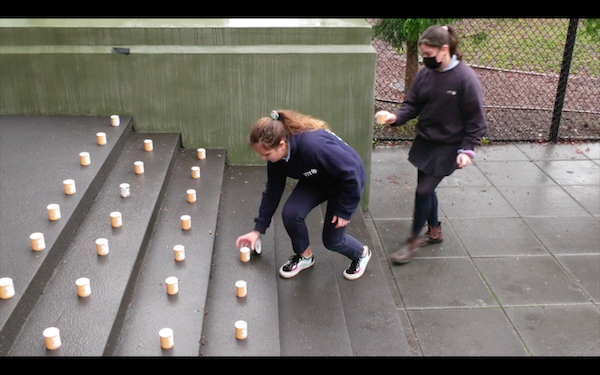
Grade 7 students at Vancouver Talmud Torah light memorial candles to mark International Holocaust Remembrance Day. (screenshot)

Vancouver’s city hall, the Burrard Street Bridge and other landmarks around the city were lit in yellow light Jan. 27, as were buildings across the country, to mark International Holocaust Remembrance Day. The commemoration coincided with the 77th anniversary of the liberation of Auschwitz.

Yellow was chosen, said Vancouver Mayor Kennedy Stewart, to reflect the colour of the candles of remembrance being lit globally to mark the day.

“Antisemitism is on the rise around the world,” the mayor said before reading a proclamation on behalf of city council. “Vancouver has the opportunity to join with the Jewish community and all of our residents and Canadians from all walks of life in demonstrating our commitment to stand against antisemitism, hate and genocide.”

Stewart was joined by councilors Sarah Kirby-Yung, Pete Fry and Adriane Carr.

Kirby-Yung spoke of calls from constituents who have had swastikas drawn on their sidewalks or who have come across antisemitic graffiti in local parks.

“I’ve seen firsthand, when you go to work out at the gym or community facility, the need to post security guards, to have them at schools and daycares, at synagogues during times of worship,” Kirby-Yung said. “It takes all of us individually to stand up to discrimination. We need to continue to work together, collectively with our Jewish community, to ensure safety and inclusion for everybody.”

The Vancouver event was sponsored by the Centre for Israel and Jewish Affairs (CIJA), the Vancouver Holocaust Education Centre (VHEC) and the Jewish Federation of Greater Vancouver.

Nico Slobinsky, Pacific regional director for CIJA, urged unity.

“Antisemitism is not just a Jewish problem, it affects us all,” he said. “Only by working together and standing up against antisemitism are we going to insulate all Canadians against the threat of hatred and racism in our society.”

Nina Krieger, executive director of the VHEC, noted that education about the Holocaust is at the heart of her agency’s mission.

“This mission is perhaps more urgent than ever as globally and in our own backyard we are encountering a rising tide of Holocaust denial and distortion,” Krieger said. “The latter includes actions or statements that seek to minimize, misrepresent or excuse the Holocaust. These assaults on the memory of the most well-documented genocide in history should raise alarms for all citizens of our diverse society. Online or offline, intentional or not, distortion of the Holocaust perpetuates antisemitism, conspiracy theories, hate speech and distrust of democratic institutions, all of which have reached new heights during the pandemic. Around the world, opponents of public health invoke Nazi policies to systematically persecute and murder Jews and others in order to depict themselves as victims and their governments as persecutors. Such outrageous comparisons are clearly inappropriate and deeply offensive to the victims and survivors of the Holocaust.”

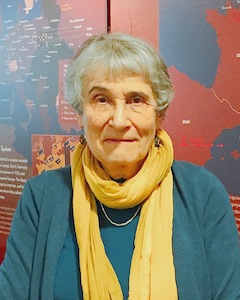
Dr. Claude Romney, a child survivor from France, spoke of her father’s survival during 34 months in Auschwitz – an unimaginable expanse of time in a place where the average life expectancy was measured in days. (Romney’s experiences, and those of her father, Jacques Lewin, were featured in the April 7, 2017, issue of the Independent: jewishindependent.ca/marking-yom-hashoah.)

photo - Dr. Claude Romney, a child survivor from France, spoke at the local commemoration marking International Holocaust Remembrance Day on Jan. 27
Dr. Claude Romney, a child survivor from France, spoke at the local commemoration marking International Holocaust Remembrance Day on Jan. 27. (photo from VHEC)

Prior to the streamed event, Grade 7 students at Vancouver Talmud Torah elementary school lit candles of remembrance. King David High School students Liam Greenberg and Sara Bauman ended the ceremony with a musical presentation.

Earlier, another ceremony was livestreamed from the National Holocaust Memorial in Ottawa. Emceed by Lawrence Greenspon, co-chair of the National Holocaust Memorial Committee, the event featured ambassadors and Canadian elected officials and was presented by CIJA, the National Capital Commission, the embassy of Israel in Canada and the Jewish Federation of Ottawa.

Shimon Koffler Fogel, chief executive officer of CIJA, said the day of remembrance is intended to be as much “prospective as it is retrospective.”

“As we remember, we also reaffirm our resolve to combat the hatred that still plagues our world today, perhaps more so than at any time since those dark days of the Shoah,” he said. “There is an urgent imperative to sound an alarm and refuse to let its ring be silenced. Hate is no longer simmering in dark corners, relegated to the discredited margins of civil society. It has, in many respects, increasingly asserted itself in the mainstream public square. It has become normalized.

“Countering hate speech is both a necessary and essential imperative to preventing hate crime,” he said. “So let us resolve, collectively here today and across this great country, to give special meaning to our remembrance by fulfilling the pledge, ‘never again.’”

Israel’s ambassador to Canada, Ronen Hoffman, told the audience that his grandmother’s entire family was murdered in the Shoah. He denounced the misuse of that history.

“Any claim, inference or comparison to the Holocaust that is not in fact the Holocaust only acts as a distortion to the truth of what happened to the victims,” he said. “Invoking any element of the Holocaust in order to advance one’s social or political agenda must be called out as a form of distortion and, indeed, denial.”

Germany’s ambassador to Canada, Sabine Sparwasser, noted that, in addition to the anniversary of the liberation of Auschwitz, it was also recently the 80th anniversary of the Wannsee Conference, where the “Final Solution” was devised.

“No country has a greater responsibility to learn from the past and to protect the future than Germany,” she said. “Remembrance is the only option. This sacred duty is the legacy of those who were murdered and of those who survived the horrors of the Shoah and whose voices have gradually disappeared. The greatest danger of all begins with forgetting, of no longer remembering what we inflict upon one another when we tolerate antisemitism, racism and hatred in our midst.”

Other speakers included Ahmed Hussen, minister of housing and diversity and inclusion; the American ambassador to Canada, David L. Cohen; Mayor Jim Watson of Ottawa; Andrea Freedman, president and executive director of the Jewish Federation of Ottawa; and Dr. Agnes Klein, a survivor of the Holocaust.

Format ImagePosted on February 11, 2022February 10, 2022Author Pat JohnsonCategories LocalTags Centre for Israel and Jewish Affairs, CIJA, Claude Romney, commemoration, International Holocaust Remembrance Day, IRHD, Jewish Federation, Kennedy Stewart, memorial, Nico Slobinsky, Nina Krieger, Ronen Hoffman, Sarah Kirby-Yung, Shimon Koffler Fogel, Vancouver, Vancouver Holocaust Education Centre, VHEC
Festive candlelighting

Festive candlelighting

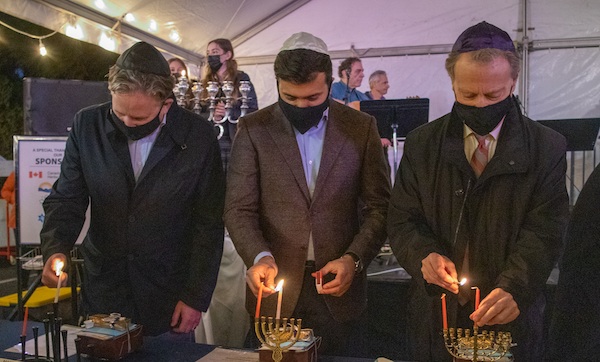
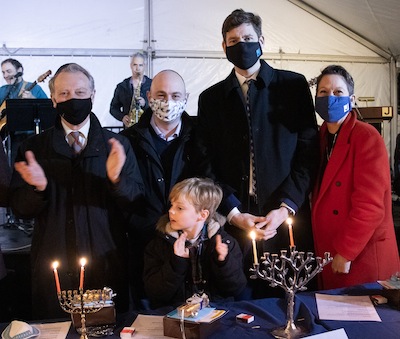
Left to right, Vancouver Mayor Kennedy Stewart,  MP Taleeb Noormohamed and MLA George Heyman light the chanukiyah. (photo by Jocelyne Hallé)

The Jewish Community Centre of Greater Vancouver (JCCGV), the Centre for Israel and Jewish Affairs (CIJA), and the Canadian Jewish Political Affairs Committee (CJPAC) welcomed elected officials representing all levels of government and political parties, as well as other distinguished guests, to light a candle on the first night of Chanukah, Nov. 28.

Member of Parliament Taleeb Noormohamed (Vancouver-Granville) spoke on behalf of the Government of Canada. Member of the Legislative Assembly George Heyman (Vancouver-Fairview) and MLA Melanie Mark (Vancouver-Mount Pleasant) were joined by MLA David Eby (Vancouver-Point Grey), and they presented remarks from the government of British Columbia, while MLA Michael Lee (Vancouver-Langara) spoke on behalf of the Official Opposition. Vancouver Mayor Kennedy Stewart also said a few words.

photo - Left to right: MLA George Heyman, Jewish Federation CEO Ezra Shanken, MLA David Eby and MLA Melanie Mark
Left to right: MLA George Heyman, Jewish Federation CEO Ezra Shanken, MLA David Eby and MLA Melanie Mark. (photo by Jocelyne Hallé)

JCCGV board chair Alvin Wasserman led the ceremony, with Rabbi Stephen Berger and two students from King David High School guiding the candlelighting. Vancouver klezmer band Tzimmes performed classic Chanukah music, with people of all ages singing and clapping along.

The celebration took place under one of the tents of the JCCGV Chanukah Market. A highlight was singing the blessings with each of the guests, many of whom were lighting a chanukiyah for the first time.

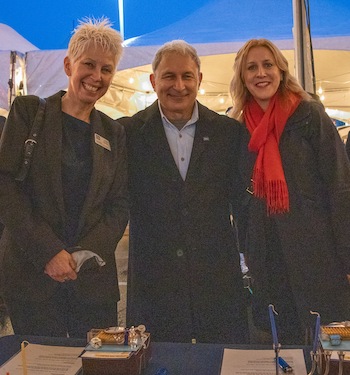
photo - Vancouver Park Board commissioner Tricia Barker, left, CIJA Pacific Region chair Geoffrey Druker and Vancouver city councilor Sarah Kirby-Yung
Vancouver Park Board commissioner Tricia Barker, left, CIJA Pacific Region chair Geoffrey Druker and Vancouver city councilor Sarah Kirby-Yung. (photo by Jocelyne Hallé)

The evening was geared around sharing the Chanukah experience with neighbours, bringing light to darkness and sharing Jewish customs. It was also a way to join together with others at the JCCGV, as it continues to plan for its redevelopment. Many of the leaders lighting candles with the Jewish community on Nov. 28 – both at the JCCGV and at the Lubavitch BC chanukiyah lighting in downtown Vancouver – share in the work and support of this community project.

Debbie Setton Tabenkin and the JCCGV programming and leadership teams created the Chanukah Market’s festive space and the JCCGV’s Chanukah programs were financially supported by a Canada Heritage grant. Many volunteers helped CIJA and CJPAC organize the candlelighting ceremony.

For more information, visit cija.ca, cjpac.ca and jccgv.com.

– Courtesy CIJA, CJPAC and JCCGV

Format ImagePosted on December 17, 2021December 16, 2021Author CIJA, CJPAC and JCCGVCategories Celebrating the HolidaysTags Canadian Jewish Political Affairs Committee, Centre for Israel and Jewish Affairs, CIJA, CJPAC, education, interfaith, JCC, JCC Chanukah Market, Jewish Community Centre, neighbours, politicians

Posts pagination

Previous page Page 1 Page 2 Page 3 Page 4 … Page 10 Next page
Proudly powered by WordPress