Skip to content
  • Home
  • Subscribe / donate
  • Events calendar
  • News
    • Local
    • National
    • Israel
    • World
    • עניין בחדשות
      A roundup of news in Canada and further afield, in Hebrew.
  • Opinion
    • From the JI
    • Op-Ed
  • Arts & Culture
    • Performing Arts
    • Music
    • Books
    • Visual Arts
    • TV & Film
  • Life
    • Celebrating the Holidays
    • Travel
    • The Daily Snooze
      Cartoons by Jacob Samuel
    • Mystery Photo
      Help the JI and JMABC fill in the gaps in our archives.
  • Community Links
    • Organizations, Etc.
    • Other News Sources & Blogs
    • Business Directory
  • FAQ
  • JI Chai Celebration
  • JI@88! video

Recent Posts

  • BGU fosters startup culture
  • Photography and glass
  • Is it the end of an era?
  • Taking life a step at a time
  • Nakba exhibit biased
  • Film festival starts next week
  • Musical with heart and soul
  • Rabbi marks 13 years
  • Keeper of VTT’s history
  • Gala fêtes Infeld’s 20th
  • Building JWest together
  • Challah Mom comes to Vancouver
  • What to do about media bias
  • Education offers hope
  • Remembrance – a moral act
  • What makes us human
  • המלחמות של נתניהו וטראמפ
  • Zionism wins big in Vegas
  • Different but connected
  • Survival not passive
  • Musical celebration of Israel
  • Shoppe celebrates 25 years
  • Human “book” event
  • Reclaiming Jewish stories
  • Bema presents Perseverance
  • CSS honours Bellas z”l
  • Sheba Promise here May 7
  • Reflections from Be’eri
  • New law a desecration
  • Resilient joy in tough times
  • Rescue dog brings joy
  • Art chosen for new museum
  • Reminder of hope, resilience
  • The national food of Israel?
  • Story of Israel’s north
  • Sheltering in train stations

Archives

Follow @JewishIndie
image - The CJN - Visit Us Banner - 300x600 - 101625

Tag: CIJA

Antisemitism allowed?

An ongoing controversy in Canada’s largest school district took a more bizarre turn this week.

Last spring, the student equity advisor of the Toronto District School Board compiled and released a compendious assemblage he called “resources to educators.” The materials, issued via email by Javier Davila, were a hodgepodge of anti-Israel propaganda, and included outright antisemitic content and the glorification of suicide bombings.

The “resources,” for example, claim that Palestinians “have been legitimately resisting racism, colonization, and genocide since the 1920s to the present day by any means necessary: general strikes, demonstrations, armed struggle, and martyrdom operations (called ‘suicide bombing’ by Zionists).” Davila’s materials also included a link to the website of the Popular Front for the Liberation of Palestine, a group that is banned in Canada. Bibliographical recommendations include children’s books that characterize Israelis as thieves and murderers.

The materials Davila distributed are intended to guide teachers in educating students about the Arab-Israeli conflict. They were not vetted by senior officials in the school board and, when controversy ensued, Davila was put on leave but then reinstated. Despite the absence of even a slap on the wrist, he moderated a panel in June with the tagline “How can we educate about Palestine if we can’t even say it?”

Not only is Davila free to “say” Palestine, he is also, evidently, free to distribute whatever material he chooses to Toronto teachers. Which brings us to this week.

Alexandra Lulka is a Toronto school trustee who is Jewish and represents a heavily Jewish district of the city.

“I was outraged to discover that some of this material justifies suicide bombings and other forms of terrorism,” she wrote on social media during the conflict in the spring between Israel and Hamas in Gaza. “This is reprehensible. These materials were provided by an employee from the TDSB equity department, the very department that should be countering antisemitism and violence, not fanning the flames.”

The school board’s integrity commissioner investigated Davila’s materials and found they did indeed contain antisemitic content and promote terrorism – and then called for Lulka to be censured because, the commissioner’s investigation declares, it was the purview of the school board, not Lulka, to determine whether the content was unacceptable. The commissioner went further, condemning Lulka for not pointing out positive aspects of Davila’s “resources.”

The Centre for Israel and Jewish Affairs criticized this part of the situation in particular.

“It is astonishingly unreasonable to compel a Jewish trustee calling out Jew-hatred to also highlight positive elements in the resources. The recommendation to censure her for not doing so is misguided and must be rejected,” said CIJA’s vice-president Noah Shack in a statement. “Punishing Trustee Lulka is contrary to the values of an educational institution purporting to engender learning and mutual respect.”

Friends of the Simon Wiesenthal Centre also drew a contrast between what should have happened and what did happen.

“This outrageous process against TDSB Trustee Alexandra Lulka is just the latest manifestation of the institutional antisemitism afflicting the TDSB,” said Jaime Kirzner-Roberts, the centre’s director of policy. “Not only is the investigation and its findings unjust, but it’s ridiculous that the person who calls out a transgression is being punished but the person responsible for the transgression was not.”

We are familiar, by now, with antisemitism being downgraded by the very people who are appointed (or self-appointed) to monitor and combat racism and bigotry. The Toronto case, which presumably will have been decided Wednesday (after the Independent goes to press), is a step beyond. It threatens to condemn the very people who stand up against antisemitism, even as a perpetrator of what the integrity commissioner acknowledges was anti-Jewish racism gets off scot-free.

This outcome is problematic, not only for the potential danger it presents to Jewish students in Canada’s largest school district. It encourages teachers to miseducate students on a sensitive and complex international issue with very real consequences for intercultural harmony here at home.

Editorial Note: After the Jewish Independent went to press, the TDSB voted to not censure Lulka. For the full story, see thecjn.ca/news/alexandra-lulka-tdsb.

Posted on December 10, 2021December 10, 2021Author The Editorial BoardCategories From the JITags Alexandra Lulka, antisemitism, Centre for Israel and Jewish Affairs, CIJA, Friends of Simon Wiesenthal Centre, FSW, Israeli-Palestinian conflict, Javier Davila, Jew-hatred, politics, TDSB, Toronto, Toronto District School Board

Help in facing antisemitism

Canada recently made several important commitments to the Jewish community, with plans to target hate and fund initiatives to educate and fight antisemitism. While good news, for some of us, these also feel like vague promises. Many of us have felt vulnerable because of our Jewish identities. It has gotten worse recently, with a sharp rise in both physical violence and hate online.

This fall, I signed up for a virtual program run by the Jewish Federation of Winnipeg, featuring Rabbi Matt Liebl in conversation with Centre for Israel and Jewish Affairs (CIJA) chief executive officer Shimon Koffler Fogel. The event was called Antisemitism in Canada: Pushing Back against Hate. The conversation was intellectual and insightful but, when it ended, I was unsatisfied. The overall message was that perhaps 80% of the antisemitic events in Canada were due to ignorance. To fix this, we must educate people. So, I asked a question during the Q&A period. It was something like, “What resources are available to us, as we go forth to educate, both online and in the Canadian context?”

The answer didn’t meet my needs, although it wasn’t wrong, either. Koffler Fogel responded by first saying that the internet (Facebook, etc.) had no borders, so we needed better Canadian policy and international law around hate online. Second, he suggested that “we” older folks had no real power to stop this antisemitic stuff on social media, but that, if it was possible to enlist some 17-year-old influencers, they could help.

Right, I’m just a middle-aged nobody. I’m no big name social media influencer. However, as a Gen Xer, I’ve lived with email since its infancy. I’ve been on the web for more than half my life. I’ve also been the target of hate online, as well as through the (far more retro) postal service and telephone. Some might say this is because I write on Jewish topics, but I’m just not that famous. Right after I moved to Canada, my Winnipeg house was egged on Chanukah when somebody saw the menorah in the window. I wasn’t even writing Jewish articles here yet, and I doubt the people who egged my house had read any of the ones published in the United States.

I could produce a list of bad experiences that occurred before moving to Canada, and these had nothing to do with being “public” about my Jewish identity. Yet, too much has happened since moving here in 2009. Recent attacks on social media this spring and summer, including being harassed and banned by a Canadian knitwear designer who strongly supported Palestinian issues, weren’t my first Canadian antisemitic experiences. I’ve mostly kept this to myself, even though the harassment was scary and painful. These attacks were directed towards me because I’m Jewish and spoke up for Israel’s right to exist. I was harassed even though I don’t vote in Israel and don’t always agree with Israel’s policies. Being Jewish and speaking out was enough.

The October anniversary of the Pittsburgh Tree of Life shootings reminded me of what greeted my family that awful Sunday morning in 2018. My kids and I went to a playground near where a lot of Jewish families live. It was easy to see an enormous swastika and other hate graffiti on the side of the nearby swimming pool building. The senior citizens, many of them Jewish, living across the street in apartment buildings, could see those hate symbols, too.

When my twins were done playing, I walked them, one holding each hand, indoors to the pool front desk to report the swastika graffiti. I then drove home and spent way too long trying to report what was obviously a hate crime to the police, the B’nai Brith and one of my editors at the time. The worst part was hearing, “Well, did you take photos?” The answer was no. I didn’t have a third hand to let go of my kids and take photos, which would have signaled to them how very distressed I was. It was another chance to feel isolated, vulnerable and angry. Not only did I experience the hate but, apparently, I should have documented it (to prove it existed) and take on the task of reporting it multiple times. The graffiti was cleaned up but, for me, the hateful message lingered.

After the virtual CIJA/Jewish Federation event, there was a follow-up note with a couple of links. One offered an entire page of antisemitism resources to read. Another link was “Report an antisemitic incident.” While I deeply appreciated the form online as being easier than what I’ve gone through previously when trying to report hate, the form didn’t say where the submitted information went. It didn’t suggest what supports were available. It didn’t say who would read submissions or when. I contacted the Winnipeg Jewish Federation to ask that this be added to the site but haven’t received a reply.

For me, the worst part of dealing with hateful messages, graffiti, assault or social media attacks is feeling alone and unsafe. Maybe most antisemitism comes from ignorance. That doesn’t make it any less hurtful or intimidating.

So, what are solutions? Yes, we need to educate others and invest in better laws and in security for Jewish institutions. We also need to invest in ourselves. Advocacy organizations and community institutions should be part of the solution. Give everybody useful tools and information for how to combat hate – because we never know who will need it next.

Also, let’s follow up and support those in our community who have faced hateful incidents. We may never erase all the hate in our midst, but our communities can offer better security, kindness, counseling or, heck, a (COVID-safe!) hug to those who experience antisemitism.

We need non-Jewish allies, too. Intellectually, I know that these incidents – graffiti, the egg on my window and even reporting a threatening email to the police – were not a big deal. These incidents can shake us up anyway. If those affected by hate crimes feel afraid, isolated and vulnerable, we can help by showing up for one another more consistently. There’s safety in numbers. Next time somebody submits one of these antisemitic incident forms, here’s hoping a friend in the community follows up, too. We can deal with the after-effects when we’re not alone. We can do that for one another. It’s time to try.

Joanne Seiff has written regularly for CBC Manitoba and various Jewish publications. She is the author of three books, including From the Outside In: Jewish Post Columns 2015-2016, a collection of essays available for digital download or as a paperback from Amazon. Check her out on Instagram @yrnspinner or at joanneseiff.blogspot.com.

Posted on November 5, 2021November 4, 2021Author Joanne SeiffCategories Op-EdTags antisemitism, Centre for Israel and Jewish Affairs, CIJA, identity, Jewish Federation of Winnipeg, lifestyle, Matt Liebl, Shimon Koffler Fogel

Election amid chaggim

Much has been made of the challenges facing Canadians as the country engages in its 44th federal general election while still in the grips of a pandemic. For Jewish voters, the succession of holidays in the weeks leading up to the Sept. 20 election makes scheduling events like community forums with candidates extra confounding.

Nevertheless, the Centre for Israel and Jewish Affairs (CIJA), along with partner agencies, will present a number of events across the country. Here in Metro Vancouver, there will be a virtual town hall on Sept. 14, 4 p.m., co-presented, as is tradition, with SUCCESS, the United Chinese Community Enrichment Services Society. Topics addressed will include racism and hate crimes; seniors’ care; post-pandemic economic recovery; immigrants and refugees; safe and healthy communities; and the sustainability of charitable and nonprofit organizations.

Two days earlier, on Sept. 12, a Richmond-focused virtual town hall will take place at 5 p.m., co-presented by CIJA and the Kehila Society of Richmond.

Tucked in between, on Sept. 13, is a national town hall, presented virtually from Toronto, again hosted by CIJA, this time in partnership with The CJN. All events are accessible from the website cija.ca/election.

Locally on Sept. 13, there is an all-candidates meeting on seniors issues for the ridings of Vancouver Granville and Vancouver South, co-hosted by Jewish Seniors Alliance. To register for it, visit jsalliance.org.

CIJA also has released a federal issues guide, outlining what it considers to be priorities on matters of domestic and foreign policy.

Among the recommendations is a request to supplement the Security Infrastructure Program, which provides funds to enhance security at institutions such as synagogues and community centres, with a program modeled after the Community Security Trust in the United Kingdom, which trains volunteers to provide patrols, situational awareness and threat prevention.

The guide urges amending the criminal code to make Holocaust denial an indictable offence and developing a standardized national social studies curriculum on antisemitism and the Holocaust.

The document, which is downloadable from the CIJA website, calls on the next government to address online hate through education and enforcement, including a social literacy campaign to “sensitize Canadians to the potent role social media plays in bullying, harassment, intimidation, dissemination of hate, and threats.” It calls for reestablishing provisions in the Canadian Human Rights Act to combat hate speech and strengthening Canadian tax laws to prohibit charities from promoting or inciting antisemitism or violent extremism.

The foreign affairs section calls on the government to ensure that Canadian humanitarian aid to Palestinians “goes where it is intended” and to oppose one-sided United Nations resolutions singling out Israel. It also calls on the government to demand that the Palestinian Authority stop the “paid to slay” program that rewards terrorism. It also calls for putting pressure on Iran until it “demonstrates meaningful improvements in comes into full compliance with its international obligations.”

Other CIJA recommendations include:

  • Implementing the United Nations Declaration on the Rights of Indigenous Peoples “as an important step toward truth and reconciliation.”
  • Putting pressure on Eastern European countries “that have evaded their responsibility to pass meaningful restitution laws” for Holocaust survivors and their descendants.
  • Strengthening immigration and refugee policies particularly to support those targeted for their identity, such as Christians and Yazidis in Iraq, LGBTQ2+ people in Chechnya and Iran, and Rohingyas in Myanmar.
  • Reintroducing the question about religion in the census “to prevent continued underreporting of Jewish Canadians.”
  • Ending the three-month celibacy requirement for LGBTQ2+ blood donors.

The full document is downloadable at cija.ca/election.

The Canadian Jewish Political Affairs Committee (CJPAC) is also busy during the campaign.

CJPAC engages “Jewish and pro-Israel Canadians in the democratic process” and helps community members build relationships within the Canadian political arena. Their website, cjpac.ca, has links to all major political parties, as well as links to volunteering and getting involved in campaigns. There is a final volunteer training webinar available at noon Pacific time on Sept. 13.

For information on your riding, where to vote and a list of candidates, go to the Elections Canada website at elections.ca.

Posted on September 10, 2021September 9, 2021Author Pat JohnsonCategories Local, NationalTags Canada, Canadian Jewish Political Affairs Committee, Centre for Israel and Jewish Affairs, CIJA, CJPAC, elections, Jewish Seniors Alliance, JSA, politics

Get involved in election

Canadian elections do not generally pivot on issues of foreign affairs. Yet, the split screen image Sunday of Justin Trudeau calling a federal election juxtaposed with images of the Taliban seizing control of Afghanistan was a stark one. Canada left Afghanistan in 2014, having joined an international coalition after 9/11 to attempt to bring the terrorists who found free rein in that country to heel.

The remaining American forces were slated to leave this month, with U.S. military officials candidly acknowledging that their departure would almost certainly result in a Taliban revival. They were wrong only about the timing. Estimates were that it might take the fundamentalist Islamist sect weeks to take back the country. It took mere days.

The implications for Afghan citizens are bleak. Desperate Afghans were hopelessly clinging to U.S. military aircraft taxiing on the runway at Kabul airport. Afghan women will, based on prior experience under the Taliban, become some of the most oppressed in the world. There are also expectations of violent retaliation against anyone and everyone who, in the past two decades, “collaborated” with Western forces. The possible scenarios for Afghan people are horrible to envision.

And the implications go beyond the borders of that country. Optimists, such as they may be on this subject, say that the 20-year Western engagement in Afghanistan has not been for naught. The United States captured Osama Bin Laden and has not experienced another 9/11-type terror attack in that period, though whether Americans are actually safer, with other forms of domestic extremism and violence on the rise, is another question. Regardless, in a region with so much instability and contending factions, the Afghan situation further disrupts an already deeply troubled part of the world.

We may not immediately see the consequences of what is happening halfway around the world, but already domestic politics are being affected by the developments. Canadian military planes are rescuing interpreters and others who assisted our forces when they were in Afghanistan. There are calls for Canada and other Western places of refuge to accept more refugees from what seems destined to become a theocratic dystopia. But we cannot, apparently, save the entirety of the Afghan people and their country from the grips of their oppressors. Western powers held the Taliban at bay for 20 years but understandable domestic pressures to put a halt to “endless wars” inevitably brought us to this point.

This week’s election call comes amid a conflagration much closer to home as well. British Columbia is seeing wildfires and weather events unlike anything we have witnessed before. The hypothetical impacts of the climate emergency have gotten very, very real for Canadians with any sense of cause and effect. Appropriately, opinion polls suggest that Canadians view climate and the environment as a top – if not the top – issue as they ponder for whom to cast their ballots.

One problem with democracy is that those who seek public approval are disinclined to tell voters things they do not want to hear. Canadians (and other earthlings) need to understand that this crisis demands that our leaders impose potentially painful policies that will impact our emissions-producing lifestyles. We say we need to address the climate emergency, but will we be so enthusiastic when it impacts our own pocketbooks and comfortable routines?

One might imagine that scenes of the province on fire might make voters look seriously, finally, at a political party with the climate as its No. 1 priority. But the Green Party of Canada has been in turmoil since the Israel-Hamas conflict last spring. Annamie Paul, the Jewish, Black leader of the party, has been fighting an internal battle against insurgents in her own ranks. We hope that her voice will be heard and that all parties will take this existential issue with utmost seriousness.

The continuing pandemic will play a role in this campaign as well – both as Canadians assess the achievements of our government during the crisis and, more immediately, in the way candidates and campaigns pursue votes while adhering to safety protocols. The parties should be judged on what kind of COVID recovery plan they propose, and how they intend to follow through on supporting the most vulnerable Canadians through this health, economic and social crisis.

Whatever issues are important to you, this is the time to make your voice heard. Consider reaching out to your local candidates. Discuss your concerns with them. Volunteer for or contribute to their campaign if you like what you hear – consider connecting through the Canadian Jewish Political Affairs Committee. The Centre for Israel and Jewish Affairs distils information about various party platforms and policies. Our country and our world face urgent issues. An informed, active electorate is the key to ensuring that our elected officials reflect the concerns that matter most to us.

Posted on August 20, 2021August 19, 2021Author The Editorial BoardCategories From the JITags Afghanistan, CIJA, CJPAC, COVID-19, elections, geopolitics, pandemic, policy, politics
Hate not acceptable at SFU

Hate not acceptable at SFU

“Antisemitism is hate, and it is not acceptable at SFU,” said Simon Fraser University president and vice-chancellor Joy Johnson. (photo by Jeff Hitchcock / flickr)

The president of Simon Fraser University met with Jewish students recently and issued a statement condemning antisemitism on campus and directing those who experience anti-Jewish racism to appropriate resources.

After meeting with Jewish students, Joy Johnson, Simon Fraser’s president and vice-chancellor, tweeted on July 12: “Their experiences were deeply upsetting.”

“Antisemitism is hate, and it is not acceptable at SFU,” she added. “If you are experiencing discrimination or hate, help is available. Please reach out.”

The university, in consultation with the SFU Multifaith Centre and Hillel BC, created a resource for those who have experienced antisemitism. This includes links to campus chaplains, confidential counseling and critical incident support for significant events.

Like many university campuses, SFU has a history of anti-Israel activism that can often veer into antisemitic imagery and tropes. The latest eruption occurred at the first council meeting of a newly elected Simon Fraser Students Society. Occurring around the time of the most recent conflict between Hamas and Israel, the council meeting passed a resolution endorsing the boycott, divestment and sanction movement against Israel (BDS) in what Jewish students view as a biased and unfair meeting.

The student society’s resolution – titled “SFSS Response to the Israeli Colonization of Palestine” – accused Israel of “disproportionate violence,” claiming “worshippers at the Al-Aqsa Mosque were indiscriminately targeted by Israeli police forces” and condemning “the ongoing persecution of the Palestinian people by the government of Israel.” The resolution endorsed the BDS movement and expressed no parallel concerns about Palestinian terrorism, violence, incitement or human rights abuses. It also accused the United States and Canada of complicity in perceived Israeli misdeeds. The resolution passed unanimously.

The student society brought in Dalya Masri, a Palestinian activist, to provide “expert” testimony before the vote, said Katia Fermon, outreach coordinator for Hillel BC, the Jewish student organization.

“She gave a presentation, which was beyond hurtful for Jewish students,” said Fermon. Masri, she said, compared the First Intifada to the sort of peaceful rallies that happen on the streets of Vancouver.

“My students have family that died in the First and the Second Intifada,” Fermon said. “This is not a strange thing for us, and she just mentioned it like it was a rally.”

The presenter accused Israel of taking over territory in 1967, while eliding the larger facts around the Six Day War and other realities, she said.

Fermon said that, in preparation for the vote, the SFSS consulted with Independent Jewish Voices, but did not consult with Hillel.

“That fact is very hurtful,” she said. “Independent Jewish Voices is not a club on campus, however Hillel Jewish Students Association is. They pay their dues.… We are a part of that union. Those voices were not asked for or heard.”

Hillel BC issued a statement condemning the student society’s approach.

“Instead of supporting an open and extensive dialogue amongst students, the SFSS has chosen to perpetuate the agenda of a movement whose use of harmful terminology fails to address the root causes of the conflict, ignoring centuries of complex history in which power dynamics constantly shifted,” it reads. “This rhetoric further sows hate and division instead of helping work towards a peaceful two-state solution. The SFSS has decided to single out the state of Israel instead of opening a space for adequate dialogue between Jewish, Israeli and Palestinian students on campus wherein we may critique the policies of the state while being mindful of the hate that may result in endorsing certain statements, activists or movements.”

It added that BDS “openly traffics in antisemitic conspiracies and dog whistles” and noted that nearly two decades of BDS activism has not “freed Palestine from violence or oppression. Instead, it has been to stoke aggression and polarization online, in the streets and on campuses.”

In a statement to the Independent, Nico Slobinsky, director of the Centre for Israel and Jewish Affairs, Pacific region, said: “The statement by SFU’s president is an important step in denouncing the rising tide of anti-Jewish hate on campus. CIJA thanks president Dr. Joy Johnson for recognizing that SFU is not immune from antisemitism. Combating anti-Jewish hatred is not only about protecting Jews but also about protecting the very fabric of our society, on and off campus.

“CIJA appreciates the strong friendship and commitment shown by Dr. Johnson to creating a campus that is inclusive, diverse, safe and open to all students,” Slobinsky added. “CIJA looks forward to working with SFU alongside our campus partner, Hillel BC, towards ensuring a healthy campus environment.”

Students have been studying remotely for more than a year and so most of the discussion, which has included a litany of offensive comments, has taken place on official and unofficial online platforms, including the primary undergraduate forum.

One Israeli student, who asked to remain anonymous, said she was one of a few who spoke up in opposition to the prevailing bias in the dialogue.

“I didn’t expect it to go smoothly,” she said. “There was a lot of backlash in the moment and it is still going on.… A lot of comments are being deleted and monitored but there are a lot of hateful comments.”

The statements frequently included slogans such as “From the river to the sea, Palestine will be free” and other comments promising the annihilation of Israel. Israel was compared with Nazi Germany, Rhodesia, apartheid-era South Africa and plantation-owning slaveholders. Concerns about the safety of Jewish people were dismissed as efforts to “stifle” legitimate criticism of Israel.

“As an Israeli, I don’t want to believe they said them personally to me,” the student said. “I try my best not to take all those comments personally, but sometimes it gets there.”

As she and other students prepare to return to campus this fall for the first time in more than a year, she said she is not concerned for her personal safety, but she is worried about some of her friends.

“I was born in Israel and I have a little bit of Israeli inside of me so, for myself, I’m not that worried,” she said. “Obviously, it’s not a nice experience.” Whether the online threats and vitriol turn into real-time incidents remains to be seen, she said, but some of her Jewish friends are already taking cover.

“They are not wearing their Star of David,” she said. “They never say out publicly that they are Jewish: to not get into a conflict, to avoid any debate on the matter, they just decided not to. I think it’s a shame…. It is a shame that we live in Canada in the 21st century and people are choosing to hide part of their identity. For myself, it’s a big chunk of my identity, so I’m not going to hide it, but I can’t blame people who choose to. I empathize with them.”

Format ImagePosted on July 23, 2021July 21, 2021Author Pat JohnsonCategories LocalTags antisemitism, BDS, CIJA, hate, Hillel BC, identity, Israel, Israeli-Palestinian conflict, Joy Johnson, Katia Fermon, Nico Slobinsky, Palestine, SFU, Simon Fraser University, students
Stepping up to confront hate

Stepping up to confront hate

Left to right: Jewish Federation’s Shelley Rivkin, CJPAC’s Kara Mintzberg and CIJA’s Nico Slobinsky spoke at an online event June 17 on topics including how individuals can help fight antisemitism in Canada. (PR photos)

Representatives from three Jewish communal agencies spoke at an online event June 17 on topics including online hate, adoption of the Working Definition of Antisemitism, strengthening supports for the investigation and prosecution of hate crimes, and how individuals can help fight antisemitism in Canada.

Shelley Rivkin, vice-president of local and global engagement at the Jewish Federation of Greater Vancouver, Kara Mintzberg, B.C. regional director for the Canadian Jewish Political Affairs Committee (CJPAC), and Nico Slobinsky, director of the Pacific region of the Centre for Israel and Jewish Affairs (CIJA), spoke about how their agencies are confronting the surge in antisemitism, as well as a range of other topics.

Dafna Silberstein, associate director of the Jewish Federation’s Israel and global engagement department, opened the evening.

“We are here tonight to understand the Canadian political process and learn how you can become more involved, how we can become engaged with a range of issues that matters to you and to our community, and to learn what our community organizations are doing to combat antisemitism,” she said.

Rivkin described Federation’s role as “our community’s primary convener.”

“We are an umbrella organization that represents over 25 organizations locally and an additional number of organizations, approximately 10, in our partnership region [in Israel’s Galil Panhandle] and globally,” said Rivkin.

Federation is the central fundraising arm of the community and runs programs and partners with other agencies to care for the most vulnerable. About one in six Jewish British Columbians lives in poverty, she said, including 13.4% of Jewish children. Federation is also critically involved in supporting Jewish day schools and ensuring continued provincial support for those institutions, she added.

Antisemitic incidents and threats have spiked in recent weeks, coincident with the conflict between Hamas and Israel. Rivkin said the relationships Federation has built with other ethnocultural agencies and communities have proven valuable.

“We have a long history of working side-by-side with other ethnocultural communities,” she said. “These relationships and the supports that we provide are very important so that, when we stand up and speak out on behalf of other ethnocultural organizations, we’re building the bridges and relationships so that they will stand up and speak out on our behalf. Especially this past month, we’ve been very proactive in reaching out to the Indigenous community and the Muslim communities, both of whom faced significant losses over this past month.”

Rivkin also noted Federation’s substantial investment – about $1 million annually – in community security.

“Hate crimes against our community remain one of the highest reported crimes in Canada,” she said. “That was why, in 2016, we made the decision to invest in a director of security that is available and responsive to all of our community organizations, in particular those organizations that have stand-alone facilities.”

Slobinsky explained that CIJA represents hundreds of thousands of voices affiliated with Jewish federations across the country.

“Combating antisemitism, educating Canadians about the central role that Israel plays in Jewish life, strengthening the ties between Canada and Israel and ensuring that Jewish voices are represented in the discussion on a range of issues is some of the long-term work that CIJA does,” he said.

Because of CIJA’s lobbying, he said, the federal government has announced an emergency summit on combating antisemitism, to be led by former justice minister Irwin Cotler.

CIJA also promotes the adoption by governments of the International Holocaust Remembrance Alliance Working Definition on Antisemitism, which Slobinsky calls “the gold standard definition for antisemitism” and a vital tool in fighting antisemitism in Canada and around the world.

“For the first time in our history, we have a definition [of antisemitism] that we as a community champion, that the Canadian government has adopted and now Ontario, New Brunswick and Quebec have adopted,” Slobinsky said. “It’s a very useful tool to work with our elected officials, law enforcement, our partners in other communities, when they ask us what is antisemitism, how do you experience antisemitism, how it manifests.… We are defining what our own discrimination, our own oppression, looks like.”

CIJA is also calling on federal and provincial governments to increase supports for existing hate crime teams in British Columbia and to initiate teams to investigate and prosecute hate crimes in jurisdictions where investigation teams do not yet exist.

Of CJPAC, Mintzberg said: “We are all about political engagement.”

“Our focus is on getting our community interested and involved in politics through volunteering and building relationships with elected officials,” she said. CJPAC, she emphasized, is not involved in lobbying or advocacy; that’s CIJA’s job. “We create programs that reflect the mandate of engagement and highlight the importance of getting involved in Canada’s political process.”

Jewish voters have a significant presence in only about 10 of the country’s 338 ridings. Especially during elections, Mintzberg said, CJPAC acts as a “political concierge,” connecting volunteers with candidates. As Canada is currently governed by a minority government, an election could come at any time. She calls on community members to step up now and be prepared when that call comes.

Mintzberg asked that people pledge to volunteer in the next election and participate in a free, one-hour online training course, which can be accessed via cjpac.ca. Slobinsky invited participants to visit cija.ca/takeaction to find ways to mobilize against antisemitism and support other topics on CIJA’s agenda.

Format ImagePosted on June 25, 2021June 24, 2021Author Pat JohnsonCategories LocalTags antisemitism, CIJA, CJPAC, Jewish Federation, Kara Mintzberg, Nico Slobinsky, politics, Shelley Rivkin

Push back against antisemitism

The last three weeks or so have been a trying time for the Jewish community both in and out of Israel.

An 11-day onslaught of terrorist missiles sent thousands to bomb shelters or to their building stairways while the Iron Dome took down 90% of the missiles from the sky. Some got past, however, and 11 Israelis, Jewish and not, died. The loss of innocent life – both Palestinian and Israeli – is heartbreaking.

In the Diaspora, we hoped that a tense political situation would not turn into something worse. When it did, we watched the videos of missiles launched, of buildings hit, of funerals held – and of a country protecting itself and its people.

We then braced for the public opinion backlash. While Israel defended itself from more than 4,000 missiles fired from civilian neighbourhoods into civilian neighbourhoods, we were told by news outlets and celebrities on talk shows and social media that Israel’s actions – in which it went to extreme lengths to target only terrorist assets – were unjust.

I believe that Israel has a right to defend itself. I believe that Israel has a place in the Middle East, and I see it increasingly accepted by its neighbours. I believe Israel has much to offer the world.

Zionist is not a dirty word. I am an unapologetic Zionist. I stand with Israel. I believe in our people’s history, collectivity, peoplehood and right to self-determination.

Grievances with government policy do not give licence to question Israel’s right to exist. I do not believe that anti-Israel equals pro-Palestinian; if it did, then those burning Israeli flags in the streets would be calling for peace, or for a two-state solution, not to “globalize the intifada.”

In Gaza, Hamas – a listed terrorist entity in Canada, the United Kingdom, the United States and the European Union – remains a barrier to peace. I believe Palestinians deserve better. I believe that Palestinians are entitled to equal rights and to self-determination. This is not at odds with my Zionism.

I believe that anti-Zionism, as defined by the International Legal Forum as “the prejudice against the Jewish movement for self-determination and the right of the Jewish people to a homeland in the state of Israel,” can itself be antisemitic and create a climate that allows antisemitism to fester.

Across the world, we are witnessing a horrific surge in antisemitism in connection with the conflict. In the United States, Jews have been chased down and beaten. In the United Kingdom, there were chants to “rape their [Jewish] daughters” and antisemitic incidents have risen almost 500%.

Canada is not immune. Recently, in Montreal, peaceful pro-Israel demonstrators were pelted with rocks. In May, Toronto experienced a 500% spike in antisemitic incidents compared to last year. Nazi symbols were spotted at anti-Israel demonstrations across the country, including in

aOttawa and London. In Vancouver, we saw a Jewish business owner being harassed and threatened, and an increase in hateful posters and graffiti. The recent spate of antisemitism has also spread online. There are numerous incidents of Jewish students bullied, businesses targeted, and many others harassed.

While my phone explodes with messages from family and friends asking how to respond to hateful social media posts and vicious videos and memes, it is easy to feel cornered. It is easy to assume that public opinion equals the right opinion, but a simple understanding of history reminds us that it does not.

We must speak out and push back against this rising tide of antisemitism.

We know that what starts with the Jews never ends with Jews. Combating antisemitism is not only about protecting Jews but also about protecting the very fabric of Canadian society. Thousands across Canada are joining the Centre for Israel and Jewish Affairs (CIJA) in calling for the federal government to convene an emergency summit on antisemitism – a forum to discuss enhancements to community security, education for youth about Jewish history, suffering and triumphs, and a Canada-wide campaign for social media literacy. Join our call to action at fightit.ca.

Neither Israel nor its supporters are perfect. Nobody is. The disproportionate criticism toward the Jewish state is unwarranted. Israel must, and will, stand by its principles, which are – not coincidentally – those same principles that gave rise to Western societies. As long as it does, I will stand with Israel, and you should, too.

Judy Zelikovitz is vice-president, university and local partner services, Centre for Israel and Jewish Affairs (CIJA).

Posted on June 11, 2021June 10, 2021Author Judy ZelikovitzCategories Op-EdTags anti-Zionist, antisemitism, Centre for Israel and Jewish Affairs, CIJA, Hamas, Israel, terror, Zionist
CIJA calls on feds to act now

CIJA calls on feds to act now

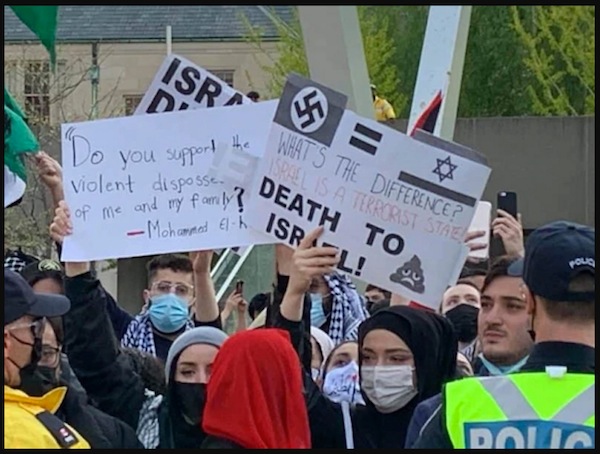
Signs shown at a recent rally in support of Palestine. (screenshot from cija.ca)

The Centre for Israel and Jewish Affairs is calling on the federal government to expand supports for Jewish communal security after a surge of antisemitic violence and vandalism in Canada, and to launch an emergency summit on antisemitism.

Shimon Koffler Fogel, CIJA’s chief executive officer, made the request in a meeting with senior staff from the prime minister’s office and Liberal cabinet ministers and members of Parliament May 20. Later that day, he spoke at a virtual event billed as a national Canadian Jewish community briefing, called Learn, Mobilize, Act: Keep the Conflict Out of Canada.

“We are calling on the prime minister to convene an emergency summit on antisemitism that will include the political leadership at both the provincial and municipal levels, a true all-of-government effort, and establish a comprehensive program to combat Jew-hatred, the oldest and most enduring hate the world has ever experienced,” he said.

CIJA also wants a complementary program to the Security Infrastructure Program, “that enhances the capacity of our community to take ownership of our own security.”

He spoke just hours after Israel announced a ceasefire in its most recent battle with Hamas.

“As we express hope for a durable ceasefire to take hold and an end to the conflict there, we are painfully aware that the battle has moved to our country, to our communities from coast to coast,” Fogel said. “It’s been frightening but we dare not cower and hide. It’s been disturbing, but we dare not be intimidated from asserting our identity, who we are and what we are, and in doing so with pride…. Our adversaries seek not only to erase our ties to the land and history of Israel, they seek to erase the presence of Jews altogether.”

He lauded the additional attention to racial justice that has emerged in recent years. “But, along with the good of that movement has come a contaminated strain that reduces everything to a simple equation of the oppressed and the oppressor, and Jews have been declared the poster child of the oppressors, so they must be rejected and vilified,” said Fogel.

Joel Reitman, co-chair of CIJA, opened the event.

“Over the past two weeks, we have watched with shock as our fellow Jews in Israel have been subjected to attack at the hands of Hamas, a terrorist organization bent on the destruction and the obliteration of the Jewish state of Israel and the murder of Israelis,” said Reitman. “Our sorrow and compassion is extended also to Hamas victims in Gaza, where Hamas has embedded its terrorist infrastructure within densely populated areas, deliberately putting the people of Gaza in harm’s way and where one-third of Hamas missiles have fallen, taking many innocent lives.

“Our outrage has deepened as the violence on our television screens has spilled over into violence and threats of violence directed against the Jews in our streets, in our communities, online and in our places of business, our schools and our houses of worship,” continued Reitman. “Never has it been more clear that Jewish people, whether we live in Canada or in Israel, must stand as one. Never has it been more clear that the ancient hatred of antisemitism does not distinguish between a Jew in Tel Aviv at or a Jew in Toronto. We are all targets…. We will not be intimidated. We will not be discouraged. We will call out the perpetrators of violence and we will call on our many friends to stand with us and we will act together. Together with our fellow Canadians right across this country, we say, enough. We know where antisemitism leads if left unchecked. We know what must be done to stop it. And, together, stop it we will.”

Naomi Rosenfeld, executive director of the Atlantic Jewish Council, said it has been a scary few weeks to be a Jew.

“With all this hatred and fear,” she said, “I hope that we all remember three things. One, it has never been more apparent why we need Israel and why we need a strong Jewish state. Two, if any of you have been going through any of the things that I’ve mentioned, please know that you are not alone. We stand together, a community here to support one another through each of these events. And, finally, as a national Canadian Jewish community, we must remain strong and resilient. We will not cower to fear and we will not hide our true identities and who we are.”

Dr. Gil Troy, professor of history at McGill University and an author of several books on Zionism, spoke of being a parent of two members of the Israel Defence Forces and the betrayal he felt to read a letter signed by 180 rabbinical students comparing the racial reckoning in the United States in recent years directly to the Israeli-Palestinian conflict.

“We’re told again and again, especially by my friends in the United States, too many of my Jewish friends in the United States, that this is a racial issue between the white Israelis, the white privileged Israelis, and the brown Palestinians,” said Troy. “And we are told that the cause of this latest conflict is Israeli provocations.… We all know that the underlying cause of this is the refusal of Hamas, the refusal of Islamic Jihad, the refusal of the so-called moderate Palestinian Authority to accept the fact, 73 years after the establishment of the state of Israel, that the state of Israel exists.”

Jeff Rosenthal, the other co-chair of CIJA, asserted that “Jews and only Jews have the right to define what constitutes antisemitism.” He said, “We’ve always known that there is no distinction between anti-Zionism and antisemitism. Our lived experiences and the experiences of our forefathers and ancestors confer a unique alertness to this threat.”

He called on viewers to mobilize and directed people to the Action Centre on the website cija.ca.


Format ImagePosted on May 28, 2021May 27, 2021Author Pat JohnsonCategories NationalTags anti-Zionism, antisemitism, Atlantic Jewish Council, Centre for Israel and Jewish Affairs, CIJA, Gil Troy, Jew-hatred, Joel Reitman, McGill, Naomi Rosenfeld, politics, security, Shimon Koffler Fogel, violence

Summit on online hate

Martin Luther King III and Arndrea Waters King delivered the keynote address at the Action Summit to Combat Online Hate, April 14 and 15. The son and daughter-in-law of the late civil rights leader Martin Luther King Jr. have both been deeply involved for many years in fighting racism, antisemitism and all forms of discrimination.

The summit was organized by the Canadian Coalition to Combat Antisemitism, an initiative of the Centre for Israel and Jewish Affairs, and funded by the Government of Canada.

King reflected on the legacy of Black-Jewish alliances in the civil rights movement and quoted his late father’s words: “Rabbis of Jewish congregations took their places on the frontlines as the Old and New Testament ethic of social justice flamed with a fire that had once transformed the world.”

King has worked in Israel and Palestine, educating young people to advance nonviolent resolutions to conflict.

“It was a wonderful experience and everywhere I went I experienced great hospitality and kindness from the people of Israel,” he said. “My father and mother, Coretta Scott King, were very concerned about the spread of antisemitism, racism and all forms of hatred, prejudice and bigotry, particularly among young people. Both of my parents made a commitment to doing everything that they could to help educate people about their shared vision for greater interracial understanding, cooperation and goodwill. Long after my father was assassinated, my mother continued to speak out against antisemitism and remain active in building the Black-Jewish coalition of social justice and human rights in Atlanta and throughout the world.”

Waters King worked for years at the Centre for Democratic Renewal, an organization that monitors and reports on hate groups, also delivering a broad range of educational programs to combat hate groups in the spirit of nonviolence that empowered the American civil rights movement.

“I have learned that the proponents of hate never sleep and our struggle against racism, antisemitism and all forms of bigotry and prejudice must remain ever-vigilant. What we can and must do is declare war on the ignorance that fuels hatred and the only known and proven cure for ignorance is education.”

King spoke about the advent of technologies over the past decades that hate groups have used to disseminate their messages. “But let’s remember that this communications revolution we have all lived through also gives us powerful tools to combat online hate,” he said.

The summit also featured keynote presentations by Katharina von Schnurbein, European Commission coordinator on combatting antisemitism, and Steven Guilbeault, federal minister of Canadian Heritage. More than three dozen others participated in two days of sessions, lectures, workshops and panel discussions. The Kings’ presentation is available online at actionsummit.ca.

Posted on May 7, 2021May 7, 2021Author Pat JohnsonCategories NationalTags Action Summit, anti-racism, antisemitism, Arndrea Waters King, Centre for Israel and Jewish Affairs, CIJA, government, Martin Luther King III
B.C. observes Yom Hashoah

B.C. observes Yom Hashoah

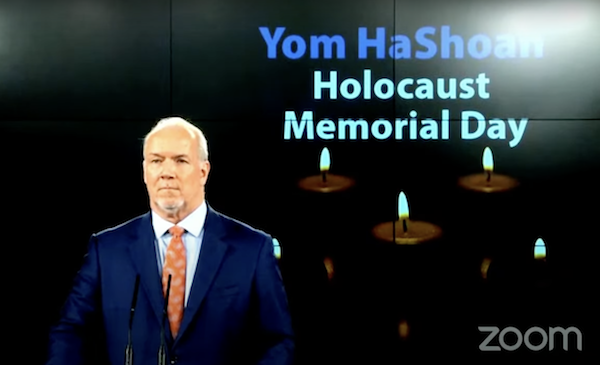
B.C. Premier John Horgan opened the commemorative event. (screenshot)

A uniquely British Columbian virtual commemoration of Yom Hashoah, Holocaust Remembrance Day, took place April 8, convened by the Government of British Columbia in partnership with the Vancouver Holocaust Education Centre (VHEC) and the Centre for Israel and Jewish Affairs, Pacific Region.

Premier John Horgan opened the event.

“On Yom Hashoah, we remember the six million Jewish lives that were lost during the Holocaust. We also remember and honour the millions who lost their lives or were murdered because of their ethnicity, sexual identity or disability,” said the premier. “Today, we also pay tribute to Holocaust survivors and, as that community grows smaller, it’s all the more important that we work together to carry that message forward – that we will never forget and it will never happen again, especially in light of the ongoing threats of violence and discrimination Jewish people are facing worldwide today.”

Horgan noted an incident in Victoria where a Chabad centre was defaced with antisemitic graffiti a day earlier.

“These are the types of acts we must stand together and fight against with a united voice, regardless of where we come from, regardless of our orientations or ethnicities or our faith. We must stand against antisemitism and racism whenever we see it,” said Horgan. “As we light the candles at Yom Hashoah in remembrance, we must remain vigilant and, as we take action today and honour those who lost their lives and those who have struggled since the Holocaust, we must again remember that we cannot repeat our past.”

Michael Lee, MLA for Vancouver-Langara, also spoke.

“As the living memory of the Holocaust fades, the important act of remembering and coming together each year grows in importance,” he said. “It is our collective responsibility to ensure that we never forget and such a thing never happens again, because, sadly, this is not just about remembering history, but about standing together today against the racism, bigotry and antisemitism that still exists in our world.… As a community, now and every day, we must stand against these acts of hate and bigotry.

“Today, on Holocaust Remembrance Day, we are reminded of why it is so important to come together, to reflect and to ensure that the past is not forgotten. We must remember both the parts of this dark, dark history that we must not let be repeated and the acts of heroism that took place amid such tragedy. Even during a period of humanity’s darkest chapters, there was still good in the world, people who risked their lives to hide and save others from the Shoah. Amidst the horrors and atrocities, there were tales of love, hope and bravery, including with the many righteous among nations, people who demonstrated that light can triumph over darkness. Today, we reaffirm our commitment to never forget; remember the victims, the survivors and the heroes; and we pledge to build a better world in their memory.”

Dr. Robert Krell, founding president of the VHEC, lit six memorial candles. The premier lit a seventh candle “to honour the millions of Roma, Slavic, LGBTQ2+ and people with disabilities who lost their lives.”

Krell, speaking on behalf of Holocaust survivors, noted that 1.5 million of the six million Jews murdered in the Holocaust were children. An estimated 93% of Jewish children in Europe were murdered, which makes his survival extremely remarkable. The fact that both his parents survived, when more than 80% of Dutch Jews were killed, is additionally miraculous.

screenshot - Dr. Robert Krell spoke on behalf of Holocaust survivors
Dr. Robert Krell spoke on behalf of Holocaust survivors. (screenshot)

“I had lost all grandparents, uncles and aunts,” Krell said. “One first cousin remained. The war left its mark and I bear a special responsibility to remember what happened and try to derive lessons from that unfathomable tragedy. The tragedy was unique in its objectives, its focus and its ferocity. Jews were extracted wherever they resided, whether Paris, Prague or Vienna, whether city or countryside or the isles of Rhodes or Corfu. The enemy pursued us and tortured and murdered without mercy, without exception.”

While Dutch citizens remember the Canadian military’s role in liberating that country, Krell also noted Canada’s failure to save European Jews before the war.

Krell also addressed the issue of the International Holocaust Remembrance Alliance’s Working Definition of Antisemitism. Around the world, he said, 34 countries have adopted the definition, as has the province of Ontario.

“As a survivor who has been deeply involved in Holocaust remembrance and education, it strikes me as unconscionable not to accept the IHRA definition to assist us all in recognizing the signs and symptoms of the scourge of Jew hatred,” he said.

Yom Hashoah fell the day before the federal New Democratic Party convention that was to consider a resolution rejecting the IHRA definition. The matter never made it to the floor, but another resolution condemning Israel passed by an overwhelming margin.

“It is my hope that we will soon see the provincial government’s adoption of the IHRA definition of antisemitism,” said Krell.

Rabbi Dan Moskovitz of Temple Sholom also took up the issue of the antisemitism definition.

“The International Holocaust Remembrance Alliance’s definition of antisemitism is, I think, the tool that guides us in our work to combat anti-Jewish sentiments,” he said. “I want to urge our provincial government to join other jurisdictions in embracing the action that is required to combat both historical and contemporary hatred of the Jewish people.”

He added: “When we think of the death of a human being, we mourn the loss of the body and the soul, but, in my work, standing with too many grieving families at graveside, it is not the body that we miss most, that is merely the vessel for the soul, the part of that person that is unique in all the world,” he said. “That’s the part that we fall in love with and are forever changed by. The soul of another leaves an imprint on our heart. So, today, we remember six million murdered Jewish souls, their lives that have been extinguished, their dreams unrealized, their loves and relationships gone forever. We pray that those dear souls are comforted and embraced under the wings of God’s presence and that now, remembered so publicly, will never be forgotten.”

Moskovitz then chanted El Moleh Rachamim and a version of the Mourner’s Kaddish that includes the names of the Nazi death camps.

In addition to the B.C. event, the Vancouver Holocaust Education Centre also partnered on April 8 with the Neuberger Holocaust Education Centre in Toronto, the Azrieli Foundation, Canadian Society for Yad Vashem, Facing History and Ourselves, Friends of Simon Wiesenthal Centre, March of the Living Canada and UIA in a Canada-wide Yom Hashoah online program that included survivor testimony from individuals across the country and a candlelighting ceremony.

A day earlier, the VHEC partnered with the Montreal Holocaust Museum for a virtual program focusing on the importance of remembrance in the intergenerational transmission of memory. Survivors and members of the second and third generations spoke about their experiences. Video recordings of all three events are available at vhec.org.

Format ImagePosted on April 23, 2021April 22, 2021Author Pat JohnsonCategories LocalTags anti-racism, antisemitism, Centre for Israel and Jewish Affairs, CIJA, Dan Moskovitz, Holocaust, IHRA, John Horgan, Michael Lee, remembrance, Robert Krell, Vancouver Holocaust Education Centre, VHEC, Yom Hashoah

Posts pagination

Previous page Page 1 … Page 3 Page 4 Page 5 … Page 10 Next page
Proudly powered by WordPress