Skip to content
  • Home
  • Subscribe / donate
  • Events calendar
  • Business Directory
  • FAQ
  • News
    • Local
    • National
    • Israel
    • World
    • עניין בחדשות
      A roundup of news in Canada and further afield, in Hebrew.
  • Opinion
    • From the JI
    • Op-Ed
  • Arts & Culture
    • Performing Arts
    • Music
    • Books
    • Visual Arts
    • TV & Film
  • Life
    • Celebrating the Holidays
    • Travel
    • The Daily Snooze
      Cartoons by Jacob Samuel
    • Mystery Photo
      Help the JI and JMABC fill in the gaps in our archives.
  • Community Links
    • Organizations, Etc.
    • Other News Sources & Blogs
  • JI Chai Celebration
  • JI@88! video

Recent Posts

  • Federation now across BC
  • Israel fighting for its existence
  • Deal strengthens Iran
  • Patriotic belonging diminishes
  • A campaign to engage
  • Upstanders’ first live event
  • Responding to Carney
  • Having your own home
  • Music a family tradition
  • Musical to warm heart
  • Community milestones … June 2026
  • Sharing her passion for Israel
  • Or Shalom reopens its doors
  • JFS from past to future
  • Need holistic approach
  • Sharing stories, advice
  • Journalist shares fears
  • Skills to live together
  • Road to independence
  • Cutting grass with scissors
  • Zionism as a solution
  • Deceit, desire & the divine
  • Reclaiming sacredness
  • Creative project ideas
  • Summer squares and cobbler
  • Thou shalt … summer commandments
  • Legal help for students
  • Revisiting myth of Lilith
  • Wrong person rebuked
  • Canada’s mixed messages
  • Questions for museum
  • Symposium on antizionism
  • Making soccer political
  • CJPAC lauds Pulver’s impact
  • City recognizes Vrba’s legacy  
  • Organ donation saves lives

Archives

Follow @JewishIndie
image - CJN box ad Rockowers 2026

Tag: Canada

Election views diverge

The Independent spoke with people in the Jewish community to gauge attitudes as the federal election approaches. What we found was a diversity of views and a lack of consensus.

An informal focus group of residents at the Weinberg Residence raised issues of out-of-pocket expenses for medical treatments and a lack of available doctors.

“You lose your doctor, you can’t get another one,” said one senior voter.

There was not great enthusiasm for any of the party leaders. One participant said she had lost respect for Liberal leader Justin Trudeau long before the recent brownface and blackface issue emerged.

“I was disappointed in him way back when he went to India and there was this whole thing of dressing up in Indian costumes. I felt it wasn’t very statesmanlike.”

“I feel that he’s had his chance and I don’t want to vote for him because he showed us what he can do. I don’t think he’s got what it takes,” said another voter.

“I expected nothing from Trudeau and I got it,” said another.

But there was no groundswell of support for Conservative leader Andrew Scheer.

“I’m disappointed,” said one. “I haven’t heard anything that’s promising.”

Some voters said NDP leader Jagmeet Singh comes across as sincere, but one said he has a lot of repair work to do with the Jewish community after his party’s positions against Israel in the past.

Elizabeth May, the Green leader, was viewed positively, but not seen as prime minister material.

“She’s very good at her subject, but I can’t envisage her really understanding what’s going on in the economy, in foreign affairs,” one resident said.

Among more than a dozen participants, the vast majority had a positive view of their incumbent MP, Jody Wilson-Raybould.

“I think she deserves better than she’s had,” said one person, while a Conservative supporter said she wishes Wilson-Raybould was running for her party, because she’d like to vote for her.

A show of hands indicated well more than half are undecided about who to vote for.

“Everybody’s confused,” said one, to laughter all around.

* * *

Alice Sundberg, director of operations and housing development for Tikva Housing Society, would like to see the federal government get back into funding nonprofit housing.

“We think that there is a really significant role for the federal government in making rental housing more affordable,” she said. Rather than subsidies to renters, which go into the pockets of landlords and don’t create new housing, she would like to see either capital grants to reduce mortgages for nonprofit or co-op housing, thus reducing the rental costs, or ongoing operating subsidies to organizations like hers that develop new housing.

“We don’t have enough supply,” said Sundberg. “Back in the ’90s, when the federal government withdrew from funding new affordable housing, it was really the beginning of our homelessness crisis.”

Housing is also a topic for Eldad Goldfarb, executive director of the Jewish Community Centre of Greater Vancouver. The centre’s redevelopment will include at least 300 units of affordable rental housing. His team has spoken to many federal officials, including MPs, but, so far, he said, “No commitments, no confirmations, lots of good feedback and great understanding of the project, support for it, but nothing has translated into actual commitments, funding, promises, nothing of that sort.”

Support for the housing component might include financing from the Canada Mortgage and Housing Corporation, rather than grants, though he hopes for federal cash for the new JCC building. He credited the federal government for stepping up with funding for security infrastructure for communities at risk, but added there is always need for more.

* * *

The rise of hate-motivated rhetoric and violence leads some community leaders to call for more federal action and leadership.

“With the rise of antisemitism, racism and far-right extremism, particularly in the online space, the Vancouver Holocaust Education Centre would welcome a comprehensive strategy to tackle hate in all its forms,” said Nina Krieger, executive director of the VHEC.

Russ Klein, principal of King David High School, would like to hear party leaders and candidates address how they are demonstrating moral and ethical leadership that creates trust and inspires Canadians, especially young people.

“How will they work to ease a society which seems quick to feel fear and seems overly stressed and anxious?” asked Klein. “I want to know how they will support a kinder, more inclusive society that offers hope and opportunity for all but especially to young people and to the most vulnerable in our society. How will they work to maintain affordable housing, livable wages and allow people to manage a balanced lifestyle in cities like Vancouver, where young families cannot afford to live in their current community? We live in extremely concerning times globally and I want Canada to lead in decreasing world tensions – how will they do that?”

* * *

Similar broad topics arose among a handful of University of British Columbia students who met at Hillel House to discuss issues that are important to them. All agreed that there has not been enough discussion of foreign affairs and there is a lack of substantive difference between the parties on issues like immigration.

“I don’t see any candidate that has a clear foreign policy vision, even though I think Chrystia Freeland is, personally, a great minister of foreign affairs,” said Adam Yosef Dobrer, a third-year political science student who is volunteering on Zach Segal’s Conservative campaign in Vancouver Granville.

Dobrer also wants Canada to return to the Conservative policy of defunding the United Nations Relief and Works Agency for Palestine Refugees in the Near East (UNRWA), which he called the greatest obstacle to peace between Israelis and Palestinians.

“In the last four years, I found it very difficult to understand where Canada as a nation lies in foreign affairs,” said Nika Perel, a fourth-year psychology student from Ontario who plans to vote Conservative. She credited the previous Conservative government with more clarity on Israel and Palestine and on Russia and Ukraine. “Stephen Harper made it very clear that he took a position supporting Ukraine.”

Jake Reznik, a nursing student with an undergraduate degree in kinesiology who remains an undecided voter, said Canada is not adequately standing up to China over its treatment of the Muslim-minority Uygher population or its other human rights violations. He added: “There is a lot of influence that the Chinese government does have in Canada that goes under-recognized.”

Matt Perzow, an NDP supporter who plans to vote strategically for Joyce Murray, the Liberal candidate in Vancouver Quadra, to prevent a Conservative government, emphasized health care, including mental health services. Defending Canadian values like multiculturalism and care for the most vulnerable are also things he wants to see party leaders prioritize.

All the students agreed that supporting Israel is an important consideration in their vote, but also said it will not be the deciding factor.

“I wouldn’t vote for any party that I thought would jeopardize the future of the Jewish people, whether it’s in Canada, in Israel or in another place,” said Perzow. “I’m not voting for somebody because of that issue, but, if I thought that something compromised the well-being of the Jewish people, I wouldn’t support them.”

Dobrer, whose family migrated to Canada from Israel when he was an infant because of the Second Intifada, said he has a “very resonant emotional connection” to Israel “but I am a Canadian first.” He is concerned about some election candidates, including Green party MP Paul Manly, who Dobrer says has a “long and sordid history of antisemitism and 9/11 ‘trutherism’ and delving into conspiracy theories.” (After being elected in a by-election this year, Manly denied he supports 9/11 conspiracies after the CBC reported on statements he had made in 2007 and 2011.)

The students all agreed that the environment and climate change are top issues for them and their peers, but expressed nearly universal hopelessness that anything substantive would change.

“I have no doubt that it will not be addressed,” said Reznik. “I know personally I’m not going to be willing to sacrifice my own standard of living and, at the same time, I think it is tremendously insulting on my part to tell someone else that they can’t attain my standard of living that we have here.”

“A lot of people are standing up and screaming about things, but they’re not going to do anything about it,” said Perel.

A hint of hope came from Dobrer: “From the government, I’m very skeptical. But from young intellectual minds, from the not-for-profit sector, from the private sector, every day there is more and more innovation, technological advances and more intellectual capital devoted to dealing with climate change.”
Posted on October 11, 2019October 10, 2019Author Pat JohnsonCategories LocalTags Adam Yosef Dobrer, Alice Sundberg, Canada, Eldad Goldfarb, federal election, Hillel House, Jake Reznik, JCCGV, Jewish Community Centre, KDHS, King David High School, Matt Perzow, Nika Perel, Nina Krieger, politics, Russ Klein, Tikva Housing, UBC, Vancouver Holocaust Education Centre, VHEC, Weinberg Residence

Canada is not “broken”

An opinion poll released last week indicates that 52% of Canadians agree with the statement that our society is “broken” – a spike of 15 points over three years ago – while just 19% of respondents disagreed with the statement.

The poll, conducted by Ipsos and provided exclusively to Global News, also suggests that two-thirds of respondents believe the economy is rigged to benefit the rich, while 61% agreed with the statement that “traditional parties and politicians don’t care about people like me.” Commentary provoked by the poll has focused on the portent these results have for a surge of populist parties or ideas in the coming federal election.

It should not be a surprise, perhaps, that people think the economy benefits the rich or that politicians have at heart the best interests of people other than little-old-us. We have been complaining about our politicians since the profession was invented and probably every one of us, no matter where we fall on the income scale, thinks we’d be doing better economically if it weren’t for some systemic force or policy that prevents us from getting ahead.

The really provocative result in this poll is the perception apparently held by more than half of Canadians that our society is broken. Admittedly, the question is ill-formed. What does “broken” even mean in this context? Regardless, the idea that we live in a broken society probably says more about the individual respondents than it does about our society as a whole. Canadians are among the most privileged, advantaged, wealthiest, healthiest and least oppressed people in the world. With some grievous historical and contemporary exceptions, Canada is one of the most egalitarian societies on earth.

We may dislike our politicians or have misgivings about this or that development, but for a poll to suggest that half of Canadians think this is a broken society makes us wonder if we are a country of naïve and entitled people. It would be instructive for Canadians who feel this way to take an eye-opening trip almost anywhere else in the world.

This is not to dismiss the very real cases of injustice, inequality or other systemic problems our country faces, but this poll indicates that half of Canadians don’t have the faintest idea how fortunate most of us have it here.

It also creates the potential for some very concerning political consequences. If Canadians march into the polling booth next month certain that this is a broken society, it is anyone’s guess what kind of ideas they might be willing to support to “fix” it.

Posted on September 13, 2019September 10, 2019Author The Editorial BoardCategories From the JITags Canada, elections, lifestyle, politics, survey

Roll out welcome mat

Bill 21, Quebec’s law that forbids most public employees from displaying any religious symbols like a turban, a Magen David or a hijab, may become an issue in the federal election. On CBC Radio’s political program The House last weekend, MPs representing the Liberal, Conservative and New Democratic parties all took effectively the same position: the law is discriminatory but provinces have the right to proclaim their own laws and, what’s more, the Constitution’s notwithstanding clause means Quebec can pretty much do whatever it wants.

There is a political calculation in all this, of course. Many Quebeckers support this law and any federal party needs to appeal to a chunk of these voters in order to succeed in the province during next month’s vote. As a result, party leaders are mostly making the right noises about this discriminatory law, while hoping to move on to the next topic ASAP.

With federal leaders basically throwing up their hands on the issue, which calls into question the most fundamental rights of Canadians of all religions, what can be done?

One individual interviewed on the program is a teacher who is Sikh. Her choice was to move from Quebec to British Columbia, where she could continue her chosen profession without diminishing her religious beliefs, which include wearing a turban.

If federal leaders will not act forcefully, perhaps leaders in the provinces outside Quebec can do something. Throughout history, Canada has been enriched by refugees and immigrants who sought freedom and opportunity – our gains roughly equating the loss to their places of origin. Why not apply the same principle to inter-provincial relations?

Perhaps provinces like British Columbia should roll out the welcome mat for teachers, school administrators, wildlife officers, Crown prosecutors and other civil servants from Quebec who no longer feel welcome there. Actively recruiting these experienced professional people of different cultures and religions would strengthen our communities and send a message to Quebec that cultural difference is an asset, not a liability.

In the absence of forceful federal leadership on this front, it would be encouraging to see provincial governments stepping up where they can.

Posted on September 13, 2019September 10, 2019Author The Editorial BoardCategories From the JITags Canada, diversity, economics, employment, immigration, politics, Quebec, racism

Concern over what to share

For many of us, it’s the beginning of the year. Not the year that starts with Rosh Hashanah. I mean, the academic year. If you’re a student, a student’s parent or a teacher, professor or other education professional, the beginning of September can mean only one thing. It’s time to get back to the grind.

This is both exciting and a nerve-racking time. You want people to like you and appreciate your skills, talents and special gifts. You want to feel welcome and make others feel welcome, too. Seeking approval is an important part of life. We all do it, right?

As overachievers, my husband and I try to start early. He mentioned that some new colleagues were moving in down the street at the beginning of August. They were moving from another country, so we should try to help, we figured. The wait for one’s belongings to arrive and pass through customs can be awhile. (For us, it took 10 days.)

My husband was out of town when they arrived, so I sprang into action. We loaned them a picnic basket filled with dishes, silverware and cups, some patio chairs and, when they asked, even a broom and dustpan.

A few days later, my husband home, we enjoyed a Saturday together out in the sunshine. When we checked our email again, we found that our new neighbour had asked us to loan more items. We apologized, but explained we weren’t usually online on Saturdays. “Oh!” she replied, “Do you do a tech Sabbath?” I had to look this up, but this term was coined in 2010 by Tiffany Shlain, an internet pioneer, and her husband, Ken Goldberg, a robotics professor. It is based loosely on the notion of unplugging from technology on a traditional Sabbath.

I was flummoxed. There seemed to be no nice way to say, “Uh, no, I do real Shabbat.” So, I thought, OK, I will try to explain. I said something like: “In the safety of Canadian diversity, we observe real Shabbat, not just ‘tech Shabbat.’

“We are Jewish and try to take the day off from Friday night to Saturday night. So, we have a big family dinner on Friday nights, we go to synagogue on Saturdays many weeks and we spend the day together, sometimes with friends. However, if you need to reach us, you can always call the landline or walk over and knock on the door. We use the phone when necessary, drive, turn on lights, etc. We are not very strict in our observance; sometimes, we spend the day as a family outside, at a farm or doing an outing together. We just try to rest and not to work.

“We hope your belongings will arrive soon!”

Her response? I kid you not – she said, “Thanks for sharing.”

I felt completely uncomfortable and embarrassed. This was from a new neighbour, someone to whom we offered the loan of various items and tried to welcome. I left it there, I had nothing else to say. My partner was somewhat more hopeful, that perhaps they were just clueless. He tried to explain how hard it is sometimes to be a minority in this way.

In the end, I realized that this fit right into the “new school year, new school experience.” Many of us are seeking approval from peers, colleagues, family members and friends. We jostle and jockey for position. We want others to admire us or, at the least, accept who we are. Then, in an effort to bond or make connections we maybe overshare with people who couldn’t care less.

At the start of the new school year, I’m often keen to make new connections, but it would have been altogether possible for me to say nothing about who we were or why we weren’t online on Saturdays. We might even have saved ourselves the trouble by not offering to loan things in the first place. However, in the interest of being welcoming to strangers and reaching out to make friends, I ended up feeling embarrassed and self-conscious rather than proud. I didn’t like it.

Before I moved to Canada, I lived in the southern United States in a place where I had good reason to feel wary about revealing too much about my religious life. We knew it could be an issue; it wasn’t an especially tolerant place.

Based on recent news events – a swastika painted on a car in a Winnipeg neighbourhood, an election scheduled for Shemini Atzeret – I have to conclude that maybe it’s time to be more careful here.

Sadly, for the first time in 10 years in Canada, I’m wondering if I would have been better off to keep my Jewish practice to myself, and reveal less. Maybe if I were hip, I’d be considering a tech Sabbath, but no. I’m connected to something that’s perhaps less popular, but a lot deeper. Sometimes, sharing this is important, even if it isn’t always the cool answer.

Joanne Seiff has written regularly for CBC Manitoba and various Jewish publications. She is the author of three books, including From the Outside In: Jewish Post Columns 2015-2016, a collection of essays available for digital download or as a paperback from Amazon. See more about her at joanneseiff.blogspot.com.

Posted on September 6, 2019September 4, 2019Author Joanne SeiffCategories Op-EdTags antisemitism, Canada, Judaism, lifestyle
View of the past

View of the past

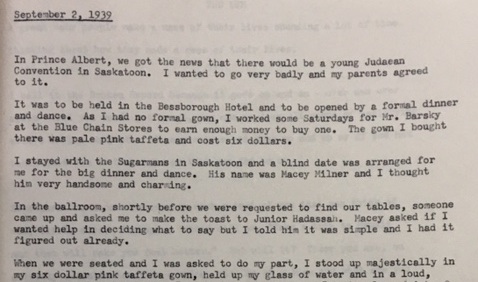
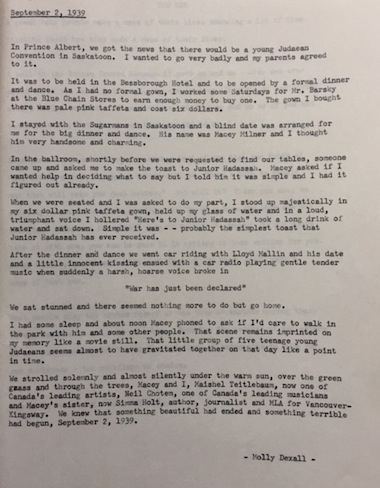
This diary note from Molly Dexall, recalling events from Sept. 2, 1939, was found by her son, Fred Dexall, and Alex Krasniak, community support worker at Yaffa House, in one of Dexall’s old binders. It was written by his mother, who was 19 at the time; she died in 1977. It is reprinted here with permission, marking 80 years since the outbreak of the Second World War on Sept. 1, 1939.

September 2, 1939

In Prince Albert, we got the news that there would be a young Judaean Convention in Saskatoon. I wanted to go very badly and my parents agreed to it.

It was to be held in the Bessborough Hotel and to be opened by a formal dinner and dance. As I had no formal gown, I worked some Saturdays for Mr. Barsky at the Blue Chain Stores to earn enough money to buy one. The gown I bought there was pale pink taffeta and cost six dollars.

image - A diary note from Molly Dexall, recalling events from Sept. 2, 1939

I stayed with the Sugarmans in Saskatoon and a blind date was arranged for me for the big dinner and dance. His name was Macey Milner and I thought him very handsome and charming.

In the ballroom, shortly before we were requested to find our tables, someone came up and asked me to make the toast to Junior Hadassah. Macey asked if I wanted help in deciding what to say but I told him it was simple and I had it figured out already.

When we were seated and I was asked to do my part, I stood up majestically in my six dollar pink taffeta gown, held up my glass of water and in a loud, triumphant voice I hollered “Here’s to Junior Hadassah” took a long drink of water and sat down. Simple it was – probably the simplest toast that Junior Hadassah has ever received.

After the dinner and dance we went car riding with Lloyd Mallin and his date and a little innocent kissing ensued with a car radio playing gentle tender music when suddenly a harsh, hoarse voice broke in

“War has just been declared”

We sat stunned and there seemed nothing more to do but go home.

I had some sleep and about noon Macey phoned to ask if I’d care to walk in the park with him and some other people. That scene remains imprinted on my memory like a movie still. That little group of five teenage young Judaeans seems almost to have gravitated together on that day like a point in time.

We strolled solemnly and almost silently under the warm sun, over the green grass and through the trees, Macey and I, Maishel Teitlebaum, now one of Canada’s leading artists, Neil Chotem, one of Canada’s leading musicians and Macey’s sister, now Simma Holt, author, journalist and MLA for Vancouver-Kingsway. We knew that something beautiful had ended and something terrible had begun, September 2, 1939.

– Molly Dexall –

Format ImagePosted on August 30, 2019August 29, 2019Author Molly DexallCategories LocalTags Canada, history, memory, Second World War, youth
Segal aims for Ottawa

Segal aims for Ottawa

Zach Segal will represent the Conservative party in the Oct. 21 federal election in the riding of Vancouver Granville. (photo from Zach Segal)

While Conservatives across Canada will spend the weeks leading up to the federal election reminding voters of Jody Wilson-Raybould’s excoriating of her former leader, Prime Minister Justin Trudeau, one Tory candidate will likely be downplaying the Vancouver MP’s star turn before a parliamentary committee.

In July, Zach Segal won the nomination to represent the Conservative party in the Oct. 21 federal election in the riding of Vancouver Granville. The incumbent, Wilson-Raybould, was elected there in 2015 and immediately was appointed minister of justice and the attorney general of Canada. In January of this year, she was shuffled to minister of veterans affairs and, less than a month later, resigned from cabinet.

Wilson-Raybould was thrown out of the Liberal caucus after testifying before the House of Commons justice committee about pressure she said she experienced from the prime minister’s office over an ongoing investigation into Quebec-based SNC-Lavalin, the largest construction company by revenue in Canada. The resulting scandal sent the governing Liberals tumbling in opinion polls, and they are now generally neck-and-neck with the Conservatives in most surveys. Wilson-Raybould is seeking reelection as an independent.

Segal said that a vote for the incumbent is a protest vote, but that a vote for him offers the chance to change the government.

“If you are upset with Justin Trudeau and you want to kick the Liberals out of Ottawa, the only way to do that is to vote for Andrew Scheer and, if you live in Vancouver Granville, to vote for Zach Segal,” he told the Independent.

The riding cuts a swath through the city, from the Fraser River almost to False Creek and roughly from West Boulevard to Cambie, also encompassing the area north of 41st Avenue west of Main Street and west of Ontario Street to 2nd Avenue. Almost all of the city’s Jewish communal organizations are located in the riding and many of the city’s Jewish residents live there.

Segal graduated from the University of British Columbia in 2011, with a major in political science and a minor in history. He went to Ottawa on an internship arranged through the Centre for Israel and Jewish Affairs.

“At the time, I was conservative-leaning, but I wasn’t partisan,” he said. “I was certainly conservative but I wasn’t affiliated like other young folks are at university.”

After the internship, Segal continued working with Manitoba Conservative MP James Bezan, who was parliamentary secretary to the minister of defence. He later became spokesperson for then-transport minister Lisa Raitt.

When the Conservatives lost the 2015 election, Segal opted to return to Vancouver. He got a job with the Canada Mortgage and Housing Corporation, which has a mandate to help Canadians access affordable housing options.

“I was very interested in housing but still interested in the government and policy world,” Segal said. “I wanted to learn more about housing so I thought a job at the Canada Mortgage and Housing Corporation would be a good opportunity because it was a Crown corporation – it wasn’t part of the federal public service, it was separate – so I thought that would be a good opportunity to get into the housing world and learn more.”

On leave since he announced his candidacy for the nomination in the spring, Segal is part of the CMHC marketing team, publicizing programs and opportunities for nonprofits, the private sector, developers and others, such as low-interest loans.

Faced with a splintered group of candidates in what will probably be one of the most closely watched races in the country, Segal is confident he can win.

“I really think I can actually win and I think that’s the most important thing,” he said, adding that the agenda in the city has largely been dominated by the left.

“I want to show that maybe we have some conservative solutions to some of these big problems that Vancouver is facing,” he said. “My big issues are all packaged into one. I think they all go together. I think everyone’s very interested in housing, in transportation, affordability and the economy. If we can solve transportation infrastructure, maybe it could help reduce pressure on housing because we could build further out and, if we could grow our economy and have better opportunities, people here could make more money and that would solve some of the issues around affordability. Certainly housing, I think we need to look at different ways of solving this, rather than the current proposals. Vancouver’s average wages are some of the lowest in Canada but we have some of the highest average home prices in Canada. I think that’s where one of the problems lies. We need to start looking at how we can grow our whole economy, and Vancouver subsequently, with better jobs and higher wages.”

He said his four years in Ottawa equip him to be an effective MP.

“A lot of people have this idea that, if you’re on the backbench, you can’t do anything, but the MP I worked for was so diligent and committed to issues that he was able to bring them to the floor of the House of Commons,” said Segal. “He was constantly tabling motions, private member’s bills, he was constantly getting his foot in the door of the prime minister’s office and he made sure that, even though he was a backbencher, he got all these prominent issues to the forefront of public policy. That was very inspiring. It’s a good message that you can accomplish things as a member of Parliament.”

As a Jewish candidate, Segal has been hearing from voters that they respected former prime minister Stephen Harper’s approach to Israel.

“Jews and non-Jews alike tell me that they deeply respected how Stephen Harper and the Conservative government stood up for Israel on the world stage,” he said. “They just liked seeing a politician stand on principle and not be bullied and stand up – quite frankly – stand up to the world, stand up to the UN. People really liked seeing that and I think they like leaders who show their true colours, and want to see that back in Ottawa.”

Segal, who attended Richmond Jewish Day School and graduated from Steveston High, went to Israel on a Birthright trip in 2008.

“You always know Israel is small but, until you’re there and you travel the country in a short period of time, you don’t realize how small it is,” he said. “When people talk about Israel’s security concerns, it’s not just a platitude. It’s a tiny country. When you visit Israel, you take tours of the Golan Heights. You can see Hezbollah outposts. Now, if you are there, you can see maybe even ISIS outposts in Syria. It’s this remarkable, tiny country, this outpost of vibrancy and Western democracy that somehow is bordering some of the most extreme elements of the world right there on its border and you really appreciate its security concerns being there.”

Back on local doorsteps, Segal said voters are asking whether they can trust their leaders.

“They see Justin Trudeau taking care of his friends. He had this big gift to Loblaws for retrofitting some fridges and they’re taking care of Irving and SNC, but, if you’re a small business owner, you’re left to fend for yourself,” said Segal.

In addition to Segal and Wilson-Raybould, Vancouver Granville voters will consider the Liberal candidate, tech entrepreneur and investor Teleeb Noormohamed, the NDP’s Yvonne Hanson, a climate activist, and Green candidate Louise Boutin, a realtor. The fledgling People’s Party of Canada has nominated Naomi Chocyk, who, at one point, was employed as a constituency assistant in Wilson-Raybould’s office. More candidates could enter the race before the close of the writ period.

Format ImagePosted on August 23, 2019August 22, 2019Author Pat JohnsonCategories LocalTags Canada, Conservative Party, elections, Vancouver Granville, Zach Segal
שינויים ניכרים באזורים הארטקטיים

שינויים ניכרים באזורים הארטקטיים

(Mario Hoppmann/NASA)

חוקרים בכירים ארה”ב: הקרח באזורים הארקטיים של קנדה החל להפשיר שבעים שנה לפני התחזיות

משלחת מאוניברסיטת אלסקה (בפיירבנקס) מצאה שינויים ניכרים בתוואי הקרקע הקפואה באזורים הארטקטיים של קנדה, במהלך שלוש עשרה שנים: בין אלפים ושלוש לאלפיים ושש עשרה. לפי הממצאים בנוסף לנסיגת שכבת הקרח נוצרו גם גבעות נמוכות, שחסמו את הרוח ואפשרו לצמחייה להכות שורש

שכבת האדמה הקפואה באזורים הארקטיים בקנדה החלה להפשיר שבעים שנה שנה לפני הזמן הצפוי. על כך מצביעים הממצאים של משלחת חוקרים בכירה שהגיע לאזור. לדבריהם התופעה מעידה על כך שכדור הארץ מתחמם בקצב הרבה יותר מהיר מכפי שצפו בתחזיות השונות. חברי המשלחת מאוניברסיטת אלסקה שבארצות הברית, אמרו כי הופתעו מאוד מהמהירות שבה גרמו עונות הקיץ החמות במיוחד לערעור השכבות העליונות של גושי הקרח התת־קרקעיים.

זה היה מדהים אמר לסוכנות החדשות הבינלאומית רויטרס, ולדימיר רומנובסקי, גיאו־פיזיקאי חבר במשלחת של האוניברסיטה. זה סימן לכך שהאקלים כיום חם הרבה יותר מאשר היה אי פעם – במהלך חמשת אלפים השנים האחרונות. החוקרים פרסמו את ממצאיהם המעניינים והיוצאי דופן בכתב העת המדעי גיאופיזיקל רייסרץ’ לטרס.

לפני מספר שבועות פורסמו הממצאים האלה ברבים- לקראת פסגת משבר האקלים שהתקיימה בבון שבגרמניה. האירוע הבינלאומי אורגן על ידי האו”ם וגורמים נוספים. זאת במטרה להגביר את המאמצים המשותפים למצוא פתרונות בנושא הכל כך מסובך. כידוע כל מדינות המערב תומכות ברעיון כי כדור הארץ מתחמם לפי ממצאים של המדענים השונים. ורק נשיא ארה”ב הנוכחי, דונלד טראמפ, מתכחש לממצאים אלה.

המאמר התבסס על ניתוח נתונים שהחוקרים אספו בביקורם האחרון באזור לפני כשלוש שנים. ובמקביל הוא מתבסס גם על סקירות אקלימיות מאז שנת אלפיים ושלוש ועוד היום. הצוות השתמש במטוס ששודרג במיוחד כדי לבקר בנקודות מרוחקות ביותר, בהן תחנת מכ”ם מתקופת המלחמה הקרה, שנמצאת במרחק של יותר משלוש מאות ק”מ מכל יישוב אנושי. כצפוי החוקרים לקחו על עצמם סיכונים גבוהים בביקור באזורים מרוחקים אלה. לדברי החוקרים ממש בנחיתה לקרקע נגלה לעיניהם נוף שונה לחלוטין על פני הקרקע הארקטית, שאותה ראו בביקורים קודמים לפני כעשור שנים.

הנוף הפך לים גלי של גבעות, שקעים צרים ובריכות. הצמחייה שבעבר היתה מעטה החלה לצמוח בכמות גדולה בחסות המקלט שסיפק הנוף מהרוחות הבלתי פוסקות. החוקרים הרגישו מצד אחד סיפוק מקצועי על כל מה מצאו, ומצד שני הרגישו תחושה שהאסון ממשמש ובא. הם ציינו כי המראה הזכיר להם אדמה חרוכה אחרי הפצצה.

זו תופעה המזכירה לי מכרה הפחם, אמרה אחת החוקרות הבכירות במשלחת. סביר למדי שתופעה זו משפיעה על אזורים נרחבים יותר ממה שאנו מעריכים. ואת זאת החוקרים יבדקו בהמשך. החוקרים חוששים ליציבות שכבת האדמה הקפואה בשל הסכנה שהפשרה מהירה תשחרר כמות נרחבת של גזים, שיביאו להאצה משמעותית של ההתחממות הגלובלית

לפי הערכות של האו”ם גם אם המחויבויות הקיימות בהסכם פריז משנת אלפיים וחמש עשרה, להפחתת פליטות גזי החממה, ייושמו במלואן העולם עדיין רחוק מאוד ממניעת הסכנה – שתהליכים דומים של היזון חוזר יביאו להאצת ההתחממות של כדור הארץ.

נוכח אזהרות המדענים כי טמפרטורות גבוהות יותר יגרמו להרס רב בחצי הכדור הדרומי, ויהוו איום על יכולת הקיום של העולם המתועש בחצי הכדור הצפוני, ארגוני סביבה נתלים במאמר שפרסמו החוקרים כהמחשת הצורך בהפחתת פליטות גזי החממה. הפשרת האדמה הקפואה היא אחת מהנקודות המצביעות על משבר האקלים, אמרה ג’ניפר מורגן מארגון גרינפיס אינטרנשיונל.

Format ImagePosted on July 17, 2019Author Roni RachmaniCategories עניין בחדשותTags Artic, Canada, climate, environment, science, אזורים הארקטיים, האקלים שהתקיימה, הסביבה, מדע מדע, קנדה
החיזבאללה פועל בקנדה

החיזבאללה פועל בקנדה

(LinkedIn) עלי קוראני

ארגון הטרור השיעי החיזבאללה שקשור באיראן אסף מידע ביטחוני רגיש על שדה התעופה הבינלאומי “פירסון” שבטורונטו. כך מסרה רשות הביטחון בתחבורה האווירית של קנדה לפני מספר ימים. מתברר שסוכן רדום של החיזבאללה שגר בארצות הברית, עלי קוראני, ביקר לפחות שבע פעמים “בפירסון” – שדה התעופה הגדול שך בקנדה (מדי שנה עוברים בו לא פחות מכחמישים מיליון נוסעים).

קוראני שהוא אזרח אמריקני ונשוי לאזרחית לבנונית-קנדית, אסף מידע מודיעיני נרחב על אמצעי הבטחה בשדה התעופה הבינלאומי. המידע שהועבר למפעילו של קוראני בלבנון כלל בין היתר את הנושאים הבאים: מיקום מצלמות האבטחה, מיקום גלאי המתכות, מהם נוהלי הביטחון בשדה, מה לובשים אנשי האבטחה במשמרות שלהם ומי מהם נושא עימו נשק.

קוראני התגייס לחיזבאללה לאחר שהבית של משפחתו נהרס במלחמת לבנון השנייה, שהתקיימה בין ישראל לחיזבאללה (בקייץ של אלפיים ושש). על קוראני הוטל עליו להעביר נשק מקנדה לארה”ב ולבצע שם פעולות טרור. זאת תוך התמקדות בעיקר באנשי עסקים יהודים שגרים בניו יורק, נספחי צה”ל שעובדים בעיר ואף הקונסוליה הישראלית בניו יורק. הטרוריסט שנמצא במעצר בארה”ב מזה כשנתיים הורשע כבר בדין. הוא צפוי לקבל מאסר עולם וגזר דינו יתפרסם במהלך ספטמבר הקרוב. עורכי דינו של הנאשם הזדרזו והודיעו כבר כי יערערו על עונשו הכבד.

קוראני סיפר לחוקריו באף. בי.איי כי קבוצת הפעולה החיצונית של החיזבאללה (המכונה יחידת תשעה מאות ועשר) פעילה בקנדה, אף יותר מאשר ארה”ב. הוא מסר לחוקרים שמות של חמישה עשר איש מרשימת ההתקשרות הפרטית שלו, שחלקם הגדול גר דווקא בקנדה.

קנדה מתברר עוד משמשת מרכז חשוב להלבנת כספים של החיזבאללה שמקורם ממכירת סמים. הלבנת הכספים מתרחשת במספר ערים ובעיקר בוונקובר. ערים נוספות ברשימה הלא מכובדת הזו: טורונטו, מונטריאול, קלגרי והליפקס. הסמים מועברים לקנדה דרך מספר דינות באמריקה הלטינית ובעיקרן קולומביה ומקסיקו. זאת על ידי הפעילים של ארגון הטרור הלבנוני. הכספים ממכירת הסמים מולבנים ומשמשים למימון פעולות הטרור של הארגון, במקומות שונים בעולם.

הפעילות של איראן וארגוני הטרור המסונפים לה התרחבה בשנים האחרונות למדינות אמריקה הליטינית, בשל הסנקציות האמריקניות הקשות שהוטלו עליה. נשיא ארה”ב, דונלד טראמפ, הטיל רק לאחרונה עוד סנקציות כלכליות על איראן. טראמפ מאמין שבדרך הלחץ הוא ישיג משהו אך בדרך כלל התוצאות הפוכות. במדינות אירופה ומומחים בתחום הביטחוני בארה”ב, קנדה וישראל, מאמינים בניגוד לטראמפ כי הסכם הגרעין עם איראן, היה טוב לכל הצדדים. אל טראמפ הצטרף עד כה רק מנהיג אחד שתמך בביטול ההסכם עם איראן והוא: ראש ממשלת ישראל בנימין נתניהו.

בשנים האחרונות החלה המשטרה הפדרלית הקנדית (האר.סי.אם.פי) לחקור לעומק את נושא הלבנת הכספים מצד החיזבאללה. פעילים של ארגון הטרור הלבנוני מלבינים כספים בהיקפים גדולים מאוד, בעזרת מספר ארגוני פשע וקרטלי סמים מקומיים ובינלאומיים.

לפי החקירות המסובכות של האמריקנים בשיתוף בין היתר של הרשויות בקולומביה, עולה כי החיזבאללה פועל במשותף עם ארגוני פשע בינלאומיים ברחבי העולם. בין היתר במדינות כמו סין וההונג קונג, בשיתוף עם שכירי חרב, סוחרי סמים וקרטלי סמים גדולים (בהם קרטל מדיין של פאבלו אסקובר שחוסל לפני כעשרים ושש שנים). מהאזנות לשיחות טלפון רבות של פעילי החיזבאללה מתברר, שהארגון מפעיל את קשריו לפעילויותיו הפליליות השונות, ברחבי העולם. ובעיקר במדינות הבאות: ארה”ב, קנדה, אוסטרליה, פנמה, ירדן, דובאי וכמובן גם לבנון.

Format ImagePosted on July 3, 2019July 3, 2019Author Roni RachmaniCategories עניין בחדשותTags Ali Kourani, Canada, Hezbollah, money laundering, terrorism, Toronto, הלבנת כספים, חיזבאללה, טורונטו, טרור, עלי קוראני, קנדה
The search for a friend

The search for a friend

Finding Fukue follows Jessica Stuart’s journey to Japan to find her childhood friend.

screenshot - Finding Fukue follows Jessica Stuart’s journey to Japan to find her childhood friend
(screenshot)

To what lengths would you go to find a childhood friend whose letters stopped coming decades ago? When online searches proved fruitless, Vancouver-born, Toronto-based musician Jessica Stuart headed back to Japan, and her journey is recorded in the CBC Short Docs film Finding Fukue, which was produced with Real Stories. Since posted to YouTube last November, the charming and moving documentary has been viewed more than 3.6 million times to date.

“When I was 9 years old, my parents got English teaching jobs and moved us all to Japan for a year,” shares Stuart as the film starts. Among the images we see are clips of home movies from that year, 1988. “I was a blond kid, and that made me of interest to all the Japanese people because they had never really seen a blond-hair person before,” she says. “They would point at me or my sister, touch my hair, talk at me; I didn’t understand anything yet. The day after we arrived, I went to school for the first time and then that was crazy. I didn’t feel that anyone was interested in getting to know me, except for one person, and her name was Fukue, and we became best of friends.”

The Stuarts – Wendy, Ron and daughters Fiona and Jessica – settled in Saku, then a small rural village with no foreigners. Now, however, Stuart has to start looking for her friend Fukue in a city of 100,000 people. She visits the elementary school they attended and gets a yearbook, where she gets Fukue’s father’s name and an address from the year 2000, but this leads her to a new development, where she and her translator (for the more complex encounters) meet some women who remember her family but can’t help with finding Fukue.

At Saku City Hall, a press contingent meets Stuart and she gets the word out on television and in print. Finally, a clerk at City Hall manages to find a phone number for Fukue’s sister, who connects the two friends. The reunions – first by phone and then in person – are quite emotional. The two fall into a familiar comfort and get reacquainted. They have kept in touch since.

The approximately 21-minute film can be found at youtu.be/ZVlZMOB-Sq0.

Format ImagePosted on June 28, 2019June 26, 2019Author Cynthia RamsayCategories TV & FilmTags Canada, CBC, documentary, friendship, Fukue, Japan, Jessica Stuart
קנדה רוצה מהגרים נוספים

קנדה רוצה מהגרים נוספים

קנדה רוצה מיליון מהגרים נוספים בשלוש השנים הקרובות

קנדה מונה למעלה משלושים ושמונה תושבים החיים בשטח ענקי המשתרע על פני כעשרה מיליון קמ”ר. מדובר בשטח אף גדול מזה של ארצות הברית (רק רוסיה מחזיקה בשטח הגדול מזה של קנדה). קנדה מבקשת להכניס לשטחה מיליון מהגרים עד סוף שנת אלפים עשרים ואחד.

“במידה רבה, הודות לאזרחים חדשים שקיבלנו בברכה במהלך ההיסטוריה שלנו, קנדה התפתחה לכדי מדינה חזקה ותוססת שכולנו נהנים ממנה”, אומר שר ההגירה, הפליטים והאזרחות, אחמד חוסיין. זאת במסגרת דין וחשבון שנתי על ההגירה לקנדה, שהוגש בראשית השנה לפרלמנט. במדד הפיתוח האנושי (האיץ’. די.איי) קנדה מדורגת במקום השניים עשר והמכובד בעולם, מתוך מאה שמונים ותשעה מדינות.

הדו”ח השנתי בנושאי הגירה מבליט שלא במקרה את הצלחת המהגרים המגיעים לקנדה. כיום כעשרים אחוז מתושבי קנדה נחשבים למהגרים (נולדו בארץ אחרת המחוצה לה). זאת לעומת פחות מארבעה עשר אחוז של מהגרים בארה”ב השכנה. בשני העשורים האחרונים הגיעו לקנדה כשישה מיליון מהגרים. לדברי שר ההגירה, הפליטים והאזרחות הקנדי, המדינה אינה מפלה מהגרים על בסיס גזע, לאום, מוצא אתני, דת או כל מגדר אחר. הוא מציין כי קנדה כיום היא המדינה המובילה בעולם בניהול מהלך ההגירה המורכב. השר חוסיין אומר כי קנדה בהצלחה מרובה בוחרת את המהגרים שתורמים לה ביותר, לעומת אלה שלא יתרמו לה.

מערך ההגירה הקנדי מבוסס על שיטת ניקוד (הנקראת סי.אר.אס) לפי מספר קריטוריונים. בהם: גיל, השכלה, שפה, ניסיון בעבודה וקשרים בקנדה (בתחומי משפחה, עבודה או לימודים). בשל הביקוש הגדול להגר לקנדה הדירוג המינימלי של שיטת הניקוד עלה בראשית השנה מרמה של ארבע מאות ארבעים ותשעה לרמה של ארבע מאות ושבעים. בכל מקרה הניקוד המקסימלי למגישי הבקשה להגר מגיע לאלף ומאתיים.

מנסיוני האישי בהגירה מישראל לקנדה

עזבתי את תל אביב ועברתי לוונקובר לפני כארבע עשרה שנים. תמיד חלמתי לגור בחו”ל. במהלך השנים הבנתי שיהיה קל יותר להגר לקנדה. מה גם שחבר טוב שלי מישראל עבר לוונקובר כארבע שנים לפני.

בדקתי באתר רשות ההגירה הקנדי באם יש לי מספיק נקודות להתחיל בהליך ההגירה. בעזרת ההשכלה הגבוהה שרכשתי בישראל, ניסיוני הממושך בעבודה בעיתונות ושליטה בשפה האנגלית – התברר לי שאני עומד במכסת הנקודות הרצויה להגירה.

הגשתי את מסמכי ההגירה לקונסוליה הקנדית בתל אביב והמתנתי לבאות. לא שיערתי בנפשי כי אאלץ להמתין זמן רב עד קבלת האישור להגר. מתברר שבאותם ימים החליטה מחלקת ההגירה הקנדית להקשיח את תנאי ההגירה. לכן שונתה שיטת הניקוד והתווספו תנאים חדשים. אך כאן נוצרה בעייה קשה באשמת מחלקת ההגירה הקנדית: היא החליטה להטיל את התנאים החדשים גם על אלה שכבר פתחו בהליכי ההגירה. זה כלל כמובן גם אותי. בפועל מדובר בהחלטה שמנוגדת לחוק כיוון שאי אפשר להחיל תנאים חדשים על מי שכבר פועל לפי תנאים קודמים. אמר לי בזמנו עורך דין קנדי שאני יכול לתבוע את ממשלת קנדה בנושא. אני וויתרתי אך נדמה לי שיש אחרים שאכן תבעו את הממשלה.

מכל מקום בעקבות שינוי שיטת הניקוד נוצר בלגאן גדול במערכת ההגירה. אפילו בקונסוליה הקנדית בתל אביב לא ידעו מה להגיד בנושא. לבסוף לאור התנאים החדשים נאלצתי לעבור מבחן באנגלית, ברמה של מי שמתעד ללמוד באחת ממוסדות הלימוד בחו”ל. הליך ההגירה התעקב ונמשך בסופו של דבר כשלוש שנים, עד ליום המיוחל שבו קיבלתי את האישור להגר לכאן.

Format ImagePosted on June 19, 2019June 12, 2019Author Roni RachmaniCategories עניין בחדשותTags Canada, immigration, Israel, הגירה, ישראל, קנדה

Posts pagination

Previous page Page 1 … Page 14 Page 15 Page 16 … Page 26 Next page
Proudly powered by WordPress