Skip to content
  • Home
  • Subscribe / donate
  • Events calendar
  • News
    • Local
    • National
    • Israel
    • World
    • עניין בחדשות
      A roundup of news in Canada and further afield, in Hebrew.
  • Opinion
    • From the JI
    • Op-Ed
  • Arts & Culture
    • Performing Arts
    • Music
    • Books
    • Visual Arts
    • TV & Film
  • Life
    • Celebrating the Holidays
    • Travel
    • The Daily Snooze
      Cartoons by Jacob Samuel
    • Mystery Photo
      Help the JI and JMABC fill in the gaps in our archives.
  • Community Links
    • Organizations, Etc.
    • Other News Sources & Blogs
    • Business Directory
  • FAQ
  • JI Chai Celebration
  • JI@88! video

Recent Posts

  • Sharing her testimony
  • Fall fight takes leap forward
  • The balancing of rights
  • Multiple Tony n’ Tina roles
  • Stories of trauma, resilience
  • Celebrate our culture
  • A responsibility to help
  • What wellness means at JCC
  • Together in mourning
  • Downhill after Trump?
  • Birth control even easier now
  • Eco-Sisters mentorship
  • Unexpected discoveries
  • Study’s results hopeful
  • Bad behaviour affects us all
  • Thankful for the police
  • UBC needs a wake-up call
  • Recalling a shining star
  • Sleep well …
  • BGU fosters startup culture
  • Photography and glass
  • Is it the end of an era?
  • Taking life a step at a time
  • Nakba exhibit biased
  • Film festival starts next week
  • Musical with heart and soul
  • Rabbi marks 13 years
  • Keeper of VTT’s history
  • Gala fêtes Infeld’s 20th
  • Building JWest together
  • Challah Mom comes to Vancouver
  • What to do about media bias
  • Education offers hope
  • Remembrance – a moral act
  • What makes us human
  • המלחמות של נתניהו וטראמפ

Archives

Follow @JewishIndie
image - The CJN - Visit Us Banner - 300x600 - 101625

Tag: business

Brian Jessel BMW turns 35

Brian Jessel BMW turns 35

Brian Jessel has loved cars since he was a kid. (photo by Alfonso Arnold)

Brian Jessel chose one of the most consequential years in Vancouver’s history, 1986, to embark on his self-named BMW dealership. Since Expo 86, both the city and Brian Jessel BMW have changed, but, according to Jessel, one thing remains constant.

“We take a personal approach to the car business. We cherish our relationships with our clients and like to spoil them and treat them as VIPs. This is how I want to be treated, so this is how I grow my business relationships,” Jessel said in a recent interview.

And he also works to grow community. Among the organizations that have benefited from his philanthropy are Jewish Federation of Greater Vancouver, Jewish Family Services, Congregation Schara Tzedeck, Lubavitch BC, the Jewish Museum and Archives of British Columbia and the Isaac Waldman Jewish Public Library.

In the general community, Jessel’s Cabriolet Charity Galas, started in 2004, are among the premier philanthropic events of the year in Vancouver. The annual galas, which raise money for pancreatic cancer research, have brought in more than $2 million and have seen the likes of talk show host Jay Leno and blues singer Colin James perform in the past.

Enthusiasm for the automobile runs in Jessel’s family. His father, Bernie, a leading figure the Toronto car market, instilled a fascination with the industry – an excitement that has carried through to future generations.

“I loved cars from the time I was a toddler; it’s probably in my DNA. I now have a 4-year-old grandson who is exactly the same; he sleeps with cars in his bed and won’t let go of the steering wheel if he gets into the driver’s seat. I bought him and his 6-year-old brother cars – yes, real cars. I just need to wait 12 years to give them to them,” he related.

The desire to be in the car business maintained such a strong pull for Jessel that other career possibilities did not stand much of a chance.

“I went to university (in Michigan) but never graduated – I wanted to get to work. I interviewed at a prestigious Bay Street stock firm and was accepted for the position, but I never started. A couple of weeks later, I was selling cars at a classy GM dealership on the west side of Toronto,” he recalled.

Eventually, in 1972, he made it out west, opening his first used car lot with six automobiles on a leased space at Burrard and 1st Avenue. Jessel sensed the appeal of foreign cars, even back in the 1970s, and turned that first car lot into a Fiat dealership – along with selling pre-owned vehicles, specializing in imports.

“These were days when, if a Jag went down the road, people stopped and looked,” said Jessel, who also attributes his success to having the gumption to take a chance when opportunity comes calling.

Before establishing itself at its current location in Vancouver in 2004, Brian Jessel BMW operated out of locations in Langley and Coquitlam. Today, it occupies a 66,000-square-foot new-car facility on Boundary Road, with an additional 36,000 square-foot pre-owned-car space nearby. Brian Jessel BMW sells more than 5,000 cars a year.

Jessel gives much of the credit to his staff for his thriving business. “Our people are knowledgeable but also warm and engaging,” he said. “And we are laser focused on all things BMW. We aren’t using a cookie-cutter format that works for selling everything from Bentley to Hyundai, like large dealership groups need to be. Yet we are the size of five dealerships, so we still have all the economies of scale of the multi-brand.”

When asked about the differences in running a dealership now as opposed to 35 years ago, he said, “As with everything in the world, the computer has changed how cars operate. Twenty years ago, I went to Europe and drove the upcoming BMW 7 Series. It had a dial in the centre console that controlled many of the car’s functions. Auto journalists hated the iDrive System when they first saw it. Now, almost every manufacturer has followed BMW’s lead and has a similar operating system.”

And there is the move to electric vehicles as well.

“The new frontier is the electric car. There is a mystique I like about electric cars,” he said. “They are so quiet and have amazing low-end power. I still love the feeling of an internal combustion engine, however, it is inevitable that electric vehicles will dominate by the end of this decade.”

Brian Jessel BMW has started taking orders for the new BMW iX, as well as the four-door sedan version, the BMW i4 – both of which are fully electric.

Sam Margolis has written for the Globe and Mail, the National Post, UPI and MSNBC.
Format ImagePosted on August 27, 2021August 25, 2021Author Sam MargolisCategories LocalTags BMW, Brian Jessel, business, cars, electric cars, entrepreneurship, philanthropy

Community milestones … Federation, Koerner, Broca

The annual general meeting of the Jewish Federation of Greater Vancouver took place on June 21. Welcomed were five new directors: Gil Kimel, Dean Lederman, Lana Pulver (chair of the annual campaign), Michelle Pollock (chair of the Israel and global engagement committee), David Porte and Daniel Steiner. They join Bruce Cohen, Alex Cristall, Catherine Epstein (vice-chair), Jessica Forman (chair of the HR committee), Sue Hector, Hodie Kahn, Shay Keil, Rick Kohn, Candace Kwinter, Shawna Merkur, Kyra Morris, Lianna Philipp, Lisa Pullan, Stan Shaw and Diane Switzer.

Kwinter is the new board chair and, as such, her central challenge mirrors that of the community: how to navigate recovery and reopening in a time of great uncertainty.

“Over the past year, I have held a dual role as vice-chair of the board and chair of the Israel and global engagement committee, which has immersed me in our work,” said Kwinter in her remarks in the June 25 Federation Shabbat message. “And, through my position on our Community Recovery Task Force, I’ve gotten to know the organizations in our community and see how our community planning, convening, facilitating and fundraising functions create a valuable synergy. The health and strength of our local community is paramount, and it will continue to be a focus throughout my term.

“Israel also holds a very special place in my heart, and I am actively involved with our partner, the Jewish Agency for Israel’s board of governors, where I serve on three committees: antisemitism; unity of the Jewish people; and aliyah. In 2018, I was privileged to be part of a group of community leaders who traveled to Far East Russia to see the impact of our overseas work. As travel restrictions begin to ease, I hope we will have the opportunity to visit our partnership region in the Upper Galilee Panhandle and resume our Israel experience programs for young adults.

“At the same time,” she continued, “I remain connected to the work we do across the continent as part of JFNA [Jewish Federations of North America]. I have attended several General Assemblies over the years, and now is the perfect time for you to experience this epic gathering of Jewish leaders, because you can participate without the time and expense of traveling.

“Looking ahead, I know we have challenges to face, but this is also an exciting time in many ways. COVID has accelerated change and has prompted us all to look at new ways of strengthening our community. Rather than looking ahead to the ‘new normal,’ we need to work together to create the ‘next normal.’ That will be our collective journey over the next two years, and I am looking forward to the future we can build together.”

At the AGM, four community leaders were honoured. Jonathon Leipsic, who chaired the Federation annual campaign from 2018 through 2020, received the Harry Woogman Award, for his consistent and conscientious leadership and his long-standing and diligent campaign involvement. Yael Segal and Becky Glotmanreceived the Lou Zimmerman Award for their integral role in the revitalization of the Ben Gurion Society, a recognition society for young donors who give $1,000 or more to the Federation annual campaign. And Enav Zusman received the Young Leadership Award.

The 2020/21 annual report can be found at jewishvancouver.com/news-and-publications/annual-reports. In 2020, Federation raised $12.2 million from 2,600 donors: $8.8 million in the 2020 annual campaign; $2 million for community recovery; and $1.4 million in special project funding.

COVID-19 was a crisis that affected – and continues to affect – every aspect of the community. Because of donors’ generosity, Federation this year was able to direct more funding to its partners than ever before.

(British Columbia’s record-breaking heatwave has had devastating effects across the province. The tragic fire in Lytton was not the first that we’ve seen and likely will not be the last. With growing concerns for another wildfire season, Jewish Federation of Greater Vancouver has set up an emergency B.C. Wildfire Relief Fund to assist those affected by wildfires in our province. To donate, visit jewishvancouver.com/bcfire.)

* * *

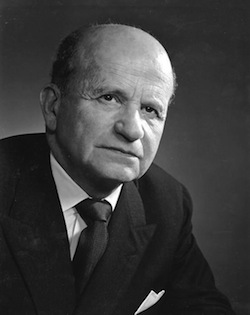
On May 20, Junior Achievement British Columbia (JABC) inducted new members into its Business Laureates of British Columbia Hall of Fame, including Gordon Diamond. There was also the posthumous induction of 10 Pioneer Laureates, including Morris Wosk, z”l. Diamond and Wosk were featured in the June 25 Jewish Independent article “JA’s newest laureates.” The article accidentally overlooked another posthumous honouree, however: Dr. Walter Charles Koerner, z”l. Here is what the JABC highlighted of Koerner’s life.

Koerner was born in 1898 in what is now the Czech Republic. He developed his expertise in the forestry industry there, through his family’s lumber business.

photo - Dr. Walter Charles Koerner
Dr. Walter Charles Koerner (photo from alchetron.com)

Koerner and his brothers immigrated to Canada in 1939 and founded the Alaska Pine and Cellulose Co., of which he was president. In 1957, the company became Rayonier Canada Ltd. and Koerner became president and later chairman of the board until his retirement in 1973.

Shortly after his arrival in Canada, Koerner made the University of British Columbia (UBC) a focal point of his philanthropy. He believed that a strong university was critical to building an engaged and successful society. He served as a member of the board of governors of UBC, as well as the chair. Not only that, he was the founding chair of UBC Hospital.

Koerner was also committed to preserving Indigenous art forms and supporting the re-emergence of Pacific Northwest Indigenous art. His multiple initiatives included supporting Indigenous carvers, repatriating Indigenous works from abroad and negotiating with then-prime minister Pierre Elliott Trudeau for financial support for the construction of the Museum of Anthropology, to which he donated his extensive collection. In recognition of his efforts in supporting Indigenous culture, the Haida Nation celebrated Koerner as an honorary chief of their nation.

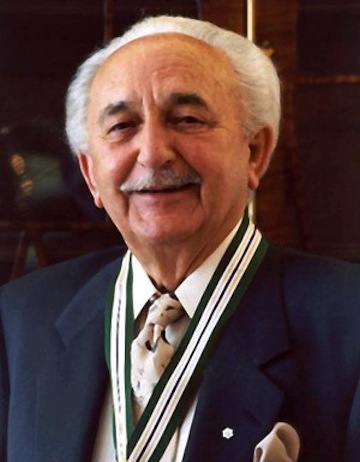
Koerner was a notable philanthropist, who donated millions of dollars to educational institutions and other public organizations and endeavours. Among his many honours, he was a Companion of the Order of Canada, and held an honorary doctor of laws from UBC.

Koerner passed away in 1995.

* * *

Vancouver’s Lilian Broca is among the artists whose works comprise the From Canada exhibition at La Maison de la Mosaïque Contemporaine in Paray-Le-Monial, France.

Every year, La Maison de la Mosaïque Contemporaine organizes and hosts an international mosaic exhibition. The 2021 edition, the 24th, is uniquely devoted to a single country, Canada, through the works of 12 artists whose origins reflect the vast expanse of the territory. This is the first time in Europe that a mosaic exhibition has been dedicated to a North American country, and it is supported by the Canadian embassy in Paris, as well as several other organizations, government agencies and communities.

Joining Broca are artists Maria Abagis, also from British Columbia; Margo Anton, Chris Sumka and Erin Pankratz, all from Alberta; Sophie Drouin, Valerie McGarry, Heather Vollans and Julie Sperling, from Ontario; Suzanne Spahi and Ginette Lussier of Quebec; and Terry Nicholls of Newfoundland.

The exhibit was arranged by Sophie Drouin and Chantal Demonchaux. It opened this month and runs to Sept. 19. For more information, visit maisondelamosaique.org.

Posted on July 23, 2021July 21, 2021Author Community members/organizationsCategories LocalTags AGM, business, Candace Kwinter, fundraising, JABC, Jewish Federation, Lilian Broca, mosaics, philanthropy, Walter Charles Koerner, wildfires
JA’s newest laureates

JA’s newest laureates

Moderator Greg D’Avignon, left, and newly inducted laureate Gordon Diamond share a laugh at the Business Laureates of British Columbia Hall of Fame celebration May 20. (screenshot)

On May 20, Gordon Diamond – chair of West Coast Reduction Ltd. and Austeville Properties Ltd. – was among those inducted into the Business Laureates of British Columbia Hall of Fame. The ceremony, which was to have been held last year, took place virtually.

The Hall of Fame was created in 2005 by Junior Achievement British Columbia (JABC) to honour local “business leaders whose efforts have shaped our province and country.” It is housed in Vancouver Convention Centre West.

The evening’s other Hall of Fame inductees were Chief Clarence Joseph Louie, chief executive officer of Osoyoos Indian Band Development Corp., and Arran and Ratana Stephens, co-founders and co-CEOs of Nature’s Path Foods Inc.

photo - Morris Wosk, z”l, was honoured as a Pioneer Laureate
Morris Wosk, z”l, was honoured as a Pioneer Laureate. (photo from orderofbc.gov.bc.ca)

Also part of the festivities, in a belated celebration of the hall’s 15th anniversary, was the posthumous induction of 10 Pioneer Laureates. Morris Wosk, z”l, who was president of Liberty Investments Ltd. and M.J. Investment Co., as well as co-founder of Wosk’s Ltd., was so honoured for both his business and philanthropic endeavours. Wosk, who passed away in 2002, “played a significant role in the growth and development of Vancouver” and was a “revered mentor to the next generation of businesspeople.”

The gala included speeches by supporters and representatives of JABC and presentations by some young achievers. There were brief video biographies for each laureate being inducted, and the Hall of Famers spoke with moderator Greg D’Avignon, president and CEO of the Business Council of British Columbia. In that conversation, Diamond pointed to the importance in leadership of building “relationships, trust,” and of being “honourable with the people who work with you, not for you.”

One of the most satisfying aspects of his business at this point, he said, is the people who are running it. “We have family members, we have a team…. I’ll be listening to various meetings and I’m in the background but, if I wasn’t there, what the family and the team has built is that my company will continue without me.”

He said of this legacy, which includes the Diamond Foundation, in addition to the businesses, “You can’t buy that feeling that I have when I look at my plants, when I look at the buildings, and that we’re capable of doing things like this,” he said, referring to supporting JABC and “giving back” to community in general.

The JABC write-up highlights the foundation, which Diamond “set up with his late father, Jack Diamond, in 1984 as a vehicle for his philanthropic aspirations. Since inception, the Diamond Foundation, funded solely by Gordon and his companies, has made donations to hospitals, schools, the arts and other public and charitable causes.”

For more on JABC’s laureates, visit businesslaureatesbc.org.

Format ImagePosted on June 25, 2021June 25, 2021Author Cynthia RamsayCategories LocalTags awards, business, Gordon Diamond, JABC, milestone, Morris Wosk, philanthropy, pioneers
CHW’s Brunch with Bakan

CHW’s Brunch with Bakan

Joel Bakan spoke at a CHW Vancouver Book Club event May 30. (photo from thecorporation.com)

The Canadian Hadassah-WIZO (CHW) Vancouver Book Club hosted a far-reaching 90-minute discussion with author, filmmaker, musician and University of British Columbia law professor Joel Bakan on May 30. Moderating the event, entitled Brunch with Bakan, was Toronto-based writer (and former Vancouverite) Adam Elliot Segal.

Bakan’s widely acclaimed 2004 book The Corporation: The Pathological Pursuit of Profit and Power explored the formation and behaviours of modern-day industrial behemoths. It was later turned into an award-winning film. His new book, The New Corporation: How “Good” Corporations are Bad for Democracy, released in 2020, also has a film attached to it – The New Corporation: The Unfortunately Necessary Sequel, which Bakan co-directed with Jennifer Abbott.

In the CHW event, Bakan shared tidbits about his upbringing, first in East Lansing, Mich., then moving to Vancouver at age 11. “I was a very young draft dodger,” he recalled, as his parents decided to move north at the height of the Vietnam War.

“Family and Judaism have been two of the pillars of my life,” he said, recounting how much of his current activism could be traced to his immigrant grandparents.

“Jewish people, by virtue of their history, understand persecution, they understand injustice. They haven’t had a choice but to understand injustice. Injustice has always been in their face. It’s no coincidence that Jewish people were leaders in the civil rights, labour and other movements,” said Bakan.

“Jewish people have always had an activist sensibility and I think it’s rooted, not only in that history, but in the ethics of the religion – chief among them is tikkun olam, that we have a duty to repair the world, which is very much a duty I take seriously,” he added.

In his recent book, which moderator Segal called a “tour de force” and “meticulously researched,” Bakan tackles such subjects as deregulation, the aviation industry and what he describes as the destructive dependence on technology. In it, he interviews not only influential legal and economic scholars but also references pop culture to explain more difficult concepts.

“I wanted the book to be readable,” he said. “I am an academic by trade, but I am a writer. I want the reader to feel pulled into a story. In all my writing for a popular audience, I try to get away from the academic notion of laying out the facts and instead lull the reader in by telling some good stories. And, once I have the reader, I try to engage them with some more analytical or informational kinds of things.”

Segal asked about Bakan’s Trump-era trip to the World Economic Forum in Davos, Switzerland, for the recent Corporation documentary project. It turned out to be a coup of sorts for a film crew to be allowed access to the normally secretive meetings of the world’s political and corporate elites in the Swiss Alps.

In this work, Bakan discusses the concept of corporate social responsibility, which, he contends, cannot do nearly enough to combat rising global social and environmental threats. He distinguishes between individuals at the top of corporations and the corporations themselves.

An example of this approach is Lord John Browne, the former chief executive officer of British Petroleum, whom Bakan portrays as a very cultured man and one of the “good guys,” who tried to get his firm to be at the forefront of corporate responsibility. However, the problem is that even the most benign, well-intentioned CEOs are hamstrung by their fiduciary and legal responsibilities to their shareholders, according to Bakan.

“A CEO can go a certain distance in trying to do a better job in terms of social or environmental responsibility, but you can’t go further in that direction in terms of what will be profitable,” said Bakan. “It’s great if corporations try to be a little better, but let us not be deluded into believing that they can go far enough to get us out of the mess we are in, be it the social mess or the environmental mess.”

The conversation turned to sports and the recent failed attempt by Europe’s top soccer clubs to form the Super League. The common thread with other societal issue is the goal of corporations or capitalism to commoditize everything, whether it be water, utilities, education or entertainment. In the case of the Super League, the vested corporate interests behind the initiative were trying to increase profits by “taking the local out of sports.”

“If you put the Toronto Maple Leafs in Dubai, they would make more money,” said Bakan. “The Super League stopped because the people and governments rose up.”

The discussion ended on an uplifting note for the future. Bakan advocated extolling the virtues that our societies value, such as democracy, freedom and equality, to create a world “in which people can flourish, where they can thrive, where they can be free, not just of government restrictions but ill health, hunger and poverty, where they can live lives of meaning and purpose in which their material needs are met.”

The past 40 years have seen corporations as drivers of policy rather than as tools, argues Bakan. “We need to understand that our democracy is what matters and its capacity to serve human flourishing and planetary survival. When we think about our policies, they need to be aimed at how we can use markets and corporations towards those ends – not how they can use us to serve markets and corporations.”

The film version of The New Corporation is available on several streaming services in Canada. As well, the CHW talk is available for anyone who donates $18 to CHW, for which a full tax receipt also will be provided. Visit chw.ca/thenewcorporation to register, or call the CHW Vancouver office at 604-257-5160. CHW supports programs and services for children and women, in healthcare and education, in Israel and Canada.

Sam Margolis has written for the Globe and Mail, the National Post, UPI and MSNBC.

Format ImagePosted on June 11, 2021June 10, 2021Author Sam MargolisCategories LocalTags business, Canada, Canadian Hadassah-WIZO, children, CHW, CHW Vancouver, corporations, democracy, healthcare, Israel, Joel Bakan, politics, women
Gala raises more than $350K

Gala raises more than $350K

Entrepreneur and venture capitalist Leonard Brody spoke with King David head of school Russ Klein about soccer, history, business, education and the pandemic at the Golden Threads Gala on May 13. (PR photo)

Entrepreneur Leonard Brody was the featured speaker at King David High School’s Golden Threads Gala on May 13, which attracted 600-plus viewers. The event raised more than $350,000 for the school from community donors in both live (via video stream) and silent auctions.

Hailed in the financial media for his innovative approach to thinking about management, Brody, who helped found the news site NowPublic, is an award-winning entrepreneur, venture capitalist and two-time Emmy Award nominee. He has raised hundreds of millions of dollars in start-up capital, taken a company to a $6 billion market capitalization at its initial public offering, and been involved in several other companies. Brody is also the co-author of two bestselling books, Innovation Nation: Canadian Leadership from Jurassic Park to Java and Everything I Needed to Know About Business … I Learned from a Canadian.

Before introducing Brody, King David head of school Russ Klein read through the speaker’s extensive curriculum vitae, calling it “one of the most impressive bios I have ever read.” The first question of the wide-ranging interview, though, had to do with Brody’s forays into owning professional sports teams.

“It sounds more glamorous than it is,” said Brody, who has been involved with European soccer clubs for almost 20 years and co-owner of the Coventry City Football Club for 10. “Coventry has arguably been one of the most challenging turnarounds in English football and we got promoted last season into the Championship League, and it looks like we will stay there next season. This is a big accomplishment for us. It’s been fun.”

Upon hearing of this success, Klein suggested Brody consider assisting the Vancouver Canucks, but then turned to more serious matters, asking about what Brody calls “pushing the reset button.”

Brody discussed historical cycles, beginning at the start of the Industrial Revolution, in about 1760. During several periods since then, something has triggered a reset, whether it be disease or war. Each of these cycles, said Brody, including our present circumstance, creates a “forced reality” and the question becomes “what is the behaviour that is going to stick?” It is a question “everyone on the planet is thinking about.”

The conversation then veered to the concept of “successful failure” in terms of what companies promise to the market and what they deliver. In Brody’s view, many sectors are “grossly over-promising” and “half-delivering” on their products. If a company can only attain half of its promise, it is, in Brody’s view, ahead of the market as a whole. Using the example of Tesla, he cited the company’s history of “overshooting a mark, creating a vision and taking customers with it” towards a higher-end goal.

On Klein’s question of whether post-secondary education is still necessary, Brody responded, “If you want to create a generation of profit-centric, money-hungry idiots, then, yes, you can avoid university.” However, he added, if you want to create a society of good citizens with critical thinking skills and the ability to be independent adults, then university education is still essential.

Brody himself holds a bachelor of arts (honours) from Queen’s University and a law degree from Osgoode Hall at York University; he is a graduate of the Private Equity Program at the Harvard Business School.

The last discussion point was the pandemic, which Brody deemed “one of the most well-managed human traumas ever.” While not discounting the tragedy inflicted on those who have fallen victim to the disease, Brody stated that we should emerge from this stage with “an unprecedented economic growth pattern.”

Currently, Brody is writing a new book in partnership with Forbes magazine, entitled The Great Re:Write, based on the successful documentary series he and Forbes produced – which has had an audience of more than seven million in the past year.

The Golden Thread Gala: Connecting Generations celebrated the community that nurtures King David High School, inspires the next generation of leaders, and was rooted in the appreciation of Jewish values and traditions. The inaugural gala highlighted a story of success told through generations, with education as the “golden thread weaving our past to our Jewish future.”

Live auction items included a “be head of the school day” for one lucky student, a set of Forevermark Black Label earrings, dinner with Russ and Deborah Klein, and a Nuevo Vallarta vacation package. Meanwhile, dozens of items, from paintings to cosmetics, weekend getaways to vintage B.C. wines, were available in the silent auction.

Emceeing the event was comedian Ivan Decker, a frequent guest on TV talk shows around North America, on Netflix and on CBC’s The Debaters. Media executive Howard Blank, past president and chair of Variety British Columbia and vice-president of the B.C. Entertainment Hall of Fame, was the auctioneer.

Sam Margolis has written for the Globe and Mail, the National Post, UPI and MSNBC.
Format ImagePosted on May 28, 2021May 27, 2021Author Sam MargolisCategories LocalTags business, education, fundraising, Golden Threads Gala, KDHS, King David High School, Leonard Brody, philanthropy, Russ Klein, technology
Ethical responsibilities in business

Ethical responsibilities in business

Writer and filmmaker Joel Bakan takes part in an online Canadian Hadassah-WIZO fundraising event May 30. (photo from Penguin Random House Canada)

The Canadian Hadassah-WIZO (CHW) Vancouver Book Club invites all CHW supporters, family and friends to an exclusive opportunity to be part of a conversation with Vancouver’s own Joel Bakan, an internationally recognized and award-winning author, producer, professor and legal scholar. Brunch with Bakan, which is a national CHW fundraising event, will take place May 30, at 11 a.m. PST.

Journalist and author Adam Elliott Segal will ask his own, as well as your questions, about Bakan’s hard-hitting book, The New Corporation: How “Good” Corporations are Bad for Democracy, which won the silver medal at the 2021 Axiom Business Book Awards in Business Ethics and is shortlisted for the B.C. and Yukon Book Prize for 2021. Segal’s roots are in Vancouver, though he now lives in Toronto, where he writes for the Globe and Mail, Toronto Star, Reader’s Digest and a host of other newspapers and magazines.

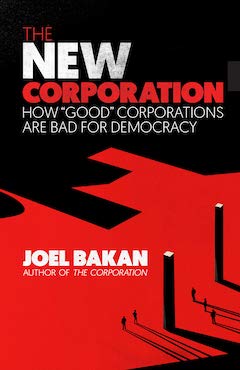
image - The New Corporation book coverThe New Corporation traces the consequences of a world close to losing its foundation of democracy. Bakan says the onus is on us to make the necessary connections and to actively be part of meaningful solutions if we want to leave our children and grandchildren a positive future. The Q&A with Segal will have a special focus on Jewish values, and ethical responsibility in business and corporate governance.

There are various ticket tiers for the Brunch with Bakan event, from $18 for the Zoom talk only to $118 for the talk, access to stream the film, a copy of the book (minimum two-week turnaround time for delivery) and name recognition. All ticket tiers include a tax receipt for the maximum allowable amount and the film, called The New Corporation: The Unfortunately Necessary Sequel, will be available May 25-28 for ticketholders to stream.

Over the last century, CHW has been involved in all aspects of Israeli life, supporting programs and services for children, women and healthcare in Israel and Canada. To tickets to the Brunch with Bakan fundraising event, visit chw.ca/thenewcorporation.

– Courtesy CHW Vancouver

Format ImagePosted on May 7, 2021May 6, 2021Author CHW VancouverCategories NationalTags books, Brunch with Bakan, business, CHW, corporations, ethics, film, fundraiser, Joel Bakan, Judaism
Joe Segal receives Rix

Joe Segal receives Rix

Joe Segal accepting the Greater Vancouver Board of Trade’s Rix Award for engaged community citizenship in an April 7 online celebration. (screenshot)

The Greater Vancouver Board of Trade paid tribute to Joe Segal on April 7, honouring him with its Rix Award for engaged community citizenship, in recognition of his many philanthropic endeavours and decades of community service.

The postponed 2020 Governors’ Banquet & Rix Awards was reimagined for the virtual gathering, which was dubbed the Governors’ Gala and Rix Awards. The event also saw the board’s Rix Award for engaged corporate citizenship bestowed on CN, and its immediate past chair, Lori Mathison – who currently serves as president and chief executive officer of Chartered Professional Accountants of British Columbia – inducted into its council of governors, along with Kari Yuers, president and CEO of Kryton International Inc. Gala co-chairs were Lorne Segal and Brent Cameron.

Born in Vegreville, Alta., in 1925, Joe Segal’s early years included losing his father at aged 14, stretches of financial hardship and hard labour building the Alaska Highway. He fought in the infantry in the Second World War, where, along with his compatriots, the Calgary Highlanders, he participated directly in the liberation of the Netherlands.

Following the war, he arrived in Vancouver with $1,500 in his pocket and set to work on more entrepreneurial pursuits. While he started small in war surplus goods, his hard work and tenacity led him to found the Fields department stores and, ultimately, take over Zellers before launching Kingswood Capital Corp., a conglomerate with interests in real estate, manufacturing and financing.

Despite his success, Segal has remained firmly grounded in the community where he built his businesses and raised his family. It is a tribute to his character that his impact and life in the city are perhaps most marked by his generosity – both with his time, as a mentor, and philanthropic endeavours.

A recipient of both an Order of Canada and an Order of British Columbia, Segal’s more recent years have been defined mainly by his philanthropy.

He served on the board and as chancellor of Simon Fraser University for six years. And, in perhaps one of his most visible contributions in Vancouver, Segal donated the historic Bank of Montreal building at 750 Hastings St. to SFU, creating a home for the Segal Graduate School of Business.

In 2010, he and his wife Rosalie donated $12 million to the VGH and UBC Hospital Foundations to create the Joseph and Rosalie Segal and Family Centre, a 100-private-room acute care centre serving the mental health needs of people in crisis. The substantial gift, made prior to mental health concerns being mainstream, is just another demonstration of his strong connection to the needs of the community. There are countless other organizations who are recipients of the Segals’ work and philanthropy.

Together with his partner Rosalie, the Segals have passed along the philanthropic genes to their children Sandra, Tracey, Gary and Lorne. The Segal family has supported mental health charities for more than 20 years. Their awareness was sparked after they were invited to attend the Coast Mental Health’s Courage to Come Back Awards, which honours individuals who have overcome major life challenges. The event has been chaired by their son, Lorne, for the past 15 years.

In a complex world, Joe Segal’s life offers a clear example for leaders today and the leaders of tomorrow. Simply put, a life well-lived will be most marked by the ways in which we give back to our community and contribute collectively towards a brighter future.

The Rix Awards are an initiative of the Greater Vancouver Board of Trade, presented in honour of the late Dr. Don Rix, who served as chair of the organization in 2008-09. Award recipients are chosen each year by a special selection committee of the board of directors, based on a number of criteria.

Watch this year’s event at boardoftrade.com/events/individual-events/1656-6471.

Format ImagePosted on April 23, 2021April 22, 2021Author Greater Vancouver Board of TradeCategories LocalTags Board of Trade, business, community service, Joe Segal, philanthropy, Rix Awards
Protect ecommerce ventures

Protect ecommerce ventures

(image from pxhere.com)

Many businesses are shifting their focus to ecommerce, and many new ecommerce businesses are popping up due to the COVID-19 pandemic. British Columbia has recognized this by launching a plan to support these businesses.

Whether your business operates its own ecommerce site or operates through a service like Shopify or Etsy, how you deal with conflict in the ecommerce environment is up to you. I always caution people against finding website policies and legal documents online, as I’ve yet to see one that adequately deals with the concerns of the business.

There are two major areas fraught with risk when using out-of-the-box or cobbled together online legal documents. Not surprisingly, one of them is privacy law. Unlike the United States, Canada has strict privacy laws that are similar to those in the European Union. You know those prompts you get now to “accept cookies” on websites? Those are to make the site compliant with the European GDPR – a set of regulations dealing with the collection and use of personal information. If you are operating a business in British Columbia, any information you collect from visitors to your website, from a visitor’s computer’s ID address (automatically collected by the web server) to the personal information they submit to buy things from your site, is governed by the Personal Information Protection Act (PIPA). Right away, that should tell you that you need a privacy policy that’s made in British Columbia or you risk penalties under PIPA.

The other areas that I find suffer from a one-size-does-not-fit-all problem are dispute resolution and intellectual property.

Dispute resolution is an often-overlooked part of any agreement, especially ecommerce terms of use. Clients often tell me that disputes won’t happen or they’re not worried. I remind them that lawyers get a lot of our work from situations that no one expected. And that solving a messy dispute is much more expensive than anticipating it and being prepared.

There are many types of disputes that can arise and many types of resolution tools. No one tool is the best for all situations.

Ecommerce businesses have certain aspects that make arbitration the best path, and some that would be more appropriate for the court system.

For example, intellectual property disputes often have to be tried in Supreme Court, not Small Claims. The cost of making a claim in Supreme Court is often higher than the cost of arbitration.

Arbitration is often used for ecommerce disputes because you can select an arbitrator with the specialized knowledge needed to understand the claim. If arbitration is an appropriate dispute resolution tool, you should discuss with your lawyer what set of rules and what type of panel will be used.

I recently advised regarding a dispute involving a breach of contract related to intellectual property in an ecommerce situation. I looked at the contract and the situation and thought about it from the perspective of a solicitor drafting terms of use.

Let’s say you craft custom mezuzot and you sell them through Etsy. There are two main areas where I see disputes arising.

One of them is sale completion, like payment, delivery, etc. This is pretty standard business stuff, such as, who is responsible for the mezuzah after payment is made but before either the payment is received or the product is delivered? There is a wealth of case law dealing with this, and it’s important that you understand what kind of insurance you’ll need in case it’s stolen or lost during that interim period.

Another type of dispute arises from the originality of your artwork. The mezuzot themselves are covered by copyright law, as are the photos of them, but how will you deal with someone who makes unauthorized copies of either the mezuzot or the photos? If the copies are slightly different, who will be the best person to determine whether there is infringement?

What if someone takes an idea that is clearly yours and makes their own mezuzot that are similar but definitely not the same? Is there a style that identifies them as part of your business? That might be a trademark issue, which cannot be dealt with in Small Claims in British Columbia. If they’re not copies of the mezuzot but inspired by them, is there infringement? Likely not. This brings us back to the terms of use.

Let’s say you have a site called TeleSeder. You sell an app and run a course to help people run their Passover seders through videoconferencing software, like Zoom or Skype. Someone signs up for the course, pays for everything, and then turns around and creates VirtuaPesach. It does almost exactly the same thing – it’s clearly using your idea, including a similar app and course, right down to the course materials. But the person running VirtuaPesach has done their homework on copyright and made sure that they’ve made enough changes to escape a claim for copyright infringement.

Copyright doesn’t protect ideas; it protects the specific works expressing those ideas. But that’s not fair, you say. They came to my site, even paid for my materials, and then ran off with them to create a competitor!

This is where a made-for-you ecommerce agreement can help. It’s true that VirtuaPesach probably doesn’t infringe your copyright, but the person behind VirtuaPesach did sign an agreement when they paid for TeleSeder. When they paid for your product, there was an exchange, and that exchange can have more terms than just “pay money, receive product.” What if you included a clause in the terms of use saying that they agree not to create a competitive product based on yours? There are limits to how far you can go with that, but it’s definitely an option. Now, you have them for breach of contract. Choosing whether to use court or arbitration to settle the dispute will be based on a discussion of certain details with your lawyer, but why not build some of the resolution right into the agreement?

You can put remedies – as long as they’re not excessive and they’re realistically tied to the problem – right into the agreement. There’s a way that the agreement can say, “Not only will you not steal my idea, but if you do, whatever you create with it will be mine.” Enforcing that could put the brakes on VirtuaPesach and hand over all of its assets to TeleSeder. The extent to which you can do that depends on circumstances, of course, but this is something to consider when transitioning to an online business.

Using carefully crafted online documents for your ecommerce business helps protect you and your business. From securing what’s yours to controlling dispute resolution before a dispute arises, an ecommerce venture has new challenges and new spins on old challenges that can be managed by getting the right advice.

Jeremy Costin is a business and estates lawyer practising in Vancouver. He sits on the board of directors and is the chair of the governance committee of the Vancouver Holocaust Education Centre, and is a frequent guest instructor at the Law Society of British Columbia.

***

Disclaimer: This article should not be construed as legal advice. Only your lawyer can give you proper advice specific to your needs.

Format ImagePosted on February 12, 2021February 11, 2021Author Jeremy CostinCategories Op-EdTags business, coronavirus, COVID-19, ecommerce, economy, law
Olive trees have long history

Olive trees have long history

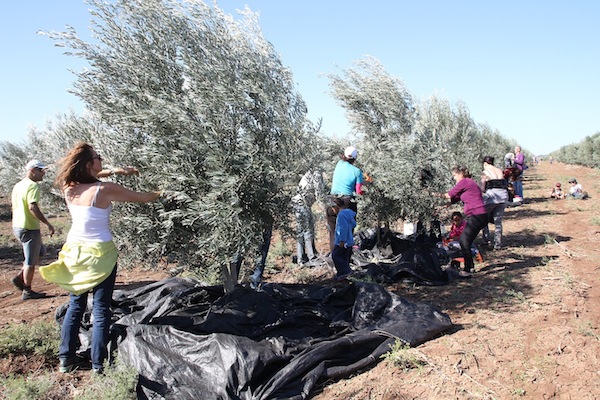
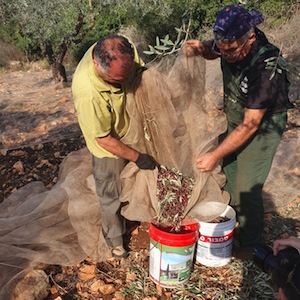
Volunteers help pick olives on a windy day in the fair trade grove of Emek Yizrael. (photo from Yoram Ron)

For thousands of years, olive trees have grown in Israel. Neolithic pottery containing olive pits and remnants of olives have been discovered in Israel’s Mount Carmel region, proving that early people produced olive oil by pulverizing the ripe olives in small pots. Some ancient trees reportedly still exist – in the Palestinian village of al-Walaja, residents claim they have the world’s oldest olive tree, supposedly 5,000 years old. More realistic is Beit Jala’s claim to an 800-year-old olive tree.

Olives for making oil are picked around December or January, so it is probably no coincidence that Chanukah comes so close to the picking season. As you know, Chanukah’s miracle revolves around the story that a very limited amount of olive oil burned in the Temple menorah for eight nights.

While the olive branch is a symbol of peace, the olive harvest in both Israel and the Palestinian territories is a challenging time. For Palestinian olive growers, extremist settlers and Israeli government policy have turned their harvest into an uncomfortable, if not a physically and economically dangerous event. Documented cases show some settlers assaulting Palestinian farmers – threatening them, driving them off their own land, physically attacking them or throwing stones at them. Sometimes, settlers vandalize Palestinian vehicles and damage farming equipment. In other cases, settlers jump-start the harvest, stealing the fruit from hundreds of trees. In the saddest of cases, settlers vandalized hundreds upon hundreds of Palestinian olive trees, in what appears to be a gross violation of Deuteronomy’s 20:19 bal tashchit precept. In this law, we may not uproot or cut down a fruit tree if we do not have an acceptable reason to do so. In the early part of last year’s harvest, the Office for Coordination of Humanitarian Affairs reported that 25 Palestinians were injured, more than 1,000 olive trees were burnt or otherwise damaged and large amounts of produce were stolen.

Since the construction of the separation barrier, some Palestinian olive growers have ended up with their groves located on the other side of the barrier and farmers must obtain special permits and go through special gates to get to their trees. The B’Tselem Organization has documented situations in which Israeli soldiers have blocked the access gates or held farmers up, and there have been reports that soldiers have used anti-riot material on the growers.

In a few cases, the separation between olive groves and homes means that growers have to travel some 25 kilometres round trip. Moreover, the growers are given fixed times to get to their trees and, sometimes, the periods available are not long enough to finish all the picking. Related, Palestinians are sometimes put into a situation in which they have to pick their fruit while the olives are still strongly attached to the branches. Olive picking is largely a manual procedure, so, to dislodge the unripened olives, growers either hit the trees with a rod or shake the trees very hard. This can result in damage to both the trees and the olives.

photo - Two men loading freshly picked olives in the organic grove of the Galilee’s Kfar Deir Hanna, November 2020
Two men loading freshly picked olives in the organic grove of the Galilee’s Kfar Deir Hanna, November 2020. (photo by Itiel Zion)

The current pandemic has caused financial havoc all over the world, including in Israel. This harvest season, Jewish Israeli olive growers have had tons of olives stolen. In the Emek Yizrael area, the Border Police found about 10 tons of olives in a nearby sheep pen. The olives had already been bagged and the gathering containers were standing to the side. The alleged thieves live in Zarzir, a village some 10 kilometres from Nazareth. Shomer Hachadash (the New Guard) tries to prevent these incidents using dogs and heat-sensing drones for nighttime surveillance. Some very bold olive thieves have even been spotted in daylight hours.

Despite this gloomy picture, however, there are promising things happening in Israel’s olive industry. Kfar Kanna’s Sindyanna is an olive oil producer. The Galilee operation is a certified fair trade establishment. In addition, it is a nonprofit organization with strong social and political commitments. Their olive oil bottles proudly say that the oil is produced by Jewish and Arab women in Israel.

Sindyanna aims to improve the working conditions and livelihoods of local Arab women, a clearly marginalized group. For example, Sindyanna provides employment training for Arab women. On the political level, Sindyanna is committed to inter-religious understanding by contracting Muslim, Jewish and Christian women. Moreover, the growers who sell their olives to Sindyanna, like the population of the Galilee itself, are a mix of ethnic groups.

Hadas Lahav, Sindyanna’s chief executive officer, said the company strongly affirms sustainable farming. Over the years, it has built strong connections with local farmers, buying olive oil directly from about 100 individual farmers and large family groups. Some of the farmers are organized into large family companies, like Al-Juzur’s seven families of the Younis clan. In Deir Hanna, the 2,500 organic olive trees belong to the Hussein family. In the Birya Forest, there are 10,000 organic olive trees maintained by Hussein Hib.

In the Jezreel Valley, there is a non-organic grove that belongs to Sindyanna in cooperation with the landowners, the Abu Hatum family from Yafi’a. In Iksal, the non-organic groves belong to the Dawawsha family. In Arabeh, the non-organic olive groves belong to the Khatib family and, at Moshav HaYogev, they belong to the Ashush family.

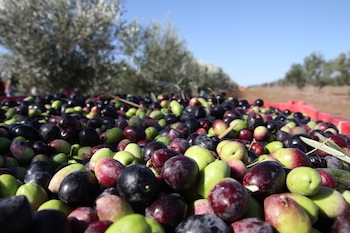
photo - Close-up of freshly picked olives in Sindyanna’s fair trade grove in Emek Yizrael
Close-up of freshly picked olives in Sindyanna’s fair trade grove in Emek Yizrael. (photo from Yoram Ron)

As Lahav pointed out, with olives, there are good years and less good years. The 2020 harvest was significantly smaller than the 2019 harvest. In a way, it was fortuitous that 2020 produced less fruit, as, with COVID-19, few permits were given to seasonal pickers entering Israel from the West Bank.

The olives picked for Sindyanna’s products are Coratina (this olive tree is highly adaptable and produces abundantly in hot dry climates, including rocky soils), Barnea (this olive was bred in Israel for oil production, but is also used for green or black table olives) and Souri (olives that are native to Israel and have been the major variety cultivated traditionally under rain-fed conditions in northern Israel). On average, in irrigated groves, a tree produces five kilograms of olive oil and, in a non-irrigated grove, a tree produces three kilograms of olive oil. The olive oil is kosher.

Here are some factoids about Sindyanna. Many of us are familiar with Dr. Bronner’s soaps, but did you know that Sindyanna of the Galilee’s organic olive oil is an essential ingredient in Dr. Bronner’s Magic Pure-Castile Soaps? KKL-JNF is also involved with Sindyanna of the Galilee – in KKL-JNF’s Birya Forest, the organic olive grove was once part of the now-defunct Qabba’a village. Not too long ago, another organic grove in Wadi Ara (planted on a former Israeli army firing range) was threatened by the construction of high-tension wires; following the protests of local farmers and the village council, the course of the power line was diverted.

Sindyanna of the Galilee sells its olive oil on Amazon and, this year, it will start selling its olive oil on select Canadian websites and in certain food stores.

Deborah Rubin Fields is an Israel-based features writer. She is also the author of Take a Peek Inside: A Child’s Guide to Radiology Exams, published in English, Hebrew and Arabic.

Format ImagePosted on January 15, 2021January 13, 2021Author Deborah Rubin FieldsCategories IsraelTags business, fair trade, farming, history, Israeli-Palestinian conflict, olive oil, olives, Palestinians, politics, Sindyanna
Using chutzpah in business

Using chutzpah in business

Uri Adoni shares “The Six Rules of Chutzpah” in his book The Unstoppable Startup. (photo from Uri Adoni)

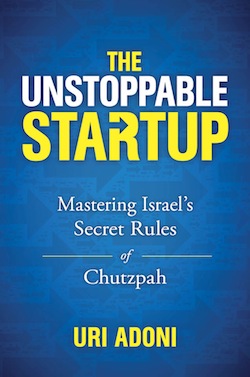
Uri Adoni, author of The Unstoppable Startup – Mastering Israel’s Secret Rules of Chutzpah, is on a mission to teach businesspeople how to use chutzpah to their advantage.

Born and raised in Israel, Adoni was working at a large advertising agency when the internet was just starting to catch fire.

“I really remember the exact moment when I first saw the internet,” Adoni told the Independent. “It was back in 1995 and it really blew my mind. I said, ‘Wow! I can talk to somebody in Singapore!’ It was very slow, dial up. It took ages to download anything, but it was crazy for me. And then I realized I just had to be part of it.

“Funnily enough, one of the partners in the agency at the time, he said to me, ‘This internet thing, it’ll never catch on.’ But, I begged to differ! And the old advertising world, I think, it will change dramatically, because you have so much data and people will know exactly what you were doing. That’s when I joined Microsoft.”

Adoni was chief executive officer of MSN Israel, working for Microsoft, for about seven years. He then moved to managing venture capital, giving him a unique view as to why some venture owners succeed while others fail. After a decade on the job, he decided to share this knowledge in book form.

According to Adoni, “One of the questions we’ve been frequently asked by people from all over the world is, ‘What is the secret sauce behind the Israeli success?’… We’re the second-largest tech hub in the world, second only to Silicon Valley, the largest per capita. We have the highest density of startups per capita, the highest venture capital per capita.”

Adoni shared that Israel has the third most companies on the NASDAQ, after the United States and China, though, in terms of population and geography, Israel is tiny compared to these countries.

“The positive side of chutzpah is what makes the difference between Israeli entrepreneurs and other entrepreneurs from around the world,” said Adoni. “One of my hypotheses is that, unlike charisma, which you’re either born with or not, chutzpah is actually something you can teach. And, I’d say, more than that, by the way. I think that any entrepreneur in the world, whether Israeli or not, they all have chutzpah. They just don’t know how to define it this way. But, I really think it’s a key ingredient in any successful startup.

“I felt the best way to explain it is by demonstrating what it is, and that the best way to demonstrate it would be to interview very successful entrepreneurs who could relate to it – asking them how important chutzpah has been in the success of their startup. If they are Israelis, they’d know it, and be able to put their finger on it.”

image - The Unstoppable Startup book coverIn The Unstoppable Startup, Adoni delves into what he has dubbed, “The Six Rules of Chutzpah,” with plenty of examples. The first rule involves changing one’s mindset, which, in turn, enables you to challenge reality as you know it, by thinking ahead of the curve.

“One of the companies we invested in at the time was a company, called CyActive, in the computer anti-virus world,” he said. “Usually, the way it works is that you have a virus and then you have the anti-virus that comes up with some sort of virus blocking. But it’s a cat-and-mouse thing, because they have to come up with a new virus and the anti-virus has to block it.

“They came up with a really interesting approach by changing the paradigm,” he explained. “They took the existing virus and, with a very smart algorithm, they created tens of thousands of potential viruses that could be expanded or developed from the original virus. And then, once we had all these viruses, we could create a tool to block them, before they even existed. So, they actually built something that blocks viruses that no one had come up with yet, but that there’s a chance they’ll come up with.”

Another rule, Adoni said, is innovating in order to meet future demand. In this context, he gave the example of the navigation app, Waze. Users share real-time data about their travel location and speed, allowing Waze to calculate the quickest way from point A to B.

“Once they use the application, all of this data [is] collected and you can sometimes know and predict where there will be traffic jams, guiding people to different routes and getting them to the destination faster,” said Adoni. “A lot of people were very skeptical about it. They said nobody will share their data; privacy issues. But, they proved everybody wrong. The market actually needed that, but we needed to bring them the tool. Once the tool was introduced, it was adopted very quickly.

“By the way, [Apple’s] Steve Jobs was one of the best – all the way from the Macintosh to the iPhone, having this entrepreneurial mindset that says, ‘I know what people need and will introduce it to them.’”

While Adoni’s book is naturally geared to startups and tech companies, he is adamant that the principles are relevant for any company, “no matter if they are small, big, or what state they are in because, at the end of the day, if you’re just doing more of the same, you may sell, you may make a living, but not necessarily make it big, or breakthrough, or grow in a large way.

“Even if you just have a small coffee shop, you should have your own competitive advantage, whether that’s with your cakes, experience, prices, name, or community. You need to differentiate yourself, showing why people should choose you over others. Random choice will not build return business. Any company around the world, any business you can think of, must think in a mindset of how they can outpace their competition, figure out their competitive advantage.”

Adoni believes his book is also great for investors, as it will teach them what to look for in startups.

In non-pandemic restricted days, Adoni regularly travels the world, speaking with university students.

Not wanting to reveal much, Adoni said he is currently working on a venture to challenge the mindset of Americans about developing new high-tech hubs in places that many people would not even consider a possibility.

Rebeca Kuropatwa is a Winnipeg freelance writer.

Format ImagePosted on December 18, 2020December 16, 2020Author Rebeca KuropatwaCategories BooksTags business, entrepreneurship, Israel, startups, technology, Uri Adoni

Posts pagination

Previous page Page 1 Page 2 Page 3 Page 4 … Page 7 Next page
Proudly powered by WordPress