Skip to content
  • Home
  • Subscribe / donate
  • Events calendar
  • News
    • Local
    • National
    • Israel
    • World
    • עניין בחדשות
      A roundup of news in Canada and further afield, in Hebrew.
  • Opinion
    • From the JI
    • Op-Ed
  • Arts & Culture
    • Performing Arts
    • Music
    • Books
    • Visual Arts
    • TV & Film
  • Life
    • Celebrating the Holidays
    • Travel
    • The Daily Snooze
      Cartoons by Jacob Samuel
    • Mystery Photo
      Help the JI and JMABC fill in the gaps in our archives.
  • Community Links
    • Organizations, Etc.
    • Other News Sources & Blogs
    • Business Directory
  • FAQ
  • JI Chai Celebration
  • JI@88! video

Recent Posts

  • Sharing her testimony
  • Fall fight takes leap forward
  • The balancing of rights
  • Multiple Tony n’ Tina roles
  • Stories of trauma, resilience
  • Celebrate our culture
  • A responsibility to help
  • What wellness means at JCC
  • Together in mourning
  • Downhill after Trump?
  • Birth control even easier now
  • Eco-Sisters mentorship
  • Unexpected discoveries
  • Study’s results hopeful
  • Bad behaviour affects us all
  • Thankful for the police
  • UBC needs a wake-up call
  • Recalling a shining star
  • Sleep well …
  • BGU fosters startup culture
  • Photography and glass
  • Is it the end of an era?
  • Taking life a step at a time
  • Nakba exhibit biased
  • Film festival starts next week
  • Musical with heart and soul
  • Rabbi marks 13 years
  • Keeper of VTT’s history
  • Gala fêtes Infeld’s 20th
  • Building JWest together
  • Challah Mom comes to Vancouver
  • What to do about media bias
  • Education offers hope
  • Remembrance – a moral act
  • What makes us human
  • המלחמות של נתניהו וטראמפ

Archives

Follow @JewishIndie
image - The CJN - Visit Us Banner - 300x600 - 101625

Tag: business

Little hat store that could

Little hat store that could

SherlockS has a window display starring a two-foot-high teddy bear dressed like Sherlock Holmes. (photo by Micha Paul)

There is a small, magical hat store right in the heart of Jerusalem, called SherlockS. It’s not hard to find. Just walk along King George Street until you see a two-foot-high teddy bear dressed in a SherlockS deerstalker hat and Inverness cloak, holding a pipe in one hand and a magnifying glass in the other, perched on a table in the display window.

SherlockS is packed with hundreds of hats for both men and women. The store specializes in hard-to-fit heads and carries hats by Stetson, Bailey, Kangol, Christys’ and many other quality hat companies. There are even Borsalinos, the kind the snazzy Italians wear. SherlockS is also the home of handmade hats by local milliners like Danielle Mazin and Justine. And SherlockS makes their own Panama hats, as well.

Owner Yaacov Peterseil decided to create this store after his dermatologist warned him about the damage the sun’s ultraviolet rays were doing to his head. “You must wear a hat outside in summer and winter,” said the doctor.

photo - Yaacov Peterseil is owner of SherlockS
Yaacov Peterseil is owner of SherlockS. (photo by Micha Paul)

“I was just looking for something to do, having left publishing,” Yaacov explained. “Could a hat store afford me the opportunity to help people by keeping the sun’s rays at bay and be financially rewarding, as well? I wondered. I had to try. So, in 2016, I opened SherlockS Hats in my garage. Before long, people came in droves to the store, which was way too small to hold both the hats and the people. So, I moved to Diskin Street, in an underground mall. But, soon, that store was too small, too. Finally, I moved to King George Street, where people could stop by, relax, get a cappuccino and a muffin, and even buy a hat.”

When Yaacov was choosing a name for his business, Sherlock and Sherlock Holmes were already taken. “So, I thought of SherlockS. SherlockS Hats has a nice ring to it. And there’s no need for an apostrophe,” he said.

Peterseil was born in 1946, in Salzburg, Austria, in a displaced persons camp. His family moved to the United States in 1949. Eventually, his father opened a wholesale clothing shop, selling ladies sweaters and T-shirts to all the big chains in New York.

“I worked with my dad for awhile,” said Yaacov. “It was there I developed a love of quality clothing.”

Yaacov believes that his varied business endeavours all led him to SherlockS Hats. He worked as a copywriter for Prentice-Hall, had his own byline in the Nassau Herald, taught journalism at the University of Michigan, was a speech writer for B’nai B’rith, founded Enjoy-A-Book Club, and owned K’tonton Book Store on Long Island. He also found time to get his rabbinic degree, and joined the rabbinate in the United States and in Newfoundland, where he taught Jewish studies at Memorial University.

In 1986, he, his wife Tamar (a family and sex therapist) and their (then) six children made aliyah. Once they settled in, Yaacov kept busy as public relations director for his mentor, Rabbi Shlomo Riskin, and developed Pitspopany Press for Children.

It was while he was busy publishing Jewish children’s books at Pitspopany that Yaacov asked me to review some of their titles. Since then, our paths have crossed a number of times.

“One of my first hat purchases was the deerstalker hat,” said Yaacov. “It was made famous in 1891 when Sidney Paget illustrated one of Conan Doyle’s Sherlock Holmes stories, putting a deerstalker hat on the detective. Today, I sell about 50 deerstalker hats a year in Israel.”

When COVID-19 forced him to keep his shop closed for weeks and months at a time, Yaacov took his store online. He created sherlockshats.com, which features a 3-D tour of his hat-filled store, as well as hundreds of hats from which to choose.

“I write two kinds of blogs for the website,” he said. “One is a story-type blog called The Adventures of the Mad Hatter. The blog tells the story of some of the strange and unusual things that happen in my hat store. The other blog gives a bit more practical information about hats and how to wear them. I’m writing one now on how to fit the hard-to-fit head.”

Next time you get to Israel, you’re invited to visit SherlockS at 31 King George. It’s not as famous as 221b Baker St. yet, but it’s getting there. And, if you want to talk hats with Yaacov, call him at 972-50-361-2342 or message him via the website.

Sybil Kaplan is a journalist, lecturer, book reviewer and food writer in Jerusalem. She created and leads the weekly English-language Shuk Walks in Machane Yehuda, she has compiled and edited nine kosher cookbooks, and is the author of Witness to History: Ten Years as a Woman Journalist in Israel.


Format ImagePosted on December 4, 2020December 2, 2020Author Sybil KaplanCategories IsraelTags business, clothing, coronavirus, COVID-19, entrepreneurship, hats, SherlockS, textiles, Yaacov Peterseil
Grinding coffee for a century

Grinding coffee for a century

Izhiman’s – the car is decorated with the company’s logo, based on advertising from that era showing a turban-wearing waiter – à la Cairo’s legendary El Fishawy coffee house in the Khan al-Khalili – serving, of course, coffee. (photo from Izhiman’s)

When the Izhiman family opened its coffee roasting and grinding business in 1921 on Suq Khan a-Zeit (Beit Habad Street), 100 metres inside the Old City’s Damascus Gate, Sir Herbert Samuel had recently arrived as Great Britain’s first high commissioner for Palestine, and Egyptian chanteuse Umm Kulthum was just beginning her illustrious career. Over the last century, the Middle East has changed beyond recognition but Izhiman’s flavourful qahwa – blended from high-quality Arabica beans – has remained a staple for Jerusalem’s coffee aficionados. And, at NIS 48 ($19 Cdn) per kilogram, the cardamom-flavoured finely ground secret mix – which includes Brazilian, Colombian, Guatemalan, Costa Rican and Tanzanian beans – is a bargain.

From that first roaster and grinding shop in the Old City, Izhiman’s has grown to a chain of six stores, with a presence in Jerusalem, Ramallah and Bethlehem. Besides its signature blend of Arab/Turkish coffee, the Izhiman family-operated chain sells tea, nuts, spices, condiments, chocolate and henna from Thailand, Turkey, Egypt and elsewhere. Many of the imports are cheaper than their Israeli counterparts.

“I manage three stores,” said Mazen Izhiman, 63, who started working at the Old City branch in 1976. “My son Mahmoud is the operations manager.”

photo - Mazen Izhiman
Mazen Izhiman (photo from Izhiman’s)

Mazen points to the various historic photos decorating his shop. One shows an antique car bearing Mandate Palestine licence plate 5111. The vehicle is decorated with the company’s logo, based on advertising from that era showing a turban-wearing waiter – à la Cairo’s legendary El Fishawy coffee house in the Khan al-Khalili – serving, of course, coffee.

Interviewed at the company’s office in Atarot Industrial Park, not far from the now-decommissioned Qalandia Airport, Mahmoud (Mamu) Izhiman, 32, explains the roaster was moved there from Abu Dis in 2014 because of transportation problems in reaching the West Bank suburb. Originally, the roaster was located on Suq Khan a-Zeit, across from the shop that his father manages today. A century ago, the beans were ground by hand, he noted. A few grams of coffee wrapped in a cone made from newspaper were sold in single-serving portions.

While the Izhiman family came to Jerusalem from the Hijaz eight centuries ago, during the time of Saladin to fight the Crusaders, the details of the founding of the business have been lost, said Mahmoud, who studied political science at the Hebrew University of Jerusalem before deciding that the coffee business was more satisfying to him than the Israeli-Palestinian quagmire.

Even the given name of the company’s founder a century ago is in dispute, he said. The family business began splitting apart in 1948, when one brother fled to Amman, Jordan, where he opened a coffee roaster of the same name. Another split occurred in 1994, and a further one in 2008, which resulted in a 2014 lawsuit in the Jerusalem District Court for copyright infringement. Notwithstanding the favourable ruling, family members continue to operate unauthorized Izhiman’s branches across the West Bank and Dubai. Indeed, the website izhiman.com is used by the unlicensed stores, said Mahmoud.

photo - Mahmoud (Mamu) Izhiman
Mahmoud (Mamu) Izhiman (photo from Izhiman’s)

Joining the family business, Mahmoud apprenticed at a 2013 course in Izmir, Turkey, offered by the Specialty Coffee Association of America, and then earned a coffee science certificate from Nouva Simonelli in Ancona, Italy.

“I was the first one in the Middle East to study with the SCAA,” he said.

That expertise led him to experiment roasting different blends, seeking a taste that he calls “balanced and aromatic” with “no acidic bitter aftertaste.” The exact blend is “top secret,” he said.

Having relocated the roaster from Abu Dis, Mahmoud bought an $80,000 machine capable of roasting a 120-kilogram batch of coffee beans in 20 minutes. In 2018, he upgraded to a $110,000, fully automated, 240-kilogram-capacity, Turkish-manufactured roaster with a built-in fire extinguisher. To preserve trade secrets, Mahmoud asked me not to take photos of the roasting machine, which he custom designed. The plant also boasts a high-tech, Chinese-made grinding and filling machine that injects nitrogen into each package before it is sealed to prevent oxidation. Mahmoud’s brother, Abdullah, is the production manager at the Atarot facility.

photo - Izhiman’s has grown to a chain of six stores, with a presence in Jerusalem, Ramallah and Bethlehem
Izhiman’s has grown to a chain of six stores, with a presence in Jerusalem, Ramallah and Bethlehem. (photo from Izhiman’s)

How much java does Izhiman’s sell? Mahmoud hesitates before answering: “Enough to call us a major coffee factory. We have a presence in every supermarket and grocery in East Jerusalem.”

But Izhiman’s success isn’t limited to providing a caffeine fix for the Arab half of the city. In December, the company opened its first outlet in Jewish Jerusalem. Mahmoud calls the four-square-metre kiosk at the First Station a “pilot.” It sells “macchiato, lokum [pistachio, hazelnut, rose and pomegranate-flavoured Turkish delight], everything,” he enthused. “If you’re afraid to come to the Old City, I’m coming to you.”

As well, Izhiman’s sister company, Coffee Zone, will soon be launching a line of espresso capsules, he added.

Delicious coffee is one of the flavours of co-existence, Mahmoud believes.

With peace on the horizon, foodies may want to visit the Izhiman’s booth at the Gulfood 2021 expo taking place Feb. 21-25 at the Dubai World Trade Centre. Inshallah.

Gil Zohar is a writer and tour guide in Jerusalem.

Format ImagePosted on December 4, 2020December 2, 2020Author Gil ZoharCategories IsraelTags business, coffee, entrepreneurship, family, history, Izhiman
Women in labour force

Women in labour force

Pamela Jeffery, founder of the Prosperity Project. (screenshot)

Pamela Jeffery, the driving force behind the Prosperity Project, led an Oct. 7 webinar entitled When Women Succeed, We all Prosper – Don’t Let COVID-19 Hold Us Back, which was part of a National Council of Jewish Women of Canada series on women and justice.

Launched on May 21 of this year, the Prosperity Project hopes to ensure that gains made by women in the workplace and elsewhere are not set back permanently by the pandemic. In July, a Royal Bank of Canada report showed that women’s participation in the labour force had decreased to its lowest level in 30 years. Women, according to RBC, have been disproportionately affected by the overall decline in work hours since March, and this has been exacerbated by the household and childcare responsibilities for which women take on a greater share than men, particularly when children are not learning in school.

“We all know that the women’s movement is unfinished,” said Jeffery. “This is why our leadership is necessary – no matter what our age or our gender. It is up to all of us to ensure that men and women have equal opportunity, which is at the heart of the Prosperity Project.”

She stressed, “There is a clear focus on making sure that the progress made over the last 60 years on gender equality is not rolled back. That is why the Prosperity Project exists.”

Jeffery spoke of three essential themes to advancing the movement: resourcefulness, relationships and risk. “Each of us has the power to bring an idea forward. We can take a calculated risk and draw on our resourcefulness and relationships to make things happen,” she said.

The Prosperity Project has several initiatives it hopes will safeguard the progress by women in the past few decades and propel it further. Among them is a “matching initiative” for nonprofit organizations whose mission is geared towards helping women with training, employment pathways, crisis counseling and mental and physical health. The initiative introduces women and men in the private sector with specific skill sets to the staff and existing boards of these nonprofits for extended volunteer assignments.

Jeffery pointed out the importance of role models and mentors for women. “A good mentor pushes someone outside of their comfort zone. Women are less likely to have mentors than men, which can explain our different career trajectories,” she said.

The Prosperity Project also plans to research and share practical solutions that will provide insights to employers and policy-makers on how to improve gender equality. Furthermore, it will enable women to learn from one another, to increase their employment income and well-being.

Jeffery cited a 2017 study by McKinsey & Co., reporting the overall societal benefits of advancing women’s equality. By addressing this issue, McKinsey found that Canada could “add $150 billion in incremental GDP in 2026 or see a 0.6% increase of annual GDP growth.”

The Prosperity Project also plans to create a modern-day Rosie the Riveter campaign, inspired by the iconic image used in advertising materials to encourage women to do factory work during the Second World War. The modern-day objective is to increase the labour force participation rate of women and, at the same time, encourage partners to share household responsibilities equally and motivate employers to bolster advancement opportunities and achieve gender parity at all levels of an enterprise.

The Prosperity Project has thus far brought on board 62 diverse female leaders from across the country, such as Enterprise Canada chief executive officer Barbara Fox, Sleep Country co-founder Christine Magee and former B.C. premier Christy Clark.

Jeffery’s own biography is one of enterprise, determination and success. An MBA graduate from Western University, in Ontario, she is the founder of the Women’s Executive Network and Canadian Board Diversity Council. She has served on the board of numerous organizations and has been a frequent contributor to the Globe and Mail and National Post.

“I am optimistic about the situation we find ourselves in, in 2020. I remind myself of how far we have come,” she said. “Back in 2003, six percent of FP500 board seats were held by women. Now, it is over 25%. I am confident we are going to be able to work together to make sure that COVID-19 does not bring us back.”

The webinar was serendipitously scheduled for an hour before the American vice-presidential debate between Kamala Harris and Mike Pence.

“We are doing quite a lot, but there is so much more to be done,” Jeffery concluded.

For more information, visit canadianprosperityproject.ca.

Sam Margolis has written for the Globe and Mail, the National Post, UPI and MSNBC.

Format ImagePosted on November 13, 2020November 11, 2020Author Sam MargolisCategories NationalTags business, coronavirus, COVID-19, economics, equality, NCJW, Pamela Jeffery, Prosperity Project, women
An Israeli-Moroccan kitchen

An Israeli-Moroccan kitchen

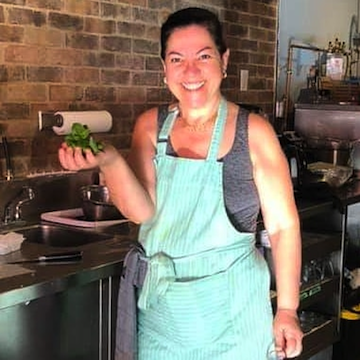
The falafel plate at Ofra’s Kitchen. (photo from Ofra’s)

Ask Ofra Sixto what makes her Israeli-Moroccan restaurant successful and she’ll unabashedly tell you: it’s keeping a positive attitude. But it takes a whole lot of moxie, too.

After all, it isn’t easy to launch a new restaurant in the midst of an unexpected economic shutdown and to create enough name recognition that patrons are willing to line up at your door for takeout. But that all speaks to the allure of Ofra’s Kitchen, which opened this past December, just as the holiday season was coming into full swing. Sixto, who owned a Moroccan restaurant on Hastings Street with her brother years ago, said it’s been her dream to open another restaurant – this time centring on vegetarian and vegan dishes.

Her previous restaurant was called Jacqueline Moroccan Food and was named after her late sister. When her brother was forced to return to Israel, the two siblings realized they would have no choice but to close the restaurant.

Jacqueline’s “was very successful. Very,” Sixto acknowledged.

It was the venue’s eclectic Israeli-Moroccan cuisine that later gave her the idea for a vegetarian follow-up focusing on classic Israeli dishes and flavourful specialties from around the Middle East.

“There is a great need, I think, for good vegetarian cuisine,” she said.

As a “flexible vegan,” Sixto said she often has trouble finding truly appealing food when she eats out. “When I go to a restaurant and I ask, ‘Do you have anything vegetarian?’ they push a salad. I’m not a rabbit, I want something substantial, right? So, when you come to my restaurant, you actually eat food. You eat really, really good and healthy and fresh and made-on-the-spot food that makes you feel good.”

The choices run the gamut from iconic falafel and pita, shakshuka and Israeli salad to lesser-known Iraqi kube and delicately spiced Moroccan beet salad. Diners can also enjoy an array of traditionally made desserts and Turkish coffee.

photo - Ofra Sixto’s restaurant focuses on vegetarian and vegan dishes
Ofra Sixto’s restaurant focuses on vegetarian and vegan dishes. (photo from Ofra’s)

Asked about her favourite dish, Sixto admitted she is partial to eggplant, which plays a starring role in several of her popular dishes. Her sabih – a Tel Aviv specialty that consists of fried eggplant, hard-boiled egg, tahina and an Israeli chutney – can be ordered as a pita sandwich or as a platter. She also serves homemade babaganoush and eggplant salad, early pioneer dishes that are still popular in Israel today.

“And, of course, my falafel is the best in town,” she said. “Not only by what I say but everybody else who eats it. It’s fresh, it’s crunchy outside, it’s moist and soft inside. It’s beautiful.”

But cooking isn’t the only exceptional quality that she brings to Denman Street. A big heart and an innate sense of civic responsibility are helping mobilize a small movement to ensure that those who can’t afford to eat at Denman’s restaurants also have food to eat.

Earlier this year, Sixto noticed that the number of individuals on Denman who were homeless was growing. She said the economic shutdown, which closed many establishments and sections of streets in downtown Vancouver, exacerbated the homeless problem, forcing many people onto Denman from Robson and Granville. Rather than ignoring the issue, Sixto decided to do something to help.

“When I would walk [to work] I would see so many homeless people. I decided, you know, I need to do something about it. I have the means and I could help – whatever my capacity is, right? So, I started feeding the homeless by giving away soup and falafels.”

And her reputation began to grow. “I mean, they are hungry,” said Sixto. “They get drinks, they get food, whatever they need.”

In time, she decided she could do even more. “I decided to make it a social thing and make people be a part of the solution.”

She began letting customers know that each $5 they donated would go toward feeding an individual who was homeless. Sixto said the idea is catching on. “It’s amazingly successful,” she said.

So far, Sixto estimates she has given out in excess of 1,300 meals. She admitted that the donations she receives don’t fully cover the out-of-pocket expenses. “But it doesn’t matter to me,” she said. “It’s not about that $5 that people give. It’s about the acknowledgment of the situation.

“You know, I speak with [the people living on the street],” Sixto said. “I stop and say, how are you today? Did you eat anything? How are you feeling? They are people. They were babies. Somebody loved them or not when they were babies, you know? Something happened to these people along their lives [before they got to where] they are. Nobody chooses to live on the street because it’s fun, right?”

In June, the province of British Columbia issued a revised health order to guide restaurants in how they can operate safely during the coronavirus pandemic. Sixto has taken those rules to heart. Her seating is about half-capacity, with tables situated two metres apart. And she has some gentle ground rules: patrons must agree to sanitize (either with hand sanitizer or by handwashing) when entering the restaurant and wear a mask when walking to and from the table.

Sixto also supports the province’s request to record the contact information of at least one customer per table. According to the province’s health office, the information is retained only in case COVID-19 contact tracing is necessary. Sixto said most people appreciate the effort that restaurant owners are making to keep their venues safe and comfortable.

When it came to navigating the recent shutdown, Sixto said her landlord played a big role. “My landlord is amazing,” she said. The temporary rent reduction allowed her to keep operating – “I never closed, not even for one day.”

Ofra’s Kitchen, located at 1088 Denman St., in Vancouver (604-688-2444, ofraskitchen.com), is open Israeli hours, starting at 11:30 a.m. and closing at “8ish” in the evening.

“As long as there are people, I’m feeding them. If you come by and I am there, I will open the door and seat you,” Sixto said. “Just like Israeli hours.”

Jan Lee’s articles and blog posts have been published in B’nai B’rith Magazine, Voices of Conservative and Masorti Judaism, Times of Israel, as well as a number of business, environmental and travel publications. Her blog can be found at multiculturaljew.polestarpassages.com.

Format ImagePosted on September 11, 2020September 10, 2020Author Jan LeeCategories LocalTags business, coronavirus, COVID-19, entrepreneurship, food, homelessness, Ofra Sixto, Ofra's, restaurant, tikkun olam, Vancouver
Finding ’n’ riding the WAHVE

Finding ’n’ riding the WAHVE

Sharon Emek, founder and owner of Work at Home Vintage Experts (WAHVE). (photo from WAHVE)

Sharon Emek’s company, Work at Home Vintage Experts (WAHVE), celebrates its 10th anniversary this year.

WAHVE matches experienced professionals who are transitioning into retirement with businesses that are looking for the professionals’ specific skills and expertise. One of the draws for what WAHVE calls “pretirees” is that the pretiree can work from home. “By removing the requirement that workers be in the office, we break down the walls that confine businesses to a smaller talent pool,” notes the website. “Wherever the best talent is for the job, we help make it happen.”

Company founder Emek was raised in a moderate Chassidic home, but her parents refused her request to pursue a higher education. Nonetheless, she went to university, earned a doctorate and became a professor. Being computer and tech savvy, however, she started consulting for companies that were developing efficiency procedures and protocols. In the early 1980s, she went into business for herself.

When she was consulting for brokers in New York, New Jersey and Connecticut, she said, “The insurance companies began noticing how the work I was doing helped them run a better operation, so they asked if I’d like to start my own insurance brokerage firm. They said, ‘We don’t have any women,’ so I said, ‘Great. I’ll be happy to.’ I’d never actually sold insurance before, but I know a lot of people, so I wrote a business plan.”

Emek’s agency became one of the largest female-owned agencies in the area, before it merged with a larger brokerage firm in 2003.

“The industry began to worry about a potentially huge talent drain to come … everyone was turning grey,” said Emek. “It was a huge boomer industry. Young people hadn’t come into the industry and everyone was concerned at what we were going to do and how we’d get our work done.

“For me,” she said, “for every problem, there’s a solution. The research started to show that the more active you are, the more you engage your brain, and the longer you live.”

Within a few years, smartphones came out and laptops were gaining popularity. A couple of years later, voice systems and video calls became commonplace.

“You can [work] … at home and no one would know that you weren’t in the office, so it occurred to me, why don’t people do that? I bet people want to continue to work, but they don’t want to be in an office any longer,” said Emek. “After 30 years of driving to work, they are ready to retire from the regular office setting … but they’re not ready to retire from work.

“We did a whole survey in the industry of people over 55, asking them about that. All of them said that they love what they do, that they don’t want to stop working – they just don’t want to work in the office. And, also, that they are worried they don’t have enough money for retirement. So, all that came together in my head and I woke up one day and said, ‘Duh!’”

While people were ready to work from home, brokerage firms did not know how to make that a reality, so Emek developed a methodology for qualifying people interested in going this route. Creating a matrix of questions similar to dating sites, but for business purposes, she assessed 50-to-80-year-olds and helped them create a resumé to qualify them for remote positions in the insurance industry.

For the past 10 years, WAHVE has been connecting “vintage” experts with brokerage positions, filling needs on both sides of the spectrum.

Neither side meets in person, she said, so the potential employer has no idea of the applicant’s ethnicity or physical attributes.

“Our clients fill out a whole job request that includes their work culture, their daily functions, etc.,” said Emek. “We created this very sophisticated software and the whole point is to transform how everyone views retirement. These people are ‘un-retiring’ … retiring from the office, not from work. That’s the key.”

While Emek acknowledges that many other industries could benefit from this type of worker, her focus for now is on the insurance and financial services sectors.

“People are still old-fashioned, thinking the only way to supervise is to see you in the office, but they are beginning to understand that they can have a flexible work environment. They also realize that you can’t always find the right talent in your backyard,” she said.

Although many younger people also would love the opportunity to work from home, Emek recommended that they start by working in an office, to gain experience and expertise.

“That’s the problem with millennials,” said Emek. “They want to work from home, but they don’t have institutional knowledge yet. How are they going to learn it unless they work with people? A 25-year-old has to be trained. They don’t yet have the knowledge to work from home.

“My customers will hire my people because they know they are experts with 25 or 30 years of experience. Within two days, they are 100% productive. My people fill a need immediately. And there’s no turnover, they aren’t looking for a promotion – they just want steady work for the rest of their lives.

“WAHVE is more than a placement agency,” she said. “It provides support to clients, insurance and tech support…. In a sense, it provides home office management services, so professionals can do their jobs. I call it the ‘independent contractor model.’”

Emek gave the example of a woman who contacted WAHVE several months ago. In an email of thanks, the woman shared, “I moved to be near my daughter and granddaughter. I’ve been in the business 30 years and I have excellent credentials, but, every time I walk into the office for an interview, they’d see my age and that I have a limp. So, for over a year, almost a year-and-a-half, I could not find a job. I applied on WAHVE and, within a month-and-a-half, I now have a job I love. And nobody knows how old I am or that I have a limp.”

Of this, Emek said, “That’s why, that’s the purpose of WAHVE.”

WAHVE is not yet in Canada, but Emek would like to see it branch out here and beyond. “At this point,” she said, “we are trying to finish penetrating the big insurance companies. Once we do that, we’ll head to Canada – in two years, we hope.”

For more information, visit wahve.com. 

Rebeca Kuropatwa is a Winnipeg freelance writer.

Format ImagePosted on February 14, 2020February 12, 2020Author Rebeca KuropatwaCategories WorldTags aging, business, Sharon Emek, WAHVE, workforce
Inherent love for business

Inherent love for business

Ben Silverman (photo from Ben Silverman)

Ben Silverman is the managing director and co-founder of Integral Artists, a talent agency based in Vancouver. He’s also the president of media investment firm Various Things Entertainment and co-founder of James Charles Properties, a real estate development company focused on B.C. holdings. It takes a lot of energy, but Silverman, who was named on Business in Vancouver’s 2019 Forty Under Forty list, has a mind that’s always working.

“Even if I am trying to relax on vacation, my brain doesn’t seem to want to shut off the part which is observing the world around us and processing it in search of new opportunities and/or improvements,” he said. “As a lifelong student of the art of calculated risks and plan execution, I am naturally compelled to the life of an entrepreneur.”

The 39-year-old grew up in a creative environment, enjoying writing and performing.

“Growing up in Richmond, I used to perform in the Prozdor musical theatre productions put on by Joan Cohen at Beth Tikvah,” he recalled. “My entire family would partake – my brothers on stage with me, my dad playing in the live orchestra and my mom helping organize the program. Prozdor was a real contributor to my enjoyment and pursuit of the performing arts.”

While he continued that pursuit, which included obtaining an undergraduate degree in creative writing, his taste for the entrepreneurial was taking shape as well. In 2003, he launched his first formal start-up, Astone Fitness, off the back of an infomercial he produced for a product he trademarked – Ripcords Resistance Bands.

Now, the film and television industry is where he brings his passions together. “Film and TV are commercial art forms which I have always been drawn to as forms of great entertainment and storytelling,” he told the Independent. “There is an inherent overlap and compromise required between the creative and the business side in film and TV.”

This overlap is where he does his best work, he said, harnessing his communication skills and his ability to relate to the needs of his creative clients, as well as his business acumen.

Outside of his work endeavours, Silverman remains active in the Jewish community, and is connected to the Bayit.

“I have tremendous respect for Rabbi Levi Varnai, who is inspiring and doing incredible work galvanizing the community around him and helping people from all walks of life feel like they belong,” Silverman said. “The shul’s [past] president, Mike Sachs, is also one of the hardest working and dedicated individuals I know. Together, their approach is inspiring and makes me feel like my contributions matter, which motivates me to participate however possible, whether financially or with my time.”

Silverman continues to dream big. Last year, Various Things Entertainment acquired feature film distribution company levelFILM, which had seven movies at the 2019 Toronto International Film Festival, including Hope Gap, starring Annette Bening and Bill Nighy, and Ordinary Love, starring Liam Neeson.

As for Integral Artists, which also has offices in Toronto, Silverman said the agency is in “active discussions regarding a further expansion within North America. Our goal is to be the largest talent agency headquartered in Canada.”

Shelley Stein-Wotten is a freelance journalist and comedy writer. She has won awards for her creative non-fiction and screenwriting and enjoys writing about the arts and environmental issues. She is based on Vancouver Island.

Format ImagePosted on February 14, 2020February 12, 2020Author Shelley Stein-WottenCategories LocalTags Bayit, Ben Silverman, business, Business in Vancouver, entrepreneurship, levelFILM, Richmond, Various Things Entertainment
Managing our potable water

Managing our potable water

Seth Siegel’s latest book is Troubled Water: What’s Wrong with What We Drink. (photo from Seth Siegel)

With approximately seven percent of the world’s renewable water resources within Canada’s borders, it would seem that we should have little to worry about when it comes to agriculture and potable needs. But our drinking water is at risk, said Seth Siegel, author of Troubled Water: What’s Wrong with What We Drink.

Siegel has spent the last half-decade studying the quality of drinking water. While his book focuses specifically on U.S. water sources, he said water quality is also a concern for Canadians and he worries that neither country is really prepared to address the threat of contaminants from our technological age: plastics, undetected chemicals and aging, inadequate infrastructure.

All of the issues that Siegel examines in his book regarding U.S. drinking water have been raised in recent years in Canada-based research. In many ways, Siegel’s exposé on the environmental impacts of toxic substances, chemicals and medication in the United States is a mirror into our own environmental dilemmas, as Canada is home to many of the same industries and technological challenges. It’s also home to its own significant problems with water purification in rural indigenous communities.

Lead in drinking water

The Flint, Mich., lead water crisis of 2014 may have faded from newspaper headlines, but researchers are still warning about the levels of lead in American and Canadian drinking water. While we are exposed to lead daily in minuscule amounts from the environment, both countries’ federal governments publish guidelines to stringently limit exposure – because lead is a neurotoxin. In Canada, old (pre-1970s or so) water pipes or solder were made with lead, while more recently made pipes do not contain the substance.

In March 2019, Health Canada tightened the guidelines for lead in potable water from a maximum of .01 micrograms (mcg) per litre to .0005 mcg/litre. The decision coincided with a yearlong investigation by Canadian journalists to determine how prevalent lead was in tap water. Some 300 homes in 11 cities were tested and, as expected, newer homes connected with updated water systems had acceptable readings but neighbourhoods with lead service lines or antiquated interior pipes had excessive lead in tap water. One older home in Whistler produced readings more than 12 times the maximum limit, and some 20 communities in Montreal were found to still have lead service lines.

What often makes things worse, Siegel told the Independent, is that updating service lines and interior water lines aren’t inexpensive undertakings and homeowners, who may not have the expertise to weigh the urgency of those changes, often have to bear the cost of upgrades.

Microplastics and more

Lead isn’t the only health risk homeowners face. Microplastic contamination, which has been traced, in part, to the use of plastic bottles, is a growing concern in Canada, home to a robust bottled water industry. Researchers at McGill University, the University of Toronto and several institutions in the United States are currently undertaking studies to determine the prevalence and effect of microplastics in the environment, including on local marine life.

While the World Health Organization states there isn’t enough evidence to confirm that ingesting microplastics is harmful to humans, Siegel and other researchers disagree. As he details in his book, there is now compelling research to suggest microplastics can actually “disrupt the human body’s hormone-related activity,” especially in children.

Becoming advocates

Still, Siegel cautions that his book isn’t an appeal to simply throw out the technology we use. “None of this is a call to ban plastic,” he said, noting that, “just more than 100 years since its first commercial use, plastic is the dominant material of our times. If one wanted to do so, it would be nearly impossible to go even a day without contact with it in some form.”

image - Troubled Water book coverThe answer, he said, is advocacy: educating ourselves and taking proactive approaches that steer both companies we invest in and the experts that oversee their products’ safety, so that materials are exhaustively tested and verified as safe for dependent, long-term use.

“Because your health and the health of your family rely upon your drinking water being of good quality, it’s important for you to get this right,” said Siegel, who said he hopes the data he has provided will help inspire a “citizen’s movement” to change the way drinking water is tested, approved and protected in the United States and elsewhere.

Troubled Water is Siegel’s second book on drinking water management. His New York Times bestseller, Let There Be Water: Israel’s Solution for a Water Starved World, published in 2015, delved deeply into Israel’s national water management system and the mechanisms that have made the country a sought-after resource on drought management in an era of climate change.

A graduate of the Hebrew University of Jerusalem and a successful entrepreneur and expert in patent law, Siegel said the book’s concept has been licensed in his name, but he is not charging royalties for its use. He said he wants to encourage other countries to use it as a template to inspire environmental change in their communities.

“[Every] country in the world is dealing with the same contaminants,” said Siegel. “They may have a different regulatory regime. Obviously, not everybody has the U.S. [Environmental Protection Agency] … but, whatever the local problems are, they are more similar than different.”

Both of Siegel’s books, as well as other resources, are available through his website, sethmsiegel.com.

Jan Lee’s articles and blog posts have been published in B’nai B’rith Magazine, Voices of Conservative and Masorti Judaism, Times of Israel, as well as a number of business, environmental and travel publications. Her blog can be found at multiculturaljew.polestarpassages.com.

Format ImagePosted on February 14, 2020February 12, 2020Author Jan LeeCategories BooksTags business, environment, government, health, policy, Seth Siegel, technology, water
Green Thumb milestone

Green Thumb milestone

Breanne Harmon at the 41st Annual Business / Arts Awards. (photo from Business / Arts)

On Nov. 7, Vancouver-based Green Thumb Theatre, in partnership with TELUS, was awarded the Community Impact Award sponsored by KPMG at the 41st Annual Business / Arts Awards Gala, held at Meridian Hall in Toronto. The Business / Arts Awards recognizes and celebrates partnerships between business and the arts, and profiles exceptional volunteers and leaders in the business and arts community who have made a significant impact on the arts in Canada.

Breanne Harmon (née Jackson) is general manager of Green Thumb. She was born and raised in Richmond, and was an avid and active member of both Beth Israel USY and Vancouver Hillel at the University of British Columbia, where she graduated with her bachelor of fine arts in theatre production and design.

Since 1975, Green Thumb Theatre has been a staple in many schools across Canada. Each year, they tour to hundreds of schools and communities, and bring professional productions to students who may otherwise have no exposure to theatre in their communities. For the past 13 years, TELUS has been a committed partner, supporting Green Thumb in creating and executing relatable, educational, artistically excellent and relevant theatre for young audiences. Throughout this partnership, TELUS has supported the development of plays that address important social issues, including bullying, homophobia, drug addiction, respectful relationships and consent.

“By bringing live professional theatre that addresses social issues youth face on a daily basis directly into their schools, we can continue to reach thousands of youth with our programming each year, making a lasting impact on those who see our plays,” said Harmon.

Green Thumb Theatre is the third theatre company – and first theatre for young audiences and touring company – to be awarded the Community Impact Award. This is the first time Green Thumb Theatre has been recognized by Business / Arts.

Format ImagePosted on December 20, 2019December 18, 2019Author Community members/organizationsCategories LocalTags Breanne Harmon, business, Green Thumb, TELUS, theatre
Constructing age-tech maps

Constructing age-tech maps

Keren Etkin (photo by Pazit Oz)

Keren Etkin, a 32-year-old Israeli master’s student, has been working on what she calls the Age Tech Market Map. This small but full link library is a place for older adults to find the latest news about technology.

“I am a gerontologist by training and tech enthusiast by nature,” said Etkin, who was born and raised in Israel and currently lives in Tel Aviv. “Gerontology is the study of various aspects of aging and gerontologists are either scientists researching the various aspects of aging or professionals working in the aging business.”

While working on her undergraduate degree in the sciences, Etkin began volunteering with Holocaust survivors, which she found a stark contrast to working in the lab. After graduating, she continued further along this path, finding work in the nonprofit sector. But she soon realized that, without a relevant degree, it would be challenging for her to advance her career, which is why she is currently studying for a master’s in gerontology.

“I work at the intersection of tech and aging, which is a very interesting place to be right now, professionally,” said Etkin. “I also run The Gerontechnologist [thegerontechnologist.com], which allows me to explore different aspects of the age-tech ecosystem and talk to many interesting people who do interesting and impactful work.”

Etkin’s first job in the industry was with Intuition Robotics, where she helped develop and build ElliQ, a friendly sidekick for older adults.

“ElliQ was the first big project I was involved with,” said Etkin. “I was recruited to Intuition Robotics in 2016 as the company’s first employee and only gerontologist. That was a very hands-on project that I feel fortunate to have had the opportunity to work on for several years.

“I know there are other gerontologists out there working in or with start-ups or investing in start-ups, and I think that’s a good thing – to have professionals from the aging industry come work inside the tech industry and help build tech solutions for the aging population.”

ElliQ makes it easier to connect to family, friends and the digital world, and helps users stay active and engaged. With it, people can read and respond to messages, share pictures, get reminders about medications, respond to questions and even receive surprise suggestions throughout the day.

“I think incorporating technology into any field of work is beneficial, specifically when it comes to the aging industry,” said Etkin. “There’s a lot to gain, since it’s very labour intensive. Some of the work currently being done by humans could be done by machines – like paperwork and some physical tasks – hence, freeing up humans to perform tasks that require uniquely human skills, such as empathy, critical thinking and creative problem-solving.”

The biggest hurdle Etkin sees in the industry is that most tech companies do not view older adults as potential users. In her opinion, they are missing out on a huge sector.

“Studies show that older adults are adopting technology more and more,” she said. “Internet use is rising steadily and many older adults own smartphones. From my experience, older adults are willing to use technology as long as they find that it’s useful and brings value to their lives.”

According to Etkin’s website, “The global spending power of people 60+ years old is expected to reach $20 trillion by 2020. Americans over 50 are expected to spend $84 billion annually on tech products by 2030.

“Contrary to common belief, most older adults hold a positive perception of technology. Many are eager to learn new tech skills as long as they find them useful. However, most of them admit they require some assistance in setting up and learning to use new devices.

“A report by the Pew Research Center found that 42% of older adults in the U.S. own smartphones and that 67% use the internet. Baby boomers spend an average of 27 hours a week online.”

Etkin began working on The Gerontechnologist in 2017. At the time, she was just looking for was a snapshot of the ecosystem and she was curious to learn what other people in the field were working on.

“After spending many, many hours doing online research, I came to the conclusion that there was no age-tech market map out there and so I decided to create it myself,” said Etkin. “After publishing it online, I got a lot of feedback and realized that other people were also interested in this. I also realized that I enjoyed creating content about age tech, and it sort of took off from there. The blog today serves anyone who’s interested in tech for older adults.”

This past summer, Etkin started posting podcasts and video series on thegerontechnologist.com, and she plans to keep working on projects that she is passionate about and that she thinks bring value to the world.

Etkin is working on the 2020 Age Tech Market Map. In the process, she will evaluate more than 2,000 service providers and choose the top 200 for the map.

“I would love to hear about Canadian start-ups developing tech for older adults,” said Etkin. “You can reach me through the contact page on my website or message me on LinkedIn and Twitter.”

Rebeca Kuropatwa is a Winnipeg freelance writer.

Format ImagePosted on December 20, 2019December 18, 2019Author Rebeca KuropatwaCategories IsraelTags business, ElliQ, gerontology, internet, seniors, technology
Glamour of a Leiber handbag

Glamour of a Leiber handbag

Judith Leiber (photo from Palm Beach Beauté)

Many of us gravitate towards objects that are bright and sparkly. Creating this magic in one handbag is what Judith Leiber, née Peto, accomplished.

Judith Peto was born in Budapest, Hungary, in 1921. Her mother, Helene, from Vienna, was a homemaker and her father, Emil, from Hungary, was a commodities broker. Together with her sister, Eva, the family had a bourgeois lifestyle.

Discovering that their teenaged daughter had a good head for numbers and academics, they sent Judith to London to study chemistry, with the hope that she would acquire a university degree and work in the cosmetics industry. Part of the reason they sent her away to school was a concern about her safety in case of a war. However, the distance from her family proved too difficult for Judith and she soon returned home.

She landed a job at a handbag company and, over the years, her father would bring her an assortment of unique handbags from his many travels around the world, thereby initiating Judith’s collection.

Learning the art of handbag-making from start to finish allowed Judith to become the first woman to join the Hungarian handbag guild; she gained the title of a true craftsman.

Judith and her family escaped and survived the Holocaust due to her father’s large circle of connections. He was fortunate to obtain a Schutzpass, a document that secured the bearer safe passage, giving the family, together with 26 others, access to a house set aside for Swiss citizens, where they could live. They ate what they could, slept on the floor and never left the security of the house.

“People in Budapest and my parents, especially my father, did one thing and then another to keep us safe, or as safe as we could be when everyone wanted to kill us,” Judith told the Jewish Exponent in a 2013 interview.

When Hungary was liberated, the family moved into a basement that was home to 60 survivors. Rebuilding the life they once knew was their goal. During this time, Judith met and fell in love with an American soldier, Gerson Leiber. Against her parents’ wishes, she married him in 1946 and the couple moved to the United States.

The young new immigrant had no intention of staying home and becoming a traditional housewife. With her knowledge and skill in making handbags, she got her first job at Nettie Rosenstein, a fashion designer. Working her way up in the company, she was commissioned to make a handbag to match the inauguration dress of the first lady, Mamie Eisenhower. The bag received high regard and this milestone, after 12 years of hard work, gave her the impetus to start her own brand.

In 1963, she launched her company with her husband and partner by her side, overseeing the business and operational duties. An avid artist himself, a painter, they were an unstoppable duo. In the 7,000-square-foot loft that became their studio, countless creations were brought to life, handbags that epitomized glamour, every piece an original, made with crystals and beads in shapes of animals, fruit and other objects.

A Judith Leiber handbag became a first lady tradition for the inauguration ball. Some A-list Hollywood stars put more thought into their Leiber handbag than their dresses, knowing it would be the focal point of any attire. One handbag could cost anywhere from $3,000 US to $20,000 US.

“That is what people pay for – quality,” Judith told the Exponent.

And quality was what she prided herself on, each bag being made by specialist craftsmen under Judith’s watchful eye in New York.

Her label brought in millions of dollars in sales each year and there was a waiting list for her creations, with women around the world wanting a timeless bag to wear and/or display as part of their home décor.

The company was sold in 1993, with Judith staying on as the head creator. She enjoyed her new life, moving out of New York and settling in East Hampton, N.Y., with her husband, “Gus.”

Over her career, Judith received numerous design awards and had her work exhibited in some of the world’s most renowned museums, including the Smithsonian, the Museum of Modern Art and the Metropolitan Museum, to name only a few.

In addition to being displayed elsewhere, there is the Leiber Collection museum in East Hampton, a project set in motion by Gus.

The Leibers were married for more than 70 years. Their earthly love story endured until 2018, when they died within hours of each other, both of heart attacks.

Ariella Stein is a mother, wife and fashion maven. A Vancouverite, she has lived in both Turkey and Israel for the past 25 years.

Format ImagePosted on December 13, 2019December 12, 2019Author Ariella SteinCategories WorldTags business, entrepreneur, fashion, handbags, history, Judith Leiber

Posts pagination

Previous page Page 1 … Page 3 Page 4 Page 5 … Page 7 Next page
Proudly powered by WordPress