Skip to content

  • Home
  • Subscribe / donate
  • Events calendar
  • News
    • Local
    • National
    • Israel
    • World
    • עניין בחדשות
      A roundup of news in Canada and further afield, in Hebrew.
  • Opinion
    • From the JI
    • Op-Ed
  • Arts & Culture
    • Performing Arts
    • Music
    • Books
    • Visual Arts
    • TV & Film
  • Life
    • Celebrating the Holidays
    • Travel
    • The Daily Snooze
      Cartoons by Jacob Samuel
    • Mystery Photo
      Help the JI and JMABC fill in the gaps in our archives.
  • Community Links
    • Organizations, Etc.
    • Other News Sources & Blogs
    • Business Directory
  • FAQ
  • JI Chai Celebration
  • JI@88! video
image - Weizmann Canada Physics Tournament 2025
image - The CJN - Visit Us Banner - 300x600 - 101625

Recent Posts

  • היהירות היא אחד האויבים הגדולים ביותר של ישראל
  • Vrba monument is unveiled
  • Music to build bridges
  • A better future possible
  • Anne Frank exhibit on now
  • Human rights in sport
  • Telling the story of an icon
  • Crawl bigger than ever
  • JCC Maccabi in Toronto
  • A way to meet fellow Jews
  • Time to include
  • Add Jewish joy to the mix
  • Reminder of humanity’s light
  • From the archives … editorials
  • Year-round holiday recipes
  • מדוע עזבתי את ישראל ואינני חושב לחזור ארצה
  • OJC hosts Oct. 7 memorial
  • A journey beyond self
  • Antisemitism a problem
  • Young man is missed
  • Orr action sparks complaint
  • Prison sentence for hate
  • Etgar Keret comes to Vancouver
  • New fall lecture series
  • Series explores music
  • Doc on Zapiro screens Nov. 6
  • Joy of shared existence
  • Community milestones … October 2025
  • MAID vs Jewish values
  • Cheshvan a great month, too
  • Bull, bear or bubble?
  • From the archives … a coin, etc.
  • מדוע האנטישמיות הולכת וגואה בעולם
  • New bio gives Vrba his due
  • Joy brighter than ever
  • When approaches differ

Archives

Follow @JewishIndie

Tag: business

China-Israel trade ties

China-Israel trade ties

Rebecca Fannin, founder of Silicon Dragon, at the event in Tel Aviv on Jan. 29. (photo from silicondragonventures.com)

Perhaps unlikely partners – 6,000 kilometres away from each other – Israel and China are cooperating and collaborating on business and investment deals worth billions of dollars. But it’s a not-so-hidden secret that China has been falling in love with Israeli start-ups, entrepreneurs and high-tech in general. And the feeling’s mutual.

The phenomenon was discussed Jan. 29 at an event called Silicon Dragon Israel, held at WeWork Sarona in Tel Aviv. Silicon Dragon events have occurred around the world since 2010.

Forbes contributor and author Rebecca Fannin is founder of Silicon Dragon, which boasts a 30,000-strong network of executives, entrepreneurs, venture capitalists and angel investors. She recently noted in Forbes that “several mega-funded Chinese tech startups are poised to go public this year or next,” with a potential combined worth of a quarter-trillion dollars.

There are likely to be Israeli fingerprints in some of those, and other recent, deals, given how Royi Benyossef, developer relations manager of Samsung Next, explained, “They’re mesmerized by Israel and their technology-exporting capabilities…. The idea that it’s a ‘start-up nation’ leads the Chinese to believe this is a place they want to invest in.”

Benyossef was on the panel discussing how key Asian corporations are leveraging Israel tech knowhow. He was joined by the director of investments of Singtel Innov8, Gil Prashker.

In another panel, moderator Simon Weintraub of Yigal Arnon and Co. explained the best way to cooperate with investors, especially when dealing with cultural barriers. As Yahal Zilka, managing partner and co-founder of Magma Venture Partners, explained, “In one word, building trust…. That doesn’t happen in one day.”

By way of example, Zilka said the GPS mapping app Waze “failed twice, miserably” in China. “And it all had to do with trust, nothing else. It clearly is a different interaction, pace and activity.”

Avishai Silvershatz, managing partner, Infinity Group, added, “The short answer is, be careful. Nothing in your experience will give you the experience to enable you to understand it. You have to have local partners, and be careful with them as well – it takes … years to understand. You have to be smart. There’s a lot of money to be made, because there’s as much money to be made as lost.”

One jolt for which most investors were unprepared was a recent government intervention. Weintraub said that, in 2016, business interaction from China was at an all-time high, until the authorities there “cracked down on the outflow of currency.” He said, “It caused tremendous uncertainty for 2017 … but now they’ve eased some of those restrictions.”

Zilka noted that the bureaucracy in China is comprised of “very complex structures.”

“In the same way that [Donald] Trump says ‘America first,’ the Chinese are saying ‘China first,’” explained Silvershatz. “They want investments to go towards their own strategic interests and goals. This is the ‘party line.’ It’s government, then corporate … so long as the government has their way.”

This panel also included Ehud Levy of Canaan Partners Israel, Aaron Mankovski of Pitango Venture Capital and Nathan Low of Sunrise Israel Tech Capital.

Independent of the event, some academics weighed in on why the Israel-China business relationship works so well.

“It’s different in organizational culture,” Daniel Galily, a former lecturer at Beijing-Geely University, told the Jewish Independent. “The educational system in China places great emphasis on discipline and obedience to superiors, while the Israeli educational system and the Israeli army encourage students and soldiers to think about new ideas and to solve problems in situations of uncertainty. The Chinese understand that, and so they strive to integrate the Israeli creativity to their economy, and also strive to learn how to combine creativity in to their economy.”

Dave Gordon is a Toronto-based freelance writer whose work has appeared in more than 100 publications around the world.

Format ImagePosted on February 23, 2018February 21, 2018Author Dave GordonCategories WorldTags business, China, high-tech, Israel, Rebecca Fannin, Silicon Dragon
Umbrella Shop to close

Umbrella Shop to close

Corry Flader, president of the Umbrella Shop. (photo from Corry Flader)

“He went around in Toronto on a bicycle repairing people’s umbrellas,” Corry Flader told the Jewish Independent. “He would knock on people’s doors.”

Flader is sharing how her grandfather Isadore (Izzy) survived and supported his young family in the 1930s. Izzy had come to Canada in 1910 from Poland and, a couple of decades later, married Ida.

“He would sit on people’s stoop and repair their umbrellas, and then move to the next house. It just metamorphosed. He met a guy who was a train porter and he said, ‘You know, if you want to make umbrellas, there’s a city named Vancouver where it rains 365 days a year.’ So, he goes home and says, ‘Ida, pack it up, we’re going to Vancouver.’… They pack up the four kids and enough kosher salami to last the train ride, and there they went.”

Since its beginnings 82 years ago, the various iterations of the Umbrella Shop have accumulated plenty of customers. At times, Flader’s family has sold 20 different styles of umbrellas, each in a variety of colours, designs and prints. For decades, it was one of the most popular places in the city to get your hands on a quality umbrella. But now, the Umbrella Shop, a third-generation business, will close its doors at the end of December.

Flader vividly recalls her family setting up in Vancouver’s Jewish community and opening their first store. “My dad told me he remembers looking for a house, and he finally bought one slated for demolition,” she said. “So him and the two older boys, who I think were between 10 and 13, began saving the place. My dad Charlie would have been around 3.”

That first shop was Vancouver Umbrella on the corner of Pender and Howe, which lasted until 1972. “I was the delivery girl,” said Flader. “I used to go pick up patio umbrellas in my dad’s 1969 station wagon. Many of your readers may remember me coming by to pick up their patio umbrellas for a re-cover, and they would give me a cool lemonade on a hot summer day or something.”

In the 1960s, Izzy’s son-in-law, Peter Hochfelder, was brought into the business. In 1972, Izzy and his son Norman sold their shares; a few years later, Sam retired. From that time, the owners were Charlie and Hochfelder. That shop ran until 1982, on Hastings Street, and then Charlie sold his shares to Hochfelder.

Corry’s brother Glen and Glen’s wife, Nancy, started GF Umbrella Shop Ltd. Corry helped them at the beginning, after which she became a school teacher. GF Umbrella Shop was on Pender between Richards and Seymour for almost 20 years. In 2001, Glen became ill and Corry became a partner and joined him in the business. They opened the Umbrella Shop on Granville Island in 2003.

“I love umbrellas, they are in my soul,” said Corry Flader. “It was my first job and my last.”

Some people have mistaken Vancouver Umbrella, in Richmond, for the Umbrella Shop, because the two independent businesses share the same roots. Hochfelder, his wife Cheryl and daughter Shawna started up Vancouver Umbrella, and Shawna is the company’s current president. In an interview with the Georgia Straight, she assured customers that their shop is not closing down and that they will continue to make and sell umbrellas.

From humble beginnings, the Umbrella Shop became a Vancouver institution spanning three generations. Flader told the CBC that her decision to close was based on health reasons. Since she made the announcement, she has received countless appreciative letters and visits from journalists. It is an establishment that will be missed.

Matthew Gindin is a freelance journalist, writer and lecturer. He writes regularly for the Forward and All That Is Interesting, and has been published in Religion Dispatches, Situate Magazine, Tikkun and elsewhere. He can be found on Medium and Twitter.


Format ImagePosted on November 10, 2017November 9, 2017Author Matthew GindinCategories LocalTags business, Corry Flader, Umbrella Shop
Three Vets closes this month

Three Vets closes this month

Jerry, left, and Keith Wolfman. (photo by Matthew Gindin)

I’m vacillating between anxiety and bliss,” said Jerry Wolfman. After 50 years of working alongside his younger brother Keith in what was once their father’s store, Vancouver’s Three Vets is coming to an end.

“The anxiety comes from thinking about what happens the day after the doors close,” Jerry explained to me from behind one of the two cash registers at the front of the store. “The bliss comes from the freedom that will follow.”

photo - Three Vets has always been bustling
Three Vets has always been bustling. (photo from the Wolfmans)

The camping equipment and military surplus store first opened its doors 70 year ago, at Prior and Main streets. The building of the Georgia Viaduct forced the store’s move to its current location, on Yukon Street at 6th Avenue, which will close Oct. 29. A giant banner over the front door announces, “Closing Out Sale: Up To 70% Off!”

Inside, the shelves are still littered with camping goods, gadgetry, clothing and hunting equipment. Through a small door on a side wall, First Nations masks and decorated wooden paddles can be glimpsed, belonging to Jerry’s other business, selling indigenous arts and crafts, which, he said, he plans to continue.

Keith is a little more sanguine about the future, at least on the surface. “What am I going to do? I’m going to take a chair yoga class and go swimming at the JCC.” He said he might also help members of his family with their business or kibitz around with other side projects.

Both Keith and Jerry grew up helping in the store, which was founded by their father, Bill Wolfman, and two other army veterans. Wolfman senior began the business with the idea of ending a shortage of bedding in logging and mining camps by using military surplus.

Keith and Jerry’s early trajectories seemed to point away from involvement in the business. Jerry went to college to study anthropology but didn’t see a future in it. Keith went traveling, at one point backpacking overland from Istanbul to Kathmandu through Iraq, Iran and Pakistan. Both brothers made their way back to their father’s store in their 20s, however, and haven’t left.

photo - Keith, left, Jerry and their mother Esther in years past
Keith, left, Jerry and their mother Esther in years past. (photo from the Wolfmans)

Jerry said it was their love of camping and the outdoors that resulted in the expansion of the store from a military surplus provider to “the great outdoor store” their sign declares them to be. Eventually, their range of merchandise expanded even further, to include housewares, emergency preparedness supplies, rain gear, travel accessories and other odds and ends that struck the brothers’ fancies. They also offered repairs for lanterns and stoves. The business often served police officers, firemen, ambulance personnel and film crews.

Some years ago, Keith and Jerry were approached by a land developer to sell the store, but they refused. The next offer they received was too good to turn down.

Other factors influencing their decision to close up shop, said Jerry, was the increase in big-box competitors, the growth of the online marketplace and increasing property taxes.

Earlier this year, on April 24, Three Vets announced the closure on its Facebook page. “It has been an absolute pleasure helping all of you with your outdoor needs,” said the statement. “We have enjoyed helping you get ready for camping trips, hiking treks, summer camp and other outdoor activities and we loved hearing about your adventures when you returned home. We can’t thank you enough for all the support you have offered us over the years.”

The Wolfman brothers have not just received support but given it in abundance, supporting a number of causes and organizations in the Jewish and general communities.

Matthew Gindin is a freelance journalist, writer and lecturer. He writes regularly for the Forward and All That Is Interesting, and has been published in Religion Dispatches, Situate Magazine, Tikkun and elsewhere. He can be found on Medium and Twitter.


Format ImagePosted on October 6, 2017October 5, 2017Author Matthew GindinCategories LocalTags business, Jerry Wolfman, Keith Wolfman, Three Vets
Have a business idea?

Have a business idea?

Gilad Babchuk of Groundswell speaks at Shtick Tank on April 27. (photo by Lior Noyman)

The Shtick Tank is a new platform for young Jewish entrepreneurs to pitch their ideas for the community and gain funding, support and mentorship to develop a start-up. At the showcase celebration on April 27 at the Ohel Ya’akov Community Kollel, four finalists – chosen from a variety of pitches – presented their business ideas to the 50-plus community members who attended the event.

Of the finalists – Alice Henry, Oded and Alon Aminov, Jarred Joffe and Tamir Barzilai – the audience selected Barzilai as the winner of the prize funding and mentorship by Gilad Babchuk of Groundswell and its Social Venture Incubator Program.

Henry presented an app called Equip, which helps users obtain the equipment they need for the experiences they want, and the Aminov brothers showcased PinPointRC, which offers worldwide drone tracking from the user’s phone. Joffe presented a smartphone application that can be used for field engineers to enhance recordkeeping, while Barzilai shared the concept of his app called Honeycomb, which identifies nearby restaurants based on dietary preferences.

The crowd seemed enthusiastic about all the ideas, asking questions of each participant after their pitch, often focusing on marketability and revenue-generation. Barzilai’s Honeycomb appeared to receive the most enthusiasm because of its utility and the potential to increase its scale by getting restaurants and food and hotel chains to register to be featured on the app.

In addition to potential market value, Barzilai’s knowledge of the market and of the artificial intelligence used by his app generated interest in the crowd. Honeycomb can be followed on Twitter (@honeycombapp) and is available in the App Store.

photo - Simon Krakovsky, left, and Brent Davis
Simon Krakovsky, left, and Brent Davis. (photo by Lior Noyman)

Shtick Tank is also a networking opportunity for future business leaders and it is run with the help of a committee of young Jewish professionals. The organizing committee has been spearheaded by Stephanie Mrakovich and includes Brent Davis, Andrea Hirsch, Simon Krakovsky, Zach Sagorin, Alex Shafran and Adelle Tepper, with support from Alana Mizrahi and Rabbi Shmulik Yeshayahu, who serves as the director of the Kollel.

Yeshayahu said the Kollel works “to reach out to non-affiliated and disengaged adults ages 24-50 by creating and promoting exciting and meaningful social, cultural and educational programs that invite people to experience Judaism (sometimes for the first time) in an inclusive, comfortable, joyful and nonjudgmental environment.”

He described the organization’s mandate as one of “connection” and said that the Business Network and Shtick Tank are perfect opportunities “to support individuals to realize their dream, while providing a platform for all applicants, attendees, sponsors and community members to connect with each other and network effectively.”

Shtick Tank, which is sponsored by Barry and Lauri Glotman and Dax Dasilva of Lightspeed, is currently accepting applications for its next event. Interested community members must submit their business ideas within technology, urban agriculture, social justice, social entrepreneurship, education, the arts, etc., by June 30, 7:30 p.m., to thekollel.com/events/shtick-tank-application-deadline. As with the first program, four finalists will be chosen to present their ideas (at the end of the summer) and the idea with the most votes will receive mentoring with Groundswell and some seed money.

Zach Sagorin is a Vancouver freelance writer. He is on the organizing committee of Shtick Tank.

Format ImagePosted on June 9, 2017June 7, 2017Author Zach SagorinCategories LocalTags business, Groundswell, high-tech, Honeycomb, Kollel, Shmulik Yeshayahu, Shtick Tank
Women mentoring women

Women mentoring women

Woman2Woman co-founders, from left, Efrat Dayagi, Keren Herscovici and Noya Lempert. (photo from Woman2Woman via israel21c.org)

Israeli actress Gal Gadot may be Wonder Woman on the big screen but Keren Herscovici, Noya Lempert and Efrat Dayagi – the initiators of a program for advancing women in prominent positions in their careers – are the true wonder women of Israel. They started Woman2Woman to help young women in top decision-making positions advance in their careers (in all fields) with some guidance from mentors who have already been there and succeeded.

“A number of times in my life, I’ve felt that I’m really in need of a mentor, and that’s what our initiative is geared toward, answering this need,” said Dayagi, a lawyer. “You can’t just cold-call someone and say, ‘So-and-so told me to call you for advice.’ I’ve sought something like this program and I would have loved a connection like this with a mentor.”

Herscovici, Lempert and Dayagi say theirs is different from other female empowerment initiatives because they don’t see women as underdogs.

“We’re not coming from the stereotypical place where women need help because they are in a lower place,” said Lempert, a doctoral student in clinical psychology. “We’re coming from a place where women have a ton of potential and we want to help them take that potential as far as possible; not from weakness but from a place of strength.”

“Ideally, there shouldn’t be a glass ceiling but, in reality, there is. The ceiling still exists. So, as long as it is there, we need to talk about it,” the women said, finishing off one another’s sentences.

Herscovici, Lempert and Dayagi are graduates of Unit 8200, the Israel Defence Forces’ signal intelligence division, known for producing an unprecedented number of startup entrepreneurs, as well as alumni with problem-solving, leadership and top managerial skills. They saw that, although women comprise half the soldiers in the unit, as 8200 alumni progress in their civilian careers, fewer women are staying in the lead. Since each member of the trio is moving full steam ahead on her individual career path, they wanted to know why other women – including those who were officers in the army – were stalling before reaching their destination.

They said they found that even the most talented woman can stumble on self-planted obstacles.

“There are many factors that can hold a woman back – family, society, discrimination – but we found one of the main reasons is they don’t believe in themselves,” said Dayagi. “There are many women who have amazing potential but feel their womanhood is stopping them from reaching the top of their game. If we know that we have the potential to succeed – and not belittle ourselves with, ‘But I’m a mom’ or ‘I’m a woman,’ or compare ourselves to men by saying, ‘Well, I’m a woman, I won’t get that position’ – then there’s no reason not to succeed.”

“We want to take the young women who are just setting out and to make sure that they continue on the path of leadership and success. We connect them with women who have already progressed a long way,” added Herscovici, a master’s student in operations research.

The program matches a young woman at the beginning of her career with a mentor in a senior position in her chosen field of expertise and sets up one-on-one sessions and group meetings.

The first four-month mentorship program, which concluded in August, accepted 20 of the 80 23-to-33-year-old applicants coming out of Unit 8200. Among the many volunteer mentors were former Treasury director-general Yael Andorn, manager of Kodak Israel Einav Aharoni-Yones and global head of human resources at Amdocs Karmit Shilo. The second program will be open to all success-minded women, not just those who have served in Unit 8200.

“We’re not aiming to change the world – we want to change how women see themselves and their worth,” said Dayagi. “We want women to embrace the idea that they can succeed in any industry.”

Herscovici said the programs are part of a bigger overall goal. “Our mission is to have an influence on the future,” she said. “We are among the few to offer personal, woman-to-woman mentors. We also have a variety of careers, not just high-tech and not just entrepreneurship, but different fields such as financing, law, science and others. We want to create a professional network of women mentors.”

Israel21C is a nonprofit educational foundation with a mission to focus media and public attention on the 21st-century Israel that exists beyond the conflict. For more, or to donate, visit israel21c.org.

Format ImagePosted on October 28, 2016October 27, 2016Author Viva Sarah Press ISRAEL21CCategories IsraelTags business, Israel, women
On becoming a great leader

On becoming a great leader

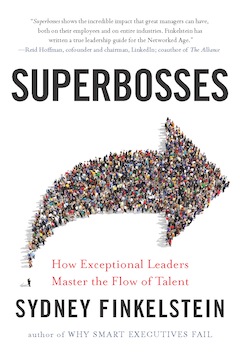
Sydney Finkelstein’s most recent book is Superbosses. (photo from Penguin/Random House Canada)

While the target audience for Sydney Finkelstein’s newest book, Superbosses: How Exceptional Bosses Master the Flow of Talent, is businesspeople, it is clear that his ideas carry well into many aspects of life, not just work, and not just business.

Finkelstein, who is a professor at the Tuck School of Business at Dartmouth College in Hanover, N.H., is originally from Montreal. He has authored 21 books and more than 80 academic articles.

“Pretty early on, I was interested in why people did what they did and in people who seem to have a lot of power and influence in society,” said Finkelstein. “I was actually very interested, and still am, in not just business leaders, but political leaders.”

Ten years ago, Finkelstein struck a note with his book Why Smart Executives Fail, and he was invited to give keynote speeches and to consult for several companies.

“Everybody pretty much had the same question, which was how to avoid getting into my sequel,” he said. “In the book, I talked about a lot of things you could do to avoid falling into the trap that led to failure but, over time, I came to realize that there was something else more important – the ability to generate and regenerate talent on a continuous basis. That’s the only way to survive and thrive in the long-term.”

After coming to this realization, Finkelstein set out to learn who possessed this ability. This is what led him to learn of those he came to call “superbosses.”

cover - SuperbossesThe Jewish Independent spoke with Finkelstein around the time of his March 8 talk and book signing at Concordia University in Montreal.

“The big difference was the ‘why smart executives fail’ leaders look at people around them – other managers and team members – as people to be used and exploited for their own purposes…. They didn’t really appreciate the fact that the people around them – team members – are actually probably the most important part of what you are doing, because they help you get better.”

Superbosses, on the other hand, wholly prioritized the idea of having great teams and great organizations of great people, understanding that this is the best way to succeed, he said. “The WSEF leaders didn’t understand that. So, that’s a gigantic difference in mindset – thinking about other people and what role they can play.

“Then, when you look at the details of how they run their businesses, there are many, many differences – from how they identify talent, to how they motivate people, how they develop teams, the role of vision and [of] inspiration.”

While most leaders, good or bad, carry with them a certain amount of ego due to their previous endeavors’ successes, Finkelstein said superbosses find ways to put that ego aside.

“This may be the best first thing for people to work on – having a degree of humility about yourself, your own accomplishments and your own personality even,” he said. “Humility doesn’t mean you’re afraid to take on challenges. It means you understand that there are other people who play a role and that you can’t let your ego run away with things.

“By the same token, listening is one of the most important managerial skills I’ve ever seen – the ability to really listen, to understand, not to critique. A lot of people are listening to find a flaw in their argument or to justify a point of view they already have. I’m talking about listening that’s designed to learn something. That’s a tremendous skill and mindset.”

Another important skill Finkelstein advised honing is open-mindedness, ranked highly with its close cousin, curiosity. These are attributes he regularly discusses with boards of directors and management teams.

“You need to have that curiosity about life, about what you’re doing,” he said. “When you have curiosity, you’re asking why a lot. Kids do that, but when we’re older, we don’t do that so much. You learn so much more by doing that.”

Courage is on the list, too – the kind of courage that challenges convention, and the ability to raise your voice when something is not going the way you think it should. “This doesn’t mean you’re going to win the argument or get your way,” said Finkelstein. “It’s about trying to improve the eventual outcome or situation you’re in.

“Many people often remain silent. They just nod their heads. As a result, they’re not engaged in what’s going on. Later, they spend their time complaining and back-biting, rather than being part of the solution. Sometimes, of course, managers or leaders create an environment where, if you challenge, you get punished, so it can be difficult, but I think courage is a critical factor.”

The next item on the list is accountability – recognizing you need to be responsible for your own actions and behavior, as well as instilling a sense of accountability in others.

“I think, by the way, that most people prefer not to be held personally accountable,” said Finkelstein. “I don’t think people should assume people would automatically be accountable. I think people enjoy it when it happens, but they don’t automatically do it. This is particularly relevant in volunteer organizations.

“Being a teacher, a nurturer of talent, is something anyone can do, no matter what their job is,” he continued. “You don’t have to be a famous CEO. You can be an average person doing whatever you’re doing. But, if you spend some time and energy acting to help others get better, often through teaching, sharing and listening … I think that’s a giant differentiator and extremely meaningful in people’s lives. If you have an impact in helping other people, it makes you feel good, too.

“Younger people, earlier in their career, who are ambitious, have high expectations, want to accomplish great things. How do you find people to work with, to work for? I talk a little about that in the book, but I also think that trying to work for someone who is more like a superboss, rather than less like one, is a great way to learn, develop and accelerate your career.”

As the book’s subtitle suggests, Finkelstein sees managing the flow of talent as one of the most important things for superbosses to do, and he segments this aspect into three categories.

“One is finding good people,” he said. “Everyone needs to hire when you’re growing, you need to hire and find people…. That’s the first stage in this flow of talent.

“The second stage, which not everyone engages in, is developing that talent, helping them get better. That’s managing the flow of that talent in a team/organization for a number of years.

“The third stage is managing the flow of talent sometimes even outside your own region, division or role in the company. Very few managers, leaders or bosses think a lot about … how they should manage people out of the organization. I’m talking about good and very good performers.

“The typical assumption among most leaders is to keep those people forever,” he said. “But, those who work for superbosses, people that really enhance their skills or have this vision, they won’t be satisfied with that small piece of pie. They want a bigger role themselves so, in fact, many of them will end up wanting to leave anyways. Managing the flow of talent should also consider this kind of radical or counterintuitive idea – managing people out of the company itself.”

Finkelstein said, “The best people know they will move around, look for those opportunities. If you know that will happen, the questions become how can you take advantage of that, how can you be strategic in that, how can you create a win-win out of that situation?’ That’s what superbosses do. They make a spinout business. One example from the book is the Hospital Corporation of America (HCA). The CEO used to create big opportunities for senior executives who were going to leave anyways. He would create a spinout company in a mental health clinic, surgical centre or what have you. That former team member would be given the opportunity to be CEO of that spinout business but, because you’re doing the spinout, you get to participate in a financial sense.”

To see where you sit on the superbosses scale, Finkelstein invites readers to visit superbosses.com and take a 10-12 question quiz.

“The quiz is because people find it interesting to see how they rank,” he said. “The book can help them get better.”

Rebeca Kuropatwa is a Winnipeg freelance writer.

Format ImagePosted on March 25, 2016March 24, 2016Author Rebeca KuropatwaCategories BooksTags business, Finkelstein, leadership, superbosses
JNF inspires entrepreneur

JNF inspires entrepreneur

Recent Blue Box packages have included artisanal jams from Bustan Confiture. Each month, the featured products change. (photo from Emily Berg)

There are many ways to support Israel and Israeli businesses. A new concept, Blue Box Israel, connects artisan Israelis with Israel supporters abroad.

Blue Box Israel is the brainchild of Emily Berg, 29. Born and raised in Toronto in a secular, Zionist Jewish household, Berg made aliyah in 2012. In her first three years in Israel, she worked in fundraising and as a strategic consultant for several different nongovernmental organizations. It was during Operation Protective Edge (Tzuk Eitan) in 2014 that she saw a need for Blue Box.

“My fiancé was called to reserve duty and was basically gone from the first until the 40th and final day,” Berg told the Independent. “It was a very quiet period. People were not going out much. And, it was the first time I was able to really reflect on my life, purpose and future here.”

photo - Emily Berg, founder and chief executive officer of Blue Box Israel
Emily Berg, founder and chief executive officer of Blue Box Israel. (photo from Emily Berg)

Berg received daily emails, calls and messages from friends and family abroad, asking how they could help.

“One day, my mother forwarded me an email she had received urging her to ‘buy Israeli products from the south,’” said Berg. “All of the links were either broken or led to Judaica sites that didn’t have the capacity to ship abroad.

“Having spent years here, I knew that there were dozens, if not hundreds, of great businesses in the south that could benefit from this type of transaction. I realized that Israel’s supporters want to buy products from Israel, but that there was not really any way to do so.”

With the Jewish National Fund’s blue and white tzedakah box etched into her mind since childhood, Berg saw it as a “portal to Israel.” In a similar vein, she wanted to give people around the world an opportunity to connect with small Israeli businesses and support them by buying their products.

“I decided to call it Blue Box, not in any way meant to be in competition with JNF; rather, to pay respect to this important artifact,” she said.

Fast forward a few months and the Blue Box concept developed into a subscription-based model, wherein customers pay a fixed price and receive a monthly package from Israel, with each focused on a different vendor.

“Blue Box is about giving Israel’s supporters a monthly taste of Israel, sending them high-quality, innovative and unique products, and giving them a chance to support a variety of hand-picked Israeli vendors,” said Berg.

Each box includes a postcard with the vendor’s story on it, written by Berg. “For me, Blue Box is first and foremost about supporting small business in Israel, but it’s also about sharing Israel’s treasures – its products and its people – with my customers.”

Berg is constantly searching for suppliers and personally visits the site of each business that she chooses to feature – whether it’s a farm, a studio or a home office. She enjoys seeing how and where the products are made, and speaking with the business owners and workers. These interactions help her get a sense of the business’ culture when writing the postcards.

“In the past, I have decided not to work with particular vendors, because I was not satisfied with the level of cleanliness or even the conditions of the workers,” said Berg. “Whether the business is run ethically is very important to me. I choose businesses with interesting stories behind them. I choose products that are well-made, suit the price point, and meet weight and customs requirements.”

The main thing for Berg is to send innovative, artisanal products (often organic or handmade) as opposed to just sending Bamba or random Judaica. And her focus is on products from Israeli-owned companies.

As the founder and chief executive officer of Blue Box, Berg has a wide network of support, most notably, a mentor via Keren-Shemesh, an organization that helps young entrepreneurs in their first two years of business.

“I also have a team of Israeli student interns from the Ruppin Academic Centre who help me with marketing, PR and social media,” said Berg. “Most people hear about the business, are so excited about it, and just want to help.”

There are many different companies that send gift baskets from Israel, mostly for the holidays, i.e. kosher items for Rosh Hashanah or Pesach. There are also a few subscription businesses in Israel that ship makeup samples or promotional items. Berg says that Blue Box is different because she features one handpicked vendor each month and includes not only a selection of their products but also their story.

“Israel is literally bursting at the seams with innovation, creativity, craft and talent,” she said. “Using fresh ingredients, high-quality materials and unique design methods, there are literally thousands of small businesses scattered throughout the country, tucked away in little-known moshavim or small studios.

“These businesses, of course, don’t necessarily have access to the global market, nor do they have the capacity to ship abroad. We work with small businesses, family businesses, kibbutzim, artists, designers, entrepreneurs, social businesses, NGOs and much more.”

Recent boxes have included items such as artisanal jams (from Bustan Confiture), honey (from Kibbutz Ein Herod), spices (from Derech HaTavlinim), organic soap and shampoo (from Arugot Habosem), hand-woven baskets (from Kuchinate, the African Refugee Women’s Collective), organic olive oil (from Rish Lakish) and organic dried fruits (from Kibbutz Neot Semadar).

The boxes are packaged at a space in southern Tel Aviv. They are shipped at the beginning of each month, and Canadian customers can expect them to arrive within 10 business days after shipping (around the middle of a month). During months with a Jewish or Israeli holiday, Berg takes special care to ensure the packages arrive on time.

Purchasing a one-time box will run you $50 (including taxes and shipping). If you choose to subscribe – and customers can cancel at anytime – the price drops. For a three-month plan, it’s $46/month, for a six-month plan, $40/month, and, for a 12-month plan, $36/month.

“We ship a different box each month,” said Berg, and “everyone receives the same box that month. So, for example, every January, a subscriber will receive organic desert-grown dates, raisins and fruit leather from Kibbutz Neot Semadar for Tu b’Shevat.

“I want Blue Box to become a household name and something that hundreds of thousands if not millions of subscribers look forward to each month. Eventually, I would like to create an online shuk [market] to sell and ship Israeli goods abroad.”

For more information, visit blueboxisrael.com or the blog at blueboxisrael.wordpress.com.

Rebeca Kuropatwa is a Winnipeg freelance writer.

Posted on February 19, 2016February 18, 2016Author Rebeca KuropatwaCategories IsraelTags Blue Box, business, Diaspora, Emily Berg, Israel

Gazan women in business


In the traditionally conservative Palestinian society of the densely populated Gaza Strip, women do not have many opportunities for entrepreneurship. Women usually marry young and raise large families. Yet, a small number of women in Gaza are opening their own businesses and serving as a model to young women throughout Gaza.

Maram Ganem began working at age 32 as an employee at a restaurant in Gaza. Five years later, she decided to start her own business. Today, she owns two restaurants in Gaza: a fast-food place and a fancy restaurant overlooking the Mediterranean Sea. She said that the first part of her dream came true when she rented a small space in a hotel in Gaza City in partnership with a local businessman. Shortly after that, she opened the first-ever fast-food restaurant in Gaza. The success of her projects led to the opening of the Roots restaurant, one of the most upscale restaurants in the city.

Ganem believes that determination and strong personality were the main reasons behind her success. She even represented Palestinians at economic conferences in Egypt. “If you have the will, you can do anything,” she told the Media Line. “I have met my goals despite the difficult political and economic conditions we face.”

She also credits her husband with contributing to her business success. “You need family support to survive in Gaza,” she said. “Men usually control most of the businesses here, and women are the workers or employees.”

Ganem was in Ramallah in recent weeks to attend the National Investment Conference, hosted by the Palestinian Ministry of Economy and Ministry of Tourism, which aims to increase international tourism to the West Bank and Gaza Strip. Representatives from more than 120 companies owned by Palestinians who live abroad came to the West Bank to discuss possible investment.

While unemployment in the West Bank has decreased slightly to just over 18%, in Gaza it is almost 40%. Unemployment is especially high among young Palestinians, including university graduates.

Read more at themedialine.org.

Posted on May 29, 2015May 27, 2015Author Fatema Mohamed TMLCategories WorldTags business, Gaza, Maram Ganem, Palestinians, Ramallah

Posts pagination

Previous page Page 1 … Page 6 Page 7
Proudly powered by WordPress