Group buying platform wins

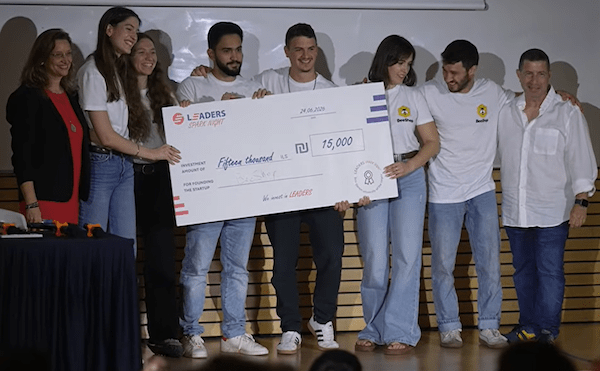
The Ben-Gurion University student team of BeeShop receives the top prize from Dana Gavish, left, and Gadi Bahat, right. (photo from BGU)

Palpably exuberant crowds, both in person in Be’er Sheva and virtually, assembled on June 24 to watch and vote in Leaders’ Spark Night, a live-pitch session featuring six student teams from Ben-Gurion University of the Negev’s Yazamut 360° entrepreneur program. The teams presented startup venture concepts they had been developing throughout the year.

Originally planned as a live RBC Lions’ Den competition in Vancouver in April, travel disruptions in Israel led to the postponement of the event. In the interim, the students continued building, and last month’s Leaders’ Spark Night showcased the culmination of their work.

Dana Gavish, founder of Yazamut 360°, began the event by offering thanks to the Friends of BGU organizations in the diaspora, making special mention of those in New York, Boston and Vancouver for “pushing the program forward.”

“The past year was extremely challenging for all of us, and especially for our dear students. Yet, even after all the uncertainty that we experienced, here we are today showing you their amazing and incredible work,” Gavish said. 

“As the world is transformed by AI, big data and automation, the pace of change often exceeds our ability to predict it. In this reality, the most valuable skill is the ability to adapt. This is exactly what we try to instil in our students – the confidence to navigate uncertainty, embrace it and lead it.”

Before introducing the teams, Gadi Bahat, head of academic programs at Yazamut, said, while the program fosters the development of ideas into fruition, its objective is also to promote leadership, to get students through difficult situations, such as standing on a stage or hearing the word “no” when pitching their ventures.

Each student group had five minutes to pitch their concept. Industry experts from North America then asked questions. Afterwards, audiences in Israel and abroad scanned a code to vote. The three teams with the most votes won cash prizes to help them continue to develop their startups.

The pitches reflected the times, with an emphasis on computer and cellphone applications, as well as harnessing the positive potential of artificial intelligence.

DEXO, an online platform that connects customers and skilled designers to create precisely customized products, led off the proceedings. According to the student entrepreneurs, the venture has already launched in the United States, aims to complete 100,000 projects in 2028 and expand to other countries.

NightLine, a tele-health service linking new mothers with professional consultants for personalized, accessible and immediate parenting support, followed. The group, which will use AI to triage urgency, addressed the universal need for postpartum care and the market it represents.

In the third slot was BuilDEER, whose goal is to change the construction industry through an AI plugin that analyzes design codes and past solutions to generate the engineering fix that is compliant with building regulations, thereby reducing delays and costs.

Heedly, a service that prevents phone scams in real time – before damage is done – came next. Such scams are a problem worldwide, with elderly people most likely to fall victim. Heedly representatives said their fraud detection alerts the victim, a trusted family member and the financial institution when a scam call is taking place.

BeeShop, a group buying platform that hopes to leverage shared demand to lower prices, was the fifth to pitch. The concept behind the venture is that the more people who want a particular product and shop in bulk will force a supplier to reduce the cost of an item, whereas a single shopper is forced to pay a higher markup.

CourtX concluded the pitches. The startup focuses on sports, particularly basketball. Their service analyzes data in real time – i.e., during a game and using AI – to help coaches make quicker decisions than pen and paper allow. Capitalizing on basketball’s popularity internationally, the group plans to market its product in Europe initially and later in North America. They also intend to branch out into other sports.

The atmosphere online and in the Negev turned electric after the pitches wrapped up and voting began on the question: Which venture would you invest in? A screen appeared with the logos of all six teams, and the attendees could watch the results as the votes were tallied.

In the end, BeeShop was the convincing winner with BuilDEER in second and CourtX a close third. The three top finishers received cheques to invest in their ventures.

The three Vancouver industry experts who were slated for the April competition took part virtually, asking questions of the teams. They were Wendi Campbell, president and chief executive officer of Junior Achievement of British Columbia; Ryan Benn, CEO of Alive Publishing Group Inc.; and Shuli Gortler, CEO of SimplyAsk and a BGU alumnus.

Since its establishment in 2018, Yazamut – which means entrepreneurship in Hebrew – has seen more than 240 startups and ventures, with more than 2,000 program participants, 11,000-plus members of its entrepreneurial community, and more than $45 million in funds invested in its companies. 

Sam Margolis has written for the Globe and Mail, the National Post, UPI and MSNBC.

Using chutzpah in business

Uri Adoni shares “The Six Rules of Chutzpah” in his book The Unstoppable Startup. (photo from Uri Adoni)

Uri Adoni, author of The Unstoppable Startup – Mastering Israel’s Secret Rules of Chutzpah, is on a mission to teach businesspeople how to use chutzpah to their advantage.

Born and raised in Israel, Adoni was working at a large advertising agency when the internet was just starting to catch fire.

“I really remember the exact moment when I first saw the internet,” Adoni told the Independent. “It was back in 1995 and it really blew my mind. I said, ‘Wow! I can talk to somebody in Singapore!’ It was very slow, dial up. It took ages to download anything, but it was crazy for me. And then I realized I just had to be part of it.

“Funnily enough, one of the partners in the agency at the time, he said to me, ‘This internet thing, it’ll never catch on.’ But, I begged to differ! And the old advertising world, I think, it will change dramatically, because you have so much data and people will know exactly what you were doing. That’s when I joined Microsoft.”

Adoni was chief executive officer of MSN Israel, working for Microsoft, for about seven years. He then moved to managing venture capital, giving him a unique view as to why some venture owners succeed while others fail. After a decade on the job, he decided to share this knowledge in book form.

According to Adoni, “One of the questions we’ve been frequently asked by people from all over the world is, ‘What is the secret sauce behind the Israeli success?’… We’re the second-largest tech hub in the world, second only to Silicon Valley, the largest per capita. We have the highest density of startups per capita, the highest venture capital per capita.”

Adoni shared that Israel has the third most companies on the NASDAQ, after the United States and China, though, in terms of population and geography, Israel is tiny compared to these countries.

“The positive side of chutzpah is what makes the difference between Israeli entrepreneurs and other entrepreneurs from around the world,” said Adoni. “One of my hypotheses is that, unlike charisma, which you’re either born with or not, chutzpah is actually something you can teach. And, I’d say, more than that, by the way. I think that any entrepreneur in the world, whether Israeli or not, they all have chutzpah. They just don’t know how to define it this way. But, I really think it’s a key ingredient in any successful startup.

“I felt the best way to explain it is by demonstrating what it is, and that the best way to demonstrate it would be to interview very successful entrepreneurs who could relate to it – asking them how important chutzpah has been in the success of their startup. If they are Israelis, they’d know it, and be able to put their finger on it.”

image - The Unstoppable Startup book coverIn The Unstoppable Startup, Adoni delves into what he has dubbed, “The Six Rules of Chutzpah,” with plenty of examples. The first rule involves changing one’s mindset, which, in turn, enables you to challenge reality as you know it, by thinking ahead of the curve.

“One of the companies we invested in at the time was a company, called CyActive, in the computer anti-virus world,” he said. “Usually, the way it works is that you have a virus and then you have the anti-virus that comes up with some sort of virus blocking. But it’s a cat-and-mouse thing, because they have to come up with a new virus and the anti-virus has to block it.

“They came up with a really interesting approach by changing the paradigm,” he explained. “They took the existing virus and, with a very smart algorithm, they created tens of thousands of potential viruses that could be expanded or developed from the original virus. And then, once we had all these viruses, we could create a tool to block them, before they even existed. So, they actually built something that blocks viruses that no one had come up with yet, but that there’s a chance they’ll come up with.”

Another rule, Adoni said, is innovating in order to meet future demand. In this context, he gave the example of the navigation app, Waze. Users share real-time data about their travel location and speed, allowing Waze to calculate the quickest way from point A to B.

“Once they use the application, all of this data [is] collected and you can sometimes know and predict where there will be traffic jams, guiding people to different routes and getting them to the destination faster,” said Adoni. “A lot of people were very skeptical about it. They said nobody will share their data; privacy issues. But, they proved everybody wrong. The market actually needed that, but we needed to bring them the tool. Once the tool was introduced, it was adopted very quickly.

“By the way, [Apple’s] Steve Jobs was one of the best – all the way from the Macintosh to the iPhone, having this entrepreneurial mindset that says, ‘I know what people need and will introduce it to them.’”

While Adoni’s book is naturally geared to startups and tech companies, he is adamant that the principles are relevant for any company, “no matter if they are small, big, or what state they are in because, at the end of the day, if you’re just doing more of the same, you may sell, you may make a living, but not necessarily make it big, or breakthrough, or grow in a large way.

“Even if you just have a small coffee shop, you should have your own competitive advantage, whether that’s with your cakes, experience, prices, name, or community. You need to differentiate yourself, showing why people should choose you over others. Random choice will not build return business. Any company around the world, any business you can think of, must think in a mindset of how they can outpace their competition, figure out their competitive advantage.”

Adoni believes his book is also great for investors, as it will teach them what to look for in startups.

In non-pandemic restricted days, Adoni regularly travels the world, speaking with university students.

Not wanting to reveal much, Adoni said he is currently working on a venture to challenge the mindset of Americans about developing new high-tech hubs in places that many people would not even consider a possibility.

Rebeca Kuropatwa is a Winnipeg freelance writer.

עליבאבא מגיעה לקנדה

ראש ממשלת קנדה, ג’סטין טרודו, הצליח להביא לקנדה מסין מספר בשורות עסקיות משמעותית, בביקורו המתקושר שם. (צילום: pm.gc.ca)

עליבאבא מגיעה לקנדה: הענקית הסינית תקים מרכז טכנולוגי שיאפשר לחברות הקנדיות נגישות לסין

ראש ממשלת קנדה, ג’סטין טרודו, הצליח להביא לקנדה מסין מספר בשורות עסקיות משמעותית, בביקורו המתקושר שם. טרודו והבעלים של קבוצת עליבאבא הסינית, ג’ק מא, הגיעו בסוף השבוע להסכם להקמת מרכז טכנולוגי גדול בקנדה. המרכז של עליבאבא יאפשר לחברות הקנדיות נגישות טובה ומהירה יותר לשוק הסיני הענקי. בפועל יאפשר הפרוייקט החדש לחברות קנדיות קשר עם כארבע מאות מיליון צרכנים סינים, ובמקביל יאפשר לסינים למצוא מוצרים קנדיים. לדברי טרודו שיתוף הפעולה בין עליבאבא לקנדה צפוי לקדם גם תיירות מסין לקנדה.

קבוצת עליבאבא למסחר אלקטרוני הוקמה של ידי מא ב-1996. הקבוצה מספקת שירותי תשלום מקוון, פורטלים בין חברות, פורטלי חיפוש ושירותי מיחשוב ענן. כשמונים אחוז מהקניות המקוונות בסין מתבצעות בעיקר על ידי עליבאבא. ב-2005 רכשה יאהו שלושים ותשעה אחוז ממניות עליבאבא תמורת מיליארד דולר. בחודש ספטמבר 2014 ביצעה עליבאבא את את ההנפקה הראשונה, שנחשבת לגדולה ביותר בהיסטוריה של הבורסה לניירות ערך בניו יורק. הקבוצה הצליחה לגייס לא פחות מעשרים וחמישה מיליארד דולר. מייד לאחר ההנפקה שוויה של עליבאבא הוערך בכמאתיים שלושים ואחד מיליארד דולר. וכשלושה חודשים לאחר מכן שווי הקבוצה הגיע כבר לכמאתיים ותשעים מיליארד דולר. כיום נחשבת הקבוצה לפלטפורמת העסקים (ביזנס טו ביזנס) הגדולה בעולם. בישראל מיוצגת עליבאבא על ידי חברת גיים און. בחודש יוני האחרון פורסם כי קבוצת עליבאבא השקיעה כחמישה מיליון דולר בסטראט-אפ הישראלי טוויגל, שמפתח מנוע חיפוש מתקדם לאתרי קניות מקוונים. עליבאבא השקיעה בחברות נוספות בישראל בהם: כחמישה מיליון דולר בחברת הסייבר התעשייתי טטהריי, וכשמונה מיליון דולר בחברת טכנולוגיית הברקודים ויז’ואל-ליד.

סביב העולם בחמש שנים: זוג מוונקובר איילנד שט בסירת מפרש קטנה וחזר הביתה בשלום

רבים המתינו על החוף וקיבלו בצהלות שמחה את קאתי וביל נורי, שהשיטו את סירת המפרש הקטנה שלהם אל הנמל של סידני שבוונקובר איילנד. ועל מה מהומה הזאת? הזוג נורי סיים משט ארוך ומייגע סביב העולם שנמשך מחמש שנים. וזאת בסירה באורך 11.3 מטר בלבד שעשוייה מפיברגלס ושיוצרה לפני עשרים וחמש שנים. בסירה הפשוטה לא הותקנו שום אמצעי ניווט אלקטרוניים ואף לא מתקן מיים. אך הנורים עם הרבה תעוזה ותושייה הצליחו במשימה הקשה.

לביל נורי ניסיון רב בהפלגה והוא פשוט רצה להגשים חלום ישן ולשוט ברחבי העולם ולאורך זמן. קאתי שאף פעם לא הפליגה הסכימה להצטרף איך שהוא למסע המתיש והארוך בים, אותו החלו בחודש יוני של שנת 2011. בימים הראשונים היא מאוד נבהלה מהים הבלתי נגמר והגלים הגבוהים, ולא הבינה מדוע הסכימה בכלל להרפתקה הזו. לאחר מכן החלה במסע הארוך להירגע ולהינות מכל רגע, שלא היה משמעמם כלל ועיקר. השניים שטו לאורך חודשים ארוכים ועצרו למנוחה על אחד החופים שמצאו וחוזר חלילה. ביל ניווט את הסירה במשך שמונה עשרה שעות ביום, בעוד שקאתי עזרה במה שיכלה. ובעיקר בישלה, וטיפלה בכל מה שנמצא בתוך הסירה. הזוג חוו סערות קשות וגלים גבוהים, דגים מדהימים מכל הגדלים והסוגים ואיים אקזוטיים שונים ומשונים. בדרך פגשו מפליגים כמותם וארגנו עימם מסיבות חוף שמחות רוויות באלכוהול. את המסע ליוו השניים בבלוגים ארוכים וקטעי ווידאו שתיארו את החוויות המרגשות וכל מה שעברו. למרבית הפלא, הזוג נורי לא מתכוון לשכון על האדמה בקביעות ובקרוב החל יחלו לתכנן את המסע הארוך הבא שלהם. פרטים עדיין אין.