

On Oct. 7, 2023, members of British Columbia’s Jewish community awoke knowing that something fundamental had changed. They could not yet know how the Hamas attacks in Israel would reshape Jewish life in Canada, nor how the months that followed would affect schools, universities, workplaces, hospitals, political institutions and personal relationships. But, even in the first days, there was a recognition that the community was entering a changed reality.
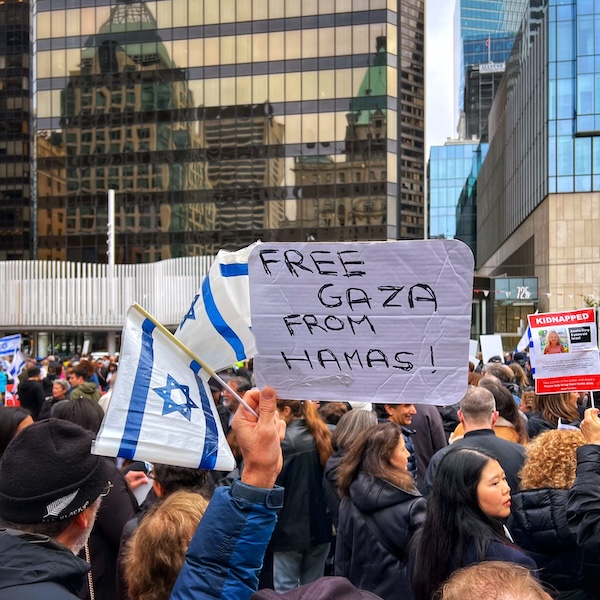
The Jewish Museum and Archives of British Columbia has completed the first phase of an ambitious effort to preserve that history. Its October 7th Documentation Project comprises 30 oral history interviews with 33 community members, as well as hundreds of documents, photographs and videos donated by individuals and organizations. The year-long initiative focused on the organized and grassroots responses across British Columbia during the first year that followed, not on interviewees’ personal responses to the attacks themselves.
Participants included rabbis, educators, students, health professionals, politicians, philanthropists, advocates, organizational leaders and community volunteers. Together, their accounts document a community responding simultaneously to events in Israel, rising antisemitism at home and profound changes within Jewish communal life.
The project was coordinated by consultant Rebecca Recant, who conducted the interviews and managed their transcription. Working with JMABC director of archives Alysa Routtenberg, she adapted the museum’s standard oral history questions to reflect the different ways participants became involved, whether professionally or as volunteers. The resulting collection includes complete transcripts, detailed summaries and keywords intended to help future researchers navigate the material. It also incorporates 19 archival donations containing related documents and visual records.
Routtenberg said the most immediate goal was not to predetermine how the history would eventually be interpreted or presented, but to ensure that it was preserved. “If I don’t save material and scramble to save it, then no one gets to do the analysis,” she said.
The interviews are not presently available as an online public resource. Researchers and other interested people can contact the archives to request access. This required human interaction provides some protection for participants whose accounts may include sensitive personal or professional information and prevents the recordings from simply being scraped and redistributed online.
Routtenberg emphasized that an archival collection is different from a curated exhibition, publication or documentary. Future phases could take any of those forms. The museum is considering follow-up interviews, additional participants and a more public presentation of the material. There may also be value in returning to the original interviewees several years from now to learn how situations they described eventually unfolded – or whether they ever concluded.
For Eli Klasner, JMABC executive director, the impulse to document the period reflects both the organization’s archival mandate and a much older Jewish tradition. “We knew we had to scribe it,” he said. “We had to start writing it down.”
That impulse gave the project an unusual quality. Archives generally receive material retrospectively, sometimes years or decades after events occurred. This project documented history while it remained unsettled and while many of the people being interviewed were still immersed in the situations they were describing.
Some participants realized during their interviews how quickly details were already disappearing. Committees had formed and changed, organizations had shifted focus, volunteers had moved on and community initiatives had repeatedly adapted to new conditions.
The interviews also revealed how interconnected the responses had been. Groups that might have appeared to be operating independently frequently shared volunteers, leaders, information and resources.
Several themes emerged.
Every participant described an increase in antisemitism after Oct. 7. Their accounts included incidents in schools, universities, workplaces, healthcare settings, political life and public spaces. Many spoke about the need for increased security at Jewish institutions and events.
Interviewees also described friendships and alliances that fractured, sometimes abruptly, as people they had considered colleagues or friends responded to the attacks and subsequent war in unexpected ways. Many interviewees criticized diversity, equity and inclusion frameworks that they said failed to recognize antisemitism or the experiences of Jewish Canadians.
The interviews record another significant, and generally positive, development: an extraordinary increase in communal solidarity. Participants described rising synagogue attendance, deeper engagement in Jewish life, increased support for communal organizations and an historic philanthropic response.
The Oct. 7 project was funded by the Ronald S. Roadburg Foundation, which was involved from its earliest planning stages. Routtenberg said foundation staff helped the museum move from a broad conviction that something should be recorded to a concrete and manageable project with defined priorities and deliverables.
Elana Bloomfield of the foundation worked with Routtenberg as she calculated how many interviews could realistically be conducted, which sectors of the community should be represented and how the project could be completed with the available resources.
The structured approach reflected lessons the JMABC learned during the COVID-19 pandemic. At that time, the museum created an online portal inviting community members to contribute photographs and stories. The response was limited, in part because the request was too open-ended and potential contributors did not know what the archives needed.
For the Oct. 7 project, the museum began with specific objectives: 30 interviews, a defined period of study and an emphasis on people directly involved in organizing the community’s response.
The first interviews centred largely on leadership. This leaves untold the stories of people who attended rallies, volunteered behind the scenes, joined synagogues, reconnected with Jewish life or experienced the period outside formal organizational roles. A future project could include shorter interviews with a much wider range of community members.
There is also a desire to strengthen the project’s geographic reach. Although participants came from across British Columbia, Jewish communal life has historically been documented through a Greater Vancouver lens. The JMABC hopes future interviews will more fully reflect the experiences of Jewish communities throughout the province.
The archive will not tell future historians what conclusions to reach. It will give them the evidence with which to ask better questions, according to archives staff. Decades from now, researchers may use the interviews for scholarly studies, documentaries, exhibitions, family histories or purposes no one has yet imagined. Some recordings may become central to a future publication. Others may remain individual accounts whose value lies simply in the fact that a particular experience was not lost. The project is not the final history of British Columbia’s Jewish community after Oct. 7. It is a first draft of that history.



