

Ariel Beery identifies himself as part of a small minority of Israelis who still believe a negotiated two-state solution, with an independent Israel and a Palestinian state living in coexistence, is an achievable reality.
While he acknowledges he is an outlier, he insists context matters. When surveys ask Israelis whether they support a Palestinian state not as a standalone bilateral deal but as part of a broader normalization with the Arab world, especially Saudi Arabia, support for the concept skyrockets to a large majority.
This apparent elasticity in Israeli public opinion is cause for hope, according to Beery, a civil society activist, entrepreneur and writer focused on liberal democracy, Jewish citizenship and Israel’s future. Beery was in Vancouver July 28 and presented in conversation with Rabbi Adam Stein at Congregation Beth Israel.
Beery was promoting his periodical Prophecy: A Journal for Tomorrow and his new book, Being Israeli After the Destruction of Gaza, which he wrote as a direct response to Peter Beinart’s antizionist book Being Jewish After the Destruction of Gaza. Beery’s book features interviews with 11 Israelis from different political, religious and social positions.
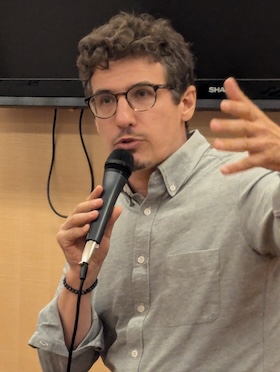
Stein noted that Beery recently appeared on Beinart’s podcast, where the two had a civil dialogue despite their stark differences.
“If there’s anything that the Jewish people have been able to do for thousands of years, it is learn how to disagree and have a conversation, even with people that disagree, and maintain the minority opinion,” said Beery. “Once you get within that culture of being able to recognize and also respect that people disagree, then you can actually build toward some kind of constructive future.”
Part of the reason for his book, Beery said, is to bring to the fore Israeli opinions that are not generally reflected in the English-language discourse. The coverage he has seen in Western media after Oct. 7, and during the ensuing multi-front war, has not reflected the Israelis he knows. Over the past three years, Beery said, he has seen an encouraging transformation taking place in Israeli society, while much of the English media has been publishing what he describes as eulogies for Zionism and the Jewish state.
Rather than the death of Zionism, or at least the end of its moral legitimacy, which Beinart and others envisage, Beery sees a massive reinvigoration of the Zionist experiment. He identifies a profound civic awakening, beginning with opposition to the government’s “judicial reforms” and ramping up in response to Oct. 7, and he credits that dynamic partly to Israel’s collectivist origins. The state grew not through centralized government, but from kibbutzim, associations, movements and competing ideological communities that learned to build together, he said.
“The DNA of the state of Israel started on this grassroots, amorphous level of many different organizations and different ideological types,” Beery said. “That’s why I say that the Zionist movement is fundamentally a liberal democratic movement. It’s a movement that is pluralistic at its very core. Israel is a result of that work, but for awhile we forgot, because we were making money.”
Immediately after Oct. 7, Jewish and non-Jewish citizens, migrants and civil-society organizations mobilized to provide food, transportation, childcare and other support, filling gaps while the government was initially absent. “All of Israeli society was volunteering, all of it,” he said. “I’ve never seen anything like this, ever.”
This phenomenon altered how many people understand Israeli identity, said Beery, and revealed a social reality not adequately reflected in either political leadership or foreign media. At the same time, Beery was explicit that his book does not represent all Israelis. For example, it does not substantially include ultra-Orthodox Israelis, non-Jewish citizens or Netanyahu-supporting voters. He said those perspectives are legitimate and necessary, but beyond the book’s chosen scope.
Beery summarized Beinart’s argument as a call for Jews to dismantle structures of state power and trust that a shared political framework – a one-state confederation – could end the cycle of violence. Beery’s deepest objection is not simply to the proposed political outcome, but to the exclusion of Israeli (and Palestinian) civil society and public opinion from the analysis.
“The thing that bothered me the most was that he spent an entire book talking about being Jewish after the destruction of Gaza without mentioning Israeli opinion,” he said. “It reflects a conception of Israel which is not real.”
Beery rejects the idea of outsiders, like Beinart, who propose a one-state arrangement that neither Israelis nor Palestinians generally want.
While Beery acknowledged the necessity of using force on and after Oct. 7, he distinguished that acknowledgment from acceptance of every subsequent military decision.
“There is no question that at times violence needs to be met with violence. That is the human condition,” he said. “The first thing you do is you clear your territory. The second thing you do is you try to deny the infrastructure for repeat attacks.”
However, he said, “We had choices, and destroying Gaza as we did, that’s a responsibility we need to take.”
The destruction in Gaza is not merely morally wrong, Beery said, but strategically so. He contends that Hamas, Hezbollah and the Houthis are sustained by international financing and networks that cannot be eliminated through bombing alone. Israel, he said, must combine necessary force with coalition-building, financial disruption and long-term strategy.
“The way to defeat Hamas and Hezbollah is to work smart,” Beery said. “It’s to cut off their resource base, it’s to stop the distribution channels, it’s to do all the hard work that requires international coalitions.”
He suggested that a growing number of Israelis are questioning what force can accomplish and assessing the choices made by the Netanyahu government.
“Sometimes, causing pain, unfortunately, is a moral choice,” he said. “The world is not fair. It’s not. It’s not been fair to us, but we also need to be smart about it, meaning just lashing out in vengeance doesn’t help anybody. We are powerful, but there’s a limit to our power.”
Domestically, Beery argued that the conventional Israeli left-right divide is shifting. Few Israelis currently believe direct bilateral negotiations with Palestinians can produce peace, but substantially more may support a regional agreement – notably, normalization with Saudi Arabia – that includes a pathway toward Palestinian statehood.
When challenged to offer a concrete solution, Beery reviewed several imperfect possibilities raised in the book: a binational framework, overlapping national identities, two states or multiple states. He resisted presenting any one model as a ready-made answer.
“There is no solution,” he said. “There is a process towards a solution, and the different ideas that people reflect in the book are all imperfect. There are many different ways that people can imagine the future, but what I think we need to do is to start imagining it together.”
He said meaningful movement requires Palestinian participation, and his limited grounds for hope include recent Palestinian municipal elections in the West Bank, in which candidates de facto recognized the reality of Israel.
What optimism Beery has rests on the civic leaders, volunteers, entrepreneurs and professionals who are newly engaged in the political process.
“The leadership of Israeli civil society has been rejuvenated in a way that the country hasn’t seen since the days of the pioneers,” he said. “Israel is changing fundamentally. Our leadership is changing. The way that we’re thinking about the state is changing.”
Disenchantment with the existing political class is sparking this change, he said, and part of that should include a national investigation into the failures leading to Oct. 7.
“The reason that I am hopeful is that some of the most brilliant, most accomplished people that I know are working on this every day now, every single day,” said Beery. “The magic ingredients are good people.”



