Skip to content
  • Home
  • Subscribe / donate
  • Events calendar
  • News
    • Local
    • National
    • Israel
    • World
    • עניין בחדשות
      A roundup of news in Canada and further afield, in Hebrew.
  • Opinion
    • From the JI
    • Op-Ed
  • Arts & Culture
    • Performing Arts
    • Music
    • Books
    • Visual Arts
    • TV & Film
  • Life
    • Celebrating the Holidays
    • Travel
    • The Daily Snooze
      Cartoons by Jacob Samuel
    • Mystery Photo
      Help the JI and JMABC fill in the gaps in our archives.
  • Community Links
    • Organizations, Etc.
    • Other News Sources & Blogs
    • Business Directory
  • FAQ
  • JI Chai Celebration
  • JI@88! video

Recent Posts

  • Eby touts government record
  • Keep lighting candles
  • Facing a complex situation
  • Unique interview show a hit
  • See Annie at Gateway
  • Explorations of light
  • Help with the legal aspects
  • Stories create impact
  • Different faiths gather
  • Advocating for girls’ rights
  • An oral song tradition
  • Genealogy tools and tips
  • Jew-hatred is centuries old
  • Aiding medical research
  • Connecting Jews to Judaism
  • Beacon of light in heart of city
  • Drag & Dreidel: A Queer Jewish Hanukkah Celebration
  • An emotional reunion
  • Post-tumble, lights still shine
  • Visit to cradle of Ashkenaz
  • Unique, memorable travels
  • Family memoir a work of art
  • A little holiday romance
  • The Maccabees, old and new
  • My Hanukkah miracle
  • After the rededication … a Hanukkah cartoon
  • Improving the holiday table
  • Vive la différence!
  • Fresh, healthy comfort foods
  • From the archives … Hanukkah
  • תגובתי לכתבה על ישראלים שרצו להגר לקנדה ולא קיבלו אותם עם שטיח אדום
  • Lessons in Mamdani’s win
  • West Van Story at the York
  • Words hold much power
  • Plenty of hopefulness
  • Lessons from past for today

Archives

Follow @JewishIndie
image - The CJN - Visit Us Banner - 300x600 - 101625

Category: News

Maus not too graphic

Maus not too graphic

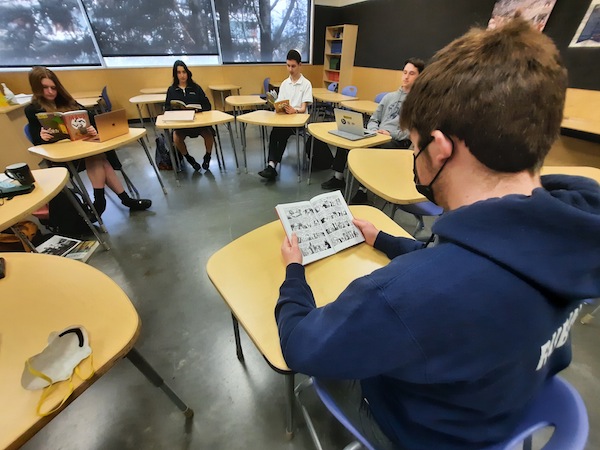
Students in Anna-Mae Wiesenthal’s Holocaust and Genocide Studies class at King David High School discuss the graphic memoir Maus. (photo by Pat Johnson)

In January, the school board in McMinn County, Tenn., voted to remove the graphic novel Maus from its eighth grade curriculum.

The book by Art Spiegelman won a Pulitzer Prize in 1992 under a special category created specifically for Maus. The two-volume collection of previously serialized comic-style narratives was viewed at the time as revolutionary for its approach to a subject like the Holocaust in a medium more commonly associated with superheroes and humour.

In the books, racial and national identities are represented through anthropomorphized animals. Jews are depicted as mice, Germans as cats, Poles as pigs, Americans as dogs, British as fish and so on. In each instance, the characters have the bodies of humans and the heads of the respective animals. This form has been criticized by some critics over the decades as overly simplistic but has caused particular discomfort to many Poles, who do not appreciate being depicted as pigs.

Spiegelman, the author, called the McMinn County decision “Orwellian,” but has seen sales of his books skyrocket since the ban thrust the works back into the spotlight.

The Independent joined in a class discussion with the five students in the Holocaust and Genocide Studies course at King David High School, led by teacher Anna-Mae Wiesenthal. Discussing the Tennessee book banning, students questioned the sincerity of the school board’s grounds for opposing the book.

In a graphic memoir dealing with the attempted annihilation of a people and which touches on history’s most horrific acts of inhumanity, students found it “absurd” that the board’s primary concerns appeared to be a couple of instances of mild profanity and the depiction of a nude cartoon cat.

The book follows the true journey of the author in pressing his father, Vladek, to share his Holocaust experiences openly for the first time.

Nitzan Berger, a great-granddaughter of a Holocaust survivor, observed that many survivors hesitated to share their narratives and that the graphic novels capture the challenges of the younger generation in approaching the subject, as well as the reticence on the part of the older generation to relive the horrors of their past. While the passing down of these stories is important, it can be painful for both generations.

“It’s interesting for us to hear about the stories, but we don’t think about the other side,” she said.

Ethan Dreyshner was struck by the speed with which an entire society, down to its youngest members, could be transformed.

“It just really shows how this whole society was changed to think the Jews were terrible people,” he said. “Six years earlier, Jews were regular citizens. It’s crazy to think that a whole society, a whole population, can just turn on their neighbours that quickly.”

Noting that young people need to begin learning about this challenging subject at some point, students contrasted Maus with Anne Frank’s diary, which for generations has been an entry point to discussion of the topic.

Olivia Levsky said a graphic novel that is intense but not particularly long may be a good starting point as well, especially for young people who rebel against assigned readings.

“It’s a very interesting way to learn something that’s very important to learn,” she said. “I didn’t feel like it was incredibly graphic or too much when I was reading it. It was graphic at times, but the Holocaust was graphic. I didn’t feel it was overly triggering or traumatizing. I didn’t feel it was inappropriate.”

Levsky also noted that Spiegelman, in some respects, depicted the national groups through the eyes of the victimizer.

“He drew each character and each race in the way that the Nazis saw them,” she said, noting particularly the Nazis’ association of Jews with vermin. “I imagine toward the end [of the war], the Americans felt like threatening dogs to the Nazis.”

image - cover of Maus I by Art SpiegelmanStudents concurred with Wiesenthal that there also may have been a practical purpose to depicting each group as a type of animal. It made each character’s identity more immediately understandable to the reader without having to repeatedly point out the race or nationality of each individual – in one instance, a Jew (mouse) hides in plain sight with the mask of a pig (Pole).

Wiesenthal noted that the second volume, which the class has not read together, is somewhat more explicit in its violence.

The teacher also stressed that the book tells the story of the Holocaust experience and intergenerational trauma through one family.

“We often talk about numbers – six million – which can serve to depersonalize what is really an impossible number to grasp,” the teacher said. “I think that we need to remember each of them had a name, each of them had a family. It’s very impersonal, often, the way we attach the number to the Holocaust.”

Maus includes situations in which non-Jewish people assisted in the survival of Jews. While it is not addressed in the book, students discussed the fact that Yad Vashem’s criteria for designation as Righteous Among the Nations excludes people who received compensation for their often-life-endangering efforts.

Shai Rubin noted that, in some cases, Jews may have given valuables voluntarily as gratitude to their rescuers. He also noted that, in addition to risking their lives, many non-Jewish helpers were experiencing economic destitution due to the war and what small amount of food they could provide to Jews in hiding may have come at a great price to their own families.

Of one woman in the story, Rubin said: “There’s a difference between doing something for money and doing something and getting money for it. She did it out of the goodness of her heart.”

In what was a shocking sequence for students, Art, the author, discovers that his father has burned the diaries of Art’s mother, Anja, who committed suicide. In response, the son lashes out at his father: “Murderer!”

This opened a discussion of what Wiesenthal called “the murder of memory” and raised the quote by Elie Wiesel (not mentioned explicitly in the book), who said of the Holocaust and its victims, “If we forget, the dead will be killed a second time.”

The Grade 12 students analyzed the content, style and medium of Maus. They observed that, often when the wrought iron gate to Auschwitz is pictured, the focus is on the words themselves, Arbeit Macht Frei, while, in this book, the eye is drawn to the individual people in the frame, a reminder that the Holocaust can often be depicted in broad strokes but it is, ultimately, about the killing of individuals.

On the medium itself, all the students concurred that it is an effective avenue for conveying challenging material.

“I think this is a really effective form of teaching the Holocaust, especially to kids,” said Dreyshner. “Something like the diary of Anne Frank, you might feel a little disconnected, you can’t see it, you can’t understand it because it’s hard to show actual images of the Holocaust to children. I think a graphic novel really does the job because you can see what happened, you can get a sense of what happened, without seeing the horrific things exactly.”

Richard Helper agreed, but subtly criticized those who are concerned about the graphic nature of the book.

“This is easily digestible, it’s effective, it has quite a bit of information on the specifics of the Nazis’ war machine as well,” he said. “While some people, I think, try and attack it for being either too simplistic or too graphic, we’re teaching a book on the Holocaust.… It’s the Holocaust.”

Wiesenthal, who has a master’s in Holocaust and genocide studies and is pursuing a PhD in the same field, pioneered the course three years ago. Until then, the Holocaust was dealt with as part of the larger Jewish history curriculum.

She acknowledged that most King David students come to the subject with some familial or other knowledge of the subject, whereas non-Jewish students, such as those in places like Tennessee, might have no knowledge of the history.

“It’s important to contextualize it,” she said.
Format ImagePosted on May 20, 2022May 19, 2022Author Pat JohnsonCategories LocalTags Anna-Mae Wiesenthal, book banning, censorship, education, Ethan Dreyshner, Holocaust, KDHS, King David High School, Maus, Nitzan Berger, Olivia Levsky, Richard Helper, Shai Rubin

Honouring those who’ve died

Four decades ago, Chaya Harel was approached by one of the teachers at her son’s Jerusalem high school. The son, Yuval, who was in his final year of school, had come to the teacher seeking advice. He was in love with Sigal, but knew the importance of succeeding in the upcoming matriculation exams. How should he allocate his time?

The teacher asked the mother for her advice and promised to pass it along as coming from the teacher, rather from Yuval’s mother, Chaya.

The mother’s advice was to spend more time with Sigal. Yuval, she reasoned, could always improve his grades later.

Tragically, Yuval Harel was killed in 1982, during the First Lebanon War. Later, in grief, Chaya Harel would say, “I had some comfort knowing it was my best advice.”

The story was shared May 3 by Geoffrey Druker at Vancouver’s annual ceremony marking Yom Hazikaron, Israel’s official day of remembrance for those fallen in war and victims of terror attacks.

Yuval Harel was one of two young men of the same name who died in the same war, a few days apart. They were two of more than 24,000 killed over 74 years, whose memories were honoured at the Vancouver event and at similar ceremonies worldwide.

“This year, as in previous years, we remember our fallen,” said Druker, who is chair of Vancouver’s Yom Hazikaron committee. “And the list painfully keeps lengthening. These past months, Israelis and foreign citizens, Jews and non-Jews, men and women, were killed on the streets, in the pubs, gas stations [and] shopping strips in Israel by terrorist attacks. Fifty-six people were added this year to the list and 84 injured soldiers [who] passed away are recognized as fallen soldiers.”

This year’s ceremony also marked 25 years since the deadliest crash in the history of the Israeli Air Force. (See jewishindependent.ca/25-years-since-deadly-crash.)

Druker shared the story of Yigal Amster, a son of Holocaust survivors who lived with asthma.

“When he joined the army, he tried to hide it,” said Druker. “He asked to join the tank corps. He wished to become an officer.” When his commanders noticed his difficulty breathing in poor air quality, Amster was assigned to a medic course.

“When the Yom Kippur [War] broke out, in 1973, he was sent to help the troops in the Suez Canal. While in an armoured vehicle, he was hit and later died from his injuries. He was 20 years old.”

Amster’s cousin, Vancouverite Charlotte Katzen, read Yizkor in his memory and in memory of all the fallen.

“May the nation of Israel remember its sons and daughters, faithful and courageous,” Katzen read the prayer in English. “The soldiers of the Israel Defence Forces, members of the undergrounds, members of the intelligence community, security and policemen, who fell in the wars of Israel, and all of whom that were killed – within Israel and outside of Israel – by terrorists. May the people of Israel keep them in their memory and be blessed with their seed; mourn the splendour of youth, the altruism of valour, the dedication of will and the dignity of self-sacrifice, which came to an end in the heavy battles. May our fallen be sealed forever within the hearts of all Israel, in this generation and forevermore.”

Michael Balshine read Yizkor for his father, Avigdor Balshine, a member of the Haganah and a pioneer in Israel’s water sector. On Feb. 23, 1948, while working with Mekorot, the national water company of Israel, Avigdor Balshine and his colleague Mark Feigin were ambushed and killed in Wadi Milik. Michael Balshine was 6 years old.

Ilene-Jo Bellas lit a candle in memory of her cousin, Fern Rykiss, who was a 17-year-old from Winnipeg who was murdered on a bus from Tel Aviv to Jerusalem in 1989.

Tamara Frankel lit a candle in memory of her family member Amnon Shapira.

Photographs were projected of family members and friends of members of the Vancouver community whose lives are among those lost in the past 74 years.

Idit Shamir, consul general of Israel in Toronto and Western Canada, sent video greetings.

“On this day, Israelis and Jews around the world remember the pain the bereaved families carry with them every day,” said Shamir. “We remember that our independence has come with a heavy price. We bow our heads with eternal gratitude to those who have paid the price, Jews and non-Jews, Israeli-born and immigrants, all those who have fallen for the state of Israel. We know that we are here because of them…. We thank the fallen sons and daughters who have protected us. We embrace their families and all the bereaved families who have sacrificed so much. We promise that their immense sacrifice will never be in vain and we pledge to do whatever is necessary to ensure that the privilege they have given us, we will give to others, to our children, their children and to the countless generations to come, the privilege of standing tall. The privilege of standing proud. The privilege of standing strong. The privilege of being a free people in our land.”

In attendance at the ceremony was Commander Robert D’Eon of the Royal Canadian Navy.

Posted on May 20, 2022May 19, 2022Author Pat JohnsonCategories Israel, LocalTags commemoration, Geoffrey Druker, Israel, memorial, Yom Hazikaron
Debating profit vs. nonprofit

Debating profit vs. nonprofit

(photo from Humber Valley Senior Citizens Club)

***

In Volume 28 of the Jewish Seniors Alliance’s Senior Line magazine, JSA members Kenneth Levitt and Larry Shapiro debated some of the arguments for and against for-profit long-term-care facilities. They offered their personal opinions in the debate, as JSA does not have a position on this topic. Their views are reprinted here, with permission.

For-profits here to stay
by Kenneth Levitt

The COVID-19 pandemic with its various mutations has caused a justified focus on long-term care (LTC) in Canada. Organizations such as the B.C. Health Coalition, the NDP, unions and other left-leaning activists or progressives, as well as some physicians, have called for the abolition of all for-profit (FP) facilities, recommending that they be taken over by provincial governments or government-approved not-for-profits (NP). This will not happen in the near future. For-profits (FP) are here to stay and, furthermore, provincial governments support them with LTC operating agreements.

The two main issues are profit and quality of care. In British Columbia, there are 27,000 persons in LTC. Approximately one-third are in each of government-operated, NP and FP facilities. When an FP builds or upgrades a facility, there is no government capital fund support. Capital funds for FPs come from investors and shareholders, whereas NPs depend on governments and their own fundraising efforts. FPs have saved governments billions of dollars in capital costs.

In general, residents are financially responsible for their room and board. Their care is paid for by the local funding authority. Should residents pay from their assets (as in the United States) or continue to pay based on income testing? Should residents who are capable contribute more for their room and board? Many NPs raise funds to subsidize care; others permit paid companions to provide extra care for residents. Should investors who put up their own risk capital (with government “ipso facto” approval) be permitted to make a profit? Is it immoral?

FPs did not do well in terms of COVID-19 deaths. Horrendous stories from Ontario and Quebec came to light that noted the squalor and the shameful living conditions of many vulnerable residents. In British Columbia, a number of NPs and FPs had too many COVID infections and deaths. Staff were not exempt from contracting COVID. How do we account for this? When we factor in those facilities with two or more residents per room, the number of COVID-19 infections, complications and deaths increase dramatically for NPs and FPs. In most cases, staff and visitors were responsible for importing the virus. Governments/health authorities were totally unaware, at the outset of the pandemic, of the extent of the problems. However, most care homes planned well, had few infections with a high percentage of vaccinated staff, and are faring well during the pandemic.

It is not just a move to single beds that will solve the problem of COVID and seasonal flu outbreaks, it is the design of the facilities. We need new and upgraded buildings now. It is also imperative that all staff be vaccinated, and that they be supported by management to better prepare for future health crises.

Canada needs FPs. FPs have the capacity to provide needed accommodation for older adults who qualify, and can build more LTC beds faster than governments. They can provide improved efficiency and greater innovation than NPs. The naysayers want to nationalize all private-sector nursing homes in Canada. The National Institute on Aging at Ryerson University in Toronto recently noted, “Some of the FPs are doing well because they have deeper pockets and much better planning procedures than NPs. It is not clear that one class of ownership is better than the other.”

In an April 2021 report, Isobel McKenzie, B.C. Seniors Advocate, criticized FPs for apparently short-changing the number of direct care hours for which they were paid and making a profit by doing so. At the same time, McKenzie noted that capital costs (building maintenance) is one area where FPs outperform NPs.

There is one FP LTC operator in Ontario, Schlegel Villages, that is at the cutting-edge of services and programs for their residents. Schlegel is a family-owned company that has about 5,000 residents and about 5,000 staff in 19 villages. It did not escape COVID-19, but they have excelled in what is known as “best practices”:

  • Their philosophy: a purposeful life for each resident.
  • Each village is accredited.
  • Staff are unionized and pay is the same as at NPs.
  • Owners are committed to providing exceptional care, and are good corporate citizens who are involved in and contribute to the communities they serve.
  • Newer villages are 60% private rooms and 40% with two persons per room. Moving forward, all new construction will be single rooms with ensuites.
  • Each resident has two bathing opportunities per week.
  • Villages have several neighbourhoods, with 32 residents residing in each self-contained neighbourhood that is well-supported by seven staff with a variety of skills.
  • Each village has programs and space open to outside community organizations and they encourage locals to hold events in the available space.

How can we move forward in a constructive way that includes government-operated facilities, not-for-profits and for-profits?

  • The federal government, in partnership with the provinces, needs to develop and to legislate a set of standards of care and service that will be enforced with consequences. This can be done through accreditation, which is currently voluntary. Once the feds have placed standards of care and service into law, each province should enact similar legislation to require that all LTC facilities be accredited. A provincial accreditation body would be responsible for accrediting, monitoring and enforcing standards.
  • Accreditation would ensure every LTC facility is delivering the hours of care and support for which they are receiving funds.
  • Wages and benefits for full-time staff should be uniform for all LTC facilities and part-time staff should be equally entitled to the same wages and benefits.
  • Hours for home care and Better at Home need to be increased. The financial threshold needs to be lowered to allow more persons in need to take advantage of such a service. This has the potential to put less strain on waitlists for LTC admissions.
  • When an FP is for sale, give preference to a quality NP to purchase it or allow a local (new) society to purchase and operate it.
  • Require all LTC facilities that plan to expand to have only single rooms with ensuites.
  • Develop a timetable and a budget for NPs to upgrade/replace current outdated institutional/hospital-style buildings.
  • Healthcare leaders, their boards of directors and seniors should be the ones who are advocating and pushing for changes. The status quo is not acceptable.

To eliminate FPs is specious and politically and/or ideologically motivated and is a short-sighted non-pragmatic position. Canada’s Parliament last year voted against such a proposal put forth by the NDP. The issue is not between the NPs or the FPs. The issue is how to ensure that the interests of the residents come first.

The billions of dollars that would be required to eliminate the FPs can better be used for increased and quantifiable quality programs and services. This would be the best and the most ethical way to honour those lost in the pandemic and to ensure it will never happen again. The issue is how we treat our most vulnerable older adults. After all, is it not a matter of human rights and choices?

No place for profits
by Larry Shapiro

photo - Policy decisions have encouraged raising the profits of private long-term care facilities by replacing union staff with contract workers, which has resulted in creating personnel shortages, declining working conditions and less access to public funding, argues Larry Shapiro
(photo from cdc.gov)

My goal in this debate is to paint a comprehensive picture illustrating conclusively why many of the for-profit long-term-care facilities (LTCFs) are squandering public funds, with little transparency or few accountability requirements to honour any predetermined set of standards in the areas of quality of service, accountability and profit. We need to see profit taken out of long-term care and need new investments in public and nonprofit beds so that we can reduce our dependence on the private, for-profit sector.

Decades of budget cuts, underfunding and privatization by successive governments have resulted in the catastrophic state of the many private care facilities that have been the sites of the loss of a great number of our loved ones. Nobody should be profiting from the care of our senior citizens. Policy decisions going back 20 years have encouraged raising the profits of private LTCFs by replacing union staff with contract workers, which has resulted in personnel shortages, declining working conditions and less access to public funding. The centre of most COVID-19 outbreaks in British Columbia and throughout the rest of the country have been in our LTCFs.

Let us examine the causes and effects of some of the common characteristics of for-profit LTC facilities that negatively affect the quality of care being dispensed to our seniors. Statistically, 67% of LTC in British Columbia is supplied by both nonprofit and for-profit organizations with the remaining 33% being supplied directly by provincial health authorities. The practice of sub-contracting care services occurs when service providers like LTCFs and assisted living facilities, which are contracted by regional health authorities to provide care, proceed to sub-contract with other companies that offer care workers, kitchen staff and maintenance crews.

These sub-contractors are able to bid lower than qualified unionized staff would cost, all to the detriment of the senior residents who are being served by these workers who are receiving lower wages and poorer benefits and who enjoy fewer full-time positions. The prevalence of sub-contracting in elder care began about 22 years ago, when the B.C. government, by virtue of Bills 29 and 94, stripped out no-contracting and job-security provisions from the collective agreements governing healthcare workers. These laws resulted in the loss of 8,000 jobs by the end of 2004. These laws (which were repealed in 2018) provided health-sector employers, including private LTCFs, with unprecedented rights to lay off unionized staff and hire them back as non-union workers through sub-contracted companies. Predictably, this negatively impacted wages and working conditions.

Reduced funding for and access to publicly funded seniors care, from the early 2000s, resulted in the rationing of care. This meant that access to publicly funded care is limited to those with more acute needs, leaving seniors with less complex needs without access to support services that could keep them from deteriorating and requiring institutional care. So, as staffing levels have declined, the care needs of many LTC residents have increased. More of the publicly funded services are being delivered by for-profit companies, often in LTCFs that combine publicly funded and private-pay beds. The latest data shows that more than 35% of beds are run by the for-profit companies. The health authorities pay for the services through block funding, which accounts for the direct care hours that each resident is to receive per day, and the cost of other services and supplies such as meals. There are no restrictions on how operators spend these dollars and health authorities do not perform payroll or expense audits to ensure public funds are actually spent on direct care.

A report from the Seniors Advocate exposed the fact that most direct care (67%) is delivered by care aides, the lowest paid care workers. For-profit care companies generate profits by underpaying the workers who provide most of the direct care, despite receiving funding based on the assumption they pay union rates contained in the master collective agreement (industry standard). Operators are not monitored to ensure that they are providing the number of care hours for which they are being paid. Without adequate oversight and reporting, companies also make profits by understaffing, which impacts the amount and quality of care that residents receive.

Many LTCFs have a combination of publicly subsidized and private-pay beds, but the co-located private-pay beds are not consistently included in the calculation of care hours delivered. This practice results in publicly funded care hours used to cross-subsidize the care of private-care residents who pay out-of-pocket (for the generation of greater profits) and, at the same time, exacerbates staffing shortages, as companies use the same staff to cover both publicly funded and private-pay beds, which should have their own dedicated staff.

Notwithstanding that the last period for which data is available is 2017-2018, it is noteworthy that while receiving, on average, the same level of public funding, contracted not-for-profit LTCF operators spent $10,000 more per resident per year than did for-profit providers. In addition, and not surprisingly, the for-profit LTCFs failed to deliver 207,000 funded direct-care hours while the nonprofit LTCFs exceeded direct-care hour targets by delivering an additional 80,000 hours of direct care beyond what they were funded to deliver.

Low staffing levels and resulting poor working conditions deteriorate the quality of care, as low staffing places both workers and residents under increased stress and reduces the amount of time care workers can spend with residents. The combination of low pay and understaffing makes it difficult to recruit and retain staff. There is adequate proof that staffing levels and staffing mix are key predictors of resident health outcomes and care quality, and that care provided in for-profit long-term care facilities is generally inferior to that provided by public- and nonprofit-owned facilities.

The B.C. government’s long-standing reliance on attracting private capital into the seniors care sector has benefited corporate chains with the ability to finance and build new facilities. In the decade between 2009 and 2018, British Columbia invested less than one half of one percent of the total healthcare capital spending (which is not very much money). More than one-third of all publicly subsidized and private-pay long-term care and assisted living spaces are controlled by large corporations, while the balance is owned by either nonprofit agencies or health authorities.

Corporate chain consolidation in seniors care has become popular among investors in this sector because the business is real estate-focused, resulting in care facilities being treated and traded as financial commodities. This being the case, the care chains are prone to engage in risky business practices. These chains are routinely bought and sold after using debt-leveraged buyouts, ultimately leaving the chains with debt-servicing costs that revenues, including the government funding, cannot cover, resulting in financial crisis and creating disruptions that undermine the quality of relational care due to high staff turnover.

The evidence is clear: profit-making has no place in seniors care. Public dollars are flowing into profits not into frontline care as intended.

Let us strive to provide the care and support for our parents, grandparents, siblings and others who gave us so much and for whom we care so much. Nobody should be profiting from the care of our seniors and that, dear readers, is why profit should be eliminated from long-term care.

Kenneth Levitt is a past president of Jewish Seniors Alliance, former chief executive officer of Louis Brier Home and Hospital, and a past chair of Camp Miriam. In 1985, he co-edited, The Challenge of Child Welfare, the first textbook on child welfare in Canada. Larry Shapiro studied accounting and worked at major firms as well as with the federal government. In 1977, he studied real estate and opened his own business. Since moving from Montreal to Vancouver, Shapiro has been an active member of the JSA board.

Format ImagePosted on May 20, 2022May 19, 2022Author Kenneth Levitt & Larry ShapiroCategories LocalTags healthcare, Jewish Seniors Alliance, JSA, long-term care, private sector, public sector, Senior Line
Community milestones … B.C. lieutenant governor visits, Diamond invested into OC, Belfer a Star of Richmond

Community milestones … B.C. lieutenant governor visits, Diamond invested into OC, Belfer a Star of Richmond

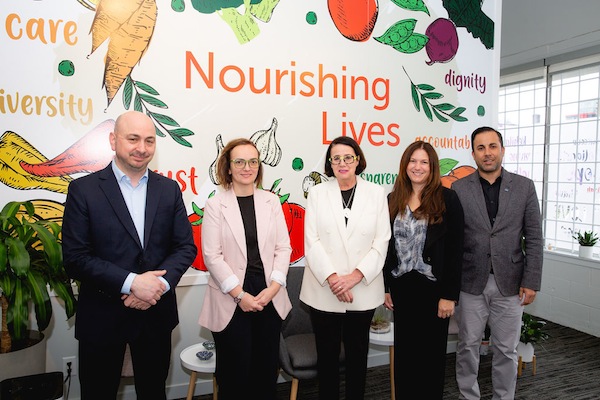
Left to right: Ezra Shanken (Jewish Federation), Tanja Demajo (Jewish Family Services), B.C. Lieutenant Governor Janet Austin, Simone Kallner (JFS board member) and Nico Slobinsky (CIJA). (photo from Jewish Federation)

Earlier this month, B.C. Lieutenant Governor Janet Austin, honorary patron of the Jewish Federation of Greater Vancouver, spent a full day getting to know the Metro Vancouver Jewish community.

Austin visited the Kitchen at Jewish Family Services, Schara Tzedeck Synagogue, the Jewish Community Centre of Greater Vancouver, the Vancouver Holocaust Education Centre, and Hillel House at the University of British Columbia.

photo - Ezra Shanken, left, with Lt. Gov. Janet Austin and Schara Tzedeck Synagogue’s Rabbi Andrew Rosenblatt.
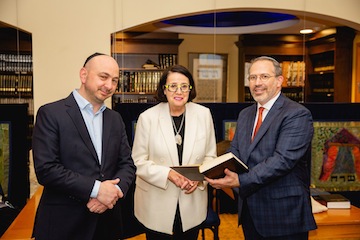
Ezra Shanken, left, with Lt. Gov. Janet Austin and Schara Tzedeck Synagogue’s Rabbi Andrew Rosenblatt. (photo from Jewish Federation)

It was an opportunity to talk together about the strategic work that Jewish Federation and its partners are doing. The Jewish Museum and Archives of British Columbia, Shelley Rivkin and Daniella Givon gave presentations about the community.

The visit to Hillel was an opportunity to see not just their good work, but how Jewish students are dealing with antisemitism on campus. They are singled out in ways other students and groups simply are not, including students connected with countries that are wrestling with difficult issues within their borders, or are led by dictators, or have dismal human rights records.

The dichotomy is shocking, and it is part of why Jewish Federation continues to push for local and provincial governments to follow the federal government in adopting the International Holocaust Remembrance Alliance definition of antisemitism.

For more photos of the day, visit facebook.com/jewishvancouver.

– Taken from Jewish Federation of Greater Vancouver chief executive officer Ezra S. Shanken’s weekly email update (May 6)

***

photo - Gordon Diamond
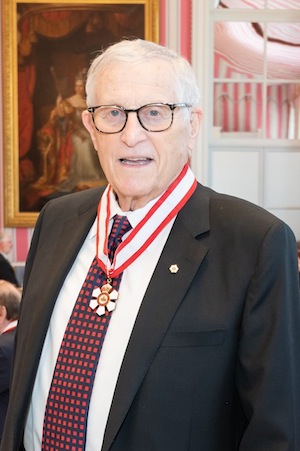
Gordon Diamond (photo from gg.ca)

On May 6, Governor General of Canada Mary Simon invested 10 Officers (OC) and 13 Members (CM) into the Order of Canada during a ceremony at Rideau Hall. Vancouver Jewish community member Gordon Diamond, OC, OBC, was among the honourees:

“Gordon Diamond has upheld the family’s exceptional legacy in philanthropy and business. Chair and owner of West Coast Reduction Ltd. and Austeville Properties Ltd., he has built them into two of Western Canada’s largest family-owned businesses. As one of our country’s leading philanthropists, he and his eponymous foundation focus on health care and social services. He is noted for his landmark donation to a major Vancouver outpatient health centre, and his support for Jerusalem’s Shalva National Centre for disabled persons and the Simon Wiesenthal Museum of Tolerance.”

– From the website of the Governor General of Canada

 ***

Richmond Cares, Richmond Gives presented the 2022 Volunteers Are Stars Awards virtually on April 27, during National Volunteer Week. Tammi Belfer was one of the four winners.

image - screenshot of Tammi Belfer shares some of the reasons she volunteers in a video on the awards website
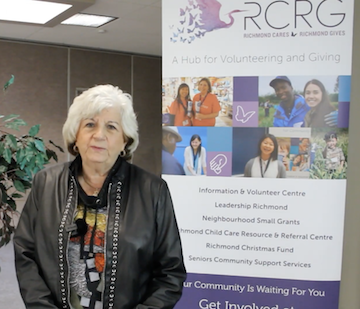
Tammi Belfer shares some of the reasons she volunteers in a video on the awards website. (screenshot)

The 18 individuals and groups who were nominated all made a meaningful difference in the Richmond community. Collectively, they’ve contributed thousands of hours to dozens of causes, enhancing the lives of residents. Their volunteer work has impacted children and youth, seniors and families, and those experiencing poverty and homelessness. In short, every one of them is a star, and their light makes our community shine so much brighter.

Belfer was honoured as a Star of Richmond for excellence in nonprofit leadership. Li Qing Wang of Richmond Women’s Resource Centre was Shooting Star Award Winner (outstanding youth volunteer); South Arm United Church Outreach Committee was the Constellation Award Winner (outstanding volunteer group); and Dawn Thomson, Special Olympics B.C.-Richmond and Salvation Army Rotary Hospice House was the Nova Star Award Winner (outstanding individual volunteer).

Belfer has been volunteering for nearly five decades, often in leadership roles.

From 1974 to 2000, she served as a board member with the Organization Through Rehabilitation and Training (ORT). Rooted in Jewish values, the organization enhances the economic prospects of individuals and communities by providing them with employment and entrepreneurial skills.

Through much of the 1980s, Belfer was a board member with the Richmond Aquanaut Swim Club, which later merged with the Richmond Racers to become the Richmond Rapids Swim Club. During her time there, she served as treasurer, supported membership development and regularly volunteered at swim meets.

She also served eight years on the board of Richmond Cares, Richmond Gives, back when the organization was known as Volunteer Richmond Information Services. Here, too, she volunteered as treasurer. She remains involved with the organization’s Richmond Christmas Fund program, volunteering each holiday season to assist families in need.

Since 2015, Belfer has served as board president of the Richmond Women’s Resource Centre, where she’s had a transformational impact. She’s played a key role in developing the organization’s board, recruiting a diverse group of new members – including many young people – who are passionate about helping women build connections and thrive in their community.  She also volunteers as project manager for the organization’s annual International Women’s Day event, which is both a community gathering and a major fundraiser, complete with an auction and raffle. Recently, she helped lead the Resource Centre in drafting a five-year strategic plan and, in 2019, was a key voice in the organization’s rebranding effort, which resulted in a new logo created in consultation with the community.

During COVID, Belfer worked with the organization’s executive director to bring all of its programs and services online, so they would remain accessible throughout the pandemic.

Speaking of programs, it’s another area where Belfer has had a substantial impact. She helped create many of the Resource Centre’s most popular initiatives, from Hot Ink, a creative writing program for teenage girls, to Work Ready, which supports women in developing employment and job-search skills.

Belfer is also a current board member of the Jewish Seniors Alliance and of Beth Tikvah Synagogue, where she actively participates on committees and generously shares her knowledge and experience, so both organizations can better serve their constituents.

Through her decades of service, Belfer has left an indelible mark on the Richmond community, and improved thousands of lives. She’s still giving her time, and still making a difference, even as she mentors young volunteers on their way to becoming community leaders. She’s one of the giants on whose shoulders they’ll stand.

Belfer shares some of the reasons she volunteers in a video on the awards website, rcrg.org/vas.

– Courtesy Richmond Cares, Richmond Gives

Format ImagePosted on May 20, 2022May 19, 2022Author Community members/organizationsCategories LocalTags Gordon Diamond, Janet Austin, Jewish Federation, Order of Canada, Richmond Cares Richmond Gives, Tammi Belfer
Bat mitzvah’s 100th birthday

Bat mitzvah’s 100th birthday

(photo from myjewishlearning.com)

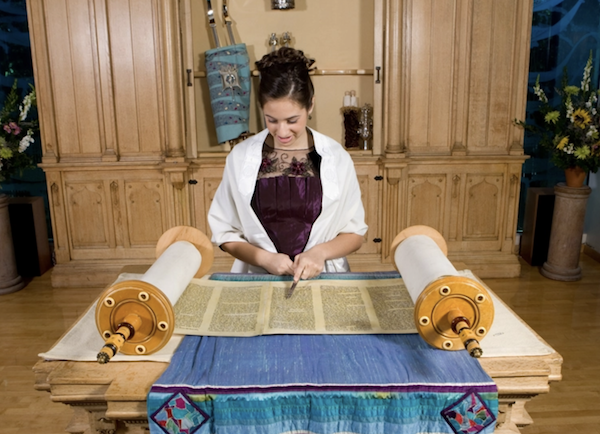
March 18, 2022, marked the 100th anniversary of the first bat mitzvah ceremony in the United States.

Judith Kaplan, daughter of Rabbi Mordechai Kaplan, became the first woman to publicly celebrate the traditional Jewish coming-of-age ceremony. Becoming a bat mitzvah, or “daughter of the commandments,” signifies that a young woman has attained legal adulthood under Jewish law.

A bat mitzvah is based on the centuries-old ritual of bar mitzvah, or “son of the commandments,” the ceremony for 13-year-old boys. Today, it typically involves months or years of study, chanting Torah in front of the congregation and giving a reflection on the week’s Torah reading.

Since that day in 1922, coming-of-age ceremonies for Jewish girls have gradually become more popular, especially in more liberal branches of Judaism.

As someone who studies how legal and social changes intersect to advance the rights of women in religious communities, I see bat mitzvah as having a transformative impact on the rights of women in Jewish life, one that continues to reverberate in important ways today.

Growing equality

For many years, the significance of becoming a bat or bar mitzvah was very different. For boys, it marked the moment when they took on all the privileges accorded to adult men in the tradition, including the right to be counted in a minyan, the minimum number of people required for community prayers; to be honoured by being called up to give blessings over the Torah reading; and to read from the Torah itself. For girls, meanwhile, it often marked a celebration of maturity, but did not necessarily bring along the rights to full and equal participation in synagogue rituals.

It is only in recent decades that the rituals enacted and the rights bestowed for boys and girls have become substantially equivalent, and only in more liberal movements.

Indeed, because of controversies over whether women should be permitted to read aloud from the Torah, Judith Kaplan was not given the honour of being called up to read from a Torah scroll – part of the ordinary routine for bar mitzvah boys. Rather, she spoke after the service had formally concluded, reciting prayers and reading selections from the biblical passages out of a book.

Even today, bat mitzvah girls in some communities read passages from sacred texts after services on Friday night or Saturday morning, instead of during the standard Saturday morning service. But the bat mitzvah ritual, in varying forms, has become widespread in all movements within Judaism. It is widely practised in Reform, Conservative and Reconstructionist – a branch of progressive Judaism later founded by Kaplan’s father – communities and is increasingly popular in the Orthodox world.

The introduction of bat mitzvah was a steppingstone to expanding roles for women in every part of the Jewish world. In the Conservative movement, for example, women’s inclusion in bat mitzvah created tensions with their exclusion from other aspects of ritual life and leadership. Girls and women who were educated alongside boys and celebrated their bat mitzvah in similar ways later found themselves excluded from adult roles.

Jewish studies scholar Anne Lapidus Lerner summed it up this way: “The bar mitzvah ceremony marks a young man’s entrance into adult Jewish responsibility and privilege – the first, it is hoped, of many such occasions. But a bat mitzvah would mark a young woman’s exit from participation. It would be the only time she was permitted to go up to read the Haftarah,” selections from the biblical books of the prophets, read after the Torah portion each Sabbath.

The push to resolve this inconsistency led to an expansion of women’s roles within Conservative Judaism, including the ordination of women as rabbis.

Orthodox women continue to push boundaries around bat mitzvah. Many Orthodox synagogues have special programs devoted to girls coming of age and host celebrations marked by lighting Sabbath candles and sharing their learning about sacred texts in a speech to the community. Some Orthodox communities host women-only prayer groups where girls read from the Torah, while families in other communities host ceremonies in their homes.

New directions

As the ritual of bat mitzvah became more widely accepted, adult women who had been denied opportunities to study for it as children have sought out bat mitzvah as well. They may choose adult bat mitzvah because they seek to become more involved in ritual leadership in their synagogue community, or to enhance their skills so that they can guide their children when it becomes time for them to begin training for their own bar or bat mitzvah. Becoming an adult bat mitzvah may also provide a public forum to mark important transformations in one’s Jewish identity.

Project Kesher, an American nongovernmental organization that fosters Jewish women’s leadership in the former Soviet Union, supports programs for adult bat mitzvah. These initiatives allow women who were forbidden to receive a Jewish education by antisemitic state policies to reclaim their identities.

Sometimes, the ritual of adult bat mitzvah celebrates a more personal journey. In a recent episode of And Just Like That, the sequel to Sex and the City, the character Charlotte faces a crisis when her child does not want to participate in their Jewish coming-of-age ceremony. Charlotte saves the day by using the occasion to have her own bat mitzvah, to celebrate her own Jewish identity as a “Jew by choice,” after converting to Judaism years ago.

The TV episode also highlights another emerging innovation around the ritual of bat mitzvah: the adoption of more gender-neutral terms “b’nai mitzvah” or “b-mitzvah.” In many contexts, the rituals of bar and bat mitzvah have become identical, but the names of the ritual are still sexually differentiated: “bar mitzvah” for boys and “bat mitzvah” for girls. Some congregations, like Charlotte’s, have moved to using the term “b’nai” – children of the commandments (though b’nai literally means “sons,” it is also used to describe gender-mixed groups) – or simply “b-mitzvah” as a term that embraces all children, including those who identify as non-binary. (The Peretz Centre for Secular Jewish Culture uses the term p’nei [faces of] mitzvah.)

So, when North American Jews celebrate the 100th anniversary of bat mitzvah, they not only celebrate a momentous occasion in the life of one young girl, but an innovation that has paved the way for wider inclusion of generations of women, children and those previously excluded from a central ritual of Jewish life.

Lisa Fishbayn Joffe is director of the Hadassah-Brandeis Institute and director of the Project on Gender, Culture, Religion and the Law, which explores the tension between women’s equality claims and religious laws. Her research focuses on gender and multiculturalism in family law and on the intersection between secular and religious law. She is a co-founder of the Boston Agunah Task Force, devoted to research, education and advocacy for women under Jewish family law. This article is republished from The Conversation, and the original can be found at brandeis.edu/jewish-experience.

Format ImagePosted on May 20, 2022May 19, 2022Author Lisa Fishbayn JoffeCategories WorldTags bat mitzvah, Hadassah-Brandeis Institute, history, Judaism

שבע עשרה שנים בוונקובר בצל מותה של אמי

בדרך כלל אני זוכר היטב את היום בו נחתי בקנדה לאחר שעזבתי את ישראל, אך השנה לאור מות אמי, התאריך הזה לא בדיוק עבר בראשי. אני נחתתי בוונקובר בחמישה עשר בפברואר אלפיים וחמש ומאז אני כאן. מדובר כבר בלמעלה משבע עשרה שנים

כאמור לא “חגגתי” השנה בשבעה עשר בפברואר את יום השנה של בואי לונקובר, כיוון שאמי נפטרה בשישה בפברואר. הגעתי בטיסת חירום לישראל כדי להיות עימה בבית החולים, ולמחרת הגעתי היא נפטרה. כאילו חיכתה רק לבואי

לאחר השבעה בה הגיעו עשרות חברים, מכרים של אחי אמיר ושלי, וכמובן בני משפחה וכן חברות רבות של אמא ושכנות שלה, נזקקתי ליום מנוחה לעקל את כל מה שעבר עלי. ואז בשבוע השני והאחרון שלי בתל אביב, התחלתי לארגן את דירת אמי לקראת הפינוי. עברתי על אין סוף מסמכים, ספרים, חפצי אמנות ובגדים, כדי לבדוק מה חשוב ומה לא. מה להמשיך ולשמור ומה לתרום. לפיכך לא היה לי זמן ומקום לחשוב על השבעה עשר בפברואר – שכאמור הוא “יום השנה” שלי כאן בוונקובר

השנתיים וחצי האחרונות בוונקובר ובכלל היום קשות מנשוא ומאוד מאוד מסובכות. הקוביד שיבש לנו את החיים והפכנו כמעט לאסירים בבתים ובאזור. בראשית שנה שעברה איבדתי את אבי שמת בגיל תעשים וארבעה חודשים, מסובכים של קוביד. אבא היה חולה מאוד וידענו שהסוף מגיע. לא יכולתי להגיע להלוויתו בגלל מגבלות הקוביד, ולפיכך ראיתי אותה באמצעות זום

אחי ואני חשבנו אמא תוכל לחיות עמנו עוד שנים רבות לאור כך שמצב בריאותה היה מצויין, לאשה בגיל תעשים ושתיים. היא הצליחה להתאושש ממותו של אבא וזה דבר לא פשוט לאחר שבעים ואחת שנות נישואים. אמא חזרה לשגרת החיים שלה שכללה מפגשים עם הרבה מחברותיה, עם בני המשפחה, ספורט כמעט כל יום וקריאת ספרים

באחד הימים (בשני לפברואר) היא ירדה מדירתה לאכול סלט, נחנקה בפתאומיות מתפוח שהיה בו והסיפור שלה נגמר מהר מאוד. היא הועברה לבית החולים איכילוב ולאחר ארבעה ימים נקבע מותה

ועתה כשאני משחזר את מה שעבר עלי בשנים האחרונות ובעיקר בשנה האחרונה, בה נפרדתי תחילה מאבא ולאחר מכן מאמא, קשה לי לחזור לשגרת החיים הרגילה, ולחשוב על שבעה עשרה השנים שלי כאן – בונקובר

כל צורת החיים שלי השתנה עת עברתי מתל אביב לוונקובר. קודם כל בישראל עבדתי במשרה מלאה כעיתונאי בתחום התקשורת, וכיום כאן זה תחביב בלבד. בשמונה השנים האחרונות אני עובד בחברה שמספקת הלוואות למי שלא יכול לקבל אותן מהבנק, ותפקידי הוא המבקר

בארץ הייתי מוקף בני משפחה חברים וכמובן היו לי בנות זוג לתקופות ארוכות בחיי. השהגעתי לוונקובר היכרתי כאן רק חבר אחד שעזב את תל אביב מספר שנים לפני. לאט לאט הצלחתי להכיר אנשים וכיום יש לי גם כן (כמו בתל אביב) מספר חברים טובים, בהם ישראלים, יהודים קנדים ומקומיים

ומהיבט האישי: מזה ארבע שנים ושמונה חודשים, יש לי בת זוג קבועה שהגיעה לוונקובר מסין. וואנווי גרה כאן כשמונה שנים ובשנתיים האחרונות היא עובדת בממשלה הפדרלית. יש לנו חיי אהבה ושותפות טובה, קירבה גדולה והרבה עניין משותף – בעיקר בתחומי האמנות והתרבות. החיים שלנו ביחד טובים מאוד ואנו רק מצפים להמשך של עוד ועוד

לסיכום: אין לי על מה להתלונן בשבע עשרה השנים שאני גר בבית בוונקובר

Posted on May 18, 2022May 4, 2022Author Roni RachmaniCategories עניין בחדשותTags Canada, COVID, death, family, immigration, Israel, הגירה, ישראל, מוות, משפחה, קוביד, קנדה
Celebrating 25 years

Celebrating 25 years

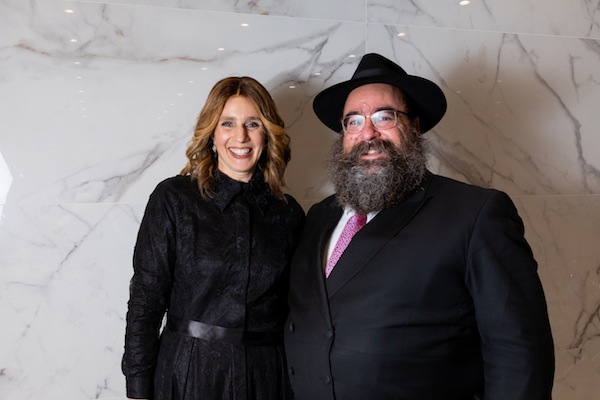
Chabad Richmond honours Rebbetzin Chanie and Rabbi Yechiel Baitelman at June 19 gala. (photo from Chabad Richmond)

“The goal of the Freilach25 gala goes beyond just a thank you to me and Chanie,” said Rabbi Yechiel Baitelman, who is being honoured with his wife Chanie next month.

“It’s about promoting the Rebbe’s mission,” he said. “And, if Chanie and I can help do that, OK. We’re dedicated to doing the Rebbe’s work, to bringing the warmth of Yiddishkeit and the warmth of Torah and Chassidus (Chassidic philosophy) to as many people as we can, in whatever ways we can.”

Freilach25, which marks Chabad Richmond’s 25th anniversary and celebrates the Baitelmans’ many contributions to the community, will take place on June 19 at Schara Tzedeck Synagogue. The keynote speaker at the event will be human rights advocate Natan Sharansky, who will talk on the importance of dialogue and cooperation between Jews from both sides of the Iron Curtain in the struggle for the release of Soviet Jewry, as well as the urgency of building and strengthening Judaism in our community.

In a recent interview with the Baitelmans, they spoke about their 25-year journey with Chabad Richmond, which began in October 1993.

Lubavitch BC’s Rabbi Yitzchak Wineberg brought the young couple out to Vancouver to be shluchim(emissaries) of the Rebbe, Menachem Mendel Schneerson (1902-1994). Rabbi Yitzchak and Henia Wineberg were, and still are, their “supervisors,” but, in 2000, the Baitelmans went out on their own, when people asked for a Chabad centre in Richmond. Nonetheless, for the first 10 years, they maintained some of their duties and responsibilities for Lubavitch BC in Vancouver – programs, summer day camp, etc.

“Our kick-off event in Richmond was during Hanukkah,” said Rabbi Baitelman. “We put the word out and had parties at our home over a couple of nights. In fact, we held a lot of programs in our home – Sunday morning Minyaneers Club, classes, and other programs. We weren’t holding services yet, but we began expanding our programs.”

Chabad has had a presence in Vancouver for a long time. Not so for Richmond. “One of the biggest struggles we have in Richmond is getting the word out that we exist, what we do, and the welcoming atmosphere we have,” said the rabbi.

The Richmond Jewish community has evolved over the years and, he said, “There are different ways of measuring the changes. There are certain areas where we see incredible success and growth, in terms of the number of people participating and supporting Chabad. And financial support is an important measure of how much the community appreciates us, and the value they put on the work that we do. Thank G-d, our budget has grown every year, and we’ve been able to offer more programs and activities. When we first moved to Richmond, we were still getting a salary from Vancouver, we were just raising money for our programs. Today, all our funds come from what we raise. The financial ties with Vancouver are long over.”

Asked what it’s been like for their family being on shlichus here, Rebbetzin Baitelman said, “Our kids are very proud of us. It’s nice to hear that from your own children. It was hard because we didn’t have a lot of family here. So, our kids didn’t get to grow up with cousins and aunts and uncles and grandparents. But they learned a lot and got ‘voluntold’ to do lots of different jobs – cooking and set-ups and welcoming – so they’re like my assistants.”

Rabbi Baitelman spoke warmly of growing up in the Rebbe’s neighbourhood, being at his farbrengens (Chassidic gatherings) and seeing the energy, the love of every Jew, and the Rebbe’s commitment to the spiritual well-being of each Jew.

“It was an amazing inspiration, seeing the selflessness of the Rebbe,” he said. “My grandparents also had a big impact on me. My maternal grandparents were shluchim of the previous rebbe. All my aunts and uncles (my mother’s siblings, the Gordons) are all on shlichus. My parents were on shlichus until I was 2 or 3 years old. They considered themselves the unofficial embassy of Gordon shluchim around the world. Anyone inspired by the Gordon family would come to our home for Shabbos or after Sunday Dollars [every Sunday outside his office, the Rebbe would hand out a dollar bill to people who came to receive his blessing].

“And, of course, Rabbi Wineberg inspired us by giving us the opportunity to come out here – he guides us a lot. Rabbi Lipa Dubrawsky was also a significant role model for how to inspire and engage people. And, of course, my uncle Rabbi Josh Gordon impacted my life tremendously. He was a shaliach in California who accomplished great things. He turned out to be a very influential, dedicated powerhouse of a man, in terms of leadership.”

As to how they ended up in Metro Vancouver, Rabbi Baitelman said, “When Chanie and I met, we discussed shlichus and we knew this was something we wanted to do, to make it the focus of our life. We knew what being shluchim would entail, although I must say that being young and a little bit naïve helped. Being shluchim in North America fits with our talents and abilities.”

Chanie Baitelman had confessed to her husband that she had only one hesitancy. She said she asked him: “Wherever we go … could they please speak English, because I’m terrible at languages? Yechiel has a love for everything Russian, and he spent a couple of stints in Russia, and I was petrified we were going to end up there.

“Living here,” she said, “Henia Wineberg has been beyond inspirational. She took me under her wing and taught me how to navigate everything, even how to cook. When I got married, I knew how to cook three things, and one of them was cream of wheat, and only for a crowd. I was 21 years old when we came here and Henia would introduce me as ‘the new rebbetzin’ and I almost went through the floor.

“When I was younger,” she continued, “my goal was to go to seminary in Australia, which I did. My parents were always very involved in our community, so we followed along and worked with them. Our grandparents and aunts and uncles were on shlichus, and extremely devoted to the Rebbe, so it was almost by osmosis that we took it on. It was something we aspired to. We lived in a little suburb of Detroit, Mich., and we grew up very wholesome. Family was our primary example to follow.”

While her parents were not on shlichus when she was growing up, she said, “My father was a teacher in a Jewish (non-Chabad) day school and we were active in the Chabad community. My mother was also an educator. But now my parents are shluchim. They’ve been shluchim for 21 years, so they went out on shlichus after us.”

Both of the Baitelmans expressed gratitude when asked what message they’d like to impart to the community.

Chanie Baitelman said: “Thankfulness and gratefulness for allowing us to be part of your community and supporting and befriending us all these years. I’ve learned something from everyone I’ve met here.”

Her husband contemplated for a moment before answering. “First thing, gratitude is very important – gratitude to the Rebbe and all the people who inspired us to be shluchim, and who mentor us. I’m so grateful to those people who opened their doors to us when we were an unknown commodity, a young couple new to the community. I try to always remember to say thank you to them for their belief in us, for their friendship and their support.

“I believe there’s still so much to do, both in terms of our personal growth, and in terms of communal growth,” he added. “Our best days are ahead of us. We have challenges, but they bring out the best in us. I invite everybody who wants to be part of this to bring their talents, experience and energy forward to join us. We’re honoured and privileged to be on the journey with this community and, together, we should bring the Rebbe a lot of naches, and fulfil his dream and vision of the times of Moshiach, of a perfect world, when everybody will have what they need, and everyone will be happy and healthy and strong. And the beauty inherent in Hashem’s world will be visible and obvious to everybody.”

The Baitelmans are the conduits through which many in the community connect with the Rebbe and his mission.

“We’re just the channel,” Chanie Baitelman stressed. “It’s not the easiest job, you have to work hard, but we’re doing something meaningful. Really, it’s a privilege. That someone would pay us to do meaningful work, is just beyond. Like our kids say: ‘So, basically, Mom, you got your dream job. You’re living your dream.’”

The Rebbe often used the metaphor of light – the power of light is that you can ignite an infinite number of flames from one light.

“In a sense, we are all shluchim, we’re all doing the Rebbe’s work in one way or another,” said Yechiel Baitelman. “Some do it as their career, some do it through volunteering or financial support, but having so many people involved in this army of goodness and kindness, all inspired by the Rebbe, that’s so rewarding. I never really understood why people wanted to volunteer with Chabad, then I realized it’s because others inspire them to get involved.”

The Baitelmans aren’t people who seek out honours. However, said the rabbi, “If, by telling our story and being part of the Freilach25 gala, we can advance the Rebbe’s mission for the betterment of the community, then do whatever you need to do. It’s not really about us, but we’re very grateful. Just please remember that there’s a bigger goal beyond the thank you and acknowledgement. Something has to come from this, whether it’s supporting Chabad or getting more involved, whatever it might be. Over the next 25 years, there’s a lot more we need to accomplish, so please have that in mind.”

Tickets for the gala are limited. They can be reserved at chabadrichmond.com/freilach25.

Shelley Civkin is a happily retired librarian and communications officer. For 17 years, she wrote a weekly book review column for the Richmond Review. She’s currently a freelance writer and volunteer.

Format ImagePosted on May 6, 2022May 4, 2022Author Shelley CivkinCategories LocalTags Baitelman, Chabad Richmond, Freilach25, gratitude, Judaism, milestone, Rebbe
“Never again” still resonates?

“Never again” still resonates?

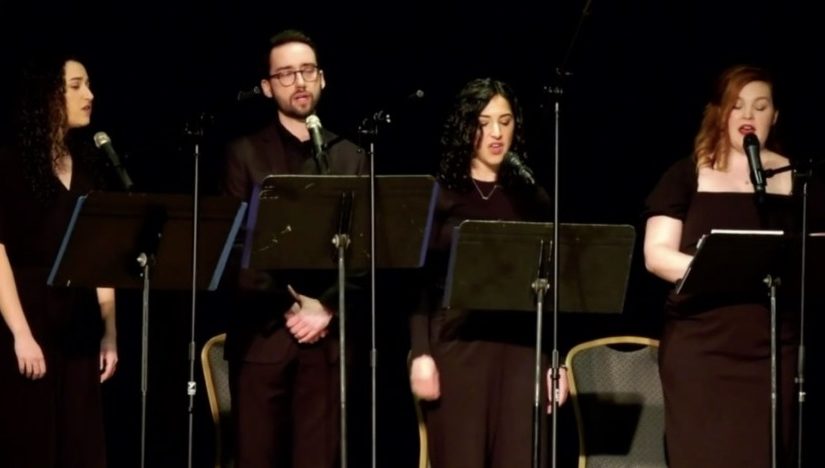
Left to right: Mia Givon, Lorenzo Tesler-Mabe, Kat Palmer and Erin Aberle-Palm. (screenshot from Kat Palmer)

Holocaust survivors and their descendants were joined by top elected officials and Jewish community leaders in a series of commemorations marking Yom Hashoah, Holocaust Remembrance Day, across Canada last week.

In Vancouver, community members gathered together at the Jewish Community Centre of Greater Vancouver April 27, while scores more watched remotely as the traditional in-person ceremony returned for the first time since the beginning of the pandemic.

Marcus Brandt, vice-president of the presenting organization, the Vancouver Holocaust Education Centre, welcomed guests and invited Holocaust survivors to light Yahrzeit candles.

“On Yom Hashoah, we join as a community to remember the six million Jews who perished in the Holocaust at the hands of Nazi Germany and its co-conspirators between 1933 and 1945,” he said. “It is also a day to pay tribute to the Jewish resistance that took place during the Holocaust.”

This year marks the 79th anniversary of the Warsaw Ghetto Uprising, which is the most notable of many acts of Jewish resistance to Nazism.

Marsha Lederman, a journalist who is the daughter of two Holocaust survivors, spoke of the importance of telling our stories.

“When I was growing up,” she said, “the Holocaust was everywhere and nowhere. As far back as I can remember, there were hints and references. My parents talked about things happening in camp. What was this camp? I knew it wasn’t like the summer camp that I went to. I knew a lot of their friends were also at these camps, but I didn’t know the details.”

At the age of 5, Marsha met a new friend whose home was filled with laughter and extended family.

“One day, when I came home from a visit at my friend’s house, I asked my mother what was really a simple, innocent question,” said Lederman. “She has grandparents, why don’t I? My poor mother. She was caught off guard and her answer was truly horrifying – at least as I remember it, because I know memory is very faulty. But, as I recall, she said I didn’t have grandparents because the Germans hated Jews and they killed them by making them take gas showers.”

This response raised more questions than answers for the young girl, not least of which was: “What did we do to make the Germans hate us so much and do they still hate us? It was a horrible introduction to the details of the tragedy of my family and it taught me another terrible lesson: be careful about asking questions because the answers could be murder.”

As a result, much of Lederman’s Holocaust education was gained “through osmosis, rather than sitting down and asking questions,” she said.

Her father died when Lederman was a young woman and, in a tragic turn of events, her mother died just as Lederman had bought a ticket to visit her in Florida, armed with a recorder to finally ask the questions she had hesitated to broach in earlier years.

“It’s taken me years to try to figure out what I could have learned in an afternoon at my mother’s kitchen table,” she said. “I have no way of knowing these things because I didn’t ask. We need to ask and we need to tell.”

Lederman explores these questions in a book being released this month, titled Kiss the Red Stairs: The Holocaust, Once Removed.

Amalia Boe-Fishman (née van Kreveld) was the featured survivor speaker at the Vancouver event. Born in the Netherlands, she was less than a year old when the Germans invaded her country. Her grandparents were soon transported to Auschwitz and murdered.

In what is an extremely rare phenomenon, Amalia, her parents and her brother all survived the war years because a Dutch Christian resistance fighter, Jan Spiekhout, and his family hid members of the de Leeuw family in a variety of hiding places over the course of years. Amalia’s mother even gave birth to another child in 1944. (That child, as well as Boe-Fishman’s oldest son, are both named Jan in honour of their rescuer.) Their survival was a statistical miracle. The Netherlands had among the lowest Jewish survival rate of any country during the Holocaust. Of 140,000 Dutch Jews in 1939, only 38,000 were alive in 1945.

Boe-Fishman recalled the day Canadian forces liberated the Netherlands – it was one of the only times in three years that she had set foot outdoors.

“It was strange and frightening outside and close to so many strangers,” she said. “The Canadian soldiers came rolling in on their tanks, handing out chocolates, everyone smiling, dancing, waving Dutch flags. Then I was told I could go home to my real family. But who were these strangers? I did not want to leave the family Spiekhout. They were my family. After all, I had not seen my real family for three years.”

In 1961, she traveled to Israel to meet members of her family who had made aliyah before the war and to reconnect with her Jewish identity. There, on the kibbutz she was staying, she met a Canadian, whom she married and they subsequently moved to Vancouver and had three children.

In 2009, Boe-Fishman and her three sons traveled to The Hague for the investiture of Jan Spiekhout and his late parents, Durk and Froukje Spiekhout, as Righteous Among the Nations by Yad Vashem.

“To be together with my children, my brother, and the grown children of the Spiekhout family, this was such a moving event in our lives,” she said.

As part of the Vancouver ceremony, Councilor Sarah Kirby-Yung read a proclamation from the City of Vancouver. Cantor Yaakov Orzech chanted El Moleh Rachamim. Lorenzo Tesler-Mabe, Mia Givon and Kat Palmer, members of the third generation, as well as Erin Aberle-Palm, sang and read poetry, accompanied by Vancouver Symphony Orchestra violinist Andrew James Brown and pianist Wendy Bross Stuart, who was also music director of the program.

The following day, a hybrid in-person and virtual event was held at the British Columbia legislature, featuring Premier John Horgan.

“On Yom Hashoah, we are challenged to ensure the words ‘never again’ are supported by action,” he said. “Over the past few years, there has been an increase in antisemitism in B.C., and the Jewish community is one of the most frequently targeted groups in police-reported hate crimes. That’s why our government will continue working to address racism and discrimination in all its forms.… Today, as we remember and honour those who were lost and those who survived, we must recommit to building a more just and inclusive province, where everyone is safe and the horrors of the past are never repeated.”

Michael Lee, member of the legislature for Vancouver-Langara, spoke on behalf of the B.C. Liberal caucus.

“Every year, we commemorate this day and remember the heroes and the Righteous Among Nations who stood up to oppose the most vile, hateful oppression,” Lee said. “We recognize the victims and survivors of the Holocaust, we make a solemn promise to never forget and never again allow such horrific actions to take place. This is a responsibility that we all must carry with us not only today but every day. It is a responsibility we must be better at upholding, as soldiers at this very moment commit war crimes once again in Europe. We have not done enough. Right here in Canada, we see another year of record rises in antisemitism. We have to do better.”

Lee called on the province to adopt the International Holocaust Remembrance Alliance Working Definition of Antisemitism.

MLA Adam Olsen represented the Green party.

“While time distances us from the horrific events, the memories and the stories remain steadfast in our mind and are carried and passed from one generation to the next,” said Olsen. “The Holocaust was an ultimate form of evil, persecution, oppression, genocide, complete disregard for human life, pushed to the most appalling degree…. The Holocaust is a stark reminder of the darkness, the wickedness, that can exist among us. However, it is also important to acknowledge that this is a story of strength, resilience and humanity and, to that, I raise my hands to all of the survivors, the Jewish community, that have ensured that the world knows and hears the stories. As difficult as it is to continue sharing them, we cannot stop hearing them or else we will fall victim to thinking that we have passed that now.”

Rabbi Harry Brechner of Congregation Emanu-El lamented the deaths of Holocaust survivors in the current war in Ukraine, “who died when they were cold, again, and hungry, again, and who died in the face of violence.”

“That never should happen and we all know that,” the rabbi said. “I don’t know how to make those big changes. I’m not a world leader. I’m the leader of a small congregation. But I think we are all leaders of our hearts and if each of us can make that difference, it’s got to have a huge ripple effect.”

Holocaust survivor Leo Vogel said that history records the end of the Holocaust in 1945. “But, for the people who lived through it and survived that horrible blight of human history, for them, 1945 is not when the Holocaust ended,” he said. “It continues to this very day to live in memories and nightmares and ongoing health problems.… The fascist attempt to eradicate the Jewish people must never be forgotten. The memory of the tortured and murdered cannot be shoveled underground as the Nazis did with the ashes. As children in the Holocaust, we were the youngest and, now, in our older years, we are at the tail end of those who can still bear witness.”

Vogel spoke of the unfathomable choice his parents made to hand him over, as a child, to a Christian family for hiding.

“Not long after that deeply painful decision to separate me from them, they were deported to Auschwitz and there they were murdered without ever knowing whether their desperate act to allow me to go into hiding saved my life,” he said. “I get cold chills when I think of the intense agony they went through in making their decision. It would have been their hope, I’m sure, that one day we would once again get together. That day never happened. Their pain must have been overwhelming. Many times, I have wondered what they said to each other and to me the night before they gave me away and, countless times, I have asked myself whether I would have had the strength to do an equal act when my children were young.”

In Ottawa, earlier on April 27, Prime Minister Justin Trudeau touted his government’s steps in fighting antisemitism, including the creation of a special envoy on preserving Holocaust remembrance and combating antisemitism, currently held by Irwin Cotler, and proposed legislation to make denying or diminishing the Holocaust a criminal offence.

“Earlier this year, our country and people around the world were shocked and dismayed to see Nazi imagery displayed in our nation’s capital,” the prime minister said, referring to trucker protests in Ottawa. “For the Jewish community, and for all communities, those images were deeply disturbing. Sadly, this wasn’t a standalone instance. Jewish people are encountering threats and violence more and more both online and in person. This troubling resurgence of antisemitism cannot and will not be ignored. The atrocities of the Holocaust cannot be buried in history.… We must make sure that ‘never again’ truly means never again.”

Shimon Koffler Fogel, chief executive officer of the Centre for Israel and Jewish Affairs, picked up on that theme, noting that the term “never again” was “born out of the Jewish experience but was always intended to be universal in its application.”

“How can we witness the atrocities visited on the Rohingya, the Uighurs or the Yazidi and claim the cry of ‘never again’ has meaning?” he asked. “How can we observe the unvarnished aggression against Ukraine and assert we have taken the lessons of the Holocaust to heart?”

He said he derives hope from the fact that Canada seems to have learned the lesson of the MS St. Louis, the ship filled with Jewish refugees that was turned away from Canada and other safe havens in 1939. Now, Canada is a place, he said, “where fleeing Syrian and Iraqi refugees can rebuild their lives, where Afghani women and girls can fulfil their dreams, where displaced, wartorn Ukrainians can find safe harbour.”

“I take great pride that Canada is so committed to Holocaust remembrance and education,” said Michael Levitt, president and chief executive officer of the Friends of the Simon Wiesenthal Centre, “A major reason is because of the survivors who, after suffering unthinkable adversity in Europe, rebuilt their shattered lives here, in our great country. Their strength, resilience and willingness to share their deeply personal and harrowing stories have been a gift and a source of inspiration to all Canadians.”

Dr. Agnes Klein, a Holocaust survivor, spoke of her family’s wartime experiences. Israel’s ambassador to Canada, Ronen Hoffman, commended Canada on adopting the International Holocaust Remembrance Alliance’s Working Definition of Antisemitism.

A day earlier, at another virtual commemoration from the Montreal Holocaust Museum, Holocaust survivor Max Smart told of his family’s harrowing Holocaust experiences.

Paul Hirschson, consul general of Israel in Montreal, compared the loss of Jewish life, with its incalculable loss of talent, in the Holocaust with the explosion of Jewish talent taking place in this century.

“Jewish talent lost was one of history’s greatest tragedies,” said the diplomat. “The talent emerging is perhaps the most exciting story of the 21st century…. Antisemitism is still widespread, also here in Canada. Montreal, where many survivors found a home, is no exception. We will defeat hate every time. Hatred will never again rob the world of Jewish talent.”

Format ImagePosted on May 6, 2022February 1, 2024Author Pat JohnsonCategories Celebrating the Holidays, NationalTags Adam Olsen, Amalia Boe-Fishman, antisemitism, CIJA, Harry Brechner, Holocaust, John Horgan, Leo Vogel, Marcus Brandt, Marsha Lederman, Michael Lee, Montreal, Ottawa, remembrance, survivor, SWC, Vancouver, VHEC, Victoria, Yom Hashoah
Investing in the climate

Investing in the climate

Martin Thibodeau, RBC’s B.C. region president, will be honoured at the Ben-Gurion University Gala Dinner June 14. (photo from RBC)

On June 9, Ben-Gurion University president Daniel Chamovitz and members of the Canadian Associates of Ben-Gurion University (CABGU) will visit Vancouver to recognize the launch of its new School of Sustainability and Climate Change (SSCC) and the local supporters who have helped make its opening possible. In particular, Royal Bank of Canada and Martin Thibodeau, RBC’s B.C. region president, will be honoured at the event.

SSCC opened last October at BGU’s Be’er Sheva campus, where its growth has been rapid. Seven months old, the school currently offers two undergraduate degrees and four graduate-level environmental science-related degrees. Its two graduate fellowships, which have supported work in renewable energy and smart city design, were funded by RBC.

“The RBC Research Fund at BGU’s School of Sustainability and Climate Change [is] being established in Martin’s honour, [and] will enable undergraduate and graduate students to be trained as, and pursue meaningful careers as, climate change innovators, entrepreneurs and policy experts,” said David Berson, who serves as CABGU’s executive director for the B.C. and Alberta Region. The funding that is raised at the gala will help further SSCC’s research programs.

SSCC’s mandate isn’t just to address environmental concerns at home in Israel, said Chamovitz. It will have a global reach, as well. BGU is currently working to cement research partnerships with universities and countries that have similar interests in addressing climate challenges. Chamovitz said RBC’s investment in its new school will provide a pathway to meeting that global need.

“RBC was one of the early supporters of SSCC, and this support was essential for leveraging subsequent support,” he said. “The Royal Bank of Canada believes in us,” and that support has served as an encouraging model for other companies to invest in BGU’s programs as well, he said.

Lorne Segal, president of Kingswood Properties and director of the Vancouver Board of Trade, who is an honorary co-chair of the June event with his wife, Mélita Segal, said corporate sponsorship is crucial to startup programs like SSCC. He said corporate support is also vital to finding answers to environmental challenges like global warming.

“Sponsorship from leading businesses and industry leaders does provide imaginative solutions to complex issues impacting our people and the planet,” he said. “Without significant and generous sponsorship support, this crucial work, simply put, would not be possible.”

Segal said supporting initiatives that bring about positive change is part of Thibodeau’s nature.

“Martin Thibodeau truly is a lifelong builder of community,” said Segal. “He is deeply praised by Ben-Gurion University for his commitment to the cause of finding solutions to climate change. It is truly remarkable how much he and RBC Royal Bank have done to enhance the capacity of the Ben-Gurion University community programs and agencies, and advance the conversation on Canada’s transition to a net-zero economy.”

Thibodeau’s support of Canadian Jewish communities and of Israel goes back decades. Originally from Quebec, he served as RBC’s regional president in Montreal until he moved to Vancouver. He oversees some of the largest – and smallest – branches and more than 4,000 employees.

In 2015, while working in Montreal, Thibodeau volunteered as a co-chair for Quebec’s largest multi-day walk for women’s cancers, held by Pharmaprix, to raise money for research at the Jewish General Hospital. “I have been involved with the Jewish community for almost my entire RBC career,” he told the Independent.

He is a strong supporter of the Jewish Federation of Greater Vancouver and the Jewish Community Centre of Greater Vancouver and their community initiatives, and he has been to Israel several times. It was in 2014, said Thibodeau, that he and his wife, Caroline, visited Be’er Sheva and learned of BGU’s environmental research. “[I was] so inspired by the research [and] the innovation,” he said, noting that it wasn’t hard to get behind the creation of a school that was working to find solutions to climate concerns.

“It’s right there in front of me every day,” he said. “I am a proud father of three children and I believe we have a responsibility to make sure that our climate can continue to thrive, and well beyond my lifetime. It is my personal belief that we need to do that today more than ever.”

Thibodeau said it’s been an interesting journey since that first visit to BGU in 2014. “It’s become such a tough priority for the world,” he said of climate change. In Canada, among other things, he supported RBC’s Blue Water Project, which helped provide clean water access to Canadian communities.

Still, Thibodeau is a reticent honouree. He admits that he is uncomfortable with the idea that he will be the guest of honour at a gala, even if it is for a cause he loves. “I’m very humbled,” he said. “I don’t like to have that kind of spotlight on me.” But, he said, raising money for research that might one day create a safer and better environment, that is something he will gladly get behind.

photo - Mélita and Lorne Segal, honorary chairs of the BGU Gala Dinner for Sustainability and Climate Change
Mélita and Lorne Segal, honorary chairs of the BGU Gala Dinner for Sustainability and Climate Change. (photo by The Collective You)

The gala will also acknowledge Lorne and Mélita Segal, who are well-known for their philanthropy and other work. Both have been recognized by Capilano University with honorary doctor of letters, and Lorne Segal has a doctor of laws (hon.) from the Justice Institute of British Columbia. He was inducted into the Order of British Columbia for his work as founding chair of Free the Children’s WE Day Vancouver and as chair of the Coast Mental Health Courage to Come Back Awards. The Segals regularly open their home to fundraising galas.

“When Lorne and I built our home, we didn’t really do it for ourselves but, rather, to share it with the community,” said Mélita Segal. “Whether it was Dr. Peter AIDS Foundation, Arts Umbrella, Chor Leoni, JNF [Jewish National Fund] or WE Charity … it has been a great joy for us and very fulfilling to give back and share in this way.”

Berson described the Segals as “tireless builders of community, leading by example while creating opportunities for people in the business world to make a difference in the lives of others. Ben-Gurion University, Canada, is genuinely fortunate to have their leadership for this event and for our organization.”

The Ben-Gurion Sustainability and Climate Change Gala on June 9 takes place at Fairmont Pacific Rim. Tickets and tables can be purchased at bengurion.ca/vancouver-gala-2022-tickets or by contacting Berson at [email protected].

Jan Lee is an award-winning editorial writer whose articles and op-eds have been published in B’nai B’rith Magazine, Voices of Conservative and Masorti Judaism and Baltimore Jewish Times, as well as a number of business, environmental and travel publications. Her blog can be found at multiculturaljew.polestarpassages.com.

Format ImagePosted on May 6, 2022May 4, 2022Author Jan LeeCategories LocalTags Ben-Gurion University, BGU, business, CABGU, climate change, Daniel Chamovitz, David Berson, environment, fundraiser, health sciences, Lorne Segal, Martin Thibodeau, Mélita Segal, philanthropy, research, science, sustainability
Shalhevet honours Vivian Claman

Shalhevet honours Vivian Claman

Vivian Claman was one of the founders of Shalhevet Girls High School and served on the school’s board for 14 years. (photo from Vivian Claman)

Vivian Claman was one of the founders of Shalhevet Girls High School. More than 14 years later – during which time she has served on the board of the school, including until recently as president – she is being celebrated at the school’s 2022 gala celebration May 22.

Leslie Kowarsky, president of the Shalhevet board, credits Claman with the school’s very existence.

“There is no one in our community who has not benefited from Vivian’s efforts, whether for Schara Tzedeck, for the Jewish Federation, or for many other worthy causes,” said Kowarsky. “I can say with confidence that Shalhevet would not exist without her tireless commitment.”

Shelley Rivkin, vice-president of the Jewish Federation of Greater Vancouver and the honoree at last year’s gala, echoed those words.

“Vivian has shown unswerving dedication and passion to maintaining and strengthening Orthodox education for girls in Vancouver,” Rivkin said. “She is a dynamic and energetic volunteer and she brought this commitment to her work on Federation’s allocation committee and other community organizations.”

Claman reflected back on the school’s creation. Ten parents, including Terrance Bloom, who would serve as the first board president, came together to address where their daughters would continue their education after they completed Grade 7 at Vancouver Hebrew Academy (VHA).

“My daughter was one of six girls in the Grade 7 class,” Claman said. “We had a little evening meeting to discuss the idea of doing a high school for the girls. My daughter said, I’m willing to try and convince the other girls to try, so we started the school.”

The availability of Orthodox Jewish education in Vancouver has been a recurring challenge and is among the range of issues being address by a new initiative called Torah West, which seeks to retain and attract more Orthodox Jews to live in Vancouver.

VHA now offers Orthodox education for boys up to Grade 10 and Claman said talks are underway to move the boys school and Shalhevet under a shared administrative umbrella.

“It makes the most sense, certainly for the donors,” she said. “They would prefer to have one institution so that we are not separate institutions going to the donors and asking for money.”

Whatever administrative structure is adopted, there will always be a separate boys school and girls school, adhering to Orthodox standards, she said.

Shalhevet is experiencing challenges that reflect larger trends in the community. With the departure of the Pacific Torah Institute yeshivah, some Orthodox families have left Vancouver.

“We absolutely need to have a strong Orthodox community and the only way we’ll do that is if Vancouver Hebrew Academy thrives and Shalhevet thrives,” said Claman. “Right now, though, to be honest, we’ve had a lot of attrition in the last couple of years. We are down numbers in our school. It is very upsetting, but that’s the reality of Vancouver. We kind of have waves. We have ups and we have downs. Right now, we are in that slump. That’s one of the reasons why Torah West is being created.”

In the school year now winding down, there are 10 students across five grades at Shalhevet, down from a peak of 25 or 27, she said.

While those numbers are disappointing, she said, there is a silver lining.

“Because of small numbers, we really can cater to the individual needs of each girl,” she said. “That’s really important. There are a lot of girls who have different issues and it’s really wonderful that they get that kind of attention. At a normal high school, there could be 30 kids in the classroom. The competition is pretty fierce.”

She added that single-gender education has been demonstrated to be advantageous, especially to girls.

“Studies have shown that girls do extremely well when they are on their own without feeling the competition or the pressure of being around boys,” said Claman. “It really does make a difference.”

On being recognized at this year’s gala – the first in-person gala in three years – Claman said she is “overwhelmed, to be honest.”

“I just announced my retirement plan – I had warned them I was going to be leaving the board after 14 years. I thought it was enough – so they decided to honour me. I’d really prefer not to be, but I didn’t really have a choice in the matter,” she said, laughing.

However, she acknowledged: “It’s a really nice way of the school showing appreciation for the many years of really hard work I put into the school.”

As past president, Claman still attends every board meeting and remains very active in school affairs. Nevertheless, as time permits, she plans to devote more hours to her emerging role as a painter.

“I was a fashion designer by profession for many years,” she said. “I retired because it was just too much time away from being a mother of three kids.”

Because she likes being busy and creative, Claman took up painting about seven years ago.

“I had taken a class many years ago in acrylic with a teacher here for one year but this time I decided to take it seriously and I’ve been painting ever since,” she said.

After a friend’s dog died, Claman painted a portrait of the pet and gave it to the grieving friend. That has led to a raft of pet portraits, but she is also receiving commissions for other works as well. (Her portfolio is at vivianclaman.com, though she acknowledges she has not had time to keep it up-to-date.)

Although she is concluding her time as a board member, Claman’s commitment to the school remains steadfast.

“To me, the most important thing about Shalhevet is we provide an Orthodox education for the Orthodox families here,” she said. “It’s wonderful to have a pluralistic community, but we absolutely must have the common denominator of the Orthodox community here. Orthodox families will not live here unless they know that they can send their kids, their girls and boys, to a high school that caters to their guidelines as to what an Orthodox Jewish education should be.”

For tickets to the May 22, 6:30 p.m., gala, which takes place at Schara Tzedeck Synagogue, visit shalhevet.ca.

Format ImagePosted on May 6, 2022May 4, 2022Author Pat JohnsonCategories LocalTags art, education, fundraiser, Jewish Federation, Leslie Kowarsky, milestone, Orthodox, painting, Shalhevet, Shelley Rivkin, tikkun olam, Torah West, Vivian Claman, volunteering

Posts pagination

Previous page Page 1 … Page 82 Page 83 Page 84 … Page 314 Next page
Proudly powered by WordPress