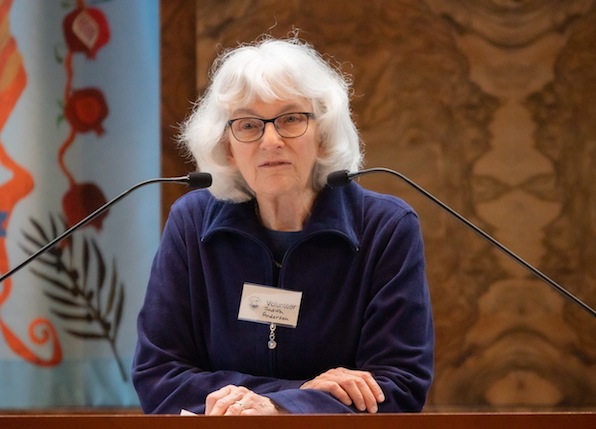
Judith Anderson speaks at the Wallenberg-Sugihara Civil Courage Society’s Raoul Wallenberg Day event last month. (photo by Masumi Kikuchi)
This year’s commemoration of Raoul Wallenberg Day took place April 10 at Congregation Beth Israel because COVID-19 restrictions prevented the gathering in January. The event honoured the courage of B.C. frontline healthcare providers during the pandemic.
Hosted by the Wallenberg-Sugihara Civil Courage Society, Judith Anderson welcomed attendees. She asked them to take a moment of silence to think about Ukraine and “all the victims of this humanitarian crisis, and to thank the countries welcoming refugees, especially Ukraine’s closest neighbours – Poland, Romania, Slovakia, Moldova and Hungary. In addition, let’s remember the many organizations and volunteers who are stepping forward to help.”
Anderson spoke about gratitude. “We are blessed to live in a peaceful society, where threads of various cultures are woven together to make a fabric that is stronger and warmer than any of the threads would be alone. Let’s recognize two special qualities of that fortunate fabric that we are thankful for today.
“First, we appreciate our shared land. Here in Vancouver, we are meeting on the unceded territories of Musqueam, Squamish and Tsleil-Waututh people. We thank them for sharing, and for having cared for these lands and waters for thousands of years.
“Second, we are thankful for our health care. Modern medicine has developed from diverse cultural threads, including science, people skills, systems management and the professional commitment of thousands of healthcare providers. Our routine expectations of health and longevity could scarcely have been imagined, just 100 years ago.
“And today,” she continued, “we are thankful, in particular, for the civil courage of those who have provided health care to British Columbians during the COVID-19 pandemic. They have faced a new, deadly, communicable disease with unknown risks to their own and their families’ health. They have worked to exhaustion under the most stressful conditions, saving lives and comforting families. Then, when vaccines became available, healthcare workers extended themselves yet more to immunize us all. Unfortunately, as some people have tired of public health restrictions, medical workers have been subjected to harassment and threats. And still they are there for us when we need health care, whatever the problem might be.”
Deputy Mayor Christine Boyle read the Raoul Wallenberg Day proclamation from the City of Vancouver, recognizing Jan. 17 as the day of its commemoration.
The Civil Courage Society’s Alan Le Fevre introduced the three speakers: Barb Nederpel, president of the Hospital Employees Union of British Columbia; Sherri Kensall, board chair of the Nurses and Nurse Practitioners of British Columbia; and Dr. Ramneek Dosanjh, president of the Doctors of British Columbia. They described the challenges and courageous responses of hospital workers, nursing professionals and doctors during the COVID pandemic.
The one-hour documentary Zero to Zero was screened at the event. Filmed over 15 months, it offers an unfiltered look at what it’s like to be a healthcare worker during the COVID-19 pandemic. It follows the staff of a hospital from the moment they admit their first patient in June 2020, till after the third wave. Filmed by a healthcare worker with unprecedented access to the hospital frontline, it deals with patients during life-and-death situations, but the focus remains on the indomitable strength of the human spirit.
After the screening, the guest speakers fielded questions from the audience about what they thought of the documentary, about long-COVID in healthcare workers and about the harassment they faced and how they responded to it.
The annual commemoration is held in memory of Raoul Wallenberg, a Swedish architect, businessman, diplomat and humanitarian, who became Sweden’s special envoy to Hungary in summer 1944 and, at great personal risk, saved tens of thousands of Jews from deportation and death. He disappeared into Soviet captivity on Jan. 17, 1945, and his fate remains unknown.
Wallenberg has been made an honorary citizen of Canada, the United States, Hungary, Australia and Israel. In 2000, the Canadian government proclaimed Jan. 17 as Raoul Wallenberg Day.
The event is also in memory of Chiune Sugihara, a Japanese diplomat who served as vice-consul in Lithuania during the Second World War. He chose to act, at clear professional and personal risk to himself and his family, issuing transit visas that allowed about 2,000 Jews, more than 90% from Poland, to escape almost certain death.
Both Wallenberg and Sugihara have been designated by Israel as Righteous Among the Nations.
The Wallenberg-Sugihara Civil Courage Society, said Anderson, defines “civil courage as an act entailing personal risk or sacrifice, intended to improve or save the lives of others who endure misfortunes attributable to social context. In even the best-managed societies, some people may suffer from conflict, injustice or threats to health and well-being – such as the COVID pandemic – that are intimately tied to our social structures. And those who help despite personal risk, show the same inner strength as wartime role models like Wallenberg and Sugihara.
“In 2006,” she continued, “the former honorary Swedish consul to Vancouver, Anders Neumuller, began Vancouver’s annual commemoration of Wallenberg Day. He later envisaged a nonprofit society dedicated to honouring acts of civil courage. And so the Wallenberg-Sugihara Civil Courage Society was formed in 2013 by members of the Swedish and Jewish communities in Vancouver.”
The Civil Courage Society honours the legacy of Wallenberg and Sugihara by acknowledging British Columbians who have demonstrated civil courage and by promoting civil courage.
“To that end, each year, we formally recognize a person or group of people who have displayed civil courage in British Columbia,” said Anderson. “We also screen a film intended to get the audience thinking about the importance of civil courage and how to encourage it.”
For more information, including photos and video of the commemoration, visit wsccs.ca.
– Courtesy Wallenberg-Sugihara Civil Courage Society
On April 20, the Simon Fraser Student Society (SFSS) voted in favour of boycott, divestment and sanctions (BDS) against Israel. The motion is in support of Palestinian liberation, which it defines as resistance against Israeli “settler-colonialism” and the occupation of historic Palestine – including the West Bank, Gaza and the present-day state of Israel.
The Hillel chapter at SFU issued a statement on April 20 denouncing the motion.
“Evidently, this motion, and the student council standing in support of it are not concerned with the safety of Jewish students on SFU campus,” reads the statement. “The adoption of the policy, which passed unanimously this evening, and which violates SFU, provincial and federal law, sets a dangerous precedent for Jewish safety, freedom of association and political mobilization on campus.”
The day after the SFSS vote, another campus group also voted on a motion related to debates over Israel.
On April 21, more than 60% of the Queen’s University Faculty Association (QUFA) voted in favour of a motion that opposed the adoption of the working definition of antisemitism from the International Holocaust Remembrance Alliance (IHRA).
The IHRA working definition of antisemitism was adopted in May 2016, and states that antisemitism is “a certain perception of Jews, which may be expressed as hatred toward Jews. Rhetorical and physical manifestations of antisemitism are directed toward Jewish or non-Jewish individuals and/or their property, toward Jewish community institutions and religious facilities.”
The document also lists many examples that could fall into the broader definition of antisemitism. Among the examples are statements about Jewish people and Israel, including “denying the Jewish people their right to self-determination, e.g., by claiming that the existence of a state of Israel is a racist endeavour.”
According to the QUFA motion, this definition threatens academic freedom and intersectional anti-racist and decolonial initiatives.
“The IHRA definition of antisemitism misconstrues antisemitism to include a broad range of criticism of the state of Israel, particularly targeting
decolonial and anti-racist critiques of the policies, structures and practices of Israel,” the motion reads. “Such targeted attacks, which primarily impact racialized faculty and students, will have a negative effect on the academic freedom of our members in the classroom, in their research and in campus politics more broadly.”
Jordan Morelli, QUFA president, said in an email that the motion was brought forward by individual members of the association, as is their right according to the association’s democratic processes. He also said the vote itself was preceded by a balanced discussion in which everybody who wanted to speak was given the opportunity to do so. Morelli further added that Queen’s recently revised policy on harassment and discrimination defines antisemitism in a manner consistent with the Ontario Human Rights Code policies, and that other faculty organizations at other schools, as well as at federal and provincial levels, have expressed similar concerns with the IHRA definition of antisemitism.
Before the vote, Queen’s Hillel published an open letter signed by more than 1,600 people – current Jewish and non-Jewish students, alumni, family members and community members – asking the faculty to vote against the motion.
“This statement contributes to the erasure of Jewish history, religiosity and values. To exclude the Jewish community from impacted ‘racialized faculty and students’ does harm to multi-racial, long-established Jewish communities. It overwrites our lived reality of centuries of constant displacement, colonization, conquest and migration,” the letter reads.
The letter also says that the fears about restricting criticism of Israel and academic freedom do not follow from a “fair” reading of the definition, as Israel is not mentioned in the definition itself, but only in the follow-up examples of what may constitute antisemitism. The letter also questioned why it does not fall to Jewish groups to define their own oppression.
“It is our understanding that a fundamental principle of anti-oppression work is allowing affected communities to define their own oppression,” reads the letter. “It is not the place of any organization external to our community…. It is the Jewish community, and the Jewish community alone, who get to decide this. This double-standard is antisemitic.”
The Hillel letter did note that some of the faculty who proposed the motion are Jewish, but said their views are out-of-sync with the vast majority of Canadian Jews.
After the motion passed, Queen’s Hillel published a statement that said they were “deeply saddened,” called the vote “an utter disgrace,” especially because no actionable steps were suggested in the motion to combat growing antisemitism on campus. However, the statement also said they were “immensely proud” of the support shown across the community.
At McGill, a similar motion in support of Palestinian solidarity that was passed by more than 70% of the Students’ Society of McGill University (SSMU) was not ratified by SSMU’s board of governors. In a statement published on April 22, the board said they could not adopt the policy because it contravened numerous SSMU governing documents, including its constitution, equity policy and Quebec law.
The original version of this article was published by The CJN. For more national Jewish news, visit thecjn.ca.
After an almost three-year hiatus due to the pandemic, StandWithUs Canada is again holding events. On May 15, StandWithUs Canada and the Diamond Foundation are presenting the crash course Antisemitism and Anti-Zionism Today: What to Expect on Campus.
The course is a chance for high school (grades 11 and 12) and first-year university students to attend interactive sessions, hear from speakers, meet like-minded students and enjoy a free kosher dinner. Students who register and attend can also receive community service hours and a gift card.
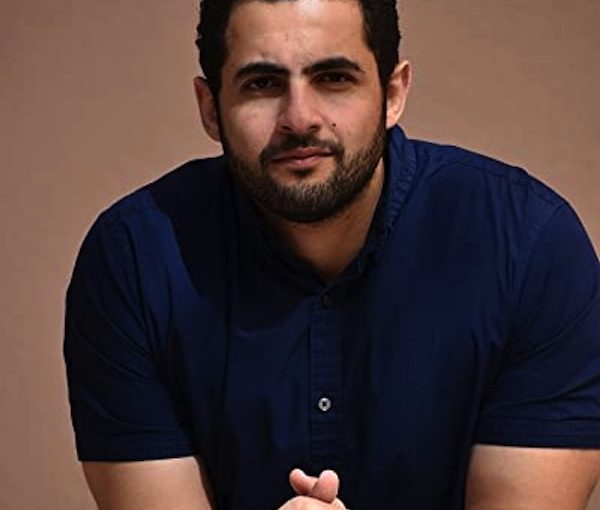
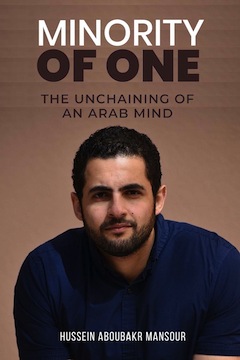
Speakers include Penina Edery, high school director, StandWithUs Canada, and Aviv Attia, StandWithUs educator and Israeli speaker. Special guest speaker Hussein Mansour Aboubakr was a dissident imprisoned in his home of Cairo, Egypt, for the crime of wanting to learn more about the country and the people he was raised to hate – Israel and Jews. One of the course sessions will be Aboubakr speaking about his journey. Other sessions will include a panel of students speaking about their experiences with antisemitism and anti-Zionism in high school and university.
The Diamond Foundation is sponsoring this crash course to reach out to Vancouver high school students and their families, to help them learn the skills, get the knowledge and find out about the resources available to support Israel and fight antisemitism. Also involved in presenting the event with StandWithUs Canada are Camp Hatikvah, Masa Israel Journey, King David High School and the Jewish Federation of Greater Vancouver.
The May 15 crash course will take place at KDHS from 4 to 8 p.m. Registration is required to attend. Students can register at forms.gle/hPncontVmAC4Jfor6.
The latest JSA Snider Foundation Virtual Empowerment Series session was co-sponsored by Jewish Seniors Alliance (JSA) and Jewish Family Services (JFS). Held on April 26, it continued with the theme “Be Inspired.” Titled Retired, Rewired and Inspired, it featured three older adults expressing their feelings, ideas and experiences of “retirement.”
Gyda Chud, co-president of JSA, started things off by describing the series – which involves co-sponsorship with other community organizations, such as JFS – and its theme.
Program committee Fran Goldberg then introduced the speakers: Rosa Tesler, who was a counselor for abused women when she retired in 2018; Dr. Paul Steinbok, who retired from neurosurgery in 2017; and Tony DuMoulin, who retired from his law career about a decade ago.
The first speaker was Tesler, known as Chully. She described retirement as an up and down road. She missed her clients. She lost her husband and her mother within the same time period. She feels privileged that she had the support of a loving family. To weather the downs, she said, a person must develop patience, determination and self-compassion. It took her a year to overcome health issues, but now, with the correct medication, she is able to live her life. She thanked her many friends, her therapist and her yoga teacher for their ongoing support.
Chully took a course on friendly aging and also the peer counseling training at JSA. She is now an active peer counselor. The pandemic caused major changes in many of her pursuits, but she continued with tai chi, yoga and peer counseling, all virtually. She did have to forgo travel. Adapting, reframing and hope kept her going. We are defined not by what happens to us, but by what we do, she said, ending with a quote from a friend in Argentina who teaches healthy aging: what is in your power, continue; stop what you didn’t want and can’t do; and initiate what you do want to do.
Steinbok had been a pediatric neurosurgeon and, when he retired, he pursued his love of photography, walking and travel. He had been part of an amateur camera club for many years and won an award in 1970. After retirement, he joined a photo group at the University of British Columbia, and learned digital photography. He began looking at nature from a closer perspective, especially its textures and patterns. He started to use his camera more creatively. He shared some of his close-ups of tree bark, stumps, mushrooms and flowers. There were shots of manhole covers – many of which have lovely designs on them. The photos are beautiful and artistic and have been in many competitions. Steinbok said the art of photography adds meaning to his life and he shares them with family, friends and the photo club. He said it feels as if he is continuing to teach, as he did in neurosurgery.
DuMoulin was a practising lawyer for 40 years, managing a firm for 24 years and teaching law. He retired at age 67, because he had many interests that he wished to pursue but not the time or energy to do so. He also wanted to retire at the top of his game.
DuMoulin calls himself a recovering lawyer – he said he needed to rewire and although he was told that he would be bored, the opposite has been the case. He feels his worldview has widened and that he is lighter and freer. He is involved in many activities and spends time with his five grandchildren. He is also reading more and has started a book club. Before COVID hit, he was traveling more, and he is exercising more. He has designed and built a cabin and has done some watercolour painting. He teaches and plays chess. He is active in JSA – on the executive and board and as a member of the editorial committee of Senior Line magazine; he chairs the advocacy committee. He is inspired by volunteers in the nonprofit sector and said the future is our responsibility – and belongs to us as well.
Tamar Stein, seniors outreach coordinator for JFS, thanked the speakers. She said JFS’s programs take place on Tuesdays at 11 a.m. – on May 10, there is a talk on grief and loss and, on May 24, on Medical Assistance in Dying.
Chud brought up the three Rs that she had heard from a friend: relationships, reflection and restorative practice. DuMoulin commented on the recording of family histories and a specific program that helps with this, called Story Worth. Larry Shapiro, co-president of JSA, added that the speakers had been inspirational and that a senior should speak at every event, while Chud thanked Jenn Propp for her contributions, Stein and the speakers.
The next JSA event is its spring forum on May 15, which features the concert With a Song in My Heart, led by Wendy Bross Stuart. The final Empowerment Series session for 2021/22 is in June, with the Kehila Society of Richmond. Visit jsalliance.org.
Shanie Levin is program coordinator for Jewish Seniors Alliance and on the editorial board of Senior Line magazine.
The construction site of the mausoleum for Bahá’í leader ‘Abdu’l Bahá, east of Haifa Bay, Israel. (photo by Gil Zohar)
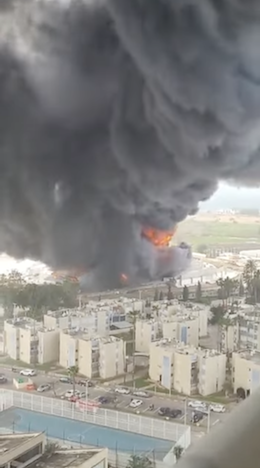
Construction of Vancouver-based architect Hossein Amanat’s mausoleum for Bahá’í leader ‘Abdu’l Bahá (1844-1921) was set back when a fire on April 8 caused significant damage to the main building at the holy site just east of Haifa Bay, Israel.
The Iranian-Canadian architect’s design features a sloping geometric meditation garden rising in a sunburst pattern to form a dome covering the tomb. Amanat’s neoclassical Persian structure extends the Ridván Garden, which was a favourite oasis where ‘Abdu’l Bahá’s father, Bahá’u’lláh (1817-1892) – the founder of the Bahá’í faith – retreated after he was released from Acre Prison in 1877. The modest house in which he stayed during his visits there has been restored. After his father’s death, the Iran-born ‘Abdu’l Bahá’ popularized the new religion outside the Middle East in a series of visits to Montreal, and cities in the United States and Europe.
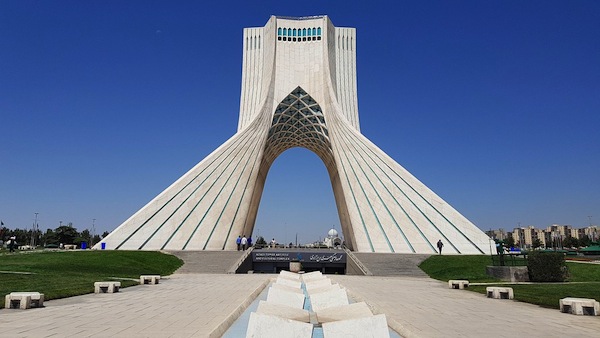
Amanat, 80, fled his native Iran after the 1979 Islamic Revolution and settled in Canada. He is best known for his Shahyad Freedom Tower in central Tehran, which was dedicated in 1972 to honour the Pahlavi dynasty. Following Iran’s revolution, the monumental 45-metre-high archway was renamed the Azadi Tower, after the square in which it stands.
Amanat also designed a series of Bahá’í administrative buildings on Mount Carmel, including the Seat of the Universal House of Justice, the Centre for the Study of the Sacred Texts, and the Centre for the International Counselors.
Architect Hossein Amanat is best known for his Shahyad Freedom Tower in Tehran, Iran, which is now known as the Azadi Tower. (photo from flickr)
The April 8 blaze destroyed “several months of work” on the 2,900-square-metre circular platform and piazza, the Universal House of Justice (the governing council of the Bahá’í faith) said in an April 14 statement. Clouds of smoke billowed from the mausoleum, prompting firefighters to evacuate the nearby suburbs of Giv’at Hatmarim and Afgad.
The fire broke out when windblown sparks from welding on the dome ignited scaffolding and plastic forms being used to mold poured concrete, Ynet reported. The completed concrete walls and structures were undamaged, and the 250 million shekel ($77 million US) project – announced in 2019 – is insured, said the Universal House of Justice. The shrine and meditation garden are being paid for by donations from Bahá’í faith’s five million members around the world.
Bahá’í media representative Sama Sabet said construction “will resume soon.” She didn’t estimate the cost of the damage.
For the last century, ‘Abdu’l Bahá has been temporarily entombed in Haifa’s shrine of Siyyid ‘Alí-Muhammad Shírází (1819-1850), popularly known as the Báb (“Gate” in Arabic). Shírází was executed in Tabriz for apostasy after claiming to be the deputy of the promised Twelver Mahdi, or al-Qa’im. According to legend, the firing squad’s initial barrage of bullets failed to hit him, and a second team of shooters was brought in. As a Shiite heretic, his body was fed to dogs. It was rescued and hidden by believers.
In 1908, all Ottoman political and religious prisoners were freed by the Young Turk revolution. Newly released, ‘Abdu’l Bahá smuggled the Báb’s remains to Ottoman Palestine and built his iconic shrine midway up Mount Carmel, near where he himself was living. Its dome, visible from the Haifa harbour along the axis of the German Colony, was gilded in 1953.
An aerial view of the Bahá’í shrine, designed by Vancouver-based architect Hossein Amanat, which caught fire on April 8. (screenshot from YouTube)
The mausoleum and garden south of the Tel Akko archeological mound will be one of seven Bahá’í holy sites, ornamental meditation gardens and administrative complexes in a western Galilee pilgrimage route stretching from Mazra’a near Nahariya south through Acre (Akko in Hebrew and Akka in Arabic) to Mount Carmel in Haifa. The serene mausoleums of the Báb and Bahá’u’lláh – together with their adjoining gardens, characterized by their sacred geometry and immaculate landscaping – were registered on UNESCO’s World Heritage List in 2008.
The Bahá’í faith believes in progressive revelation – that God has revealed himself in a series of manifestations, including Moses, Jesus, Muhammad and, most recently, Bahá’u’lláh.
In 1863, Bahá’u’lláh fulfilled the Báb’s prophecies by proclaiming the Bahá’í faith. The new creed eventually evolved into a global religion. Exiled from Persia to Ottoman Baghdad and then the imperial capital Constantinople (today Istanbul) in 1868, Bahá’u’lláh was imprisoned in Acre’s Turkish citadel in remote Palestine. For Israelis, the notorious jail and its gallows are best known for the prison breakout on May 4, 1947, near the end of the British Mandate of Palestine, in which gunmen from the Irgun underground freed 27 incarcerated freedom fighters.
After being released from Acre Prison, Bahá’u’lláh moved six kilometres north to Mazra’a, also called Mazra’ih. Two years later, he settled in the Mansion of Bahjí (meaning “delight”) in Acre. That palatial home was built in 1821 by ‘Abdu’lláh Páshá, then the Ottoman governor of Acre. Bahá’u’lláh remained there until his death in 1892.
In addition to the mausoleums of the Báb and Bahá’u’lláh, Bahá’í pilgrimage sites in Haifa and the western Galilee on UNESCO’s World Heritage List include the Shrine of Bahá’u’lláh and adjoining Mansion of Bahjí and Bahjí Gardens in Acre; the Shrine of the Báb; the 19 terraces of the Bahá’í Gardens and Bahá’í World Centre in Haifa; and the House of ‘Abbud in the Old City of Acre, where the Bahá’u’lláh spent time after being released from prison.
Gil Zohar is a writer and tour guide in Jerusalem.
רכישה ראשונה: קנדה החליטה לרכוש את המטוס המפציץ החמקן אף שלושים וחמש
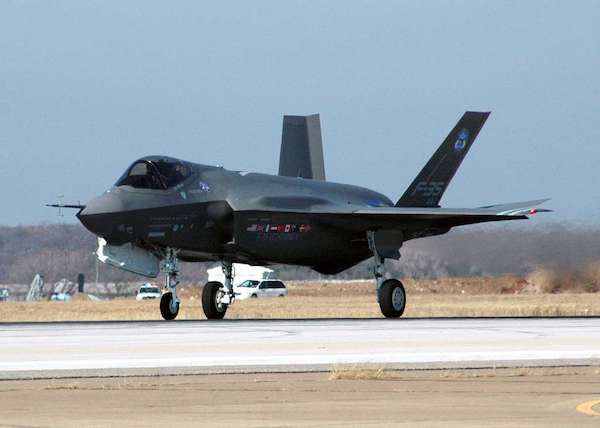
לאור פלישת רוסיה לאוקראינה הבינו בקנדה שיש להיערך ברצינות לאיומים שבדרך. ממשלת קנדה הליברלית בראשות ראש הממשלה, ג’סטין טרודו, החליטה סוף סוף לרכוש מטוסי קרב אמריקנים חדישים. מדובר על המטוסים המפציצים החמקנים מסוג אף שלושים וחמש, מתוצרת לוקהיד מרטין. כך אישרה בהודעתה לעיתונות שרת ההגנה הקנדית, אניטה אנאנד. ממשלת קנדה העדיפה איפוא את המטוסים האמריקנים על פני מטוסי גריפן של חברת סאאב השבדית. המטוסים החדישים האמריקנים יחליפו את המטוסים הישנים של חיל האוויר הקנדי מסוג סי.אף שמונה עשרה. בעבר ממשלת קנדה השמרנית בראשות ראש הממשלה דאז, סטיבן הרפר, החליטה לרכוש את מטוסי הקרב האמריקנים המפציצים החמקנים החדישים. אך לאחריה ממשלת טרודו הורידה את הנושא מסדר היום שלה לפני למעלה משש שנים, כאמור עד ימים אלה. אין ספק שהמשבר החמור הנוכחי באוקראינה השפיע על ממשלת טרודו, שהודיעה כאמור על פתיחת המשא ומתן רציני עם היצרנית לוקהיד מרטין, לרכישת המטוסים היקרים
ממשלת טרודו תרכוש בסך הכל שמונים ושמונה מטוסים בסכום אדיר של כחמישה עשר מילארד דולר (אמריקני), עבור חיל האוויר הקנדי. בחודשים הקרובים צפויה להיחתם עסקת הענק בין הצדדים. בשלב ראשון יסופקו לקנדה שלושים וחמישה מטוסים מסוג האף שלושים וחמש, וזאת בתוך שלוש השנים הבאות
יצויין שבמקרה חירום צבאות ארצות הברית וקנדה יגנו במשותף על המרחב האוויר של שתי המדינות המקיימות יחסי שכנות ידידותיים הדוקים מאוד. ובמקרה כזה שתי המדינות יוגדרו כמדינה אחת
עם תחילת העבודה של יצור מטוסי המפציצים החמקנים אף שלושים וחמש, שהושקעו בו למעלה מארבע מאות מילארד דולר (אמריקני), גייסו האמריקנים שבע מדינות נוספות, שיתתפו בפרוייקט היוקרתי והיקר. מדובר במדינות הבאות: קנדה, בריטניה, איטליה, הולנד נורווגיה, דנמרק ואוסטרליה. תשע מדינות נוספות הבטיחו לאמריקנים לרכוש אף הן את המטוסים אף שלושים וחמש היקרים. מדובר במדינות הבאות: ישראל, בלגיה, פינלנד, גרמניה, יפן, פולין, סינגפור, דרום קוריאה ושווייץ
רכישה שנייה:אלביט מערכות תספק מערכת אווירית לצבא קנדה בסכום של כתשעה מיליון דולר אמריקני
חברת אלביט מערכות הישראלית אמורה לספק מערכת שליטה ובקרה לצבאי הקנדי, בסכום של כתשעה מיליון דולר (אמריקני). המערכת אמורה להציג תמונה אווירית מלאה ולאפשר תיאום יעיל ובקרה של כלי הטיס במרחב הקנדי. וכן תקשור ליישומים ולמערכות שליטה ובקרה קיימות של צבא קנדה. המערכת החדישה של אלביט מערכות שתסופק לצבאי של קנדה, תתמוך במשימות אוויריות ובפעולות צבאיות משותפות של פיקוד היבשה, פקיוד האוויר והפיקוד המשותף. המערכת האווירית מבוססת על מערכת צבא “יבשה” דיגיטלית שאלביט מערכות פיתחה לפני מספר שנים, ונמצאת בשימוש פעיל על ידי צה”ל
ממשלת קנדה בראשות ראש הממשלה, ג’סטין טרודו, החליטה לרכוש את המערכת של אלביט מערכות הישראלית, במסגרת פרויקט שדרוג מערך התיאום האווירי של הכוחות הטקטיים. הצבא הקנדי יש לציין, רוצה כבר זמן רב מערכת דיגיטלית שתאפשר התמצאות מצבית במרחב האווירי, תוך תיאום אווירי משופר וניהול המערך שלו על ידי מטה הפיקוד הצבאי
יצוין כי אלביט מערכות זכתה לאחרונה במכרז ענקי של חיל האוויר של איחוד האמירויות, לאספקת מערכות הגנה מבוססות לייזר אינפרה אדום, ומערכות לוחמה אלקטרוניות – בסכום של חמישים ושלושה מיליון דולר (אמריקני)
במקביל אלביט מערכות זכתה לאחרונה במכרז נוסף גדול של חיל האוויר של בריטניה, לאספקת מערכות אלקטרוניות להגברת יכולות הלוחמה – בסכום של כמאה מיליון דולר (אמריקני)
A friend described to me once what Warsaw looked like in the aftermath of the Second World War. A small boy then, he remembered vividly the ripped apartment buildings, whole sides of buildings missing. When you raised your head, he said, you could see a bed up there, one leg hanging over the precipice, the chimney, a chair stuck in half fall. The lives turned into ruins and exposed.
The “noble” war, as Russian President Vladimir Putin calls it, has killed thousands. Other thousands have been taken into filtration camps by Russians. The war has uprooted the lives of millions. It has separated wives from husbands, children from fathers. It has laid bare what is usually concealed from the eyes of a stranger: human attachments and loves, support for one another and acts of kindness. But also, the seismic faults running through so many families; their discontents, their arguments, and the way they cope with them in the time of crises.
Inadvertently, I became privy to the lives of many simply because I happened to be there at the time of their great vulnerability and need. Those I met (and, with rare exceptions, these were women with children) were going through the horrors and desolation of war. All, without exception, were traumatized. All needed practical help, advice, information and, above all, empathy.
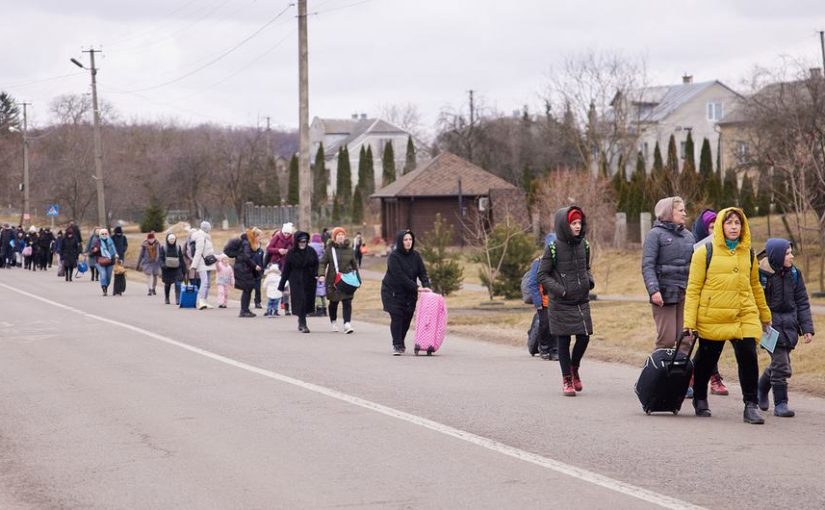
But what they also needed, I discovered, was to talk about what they had gone through. That need was spontaneous and raw. They broke into stories easily and without invitation on my part. Each story was different, yet many followed the similar pattern: destruction and loss of property or homes; weeks in basements with scarce water, food supplies and electricity; the howl of air raid sirens; separation from loved ones and concern about their well-being; screams of traumatized children; and, then, finally evacuation, finally escape, over many days. Escape on foot, by trains, buses or sometimes cars, with detours necessitated by rockets and missiles; crossing rivers on boats where bridges were blown up.
I heard repeated gratitude to Ukrainian volunteers who facilitated the escapes, relaying families from one safe place to another; informing about the dangers on the way and how to bypass them. I heard stories of churches that sheltered families overnight; of people harbouring strangers in their homes; of volunteers who organized food that awaited fleeing families at different points of their long and hazardous journey to safety. I learned a new word – humanitarka, meaning clothing (and perhaps food) that poured into Ukraine from the West as humanitarian aid.
And I heard stories of the brutality of Russian soldiers towards civilians. I heard stories of looting, torture and rape. I heard stories of Russian soldiers leaving villages and shooting in their wake every cow, every chicken, so that the owners would be left with nothing; gratuitously smashing all the preservatives Ukrainians traditionally prepare for winter. I heard how Russian soldiers pretended they would allow villagers to run to safety, only to shoot them in their legs, and finish them off later like hunted animals. I heard stories of booby-trapped corpses, of Russians abandoning their dead.
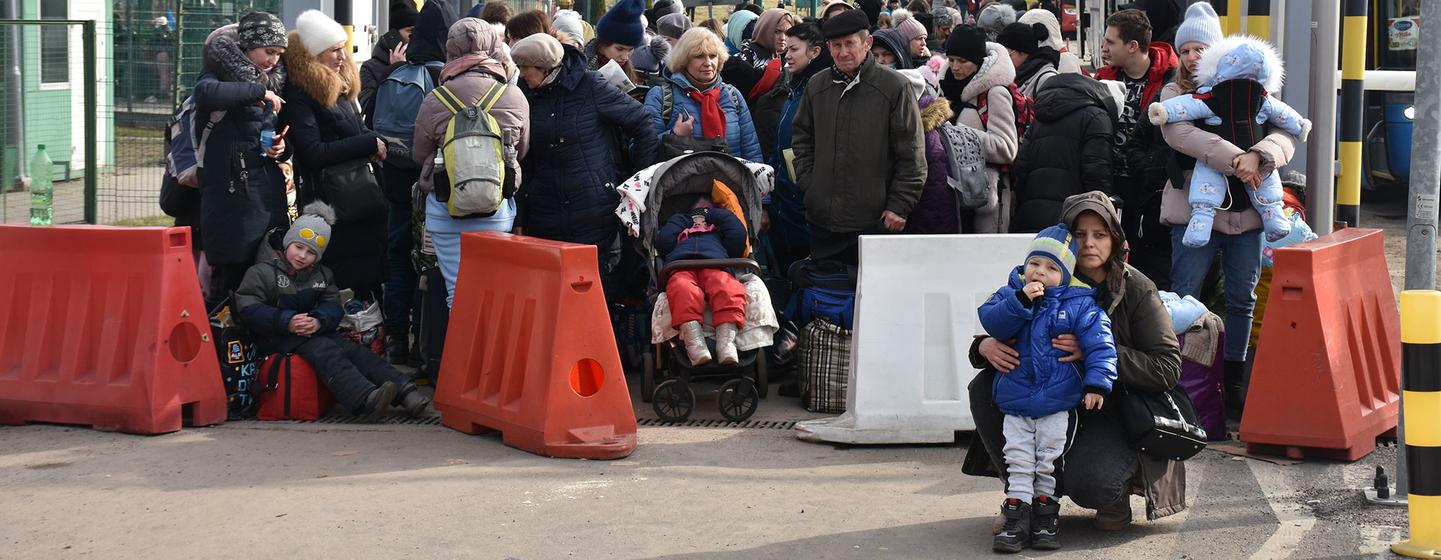
In the two-and-a-half weeks I volunteered with the Joint Distribution Committee (JDC) at a border crossing and in a refugee shelter several kilometres away from the Polish border with Ukraine, I met people of all walks of life – I met the Ukrainian Nation.
I met a grandmother who escaped missiles with her six grandchildren and made it to Poland while the parents of the children had perished.
I met a man, a welder, looking after his old and infirm mother. They couldn’t possibly live with any family, the man explained, because his mother became psychotic and incontinent, and he regularly had to clean up after her. The welder was now trying to bring to Poland his former wife with her new husband and their three children, one of whom was his.
I met 60 elderly Baptists from Zaporizhzhia who were on the way to Amsterdam, where a sister Baptist church was going to shelter them. Zaporizhshia is the site of the largest atomic plant in Europe and it had been overtaken by Russian soldiers. It’s the city where my relatives live. Talking to these refugees, I realized that my aunt had been concealing the truth from me all along: the rockets are falling 10 kilometres away from the city.
I discovered that the most painful subject and the last thing that came up in conversations was the fact that women had had to leave their loved ones behind. The worry for their soldier sons and husbands, their parents, grandparents and siblings, was a deeply hidden, yet constant, heartbreak. It was a breaking point for many. I will not forget those eyes, dozens and dozens of women’s eyes: blue, grey, greenish; eyes magnified by tears at the thought of the separation from loved ones. When a collective image of Ukraine comes to my mind, it’s women’s eyes. Embarrassed to cry in front of me, a stranger, they tried to look away. The older sister would often say to the younger, “Enough already, just stop it!” while breaking into tears herself.
Another move that caused tears was my offering of money to refugees, the generous donations that I had received while I was still in Vancouver. In Canada, I had packed lots of envelopes to put the money into, for a civilized handout. How naïve I was! In the chaos of a refugee centre, it was quickly handing over money from hands to hands. A scared look and the initial refusal to accept was universal. I had to come up with some strategy to overcome the mutual embarrassment. “This is not my money,” I would say. “This is from Canadian friends, people like you. Canadians care about you. They want to help you. But they can’t be here. They asked me to do it for them. Please take it.” A grateful look. Tears. A hug.
The refugee centre was a temporary shelter. Refugees could spend several nights there and then move on: to some city, some country.
The vast majority of the refugees I met were determined to return home once the war was over. But they had made it to Poland and many would have liked to stay there while the war was raging. Poland was familiar; it has cultural and historical ties with Ukraine, especially with the western part of Ukraine.
In the post-Soviet times, before this war, thousands of Ukrainians had gone to Poland for work: a member of the European Union, Polish standards of living and salaries were higher than Ukrainian. Besides, the Polish language was closer to Ukrainian than any others of the countries that came forward to help. It would be manageable somehow; it could be learned, if not by everybody, at least by the younger people. But Poland couldn’t take in any more refugees. Posters in the refugee centre read in Ukrainian: “We are happy to welcome you, but our cities are full. Our small rural communities are cozy and peaceful. Consider moving there.” But even small villages were full and couldn’t afford to welcome any more people.
The women who arrived at the refugee centre accepted with resignation the fact that they would have to be on the move again. The way they decided where to go next somewhat surprised me: it wasn’t on the basis of a better financial package or living conditions. Rather, the criteria was proximity to Ukraine. The first question that women asked me about various countries also seemed unusual: they wanted to know if they would be able to find work quickly. I would talk about the hardships they had just endured; the necessity to rest, to take a break, to look around first. But that didn’t register. They have worked all their lives, they said. They are used to work. Living for free at somebody’s expenses was a no-no.
Most of the Ukrainian women I met were mild-mannered and perhaps less assertive, less forceful, compared to North American ones. All were both surprised and grateful for the help and goodwill they’d seen from so many. They couldn’t praise enough what the Poles did for them. They were deeply touched by the smallest acts of kindness. And none took the help for granted. “If this happened to other nations and we, Ukrainians, would have to do this for somebody else, would we have done the same? I am not sure,” said one woman.
Few discussed the wider political implications of the war. They didn’t talk about Putin or his goals, or the future of their country. Their concerns were more practical and immediate: food, clothing and the well-being of their children, their elderly mothers.
But I remember one woman, Nina, and her fiery indignation: “What have we done to Russians? What do they want from us? We didn’t bother anybody. Nazi? What Nazi? We live peacefully with our neighbours: gypsies, Jews, Ukrainians, Russians. We all speak Ukrainian and Russian!”
Another, older, woman, while waiting for the bus to Germany, was even more emphatic: “You tell me why Russians believe Putin’s propaganda? Why do they have the mentality of slaves? We Ukrainians may have our problems. But we’re free people. Russians are slaves! Slaves.” (The word “slave” in Russian usage has strongly negative connotations, implying the qualities of subservience, fear, and the desire to please the master.)
I thought about these words. I don’t have an answer to her question. Nor do I have any convincing arguments against her harsh indictment.
I’m still trying to comprehend and, in some way, come to terms with what I experienced over 16 days. It began when I flew into Warsaw from Vancouver and was picked up at the airport by a JDC representative. Together with two volunteers from the United States, we were driven to the Polish-Ukrainian border, where a small group of Holocaust survivors was to arrive. The drive took four to five hours and, by the time we got to the border, it was totally dark and bitterly cold.
Arrangements had been made with Germany that it would take in the Holocaust survivors. The German Red Cross ambulance bus had traveled 13 hours. I learned later that everybody in the ambulance was a volunteer – the driver was a history teacher, the three women were professional nurses donating hours and hours of service.
I wondered how it was possible to find a few Holocaust survivors in a warring country and bring them to safety. It turned out that the Jewish Agency had used the lists of survivors receiving financial assistance before the war to contact and evacuate them.
What struck me most at the time was the sight of several empty white canvass stretchers on the dirt next to the bus. It started to drizzle; the Germans stacked the stretchers and covered them with a tarp. The stretchers, soon to be filled with people, were a menacing sign of the proximity of war, invisible yet close. When the bus from Ukraine finally arrived, one body was carried out on a stretcher. So emaciated and skeletal was this body that, for a moment, I wondered why they were transporting a corpse with the living. When I looked closer, I saw that it was a woman, wounded and emaciated to an extreme degree but alive. For the next while, the Germans administered an IV to the seemingly unresponsive body. I overheard a conversation between two nurses: one wondering if the woman would be able to make it to Germany. They asked her a question – I translated – was she in pain? The woman shook her head. The Germans proceeded to take care of others.
Six other women got off the bus with some help from the Red Cross people and us.
One lady clutched her battered black purse that was overflowing with some papers. She refused to board the ambulance bus. A nurse and I held her up against the bitter wind, while she told us that her son was waiting for her here, around the corner, that he was going to pick her up. We finally figured out what she meant: her son was in Germany and she believed that she had arrived to Germany, not Poland. Efforts were made to contact her son right there, and somebody got him on the phone or they said they did, I’m not sure. But somehow the matter was settled: the woman agreed to board the ambulance.
None of these old and frail women escaped with any possessions to speak of: a handbag, a sack, was all they managed to take. But that little something was now the focus of their attention; a symbol of their lost nests, and they feverishly clung to it.
One woman finally settled on a stretcher inside the ambulance, her purse sitting on top of her chest. Another plowed through her handbag in search of a watch, the only item left from her late husband, she said; she couldn’t find it, believed it was stolen and was distraught.
Yet another was worried about her frequent need to urinate. A nurse and I led her to the blue booths on the side of the road. She whispered in my ear, asking if I could take her alone: the nurse had accompanied her to the booth before; it was too embarrassing to need to go again.
None of the Holocaust survivors seemed to be clear about what was going on and where they were going next. Finding out that there would be another 13 hours of travel to Frankfurt on top of the hours of travel behind her, one of the passengers refused to go. “I won’t be able to take it,” she said. “I lived through German occupation once and now it’s the Russians. I’ve had enough.”
The last to arrive (I think in a separate bus) was a man. With nothing in his hands, he seemed to be unperturbed by the lack of any worldly possessions. He came from Kyiv. “I didn’t want to leave. But I’m an invalid. I live on the third floor and can’t go downstairs into the basement during the air raids,” he explained. “My son was worried and decided to pack me off to Germany. One way or the other, what difference does it make for me after all I’ve lived through? I remember the Germans. They didn’t do to us what the Russians are doing.”
For almost anyone, this would be the most stunning statement. The Nazis, the Germans, and their allies, committed terrible atrocities during the Second World War (“the Great Patriotic War,” as it was officially called in the Soviet Union, where I grew up). They were inhuman in their cruelty; they were beasts. I still remember the games of my childhood that we played in our yards: the good guys were Russians, the bad ones were Nazis, the Fritzes, as we called them.
I thought about it as I was watched the German nurses taking care, with utmost attention and patience, of the elderly Ukrainian Jews, the Holocaust survivors, escaping Russian atrocities in the 21st century.
Marina Sonkina is a fiction writer, and teaches in the Liberal Arts Program 55+ at Simon Fraser University. She immigrated to Canada with her two then-young sons, as the Soviet Union was breaking up. When Russia attacked Ukraine, she applied as a volunteer with the Jewish Joint Distribution Committee. She arrived in Poland early this month and was a frontline responder for 16 days, offering refugees medical and psychological support.
The Consulate General of Israel in Toronto and Western Canada marked World Water Day on March 22 with a webinar entitled “Squeezing Water from a Stone.” Dr. Alex Furman of Technion – Israel Institute of Technology in Haifa and Dr. Roy Brouwer of the University of Waterloo focused on Israeli and Canadian perspectives of water conservation and management.
Furman, director of the Stephen and Nancy Grand Water Research Institute at Technion, provided an overview of water management in Israel, describing how a land that is 60% desert – and uses more than 100% of its water – still has water left for use.
“The issue of water scarcity in the future is going to grow as the population grows and we need more water to feed people and for agriculture,” Furman said.
Israel’s population, which has expanded tenfold in the past 75 years, continues to climb. Further, its Western standard of living, including such things as daily showers, presents a further strain on the country’s water supply.
Israel recognized the need for innovation in this area several decades ago. Starting in the 1980s, it began treating wastewater for reuse in agriculture and, in the 2000s, the country started major desalination projects. Desalinated water now constitutes a large amount of the water consumed in Israel, but is not a completely win-win scenario. For example, a detrimental consequence of desalination is that the process also removes essential minerals, such as magnesium.
Another area where Israel is taking the lead is in water-saving technology, such as drip irrigation. Agricultural use of water in Israel has decreased in the past 30 years, a period over which agricultural production increased.
“Instead of irrigating the land, we irrigate the plant. Drip irrigation is providing water for what the plant needs. It’s not the amount of water that is important but the precision in how water is applied,” Furman said.
Concurrently, Furman added, Israelis are doing more to reduce water usage in the home, and the country has developed educational campaigns to inform its citizenry on ways to minimize water consumption.
“We are a very fast-growing country that requires a lot of water and requires the development of new water resources at all times,” Furman said.
Brouwer, an economics professor with an academic interest in water resources, highlighted the broader need for collective international partnership in looking at solutions for water issues through interdisciplinary cooperation, policy expertise and innovation.
“Water disregards boundaries and so must we,” he said, employing the motto of his department at the University of Waterloo.
The working definitions of water security, as put forward by the United Nations, Brouwer explained, are to have stable, peaceful and reliable access to adequate quantities and acceptable quality water. This, in turn, should sustain livelihoods, human well-being, socioeconomic development, protection from pollution and other water disasters, and preservation of ecosystems.
“From an economic point of view,” he said, “we need water to produce all kinds of things.”
As examples, Brouwer showed how much water is needed for basic clothing items: 10,000 litres of water are used to produce a kilogram of cotton, which, therefore, means 2,500 litres are required to make a 250-gram T-shirt and 8,000 litres for an 800-gram pair of blue jeans. For a morning cup of coffee, the equivalent of 1,000 cups of water are needed – from growing the bean, processing it and transporting it to the consumer.
Pressures on the international water supply are further exacerbated as countries such as China, Brazil and India achieve a higher standard of living and demand more goods like Western clothing and coffee.
“We expect that water stress will continue into the future,” Brouwer said, noting that two billion people in the world currently live in areas where water is scarce, including in the Middle East and in Northern Africa.
Global demand for water is, according to Brouwer, expected to grow one percent per year until 2050. By that time, 45% of global output would come from countries experiencing water scarcity. Tel Aviv, along with Sao Paulo, Cape Town and Karachi, is among the cities in the world most at risk of experiencing water shortages.
In a chart, Brouwer showed the skewed distribution of water usage around the world – from the average American, who uses 156 gallons per day to a French person who uses 76, an Indian at 38 and a Malian at three. Canada is the second-largest consumer of water per capita in the world. The average Israeli consumes 40% less water than their Canadian counterpart.
In his final remarks, Brouwer said the widely held view of water abundance in Canada may be a misperception when water quality and access to clean and safe drinking water are taken into consideration.
He concluded that water has value, but that its price is not reflective of its true value. Attention, he said, should be paid to both increasing water supply and policies that reduce water demand, and that water pricing is one way to raise awareness for essential water services.
Technion Canada partnered with the consulate on the World Water Day initiative.
Sam Margolis has written for the Globe and Mail, the National Post, UPI and MSNBC.
Among the works for sale is “Spring Time” by Yuri Padal.
On April 3, at Art Works Gallery, Art in Aid of Ukraine was launched. Artists and communities in Vancouver, standing in solidarity with the Ukrainian people, came together for the opening of the exhibit and sale. The opening featured local speakers, as well as guests via video link from Toronto and Ottawa. Among the speakers were members of Parliament, the consuls general of Ukraine and Poland, Ukrainian Canadian Congress leadership, and others.
The fundraiser is a non-partisan grassroots event highlighting the role of community engagement; the humane power of art and the critical importance of defending the democratic process. Donations and partial proceeds from artwork sales will go to the Ukraine Humanitarian Appeal of the Ukrainian Canadian Congress and the Ukraine Emergency Relief Fund of the Jewish Federation of Greater Vancouver.
The featured artist, Yuri Padal, was born in 1949 in Kyiv, and studied under the direction of Glushenko. Padal now lives in Vancouver. His works connect to the universal energies of beauty, colour, freedom and positive balance.
For other participating artists, visit artworksbc.com. Art Works Gallery is located at 1536 Venables St., and the fundraiser runs to April 27.
The monument for the 73 Israel Defence Forces soldiers killed in the 1997 helicopter accident over She’ar Yashuv in northern Israel. (photo by Geoffrey Druker)
This year’s community Yom Hazikaron commemoration on May 3 will mark the 25th anniversary of Israel’s worst air disaster.
On the evening of Feb. 4, 1997, two Israel Air Force helicopters collided into each other. One crashed in Moshav She’ar Yashuv, the second near Kibbutz Dafna. All 73 people on board the helicopters were killed, including eight air crew members. No one on the ground was hurt.
“The presence of Israeli forces in southern Lebanon, following the 1982 operation, led to ongoing battles with the Hezbollah,” explained Geoffrey Druker, who leads the annual Yom Hazikaron (Memorial Day) ceremony, which this year takes place at the Rothstein Theatre. “Many IDF convoys going into southern Lebanon were ambushed and hit by IEDs, so the IDF started flying in its troops.”
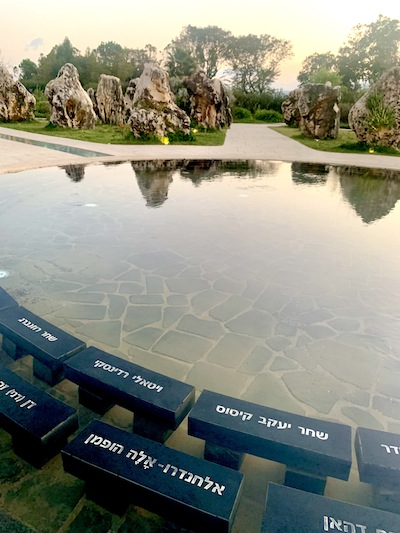
The 73 boulders surround a small pool. (photo by Geoffrey Druker)
Druker said the accident was devastating. “It was the largest helicopter crash in all helicopter aviation,” he said. “Until, in 2002, a Russian helicopter downed by Chechens killed 127.
“The accident increased the pressure to withdraw from southern Lebanon,” he added, “which happened in May 2002.”
Jewish Federation of Greater Vancouver’s Gesher Chai (Living Bridge) programs connect Metro Vancouver’s Jewish communities with Israel’s Galilee Panhandle communities. One of those connections is that King David High School’s sister school in Israel is Har Vagai, which is located on Kibbutz Dafna, where a part of one of the helicopters fell. In 2017, KDHS Grade 8 students traveled to Israel and spent time with their Har Vagai peers.
Another perspective of the memorial. (photo by Geoffrey Druker)
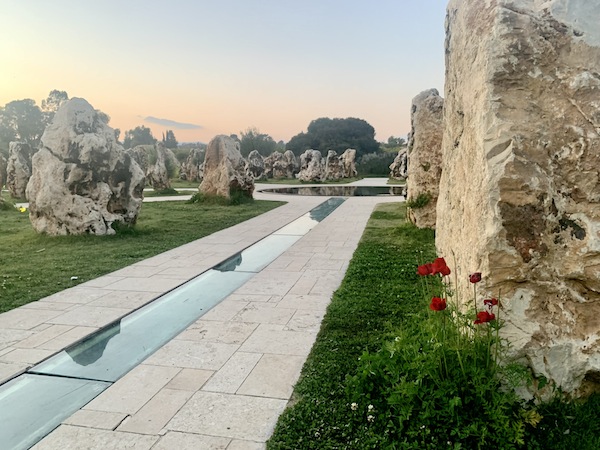
“The students visited the memorial and documented their meeting there, and the video was shown at our Yom Hazikaron ceremony here,” said Druker. “The memorial site is located in the ravine where a helicopter fell, not far from Kibbutz Dafna. On the site are 73 boulders, each the height of a person and all names are recorded on the site – a very moving memorial site.”
The 73 boulders surround a small pool. Among those remembered are three soldiers from our partnership region: Sgt. Tomer Goldberg, from Moshav Dishon; Staff Sgt. Tsafrir Shoval, from Kibbutz Baram; and Staff Sgt. Alejandro (Ale) Hofman, from Kibbutz Merom Golan, who was a graduate of Har Vagai. Hofman was 19 when he died.
In addition to that physical memorial, Druker said, “An annual conference is held in memory of the fallen, attended by the bereaved families. Students from the region participate in the conference. It’s attended by groups of soldiers and, over the years, the prime minister, the president, minister of defence and the chief of staff have attended and spoke at the conference.
“Every year, they focus on another topic, not necessarily on loss and grief – the bereaved families choose to have educational and other topics of interest. This year was about solidarity in times of COVID-19. Due to COVID, only 400 people attended this year, and the chief of staff spoke on behalf of the country’s leadership.”
Druker added, “An interesting point about that conference – the organizers do not adhere to official protocol because that might take away the decision-making from the bereaved families, regarding who can speak and what elements must be included. The wife of the then-chief of staff when the accident happened, Tali Lipkin-Shahak, has taken part in all the events. She personally is committed to be with the bereaved families.” (Amnon Lipkin-Shahak died from cancer in 2012.)
The local Yom Hazikaron ceremony will pay respects not only to the 73 who died in the helicopter accident 25 years ago, but all of Israel’s fallen soldiers and victims of hostile acts.
The commemoration at the Rothstein Theatre on May 3 starts at 7:30 p.m. and registration is required for those wanting to attend in-person, as seats will be limited: jewishvancouver.com/zikaron. The ceremony also will be broadcast live.