Skip to content
  • Home
  • Subscribe / donate
  • Events calendar
  • News
    • Local
    • National
    • Israel
    • World
    • עניין בחדשות
      A roundup of news in Canada and further afield, in Hebrew.
  • Opinion
    • From the JI
    • Op-Ed
  • Arts & Culture
    • Performing Arts
    • Music
    • Books
    • Visual Arts
    • TV & Film
  • Life
    • Celebrating the Holidays
    • Travel
    • The Daily Snooze
      Cartoons by Jacob Samuel
    • Mystery Photo
      Help the JI and JMABC fill in the gaps in our archives.
  • Community Links
    • Organizations, Etc.
    • Other News Sources & Blogs
    • Business Directory
  • FAQ
  • JI Chai Celebration
  • JI@88! video

Recent Posts

  • Sharing her testimony
  • Fall fight takes leap forward
  • The balancing of rights
  • Multiple Tony n’ Tina roles
  • Stories of trauma, resilience
  • Celebrate our culture
  • A responsibility to help
  • What wellness means at JCC
  • Together in mourning
  • Downhill after Trump?
  • Birth control even easier now
  • Eco-Sisters mentorship
  • Unexpected discoveries
  • Study’s results hopeful
  • Bad behaviour affects us all
  • Thankful for the police
  • UBC needs a wake-up call
  • Recalling a shining star
  • Sleep well …
  • BGU fosters startup culture
  • Photography and glass
  • Is it the end of an era?
  • Taking life a step at a time
  • Nakba exhibit biased
  • Film festival starts next week
  • Musical with heart and soul
  • Rabbi marks 13 years
  • Keeper of VTT’s history
  • Gala fêtes Infeld’s 20th
  • Building JWest together
  • Challah Mom comes to Vancouver
  • What to do about media bias
  • Education offers hope
  • Remembrance – a moral act
  • What makes us human
  • המלחמות של נתניהו וטראמפ

Archives

Follow @JewishIndie
image - The CJN - Visit Us Banner - 300x600 - 101625

Category: News

From the JI archives … camp

image - article from Sept. 3 1937 JWB
Sept. 3, 1937: “It is practically impossible in the space of a short article to fully describe the happy holiday enjoyed by eighty-five children at the Council of Jewish Women Camp at Crescent Beach this summer,” begins this article by Mrs. M. M. Grossman. I know the first “M” refers to Max, but I couldn’t find his wife’s name before we went to press.

What strikes me every time the Jewish Independent does a Camp Guide issue is the staying power of our Jewish summer camps.

Camp Hatikvah was started in 1937 at Crescent Beach by the National Council of Jewish Women. It was run under their auspices until 1944, when, according to the camp’s website, “members of the Young Judaea youth organization arranged to first rent, and then later acquire, the property to create Camp Hatikvah.” The camp is located on Lake Kalamalka in the Okanagan Valley.

The site quotes the Independent’s predecessor, the Jewish Western Bulletin, noting that a 1949 article in the JWB stated that “Camp Hatikvah provided early participants with a ‘place where they could live and express themselves as Jews, unhampered with fear of others and free from the out-of-place feeling that is so often a part of North American Jewishness.’ Developed in the aftermath of the Holocaust, Hatikvah existed to ‘produce proud, happy Jewish youth who were earnest and sincere in their beliefs’ and committed to the re-building of the Jewish people.”

image - April 22, 1955: Camp BB Riback comes into existence.
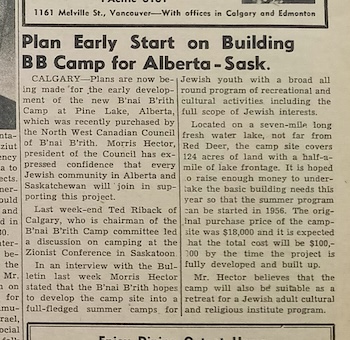
April 22, 1955: Camp BB Riback comes into existence.

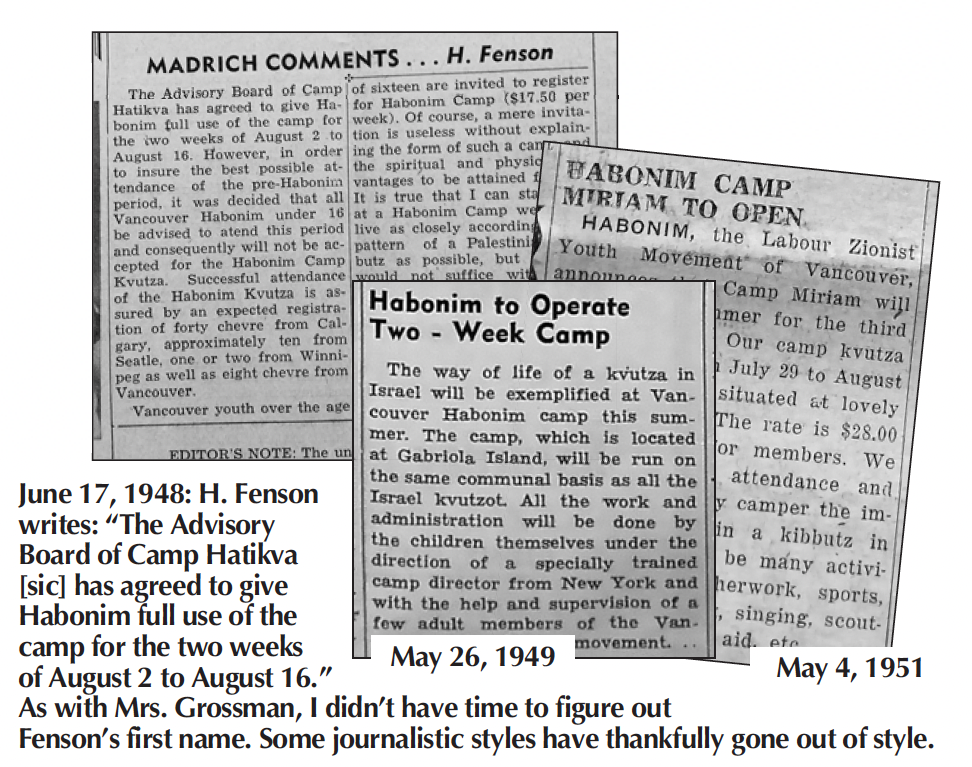
And the camp wasn’t territorial, it appears. According to a 1948 article in the JWB, Camp Hatikvah allowed Habonim Machaneh (Camp) to use its facilities for two weeks. By 1949, Habonim was renting a camp on Gabriola Island and, by 1951, Habonim Camp Miriam was in its third year, but, it seems, its first with the name Camp Miriam.

Camp BB Riback, in Pine Lake, Alta., was founded in 1955, led by Ted Riback of Calgary, who was chair of the B’nai B’rith Camp committee. There were two articles in the April 22, 1955, JWB about it, one about the camp and one about the upcoming B’nai B’rith convention, the highlight of which was anticipated to be a discussion about the camp.

image - July 13, 1956: Kids from Vancouver have always attended Camp Solomon Schechter in Washington state.
July 13, 1956: Kids from Vancouver have always attended Camp Solomon Schechter in Washington state.

While Camp Solomon Schechter was established by rabbis Joshua Stampfer and Joseph Wagner in 1954, the first mention I could find of it in the JWB was in 1956. The week-long camp at Echo Lake, Wash., was also under the supervision of Rabbi Bert Woythaler of Vancouver’s Congregation Beth Israel and the Pacific Northwest Region of the United Synagogue sponsored it. The camp has been located near Olympia, Wash., since 1968.

image - Dec. 29, 2006: Even before Camp Kalsman had a summer session, they were part of the Jewish Western Bulletin’s Camp Guide
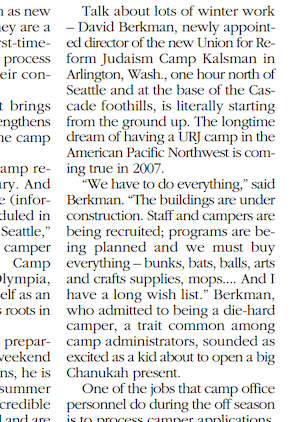
Dec. 29, 2006: Even before Camp Kalsman had a summer session, they were part of the Jewish Western Bulletin’s Camp Guide.

Relative newcomer Camp Kalsman started in 2007, and the JWB has followed it since its beginnings, as well. In 2006, the camp ran an ad looking for a director and, in our Dec. 29, 2006, Camp Guide, David Berkman, the newly appointed director, spoke to the paper about the Union for Reform Judaism camp, in Arlington, Wash. “The buildings are under construction. Staff and campers are being recruited; programs are being planned and we must buy everything – bunks, bats, balls, arts and crafts supplies, mops…. I have a long wish list,” he said.

As that 2006 article by Pearl Salkin noted, “The camps might not have big brass bands, but the excitement is already building. If you want your children to join in the fun, sign them up now, before the parade passes by.”


Posted on December 19, 2025December 18, 2025Author Cynthia RamsayCategories LocalTags history, Jewish summer camp, Jewish Western Bulletin, JI @ 95, JWB

עשרים ואחת שנים להגעתי לונקובר

בראשית השנה החדשה ימלאו עשרים ואחת שנים להגעתי לונקובר ואין ספק שהזמן רץ כל כך מהר. לו יכולתי להחזיר את שעון הזמן אחורה הייתי עוזב את ישראל שנים קודם לכן. כבר בראשית שנות השמונים (לאחר השחרור מהשירות הצבאי) היה לי חלום שלא הרפה ממני והוא לעבור לגור בחו”ל. לאורך המשך שנות חיי הצטרפו סיבות נוספות (לחלום) מדוע רציתי לעזוב את ישראל ולבסוף עשיתי זאת רק בראשית שנת אלפיים וחמש.השנים הראשונות היו קשות במיוחד על רקע העבודה שנאלצתי להתמודד עם המציאות הלא פשוטה שבונקובר לא אוכל לעבוד עוד בתחום המדיה, כפי שעשיתי שנים בישראל. אמנם כתבתי כפרילאנס במשך שנים מכאן לישראל עבור ידיעות אחרונות ווינט, אך אין מקום להשוואה לעבודה הקבועה בארץ. במקביל התחלתי להבין שהמנטליות הקנדית שונה לחלוטין מזו שבישראל וזה לוקח זמן די רב להתאים את עצמך לכך

מכל מקום אחרי שעבדתי במשך כשבע שנים כמחפש מידע עבור חברה פיננסית מקומית, לאור הרקע העיתונאי שלי, הצטרפתי לחברת פרוגרסה שבה אני עובד עד היום – במשך אחת עשרה וחצי שנים. מדובר בחברה פיננסית שמספקת הלוואות ללקוחות שלא יכולים לקבל הלוואה מהבנק (בשל קרדיט גרוע). בשנתיים הראשונות שימשתי מנהל קשרי לקוחות ומזה קרוב לתשע וחצי שנים אני הוא מבקר החברה. זו עבודה אחראית ומאתגרת ואני אוהב לעשותה. אני לא חושב בשלב זה כלל על נושא הפרישה למרות שבקנדה הגיל הרשמי לצאת לפנסיה הוא 65. מבחינתי הכל פתוח לגבי השאלה עד מתי אמשיך לעבוד בחברה

בהיבט האישי יש לי זוגיות קרובה במשך למעלה משמונה שנים וזה מעניק יציבות לחיי שנינו. בת הזוג שלי הגיעה מסין והפכה את ונקובר כמוני, לבית הקבוע שלה. למרות הרקע השונה יש לנו עניין משותף בלא מעט תחומים בהם אמנות, מוסיקה ועיצוב. שנינו מאוד אוהבים את אירופה והקלאסיות שבה. מאוד נהנינו לבקר בשנים האחרונות בציריך, ברצלונה, מדריד, לונדון, דבלין ואמסטרדם – שהיא עדיין העיר האהובה עלי. אנו מתכננים בשנים הקרובות להמשיך ולטייל בערים המרכזיות של אירופה

אני אוהב לחלק את בני האדם לשתי קבוצות מרכזיות: עכברי עיר ועכבר שדה. אנו עכברי עיר שאוהבים את מה שהערים יכולות להציע, ובעיקר בתחום התרבות. בנוסף הנוף העירוני מושך אותנו בעיקר כשמדובר במבנים עם היסטוריה ארוכה

בשעות הפנאי ביוזמתי אנו לוקחים חלק באירועי מוזיקה המתרחשים בונקובר בהם: קונצרטים של התזמורת הסימפונית המקומית ואופרות של בית האופרה המקומי. בנוסף אנו הולכים בקביעות למועדון הג’אז המקומי שמארח אמנים מארה”ב ומקומיים כאחד. בתחום מוסיקת הפופ הלכנו למספר הופעות באצטדיון הגדול (שנמצא סמוך לביתנו) ובהן של: פול מקרטני, אלטון ג’ון, פיטר גבריאל, להקת קולדפליי וטיילור סוויפט.

יש לי כאן גם מספר חברים ורובם לא ישראלים וזה טוב כי חיפשתי להשתלב בחברה המקומית ולא להישאר זר לנצח . גיוון החברים שלא שייכים לקבוצה אחת ואף לא מכירים אחד את השני, הופכים את המפגשים עימם למעניינים ופוריים. מי שמכיר אותי יודע שאני לא אוהב מפגשים חברתיים בקבוצות גדולות, אלה מפגשים של אחד עם אחד או זוג עם זוג נוסף

ונקובר נחשבת לאחת הערים היפות בעולם עם טבע מדהים גם ממש בעיר עצמה. לא צריך להרחיק לכת כדי להגיע לפינות טבע שקטות, כיוון שהעיר מוקפת במים ובתוכה נמצאים מספר פרקים בהם סטנלי פארק שהוא גדול מהסנטרל פארק של ניו יורק. בהחלט עיר שמומלץ לבקר בה

Posted on December 17, 2025December 10, 2025Author Roni RachmaniCategories עניין בחדשותTags Israel, reflections, travel, Vancouver, work, ונקובר, ישראל, לטייל, עבודה

Eby touts government record

More than 18 months ago, Charlotte Kates, who is identified as the international coordinator of Samidoun Palestinian Prisoner Solidarity Network, made inflammatory remarks at a rally in Vancouver. She celebrated the 10/7 terror attacks by Hamas against Israel, calling them “heroic and brave” and led the audience in chants of “Long live Oct. 7.” She referred to terrorist organizations as “resistance fighters” and “heroes.” 

After an investigation, the Vancouver Police Department recommended charges against Kates based on Criminal Code provisions against incitement of hatred. Later last year, the federal government designated Samidoun a terrorist entity.

A year-and-a-half after the police sent its report to Crown counsel, no charges have been laid. In a year-end interview with BC Premier David Eby, the Independent asked why the attorney general has not acted to either bring charges or to explain why charges are not warranted. The premier assured the paper that he would check with the office of Attorney General Niki Sharma but his office did not respond by press time. The Independent will continue to press the government on the matter.

photo - BC Premier David Eby
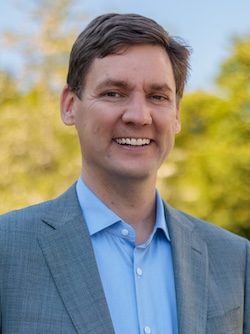
BC Premier David Eby told the Independent: “We really have tried to be a government that takes on hate and racism from all angles.” (photo from BC NDP)

“It’s a really troubling case and it’s incredibly problematic,” said Eby, adding that he is “reluctant to weigh in too much until I know the exact status of the case.”

Speaking more broadly, Eby acknowledged the message hate crime charges send to the community.

“We believe strongly that an example is set to the broader community when someone is arrested and prosecuted for a hate crime,” he said. “We have seen some very high-profile incidents that have not met the kind of outcomes that I expect and that our government expects through the justice system. So, we’ve been working with Crown and the federal government to be able to come to better results through the criminal justice system.”

Eby touted his government’s range of antiracism initiatives.

In November, he said, the government announced a set of grants for groups targeted by hate and violence, including the Jewish community. 

“While the Jewish community has been disproportionately impacted by rising hate, they’re not the only community that has been impacted by some of the international problems we’ve seen [and] a rise in racism here in British Columbia,” he said. 

The government has committed to so-called “bubble zone” legislation, which would limit the ability of protesters to access space within a designated distance around religious and cultural institutions. Eby said the legislation is being spearheaded by Sunita Dhir, member of the legislature for Vancouver-Langara and parliamentary secretary for international credentials. 

The bubble zone concept is also in the mandate letter for Nina Krieger, the minister of public safety and solicitor general, as well as that of Sharma. A mandate letter is the direction a minister receives on appointment to cabinet outlining what the premier and the government expect them to accomplish.

“They are working on it and we hope to be able to bring forward legislation soon,” the premier said. “I know it’s important for the community. It will not be this session, though.”

In addition to security grants that address negative outcomes, Eby stressed proactive measures that confront underlying hatred and racism.

“We really have tried to be a government that takes on hate and racism from all angles,” he said, citing the introduction of mandatory Holocaust education in the Grade 10 curriculum.

It is early in the process, so Eby could not comment on responses to the new curriculum, but acknowledged that many students had already been learning about the subject even before it was mandated. The fact that he has not heard of any negative outcomes around the rollout of the curriculum suggests to him that all is going to plan.

Anti-bullying programs across the school system are also aimed at inculcating inclusive values in society.

“We have our anti-bullying initiatives that we continue to support within schools, that educate students about the importance of understanding both the differences and strengths that come from our differences in this province,” he said. “Unfortunately, Pink Shirt Day has somehow become controversial with the Conservatives, but not for us.”

Eby was referring to internal Conservative Party discord around the anti-bullying day, with at least one Conservative MLA accusing “the left” of using the day to “bully” people into wearing pink shirts. Another MLA, Elenore Sturko, who was elected as a Conservative and is a lesbian, claims she was forced out of the Conservative caucus in part because of her support for Pink Shirt Day. 

“We continue to support the idea that kids should be educated about bullying at an early age because that turns into adults who are more welcoming and understand the strength that our province draws from our diversity,” said Eby.

The government has also set up an antiracism hotline, partly because some people may be reluctant to go to police. 

“That hotline connects to community groups that are able to reach out and support people that have faced racism in the community and [are] able to respond to it,” said Eby. “This provides us with information about where these problems are happening and allows us to support community groups with outreach, to be more proactive where there are hotspots of racist activity.”

There is no single solution, the premier said.

“There really is a wide array of initiatives related to this work and, unfortunately, there has been a rise in racism and it has disproportionately impacted the Jewish community,” he said. “We’ve been working to make sure that we’re not taking just one approach, but several approaches to deal with it.”

Eby expressed greetings to the Jewish community at Hanukkah, acknowledging the challenges of this year and optimism for the future. It has been, he said, “a very challenging year for the Jewish community and for all British Columbians who believe in a hate-free province and believe in the strength that comes from our diversity.

“I am certain that 2026 and forward will be better and I sincerely hope and expect that our shared work together, between government and the Jewish community, will lead to the kind of outcomes we’re looking for, which is a safe, prosperous and welcoming province for everybody.” 

Posted on December 5, 2025December 3, 2025Author Pat JohnsonCategories LocalTags anti-bullying, antiracism, antisemitism, Charlotte Kates, criminal justice system, David Eby, government policy, Hanukkah
Facing a complex situation

Facing a complex situation

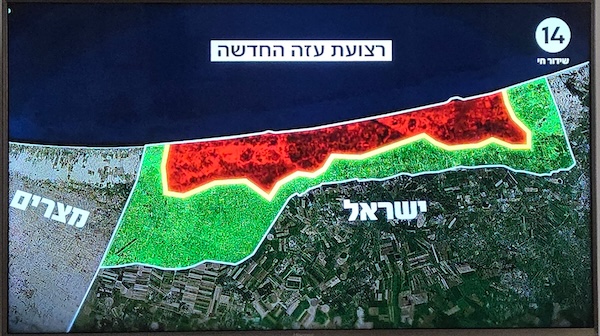
The Gaza Strip is currently divided between the Israeli-held zone (green) and Hamas territory (red). (Screenshot from Channel 14)

More than 25 months after Hamas’s Oct. 7, 2023, massacre and the consequent multi-front Middle East war, and more than one year after Israel and Hezbollah reached a ceasefire agreement on Nov. 27, 2024, Israel faces a complex geopolitical and security situation.

In the north, the Israel Defence Forces (IDF) is engaged in continuous covert and overt operations to prevent Hezbollah from rearming and regrouping. The Shi’ite terrorist militia has been dealt multiple blows, first by the Mossad’s twin attack Sept. 17-18, 2024, nicknamed Operation Grim Beeper, in which thousands of hand-held pagers and hundreds of walkie-talkies used by Hezbollah operatives exploded across Lebanon and Syria. On Sept. 27, the terror group’s secretary-general, Hassan Nasrallah, was assassinated in his Beirut bunker. On Nov. 23, the IDF eliminated Haytham Ali Tabataba’i in a missile strike on the Lebanese capital – Hezbollah’s chief of staff had been designated by the US Department of State as a Specially Designated Global Terrorist in 2016. Washington was offering a $5 million US bounty for information on him.

Though diminished, Hezbollah is not a spent force, according to Michael Rubin, a senior fellow at the Washington-based American Enterprise Institute who specializes in Iran, Turkey and the broader Middle East. Writing in the National Security Journal, Rubin notes that, notwithstanding the targeting of its senior leadership, Hezbollah’s financing – diaspora-linked laundering from Europe, Africa and South America and new backing from Turkey – remains resilient. He cautions that, unless Lebanon’s President Joseph Aoun cuts off the money supply and disarms Hezbollah by the year’s end, the country will slide into a renewed insurgency. Trained by Iran’s Islamic Revolutionary Guard Corps in guerrilla tactics and bomb-making, Hezbollah will resume its terror campaign attacking Lebanese armed forces’ vehicles with IEDs (improvised explosive devices), said Rubin.

Israel has made a huge investment to literally alter the landscape of its 120-kilometre-long northern frontier into a formidable physical barrier, and to blow up cross-border tunnels. Similarly, during the Israeli occupation of southern Lebanon from 1985 to 2000, several strategic mountain peaks were bulldozed to no longer loom over the Upper Galilee. However, the fiasco of Oct. 7 has shown that static positions provide limited deterrence against lightning strikes by well-trained guerillas.

In the Gaza Strip, Hamas – an Arabic acronym for Harakat al-Muqawama al-Islamia (the Islamic Resistance Movement) – also refuses to disarm. There, too, the situation remains unclear, complicated by Israel’s assassination of the terrorist group’s leaders: Yahya Sinwar, his brother Mohammed, Mohammed Deif, Marwan Issa and Ismail Haniyeh.

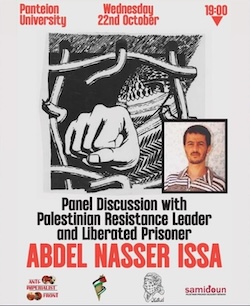
image - On Oct. 22, the terrorist-linked group Samidoun hosted a panel discussion in Athens with a newly released top Hamas operative
On Oct. 22, the terrorist-linked group Samidoun hosted a panel discussion in Athens with a newly released top Hamas operative.

In October, Israel released nearly 2,000 Palestinian prisoners and detainees as part of the first phase of a US-brokered ceasefire and hostage deal with Hamas. In exchange, Hamas released 20 living Israeli hostages. On Oct. 22, the terrorist-linked group Samidoun hosted a panel discussion in Athens with the newly released top Hamas operative Abdel Nasser Issa. Known as a student of Hamas’s notorious chief bombmaker Yayha Ayyash (1966-1996), aka “the Engineer,” Issa was serving two life sentences for his involvement in two suicide bombings in 1995 that killed 20 Israeli civilians and wounded more than 100.

On Nov. 24, Palestinian Islamic Jihad turned over a coffin with the remains of Dror Or. Staff Sgt. Ran Gvili and Sudthisak Rinthalak are the last two people murdered on Oct. 7 not yet returned. Rinthalak, an agricultural worker at Kibbutz Be’eri near the border of the Gaza Strip in southern Israel, was among the more than 40 Thais killed and 31 kidnapped in Hamas’s attack.

Also in November, a flight of 153 Gazans landed in Johannesburg, after departing from Ramon Airport near Eilat. Shimi Zuaretz, a spokesperson for Coordination of Government Activities in the Territories (COGAT) – the Israeli body that runs civil affairs in the West Bank – confirmed that the Palestinians transited through Israel “after COGAT received approval from a third country to receive them.” That third country was South Africa.

Some 200,000 Gazans are currently living in limbo in Cairo, unable to either find a destination in which to settle or to return to their homes. Together with the estimated tens of thousands of combatants and civilians killed in the Gaza war, these numbers indicate the ongoing depopulation of the destroyed coastal enclave.

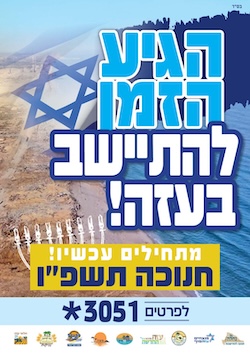
image - Israeli Prime Minister Binyamin Netanyahu’s coalition faces a mounting campaign to reestablish Jewish settlements in the Gaza Strip. The poster above reads, “It’s time to settle in Gaza! Let’s start now! Hanukkah 5786!” 
Israeli Prime Minister Binyamin Netanyahu’s coalition faces a mounting campaign to reestablish Jewish settlements in the Gaza Strip. The poster above reads, “It’s time to settle in Gaza! Let’s start now! Hanukkah 5786!”

With an election on the horizon in the first half of 2026, Israeli Prime Minister Binyamin Netanyahu’s coalition faces a mounting campaign to reestablish Jewish settlements in the Gaza Strip. Daniella Weiss, head of Nachala Movement Israel, whose stated aim is to settle further into Judea and Samaria, wants to begin Jewish settlement in Gaza within “months.” According to Weiss, more than 600 families – more than 2,500 people – had already registered for an initiative to settle in new beach towns.

Many Israelis fault Prime Minister Ariel Sharon’s unilateral withdrawal of 9,000 settlers from Gush Katif in 2005 as the catalyst that allowed Hamas to seize power from the Palestinian Authority two years later. In turn, that violent coup laid the way for the catastrophic Oct. 7, 2023, attack on cities and kibbutzim bordering Gaza.

The Gaza Strip’s 365 square kilometres are today uneasily divided into Hamas- and Israeli-controlled sectors. Israel will not allow Türkiye or Qatar to send troops to monitor the ceasefire, nor are any other countries keen to send boots on the ground. US President Donald Trump envisions a $500-million military base near Qiryat Gat, called the US Civil-Military Coordination Centre, to assist in Gaza’s future governance and patrol of the territory.

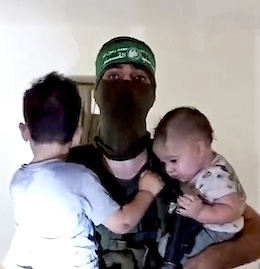
photo - The Israeli Defence Forces have killed Muhammad Abu Shaar, the Hamas terrorist who broke into Adi Vital-Kaploun’s residence on Oct. 7, 2023, and murdered her in front of her young children. He recorded himself with Adi’s babies in the same room she was killed as a Hamas propaganda video
The Israeli Defence Forces have killed Muhammad Abu Shaar, the Hamas terrorist who broke into Adi Vital-Kaploun’s residence on Oct. 7, 2023, and murdered her in front of her young children. He recorded himself with Adi’s babies in the same room she was killed as a Hamas propaganda video. (internet image)

Clan and Bedouin tribal groups in Gaza are engaged in a violent internecine struggle with Hamas. And the London-based Asharq Al-Awsat newspaper reported on Nov. 15 that IDF commandos on motorcycles are targeting Palestinians who participated in the abduction and holding of Israelis during the Oct. 7 attack. Among the Mujahideen Brigades terrorists gunned down in Khan Yunis was Mohammed Abu Mustafa, who kidnapped Shiri Bibas and her children Kfir and Ariel from Kibbutz Nirim on Oct. 7. Also recently eliminated was Muhammad Abu Shaar, who broke into Adi Vital-Kaploun’s residence at Kibbutz Holit and murdered the Canadian-Israeli woman in front of her 4-year-old son Negev and 4-month-old toddler Eshel. Shaar then recorded himself holding her children in the same safe room where Vital-Kaploun was murdered.

Troops of the elite Nahal Brigade captured six Hamas gunmen who surrendered after a 24-hour search that followed the IDF’s collapsing of the tunnel in Rafah where the terrorists were hiding, forcing them to emerge from a shaft, the military reported. The men were taken to Israel to be questioned by the Shin Bet Klali (General Security Service). A photo released by the IDF showed four of the operatives in the army’s custody, hands tied behind their backs, next to an armoured vehicle.

“At the end of a 24-hour pursuit, all 17 terrorists who attempted to flee the underground terror infrastructure in eastern Rafah were either eliminated or apprehended,” the IDF announced. At least 30 Hamas terrorists were killed trying to flee from tunnels in Rafah last month.

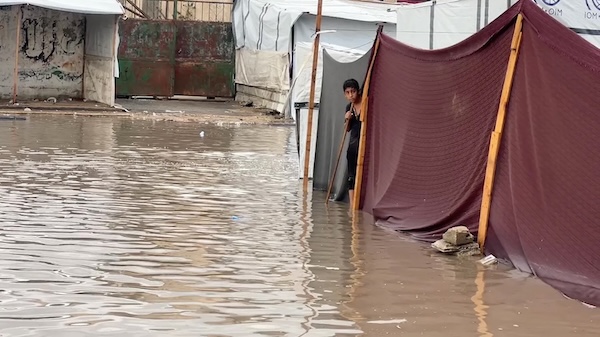
photo - Last month’s winter rain flooded Gaza’s tent encampments
Last month’s winter rain flooded Gaza’s tent encampments. (photo form IDDEF)

Environmental issues are also impacting the complex situation. Last month’s winter rain flooded Gaza’s tent encampments. In Iran, a severe drought has depleted the reservoirs that provide its capital city, Tehran, with drinking water.

Symbolizing the Ayatollah regime’s crumbling control, on Nov. 12, protesters garbed in military uniforms of the Shah’s regime unfurled the banned pre-1979 lion and sun Pahlavi national flag in a Tehran metro station. Commentators have posited that the next revolution may come soon, if the taps run dry.

Gil Zohar is a journalist and tour guide based in Jerusalem.

Format ImagePosted on December 5, 2025December 3, 2025Author Gil ZoharCategories IsraelTags Gaza, Hamas, Hezbollah, Israel, security, terrorism, war

Help with the legal aspects

When Erin Brandt founded the Antisemitism Legal Helpline in January 2024, the employment and human rights lawyer had no idea how much time this volunteer position would consume. 

“The fact that we’re getting this many calls is a little terrifying,” she said. Last year, 32% of the more than 50 calls for assistance were about employment and labour issues, 29% about human rights, and the remainder were about defamation, strata or tenancy disputes, criminal matters and on-campus incidents. This year, as of early November, there had been 44 calls, with the top two concerns remaining the same, but with the order reversed: human rights (30% of calls), followed by employment and labour issues (25%).

“A lot of people don’t know about us and, therefore, aren’t calling – so this represents just a small sampling of what’s going on in BC,” she said.

The Antisemitism Legal Helpline’s operational costs are mainly funded by the Law Foundation of British Columbia, and all legal advice is provided on a volunteer basis by 30 lawyers, “mostly Jewish, but also non-Jewish who have identified as allies of the Jewish community,” said Brandt.

The helpline’s steering committee includes Brandt, Jessica Forman and Cindy Switzer; Rochelle Garfinkel is the coordinator.

Jews who have experienced antisemitism and want to inquire about the potential for legal action can call the helpline and be referred to a lawyer with an appropriate specialty. They receive a 30-minute, free legal consultation about whether there has been a legal breach and, if so, what the options are.

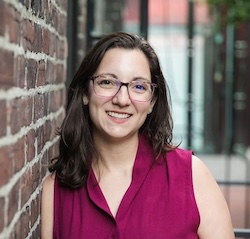
photo - Lawyer Erin Brandt, founder and steering committee member of British Columbia’s Antisemitism Legal Helpline
Lawyer Erin Brandt, founder and steering committee member of British Columbia’s Antisemitism Legal Helpline. (from antisemitismlegalhelp.org)

“People come to us looking for advice on whether their case has merit, and part of our job is to explain the legal system and what it looks like to pursue a complaint to conclusion,” Brandt said. “It could include sending a cease and demand letter, among other options. If an individual wants to pursue a complaint further, sometimes a lawyer may be prepared to take it on pro bono, or the case might be strong enough that it warrants seeking outside funding, from resources in the Jewish community. There are legal funds available.”

The lawyers in the roster are confident and experienced, Brandt added. “One of the things people look for is cultural competency. When they feel vulnerable or attacked, they want to speak to someone who empathizes with what they’ve been through. Our roster of lawyers is small, but strong, and if a situation comes up where the current roster can’t help, the steering committee steps in to work our networks and bring in the right lawyers.”

The US equivalent of the Antisemitism Legal Helpline is the Anti-Defamation League’s Legal Action Network, which launched in early November with a team of 40 law firms constituting some 40,000 lawyers. “This is the largest and most powerful network of attorneys in this country, united and walking in lock step in the fight against antisemitism,” said James Pasch, vice-president of litigation at the ADL. Those attorneys are not all Jewish, he added, and being Jewish was not a prerequisite for volunteering legal assistance. 

“We were looking for like-minded, talented attorneys who’d be interested in pro bono cases to fight back against antisemitism, and we’ve been heartened by the response of the American legal community. There’s an understanding that the spread of antisemitism in our communities cannot be tolerated and, when it crosses the line to horrific conduct, it’s incumbent on us to push back and fight for the rights of the Jewish community.” 

Victims of acts of antisemitism receive a call from a law firm that does a thorough intake process. After that, if there are issues that are legally actionable, they work to provide ongoing legal assistance on an individualized case basis. 

“We have to use every tool in the toolkit in the fight against antisemitism, and using the courts will be a vital tool in that fight,” he said. “We’re extraordinarily heartened and grateful that such a large swath of the legal community has decided to stand ready to provide pro bono legal assistance to the Jewish community.”

After Oct. 7, 2023, an antisemitism hotline for college students and professors was launched by the law firm Gibson Dunn, in collaboration with the ADL, Hillel International and the Brandeis Centre. While it led to 25 legal actions that resulted in settlements, criminal prosecutions and policy changes at universities, calls were coming from people outside of college campuses, too. They encompassed employment issues, denial of service and harassment of students in schools among other issues.

“The rise of antisemitism was never going to just stay siloed on campus,” Pasch noted. “We’ve seen antisemitism metastasize and spread across the United States. It was vital that we set up a system that gives the Jewish community an ability to fight back against it, tell their story and pursue legal remedies that will better protect us now and for years to come.” 

To reach the BC Antisemitism Legal Helpline, call 778-800-8917 or email [email protected]; the website is antisemitismlegalhelp.org. 

Lauren Kramer, an award-winning writer and editor, lives in Richmond.

Posted on December 5, 2025December 3, 2025Author Lauren KramerCategories LocalTags antisemitism, Antisemitism Legal Helpline, Erin Brandt, legal aid
Stories create impact

Stories create impact

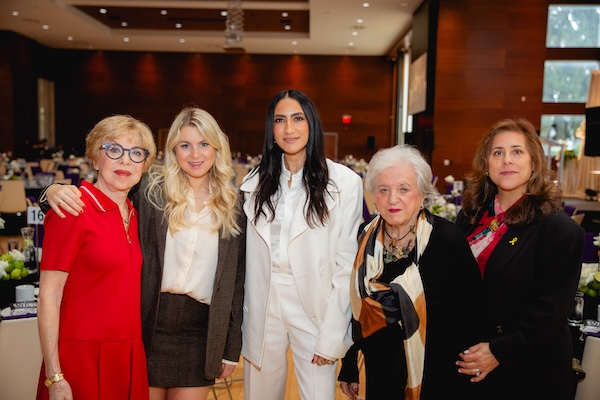
Choices keynote speaker Mandana Dayani, centre, with event  co-chairs, left to right, Gail James, Briana James, Lola Pawer and Lisa Boroditsky. (photo by Rhonda Dent)

On Nov. 16, Choices once again celebrated the work of Jewish women philanthropists. This year’s theme, “L’dor Vador” (“Generation to Generation”), reflected the more than 400 people who attended the 21st annual event, which took place at Congregation Beth Israel.

“We saw so many younger, first-time attendees,” said Ricki Thal, associate campaign director at Jewish Federation of Greater Vancouver. 

The event’s four co-chairs also represented the theme: Gail James and her granddaughter, Briana James; Lola Pawer and her daughter, Lisa Boroditsky.

Briana James introduced the keynote speaker, business leader and activist Mandana Dayani. In doing so, James said “our future shines bright,” with Dayani leading the way in philanthropy and activism, fighting antisemitism and advocating on behalf of women’s rights. 

Dayani took the stage with her husband, Peter Traugott, presenting her material in conversation with him.

A Hollywood film producer with credits including HBO, Apple TV and Netflix, among others, Traugott also holds a master’s in business administration from Harvard University. He set a light-hearted tone, quipping, “This is my first at this – [being] Mandana’s ‘plus one’!” Speaking about their Jewish life in Los Angeles, where several members of the Dayani family live close by, he described a cross between Everybody Loves Raymond and My Big Fat Greek Wedding.

Traugott asked Dayani about her experiences as a new immigrant in New York. She spoke of the culture shock, the lights and traffic in New York. She also spoke, with gratitude, about HIAS (Hebrew Immigrant Aid Society), which supported her family’s flight from Iran, found her father a job as a shoe salesman and found them a place to live, where they became part of the community.

Dayani said her earliest memories of Iran are of “the morality police, the fear in everyone’s eyes.” She recalled having a gun pointed at her when she was just 4 years old. She is now 43.

Her family, who had wanted to leave Iran since the revolution in 1979, finally got a visa to Italy in 1987. They fled there, “leaving everything behind.” The experience has left her, she said, with an enduring sense of “how quickly this escalates, seeing my country taken over by lunatics.” 

Despite having to live “with no safety net, starting over and over again, with no money,” Dayani said, “I’ve never missed a Shabbat in my life…. Shabbat is everything to us.”

Dayani’s grandfather was a rabbi and the family Orthodox. She understands the sacrifices that had to be made to maintain their traditions and feels “a responsibility” to do so as well, she said. As for integrating into American life, she described watching TV to learn how to dress, speak and behave as an American. She said, “I feel very Persian. Being a Persian Jew, that’s integral to who I am.” She also describes herself as “deeply patriotic – the US saved my life.”

Dayani takes her two daughters everywhere, she said. “If I meet my heroes, they meet my heroes. If I’m going to the UN General Assembly or the White House, they come with me.”

She and Traugott are trying to raise active, responsible citizens. “We have conversations about what’s happening in the world and they’re always rooted in kindness, through the lens of compassion,” she said.

Dayani advises caution when it comes to internalizing the messages we see online. “If we cave to the algorithms, we’ll believe that everyone hates Jews and it simply isn’t true,” she said, adding, “So many people stand with us and love us. The kids are good!”

In response to a question from Traugott about her process as a storyteller, Dayani spoke about “using storytelling to create impact,” to change society in significant ways.

Dayani acknowledged that anger spurs some of her work, such as her fight against the first Trump administration’s policy of attempting to deter migrants by separating children from their parents. She recalled her fears as a child, landing in New York, not wanting to let go of her mother’s hand. “I can’t think of a worse thing you could do to the most vulnerable population in the world,” she said. This sentiment led her to travel to Texas to see the policy in action, as the disconnect was just too powerful, she said. “The country that saved me is doing this?”

Her strategy in situations like this, she said, is to “call all the women I know who are smarter than me” to together “redirect the world’s attention to what we want them to look at. Real issues. It worked.”

She explained, “We received hundreds of millions of dollars of donated advertising…. I was so moved by how everyone showed up.”

The advertising aspect – the dissemination of information – was absolutely essential, she said, noting that “20% of the pro-Hamas information being spread on social media right after Oct. 7 was disseminated by bots, not real people…. It was planned. There was spin on the day it happened.” 

When Mandani posted a video about this online within days of Hamas’s attack, the post got some 50 million views within a couple of hours. Death threats started coming in.

“I am a progressive leader and none of those people were speaking up,” she said, referring to other human rights and anti-hate activists.

Even though, as Traugott noted, Dayani doesn’t just work for a single demographic, but rather does outreach on behalf of various groups who have experienced different kinds of trauma and marginalization, she lost friends after Oct. 7 – or, as she put it, “so-called ‘thought leaders’ remaining silent because they couldn’t stand 10 negative comments” on their social media accounts. Dayani said the people she thought were her peers lacked the courage to stand up for justice when it came to Jews. 

Among many other initiatives, Dayani founded, in 2024, the Calanet Foundation for young people, to harness “the power of Jewish stories in response to the branding work done by the Palestinian contingent.” After Oct. 7, she saw “so many black squares on people’s feeds,” as a mark of Jews’ grief. She also wanted people to focus on “the desert flower growing out of a crack,” the calanet (Hebrew for anemone), which symbolizes strength and resilience. She quoted the adage “They tried to bury us – they didn’t know we were seeds.”

One of Calanet’s projects is One Mitzvah a Day, which entails expressing thanks to those who stand up against antisemitism and/or in support of Israel – “one text a day, such as expressing gratitude to Trader Joe’s for selling Israeli feta,” said Dayani, noting that 5.5 million messages have been sent since the project’s January launch. Traugott pointed out that “most of the allies weren’t Jewish.”

Dayani asked the audience to consider “the power of this room, when everyone does the work.” She said, “Just do what you’re doing today – keep showing up.”  

Shula Klinger is an author and journalist living in North Vancouver.

Format ImagePosted on December 5, 2025December 4, 2025Author Shula KlingerCategories LocalTags annual campaign, antisemitism, Calanet, Choices, Jewish Federation, Mandana Dayani, Oct. 7, One Mitzvah a Day, Peter Traugott, philanthropy, Ricki Thal, tikkun olam
Different faiths gather

Different faiths gather

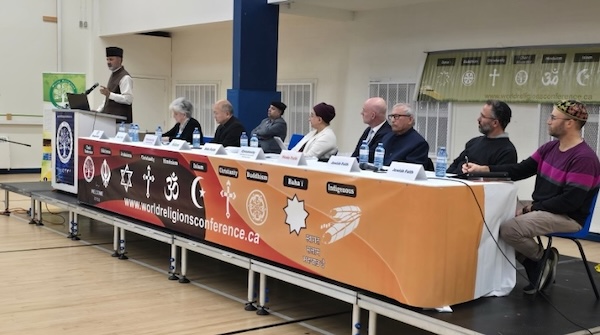
Presenters at the World Religions Conference, which was held at Star of the Sea Community Hall in White Rock on Nov. 17. Rabbi Arik Labowitz of Or Shalom is second from the right and, to his right, is the writer, Cantor Michael Zoosman (photo by Rizwan Peerzada)

Last month, the Elderly Organization of Ahmadiyya Muslim Ansarullah BC held the World Religions Conference. This annual multifaith event, organized by Ahmadiyya Muslim Jama’at Canada, brings together scholars from the world’s many religions to speak on a common topic from their respective religious traditions.

The Nov. 17 gathering was held at the Star of the Sea Community Hall in White Rock. Jonquil Hallgate, Surrey Interfaith Council chair, served as the moderator for faith leaders Dr. Eilaine McCeary (Baha’i), Rev. Richard Chau (Catholicism), Naeem Ahmed Lakhan (Islam), Sukhvinder Kaur Vinning (Sikhism), Eden Engen (Church of Jesus Christ of Latter-day Saints), Shrinath Dwivedi (Hindusim) and, representing Judaism, Rabbi Arik Labowitz of Or Shalom and I. It was the second such Ahmadiyya multifaith event in which I have participated, the first occurring when I lived in Greater Washington, DC, years ago.

This year’s theme, “Kindness and Kinship,” focused on recognizing our shared humanity – being of a kind. Speakers shared inspiring variations on this theme, emphasizing that people can be motivated by such recognition to cooperate with and help one another, to treat others as if they were members of their own family, to be generous, loving and thoughtful, and to give as if to kin. Many leaders referenced directly or indirectly the famous Hebrew phrase “v’ahavta l’reiakha kamokha” – “love your neighbour as yourself” – from Leviticus 19:18. 

At Rabbi Arik’s suggestion, after he spoke, I concluded the evening by leading a rendition of “Olam Chesed Yibaneh” (“The World is Built with Kindness”), which Rabbi Menachem Creditor wrote in the wake of the 9/11 terrorist attacks across the United States. Using the eponymous text from Psalms (Tehillim) 89:3 as the refrain, the song adds: “I will build this world from love. And you must build this world from love. And if we build this world from love, then God will build this world from love.” We repeated the chanted melody, with guitar, as a niggun on a neutral syllable, to invite others to join in with us in the universal language of song. During the Indian dinner that followed, many attendees approached us to share how much they had learned and how much they appreciated what we had to share.

Such interfaith collegiality – even “kinship” – occurs frequently among colleagues serving, like I do, in multifaith capacities as spiritual health practitioners (what, in the United States, we called “chaplains”) in hospital, military and prison settings. It is understandably much harder for those on the pulpit, who have the sacred responsibility of attending to the members of their own congregations and communities. This prioritization is why it is so impressive to consider the partnerships that local clergy, including so many of our rabbis, have made in Vancouver over the years. It is my hope and prayer to be able to sing at many such functions in the months and years to come. Only by standing together for the sake of mutual chesed, lovingkindness, can we hope to move forward in peace and fellowship as a thriving, diverse community. 

Cantor Michael Zoosman is a certified spiritual care practitioner with the Canadian Association for Spiritual Care and received his cantorial ordination from the Jewish Theological Seminary of America in 2008. He sits as an advisory committee member at Death Penalty Action and is co-founder of L’chaim! Jews Against the Death Penalty. Zoosman is a former Jewish prison chaplain and psychiatric hospital chaplain. Currently, he serves as a spiritual health practitioner (chaplain) for mental health outreach teams, working with individuals in the community living with severe mental health disorders and addiction. He lives with his family in Vancouver.

Format ImagePosted on December 5, 2025December 3, 2025Author Cantor Michael ZoosmanCategories LocalTags Ahmadiyya Muslim Jama’at Canada, interfaith, multifaith, religion
Advocating for girls’ rights

Advocating for girls’ rights

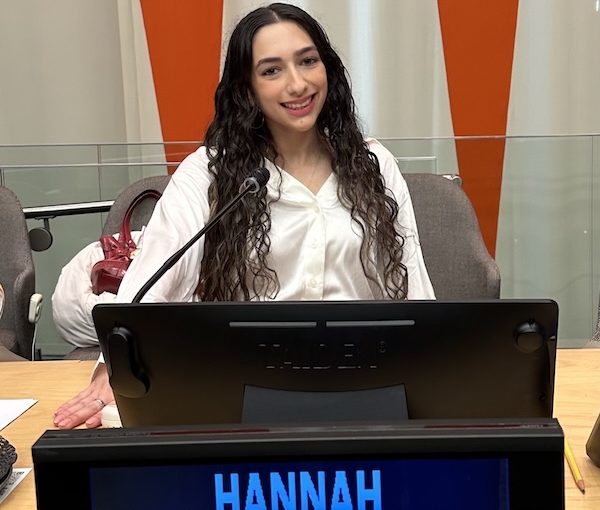
Hannah Presman Chikiar spoke and moderated at the United Nations headquarters in New York City, on Oct. 10, as part of Girls Speak Out 2025, held in celebration of the International Day of the Girl. (photo from Hannah Presman Chikiar)

At the start of this year, I was doing what any average 15-year-old would be doing: studying, playing sports, hanging out with friends, counting down the days until summer and, yes, waiting to turn 16 to get my driver’s licence! I never imagined I would be speaking and moderating at the United Nations headquarters in New York City, in front of hundreds of global leaders, delegates and young people. On Oct. 10, 2025, I had the honour of doing exactly that at Girls Speak Out 2025, held in celebration of the International Day of the Girl. 

I happened to be seated beside Annalena Baerbock, the president of the UN General Assembly. The room filled with hundreds of people, while many others joined online. Girls Speak Out 2025 was not only a celebration; it was a policy platform where commitments were made, with the expectation that they will be fulfilled. The event highlighted real stories and actionable solutions, emphasizing that girls’ rights must be recognized, supported and acted upon without delay. The energy in the room, the stories shared and the voices of girls from around the world showed everyone the power of youth advocacy and the importance of taking action rather than waiting for permission.

My connection to Judaism has always guided me, particularly the principle of tikkun olam (repairing the world), which inspires me to act for justice and equality wherever I can. It was this commitment to advocacy and making a positive impact that aligned with the mission of the Vancouver section of the National Council of Jewish Women of Canada (NCJWC), which nominated me for this amazing opportunity with the UN.

From June through October, I worked with nine other girls: they were from Liberia, Bolivia, Ghana, the United Kingdom and the United States. I woke up every Saturday at 4:30 a.m. Vancouver time to meet with them and plan, with the support of the Working Group on Girls, a fully girl-led UN event shaped around our theme: “We Are Here: Bold, Diverse and Unstoppable – Demanding Action for Girls’ Rights.” Together, we co-designed two panels: “Girls on the Frontline of Crisis: Protection, Peace & Power” and “From Margins to Power: Girls Defying Discrimination and Reclaiming Identity.” Collaborating with this diverse team of girls was inspiring and gave me the chance to learn from experiences vastly different from my own.

On the day of the event, I had the privilege of being one of the four moderators leading the discussions and sharing information about what girls around the world are facing. As I proudly wore my Magen David necklace, I spoke about how, in many crisis settings, child marriage rates are nearly double the global average and millions of girls face heightened risks of sexual violence with little or no support. Globally, 12 million girls are married every year, more girls than boys remain out of school in parts of sub-Saharan Africa, and anemia rates continue to worsen in several countries. Nearly one in four girls – about 150 million girls – live in countries where they do not have equal inheritance rights, and girls in fragile or conflict-affected regions are 90% more likely to be out of secondary school than those in stable environments.

These realities underscored the urgency of the issues, and we opened the floor for a recommitment discussion, inviting member-states and UN agencies to share their reaffirmations on advancing the rights of girls.

Over the past few years, I’ve been deeply involved in leadership and advocacy programs that shaped my understanding of social responsibility and community engagement. Last year, I completed the StandWithUs Teen Leadership Council and the Canadian Jewish Political Affairs Committee (CJPAC) Generation program. This year, I am a part of the StandWithUs Kenneth Leventhal Internship, and I am continuing my involvement with CJPAC. I also serve on the Multi-Faith Summit Council of British Columbia committee. These experiences have taught me, and continue to teach me, how to work with people from different backgrounds, speak up for causes I care about, and translate values into action.

I have been invited to participate in the 70th session of the Commission on the Status of Women (CSW70) Girls’ Statement Writing Group, which will take place at UN headquarters in New York in March 2026. In this program, girl delegates from around the world collaborate to write and refine the annual Girls’ Statement, share perspectives on justice and empowerment, and learn more about advocacy and policy writing. 

Reflecting on my recent journey, I am deeply thankful for the support that made it possible, notably the help and encouragement of NCJWC Vancouver and its chair, Jordana Corenblum, the International Council of Jewish Women, and my family. Their encouragement gave me the strength and confidence to fully engage in this work and to represent the Jewish community while advocating for girls’ rights.

Girls Speak Out 2025 reminded me that change is possible when young people speak boldly, collaborate widely and demand accountability. I hope to carry these lessons forward, continuing to act for justice, equity and opportunity for all girls, wherever I can. 

Hannah Presman Chikiar is a Grade 11 student at King David High School. She is part of the StandWithUs Kenneth Leventhal Internship, is involved with the Canadian Jewish Political Affairs Committee, serves on the Multi-Faith Summit Council of British Columbia committee and is working on the Commission of the Status of Women..

Format ImagePosted on December 5, 2025December 3, 2025Author Hannah Presman ChikiarCategories WorldTags advocacy, equity, girl, Girls Speak Out, justice, National Council of Jewish Women, NCJWC Vancouver, policy, politics, United Nations, women
An oral song tradition

An oral song tradition

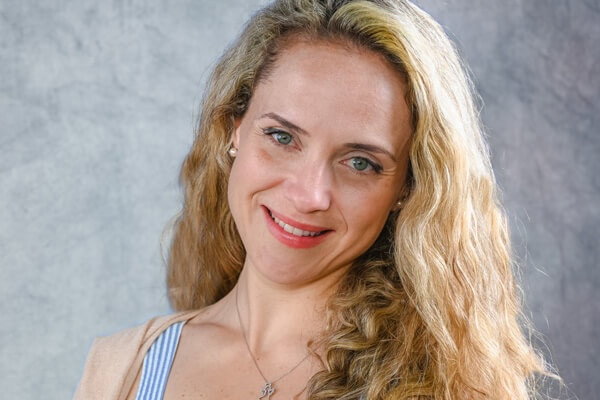
Shenandoah University Prof. Lori Şen spoke about Sephardic music on Nov. 2, as part of Kolot Mayim Reform Temple’s 2025/26 lecture series. (PR photo)

Kolot Mayim Reform Temple started its 2025/26 Building  Bridges Zoom lecture series – six music-themed talks running through April – on Nov. 2, with Lori Şen, a professor of vocal pedagogy at Shenandoah University in Winchester, Va.

The title of Şen’s lecture was Classical Echoes in Ladino: Sephardic Songs Reimagined.

“This talk is especially meaningful to me, as it reflects a journey that began about eight or nine years ago with my doctoral dissertation in voice performance,” she said.

“What started as an academic project has since grown into a broader exploration and celebration of a rich and underrepresented genre within the Western classical tradition – Sephardic art song.”

Şen spoke about the Sephardim, their history, language and culture, before discussing the elements of traditional Sephardic music. Later, she introduced Western classical arrangements of Sephardic folk songs for voice and various instruments, and spoke about the development of this genre, playing excerpts from a variety of songs. 

Within the expanse of what constitutes Sephardic culture, there is a language, most commonly called Ladino or Judeo-Spanish, a mix of 14th- and 15th-century Castilian, with contributions from Galego-Portuguese, Catalan, Valencian, Aragonese, Hebrew, Turkish, Arabic and others, such as Greek, French, Italian and Balkan languages.

“A certain linguistic creativity is inherent to Judeo-Spanish, which has even been used as a vehicle for expressing verbal revenge through humour in an oppressive society,” Şen said, citing examples of plays on words that can be found in Ladino.

Şen quoted from linguist Marie-Christine Varol, author of Manual of Judeo-Spanish: “Irony, distance, puns and endless plays on meanings and stylistic nuances bouncing back and forth make this language of quotations, double entendres, discrete jokes that seem undecipherable of implied and overly clear meanings into an original and eternally renewed linguistic system steeped in a devastating sense of humour that can only be achieved through a knowledge of several languages, a knowledge that gives it its strength, its richness and its freedom.”

Şen said the types of Sephardic song are defined based on musical parameters such as structure, melody and rhythm, as well as the text and the relationship between the music and text. Many songs were passed down orally, making their origins difficult to trace. Others are Ladino translations or adaptations of Turkish, French and Balkan songs, incorporating dance rhythms like tango and foxtrot, and sometimes referencing familiar operettas.

“Since this repertoire represents such a wide range of cultural exchange, the musical analyses of them require vast musical knowledge,” Şen said. “Sephardic music possesses elements of Western classical music of all periods, starting from medieval, Spanish, Moroccan, Balkan and Greek musical traditions, and Turkish folk and classical forms, including makam.”

Makam is the Middle Eastern modal practice with more pitches than we’re used to in our Western 12-tone notation system.

According to Şen, although instruments were employed on occasion, the Sephardic song repertoire is essentially vocal. When instruments were involved, they were mainly percussive, a tambourine, for instance, though mandolin and oud were also employed.

Traditional Sephardic folk songs, since they were transmitted orally, incorporate a large amount of improvisation. Thus, the melodies of the same songs can differ significantly between communities and across generations.

On her website, lorisen.com, Şen has a catalogue she compiled that includes lists of Sephardic works and composers, works categorized by instrumentation, and songs. Based on archival research and interviews she has conducted with Jewish musicians and music scholars, Şen has identified more than 45 composers who have arranged more than 190 different traditional Sephardic folk songs in the art song form for voice and various instruments. Also on her website is a Ladino diction guide designed to assist singers interested in performing Sephardic songs.

A mezzo-soprano and Fulbright alumna, Şen’s range spans opera, art song, musical theatre and jazz, and she has performed throughout Europe and the United States. Her teaching and research specialize in vocal literature, pedagogy and voice science. Further, through her background in physics, she explores the art and science of the singing voice.

The next lecture in the Kolot Mayim series will feature Broadway historian and lecturer David Benkof on Jan. 11 at 11 a.m. Benkof will deliver his talk – Spotlight on Jewish Broadway with the Broadway Maven – in Victoria in person and on Zoom. For information, visit kolotmayimreformtemple.com.  

Sam Margolis has written for the Globe and Mail, the National Post, UPI and MSNBC.

Format ImagePosted on December 5, 2025December 3, 2025Author Sam MargolisCategories LocalTags history, Kolot Mayim, Lori Şen, music, Sephardic music, speakers
Genealogy tools and tips

Genealogy tools and tips

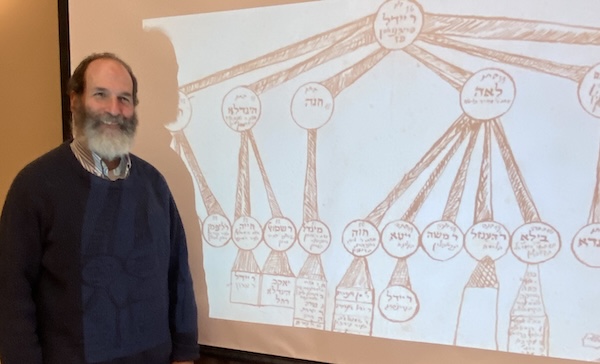
Stephen Falk, president of the Jewish Genealogical Society of British Columbia, spoke at the White Rock South Surrey Jewish Community Centre on Nov. 16, offering guidance on tracing one’s Jewish ancestry. (photo by Chloe Heuchert)

The White Rock South Surrey Jewish Community Centre (JCC) hosted a talk by Stephen Falk, president of the Jewish Genealogical Society of British Columbia, on Nov. 16. 

Falk introduced attendees to the fundamentals of genealogical research, providing practical guidance on tracing Jewish ancestry, accessing historical records and connecting with broader genealogical communities. 

The presentation was immersive, with participants encouraged to ask questions throughout. Attendees engaged directly with Falk, exploring specific strategies for research, software tools and resources relevant to their own projects. The interactive format allowed for a deeper understanding of both the challenges and the opportunities involved in tracing family histories.

Falk emphasized that genealogy begins with what is already known: any names, dates and locations provide a foundation for exploring more distant connections. Collecting family stories, though often incomplete or imprecise, can serve as a useful starting point. Participants were encouraged to verify details through official records, recognizing that oral histories often contain gaps or inaccuracies.

A key focus of the presentation was the variety of resources available to genealogists today. Census records, birth and death certificates, and marriage registrations were highlighted as essential tools. Falk also emphasized the value of local archives and library databases, which often contain digitized or microfilmed records that can be accessed for free or with minimal cost. Provincial archives, for example, offer searchable databases of records that can provide key insights on both recent and more historical generations.

Online platforms such as Ancestry and MyHeritage were discussed as powerful ways to organize research and access international records. Falk also mentioned JewishGen, a resource dedicated to Jewish genealogy, which hosts special interest groups (SIGs) focused on specific geographic regions, including Germany, Poland, Ukraine and other areas of historical Jewish settlement. These groups allow researchers to connect with others who may be working on the same family lines or the same regions, providing both guidance and collaboration opportunities.

Genealogical research often involves piecing together information from multiple sources. Falk likened the process to solving a puzzle, where each record or data point can clarify relationships or reveal new leads. Even apparent dead-ends can be opportunities to explore alternative paths, whether by examining less-common records, revisiting archival materials, or connecting with researchers in SIGs.

The presentation also highlighted unique resources that may not be immediately obvious to amateur genealogists. For example, records maintained by the Church of Jesus Christ of Latter-day Saints include extensive documentation of Jewish communities dating back to the 18th century. These archives, now largely digitized, provide valuable historical data and can supplement other sources, helping researchers build a more complete picture of family histories, said Falk.

The session also addressed practical approaches to organizing and tracking genealogical data. Falk discussed the use of software programs that allow researchers to record information, update details and integrate findings from multiple sources. These tools help manage large volumes of information and make it easier to visualize relationships and connections across generations.

Research often requires persistence, as records can be incomplete, misfiled or dispersed across many locations. Understanding privacy restrictions and record accessibility is also important: for instance, European birth records may be subject to privacy laws, while death records may only become publicly accessible after a certain number of years. By navigating these factors carefully, genealogists can uncover accurate and meaningful information about their family history, said Falk.

Talk attendees explored ways to handle common challenges, such as verifying oral histories, identifying unusual surnames and navigating records from numerous countries. Falk emphasized the value of community and collaboration, noting that genealogical work is often enhanced when researchers share insights and resources with one another.

By the end of the session, attendees had both a framework and tools to begin or expand their genealogical projects. Falk emphasized that Jewish genealogy is not only about tracing ancestry but also about engaging with cultural heritage, historical context and global connections. 

Falk’s presentation demonstrated that genealogy is both accessible and rewarding. Genealogists can uncover rich stories, strengthen community connections and gain a deeper understanding of personal and cultural history. The past can be explored, documented and shared with future generations.

Chloe Heuchert is an historian specializing in Canadian Jewish history. During her master’s program at Trinity Western University, she focused on Jewish internment in Quebec during the Second World War.

Format ImagePosted on December 5, 2025December 3, 2025Author Chloe HeuchertCategories LocalTags family history, genealogy, Jewish Genealogical Society, research, Stephen Falk, White Rock South Surrey Jewish Community Centre

Posts pagination

Previous page Page 1 … Page 11 Page 12 Page 13 … Page 326 Next page
Proudly powered by WordPress