
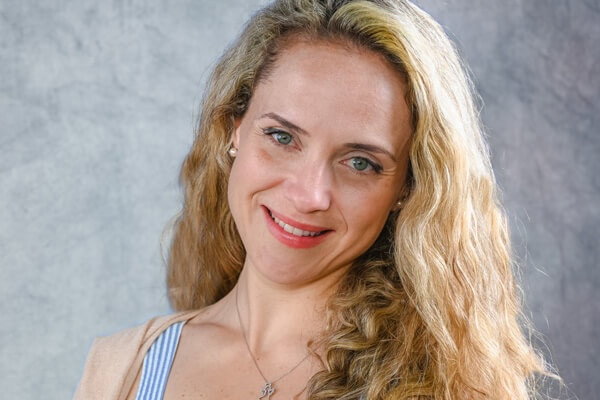
Shenandoah University Prof. Lori Şen spoke about Sephardic music on Nov. 2, as part of Kolot Mayim Reform Temple’s 2025/26 lecture series. (PR photo)
Kolot Mayim Reform Temple started its 2025/26 Building Bridges Zoom lecture series – six music-themed talks running through April – on Nov. 2, with Lori Şen, a professor of vocal pedagogy at Shenandoah University in Winchester, Va.
The title of Şen’s lecture was Classical Echoes in Ladino: Sephardic Songs Reimagined.
“This talk is especially meaningful to me, as it reflects a journey that began about eight or nine years ago with my doctoral dissertation in voice performance,” she said.
“What started as an academic project has since grown into a broader exploration and celebration of a rich and underrepresented genre within the Western classical tradition – Sephardic art song.”
Şen spoke about the Sephardim, their history, language and culture, before discussing the elements of traditional Sephardic music. Later, she introduced Western classical arrangements of Sephardic folk songs for voice and various instruments, and spoke about the development of this genre, playing excerpts from a variety of songs.
Within the expanse of what constitutes Sephardic culture, there is a language, most commonly called Ladino or Judeo-Spanish, a mix of 14th- and 15th-century Castilian, with contributions from Galego-Portuguese, Catalan, Valencian, Aragonese, Hebrew, Turkish, Arabic and others, such as Greek, French, Italian and Balkan languages.
“A certain linguistic creativity is inherent to Judeo-Spanish, which has even been used as a vehicle for expressing verbal revenge through humour in an oppressive society,” Şen said, citing examples of plays on words that can be found in Ladino.
Şen quoted from linguist Marie-Christine Varol, author of Manual of Judeo-Spanish: “Irony, distance, puns and endless plays on meanings and stylistic nuances bouncing back and forth make this language of quotations, double entendres, discrete jokes that seem undecipherable of implied and overly clear meanings into an original and eternally renewed linguistic system steeped in a devastating sense of humour that can only be achieved through a knowledge of several languages, a knowledge that gives it its strength, its richness and its freedom.”
Şen said the types of Sephardic song are defined based on musical parameters such as structure, melody and rhythm, as well as the text and the relationship between the music and text. Many songs were passed down orally, making their origins difficult to trace. Others are Ladino translations or adaptations of Turkish, French and Balkan songs, incorporating dance rhythms like tango and foxtrot, and sometimes referencing familiar operettas.
“Since this repertoire represents such a wide range of cultural exchange, the musical analyses of them require vast musical knowledge,” Şen said. “Sephardic music possesses elements of Western classical music of all periods, starting from medieval, Spanish, Moroccan, Balkan and Greek musical traditions, and Turkish folk and classical forms, including makam.”
Makam is the Middle Eastern modal practice with more pitches than we’re used to in our Western 12-tone notation system.
According to Şen, although instruments were employed on occasion, the Sephardic song repertoire is essentially vocal. When instruments were involved, they were mainly percussive, a tambourine, for instance, though mandolin and oud were also employed.
Traditional Sephardic folk songs, since they were transmitted orally, incorporate a large amount of improvisation. Thus, the melodies of the same songs can differ significantly between communities and across generations.
On her website, lorisen.com, Şen has a catalogue she compiled that includes lists of Sephardic works and composers, works categorized by instrumentation, and songs. Based on archival research and interviews she has conducted with Jewish musicians and music scholars, Şen has identified more than 45 composers who have arranged more than 190 different traditional Sephardic folk songs in the art song form for voice and various instruments. Also on her website is a Ladino diction guide designed to assist singers interested in performing Sephardic songs.
A mezzo-soprano and Fulbright alumna, Şen’s range spans opera, art song, musical theatre and jazz, and she has performed throughout Europe and the United States. Her teaching and research specialize in vocal literature, pedagogy and voice science. Further, through her background in physics, she explores the art and science of the singing voice.
The next lecture in the Kolot Mayim series will feature Broadway historian and lecturer David Benkof on Jan. 11 at 11 a.m. Benkof will deliver his talk – Spotlight on Jewish Broadway with the Broadway Maven – in Victoria in person and on Zoom. For information, visit kolotmayimreformtemple.com.
Sam Margolis has written for the Globe and Mail, the National Post, UPI and MSNBC.