
Skip to content
  • Home
  • Subscribe / donate
  • Events calendar
  • News
    • Local
    • National
    • Israel
    • World
    • עניין בחדשות
      A roundup of news in Canada and further afield, in Hebrew.
  • Opinion
    • From the JI
    • Op-Ed
  • Arts & Culture
    • Performing Arts
    • Music
    • Books
    • Visual Arts
    • TV & Film
  • Life
    • Celebrating the Holidays
    • Travel
    • The Daily Snooze
      Cartoons by Jacob Samuel
    • Mystery Photo
      Help the JI and JMABC fill in the gaps in our archives.
  • Community Links
    • Organizations, Etc.
    • Other News Sources & Blogs
    • Business Directory
  • FAQ
  • JI Chai Celebration
  • JI@88! video

Recent Posts

  • BGU fosters startup culture
  • Photography and glass
  • Is it the end of an era?
  • Taking life a step at a time
  • Nakba exhibit biased
  • Fight for Jewish rights
  • Film festival starts next week
  • Musical with heart and soul
  • Rabbi marks 13 years
  • Keeper of VTT’s history
  • Gala fêtes Infeld’s 20th
  • Building JWest together
  • Challah Mom comes to Vancouver
  • What to do about media bias
  • Education offers hope
  • Remembrance – a moral act
  • What makes us human
  • המלחמות של נתניהו וטראמפ
  • Zionism wins big in Vegas
  • Different but connected
  • Survival not passive
  • Musical celebration of Israel
  • Shoppe celebrates 25 years
  • Human “book” event
  • Reclaiming Jewish stories
  • Bema presents Perseverance
  • CSS honours Bellas z”l
  • Sheba Promise here May 7
  • Reflections from Be’eri
  • New law a desecration
  • Resilient joy in tough times
  • Rescue dog brings joy
  • Art chosen for new museum
  • Reminder of hope, resilience
  • The national food of Israel?
  • Story of Israel’s north

Archives

Follow @JewishIndie
image - The CJN - Visit Us Banner - 300x600 - 101625

Tag: White Rock South Surrey Jewish Community Centre

Genealogy tools and tips

Genealogy tools and tips

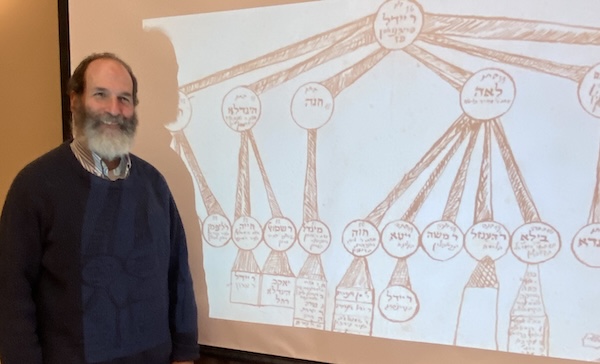
Stephen Falk, president of the Jewish Genealogical Society of British Columbia, spoke at the White Rock South Surrey Jewish Community Centre on Nov. 16, offering guidance on tracing one’s Jewish ancestry. (photo by Chloe Heuchert)

The White Rock South Surrey Jewish Community Centre (JCC) hosted a talk by Stephen Falk, president of the Jewish Genealogical Society of British Columbia, on Nov. 16. 

Falk introduced attendees to the fundamentals of genealogical research, providing practical guidance on tracing Jewish ancestry, accessing historical records and connecting with broader genealogical communities. 

The presentation was immersive, with participants encouraged to ask questions throughout. Attendees engaged directly with Falk, exploring specific strategies for research, software tools and resources relevant to their own projects. The interactive format allowed for a deeper understanding of both the challenges and the opportunities involved in tracing family histories.

Falk emphasized that genealogy begins with what is already known: any names, dates and locations provide a foundation for exploring more distant connections. Collecting family stories, though often incomplete or imprecise, can serve as a useful starting point. Participants were encouraged to verify details through official records, recognizing that oral histories often contain gaps or inaccuracies.

A key focus of the presentation was the variety of resources available to genealogists today. Census records, birth and death certificates, and marriage registrations were highlighted as essential tools. Falk also emphasized the value of local archives and library databases, which often contain digitized or microfilmed records that can be accessed for free or with minimal cost. Provincial archives, for example, offer searchable databases of records that can provide key insights on both recent and more historical generations.

Online platforms such as Ancestry and MyHeritage were discussed as powerful ways to organize research and access international records. Falk also mentioned JewishGen, a resource dedicated to Jewish genealogy, which hosts special interest groups (SIGs) focused on specific geographic regions, including Germany, Poland, Ukraine and other areas of historical Jewish settlement. These groups allow researchers to connect with others who may be working on the same family lines or the same regions, providing both guidance and collaboration opportunities.

Genealogical research often involves piecing together information from multiple sources. Falk likened the process to solving a puzzle, where each record or data point can clarify relationships or reveal new leads. Even apparent dead-ends can be opportunities to explore alternative paths, whether by examining less-common records, revisiting archival materials, or connecting with researchers in SIGs.

The presentation also highlighted unique resources that may not be immediately obvious to amateur genealogists. For example, records maintained by the Church of Jesus Christ of Latter-day Saints include extensive documentation of Jewish communities dating back to the 18th century. These archives, now largely digitized, provide valuable historical data and can supplement other sources, helping researchers build a more complete picture of family histories, said Falk.

The session also addressed practical approaches to organizing and tracking genealogical data. Falk discussed the use of software programs that allow researchers to record information, update details and integrate findings from multiple sources. These tools help manage large volumes of information and make it easier to visualize relationships and connections across generations.

Research often requires persistence, as records can be incomplete, misfiled or dispersed across many locations. Understanding privacy restrictions and record accessibility is also important: for instance, European birth records may be subject to privacy laws, while death records may only become publicly accessible after a certain number of years. By navigating these factors carefully, genealogists can uncover accurate and meaningful information about their family history, said Falk.

Talk attendees explored ways to handle common challenges, such as verifying oral histories, identifying unusual surnames and navigating records from numerous countries. Falk emphasized the value of community and collaboration, noting that genealogical work is often enhanced when researchers share insights and resources with one another.

By the end of the session, attendees had both a framework and tools to begin or expand their genealogical projects. Falk emphasized that Jewish genealogy is not only about tracing ancestry but also about engaging with cultural heritage, historical context and global connections. 

Falk’s presentation demonstrated that genealogy is both accessible and rewarding. Genealogists can uncover rich stories, strengthen community connections and gain a deeper understanding of personal and cultural history. The past can be explored, documented and shared with future generations.

Chloe Heuchert is an historian specializing in Canadian Jewish history. During her master’s program at Trinity Western University, she focused on Jewish internment in Quebec during the Second World War.

Format ImagePosted on December 5, 2025December 3, 2025Author Chloe HeuchertCategories LocalTags family history, genealogy, Jewish Genealogical Society, research, Stephen Falk, White Rock South Surrey Jewish Community Centre
New fall lecture series

New fall lecture series

White Rock South Surrey Jewish Community Centre’s first-ever Fall Speaker Series, starts Oct. 29, with a talk on Jewish immigration to Canada. (image designed by Chloe Heuchert)

On Oct. 29, I will help launch White Rock South Surrey Jewish Community Centre’s first-ever Fall Speaker Series, which will also feature presenters from the Jewish Genealogical Society of British Columbia and the Jewish Museum and Arch-ives of British Columbia over the coming months.

For my presentation, I will give an introduction to the history of the Jews in Canada and some of the adversities they have had to face. I start off with the first known Jewish settlers, who came here in the 1760s, following Britain’s conquest of New France. So, Jews first came to Canada when it was under the British colonial rule. While there were no legal restrictions on them, the opportunities for integration into public life and to hold public office were limited. 

One of the earliest Jewish settlers was Aaron Hart, a fur trader who lived in Trois-Rivières, Que. The Hart family was influential over generations and laid the groundwork for Canada’s first Jewish community, in Montreal, in the late 1760s. 

Most formal Jewish communities – which grew into the ones we inhabit now – were established in major Canadian cities during the 19th century. Most of these Jewish Canadians would have been small business owners, farmers and traders. While small in number, they established the first synagogues and communal organizations.

During the latter half of the 19th and early 20th centuries, a significant surge of Jewish migration from Eastern Europe occurred. Between 1880 and 1920, Canada’s Jewish population grew from a few hundred to tens of thousands. These individuals found jobs as garment workers, shopkeepers and tailors, among other things, contributing to the industrial economy. They formed organizations, published English and Yiddish newspapers, held social gatherings, etc. In the larger community, Jewish immigrants were regularly at the forefront of labour, social justice and human rights movements, in part because of their own experiences with marginalization. 

While Jewish immigrants had thriving communities, they also faced adversity. Antisemitism dates back millennia, before there was even a word for it. In the context of the first Jewish settlers in Canada, Jews were often treated with suspicion and faced social exclusion. Certain professions, institutions and clubs were closed to them. Different publications and political figures depicted Jews as a threat to Canadian morality and economic stability. Restrictive measures were put in place in the 1910s and 1920s, as Jews were seen as “undesirable.” The 1923 Immigration Act severely restricted Jewish and other immigration. (Most notably, it effectively banned Chinese immigration.)

Antisemitism continued to be prevalent during the interwar years, becoming more organized and explicit. Hotels, social clubs and resorts often displayed signs barring Jews and there were several groups advocating for even more restrictive policies. The government of William Lyon Mackenzie King was antisemitic and, during the Second World War, only permitted a small percentage of Jews into Canada – the attitude of “none is too many,” in reference to Jewish immigrants, applied. Many Jewish boys and men were put into internment camps and the government imposed strict financial responsibility requirements on those wanting to sponsor others to enter the country or be freed from internment. While immigration policies began to loosen after the Holocaust, antisemitism is an ongoing challenge in Canada. 

White Rock South Surrey Jewish Community Centre’s new speaker series was created to highlight and celebrate Jewish heritage and identity in Canada. Its goal is to engage the community in exploring Jewish genealogy, culture and history, while encouraging intergenerational dialogue and a personal connection to the past. Ideally, it will serve as a platform for education, reflection and preservation of Jewish life in Canada, inspiring attendees to delve into their own histories and contribute to the broader communal narrative.

To register for any of the series talks, go to wrssjcc.org. 

Chloe Heuchert is an historian specializing in Canadian Jewish history. During her master’s program at Trinity Western University, she focused on Jewish internment in Quebec during the Second World War.

Format ImagePosted on October 24, 2025October 23, 2025Author Chloe HeuchertCategories LocalTags Canadian Jewish history, education, history, immigration, speakers, White Rock South Surrey Jewish Community Centre, WRSSJCC
Proudly powered by WordPress