Skip to content
  • Home
  • Subscribe / donate
  • Events calendar
  • News
    • Local
    • National
    • Israel
    • World
    • עניין בחדשות
      A roundup of news in Canada and further afield, in Hebrew.
  • Opinion
    • From the JI
    • Op-Ed
  • Arts & Culture
    • Performing Arts
    • Music
    • Books
    • Visual Arts
    • TV & Film
  • Life
    • Celebrating the Holidays
    • Travel
    • The Daily Snooze
      Cartoons by Jacob Samuel
    • Mystery Photo
      Help the JI and JMABC fill in the gaps in our archives.
  • Community Links
    • Organizations, Etc.
    • Other News Sources & Blogs
    • Business Directory
  • FAQ
  • JI Chai Celebration
  • JI@88! video

Recent Posts

  • BGU fosters startup culture
  • Photography and glass
  • Is it the end of an era?
  • Taking life a step at a time
  • Nakba exhibit biased
  • Film festival starts next week
  • Musical with heart and soul
  • Rabbi marks 13 years
  • Keeper of VTT’s history
  • Gala fêtes Infeld’s 20th
  • Building JWest together
  • Challah Mom comes to Vancouver
  • What to do about media bias
  • Education offers hope
  • Remembrance – a moral act
  • What makes us human
  • המלחמות של נתניהו וטראמפ
  • Zionism wins big in Vegas
  • Different but connected
  • Survival not passive
  • Musical celebration of Israel
  • Shoppe celebrates 25 years
  • Human “book” event
  • Reclaiming Jewish stories
  • Bema presents Perseverance
  • CSS honours Bellas z”l
  • Sheba Promise here May 7
  • Reflections from Be’eri
  • New law a desecration
  • Resilient joy in tough times
  • Rescue dog brings joy
  • Art chosen for new museum
  • Reminder of hope, resilience
  • The national food of Israel?
  • Story of Israel’s north
  • Sheltering in train stations

Archives

Follow @JewishIndie
image - The CJN - Visit Us Banner - 300x600 - 101625

Byline: Cynthia Ramsay

From the archives … social life

From the archives … social life

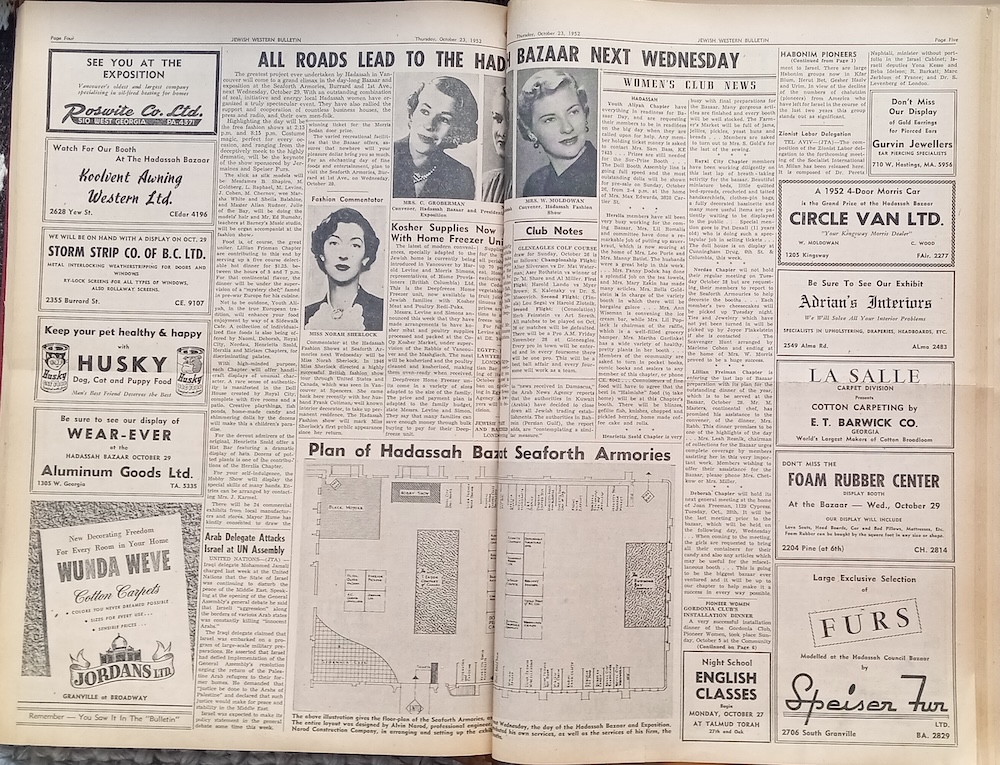
Oct. 10, 1935: This week, 90 years ago, community members were coming and going from the city. There was a Folk Song and Dance Festival and Arts and Crafts Exhibition coming up. Beth Israel, Young Judaea, AZA, BB Junior Auxiliary, Junior Council and Sub-Junior Council all had meetings and other events. China Seas and Page Miss Glory were screening at the Capitol Orpheum and Heart’s Desire was playing at the Strand.

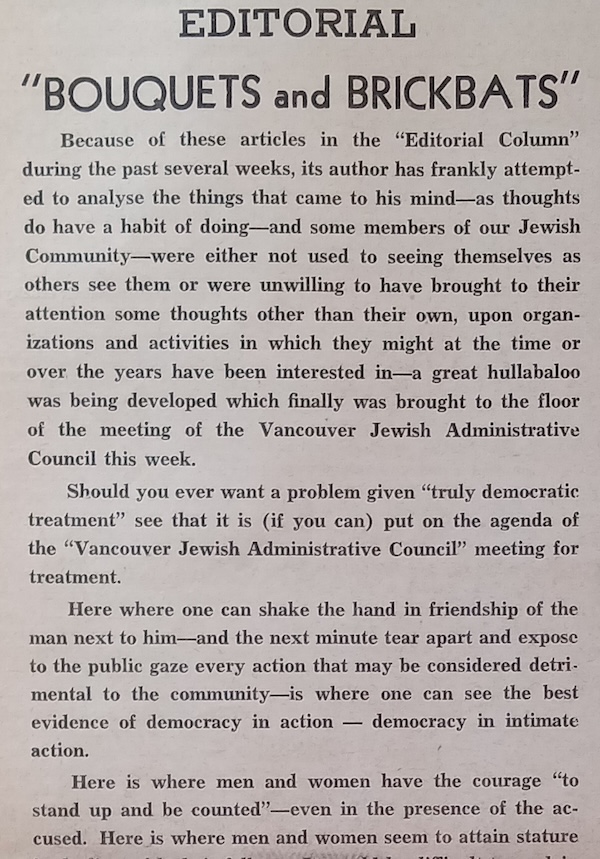
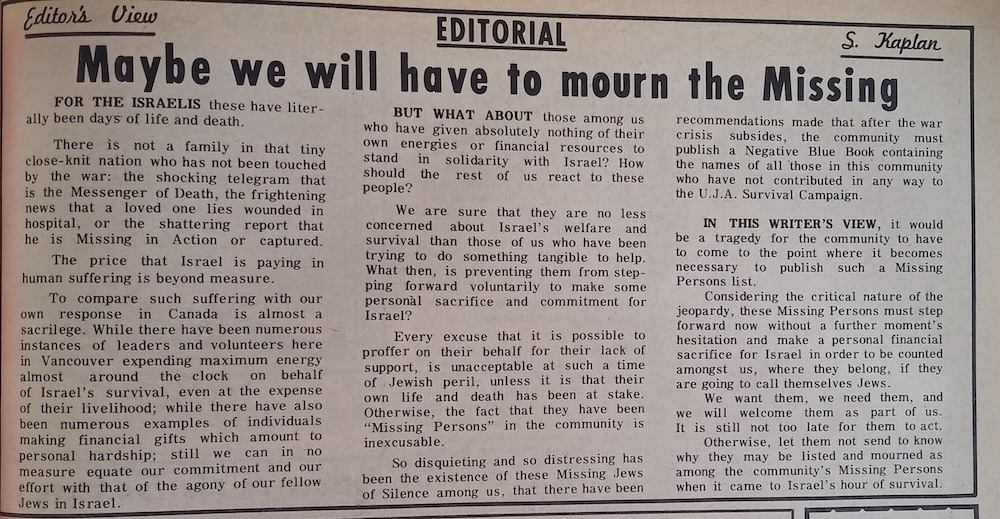
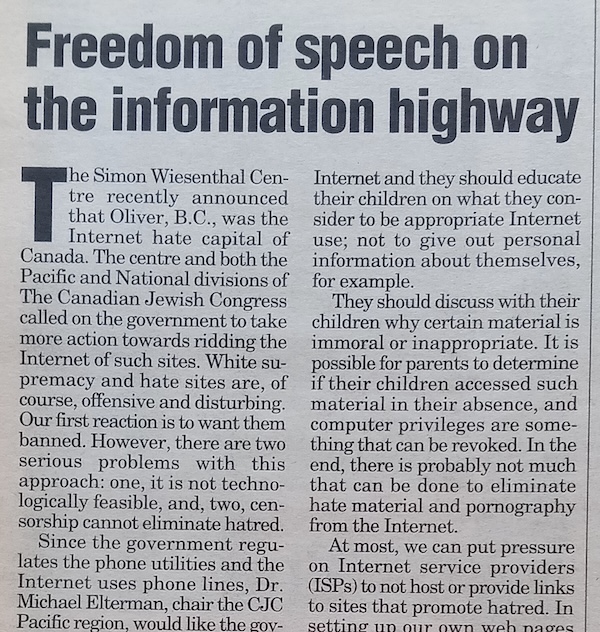
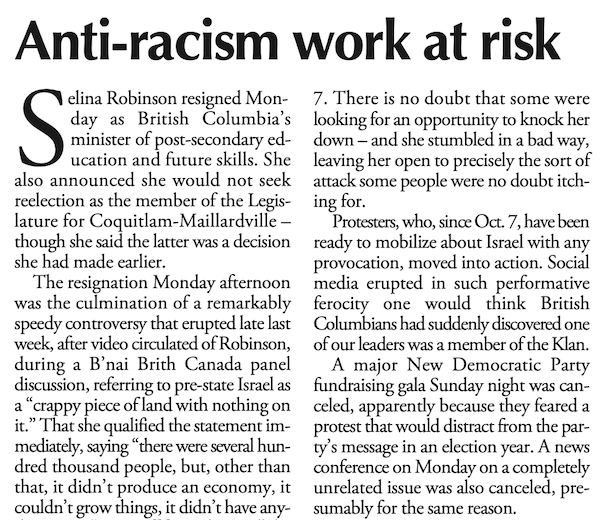
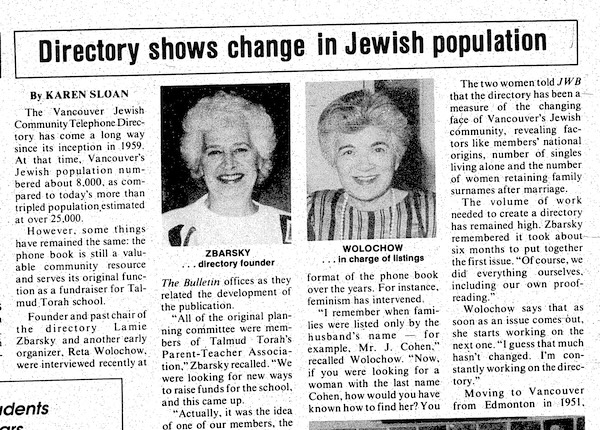
The Jewish Western Bulletin / Jewish Independent has always covered the arts and culture scene. Amid the harder-hitting news, there have been society and social notes columns, social and club news sections, synagogue calendars, event listings, notices and advertisements, as well as articles promoting, reviewing or otherwise profiling various creatives (including community organizers) or their creations/events.

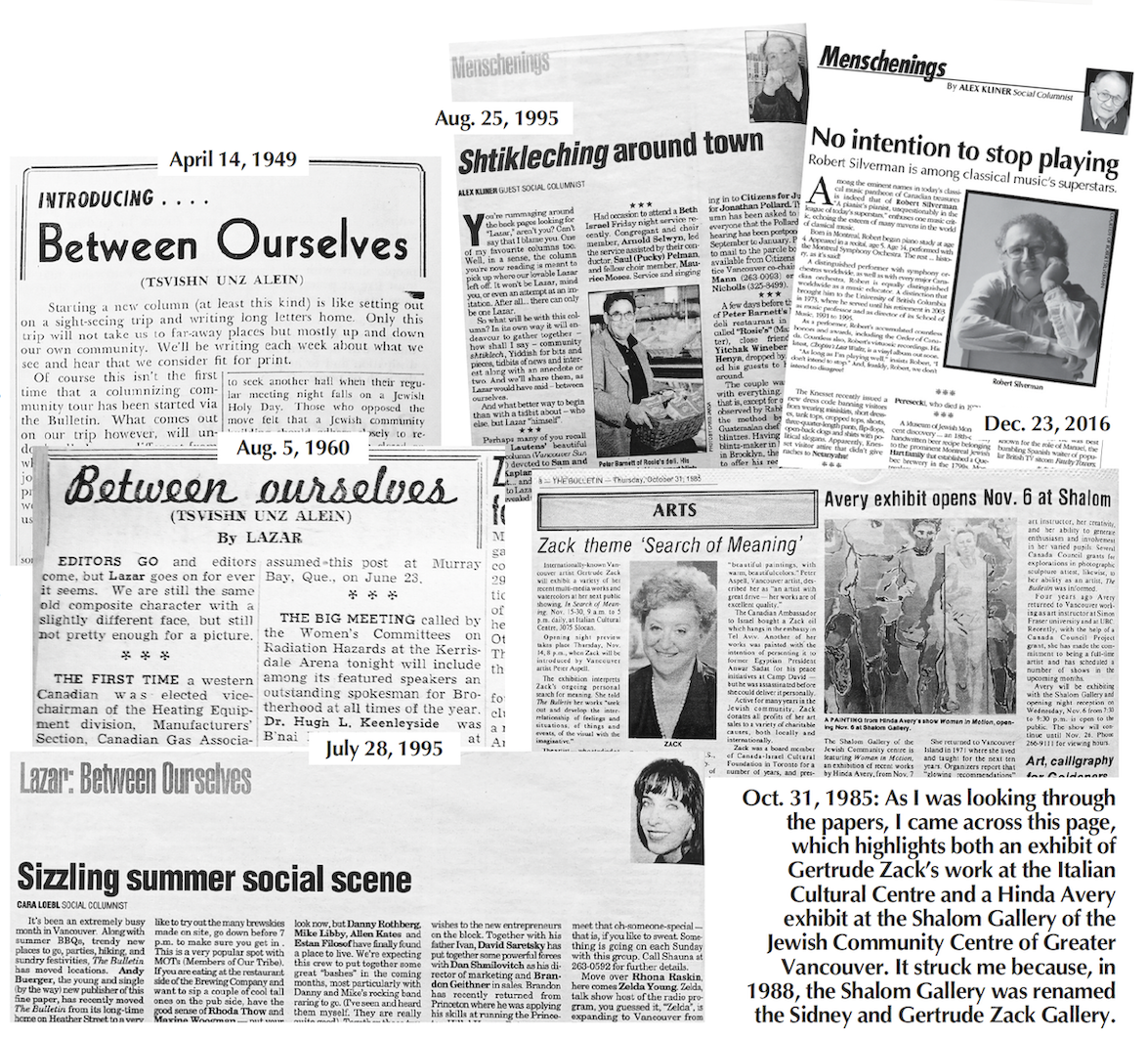
One of the longest-lasting social columns is Between Ourselves (Tsvishn Unz Alein) by Lazar, which started on April 14, 1949, when the JWB was run by the Vancouver Jewish Administrative Organization (akin to our Jewish Federation of Greater Vancouver) and Abraham Arnold was managing editor. When Sam and Mona Kaplan took over the paper in 1960, Mona Kaplan penned her first Between Ourselves (Tsvishn Unz Alein) by Lazar columns, in the Aug. 5 issue of that year, and she continued to be “Lazar” until the paper again sort of changed hands in mid-1995. While the Kaplans still owned the JWB, it came under new management, as they were beginning their retirement journey. At first, the new publisher, Andrew Buerger, kept the Lazar column – minus its Yiddish flavour – but editor Ariela Friedmann bid “Farewell to Lazar” (then written by Cara Loebl) a couple of months’ later, on Aug. 18, 1995.

Its replacement was Menschenings, which, Friedmann noted, would “give voice to all ages and aspects of the community, from social news, to what’s new, who’s new, some schmoozing, a bit of this and that.” 

Initially, the column was alternately written by two different writers, Jacqui Roitman and Alex Kliner, both of whom had experience in theatre and film. As many readers will know, Alex became the sole face of Menschenings, continuing through the Kaplans’ sale of the paper in mid-1999 to Kyle Berger, Pat Johnson and me. From his first column to his last, in 2016, when he retired, Alex’s writing was infused with Yiddish, having a heimishe (homey and familiar) quality like Lazar’s, meaning that Between Ourselves/Menschenings lasted some 67 years. 

image - Between Ourselves/Menschenings history in newspaper clippings

Format ImagePosted on October 10, 2025October 8, 2025Author Cynthia RamsayCategories From the JITags Abraham Arnold, Alex Kliner, Cara Loebl, history, Jacqui Roitman, Lazar, lifestyle, Mona Kaplan

Canada recognizes Palestine

On Sunday, Prime Minister Mark Carney issued a statement on Canada’s recognition of Palestine as a state.

“Recognizing the state of Palestine, led by the Palestinian Authority, empowers those who seek peaceful coexistence and the end of Hamas,” said Carney. “This in no way legitimizes terrorism, nor is it any reward for it. Furthermore, it in no way compromises Canada’s steadfast support for the state of Israel, its people and their security – security that can only ultimately be guaranteed through the achievement of a comprehensive two-state solution.”

photo - Prime Minister Mark Carney
Prime Minister Mark Carney announced on Sunday that Canada would recognize Palestine as a state. (photo from Office of the Prime Minister)

Carney noted: “Since 1947, it has been the policy of every Canadian government to support a two-state solution for lasting peace in the Middle East.” He said there was an “expectation that this outcome would be eventually achieved as part of a negotiated settlement,” but “this possibility has been steadily and gravely eroded” by several factors. 

In addition to other criticisms of both Hamas and Israel, Carney lists the “pervasive threat of Hamas terrorism to Israel and its people, culminating in the heinous terrorist attack of Oct. 7, 2023,” and Hamas’s rejection of Israel’s right to exist; “accelerated settlement building across the West Bank and East Jerusalem, while settler violence against Palestinians has soared”; “the E1 Settlement Plan and this year’s vote by the Knesset calling for the annexation of the West Bank”; and the “Israeli government’s contribution to the humanitarian disaster in Gaza, including by impeding access to food and other essential humanitarian supplies.”

Carney said the Palestinian Authority “has provided direct commitments to Canada and the international community on much-needed reforms, including to fundamentally reform its governance, to hold general elections in 2026 in which Hamas can play no part, and to demilitarize the Palestinian state.”

In reaction to the prime minister’s Sept. 21 statement, Noah Shack, chief executive officer of the Centre for Israel and Jewish Affairs, said, “Hamas is not an isolated phenomenon. It is a violent manifestation of the rejection of the right of the Jewish people to a state in our ancestral home – a rejection that runs deep within Palestinian society.

“As Prime Minister Carney himself has noted, a Palestinian state must be a Zionist state. Today’s announcement undermines that objective and gives Hamas and other Palestinian rejectionists a sense of victory. This will only make it harder to secure the release of hostages and build a better future for Israelis and Palestinians.”

Shack acknowledged that, while the “announcement does not come as a surprise, the details are important. The government has stated that, while it is extending recognition, normalization of relations with a ‘state of Palestine’ is an ongoing, long-term process…. We will argue that this must not proceed so long as hostages are in tunnels, Hamas remains in power and the Palestinian leadership rejects Israel’s existence as a Jewish state.

“And we will continue,” said Shack, “to make it clear that, with anti-Jewish hate escalating, our government must recognize the unintended effect foreign policy has on the climate in our own country.”

B’nai Brith Canada also issued a response to Carney’s statement.

“The PA has shown, time and again, that it cannot be trusted,” said Richard Robertson, director of research and advocacy for B’nai Brith Canada. “It is unable to govern the Palestinian Territories and has repeatedly demonstrated it is unwilling to deliver on the very commitments upon which Canada’s recognition is supposed to be predicated.

“The commitments include democratic reform, free and fair elections in 2026 without Hamas, and the full demilitarization of the Palestinian Territories.

“None of these conditions have been met. Hamas continues to arm itself, hold hostages and carry out terror attacks. Recognition under these circumstances does not bring us any closer to lasting peace, it only further compromises the prospect of a two-state solution.”

Robertson said the “government has chosen appeasement over principle.”

On Sunday, the United Kingdom, Australia and Portugal made similar announcements to that of Canada. Reaction from Israel was critical.

“After the atrocities of Oct. 7, while Hamas continues its campaign of terror, and while it continues to cruelly hold 48 hostages in the tunnels and dungeons of Gaza, the recognition of a Palestinian state by some nations today is, not surprisingly, cheered by Hamas,” wrote Israel’s President Isaac Herzog in an X post.

“It will not help one Palestinian, it won’t help free one hostage, and it will not help us reach any settlement between Israelis and Palestinians. It will only embolden the forces of darkness.

“This is a sad day for those who seek true peace,” he concluded.

Israel’s Prime Minister Binyamin Netanyahu said he will release a formal response after he returns from the United States. However, in a widely reported Hebrew-language video statement, he said, “I have a clear message to those leaders who recognize a Palestinian state after the horrific massacre on Oct. 7 – you are handing a huge reward to terror.

“It will not happen,” he added. “A Palestinian state will not be established west of the Jordan.”

According to various news reports, Hamas did indeed applaud the recognition announcements, as did the Palestinian Authority. 

Posted on September 26, 2025September 24, 2025Author Cynthia RamsayCategories NationalTags Binyamin Netanyahu, B’nai Brith Canada, Centre for Israel and Jewish Affairs, CIJA, Hamas, Isaac Herzog, Israel, Liberal Party of Canada, Mark Carney, Noah Shack, Palestine, Palestinian Authority, politics, Richard Robertson, terrorism
Working with “the enemy”

Working with “the enemy”

In the Gaza Youth Committee campaign We Live Together, We Die Together, young Gazans hold, in a show of solidarity with Israelis, photographs of Israeli children who were killed on Oct. 7, 2023. (photo from Rami Aman)

“People must understand that the people of Gaza are not victims and they are not superheroes. We are human beings, a group of people like any other society. We love life and hate death, we love singing and we hate violence. We are not terrorists. Parents pay to educate their sons and daughters in medicine, engineering, pharmacy, art, business, English and other languages. Gaza is not Hamas, and Hamas is not Gaza – Hamas is part of the Muslim Brotherhood,” Palestinian journalist Rami Aman, founder of the Gaza Youth Committee, told the Independent in a recent interview.

JI readers may have seen on social media one of the latest Gaza Youth Committee (GYC) campaigns, called We Live Together, We Die Together. Its images feature young Gazans holding, in a show of solidarity with Israelis, photographs of Israeli children who were killed on Oct. 7, 2023. The Gazans stand amid buildings and neighbourhoods destroyed in the Israel-Hamas war. The Independent was connected with Aman by Vancouver Friends of Standing Together.

“As the months of war passed, many voices increased within Israeli society opposing the killing of Gaza’s children, expressing solidarity with their families, and calling for an end to the war,” he explained about the social media campaign. “In Gaza, we saw tens of thousands of Israeli demonstrators carrying pictures of child victims in the Gaza war. Therefore, despite the killing, hunger, siege and shortages in Gaza, it was important for us to prove that, in Gaza, there are Palestinians who object to the killing of any child, and to show their solidarity with all the child victims who have fallen in the war, Israeli or Palestinian.

“We have lost a large number of Muslim, Christian and Jewish children because of this war between Hamas and the Israeli army,” he said. “This campaign emerged from Gaza to emphasize the people’s rejection of the war and the killing of children, and the need to release the Israeli hostages, end the war and provide medical treatment for the children of Gaza.”

photo - Palestinian journalist Rami Aman, founder of the Gaza Youth Committee
Palestinian journalist Rami Aman, founder of the Gaza Youth Committee, speaking at an event. One of his goals is to hold meetings between Palestinians and Israelis to help them respect one another and determine their own fate. (photo from Rami Aman)

Aman started the GYC after the first Israel-Hamas war, which he described as “a turning point” in his life.

“I began thinking about trying to do something two months after the end of the war in 2009. I decided to look for a place to establish an FM radio station in Gaza that would emphasize the voice of the peaceful people of Gaza,” said Aman, who has a bachelor’s degree in electronics and communication engineering. “At the beginning of August 2009, I received my first request from Hamas security. They interrogated me for long hours, and I was subjected to repeated assaults by Hamas members in the following days. They warned me against broadcasting any radio station or publishing any media content about Gaza without their permission.”

Realizing that Hamas wanted no other voice from Gaza than their own, Aman said, “At the beginning of 2010, I decided to form an independent youth group whose goal was to spread awareness internally and to strengthen our relations externally. Our first meeting included 30 young men and women from Gaza, and we agreed on the need to form an independent youth body that would advocate for Palestinian reconciliation and spread the voice of peace from Gaza to the entire world.”

The Gaza Youth Committee currently has more than 300 members inside and outside Gaza, said Aman, “and we are still trying to reach our goals.”

“We are all working to convey the true image of the people of Gaza and to build genuine partnerships with Israelis to help Palestinians and Israelis understand and respect each other,” he said.

Over the past 15 years of activities and meetings, Aman said he has learned a lot, “including how to influence public opinion within Gaza and how to build pressure and advocacy campaigns.

“Over these years,” he said, “I’ve realized the importance of inviting enemies to dialogue, instead of fighting, and trying to shape a different image of the other. These years have helped me differentiate between the Palestinian who wants to build their society for the better and the Palestinian who seeks to achieve their own interests from the Israelis or Palestinians at the expense of others.

“After many different activities between the Gaza Youth Committee and several Israeli movements and organizations, we have built many bridges and created a lot of connections and relations.”

GYC initiatives have included the release of 200 doves from Gaza with messages of peace, Skype calls between Gazans and Americans, and Gazans and Israelis, and a cycling marathon along the border in which both Israelis and Gazans participated.

This work has not been without risk. Aman has been arrested and tortured by Hamas more than once for his peace initiatives with Israelis, as have people with whom he has worked. After a GYC Zoom call in April 2020, he was arrested, Hamas apparently being alerted by the social media post of journalist Hind Khoudary, who was consulting for Amnesty International at the time.

According to a 2020 Jerusalem Post article, “she did not tag Hamas officials in her Facebook posts against Rami Aman to get him arrested but as a protest against normalization activities.

“‘I want all the normalization activities he is doing with Israel from Gaza to stop immediately because any joint activities, cooperation or dialogue with Israelis is unacceptable, even engaging with Israeli ‘peace activists,’” she said in an interview with the Post.

To secure his release, Aman was told he’d have to divorce his then-wife, the daughter of a Hamas official, who was also among those arrested. He eventually signed the papers in August of that year. His wife had already been released at that point, but Aman remained in prison, despite what he’d been told. He was prosecuted in September 2020 for “weakening revolutionary spirit,” and ultimately convicted. After international pressure, he was released in late October, with a suspended sentence, according to a 2021 article in the Times of Israel.

His former wife traveled with a Hamas escort to Cairo while Hamas released Aman from prison one day later. The couple kept in touch after Aman’s release from prison and subsequent move to Cairo in 2021, but have drifted apart for various reasons. Intending to return to Gaza in late 2023, the war caused Aman to change his plans.

“When I first started working for Gaza from abroad, I felt strong and free, and I regained my energy,” he said. “With the outbreak of the war, I began to feel stuck. I couldn’t call on people to demonstrate to end the war while I was on Facebook. People in Gaza trusted me because I was always the first to demonstrate against Hamas, from 2011 until before I left Gaza. If I were in Gaza, I would certainly demonstrate, even for an hour every day, to end the war. Then I would call on people to demonstrate while I was on the street.”

While he would prefer to be in Gaza, Aman said technology has helped GYC’s activism greatly, even before he had to leave his homeland.

“From 2007 until now, Israel has consistently imposed blockades on the residents of the Gaza Strip,” he explained, “while Hamas remained unaffected by any crises and received hundreds of millions of dollars with the help of the Qataris and [Israeli Prime Minister Binyamin] Netanyahu, in addition to Hamas’s control over travel through the Rafah crossing.

“The real blockade was imposed on us in the Gaza Youth Committee and the majority of Palestinians, so we used Skype and Zoom to communicate with our friends and partners outside Gaza, the most famous of which was the Skype with Your Enemy initiative in 2014.

“We also organized hundreds of meetings that helped introduce me to the world and led several organizations to extend invitations to visit them abroad. I traveled to India because of these meetings, which led to me meeting with the Dalai Lama. A few months ago, I was in Europe to speak about Gaza in several European cities.

“Most of the news coming from media outlets and news agencies will not present the truth to anyone, and it is better to communicate directly with the people in Gaza,” said Aman. “Israel has not provided us with permits to enter the West Bank and Jerusalem. Since 2010, the Israeli authorities have only granted me a 12-hour permit to attend a workshop in 2014 and permits to transit to Jordan when traveling from Gaza. For me and others, these applications have resulted in the building of a large number of personal friendships that continue to this day because they have been created between people, both Palestinians and Israelis.”

Aman has strong criticisms of the media in general, and Al Jazeera in particular, as well as UNRWA (the United Nations Relief and Works Agency for Palestine Refugees in the Near East).

“No Palestinian in Gaza watches Al Jazeera. No Palestinian in Gaza trusts in UNRWA. No Palestinian in Gaza trusts in all of these media,” Aman told UN Watch in an interview earlier this month.

In this atmosphere, the GYC continues its efforts.

“We at the Gaza Youth Committee work to strengthen the capacities of Palestinian youth, develop their skills and create a Palestinian movement from Gaza, the West Bank and the diaspora that expresses the aspirations of the independent Palestinian people,” said Aman. “At the Gaza Youth Committee, we always strive to hold meetings between Palestinians in Gaza and Israelis, helping them respect each other and determine their own fate by implementing joint initiatives and conveying their voices to the Americans and Europeans.

“Before the war,” he said, “we always tried to organize demonstrations to demand that Hamas hold elections, resolve the unemployment and electricity crises, and step back from governing Gaza. Even now, during the war, we are working to direct the people of Gaza to demand an end to the war.”

Aman contends that most Gazans want peace, despite polls that indicate the opposite.

“I don’t believe that much in polls,” he said, “but I understand Palestinian and Israeli public opinion. The two societies have been at war for years and have seen nothing but bloodshed and destruction, and wars only create enemies. Trust was lost before Oct. 7 and the distrust increased after the war.

“I have always believed in the importance of talking to enemies and engaging in dialogue instead of fighting. This is what I do through Zoom and Skype meetings. If there is one Palestinian and one Israeli who believe in a peaceful solution, then there is hope. We need courageous decision-makers who can lead their societies toward peace, not lead them toward fighting, hostage-taking and spreading hatred.”

Given his years of organizing video conferences, Aman said, “I have considerable experience, gained from speaking with thousands of Palestinians and thousands of Israelis. Their beliefs and opinions differ, but the common humanity that unites them always remains. They don’t know each other because of the media, and I believe in what I do and in every person’s right to life and safety, regardless of their religious or political beliefs.”

Working with “the enemy” has become Aman’s life mission. This, despite having been imprisoned and tortured by Hamas, having had loved ones killed or taken away from him by both Israeli forces and Hamas, and his neighbourhood in Gaza being destroyed by Israeli bombs.

“It’s true that, as a person, I suffer every day from this news and all the memories,” he admitted. “In addition to what Hamas did to me, it was horrific and psychologically and physically painful. However, there are people around me from whom I get this energy, and I always feel that I must be their partner in promoting dialogue and respect between Palestinians and Israelis.

“With every loss of a person, I always feel that they are advising me to continue my path and take care of their children,” he said. “Therefore, in my activities, I always aim to help families and individuals I know well, and I don’t want them to feel that I am far away from them. That is why I do my best to make their voices heard and that is from where my sense of responsibility for this matter comes.”

Aman is certain there are partners for peace on both sides.

“I consider myself a partner to any Israeli who seeks peace and an end to the war,” he said. “I know that there are Israelis who consider themselves peace partners with the Palestinians. I know Palestinians and Israelis who have lost their children and parents and still believe in peace, so that no more victims fall.”

He stressed the need to stand together.

“Our voices must unite to stop the war, free the Israeli hostages, protect the Palestinians in Gaza and help them rebuild their society,” he said. “We must find 50 Palestinian and Israeli leaders who will work to bring Palestinians and Israelis together.”

As Aman responded to the Independent’s questions, he said Israel Defence Forces tanks were “stationed hundreds of metres away from where my family and friends are. But I always know,” he said, “that life exists and so does death. Anyone can be the next hope and anyone can be the next victim.” 

Format ImagePosted on September 26, 2025September 26, 2025Author Cynthia RamsayCategories WorldTags Amnesty International, free speech, Gaza war, Gaza Youth Committee, GYC, Hamas, Israel, Israel-Hamas war, Israelis, journalism, media, Oct. 7, Palestinians, peace, politics, Rami Aman, solidarity, United Nations, UNRWA
CHW expands helping efforts

CHW expands helping efforts

Israeli journalist Rolene Marks, chair of WIZO’s Hasbara Division, was the keynote speaker at CHW Vancouver Centre’s Opening Lunch and Fashion Show on Sept. 14. (photo by Cynthia Ramsay)

“I know that, as a community, you are feeling vulnerable and you are feeling that you have to be the mouthpiece or, as I call it, the litmus test, for however Israel is prosecuting a war so many miles, so far away, from you,” Israeli journalist and advocate Rolene Marks told those gathered at CHW Vancouver Centre’s Opening Lunch and Fashion Show on Sept. 14. “And I want to tell you that, although Israel’s not perfect – even though we are the only country in the world expected to prosecute a perfect war – you can be proud of the state of Israel.”

photo - Left to right: Claudia Goldman, Rolene Marks and Toby Rubin at the Sept. 14 event
Left to right: Claudia Goldman, Rolene Marks and Toby Rubin at the Sept. 14 event. (photo from CHW)

Marks, who, among other things, chairs WIZO’s Hasbara Division, was the event’s keynote speaker. Toby Rubin, president of CHW Vancouver Centre, welcomed the 150-plus guests at the Richmond Country Club Sept. 14, acknowledging the presence of Judy Mandleman, Rochelle Levinson and Claudia Goldman – three local Jewish community members who have been presidents of national CHW. She noted that the current national president, Tova Train, would be speaking, as would Lisa Colt-Kotler, chief executive officer of CHW, and Marks.

“This luncheon today is raising funds for two very important projects that we have here locally,” said Rubin. “One is JOLT, and the other is Franny’s Fund [which supports six youth advocacy centres across Canada, including the Treehouse Vancouver Child and Youth Advocacy Centre]. JOLT is the Jewish Outreach Leadership Training program at Canadian Young Judaea, and provides camperships to seven camps across Canada, including our very own Camp Hatikvah. Today, we are honoured to have with us the president of Camp Hatikvah, Joanna Wasel, who, along with the camp director and staff has worked with CHW these past two summers with the campers.”

Last year, Wasel and staff spearheaded making keychains and bracelets for Israeli soldiers, which Colt-Kotler and Train hand-delivered on a visit last January to patients at the Gandel Rehabilitation Centre at Hadassah Hospital, said Tobin.

This year, campers in Hatikvah’s first session created their own version of the Maccabi Games, as a fundraiser for HaGal Sheli (My Wave), “a surfing program that is used to help people combat stress, anxiety and PTSD,” said Rubin. “And you can only imagine, since Oct. 7, how important that program is.”

The initiative raised more than $7,000 for HaGal Sheli, said Rubin, who also noted that the brunch’s table decorations of books, toy cars and pens would be given to Treehouse Vancouver. Many of the books were donated by Vancouver Talmud Torah, she said.

Train, who came to the event from Toronto, spoke about being from Edmonton, calling herself “a Westerner at heart.”

“I never imagined myself taking on the role of national president,” she said, “but I’ve always believed with my whole heart that, if I cannot serve Israel by wearing a uniform, then my obligation is to serve in every other way I can. That’s why CHW speaks so deeply to me. For more than a century, this organization has invested in education, health care and social services. And, today, especially after Oct. 7, those needs have never been greater – Rolene shared with me a statistic this morning that more than 10,000 IDF soldiers have been treated for mental health issues across the country since Oct. 7.”

After a video about CHW’s various impacts, Colt-Kotler presented a plaque to Bernard Pinsky, in his role as chair of the Ronald S. Roadburg Foundation.

“CHW, at our core, is philanthropy, and we were founded, as you know, in 1917, by a very dedicated, special woman named Lillian Freiman,” said Colt-Kotler, describing Freiman as “an example of philanthropy” and “of dedication to the Jewish community,” and as “the essence of what a CHW woman is … an empowered woman.”

photo - Lisa Colt-Kotler, chief executive officer of CHW, presents a plaque to Bernard Pinsky, chair of the Ronald S. Roadburg Foundation
Lisa Colt-Kotler, chief executive officer of CHW, presents a plaque to Bernard Pinsky, chair of the Ronald S. Roadburg Foundation. (photo from CHW)

She continued, “We created the Lillian Freiman Society to recognize individual donors for their generous philanthropy, starting at $100,000, and the Ronald S. Roadburg Foundation generously donated to Michal Sela Forum …  to combat domestic violence, to provide innovative solutions for the protection from and prevention of intimate partner violence,” said Colt-Kotler. 

Pinsky said he pushed the foundation to have women’s empowerment as one of its focuses because, from the time he was a teenager, he has been influenced by his sister, Helen Pinsky, who attended the brunch.

“She’s a real feminist,” he said. “And somebody who taught me that women’s empowerment and women’s protection is very, very important in life, and I think it’s no less important today than it was over 50 years ago, when she talked to me about it.”

When Marks took to the podium, she acknowledged the Israel Defence Forces soldiers, who are “fighting 24/7 to protect the state of Israel.”

“I also want to take a moment to acknowledge the over 900 soldiers who have fallen in defence of the state of Israel and the many who are wounded, both physically and who carry those invisible wounds,” said Marks. 

“It is an absolute imperative that I mention that we still have 48 hostages languishing in the hell of Gaza,” she added. “Every second counts…. We want them home now.”

Marks specializes in media, public relations and training on Jewish- and Israel-related issues. She hosts a radio program called Modiin and Beyond and is a contributor on Johannesburg’s Chai FM. She co-founded Lay of the Land, hosts The Israel Brief on YouTube and serves as a national spokesperson for the South African Zionist Federation. She is currently doing a doctorate at Middlesex University London, in media, politics and antisemitism.

“I’m the W in the CHW [Canadian Hadassah-WIZO] – I represent World WIZO, Israel’s foremost women’s organization in terms of working for empowerment,” said Marks. “And we have seen, certainly in the last two years, the voices of Jewish women and the experience of Israeli women on the 7th of October completely erased from the feminist landscape.”

Israel is fighting a war on multiple fronts, she said, acknowledging how vulnerable the diaspora community feels because of what is put out in the media, which filters onto the streets and makes it into government policy.

“I know that every day you hear the accusations: genocide, mass starvation, bombing of civilian infrastructure, like hospitals. And I can tell you that, as somebody who is living through the war and covering the war, the situation is not what you are being painted out to answer for.”

Marks was in Gaza a few weeks before the CHW brunch.

“I saw mountains – mountains and mountains – of humanitarian aid marked United Nations, UNICEF, World Food Program, and more. Things like medical kits, baby formula, flour, oil, pasta, hygiene kits, all languishing in the sun. Now, accompanying the few of us that went in, apart from our incredible soldiers, were two journalists from Australia’s ABC [network]…. The IDF said to us, we’re here to answer questions, but, guys, go off, find your stories; there was no interference. And these two journalists stood in front of a big mountain of aid marked United Nations and, in his piece to camera, the correspondent said, ‘This is the image that Israel wants you to see with regards to humanitarian aid.’ And you could hear the collective jaw drop from the rest of us, including colleagues from the Arab media, because we know what we saw. But my point is this: the bias and the narrative-building start in the field.

“I’ve had several instances where I’ve gone into the field with the foreign media,” she said. “And, despite what they have seen, they have turned it into an agenda that they can push to put the pressure on Israel, and to put the pressure on you as a community.”

Marks stressed that “we can hold our heads up high as a community and as a people. There is nothing dirty about the Z word.”

Zionist, she said, “just means a belief in the existence of the nation-state of the Jewish people in our ancient homeland.”

In the fight against antisemitism, everyone must play a role, said Marks, whether “sharing on your social media or writing letters to the press or getting involved in your community organizations. We are a people that have survived millennia of blood libels, persecution, and attempts to erase our history and our narrative.”

This can include something like wearing a Magen David, she said: “When you show your pride and you show your strength, you stand up to the hate, you stand up to the misinformation.”

She added, “The truth always comes, but we need your help to make that happen. When people accuse us of genocide, I can tell you, as somebody who has been working on the ground, the complete opposite is true.… Our army inoculates children against polio in the Gaza Strip, and drops leaflets, and moves civilians out of harm’s way.”

She recommended people follow Israel’s COGAT (Coordinator of Government Activities in the Territories) website, where you can track the humanitarian aid going to the Gaza Strip and related news.

Referring to the murder of American activist Charlie Kirk, she said “it was symptomatic of something very, very frightening that is spreading around the world, and that is a move to disengage in discourse, a move to shut down conversation. And it is so important that we have these conversations. It is so important that we interrogate the truth and the facts.”

In the question-and-answer period, Marks suggested the lack of support from allies like Canada, France, the United Kingdom, Australia and others, is “a big campaign to deflect from problems that are domestic.”

“It’s very, very distressing for us in Israel to see our allies taking the side of Hamas, and also treating us like the naughty child of the world,” she said. “And part of that is, we believe, that many countries have forgotten or don’t know what it’s like to live under constant threat. We live under constant threat … wars within wars.”

Marks recalled what Israeli President Isaac Herzog told British Prime Minister Keir Starmer in a recent meeting: “Friends can sometimes disagree – but don’t reward terror.”

While in Vancouver, Marks also spoke at a CHW-Community Kollel event on Sept. 12.

photo - The fashion show part of CHW Vancouver Centre’s opening event featured local community members sporting clothes from Maison Labelle Boutique and After Five
The fashion show part of CHW Vancouver Centre’s opening event featured local community members sporting clothes from Maison Labelle Boutique and After Five. (photo from CHW)

The Sept. 14 speeches and brunch were followed by an intergenerational fashion show, with models sporting clothes from Maison Labelle Boutique and After Five. Walking down the runway were grandmothers, mothers, daughters, granddaughters and friends. 

Format ImagePosted on September 26, 2025September 24, 2025Author Cynthia RamsayCategories LocalTags After Five, antisemitism, Bernard Pinsky, bias, Canadian Hadassah-WIZO, CHW, fashion show, genocide, health care, Israel-Hamas war, journalism, Lisa Colt-Kotler, Maison Labelle Boutique, media, Oct. 7, philanthropy, Rolene Marks, Ronald S. Roadburg Foundation, tikkun olam, Toby Rubin, Tova Train, United Nations, women, World WIZO
Impacts of oppression

Impacts of oppression

Franz was shot in Prague, including near Franz Kafka’s birthplace. (still from film)

Troubled father-son relationships, both literally and metaphorically, are themes of Franz and Orphan, the former a biopic with some quirks and the latter a more old-school period piece. The two movies are part of this year’s Vancouver International Film Festival, which runs Oct. 2-12.

Director Agnieszka Holland’s Franz is an imaginative film that flits between the “present,” Franz Kafka’s adult years, until his death, at age 40, in 1924, and some formative childhood moments (mostly highlighting his domineering and dismissive father), while also jumping into the future, where tour guides at various institutions and parks tell modern-day tourists all about the influential writer. 

In one of these future moments, we learn that the ratio of words written by Kafka and those written by others about him is approximately one to 10 million. Some of these millions of words were written by Kafka’s friend and literary executor, novelist Max Brod, who rescued much of Kafka’s work. Brod’s Franz Kafka: A Biography is apparently a primary source of what we know about Kafka’s life, and he is featured in Holland’s film.

While Idan Weiss, who plays the tortured writer (and insurance lawyer) has gotten kudos from other reviewers for his performance, Peter Kurth, who plays Hermann Kafka, Franz’s father, stands out even more. Kurth plays stubborn and unlikeable well, but also shows Hermann’s vulnerability and how he uses meanness to cover it up.

Franz Kafka was born in Prague, in 1883, and he is witness to world-changing events, including the First World War and the subsequent collapse of the Austro-Hungarian Empire. Kafka was drafted, but his employers successfully argued that he was an indispensable worker – according to the movie, they did so at Hermann’s behest. The creation of Czechoslovakia and several other independent states after the war is not an explicit aspect of Franz, but the oppressiveness of the empire (the fatherland, in the metaphor) comes out in Kafka’s depictions of bureaucracy, alienation, anxiety, etc. While Franz doesn’t add any new knowledge to what’s known about Kafka, his upbringing (harsh on many levels), writing (most of it published after his death), love life (engaged for a period, then involved with a married woman), religion (not an observant or believing Jew) and illness (tuberculosis), but it might bring a new generation to his ideas, which remain important.

As Holland told Variety: “the dehumanization of society, the despisal of [certain groups of people] and alienation are once again becoming the main communicative tools,” but, not wanting to “give an interpretation like that,” she said, “Kafka has been interpreted in so many ways, as is shown in the film, but when you compare what he wrote with what was written about him they are poles apart. So, we didn’t want to reinterpret Kafka; we wanted to make him alive.”

And Franz is a success in those terms. It is entertaining and thought-provoking, though sometimes the thoughts are about odd creative choices. There is a lot of male nudity and it’s not always clear why. For example, in one scene at a sanitorium, naked men, some wearing animal head masks, engage in a game of tug-o-war.

László Nemes’s Orphan, which takes place in Hungary, is a more linear and literal form of storytelling, also focusing on a time of upheaval and oppression. While most of the film takes place in 1957 – a year after the Soviet Union crushed the people’s revolt against the country’s communist government – the young Jewish protagonist, Andor (played by a brooding Bojtorján Barábas), was put into an orphanage during the Second World War. We witness his mother and a reluctant Andor reunited after the Holocaust. Her “saviour” was a non-Jew, Berend (played by Grégory Gadebois with nuance), who Andor absolutely hates. 

photo - Bojtorján Barábas and Grégory Gadebois in Orphan
Bojtorján Barábas and Grégory Gadebois in Orphan. (photo © Mostra internazionale d’arte cinematografica­)

Andor cannot forgive his mother for giving up on the possibility of his father’s survival, even years after the war, and, when Berend claims that Andor is actually his biological son (and Andor’s mother never clarifies), Andor’s anger is barely containable and the tension mounts to a climatic Ferris wheel ride. While Berend is an abusive brute, he also seems to genuinely want Andor’s filial affection. Andor and Berend not only represent son and (possible) father, but Hungary’s desire for freedom from its Soviet oppression. 

Orphan is slow-paced, capturing the heaviness of the period, the incapacitating fear and oppression of 1957 Hungary. Twelve-year-old Andor doesn’t go to school, roams the streets, amuses himself at home, seems bored silly at times, and has nowhere positive to channel his frustrations and his feelings of abandonment.

While Franz and Orphan are two very different movies, they cover overlapping themes that are sadly all too relevant. Franz screens Oct. 7 and 11, and Orphan plays Oct. 2 and 4.

For tickets to either film and the entire festival line-up, go to viff.org. 

Format ImagePosted on September 26, 2025September 24, 2025Author Cynthia RamsayCategories TV & FilmTags Agnieszka Holland, Franz, history, László Nemes, movies, Orphan, Vancouver International Film Festival, VIFF

From the archives … Israel

image - JI at 95 clippings relating to Israel, mostly from 1970

Posted on September 26, 2025September 24, 2025Author Cynthia RamsayCategories From the JITags Arabs and Jews, archives, history, Israel, Jewish Independent, Jewish Western Bulletin, Zionism

Innovative approach to care

On Sept. 30, Canadian Friends of Sheba Medical Centre will host Medicine Reimagined, an evening with Prof. Amitai Ziv, deputy director of Sheba Medical Centre and head of its Rehabilitation Hospital, which is the national rehabilitation facility of Israel. Ziv is also the founder and director of the Israel Centre for Medical Simulation (MSR), an innovation hub for improving patient safety and clinical training.

Originally from Montreal, Ziv is spending his sabbatical in Vancouver at the University of British Columbia.

“This will be the first Canadian Friends of Sheba event in Vancouver, as we launch our chapter here, and we are truly thrilled to welcome Prof. Amitai Ziv,” Galit Blumenthal, manager of donor relations and events at Canadian Friends of Sheba Medical Centre, told the Independent. “Our goal is to raise awareness of Sheba Medical Centre and highlight its profound impact both in Israel and on the global stage.”

photo - Prof. Amitai Ziv, deputy director of Sheba Medical Centre and its Rehabilitation Hospital, speaks in Vancouver on the topic Medicine Reimagined
Prof. Amitai Ziv, deputy director of Sheba Medical Centre and its Rehabilitation Hospital, speaks in Vancouver on the topic Medicine Reimagined. (internet photo)

Sheba Medical Centre was established in 1948. Located in Tel HaShomer, near Tel Aviv, its website notes the facility has 159 medical departments and clinics, almost 2,000 beds and 75 laboratories, and receives about 1.9 million clinical visits and 200,000 emergency room visits a year. Its seven major facilities comprise a cancer centre, an academic campus, a research complex and four hospitals: children’s, women’s, acute care and rehabilitation. It also has several centres of excellence and institutes, notably for cancer, and heart and circulation. It counts 10,000 healthcare professionals, 1,700 physicians and 200 PhD research professionals.

“I support them, along with many other Israeli institutions, as I feel that this is at least some contribution that I can make during these difficult times,” said Tova Kornfeld, who connected Canadian Friends of Sheba Medical Centre (CFSMC), which is based in Toronto, with the Independent.

“I sometimes feel powerless living here in Canada when I see what is happening in Israel,” said Kornfeld. “If I can help in any way, whether by bringing awareness to the work being done by the various organizations or by making financial contributions, then I feel I must. As far as Sheba is concerned, it stepped up to the plate when Soroka Hospital was hit by an Iranian missile and took in all the ICU patients. 

“It is also the biggest rehab hospital in Israel and is providing rehabilitation for thousands of soldiers who have been injured since Oct. 7,” she added. “I have family members in the IDF and it is comforting to know that, if something were to happen to any of them, there would be hospitals like Sheba to care for them.”

Ziv’s areas of expertise are medical education, simulation and rehabilitative medicine, and he has served as a consultant and speaker at academic and health institutions around the world. The event in Vancouver will offer a look at Sheba Medical Centre and its innovations in, among other things, the rehabilitation field.

On Sept. 30, Vancouverites will also get to meet Einat Enbar, chief executive officer of CFSMC, which was established in 2017 to raise awareness and funds for Sheba Medical Centre, the care it offers, the research it conducts and the educational training it provides.

For Kornfeld, there is another aspect to supporting Israeli organizations and institutions. She hopes that financial and other assistance from the diaspora “gives the Israelis caught in the fray the message that we have their backs and that we are all in this together regardless of where we live. I would hope that this would be comforting to them when it appears that most of the world is against not only Israel but the Jewish people themselves.”

For more information on CFSMC and SMC, visit shebacanada.org. To attend the Sept. 30, 7 p.m., event in Vancouver (location upon registration), go to weblink.donorperfect.com/ProfAmitaiZivInVancouver. While free to attend, donations are welcome. Readers can email Blumenthal at [email protected] with any questions. 

Posted on September 12, 2025September 11, 2025Author Cynthia RamsayCategories Israel, LocalTags Amitai Ziv, CFSMC, fundraising, Israel, medicine, rehabilitation, research, Sheba Medical Centre, SMC, speakers, Tova Kornfeld
Traveling as a woman

Traveling as a woman

Caryl Eve Dolinko, author of A Woman’s Guide to World Travel, has been to 93 countries and counting. (photo from caryldolinko.com)

Caryl Eve Dolinko’s A Woman’s Guide to World Travel literally covers everything you need to know when traveling, from choosing where to go through to reacclimatizing when you get back home. Anyone, but especially women, about to take their first international trip should have this book handy. For people who have been a few places, and even for seasoned travelers, Dolinko’s latest also has snippets of history, many short, informative travel stories, an interesting perspective – and likely at least one point you’ve not thought of before.

Dolinko, who is a member of the Vancouver Jewish community, has been exploring the world for more than 40 years. She has been to 93 countries and counting. She has journeyed on her own and with others, as a young person and as an older person, as “a working professional, a mother with kids, as a straight and gay woman, and a daughter caring for an elderly parent.”

image - A Woman’s Guide to World Travel book coverA Woman’s Guide to World Travel, published by Whitecap Books earlier this year, is Dolinko’s third travel book, but the first as sole author. She co-wrote both The Complete Guide to Independent Travel (self-published) and The Globetrotter’s Guide: Essential Skills for Budget Travel (Red Deer Press), with Wayne Smits. The latter was a Canadian bestseller, notes Dolinko.

In the 25-plus years since The Globetrotter’s Guide came out, much has changed.

“The world’s population has almost doubled from over 4 billion in the early 1980s when I started to travel, to just over 8 billion today, putting a strain on finite resources,” writes Dolinko. “Many tourist attractions are now overused, overrun and exploited as a result of global tourism’s exponential growth. I believe it is past time for us to reconsider how we travel and become more aware of the impact we have.”

Her own approach to travel has changed since she started, at age 18, with a planned four-month trip to Europe that turned into “an epic eight-year odyssey.”

“When I first started traveling around the world in 1982, there was very little information available, especially for women, as very few were traveling the world alone,” she writes. “The internet didn’t exist, and neither did smartphones, digital cameras, selfies, social media, travel and hotel apps, GPS or texting. Lonely Planet was just starting to publish travel books and National Geographic was about the only magazine that showed exotic places around the world. Travel guides and literature were written with men in mind and, with so few women traveling, there was no need to address our particular issues and concerns. Only a small selection of useful advice was available to address women’s needs.”

That situation continues to change, with some studies estimating that “women are the primary decision-makers for travel in households, influencing up to 80% of all travel decisions. That’s a tremendous amount of buying power and it has influenced the tourism industry to change to meet our needs,” points out Dolinko, whose guide takes readers through some of the history leading to this development.

She briefly highlights six women “who dared to travel in their day,” starting with Ida Pfeiffer, who was born in Vienna in 1797. While Pfeiffer’s “travel stories and books inspired future generations of adventurers … her ethnocentric views frequently led her to be critical and intolerant of other cultures,” writes Dolinko. “As a result, she could be a harsh traveler, lacking the ability to appreciate other cultures on their own terms.”

Dolinko places great emphasis on what can be learned from other cultures, and stresses the importance of traveling with humility, not just for our own education, personal growth and safety, but for the benefit of the people and communities we encounter.

“Through our spending habits, we have the power to influence local economies and cultures, so it’s crucial to make informed decisions and be mindful of our impact,” she writes. “By supporting local businesses and organizations that prioritize sustainability and conservation efforts, we can make a positive difference and be a catalyst for change. Your actions have real consequences, so aim to leave a positive impact and a gentle footprint wherever you go.”

Elsewhere, she shares warnings, like “It’s strictly a cultural taboo or against the law in some cultures to be gay, and open displays of affection are discouraged”; “In some cultures, it’s expected and even considered impolite to accept the initial price offered by the seller without attempting to negotiate”; and “When communicating nonverbally, it is important to be aware of cultural differences and the meanings behind certain gestures. Pointing with your finger, for example, can be seen as rude or confrontational in many cultures.”

Dolinko spends time on photography in this context – reminding readers that some religious sites may prohibit photography, some people may not want to be on your social media feed and some cultures believe that a camera can steal a person’s soul. She talks about selfies, camera types and photo composition. 

There is not a stone left unturned in A Woman’s Guide to World Travel. She covers factors to consider when deciding where to go (like safety, cultural norms and accessibility), budgeting (don’t forget admission fees, tips, snacks, SIM cards and so on), choosing luggage (suitcase vs backpack, for instance) and packing (she gives detailed lists of clothing, footwear, toiletries and medical supplies to bring, plus a host of other items to consider). She suggests where you should be in your preparedness two months out, one month out, a week before you leave and the day before you leave. She explains and lists the documents you’ll need, the insurance and vaccinations, how you should leave your home and office, and what the people you leave behind might need if something were to happen to you on your trip.

Specific to women, Dolinko talks about how to interact with men (“being aware of cultural differences that may affect communication and behaviour, as well as keeping an eye out for red flags and listening to your intuition”) and how to safely have a travel romance (with men or women), as well as what to do if, God forbid, you are sexually assaulted or raped. She lays out how to deal with some common gynecological issues while traveling. She offers advice on visiting religious buildings. She makes suggestions about traveling with kids. And she shares so much more. 

To say that the 384-page A Woman’s Guide to World Travel is comprehensive is an understatement. It encompasses 40 years of experience traveling around the world, lots of photos (which I wish had been captioned, with some in colour) and relevant anecdotes. It’s a one-stop “shop” for anything you might want to know – and lots you didn’t know you needed to know – about travel. 

Format ImagePosted on September 12, 2025September 11, 2025Author Cynthia RamsayCategories BooksTags A Woman’s Guide to World Travel, Caryl Eve Dolinko, history, travel, women

Thriller delves into AI world

Daniel Kalla commands readers’ interest from the first sentence of his latest thriller, The Deepest Fake. And he keeps us turning pages straight to the end, not only as we contemplate who might be the culprit(s) of our hero’s apparent demise, but also as we consider the ideas Kalla puts forward about artificial intelligence, intellectual property, relationships, trust, measures of a successful life, and more.

Jewish Independent readers will be familiar with Kalla, who, in addition to being a writer of many international bestselling novels, is an emergency room physician here in Vancouver. The JI interviewed Kalla in 2023 and has reviewed of a few of his previous novels.

image - The Deepest Fake book coverThe plot-driving topic of The Deepest Fake – artificial intelligence – is new territory for the doctor-writer, who has penned many medical and science thrillers, using his physician’s knowledge to powerful effect. But he also has written an historical fiction trilogy set in Shanghai during the Second World War, where thousands of Jews fleeing Europe found safe haven, even as China and Japan were at war, so we know Kalla’s not afraid to do the research necessary to create a realistic-seeming fictional world centred around places and concepts less familiar to him, and to most readers.

As much as The Deepest Fake highlights some of the moral issues surrounding AI, it also explores other big issues, like medical assistance in dying (MAiD), fidelity in marriage and business partnerships, the foundations of trust, and where the creative process begins and who owns it. Kalla manages to cover all this ground and raise so many relevant questions while telling a great story. The Deepest Fake begins with a bang – “Liam Hirsch never seriously contemplated dying before his forty-ninth birthday – until today” – and keeps up the pace throughout.

Liam, founder and chief executive officer of a thriving AI company, TransScend, is suffering from a mysterious medical condition that’s first diagnosed as an aggressive form of ASL (amyotrophic lateral sclerosis). His symptoms – twitches and challenges with movement – have been getting worse, and he’s likely to lose basic motor function within months, maybe a year.

Despite the seriousness of his illness, Liam hesitates to tell his wife and kids, the former not only because of the pain it will cause, but because, weeks before, he discovered, with the help of a private investigator, that his wife was cheating on him. Adding to Liam’s stresses and the book’s adventure are some accounting irregularities at his company, the competitive nature of the tech world and the potentially manipulative AI app that he helped create. So, when it becomes obvious that someone wants Liam gone, the suspects are numerous, including his wife, all his staff, an aggrieved former business partner, and the technology itself.

The Deepest Fake is a fun, satisfying read. 

Posted on September 12, 2025September 11, 2025Author Cynthia RamsayCategories BooksTags artificial intelligence, Daniel Kalla, fiction, novels, The Deepest Fake, thrillers
Two different kinds of magic

Two different kinds of magic

It’s almost a new year. We’ve been taking stock more than usual throughout the month of Elul. It’s a valuable skill – being able to do regular cheshbon hanefesh, accounting of the soul, reflecting on our views and actions, with an eye to self-improvement, maybe even creating a positive ripple effect that extends beyond ourselves.

Two new children’s picture books introduce – or reinforce – the Jewish values of Shabbat (taking a break from work and technology, thereby recharging our physical and mental selves) and tikkun olam (taking care of ourselves, our homes, our neighbourhoods, and so on). They remind us that making the world better starts with us, what we do, how we treat ourselves and others.

Seattle publisher Intergalactic Afikoman released Fairy GodBubbie’s Shabbat by Ann Diament Koffsky this month. Koffsky has written and illustrated more than 50 kids books, with many about Judaism, its holidays, foods and symbols. Her website is worth checking out: there are reading guides, you can see her many artistic styles, download colouring pages featuring scenes from her books, as well as other images, and, of course, there are links to purchase her books.

In Fairy GodBubbie’s Shabbat, the Mazel family is busy and seems happy enough, Dad on his laptop, Mom on her phone, Sara playing games on a tablet. But, “Why is no one schmoozing?” wonders Fairy GodBubbie. “Noshing?? Kibbitzing!”

“Unlike regular fairy godmothers who come only when called, Fairy GodBubbies just show up to fix things.

“Even when they’re not invited,” writes Koffsky.

So, poof! With a couple of Shabbat candles and a frequency jammer, Fairy GodBubbie helps the Mazels experience a different kind of Shabbat, a much more fulfilling one, a magical one. And readers can create the experience at their own homes, trying out what Koffsky calls a “a Tech Shabbat – a day away from screens.” She asks, “If your family does choose to try out a Tech Shabbat, what would you most like to do during that time?” And offers some choices – “Will you eat a family meal? … Curl up with a good book?” – and encourages readers to come up with their own ideas to make their “next Shabbat feel magical.”

image - Ruby Finkelman Finds the Real Magic book coverThe Collective Book Studio’s Ruby Finkelman Finds the Real Magic, written by Mike King with illustrations by Shahar Kober, which came out earlier this year, also features a young heroine and, as the title indicates, “magic.” But there are no magical GodBubbies; rather, a self-realization that a beautiful village, a beautiful life, don’t just happen by magic – happiness, cleanliness, kindness, etc., require not only effort, but sometimes doing things you don’t enjoy doing. In Ruby’s case, she “especially didn’t like brushing her teeth,” so, one night, she decides, “I’m never going to brush my teeth again.”

Even such seemingly inconsequential actions have repercussions. Other kids stop brushing their teeth. Then they decide not to wash their faces, tidy up after themselves or treat one another kindly. Parents nag, children kvetch. The grownups become so exhausted, they have “no strength left to lift a toothbrush, do the laundry, take out the garbage, and on and on.” Kvellville soon turns into what neighbouring villages start calling “Schmutzville.” A town meeting devolves into several arguments, everyone turning on one another.

Seeing the madness, and realizing how it all started, Ruby sets about to right the situation.

“Mensch is a Yiddish word that means ‘human,’ but when used in the sense of ‘being a mensch,’ it means being a human in the best possible way, or being the best human that you can be,” writes King in an author’s note at the end of the story. “But it’s not only a Jewish thing – it’s a universal value, an idea of how to act in a way that makes the world a better place, simply because you behave in a good and kind way.”

While the toothbrushing premise is a little bit of a stretch, King is a pediatric dentist, so it’s no wonder, and he does manage to make the story work. It’s a wonderful message, of course, and Kober’s artwork is delightful. 

Format ImagePosted on September 12, 2025September 11, 2025Author Cynthia RamsayCategories BooksTags Ann Diament Koffsky, artwork, children's books, Collective Book Studio, Intergalactic Afikoman, kids books, Mike King, Shahar Kober

Posts pagination

Previous page Page 1 … Page 4 Page 5 Page 6 … Page 84 Next page
Proudly powered by WordPress