Skip to content
  • Home
  • Subscribe / donate
  • Events calendar
  • Business Directory
  • FAQ
  • News
    • Local
    • National
    • Israel
    • World
    • עניין בחדשות
      A roundup of news in Canada and further afield, in Hebrew.
  • Opinion
    • From the JI
    • Op-Ed
  • Arts & Culture
    • Performing Arts
    • Music
    • Books
    • Visual Arts
    • TV & Film
  • Life
    • Celebrating the Holidays
    • Travel
    • The Daily Snooze
      Cartoons by Jacob Samuel
    • Mystery Photo
      Help the JI and JMABC fill in the gaps in our archives.
  • Community Links
    • Organizations, Etc.
    • Other News Sources & Blogs
  • JI Chai Celebration
  • JI@88! video

Recent Posts

  • Or Shalom reopens its doors
  • JFS from past to future
  • Need holistic approach
  • Sharing stories, advice
  • Journalist shares fears
  • Skills to live together
  • Road to independence
  • Cutting grass with scissors
  • Zionism as a solution
  • Deceit, desire & the divine
  • Reclaiming sacredness
  • Creative project ideas
  • Summer squares and cobbler
  • Thou shalt … summer commandments
  • Legal help for students
  • Revisiting myth of Lilith
  • Wrong person rebuked
  • Canada’s mixed messages
  • Questions for museum
  • Symposium on antizionism
  • Making soccer political
  • CJPAC lauds Pulver’s impact
  • City recognizes Vrba’s legacy  
  • Organ donation saves lives
  • Theodore’s March premiere
  • A healing Shabbaton
  • Supplying healthy food
  • A chime of metal tags
  • Yellowknife seder a first
  • Ishai energizes, unifies
  • A Lag b’Omer to remember
  • Expanding the healing
  • Hannah Senesh – a unique hero
  • Community milestones … May 2026
  • Деньги до зарплаты на карту Займ до зп онлайн за 5 минут 2026
  • Микрокредит онлайн в Казахстане Микрозайм в Акшамат

Archives

Follow @JewishIndie
image - The CJN - Visit Us Banner - 300x600 - 101625

Byline: Cynthia Ramsay

Death must be confronted

Death must be confronted

From left, David Karp, Dr. Romayne Gallagher, Katherine Hammond, Rabbi Dan Moskovitz, Stephen Quinn and Dr. David Silver. (photo by Shawn Gold)

In a night of many interesting and challenging ideas, one of the most interesting came late in the question period. Determining when a person has died is not just a matter of biology, but of choice. According to Dr. David Silver, the question to ask is, When is the person who is valuable and valued gone, even if the body remains alive?

Silver, chair in business and professional ethics and director of the W. Maurice Young Centre in Applied Ethics at the University of British Columbia, was one of five panelists participating in A Community Conversation about Death and Dying, hosted by Sisterhood of Temple Sholom, Women of Reform Judaism, at the synagogue. Organized by Sisterhood’s Brenda Karp, the event was hosted by CBC broadcaster Stephen Quinn and also featured Dr. Romayne Gallagher, head of the palliative care division of the department of community and family medicine at Providence Health Care; Rabbi Dan Moskovitz, senior rabbi at Temple Sholom; lawyer David Karp, partner at Myers, McMurdo and Karp; and Katherine Hammond, a registered nurse, whose family is fighting for their mother’s right to die. Some 350 people came to hear the conversation.

Taming our inner monsters

Noting that his eldest daughter’s introduction to death began with a pet snail, Silver said that he and his wife have explained death to their children. They understand that Mom and Dad will die and that they, too, will die one day, but they have much more to learn, he said, admitting that he, and most of us, “have not advanced far beyond this child’s relationship with death.”

But, he argued, we have an obligation to reach a more mature relationship with death, as well as with sex and spirituality, all of which inhabit “the wild places of our minds.” As Max, the protagonist in Maurice Sendak’s Where the Wild Things Are, tamed the wild things, we must try and tame our own monsters, such as loneliness, physical decline, loss of loved ones, and other such concerns, he said. “Each of these is a real and legitimate source of fear, but a trick to avoid terror is to name these fears, to separate them so that they do not confront us all at once.”

Silver’s core terror in facing death, he said, is saying goodbye to himself, “the person he has known the longest.” He has been searching for an answer to this fear by looking for role models. In this regard, he quoted from an interview Sendak did in 2012, the year he died, with NPR’s Terry Gross: “I have nothing now but praise for my life. I’m not unhappy. I cry a lot because I miss people. They die and I can’t stop them. They leave me and I love them more…. There are so many beautiful things in the world which I will have to leave when I die, but I’m ready, I’m ready, I’m ready.”

Palliative care is about quality of life

Preparation for death is important, agreed Gallagher. Avoidance is one way of dealing with the fear, she said, but most people seek a way of coping, trying to control as much as possible this part of their life. Palliative care, she stressed, is not “just for the dying,” it’s about living well as long you can. In palliative care, death is a part of life.

Gallagher referenced Dr. Elisabeth Kübler-Ross’ research on death, in particular the book Death: The Final Stage of Growth. She remarked how people near the end of life continue to grow spiritually and emotionally, despite the physical breakdown of their bodies. This growth, of course, is hard if you’re in pain, and one of palliative care’s aims is to relieve the suffering as much as possible, and help people deal with the pain that cannot be relieved.

People nearing the end of life are vulnerable, she continued – physically frail, worried about their loved ones, perhaps they have financial pressures – so when someone in this situation expresses a desire for the dying process to go faster, you need to ask them what it is that they are feeling. In most cases, she said, there is something that can be done to help with the acceptance of the changes that are occurring.

Unfortunately, palliative care is currently a patchwork of services, she said. More funding is needed and, Gallagher suggested, we’re perhaps spending too much on technology and finding cures and too little on figuring out how to live well with a chronic illness.

She advised that people help family members by making a plan, letting your family know how you would like things to progress. It won’t guarantee a good or easy death, she said, but it can ease the suffering and help you live as long as possible as well as possible.

Judaism wants us to know death

“The most important thing we learn in life is that life is finite,” said Moskovitz when he took the mic. This is one of the lessons of Adam and Eve, who eat from the Tree of Knowledge and learn that they are mortal. God casts them out of the garden, telling them they should go and live their life. In this way, God does them a favor because the clock is now ticking for them. Not surprisingly, the first thing they do is have a child, “because the way that we try to instil our immortality is through our progeny … and so that knowledge, that moment, is so critically embedded in our spiritual understanding and religious life and it’s a story that’s shared in many different forms amongst all the religious traditions.”

Knowing that we’re going to die helps us prioritize our choices, our purpose, said Moskovitz. There are many Jewish rituals connected with death, sitting shivah, the lighting of yahrzeit candles, Yom Kippur, for example – “all of this is so that death is not a stranger to us, but death is as much a part of life … as birth is.”

Moskovitz referred to Ernest Becker’s The Denial of Death as one of the most important books he has ever read. Becker posited that, even though we know we are going to die, we don’t believe it: we deny death so that we don’t become paralyzed by fear. One of Becker’s astute observations, said Moskovitz, is that our obsession with not dying gets in the way of our fully living.

We don’t talk about death, or we whisper “cancer,” out of a superstition that it will bring death about. However, Judaism wants us to do the opposite, to do teshuvah (repentance) every day, for any day may be our last.

Martin Heidegger, in Being and Time, taught that, in order to live authentically, we need to confront death head on. The rabbi translated from the German, “If I take death into my life, acknowledge it and face it squarely, I will free myself from the anxiety of death, the pettiness of life and only then will I truly be free to become myself.”

One of the Jewish customs that embraces the reality that no one lives forever is that of ethical wills, said Moskovitz. They used to be part and parcel of life. Parents would write a letter to pass on values to their children and grandchildren, summing up what they had learned and what they wanted their children/grandchildren to know/live in their own lives. Ethical wills are not easy to write, he acknowledged – it is not easy to determine what is worth noting from one’s entire life – nor are they easy to read or to receive. He suggested that people imagine, if you had just one letter to write, to whom would it be addressed, and what would you like them to know?

About such things as ethical wills and personal directives, Karp pointed out in the Q&A that they are not legally binding. However, Gallagher noted, they are helpful to family, friends and caregivers, advising people to restrict the content to value matters rather than types of treatment, which may put caregivers in a difficult position.

Courts consider whether a person has the right to die

In his talk, Karp spoke about some of the legal issues relevant to assisted suicide (suicide committed with the help of others) and euthanasia (the killing of another to relieve dire suffering). The latter is only legal in Belgium, the Netherlands and Luxembourg, he said, and assisted suicide only in Switzerland; there are assisted dying laws in Oregon, Washington and Vermont.

In Canada, he said, while suicide is no longer illegal, assisting a suicide is, and it carries a maximum jail sentence of 14 years. Parliament’s rationale, he explained, was a desire to “prevent people from assisting suicide [of] those that are not mentally capable of … making their own decisions and, because of the values that Canadian people had, that society places on human life, which might easily be eroded … if assistance in committing suicide were decriminalized.”

Karp said the seminal case in this matter was the 1993 Rodriguez v. British Columbia (Attorney General). In a 5-4 decision, the Supreme Court of Canada voted against terminally ill Sue Rodriguez’s right to assisted suicide.

Another important decision came from the B.C. Supreme Court in 2012, which “struck down the prohibition against physician-assisted suicide, calling the law discriminatory, disproportionate and over-broad.” Justice Lynn Smith suspended her ruling to give Parliament time to redraft the legislation, said Karp.

Within a month, however, the federal government appealed, arguing “that the current legislation is in place to protect the vulnerable who might be induced in moments of weakness to commit suicide and that the B.C. Supreme Court had no right to overrule Rodriguez….” (The case is called Lee Carter, et al., v. Attorney General of Canada, et al.)

The federal government won the appeal but the decision noted, “Should the Supreme Court of Canada revisit this issue … consideration should be given to … ‘constitutional exemption,’ … essentially to say, we don’t agree with the law either but our hands are tied…. So, what that’s done in practical effect now is it’s re-opened the debate and left the door open to re-argue Rodriguez at the Supreme Court of Canada but, until then, physician-assisted suicide remains illegal in Canada.”

The Supreme Court of Canada agreed in January of this year to an appeal of the appeal, and so will be considering this issue again. Karp predicted that the court will rule against the government, given how Canadians’ views have changed and the experience of physician-assisted suicide where it is legal – there is no evidence of increased deaths among women, lower-income, uninsured and members of other vulnerable populations.

Family tries to have mother’s wishes honored

Hammond and her family have been fighting their own legal battle for her mother Margot Bentley’s right to die.

Hammond shared a bit about her mother’s life before she was diagnosed with Alzheimer’s in 1999. Eight years prior, Bentley wrote a one-page living will. In it, said Hammond, she wrote, “If there is no reasonable expectation of my recovery from extreme physical or mental disability, I direct that I be allowed to die.” Her mother also indicated that she “wanted no nourishment or liquids” in this situation. “My mom did not fear death, she was a very spiritual person,” said Hammond. “What she did fear though was a long, slow, lingering, gradual degradation and, as she saw it, her loss of dignity, and she talked about this a lot with us, her family.”

Hammond described the mental and physical decline of her mother. In a care home for years now, her mother can’t walk, stand, she is unresponsive, kept alive with spoon-feeding. In 2011, said Hammond, the family showed the living will to the care home and, initially, they agreed to follow it, but Fraser Health (the regional authority) intervened and legal proceedings ensued, with the decision that her mother will be cared for despite her expressed wishes.

It’s a human rights issue, said Hammond, according to lawyer Kieren Bridge, who offered to represent her family on a pro bono basis. The family continues to fight – Hammond said she is sure they are doing the right thing.

As advice to others, she recommended that people fill out a representation agreement. If your doctor won’t honor your wishes, she said, find another one. She also recommended that people join the group Dying with Dignity.

After the Q&A, Sisterhood president Reesa Devlin closed the event, thanking the panel, Brenda Karp and other volunteers.

Format ImagePosted on May 9, 2014May 8, 2014Author Cynthia RamsayCategories LocalTags Brenda Karp, David Karp, Dr. David Silver, Dr. Roymayne Gallagher, Katherine Hammond, Rabbi Dan Moskovitz, Reesa Devlin, Sisterhood of Temple Sholom, Women of Reform Judaism
Yom Hashoah ceremony includes survivors and next generations

Yom Hashoah ceremony includes survivors and next generations

Marie Doduck, third from the left, with her family. (photo by Cynthia Ramsay)

“Although the sheer number of Jews who perished in the Holocaust, six million, is seemingly beyond human comprehension, we must remember that each life snuffed out belonged to a person, an individual with a past, present and a promise of the future, a human being endowed with feelings, thoughts and dreams. Tonight, we light candles in memory of the six million Jews, one and a half million of whom were children … and in memory of the millions of other victims – we commemorate them as persons, as individuals.”

Ian Penn of the Second Generation set the tone, as master of ceremonies, for Vancouver Holocaust Education Centre’s Yom Hashoah commemoration on Monday, April 28. A standing-room-only crowd at the Jewish Community Centre of Greater Vancouver’s Wosk Auditorium attended.

Survivors from the local community lit candles in memory of all those who died. Chazzan Yaacov Orzech (Second Generation) chanted El Maleh Rachamim and survivor Chaim Kornfeld, the Kaddish. Dr. Moira Stilwell, MLA, spoke on behalf of the province.

“Those who cannot learn from history are doomed to repeat it,” she reminded the audience. “Yom Hashoah is not just about learning from history, but about passing those lessons on to the next generation. Today, we honor the six million voices that were silenced during the Holocaust, we mourn them, we remember them, and by remembering them, we pledge to never let genocide happen again. Today, we join together and speak for them.”

Penn spoke briefly, but movingly, of his mother, Lola, who died in January, just shy of her 92nd birthday. She survived the Holocaust but, as with most, not without sustaining great losses and witnessing much horror. Addressing his peers, he said, “We grew up with physical comforts but some strangeness and confusion, with marginal understanding and appreciation of the difficulty of becoming normal. Our parents, like Lola, clung to their traditions, confronted the modern, the world they were jettisoned into, their escape route, as best they could, and drove us forward to fulfil their stolen dreams…. Our parents, your parents, were, perhaps, no less complicated than Lola, at times positive and resilient, loving and strategic. And, just as likely, suspicious and threatening, ever vigilant and occasionally hyper-vigilant…. They had to create and re-create themselves, their fears, their terrors, opaque to us, whilst we, their prized possessions, were shepherded with passion … they were survivors in every sense of that word.”

Survivor Mariette Doduck spoke. “The person you see before you is Marie Doduck, a mother, a grandmother and a community volunteer. But there’s another me, Mariette Rozen. A frightened little girl, a tough kid, an enfant sauvage who lived through a lost childhood.” She was only three and a half years old, living in Brussels, when her “life was suddenly ripped apart and irrevocably changed by Nazis.”

In 1939, her family – she was the youngest of 11 – was separated. “We were put into peril by the fact of our Jewishness, a crime under the rule of Nazis’ Europe…. My mother had made a fatal mistake of following orders and registering us at the police station as of Jewish descent. She was told that, if she did, she would not be [taken] … nor would any of us. We had to run and vanish in order to survive. We children were separated and put into different homes. We became the children of silence, like robots, no talking, no crying, no disturbance, a blank mind, with no feelings and really no future. We lived in the moment, we felt nothing except hunger, feelings like loneliness were a luxury.”

Her mother and her brother Albert were murdered in Auschwitz. Doduck saw them being loaded into the trucks. “I had come out of hiding to celebrate my seventh birthday. I hadn’t seen my mother since I was three and a half years old. That was the last time I saw my mother and my brother alive.” Her brother Jean, part of the French Resistance, was hanged by the Gestapo; her brother Simon died three weeks after liberation – “after eating, from the mistaken kindness of the American and Canadian soldiers who liberated the concentration camps and fed the fragile, thin and starving prisoners food that they could no longer digest.”

To survive, Doduck hid with non-Jewish families and in orphanages, took refuge in storm sewers, cellars, as well as in a hayloft, from which she bears a scar from a pitchfork wielded by a Nazi soldier looking for Jews. “I lived mostly in darkness, literally.” When she returned to Brussels years later, she said, she couldn’t recognize it in the light.

“I became tough and streetwise and, because of my young age and my unusual photographic memory, I was used as a messenger in the French Underground. I was even smuggled into a prison to pass a message into my sister Sarah…. Like a fugitive, I lived in fear and confusion in more than one country…. The people I lived with often beat me, and often treated me like a slave … even though they were paid by my family to keep me in hiding. There were also those that risked their lives to save me.” Among them, a convent’s mother superior and a German friend of Doduck’s brother.

Doduck recalled a friend’s death. Savagely beaten, the girl died in her arms. “If I had not forgotten to make my bed and, therefore, been forbidden to go outside [the convent],” said Doduck, she, too, would have been killed.

Doduck also experienced illness, one in which pustules covered her whole body; her skin had to be scrubbed with sulfur. “Despite this sickness and all of the physical and mental anguish, I, like millions of others, did survive, not unscarred, and, in a sense, wise for it. In a perverse way, perhaps, one could even say that I was fortunate because I have seen both sides of humanity.”

“It was only with great pressure from the Jewish community … [that, eventually] 1,123 Jewish orphan children and young adults were brought out of wartorn Europe to make a new life in Canada.”

Reading the book None Is Too Many, Doduck said she had to put it down often, so angered was she that such attitudes existed in Canada as well, “attitudes that nearly kept me, my brothers and sisters out of Canada. People like Prime Minister Mackenzie King and his sidekick Mr. [Frederick] Blair, then director of immigration, did everything in their power at that time to keep Jews out of Canada, even orphan refugee children. It was only with great pressure from the Jewish community,” she said, that, eventually, “1,123 Jewish orphan children and young adults were brought out of wartorn Europe to make a new life in Canada.”

Doduck was one of those children. “When I first started to tell people what had happened to me, they said, ‘Forget about the past.’ But I say to you, I learned from my experiences, both good and bad. Whatever we experience in life contains a message. God provides these vehicles, however painful. It is up to us to interpret and accept them. This we can choose to do either positively or negatively. Without sounding immodest, I had the courage, even as a child, to go on despite the feeling of mistrust, fear, pain and loathing. These lessons are in a significant way responsible for who I am today.”

Doduck arrived here in 1947, 12 years old and, once again, “plunged into a world of strangers.” Here, she said, “I saw goodness in people that I shall never forget, and that’s my adoptive family, Joe and Minnie Satanov and many other wonderful families that took in children of the Holocaust across Canada.”

The Satanovs raised Doduck as their daughter. They bought her first bike, her first pair of skates and many other such things. “You’ve got to understand, we survivors had no toys to play with, we had no blanket to hold on to, we had nothing…. Through their patience and love and understanding, they brought me back to my Jewishness and gave me back my humanity.” But it wasn’t easy, and she ran away from home many times in the first year. “How can you understand how angry, hurt, lonely I was, missing my own mother, brothers, sisters?”

With the Satanovs’ love and support, Doduck graduated high school. “I entered the business working world and eventually met my husband, whom they liked and, as good parents would do, they paid for our wedding. They are both at rest now, but the memory of them is forever ingrained in my heart and in my daughters’, who loved them as grandparents.”

Although encouraged to hide her Jewish identity during the war, between her brother’s reminders that she must remain Jewish and memories of her mother, for example, lighting Shabbat candles (her father died when she was a toddler), Doduck said, “My Jewishness was always part of me…. Now, I take pride in passing this on to my children and grandchildren, unafraid and unabashed, to show and teach them what it is to be … proud of their heritage. Yet, the future is not assured for them. What happened to me and to millions of innocents could happen again … we have the obligation to tell the world the horror of the Holocaust, to teach our children, and they to theirs, so that the past will not repeat itself.”

The hurt will never go away, but life for her has been “a step-by-step process, not something to take for granted, but to fight for. We turned out, survivors, we turned out [to be] decent people that help other people. We are involved in whatever is good: fighting hatred, fanaticism and racism. Although our childhood has been robbed from us – look what we have achieved.”

“I read that the truth is not only violated by falsehood, it may be equally outraged by silence. And I refuse to be silent. Future generations must know and learn. This must be done, however painful. It is our sacred duty – prejudice, hatred, racism, antisemitism have no place in our society.”

She warned, however, that there “are many who are now denying the Holocaust and so we must bear witness…. Because we survived, we have a duty, an obligation, to see to it that these truths are not forgotten…. I read that the truth is not only violated by falsehood, it may be equally outraged by silence. And I refuse to be silent. Future generations must know and learn. This must be done, however painful. It is our sacred duty – prejudice, hatred, racism, antisemitism have no place in our society.

“Tonight, we meet to mark Yom Hashoah, presented by Vancouver Holocaust Education Centre, of which I’m a founding member. I have spoken to countless groups of students about my experiences as a Holocaust survivor. Not everyone can understand how extremely painful it is for me, for us, to remember things I would rather forget. But we do it, I do it, regardless of the sleepless nights that follow. I do it because I know that education is the only key to prevention.”

Doduck concluded, “When I speak to young people, I speak as a child, Mariette; tonight, to you, as a peer, Marie. Yet, standing here before you, I find that I cannot separate the two so easily. But maybe these two different people, one that witnessed the horrors of the Holocaust and the other an active citizen in our community, are essential in the present day: essential to the remembrance of the Shoah and essential to working to ensure that it will never happen again.”

Throughout the evening, musical selections were performed by Claire Klein Osipov or members of an ensemble that included Gil Ashkenazy, Megan Emanuel, Samantha Gomberoff (Fourth Generation), Maya Kallner, Sasha Kaye, Jared Khalifa; Kathryn Rose Palmer, Brian Riback, Talya Kaplan Rozenberg, Ayla Tesler-Mabe and Lorenzo Tesler-Mabe, all of the Third Generation. Wendy Bross Stuart, who produced the evening with husband Ron Stuart, was on piano, Eric Wilson on cello. The organizing committee was Cathy Golden, Ethel Kofsky and Rome Fox, all of the Second Generation.

Format ImagePosted on May 9, 2014May 9, 2014Author Cynthia RamsayCategories LocalTags Marie Doduck, Vancouver Holocaust Education Centre, Yom Hashoah
Justin Trudeau meets community leaders, chats with JI

Justin Trudeau meets community leaders, chats with JI

Justin Trudeau, leader of the Liberal Party of Canada, was in Vancouver on April 10, and addressed a roundtable lunch organized by CJPAC. (photo by Cynthia Ramsay)

The Canadian Jewish Political Affairs Committee (CJPAC) hosted a community roundtable lunch on Thursday, April 10, with Justin Trudeau, leader of the Liberal Party of Canada.

“CJPAC seeks to activate the Jewish community in the Canadian political process, and roundtables such as these provide opportunities to build relationships and engage with elected officials from all political parties,” explained Mark Waldman, CJPAC’s executive director, in an email after the event.

“CJPAC is a multi-partisan, national organization that has been active in Vancouver for many years,” he added. As an example of the organization’s work locally, he noted, “Recently in Vancouver, CJPAC hosted an event called Women in Politics, which was attended by more than 30 women. Participants engaged on a personal level with former and current female politicians from a number of political parties and levels of government.”

Thursday’s lunch meeting took place in a boardroom at Blake, Cassels and Graydon LLP downtown. It seemed like a couple of dozen community members were in attendance. As they were leaving, Trudeau spoke briefly with the Jewish Independent before heading to another appointment.

“… I’m glad to say that any government of Canada will be supportive of Israel, not for ideological or political or strategic reasons, but because the values Israel stands for are Canadian values of openness, of respect, of democracy, of equality, and we need more of that, particularly in the tough neighborhood that Israel is in.”

“It went great,” he said about how the roundtable went. “We talked about, obviously, Canada’s support of Israel, which is extremely important to me and the point I made is that I am an unequivocal supporter of Israel. We need a two-state solution of a Jewish state on one side and a Palestinian state. Where I take issue a little bit with the prime minister these days is just that he’s tended to make it a little more of a domestic football, with some people being more supporters of Israel than others, and I’m happy to say that I love the prime minister for his support of Israel and thank Mr. Mulcair for his personal support of Israel as well, and I’m glad to say that any government of Canada will be supportive of Israel, not for ideological or political or strategic reasons, but because the values Israel stands for are Canadian values of openness, of respect, of democracy, of equality, and we need more of that, particularly in the tough neighborhood that Israel is in.”

Domestically, there have been changes made or proposed at the federal level over the years that, in the opinion of some, challenge those very values of openness, respect, democracy and equality, a recent example being Bill C-23, or the Fair Elections Act. When asked to describe his vision of the role of a federal government, Trudeau responded, “First of all, we have to understand that Canada is a federation, not a unitary state, so how we engage with different levels of government as a federal government – partnership with provinces, partnership with municipalities – and understanding the work together that we do as different levels of government all serves the same citizens.

“Giving a government a majority doesn’t give them the capacity to perpetuate themselves indefinitely by tricking the rules; that’s what happens in developing countries, that’s not what’s supposed to happen in Canada.”

“But even within the way Parliament functions,” he continued, “I made a strong commitment last June towards open Parliament, which would mean less whipped votes; open nominations, which would mean no omnibus bills, no misuse of prorogation, a lot more openness, the transparency around online posting of our expenses. Actually, what we announced in June last year then triggered similar announcements from everyone and now all of Parliament is starting to post online, and that was something that we triggered. So, I think when you look at that, when you look at the partisan approach to the Fair Elections Act – which is a very unfair elections act – I’m certainly trying to get the message out to Canadians that we do not need elections to be fixed in advance in favor of the Conservatives, and that’s exactly what’s happening. Giving a government a majority doesn’t give them the capacity to perpetuate themselves indefinitely by tricking the rules; that’s what happens in developing countries, that’s not what’s supposed to happen in Canada.”

With the defeat of the Parti Quebecois on April 7, there is reason to believe that its proposed Charter of Values will also go by the wayside. However, at least some of the sentiment that allowed it to be proposed in the first place – fear over immigration – likely still exists and, over the last few years, more than one European government has called multiculturalism a failure. In light of this, the Independent asked Trudeau what he thought about the future of multiculturalism in Canada.

“Multiculturalism in Canada is about building a diverse, flourishing fabric of a country that is strong, not in spite of its differences, but because of those differences.

“The German model of multiculturalism failed because they brought over temporary workers from Turkey and never allowed them citizenship, didn’t treat them like Germans and, even a few generations in, they never became [citizens]. Multiculturalism in Canada is about building a diverse, flourishing fabric of a country that is strong, not in spite of its differences, but because of those differences.

“And, I’ll say two things on Quebec. First of all, I, as of last fall, spoke very strongly in a number of editorials to Canadians to not get overly worked up about this Charter of Values, to trust Quebecers because Quebecers were not going to accept this, and I was pleased to see them show that on Monday night, and show that very strongly.

“But the second element: it does demonstrate how politicians can twist perceptions, and a lot of Quebecers who initially expressed support for the idea of the charter did so thinking they were sticking up for equality; you know, ‘liberating people from the oppressive yoke of religion,’ because, of course, in Quebec, that’s what happened through the sixties with their Quiet Revolution. But, as soon as people explained to them, no, this is about people having to choose between their religion or their job, Quebecers said, well, that doesn’t work at all, and that’s exactly what we have.”

When asked if he had any final words before the interview ended, Trudeau said, “Just what a pleasure it is to be out here in Vancouver. I had a great conversation with a number of strong members of the Jewish community and, unfortunately, we didn’t have enough time, so I look forward to coming back and doing this again soon.”

Format ImagePosted on April 18, 2014April 16, 2014Author Cynthia RamsayCategories LocalTags Bill C-23, Canadian Jewish Political Affairs Committee, Charter of Values, CJPAC, Fair Elections Act, Justin Trudeau, Liberal Party of Canada, Mark Waldman, multiculturalism, Parti Quebecois, Quiet Revolution
The fight faced by the West – Melanie Phillips delivers the Faigen Family Lecture

The fight faced by the West – Melanie Phillips delivers the Faigen Family Lecture

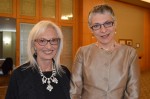
From left, Meryle Kates, executive director, Toronto chapter, Stand With Us, and British journalist and author Melanie Phillips. (photo from Vancouver Hebrew Academy)

On April 1, at the fourth annual Faigen Family Lecture Series presented by Vancouver Hebrew Academy, British journalist and author Melanie Phillips tackled what she called “the herd of elephants stomping around the furniture.”

From 9/11 to the 7/7 bus bombings in London, through the Spanish train and Mumbai bombings, the activities of Hezbollah and Iran, she said, “There is a refusal in the West to acknowledge the link between all these disparate events … that all these phenomena, which take different forms, are a variation of the Islamic religious war, or jihad. Now, we know that this is the case because the perpetrators tell us this – they tell us this over and over again in varying terms.”

More than 150 people filled the downstairs auditorium at Schara Tzedeck Synagogue to hear Phillips speak, which she did after brief remarks from VHA board co-president David Emanuel; Gina Faigen, whose father, Dr. Morris Faigen, z’l, created the lecture series; and Meryle Kates, executive director, Toronto chapter, Stand With Us, who introduced Phillips.

Phillips, author most recently of The World Turned Upside Down: The Global Battle over God, Truth and Power (Encounter, 2010), said that, in Britain, when 9/11 happened, they were told it had nothing to do with religion: “It was to do with poverty, it was to do with lack of education, it was to do with alienation from the surroundings of society.” Referring to the perpetrators of terrorism, she said they were not poor, they were well-educated and, in Britain, they were being alienated, not by Western influences, but by Islamic preachers. Nonetheless, the British were told, “It was Bosnia, it was Chechnya, it was Kashmir and, above all, it was Palestine. So, the way of solving this problem … was you dealt with grievances. Get rid of the grievances, and you will get rid of the problem of terrorism…. It ignored the fact that all these people said over and over again they were doing it for religious reasons, they were doing it in order to defend God against modernity, against America, against the Jews and against the West. It ignored the verses of the Koran which framed these declarations of war being perpetrated on Jews and on the West.”

Phillips said the British government now has decided “what we’re living through is the perversion of the religion,” but it is more accurate to say we’re up against an interpretation of the religion with which not all Muslims agree and, indeed, of which many Muslims are “the principal victims.” However, she noted, offering the British security service as her source, between 2,000 and 4,000 young British Muslims are considered to be “active terrorists” and “they believe the true number is far greater than that.” She added, “opinion polls show that some 40 to 60 percent of British Muslims want to live under sharia law. Now, this is no small matter. Sharia law is in direct conflict with the state, it recognizes no such authority.”

Britain has a “very, very serious problem of religious fanatical radicalization but it has not accepted this.” Only recently, she said, it was reported that the prime minister has set up an inquiry into the Muslim Brotherhood.

Phillips argued that reticence in dealing with terrorism comes from a decent impulse most people have: the fear of being intolerant. She said we must never forget that there are many Muslims “who come to the West because they actually subscribe to Western ideals in that they want to live in peace and freedom, they want to have jobs like everybody else, they want to bring up their families in peace and security like everybody else…. There are people who are so enraged by Muslim, by Islamic terrorism … that they forget that, and I think it’s very important that we don’t forget that. But it’s equally important that we don’t ignore the other side of the story.”

Liberal democracies welcome minorities, she said, as contributing to and enhancing the culture. “The quid pro quo, however, is that minorities have to, in their terms, sign up to a kind of overarching national story, an overarching set of values.” If the rule of law doesn’t apply to everyone, she continued, then a country is no longer a liberal democracy.

In the late 1980s, Phillips began writing about the “cultural vacuum” she perceived was developing. “I started writing about things to do with family, with education, with multiculturalism. It just seemed to me that, over the years, something was going very, very wrong with all these issues; values were being turned on their heads.” She gave the example of family breakdown becoming more of an entitlement, a person’s right rather than a thing that should be avoided if at all possible. She spoke of education in Britain as becoming more child-centric, the belief that imposing constraints and rules on children limited their creativity, leading to illiterate and innumerate children. As well, she said, certain self-defined victim groups were being given a free pass on their behavior because they were supposed victims of the majority.

“… the culture of the nation, as expressed in education, as expressed in the laws passed by that nation … was deemed to be illegitimate because the nation was deemed to be illegitimate. Why? Because nations led to nationalism, and nationalism led to prejudice and war, and if you wish to avoid prejudice and war, you basically abolish the nation … you set up institutions which trumped the nation, transnational institutions, which bound nations together under an umbrella of common values, and those were deemed to be more legitimate than the nation because those brought people together, they were inclusive, they didn’t separate.”

She described human rights laws as pitting one set of rights against another, rather than being universal, as was claimed, and contended this was part of a more general view that “the culture of the nation, as expressed in education, as expressed in the laws passed by that nation … was deemed to be illegitimate because the nation was deemed to be illegitimate. Why? Because nations led to nationalism, and nationalism led to prejudice and war, and if you wish to avoid prejudice and war, you basically abolish the nation … you set up institutions which trumped the nation, transnational institutions, which bound nations together under an umbrella of common values, and those were deemed to be more legitimate than the nation because those brought people together, they were inclusive, they didn’t separate.”

In Phillips’ view, multiculturalism doesn’t mean that we should simply be tolerant and respectful of minorities, but rather, as a doctrine, says that every single culture should be regarded as having identical value as every other. “So, that means that you cannot hold liberal values because … if you’re up against a culture which basically believes that women are second-class citizens or that gay people should be killed, then you as a liberal society cannot impose your view that gay people should have civil rights and that women should have equality because you are being racist, because you are imposing your culture on their culture … consequently, it’s a liberal death warrant, it’s a liberal society’s death warrant, multiculturalism.”

As with other isms, Phillips said, multiculturalism has become unchallengeable. This has happened, she argued, because the West has told itself that religion is bunk. “In other words, instead of adhering to a program which owes its origins to what are considered to be divinely inspired rules of behavior, man … shapes the world, or reshapes the world, according to his own wishes…. So, we have a whole range of ideologies which now govern our assumptions in the West. We have materialism, the idea that everything … must be explained by material explanation. We have moral and cultural relativism, the idea that what is right for me is what is right…. We have deep-green environmentalism, which says that the world would be a great place if only it wasn’t for the human race mucking it all up.”

Phillips said that ideologies replace truth by power. “In the non-ideological world, one looks at facts and evidence and then other facts and evidence and one reaches a conclusion. With an ideology, you start with the conclusion…. The idea governs how you look at the world and, if there is evidence that conflicts with that idea, you have to wrench the evidence to fit that idea … one group fights for supremacy over another group, and that’s how you lose the sense of a national overarching set of values.”

On a whole range of issues, “it is no longer possible to have a rational discussion with people who believe in these ideologies, as upon each issue there can be only one story for them…. Reason is replaced by bullying, intimidation and the suppression of debate.”

Ideologies drive out reason, she said. “And, if there is no truth, there can be no lies either because truth and lies are merely alternative narratives in the jargon of the time.” On a whole range of issues, “it is no longer possible to have a rational discussion with people who believe in these ideologies, as upon each issue there can be only one story for them…. Reason is replaced by bullying, intimidation and the suppression of debate.”

Phillips noted the irony in the West’s replacement of religion with secular dogma. “Just as with medieval Christianity, with Islam through the ages, these ideologies represent a perfectly closed thought system which brooks no alternative because … each of them aspires to create a perfect world, they are synonymous with virtue and, therefore, brook no opposition.”

They have turned evidence and logic on their heads, she said, in a way that is particularly relevant to Israel. “Because of the ideology of multiculturalism and minority rights, self-designated victim groups, defined as those without power, can never do wrong, while the majority groups can never do right. So, it follows, the Muslim world can never be held responsible for blowing people up because they are, as people of the Third World, victims of the West.”

In this scenario, she explained, Jews can never be victims, they are not a minority because they are held to be all-powerful and in control of the media, Wall Street and America – “so much of the hateful discourse about Israel follows from that.” Phillips said this echoes the narrative within Islam. “Because Islam considers itself to be the perfect, unchallengeable word of God, it can never do wrong.” All aggression by Islam is, therefore, seen as “automatically self-defence,” while Western or Israeli “real self-defence is said to be aggression.”

Added to this, she said, is “transnational progressivism,” in which nations are innately divisive and Western nations “innately colonialist, rapacious and cruel.” Israel, therefore, is “triply damned”: “It’s a nation, bad. It’s a Western nation, very bad. It’s a Jewish, Western nation, racist. So, when Israel goes to war to defend its people against the thousands of rockets coming at it from Gaza or whatever it is, the thousands of rockets are regarded as immaterial. What is important is Israel’s military self-defence in the interests of a Western, ‘racist’ nation. Terrorism, by contrast, becomes resistance.”

The utopian nature of ideologies makes them, “by definition, the most high-minded of ideas and thus the most high-minded people subscribe to them, the intelligentsia, which wear them as badges of conscience.” Among the things this explains, she said, is “the phenomenon of left-wingers, high-minded people devoted to human rights and sexual promiscuity marching shoulder to shoulder on the streets of London and elsewhere with radical Islamists devoted to killing homosexuals and stoning adulterous women to death under the common band of human rights.”

Worse, she added, is that, when utopia “fails to materialize, and utopia always fails to materialize, its adherents, its proponents, are so enraged by the failure of what cannot fail … that they select scapegoats on whom they turn to take out their rage over the thwarted establishment of a perfect world, and the scapegoats become enemies of humanity.”

One of the commonalities between all these disparate ideologies, she said, is “hostility to Judaism, Israel and the Jewish people.” She attributes this, in part, to the fact that it was Judaism that laid down the moral foundations of Western morality, “which is under attack from moral relativism.” And herein lies her solution.

In Phillips’ opinion, “the essence of the problem is the displacement of religion, especially biblical morality, and its replacement by secular ideology.” So, the religious basis of the West needs to be restored. She thinks this is possible for two main reasons. “First, people are not adverse to spirituality…. What they don’t want to believe in is in organized religion, but that’s very different from saying they don’t want to believe or that they don’t instinctively believe in something that is supernatural…. The second is this, there’s an assumption in our modern world that in one box is reason and in another box is religion and the two can never meet…. The fact is that religion was the wellspring reason, order, progress, human dignity and liberty…. Without the Hebrew Bible, these things … would not have existed and, I would suggest, that as religion has been progressively edged out of Western life, so truth and morality have crumbled, leading to irrationality, prejudice and so forth.

“Western science grew, essentially, out of the revolutionary claim in the Bible that the universe was the product of a rational creator who endowed men with reason so that he could ask questions about the natural world.”

“And it was not just any religion that created reason and progress,” she continued, “but very specifically Christianity and the Hebrew Bible from which it sprang, the Hebrew Bible…. Western science grew, essentially, out of the revolutionary claim in the Bible that the universe was the product of a rational creator who endowed men with reason so that he could ask questions about the natural world…. The problem arose in our modern times, when science overreached itself and sought to explain the inexplicable … and so, scientific materialism became a kind of faith in itself, an explanation for all things, but that isn’t actually the case.”

It is the same with equality, she said. “It is the Hebrew Bible again which tells us that we are all created equal in the eyes of God and, therefore, we have to respect each other as human beings and, without that biblical story, equality would not exist, nor would we have our assumptions of putting the interests of others first, which lie at the very heart of a civilized … society.”

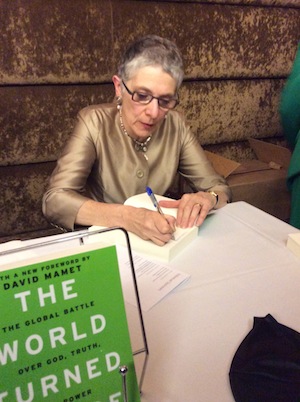
photo - Melanie Phillips signs her latest book
Melanie Phillips signs copies of her book The World Turned Upside Down: The Global Battle over God, Truth and Power for attendees at the April 1 Faigen Family Lecture.

The task of the West, she said, is “to re-Christianize, as the previous pope well understood. And I realize that to use those terms, to say the West must re-Christianize, causes a terrible frisson, not least among people in this audience. Christianity has not been an unalloyed pleasure for the Jewish people, but if we wish to defend and protect and assert Western culture, we have to accept that Christianity is at the root of Western culture, with all its freedoms and all its values…. And at the root of Christianity is the Hebrew Bible.”

As Jews, we must “help reconnect the Western world with those Jewish roots and values which are the root, are the very core, of the Western culture,” she said. “We have to stand up very clearly for stating the truths about the state of Israel, its history and its present situation.”

Phillips called the “attack on Israel” the most important “cause of our time, not just because we are Jews and we should care about the existence, survival and security of the state of Israel,” but “because attitudes to Israel are attitudes to truth, to justice, to morality, to decency, to civilization. If people are on the wrong side, essentially … of Israel, they are on the wrong side of truth, justice, morality and civilization…. Western culture is currently at great risk because its understanding of itself has been smashed into fragments. The way to save it … is by putting those fragments back together again…. The challenges are truly formidable but if, and only if, we have faith in ourselves, it can and must done.”

After a 15-minute Q&A, VHA head of school Rabbi Don Pacht concluded the evening on a light note, thanking Phillips for an informative lecture, as well as for her “wholesale endorsement of the Hebrew Bible,” of which he’s “a huge fan.” He also thanked the Faigen family for their sponsorship of the annual event.

Format ImagePosted on April 11, 2014April 14, 2014Author Cynthia RamsayCategories LocalTags David Emanuel, Faigen Family Lecture Series, Gina Faigen, Melanie Phillips, Meryle Kates, Rabbi Don Pacht, Stand With Us, The World Turned Upside Down, Vancouver Hebrew Academy

The gluten won’t be missed

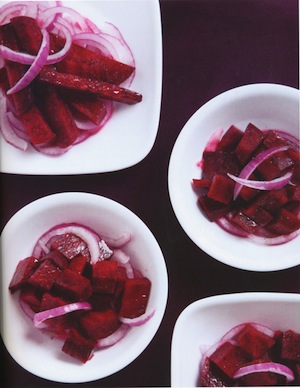
Beet salad from Gluten-Free Goes Gourmet. (photo by Ruchy Schon)

At least three times a year – Rosh Hashanah, Chanukah and Passover – I liven up my dinner menus by trying out some new recipes from recently published cookbooks. I don’t keep a kosher kitchen, I’m not gluten or dairy intolerant, nor am I diabetic or allergic to corn, yet I ventured this spring to try Vicky Pearl’s Gluten-Free Goes Gourmet (Moznaim Publishing Co.), which actually came out last September. While many of the recipes may be appropriate for Pesach meals, many are not chametz-free, particularly in the dessert section – but they’ll make for delicious treats after the holiday.

There are more than 100 recipes in Gluten-Free Goes Gourmet; most are easy-to-follow and quick to make (even without a mixer), but others require a few hours (preparation plus cooking time), so make sure to plan ahead and carefully read through the recipes before setting about to make them. Everything I tried in Gluten-Free Goes Gourmet turned out just like the photos (which are lovely) and, with the exception of the kugel – which, for some reason, I couldn’t get to the quite the right consistency and which had too much salt for my liking – everything tasted great. There was one typo in the book that I came across: the oatmeal chocolate chip cookie recipe makes almost four-dozen cookies, not 18, as indicated.

Gluten-Free Goes Gourmet contains useful information on many of the ingredients used in the recipes, including their nutritional benefits. It has numerous sections: dips and drinks, salads, soups, meat and poultry, fish, mock dairy, side dishes, breads, desserts, and cakes and cookies. It would have been nice to experiment with these last chapters more, as the cookies I made were so delicious – and all indications are that the other gluten-free desserts and breads will be just as tasty.

The following recipes will give readers an idea of how good “free” eating can be. Enjoy!

BEET SALAD

Try to buy beets that are uniform in size, since they’ll cook more evenly. As an added bonus, smaller beets are sweeter.

photo - beet salad
Beet salad from Gluten-Free Goes Gourmet. (photo by Ruchy Schon)

10 beets, peeled
1 red onion

Dressing:
1/2 cup liquid from cooked beets or water
1/3 cup vinegar or freshly squeezed lemon juice
1/4 cup agave, xylitol or granulated sugar
1/4 cup oil
2 tsp kosher salt
1/2 tsp freshly ground pepper

Place beets in an eight-to-10-quart pot (depending on size of beets); cover with water. Bring to a rolling boil over high heat. Cook for one or two hours, maintaining a rolling boil, or until beets are tender enough that the tines of a fork meet with little resistance. Reserving 1/2 cup of cooking water, remove beets from water. Cool slightly. Slice beets according to your preference.

Place beets in a serving bowl; add onions. In a separate small bowl, mix together dressing ingredients. Pour dressing over vegetables, tossing gently until well coated. For best results, cover with plastic wrap and refrigerate overnight. Bring to room temperature before serving.

Yields eight to 10 servings.

CREAM OF ZUCCHINI SOUP

5 large zucchinis, scrubbed clean, washed and cut into thirds
3 large potatoes, peeled and cut into quarters
1 large onion, halved
1/4 tsp freshly ground black pepper
1-2 tbsp (heaping) kosher salt

Place all ingredients into an eight-quart pot. Fill three-quarters full with water and bring to a boil over high heat.

Reduce heat to medium; cook, with lid slightly ajar, for half an hour.

Place immersion blender in pot; blend until smooth.

Makes eight to 10 servings. Freezes very well for up to six months: chill before freezing and thaw in refrigerator.

ALMOND CRACKERS

2 large eggs
2 1/2 tbsp oil
3/4 cup sesame seeds
2 tsp kosher salt
3 cups almond flour
2 tbsp potato starch
1 tbsp minced onion
1 tbsp minced garlic

Preheat oven to 350°F. In the bowl of an electric mixer, cream together eggs and oil. Change paddle attachment to a dough hook.

Add sesame seeds, salt, flour, potato starch, onion and garlic to bowl; mix well.

Divide dough in half. Working with one piece at a time, roll out between layers of parchment paper to 1/16th of an inch thickness.

Remove the top parchment paper; transfer the dough with the parchment paper still under it to a cookie sheet. Cut into one-by-three-inch rectangles. Repeat with the remaining dough.

Bake in preheated oven 14 to 16 minutes or until golden.

Allow crackers to cook on parchment paper on rack.

Yields 60 crackers and the crackers freeze well for up to two months. They will store well in an airtight container at room temperature for up to two weeks.

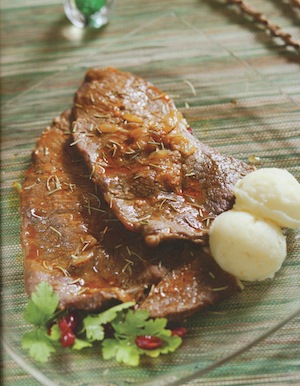
SHOULDER STEAK

photo - shoulder steak
Shoulder steak.
(photo by Ruchy Schon)

1/4 cup oil
3 cloves garlic, minced
3 large onions, sliced thinly
1 lb shoulder steak or pepper steak, or 4 pieces minute steak
1 cup semi-dry red wine
1 bay leaf
1 tsp kosher salt
1/2 tsp dried minced garlic
1/4 tsp dried rosemary leaves (optional)
1/8 tsp freshly ground pepper

Heat oil in a large skillet set over medium heat. Add garlic; brown for about one minute. Add onions; sauté until translucent, three to five minutes.

Add steak, wine, bay leaf and spices. Increase heat to high; bring to a boil. Add five cups water; return to a boil. Reduce heat to medium; cook, covered, for two to two-and-a-half hours or until meat is tender. Remove bay leaf before serving.

Makes four servings. Freezes very well for up to six months.

POTATO KUGEL

5 large eggs
1 cup oil
2 tbsp (heaping) kosher salt
10 large Idaho/russett potatoes (about 5 lbs), peeled and cut in half lengthwise
1 large onion, peeled and cut in half

Preheat oven to 450°F. In a large bowl, whisk together eggs until lightly beaten. Whisk in oil and salt.

In a food processor fitted with the blade with tiny holes and working in batches, process potatoes and onion until almost smooth. Transfer potato mixture to bowl, blending well with egg mixture.

Pour mixture into a parchment-paper-lined nine-by-13-inch baking pan.

Bake in centre of preheated oven for one hour or until top is browned. Reduce heat to 350°F. Bake for two hours.

Yields 12 generous servings.

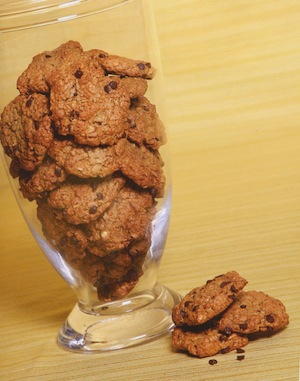
OATMEAL CHOCOLATE CHIP COOKIES

photo - Oatmeal chocolate chip cookies
Oatmeal chocolate chip cookies.
(photo by Ruchy Schon)

1 cup peanut butter
1/4 trans-fat-free margarine, room temperature (1/2 stick)
3/4 cup agave
1/2 cup xylitol or granulated sugar
2 large eggs
1 1/4 tsp baking soda
3 cups old-fashioned rolled oats
2/3 cup chocolate chips (sugar-free, if you prefer)

Preheat oven to 350°F. Line two baking sheets with parchment paper. Set aside.

In an electric mixer, cream together peanut butter, margarine, agave and xylitol (or sugar). Add eggs and baking soda. Mix well.

Stir in oats and chocolate chips until well combined.

Use a tablespoon to drop spoonfuls of dough onto prepared baking sheets. Bake in centre of preheated oven for 11 minutes or until golden yet soft. Do not overbake. Remove to rack to cool completely.

Makes about 48 cookies.

Posted on April 11, 2014April 16, 2014Author Cynthia RamsayCategories Celebrating the HolidaysTags Gluten-Free Goes Gourmet, Vicky Pearl

Carol Rose’s From the Dream

Reading From the Dream, Carol Rose’s most recent collection of poetry, led me to my bookshelf, where her first collection, Behind the Blue Gate, was safely stored. This shelf is home to books that have particularly impressed me, and which I may want to read again, as well as those that have been written by friends. Rose’s falls into both groups, and From the Dream will soon be joining its older sister.

From the Dream cover
Carol Rose’s newest collection of poetry was published by Albion-Andalus Inc. in 2013.

In looking back at Behind the Blue Gate (Beach Holme Publishing, 1997), I not only enjoyed it on its own merit, but enjoyed comparing its themes and style with From the Dream (Albion-Andalus Inc., 2013). While both collections were obviously written by the same intelligent and caring person, the effects of time and experience were evident, and there is a difference in tone: the latter seems more accepting of the way of the world. My first thought was that, perhaps having grandchildren – which Rose now does aplenty – required a person to be more optimistic.

“I am not sure if it is about being a grandparent, or about living longer and suffering the losses and demise that come with age while, at the same time, learning to treasure what we have at this very moment (including partners, children, grandchildren and friends). From the Dream seems to investigate these ideas, even the humorous poems,” said Rose in an email interview, giving as an example the poem “singin like he used to,” about attending a Bob Dylan concert as an older person, which “has us reluctantly ‘aging before our very eyes,’ while still being able to laugh at the life we are blessed to continue living.”

She agreed that the poems in From the Dream are less confrontational or cynical than those in Behind the Blue Gate. “Particularly,” she noted, “when it comes to poems about women in the Bible or women in Judaism.”

Rose was quite involved in the Jewish feminist movement (from the early 1970s) and, she said, “I think that my writing was driven by a desire to create a new myth or a new narrative, or perhaps a more inclusive midrash.

“Just as there were women who were lobbying for political change, or women who were trying to create new rituals – and I was part of that effort, as well – there were also many women who were trying to create woman-centred interpretations of biblical teachings. We realized that women had only heard about biblical matriarchs (or even about Lilith) through the teachings of their rabbis or preachers. I wondered (along with many others, in various faith communities) what would happen if women began telling these same stories – but from their own point of view. To that end, I wrote some midrashic poems, including some that can be found in ‘The Crones’ section of Behind the Blue Gate.

“In those years, I was not only reading and studying the material, I was teaching and running workshops on women and spirituality, so it was very ‘alive’ in my thinking. I am not teaching that material as much, now, and there are certainly wonderful contemporary midrashic materials (by and about women) that have appeared in the last 15-20 years, so I no longer feel that same urgency.

“What I feel most drawn to, these days,” she said, “are women’s rituals, women’s dreams, women’s experience of the Holy, the angelic, and women’s encounters with Mystery – in nature, and in the lives of their family and friends. From the Dream, especially the section called ‘Shivering in the Silence,’ explores some of these ideas.”

From the Dream includes work from the mid-1990s through to recent years. When asked about the process for deciding what was to be included, Rose said, “As you know, it can take many years for a collection of poems to become a book. In the selection, many individual poems are left behind. As the new work began to emerge, I noticed that several of the earlier poems were still very much alive. From the Dream plucked them up and wove them into its theme of memory and loss. My friend, poet Di Brandt, once said that we are ‘always writing the same poem.’ I don’t know that I agree with her entirely, but I do believe that we strive to write ourselves out of pain and uncertainty, and that some of the earlier poems seemed to help me understand what it was that I was still wrestling with.”

The idea of “wrestling” in this context brings to mind Jacob’s struggle with God, and many of the poems in both From the Dream and Behind the Blue Gate are inspired by Jewish texts and beliefs, in which Rose is steeped. But her work is by no means parochial, and reflects a broad understanding of and empathy for humanity, beyond the religious, geographic, relational and other boundaries by which we separate ourselves from each other.

Born in New York City, Rose has lived in various places, and currently divides her time between Winnipeg, St. Louis and Jerusalem. Among her academic credentials are a bachelor’s in religious studies from the University of Manitoba and a master’s in theology from the University of Winnipeg, as well as graduate work in cross-cultural and international education. For several years, she has taught imagery and, according to her bio, “she also uses imagery work in a private counseling practice she shares with her husband, Dr. Neal Rose,” who also happens to be a rabbi.

“In terms of spirituality,” she told the Independent, “I suppose I would say that my frame is Jewish mysticism, that I believe that the world was created out of the word (or words); that we are part of ongoing revelation, believing that we can receive or grasp truth (sometimes with the help of a presence, a friend, an angel or a loved one); that we are loved and capable of loving; that the dead live on, that their presence (in our memory or awareness) urges us to live justly; that the created world is a gift, that we take only what we need and that we respect the cycles of time, celebrate the Sabbath, eat permitted food with awareness, offer thanksgiving, extend our hands and hearts to others. I think both books convey these sentiments.”

She explained imagery work as “similar to what we have come to know as ‘visualization,’ though my teacher (psychologist and wise woman Colette Aboulker-Muscat) preferred to call it ‘imagery’ because she believed that we can access information through any of our senses.

“When the mind is brought to stillness, through a brief breathing exercise and a directed intention (know as kavanah), we can gain a deeper connection to intuition and/or inspirational thinking. Clearly, as a writer, quieting the mind and sitting in stillness is a useful technique. But imagery work is much more complex; it is a system based on liturgical, biblical and mystical teachings that can help us contact our innermost thoughts and feelings. Using this technique can offer us healing, increased creativity and a sense of wholeness. I generally teach this method in small groups, on retreats, or as a spiritual director, with individuals of all faiths.”

In addition to being a teacher and a multiple-award-winning writer whose poetry and essays have been published in several journals and anthologies, Rose is also an editor. She knows well the power and weakness of words, and even deals with them explicitly in her work, such as in the poem “etching images,” which forms part of the “Shivering in the Silence,” section of From the Dream.

“Ah, the limitations of language,” she acknowledged. “Yes, this is a constant tug of war! How to express what one sees, senses, feels or understands? How, especially, in those moments of enormous insight, or of injustice and deep suffering, or of great love and amazing beauty? (Is it any wonder that some midrashim describe Moses as a ‘stutterer’ or a man ‘slow of speech’?) How can words capture numinous experiences? And yet, for the poet this becomes the challenge.

“Certainly, the closer we come to describing what we think, feel, understand or experience, the better we are able to communicate with others – the closer we come to the medieval notion of what it means to be human: m’daber, the one who speaks.”

Posted on April 11, 2014April 16, 2014Author Cynthia RamsayCategories BooksTags Behind the Blue Gate, From the Dream, imagery, poetry

JI writers show off their stuff

There are some very talented writers who contribute to the Jewish Independent, so it’s not surprising that many of them have been published elsewhere. Here are brief reviews of six books that feature contributions from, or are authored by, freelancers who have written for the JI at some point.

***

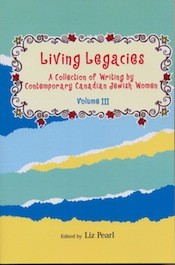
Living Legacies: A Collection of Writing by Contemporary Canadian Jewish Women, Volume 3 (PK Press, 2011), edited by Liz Pearl, comprises essays from more than 35 women, including at least two who have contributed to the JI – Shoshana Litman (Victoria) and Ricki Segal (Winnipeg) – as well as three other British Columbians: Shelley Halpern Evans, Dale Adams Segal and Helen Waldstein Wilkes. In this most recent volume, Pearl has once again collected from women across the country stories that create connections, both spiritual and human.

image - Living Legacies cover
Living Legacies Vol. III was released in 2011.

In writing about her family and the role that food plays in their expression of love, for example, Evans touches upon rituals that are important to secular and religious Jewish life; the way in which a recipe passed down from a grandmother or the care that a parent or a spouse puts into making a meal brings family and friends closer. Litman’s Shabbat dinner at a friend’s home in Brooklyn offers her “[h]ints of heaven,” and also reconnects her to a woman she knew from Vancouver – these “divine encounters” not only make Litman “feel encouraged and uplifted,” but also, she writes, “The thin veil that separates me from others disappears, like overcast skies swept clean by spring winds to reveal the warm sunlight that is always there.”

In writing about how she’s been composing prayers all her life, despite her non-religious upbringing, Dale Adams Segal notes that she has “paddl[ed] down many rivers of growing up: of being married and divorced and married again, of birthing children and witnessing the birth of a granddaughter, of finding those whom I would love and losing those whom I have loved…. I share with you that this practice of writing prayer has restored me to life again and again….” And Ricki Segal pays tribute to her mother, who at the time of writing was suffering from dementia, in sharing some of what she has learned from her mother about love, attentiveness, tenacity, forgiveness and other important facets of life.

Wilkes’ essay is about her personal journey, from being made to feel ashamed about being Jewish by antisemitic classmates when she was a child to “com[ing] home” when she heard the Barchu: “I began to weep,” she writes. “Something deep inside me had been touched, and I knew that I had indeed come home.” She now sees Jewishness as a bridge that helps her “see aging as a purposeful process. Hopefully, the passing years will be accompanied by a growing measure of wisdom. If this means that I can be a role model to my children and grandchildren, then I will be blessed indeed.”

Role models would describe all of the contributors to this and previous volumes of Living Legacies – and this fact offers reassurance that there are many more women (men and children) who would also fit that bill.

***

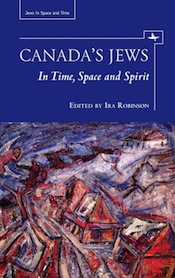
Canada’s Jews: In Time, Space and Spirit, edited by Concordia University’s Prof. Ira Robinson, was published by Academic Studies Press in 2013. It is part of the Jews in Space and Time series which, according to ASP’s website, “brings together some of the best scholars in their respective fields to explore the histories of Jewish communities in different geographical areas and historical eras, deepening our understanding of Jews and the relationships that they forged within their host countries.”

image - Canada's Jews cover
Canada’s Jews “brings together some of the best scholars in their respective fields.”

Canada’s Jews is special for several reasons, including its dedication to two men who for a part of their lives called Vancouver home and contributed to several local institutions, including the JI’s forerunner, the Jewish Western Bulletin: David Rome (1910-1996) and Abraham Arnold (1922-2011). These men, as Robinson notes, also “broke new ground in the field of Canadian Jewish studies.”

For Canada’s Jews, Robinson has amassed almost everyone who is currently attempting to continue Rome’s and Arnold’s legacy. Local contributors are Jewish Historical Society of British Columbia historian emeritus Cyril Leonoff, who co-wrote the chapter on Vancouver with me; University of British Columbia Prof. Alex Hart, who contributed an extensive essay on Jews in English literature; and UBC Prof. Richard Menkis, who wrote two chapters, a revised version of a previous article on Reform Judaism in Canada, and a comprehensive look at Conservative Judaism, as well as Reconstructionism and Renewal.

In the preface, Robinson notes that Canada’s Jews “will be of interest to scholars, students and readers of Canadian and Jewish studies,” however, the essays are, on the whole, very accessible and most people will find something to engage them.

The book has three parts: the first spans the history of Canadian Jews from the mid-1700s to after the Second World War; the second looks at contemporary Canada, beginning with a couple of chapters on general demographics and politics, followed by chapters on Jewish communities across the country; and the third comprises chapters on Judaism, Yiddish, literature and art, with the volume’s concluding chapter being a detailed inventory of the state of Jewish studies in Canada and recommendations for how the field might expand.

Canada’s Jews is full of factoids that can be gleaned on a quick reading. For example, “While almost all Canadian Jews in 1945 were Ashkenazi, today close to 20% have Sephardi roots” (Franklin Bialystock); Regina’s Jewish population in 2001 was 720, “about the same as it had been since 1951” (Debby Shoctor); and 2005 calculations show the average household size for the Jewish community as a whole in Greater Montreal to be 3.46, compared to that of the Satmar/Belz/Skver, 5.69; Lubavitch, 5.45; and Tosh, 6.37 (William Shaffir).

Because of how data are collected and the fact that such essay collections take a long time to put together, hunters for current statistics will be frustrated, as many of the survey and census figures are almost 10 or more years old. As well, the chapters on specific cities’ communities are quite brief in some cases and, while they provide a general overview and raise some issues for future research most – including the chapter I co-wrote – do not delve into any analysis, for example, of issues such as the effects of immigration on communal participation and/or fundraising. Perhaps the situation in small communities is similar – limited availability of information and little previous analytical work on which to build.

These small criticisms aside, the volume will contribute much to readers’ knowledge of Jews in Canada, and there are several in-depth analyses in the collection, including a couple of chapters that provide fascinating reading for anyone interested in the evolution of the mainstream Jewish community’s structure on a national level.

***

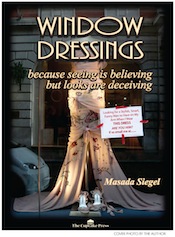
On the fiction front, readers of chick lit will appreciate Masada Siegel’s first novel, Window Dressings (Cupcake Press, 2012). It begins with the main character, Skye Silver, attempting – and failing – to manouevre her body into a position that her boyfriend Gregg wants her to try from the Palmasutra, a mobile operating system version of the Kamasutra. The trouble in bed is but one of the problems this couple is having in their soon-to-be over three-year relationship. Religion (Skye is Jewish, Gregg is Protestant), lack of communication and insecurity, among other things, lead to the betrayal that sends Skye into singlehood.

image - Window Dressings cover
Readers of chick lit will appreciate Masada Siegel’s first novel.

Despite a poor body image, sadness over her break-up and very high standards for the outward beauty of possible mates, Skye manages to find many suitors, and much of Window Dressings is about what happens on those dates. She is supported by two besties: Josh, a writer/editor, with whom “mutual attraction had turned into a strong friendship”; and Karen, an international model.

While Skye is getting used to her new status and trying to meet “hot neighbor boy” – both a real character and Skye’s ideal man – she loses her job at Xtremedream advertising. Halfheartedly looking for a new job, she takes on some freelance work, falling back on the journalism degree she got in addition to her master’s in business admin. With relative ease, it seems, she lands a job at the New York Times and, dream job in hand, life gets even better for Skye.

***

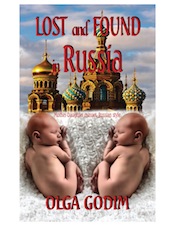
In Lost and Found in Russia by Olga Godim (Eternal Press, 2013), Amanda anxiously awaits news about her daughter, Gloria, who is in the hospital after a car accident. Amanda volunteers to give blood for the needed transfusion and, while the lab work is being done, we find out that Amanda is a linguist. A contract decades earlier had her teaching Russian to a group of Toronto journalists. She fell in love with one of them, Donald, and married him a week before they moved to Russia, where Gloria was born. For Amanda, it was Gloria who “filled the emptiness left after Donald’s death.”

When the blood work reveals that Gloria is not Amanda’s biological daughter, the doctor makes a comment about a possible switch at birth, and Amanda recalls that, 34 years ago, “Two red-headed girls were born on the same day in that decrepit hospital with peeling paint on the walls and one washroom for the entire corridor.” As she sits by Gloria’s bedside, Amanda resolves to find her other daughter: “Of course, Gloria was her daughter, her blood type notwithstanding. She just had another red-haired daughter somewhere in Russia.”

image - Lost and Found in Russia cover
Olga Godim’s first novel explores mother-daughter relationships.

Meanwhile, Sonya is steeling herself to kick out her drunk of a husband, Alexei, as she can no longer afford to support him, herself and their teenage daughter, Ksenya, on what she earns from working two jobs. The Russian family arrived in Canada two years earlier from Israel, where Sonya had been a dancer and a dance instructor, and they now live in Vancouver, where Alexei’s supposed musical genius is as underappreciated as it was in Israel. Sonya not only has to deal with an alcoholic partner and trying to scrape out a living, but with her daughter’s understandable frustrations.

The book follows Amanda’s search for her other daughter; along the way, she also opens herself up to life for the first time since her husband died. It also follows Sonya’s struggles with Ksenya, and their rapprochement. Godim writes authentic dialogue, and captures the intricacies of relationships, mainly that between mother-daughter. Most interesting, however, is the view of Judaism from a Russian perspective, not only how one self-identifies culturally, religiously or otherwise, but the prevalent antisemitism. The fairytale ending is over the top, and there are a few odd scenes that could have been replaced with more development of the main characters, but the writing style and especially the Sonya-Ksenya relationship, make Lost and Found in Russia a good read.

***

It’s hard to know what to think about Curt Leviant’s Zix Zexy Stories (Texas Tech University Press, 2012). Leviant is an excellent writer, he’s knowledgeable about literature, Yiddish and Judaism, among other topics, and he has what to say. But he has a weakness, or made a poor choice. In pretty much every one of the seven (not zix) stories in this collection, he features a young, blond, big-breasted, non-Jewish, beautiful, dumb woman who admires, lusts after or is married to an older, professorial/rabbinical Jewish man. Perhaps this is an intentional attempt to link the stories – with the trope of the shiksa goddess – but, if so, it doesn’t work. Better the Franz Kafka connection that ties at least four of the stories.

image - Zix Zexy Ztories cover
Curt Leviant’s short stories are thought-provoking.

Zeven Ztrange Ztories would have been a better title, in that the collection successfully channels Kafka-esque absurdity, and intelligently considers existential matters. For example, in “From Helena; or, Sanskrit is Sexy Too,” a professor named Keller is introduced to a woman who is the object of many men’s desire, including the married man who introduces Keller to her. At this woman’s house, Keller runs into her professor father, who is doing kabbalistic research that entails cracking open walnuts to see if they’re all “built the same.” The father is dressed in a cloak and cowl. When Keller asks him why, he explains, “… A wise man, I believe it was Thomas Mann – you heard of Thomas Mann, I suppose – said that an esthetic worldview is incapable of solving world problems that cry for solution. Nevertheless, esthetics is crucial. Without esthetics we would be dogs barking at the moon. That’s why I don this unseemly garb. To put myself in the medieval mood. I am doing research.”

Throughout the collection, such thought-provoking passages appear. As well, Leviant is a strong storyteller. In “From Golden Necklace,” about an architect who travels to Italy to see a special collection of art, the tension is palpable when the architect sees the necklace his mother – who, along with his father, was killed in the Holocaust – on the woman escorting him around the palazzo. As another example, ignoring the object of Shmulik Gafni’s supposed affections (a shiksa), Leviant masterfully exhibits the ability of words to both accuse and acquit someone: none of the facts substantiates the rumor that Gafni is an adulterer, yet that very fact fuels it. All of the stories have something to recommend them.

***

image - Brothers Schlemiel cover
Mark Binder’s The Brothers Schlemiel is a good story very well told.

On the inside cover, The Brothers Schlemiel by Mark Binder (Light Publications, 2013) is described as “… a novel of Chelm … being the reasonably complete adventures of Abraham and Adam Schlemiel, identical twins, born in the village of fools and confused from birth.” As most readers know, from Chelm – from dim-wittedness and confusion – comes great wisdom and clarity, along with, of course, much humor.

Binder has created characters with whom we empathize, not just Adam and Abraham, or Abraham and Adam, who can’t even tell themselves apart at times, but their parents, sister and the other villagers. He ably manages some fine balances: writing about silliness without the story becoming stupid, and evoking sentimentality while not becoming saccharine. There are parts of The Brothers Schlemiel that could even be called scary – encounters with Russian soldiers and gun-wielding robbers. As well, through the vehicles of comedy and fantasy, The Brothers Schlemiel touches on many serious topics, from poverty to racism, to ethics in business, to whom people choose to be, and more. At the end of the day, however, The Brothers Schlemiel is just a good story very well told.

Posted on April 11, 2014May 3, 2014Author Cynthia RamsayCategories BooksTags Abraham Arnold, Alex Hart, Canada’s Jews, Curt Leviant, Cyril Leonoff, Dale Adams Segal, David Rome, Debby Shoctor, Franklin Bialystock, Helen Waldstein Wilkes, Ira Robinson, Living Legacies, Liz Pearl, Lost and Found in Russia, Mark Binder, Masada Siegel, Olga Godim, Richard Menkis, Ricki Segal, Shelley Halpern Evans, Shoshana Litman, The Brothers Schlemiel, William Shaffir, Window Dressings, Zix Zexy Stories
Gasoi at the Rothstein

Gasoi at the Rothstein

Jennifer Gasoi (photo from jennifergasoi.com)

In 2003, the Jewish Independent reviewed Jennifer Gasoi’s debut children’s album, Songs for You, describing it as “intelligent, energetic, philosophical, educational, at times silly and, most importantly, it’s high-quality music.” Since then, Gasoi has garnered numerous awards and nominations for her music. The latest – her second CD, Throw a Penny in the Wishing Well, took home the 2014 Grammy Award for best children’s album.

With the big January win still fresh, Gasoi – the first Canadian to ever receive this Grammy honor – returns to Vancouver next month. Living in Montreal since 2002, she is not only coming back to see family, but to perform two concerts on April 12 to benefit the Children’s Hearing and Speech Centre of British Columbia.

Gasoi, who also won the 2013 Sirius XM Canadian Indie Awards for children’s artist of the year, the Parent Choice Award and the Canadian Book Centre’s selection for best children’s music, and was a semi-finalist in the International Songwriting Competition and a Juno nominee for children’s album of the year, took time to speak with the Jewish Independent before her upcoming visit.

JI: You’ve won other honors and nominations in your career. In what ways, if any, is the Grammy different, and in what ways has it already affected your work/schedule?

JG: The other awards and nominations were wonderful accolades, but winning a Grammy has taken my career into a whole new realm. I’m being asked to speak and represent many different organizations. I’ve had quite a few requests internationally – to play shows (U.S.), to submit my music to radio stations (Australia), to sell my CDs (a theatre company in Oklahoma) and I’ve even had interest to play a show in China. There’s a certain status associated with being a Grammy winner that I’m still getting used to! It’s been quite a challenge keeping up with all the requests and opportunities arising. There’s no question that new doors are opening and my horizons are broadening.

JI: You have consistently put out quality recordings. From where do you find your inspiration? How do you keep the work fresh and interesting for yourself?

CD cover - Jennifer Gasoi's Throw a Penny in the Wishing Well
Jennifer Gasoi won a Grammy this year for Throw a Penny in the Wishing Well. (image from jennifergasoi.com)

JG: I am inspired by life. By people, experiences, nature, music, small moments, unexpected interactions, synchronicities. Sometimes, it’s just a simple two-minute interaction that can inspire a song. Or a memory can be the catalyst. “The Little Things” started off with the image of jelly tots– little candies that I used to love as a child – and it spun into a whole song about all the joyful moments from my childhood. “The Pizza Man” was inspired by a real-life pizza man at a iconic pizzeria in Montreal. Inspiration can hit anytime, anywhere. To keep the creative energy flowing, I see live shows, listen to music, practise yoga and meditation, go for walks on the mountain, take improv comedy classes, watch inspiring videos, dance, and spend time with creative and inspiring people. Children are one of my main sources of inspiration. They continually amaze me. They are so full of life, connected, brilliant, openhearted, pure and so much fun to be with. They remind me of what is really important in life.”

JI: You’ve been very involved in the Jewish communities of both Vancouver and Montreal. In what ways, if at all, has your Jewish heritage/upbringing/communal ties influenced your life/work?

JG: There is something very special about being part of such a close-knit community in both Vancouver and Montreal. It has provided me with a real sense of belonging and groundedness. When I was a child and attended synagogue at Temple Sholom, I was deeply moved by the music played during the services. I love Jewish music. It touches my soul. My Jewish heritage has definitely influenced my songwriting. In my first album, Songs for You, I have a klezmer tune called “The Animal Party,” and, in my latest CD, Throw a Penny in the Wishing Well, the hora features prominently at the end of “The Purple Man.”

I have the privilege of playing music for seniors and patients in several hospitals in Montreal. There is a significant Jewish population, so I often play classic Jewish songs such as “Hinei Ma Tov,” “Heveinu Shalom Aleichem” and “B’shana Ha’ba’a.” I once played Hatikvah during one of my gigs at a Jewish seniors group held in a synagogue, and everyone in the room stood up and sang along. It was so powerful, it brought me to tears.

JI: Are there any projects on which you’re currently working/collaborating?

JG: I have some projects in the works. That’s all I’ll say for now. My priority is to get all my business in order so that I can continue to create music, perform and reach a wider audience.

JI: Is there is anything else you’d like to share?

JG: I am so grateful to be living the life of my dreams. I hope that I can inspire others – big and small – to take chances in their lives, to live from the heart and know that anything is possible.

Jennifer Gasoi will perform twice at the Children’s Hearing and Speech Centre of British Columbia’s annual Family Concert on April 12, at 10:30 a.m. and 1 p.m. The event at the Norman and Annette Rothstein Theatre – which raises funds to support CHSC’s audiology program – will also feature clowns, games, auction items and face painting. Tickets are $15.50 per child and youth under 17, $18.50 per adult 18 and over, and $60 for a family of four (two adults and two children under 17); they are available from childrenshearing.ca.

Format ImagePosted on March 28, 2014May 3, 2014Author Cynthia RamsayCategories MusicTags Children's Hearing and Speech Centre, CHSC, Grammy, JCCGV, Jennifer Gasoi, Rothstein Theatre, Throw a Penny in the WIshing Well
Kaplan’s Deli closes after 47 years

Kaplan’s Deli closes after 47 years

Earlier this month, Kaplan’s Deli & Catering at 5775 Oak St. closed. On March 6, there were three signs on the door, one noting that the locks had been changed, and two concerning monies that had to be paid within five days. On March 18, the signs were still there. The doors were still locked. The property management company was continuing its search for new tenants.

Whether or not one frequented the deli, it is sad to see it go. Opened by Ida and Abrasha Kaplan in October 1967, Kaplan’s (with variations on what descriptors followed the name) was a veritable institution in the community. Its opening was heralded with a two-page spread in the Jewish Independent’s predecessor, the Jewish Western Bulletin.

Owners of two Pheasant Delicatessen locations at the time, the Kaplans kept Pheasant’s longstanding 4030 Cambie St. location until, it seems, from the pages of the JWB, April 1969, when it was taken over by Sigy and Molly Robbins. It looks like Pheasant lasted until 1972, when the Pyrogy House starts being advertised in the Bulletin at 4030 Cambie St.

The Kaplans bought Pheasant from Helen and Jack Finkelstein in 1962. The Finkelsteins had owned it since 1952. The for-sale notice the year prior noted the deli’s “good turnover” and “illness reason for selling” – the Finkelsteins bought it from Mrs. Sarah Nager, who seems to have been the first Jewish proprietor of the deli that first appears in the B.C. city directories in 1947.

photo - Kaplan's in 1967
When Kaplan’s opened in 1967, its modernity was lauded.

The Kaplans opened Kaplan’s Delicatessen & Restaurant, “[j]ust a couple of stores over from their former Oak and 41st location (their popular Pheasant Sandwich Bar and Delicatessen),” reads the Oct. 20, 1967, article on the opening. With a seating capacity of 58, the restaurant’s modernity and beauty was lauded, as was its family atmosphere.

In the March 19, 1981, JWB, Mr. and Mrs. Serge Haber ran an ad announcing Kaplan’s new management, and “the introduction of new delicacies from Montreal and Toronto to the already large list available.” As did the Kaplans, Serge and Elinor Haber would run holiday greetings and advertise regularly in the JWB.

In 2000, Haber sold Kaplan’s to Marshall Cramer, in part, Haber told the JWB at the time, because Cramer agreed to keep the staff and run the business as it had been in the past.

Cramer had the store at 5775 Oak St. until 2012, when Howie English took it over. Full of optimism when interviewed by Menschenings’ Alex Kliner, English would not succeed in his hope to “make Kaplan’s the most famous deli in North America.” Unless someone in the community buys the name and reinvents the restaurant, he’ll have been its final owner.

Format ImagePosted on March 21, 2014March 28, 2014Author Cynthia RamsayCategories LocalTags Abrasha Kaplan, Howie English, Ida Kaplan, Kaplan's Deli, Marshall Cramer, Serge Haber
JNF, CFHU honor Gary Segal

JNF, CFHU honor Gary Segal

Gary and Nanci Segal learn about bees at the Hebrew U Rehovot campus, home of the Robert H. Smith Faculty of Agriculture, Food and Environment. (photo from JNF Pacific Region)

This year, for the first time in Vancouver, Jewish National Fund and Canadian Friends of the Hebrew University of Jerusalem are together hosting the Negev Dinner.

The dinner will pay tribute to businessman and philanthropist Gary Segal, whose “remarkable heritage” is “led first and foremost by a love of humanity, a love of the land of Israel and a deep social commitment and yearning for tikkun olam,” said JNF Pacific Region shaliach Ilan Pilo. The event will raise funds for an educational outreach program led by JNF at Hebrew U’s Joseph Meyerhoff Youth Centre.

“Gary and [his wife] Nanci wanted to support the JNF and HU and, when this project came up, they simply realized the importance of doing it,” Dina Wachtel, executive director of CFHU Western Region, told the Independent. In the program, she explained, “They are taking mainly at-risk youth from the periphery of the country, both geographically and socially, many of whom are kids of immigrants and hard-working citizens, and are offering them a lifetime opportunity … interaction with PhD and graduate students who teach them science and ecological sciences. Basically, these kids are exposed to a world that, for the most part, they are not familiar with and, by exposing them to hands-on lessons in science and allowing them to learn presentation and leadership skills, we are literally transforming their sense of pride and ability to believe in themselves that, yes, they can reach university and that it is not beyond their reach.

“Both Gary and Nanci know that Israel’s number one capital is its human resources and, by investing in these kids, they are literally investing in Israel’s most precious capital.”

Vice-president of Kingswood Capital Corp., Gary Segal’s philanthropic endeavors are numerous. Locally, they include – but are not limited to – Ronald McDonald House, VGH & UBC Hospital Foundation, Jewish Community Foundation, Louis Brier Home and Hospital, Kollel, Vancouver Talmud Torah Foundation and St. Paul’s Hospital Foundation. Among the work Gary and Nanci Segal (and their family) support is that of Dr. Rick Hodes, medical director of Ethiopia for the American Jewish Joint Distribution Committee.

“It was important to me to support a project that would have a direct impact on underprivileged youth, including the Ethiopian community that I have become involved with over the years; at the same time, it would have to be one that fits the mandates of both organizations,” explained Gary Segal about the choice of the JNF-HU project for the proceeds of this year’s Negev Dinner.

Seeing the JNF and CFHU projects firsthand

The Segals were in Israel earlier this month on a trip with Pilo and Wachtel. “The two days I just spent in Israel witnessing firsthand the outreach activities of the Joseph Meyerhoff Youth Centre at Hebrew U affirmed the absolute merits of this project and how it aligns perfectly with my stated goal for this dinner,” said Segal.

“I witnessed the enthusiastic way in which these young students embraced the wide range of activities, and heard from them directly how much they love being part of it,” he added. “These children would not have the opportunity to be exposed to such things through their homes and resource-challenged schools alone. A clearly devoted and emotionally invested teacher that I spoke with recounted how she overcame her own disadvantaged background to become a teacher, and how important it is to her to give these children the understanding and belief that they can aspire to a better life through advanced education. Most of the participating children have parents either in low-level jobs or else unemployed, and many of them come to school hungry so, on her own account, she brings food to school to be able to feed them. In addition to stimulating an interest in science and the environment through this youth centre program, the children go back and do research and make a presentation to the student body and parents, as well. The teacher explained how this develops public speaking and leadership skills and instils in them a new sense of self-confidence. At the same time, for the parents, it leads to a sense of pride in their children.”

The trip to Israel “was a mixture of viewing projects, gaining perspectives on Israel from a variety of people, experiencing the specific science outreach program we are supporting through the upcoming dinner, and having some fun,” Segal said.

In Jerusalem, the couple visited Mahane Yehuda, Teddy Park, the Old City and the Western Wall. On erev Shabbat, they had dinner at the home of Rabbi Ehud Bandel, the first Israeli native ordained in the Masorti (Conservative) movement. One evening, they took in a musical comedy show by the Voca People and, another night, Gary Segal dined with two Knesset members from the Yesh Atid party, Ronen Hoffman and Karine Elharrar. “Ronen is head of the Israel/Canada relations committee and has prior experience in various Israeli peace efforts; Karine is involved in disabilities awareness and accessibility,” explained Segal.

Sunday was spent touring JNF projects, he continued. They visited a new water bio-filteration pilot system in Kfar Saba, the Biriya Forest (“which sadly suffered a lot of tree-branch destruction from the winter snowstorm”) and the Hula Valley bird sanctuary park. “We saw everything in a somewhat different light,” he said, “as it was an extremely hazy day due to dust from Africa having spread all the way to Israel.”

On Monday, the Segals met with HU president Menahem Ben-Sasson on the Mount Scopus campus before heading to HU’s Safra Givat Ram campus to meet with Joseph Meyerhoff Youth Centre administrators and get an overview of the program they are sponsoring.

“Interacting with these lively and outgoing youth over the course of these two days was most definitely one of the highlights of the trip for me and Nanci, and my ability to converse directly with the kids in Hebrew made it particularly fun and personal for me,” said Segal. “In the spirit of my own quest for new experiences as an adult, I did something I never thought I would do – in one of the Monday morning labs, the instructor was talking about the West African python snake wrapped around his neck and, when he went to pass it to me, I actually took it from him and held it while encircled by some curious yet wary girls in the class – my first close-up, hands-on interaction with a snake.”

On the way to Tel Aviv, Segal said they stopped at the JNF Canada Park so that he and Nanci could “plant an olive tree and see the commemorative plaque for the grove we planted in 2000 in honor of our daughter Stephanie’s bat mitzvah.”

photo - Gary and Nanci Segal in JNF Canada Park
Gary and Nanci Segal in JNF Canada Park. (photo from JNF Pacific Region)

Before checking into their hotel, they met with the new Israeli health minister, Yael German, who, Segal noted, “before national office … was the very successful mayor of Herzliya for 15 years.” She gave them over an hour of her time, he said, discussing with them some of the many issues with which the ministry is dealing.

“Tuesday involved a visit to the Hebrew U Rehovot campus, home of the Robert H. Smith Faculty of Agriculture, Food and Environment,” said Segal. “We first were introduced to some of their international activities to assist countries to alleviate problems of hunger, disease and poverty through technical training and technology transfer. We heard about some fascinating research projects being undertaken in this regard, and had the opportunity to hear from a half-dozen post-graduate international scholarship students from Africa and Asia who are there to gain knowledge that can be implemented back home.”

For the rest of the morning, the Segals tagged along with children visiting from the periphery community of Kiryat Malachi. They saw the mechanical milking process and, said Segal, “another first for me, tasting fresh (sterilized) goat milk. We then moved on to a session learning about live bees and the workings of the hive and honey making. Before leaving the campus, we had lunch in the cafeteria with the children…. It gave me the opportunity to have a very moving and enlightening talk about the outreach program with one of their obviously very dedicated teachers.

“We then departed campus for the last element of our outreach experience – a visit to the periphery community of Kiryat Ekron. The mayor of this community of 11,500 people was very happy to take the time to greet and accompany us at the school, and the proud principal of the school explained to us how she had a vision to bring such a science-outreach program to her school and had searched far and wide and negotiated for about a year to make her vision a reality. We sat in on an entertaining chemistry class being led by the same Hebrew U graduate student we first met the day before in Jerusalem while leading a class there on trees and the environment. As we were leaving the school, I saw the presence of JNF here, too, in an outdoor classroom structure that had been funded by them. Another fond memory from this visit was successfully coaxing a number of young girls to serenade me with one of their favorite Israeli pop songs in Moroccan Arabic.”

The next day and a half comprised visits to more JNF activities, “including the Be’er Sheva River Park, the older settlements and newer pioneer settlements near the Gaza borders, and the impressive Sderot high school.” The region’s mayor explained the “programs available to the students, as well as the challenges of being in such a dangerously exposed area.”

Rounding out their 10-day trip, the Segals met JNF world chairman Efi Stenzler, spent time with friends and took a helicopter ride over the country with Wachtel.

A longtime involvement

Segal’s connection to JNF and HU extend much further back than this recent visit, of course. “From my Talmud Torah and Camp Hatikvah days,” he said, “I grew up with a strong feeling of connection to Israel and an understanding of its importance to the Jewish people. In terms of JNF specifically, though I felt I was already very familiar with the general nature of JNF’s activities in Israel through the blue pushke box, Tu b’Shevat, attending Negev dinners and my many discussions over the years with different Vancouver JNF emissaries, I must say that I was very impressed on this trip seeing the breadth and depth of JNF’s projects from before statehood through today, and the vast impact they have on the quality of life, security and future prospects of the Israeli people. They touch upon these areas in so many different ways.

“Regarding Hebrew U,” he continued, “I can honestly say that my decision to attend Hebrew U in 1971/72 for my second year of university studies played a pivotal role in developing many of my life interests and activities…. That was a very exciting and stimulating year and a half, from the first few months on kibbutz through the end of the school year in Israel, then followed by three months of adventure travel with my good buddy Ben Goldberg in East Africa, including being in Uganda during Idi Amin’s reign of terror. This opened up a whole new desire to learn about the developing world, leading to my post-BA year of travel across Asia and the Middle East in 1974/75. You could say, in a way, this all sowed the seeds for my current philanthropic work in Ethiopia and my interest in the Ethiopian community in Israel.”

The 2014 Negev Dinner takes place on Sunday, April 6, at the Four Seasons Hotel in Vancouver, starting at 5:30 p.m. For tickets and more information, call 604-257-5155 or e-mail [email protected].

Format ImagePosted on March 21, 2014April 27, 2014Author Cynthia RamsayCategories LocalTags Canadian Friends of the Hebrew University, CFHU, Dina Wachtel, Gary Segal, Ilan Pilo, Jewish National Fund, JNF, Joseph Meyerhoff Youth Centre, Nanci Segal, Negev Dinner

Posts pagination

Previous page Page 1 … Page 83 Page 84 Page 85 Next page
Proudly powered by WordPress