Skip to content
  • Home
  • Subscribe / donate
  • Events calendar
  • Business Directory
  • FAQ
  • News
    • Local
    • National
    • Israel
    • World
    • עניין בחדשות
      A roundup of news in Canada and further afield, in Hebrew.
  • Opinion
    • From the JI
    • Op-Ed
  • Arts & Culture
    • Performing Arts
    • Music
    • Books
    • Visual Arts
    • TV & Film
  • Life
    • Celebrating the Holidays
    • Travel
    • The Daily Snooze
      Cartoons by Jacob Samuel
    • Mystery Photo
      Help the JI and JMABC fill in the gaps in our archives.
  • Community Links
    • Organizations, Etc.
    • Other News Sources & Blogs
  • JI Chai Celebration
  • JI@88! video

Recent Posts

  • Or Shalom reopens its doors
  • JFS from past to future
  • Need holistic approach
  • Sharing stories, advice
  • Journalist shares fears
  • Skills to live together
  • Road to independence
  • Cutting grass with scissors
  • Zionism as a solution
  • Deceit, desire & the divine
  • Reclaiming sacredness
  • Creative project ideas
  • Summer squares and cobbler
  • Thou shalt … summer commandments
  • Legal help for students
  • Revisiting myth of Lilith
  • Wrong person rebuked
  • Canada’s mixed messages
  • Questions for museum
  • Symposium on antizionism
  • Making soccer political
  • CJPAC lauds Pulver’s impact
  • City recognizes Vrba’s legacy  
  • Organ donation saves lives
  • Theodore’s March premiere
  • A healing Shabbaton
  • Supplying healthy food
  • A chime of metal tags
  • Yellowknife seder a first
  • Ishai energizes, unifies
  • A Lag b’Omer to remember
  • Expanding the healing
  • Hannah Senesh – a unique hero
  • Community milestones … May 2026
  • Деньги до зарплаты на карту Займ до зп онлайн за 5 минут 2026
  • Микрокредит онлайн в Казахстане Микрозайм в Акшамат

Archives

Follow @JewishIndie
image - The CJN - Visit Us Banner - 300x600 - 101625

Byline: Cynthia Ramsay

Both TUTS shows worth seeing, why not see both?

Both TUTS shows worth seeing, why not see both?

When Fiona (Lindsay Warnock) asks her savior to take off his helmet so that she can meet her prince, Shrek (Matt Palmer) is reluctant. (photo by Milan Radovanovic)

An ugly ogre and a beautiful blonde. You wouldn’t think they’d have much in common, but the similarities stand out when you see Shrek: The Musical and Legally Blonde: The Musical back to back, as the Jewish Independent did this month at Theatre Under the Stars.

In Shrek, the title character was sent out into the world by his parents at age 7. A brave, kind, generous soul, he is feared and harassed (think pitchforks and torches) for his gruesome exterior. He chooses to live in an isolated swamp, alone. But, when Lord Farquaad exiles all the fairy-tale creatures from Duloc – because they are different/special/freaks – they end up in Shrek’s backyard. In need of a hero, they ask for Shrek’s help, which he provides, despite his complaining, because that’s just who he is. Unwillingly accompanied by his soon-to-be best buddy and faithful sidekick Donkey, who is also fleeing Farquaad’s soldiers (because he can talk – and talk he does), Shrek travels to Duloc. There, he makes a deal with Farquaad, who is also in need of a hero – to retrieve Princess Fiona, who has been locked in a dragon-guarded tower by her parents, who assure her that, one day, her prince will come. Farquaad’s intentions are anything but noble, however, and Shrek must ultimately save Fiona from her prince.

photo - Scott Walters as Emmett and Jocelyn Gauthier as Elle Woods work very well together on stage
Scott Walters as Emmett and Jocelyn Gauthier as Elle Woods work very well together on stage. (photo by Milan Radovanovic)

In Legally Blonde, we have Elle. When the musical begins, Elle has her prince and they are set to live happily ever after; that is, until her prince, Warner, dumps her to go to Harvard Law School, where he hopes to find a more serious and appropriate wife for someone of his station. A smart, caring and optimistic soul, she is ridiculed and discounted for her attractive exterior. Instead of running away, as did Shrek initially, Elle fights back, putting her nose to the books and getting into Harvard so that she can show Warner just how serious she is. While she doesn’t have to fend off dragons and soldiers, she must defend herself against unwanted advances and prove herself worthy, not only to her fellow lawyers but to herself. She, like Shrek, doesn’t have to fight alone, but is supported by a trio of besties from back home (who most often appear as a figment of her imagination, as her own Greek chorus, supplemented by other Delta Nu sorority sisters) and a new friend, Paulette. As must the fairy-tale creatures, Paulette also must find her voice, the confidence to stand up for herself and her rights.

Both age-old stories of finding the courage to be oneself, and proudly so, are creatively and humorously told. Though Shrek drags a bit in parts and Legally Blonde doesn’t quite measure up to last year’s production, both are a lot of fun and the talent of the TUTS actors and crews is clear.

Matt Palmer as Shrek, Lindsay Warnock as Princess Fiona and especially Victor Hunter as Lord Farquaad stand out in Shrek, along with great performances from Ken Overby as Donkey, Sharon Crandall as Dragon and John Payne as Narrator – and, truth be told, the entire cast of fairy-tale misfits. Shrek is a top-notch ensemble work in every sense, with the sets (Brian Ball), costumes (Chris Sinosich) and choreography (Julie Tomaino) almost characters themselves. Sarah Rodgers’ direction keeps things moving when they threaten to lull, and the actors’ comedic timing is brilliant, as are their facial expressions and body language.

Legally Blonde didn’t run as smoothly on opening night and, while Valerie Easton’s choreography is once again energizing – it was hard not to dance all the way back to the car after the show – there were a few scenes that seemed rushed, or ill-timed. Jocelyn Gauthier does a solid job as Elle, and she really is the star of the production, although she too is supported by a fabulous cast, notably the actors reprising their lead roles from last year: Cathy Wilmot as Paulette, Peter Cumins as Warner, Jewish community member Warren Kimmel as Callaghan (who seemed even better this year than last) and Scott Walters as Emmett, though Walters once again overplays the part – no one is that cheery … well, except for Elle, but it works for her, not so much for him. Then there’s Jacob Woike as the walking-porn UPS guy, Kyle – so funny.

There is really no reason not to go to TUTS this year. Two high-quality musicals with grade-A performers in an idyllic setting. Quadruple snaps!

Visit tuts.ca for information on showtimes and tickets.

Format ImagePosted on July 25, 2014July 23, 2014Author Cynthia RamsayCategories Performing ArtsTags Brian Ball, Cathy Wilmot, Chris Sinosich, Jacob Woike, Jocelyn Gauthier, John Payne, Julie Tomaino, Ken Overby, Legally Blonde, Lindsay Warnock, Matt Palmer, Peter Cumins, Sarah Rodgers, Scott Walters, Sharon Crandall, Shrek, Theatre Under the Stars, TUTS, Valerie Easton, Victor Hunter, Warren Kimmel
VanDusen hosts Sculptors’ Society exhibit

VanDusen hosts Sculptors’ Society exhibit

The art of Jesse Rubin, above, and Suzy Birstein will be among the work displayed at the summer exhibit of the Sculptors’ Society. (photo courtesy of Jesse Rubin)

From larger than life to the minute details of life, the artwork that will be on display at the 38th annual summer exhibit of the Sculptors’ Society of British Columbia will engage viewers with multiple aspects of life – and a lot of remarkable art.

The exhibition, which opens July 31 at VanDusen Botanical Garden, features more than 15 artists, including Jewish community members Suzy Birstein and Jesse Rubin. Looking at the difference in style and material of these two artists alone gives an idea of what diverse interest the exhibit will hold. And, as noted in the promotional material, “In some cases, this exhibition is one of the few chances you will have to see [sculptors’] work here in their home province.”

Birstein says in her artist statement for the exhibit, “As a child, I studied dance, Hollywood musicals, film noire and Rembrandt. As an adult, I’ve been seduced by the sensuality, spontaneity and intellectual activity of working with clay and color, and the essence of romance.

“I see my imagery as a marriage of my childhood and adult influences. The figure dominates my work as I endeavor to create archetypal icons … overlaid with the spirit of song and dance. I long to merge the power of Nefertiti with the spirit of Carmen Miranda.”

The magnitude of Birstein’s scope is evident in her colorful, playful sculptures that engender a larger-than-life feeling, even if they are “regular” size. Meanwhile,

Rubin operates at the other end of the spectrum, making detailed miniatures that, while also fun, are highly realistic. A self-taught artist who began sculpting 19 years ago, Rubin writes in his statement, “I try to express the inner emotion of each piece, and hopefully the viewer will get a feel for what the person or creature might actually be like.”

Nefertiti meets Miranda

photo - Suzy Birstein will be displayed at the Sculptors’ Society exhibit, July 31-Aug. 4
Suzy Birstein’s art will be displayed at the Sculptors’ Society exhibit, July 31-Aug. 4.
(photo courtesy of Suzy Birstein)

While Birstein’s name will be familiar to many JI readers, the last interview the paper carried with her was in 2008  (though she wrote about her Mia Muse workshops in 2013). Since then, Birstein told the Independent, she has created the Tap to the Muse exhibition of life-size Muses, a film that features her dancing and her sculptures, as well as “Motion Pitchers” for the Academy Awards’ ‘Everyone Wins at the Oscars’ gift bags.

“During the summer of 2008, film again serendipitously influenced my life,” she said. “I saw Mama Mia, and it took me back to my early 20s, living in Greece. After crying my way through the film with nostalgia for Greece, I was determined to go to that island.”

The island was Skopelos and, as it happens, Birstein had been forwarded website information for an art centre there. “I wrote to the two American women who founded the centre and the Mia Muse biannual workshops were created. I have been there three times since 2009 and can’t wait to return August/September 2015!” she said.

With each trip to Skopelos comes “European art adventure – Turkey, France and Spain – with new artistic influences,” said Birstein. “After France, I fell in love with painting – spent two years teaching myself to paint with oils, creating portraits of my Muses.

“After Spain in 2013, I was inspired by Velázquez’s ‘Las Meninas’ painting. Although not in Madrid to experience the original, the influence of ‘Las Meninas’ was all over Spain – at the Museu Picasso in Barcelona, in tourist art, contemporary art. My new sculptures are inspired by ‘Las Meninas’ but, as with all my art, there is never any one influence.

“India is the other place and culture that greatly fascinates me,” she added. “I am planning to create art during an artist residency in India and to explore the giant terracotta horses of Tamil Nadu. I have just begun a series of sculptures and paintings fusing these elements together.”

When asked about her desire to merge Nefertiti and Miranda, Birstein explained, “All my work is interplay of ancient and contemporary world cultures,” adding that she is “particularly fascinated with the concept of goddesses and cultural icons from Ancient Egypt to contemporary film.

“Queen Nefertiti symbolizes tradition, beauty, power, grace.

Carmen Miranda, wild, elaborate, ornate, fun, song ’n’ dance and with the hint of tragedy from personal life. The notion of transcending tragedy with absolute abandon to the joy of creativity, collaboration, performance and costume” is what draws her to both Nefertiti and Miranda.

“For me,” said Birstein, “life as art is one – my work, person, home, garden, teaching. I am mentored by art spirits and, through this, mentor my students.”

Birstein’s recent work includes 15 sculptures that will be given out as awards by the B.C. Tap Dance Society. “I have always loved tap and been inspired by Hollywood musicals – Fred Astaire, Gene Kelly,” she explained. “I went to the Tap Dance Festival 12 years ago created by VTDS and was hooked!”

She has been dancing with Vancouver Tap Dance Society ever since and is now part of Heart and Soul, their adult company.

“VTDS creates an amazing tap festival annually, on Labor Day Weekend, and this year they are having a silent auction on Aug. 28, giving 15 awards – five to tap artists, five to volunteers, five to patrons. They wanted to present meaningful/personalized awards from someone within their community and thought of me, especially because I also did this for the Academy Awards in 2008. I am creating very funky, colorful ceramic shoes.”

For Mia Muse 2015, Birstein will “have the opportunity to teach children in Skopelos at their film festival, SIFFY, followed by the Mia Muse ceramics workshop for adults. It is fabulous,” she said, to be able to “combine film/travel/art with mentoring children and adults.”

Molding his own reality

Born in Montreal, Rubin was five years old when he moved with his family to Vancouver in 1974. Here, they “opened the first bakery to sell bagels in Vancouver, the Bagel King, and, later, the Montreal Bagel Factory in Kitsilano.”

In an interview with the Independent, Rubin shared a bit about his journey to becoming an artist.

“As a kid, I enjoyed drawing, but, by the age of 13, I began playing the guitar. Music has always been a huge passion,” he said.

“I began sculpting on a whim when I was 26. I bought a pound of clay and made some whimsical cartoonish characters like goofy frogs. After a few months of getting used to working with clay in that manner, I began to sculpt parts of the human body as realistically as I could. The learning curve was fun, painful and, at times, slow. It took a few years to get the fundamentals down and, in retrospect, I could have benefited from some proper instruction. Years later, when I wanted to learn how to make silicone molds in order to reproduce my work, I turned to instructional DVDs for help.

“As far as the scale I work in,” he continued, “my father was a jeweler, so maybe it’s in the genes. I do know that I’m attracted to small-scale realistic sculpture. I like the idea of condensing all that visual information into a small space.”

Many different influences and approaches combine to form Rubin’s final creations. “First, I sculpt my piece out of Sculpey,” he explained. “It stays malleable until you bake it in the oven. (My wife does a little blessing before I bake each piece because it’s so fragile and, once it’s in the oven, it can twist, crack and, occasionally, develop small surface bubbles.) So, once I have my baked Sculpey model, I then use it to make a silicone mold. When I have the silicone mold, I reproduce the sculpture in resin. From there, I go on to the painting.”

Rubin’s art can be seen at deviantart.com, which is a communal website for artists: search for jesserubin. Birstein’s website is suzybirstein.com. For more information about the Sculptors’ Society or the exhibit, visit ssbc.ca or email [email protected]. The exhibit opens July 31, 5:30-7:30 p.m., and runs Aug. 1-4, 9 a.m.-9 p.m., at VanDusen. (Garden admission or membership is required.)

Format ImagePosted on July 18, 2014July 17, 2014Author Cynthia RamsayCategories Visual ArtsTags Jesse Rubin, Sculptors’ Society, Suzy Birstein, Vancouver Tap Dance Society, VanDusen Botanical Garden
Chabad honors Rebbe

Chabad honors Rebbe

Rabbi Shlomo Riskin speaks to the Vancouver audience via webcast. (photo by Cynthia Ramsay)

Empowerment. Scholarship. Connection. Each of these words was used more than once to describe the Rebbe – Rabbi Menachem Mendel Schneerson, z”l – and his impact during the July 9 community commemoration of the 20th year since his passing.

At Chabad Lubavitch at Oak and 41st, the six B.C. Chabad Houses hosted a night of learning, with workshops and dinner, followed by a speech, via webcast, from Rabbi Shlomo Riskin, chief rabbi of Efrat, Israel, and chancellor of Ohr Torah Stone in Israel, and the video The Rebbe: Marching Orders.

Timeless Leadership: An Evening of Inspiration offered two sets of workshops from which attendees could choose. The first set comprised Turning Lubavitch Outward by Rabbi Yitzchok Wineberg of Chabad Lubavitch BC; The Rebbe’s Melodies by Rabbi Falik Schtroks of the Centre for Judaism in White Rock; and Stories of the Rebbe by Rabbi Yechiel Baitelman of Chabad of Richmond. The second set was The Wisdom of the Lubavitcher Rebbe by Rabbi Binyomin Bitton of Chabad of Downtown, and The Rebbe’s Advice by Rabbi Dovid Rosenfeld of Camp Gan Israel; Rabbi Meir Kaplan of Chabad of Vancouver Island, was unable to attend.

Among the handouts was a timeline of Schneerson’s life prior to his becoming the Rebbe. Born in Ukraine in 1902, Schneerson was considered a child prodigy and, by the time he was in his teens, he was exchanging letters with respected scholars. He married Chaya Mushka, the daughter of the sixth Lubavitcher Rebbe, Rabbi Yosef Yitzchak Schneersohn, in Poland in 1928. He then went to the University of Berlin, followed by the ESTL engineering school and the Sorbonne in Paris, while also giving Torah classes and the like. When the Nazis conquered Paris, the Rebbe and his wife managed to escape, by ship from Lisbon to New York. At his father-in-law’s behest, Schneerson became a director of multiple Lubavitch organizations and began to publish his thoughts on Chassidic tracts and write responsa. In 1951, a year after his father-in-law died, Schneerson became the Rebbe.

Wineberg, who gave a brief overview of Chabad’s history, called Schneerson “a Rebbe for our times.” A more critical problem in our age – the last 65, and especially the last 30-35, years – than assimilation, said Wineberg, has been low self-esteem. In this context, he highlighted the Rebbe’s belief that, “There is no such thing as a small Jew.” The Rebbe took what was an insular, study-focused organization and, while keeping the foundation of Torah and study, broadened its vision to include all Jews, said Wineberg, noting that the Rebbe connected with every single person he encountered. The Rebbe, he said, was the inspiration behind Chabad heading to campuses, to welcoming Jews to dinner, to prayer, to don tefillin.

Bitton provided some statistics on the Rebbe’s outreach and his scholarly contributions: he spoke on 31,393 occasions, for example, and 11,700 of his letters have been published so far; there are tens of thousands of pages of his writings. The Rebbe’s unique approach to learning, explained Bitton, is that he connected talmudic understanding with its kabbalistic translation. When the Rebbe analyzed an idea, said Bitton, he peeled its exterior layers away and got to the pure essence of the idea, the quintessential idea that was at the root of the discussion. For the Rebbe, he said, kol haTorah inyan echad, the entire Torah is one “topic.”

In telling the stories of his encounters with the Rebbe, Riskin echoed some of the sentiments shared by the local Chabad rabbis in their presentations. He compared the Rebbe to Moses, in that, as Moses is still alive in a sense because his teachings continue to be studied, the same is true of the Rebbe. “Certainly for me,” said Riskin, “because not only did he change my life, but he gave me fundamental messages by which I live my life, and which informed my world of education … and my world of the rabbinate.”

Riskin shared how he became the founding rabbi of Lincoln Square Synagogue in the mid-1960s. Having attended Yeshivah University on scholarships, he wanted to repay the institution and agreed to do some speaking engagements after receiving his ordination, one of which was at “a kind of Rosh Hashanah-Yom Kippur synagogue” that didn’t have its own building and was in what was then a poor neighborhood. They had a rabbi and were relatively satisfied but not completely, so they approached YU and, after Riskin came for one Motzei Shabbat, they wanted to hire him. When deciding whether or not to accept the pulpit, Riskin was conflicted and received conflicting advice. So, he asked for a meeting with the Rebbe, who told him to listen to his own rebbe (Rav Joseph B. Soloveitchik, z”l), adding that, “In every battle, there are people who have to get dressed like the enemy and go into the enemy territory … and you will not only win the battle, you will win the war.”

When Riskin argued that his future congregants have no background and that he would have nothing with which to work, the Rebbe said, “You can never say about a Jew that he has no background. Every Jew has a kingly background; every Jew is, after all, a descendant of Avraham, Yitzchak, Yaakov, of Sarah, Rivka, Rachel and Leah…. I left the Rebbe’s presence awestruck, and with a very profound sense of empowerment.”

Another encounter with the Rebbe took place after Riskin had spent time working with an eccentric, wealthy man who, when he met Riskin was non-observant and married to a non-Jew. After that initial meeting, Riskin accepted the man as a single member of the shul (i.e. without his wife) but later found himself doubting that decision. When he asked the Rebbe about it, the Rebbe never told Riskin whether he’d made the right decision, but rather said, “No one is able to truly evaluate the profound value of the Jewish soul.” This meant, said Riskin, that “every Jew has an affinity to Torah and you can never give up on any Jew no matter how far away he may have went. And that, too, has become a very important part of my teaching.”

When Riskin was making aliyah, he could not meet with the Rebbe directly – because of the Rebbe’s ill health following a heart attack – but he received his blessing through Soloveitchik at a farbrengen (Chassidic gathering) they were all attending. To the blessing, the Rebbe added that, in Efrat, Riskin “must produce shluchim, emissaries, who are modern on the outside and Chabad on the inside.” Riskin credits the Rebbe for his having been able to establish Ohr Torah Stone, which has, among other programs, hundreds of shluchim.

Format ImagePosted on July 18, 2014July 17, 2014Author Cynthia RamsayCategories LocalTags Binyomin Bitton, Chabad, Lubavitch, Menachem Mendel Schneerson, Ohr Torah Stone, Rebbe, Shlomo Riskin, Yitzchok Wineberg
Ventanas to play at Folk Fest

Ventanas to play at Folk Fest

Tamar Ilana, centre right, and the Ventanas will perform at the Vancouver Folk Music Festival, which takes place July 18-20. (photo from the Ventanas)

It is no wonder that the music of Tamar Ilana and the Ventanas is eclectic, with influences from around the world. Ilana has not only traveled the world, studying in both Canada and Spain, but performs with a group of talented musicians whose expertise and interests are as wide-ranging as her own. When she and the Ventanas play at the Vancouver Folk Music Festival next weekend, July 18-20, they will offer, as their name suggests, “windows into other lands and cultures.” And, they will have you up dancing.

Born in Toronto, Ilana lived in the heart of the city with her mother, Dr. Judith R. Cohen, an ethnomusicologist and performer specializing in Judeo-Spanish (Ladino) songs. She studied French and graduated high school with a bilingual diploma. “However,” she told the Independent, “I also feel like I grew up in Spain.”

Explained Ilana, “I began accompanying my mother on her field trips when I was 4 (my first trip was to Israel), and then Spain when I was 5. I have had a few homes in Spain over the years. First, Ribadavia, Galicia, where I would roam the castle grounds (now closed to the public) and contemplate the small length of the old graves there, and how short people must have been. Then Hervás, Cáceres, which will forever be ‘mi pueblo.’ When I was 12, I met a family there who took me in as their own and, when my mom would romp all over the peninsula, studying, researching and traveling, I would often stay in Hervás with my ‘family’ there, and join up with my mom for shows. It is in Hervás that I really feel I learned Spanish, grew up a lot, and became a lot of who I am today.”

At 14, Ilana went to Ibiza with her mother, who “was retracing Alan Lomax’s footsteps from 50 years previous.” Since then, Ilana has spent many summers there, she did her third year of university in Barcelona, and studied flamenco in Seville for a year. “So, really, Spain is my other home,” she said.

“My father is part Native Canadian (Cree-Saulteaux), part Romanian and part Scottish. I have not lived with him since I was a baby, but we are close and he has always been a big part of my life. He came to visit me in Barcelona and Seville both times I lived there. He is not a musician but he is a huge supporter of the arts and my life. He says he is my No. 2 fan (my mother being No. 1, hahaha). Both my parents definitely support me as a performer.”

“Science, although I do love it as well, was almost just a form of rebellion from music! But I have now accepted music as who I am.”

Despite being surrounded by music, and performing from a young age, Ilana graduated from University of Toronto with a B.Sc. in biology and worked in the field briefly. “Science, although I do love it as well, was almost just a form of rebellion from music!” she said. “But I have now accepted music as who I am.”

The list of countries to which Ilana has traveled is long. “I used to complain a lot about traveling and performing … and I said that, when I grew up, I wanted to be ‘normal,’ with a house, a car, a 9-5 job. But, I guess, deep down, I always enjoyed the actual singing part. Now, singing, performing and traveling are just so much a part of me that even when I tried to change myself with my biology degree and then working 9-5 for two years in renewable energy, I felt like an imposter. Now, I feel like myself.”

Ilana began her study of flamenco when she was 8, captivated by a performance by Esmeralda Enrique (in Toronto): “I said to my mom, ‘I want to do that,’ and she said, ‘So go talk to her.’ I did, and I began studying dance with her that same year. I have been immersed in the flamenco world ever since.”

When studying in Barcelona in 2007, Ilana did a workshop with Montse Cortés, and “fell in love with flamenco singing.” She said she felt like all the parts of her life were being pulled together.

“Flamenco is everything,” said Ilana. “It is sorrow, it is happiness, it is love, it is death. It is every emotion you could possibly feel all together. It is also technically difficult, which is a good challenge. Flamenco is amazing in that if you speak ‘flamenco,’ you can get on stage with anyone else who speaks ‘flamenco’ and do a whole show without ever speaking to each other in any common tongue.”

Ilana continues to study with Enrique, and sings with her company. She also teaches dancing and singing out of Enrique’s studio, the Academy of Spanish Dance in Toronto.

Though she was working with fantastic people, her mind and soul were on her music and dancing, “what I was going to sing, what I was going to wear, who would be doing the show with me, how to promote it.” So, she left her job, sold her car, left everything she had dreamed of having as a child, and went to Seville.

The path has required courage on more than one occasion. After graduating U of T, she worked as co-campaign coordinator of the Green Energy Act Alliance. Once the act was passed, she was offered a promotion by the nonprofit with which she was working, “but it did not feel right,” said Ilana. Though she was working with fantastic people, her mind and soul were on her music and dancing, “what I was going to sing, what I was going to wear, who would be doing the show with me, how to promote it.” So, she left her job, sold her car, left everything she had dreamed of having as a child, and went to Seville.

“I felt like I was singing flamenco but, really, I felt like I did not know what I was doing, and the only way to know what I was doing would be to go immerse myself in that culture for an extended period of time,” she explained. “It was difficult. The first day at the Fundación Cristina Heeren Escuela de Arte Flamenco was hard – the other singers were so good! Up until then, I had felt like I was a good singer, but that day I felt like I had never sung before in my life! I came home crying. I cried many times at that school – sometimes I was even told I would never be able to sing flamenco because I was not from there! But those hard words actually contributed to the power of flamenco singing, and I began to sing stronger and with more confidence and more knowledge.

“My singing and my understanding of flamenco changed drastically that year (2010-2011), and I returned in 2013 with a Chalmer’s Professional Development Grant to study for another three months. My goal when I first went to Seville was to learn a cante libre (form with no rhythm) and I learned many, which I still sing today, such as ‘Granaína.’”

Although Ashkenazi, Ilana grew up surrounded by Sephardi music and culture, it being her mother’s specialty. “She is a preserver of many old songs that almost no one sings anymore,” said Ilana. “To her, these precious songs are treasures to be guarded dearly.

“I did not grow up religious,” she added, “but we always celebrated the High Holidays with my extended family, and sometimes went to shul. My mother likes going to the synagogue of the Indian Jews here in Toronto sometimes because she is ever interested in different musical cultures and how different communities celebrate, sing and dance according to their customs.

“We often lit candles and sang the prayers on Shabbat, and we traveled to Israel many times as I was growing up…. I recently returned to Israel after many years, this time with Taglit Birthright, and I stayed to visit my cousin and also to play some flamenco in Tel Aviv with friends I had met in Seville.

“Although I am not religious, I feel like the Jewish people are my family, and that there is a common understanding somehow between us all, no matter where we are from in the world. I find this feeling difficult to explain to non-Jews sometimes, but it is a deep feeling I have.”

“Although I am not religious, I feel like the Jewish people are my family, and that there is a common understanding somehow between us all, no matter where we are from in the world. I find this feeling difficult to explain to non-Jews sometimes, but it is a deep feeling I have.”

Before she went to Seville, Ilana was performing with various groups in different projects – a glimpse of her website shows that she still has a host of projects on the go – and, while she was away, these musicians “formed a collective dubbed Fedora Upside-Down (based on the fact that many are buskers, and the idea was to bring folk and world music to the streets to make it more accessible to the general public). It truly felt as though all my worlds had collided, and everyone was just waiting for me to come home and fit right in. And I did!”

From a flamenco rehearsal with Dennis Duffin, Ilana was connected with Mark Marzcyk, leader of Lemon Bucket Orkestra (LBO). The trio was joined by LBO percussionist Jaash Singh and, said Ilana, “We jammed all of summer 2011, in the heart of Fedora Upside-Down, our community and best friends and colleagues. By the time the fall came around, we started being invited to play shows and we called ourselves Ventanas, which means ‘Windows’ in Spanish, after the idea that we are a series of windows into other lands and cultures.”

The only part missing, she said, was an oud player. Singh suggested his friend Demetrios Petsalakis. “He appeared in my kitchen and it was as though he had been there all along!” said Ilana. “We invited him out to our weekend gig … and he showed up and played all the tunes with no charts and barely a rehearsal, just picking them up on the fly. And so, our original quintet was formed.”

Though Ilana dances on some of the pieces, the transition between dancing and singing can be hard, so Ilana invited Ilse Gudiño to join the group, and LBO dancer Stephania Woloshyn also was a guest performer many times. “These are the seven members on our debut self-titled EP,” noted Ilana.

Alexandra Talbot joined when Gudiño had a baby, and now tours with them, and “violinist, composer, friend and Fedora Upside-Down colleague Jessica Hana Deutsch” is also on this tour, as is percussionist Derek Gray.

“Our creative process is always changing,” explained Ilana. “Basically, I am the leader and can make the final call on things. But, since I play with such talented musicians and each one of them knows their styles and cultures so incredibly well, I really just trust their judgment on most things. Mark has a gifted ear for arranging, so especially at the beginning, we would follow his suggestions. Demetrios has a certain ability to compose music that sounds as if it is an old, traditional song, and

Dennis always adds a flamenco feel to it with his voicings and rhythmic changes. Everyone really brings their musical lives to the table and we take it from there. Anyone can suggest a song, teach it, and everyone’s input is heavily taken into consideration before anything is set in stone. Basically, everything is a group decision, and it works surprisingly smoothly.”

The Ventanas’ appearance at the Vancouver Folk Fest is part of a cross-Canada tour and, said Ilana, “Right now, I am planning on going to WOMEX in October to make some important connections and also meet with a few friends there to plan our first European tour. We plan on performing in Spain, Portugal, France, Italy and Germany in the next year. We might even make it to Greece. WOMEX is in Galicia this year, which will bring me right back to when I was 10 years old and traveling there a lot.”

While Ilana has never been a member of LBO, she has been their guest in various shows, and she has “shared many stages with them, traveled and performed with them.” As it happens, LBO will also be at the Vancouver Folk Fest and, said Ilana, “Ventanas and Lemon Bucket will join forces at VFMF. Come and see how!”

For more about the Ventanas, visit ventanasmusic.com. For the full lineup of Folk Fest performers and other information, visit thefestival.bc.ca.


Format ImagePosted on July 11, 2014February 8, 2015Author Cynthia RamsayCategories Arts & CultureTags Judeo-Spanish, Judith R. Cohen, Ladino, Lemon Bucket Orkestra, Tamar Ilana, Tamar Ilana and the Ventanas, Vancouver Folk Music Festival
Delightful – and easy – dairy recipes for summer

Delightful – and easy – dairy recipes for summer

Leah Schapira’s and Victoria Dwek’s sunflower salad, from their most recent cookbook, Dairy Made Easy. (photo by Daniel Lailah)

There’s almost no need for me to try out the recipes from Leah Schapira and Victoria Dwek anymore. Their Made Easy cookbooks are “triple-tested” and I’ve reviewed enough of them to know that the recipes will result in delicious meals. But, an excuse to try a new dish, especially a new dessert – I just can’t pass that up.

This time, using Dairy Made Easy, which was released, appropriately, just before Shavuot, I made the sunflower salad, baked roasted veggie pasta and lemon curd ice cream, but there are other salads, pastas and desserts, as well as soups, appies, pizzas and breakfasts. While Schapira and Dwek favor more packaged/frozen ingredients than I prefer, and a little more salt and sugar, I find their recipes amenable to adaptation and feel completely at ease with replacing, for example, frozen cauliflower with fresh, and using less/more of almost anything. Even if the consistency or look isn’t quite as nice, the taste is every bit as good.

SUNFLOWER SALAD

1 head romaine lettuce, chopped, or 5 cups baby spinach leaves
2 mangos, peeled and diced
1/2 red onion, finely diced

Dressing:
4 oz. (115 grams) goat or feta cheese
2 tbsp olive oil
2 tbsp white wine vinegar
1/2 tsp Italian seasoning

Sunflower brittle:
1 tbsp butter
1/4 cup salted hulled sunflower seeds
1/4 cup sugar 

In a large bowl, combine lettuce, mango and red onion. Set aside.

Prepare the dressing. In a small bowl, use a fork to mash goat cheese with olive oil, vinegar and Italian seasoning. You can also use a mini chopper for a smoother consistency.

Prepare the brittle. Melt butter in a sauté pan over medium heat. Add sunflower seeds and toast for 30-60 seconds. Remove from pan and set aside. Add sugar to the pan and stir constantly until sugar is melted, about three minutes. It should be brown and completely smooth. Stir in sunflower seeds, pour into a thin layer onto a sheet of parchment paper and flatten as much as possible. Let harden. Chop into small bits, using a mini chopper or the bottom of a can.

Toss salad with dressing. Top with sunflower brittle. Makes four servings.

photo - Baked roasted veggie pasta
Baked roasted veggie pasta (photo by Daniel Lailah)

BAKED ROASTED VEGGIE PASTA

1 lb fusilli or penne pasta
2 pints cherry tomatoes, halved
2 red onions, cut into wedges
1 zucchini, cut into half moons
1/4 cup olive oil
1/2 tsp garlic powder
kosher salt, to taste
coarse black pepper, to taste
6 oz. (170 grams) feta cheese
1 tbsp chopped fresh or frozen basil

Prepare pasta according to package directions.

Preheat oven to 400°F. In a nine-by-13-inch pan, combine cherry tomatoes, red onions and zucchini. (More veggies can be added to the mix; red peppers substituted for the tomatoes.) Toss with olive oil and garlic powder. Bake for 30 minutes, stirring occasionally.

Add pasta to vegetables and mix well. Season with salt and pepper.

Preheat oven to broil and broil for 10 minutes, stirring after five minutes.

Add feta cheese and basil; stir to combine (the heat will melt the cheese). Serve hot or at room temperature. Makes eight servings.

photo - Lemon curd ice cream
Lemon curd ice cream (photo by Daniel Lailah)

LEMON CURD ICE CREAM

1 graham cracker pie crust
5 egg yolks
juice and zest of 2-4 lemons (about 1/3 cup juice)
1 cup sugar
2 cups heavy (i.e. whipping) cream

1. Crumble piecrust (which can be made using graham cracker crumbs or crushed tea biscuits mixed with some melted butter) and sprinkle crumbs into the bottom of individual serving dishes, or one large serving dish. Set aside.

2. Combine egg yolks, lemon juice, zest and sugar over a double boiler. Cook, whisking constantly, until thickened, six to eight minutes. Let cool.

3. In the bowl of an electric mixer, beat cream until stiff. Gently fold two-thirds of the lemon curd into the cream, a little at a time. It’s not a problem if there are swirls of yellow in the mixture. Pipe or spoon over crumbled crust. Drizzle with remaining lemon curd. Freeze until ready to serve. Makes eight to 10 servings.

Format ImagePosted on July 11, 2014July 15, 2014Author Cynthia RamsayCategories LifeTags Dairy Made Easy, Leah Schapira, Victoria Dwek
Through blues to happiness with Jill Newman

Through blues to happiness with Jill Newman

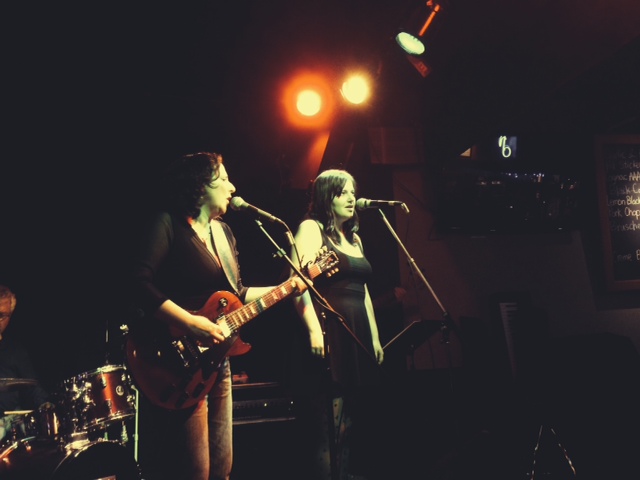
Jill Newman at Cottage Bistro May 9 singing from her new CD, Lovestruck Blues. (photo by John Endo Greenaway)

Happiness. Perhaps ironically, Jill Newman’s performance at the release party for her latest CD, Lovestruck Blues, exuded happiness. The May 9 show at Cottage Bistro featured bright vocals, skilful (and electric) electric-guitar playing, cheerful interactions with the audience and a playlist of well-written, original songs, many about finding love, but also about losing it – even these, though, exhibit optimism, finding the courage and strength to be on one’s own and true to one’s heart.

Newman’s talents as a songwriter and musician were obvious in her debut recording, Fragile Walls, in 2004. The review in the Independent (“A garden of musical delights,” April 22, 2005) ended with the comment, “It’s been a long road for Newman to reach this creative milestone. Hopefully, it’s the first of many.” A decade later, Lovestruck Blues is another welcome milestone – and there’s nothing fragile about it. It exhibits the confidence and contentment of someone who has, so to speak, come out the other side. As Newman writes in the CD booklet, “It is the story of my journey – of turning my world upside down, taking some risks and being blissfully happy for having done so.”

image - Lovestruck Blues CD cover
Lovestruck Blues is Jill Newman’s second CD.

During the period between releases, Newman told the Independent, a lot changed for her personally and musically. “My first CD was the culmination of many years of dreaming of making my own recordings,” she explained. “I was going through a difficult time in my life, including a breakup, so the songs were really all about loss and heartbreak. I had a great producer who took care of almost everything for me, from arranging the songs to organizing and directing the entire recording process.

“Today, I’m in a much better place personally, having just gotten married a few years ago and feeling happy. That does present some challenges for writing the blues – as lately I’ve been writing happy blues songs. I produced Lovestruck Blues myself with support from my engineer, Marc L’Esperance. I made all the final decisions in terms of how I wanted the recording to sound and directed the recording sessions in Seattle and Vancouver. I was not going for a retro sound, but that’s really what comes out. I’ve played in everything from country, punk, blues and even an all-female Led Zeppelin tribute band, so I’m quite eclectic in my approach to music. I’m often told that my music should be in soundtracks for Quentin Tarantino’s films, the less happy songs, that is.

“I’m most at home in front of a live audience rather than in the studio, as I really enjoy the energy and the interaction between the audience and the band,” she added. “I’ve been doing lots of performances and my live shows are definitely stronger than they were 10 years ago. I’ve also been doing quite a bit of vocal work over the past few years. Songwriting is always a challenge, with lots of hours spent struggling with lyrics – I still tend to write the music first or jointly with the words and then fine tune the lyrics.”

Lovestruck Blues includes 10 original songs, one of which – “Too Hard to Handle” – was co-written with Vancouver actor, artist, director, playwright and songwriter Lynna Goldhar Smith.

“I’m originally from Wisconsin, but immigrated to Vancouver Island with my family as a teen. I spent about 25 years living in the Vancouver area, with some brief stints in Washington,” said Newman about her community connections. “I was raised in a secular Jewish household with no religious upbringing, but I identify culturally as Jewish. My most valued connection to the Jewish community was my past involvement with the Peretz Centre for Secular Jewish Culture. My daughter, Michelle, participated as a young teen in the b’nai mitzvah program, which was a great experience for both of us. I also enjoyed singing in the Jewish Folk Choir and participating in the Peretz programming.

“I’ve worked for Jewish Family Service Agency in Vancouver and in Seattle and participated in advocacy to address poverty in the Jewish community in Vancouver. I combine my work as a professional guitarist, singer and songwriter with my part-time work as a therapist with teens who are struggling with mental health issues. When I have spare time, I enjoy being in the outdoors kayaking or sailing.”

photo - Jill Newman and her daughter, Michelle Baynton, at the Lovestruck Blues CD release
Jill Newman and her daughter, Michelle Baynton, at the Lovestruck Blues CD release. (photo by John Endo Greenaway)

A woman with many abilities and interests, Newman’s musical path also started somewhere other than where it led.

“I started in music playing classical flute at age 9 and got involved in community symphony and jazz combos as I got older, with a stint studying jazz in college,” she told the Independent. “My first stringed instrument was the banjo, followed by the acoustic guitar and pedal steel [guitar], but when I first plugged in an electric guitar (Stratocaster copy) at age 15, I was totally hooked. I loved the sound and the power of the electric guitar, especially turned up loud with distortion. A friend who’d been in rock bands taught me how to bend the strings properly and I began specializing in playing lead guitar – something very few girls were doing when I was a teen.

“I played constantly and learned everything I could figure out by Heart, Aerosmith, Yes and Led Zeppelin, but I also started writing my own songs and performing in coffeehouses. By my early 20s, I was making a living as a full-time professional guitarist and, other than recovering from a hand injury, I’ve never stopped playing. I feel strongly that we need more female electric guitarist role models and I volunteered as a guitar instructor for Vancouver Girls Rock Camp in 2012.”

And what draws Newman to the blues? “It’s the raw emotion and the simplicity of the music that grabs me,” she said, reiterating, “I’ve had a longstanding love of the electric guitar and, when I first began listening to blues players like Freddie King and Eric Clapton, I was blown away by the expressiveness of their playing. In recent years, I’ve been focusing a lot on slide guitar, which has a range of expression that emulates the human voice and beyond. There’s nothing more soulful than Roy Rogers playing slide guitar on Elmore James’ song ‘The Sky is Crying,’ or almost anything by Ry Cooder or Derek Trucks.”

Part of the fun of the Cottage Bistro CD release party – in which she was accompanied on stage by Loren Etkin on drums and Brian Scott on bass – was the seemingly spontaneous invitation by

Newman for her daughter, Michelle Baynton, and Cecile Larochelle to join her in a couple of the songs they each performed with Newman on Lovestruck Blues.

“One of the things that was the most special about making this new CD,” Newman admitted, “was getting a chance to record with my daughter, Michelle. She’s just finishing her opera degree at UBC and, despite my doing a very different style of music, we get a lovely vocal blend together. Michelle sang background vocals on my songs, ‘Everything Will Change’ and ‘Without You.’”

Newman, along with Etkin and Cameron Hood (bass), will perform next on July 14, 9 p.m., at Guilt & Co., 1 Alexander St., in Vancouver. For other upcoming performances, keep an eye on jillnewman.net, sign up to receive email updates or like the Jill Newman Blues Facebook page.

Format ImagePosted on July 4, 2014July 2, 2014Author Cynthia RamsayCategories MusicTags Brian Scott, Cameron Hood, Cecile Larochelle, Fragile Walls, Guilt & Co., Jill Newman, Loren Etkin, Lovestruck Blues, Lynna Goldhar Smith, Michelle Baynton
Community memorial for Eyal Yifrach, Gilad Shaar and Naftali Fraenkel

Community memorial for Eyal Yifrach, Gilad Shaar and Naftali Fraenkel

Eyal Yifrach, Gilad Sha’er and Naftali Fraenkel z”l (photo from mfa.gov.il)

On Monday, June 30, the bodies of Eyal Yifrach, 19, Gilad Shaar, 16, Naftali Fraenkel, 16, who were kidnapped June 12, were found northwest of Hebron. The sad discovery was the result of an extensive search effort led by the Israel Defence Forces, the Israel Security Agency and the Israel Police. A joint funeral was held July 1. Jewish groups and others around the world join in mourning.

In Vancouver, there will be a community memorial service, coordinated by the Rabbinical Association of Vancouver and led by Rabbi Berger, Rabbi Moskovitz and Cantor Szenes-Strauss, on Thursday, July 3, at the Jewish Community Centre of Greater Vancouver at 7:30 p.m.

As well, to share your thoughts and express your condolences to the families of the boys, visit the Jewish Federations of North America’s “Remember Our Boys” page.

Format ImagePosted on July 2, 2014July 9, 2014Author Cynthia RamsayCategories Israel, LocalTags Eyal Yifrach, Gilad Shaar, memorial, Naftali Fraenkel
Take a virtual tour of Jewish Montreal

Take a virtual tour of Jewish Montreal

The three current Museum of Jewish Montreal tours can be taken online or while in Montreal, either self-directed using a mobile device or led by museum staff.

The Museum of Jewish Montreal was created when the city’s Jewish community turned 250 years old in 2010. While it may contain material dating back to the 1760s, it presents the information using the latest technology.

An online and mobile museum, its activities include “connecting exhibits to personal stories, narrations, songs, poems and films”; and “creating a virtual museum and mobile applications so that the viewer can interact with our community’s history at home or on the street.” So, if you’re in Montreal, you can take the museum’s tours with museum staff or self-direct your own. From Vancouver, you can simply go online.

One of the current tours, Work Upon Arrival, gives visitors an idea of the challenges faced by immigrants who worked in Montreal’s garment industry from 1914-1941. It does this through the stories and photographs of six people, supplemented by archival images and text/audio providing the broader historical context.

The oral history excerpts in the exhibit were recorded in the 1970s by Vancouverite Seemah Berson. They are among the interviews Berson conducted with Eastern European Jewish immigrants to Montreal, Toronto, Winnipeg and Vancouver in the first part of the last century, which form the basis of her book I Have a Story to Tell You (Wilfrid Laurier University Press, 2010).

Berson’s work came to form the foundation of the exhibit when Montrealer Harold Gordon wrote Berson to praise her book. They kept in touch and he introduced her to a friend, who introduced her to museum director Zev Moses. Later, Berson was introduced over the phone to museum research director Stephanie Tara Schwartz and exhibit curator Sarah Woolf. For them, she told the Independent, she was “available for queries and questions. I suppose were I younger and more agile, I would have loved to be on the spot and physically part of this. They were amenable to my suggestions, etc. Essentially, I needed to keep in mind the important fact that a great part of the purpose of my book was to disseminate these stories and keep the voices of my storytellers alive.”

Berson explained that Schwartz and Woolf “researched and found children and grandchildren – one in Israel – which was so great for me because his grandmother was not known to me when I went to Montreal to interview people. I had walked into a nursing home where she lived and she talked to me. I didn’t know anyone in her family, so it was great to connect.”

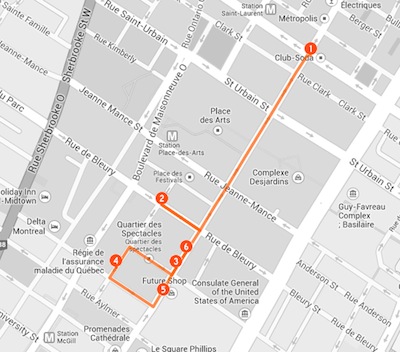
The six interviewees and locations featured in Work Upon Arrival are Hyman Leibovitch, Midway Photo Play, 1229 St. Laurent (1914); Jennie Zelda Litvack, L. Holstein and Co., 1475 Bleury (1925-26); Rose Esterson, International Ladies’ Garment Workers’ Union, 395-397 Ste. Catherine O. (1933-1954); Sidney Sarkin, Sam Hart and Co., 437 Mayor (1925); Ena Ship, Jacobs Building, 460 Ste. Catherine O. (1934); and Norman Massey (aka Noach Puterman), Parkley Clothes, 372 Ste. Catherine O. (1937-1941).

image - Work Upon Arrival exhibit takes visitors along Rue Ste. Catherine Ouest and through its garment-industry history.
The Work Upon Arrival exhibit takes visitors along Rue Ste. Catherine Ouest and through its garment-industry history.

“Exploring the open expanses of downtown Montreal’s Quartier des spectacles, it’s difficult to believe this was once a bustling garment district. Packed with factories and sweatshops, tailors and seamstresses, manufacturers and union executives, the relatively small Rue Ste. Catherine corridor between University [Street] and Boulevard St. Laurent was a hotbed of clothing production, class confrontation and radical politics,” the exhibit begins.

“Picture Ste. Catherine on a busy day in the 1920s and 1930s: steam billowing out of factory windows and grey snow covering the muddied streets; children ferrying newspapers and bales of cloth from building to building; thousands of weary workers flooding the streets for a brief lunchtime break; the mingling sounds of French, English, Yiddish, Italian, Russian….”

Work Upon Arrival explores such questions as “… how did these immigrants find work with little financial support and few personal connections at their disposal? How did so many Jews end up in the garment industry, working as cutters, machine operators and even as manufacturers? And how did so many Jews get involved in labor politics?”

Each oral history section has a summary of the subject’s arrival to Canada and their first jobs (at least), how much they were paid, the working conditions, etc.; a couple of brief excerpts from Berson’s book, along with their transcriptions; and photos of the interviewee and relevant buildings and/or documents. The parts between each oral history provide a broader context, and direct tourists (virtual and literal) from one location to the next. The combination of the personal and more general makes for a memorable learning experience. There is something special about hearing someone’s voice, even if you don’t know them, and it gives the exhibit more impact than images or text alone would have provided.

Work Upon Arrival has 20-odd sources, and Berson’s recordings appear courtesy of the Canadian Museum of Civilization, Seemah C. Berson Collection. Among those thanked are Berson and the Betty Averbach Foundation.

The other current MJM tours are Between These Walls: Hidden Sounds of Hazzanut in Montreal (1934 to 1965) and A Geography of Jewish Care: A Virtual Tour of 150 Years of Jewish Social Services in Montreal. The website is imjm.ca and in-person visits can be scheduled by emailing [email protected].

Format ImagePosted on June 27, 2014June 25, 2014Author Cynthia RamsayCategories NationalTags garment industry, I Have a Story to Tell, Museum of Jewish Montreal, Seemah C. Berson, Work Upon Arrival1 Comment on Take a virtual tour of Jewish Montreal
About this year’s Summer Celebration cover

About this year’s Summer Celebration cover

This year’s Summer Celebration cover is a collaborative effort between Jewish Independent production manager Josie Tonio McCarthy, JI publisher Cynthia Ramsay and archivist Jennifer Yuhasz of the Jewish Museum and Archives of British Columbia, which granted the JI permission to use the circa 1950 Leonard Frank photo that appears on the left of the cover and blends into the current-day photo taken on the Granville Street Bridge of False Creek, with the Burrard Bridge and North Shore mountains in background.

Frank was a well-known professional photographer in British Columbia, active between 1910-1944. He was born in Germany and first moved to San Francisco, before traveling to Port Alberni, B.C., to work in the mining industry. He began his photography interest there. In 1916, he moved to Vancouver and began to work as a photographer. He traveled throughout the province, taking a wide array of photographs, thereby preserving a detailed record of life here. Frank was interested in photographing city scenes (buildings, bridges, waterfront), industry (logging, construction, shipping) as well as scenic views (mountains, lakes, woods). In 1946, two years after Frank died, Otto F. Landauer purchased the Leonard Frank Photos Studio, which he owned and operated until his death in 1980.

The JMABC has approximately 39,000 photographs in the Leonard Frank-Otto Landauer Photos Studio collection – the largest collection of Frank photos in existence. Of these, the JMABC has digitized almost 7,000 photographs and made them available for viewing on its website. You can search them using the JMABC’s Yosef Wosk Online Photo Library: jewishmuseum.ca/archives.

To learn how to fade one photo into another in a minute, click here for a video.

Format ImagePosted on June 13, 2014February 24, 2016Author Cynthia RamsayCategories Celebrating the HolidaysTags Jewish Museum and Archives of British Columbia, JMABC, Leonard Frank, Otto F. Landauer
JFSA Innovators Lunch raises record amount

JFSA Innovators Lunch raises record amount

David Chilton, second from the right, with Josh, Michelle and Dr. Neil Pollock. (photo by Robert Albanese Photography)

More than 650 people attended the Jewish Family Service Agency’s 10th annual Innovators Lunch on May 1. This year’s keynote speaker was Wealthy Barber author and Dragons’ Den investor David Chilton.

JFSA board chair Joel Steinberg welcomed attendees to the event, which took place at the Hyatt Regency Vancouver, and introduced Beth Israel Rabbi Jonathan Infeld to make the HaMotzi. The rabbi explained the blessing and connected it to JFSA, describing the agency as “God’s partner in sustaining the most needy in our community, working together and bringing God’s blessing down from heaven and providing it in a real way.”

In his thanks and remarks, Steinberg noted how the Innovators Lunch had grown over the years, generating “significant funds for many important programs and services provided by JFSA.” Through corporate sponsorships, ticket sales and donations, this year’s lunch raised a record amount – more than $315,000, JFSA director of development and communications Audrey Moss told the Independent Monday.

The annual video, introduced by JFSA executive director Charlotte Katzen, not only highlighted the services offered by JFSA – this year focusing on mental health counseling and outreach – but celebrated the driving force behind the Innovators event, Naomi Gropper Steiner z”l, whose “dream, vision and tireless efforts” helped launch it. As the program noted, “Naomi was a remarkable person who dedicated her exceptional talents to helping others.”

Event chair Jackie Cristall Morris echoed those sentiments in her comments and offered thanks to all those who contributed to the lunch as she invited Dr. Neil Pollock to the podium. He and his wife Michelle were this year’s event angel donors, matching dollar for dollar any new gifts or portion of increased gifts, up to $20,000. “I can see that every additional dollar that I give helps to make the life of someone in need, in our local community, a little bit better. That is why we decided to offer the matching gift opportunity for the JFSA this year,” he said. Pollock praised JFSA as “a lifeline” for many, and encouraged everyone to give outside of their comfort zone, reassuring them that it would not change their circumstances, but would help change the lives of JFSA clients.

Shay Keil of Keil Investment Group at ScotiaMcLeod, which co-sponsored the lunch with Austeville Properties, introduced Chilton, who proceeded to entertain the audience with several jokes and stories, all of which had a humorous element. He started off bemoaning Fifty Shades of Grey’s unseating of The Wealthy Barber as Canada’s all-time bestselling book. He then recounted what happened when he first returned to public speaking after a brief retirement, during which he was engaged in various projects, including homeschooling his kids for a few years.

His first tour was for CIBC, he said, speaking to the company’s high-end wealth-management clients, and it started in Victoria. It was an elderly crowd. He joked, “The average age was deceased…. I normally talk about save 10 percent and max your RRSP; these people were too old for RIFs. I didn’t know what to say.” When he finished his speech, two elderly women asked his advice on their portfolio. “‘Well,’ he said, ‘I can’t answer that here. I don’t know your risk tolerance level, your pension involved, your income needs, your age, your health, I’d have to ascertain all that before I can give you any advice.’ And the second lady cut in and said, ‘Please just give us a broad general counsel.’ And I said, ‘Well, do you mind me asking how old are you two?’ She said, ‘We’re twins … we’re 93.’ I said, ‘Oh my, I’d spend it.’”

When the laughter subsided, Chilton shared a couple of funny stories about the beginning of his career. One happened at the start of his tour for The Wealthy Barber. He was waiting at the Calgary airport for a flight and visited the bookstore. Seeing his book on display, he offered to sign some copies, only to have the clerk want to know why he would want to do that, not believing that the 25-year-old in front of her could have written it.

The entire season of Dragons Den is filmed in 21 days and, for these 21 days, the dragons must always wear the same clothing because the decision as to which pitches form each individual show are made only after all the filming is complete.

Chilton spoke of how he became involved in Dragons’ Den (“I’ve had so much fun doing the show”), how it has changed his life (he’s no longer always asked whether it’s best to pay off one’s mortgage or max one’s RRSP, but rather whether his fellow dragon, Kevin O’Leary, is really a jerk), how it attracts very passionate fans, some of whom are inspired to go into business, and a few of his favorite entrepreneurs and most profitable or surprising investments. He also shared other tidbits. He explained, for example, that the entire season is filmed in 21 days, over which they see 230 pitches. For these 21 days, the dragons must always wear the same clothing because the decision as to which pitches form each individual show are made only after all the filming is complete, and there needs to be continuity within each show.

Outside of Dragons’ Den, Chilton has invested in other businesses. Notably, he helped cookbook authors Janet and Greta Podleski – after about a year of them wooing him. He spoke with obvious fondness and admiration for the sisters, who almost went bankrupt (paying their mortgage with credit cards!) before they saw success. Their first book, Looneyspoons, spent almost two years on the national bestseller list and sold 850,000 copies in Canada alone. They have since published more cookbooks and expanded into other food-related ventures.

Chilton ended his speech with a call for perspective. Describing himself as always being in a good mood, he noted that this isn’t the case with many others. “People say that Canada’s national pastime is hockey, but I’d argue, after 25 years on the road, it’s complaining. Everywhere you go,” he said, “people whine about absolutely nothing. It is amazing to me how many people voluntarily decide to be in a bad mood about a trivial matter.”

An economist by training, Chilton said, “I believe the number one thing holding back productivity in many people’s lives is their whining and complaining, they’re always focused on something negative and it’s usually something trivial. People have lost perspective. In Canada, we have lost the ability to discern the difference between a minor inconvenience and a major problem. A long lineup at Tim Horton’s is not a major problem, but it spins people into bad moods for hours. It’s crazy. Look around the world right now and what’s happening in so many places, Ukraine obviously, but think about Syria. We’re talking about a relatively wealthy developed country disintegrating right in front of our eyes, and it’s happening everywhere in the world.”

“I’m telling you right now, if you are healthy and you live in Canada, especially if you live here [in Vancouver], it doesn’t get any better than right here and right now. You’ve got to step back and see how fortunate we are. It’s that perspective, I think, that leads to more generosity, more community involvement, all of that.”

Not only are Canadians better off relative to most other countries, but to previous centuries. “We are living such better lives than at any point in history. It’s crazy that people don’t notice that. And I’m not talking back to medieval times, I’m talking 20 and 40 years ago, one or two generations. Everything, and I repeat, everything is way better now than it was then, everything.” He gave many examples – cars, phones (which now have “more computing power than the entire Apollo 11 mission”), air travel, television, wages, home sizes and building materials, health care. “I’m telling you right now, if you are healthy and you live in Canada, especially if you live here [in Vancouver], it doesn’t get any better than right here and right now. You’ve got to step back and see how fortunate we are. It’s that perspective, I think, that leads to more generosity, more community involvement, all of that. That’s what days like this are all about.”

For more information about JFSA, call 604-257-5151 or visit jfsa.ca.

Format ImagePosted on May 9, 2014May 8, 2014Author Cynthia RamsayCategories LocalTags Audrey Moss, Charlotte Katzen, David Chilton, Dragons' Den, Greta Podleski, Jackie Cristall Morris, Janet Podleski, Jewish Family Service Agency, Jonathan Infeld, Looneyspoons, Neil Pollock, Shay Keil, The Wealthy Barber, The Wealthy Barber Returns

Posts pagination

Previous page Page 1 … Page 82 Page 83 Page 84 Page 85 Next page
Proudly powered by WordPress