Skip to content
  • Home
  • Subscribe / donate
  • Events calendar
  • News
    • Local
    • National
    • Israel
    • World
    • עניין בחדשות
      A roundup of news in Canada and further afield, in Hebrew.
  • Opinion
    • From the JI
    • Op-Ed
  • Arts & Culture
    • Performing Arts
    • Music
    • Books
    • Visual Arts
    • TV & Film
  • Life
    • Celebrating the Holidays
    • Travel
    • The Daily Snooze
      Cartoons by Jacob Samuel
    • Mystery Photo
      Help the JI and JMABC fill in the gaps in our archives.
  • Community Links
    • Organizations, Etc.
    • Other News Sources & Blogs
    • Business Directory
  • FAQ
  • JI Chai Celebration
  • JI@88! video

Recent Posts

  • BGU fosters startup culture
  • Photography and glass
  • Is it the end of an era?
  • Taking life a step at a time
  • Nakba exhibit biased
  • Film festival starts next week
  • Musical with heart and soul
  • Rabbi marks 13 years
  • Keeper of VTT’s history
  • Gala fêtes Infeld’s 20th
  • Building JWest together
  • Challah Mom comes to Vancouver
  • What to do about media bias
  • Education offers hope
  • Remembrance – a moral act
  • What makes us human
  • המלחמות של נתניהו וטראמפ
  • Zionism wins big in Vegas
  • Different but connected
  • Survival not passive
  • Musical celebration of Israel
  • Shoppe celebrates 25 years
  • Human “book” event
  • Reclaiming Jewish stories
  • Bema presents Perseverance
  • CSS honours Bellas z”l
  • Sheba Promise here May 7
  • Reflections from Be’eri
  • New law a desecration
  • Resilient joy in tough times
  • Rescue dog brings joy
  • Art chosen for new museum
  • Reminder of hope, resilience
  • The national food of Israel?
  • Story of Israel’s north
  • Sheltering in train stations

Archives

Follow @JewishIndie
image - The CJN - Visit Us Banner - 300x600 - 101625

Byline: Cynthia Ramsay

Life, beginning to end

Love is at the heart of three new children’s books that would make great Hanukkah gifts.

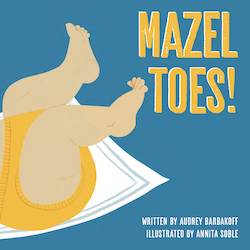
image - Mazel Toes! book coverMany different types of families welcome their newborns in Mazel Toes!, written by Dr. Audrey Barbakoff and illustrated by Annita Soble. Each set of pages is a work of art with a rhyming poem that highlights playful gestures of love, like a kiss on the pupik (belly button), and more serious ones, like making sure baby is safe and warm in their schmatte (rag or, in this case, “a well-loved baby blanket”). Multiple generations of Jews are depicted, multiple family configurations and multiple cultures. It is a fun board book for both reader and listener – and can be as interactive as you want it to be. You can read it quietly, all snuggled up, or more raucously, with tickles of “mazel toes” and other giggles.

image - Waiting for Max book coverA more serious but equally  adorable and educational book is Waiting for Max: A NICU Story, written by Emily Rosen and illustrated by Esther Diana. Based on Rosen’s own experiences of having had a baby who had to spend 16 days in the hospital’s neonatal intensive care unit (NICU), Waiting for Max centres around Louise, Max’s big sister, who is very keen to meet her new baby brother and doesn’t really understand why Max, who was born premature, can’t come home yet. So, she puts her mind to figuring out ways to help him escape from the “little plastic box” (incubator) he’s in. She puts a lot of imagination and work into drawing out her ideas. Each one she comes up with, she gives to her parents to take to Max, so that he can follow her instructions. She shows great perseverance, always thinking up a new idea when one doesn’t work. She keeps at it until Max eventually makes it home – no doubt, because of her idea.

Apparently, one in 10 babies in the United States must spend time in an NICU, and Rosen will donate a portion of her book’s proceeds, as well as copies of Waiting for Max, to NICU hospitals and nonprofits across the States.

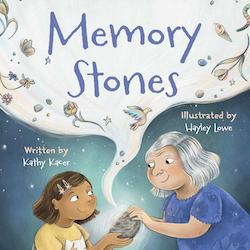
image - Memory Stones book coverAt the other end of the life spectrum, author Kathy Kacer, who specializes in writing books to educate younger readers about the Holocaust, has come out with a different kind of lesson. In Memory Stones, which is beautifully illustrated by Hayley Lowe, we meet Sophie, who has just lost her beloved grandmother. We see some of the many fun things Sophie and Granny would do together, and how heartbroken Sophie is when Granny dies. Sophie brings flowers to Granny’s grave, but they never last long. When Sophie’s mom shares that people in some cultures, including Jews, place stones on loved one’s graves, Sophie figures out a special way to remember her grandmother.

Memory Stones, published by Second Story Press, is intended for readers 6 to 8 years old. Published by the Collective Book Studio, Waiting for Max is for readers 4 to 8 years old, and Mazel Toes!, for babies to toddlers.

Posted on November 21, 2025November 20, 2025Author Cynthia RamsayCategories BooksTags Annita Soble, Audrey Barbakoff, children's books, Collective Book Studio, death, Emily Rosen, Esther Diana, Hayley Lowe, Kathy Kacer, kids books, life, Mazel Toes!, memory, Memory Stones, Second Story Press, Waiting for Max
From the archives … books

From the archives … books

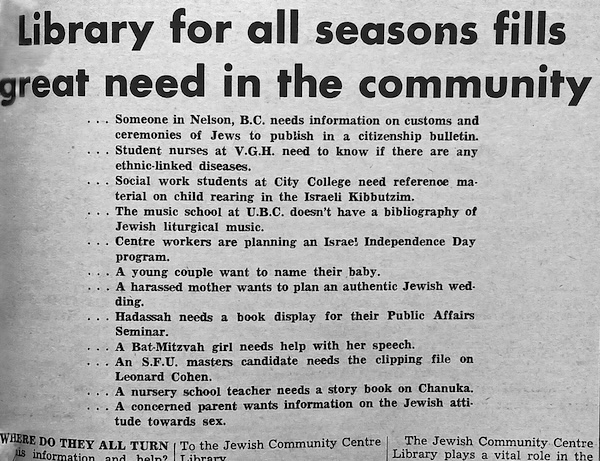
In honour of Jewish Book Month, which runs Nov. 13 to Dec. 13, I’m highlighting a short article that appeared in the Independent’s predecessor, the Jewish Western Bulletin, on Dec. 18, 1970.

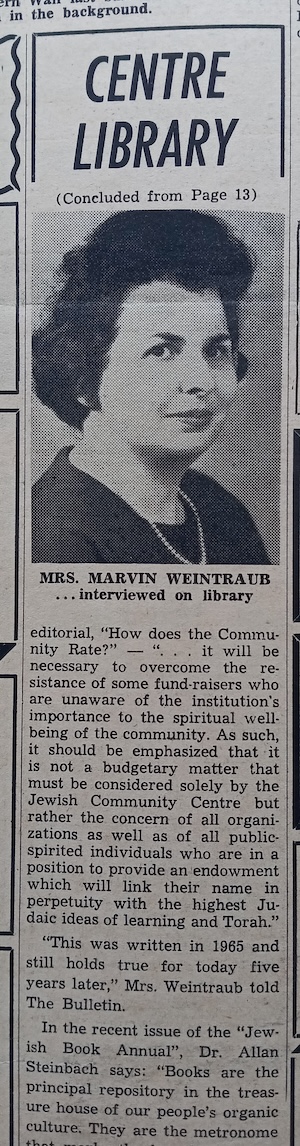
image - Rita Weintraub photo in the article on the JCC Library from the Jewish Western Bulletin, on Dec. 18, 1970 The focus on the Jewish Community Centre Library, now called the Isaac Waldman Jewish Public Library, stressed the “vital role” the library plays “in the life of the Vancouver Jewish community” and how it serves “the community at large in a very meaningful and important way. At any time, one can pass by and see it being used for recreational reading, browsing or study.”

The article notes how a visiting professor who stopped in at the library remarked “how thoroughly cross-referenced it was.” 

“Mrs. Marvin Weintraub, hardworking and dedicated volunteer librarian,” aka Rita Weintraub, is interviewed for the story. Many in our community will have known Rita, who died in 2020. The library she was instrumental in building was a lifelong passion. In the article, she refers to the library as important for “the spiritual well-bring of the community.” As such, she said, it should be “the concern of all organizations as well as of all public-spirited individuals who are in a position to provide an endowment which will link their name in perpetuity with the highest Judaic ideas of learning and Torah.”

Posted on November 21, 2025November 20, 2025Author Cynthia RamsayCategories From the JITags history, Isaac Waldman Jewish Public Library, Jewish journalism, Jewish Western Bulletin, Rita Weintraub
Music to build bridges

Music to build bridges

On Nov. 29, sopranos Jaclyn Grossman, left, and Miriam Khalil will perform Salam-Shalom: Echoes of Home, a program they put together in an effort “to build bridges between our communities.”

“Salam-Shalom: Echoes of Home grew out of countless conversations between Miriam and me over the past few years – conversations that gave me a lot of hope during a difficult time,” Jaclyn Grossman told the Independent about her upcoming concert with fellow soprano Miriam Khalil.

“We shared what we were each experiencing, what our communities were going through, and how we might better understand and support one another,” said Grossman. “We both felt a deep need to do something meaningful and to use our voices and our art to foster empathy, connection and healing. This project is deeply meaningful to me because I hope it can create a space for reflection, healing and understanding for our communities, and for anyone who connects with its themes of home, acceptance and belonging. I truly believe we are stronger when we stand together, and I hope this concert helps build bridges that make that possible.”

Grossman and Khalil will be accompanied on piano by Gordon Gerrard, artistic director of City Opera Vancouver, which is presenting the concert. Idan Cohen (Ne.Sans Opera & Dance) will lend his experience in stage and movement, and Avideh Saadatpajouh has created projections that, among other things, highlight some of the textual elements.

“Jaclyn is a beautiful person and has always been someone that I have connected with,” said Khalil about why she wanted to be involved with the production. “Through many of our conversations, our shared dialogue grew and became something we realized we both needed in order to find healing. Jaclyn had mentioned that she had spoken to Gordon about the possibility of creating something together. What made this project so special was our dialogue from the very beginning. Through numerous meetings, we spoke about finding a way through song, language and poetry to create a space for healing and shared empathy and, most importantly, to build bridges between our communities. We longed for the same thing, peace and human connection – this recital is an extension of that longing and an expression of hope.”

As for his participation, Gerrard said he became interested after a conversation with Grossman more than a year ago. “I was distressed to hear that she had had several concert appearances canceled over recent months,” he said. “It seemed to me that many organizations seemed hesitant to present Jewish and Arab artists out of fear of controversy. The program was suggested by Jaclyn as a direct way to counteract this.”

photo - Pianist Gordon Gerrard, artistic director of City Opera Vancouver
Pianist Gordon Gerrard, artistic director of City Opera Vancouver. (photo from City Opera Vancouver)

About the risk of City Opera Vancouver being “canceled” for presenting Salam-Shalom, Gerrard said, “Certainly, we have committed to this special event after careful consideration of the charged environment that we are all a part of right now. We wanted to be sure that we acted responsibly, and that we would be able to create a respectful space for everyone involved. Because I trust Jaclyn, Miriam and Idan entirely, we’ve been able to have many helpful conversations about this event and how to go about it. This has given us at City Opera confidence that we are doing something that intends to create better understanding and, for us, this remains the priority.”

“Our goal with this project is to create a space for nuanced dialogue, where all voices can be heard and where empathy and understanding can grow,” said Grossman. “While this kind of work isn’t always easy, I believe it’s essential. In times like these, it’s more important than ever for communities to come together, listen to one another, and foster compassion. To me, standing together in empathy and respect for all people feels like the only path forward.”

“My concern,” said Khalil, “is that we have a responsibility to one another. If we keep being afraid, then no change will ever take place. We must unite and listen to each other. As Jaclyn mentioned, without compassion and empathy, the way forward feels unattainable. There is great growth in seeing and appreciating one another’s perspective.”

Grossman and Khalil chose the repertoire, and the result will be a concert of “beautiful and seldom performed works entirely curated by the two of them,” said Gerrard.

The hour-long program comprises melodies from myriad musical heritages, including Arabic, Hebrew, Ladino, Spanish and Yiddish. The concert’s press release highlights “Eli, Eli,” an arrangement of a poem by Jewish-Hungarian resistance fighter Hannah Szenes during the Second World War; “Mermaid Songs” by Palestinian-American composer Felix Jarrar; “Ukolebavka,” a lullaby by Jewish composer Ilse Weber, who wrote and performed songs to comfort children when she was interned in Terezín; “Ayre,” by Argentine Jew Osvaldo Golijov, which explores the themes of exile and belonging using the words of a Hebrew prayer and those of Palestinian writer Mahmoud Darwish; and “The New Colossus,” a setting of Emma Lazarus’s poem (inscribed on the Statue of Liberty) by pianist and composer Nate Ben-Horin, who is part of Grossman’s duo, the Likht Ensemble. Another of the songs on the program is “Mi Lo Yeshalach,” by contemporary Israeli composer Hana Ajiashvili. The complete repertoire, with all the lyrics, has been posted on cityoperavancouver.com.

“To me, Salam-Shalom: Echoes of Home is an urgent expression of a voice that feels increasingly silenced,” said Cohen. “I believe the growing calls to silence or divide rather than engage in dialogue are deeply troubling. When Jaclyn, Miriam and Gordon reached out, I immediately said yes. 

“This project also speaks to my responsibility to uphold these values and address the horrors we are living through, through art,” Cohen added. “It’s easy to see conflict in simple opposites – right and wrong, us and them – but true understanding asks us to face complexities.

“Art,” he said, “should remain a space for reflection and critical thought, not moral posturing. I believe in its power to unite, to reveal our shared humanity, and to keep hope for peace alive.”

For tickets to Salam-Shalom, go to cityoperavancouver.com. 

Format ImagePosted on November 7, 2025November 6, 2025Author Cynthia RamsayCategories MusicTags City Opera Vancouver, dialogue, Gordon Gerrard, Idan Cohen, Jaclyn Grossman, Miriam Khalil, peace, Salam-Shalom
Telling the story of an icon

Telling the story of an icon

Ronnie Marmo brings his one-man show I’m Not a Comedian … I’m Lenny Bruce to the Chutzpah! Festival Nov. 18. (photo from dorensorellphotography.com via Chutzpah!)

In 2017, with the expectation of a six-week run, creator and performer Ronnie Marmo and director Joe Mantegna brought I’m Not a Comedian … I’m Lenny Bruce to the stage. Now, celebrating eight years and 468 performances, Marmo told the Independent, “we can not wait to bring it up to Vancouver for 469!”

I’m Not a Comedian … I’m Lenny Bruce is part of this year’s Chutzpah! Festival, which runs Nov. 12-23. It’s being presented on Nov. 18, 7:30 p.m., at the Rothstein Theatre.

Bruce, a groundbreaking standup comedian and satirist, was born Leonard Alfred Schneider in Mineola, on Long Island, NY, in 1925. He consistently pushed social and legal boundaries, being arrested more than once for what was considered obscenity in his day, including a conviction in 1964 for a performance he gave at Café Au Go Go in New York City. Bruce died two years later, at age 40, from an accidental overdose. He was bankrupt, basically not having been employable after the conviction. It would be 37 years before he was posthumously pardoned, by then-governor George E. Pataki.

In I’m Not a Comedian … I’m Lenny Bruce, Marmo told the Independent, “We bookend the show with the final moments of his life and take you on a journey through his first performance all the way to his demise. We learn about his family, we see his charm and success, his struggle with addiction, his long-standing fight with the judicial system. We don’t hold back. You really get a full theatrical experience of his entire life.”

Bruce is one of Marmo’s heroes.

“What inspires me about Lenny is how ahead of his time he was and how passionate he was about his pursuit of the truth. I have so much respect for someone who is willing to sacrifice everything and put it all on the line just to make sure he didn’t fall into suit with everyone else. I’m proud to be entrusted by the family to be the one to tell his story to the next generation.”

Marmo landed on the title for the show after hearing Bruce say, in an audio clip, “I’m sorry I wasn’t funny tonight … I’m not a comedian, I’m Lenny Bruce.” For Marmo, that comment resonated. “He wasn’t a comedian – he was so much more than that,” said Marmo of Bruce. “He was a satirist, a social commentator and a true advocate for the freedom of expression.”

The show has evolved a lot since its creation.

“As the writer, I am always tinkering with the script,” said Marmo. “For example, I removed the famous ‘N-word’ bit when we came back after the pandemic. I felt as though, even though the bit itself was in support of removing power from words so we don’t give them the chance to harm us, I knew that people might have a hard time hearing what Lenny was actually trying to say. Plus, even though I loved the impact it had on an audience, it kept me up at night thinking about it even before events like what happened to George Floyd. I have a responsibility as an artist to tell the absolute truth but also to not be tone deaf to the world around me. I don’t believe Lenny would have done that bit today. 

“I also had long discussions with Kitty [Bruce, Lenny’s daughter] and my director, Joe Mantegna, who both agreed that it was best to remove it. So, I replaced it with ‘The Meaning of Obscenity,’ which, in my opinion, supports the show even more. So, I’m happy to make the switch, knowing it is not only the best fit culturally in this climate but also the strongest choice for the show overall. As a performer, my portrayal of Lenny evolves as I explore my own life and how I tell his story resonates differently depending on where I am in my life. I think it takes passion, dedication and an openness to watch it grow and evolve along with me.”

While I’m Not a Comedian … I’m Lenny Bruce premiered in 2017, Marmo said, “I’ve actually been with Lenny since 2005, when I did another show about him, called Lenny’s Back and Boy is He Pissed. On stage, I don’t separate us – it is my job as an actor to find where we meet in the middle. I try to focus on all the similarities that I identify with for Lenny. It is easy to keep it fresh because it is such an emotional ride and massive performance. I don’t feel like I ‘have it’ yet, which is refreshing, because it always feels just slightly out of reach.”

When Marmo did Lenny’s Back, which was brought to him by comedian Charlie Brill, he became “intimately involved with Lenny Bruce and his life.

“In getting to know him, I realized that there was so much of his story we weren’t telling. I wanted to get into the nitty gritty, I wanted to do his bits,” said Marmo. “So, I set out to write my own show. 

“We initially started the show anticipating a six-week run,” he said. “This thing has caught fire in the most incredible way. It is a testament to just how relevant Lenny is today – perhaps even more than he was over 60 years ago! It truly has been a perfect storm: free speech, first amendment, cancel culture and not to mention the success of the Amazon series The Marvelous Mrs. Maisel. They really helped catapult Lenny’s name back into pop culture and have sold thousands of tickets for us. We have, in some ways, come very far and, in others, not far at all.”

Marmo described Bruce as “a very proud Jewish man,” who often incorporated Judaism and his Jewish heritage into his material. “He openly incorporated his Yiddish vocabulary into his bits and there is quite a bit of familiar references sprinkled throughout the show,” said Marmo. “His relationship with religion overall was complex but, rather than hiding his heritage, he celebrated it.”

As for what he thought gave Bruce the courage to run up against the country’s obscenity laws, Marmo said, “The truth. He held a mirror up to society and asked questions that everyone wondered about but never found any resolution to. He also fervently believed in our judicial system and always believed that it would prevail and he would be redeemed – something that he, unfortunately, didn’t see in his lifetime, but did come to fruition with his posthumous pardon in 2003 – the first in New York history, in fact. He spoke out loud what everyone whispered to themselves and his popularity was proof of how profound he was.”

Even though Bruce wasn’t alive to receive the pardon, Marmo still believes it was an important action.

“It was a landmark symbolic victory for free speech,” he said. “I think it was redemption. It was validation that Lenny had something to say to this society and that we are free-thinking creatives entitled to our artistic expression.”

For tickets to I’m Not a Comedian … I’m Lenny Bruce or any other Chutzpah! show, go to chutzpahfestival.com or call 604-257-5145. 

Format ImagePosted on November 7, 2025November 6, 2025Author Cynthia RamsayCategories Performing ArtsTags Chutzpah!, comedy, free speech, history, Lenny Bruce, Ronnie Marmo, satire

From the archives … editorials

Almost every year that the Jewish Independent has entered the American Jewish Press Association’s Simon Rockower Awards for Excellence in Jewish Journalism competition, the paper has been recognized for its editorials. We have won for other articles, too, in several different categories, but have taken away the most honours for our editorials. This year, for instance, we took first and second place! (See jewishindependent.ca/ji-editorials-win-twice.)

The JI’s editorial board, Pat Johnson, Basya Laye and I, don’t always agree initially on what the editorial’s stance will be. Our back-and-forths, exchanging our different views and coming to a consensus, is one of my favourite parts of running the paper. It’s a key reason, I believe, that the editorials have been so award-winning.

Another reason is that the three of us have read and worked on the Jewish Independent for so many years, and we’ve been part of this community for so many years. We are grateful for those on whose shoulders we stand. The wisdom of previous generations, and that of our own generation, inspires how we look at what’s happening here and elsewhere in the world.

As I looked through the JI archives, I came across the first editorial I wrote for the paper, when it was still called the Jewish Western Bulletin, and before Pat, Basya and I became a team. I also clipped out just some of the thousands of editorials that have been written over the years. There are so many recurring themes, including communal and democratic responsibilities and the importance of free speech. The editorials variously try to calm, cajole, educate or empower readers. 

image - April 13, 1945, editorial in JWB
April 13, 1945: The paper’s editorials were brought under community review. Associate editor Goodman Florence describes the meeting that took place and comes to the conclusion that, “He who aspires to express himself must expect to receive both ‘bouquets and brick-bats’ – and if he is intelligent he will use them both.”
image - Oct. 26, 1973, editorial in JWB
Oct. 26, 1973: Jewish Western Bulletin editor Sam Kaplan calls out community members who’ve not contributed funds to Israel in the wake of the Yom Kippur War. The editorial floats the idea of publishing a list of these “Missing Jews of Silence.”
Feb. 6, 1998, editorial in the JWB
Feb. 6, 1998: My first editorial for the paper argued for limited  regulation of the internet, concluding that state censorship is more dangerous than free speech, including hate speech.
image - The JI editorial board’s first place Rockower Award winners from 2024
The JI editorial board’s first place Rockower Award winners from 2024 – and our many other missives – can be read at jewishindependent.ca.
Posted on November 7, 2025November 6, 2025Author Cynthia RamsayCategories From the JITags AJPA, American Jewish Press Association, editorials, history, Jewish Independent, Jewish Western Bulletin, journalism, Rockower Awards
A journey beyond self

A journey beyond self

“The Valley of the Shadow” by Michal Tkachenko.

Songs of Deliverance, a solo exhibit by Michal Tkachenko, opened last month at the Zack Gallery and is on display until Nov. 10. While its title is inspired by the lyrics of a Bethel Music song – “You unravel me, with a melody / You surround me with a song / Of deliverance, from my enemies / Till all my fears are gone” – its focus derives from three psalms.

“I really wanted to have a subject for the exhibition that would bind communities together and so I came to rest on the psalms, which span both Judaism and Christianity, but are also used in secular society as a means to reach out to a greater being beyond ourselves,” Tkachenko told the Independent. “For me, this is a huge departure from previous work in both subject and vulnerability. It is my most honest work so far and, as the exhibition falls on the two-year anniversary of everything I saw with my spirit, I feel myself rising from the anguish and am ready to speak about my experience now, to move towards creating what I saw was possible.”

Lacking the exact words to describe it, Tkachenko said she had a near-death, or mystical, experience two years ago, and she was in that state for more than a week.

“It instantly changed my entire outlook on life and death and it completely changed me,” she said. “I was so excited about it until I began to realize how isolated it made me and how those I reached out to didn’t always have a helpful response. I quickly spiraled into the dark night of the soul and have been traveling that road…. Two very deep things came to rest in me during this time. The first was a deep longing in my spirit for something greater than myself, to draw and stay extremely close to God. The second was a deep grief that all that I had seen with my spirit, particularly an unseen solid force of love that is everywhere and how we are meant to love and be vulnerable with each other as our primary purpose in life, were things I could not make happen however hard I tried.”

Psalm 23 – “As I walk through the valley of the shadow of death, I will fear no evil” – was with Tkachenko throughout this two-year period. “For me,” she said, “it was a psalm about my journey and how, in the midst of the darkness, God was always with me and more vivid than I had ever experienced outside of that extraordinary week.”

photo - Michal Tkachenko’s solo exhibit, Songs of Deliverance, is at the Zack Gallery until Nov. 10
Michal Tkachenko’s solo exhibit, Songs of Deliverance, is at the Zack Gallery until Nov. 10. (photo by Andrea Lee)

As she approached the one-year anniversary of that week, Tkachenko asked two people to write her a blessing, as she made a vow to God and shaved her head. “One of the blessings,” she said, “included Psalm 63 and it reflected my own deep longing for God, ‘I thirst for you, my whole being longs for you, in a dry parched land where there is no water.’… My hair that I shaved off is part of the exhibition in an aged box that is meant to suggest a holy relic of the past, when people had more vivid experiences with God.

“Psalm 139 is such a beautiful expression of God’s love and absolutely full of beautiful imagery as an artist,” she continued. “It is a psalm that has also kept me company on my two-year journey and moves me every time I read it. 

“For this psalm,” she said, “I made a pile of sketches of different verses and the images that came to me. Of those, I chose seven to do larger pieces on mylar. In many of the pieces, the spirit of God is represented by the white negative space. In ‘You Hem Me in Behind and Before, You Lay Your Hand Upon Me,’ the image of a human is abstracted in a long, dark column down the centre of the page, but the figure is not the focus. Instead, the white empty space is the representation of God hemming that figure in from ‘behind and before.’”

Songs of Deliverance marks Tkachenko’s return to drawing and painting after this two-year period, during which she spent a lot of time writing. “My goal is to make short, layered videos using these writings,” she said.

She also took a break from painting during COVID, making art out of dollhouses that people were getting rid of in the decluttering that took place then. In these dollhouses, she created COVID lockdown scenes in miniature.

“My interest is not held by one medium or one style alone, although I do have a style that often emerges naturally,” she said. “The older I get, the less interested I am in creating what I think others will like or want to buy and more about what I want to say and what I am excited about making and expressing through the medium that seems best suited to that particular message.”

Tkachenko was born in Victoria but grew up in Vancouver. Her dad, an architectural technician, builder and musician, was a Ukrainian immigrant to Canada after the Second World War, while her mom, a teacher, music teacher and musician, was a second-generation Canadian with a Scottish/British background.

“My parents were part of the hippy movement in the ’60s and ’70s and, when I was young, we lived in communal housing,” said Tkachenko, who is the oldest of four sisters.

“Growing up in a big creative household, there were always guests and cooking parties (Ukrainian food), live music and all sorts of art projects going on,” she said. “My parents didn’t push the academics as much because they wanted to make sure we found what gave us excitement and joy and they invested in building our self-esteem instead.”

That said, Tkachenko has a bachelor’s and a master’s in fine arts. For her schooling, she has lived in Vancouver, Victoria, Calgary, Toronto, Florence and London (England). She has lived and volunteered in Haiti, Kenya, Malawi and Liberia, among other places. She has studios in both Vancouver and Manchester, as she, her husband and kids travel between Canada and the United Kingdom.

Despite knowing from a young age that she was going to be an artist, it took time for Tkachenko to recognize her skill and justify making art – “I considered it a luxury item, when the poor existed in the world,” she said.

“My hippy parents had driven us down to Mexico a number of times when my sister and I were young children (we are the oldest two) and we had been taken to the slums to understand how most of the world lived and how, despite our modest life in Canada, we were rich compared to rest of the world. It had made a huge and lasting impression on me as a child.”

At 18, she moved to Haiti to volunteer for a year, she said, “but before the year was out, I was in a life-altering car accident in which a friend died, my skull was shattered and my face smashed in on one side. I was flown back to Canada for reconstructive surgery and to recover.”

She volunteered for a spell in Kenya a few years later, but then finally decided to follow her calling in art.

Tkachenko works out of Parker Studios in Vancouver. She is also on the advisory committee for the DTES Small Arts Grant. “Being on this committee and working out of Carnegie [Community Centre] in the Downtown Eastside joins two things I value – the arts and working among the less fortunate,” she said.

Tkachenko’s husband is Jewish on his mother’s side – “her parents fled Czechoslovakia and Germany for the UK during WWII,” Tkachenko shared.

“Although they purposefully lost a lot of their Jewish heritage during the shift for safety reasons, my kids and I have become interested in it,” she said. “I came from a very open faith background because my parents were hippies that were part of the Jesus People Movement. They always encouraged us to find our own way to God and faith and, as a result, the people I am drawn to with my spirit are varied, from Jewish to Muslim, from Buddhist to Eastern Awakenings. The value of community does go beyond a single group [an idea she explores in one of The Journey series videos she is currently working on] and the more open and loving we become with each other, the more we can appreciate the differences that we each were gifted. And the more we see the bigger picture and what we all have in common.” 

Format ImagePosted on October 24, 2025October 23, 2025Author Cynthia RamsayCategories Visual ArtsTags Michal Tkachenko, painting, psalms, spirituality, Zack Gallery
Joy of shared existence

Joy of shared existence

Omer Backley-Astrachan and Jana Castillo present the North American premiere of their work Common Place on Nov. 20, as part of this year’s Chutzpah! Festival. (photo by Wendell Levi Teodoro)

Intoxicating, moving, compelling, exhilarating – these are just some of the words that have been used to describe Common Place by Australian dancers and choreographers Omer Backley-Astrachan and Jana Castillo, which premiered in March at Riverside Theatres in Sydney. The work will have its North American premiere on Nov. 20, 7:30 p.m., at the Rothstein Theatre, as part of this year’s Chutzpah! Festival.

Common Place is described as “a physical exploration of belonging and togetherness, delving into shared action, collaboration and transcendent synchronization.” It is the first work that Backley-Astrachan and Castillo have created together.

In an interview with The Scoop arts review website, Backley-Astrachan explained, “We started by not knowing what the work was going to be about. We just danced together and, through that process, found the essence of what it means to find common ground.

“Jana and I could have spent time talking about our histories and our backgrounds,” he said. “Instead, we just created the work with movement at the centre and tried to find moments where we clicked together.”

He pointed out the title of the piece also invokes that which is commonplace, or ordinary.

“We tried to find a sense of exhilaration or a profound experience through very simple, very commonplace beginnings,” he told The Scoop. “So, rather than trying to create something complicated and highly technical, we took on a sensibility, almost inspired by folk, where it is something that anyone could do.”

“What we tried to avoid is creating the story first and then moulding ourselves into a preexisting narrative,” Backley-Astrachan told the Independent. “Instead, we wanted to stay curious and let the story unfold through the meeting between the bodies. It was important to us not to obey structured archetypes, rather to allow our shared physicality to weave the drama and the intimacy.”

“Common Place, for me, is the coming together of two people,” said Castillo. “It’s feeling the ease, frustration and joy of a shared existence. The audience could be witnessing a single day of a relationship, or a lifetime of reflection.”

The dancers met at a colleague’s birthday party, Backley-Astrachan said. “Jana flipped me off from across the room, giving me the finger, which obviously caught my attention – little did I know about Jana’s Tourette’s at the time. Jana immediately explained and apologized, which turned into the funniest and most endearing friendship.”

The two share a philosophy of movement and artistic practice. When Backley-Astrachan saw Castillo perform live with the Australian company Force Majeure, he said he “vowed to work with this incredible dancer, which came true.”

“Jana and I are both the same age and have had similar career journeys, which led us to a similar idea of what we are looking for in dance and dance-making – a sense of maturity, an interest in truth-making through physical storytelling,” he explained. “Working with a like-minded collaborator is non-negotiable. It’s about being able to commit wholly to the process without getting distracted by ambition.”

The creation of Common Place took a few years. The need to get the work stage-ready by its March premiere helped drive its completion. 

“But I know that, if we had more time, we would probably continue to change and evolve the work, so it’s good we were limited,” acknowledged Backley-Astrachan. “That said, we made sure the work follows an emotional structure that makes tonal sense and goes through the full life cycle during the duration of the work. That said, choreography is a living thing that starts and ends again and again every time we do it.”

“This piece was quite unique because we had a lot of space in between development phases to allow the qualities of the movement to be digested into the body,” Castillo said. “It became clear very early on – this piece is about a relationship between two people. The premise of the work was to bring our whole selves. So, naturally, our outside experiences influenced what we brought into the space. We weren’t dictated by a creative brief, which can be terrifying as a creator because there are too many options. Just like in a relationship, you figure it out, but it takes time. You learn … when to rein it in and when to trust and let go.”

“I truly believe in the ability of dance and physical language to transcend an ordinary sense of meaning,” said Backley-Astrachan. “I have had the pleasure of being left speechless at the end of works by [Israeli choreographer] Ohad Naharin – his work changed my life in a deep way. I try in my own work to allow a certain state where several, sometimes opposing, forces can be true at the same time. Dance as a medium can give space for interpretation and, within that, there is also clarity and detail.”

In addition to the Nov. 20 performance, Backley-Astrachan and Castillo will lead a masterclass for dancers on Nov. 21, at 10 a.m.

This year’s Chutzpah! Festival runs Nov. 12-23, opening with Modi at the Vogue Theatre, where Chutzpah! is the community partner of MRG Live for the comedian’s Pause for Laughter Tour, and closing with the Golden Thread Septet’s Yiddish Songs of Social Change at the Rothstein Theatre.

Most single tickets for Chutzpah! are offered at a pay-what-you-will price, with the levels at $18, $36, $52 and $70 (+ gst/sc). I’m Not a Comedian … I’m Lenny Bruce is $40 (students/seniors), $54 (general) and $72 (VIP) (+gst/sc). ChutzPacks are also available: see four different regular-price shows of your choice for $136. Tickets for Modi can be purchased through admitone.com/events. All tickets can be purchased at chutzpahfestival.com or 604-257-5145. 

Format ImagePosted on October 24, 2025October 23, 2025Author Cynthia RamsayCategories Performing ArtsTags choreography, Chutzpah! Festival, Common Place, dance, Jana Castillo, Omer Backley-Astrachan
From the archives … a coin, etc.

From the archives … a coin, etc.

My latest trip down a rabbit hole was inspired by this issue’s theme of Finance & Law. One of the first news items that caught my eye was “Model for U.S. Coin Revealed as a Jewess at Marriage.” The two-paragraph story appeared in the July 24, 1930, copy of one of the Jewish Independent’s predecessors, the Jewish Centre News.

“Through her marriage it was revealed that Miss Doris Doscher, whose face adorns the new twenty-five cent pieces issued by the National Treasury, is a Jewess. She was married yesterday to Dr. H. William Baum at the Jewish Institute of Religion,” reads the article.

“Miss Doscher was selected several years ago by the government representatives as the model for the new twenty-five cent pieces because she characterized ‘the highest type of American Womanhood.’”

Doscher, who lived from 1882 to 1970, was an actress (in silent films!) and model. Her main claim to fame movie-wise seems to have been the role of Eve in 1918’s The Birth of a Race. Her most famous modeling ventures were for the Standing Liberty Quarter (in circulation 1916-1930), designed by Hermon Atkins MacNeil, and for the Pulitzer Fountain of Abundance by Karl Bitter (and Thomas Hastings, according to nycgovparks.org), which was dedicated in 2016, having been completed by Isidore Konti and Karl Gruppe after Bitter died in 1915. The fountain is located at Grand Army Plaza in Manhattan.

From the late 1920s, Doscher worked as a newspaper columnist and radio broadcaster, even having her own health and beauty column for a time; she also lectured on the topic. But, back to the Standing Liberty Quarter, which was controversial for a couple of reasons.

image - A 1918 print of Doris Doscher, horizontally flipped for comparison to the Standing Liberty Quarter, for which she may have been the model
A 1918 print of Doris Doscher, horizontally flipped for comparison to the Standing Liberty Quarter, for which she may have been the model. (photo from mediastorehouse.com)
image - Standing Liberty Quarter, 1930
The Standing Liberty Quarter, 1930.

The first iteration of Liberty was quite risqué, with her right breast exposed, which apparently appalled the women’s movement of the day, as well as clergy and others. According to edmontoncoinclub.com, “The initial production run of 52,000 pieces had made their way through the Treasury system by January 1917; by then, the production of the ‘Type 1’ 1917 issue was already in full-swing … but by early 1917 clearly something had to be done. Hermon MacNeil was obliged to modify his design, which he strenuously objected to [an article on uscoinnews.com asserts that MacNeil never authorized the design change], and the reasons that were given to him by the mint were everything from poor striking characteristics, relief problems, die wear, coin wear, anything else but that exposed breast. The dies were modified in time for the 1918 strike (known as ‘Type 2’), and it featured a now ‘clad-to-the-neck’ in chain-mail Liberty.” Other changes were made for that casting and there were later revisions. 

“The last run of the Standing Liberty Quarter took place in 1930, with only Philadelphia and San Francisco minting them. None were made in 1931 or 1932, possibly reflecting an oversupply because of the Great Depression, which had decimated the world economy in 1929,” notes the article on edmontoncoinclub.com.

The second controversy – which is still unresolved – arose after Doscher died. In 1972, another actress and model, Irene MacDowell, claimed to have been MacNeil’s model. According to various reports, her husband was friends with MacNeil and would not have approved of her modeling for the sculptor, hence, the secrecy. Another rumour is that MacNeil’s wife considered MacDowell a threat to her marriage, and so the sculptor kept her identity hidden.

It may never be known whether MacDowell or Doscher was the real model for the Standing Liberty Quarter, but Doscher was publicly credited, becoming known as known as “the girl on the Quarter.” And the moniker stuck. As noted on a memorial site for MacNeil (hermonatkinsmacneil.com), “100 years after the birth of Hermon MacNeil and fifty years after the Standing Liberty Quarter was minted, Doris Doscher Baum appeared on the TV quiz show I’ve Got a Secret on April 4, 1966.” The video is on YouTube.

There’s even more on this whole topic – including the reason the Standing Liberty coin was made. According to a blog on greatamericancoincompany.com, “When Robert W. Woolley took office as Mint director in April 1915, he asked [Philadelphia Mint superintendent Adam] Joyce to have [Mint chief engraver Charles] Barber submit some new designs for the dime, quarter and half dollar. It seems Woolley misinterpreted a memo from the assistant treasury secretary stating that coin designs could be changed after 25 years. Woolley took it to mean they must be changed and set the redesign wheels in motion.”

Barber’s suggested designs did not impress, and so a few sculptors were asked to make a submission, and MacNeil’s won. In the end, the blog notes, more than 214 million MacNeil quarters were made.

I could have spent as many hours exploring the other clippings I picked for this issue’s theme. I settled on a group that, to me, shows the paper’s diversity, as well as how technology and societal attitudes change over the years. 

image - April 4, 1947: In an article by Winnipeg Jewish community member David Orlikow, Saskatchewan’s then-premier Tommy Douglas talks about the Bill of Rights his province was introducing  – the first such bill in Canada. Orlikow would have a 43-year political career, including 26 years as an MP (1962-1988)
April 4, 1947: In an article by Winnipeg Jewish community member David Orlikow, Saskatchewan’s then-premier Tommy Douglas talks about the Bill of Rights his province was introducing  – the first such bill in Canada. Orlikow would have a 43-year political career, including 26 years as an MP (1962-1988).
imaeg - Oct. 17, 1969: An organization called the National Committee for Furtherance of Jewish Education was appalled, to say the least, by the goings-on at the Woodstock Music and Arts Festival, which, it contended, created “a national hallucination which has distorted the minds of 200,000,000 Americans as to what is wrong morally"
Oct. 17, 1969: An organization called the National Committee for Furtherance of Jewish Education was appalled, to say the least, by the goings-on at the Woodstock Music and Arts Festival, which, it contended, created “a national hallucination which has distorted the minds of 200,000,000 Americans as to what is wrong morally.”

image 1 - Community organizations need to fundraise, of course. A couple of the longest-running initiatives were the Hadassah Bazaar, which may have started in 1933 as a small affair at the JCC that graduated to Seaforth Armories in 1952, though the 1952 bazaar is generally counted as the first one and the 2007 event at the Hellenic Community Centre as the last; and the community phone directory, a fundraiser for Vancouver Talmud Torah that ran from 1959 to 2013-14.

image 2 - Community organizations need to fundraise, of course. A couple of the longest-running initiatives were the Hadassah Bazaar, which may have started in 1933 as a small affair at the JCC that graduated to Seaforth Armories in 1952, though the 1952 bazaar is generally counted as the first one and the 2007 event at the Hellenic Community Centre as the last; and the community phone directory, a fundraiser for Vancouver Talmud Torah that ran from 1959 to 2013-14.
Community organizations need to fundraise, of course. A couple of the longest-running initiatives were the Hadassah Bazaar, which may have started in 1933 as a small affair at the JCC that graduated to Seaforth Armories in 1952, though the 1952 bazaar is generally counted as the first one and the 2007 event at the Hellenic Community Centre as the last; and the community phone directory, a fundraiser for Vancouver Talmud Torah that ran from 1959 to 2013-14.


image - Nov. 17, 1995: Antisemitic graffiti on Beth Israel Synagogue concerned a passerby, but it was a “false alarm.” BI had agreed for its exterior to be used for “an episode of the locally-produced cop show The Commish.”
Nov. 17, 1995: Antisemitic graffiti on Beth Israel Synagogue concerned a passerby, but it was a “false alarm.” BI had agreed for its exterior to be used for “an episode of the locally-produced cop show The Commish.”
Format ImagePosted on October 24, 2025October 23, 2025Author Cynthia RamsayCategories From the JITags coins, finance, history, Jewish Centre News, Jewish Western Bulletin, law, ytttttttttt
Joy brighter than ever

Joy brighter than ever

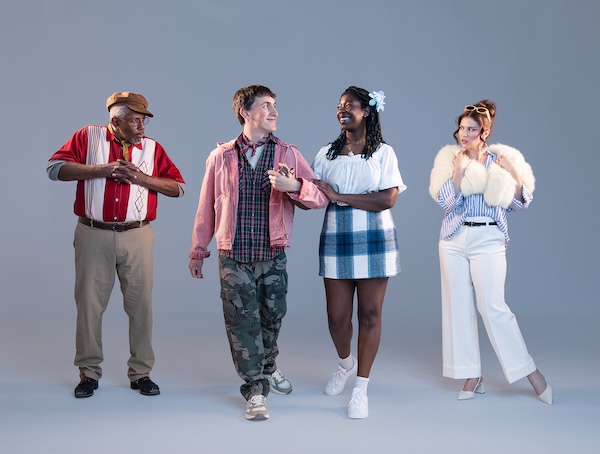
Gila Münster, left, Yan Simon and Sarah Freia bring 8 Gays of Channukah: The Musical to the Chutzpah! Festival Nov. 13. (photo by Jamie Marshalls)

At this year’s Chutzpah! Festival, which runs Nov. 12-23, Jewish drag queen entertainer Gila Münster presents the Western Canadian debut of 8 Gays of Channukah: The Musical.

Calling Chutzpah! “one of the city’s most beloved celebrations of music, theatre and culture,” Münster wrote in a recent Facebook post: “What began in Toronto as the largest annual queer Jewish event in Canada is now coming West, bringing music, comedy and unapologetic queer Jewish joy to the stage.

“And it couldn’t come at a more important time,” she adds. “As antisemitism and anti-LGBTQ backlash continue to rise across North America, spaces that celebrate and centre our communities are not just entertainment – they are acts of resilience, visibility and solidarity. This show is about more than laughter: it’s about lighting the menorah together in defiance of hate and letting our joy shine brighter than ever.”

8 Gays of Channukah takes place Nov. 13, 7:30 p.m., at the Rothstein Theatre. “Eight stories are brought to life by the show’s creators, Gila Münster, Sarah Freia and Yan Simon, who reimagine holiday traditions with camp, sparkle and pride,” reads the Chutzpah! blurb. Local artist Joylyn Secunda opens the event with an excerpt from their show, The Routine, and there is a holiday shuk (market) during intermission and after the performances. People can pick up some gifts – made by local artisans – for the holidays.

First performed in December 2019, 8 Gays of Channukah started out as a variety show, said Münster. Last year, it evolved into a full-length musical created by Münster, Freia and Simon, and directed by Hershel Blatt.

“Now, 8 Gays of Channukah: The Musical is a 90-minute theatrical extravaganza with original songs, storytelling and dazzling costumes by queer Jewish designer Dan Dwir of House of Dwir,” said Münster. “The premise is that the three of us – Yan, Sarah and I – find ourselves on stage without a plan. We decide to share our experiences as queer Jewish people, but, as tensions rise, our bickering begins to twist the message. Over the course of the show, we learn how to coexist despite our differences and discover how much we truly share.

“The stories we tell touch on everything from coming out, to losing a loved one, to first crushes – and, of course, the joys and challenges of being an intersectional minority.”

It was from one of those challenges that 8 Gays of Channukah came into existence.

“In 2019, I was an undergrad at York University, getting ready to perform a drag show for the school’s 2SLGBTQIA+ affinity club,” Münster said. “Two days before the show, I got a voicemail from the club’s coordinator saying the event was canceled and I was banned from the club. The reason? I had mentioned that I was planning to go on Birthright to Israel that summer, and some members said it made them uncomfortable.

“I wasn’t given a chance to explain why that reaction was antisemitic, or even to defend myself. It was devastating. I felt erased – like there was no room for me to be both queer and Jewish.

“But I didn’t want to give up,” she said. “I reached out to Hillel Ontario and started a campus group called Rainbow Jews, a space where queer Jewish students of all stripes could show up fully as themselves. At our very first meeting, people asked me if I could put together a holiday party for queer Jews. That’s when the idea hit me: 8 Gays of Channukah. It started as a scrappy variety show with eight local queer Jewish performers – and now, seven years later, it’s grown into a tradition I’m so proud of.”

Over the years, singers, instrumentalists, comedians, dancers, burlesque and visual artists have participated. “Some highlights include legendary performers like 78-year-old drag queen Fontaine and Jamaican-Jewish comic Tamara Shevon, alongside rising stars such as dancing diva Josie and punk rock princess Alissa Brink,” said Münster. “In recent years, the show has found a kind of ‘core cast.’ Yan Simon – a Russian-Israeli singer-songwriter now based in Ottawa – first performed with us in 2019 and has been part of every show since 2023. Sarah Freia – an actress, singer and poet splitting her time between Toronto and London [England] – also joined, in 2023, and has been with us ever since. Together, we’ve built on the variety show tradition while adding our own creative chemistry into the mix.”

With Münster in Kingston, Ont., Simon in Ottawa and Freia in Toronto and London, the building of the musical required tenacity – hours in transit for in-person rehearsals and hours more in digital meetings, including with director Blatt, who traveled back and forth from New York.

“Because the show is rooted in personal storytelling, we had to really learn how to listen to each other and trust each other’s artistic instincts,” said Münster. “We were also lucky to have amazing rehearsal assistants, Olivia Daniels and Jesse Levy, who helped us shape the movement on stage.

“When we premiered the musical in December 2024, it was both thrilling and terrifying. We’d spent a year and $25,000 developing an entirely new format with all original material and we knew our loyal audience was counting on us to deliver. Of course, there were a few inevitable hiccups, but the energy in the theatre was electric. One moment I’ll never forget was after the show, when the non-Jewish partner of a Jewish audience member told us that, for the first time, he truly understood how antisemitism feels. That conversation reminded me that every person in the audience will connect to the show in their own way – and that’s the real magic of it.”

Münster’s first drag performance was at an event organized by the Centre for Israel and Jewish Affairs for Pride. Called Jew-Paul’s Drag Race, it was hosted by drag legend Divine Darlin’, said Münster.

“I had spent weeks putting together my outfit, inspired by the Wicked Witch of the West. On the day of, it took me three hours to do my makeup, and then my friend Diana drove me to the Drink, where the show was happening. She practically had to drag me up the stairs – I was so nervous.

“The first song I ever performed in drag was Carrie Underwood’s ‘Blown Away’ – a nod to The Wizard of Oz – followed by Netta Barzilai’s ‘Toy,’ which had just won Eurovision 2018. The crowd went wild for that second number, and, in that moment, I realized there might be a space for me to bring my queer, Jewish and Israeli identities together on stage,” said Münster, who ended up winning the competition. 

“From that night on, I was hooked,” she said.

Some JI readers will know Münster from her having been one of JQT Vancouver’s Hanukkah Hotties in 2022. She’s also on JQT’s Wall of Artists.

“I first connected with JQT’s founder and executive director, Carmel Tanaka, about four years ago,” explained Münster. “She found me online, and we bonded quickly over our intersectional identities.

“Looking back at the Hanukkah Hotties video … always makes me laugh,” she said, “because it takes me right back to the era of ‘Zoom drag.’ That meant getting into full glam, setting up lights and lip syncing in my living room – all to a silent, invisible audience on the other side of the screen. It was bizarre, a little lonely, and yet so wonderfully camp at the same time.”

Drag isn’t just an art form for Münster, but her business.

“It’s helped me pay my way through law school and beyond,” she said. “Having signature events that only I can deliver – especially those built around original music that doesn’t exist anywhere else – sets me apart from entertainers who focus mainly on lip syncing to existing tracks.

“Alongside 8 Gays of Channukah, another one of my signature offerings is Drag Queen Story Time. I’m proud to be the only drag performer officially approved as a vendor for the Toronto District School Board.”

Münster is also adept at cross-stitching, and sells her creations and other artwork on Etsy.

“My mom first taught me to cross-stitch when I was a kid, but I really picked it back up during the pandemic lockdowns,” she said, adding that “stitching became both a way to connect with people when we couldn’t leave our homes and a way to pass time that actually felt productive.”

Münster, Freia and Simon are excited to bring 8 Gays of Channukah: The Musical to Vancouver. “More than anything,” said Münster, “we hope the show helps build bridges between queer, Jewish and allied communities – especially in this moment of deep polarization.”

For the full Chutzpah! lineup and tickets to all the shows, go to chutzpahfestival.com or call 604-257-5145. 

Format ImagePosted on October 10, 2025October 8, 2025Author Cynthia RamsayCategories Performing ArtsTags 8 Gays of Channukah, business, Chutzpah!, Gila Münster, LGBTQ+, musicals, Sarah Freia, Yan Simon

Find the funny in you

In Irwin Levin’s upcoming Jewish Humour Playshop, participants will discover and/or build upon their own creativity and sense of humour through improv games, written and spoken exercises.

With a background in stand-up comedy and improvisation, Levin is a man with a message: “Everyone is funny!” He encourages community members (18+) to join in his three-hour “playshop” at the Jewish Community Centre of Greater Vancouver on Oct. 19, starting at 10:15 a.m.

“Come as you are, ready to play and have some laughs!” he told the Independent, adding, “I’m looking forward to teaching fellow members of the tribe at this unique event, where we can let loose and be the funny people we know we are.”

Featured exercises will include Wisdom from Chelm, Mensch on the Bench, and Jokes from Jewish Entertainers.

photo - Irwin Levin encourages community members to join his Oct. 19 improv playshop at the Jewish Community Centre of Greater Vancouver
Irwin Levin encourages community members to join his Oct. 19 improv playshop at the Jewish Community Centre of Greater Vancouver. “Come as you are, ready to play and have some laughs!” he said. (photo from Irwin Levin)

Levin has had what he calls “a wicked sense of humour” since childhood.

“Being funny is very important to me,” he said. ”I hated school because of problems with focus, and I didn’t bond well with other kids. My solace was making kids, teachers and others laugh, but, most importantly, I made myself laugh – like when I was 17 and accidentally reversed my dad’s car instead of going forwards, thus making a hole in the side of the garage and then crashing through the back onto our back lawn. After being very upset, I had the thought that we have the only three-door garage on the block – that made me laugh and helped me a lot. 

“The point is, sometimes it helps to look at the funny side of life. Laughter is very healthy and sometimes necessary, especially in a stressful world. That doesn’t mean you shouldn’t take life seriously, but it’s always nice to find someone to laugh with or on your own.”

Over the last five years, Levin has taken improv classes from David C. Jones, stand-up comedy classes with David Granirer and sketch comedy classes at Blind Tiger Comedy. He has performed at China Cloud Studios in Vancouver and is currently teaching a three-month improv series at Carousel Theatre with his wife, Cass Freeman.

“I started taking stand-up courses before improv, to see if that was something I wanted to do for a living. Around that time, I started dating Cass and she was into improv and got me interested. This was in the mid-’90s,” Levin said.

“Improv can relieve stress, reduce stage fright and improve self-esteem,” Freeman told the Independent in an interview a few years ago about the theatrical form. (See jewishindependent.ca/many-reasons-to-learn-improv.)  “Improv games encourage creativity, quick thinking and communication skills, and are a great tool for breaking the ice, having fun and building team spirit,” she said.

“When taking classes, improv is mostly playing games and doing short scenes,” Levin explained about what people can expect at his upcoming playshop. “There are no mistakes in improv! In improv, you aren’t trying to say funny things – you say things funny. The comedy just comes organically in a scene.

“The games in my playshop will be low pressure, because a lot of the exercises will be written, so that participants can take their time with coming up with answers and read out in a circle. Also, they don’t have to participate in any game that they won’t be comfortable playing.”

The cost to attend Levin’s Jewish Humour Playshop is $30 or pay what you can. People can register by texting Levin at 778-862-4638. 

Posted on October 10, 2025October 8, 2025Author Cynthia RamsayCategories UncategorizedTags humour, improv, Irwin Levin, Jewish Humour Playshop, workshops

Posts pagination

Previous page Page 1 … Page 3 Page 4 Page 5 … Page 84 Next page
Proudly powered by WordPress