Skip to content
  • Home
  • Subscribe / donate
  • Events calendar
  • News
    • Local
    • National
    • Israel
    • World
    • עניין בחדשות
      A roundup of news in Canada and further afield, in Hebrew.
  • Opinion
    • From the JI
    • Op-Ed
  • Arts & Culture
    • Performing Arts
    • Music
    • Books
    • Visual Arts
    • TV & Film
  • Life
    • Celebrating the Holidays
    • Travel
    • The Daily Snooze
      Cartoons by Jacob Samuel
    • Mystery Photo
      Help the JI and JMABC fill in the gaps in our archives.
  • Community Links
    • Organizations, Etc.
    • Other News Sources & Blogs
    • Business Directory
  • FAQ
  • JI Chai Celebration
  • JI@88! video

Recent Posts

  • BGU fosters startup culture
  • Photography and glass
  • Is it the end of an era?
  • Taking life a step at a time
  • Nakba exhibit biased
  • Film festival starts next week
  • Musical with heart and soul
  • Rabbi marks 13 years
  • Keeper of VTT’s history
  • Gala fêtes Infeld’s 20th
  • Building JWest together
  • Challah Mom comes to Vancouver
  • What to do about media bias
  • Education offers hope
  • Remembrance – a moral act
  • What makes us human
  • המלחמות של נתניהו וטראמפ
  • Zionism wins big in Vegas
  • Different but connected
  • Survival not passive
  • Musical celebration of Israel
  • Shoppe celebrates 25 years
  • Human “book” event
  • Reclaiming Jewish stories
  • Bema presents Perseverance
  • CSS honours Bellas z”l
  • Sheba Promise here May 7
  • Reflections from Be’eri
  • New law a desecration
  • Resilient joy in tough times
  • Rescue dog brings joy
  • Art chosen for new museum
  • Reminder of hope, resilience
  • The national food of Israel?
  • Story of Israel’s north
  • Sheltering in train stations

Archives

Follow @JewishIndie
image - The CJN - Visit Us Banner - 300x600 - 101625

Byline: Cynthia Ramsay

What should governments do?

What should governments do?

Left to right at the Jewish Seniors Alliance of BC Fall Symposium Nov. 23: Jeff Moss, Joyce Murray, Anthony Kupferschmidt, Dan Levitt and Isobel Mackenzie. (photo by Alex Roque Photography)

The Jewish Seniors Alliance of British Columbia’s fall symposium featured a panel discussion on the responsibilities of governments for seniors. The panelists discussed housing, transportation and healthcare services. They explored challenges in funding, staffing and service delivery, while also touching on topics such as the potential for community involvement in shaping senior support systems.

The Nov. 23 gathering, which took place at the Jewish Community Centre of Greater Vancouver, opened with Jeff Moss, executive director of JSABC. He said provincial advocacy is “at the heart” of what JSA does, “and bringing together politicians in this space is really important, because the conversations that we have when we meet with the provincial government, or when we’re meeting with the opposition, [are] where we are advocating strongly for universal free home support for seniors in British Columbia.”

JSA’s partners in this campaign are Council of Senior Citizens’ Organization (COSCO), the BC Health Coalition, the Independent Long-Term Care Councils Association of BC, Family Caregivers of British Columbia and the BC Care Providers Association (BCCPA), whose chief executive officer, Mary Polak, addressed those gathered. 

Polak shared that her father, who’s 96 years old, is in long-term care. He has some dementia issues and needs to have some specialized care, she said. “But in the time that he was at home with us and we were trying to give him the best quality of life we could in our own home, it was a real challenge to try and support that with home health services. And we were in a better place than many because at least we had some of the financial capacity to do that, and we had the family around us. But, for an increasing number of people, that’s becoming impossible, and it shouldn’t be that way.”

Ezra Shanken, CEO of the Jewish Federation of Greater Vancouver, which also is a partner and supporter of JSABC, introduced Shay Keil, who sponsored the event with the BCCPA and JSA, along with Michael and Sally Geller, and the Zalkow Foundation.

“Seniors are the foundation of who we are,” said Keil. “You’ve built our families, our traditions and our values, and you deserve to be honoured, supported and celebrated. We often speak of m’dor l’dor, from generation to generation, and that idea is very close to my heart. I strongly believe in the connection between seniors and children and everyone in between. That belief is why I’m here today, and why I’m deeply committed to community through volunteering, supporting and staying actively involved in the organizations that strengthen the lives of those around us, including JSA.”

Keil introduced the emcee of the panel, Isobel Mackenzie, “who served as British Columbia’s seniors advocate from 2014 to 2024, and has spent her career championing the well-being, safety and dignity of our seniors.”

Mackenzie asked each panelist to come to the stage: Anthony Kupferschmidt, strategic lead for aging and older persons with the City of Vancouver, who has worked in similar capacities with other cities and groups, and is also a gerontologist; Joyce Murray, who has served both as a member of the Legislative Assembly and as a member of Parliament; and Dan Levitt, a gerontologist who has worked 30-plus years in seniors care, and is the current seniors advocate for the province.

Each panelist gave an overview of their opinions, starting with Kupferschmidt, who noted that much of what a municipality can do for the aging population requires financial support from other orders of government. However, a city can impact seniors in such areas as “zoning and related development charges, making sure that we have the right type of housing and the right mix of housing  across the city.”

Municipalities can work with the provincial government, for example, on where care homes are located and support their development. Transportation is another key area, as are sidewalks and other “elements of an age-friendly city.” Cities have a role with respect to public libraries and the accessible services they offer, community centres, senior centres, pools, arenas, etc. 

Levitt was the next to speak. “Currently, there are 5.5 million people living in our province, 1.1 million people are over 65,” he said. “Today, there’s one in five – 20% of all people are seniors. Fast forward just a decade from now and it’ll be one in four, 25%…. We have more people who are living longer and more people who are seniors, so 400,000 more seniors in the next decade.”

Levitt’s office monitors five areas: health care, transportation, housing, income and community services.

“The general trend,” he said, “is that there are more seniors and there are more investments, but there’s less available per senior.”

As an example, he said, a quarter of all seniors are living on $23,000 a year, or less than $2,000 a month. “And it’s not that hard to go find people living in the West End in affordable housing living on less than $1,000 a month, so they really need that income support from all levels of government, they need those subsidies.”

Levitt said there were 13,000 people on the waitlist for affordable housing last year. “How many of them got a space?” he asked. “Six percent, just under 800 people have got a space for affordable seniors housing in our province. We haven’t built enough, and there is a call right now to build more, but we’re not keeping pace with that demand.”

As well, he said, the province has been taking money away from long-term care homes, no longer funding overtime and agency nurses, for example, and this affects places like the Louis Brier Home and Hospital.

“It means that an already very thin margin is now almost impossible to operate without that government subsidy,” said Levitt. 

“We haven’t invested enough either in seniors care,” he added. “We did a report in July, and our July report identifies that over 16,000 people are going to be short long-term care because we’re not building enough beds. There are 7,200 people on the waitlist today.” The burden of care, he said, is being transferred to families.

Murray took the conversation in a different direction.

“I was looking at the budget numbers about this when I was thinking about what I would be saying,” she said, “and the total new spending on OAS [Old Age Security] and medical care for seniors alone in the 2023 budget was $110 billion of new money…. Now, that’s going to tie into some of the demographics, for sure, but, when you break that down, that’s $4,300 per retiree 65 and older in new money in the 2023 federal budget versus $755 for younger Canadian under 45 in new money.”

She wondered about how well younger people were being supported. She also spoke of environmental concerns.

“What does it mean to be a good ancestor?” she asked. “And what do we think our society, our province, our country needs to do so that we collectively are good ancestors?”

“To govern is to choose,” said Mackenzie, noting that governments must make decisions about how “to allocate our finite resources to our infinite demands.”

The panelists talked more about that, as well as the way in which different levels of government work with one another. Murray said governments make policies they hope will attract voters, and seniors tend to vote more than younger people, so, for example, “a family with two members can earn up to $180,000 a year and still get their full OAS,” she said, asking, “Is that a good allocation of money?”

Mackenzie asked a variant of Murray’s question, considering how maximum monthly payments for public long-term care work.

“The person whose income is $200,000 a year is going to pay the same for their publicly funded long-term care plan as the person whose income is $70,000 a year,” said Mackenzie. “And so, if, on the one hand, we say, well, the people who have more should get less, which is the OAS argument, to what extent should we flip that and say, well, the people who have more should pay more when it comes to publicly subsidized long-term care? That’s, I think, missing from the discussion…. I think there are very uncomfortable conversations … that governments are going to have to have with their electorate and, as elected officials, you don’t like to have those uncomfortable conversations, for obvious reasons.”

Levitt thought the situation could be improved if governments helped people understand how much money they need to save to age well, what supports there would be for them as they age, and what people could do to support themselves. 

Murray suggested, “Maybe what we need is like a citizens’ assembly, to start out by identifying what are the key things that are maybe broken or need improvement so that we can be good ancestors. And then have a citizens’ assembly that looks at what are the best solutions in other countries … and then create a proposal on that. I think we have to crowdsource the solutions here…. We need citizens to help us solve this.”

Kupferschmidt brought up Better at Home, a basket of non-medical services that seniors can access. “There has been public engagement into what those services should be…. However, there are examples of the service that is offered in one neighbourhood in the city is different than another,” he said, explaining that a “model with all the best intentions can sometimes create some disparities as well.”

Mackenzie stressed the complexities, both because everyone’s needs and everyone’s solutions are different. “And, in the end, in those environments, generally, we try to come up with solutions that meet the greatest good for the greatest number, but that certainly doesn’t meet the need for everybody all the time and that is, I think, the political challenge at all levels of government, whether they be the local, the provincial or the federal.”

Posted on December 19, 2025December 18, 2025Author Cynthia RamsayCategories LocalTags Anthony Kupferschmidt, Dan Levitt, eff Moss, Ezra Shanken, funding, governance, government, government funding, health care, Isobel Mackenzie, Jewish Seniors Aliance, Joyce Murray, JSABC, long-term care, Mary Polak, policy, seniors, Shay Keil
Four Peretz pillars honoured

Four Peretz pillars honoured

As the owner of the 95-year-old Jewish Independent, I know full well that our Jewish community is built on the shoulders of those came before us. It is upon this foundation that we continue to grow, keeping our institutions going, while also starting new ventures and winding up groups that have served their purpose. Sometimes an organization will rebrand and recreate itself, sometimes it will reconnect with and reestablish its roots.

It is with these thoughts in mind that I watched the short documentary film Four Pillars of Peretz, which premiered last month at the Peretz Centre for Secular Jewish Culture. But it was also more personal than that, as I knew the four women being profiled: Bluma Field, Sylvia Friedman, Claire Klein Osipov and Gallia Chud, all of whom have passed away. To me, these women exemplified grace and grit. They were doers and they lived by their beliefs – most important, to me, though, was that they welcomed me, made a place for me, treated me as if I mattered, despite my holding very different views than they did on many things.

screenshot - Bluma Field, left, and Claire Klein Osipov
Bluma Field, left, and Claire Klein Osipov. (screenshot)

Nothing in filmmaker Michael Kissinger’s 36-minute documentary shattered the notion that they treated everyone with such respect, for which I’m grateful. I want to remember these women this way. A key element I feel is missing in the world today is this ability to be friends, or at least be civil to, people with different opinions. We are so polarized that our own views – and our need to express them – often take precedence over making another human feel, well, human.

I know that this phenomenon is nothing new. As is the case with most organizations, the Peretz Centre was started to fill a need that wasn’t being met by other groups at the time. Secular and socialist in nature, the Peretz has rarely “fit in” with the mainstream Jewish community over its 80-year history. While its politics held no interest for me, its focus on Yiddish culture, its choir in particular, did appeal to me and I was involved for some 30 years, having been introduced to the centre by Claire, who was the epitome of class – and, wow, what an incredible voice. She was close friends with my aunt, who also, sadly, has passed away. 

Going down memory lane with Four Pillars of Peretz was truly a pleasure. For people who don’t know the four women profiled, I would still recommend watching it, if only to demystify the Peretz Centre. Community unity shouldn’t mean community uniformity, and everyone should be so lucky as to have at least one place where they feel welcome. We don’t need to belong everywhere, but it’s vital to our health, I think, that we belong somewhere.

screenshot - Sylvia Friedman with her son, Michael Friedman
Sylvia Friedman with her son, Michael Friedman. (screenshot)

Four Pillars of Peretz is also an example of what other organizations could do to honour their founders. Keeping history alive is so important, in my view. It’s not an inexpensive endeavour, but it’s worthwhile. In the case of this documentary, Kissinger really captures the spirits of these women and the way in which they still inspire others. Bluma, Sylvia, Claire and Gallia were by no means the only pillars of the Peretz Centre, but they were particularly driving forces, and they were so for decades.

“These stubborn old ladies, you know, they get sh*t done,” says Faith Jones, providing the first comments in the film, which features clips from interviews with other Peretz members and with members of the women’s families. Through these snippets, as well as photographs and other archival material, you get a sense of the enormous amount of effort and love that it takes to start an organization and keep it running. 

The film starts with an overview of the four women, then each gets their own spotlight. The snappy music and the way in which Kissinger has edited the film makes it move along smoothly, both communicating the challenges these women – and others in their generation – faced with tenacity, but also with joy. 

“I think all of these women, if they were here today, would say that they got just as much out of it as they put into it, because it’s community,” says one of Gallia’s daughters, Rita Chudnovsky, near the end of the film. “And there’s no replacement for a sense of community, and that’s something that’s, I think, getting harder for people to find.”

For more about the film, go to peretz-centre.org/post/four-pillars-of-peretz-short-documentary-film-project.

Format ImagePosted on December 19, 2025December 18, 2025Author Cynthia RamsayCategories TV & FilmTags Bluma Field, Claire Klein Osipov, documentaries, films, Gallia Chud, history, Michael Kissinger, Peretz Centre, Sylvia Friedman

From the JI archives … camp

image - article from Sept. 3 1937 JWB
Sept. 3, 1937: “It is practically impossible in the space of a short article to fully describe the happy holiday enjoyed by eighty-five children at the Council of Jewish Women Camp at Crescent Beach this summer,” begins this article by Mrs. M. M. Grossman. I know the first “M” refers to Max, but I couldn’t find his wife’s name before we went to press.

What strikes me every time the Jewish Independent does a Camp Guide issue is the staying power of our Jewish summer camps.

Camp Hatikvah was started in 1937 at Crescent Beach by the National Council of Jewish Women. It was run under their auspices until 1944, when, according to the camp’s website, “members of the Young Judaea youth organization arranged to first rent, and then later acquire, the property to create Camp Hatikvah.” The camp is located on Lake Kalamalka in the Okanagan Valley.

The site quotes the Independent’s predecessor, the Jewish Western Bulletin, noting that a 1949 article in the JWB stated that “Camp Hatikvah provided early participants with a ‘place where they could live and express themselves as Jews, unhampered with fear of others and free from the out-of-place feeling that is so often a part of North American Jewishness.’ Developed in the aftermath of the Holocaust, Hatikvah existed to ‘produce proud, happy Jewish youth who were earnest and sincere in their beliefs’ and committed to the re-building of the Jewish people.”

image - April 22, 1955: Camp BB Riback comes into existence.
April 22, 1955: Camp BB Riback comes into existence.

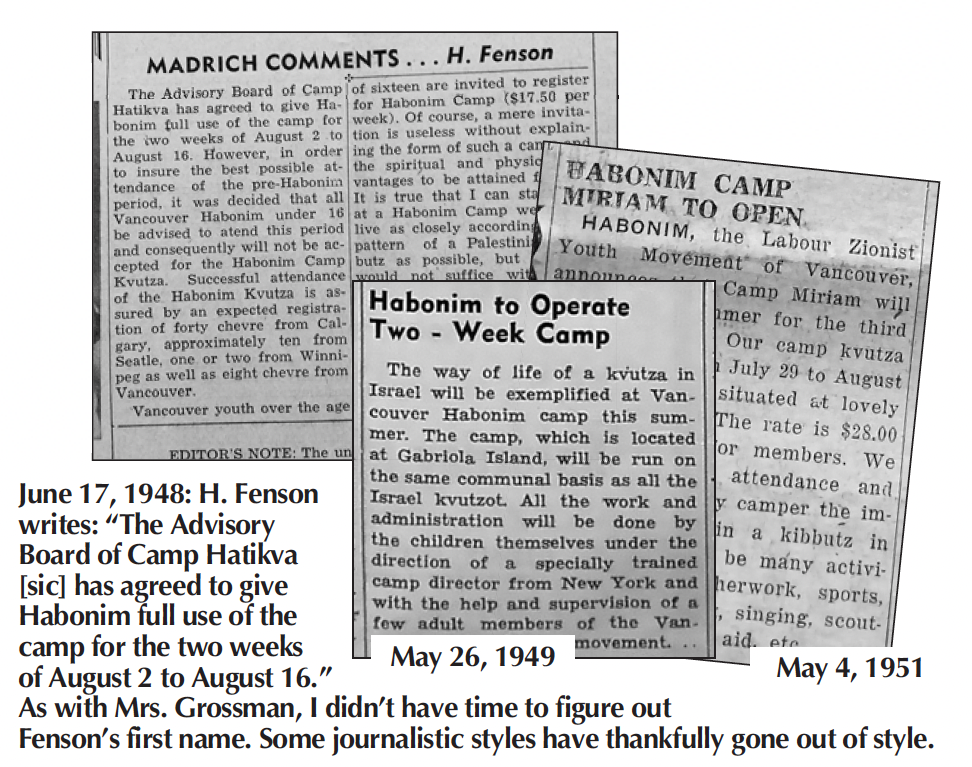
And the camp wasn’t territorial, it appears. According to a 1948 article in the JWB, Camp Hatikvah allowed Habonim Machaneh (Camp) to use its facilities for two weeks. By 1949, Habonim was renting a camp on Gabriola Island and, by 1951, Habonim Camp Miriam was in its third year, but, it seems, its first with the name Camp Miriam.

Camp BB Riback, in Pine Lake, Alta., was founded in 1955, led by Ted Riback of Calgary, who was chair of the B’nai B’rith Camp committee. There were two articles in the April 22, 1955, JWB about it, one about the camp and one about the upcoming B’nai B’rith convention, the highlight of which was anticipated to be a discussion about the camp.

image - July 13, 1956: Kids from Vancouver have always attended Camp Solomon Schechter in Washington state.
July 13, 1956: Kids from Vancouver have always attended Camp Solomon Schechter in Washington state.

While Camp Solomon Schechter was established by rabbis Joshua Stampfer and Joseph Wagner in 1954, the first mention I could find of it in the JWB was in 1956. The week-long camp at Echo Lake, Wash., was also under the supervision of Rabbi Bert Woythaler of Vancouver’s Congregation Beth Israel and the Pacific Northwest Region of the United Synagogue sponsored it. The camp has been located near Olympia, Wash., since 1968.

image - Dec. 29, 2006: Even before Camp Kalsman had a summer session, they were part of the Jewish Western Bulletin’s Camp Guide
Dec. 29, 2006: Even before Camp Kalsman had a summer session, they were part of the Jewish Western Bulletin’s Camp Guide.

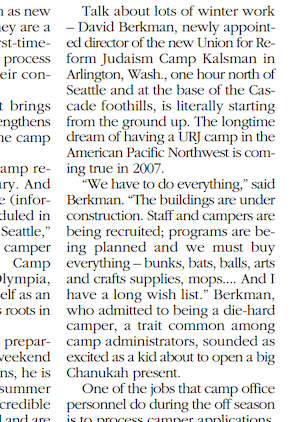
Relative newcomer Camp Kalsman started in 2007, and the JWB has followed it since its beginnings, as well. In 2006, the camp ran an ad looking for a director and, in our Dec. 29, 2006, Camp Guide, David Berkman, the newly appointed director, spoke to the paper about the Union for Reform Judaism camp, in Arlington, Wash. “The buildings are under construction. Staff and campers are being recruited; programs are being planned and we must buy everything – bunks, bats, balls, arts and crafts supplies, mops…. I have a long wish list,” he said.

As that 2006 article by Pearl Salkin noted, “The camps might not have big brass bands, but the excitement is already building. If you want your children to join in the fun, sign them up now, before the parade passes by.”


Posted on December 19, 2025December 18, 2025Author Cynthia RamsayCategories LocalTags history, Jewish summer camp, Jewish Western Bulletin, JI @ 95, JWB
Unique interview show a hit

Unique interview show a hit

Margaux Wosk is a cast member of The Assembly, currently streaming on CBC Gem. (photo by Erich Saide / The Assembly)

“I am so proud of what we accomplished,” Margaux Wosk told the Independent about The Assembly, which is now streaming on CBC Gem. “The show offers fresh perspectives on autism and highlights how diverse autistic experiences can be. It also makes for authentic interviews, because no questions are off the table, which is rare to see in mainstream programming.”

Having watched the show, I couldn’t agree more. Produced by Vancouver-based production company Small Army Entertainment, The Assembly is entertaining. The way in which everyone interacts is refreshingly respectful, the content of the questions is unexpected and the honesty from both the interviewers and interviewees makes for compelling viewing. Everyone comes off as down-to-earth, friendly, with joys and fears most of us have experienced, just in different ways. In the inaugural season, the cast comprises more than 40 autistic and neurodivergent British Columbians interviewing six celebrities – Howie Mandel (America’s Got Talent), Maitreyi Ramakrishnan (Never Have I Ever), singer-songwriter Jann Arden, Allan Hawco (Saint-Pierre), Arlene Dickinson (Dragon’s Den) and comedian Russell Peters – over the course of six episodes. 

According to CBC, the show is adapted from a French program, Les rencontres du Papotin, which started in 2022 on France 2 and became so popular that it has been commissioned in 19 countries to date. It was renamed The Assembly for British audiences, which is how it has been imported into Canada. But the origins go back even further, notes CBC – “The TV program was inspired by a real-life newspaper that has been written and published by autistic journalists since 1990.”

Wosk found out about the Canadian production via a Small Army Entertainment social media post.

The casting process took more than a year, according to CBC. “Producers worked with professional organizations within the autistic community to find people who would be interested in appearing on the show. Once selected, they were provided with some background information about each celebrity guest, but it was up to them to do their own research and decide how much or how little they would prepare,” says a Nov. 6 CBC Gem post.

“We received information about each guest and submitted about five questions each,” said Wosk. “These were then narrowed down to the best questions, and the team made sure there were no duplicates from other cast members. This process allowed us to craft questions that were both meaningful and unique.”

Filming took place in various places. “We filmed mostly during the summer at a few locations around the city that had natural lighting to accommodate people with light sensitivity, like myself,” said Wosk, who wanted to participate in the show for a few reasons.

“I love public speaking, and I wanted to help reduce the stigma around what autistic people are capable of,” they said. “I also wanted to reclaim my narrative. My childhood was difficult in many ways, so being able to feel empowered and share my perspective as an adult is really meaningful to me.”

Wosk serves as president of BC People First, where they support self-advocacy and inclusion for people with intellectual and developmental disabilities. They have written for or been featured in numerous publications and been interviewed for radio and other media many times. They received a BC Achievement Community Award this year, recognizing that their work with BC People First “breaks down barriers, fosters pride and amplifies underrepresented perspectives through creativity, advocacy and education”; that their business, Retrophiliac, empowers “others to express themselves, reduce stigma and build community”; that, in their leadership on accessibility, education and business development, their artwork and other initiatives, they are “a strong voice for inclusion, pride and important systemic change.”

Retrophiliac “sells items focused on disability, neurodiversity and self-expression, as well as communication cards that help people communicate,” and has a couple of access points: retrophiliac.etsy.com and shopretrophiliac.com. Wosk’s website is margauxwosk.com.

One particularly exciting moment for me as a viewer of The Assembly, though I only know Wosk slightly through some volunteer work we’ve done, was when Arden, as she was chatting with some of the interviewers after the main filming, said Wosk looked “kick ass.”

“It was amazing,” said Wosk when I asked how it felt to hear that. “I had planned my outfit weeks in advance for each taping, and my sense of style is really important to me. It is one of the ways I express my personality, so hearing Jann Arden compliment it felt very affirming and special.”

Wosk isn’t the only Jewish community member on The Assembly. I recognized Lyle Lexier and Wosk thought there might be another. CBC didn’t respond to my emails.

“I hope viewers have their assumptions about autism challenged and reduced,” said Wosk about the show. “I also hope they enjoy seeing Canadian celebrities and public figures answer questions in ways they probably have not seen elsewhere, giving a deeper sense of how human and relatable they are.”

To watch The Assembly, go to gem.cbc.ca. 

Format ImagePosted on December 5, 2025December 3, 2025Author Cynthia RamsayCategories TV & FilmTags autism, CBC, CBC Gem, Margaux Wosk, neurodivergent, Retrophiliac, Small Army Entertainment, The Assembly
See Annie at Gateway

See Annie at Gateway

Azaleah Korn, who plays the title role in Gateway Theatre’s production of the musical Annie, takes guidance from director Josh Epstein. (photo from Gateway Theatre)

Vancouver Jewish community member Azaleah Korn plays the title character in Gateway Theatre’s production of Annie, which opens Dec. 11 and runs through Jan. 3. The production is directed by another Jewish community member: Josh Epstein.

“When I found out I got the role of Annie, I cried and screamed and cried some more,” Korn told the Independent. “I was shocked, excited, crazy happy and a little nervous all at once! Being able to play the role of Annie is a huge honour and fills me with so much joy, excitement and inspiration.”

For the few readers unfamiliar with the Tony Award-winning musical, which has had several movie adaptations, Annie is set in New York City in the 1930s. It centres around Annie, an orphan who is eternally positive despite her harsh circumstances. Her luck – and that of her companion, the stray dog, Sandy – changes when she is invited to spend the holidays with billionaire Oliver Warbucks.

“I love singing all the songs in this play and I truly love diving deep into this complex human and figuring out how and why she does what she does and thinks what she thinks,” said Korn, who is a Grade 8 student at Eric Hamber Secondary School. 

photo - Azaleah Korn stars in Gateway Theatre’s Annie, which runs Dec. 11-Jan. 3. The role of Sandy is played by three dogs; pictured here is Poco
Azaleah Korn stars in Gateway Theatre’s Annie, which runs Dec. 11-Jan. 3. The role of Sandy is played by three dogs; pictured here is Poco. (photo by David Cooper)

“Playing Annie is challenging for me because it’s not a character that I innately identify with,” Korn said. “Her hope and upbeat attitude, even in her awful situation, isn’t my gut reaction. But playing her has inspired me to find the hope or silver lining in otherwise sad situations. The most fun part of being Annie is exploring the world through her eyes.”

At age 13, Korn has the training and experience to play such an iconic role and make it her own.

“I can’t remember a time when I wasn’t performing; whether it be for my parents, friends, family and/or my stuffed animals!!” she said. “I started training in musical theatre, dance and vocals at the age of 5. Funnily enough, my very first vocal performance, at the age of 5, were songs from Annie: ‘Maybe’ and ‘You’re Never Fully Dressed.’”

Korn played Tomika in School of Rock at Theatre Under the Stars in 2024 and Brigitta in the Sound of Music at Delta Youth Theatre in 2023. She competes vocally and, this past year, won first place in the musical theatre genre at Kiwanis Music Festival. For the last three years, she has been dancing competitively, with the Happening Dance Studio. A couple of years ago, she won a nationwide songwriting contest. She would like to study musical theatre in New York and perform on Broadway. 

“I prepare for my roles by learning the backstory of the show and my character. I really try to bring ‘me’ to the character I am playing, so, although I watch the musical or movie, I try not to copy or emulate exactly what I see. It is really important for me to bring my own authentic self to the character, so it feels and looks real,” she explained.

“To memorize my lines, I visualize the scene over and over. This technique helps me feel the beat of the scene and then the lines come more naturally.

“To calm my nerves,” she said, “I think, ‘what would Beyoncé do?’ I channel my inner courage and remember that musical theatre is my biggest passion and love. Reminding myself of my love for being on stage helps ease the nerves.”

Self-care is part of it, too. With Annie, for example, there are shows six days a week, and a matinée and evening performance on Saturdays.

“To have enough energy for the shows, I try to relax – when I’m not at school or rehearsing!” said Korn. “I like to zone out by watching TV or reading a book and keeping my talking to a minimum (which can be hard for me at times!), so I don’t wear my voice out. Luckily, my mum cooks me healthy meals so I have the energy to dance, sing and act my heart out on the stage. I warm up my body and voice. Cheryl Porter’s vocal warm-ups are amongst my favourite and have helped me keep my vocal cords safe throughout my singing years and daily shows.”

It was Korn’s mom who saw that Gateway Theatre was casting for Annie.

“She submitted me for the role of Annie and/or the orphans,” said Korn. “I practised the vocals for the audition with my vocal coach, Frederik Robert. My mum was my reader for the scene I had to practise. I guess she did an OK job! Mentally, I told myself to just go in there with all my confidence and courage and play the role and sing the best I could. And, like my mum always reminds me, ‘have fun!’”

This will be Korn’s first time working with Gateway Theatre. She is grateful to Epstein, choreographer Nicol Spinola, music director Sean Bayntum and the whole Gateway team for the “incredible opportunity.” Her parents have provided “endless support,” she said, also highlighting her vocal coach, Robert, and dance teacher, Kim Stevenson, “for pushing me and believing in me!”

Judaism is a fundamental aspect of Korn’s life. 

“My grandfather, David Solomon Korn (he is named after two kings, he likes to remind us), is a Holocaust survivor. He and his brother Yaakov, aged 6 and 7, survived the Nazis as they came through Europe, including Brno, Czechoslovakia, where my grandfather was born. Tragically, his parents died at the hands of the Nazis, leaving my grandfather and his brother orphans. He recently wrote his memoir, in a book called At Great Risk, with the assistance of the Azrieli Foundation. My grandmother, Yona, was born in Afula, Israel. My grandparents met in Montreal and, after marrying, lived in Haifa before immigrating to Canada. It is a story of survival, determination and hope.

“Playing the role of Annie causes me to pause often to reflect upon the injustices inflicted upon my grandfather, who himself was orphaned at a young age, and the resilience of the Jewish people,” Korn continued. “My Jewish identity is strong and it is an important part of who I am today.”

It is easy to see why Epstein told the Independent that everyone who sees Annie will “walk away drawn in to our Annie, rising star Azaleah Korn – she’s got a mix of undeniable star power and acting chops.”

Epstein is a multifaceted talent himself, being an actor, producer, director and writer. The almost-46-year-old is a theatre veteran. For him, directing at Gateway Theatre is special.

“I spent my Hanukkahs doing the seasonal show at the Gateway as a kid – five winters,” he said. “It was a training ground for me, and this is all full circle.”

He directed Gateway’s 2024 production of Oliver! (He was part of Gateway’s 1992 production of the musical, playing young pickpocket Charley Bates.)

“Coming off Oliver! last year was a real awakening for me,” Epstein told the JI. “I didn’t expect how joyful it would be to dust off a classic and rediscover how well these classics hold up when you approach them with imagination and depth. The Gateway encouraged us to dream big and take risks. Barb Tomasic (executive artistic director) is an extraordinary leader, and that attitude trickles through the entire company.

“On opening night, she asked me about returning, I was a quick yes. She had a list, I had a list, and Annie was at the top of both.”

When asked his favourite thing about Annie so far, Epstein said, “We’ve found fresh takes on every character.” As noted, he highlighted Korn. He also said, “I think audiences will see a Warbucks they’ve never seen before. Charlie Gallant brings something impulsive, surprising and emotionally alive. It reinvigorates the role and opens up the whole story.”

He added, “But, who am I kidding, the dog will undoubtedly get the most attention. Everyone loves Sandy.” 

Sandy is played by three dogs: Neko, Mylo and Poco. While there is the saying, “never work with kids or animals,” Epstein said, “It’s a myth. We had 70 kids audition. Seventy. Vancouver is full of incredible training programs … so the talent pool was unbelievable and our orphans are exceptional. The challenge is harnessing all that energy and potential inside a big, fast-moving machine.”

It’s been six to 10 months of planning, said Epstein, between “sets, costumes, props, auditions and logistics. Then, three intense weeks of rehearsal into tech. In that window, we have to teach all the music, choreograph huge numbers, stage transitions, build quick changes, run fight direction, intimacy work, dialect coaching, work with three dogs and a dog trainer, squeeze in costume fittings and lift calls, and prep special promo events. When you break it down, the number of actual hours we get for scene work is shockingly small, so my job is to move quickly while still hitting all the moments we want to savour.”

There is nothing like live theatre.

“Look,” said Epstein, “more and more, most of us are at home scrolling, streaming, consuming things alone. Theatre is one of the last places where you sit in a room with hundreds of strangers and feel something together. For this price, with this level of talent and this much energy poured into it, there’s nothing else quite like it.

“At its core, Annie is a story about chosen family, about finding the people who show you that love isn’t just something you give, but something you have to allow yourself to receive – Warbucks learns that, Annie teaches it – and I hope you leave the theatre optimistic about finding that kind of connection with your own chosen family, whoever they may be.”

For tickets to Annie, go to gatewaytheatre.com. 

Format ImagePosted on December 5, 2025December 3, 2025Author Cynthia RamsayCategories Performing ArtsTags Annie, Azaleah Korn, Gateway Theatre, Josh Epstein, musicals

Unique, memorable travels

I know what my wife and I will do for at least part of our winter break – go through the latest edition of Robin Esrock’s The Great Canadian Bucket List: One-of-a-Kind Travel Experiences together and make plans. For when? I’m not sure. But plans. Wish lists.

Published by Dundurn Press, and released just last month, this is the third edition of Esrock’s popular book. I interviewed Esrock when the original book came out in 2013, and it has evolved substantially since then. Notably, as he points out in the introduction, this new list “casts an overdue lens on Indigenous tourism,” which he hopes will result in powerful and personal connections this country desperately needs.” 

New experiences have been added and some revisions have been made. In tandem with the books, there has always been a website, canadianbucketlist.com, because, as Esrock writes, “Tourism is a constantly evolving industry. Tour operators, restaurants and hotels often change names or ownership, adapt their services or cease operations altogether. Records fall, facts shift and practical information needs to be constantly updated.”

image - The Great Canadian Bucket List book coverThe Great Canadian Bucket List is organized by province, west to east, then up to Yukon, the Northwest Territories and Nunavut. It wraps up with a national section, which has some “Canada’s best” lists, among other things. There are fabulous colour photos throughout. Esrock highlights four to 17 experiences in each chapter, with his home province of British Columbia having the most entries. 

You will hear no complaints from me about this! During COVID, I saw more of British Columbia than I had in the previous 28 or so years of living here. What I love about Esrock’s bucket list choices is their range, from, for example, houseboating on Shuswap Lake, which I could see myself doing, to heli-skiing, which is a hard no, to visiting Haida Gwaii, which I hope to do next year, to things that I’ve done, like visit the Malahat Skywalk on Vancouver Island, and things that probably all of us have done, such as take a stroll along the Seawall. 

The range is as varied for the rest of Canada: there are places I’ve been, things I’d never do, and things I’d jump at the chance to do. 

Years ago, I visited Head-Smashed-in-Buffalo Jump in Alberta and found it fascinating, learning a lot about Indigenous hunting practices. According to Esrock, the “UNESCO World Heritage Site is the most significant and best-preserved buffalo jump site on the continent.”

I’m “hometown” proud of Magnetic Hill in Moncton, NB, where I was born. I’ve rolled “up” the hill more than once and still get a kick out of the cheesiness of it all. As Esrock explains, it’s all an optical illusion, but it’s still magic to me.

I’ve had the privilege of wandering, and occasionally buying something, in every one of Esrock’s best urban markets in Canada: Granville Island here, St. Lawrence Market in Toronto, ByWard Market in Ottawa and the Forks in Winnipeg.

I’m not a big risk taker, so won’t be leaning off the top of the CN Tower in Toronto anytime soon, even with all the safety cords in the world, or scaling a frozen waterfall in Mont-Sainte-Anne, Que. And I will never jump off anything much higher than a curb.

That said, there are so many experiences that I would like to have. In the context of Esrock’s book, one of the top ones is cycling the Kettle Valley Railway, especially now that I’ve learned from Esrock that there’s a company that will provide the bikes, accommodation – and carry our bags! I’d like to check out the tunnels in Moose Jaw, Sask., which “were access corridors for steam engineers, then used as a safe haven for Chinese migrants fearing for their lives, and finally by bootleggers and gangsters.” 

I would love to get to Churchill, Man., something I never managed to do when I lived in Winnipeg. Visiting L’Anse aux Meadows, in Newfoundland and Labrador, where there are the remains of a Norse settlement from 1000 CE, would be cool. Cruising the Northwest Passage would be a once-in-a-lifetime experience (hopefully). There are hikes and kayaking adventures that call to me….

But, for now, I will flip the pages of The Great Canadian Bucket List, contemplating all the possibilities. I’ll worry about what’s affordable, what’s doable physically and mentally, what’s possible time-wise, etc., later. 

Posted on December 5, 2025December 4, 2025Author Cynthia RamsayCategories BooksTags Canada, Great Canadian Bucket List, Robin Esrock, travel

Family memoir a work of art

Karen Bermann’s The Art of Being a Stranger: A Family Memoir, published by New Jewish Press, an imprint of University of Toronto Press, is a work of art. It is moving in ways hard to describe. It might not capture every detail of her family’s history – in fact, wide swaths of that history are missing. What’s not missing, what is powerful, are the feelings this book evokes.

Bermann, who lives in Rome, is professor emerita of architecture at Iowa State University. Her father, Fritz, was born into an Orthodox Jewish family in Vienna. At 15 years old, he and his younger sister, Elsa, who was 10, fled Europe, alone, in the late 1930s. They were separated in Haifa, his sister being taken to an orphanage with the other children who were too young to work. Fritz, as lucky as one can be after losing one’s family and home, ended up with a Russian farming family who treated him well. Nonetheless, at 18, he left the farm and headed off to live on a kibbutz.

image - The Art of Being a Stranger book coverThe way in which Bermann intertwines her father’s words with her own commentary and descriptions is so effective. For example, when Fritz tells her about getting in trouble, at 10 years old, for writing a story about building a bomb to blow up the school, Bermann writes, “‘Oh, Dad, that is really bad.’ Yes, that was a particularly bad one. ‘Were you always so angry?’ I was born angry. And scared. As was my father before me. ‘Even before the Nazis, you were so angry and scared?’ Well, yes. But the Nazis didn’t help.”

This dark sense of humour permeates The Art of Being a Stranger. Bermann doesn’t sentimentalize or sensationalize, she just tells us what her father tells her and sometimes shares her reactions. We also learn – and feel – what she went through as Fritz’s daughter. She writes succinctly, poetically, in both words and images. 

From pre-state Israel, Fritz went to New York City, where he worked in building maintenance. After an incident with an antisemitic boss, he found work at a company, where, over 20 years, he rose up the ladder. “Somehow from being a peasant in Palestine I found myself a bigshot in the world of New York building maintenance,” he tells his daughter. 

But New York never became, for him, a city of museums and operas, but remained one of crooks and bribes. Just like his Vienna wasn’t the city tourists visited to eat sachertorte and go skating, but rather was “a shtetl of poor religious Jews, a ghetto of ignorant bastards who beat their children for making noise on Shabbos, but who knew in their bones that they were not welcome, who recognized the stench of antisemitism in the street while others were perfuming their noses in the rose gardens.”

Fritz’s trauma, inherited from his ancestors, is passed on to his daughter in full force. Yet, Bermann, as a teenager, would defend her father against her friends’ calling him a Nazi, for instance. He was brutally abusive. She only talks about this in relation to herself, not others in the household. To survive, she built “a parallel structure to the one I live in my father’s house.” 

“Fritz was ruthlessly (one of his favorite words) honest about the danger of hope. Hope was more than pointless, it was stupid, and led to suffering,” writes Bermann. “People disappointed by life were stupid people; they made him angry…. He taught us about the strength of character that hopelessness required.”

In addition to sharing some of her childhood experiences, Bermann shares some of her experiences working, at the age of 19, on the rehabilitation of one of the more than 1,000 abandoned buildings on the Lower East Side that she and a group took over from the city: “Ditched by landlords who couldn’t squeeze a profit out of a tenement in need of heat, in need of maintenance, a building that leaked from every weak pore.”

We meet other family members, we find out how Fritz’s story ends. From fragments of a life, we see how complex we humans are, how many contradictions we hold within us, how we can be that which we hate, how we can hurt who we love and how we can love the broken, how beauty exists, sometimes inextricably with the ugly. The stranger of the title is Fritz, it’s Bermann, it’s us. Yet, experiencing The Art of Being a Stranger made me feel more part of humanity, kind of like when we chant Ashamnu together as a congregation: we have abused, we have betrayed, we have been cruel…. None of us is perfect, none of us gets through life unscathed or without hurting others. Yet, we keep getting up in the morning and living. Until we don’t. 

Posted on December 5, 2025December 4, 2025Author Cynthia RamsayCategories BooksTags Art of Being a Stranger, Holocaust, intergenerational trauma, Karen Bermann, memoirs

A little holiday romance

One of my guilty pleasures is Hallmark-style holiday movies. Fine, they’re Christmas movies mainly. But, whenever there is a Jewish character, plotline or, in rare instances, it’s a Hanukkah movie, I am even more a fan. Comfortable in their predictability, especially the happy ending, my body relaxes just thinking about the break from reality they offer. In the last few years, I’ve also read more than my share of  Hallmark-style novels, and this is why I was excited to receive an email from Amelia Doyle, author of Two Weeks in Toronto, which was published last year but was just named a finalist in the romance category of the Canadian Book Club Awards. The winners will be announced in February.

Doyle, a Jewish author based in Dublin, Ireland, has written a few romance novels and has another on the way for next year. Two Weeks in Toronto would make a wonderful holiday movie – and a welcome gift for anyone who’s admitted to you that they like romance novels. There’s no will-they-or-won’t-they-fall-in-love here, just how they will, what obstacles they will have to overcome, what role their best friends or family members will play.

image - Two Weeks in Toronto book coverIn Two Weeks in Toronto, our protagonists are Ciara and Ethan.  They live in Dublin and know each other because Ethan is Ciara’s dentist – and Ciara is terrified of the dentist. Not of Ethan, but of the dentist as a larger concept, its root canals, teeth-cleanings, etc. Ethan does what he can to help Ciara overcome her fears. So, though the two have known each other awhile, it’s been a professional relationship, and they don’t know each other well.

This changes when Ciara’s sister’s wedding requires Ciara to return to her family in Toronto, which she really doesn’t want to do because of a brutally harsh mother and a very difficult sister, and Ethan must go home for the celebration of his parents’ 40th anniversary and of his brother’s engagement, which will be awkward, to say the least, because his brother’s fiancée is Ethan’s former girlfriend.

Ethan suggests to Ciara that he join her in Toronto for the wedding (and Hanukkah) and she join him in Galway over New Year’s – as “boyfriend” and “girlfriend,” so neither will have to face their situations alone. While Ethan is not Jewish, he ends up feeling quite at home with Ciara’s family. Turns out her father, who’s from Ireland, knows Ethan’s parents, and there are connections with other folks in Ciara’s realm. Ciara’s dad also makes sure Ethan knows what’s going on with the candlelightings and what Hanukkah is all about.

I had some trouble believing the sheer horridness of Ciara’s mother and sister, in part because her dad and brother are so friendly and caring, but also because I’m lucky enough not to have such nasty people in my family. I would have been more heavy-handed in the editing process, but, overall, Two Weeks in Toronto is a light, fun read. I’ll keep Doyle in mind when I’m looking for my next escape. 

Posted on December 5, 2025December 4, 2025Author Cynthia RamsayCategories BooksTags Amelia Doyle, romance novels, Two Weeks in Toronto
From the archives … Hanukkah

From the archives … Hanukkah

The editorial in the Dec. 8, 1939, issue of the Jewish Western Bulletin.

We’ve come a long way in many ways, though some readers may disagree. I read, kind of in horror, the newspaper’s Dec. 8, 1939, editorial in which the lesson drawn from Hanukkah was that, “More formidable than the most rabid anti-Semite is the unfaithful Jew in our ranks. More threatening than all the malicious libels and frauds of such papers as DER ANGRIFF and DER DEUTSCHE BEOBACHTER, is the Jew who is IGNORANT of his history, ignorant of his literature, his tradition, his TORAH and his God.”

I can appreciate the Maccabean victory “was not by a superior might but with a superior SPIRIT, that untrained Judean forces did meet the enemy and vanquished him.” I agree that Jewish education is vital to Jewish continuity, but yikes. I’m not sure all the “yelling” capital letters encourage the message that: “There must be a closer alliance, a sense of closer affinity, a warmer consciousness of brotherhood between Jew and Jew and between the individual Jew and Jewry at large if we are to succeed – nay, if we are to insure our future as a people!”

I am also always surprised at how much of the advertising in the early years of the Jewish Western Bulletin was for alcohol. As but one example, given the time of year, is the Dec. 24, 1941, ad from United Distillers Ltd., “The Happy Holiday List” that readers are asked to “cut out and keep for reference,” which I guess I’ve done, though I don’t think any of the brands still exist.

I did enjoy some of the Hanukkah trivia that made the front cover of the Dec. 11, 1936, paper, though it was a jarring juxtaposition with the world news. As it happens, the first item, on the melody of the traditional Hanukkah song “Maoz Tzur,” mentions Martin Luther, as does the article on the cemetery in the German City of Worms that is featured in this week’s issue – on this very page, in fact – which discusses briefly Luther’s legacy.

In his “Lights on Hanukah” article, Rabbi Abraham H. Israelitan points out: “The familiar melody of ‘Maoz-Tzur,’ the well-known hymn that is sung after the kindling of the lights, is not Jewish at all, as is commonly supposed, but is really an adaptation of an old German folk song of the Middle Ages. This German folk melody has also been utilized by the Christians. The famous Martin Luther, for example, utilized it for his German chorals.”

The rabbi also notes, “One of the poems in Lord Byron’s ‘Hebrew Melodies’ – ‘On Jordans Bank’s’ [sic] – was set to the music of Maoz-Tzur by the great poet’s close friend Isaac Nathan.” He goes on to reveal “the origin of latkes,” and a few more of what we now call “fun facts.” Israelitan was not a local rabbi. His article was distributed by Seven Arts Feature Syndicate, which, according to Google, was an American group that provided content to Jewish papers from the 1920s through the 1960s.

Holiday parties, concerts, menorah lightings and more have always been promoted or covered in the newspaper, of course. Almost every Hanukkah issue has included recipes, gift ideas, personal holiday stories. And pretty much every Hanukkah-themed editorial aims to point out what the Maccabees can teach us today or what light we can shine to diminish the darkness in the world – though we do it a little less harshly than the editors of 80, 90 years ago, I think. Most certainly, we do it with fewer capital letters. 

image - An adl in the Dec. 24, 1941, issue of the Jewish Western Bulletin
An ad in the Dec. 24, 1941, issue of the Jewish Western Bulletin.
image - An article on Hanukkah trivia in the Jewish Western Bulletin Dec. 11, 1936
An article on Hanukkah trivia in the Jewish Western Bulletin Dec. 11, 1936.
Posted on December 5, 2025December 4, 2025Author Cynthia RamsayCategories From the JITags archives, editorials, fun facts, Hanukkah, history, Maoz Tzur, trivia
West Van Story at the York

West Van Story at the York

The cast of Theatre Replacement’s East Van Panto: West Van Story, left to right: Tom Pickett, Ben Brown, Ivy Charles and Meaghan Chenosky. (photo by Emily Cooper Photography)

If you want a ticket to East Van Panto: West Van Story, you’d better move fast. At press time, the show had just opened and most performances at the York Theatre were already sold out.

Theatre Replacement’s romp for all ages is inspired by Romeo and Juliet this year. The annual event is popular for many reasons, including a consistently stellar creative team and talented actors, its local flavour and political bent. 

In East Van Panto: West Van Story, written by Marcus Youssef with Pedro Chamale, a tsunami strands West Van influencer Holly and her curling team in East Van, where she falls for Joes – a member of their sworn rivals. Adding to her troubles is her mega-developer “motherfather,” Boberta Rainy. The question is will Holly “follow her heart – and Joes – into a new world of love, dance battles and civic resistance? Or will Boberta’s towers and renovictions crush everything in their path?”

“It’s really fun to be part of a show that takes being silly so seriously,” technical director Daniel O’Shea told the Independent in a recent interview.

O’Shea has been involved with the Panto for a few years now.

“The creative team will come up with such wacky characters and gags, and then we have to earnestly sit around the table and figure them out,” he said. “My first year with Theatre Replacement’s East Van Panto, we had to have the king of the skunks shoot a ‘Stink Canon 9000’ into the audience – who wouldn’t enjoy coming up with that?! Also, because the Panto is a new satire every year, getting to be part of a show that speaks to the current community concerns from a local perspective always feels like a breath of fresh air.”

O’Shea first worked with Theatre Replacement on a show called MINE, which, he said, “was a performance that took place half on stage and half in Minecraft. I was colleagues with a number of the devisors on the show and we needed to build some systems for controlling the projection integrating the video input from multiple gaming computers and building in game cues. As part of that show, we built a tech booth in Minecraft and I had little avatar who would run around and hit in game buttons to teleport people or spawn creatures; it was quite fun. I guess I mention it because the pleasure in working with Theatre Replacement is that I’ll often be solving unorthodox problems or working in novel ways.”

The biggest challenge of working on the Panto, he said, is its size.

“We want East Van Panto to feel like a big show, with clever sets and big costumes and arresting moments, and we often succeed, but all of that has to fit into quite a small container,” he explained. “The York Theatre is a wonderful home and we love being there, but we are often pushing the limit of what we can fit onto the stage. It often requires extremely thoughtful planning and clever technical solutions to achieve this big story book mise en scène in a converted movie theatre. We are grateful to our partners at the Cultch and the tech team there that help to pull it off each year.”

photo - Daniel O’Shea
Daniel O’Shea (photo from Theatre Replacement)

O’Shea has a bachelor of fine art from Simon Fraser University, where he majored in theatre performance and film production. 

“I’ve always had a love of both film and stage since I was a kid, fostered by my parents taking us out to shows, and a somewhat onerous VHS mail arrangement through which we received dozens of old back catalogue titles. Though they present quite differently now, both film and theatre share so much DNA, going to back to early cinema. That particular artist-alchemy of narrative, imagination, character, emotion, etc., that both seek has always been something I’ve been drawn to create.”

He gave a shout out to his high school, Burnaby North, and to Alison Schamberger and Phil Byrne, who ran the theatre and media arts program. “They were both instrumental to instilling the sense that creating in both fields was possible, valuable and worthy,” he said.

Career-wise, O’Shea has focused on lighting and projection design, filmmaking and technical direction. He has done some performing, but not for about 10 years now. Nonetheless, his acting experience continues to help his work, in that it allows him to have a fuller sense of the world a show creates.

“It’s possible to get overly engrossed in the issues that feel pertinent to one’s role, like the efficiency of technical rehearsal or the familiarity of ‘how things are done’ and miss the chance to allow for creative risk-taking and imagination,” he said. “Having that performance background helps remind me that achieving the desired audience experience during a show is the goal rather than whether your plan going into tech looks like what’s on stage opening night.”

O’Shea is also a founding member of A Wake of Vultures, with Nancy Tam and Conor Wylie. 

“It’s a vehicle for us to make work that is true to our artistic core,” said O’Shea. “The three of us work as freelance designers/ artists in the broader community and convene together when someone has a juicy idea. 

“Working as a freelancer, you are often given creative agency, I mean it’s clearly part of what you are there for, but it’s often within the constraints of the production or the shows’ genre/esthetics. If it’s a play about a character journey, then the design has to serve that. When we work together in A Wake of Vultures, we really get to dream wildly as designers/conceptual thinkers and follow our process…. That freedom to dream and build ways of affecting the audience before serving other elements of the show is deeply enjoyable.”

Currently, A Wake of Vultures is working on a piece called SweatCry, “which will be some sort of structured social experience investigating ecstasy, purgation and dance,” said O’Shea. “I’m also going on tour with Jade Circle, a show on which I did the projection design, made by Jasmine Chen, which is a beautiful show tracing the cascading chain of mother-daughter relationship and stories buried within our own families.”

O’Shea described his own connection to Judaism and Jewish community as “cultural and fostered through the deep networks that I’ve grown up a part of and, yet, it feels most represented by the Groucho Marx line, ‘I wouldn’t want to belong to a club that would have me as a member’ – a belonging and exclusion at the same time. That, or Moses’ line about being a ‘stranger in a strange land.’ There is a tension in being a tribe of the estranged that has meaning to me, both in the way that it seats one in relationship to the world and in how it asks of you to make kinship with ‘the stranger.’

“I think it is also the reason why I have such a love of ritual,” he concluded. “Whether it’s in a show or a meal of special ceremony, the sense that formal choices, of how to do things, can have deep symbolic and historical ties, and be a thread that links people across time really moves me … both of these facets of my Jewish identity shape my life and work.”

For tickets to East Van Panto: West Van Story, which is directed by Chelsea Haberlin, with music by Veda Hille, go to thecultch.com. There are shows through Jan. 4.

Format ImagePosted on November 21, 2025November 20, 2025Author Cynthia RamsayCategories Performing ArtsTags Daniel O'Shea, East Van Panto, musicals, panto

Posts pagination

Previous page Page 1 Page 2 Page 3 Page 4 … Page 84 Next page
Proudly powered by WordPress