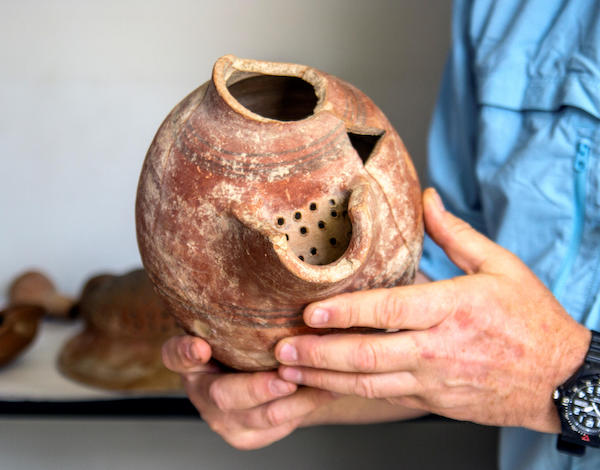
Nanopores taken from ancient pottery have allowed researchers to make beer following a 5,000-year-old recipe. (photo by Yaniv Berman IAA via Ashernet)
Research led by scholars at Hebrew University, the Israel Antiquities Authority, Tel Aviv University and Bar-Ilan University has revealed a way to isolate yeast from ancient pottery, from which beer was then produced. HU’s Dr. Ronen Hazan and IAA’s Dr. Yitzhak Paz, who are among the leaders of the research, noted that “we now know what Philistine and Egyptian beers tasted like.” The team examined the colonies of yeast that formed and settled in the pottery’s nanopores. Ultimately, they were able to use resurrected yeast to create a beer that’s approximately 5,000 years old.
“By the way, the beer isn’t bad,” said Hazan. “Aside from the gimmick of drinking beer from the time of King Pharaoh, this research is extremely important to the field of experimental archeology – a field that seeks to reconstruct the past. Our research offers new tools to examine ancient methods and enables us to taste the flavours of the past.”
Added Paz, “This is the first time we succeeded in producing ancient alcohol from ancient yeast. In other words, from the original substances from which alcohol was produced. This has never been done before.”
ישראלים המבקשים לברר פרטים על הליך קבלת תושבות קנדית, נתקלו בנציגי חברת פרו איי.סי.סי שניסו להונות אותם. כך נטען בכתבה במדור הכלכלי של עיתון הארץ – דה מארקר. עוד נטען בכתבה כי נציגי החברה טוענים שהם עוזרים בבקשות לתושבות מטעם שגרירות קנדה, ומוכנים לעזור לישראלים אם ישלמו חמש מאות ושמונים דולר, ויעבירו להם את פרטי כרטיס האשראי שלהם. משגרירות קנדה בתל אביב נמסר בתגובה כי לחברת פרו איי.סי. סי אין קשר למשרד ההגירה, פליטים ואזרחות, וממשלת קנדה רואה בחומרה כל ניסיון להונות בתחום האזרחות או ההגירה. אם מישהו מציג עצמו כנציג השגרירות או משרד ההגירה ומציע מעמד הגירה או אזרחות בטלפון זו הונאה. מחברת פרו איי.סי.סי לא נמסרה תגובה לעיתון הישראלי.
בשבועות האחרונים מופיעה מודעה בפייסבוק מטעם פרו איי.סי.סי ובה ההצעה לבדוק זכאות לאזרחות קנדית. ישראלים שנכנסים ללינק מקבלים לאחר זמן קצר שיחה טלפונית, המוצגת באפליקציות לזיהוי שיחה כשיחה משגרירות קנדה, ובה אדם המציג עצמו כעובד שם ומסביר את המשמעות של הגשת בקשה לתושבות. עיתונאית דה מארקר השאירה את פרטיה באתר החברה ונציגה התקשר אליה. הוא הציג עצמו בשם וויליאם סאנלי עובד פרו איי.סי.סי, מבלי לציין שהחברה אינה שייכת לשגרירות קנדה. סאנלי פירט את ההיתרונות בהגירה לקנדה, מערכת הבריאות המתקדמת, לימודים בחינם, עזרה בפתיחת עסק ועוד.
לשאלת הכתבת מדוע נוקטת השגרירות הקנדית בגישה פרו-אקטיבית ומגייסת אנשים ממדינות אחרות לעבור אליה, טען סאנלי, כי קנדה מבקשת להגדיל את האוכלוסייה במדינה ומקבלת בכל חודש שבעה עשר אלף תושבים חדשים, העונים על דרישות מסוימות. בהן: גיל, רמת השכלה, ניסיון תעסוקתי ואנגלית ברמה גבוהה. לאחר שהכתבת ענתה על מספר שאלות סאנלי הודיע לה כי היא עומדת בדרישות, ועליה למלא טופס שישלח אליה דרך האימייל, ולשלם מייד חמש מאות ושמונים דולר. סאנלי הפעיל לחץ על הכתבת והודיע לה כי התחיל כבר בהליך הרישום שלה, ואם היא תעצור אותו, היא תאלץ להמתין כשנה, עד שתוכל להגיש בקשה חדשה. לדברי סאנלי אם הכתבת לא תפעל מייד להגשת הבקשה להגירה היא תסומן על ידי השגרירות, ולכן תאלץ להמתין שנה תמימה להגשת בקשה חדשה.
בשגרירות קנדה בתל אביב מסרו כי הם פתחו בבדיקה בנושא פעילות חברת פרו איי. סי.סי. בשגרירות ביקשו לציין כי אלה המבקשים להגר למדינה נוטים לעתים קרובות להסתמך על יועצי הגירה, שיעזרו להם לטפל בנושא. עם זאת הם עלולים ליפול לידי נוכלים. ממשלת קנדה החליטה להשקיע השנה מיליוני דולרים, כדי להגן על האזרחים והמועמדים להגירה, כדי שלא יפלו במלכודות של הנוכלים. עוד נמסר כי משרד ההגירה לא מעניק יחס מיוחד למי שפועל להגר באמצעות יועץ, וזה לא מבטיח להם דבר. כל הטפסים הנחוצים להגירה נמצאים באתר משרד ההגירה ואפשר להוריד אותם ללא תשלום. גם רשימת יועצי ההגירה החוקיים נמצאים באתר. אגב חברת פרו איי.סי.סי לא נמצאת ברשימת היועצים המוסמכים לטפל בהגירה לקנדה.
בדקתי את האתר של פרו איי.סי.סי ומצאתי שמשרדי החברה ממקומים ברחוב הייסטינג 1021 בוונקובר. פרו איי.סי.סי מציגה עצמה כחברה מובילה עם רקורד מוכח בתחום ההגירה, והבאת מהגרים לקנדה מכל העולם. מהגרים שהם אנשי מקצוע מיומנים, אנשי עסקים, סטודנטים וחברי משפחה. בחברה מציינים עוד כי הם ליוו כבר אלפים שהגרו לקנדה. בדף החברה בפייסבוק מפורסם כי יש לה כששת אלפים וחמש מאות “לייקס”.
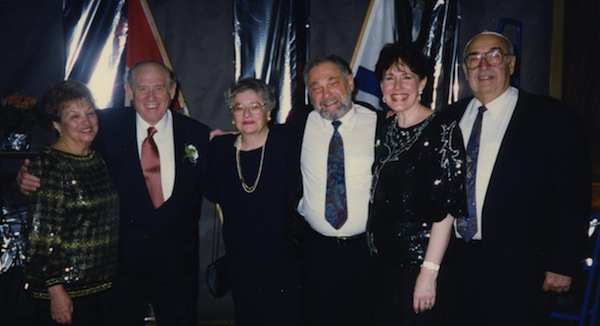
Phyllis and Rabbi Wilfred Solomon, centre, with Cantor Murray Nixon and his wife Dorothy, left, and Sharon and Irving Kates, at Beth Israel’s 60th anniversary gala in 1992. (photo from Congregation Beth Israel fonds, JMABC L.22263)
On June 17, Congregation Beth Israel will pay tribute to Rabbi Emeritus Wilfred (Zev) and Phyllis Solomon. The rabbi was spiritual leader of the synagogue from 1964 to 1997. During that time, gala co-chair Marcy Schwartzman told the Independent, he officiated at more than 4,000 lifecycle events, including about 500 brit milot and baby namings, 750 weddings, 800 b’nai mitzvah, 250 conversions, 900 funerals and 900 unveilings.
But the cause for celebration goes beyond numbers, of course.
Phyllis and Wilfred Solomon are being honoured by Congregation Beth Israel on June 17. (photo from Beth Israel)
“Rabbi Zev and Phyllis Solomon were the heart and soul of Congregation Beth Israel for many years,” said board president Helen Pinksy. “Together, they gave our synagogue honour and status as a warm, caring, forward-thinking and progressive community of committed Jews in Vancouver. The role of emeritus for Rabbi Solomon indicates his distinguished service and was not awarded pro forma, but because he, together with his wife, accomplished much and were beloved by the people they served. It is a true pleasure to be honouring him in return with this gala.”
Pinksy and her family have been members of Beth Israel for about 25 years. Upon joining the synagogue, she said, “Almost immediately, I asked Rabbi Solomon to teach me Torah and Haftarah reading, because I wanted to have an adult bat mitzvah. Under his tutelage, it took place. After that, my oldest son Isaac was in Rabbi Solomon’s last bar mitzvah cohort, in 1997.”
Current spiritual leader of Beth Israel, Senior Rabbi Jonathan Infeld, met the Solomons at his installation 13 years ago.
“Rabbi Solomon was beloved because of his warmth, love and concern for the Jewish people, the Vancouver Jewish community and the members of our synagogue,” said Infeld. “He worked extremely hard to bring Torah and love to everyone in his realm. I always hope to emulate his examples.”
Both Infeld and Pinsky attended the Rabbinical Assembly, which took place this year in Montreal May 5-8. Solomon was one of six rabbis honoured by the Conservative movement organization on the first night of the convention.
“Conservative rabbis from across the world were in attendance,” said Infeld. “Unfortunately, Rabbi Solomon and Phyllis were not able to make it because they live in Jerusalem. Rabbi Lionel Moses organized and chaired the ceremony. I spoke about Rabbi Solomon and his wife, Phyllis. Liberal MP Anthony Housefather presented an award that Helen Pinsky received on Rabbi Solomon’s behalf.”
“As soon as I heard about the tribute ceremony for the Solomons, I wanted to be there,” said Pinsky. “It was an extreme honour to accept the certificate of merit and tribute on their behalf. The certificate is signed by Prime Minister [Justin] Trudeau, and the prime minister filmed a message of congratulations to the Rabbinical Assembly to welcome us there.
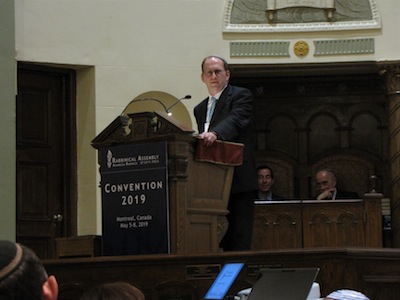
Congregation Beth Israel Senior Rabbi Jonathan Infeld speaks about BI Rabbi Emeritus Wilfred Solomon at the Rabbinical Assembly in Montreal on May 5-8. (photo from Beth Israel)
“The greatest thrill,” she said, “was to hear Rabbi Infeld describe the accomplishments and the personal courage and integrity of the Solomons to the assembled rabbis and other guests at the assembly. It was easy for us to decide to attend, because we didn’t want this opportunity to honour the Solomons to go by without proper acknowledgement.”
The Solomons worked for the benefit of the synagogue and the larger community. “They became friends with many of their congregants and the families that made up the synagogue, grew up with the Solomon family,” said Pinsky. “Rabbi Solomon took a leading role in advocating for human rights and protecting human dignity within the Vancouver Jewish community and neither he nor Phyllis hesitated to stand up for what they believed to be fair. He was involved in demanding freedom of Soviet Jews, in the exodus of Ethiopian Jews, and he supported Martin Luther King and other leaders who fought for racial and social equality during the ’60s, ’70s and onwards. The Solomons also aided in the synagogue’s adaptation to include women as equals within the Conservative movement. Their impact was huge.”
The couple made aliyah right after Rabbi Solomon’s retirement in fall 1997, said Pinsky. “They have lived in Jerusalem ever since,” she said. “In around 2006, they attended and Rabbi Solomon officiated at my niece’s bat mitzvah at the Southern Wall, just below the Western Wall, and we socialized all weekend. The Solomons retained a warm and friendly relationship with my extended family, as they did with most of the families in the synagogue. They had known my parents since the ’70s, for example, and were quick to send us kids kind notes of sympathy on the passing of our father and then our mother. I know of many congregants who have lunched with the Solomons each time they visit Jerusalem, and still maintain that special relationship that one can have with ‘my rabbi.’”
“I see them every time that I am in Israel,” said Infeld. “We also talk on the phone and email.”
Infeld is joined in leading the congregation by Assistant Rabbi Adam Stein, Ba’alat Tefillah Debby Fenson and youth director Rabbi David Bluman. The synagogue has more than 640 member families, according to its website.
“Rabbi Solomon and Phyllis gave so much to Beth Israel and the entire Vancouver Jewish community. We are as we are today as a synagogue because of the two of them. They built so much. We should always be grateful to them,” said Infeld. “Our gala will be just one way to continue to show them our gratitude and appreciation.”
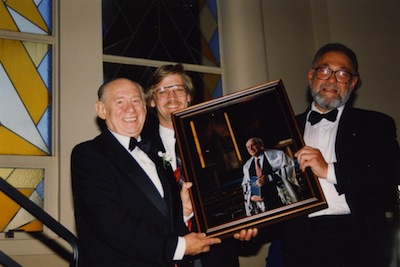
Cantor Murray Nixon, left, and Rabbi Wilfred Solomon, right, hold a framed photo of Nixon taken by Don McGregor, middle, at Beth Israel, circa 1995. (photo from Congregation Beth Israel fonds, JMABC L.22388)
For the last while, the gala committee, which Schwartzman co-chairs with Leatt Vinegar, has been asking the community to send in photographs of and stories about the Solomons. These photos will be shared throughout the event in different ways, said Schwartzman.
“It is going to be a lovely evening of celebrating our beloved Rabbi and Mrs. Solomon,” she said, “but it is also a celebration of our congregation and how it touches our lives at those lifecycle pivotal moments.”
In this vein, a new exhibit is being mounted.
“We are excited to officially open the museum cases in the synagogue once again,” said Schwartzman. “Jean Gerber and Lissa Weinberger have been working hard at bringing back these displays. Phyllis Solomon helped develop the original museum in the old building and she has been involved in helping to decide which pieces will be in this new display that officially opens at the gala.
“We will also be naming the street that leads down to our parking lot … and, if technology holds up, we will be trying a live link to the Solomons in Israel.”
A special book of messages is being designed to give to the Solomons as a keepsake, and a digital version will also be created, so that everyone can view it. To contribute to the book, contact Esther Moses-Wood at esther@bethisrael.ca.
Proceeds from the gala and book will support the operation of the synagogue. For tickets ($180), call 604-731-4161 by June 1.
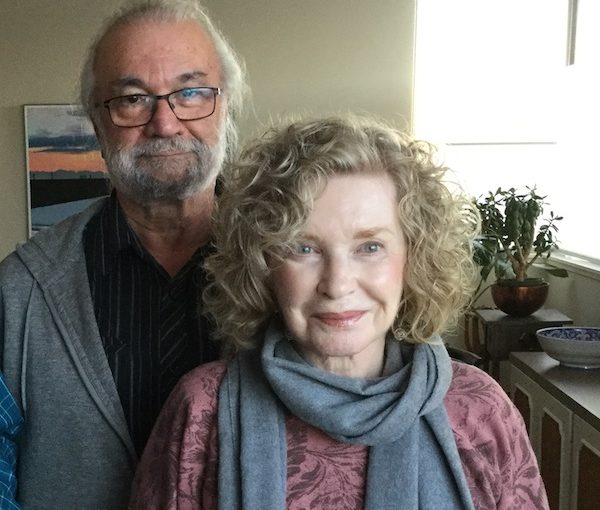
Maurice Yacowar and wife Anne Petrie. (photo from Yacowars)
Shtisel, the unlikely yet addictive hit television series about a Charedi family in Jerusalem, is now the subject of a new book, Reading Shtisel: A TV Masterpiece from Israel, an episode-by-episode analysis penned by Victoria writer and critic Maurice Yacowar, which he will share at the Jewish Community Centre of Victoria June 2.
Yacowar, a retired film professor, began his project in December 2018, as Netflix started airing the series that has become de rigueur viewing among Jews and non-Jews alike. As with many of the show’s aficionados and binge watchers, he was hooked, but his is the only book on Shtisel written thus far. The book’s first printing took place in March.
From his perspective, the show transcends what some may initially dismiss as soap-operatic tendencies. Not a character, not a scene, not an action in the two-season, 24-episode show is out of place, according to Yacowar.
“People (and animals) come and go, some questions may seem unanswered, but those elements are not relevant to the story. Nothing in the show is superfluous or unnecessary. Everything has a reason. We enter their domain, and we leave it, just at the right time,” he recently told the Jewish Independent at a Victoria restaurant.
Hence, the use of the word masterpiece in the book’s subtitle. “People from all cultures are able to relate to the drama and the compassion,” Yacowar explained.
“What’s more, no character stands for a safe idea,” he added. Shulem, the patriarch of the Shtisel family, is the most confounding of them all. At times, he is bullying to the point of being dictatorial; at other times, gentle and caring.
All involved do things that are not “in character,” said Yacowar, which takes viewers along various side streets or smaller stories within the story. There is the studious Zvi Arye, who, after watching a video taken in childhood, laments having had a shot at singing stardom thwarted; the scheming Lippe, who, for a time, abandons his family, though exhibits moments of great kindness and affection to those closest to him; and the show’s least sympathetic character, Nuchem, who doesn’t want his daughter, Libbi, to marry a deadbeat artist, aka his nephew Akiva, Shulem’s son.
Throughout the series are connections to the world outside the strict ultra-Orthodox confines of the Geula neighbourhood in Jerusalem, said Yacowar. Grandmother Malka is fixated by American daytime dramas, Giti’s need for money after her husband departs for Argentina leads her to seek work as a housekeeper for a clothing store manager, and cellphone use among this set of Charedim is ubiquitous.
It is Akiva’s desire to be an artist, though, which perhaps represents the greatest struggle between the secular and the religious in the show, not to mention the personal psychological conflict for the character himself. There are times, particularly those when he is immersed in his art, that Akiva appears to shift seamlessly from one world to another. And others, such as the scene where Akiva is presented with an award and funds for his art at an elite gallery, when the distinction between the pious Shtisel family and mainstream Israeli society could not be more pronounced.
Akiva, Yacowar pointed out, manages to rise in his battle and become his own person as the series concludes at the end of Season 2, no longer shackled by the vagaries of his father’s moods. In contrast, Shulem’s flaws – his conceit and ego, his inability to accept his son’s success in that other world – are on full display.
Yacowar doesn’t expect everyone to agree with his assessment of the series. “Other critics may well choose different points of emphasis, different connections and implications in phrase, situation or device,” he writes. “That’s the beauty, magic of connecting with a drama of such extraordinary richness and complexity.”
There is one point, however, on which he does expect readers of his book to be in agreement: “Let there be the illumination of a Season 3 – but only from the same creators and the same depth and integrity.”
Yacowar has written more than a dozen books on subjects ranging from the films of Alfred Hitchcock to the comic art of Mel Brooks and Woody Allen. He has written two books about The Sopranos and a humorous work, Mondays with Moishe.
Reading Shtisel: A TV Masterpiece from Israel is available online and at Congregation Emanu-El and the JCC of Victoria. Yacowar’s June 2 presentation at the JCC will start at 11 a.m.
Sam Margolishas written for the Globe and Mail, the National Post, UPI and MSNBC.
The Eurovision Song Contest, like the World Cup, is one of those cultural phenomena that seems to enrapture huge swaths of the world while North Americans observe it dispassionately, if at all, wondering what it’s all about.
For Jewish North Americans, the annual international songfest gained attention last year and this year for the 2018 Israeli victory by performer Netta Barzilai, a victory that comes with the privilege of hosting the next contest. So it was that the world descended on Tel Aviv last week for the 2019 edition.
Commentary on social media was polarized. Anti-Israel activists called for a boycott of the event, while Israelis and Zionists (as well as tourists who are as attuned to Israel-Palestine politics as most of us are to the nuances of Eurovision or the World Cup) posted photos of a rapturous Mediterranean seaside celebration.
Calls to boycott one of the world’s most watched cultural events because it takes place in Israel represent a continuing effort to portray Israel as a nation apart from the rest, an untouchable among countries. To make this approach make sense, Israel has to be recast to fit the narrative. Notably, there was no serious discussion of a boycott when Eurovision was hosted by Russia, an autocracy guilty of terrible crimes and oppression.
For all its bluster and online ubiquity, the boycott-Israel movement has largely been a failure on the surface. Last week, activists called for a boycott of Israeli wines and, in response, there was a run on Israeli wines at Vancouver-area liquor stores. Similar campaigns have regularly produced far more sizzle than steak, with counter buycotts negating any large impacts that the boycotts might inflict.
What the BDS movement does successfully, though, is solidify in the minds of uninformed or unengaged people the idea that the Israeli-Palestinian conflict can be blamed on one party. If peace, justice and coexistence were the real aim of the movement, they might choose to call out injustices and corruption by the Hamas and Fatah rulers in Palestine alongside wrongs perpetrated by the Israeli government and military. Indeed, boycotts need not have any actual economic success in order to succeed at planting a narrative – a fact the BDS movement has seized upon.
Meanwhile, there has been outrage from supporters of the BDS movement in response to legislative moves to block anti-Israel boycotts. The German Bundestag recently passed a resolution condemning BDS as antisemitic and calling it redolent of Nazi-era boycotts. Activists have responded with a classic goose/gander dichotomy, seemingly demanding the right to boycott while incensed that anyone might boycott them back.
As we have written in this space previously, legislative punishments for boycotting Israel, which have also been passed by many U.S. states, may come from the right philosophical place, but we’d prefer to see the basis of the movement countered intellectually, rather than with the blunt force – and unintended consequences – of these laws.
Ultimately, the message we should take from the Eurovision experience and the broader BDS movement is that misrepresentations must be met with truth, even if that seems like a Sisyphean effort. More specifically, the boycotts should be met with a forceful response that not only declares our opposition to the boycott itself. We must also loudly proclaim that the underlying assertion of unilateral Israeli guilt for this seven-decade conflict is a false premise upon which the entire BDS cause rests. Of course, Israel has responsibilities in the goal of a lasting peace, but so do Palestinians, a fact that BDS supporters and much of the world refuse to acknowledge.
Eurovision organizers tried unsuccessfully to keep politics out of the competition but they came anyway. The supposed controversies did nothing to detract from the “big show” and, in fact, could be said to have highlighted the complex entity that is Israel and its capacity to embrace diverse views.
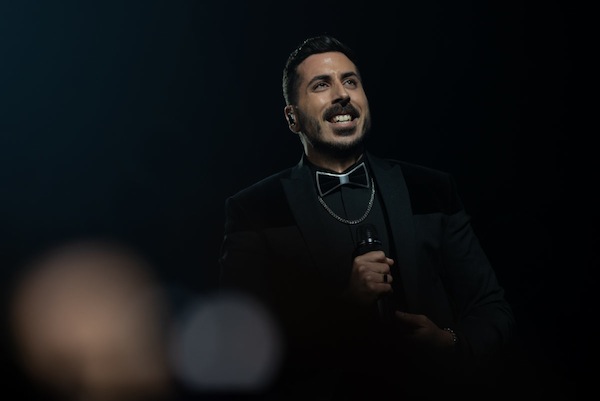
While Israel’s entrant, Kobi Marimi, didn’t fare very well – coming in 23rd of 26 entrants – he gave an emotional performance, finishing his song “Home” with tears. He later told reporters, “I don’t have words to explain how much I love this country, and how proud I am for myself and my team.” We’re pretty proud, too.
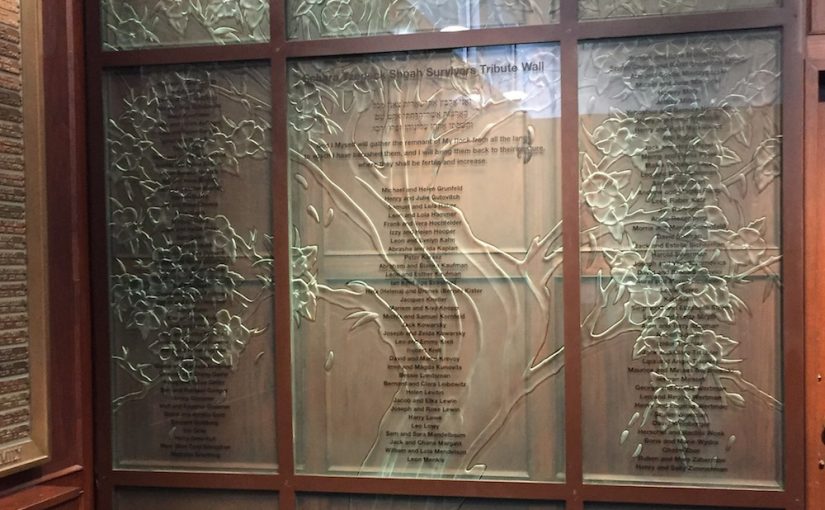
The Schara Tzedeck Shoah Survivors Tribute Wall was created for the congregation by John Nutter. The sculpture, which includes the names of 230 survivors, was dedicated May 3. (photo from John Nutter)
Congregation Schara Tzedeck has a new art installation in its main sanctuary. The Schara Tzedeck Shoah Survivors Tribute Wall – a Tree of Life rendered in sandblasted glass – includes the names of 230 survivors. It was dedicated May 3.
Full of shared memories and friendship, the pre-Shabbat dedication ceremony featured several speakers: the synagogue’s spiritual leader, Rabbi Andrew Rosenblatt; its executive president, Howard Kallner; younger family members of the survivors; Ed Lewin, co-chair of the project with Hodie Kahn; and the man who started the entire project, Dr. Robert Krell, a child survivor.
“We wanted to honour the Holocaust survivors who found their way to Canada, before and after the war, and wound up as members of this shul,” Lewin told the Independent. “Most of them came here in 1948. Their names are all there, on the wall. My parents’ and grandparents’ names are among them.”
Explaining how the project started, Lewin said, “We had this empty space, and Krell suggested a tribute to Holocaust survivors. It was several years ago. It took us awhile to find the talented glass artist, John Nutter, who transformed our ideas into a sculpture.”
The synagogue is publishing a commemorative book about the installation, as well. While the Tribute Wall features survivors’ names only, the book also contains photographs of the survivors; there are family and group photo pages. Together, the book and the wall serve as a memorial to those who not only survived the Shoah but contributed greatly to Schara Tzedeck and to the development of Greater Vancouver and the province over the past seven decades.
One page of the book is dedicated to Nutter, who has created numerous art installations for churches and synagogues, mostly in New York. His works decorate many institutions in the United States and Canada: hotels, museums, hospitals. He collaborated with local artist Bill Reid on a glass sculpture at the Vancouver International Airport. A few years ago, Glass Magazine named Nutter one of the top three architectural glass artists in the country.
About how he came to design the Tribute Wall, Nutter said, “A few years ago, I did a small glass sculpture for the Louis Brier Home, a collaboration with a wonderful artist and friend, Diana Zoe Coop. Camille Wenner, Diana’s daughter, works for Schara Tzedeck. I’ve known Camille since she was a young child. She contacted me about this project and, of course, I said, yes.”
He explained his work process. “They knew exactly what they wanted – a Tree of Life, made like a Vancouver cherry tree in bloom. Usually, I start with a small draft, show it to my clients, make changes until they’re satisfied, before I transfer the design to glass. But the people from Schara Tzedeck were very nice. They approved my first draft of the design.”
The first step in making the sculpture was creating a life-size drawing out of the small-scale draft. “I hire a company for that,” said Nutter, “give them my small drawing, and they blow it up to the size I want.”
Once he has the full-size paper draft, he starts working on the glass. For this sculpture, he used nine separate glass panels. The three bottom panels are roots. “The words ‘Schara Tzedeck’ are carved among the roots, to symbolize the Jews who had set their roots with the congregation,” Nutter explained.
The middle panel is the trunk, and the five panels around it are carved with leaves and flowers. “I sandblasted each petal of each flower individually,” Nutter said. “It gives more depth to the sculpture.”
The work is made of 15-millimetre laminated glass; two layers joined together. The carving is on the back, and the names of the survivors are written on the front, in black, which adds to the visual depth.
Nutter has been working with architectural glass for decades. “I started as an architecture student at the University of Manitoba,” he recalled. “A couple years into my studies, I took a summer job with a stained glass company. I loved it so much, I left my schooling and stayed with the company for several years, before I founded my own company. I never finished my architectural degree, but I taught stained glass making at the same faculty years later.”
He loves architecture, and most of his works are large-scale glass. “Sometimes,” he said, “my background in architecture helps me to win the contracts. I often build small-scale models of my proposed installations when I bid for a job. I like the details and hardware used in the models. I learned that during my years of architectural studies.”
Frequently, Nutter’s sculptures and windows tell a story, like the one he created for Schara Tzedeck. “In the past, when artists made glass installations in churches and other religious institutions, it was always to tell a story, as most of the population were illiterate,” he said. “Now, people can read, so the art became more decorative, but it still tells a story.”
To learn more about the artist, visit johnnutterglassstudio.com or visit his studio on Granville Island. For those interested in purchasing the hardcover, full-colour commemorative book ($54), visit scharatzedeck.com/event/-shoah-survivors-tribute-book-order.html; the order deadline is June 30.
Olga Livshinis a Vancouver freelance writer. She can be reached at olgagodim@gmail.com.
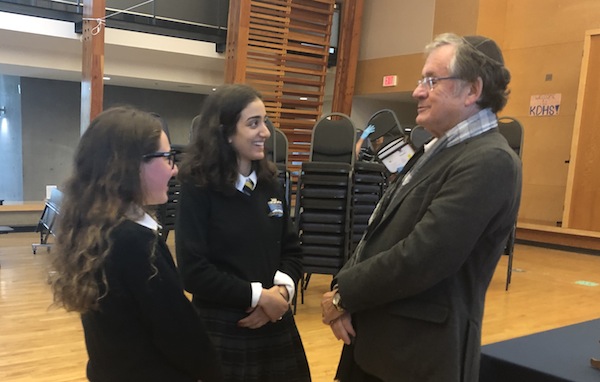
Dr. Robert Krell with Grade 12 King David High School students Gali Goldman, left, and Edden Av-Gay. (photo by Shula Klinger)
On May 2, King David High School marked Yom Hashoah at its annual assembly commemorating those lost in the Holocaust. This year, for the first time, the school hosted Grade 10 students from Alpha Secondary School in Burnaby.
The morning began with prayers for the victims of the recent Poway shooting in San Diego. After a minute’s silence, the assembly commenced with a procession led by child Holocaust survivor Dr. Robert Krell. Each of the five KHDS students in the procession carried a candle.
Originally from The Hague, Krell is founding president of the Vancouver Holocaust Education Centre and an educator and advocate for the centre’s programs. He is also professor emeritus, department of psychiatry, University of British Columbia, and distinguished life fellow of the American Psychiatric Association. He was introduced by KDHS students Estie Kallner and Mattea Lewis, his granddaughters. They spoke of their grandfather, thanking him for the “privilege” of hearing firsthand stories of the Holocaust.
Krell began his talk holding up a black and white photograph of himself as a baby. “Who was the enemy of the Third Reich?” he asked the audience. “This,” he said.
Krell was born when Holland was already occupied by Nazi forces. Indeed, the hospital he was born in was already partially confiscated by the Gestapo. He described how restrictions were imposed rapidly, every mundane aspect of Jewish life being placed under more and more stringent rules. Deportations began in 1942. Speaking of the local Jewish population being assembled for the euphemistically named “resettlement in the east,” he said, “No one panicked sufficiently.”
Krell went on to describe how, as family friends began to disappear, his “rather astute” parents fled their home, taking few possessions. “What would you grab?” he asked. His parents abandoned their photo albums because, in enemy hands, they would give away too much personal information.
Placed in the care of a local Dutch Christian family, Krell learned to call the parents Mother and Father. He described them as “the most wonderful people on earth.” With them, he said, his life was “comparatively normal.” That said, with the ever-present risk of betrayal, as a dark-haired child in a sea of blond heads, he was very noticeable. He was not allowed to look out of the apartment windows; there were Dutch Nazi sympathisers living within sight of his adoptive home.
One of the most powerful aspects of the lecture were Krell’s insights on human memory and identity under conditions of extreme stress. He described his recollections as “fragmented, not fully formed” and, while his young mind didn’t appreciate the extent of the horrors being committed outside, he said, “I knew something was wrong because I was part of another family.” His mother, he explained, remembered nothing of that period. Having given her young son over to a Dutch Christian, he said, “She was in shock for three months.” He spoke in the present tense of how his real identity vanished in hiding. “I melt into the family.”
As an adult, his adoptive sister, Nora, also buried some memories, which led to a conflict with Krell. He recalled being taken to visit his mother by Nora but Nora said she had never done that. This was a way of “denying me my memory,” he said, adding that this denial causes grievous harm to the psyche. Even though we have fragmented memories, he said, “we don’t want to give them up because they are part of who we are.”
In the end, the disagreement was resolved. Nora had indeed taken Krell to see his mother. Twice, he was nearly discovered and twice he narrowly escaped, first by covering his head with a blanket and, the second time, by hiding under a bed.
His years in hiding were characterized by unease, a looming sense of fear and constant hyper-vigilance. After the war, his family moved to Vancouver, leaving behind Holland, which he said he viewed as “a place of death.” He described himself as “the most eager immigrant-in-waiting that ever existed.”
Once in Canada, Krell reinvented himself, hiding his shyness behind outward charm and sociability. He said he became resilient, ignoring illness and pain, striving to forge a new life, a family and career for himself.
He spoke of the medical advice he received when dealing with overwhelming feelings – “You should get rid of your obsession with the Holocaust.” Instead, he helped found the Holocaust Symposium for high school students and facilitated the recording of 140 testimonies from survivors.
Following the lecture at KDHS, Krell answered questions from students, concerning Holocaust education today, as well as why it is that some people hid Jews and put their own lives at risk. Krell referred to “common decency,” adding that his own rescuers “didn’t know the precise nature of the unfolding danger, but once they had me, they were committed.” He told the students that, in spite of the “showcase” of the Nuremberg trials, “there is no justice.” And, are we at risk today? “Massively.”
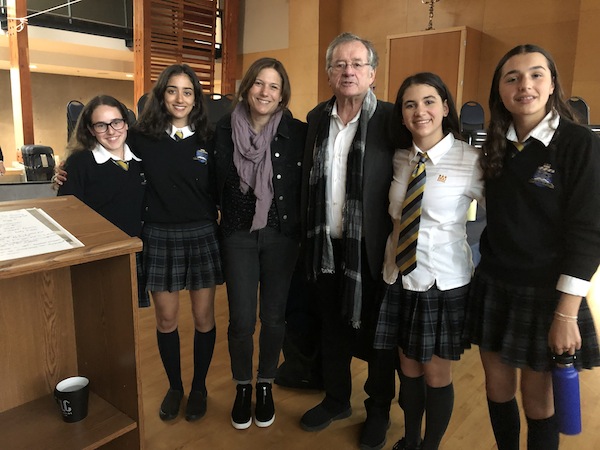
Left to right: KDHS students Gali Goldman and Edden Av-Gay, Dr. Robert Krell’s daughter Simone Kallner, Dr. Robert Krell and his granddaughters Estie Kallner and Mattea Lewis. (photo by Shula Klinger)
In his closing comments, Krell shifted from storyteller to teacher, using the narrative of his life to guide the students in theirs. “Learn your history,” he said. “In it lies everything to secure the safety of your children and grandchildren.”
He said, “Without engaging with the Holocaust, you are at great risk of becoming an under-educated person, and that makes you vulnerable. This mass murder took doctors, lawyers. Physicians were killing children in 1938. It was the doctors, engineers, architects. Each of the professions we trust for our safety. They all worked in the service of mass murder. Safeguard your professions from sliding into the abyss. It happens so quickly.”
Grade 12 students Edden Av-Gay and Gali Goldman spoke with Krell after his talk. Av-Gay was struck by how “one person could experience so many miracles in his life, especially someone born into such hardship” and said, “His story is truly amazing.”
Goldman, who had recently given a class presentation on youth movements during the Holocaust, had heard Krell tell his story before. She said she was still touched by how “he lost so much but he has devoted his life to teaching about what he went through, even though it was horrific. He can still find parts of his story that were miracles.”
Asked about Krell’s decision to speak about his past, Av-Gay said, “I think it’s not a matter of him being comfortable telling his story, I think he feels obligated to do it, to share his past, to show what happened to six million Jewish people.”
Alpha Secondary Grade 10 student Amy Ricker said she found Krell “motivating and inspiring.” Ricker, who hopes to become a humanitarian lawyer, said she “teared up because he showed me how in the dark I have been, and how much I want to help people.”
One perhaps surprising message in his talk was a warning about tolerance.
“If Jews were ‘tolerated’ in Holland, and the result was the deaths of over 80% of the Jewish population,” he said, “then we have to do much better than just tolerance.”
As he finished his lecture, he said, “Realize what you have. Thank your parents and tell your irritating siblings that you love them. I urge you – be kind.”
Shula Klingeris an author and journalist living in North Vancouver. Find out more at shulaklinger.com.
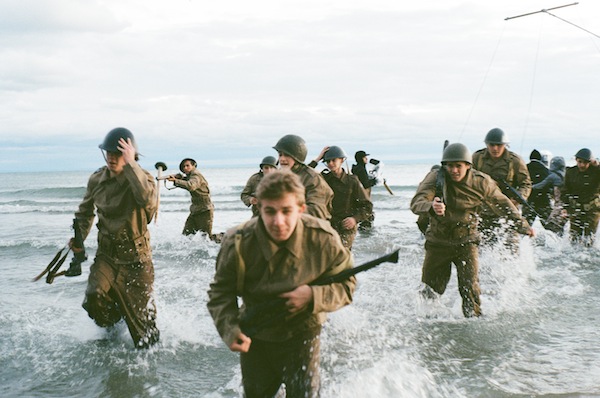
The fear, bloodshed and massive loss of life in the cause of freedom are illustrated through remarkable – and convincing – dramatic reenactments in D-Day in 14 Stories. (photo from YAP Films and the History Channel)
The horrors and heroism of D-Day took place 75 years ago June 6. A remarkable new documentary, with distinct Canadian and Jewish connections, will air on the History Channel June 1. D-Day in 14 Stories includes firsthand recollections from Allied and German soldiers and French civilians – many of them kids or teenagers at the time of the conflict.
The massive battle of the Second World War saw more than 150,000 Canadian, American, British and other Allied soldiers storm the beaches of France, marking the turning point of Nazi – and Allied – fortunes.
D-Day in 14 Stories is a social history of D-Day, a joint production of YAP Films and the History Channel. The events on that long-ago day in 1944 are illuminated by eyewitness accounts from some of the few remaining veterans of that historic battle.
On D-Day alone, 359 Canadian soldiers were killed. More than 5,000 Canadian soldiers died during the succeeding weeks of fighting in Normandy. The fear, bloodshed and massive loss of life in the cause of freedom are illustrated through remarkable – and convincing – dramatic reenactments, visual effects and historical footage, including a trove of colour film taken by a soldier using an early Bell and Howell handheld movie camera.
Many soldiers on both sides were just following orders but, as Morton Waitzman recounts in the documentary, some Jewish soldiers felt a particular motivation.
“Being of the Jewish faith myself, and so many of my comrades, we knew we had to get over there as soon as possible to do whatever we could to stop this terrible curse,” he said. As a communications specialist, he connected American and British forces with members of the French Underground to help coordinate the battle.
D-Day in 14 Stories makes the effort to capture the particular experiences of African-American and First Nations soldiers. (photo from YAP Films and the History Channel)
The Germans were anticipating an attack, but had no idea when, where or how large a force the Allies would assemble. The documentary follows a wall of soldiers parachuting through a cascade of tracers. In all, 13,000 Americans dropped inland by air to support the amphibious landing and undermine the German response.
While one Allied soldier says, “Anybody who says they weren’t afraid is not telling the truth,” a German soldier recounts, tellingly: “We had no fear. We were convinced that we would win.”
Until D-Day, the British Air Force had strafed the Normandy coast, but returned to their island redoubt. French residents of the area were familiar with the routine: take shelter when the alarms go off and come back out when they ring again.
Bernard Marie was a 5-year-old child in Normandy at the time.
“The big difference is that, on June 6th, the siren never came back,” he said.
In all, 7,000 vessels embarked from Britain to the French coast. The Allies had no illusions about the cost of the operation. Casualties were anticipated to reach 25 to 30%.
Emotionally powerful dramatizations follow 16- and 17-year-olds as they face the life-and-death moment for themselves and the free world.
“Some never got off the boat,” recalled one soldier. “They were shot, bodies laid all over, boats turned upside down, real chaos. We still kept going forward.… Soldiers.”
One survivor remembers that, despite the explosions all around him, his sole consideration when coming ashore at Normandy was that his socks were soaked through.
The average soldier was carrying 35 kilograms on his back and, for those whose vessels did not manage to make it close to shore, jumping off the ship, in many cases, led to almost instantaneous drowning.
If they survived the initial landing, the soldiers had to confront the German enemy firing down from above at Allied soldiers who were effectively sitting ducks. A German soldier recalls: “We merely had to point that machine gun and it was like cutting wheat with a scythe. For the odd miss, we had a thousand hits.”
The film admirably makes the effort to capture the particular experiences of African-American and First Nations soldiers.
Waitzman, the Jewish American soldier, went on to fight in Europe and participated in the liberation of concentration camps.
“We became eyewitnesses to the Holocaust by what we saw,” he says in the film. “We were very compelled to tell the details to young people. We had to talk, to fight this as much as possible.”
Another veteran of the battle reflects on the loss of life, but ponders the alternative: “God knows what would’ve happened if we hadn’t done it.”
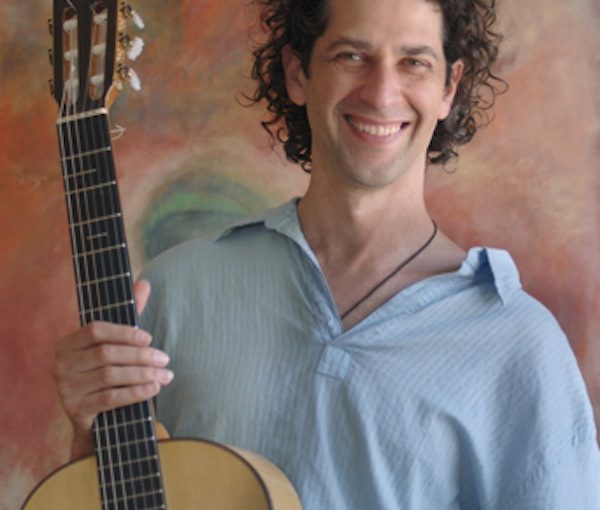
Vancouver composer Itamar Erez will have a world première of his work at the Sound of Dragon Ensemble (Vancouver) and Melody of China (San Francisco) concert May 30, 7 p.m., at the Western Front. Erez will be playing guitar with Sound of Dragon, as well. His composition, Migrant Voices, was inspired by Italo Calvino’s book Invisible Cities, which Erez read when he was younger. It is an imagined set of conversations between Marco Polo and the emperor of the 13th-century Mongolian empire, Kublai Khan. Each chapter of the book is a prose poem, describing an imaginary city that Marco Polo “discovered” in his travels. “I remember being deeply inspired by it as a young person,” said Erez. “In a similar way, perhaps, the music of Migrant Voices is a kind of a ‘discovered’ folk song, from an imaginary city, country or culture. Based on a 9/8 and 7/8 time signature, it definitely has elements taken from certain Balkan/Greek music, Turkish or Armenian. Not sure, to tell you the truth, exactly why and how – it just came to me one day as if a voice whispered it in my ear.”
The May 30 concert – in celebration of Asian Heritage Month – is the first collaboration of two professional music ensembles with Chinese roots from across the border between Canada and the United States. For tickets and more information, visit soundofdragon.com.
השר האחראי בממשלה הפדרלית על הפחתת הפשע המאורגן בקנדה, ביל בלייר, אמר כי אם הם ידרשו, פקידי הממשלה יעידו בפני הוועדה המיוחדת.
הממשלה הפדרלית בראשות המפלגה הליברלית והמשטרה הפדרלית (האר.סי.אם.פי) הודיעו בנפרד, כי ישתפו פעולה עם ועדת החקירה המיוחדת שתבדוק את נושא הלבנת הכספים במחוז בריטיש קולומביה. על הקמת הוועדה החליט הפריימר של בריטיש קולומביה, ג’ון הורגן, ובראשה יעמוד שופט בית המשפט העליון אוסטין קלאן.
השר האחראי בממשלה הפדרלית על הפחתת הפשע המאורגן בקנדה, ביל בלייר, אמר כי אם הם ידרשו, פקידי הממשלה יעידו בפני הוועדה המיוחדת. זה כולל גם נציגים של האר.סי.אם.פי, סוכנות המודיעין לנושאים פיננסים ופ’ינטרק. המידע ימסר על ידם כל אימת שידרשו ובלבד שלא יסכן חקירות בהם הם עוסקים.
בלייר הוסיף כי הממשלה הפדרלית נקטה כבר במספר צעדים משמעותיים בנושא הלבנת ההון. בין היתר הממשלה השקיעה שבעים מיליון דולר נוספים למשך חמש השנים הבאות, כדי להקים כוח משימה מיוחד להילחם בהלבנת כספים. הממשלה החליטה גם להגביר את קליטת ואיסוף המידע הפיננסי בנושא.
במקביל המשטרה הפדרלית הודיעה בנפרד כי גם היא תשתף פעולה באופן מלא עם הוועדה לחקירת הלבנת הכספים במחוז.
ממשלת בריטיש קולומביה החליטה לבדוק לעומק את פרשת הלבנת הכספים, מקלט מתשלום מיסים ומקום להפקדת מזומנים ללא זהות, המתרחשות בוונקובר ובאזור. הממשלה פרסמה לאחרונה דוחות שחשפו את ממדי התופעה החמורה, כאשר בתקופת השלטון המפלגה הליבראלית היא הושתקה.
בשנה שעברה לפי הערכה הולבנו באזור ונקובר למעלה משבעה מילארד דולר. למעלה מחמישה מיליארד מהסכום המולבן הושקע בנדל”ן. הדבר הביא לפי הערכה לעלייה של יותר מחמישה אחוזים במחירי הנדל”ן אשתקד. לא פלא שבוונקבור עצמה מחירי הנדל”ן עלו ביותר משבעים אחוז בחמש השנים האחרונות.
הממצאים של הדוחות הממשלתיים ממחישים כיצד זרם מזומן רב להלבנה בבתי קזינו השונים, רכישת מכוניות ותכשיטים יקרים וכמובן לענף הנדל”ן.
דיווחים קודמים של הממשלה גילו כיצד בתי קזינו במשך שנים קיבלו מיליוני דולרים במזומן. ואילו לאחרונה פורסם איך השוק האפור משגשג ביצוא מכוניות יוקרה מונקובר לסין. זאת תוך קבלת מיליוני דולרים בגין החזרי מס מכירות רכבים לקונים בחו”ל. אבל כל אלה לא קרובים למה שקורה בתחום הנדל”ן. מדובר במגזר שעל פי הערכות מהווה כשליש מהתוצר המקומי הגולמי של המחוז והוא בעצם הדלק של הכלכלה המקומית.
לפי הערכות בממשלת המחוז למעלה ממאתיים מיליארד דולר הולבנו באזור ונקובר בעשרים השנים האחרונות. מרבית הכסף השחור הושקע כאמור בנדל”ן כאשר אחד מכל חמישה בתים נרכש במזומן, ולנכסים רבים אין זהות ברורה מי בעליהם. לפעמים דירות רבות נרכשו עת ידי אותו גורם בבניין מגורים אחד. בעלי נכסים רבים פורעים את המשכנתאות שלהם מהר מאוד, ויש בעלי נכסים שמחזיקים בעשרות משכנתאות בו זמנית.
על פי הדוחות של ממשלת מחוז בריטיש קולומביה: ונקובר רבתי הפכה למכבסת כספים של הפשע המאורגן בו שותפים גורמים זרים. על הגורמים הפליליים נמנים: קרטלי סמים של מקסיקו, גורמי פשע מאורגן מאירן כולל ארגון החיזבללה, וגורמי פדע מסין. אזור ונקובר רכש לעצמו מוניטין שאין להכחישו כמקום נוח להלבנת הון, סחר בסמים והפקדת מזומנים בהיקף גדול.
הממשלה המחוזית מתכננת להקים מרשם ציבורי של בעלי קרקעות במהלך השנה, כדי לדעת בוודאות מי עומד מאחורי הנדל”ן היקר באזור כולו. במקביל הממשלה ממשיכה להפעיל לחצים על הממשלה הפדרלית לקבלת משאבים משמעותיים, להילחם בהון השחור. וכן להתקין חדשות כדי לפקח טוב יותר על עסקאות במזומן ועל פעילויות חשודות.