
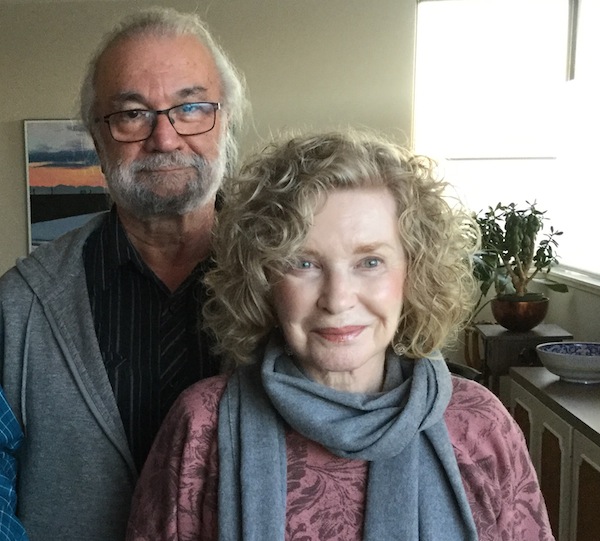

Maurice Yacowar and wife Anne Petrie. (photo from Yacowars)
Shtisel, the unlikely yet addictive hit television series about a Charedi family in Jerusalem, is now the subject of a new book, Reading Shtisel: A TV Masterpiece from Israel, an episode-by-episode analysis penned by Victoria writer and critic Maurice Yacowar, which he will share at the Jewish Community Centre of Victoria June 2.
Yacowar, a retired film professor, began his project in December 2018, as Netflix started airing the series that has become de rigueur viewing among Jews and non-Jews alike. As with many of the show’s aficionados and binge watchers, he was hooked, but his is the only book on Shtisel written thus far. The book’s first printing took place in March.
From his perspective, the show transcends what some may initially dismiss as soap-operatic tendencies. Not a character, not a scene, not an action in the two-season, 24-episode show is out of place, according to Yacowar.
“People (and animals) come and go, some questions may seem unanswered, but those elements are not relevant to the story. Nothing in the show is superfluous or unnecessary. Everything has a reason. We enter their domain, and we leave it, just at the right time,” he recently told the Jewish Independent at a Victoria restaurant.
Hence, the use of the word masterpiece in the book’s subtitle. “People from all cultures are able to relate to the drama and the compassion,” Yacowar explained.
“What’s more, no character stands for a safe idea,” he added. Shulem, the patriarch of the Shtisel family, is the most confounding of them all. At times, he is bullying to the point of being dictatorial; at other times, gentle and caring.
All involved do things that are not “in character,” said Yacowar, which takes viewers along various side streets or smaller stories within the story. There is the studious Zvi Arye, who, after watching a video taken in childhood, laments having had a shot at singing stardom thwarted; the scheming Lippe, who, for a time, abandons his family, though exhibits moments of great kindness and affection to those closest to him; and the show’s least sympathetic character, Nuchem, who doesn’t want his daughter, Libbi, to marry a deadbeat artist, aka his nephew Akiva, Shulem’s son.
Throughout the series are connections to the world outside the strict ultra-Orthodox confines of the Geula neighbourhood in Jerusalem, said Yacowar. Grandmother Malka is fixated by American daytime dramas, Giti’s need for money after her husband departs for Argentina leads her to seek work as a housekeeper for a clothing store manager, and cellphone use among this set of Charedim is ubiquitous.
It is Akiva’s desire to be an artist, though, which perhaps represents the greatest struggle between the secular and the religious in the show, not to mention the personal psychological conflict for the character himself. There are times, particularly those when he is immersed in his art, that Akiva appears to shift seamlessly from one world to another. And others, such as the scene where Akiva is presented with an award and funds for his art at an elite gallery, when the distinction between the pious Shtisel family and mainstream Israeli society could not be more pronounced.
Akiva, Yacowar pointed out, manages to rise in his battle and become his own person as the series concludes at the end of Season 2, no longer shackled by the vagaries of his father’s moods. In contrast, Shulem’s flaws – his conceit and ego, his inability to accept his son’s success in that other world – are on full display.
Yacowar doesn’t expect everyone to agree with his assessment of the series. “Other critics may well choose different points of emphasis, different connections and implications in phrase, situation or device,” he writes. “That’s the beauty, magic of connecting with a drama of such extraordinary richness and complexity.”
There is one point, however, on which he does expect readers of his book to be in agreement: “Let there be the illumination of a Season 3 – but only from the same creators and the same depth and integrity.”
Yacowar has written more than a dozen books on subjects ranging from the films of Alfred Hitchcock to the comic art of Mel Brooks and Woody Allen. He has written two books about The Sopranos and a humorous work, Mondays with Moishe.
Reading Shtisel: A TV Masterpiece from Israel is available online and at Congregation Emanu-El and the JCC of Victoria. Yacowar’s June 2 presentation at the JCC will start at 11 a.m.
Sam Margolis has written for the Globe and Mail, the National Post, UPI and MSNBC.



