Skip to content
  • Home
  • Subscribe / donate
  • Events calendar
  • News
    • Local
    • National
    • Israel
    • World
    • עניין בחדשות
      A roundup of news in Canada and further afield, in Hebrew.
  • Opinion
    • From the JI
    • Op-Ed
  • Arts & Culture
    • Performing Arts
    • Music
    • Books
    • Visual Arts
    • TV & Film
  • Life
    • Celebrating the Holidays
    • Travel
    • The Daily Snooze
      Cartoons by Jacob Samuel
    • Mystery Photo
      Help the JI and JMABC fill in the gaps in our archives.
  • Community Links
    • Organizations, Etc.
    • Other News Sources & Blogs
    • Business Directory
  • FAQ
  • JI Chai Celebration
  • JI@88! video

Recent Posts

  • Sharing her testimony
  • Fall fight takes leap forward
  • The balancing of rights
  • Multiple Tony n’ Tina roles
  • Stories of trauma, resilience
  • Celebrate our culture
  • A responsibility to help
  • What wellness means at JCC
  • Together in mourning
  • Downhill after Trump?
  • Birth control even easier now
  • Eco-Sisters mentorship
  • Unexpected discoveries
  • Study’s results hopeful
  • Bad behaviour affects us all
  • Thankful for the police
  • UBC needs a wake-up call
  • Recalling a shining star
  • Sleep well …
  • BGU fosters startup culture
  • Photography and glass
  • Is it the end of an era?
  • Taking life a step at a time
  • Nakba exhibit biased
  • Film festival starts next week
  • Musical with heart and soul
  • Rabbi marks 13 years
  • Keeper of VTT’s history
  • Gala fêtes Infeld’s 20th
  • Building JWest together
  • Challah Mom comes to Vancouver
  • What to do about media bias
  • Education offers hope
  • Remembrance – a moral act
  • What makes us human
  • המלחמות של נתניהו וטראמפ

Archives

Follow @JewishIndie
image - The CJN - Visit Us Banner - 300x600 - 101625

Month: May 2019

Community day of learning

Community day of learning

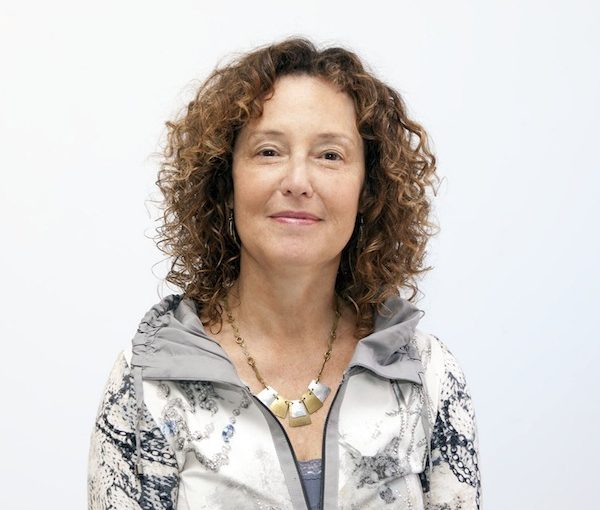
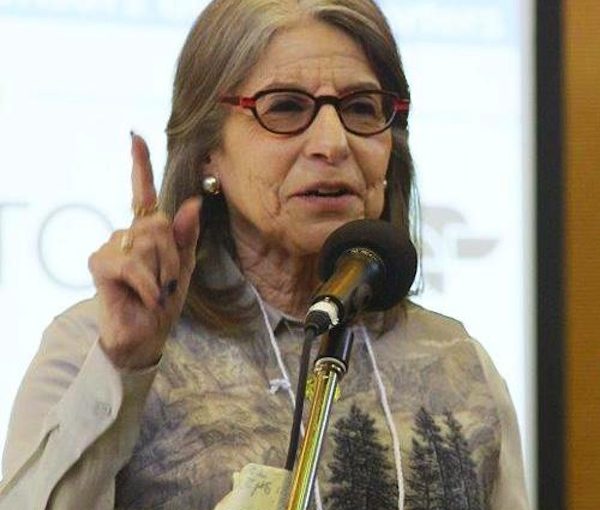
Prof. Norma Joseph (photo from Association for Canadian Jewish Studies)

On June 2, the Association for Canadian Jewish Studies is holding a day of lectures in the Jewish community that will be topped off with music from the Vancouver Jewish Folk Choir, the granting of the 2019 Louis Rosenberg Canadian Jewish Studies Distinguished Service Award to scholar and activist Norma Joseph and a talk by Franklin Bialystok on Canadian Jewish Congress.

“We offer a community day every year, and it’s always the opening day of the conference,” co-organizer Jesse Toufexis told the Independent.

“The motivations for the community day are plentiful,” said Toufexis. “Firstly, we receive great support in a number of ways from Jewish communities all over Canada, so this is an excellent way not only to thank them but to show them what the scholarly community is up to.

“Secondly, the Jewish community is interested in the topics we cover, from history to sociology to literature and art. So, coming from fields where we work on such minutely detailed projects, it’s fun to engage with a community that gets excited about the topics we ourselves find exciting.

“Thirdly, I think holding a community day is just part of a tradition that fosters togetherness. We aren’t scholars out in the ether, doing our own thing and keeping it to ourselves. I think of us more as a branch of a much larger Canadian Jewish community that includes all the various roles and aspects of Jewish life in this country, and I think it’s something of a duty to share what we’re constantly learning about our common past, present and future.”

Prof. Rebecca Margolis, ACJS president, praised Toufexis and co-organizer Prof. Richard Menkis on having “put together an amazing community day together in partnership with a team of local organizations that have gone above and beyond to make this day a success: Jewish Museum and Archives of B.C. and our host, the Peretz Centre for Secular Jewish Culture. As a member-run organization,” she said, “we value opportunities to collaborate with local organizations in order to produce exciting programming on the Jewish Canadian experience.”

The first panel session of the day is Jewish Space in Literature and Popular Culture, followed by Antisemitism and the Holocaust. At lunch, a panel discusses the topic Archives Matter. The two afternoon panels are Media Studies, and Challenging the Status Quo. Joseph’s talk in this last session is called No Longer Silent: Iraqi Jewish Immigrants and the CJC.

“I’ve been working on the Iraqi Jewish community in a bunch of different ways and my most recent publications are about their food and what we can learn about their cultural history and immigration patterns through studying their food,” Joseph told the Independent in a phone interview from her home in Montreal. “But I’ve also looked at, through the immigration pattern, the traumas they suffered by the expulsion from Iraq and the processes through which they had to escape from Iraq, as well as the ways in which they adapted to life in Montreal.”

It is only in the last decade or two, said Joseph, that Iraqi Jewish community members have “begun to present their memoirs and talk about how awful the experience from the Farhud in 1941 was. So, then I began to gather their stories.”

Joseph is particularly interested in the transition of the community from being unwilling to talk about their experiences to talking about them. “And also,” she said, “in the process of [preparing for] this year’s conference, which is celebrating 100 years of Canadian Jewish Congress, to figure out in what ways did Canadian Jewish Congress help or not help this community migrate or emigrate into Canada, which was, in fact, to Montreal. And that’s where I’m doing research right now. The Iraqi Jews themselves say, oh no, they didn’t help us … we came alone, we found our way on our own and nobody ever helped us. We didn’t ask for help. We weren’t refugees…. End of story.”

This perspective, as well as the larger Jewish community’s focus at the time on dealing with the impacts of the Holocaust, contributed to the silence, said Joseph.

“I wanted to go behind the scenes and say, OK, but in what ways that they [Iraqi Jews] might not have known was Congress working with the Government of Canada to open the doors, because we know that the doors of Canada were closed to Jewish immigration during World War Two but, afterwards, in the 1950s the doors open…. Did anyone in Congress help Middle Eastern Jews come? That’s my question. And that’s what I’m researching now at the archives, interviewing some people.”

Joseph’s interest in the Iraqi Jewish community comes in part from her and her husband Howard’s experiences.

“In 1970,” she said, “we came to Canada [from the United States]. He was invited to become the rabbi of the Spanish and Portuguese congregation. He was their rabbi for 40 years. And the congregation has many different communities – it has Iraqis, Lebanese, Moroccan, some Iranians, and we love the diversity of communities, the cultural diversity was so exciting.

“I never thought of studying the communities that we were friendly with and that my husband was the rabbi of, but, eventually, at some point, somebody said to me, why don’t you study Canadian Jews? And I looked around me at all these wonderful, diverse ethnic communities of Jews and I said, oh, this is a great idea, why not study the people I know so well?

“And I was interested in gender. I started asking a lot of questions and I especially focused on the women. And it came out that they were willing to talk to me, especially about food, and food was an entree into learning about their experiences, both in Baghdad and the transitions to Montreal and how hard those transitions were…. They couldn’t find the right foods and they didn’t know how to cook and there were no cookbooks and how were they going to cook and where were they going to find the spices? That was very symbolic of life, the difficulties of life in Montreal for this community that didn’t like gefilte fish.”

Joseph is being honoured by the ACJS for attaining the “highest standards of scholarship, creative and effective dissemination of research, and activism in a manner without rival in our field of Canadian Jewish studies, as well as being a respected voice in Jewish feminist studies more broadly.” Not only is she being recognized for “her mastery of both traditional rabbinic sources and anthropological methods,” but her teaching, her work in documentary and educational film, being a founding member of the Canadian Coalition of Jewish Women for the Get, as well as participating in the founding of the Institute for Canadian Jewish Studies at Concordia University, among many other accomplishments. For more than 15 years, she has written a regular column in the Canadian Jewish News. In one of these columns, in recent months, she recalled a time “when the phrase ‘liberal values’ was not a dirty word.”

“I was raised Orthodox,” she told the Independent. “My grandfather was a great Orthodox rabbi in Williamsburg…. But my parents worked very, very hard to send me to one of the great liberal Orthodox schools. It was called the Yeshivah of Flatbush, where boys and girls study together and we were taught that boys and girls could learn, and girls were included in that equation. It was one of the best schools because I learned fluent Hebrew, which was very rare, and it was a Zionist school, beginning in the ’50s.”

She added, “It wasn’t our liberal values in the 21st century, but it was mid-20th-century values. We learned to love Israel. We learned about justice, we learned about equality in some very interesting ways. We were patriotic Americans, my country right or wrong, which, after Vietnam, we had to rejig, but we were there before Vietnam…. I’ll tell you another thing that’s interesting about my upbringing – we didn’t learn about the Holocaust. At that age, in the ’50s and ’60s, parents didn’t want their children traumatized by stories of the Holocaust.”

Between her own studies of Jewish law and those of her husband, Joseph lauded the insight and flexibility that can be found in Judaism. “My husband always taught me that, if you are a legalist, are in charge of the law … the easiest answer is no, because it means you don’t have to examine and search the law. The hardest thing, but most creative thing, is to find a way to say yes…. We have thousands of years of law – surely in all that precedent you can find something.”

As but one example, Joseph has used Jewish law to argue for the rights (and obligations) of women, and has seen progress on the feminist front.

“For example,” she said, “let’s just take the world of bat mitzvah. In the 1950s, there weren’t bat mitzvahs, for the most part. Even the Conservative and Reform movements didn’t want bat mitzvahs…. Today, 2019, there isn’t a community that doesn’t offer some form of recognition of a girl’s 12th birthday,” including Chassidic communities.

“That’s a transformation because of feminist critique,” she said. “They will never admit it. They will say we always did it. But that’s a big change, on one hand. On the other hand, it’s silly, it’s narishkeit; it’s small, it’s nothing.”

But even incremental change leads to larger change, and Joseph spoke about the “incredible historical research coming out – women [always] had strong ritual lives, but what’s coming out now is the need for public ritual formats for women in all sectors of society.”

For the full schedule of and to register for the ACJS community day, visit eventbrite.ca.

Format ImagePosted on May 17, 2019May 16, 2019Author Cynthia RamsayCategories LocalTags education, history, Iraq, Jesse Toufexis, Norma Joseph, Peretz Centre, Rebecca Margolis, Richard Menkis
A mind-blowing exhibit

A mind-blowing exhibit

“Sunflowers” by Jocelyne Hallé.

The new show at Zack Gallery, #SeasonsAtZack features Instagram artists. A fundraiser for the gallery, the exhibit is extremely eclectic.

“The theme of the show is based on the theme of Festival Ha’Rikud, ‘Seasons of Israel,’” said Daniel Wajsman, marketing coordinator at the Jewish Community Centre of Greater Vancouver. “Every year, the gallery has a group show to coincide with the festival and the artists submit their paintings to the gallery. This year, we thought: why don’t we do social media instead? These days, everyone has a camera…. We all take pictures with our phones and share them with friends and family. This is one step further. Why can’t we share our photos with everyone? That’s what Instagram does – it is a site where we share our images with the world. That’s what we aimed for in this show at the Zack. We wanted to change the concept of what art is.”

The gallery started with the idea that only artists who have an Instagram account would be featured in the exhibit, but later opened the submission process to everyone, said Wajsman. All of the images from the show will be on the JCC’s Instagram page and prints will be available for purchase in different sizes and formats.

About a third of the photos in the exhibit come from a select group of people: staff members of several Jewish organizations, who went to Israel in April for a professional seminar. The organizations participating in the seminar were the JCC, Jewish Federation of Greater Vancouver, Jewish Family Services, Louis Brier Home and Hospital, Vancouver Holocaust Education Centre and Nava Creative Kosher Cuisine.

“We work closely together, but we don’t all know each other,” said Wajsman. “Some of us are Jewish, and some are not. The seminar had a double goal: to teach us about Israel and Jewish history and to connect us with each other.”

Regular visitors to the Zack Gallery will be familiar with many of the photographers in the exhibit. Some of the photos are by artists who have exhibited previously at the gallery – like Lauren Morris, Michael Abelman and others – and submitted photographs of their paintings for the show.

Another set of participants includes local masters of photography, such as Jocelyne Hallé, Judy Angel and Ivor Levin. Each one has more than one of their images on display.

Halle’s “Sunflowers” photo was taken recently. The bright sunny heads of the large flowers contrast sharply with the heavy stormy clouds overhead, and the juxtaposition evokes strong emotions. “It wasn’t Photoshopped at all,” said Hallé. “It’s just the way I took it.”

In contrast, Angel’s airy images glow and shimmer with transparent sunlight. They are so light, they seem translucent, able to fly off the wall like magical butterflies.

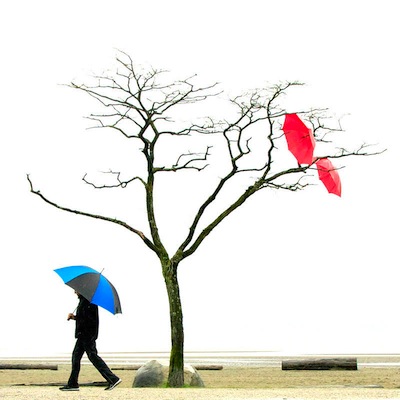
photo - “Umbrellas” by Ivor Levin
“Umbrellas” by Ivor Levin.

Beside them, Levin’s photos look like drawings, their colour schemes and compositions inspired by the rains and umbrellas of the autumn season in Vancouver.

New artists also have a strong presence in this show. For them, having their names under their art on the gallery walls is a fascinating experience. One of this crowd is Linda Lando, the Zack Gallery director. “I’m not an artist,” she said. “I’ve never displayed anything before.”

One of her photos, the colourful “Ein Gedi Night,” was taken on her trip to Israel, as a member of the seminar. “We visited Kibbutz Ein Gedi late at night,” she said. “It is a beautiful floral oasis in the desert. They have amazing flowers, and this blooming tree was near the entrance.”

Robert Johnson, also part of the seminar and a longtime JCC employee, has a couple of his photos in the show. One of them is particularly memorable: a photo of a camel with a sad expression, lying under a tree. The title of the photograph is “This is Not a Camel.”

“He talked to me,” Johnson said with a smile. “People were riding him all day, and he didn’t want to be a riding camel anymore.”

The variety of the images in the show is mind-blowing: from Israeli landscapes to mud bathers on the shore of the Dead Sea to abstract composition. #SeasonsAtZack continues until June 9.

Olga Livshin is a Vancouver freelance writer. She can be reached at [email protected].

Format ImagePosted on May 17, 2019May 16, 2019Author Olga LivshinCategories Visual ArtsTags #SeasonsAtZack, art, Festival Ha’Rikud, Instagram, Israel, photography, Zack Gallery

Harbingers of future?

In 2015, the federal New Democratic Party nixed Paul Manly’s hopes to run for Parliament, barring his candidacy because his anti-Israel politics were deemed too extreme. Manly joined the Green party and, this month, won a federal by-election in Nanaimo-Ladysmith. As only the second Green federally elected, Manly now makes up 50% of the federal Green party caucus.

By-elections are notoriously poor predictors of voter intentions in general elections. Manly’s win could go down as a footnote in history – or it could be a harbinger of tectonic change in Canadian politics. Little should be extrapolated from a single by-election outcome, but neither should we ignore the fact that the by-election win by Deborah Grey of the Reform Party, in 1989, represented the beginning of a new epoch in Canadian politics. The Reform party in the West and the Bloc Québecois in Québec gobbled up the Progressive Conservative party – and the New Democrats’ share of the vote.

Just days before the Nanaimo by-election, the Green party also made inroads in the Prince Edward Island provincial election, forming the official opposition. Just as a by-election is not a good measure of federal voters’ intentions, neither is a modest success in the micro-province of P.E.I. What both these outcomes do suggest is that a larger number of Canadians than ever before are considering casting a ballot for the Greens.

The outcome in Nanaimo-Ladysmith should send chills down the spines of Liberal and NDP organizers. Both parties saw their vote share collapse while the Greens leapfrogged and the Conservatives held their own.

Conventional wisdom says that the Green party should take more votes away from the NDP than from any other party. However, many 2015 Liberal voters are over their Trudeaumania and millions of Canadians are looking for a place to park their votes. The party would get a significant boost if Jody Wilson-Raybould and Jane Philpott, two women who embody the country’s disappointment in Prime Minister Justin Trudeau and his sunny ways, opt to run under the Green banner, as has been rumoured.

Jagmeet Singh, who managed to win his own by-election last year, can hardly find any silver lining in recent results. With the Liberals, who arguably ran to the left of the NDP last time, hemorrhaging support, the NDP should be sitting pretty. They are not.

Six months out from the general election, Conservative leader Andrew Scheer is the only party leader who should be pleased with the current landscape.

What this all means is not completely clear. Under Thomas Mulcair’s leadership, the NDP was dragged back to a more moderate middle after a period when it had seemed to go a bit off the rails, notably on the issue of Israel and Palestine. How the party addresses that and other contentious issues in the coming years will be determined significantly by the makeup of their caucus after the October elections. It was after their last terrible drubbing, in 1993, that the NDP fell under the sway of anti-Israel extremists. With just nine seats in parliament, and Svend Robinson as the most vocal and visible MP, the party became a hotbed of anti-Zionist activism. (Robinson is seeking a comeback in the riding of Burnaby North-Seymour.)

Under Mulcair’s leadership, a number of former New Democrats, like Manly, shifted over to the Green party. Elizabeth May, the party leader, and, until this month its only MP, doesn’t seem certain of where she stands on the issue. When her party’s convention passed a wildly unbalanced attack on Israel, she threatened to resign unless it was rescinded or watered down. Since then, she herself has made some contentious comments about Israel.

In the NDP and in the Green party, there are a small number of courageous Jewish and non-Jewish Zionists trying to lead their parties to a common-sense position on Middle East matters. Too often, these individuals are ridiculed in our own community when they should be commended for promoting a balanced, reasonable approach to the issue regardless of political persuasion.

Nevertheless, given the emerging landscape, if the Greens and New Democrats do not form some kind of electoral alliance – and if the Liberals do not pull themselves out of their largely self-inflicted pit of unpopularity – Canada is likely to be in for a long run of Conservative government. In that case, the nuance of Israel-Palestine policy on the left will be a moot point.

Posted on May 17, 2019May 16, 2019Author The Editorial BoardCategories From the JITags Canada, elections, politics

How we can live after death

It is the instinct of all living things to try to stay alive, humans among them. Most religious doctrines pay a great deal of attention to this issue. And many people, whether part of an organized religion or not, believe that a spirit leaves the body after death. Where viewpoints vary mainly is what happens then.

In many belief systems, we stay alive in some form or another even after death. Hindus, like Buddhists, believe that a departing spirit is reincarnated into some other life form. Buddhists believe there is no guarantee that the life form will be human; they believe that liberation from the cycle of life is the only desirable objective, a state they call nirvana.

The monotheistic religions all have some concept of an afterlife, with outcomes based on our behaviour during our life on earth. Indeed, both Christianity and Islam see the afterlife as the most desirable state, at least for the righteous, compared with our life on earth, the current one being a “a vale of tears.” Judaism also sees a reward for the righteous, with a resurrection when the Messiah arrives to usher in the “End of Days” and heaven on earth. But Jews, in contrast, are urged to live the fullest possible life while alive, every life being precious.

Without entering into discussions on this issue as to the merits of one position or another, I have drawn some conclusions as to their relevance on the question of staying alive. Empirical evidence from religious enthusiasts is meagre, relying on faith rather than hard facts, or reports of a life, or lives, after death from thousands of years ago. These form the basis for the promise underlying the religious thesis.

The realization of a positive outcome in the religious sphere depends on an unblemished life experience. I cannot count on being among those judged as sufficiently righteous and deserving. That leaves me with the task of doing the best I can to extend the life I know about, the one I am living now. Having past the four-score mark is evidence that I have done some things right, having already survived many of “the slings and arrows of outrageous fortune.” I must have good DNA.

Chance has favoured me in my encounters with accident, disease and body-systems breakdowns. I have survived my encounter with “the big C” up to this time. I have diabetes under apparent control, but one never knows, as it works its damage asymptomatically.

I take pills in abundance to ward off the evils of sugar, high blood pressure and stroke. I quit smoking in my early forties and drink alcohol sparingly. My food habits are not outrageous, without denying myself the favourites that make life worth living. I exercise religiously when not on holiday. I have given up driving on the promise it will increase my life expectancy. Best of all, I pass my life with the woman of my dreams. Life is grand.

The other night, I spent some time with family. We found ourselves talking about our experiences with forbearers who had gone before us. For a short while, it appeared to me almost as if those ancestors were there with us, alive and sharing our good times. Like a lightning bolt, it struck me that that was truly another way of staying alive. The people in our lives who are important to us, those who have marked us in our life experience, they continue to be alive for us as long as they remain in our memories. They never disappear for us as long as we live; they go on being a part of our lives.

So, that’s the secret. We must continue to be important in the lives of the people who surround us. As long as we do that, we will stay alive even after we are physically gone. We have to cherish those we care for while we have them, in part so they will continue to cherish us.

But this does not apply to family only. It is true for all the people in our lives to whom we reach out, to all those we touch and those who touch us. If we want to stay alive, we have to do the reaching out.

Moses and Jeremiah and Isaiah and Jesus can thus be alive for us as well, if they have touched us and touched our lives. Shakespeare and da Vinci are alive for me. Spinoza is alive for me. Danny Kaye and Sid Caesar are alive for me, as is Beethoven.

They are all alive for me because they are a part of who I am. All the people who have made me what I am are alive for me every day of my life. I am surrounded by a crowd. Sometimes, they speak through me. You can’t spend much time with me without getting to meet some of them.

If I write something and it touches another soul, then I may still be alive for them whether I am physically there or not. Even for the people who no longer remember my name, I may still be alive for them in some cranny of their consciousness. That’s not so bad. If we can believe in that, in our own minds we have a future beyond our temporal experience of life.

So, now you know the secret. Go out there and talk to the people around you. Phone them. Write an email. Hug or kiss them if you can get away with it. You may get to live forever if they tell their children about you. If you know what you have done, if you have faith in it, as I do, regardless of your other beliefs, this can be your “promised land.”

Max Roytenberg is a Vancouver-based poet, writer and blogger. His book Hero in My Own Eyes: Tripping a Life Fantastic is available from Amazon and other online booksellers.

Posted on May 17, 2019May 16, 2019Author Max RoytenbergCategories Op-EdTags health, lifestyle, philosophy, religion
Dancers explore new territory

Dancers explore new territory

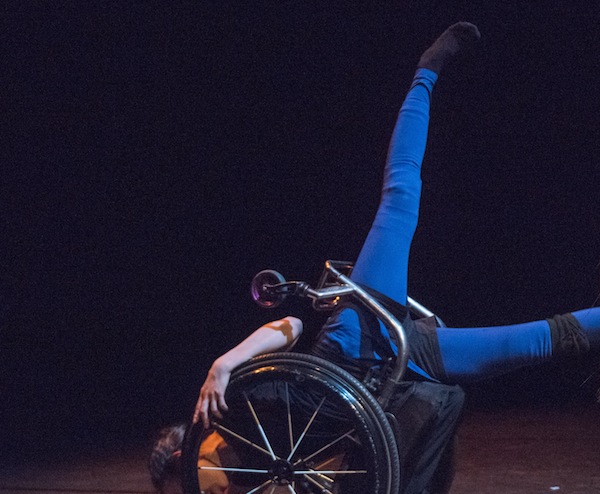
Magic & Remembering opens at Scotiabank Dance Centre on June 1, which is B.C. Access Awareness Day. (photo from All Bodies Dance Project)

The themes in this show range from home and belonging to our collective connection to self, city and architecture,” All Bodies Dance Project co-founder and facilitator Naomi Brand said about Magic & Remembering, a program of dances and films, featuring dancers with and without disabilities, that runs June 1-3 at Scotiabank Dance Centre.

“A lot of ABDP’s choreography highlights the relationship between different bodies moving in different ways,” said Brand, who is a member of the Jewish community. “We try and make work where our differences as dancers are celebrated and exploited for their choreographic potential. We’re always looking for new territory that challenges notions of the ‘typical’ dancer and the typical ways of making dance.”

A similar motivation sparked the idea for this show.

“Magic & Remembering was born out of the desires from artists in our company to lead their own choreographic processes, as well as an idea to explore new territory in dance filmmaking,” said Brand.

The program comprises three dances and three films. Most of the works are new for this production and created by longtime members of All Bodies Dance Project.

“ABDP works in a very organic way as a collective of artists who work through collaboration and improvisation to devise new choreography,” explained Brand. “Each of the pieces came about in a different way through a different creative process. My role has been to act as an ‘outside eye’ to support the choreographers, offer feedback and suggestions; sort of an editor to help clarify the pieces.”

Two of the three filmmakers are local, she said. Martin Borden – who is also a visual artist, woodcarver and educator, and has been documenting ABDP’s work for many years – collaborated with dancers/choreographers Rianne Svelnis and Harmanie Taylor on Sanctuary.

Gemma Crowe worked with Carolina Bergonzoni on Ho.Me. “Gemma is a dancer who has been working in video for a number of years,” said Brand. “As a dancer, she brings a keen understanding of how the camera moves almost as a partner in the dance.”

The third film is called Inclinations and it was created, said Brand, “by our friends and colleagues Danielle Peers (Edmonton) and Alice Sheppard (based in New York) and features a cast of four manual wheelchair users, including Harmanie Taylor from All Bodies Dance Project.”

Quoting from Sheppard’s website, Brand described the piece as one that “contrasts the playful connections when disability esthetics, disability community and a gorgeous ramp meet the institutional histories and discordant inclinations that can lurk just below the surface.”

“We are excited to include this beautiful film in our production,” said Brand, “as a way to connect and support disabled dance artists in our network from outside of Vancouver.”

The press material for the production notes that the films are “of dance works reimagined for the camera.” As to what that means, Brand explained that Sanctuary and Ho.Me were originally created as dances performed live: the former for the 2018 Vines Art Festival and the latter for last year’s Dancing on the Edge Festival.

“We’ve taken those dances,” she said, “and ‘reimagined’ them through the lens of the camera by using the same movement material, but reconfiguring it into a new piece. The camera allows for an intimacy and detailed insight into the dances that opens up whole new possibilities. For example, Carolina Bergonzoni’s Ho.Me, which consists of three personal solos, was shot in the dancers’ own apartments. We get to see these unique bodies and their movements in their private spaces, surrounded by objects of meaning to them.

“Sanctuary is shot in a busy urban location. The duet is accompanied by a soundscore created from the sounds of a typical Vancouver afternoon. Video allows us to take viewers into new worlds and to see the dancers and the dances in new ways.”

As for the dances in Magic & Remembering, Brand said they “use the dancers’ differences in unexpected and evocative ways. For example, Harmanie Taylor and Peggy Leung’s duet, Inflect, was born out of the simple choreographic question, what would happen if both seated and standing dancer used wheels? Peggy dances on a wooden wheelie board that facilitates all kinds of interesting and surprising ways of relating to Harmanie, who is a manual wheelchair user.

“Romham Gallacher’s trio, Re/integrate, delves into some deep and personal territory by exploring the process of bringing trauma-shattered pieces of oneself back together. The piece makes use of some intricate contact duet material between Adam Warren and Peggy Leung. Adam is a wheelchair user but dances the pieces without his chair.

“Cheyenne Seary’s Clove Hitch is a quintet based on themes of identity, individuality and belonging in a group,” she said. “The piece is set to music by Juno-nominated indigenous artist Cris Derksen.”

All Bodies Dance Project has many collaborators and partnerships that make its work possible, said Brand. “For this production,” she said, “we have partnered with the Roundhouse Community Art Centre and the Gathering Place, where we do most of our rehearsals, and are grateful to have received grant funding from the City of Vancouver.”

Magic & Remembering opens on B.C. Access Awareness Day, which is “a comprehensive campaign to raise awareness about disability, accessibility and inclusion,” said Brand.

In line with ABDP’s efforts to remove barriers, “all of the performances are scent-reduced with sliding scale ticket pricing – no one is turned away for lack of funds,” she said. “Our two performances on Monday, June 3, include ASL interpretation.”

For tickets ($10-$25) and more information, visit allbodiesdance.ca.

Format ImagePosted on May 17, 2019May 16, 2019Author Cynthia RamsayCategories Performing ArtsTags All Bodies Dance, dance, disability, film, Naomi Brand
A wonder-full evening

A wonder-full evening

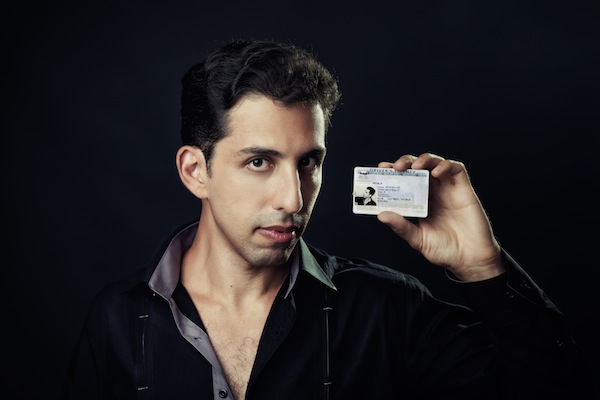
Illusionist Vitaly Beckman can seemingly change a driver’s licence photo. To witness the feat in person, check out his June 5 show at the River Rock Casino. (photo by Galina Sumaneeva)

“I rarely have a chance to perform in my own town, so it’s a privilege and I am really looking forward to it,” illusionist Vitaly Beckman told the Jewish Independent about his June 5 show, Vitaly: An Evening of Wonders, at the River Rock Casino, which is a fundraiser for Richmond’s Beth Tikvah Synagogue.

Beckman is constantly performing on the road. “My favourite trip was to Puerto Montt, in Chile – I got to perform in a beautiful theatre situated right over a lake and witness some breathtaking views,” he said. “Other recent highlights include doing an off-Broadway run last summer. I was performing eight shows a week for 16 weeks straight. It was surreal to see my own face appear on the Times Square buildings, and was a dream come true.”

Every show is unique, he said. And, in every show, “there are things that do not go according to plan, and I have to adjust and improvise. Especially when I invite audience members up on stage, you never know what to expect. It’s part of the fun and makes it more interesting and memorable.”

This is one of the reasons Beth Tikvah asked Beckman to perform.

“The synagogue wanted to try something unique and different from the usual,” board member Allan Seltzer told the Independent. “We wanted to be able to invite congregants, Jewish community members and the general public of all ages to an exciting ‘evening of wonders.’”

Magician Stephen Kaplan will also perform on June 5.

Noting both performers’ “great stage presence and showmanship,” Seltzer said, “Vitaly emigrated from the former Soviet Union as a boy and has been wowing audiences with his world-class show for over 15 years. Vitaly has appeared on television around the world and recently fooled Penn and Teller on their WB televised show.”

Beckman told the Independent he is always coming up with new illusions, but that he needs to section off parts of the year to actually work on them. “I find that I need no distractions in order to create new material, as the creative process requires an absolute focus and to think of nothing else,” he said. “Oftentimes, I take the summers off to do that, and sometimes find small breaks in between shows.”

As for Kaplan, Seltzer said he “has been performing and entertaining audiences across B.C. for over 25 years. His unique brand of illusions and comedy make him the ideal opening act for Vitaly.

“Both artists are Jewish and are proud to be assisting Beth Tikvah for this special evening,” he said.

Also participating in the evening’s entertainment will be emcee and fellow community member Howard Blank, who, said Seltzer, “is known throughout B.C. for his vast philanthropic work on stage at over 50 galas and events annually … [and] has been bestowed with the Sovereign’s Medal for Volunteers by the governor general in Ottawa. Howard celebrates his Jewish Vancouver roots by donating his time to numerous Jewish events, including the JCC Sports Dinner, Chabad, Talmud Torah and our Evening of Wonders.”

Funds raised from the River Rock show will be put toward Beth Tikvah programs and services, which include a preschool, religious school, social and educational youth programs, adult education, Jewish holiday programming, conversion classes, Israel programming, interfaith panels and lifecycle events, said Seltzer. He added about the youth activities that “many of our participants are Jewish children and youth who are in public schools, and their only exposure to Judaism and the Jewish community is through our youth and religious school program.”

VIP ticketholders will get a chance to meet Beckman after the show and sponsors will be recognized in the evening’s program, said Seltzer.

As for what the audience can expect, Beckman said, “They will witness art coming to life – photos will come to life, drawings come out of a page and even their face will disappear on their own driver’s licences. If they like, the photo on their ID will be replaced by another face, whoever’s they choose. It has never been done before by anyone else. There is also a new piece, dedicated to Salvador Dali, whose work also inspired some of the visuals in the show.”

For tickets to Vitaly: An Evening of Wonders, visit ticketmaster.ca or call Beth Tikvah at 604-271-6262.

Format ImagePosted on May 17, 2019May 16, 2019Author Cynthia RamsayCategories Performing ArtsTags Beth Tikvah, fundraiser, Howard Blank, magic, philanthropy, Stephen Kaplan, Vitaly Beckman
Korczak course at UBC

Korczak course at UBC

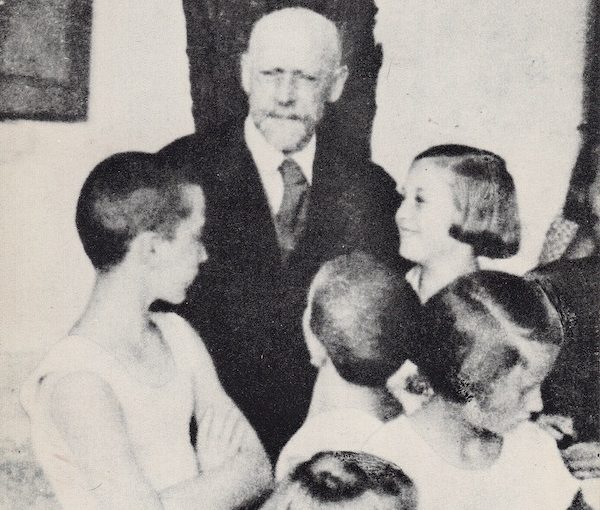
A postcard showing Janusz Korczak in the courtyard of the orphanage on Krochmalna Street in Warsaw, Poland, in the early 1930s.

An unprecedented interdisciplinary event will take place this summer at the University of British Columbia, focusing on the legacy of Janusz Korczak, a pioneer in the area of children’s rights and welfare.

Korczak is perhaps remembered most for his final act of heroism: his refusal to accept an offer of a reprieve, choosing instead to walk with the 200 or so orphaned children of his school as they were sent to their deaths at Treblinka. But it is his legacy as an educator, physician and writer that will be the focus of the 2019 Korczak Summer Institute. The two-week intensive program, called Advocacy in Action: The Legacy of Janusz Korczak, is open to graduate and undergraduate students across disciplines. It takes place July 2-11.

“To the best of my knowledge, there’s never been a university-based course on the work of Janucz Korczak, not in his native Poland, not in Israel, certainly not in North America,” said Rabbi Dr. Hillel Goelman, professor emeritus in UBC’s department of educational and counseling psychology, and special education. The program was developed across disciplines, reflecting Korczak’s range of academic and philosophical work.

“He was a pediatrician by training, so we reached out to the department of pediatrics to get their help and a number of faculty members are going to do Korczak-related activities,” said Goelman. “He was an educator, so the faculty of education were happy to co-sponsor the course with the Januscz Korczak Association [of Canada]. But it would also be open to people studying social work or any sort of child-focused activity. A lot of people at UBC support the whole cause of child activism and child welfare from an interdisciplinary perspective.”

Korczak’s philosophy inspired and informed the United Nations Charter on the Rights of Children. Importantly, his work was not limited to academics or writing, but was devoted to applying his values of child empowerment directly to the real world.

“Children are not the people of tomorrow but people today,” Korczak wrote. “They are entitled to be taken seriously. They have a right to be treated by adults with tenderness and respect, as equals.”

“In the orphanage that he ran in Warsaw, they had a children’s parliament, where children elected their leaders to make the rules and enforce the rules,” said Goelman. “There was a children’s court, where children could complain about their treatment either by the staff or by other students. There was a children’s newspaper that they published. He very much empowered children and he thought it was important to draw on this and give them opportunities to develop their own leadership. I think those are all very important contemporary messages for educators, social workers, pediatricians … and it’s kind of timeless. It’s really relevant to where we are today in terms of child activism, child welfare and child advocacy.”

The institute is designed to help participants transform their working environment to model democratic principles pioneered by Korczak in his writings, pedagogy and governance of the orphanages under his care. It will also encourage participants to adopt strategies to translate the respect for children’s rights into professional practices, including communication with parents and the larger community, and to learn how to help children in developing and sustaining their cultural identity, particularly among those who may struggle with multiple identities.

The course will be taught by Prof. Tatyana Tsyrlina-Spady, an internationally recognized expert on the life and legacy of Korczak and adjunct professor at Seattle Pacific University. She will be joined by a team of international and national invited speakers: teacher trainer and UNICEF consultant Jonathan Levy (Paris, France); founders and leaders in the field of social pediatrics Dr. Gilles Julien and Hélène Trudel (Montreal); researcher and practitioner of Korczak’s legacy Wojtek Lasota (Warsaw, Poland); several UBC professors of nursing and psychology; U.S.-Canadian writer Tilar Mazzeo (Victoria); and a Holocaust survivor and poet, Vancouverite Lillian Boraks-Nemetz.

Promoting Korczak’s pedagogical ideas, as well as their effect on children’s education, is part of the mandate of the Janucz Korczak Association of Canada, which was founded in 2002. The president, Jerry Nussbaum, lives in Vancouver, as do fellow board members Goelman and Boraks-Nemetz.

“His work is very much alive,” said Goelman of Korczak.

The deadline to register for the UBC course is May 28: pdce.educ.ubc.ca/child-advocacy.

Format ImagePosted on May 17, 2019May 16, 2019Author Pat JohnsonCategories LocalTags children, education, Hillel Goelman, history, Holocaust, Janusz Korczak, UBC
Honouring our heroes

Honouring our heroes

Elad Pelleg and his grandmother, Dvora. Pelleg shared his family’s story during the community’s Yom Hazikaron ceremony May 7. (photo from Elad Pelleg)

The sacrifices Israeli families have made for 71 years were marked in Vancouver last week during Yom Hazikaron ceremonies. The tragic losses of life in wars, intifadas and terror attacks were memorialized by hundreds of attendees at the Jewish Community Centre of Greater Vancouver May 7.

The annual ceremony, led by Geoffrey Druker, specifically acknowledges family members and friends of local community members who have died defending Israel. The impacts of the losses were individualized through the stories of particular families, including numerous who lost more than one member, often across generations and in different wars.

Elad Pelleg, the Dror Israel youth movement shaliach (emissary) to Camp Miriam, shared the story of his grandmother, Dvora Pelleg, a narrative of Zionist longing, loss and rededication.

Dvora was born in Hungary, in 1921, the second daughter in an Orthodox family of seven children.

“As a teenager, she joined a Zionist youth movement, where she discovered a new world, and a new yearning was born: to live in the land of Israel,” her grandson told the audience in the Wosk Auditorium.

He recounted the story as his grandmother had told it to him: “One day, we were invited to see a movie about the chalutzim (pioneers) … I asked my mother to join me, to see for herself what Zionism was all about, and understand my dream of moving there. She came from a very Orthodox family. This was not an easy request for her to fulfil. She deliberated and, in order not to disappoint me, decided to come. She did not want to be recognized, so she disguised herself and joined me for the movie. At a time when antisemitism was rampant, seeing a movie that showed the freedom and spirit of living in the land of Israel brought her to tears.”

Dvora went on to become a Zionist youth leader and received additional training, hachshara, in preparation for aliyah to the land of Israel.

“In the hachshara, she met my grandfather, Yosef,” Pelleg said. “In 1939, the war broke out and their lives changed completely. My grandparents, Dvora and Yosef, decided to move to the capital, Budapest, in an attempt to migrate to Israel illegally. They failed to make this journey, stayed in Budapest and got married in 1942. On the 22nd of August, 1943, their son Michael was born.”

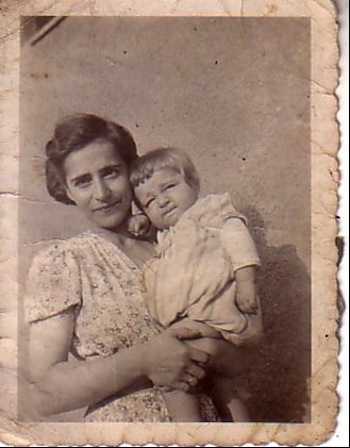
photo - Dvora Pelleg holding baby Michael
Dvora Pelleg holding baby Michael. (photo from Elad Pelleg)

When the Nazis invaded Hungary, Yosef was sent to a labour camp, while Dvora fought to survive with baby Michael.

“She had to keep moving between cellars and attics; she suffered from hunger, and ended up surviving only due to her tremendous effort,” said Pelleg. “My grandfather survived a number of labour camps and a death march. After the war, he returned to Budapest to reunite with my grandmother and Michael.”

Dvora lost her parents, Hanna and Yitzchak, as well as three siblings, all murdered in Auschwitz.

“The only thing left from her mother is a single photo she carried on her throughout the war,” Pelleg said. “Being refugees in their own country, they sought a way to Eretz Israel. In 1947, they boarded an unauthorized ship, Geula, with many other Holocaust survivors. The British, who at that time governed the land of Israel, stopped the ship and sent them to an internment camp in Cyprus, where they were held for almost a year.

“It was there, behind barbed wire, that they heard [about] the establishment of the state of Israel, on May 15, 1948,” Pelleg said. “Later that year, they finally made it to Israel, where two sons were born: Shimon and my father, Eli.” The couple Hebraized their named to Pelleg from Pollock when they began working for the Israeli government.

Michael grew up in Israel, graduated high school with honours and served in the army as a combat medic. Following his army service, he enrolled in university and studied accounting. In 1966, he married the love of his life, Ester.

“In 1967, the Six Day War broke out,” Pelleg recounted. “Michael did not receive an army call-up, but his heart commanded him to pack a bag and join his unit. Before leaving the house for the last time in his life, he said to his mother, ‘I can’t stay in the classroom while the army is fighting to defend our country.’

“When he reached his unit, he found that they already had a medic in place, yet he insisted on joining them anyway. On the first day of the war, June 5, 1967, in a fierce battle on the outskirts of Rafiah, his armoured vehicle was hit. Michael Pollock, the uncle I never met, was killed.

“My grandmother had to bear the heavy burden on her shoulders and in her soul, of not only being a Holocaust survivor, but also a bereaved mother. Her family was murdered on European soil and her son died in battle in Israel and, this time, she could not save him.

“When I was born, my parents gave me the middle name Michael, in his memory,” said Pelleg. “Being my grandmother’s first grandson, we have a very special connection and she is a very significant figure in my life. As a child, visiting her in her house, I would ask her many questions: about her family, about the events of the Holocaust, about Michael and why he died in the war. Slowly and with great difficulty, she opened up and shared with me her story, the story of our family.”

When Pelleg was 13, the year of his bar mitzvah, he started participating in Yom Hazikaron memorial ceremonies with his family, and described a typical commemoration.

“We start in the evening with a ceremony at Beit Yad L’Banim, the memorial home for fallen soldiers, in the city of Ramat Gan,” he said. “In the ceremony, they read the names of all the fallen soldiers of the city, sing a few songs and read passages about mourning, bereavement and love that will never be fulfilled. When Michael’s name is called, we light a candle in his memory and listen quietly to Savta crying softly at the end of the row.

“On Yom Hazikaron, the following morning, we meet at the military cemetery at Kiriyat shul. There are thousands of graves there and, around each one of them, a family like mine gathers. We all stand together and listen to the chazzan recite El Maleh Rachamim.”

Despite all this, Pelleg said his grandmother’s story is not only a story of mourning and bereavement but also of strength and resilience.

“In memory of their son, my grandparents decided to dedicate the rest of their lives in service of the state of Israel,” he said. “My grandfather worked first as a civilian in the army, and then in the Ministry of Defence. My grandmother worked in the Mossad, the national intelligence agency, until she retired. After my grandfather passed away, she chose to volunteer at a nonprofit called Yad Sarah, which provides medical equipment for those in need.”

Now 98 years old, Dvora is no longer able to attend the memorial ceremonies. On her 90th birthday, Pelleg told her: “Your life shapes my identity, my choices in life, and is expressed through my middle name, Michael, which I carry proudly.”

The JCC Choir, led by Noa Cohen, as well as Ellen Silverman on piano and Kinneret Sieradzky on violin, provided musical tributes. Rabbi Shlomo Gabay chanted El Maleh Rachamim. Rabbi Philip Gibbs said Kaddish. If’at Eilon-Heiber lit a yahrzeit candle for her friend Yaacov Koma and Samuel Heller lit a candle for his friend Adero Ahonim. Yoni Rechter, who was the featured performer at the next night’s celebration of Israel’s independence day, sang his hit song “Tears of Angels.” The event was co-sponsored by the Jewish Community Centre of Greater Vancouver and the Jewish Federation of Greater Vancouver.

Druker marked the end of Yom Hazikaron at the Chan Centre just prior to the beginning of the community’s Yom Ha’atzmaut celebration. The festivities opened with the singing of O Canada and Hatikvah by the King David High School Choir, directed by Johnny Seguin, and included remarks by Karen James, Candace Kwinter and this year’s shinshinim (volunteer emissaries) from Israel, Or Aharoni and Ofir Gady, as well as a video of greetings from previous shinshinim and a call for hosts for next year’s volunteers. The JCC’s Orr Chadash and Orr Atid dancers, under the leadership of Noga Vieman, performed, as did the Juice Band, before Rechter and his fellow musicians took to the stage. The annual Yom Ha’atzmaut celebration is presented by Jewish Federation, with hotel sponsor Georgian Court, media sponsor Jewish Independent and 45 other community partners. For an interview with Rechter, see jewishindependent.ca/israeli-music-icon-sings-here.

Format ImagePosted on May 17, 2019May 16, 2019Author Pat JohnsonCategories Celebrating the HolidaysTags Elad Pelleg, Israel, Yom Ha'atzmaut, Yom Hazikaron
ED is a complex condition

ED is a complex condition

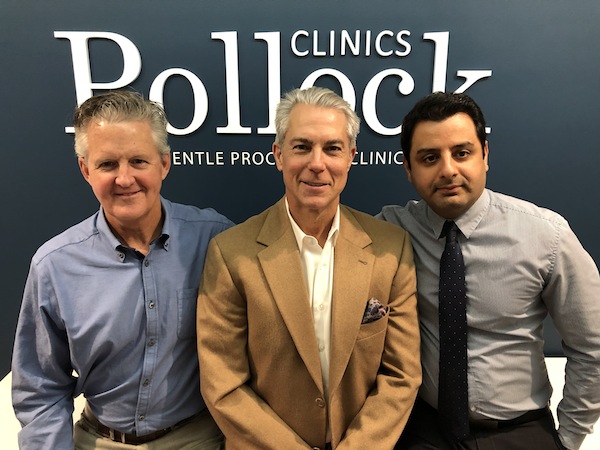
Left to right: Pollock Clinics sex therapist Tom Foster and physicians Neil Pollock and Roozbeh Ahmadi. (photo from Pollock Clinics)

While there may be any number of reasons why the frequency of a couple’s intimate sexual contact may wane, it is a critical cornerstone supporting the continuation of a healthy relationship. Often, when a couple is having sex infrequently, or not at all, their relationship becomes vulnerable to anger, detachment, infidelity and divorce. One factor that can come into play regarding a couple and their sex life is erectile dysfunction.

“ED is a medical condition where a man is consistently unable to achieve and maintain an erection that allows for satisfactory sexual function. ED is also referred to as impotence,” explained Drs. Neil Pollock and Roozbeh Ahmadi of Pollock Clinics in an email interview with the Independent. “The Canadian Study of Erectile Dysfunction identified 49.4% of men over the age of 40 with ED (Canadian Urological Association erectile dysfunction guideline 2015). By the time men reach the age of 70, almost 70% of them will experience some form of erectile dysfunction.”

Conventional treatment for ED generally involves blocking the symptoms, with medications like Viagra and Cialis. “If pills are not working, the next step is the injection or suppository forms of medications that patients can inject into the penis or infuse into the urethra prior to having intercourse,” said the doctors. “If these medications are not satisfactory, then there is the option of a vacuum erection device that a patient will need to apply to the penis and get an erection through the vacuum created within the tube. If none of the options is satisfactory, then there is the option of surgery, such as penile implant surgery.

“The issue with pills, injection and pump is the fact that all need prior timing and preparation and, in the case of pills, they can cause significant side effects, such as headaches, flushing, upset stomach and visual changes, which a lot of patients cannot tolerate.”

There are many factors that can cause ED. “These include neurological disorders, hormonal imbalance, structural abnormalities, side effects of medications or surgeries, mood disorders,” said the doctors, but “the most important and prevalent one is vascular disease.

“When a man becomes aroused, the brain releases a neurochemical substance to increase the size of blood vessels carrying blood to the penis and reduce the size of the vessels that carry it out,” they explained. “Twin compartments that run the length of the penis, called corpora cavernosa, become flush with blood that is trapped in the shaft. This causes the penis to stiffen and become erect. If blood flow to the penis is inhibited or the blood vessels are clogged or constricted, erection cannot be achieved or maintained.”

High cholesterol and the buildup of arterial plaque, over time, cause blood vessels to narrow, lessening their capability to carry blood. One of the first places men will notice this reduced flow is with ED, which is why ED has been dubbed “the canary in the coal mine” – it can serve as a distress signal three to five years prior to a major heart attack.

Lifestyle choices and health conditions that can also contribute to ED include smoking, obesity, a sedentary lifestyle and chronic alcoholism and/or substance abuse.

“Sexual wellness is essential to men’s health and happiness,” said Pollock and Ahmadi. “It is an integral part of men’s overall wellness as they age. A great number of scientific studies have shown the many benefits of a healthy and active love life, which include living longer, greater well-being and a happier and longer lasting relationship with your partner.”

Pollock Clinics provides a few treatments for ED.

“In the last few years, there are innovative regenerative treatment options to deal with the root cause of the problem, and not just the symptom,” said the doctors. “These new modalities include low-intensity shockwave therapy and platelet-rich plasma therapy [also known as the PRP shot], and are currently used in many countries around the world.”

PRP is created from a patient’s own blood and is commonly used in orthopedics, plastic surgery and sports medicine. “Studies have shown that this penile injection contains several different growth factors that can stimulate the healing of erectile tissue and is a safe and effective option for penile rejuvenation and improvement of erectile function … by enhancing and increasing the blood flow to the erectile tissue, offering a longer lasting desired outcome.

“ED shockwave therapy,” the doctors explained, “also promotes the regeneration of blood vessels in the penile shaft. That, like PRP, leads to longer and more satisfying erections and is accomplished by directing painless energy waves into the shaft of the penis.”

In addition to these two treatments, Pollock Clinics offers therapy, since ED has both physiological and psychological causes.

“Pollock Clinics also has a certified sex therapist to deal with psychogenic issues that might be affecting a man’s sexual health,” said the doctors. The goal of therapy is to provide “strategies to get a patient’s mind working with him instead of against him in a sexual encounter.”

Pollock and Ahmadi strongly encourage men to talk to their own doctor about any health issues they may have and the treatment options available.

Rebeca Kuropatwa is a Winnipeg freelance writer.

Format ImagePosted on May 17, 2019May 16, 2019Author Rebeca KuropatwaCategories LocalTags erectile dysfunction, health, men, Neil Pollock, Roozbeh Ahmadi
Documentary breaks silence

Documentary breaks silence

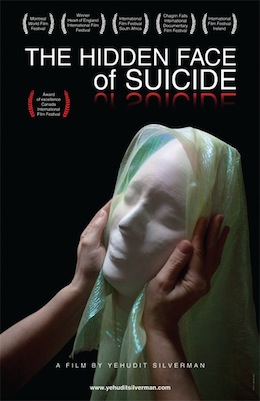
Prof. Yehudit Silverman’s The Hidden Face of Suicide is helping people talk about a topic still surrounded by stigma. (photo from yehuditsilverman.com)

Concordia University professor Yehudit Silverman’s award-winning documentary The Hidden Face of Suicide focuses on the world of survivors – those who have lost loved ones to suicide – and reveals their remarkable stories.

Wanting to learn the story behind the silence in her own family, Silverman offered suicide survivors a creative way to express themselves – using masks. In the documentary, she highlights the danger of secrets and the cost of silence.

Produced and directed by Silverman, The Hidden Face of Suicide features the Montreal group Family Survivors of Suicide. It has screened at Cinema du Parc in Montreal, Curzon Theatre in London, England, on PBS television in the United States, and at various international festivals and theatres. It was also shown at the Montreal Museum of Fine Arts, as part of the Seeds of Hope project, and is being used in diverse locations in Montreal as an education tool around the issue of suicide.

At Concordia, Silverman leads a graduate program that trains therapists in three different programs – art, drama and music therapies – with the goal of soon adding dance therapy.

The Hidden Face of Suicide, which was released in 2010, came out of a five-year research project about suicide.

“I was interested in the stigma that surrounds it and the fact that it’s not talked about or mentioned,” Silverman told the Independent. “I did a lot of reading about it. Then, I found the Montreal group Family Survivors of Suicide and I met the woman who was the facilitator, named Caroline, and then she invited me to the group.

“I started attending the group and hearing the stories. They all lost family to suicide. I listened and, after I got to know them … I was there for about six months and I wrote down some of the themes that came up, kind of field research – identifying common themes … and a lot of it was having to hide, having people turn away, having to wear a mask.

“And so, out of that, I asked if they would be part of a film. Then, we started working on the film and part of it was them creating masks, since that had come up for them. So, they created masks, wore them and worked with them. And that became a very powerful tool and also a metaphor for those who are left behind.”

image - The Hidden Face of Suicide facilitates difficult conversations
The Hidden Face of Suicide facilitates difficult conversations.

Doing this research also spurred Silverman to ask her parents about her uncle’s suicide for the first time. She did so on camera. “I was intrigued with the fact that I had never known about this,” she said. “And, why was that … why was there shame and stigma?”

As well, during high school, Silverman knew fellow students who had taken their own lives – and these suicides, too, were never talked about. She felt compelled to learn more about why that was and to create a film to help break the silence.

While the release of the film and its being so well received was a high point, Silverman also noted an article she wrote reflecting on the whole process – called “Choosing to Enter the Darkness – A Researcher’s Reflection on Working with Suicide Survivors: A Collage of Words and Images” – which was published in Qualitative Research and Psychology.

“I wanted the audience to hear the experience of survivors – what it’s like to be left behind – and to also break the stigma and shame around it. And, it has. People in the audience often stand up and share their own stories for the first time,” she said. “I had a woman in one of my screenings and she said, ‘I’m 84. When I was 24, my mother took her own life and I’ve never talked about it until now. I was too ashamed.’ So, for 60 years she held that in.

“So, that was the goal. I feel like it has been helpful in terms of … breaking the silence. It’s also been used a lot to encourage discussion for people to talk about it, and it’s in universities, libraries and all the suicide organizations.”

Silverman contends that using art to broach such taboo topics allows people to confront issues without feeling overwhelmed. This approach fits with her therapy practice in general, as she uses art as a gateway for patients to share emotions they likely would not share otherwise.

“Talking can often just go around and around in circles, where nothing new is actually being discovered,” she explained. “I’m not saying that always happens. But, I think that using art as another tool can be incredibly powerful.”

Silverman has received positive feedback about the film, including from people who said they were feeling suicidal and that the film helped, as it talked about suicide openly and showed the pain of those left behind.

“I think it can be used to initiate a discussion in a safe way,” said Silverman. “It would be great if someone would use it to create an educational kit…. For me, the emphasis is that, if suicide is still surrounded by shame and stigma, it’s harmful for those who are suicidal. If they feel like people are so ashamed that they can’t even mention it, then how can they reach out for help? So, that’s my message. It feels very sad to me that I made the film in 2010 and I still feel like there’s a lot of stigma around suicide.”

On the other hand, Silverman said she thinks some things are slowly getting better; for example, that clergy are discussing the topic more with their congregations.

“Some rabbis, priests and ministers now mention the word ‘suicide,’” she said. “I’ve been to a few funerals where it’s mentioned very sensitively, but honestly, with, of course, the family’s permission. I think that’s helpful for everyone there, because everyone knows.

“I feel like schools are trying to deal with it in a better way, too. We recently had a suicide at Concordia. I was called in to help with the response. And so, I feel like there is a real desire now to be more honest about it and to try and find the best way, because college kids are very susceptible.”

According to Silverman, suicide is the biggest killer of adolescents and people in their early 20s in Canada, though different cultures and populations experience different rates. The elderly are also vulnerable, due mainly to loneliness.

“With the Inuit population, First Nations, there’s a really high incidence of suicide,” added Silverman. “I’ve gone out north and it’s really sad. They’re also doing some wonderful grassroots stuff to address that.”

Silverman’s film can be rented or purchased online. Visit reelhouse.org/yehuditsilverman/the-hidden-face-of-suicide for more information.

Rebeca Kuropatwa is a Winnipeg freelance writer.

Format ImagePosted on May 17, 2019May 16, 2019Author Rebeca KuropatwaCategories TV & FilmTags health, suicide, Yehudit Silverman

Posts pagination

Previous page Page 1 Page 2 Page 3 Page 4 … Page 7 Next page
Proudly powered by WordPress