Skip to content
  • Home
  • Subscribe / donate
  • Events calendar
  • News
    • Local
    • National
    • Israel
    • World
    • עניין בחדשות
      A roundup of news in Canada and further afield, in Hebrew.
  • Opinion
    • From the JI
    • Op-Ed
  • Arts & Culture
    • Performing Arts
    • Music
    • Books
    • Visual Arts
    • TV & Film
  • Life
    • Celebrating the Holidays
    • Travel
    • The Daily Snooze
      Cartoons by Jacob Samuel
    • Mystery Photo
      Help the JI and JMABC fill in the gaps in our archives.
  • Community Links
    • Organizations, Etc.
    • Other News Sources & Blogs
    • Business Directory
  • FAQ
  • JI Chai Celebration
  • JI@88! video

Recent Posts

  • Sharing her testimony
  • Fall fight takes leap forward
  • The balancing of rights
  • Multiple Tony n’ Tina roles
  • Stories of trauma, resilience
  • Celebrate our culture
  • A responsibility to help
  • What wellness means at JCC
  • Together in mourning
  • Downhill after Trump?
  • Birth control even easier now
  • Eco-Sisters mentorship
  • Unexpected discoveries
  • Study’s results hopeful
  • Bad behaviour affects us all
  • Thankful for the police
  • UBC needs a wake-up call
  • Recalling a shining star
  • Sleep well …
  • BGU fosters startup culture
  • Photography and glass
  • Is it the end of an era?
  • Taking life a step at a time
  • Nakba exhibit biased
  • Film festival starts next week
  • Musical with heart and soul
  • Rabbi marks 13 years
  • Keeper of VTT’s history
  • Gala fêtes Infeld’s 20th
  • Building JWest together
  • Challah Mom comes to Vancouver
  • What to do about media bias
  • Education offers hope
  • Remembrance – a moral act
  • What makes us human
  • המלחמות של נתניהו וטראמפ

Archives

Follow @JewishIndie
image - The CJN - Visit Us Banner - 300x600 - 101625

Month: May 2019

Traveling into our past

Traveling into our past

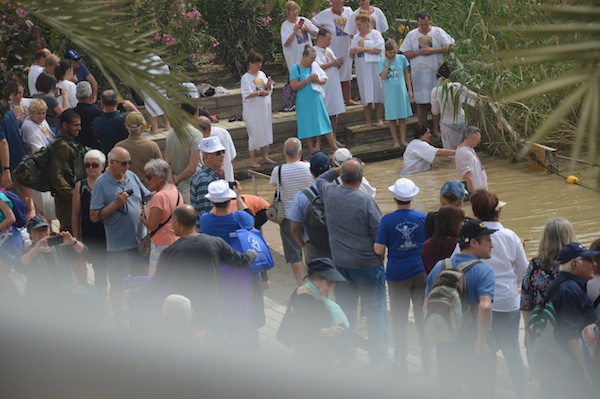
Christians preparing to be baptized in the Jordan River. (photo by Barry Kaplan)

A few days prior to Passover, the Israeli Government Press Office organized a special field trip to the Jordan River and Jericho. The bus with 40 journalists left the GPO office parking lot at 8:30 a.m. and traveled on Highway #1 to the southern part of the Jordan Valley with a guide. We passed Maale Adumim, now a city with 45,000 residents, and headed through the desert area.

We began the ascent to Jericho, passing the Inn of the Good Samaritan, the sea-level sign and the barren hills. A strip of restaurants and souvenir places seemed to appear out of nowhere. We heard about the history of Kibbutz Bet Arevo, situated in this area from 1939 to 1948, passed a veritable forest of palm trees and, by 9:20 a.m., we were at Qasr al-Yahud, where John the Baptist is said to have baptized Jesus. After it passed through the security fence, the bus parked and we walked down to the Jordan River.

Until 1967, this site was under Jordanian control and, in 1968, access was prohibited. In recent years, the tourism and regional development ministries have carried out various projects, including the clearing of mines, and, in 2011, the site was opened to visitors. The site and facilities are overseen by the Israeli Civil Administration and the Israeli Ministry of Tourism as part of a national park.

Running down the middle of the Jordan River is a metal divider. On the other side of it is Jordan. There were people standing around the river and, behind them, churches were visible on the Jordanian side. On the Israeli side, down more steps, people were wearing white cover-ups and going into the river, presumably to be baptized.
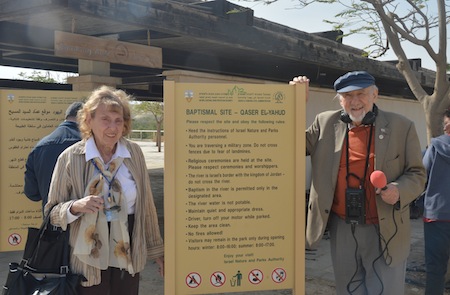
photo - Writer Sybil Kaplan with friend Walter Bingham, who, in his 90s, is the oldest working journalist in Israel
Writer Sybil Kaplan with friend Walter Bingham, who, in his 90s, is the oldest working journalist in Israel. (photo by Barry Kaplan)

In addition to its significance to Christians, two Jewish events took place at this spot.

In the Book of Joshua, we read how the Israelites, after 40 years of wandering in the desert, led by Joshua, crossed the Jordan River as the river became a stream. Supposedly this happened on the 10th of Nissan, this year April 15. Our guide says this could have taken place 4,440 years ago.

The passage in the Book of Joshua reads: “When the soles of the feet of the priests who bear the ark of the Lord, the Lord of all the earth, shall rest in the waters of the Jordan, that the waters of the Jordan shall be cut off, even the waters that come down from above, and they shall stand in one heap.” (Joshua 3:13)

At this point in our trip, we were joined by Uzi Dayan, former major general, national security adviser and Israel Defence Forces deputy chief of staff. According to Dayan, this passage from Joshua describes “the first aliyah to Israel.”

Another biblical text (2 Kings 2:1-2) says Elijah struck the Jordan River water with his cloak. The water parted so that he and Elisha could cross. After Elijah ascended, Elisha again parted the waters with Elijah’s cloak so he could return to Israel. This occurred before Elijah ascended to heaven in a fiery chariot.

Dayan noted that, on the day of our visit, there would be 17 other busloads of people coming to commemorate what has happened here, and that a ceremony would be held that afternoon. We would return for it, but not stay (as I will explain later).

* * *

At 11:10 a.m., we reboarded the bus and became part of a convoy, with IDF soldiers and jeeps leading us and several soldiers inside each bus. On one side of the road are mine fields, still being cleared.

Our next stop was the sixth- or seventh-century CE Shalom Al Yisrael Synagogue. Down some steps, we walked around the 10-by-13-metre mosaic floor that featured a menorah in its centre. It was identified as being the floor of a synagogue because of the images of the menorah, as well as an ark, shofar and lulav. The name stems from a mosaic inscription with the Hebrew words Shalom Al Yisrael.
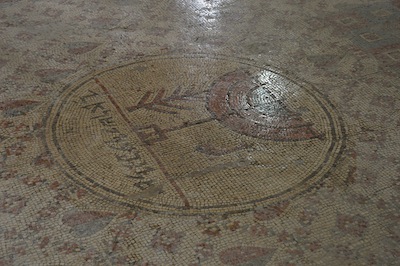
photo - Shalom Al Yisrael Synagogue mosaic in Jericho
Shalom Al Yisrael Synagogue mosaic in Jericho. (photo by Barry Kaplan)

The synagogue was probably used for hundreds of years, but then the Jericho Jewish community dissipated, and the synagogue was forgotten. It was revealed in excavations conducted in 1936 by Dimitri Baramki of the department of antiquities under the British Mandate.

After the 1967 Six Day War, the site came under Israeli military control and remained under the administrative responsibility of the Arab owners – the Shahwan family, who had built a house over the mosaic floor and charged admission to visit it. Tourists and Jews began visiting the site regularly for prayers. In 1987, the Israeli authorities confiscated the mosaic, the house and a small part of the farm around it. They offered compensation to the Shahwan family, but it was rejected.

After the 1995 Oslo Accords, control of the site was given to the Palestinian Authority. It was agreed that free access to it would continue, and that it would be adequately protected.

There have been some incidents. For example, on the night of Oct. 12, 2000, the synagogue was vandalized by Palestinians who torched and destroyed most of the building, burned holy books and relics, and damaged the mosaic. For more than eight years, no Jews were permitted in Shalom Al Yisrael Synagogue, but, during that time, it was restored by the Municipality of Jericho. Since 2007, prayer services have been allowed once a week.

* * *

By 12:15 p.m., we were at the tel (hill, or mound), which some journalists climbed. Opposite is a building with restaurants, snacks and a kind of enclosed mall. Israeli soldiers patrol the entire area. Outside, a man was giving rides to people atop a camel, and soldiers sat around and chatted.

The archeological site is about 2.5 kilometres north of modern-day Jericho, on the site of the ancient city, 258 metres below sea level. It was inhabited from the 10th century BCE. Excavations began in 1868 and settlements are known to date from 10000 BCE.
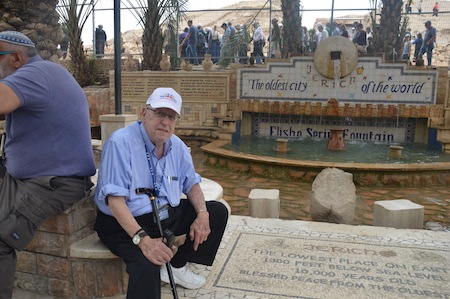
photo - Photographer Barry Kaplan rests by Jericho’s oldest city wall. Tel Jericho can be seen in the background
Photographer Barry Kaplan rests by Jericho’s oldest city wall. Tel Jericho can be seen in the background. (photo by Barry Kaplan)

The story in the Book of Joshua relates that, when the Israelites were encamped in the Jordan Valley, ready to cross the river, Joshua, as a final preparation, sent out two spies to investigate the military strength of Jericho. The spies stayed in Rahab’s house, which was built into the city wall. The soldiers sent to capture the spies asked Rahab to bring out the spies; instead, she hid them.

After escaping, the spies promised to spare Rahab and her family after taking the city, if she would mark her house by hanging a red cord out the window. When Jericho fell, Rahab and her whole family were saved, becoming part of the Jewish people.

The biblical battle of Jericho was the first battle that was fought by the Israelites. According to Joshua 6:1-27, the walls of Jericho fell after Joshua’s army marched around the city and blew their trumpets.

* * *

Our second-last stop was Moshav Naama, which is about 45 minutes from the centre of Jerusalem and one-and-a-half hours from Tel Aviv. About 50 families live there. We arrived at 2 p.m.

On the moshav, they grow grapes, dates and organic vegetables. Inon, one of the farmers, grows herbs in greenhouses. In the warehouse, sweet basil and tarragon are packaged for shipping all over the world to supermarkets.

Inon said 95% of the dates grown there are Medjoul and 5% are other kinds. Medjoul dates originated in the Middle East and North Africa, and are one of the most famous varieties. They are well-known for their large size and delicious flavour. The dates from the moshav will be harvested in September and October.

* * *

At 4:30 p.m., above Qasr al-Yahud, the baptismal site, chairs have been set up for the approximately 900 people who will listen to speeches commemorating the Israelites arrival in the Promised Land. However, since most of the journalists do not understand the Hebrew, the GPO bus boards at 5:20 p.m. and travels back to the GPO offices, arriving just over an hour later. Even though we didn’t stay for the whole proceedings, I am still excited to have been a witness to the ceremony.

Sybil Kaplan is a journalist, lecturer, book reviewer and food writer in Jerusalem. She created and leads the weekly English-language Shuk Walks in Machane Yehuda, she has compiled and edited nine kosher cookbooks, and is the author of Witness to History: Ten Years as a Woman Journalist in Israel.

[For more on this press trip to the Jordan River and Jericho, see “Celebrating our history.”]
Format ImagePosted on May 3, 2019May 1, 2019Author Sybil KaplanCategories IsraelTags Christianity, history, Israel, Jericho, Jordan River, Judaism, Qasr al-Yahud
A miracle in Beit Shemesh?

A miracle in Beit Shemesh?

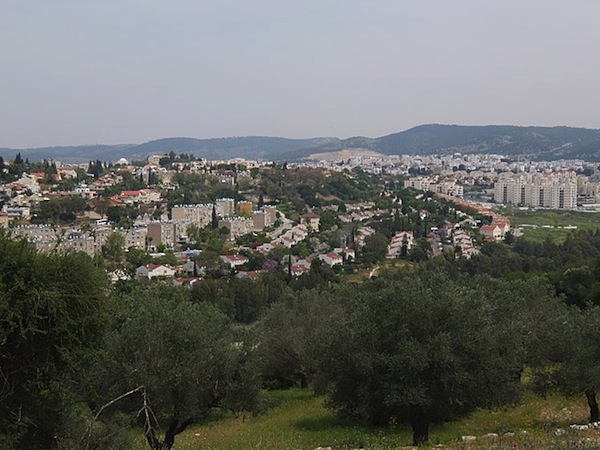
(photo by Davidbena)

Beit Shemesh is centrally located, halfway between Jerusalem and Tel Aviv. Many Moroccan immigrants were settled here in tent camps in the 1950s, followed by many subsequent immigrants,

including from Ethiopia, the former Soviet Union, North America, South Africa and England. For the last decade, the city has been known as a hotbed of protests instigated by religious extremists – a symptom of an Israeli political culture moving toward greater religious segregation and intolerance.

Miraculously, though, the tides are turning, bringing with it hope and optimism. For the past decade, Moshe Abutbul, who is ultra-Orthodox, was the local mayor, and he marketed new homes to this community. Before the elections last November, popular opinion was that he would win again. His only challenger was Dr. Aliza Bloch. Though she was well-known and popular as an educator and community leader, Bloch is a woman and not ultra-Orthodox in a city that has been attracting more ultra-Orthodox residents while others have been slowly moving away.

But the miracle is that Beit Shemesh residents of all stripes and styles collectively understood that our beautiful city had deteriorated into one of the poorest in Israel. Everybody wants a nice, clean place to live and raise their families – whatever their religious observance. So, in what is probably a rare occurrence in the history of Israeli municipal politics, the residents of Beit Shemesh decided it was time for a change. They broke away from traditional voting patterns and voted for Bloch, who ran as an independent, under the banner of professionalism and transparency.

Bloch made no deals or promises as part of her campaign. She promised the people cleanliness, law and order, good education and the establishment of a youth department – 50% of the 122,000 residents are under the age of 18.

Bloch spent her first day in office getting to know every single employee on a personal basis. In her first month, she met weekly with the sanitation department, including personal tours of their routes to help improve morale and services to the entire city. She organized a municipal clean-up day for volunteers of all ages in every neighbourhood. She has already replaced many department heads, and the youth groups are finally getting facilities for their weekly meetings and programs, after 20 years of meeting outdoors on the streets, regardless of weather conditions.

Even more exciting are the “town hall” meetings with every neighbourhood that are open to the public, and her efforts to bring national ministers and other influencers to Beit Shemesh to help dig this fast-growing city out of its deficit and help it flourish.

The new administration works from early morning to late at night to improve the city services. But it’s the human factor that is most interesting. Bloch has a doctorate in education. She is literally educating an entire city to respect one another and cooperate for the greater good. And that is the true Israeli miracle of her first several months in office. A diverse and highly opinionated population is learning to live and work side-by-side with mutual respect and understanding. A city that was known for anger and intolerance is turning into a beacon of understanding and mutual respect.

Mimi Estrin Kamilar is a former Vancouverite who made aliyah and is a philanthropy consultant. She is a 25-year resident and community activist in Beit Shemesh. While she has known Dr. Aliza Bloch for a long time and became active in her campaign, she is not an employee of the mayor or the municipality.

Format ImagePosted on May 3, 2019May 1, 2019Author Mimi Estrin KamilarCategories Op-EdTags Aliza Bloch, Beit Shemesh, Israel, politics
Last Letters online exhibit

Last Letters online exhibit

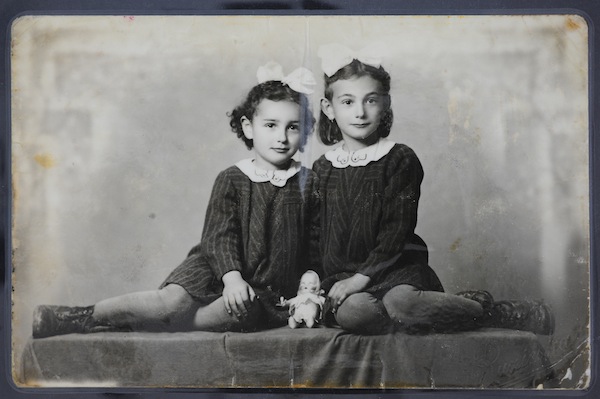
Susan-Zsuzsa and Lili Klein (photo from Yad Vashem via Ashernet)

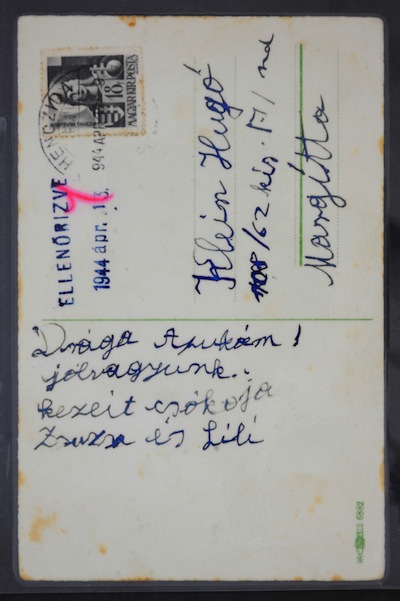
photo - letter Susan-Zsuzsa and Lili Klein to their father
(photo from Yad Vashem via Ashernet)

On April 13, 1944, sisters Susan-Zsuzsa and Lili Klein (in photo) wrote their father Hugo a short letter: “Dear Daddy, We are well – goodbye.” Hugo had been drafted into a forced labour battalion in 1943; his wife Matild had stayed with their two daughters in their hometown of Hencida in the Bihar district of Hungary. Hugo survived the war, but Matild, Susan-Zsuzsa, 9, and Lili, 7, were deported to Auschwitz on May 24, 1944, and murdered shortly after their arrival.

Exactly 75 years later, Susan-Zsuzsa and Lili’s letter is among a dozen last letters included in Yad Vashem’s latest online exhibition, Last Letters from the Holocaust: 1944, presented to mark Israel’s Holocaust Martyrs’ and Heroes’ Remembrance Day. Many of the documents included in the exhibition (yadvashem.org/yv/en/exhibitions/last-letters/1944/index.asp), as well as the photographs, were donated to Yad Vashem as part of its national Gathering the Fragments campaign. Together with the tens of thousands of Holocaust-era artifacts and artworks in Yad Vashem’s collections, these historical testimonies are due to be conserved and stored in the new Shoah Heritage Collections Centre, part of a new campus being built on the Mount of Remembrance in Jerusalem. 


Format ImagePosted on May 3, 2019May 1, 2019Author Yad Vashem courtesy Edgar AsherCategories IsraelTags history, Holocaust, letter-writing
Sniffing helps us think

Sniffing helps us think

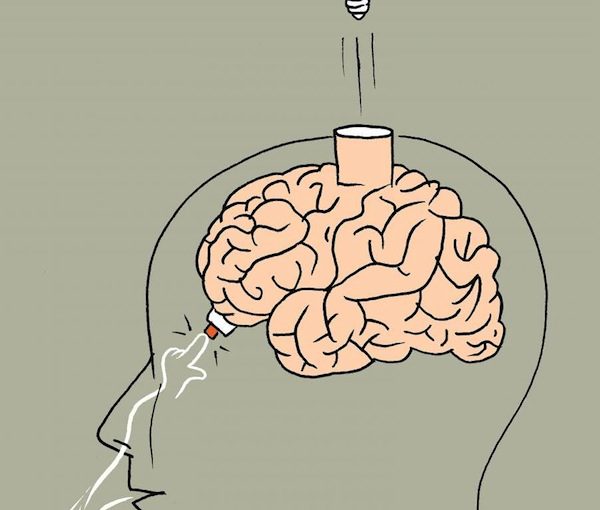
Subjects given problems to solve as they inhaled did better on tests. (image from wis-wander.weizmann.ac.il)

A shot of espresso, a piece of chocolate or a headstand – all of these have been recommended before taking a big test. The best advice, however, could be to take a deep breath. According to research conducted in the lab of Prof. Noam Sobel of the Weizmann Institute of Science’s neurobiology department, people who inhaled when presented with a visuospatial task were better at completing it than those who exhaled in the same situation. The results of the study, which were published in Nature Human Behavior, suggest that the olfactory system may have shaped the evolution of brain function far beyond the basic function of smelling.

Dr. Ofer Perl, who led the research as a graduate student in Sobel’s lab, explained that smell is the most ancient sense. “Even plants and bacteria can ‘smell’ molecules in their environment and react,” said Perl. “But all terrestrial mammals smell by taking air in through their nasal passages and passing signals through nerves into the brain.”

Some theories suggest that this ancient sense set the pattern for the development of other parts of the brain. That is, each additional sense evolved using the template that had previously been set out by the earlier ones. From there, the idea arose that inhalation, in and of itself, might prepare the brain for taking in new information – in essence, synchronizing the two processes.

Indeed, studies from the 1940s on have found that the areas of the brain that are involved in processing smell – and thus in inhalation – are connected with those that create new memories. But the new study started with the hypothesis that parts of the brain involved in higher cognitive functioning may also have evolved along the same basic template, even if these have no ties whatsoever to the sense of smell.

“In other mammals, the sense of smell, inhalation and information processing go together,” said Sobel. “Our hypothesis stated that it is not just the olfactory system, but the entire brain that gets ready for processing new information upon inhalation. We think of this as the ‘sniffing brain.’”

To test their hypothesis, the researchers designed an experiment in which they could measure the airflow through the nostrils of subjects and, at the same time, present them with test problems to solve. These included math problems, spatial visualization problems (in which they had to decide if a drawing of a three-dimensional figure could exist in reality) and verbal tests (in which they had to decide whether the words presented on the screen were real). The subjects were asked to click on a button twice – once when they had answered a question and once when they were ready for the next question. The researchers noted that, as the subjects went through the problems, they took in air just before pressing the button for the question.

The experiment was designed so the researchers could ensure the subjects were not aware that their inhalations were being monitored, and they ruled out a scenario in which the button pushing itself was reason for inhaling, rather than preparation for the task.

Next, the researchers changed the format around, giving subjects only the spatial problems to solve, but half were presented as the test-takers inhaled, half as they exhaled. Inhalation turned out to be significantly tied to successful completion of the test problems. During the experiment, the researchers measured the subjects’ electric brain activity with EEG and here, too, they found differences between inhaling and exhaling, especially in connectivity between different parts of the brain. This was true during rest periods as well as in problem-solving, with greater connectivity linked to inhaling. Moreover, the larger the gap between the two levels of connectivity, the more inhaling appeared to help the subjects solve problems.

“One might think that the brain associates inhaling with oxygenation and thus prepares itself to better focus on test questions, but the time frame does not fit,” said Sobel. “It happens within 200 milliseconds – long before oxygen gets from the lungs to the brain. Our results show that it is not only the olfactory system that is sensitive to inhalation and exhalation – it is the entire brain. We think that we could generalize, and say that the brain works better with inhalation.”

The findings could help explain, among other things, why the world seems fuzzy when our noses are stuffed. Sobel points out that the very word “inspiration” means both to breathe in and to move the intellect or emotions. And those who practise meditation know that the breath is key to controlling emotions and thoughts. This, though, is important empirical support for these intuitions, and it shows that our sense of smell, in some way, most likely provided the prototype for the evolution of the rest of our brain.

The scientists think their findings may, among other things, lead to research into methods to help children and adults with attention and learning disorders improve their skills through controlled nasal breathing.

Sobel’s research is supported by the Azrieli National Institute for Human Brain Imaging and Research; the Norman and Helen Asher Centre for Human Brain Imaging; the Nadia Jaglom Laboratory for the Research in the Neurobiology of Olfaction; the Fondation Adelis; the Rob and Cheryl McEwen Fund for Brain Research; and the European Research Council. Sobel is the incumbent of the Sara and Michael Sela Professorial Chair of Neurobiology.

For the latest Weizmann Institute news, visit wis-wander.weizmann.ac.il.

Format ImagePosted on May 3, 2019May 1, 2019Author Weizmann Institute of ScienceCategories IsraelTags brain, learning, Noam Sobel, Ofer Perl, science
העיר חמישית היקרה בעולם

העיר חמישית היקרה בעולם

ונקובר העיר חמישית היקרה בעולם מבחינת מחירי דירות ברמה הגלובלית. (Mac9)

חברת הנדל”ן סי.בי.אר.אי פירסמה את הדוח השנתי שבדק את שוקי הנדל”ן בשלושים וחמש ערים לשנה הנוכחית. אסיה בראש הנכסים היקרים כשהונג קונג במקום הראשון שנה חמישית ברציפות, סינגפור שנייה ושנגחאי שלישית. ניו יורק היא העיר היקרה ביותר לשכירות.

אסיה שלטה ברשימה של שווקי הנכסים היקרים ביותר בעולם: אחרי הונג קונג סינגפור במקום השני ושנגחאי במקום השלישי. על פי הדוח המחיר הממוצע של בית בהונג קונג בשנה זו הוא יותר ממיליון ומאתיים אלף דולר. הביקוש הגבוה וההיצע המועט העלו את מחירי הנדל”ן לרמות בלתי אפשריות בשנים האחרונות. ולכן ישנן תכניות ליצירת אי מלאכותי בעלות שמונים מיליארד דולר אשר אמור להקל מעט על מצוקת הדיור.

הערים הסיניות שנזן ובייג’ין נכנסו גם הן לרשימת עשר הערים היקרות ביותר השנה, והגיעו למקומות החמישי והתשיעי בהתאמה. ונקובר בה המחיר הממוצע של בית מגורים עומד על שמונה מאות ושישה אלף אלך דולר – היא העיר הצפון אמריקאית היקרה ביותר במובן זה, והרביעית בסך הכל בעולם. לוס אנג’לס וניו יורק נמצאות גם הן בעשירייה הראשונה. לונדון שהגיעה למקום השמיני ברשימה היא העיר היקרה באירופה. קונים פוטנציאליים בבירת אנגליה יצטרכו לקחת בחשבון הוצאה של ששת מאות ארבעים ושבעה אלף דולר בשנה זו. הערים הזולות ביותר לרכישת בית שנסקרו היו: איסטנבול, הו צ’י מין סיטי ובנגקוק. הערים שראו את העלייה החדה ביותר במחירים הן: ברצלונה, דבלין ושנגחאי.

בכל הקשור לשוק השכירות העיר היקרה ביותר היא ניו יורק, בה שכר הדירה בממוצע הוא אלפים שמונה מאות ארבעים וארבעה דולר (לחודש). אבו דאבי והונג קונג הן שתי הערים היקרות ביותר הבאות, עם שכר דירה ממוצע של יותר מאלפיים ושבע מאות דולר. העלייה החדה ביותר בדמי השכירות לעומת שנה שעברה נרשמה דווקא בליסבון, בה המחירים עלו ביותר מעשרים אחוז. הערים הזולות ביותר להשכרת דירה הן: בנגקוק, איסטנבול ומונטריאול (אם כי מידע במדד זה לא היה זמין עבור חמש ערים שונות).

ככלל אנחנו רואים שהעלייה במחירי הבתים מאיטה בעודנו נעים אל עבר סופו של מחזור נכסי ארוך. כך אמרה ג’נט סיבריטס, ראש מחלקת מחקר של סי.בי.אר.אי בריטניה. לדבריה אנו מצפים ששיעורי הרבית העולים ישפיעו על ערים בארה”ב. ואמצעי הקירור השונים ישפיעו אל האזור הפסיפי-אסייתי.

להלן מחירי דירות ממוצעים לפי דוח החיים הגלובליים: במקום העשירי פריז כשהמחיר עומד על כשש מאות עשרים ושישה אלף דולר (מדובר על התייקרות של תשעה אחוזים בשנה האחרונה). במקום התשיעי בייג’ינג שהמחיר עומד על שש מאות עשרים ותשעה אלף דולר. במקום השמיני לונדון שהמחיר עומד על שש מאות ארבעים ושבעה אלף דולר. במקום השביעי ניו יורק שהמחיר עומד על שש מאות שבעים וארבעה אלף דולר. במקום השישי לוס אנג’לס כשהמחיר עומד על שש מאות שבעים ותשעה אלף דולר (מדובר על התייקרות של שישה וחצי אחוזים בשנה האחרונה). במקום החמישי שנזן כשהמחיר עומד על שש מאות ושמונים אלף דולר. במקום הרביעי ונקובר כשהמחיר עומד על שמונה מאות וחמישה עשר אלף דולר. במקום השלישי שנגחאי כשהמחיר עומד על שמונה מאות שבעים ושלושה אלף דולר (מדובר על התייקרות של אחד עשר אחוז בשנה האחרונה). במקום השני סינגפור כשהמחיר עומד על שמונה מאות שבעים וארבעה אלף דולר. ובמקום הראשון הונג קונג כשהמחיר זהה – שמונה מאות שבעים וארבעה אלף דולר.

Format ImagePosted on May 1, 2019May 1, 2019Author Roni RachmaniCategories עניין בחדשותTags Asia, housing shortage, real estate, Vancouver, אסיה, ונקובר, מצוקת הדיור, נדל"ן

Posts pagination

Previous page Page 1 … Page 6 Page 7
Proudly powered by WordPress