Skip to content
  • Home
  • Subscribe / donate
  • Events calendar
  • News
    • Local
    • National
    • Israel
    • World
    • עניין בחדשות
      A roundup of news in Canada and further afield, in Hebrew.
  • Opinion
    • From the JI
    • Op-Ed
  • Arts & Culture
    • Performing Arts
    • Music
    • Books
    • Visual Arts
    • TV & Film
  • Life
    • Celebrating the Holidays
    • Travel
    • The Daily Snooze
      Cartoons by Jacob Samuel
    • Mystery Photo
      Help the JI and JMABC fill in the gaps in our archives.
  • Community Links
    • Organizations, Etc.
    • Other News Sources & Blogs
    • Business Directory
  • FAQ
  • JI Chai Celebration
  • JI@88! video

Recent Posts

  • המלחמות של נתניהו וטראמפ
  • Zionism wins big in Vegas
  • Different but connected
  • Survival not passive
  • Musical celebration of Israel
  • Shoppe celebrates 25 years
  • Human “book” event
  • Reclaiming Jewish stories
  • Bema presents Perseverance
  • CSS honours Bellas z”l
  • Sheba Promise here May 7
  • Reflections from Be’eri
  • New law a desecration
  • Resilient joy in tough times
  • Rescue dog brings joy
  • Art chosen for new museum
  • Reminder of hope, resilience
  • The national food of Israel?
  • Story of Israel’s north
  • Sheltering in train stations
  • Teach critical thinking
  • Learning to bridge divides
  • Supporting Iranian community
  • Art dismantles systems
  • Beth Tikvah celebrates 50th
  • What is Jewish music?
  • Celebrate joy of music
  • Women share experiences 
  • Raising funds for Survivors
  • Call for digital literacy
  • The hidden hand of hate
  • Tarot as spiritual ritual
  • Students create fancy meal
  • Encouraging young voices
  • Rose’s Angels delivers
  • Living life to its fullest

Archives

Follow @JewishIndie
image - The CJN - Visit Us Banner - 300x600 - 101625

Byline: Weizmann Institute of Science

Sanctuary garden benefits

Sanctuary garden benefits

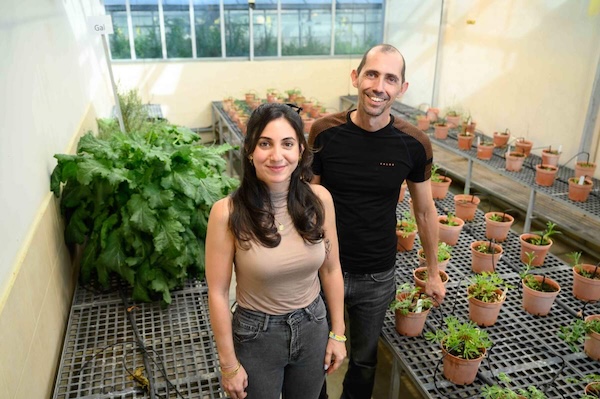
Gal Raviv, left, and Prof. Tamir Klein in the plant sanctuary at Weizmann Institute of Science in Rehovot, Israel. (photo from Weizmann Institute of Science)

When PhD student Gal Raviv thought of creating a sanctuary garden at the Weizmann Institute of Science, what she had in mind was saving endangered plants. But, after the Oct. 7, 2023, attack on Israel, the garden became for her a refuge of serenity and strength. “There’s something grounding about plants that keep growing no matter what happens around us. If they can do it, so can we,” she said. “They represent what the land of Israel can produce and, in these difficult times, they symbolize our own roots in this land.”

Raviv came up with the idea of the garden after hearing a lecture on plant conservation at a conference that Prof. Tamir Klein, whose Weizmann lab specializes in tree research, had organized at the institute. In late summer of 2023, they set up the garden in Weizmann’s greenhouses, with full backing from Weizmann’s Institute for Environmental Sustainability.

Raviv’s doctoral research, conducted in Prof. David Margulies’s lab, is unrelated to plants and focuses on molecular aspects of cancer therapy. Nonetheless, she volunteered to tend the garden, getting crucial help from the greenhouse staff and relying on their expertise.

“When people hear about endangered species, they usually think of a toad whose swamp has dried up, or other animals or birds. But at the basis of any ecosystem are plants: they are the very foundation of our existence,” Raviv said.

“Plant diversity supports diverse insects that in turn provide food for birds and animals. When plant species go extinct, their loss can disrupt the integrity of an entire ecosystem,” added Klein.

Of some 2,300 wild plants found in Israel, more than 400 are in danger of extinction, according to the Red Book of Israel’s Nature and Parks Authority. Plant species that are unique to Israel are particularly threatened: there are about 55 such species, and 35 of them are endangered. 

“We have a global responsibility to preserve these plants,” Klein said.

The major threat to plants is habitat loss, which in Israel is especially acute along the Mediterranean. Sand dunes and other parts of the coastal plain are home to an unusually large proportion of wild plant species, yet, to the plants’ misfortune, that’s also where humans love to settle. Less than 30% of the pristine coastal sands that used to line the Mediterranean in the early 20th century remained undeveloped by the beginning of the 21st. These sands might disappear altogether if left unprotected.

There are several plant sanctuaries in Israel, but not all have the proper climate to grow coastal plants outdoors, whereas the Weizmann campus, with weather that’s similar to that of the coast, is well suited to this end. Raviv and Klein kept this in mind when preparing a list of plant species for the sanctuary. The final list was compiled in collaboration with the Israel Nature and Parks Authority, which also provided seeds.

Now in its third year, Weizmann’s sanctuary garden holds some 20 endangered plants, a number of which are unique to Israel’s coastal plain; others also grow in neighbouring regions. Most are flowering annuals, but there are also perennials, as well as two species of ancient wheat, genetic relatives of today’s crop varieties. These plants are gradually revealing their preferences and personalities to Raviv and the greenhouse staff, while occasionally serving up challenges and surprises.

For example, since the greenhouses have no bees or other natural pollinators, some of the plants bloomed but produced no seeds. “So, I became the bee,” Raviv said.

To help some species, she made adjacent flowers “kiss,” that is, touch in a way that pollen from one flower could get to the stigma, or ovary system, of another – a process known as self-pollination or cross-pollination, depending on whether the two flowers belong to the same plant or to different ones. She did that, for instance, for Erodium subintegrifolium, known as stork’s bill in Europe and heron’s bill in North America. 

In other species – such as the perennial Salvia eigii, named for the botanist Alexander Eig – the reproductive organs are too deep inside the flower for the kiss method to work. Raviv came up with a creative solution. She collected whisker hairs shed by her three cats and used them to transfer pollen from one flower to the stigma of another.

Luckily for Raviv, however, most plants in the sanctuary garden manage to pollinate by themselves. 

Other challenges now solved include “late bloomers.” Silene modesta, from a genus also known as campion or catchfly – an annual plant that grows in sandy soil on the coast and in the western Negev desert – thrived in the sanctuary garden from the start. However, even though it produced lots of flower buds, these seemed to dry up before getting a chance to bloom. 

A plant conservation expert told Raviv to open one of the dried buds to see if it contained seeds. Indeed, it did, which meant that it had bloomed at some point without being caught in the act. So Raviv went to the garden late at night and, sure enough, found the slender Silene in full bloom. Keeping the bud closed after sunrise is the plant’s strategy for reducing water evaporation during the hot hours, while also protecting its flowers from the strong daytime coastal winds. 

The discovery prompted Raviv to initiate a research project in which she compares Silene modesta with its non-endangered relative, Silene palaestina. The goal is to uncover the biochemical processes that ensure water conservation in the endangered plant.

In fact, a major goal of plant conservation is to preserve valuable properties that might be lost forever should their carriers disappear. Revealing the mechanisms behind such properties might make it possible to transfer them to other plants to, for example, help them grow in arid conditions or otherwise adapt to the adversities of climate change. 

– Courtesy Weizmann Institute of Science
Format ImagePosted on March 13, 2026March 12, 2026Author Weizmann Institute of ScienceCategories IsraelTags conservation, education, endangered plants, Gal Raviv, gardens, preservation, science
Sniffing helps us think

Sniffing helps us think

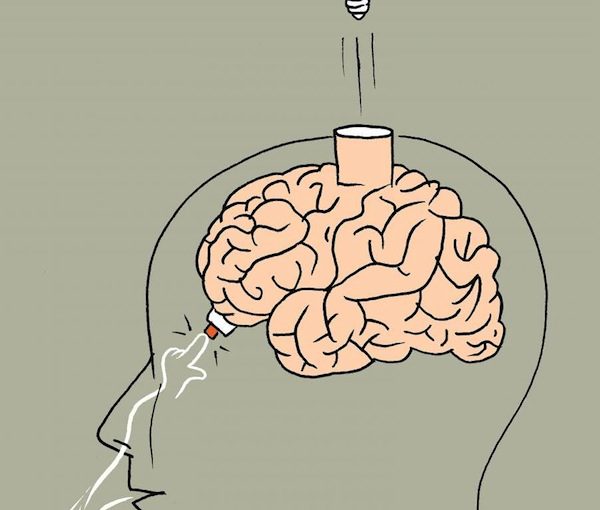
Subjects given problems to solve as they inhaled did better on tests. (image from wis-wander.weizmann.ac.il)

A shot of espresso, a piece of chocolate or a headstand – all of these have been recommended before taking a big test. The best advice, however, could be to take a deep breath. According to research conducted in the lab of Prof. Noam Sobel of the Weizmann Institute of Science’s neurobiology department, people who inhaled when presented with a visuospatial task were better at completing it than those who exhaled in the same situation. The results of the study, which were published in Nature Human Behavior, suggest that the olfactory system may have shaped the evolution of brain function far beyond the basic function of smelling.

Dr. Ofer Perl, who led the research as a graduate student in Sobel’s lab, explained that smell is the most ancient sense. “Even plants and bacteria can ‘smell’ molecules in their environment and react,” said Perl. “But all terrestrial mammals smell by taking air in through their nasal passages and passing signals through nerves into the brain.”

Some theories suggest that this ancient sense set the pattern for the development of other parts of the brain. That is, each additional sense evolved using the template that had previously been set out by the earlier ones. From there, the idea arose that inhalation, in and of itself, might prepare the brain for taking in new information – in essence, synchronizing the two processes.

Indeed, studies from the 1940s on have found that the areas of the brain that are involved in processing smell – and thus in inhalation – are connected with those that create new memories. But the new study started with the hypothesis that parts of the brain involved in higher cognitive functioning may also have evolved along the same basic template, even if these have no ties whatsoever to the sense of smell.

“In other mammals, the sense of smell, inhalation and information processing go together,” said Sobel. “Our hypothesis stated that it is not just the olfactory system, but the entire brain that gets ready for processing new information upon inhalation. We think of this as the ‘sniffing brain.’”

To test their hypothesis, the researchers designed an experiment in which they could measure the airflow through the nostrils of subjects and, at the same time, present them with test problems to solve. These included math problems, spatial visualization problems (in which they had to decide if a drawing of a three-dimensional figure could exist in reality) and verbal tests (in which they had to decide whether the words presented on the screen were real). The subjects were asked to click on a button twice – once when they had answered a question and once when they were ready for the next question. The researchers noted that, as the subjects went through the problems, they took in air just before pressing the button for the question.

The experiment was designed so the researchers could ensure the subjects were not aware that their inhalations were being monitored, and they ruled out a scenario in which the button pushing itself was reason for inhaling, rather than preparation for the task.

Next, the researchers changed the format around, giving subjects only the spatial problems to solve, but half were presented as the test-takers inhaled, half as they exhaled. Inhalation turned out to be significantly tied to successful completion of the test problems. During the experiment, the researchers measured the subjects’ electric brain activity with EEG and here, too, they found differences between inhaling and exhaling, especially in connectivity between different parts of the brain. This was true during rest periods as well as in problem-solving, with greater connectivity linked to inhaling. Moreover, the larger the gap between the two levels of connectivity, the more inhaling appeared to help the subjects solve problems.

“One might think that the brain associates inhaling with oxygenation and thus prepares itself to better focus on test questions, but the time frame does not fit,” said Sobel. “It happens within 200 milliseconds – long before oxygen gets from the lungs to the brain. Our results show that it is not only the olfactory system that is sensitive to inhalation and exhalation – it is the entire brain. We think that we could generalize, and say that the brain works better with inhalation.”

The findings could help explain, among other things, why the world seems fuzzy when our noses are stuffed. Sobel points out that the very word “inspiration” means both to breathe in and to move the intellect or emotions. And those who practise meditation know that the breath is key to controlling emotions and thoughts. This, though, is important empirical support for these intuitions, and it shows that our sense of smell, in some way, most likely provided the prototype for the evolution of the rest of our brain.

The scientists think their findings may, among other things, lead to research into methods to help children and adults with attention and learning disorders improve their skills through controlled nasal breathing.

Sobel’s research is supported by the Azrieli National Institute for Human Brain Imaging and Research; the Norman and Helen Asher Centre for Human Brain Imaging; the Nadia Jaglom Laboratory for the Research in the Neurobiology of Olfaction; the Fondation Adelis; the Rob and Cheryl McEwen Fund for Brain Research; and the European Research Council. Sobel is the incumbent of the Sara and Michael Sela Professorial Chair of Neurobiology.

For the latest Weizmann Institute news, visit wis-wander.weizmann.ac.il.

Format ImagePosted on May 3, 2019May 1, 2019Author Weizmann Institute of ScienceCategories IsraelTags brain, learning, Noam Sobel, Ofer Perl, science
Mimicking silkworms

Mimicking silkworms

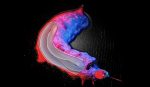
A silkworm viewed with an infrared camera. The pale elongated cavity is the silk gland. (photo from © 2017 Natural Materials Group)

Scientists have designed microscopic silk capsules that mimic, on a very small scale, the structure of silkworm cocoons. The capsules can serve as a protective environment for the transport of sensitive “cargo” such as natural silk proteins, antibodies or other delicate molecules. The collaborative research – which was performed by an international team of academics from the Weizmann Institute of Science in Israel; the universities of Cambridge, Oxford and Sheffield in the United Kingdom; and the ETH in Switzerland – may lead to a host of applications in the cosmetics, food and pharmaceutical industries, particularly in the delivery of drugs within the body. The findings were reported this summer in Nature Communications.

The use of natural proteins from which silkworms and spiders spin their elastic fibres has been limited, as these proteins have a tendency to clump together once extracted. Until now, researchers have been using chemically processed silk fibres, which have different mechanical properties and are relatively inert compared to the natural ones. Dr. Ulyana Shimanovich – then a postdoctoral fellow supervised by Prof. Tuomas P. J. Knowles at Cambridge and now head of a new lab in Weizmann’s materials and interfaces department – decided to find out what keeps the natural silk proteins from clumping together in the animal prior to the spinning.

The silk proteins are stored in liquid form in the silkworm’s glands before they are spun into the threads used to construct the cocoons. To imitate the natural process of structuring silk protein into protective capsules, the researchers used the principles of microfluidics, a field that deals with the control of fluid flow parameters on the micron-scale level. They placed proteins extracted directly from the glands of silkworms inside microscopic channels on a chip made of a silicon-derived polymer and caused the protein molecules to self-assemble into a gel-like material, exactly as in a silkworm. The gel formed microscopic capsules; within these capsules, the rest of the protein stayed protected as a solution, as it does in the animal’s gland. By controlling the viscosity of the silk protein solution and the forces acting upon it, the researchers have been able to control the capsules’ shape (round or elongated) and size: from 300 nanometres to more than 20 micrometres. Inside these artificial capsules, the natural silk proteins remained intact for an unlimited amount of time without losing their properties or ability to function.

“Making synthetic capsules is normally a complex and energy-intensive process,” explained Shimanovich. “In contrast, silk capsules are easier to produce and require less energy to manufacture. Moreover, silk is biodegradable.”

The tough silk capsules may be used to protect sensitive molecules, such as antibodies and other proteins, preventing them from losing desired qualities. The capsules can be employed, for example, to deliver drugs or vaccines intact to target organs. In particular, said Shimanovich, they may help develop future therapies for neurodegenerative diseases: because the capsules can penetrate the blood-brain barrier, they may enable the development of new treatment for these diseases.

As well, since the capsules are biodegradable, they may have multiple uses. For example, they might be employed in the food industry to incorporate healthful oil particles into bread or other products. Potential applications for natural silk proteins stored inside the new capsules include the development of skin treatments for burns or cosmetic use, and the design of strong elastic fibres for tissue engineering – for example, for the fabrication of improved biological implants.

The research team included Dr. Simone F. Ruggeri, Dr. Erwin De Genst, Dr. Thomas Mueller, Dr. Teresa P. Barros and Prof. Christopher M. Dobson of Cambridge; Dr. Jozef Adamcik and Prof. Raffaele Mezzenga of ETH Zurich; professors David Porter and Fritz Vollrath of Oxford; and Dr. Chris Holland of the University of Sheffield. Shimanovich’s research is supported by the Benoziyo Fund for the Advancement of Science; the Peter and Patricia Gruber Awards; and Georges Lustgarten.


Format ImagePosted on October 20, 2017October 19, 2017Author Weizmann Institute of ScienceCategories IsraelTags Israel, science, silkworms, Ulyana Shimanovich
Proudly powered by WordPress