Skip to content

  • Home
  • Subscribe / donate
  • Events calendar
  • News
    • Local
    • National
    • Israel
    • World
    • עניין בחדשות
      A roundup of news in Canada and further afield, in Hebrew.
  • Opinion
    • From the JI
    • Op-Ed
  • Arts & Culture
    • Performing Arts
    • Music
    • Books
    • Visual Arts
    • TV & Film
  • Life
    • Celebrating the Holidays
    • Travel
    • The Daily Snooze
      Cartoons by Jacob Samuel
    • Mystery Photo
      Help the JI and JMABC fill in the gaps in our archives.
  • Community Links
    • Organizations, Etc.
    • Other News Sources & Blogs
    • Business Directory
  • FAQ
  • JI Chai Celebration
  • JI@88! video
image - Weizmann Canada Physics Tournament 2025
image - The CJN - Visit Us Banner - 300x600 - 101625

Recent Posts

  • היהירות היא אחד האויבים הגדולים ביותר של ישראל
  • Vrba monument is unveiled
  • Music to build bridges
  • A better future possible
  • Anne Frank exhibit on now
  • Human rights in sport
  • Telling the story of an icon
  • Crawl bigger than ever
  • JCC Maccabi in Toronto
  • A way to meet fellow Jews
  • Time to include
  • Add Jewish joy to the mix
  • Reminder of humanity’s light
  • From the archives … editorials
  • Year-round holiday recipes
  • מדוע עזבתי את ישראל ואינני חושב לחזור ארצה
  • OJC hosts Oct. 7 memorial
  • A journey beyond self
  • Antisemitism a problem
  • Young man is missed
  • Orr action sparks complaint
  • Prison sentence for hate
  • Etgar Keret comes to Vancouver
  • New fall lecture series
  • Series explores music
  • Doc on Zapiro screens Nov. 6
  • Joy of shared existence
  • Community milestones … October 2025
  • MAID vs Jewish values
  • Cheshvan a great month, too
  • Bull, bear or bubble?
  • From the archives … a coin, etc.
  • מדוע האנטישמיות הולכת וגואה בעולם
  • New bio gives Vrba his due
  • Joy brighter than ever
  • When approaches differ

Archives

Follow @JewishIndie

Tag: Jordan River

Celebrating our history

Celebrating our history

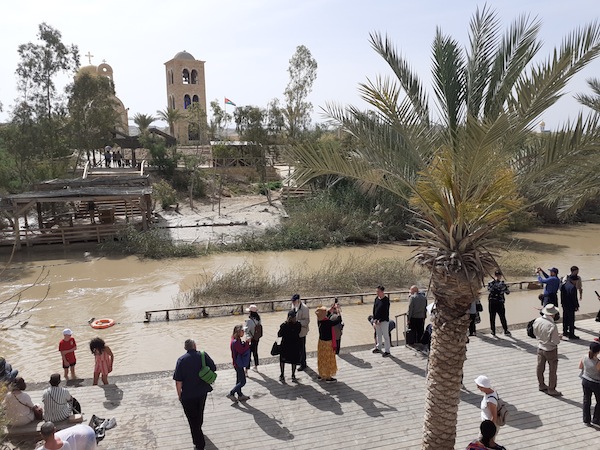
An April 15 press tour took journalists to the Israeli side of the Jordan River. Joshua and the Israelites made their crossing here. (photo by Gil Zohar)

Seventeen bulletproof buses of pilgrims, plus one carrying journalists, spilled their contents April 15 at Qasr al-Yahud (Arabic for the Jews’ Castle) on the muddy banks of the not-so-mighty Jordan River, 10 kilometres east of Jericho. The buses were provided by the Government Press Office in Jerusalem.

The holy site is also called the Land of Monasteries because of the seven Catholic, Greek Orthodox and Ethiopian churches there. Until 2011, it was a fenced-off, closed military zone ringed by minefields. Qasr al-Yahud is revered by Christians as the place where John the Baptist immersed his second cousin, Jesus of Nazareth.

For Jews, the shrine marks where, on Nissan 10, circa 1290 BCE, Joshua bin Nun led the Children of Israel to ford the Jordan River and begin their conquest of the Promised Land. But, with the cold peace prevailing between Israel and Jordan, soldiers of the Hashemite Kingdom’s Arab Legion warily monitored the crowds, making sure that no brave souls crossed to the polluted stream’s east bank to reenact Joshua’s miraculous crossing on dry land.

As Joshua and the 12 tribes approached the river, they were met by the kohanim (priests) carrying the Ark of the Covenant. The Jordan then miraculously split for them – perhaps caused by a landslide in the earthquake-prone region that temporarily blocked the river’s flow – allowing them to cross. After fording the Jordan, Joshua erected 12 stones taken from the river at Gilgal, whose location today is disputed by historians and archeologists.

Symbolizing that the process of the Israelites conquering the Promised Land some 3,289 years ago is still underway, Palestinian teenagers in Jericho pelted the armoured bus in which the journalists were riding, smashing one of the shatterproof windows. No one was injured in the attack.

For this writer, the explosive sound of the thump of the rock on glass brought to mind Joshua’s advice when the Israelites marched on ancient Jericho to begin their conquest: “Be strong and of good courage.” (Joshua 1:9)

Qasr al-Yahud is a corruption of “the Jews’ break,” traditionally the place where the Israelites crossed over, that is, “broke” the Jordan River after their 40 years of wandering in the Sinai Desert: “When the soles of the feet of the priests who bear the ark of the Lord, the Lord of all the earth, shall rest in the waters of the Jordan, that the waters of the Jordan shall be cut off, even the waters that come down from above, and they shall stand in one heap.” (Joshua 3:13)

It was here, too, that Elijah the Prophet ascended to heaven in a fiery chariot after he and Elisha crossed the Jordan: “And Elijah took his mantle, and wrapped it together, and smote the waters; and they were divided hither and thither, so that they two went over on dry ground.” (2 Kings 2:8)

The strategic and diplomatic significance of the Jordan Valley were spoken about by retired Israel Defence Force (IDF) deputy chief-of-staff major general Uzi Dayan, who was elected to Israel’s Knesset (parliament) in the country’s April 9 general election.

Rabbi Yisrael Meir Lau, the chief rabbi of Tel Aviv, and previously Ashkenazi chief rabbi of Israel, spoke of the Land of Israel’s long centuries of foreign occupation, from the Romans to the British.

From 1948 until 1967, Qasr al-Yahud was under Jordanian control, and was a popular destination for tourists and pilgrims. In 1968, following the Six Day War, access to the site was prohibited by the IDF because of its location beyond the border fence in a closed military zone. In recent years, the Israeli Civil Administration – with the assistance of the tourism and regional development ministries – carried out infrastructure and development work at the site, including the clearing of mines. In 2011, the site was opened to visitors on a permanent basis without the need for prior security coordination.

Entering ancient Jericho, with its 8,000-year-old remains at Tel as-Sultan and two Byzantine-era synagogues, is another matter. Large signs at the entrance to the city proclaim in Hebrew and English that entry is prohibited to Israelis. In honour of the Nissan 10 celebration, however, Israelis were allowed to enter the city in Area A, the Palestinian self-rule section of the West Bank, which is off limits the rest of year.

And what of the minefields? One million square metres of land are currently being cleared of approximately 3,000 anti-personnel mines, antitank mines and other unexploded ordinance. The project is being carried out by Israel’s National Mine Action Authority under the direction of the Defence Ministry, together with HALO Trust, an international mine-clearance charity.

Gil Zohar is a journalist based in Jerusalem.

[For more on this press trip to the Jordan River and Jericho, see “Traveling into our past.”]
Format ImagePosted on May 3, 2019May 1, 2019Author Gil ZoharCategories IsraelTags Christianity, history, Israel, Jordan River, Judaism, Qasr al-Yahud
Traveling into our past

Traveling into our past

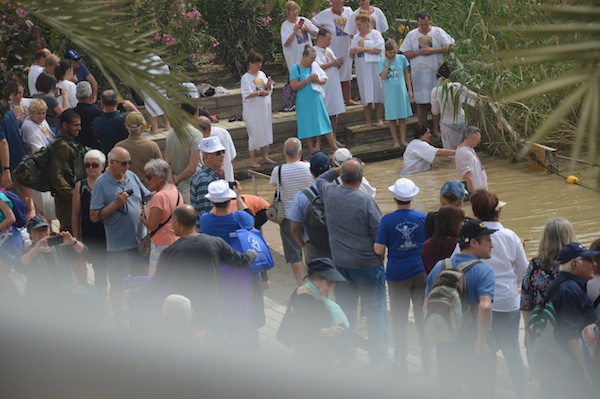
Christians preparing to be baptized in the Jordan River. (photo by Barry Kaplan)

A few days prior to Passover, the Israeli Government Press Office organized a special field trip to the Jordan River and Jericho. The bus with 40 journalists left the GPO office parking lot at 8:30 a.m. and traveled on Highway #1 to the southern part of the Jordan Valley with a guide. We passed Maale Adumim, now a city with 45,000 residents, and headed through the desert area.

We began the ascent to Jericho, passing the Inn of the Good Samaritan, the sea-level sign and the barren hills. A strip of restaurants and souvenir places seemed to appear out of nowhere. We heard about the history of Kibbutz Bet Arevo, situated in this area from 1939 to 1948, passed a veritable forest of palm trees and, by 9:20 a.m., we were at Qasr al-Yahud, where John the Baptist is said to have baptized Jesus. After it passed through the security fence, the bus parked and we walked down to the Jordan River.

Until 1967, this site was under Jordanian control and, in 1968, access was prohibited. In recent years, the tourism and regional development ministries have carried out various projects, including the clearing of mines, and, in 2011, the site was opened to visitors. The site and facilities are overseen by the Israeli Civil Administration and the Israeli Ministry of Tourism as part of a national park.

Running down the middle of the Jordan River is a metal divider. On the other side of it is Jordan. There were people standing around the river and, behind them, churches were visible on the Jordanian side. On the Israeli side, down more steps, people were wearing white cover-ups and going into the river, presumably to be baptized.

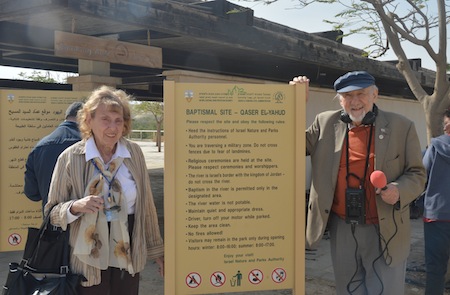
photo - Writer Sybil Kaplan with friend Walter Bingham, who, in his 90s, is the oldest working journalist in Israel
Writer Sybil Kaplan with friend Walter Bingham, who, in his 90s, is the oldest working journalist in Israel. (photo by Barry Kaplan)

In addition to its significance to Christians, two Jewish events took place at this spot.

In the Book of Joshua, we read how the Israelites, after 40 years of wandering in the desert, led by Joshua, crossed the Jordan River as the river became a stream. Supposedly this happened on the 10th of Nissan, this year April 15. Our guide says this could have taken place 4,440 years ago.

The passage in the Book of Joshua reads: “When the soles of the feet of the priests who bear the ark of the Lord, the Lord of all the earth, shall rest in the waters of the Jordan, that the waters of the Jordan shall be cut off, even the waters that come down from above, and they shall stand in one heap.” (Joshua 3:13)

At this point in our trip, we were joined by Uzi Dayan, former major general, national security adviser and Israel Defence Forces deputy chief of staff. According to Dayan, this passage from Joshua describes “the first aliyah to Israel.”

Another biblical text (2 Kings 2:1-2) says Elijah struck the Jordan River water with his cloak. The water parted so that he and Elisha could cross. After Elijah ascended, Elisha again parted the waters with Elijah’s cloak so he could return to Israel. This occurred before Elijah ascended to heaven in a fiery chariot.

Dayan noted that, on the day of our visit, there would be 17 other busloads of people coming to commemorate what has happened here, and that a ceremony would be held that afternoon. We would return for it, but not stay (as I will explain later).

* * *

At 11:10 a.m., we reboarded the bus and became part of a convoy, with IDF soldiers and jeeps leading us and several soldiers inside each bus. On one side of the road are mine fields, still being cleared.

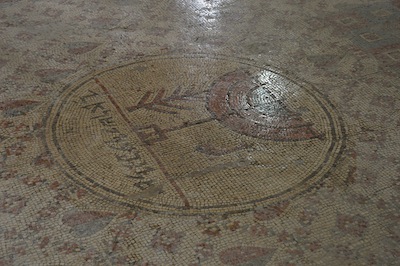
Our next stop was the sixth- or seventh-century CE Shalom Al Yisrael Synagogue. Down some steps, we walked around the 10-by-13-metre mosaic floor that featured a menorah in its centre. It was identified as being the floor of a synagogue because of the images of the menorah, as well as an ark, shofar and lulav. The name stems from a mosaic inscription with the Hebrew words Shalom Al Yisrael.

photo - Shalom Al Yisrael Synagogue mosaic in Jericho
Shalom Al Yisrael Synagogue mosaic in Jericho. (photo by Barry Kaplan)

The synagogue was probably used for hundreds of years, but then the Jericho Jewish community dissipated, and the synagogue was forgotten. It was revealed in excavations conducted in 1936 by Dimitri Baramki of the department of antiquities under the British Mandate.

After the 1967 Six Day War, the site came under Israeli military control and remained under the administrative responsibility of the Arab owners – the Shahwan family, who had built a house over the mosaic floor and charged admission to visit it. Tourists and Jews began visiting the site regularly for prayers. In 1987, the Israeli authorities confiscated the mosaic, the house and a small part of the farm around it. They offered compensation to the Shahwan family, but it was rejected.

After the 1995 Oslo Accords, control of the site was given to the Palestinian Authority. It was agreed that free access to it would continue, and that it would be adequately protected.

There have been some incidents. For example, on the night of Oct. 12, 2000, the synagogue was vandalized by Palestinians who torched and destroyed most of the building, burned holy books and relics, and damaged the mosaic. For more than eight years, no Jews were permitted in Shalom Al Yisrael Synagogue, but, during that time, it was restored by the Municipality of Jericho. Since 2007, prayer services have been allowed once a week.

* * *

By 12:15 p.m., we were at the tel (hill, or mound), which some journalists climbed. Opposite is a building with restaurants, snacks and a kind of enclosed mall. Israeli soldiers patrol the entire area. Outside, a man was giving rides to people atop a camel, and soldiers sat around and chatted.

The archeological site is about 2.5 kilometres north of modern-day Jericho, on the site of the ancient city, 258 metres below sea level. It was inhabited from the 10th century BCE. Excavations began in 1868 and settlements are known to date from 10000 BCE.

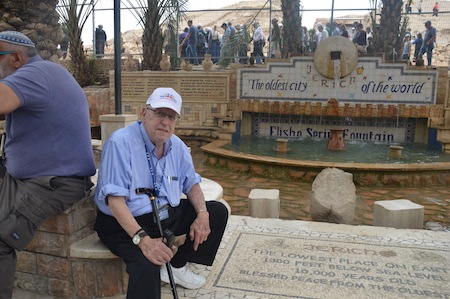
photo - Photographer Barry Kaplan rests by Jericho’s oldest city wall. Tel Jericho can be seen in the background
Photographer Barry Kaplan rests by Jericho’s oldest city wall. Tel Jericho can be seen in the background. (photo by Barry Kaplan)

The story in the Book of Joshua relates that, when the Israelites were encamped in the Jordan Valley, ready to cross the river, Joshua, as a final preparation, sent out two spies to investigate the military strength of Jericho. The spies stayed in Rahab’s house, which was built into the city wall. The soldiers sent to capture the spies asked Rahab to bring out the spies; instead, she hid them.

After escaping, the spies promised to spare Rahab and her family after taking the city, if she would mark her house by hanging a red cord out the window. When Jericho fell, Rahab and her whole family were saved, becoming part of the Jewish people.

The biblical battle of Jericho was the first battle that was fought by the Israelites. According to Joshua 6:1-27, the walls of Jericho fell after Joshua’s army marched around the city and blew their trumpets.

* * *

Our second-last stop was Moshav Naama, which is about 45 minutes from the centre of Jerusalem and one-and-a-half hours from Tel Aviv. About 50 families live there. We arrived at 2 p.m.

On the moshav, they grow grapes, dates and organic vegetables. Inon, one of the farmers, grows herbs in greenhouses. In the warehouse, sweet basil and tarragon are packaged for shipping all over the world to supermarkets.

Inon said 95% of the dates grown there are Medjoul and 5% are other kinds. Medjoul dates originated in the Middle East and North Africa, and are one of the most famous varieties. They are well-known for their large size and delicious flavour. The dates from the moshav will be harvested in September and October.

* * *

At 4:30 p.m., above Qasr al-Yahud, the baptismal site, chairs have been set up for the approximately 900 people who will listen to speeches commemorating the Israelites arrival in the Promised Land. However, since most of the journalists do not understand the Hebrew, the GPO bus boards at 5:20 p.m. and travels back to the GPO offices, arriving just over an hour later. Even though we didn’t stay for the whole proceedings, I am still excited to have been a witness to the ceremony.

Sybil Kaplan is a journalist, lecturer, book reviewer and food writer in Jerusalem. She created and leads the weekly English-language Shuk Walks in Machane Yehuda, she has compiled and edited nine kosher cookbooks, and is the author of Witness to History: Ten Years as a Woman Journalist in Israel.

[For more on this press trip to the Jordan River and Jericho, see “Celebrating our history.”]

Format ImagePosted on May 3, 2019May 1, 2019Author Sybil KaplanCategories IsraelTags Christianity, history, Israel, Jericho, Jordan River, Judaism, Qasr al-Yahud
EcoPeace crosses borders

EcoPeace crosses borders

EcoPeace Middle East is an Israeli-Jordanian-Palestinian organization dedicated to environmental peace building, primarily through water diplomacy. (photo from EcoPeace Middle East)

EcoPeace was created by Gidon Bromberg some 22 years ago after he made the connection between ecology and the lack of cooperation between the region’s various authorities regarding water issues.

At the time, he was studying for a master’s in environmental law in Washington, D.C. When he returned to Israel, he organized the very first gathering of Israeli, Palestinian, Jordanian and Egyptian environmentalists. On the second day of the meeting, in December 1994, an agreement was struck to create EcoPeace Middle East.

Bromberg has been working together with Jordanian Munqeth Mehyar since then and Palestinian Nader Khateeb since 2001 to create an Israeli-Jordanian-Palestinian organization dedicated to environmental peace building, primarily through water diplomacy, and to the advancement – through both top-down advocacy and community-led grassroots work – of cross-border cooperation concerning shared water resources, pollution issues and sustainable development issues. Half of their programming is bottom-up community work through the Good Water Neighbors (GWN) project, now into its 15th year of operation.

“The second half of our work is advocacy aimed at influencing the Israeli, Palestinian and Jordanian governments, as well as at garnering support from the international community in advancing dialogue and cooperation between them,” Bromberg told the Independent.

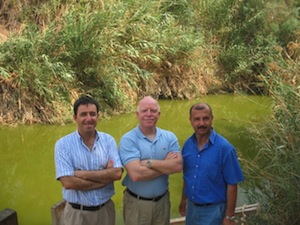
photo - The three co-directors of EcoPeace Middle East at the Jordan River. From left to right: Gidon Bromberg (Israel), Munqeth Mehyar (Jordan) and Nader Khateeb (Palestine)
The three co-directors of EcoPeace Middle East at the Jordan River. From left to right: Gidon Bromberg (Israel), Munqeth Mehyar (Jordan) and Nader Khateeb (Palestine). (photo from EcoPeace via commons.wikimedia.org)

The underlying assumption behind their efforts on all fronts is that regional cooperation is in each party’s best self-interest. “As altruism is not a common feature of foreign policy, particularly not in the midst of conflict, speaking to the self-interest of each side enables us to create political will for cooperation that ultimately serves the region as a whole,” said Bromberg.

Over the years, EcoPeace’s major areas of work have been focused on the rehabilitation of the Jordan River; a regional plan for sustainable development in the Jordan Valley; water and the peace process; Gaza’s water, sanitation and energy crisis; the water-energy nexus in the region; and the Red Sea-Dead Sea conduit.

Since its establishment, EcoPeace Middle East has seen many periods of extreme hostility and bloodshed in the region but, in the midst of that, has been able to make headway.

“Joint work of Israelis, Palestinians and Jordanians through EcoPeace’s programs has brought the leveraging of more than half a billion U.S. dollars in recent years for water supply and sanitation solutions in the GWN communities, all with a strong cross-border effect, i.e. removal of sewage from shared resources,” said Bromberg. “EcoPeace has also been able to convene Israeli, Palestinian and Jordanian government representatives together and generate dialogue between them around issues such as the Jordan River, at a time when no such meetings were taking place.”

At the community level, EcoPeace holds many cross-border youth gatherings every year, wherein kids not only learn about the interdependency of their and their neighbors’ water reality, but also about each other, in an effort to break down negative stereotypes.

One of the biggest achievements of EcoPeace in terms of bringing together people from the three countries has been the facilitation of relations between Jordan Valley mayors, who have rallied together to demand joint governmental cooperation toward rehabilitating the river.

“As far as positive ripple effects, very much due to our work, there is a growing realization amongst the various stakeholders, including decision makers, that regional sustainable development is crucial for geopolitical stability and for security in the region, for economic growth, public health and other aspects of life in the region,” said Bromberg.

EcoPeace’s notion of water as a political game changer in the region, for example, is slowly but surely becoming a part of the political discourse.

“The Jordan River is a good example of persistence that has recently started to pay off,” said Bromberg. “Ten years ago, when we were trying to convince the Israeli Water Authority (IWA) to release fresh water from the Sea of Galilee to the Jordan River, something which had then not happened for almost 60 years, one of the seniors raised his palm and said, ‘Gidon, when hair grows on this palm, that’s when fresh water will flow again from the Sea of Galilee to the Jordan River.’”

Nonetheless, by mid-2013, following years of advocacy by EcoPeace and others, the IWA released nine million cubic metres (mcm) of water into the river, committing to raise this volume to 30 mcm in the near future. This is only a drop in the bucket, however. Based on research commissioned for the project, the estimate is that 400 mcm overall is required to rehabilitate the river – and not all from the Sea of Galilee, which is in Israeli territory, but also from Jordan and Syria.

This is a very important first step, said Bromberg, who is certain of EcoPeace’s ability, with the help of many partners, to convince the relevant decision makers to allow for more significant volumes of water to flow into the river.

“Times now are particularly difficult in our region,” he said. “Hostility between Israelis and Palestinians has reached a whole new level, a frightening environment that, for the most part, does not react well to cooperation.”

Bromberg believes that, through providing youth in each of their communities with opportunities and cooperation with their neighbors, even this complex environment can be overcome.

For more information, visit foeme.org or facebook.com/ecopeacemiddleeast.

Rebeca Kuropatwa is a Winnipeg freelance writer.

Format ImagePosted on May 6, 2016May 5, 2016Author Rebeca KuropatwaCategories WorldTags Dead Sea, EcoPeace, Israeli-Palestinian conflict, Jordan River, Middle East, peace, Red Sea, water
Proudly powered by WordPress