Skip to content
  • Home
  • Subscribe / donate
  • Events calendar
  • Business Directory
  • FAQ
  • News
    • Local
    • National
    • Israel
    • World
    • עניין בחדשות
      A roundup of news in Canada and further afield, in Hebrew.
  • Opinion
    • From the JI
    • Op-Ed
  • Arts & Culture
    • Performing Arts
    • Music
    • Books
    • Visual Arts
    • TV & Film
  • Life
    • Celebrating the Holidays
    • Travel
    • The Daily Snooze
      Cartoons by Jacob Samuel
    • Mystery Photo
      Help the JI and JMABC fill in the gaps in our archives.
  • Community Links
    • Organizations, Etc.
    • Other News Sources & Blogs
  • JI Chai Celebration
  • JI@88! video

Recent Posts

  • Federation now across BC
  • Israel fighting for its existence
  • Deal strengthens Iran
  • Patriotic belonging diminishes
  • A campaign to engage
  • Upstanders’ first live event
  • Responding to Carney
  • Having your own home
  • Music a family tradition
  • Musical to warm heart
  • Community milestones … June 2026
  • Sharing her passion for Israel
  • Or Shalom reopens its doors
  • JFS from past to future
  • Need holistic approach
  • Sharing stories, advice
  • Journalist shares fears
  • Skills to live together
  • Road to independence
  • Cutting grass with scissors
  • Zionism as a solution
  • Deceit, desire & the divine
  • Reclaiming sacredness
  • Creative project ideas
  • Summer squares and cobbler
  • Thou shalt … summer commandments
  • Legal help for students
  • Revisiting myth of Lilith
  • Wrong person rebuked
  • Canada’s mixed messages
  • Questions for museum
  • Symposium on antizionism
  • Making soccer political
  • CJPAC lauds Pulver’s impact
  • City recognizes Vrba’s legacy  
  • Organ donation saves lives

Archives

Follow @JewishIndie
image - CJN box ad Rockowers 2026

Tag: Israel

האם צריכה יהדות התפוצות להביע את דעתה בענייניה של ישראל

האם צריכה יהדות התפוצות להביע את דעתה בענייניה של ישראל

(Beny Shlevich photo)

הצעת חוק החדשה של חברת הכנסת תהילה פרידמן ממפלגת כחול לבן, מעוררת עניין רב בעולם היהודי. לדברי אחד מהבכירים בקהילת היהודים בארצות הברית, דיוויד באטלר, הצעת חוק זו מעלה על הפרק את אחד האירועים המשמעותיים ביחסי ישראל והתפוצות מזה שנים רבות.

השאלה שהחוזרת על עצמה אין סוף פעמים, נדונה לעיתים קרובות במאמרי דעות בעיתונות, בנאומים ובכנסים יהודיים שונים, אך היא מעולם לא זכתה לתשובה חד משמעית. כעת מוצעת בכנסת חקיקה חדשה שתיתן למנהיגי יהדות התפוצות סוף סוף תפקיד רשמי בענייניה של ישראל, ואולי אף תבשר על עידן חדש ביחסי ישראל והתפוצות.

מתוך כלל היהודים בעולם שמספרם מוערך בכחמישה עשר מיליון, קרוב לשבעה מיליון גרים בישראל, לפי נתוני ממשלת ישראל. על פי הערכות שונות כשמונת המיליונים הנותרים חיים ברובם בשש המדינות הבאות: ארה”ב כשישה מיליון, צרפת כחצי מיליון, קנדה כארבע מאות אלף, בריטניה כשלוש מאות אלף, ארגנטינה כמאתיים אלף ורוסיה כמאתיים אלף.

את הצעת החוק, שזכתה לתמיכת משרד התפוצות, מקדמת כאמור ח”כ תהילה פרידמן. החוק המוצע יחייב את ממשלת ישראל להיוועץ במנהיגי יהדות העולם בעניינים שייחשבו בעיניה כמכריעים, ונוגעים גם לכשמונה מיליון היהודים שחיים מחוץ לישראל.

באטלר אומר הצעת החוק החדשה “עשויה להיות אחד האירועים המשמעותיים ביותר ביחסי ישראל והתפוצות מזה עשרות שנים”. באטלר אגב משמש יו”ר ועדת ישראל וחו”ל של ארגון הגג של הפדרציות היהודיות בצפון אמריקה (שמאגד מאה ארבעים ושש פדרציות יהודיות ועוד שלוש מאות קהילות עצמאיות).

פדרציות אלו שולחות במשותף לישראל מדי שנה מאות מיליוני דולרים בדמות מענקים למלכ”רים שונים, שפועלים למען ישראלים מכל מגזרי בחברה. ביניהם שני השותפים העיקריים של הפדרציות מחוץ לארה”ב: הסוכנות היהדות לישראל וארגון הג’וינט.

בסוף חודש אוקטובר קיימו הארגונים את הכנס השנתי שלהם (בפורמט מקוון) ובו עלתה לדיון השאלה המרכזית: באיזו מידה צריכה להיות ליהודי העולם אמירה בענייני הפנים של ישראל. שאלה זו שימשה כזרז להצעת החוק הממשלתית של השרה לענייני התפוצות עומר ינקליבץ’ (השרה החרדית הראשונה בישראל).

אריק פינגהרט, לשעבר חבר קונגרס יהודי מאוהיו (עומד כיום בראש רשת הפדרציות היהודיות) מאמין שהישראלים וממשלת ישראל צריכים לרצות לשמוע גם מהיהודים בעולם, וללמוד ולהבין את נקודות המבט של היהודים בעולם. “איננו רוצים לנסות לומר לממשלת ישראל מה לעשות, אבל אנחנו כן רוצים שהם ישמעו את מה שיש לנו לומר בעניינים המשפיעים על הקהילה שלנו”, הוא מוסיף.

לדברי השרה ינלקביץ’: “עלינו להבין לעומק את האינטרסים והצרכים של כשמונה מיליון האחים והאחיות של ישראל הגרים מחוץ לגבולותינו. זה נכון במיוחד כאשר מדינת ישראל מקבלת החלטות המשפיעות ישירות על קהילות יהודיות מחוץ לישראל. אם למדתי משהו בתפקידי כשרה בשמונת החודשים האחרונים, זה שליהדות העולם יש קול. הוא עשיר, הוא מגוון, הוא חזק, אי אפשר ואין רשות להתעלם ממנו”.

ישנן כמה סוגיות שבאופן קבוע נוגעות בנקודות רגישות במערכת היחסים המורכבת בין שתי הקהילות היהודיות הגדולות בעולם, ישראל וארה”ב. רוב היהודים האמריקנים מזדהים כרפורמים או כקונסרבטיבים, אך היחס לשני הזרמים הלא אורתודוקסיים הללו הוא יחס של בוז או עוינות של ממש, מצד רבים בישראל, בכלל זה הרבנות הראשית. גיורים שעורכים רבנים רפורמים או קונסרבטיבים אינם מוכרים בישראל, ויהודים אמריקנים שרוצים להתפלל בכותל המערבי במניינים שיוויוניים, בעירוב נשים וגברים או בהובלת נשים, נחסמים באופן קבוע ואינם מורשים לעשות זאת.

“במשך זמן רב מדי הייתה ישראל המקום היחיד עלי אדמות שבו לא כל היהודים מקבלים יחס שווה. זה משהו שישראל צריכה לתקן ויפה שעה אחת קודם, ולא רק בגלל יהודי התפוצות”, אומרת חברת הכנסת מרב מיכאלי ממפלגת העבודה. “יש לנו גם כאן בישראל יהודים רפורמים וקונסרבטיבים שעדיין אינם נהנים משיוויון לא במימון, לא בזכויות ולא בהכרה על-ידי המדינה”, היא מוסיפה.

רבים מחברי הכנסת התומכים בחקיקה החדשה התנסו במגורים בתפוצות או בעבודה עם יהודי התפוצות. מיכאלי עבדה בעבר כמדריכה במרכז קהילתי יהודי במערב פאלם ביץ’, פלורידה. פרידמן, עורכת דין דתייה מירושלים, ייצגה בעבר את הפדרציה היהודית הגדולה ביותר בניו ג’רזי (הידועה בשם גרֵייטר מֶטרוֹ-ווֶסט). הוריה של ינקלביץ’ עלו לישראל מברית המועצות לשעבר.

חברת כנסת נוספת שתומכת בחקיקה היא מיכל קוֹטלר-ווּנש ממפלגת כחול לבן, שגדלה במונטריאול ולאחר מכן שבה לישראל. אביה, ארווין קוטלר, שימש בעבר שר המשפטים בקנדה. לדבריה: “השאלה אינה אם אלא איך לערב את יהודי התפוצות. אנחנו חיים ברגע היסטורי, שבו יש לנו הזדמנות כבירה לעצב מחדש ולשנות את תבנית המחשבה ביחסי ישראל והתפוצות, למה שהיא שהייתה אמורה להיות”.

שמואל רוזנר, שמשמש עיתונאי ופרשן של הניו יורק טיימס, אומר כי הוא אינו חושב שהצעד הזה יעבור בכנסת במיוחד עכשיו, כשישראל ממוקדת בקורונה, ודעת ראש הממשלה בנימין נתניהו מוסחת בשל ההפגנות נגד עמידתו בראשות הממשלה. הוא מוסיף: “הקמת מנגנון אפקטיבי שמייצג נאמנה את האינטרסים של יהודי התפוצות יהיה בלתי אפשרי, והישראלים אינם רוצים בחוק שכזה. אני חושב שהתייעצות בין ישראל לבין יהדות העולם צריכה להיעשות באופן קבוע ורציני, אבל לא צריכה להיות רשמית בשום צורה. אני תומך לחלוטין בדיאלוג, אבל מתנגד לכל דיאלוג שתלוי במנגנונים רשמיים ובחוקים שתכליתם היא לכפות על ממשלת ישראל התייעצות עם גורמים מבחוץ”.

פרידמן מסכימה כי נמוכים הסיכויים שהצעת החוק שלה שפרטיה מעורפלים בשלב זה, לדרוש חובת התייעצות עם יהדות התפוצות בהחלטות שיש להן השפעות ישירות על יהדות העולם – תהפוך לחוק. זאת, במיוחד בנסיבות הנוכחיות. אך היא שואבת עידוד מכך שמשרד התפוצות הטיל את כובד משקלו על ההצעה. “זה פשוט הופך את כל העניין להרבה יותר רציני”, היא הוסיפה.

שירה רודרמן, מנכ”לית קרן משפחת רדומן, גוף פילנתרופי עם משרדים בישראל ובבוסטון, שמבקש לעזור לגשר על הפער שבין ישראל לתפוצות, אומרת שבדרך כלל המחוקקים הישראלים שמים לב לקהילות היהודיות מעבר לים, רק כאשר יש משבר בבית או בחו”ל. רודמן: “זה צריך להשתנות. במשך השנים, שמענו הרבה הערות נגד יהודים רפורמים וקונסרבטיבים, שהדעות שלהם אינן חשובות, למעט כאשר הדברים אמורים בתרומות ובשתדלנות למען ישראל. לפני למעלה משבעים שנה, הייתה לעם היהודי בכל מקום שבו היה – מטרה משותפת: להקים מולדת יהודית. היום, אין לנו מטרה משותפת או ייעוד משותף. איך אפשר לבנות עתיד ביחד אם אין לך מטרה משותפת”.

פרידמן שממשיכה בקידום החקיקה, אישרה שקיימת התנגדות להצעת החוק, אבל היא מאמינה שבכל זאת מדובר ברעיון חשוב. פרידמן: “אני מקבלת לחץ נגדי הן מהשמאל והן מהימין. ברור לכולנו שישנן סוגיות שרק אזרחי ישראל יכולים להחליט בהן, כמו ביטחון וכלכלה. אבל כשמדובר בסוגיות שיש להן השפעה ישירה על העם היהודי כולו, כמו שינוי חוק השבות או איך אמור להיראות הכותל, או שאלות לגבי גיור – גם יהדות העולם צריכה לקבל קול”.

Format ImagePosted on November 18, 2020November 16, 2020Author Roni RachmaniCategories עניין בחדשותTags conversion, Diaspora, Israel, Israel-Diaspora relations, law, Law of Return, Tehila Friedman, Western Wall, world Jewry, גיור, הכותל, חוק, חוק השבות, יהדות העולם, יהדות התפוצות, יחסי ישראל והתפוצות, ישראל, תהילה פרידמן

Nature in Israel talk

On Nov. 19, the Jewish Community Centre of Victoria will host a webinar dedicated to Nature Israel (Society for the Protection of Nature in Israel, SPNI) and the organization’s role in addressing Israel’s environmental challenges.

For more than 60 years, SPNI has been dedicated to protecting and preserving Israel’s natural resources, environment, natural assets and landscape. The work carried out by SPNI now will determine what the land of Israel will look like for generations to come.

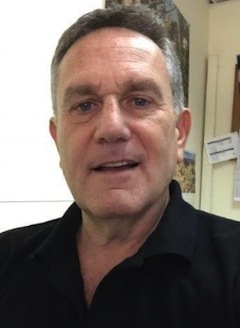
photo - Jay Shofet
Jay Shofet

The Canadian Society for the Protection of Nature in Israel (CSPNI) is a registered charity with the mission to raise awareness of, and funds for, the work of SPNI to protect and preserve Israel. CSPNI is, therefore, lending support to this program, which will be led by Jay Shofet, director of partnerships and development at SPNI.

A Brief History of Israel’s Environmental Movement: A Snapshot of Today’s Sustainability Challenges and Successes will highlight the programs run by SPNI. As well, Shofet will trace the growth of Israel’s environmental movement, from its early-decades focus on a romantic notion of conservation, through its growth and professionalization stage in the 1990s, to its grassroots focus on sustainability in the last decade. Then, he will give a snapshot of where things stand today: how a new ethos of dense, sustainable cities is slowly developing; how land-use planning affects everything; how the push for renewable energy is fighting against entrenched economic interests and old infrastructure; and how Israel’s world-class biodiversity is threatened by habitat loss and fragmentation – and what SPNI is doing about it.

The webinar begins at 10 a.m. To register, go to jccvictoria.ca/webinars-3.

Posted on November 13, 2020November 11, 2020Author JCC of VictoriaCategories LocalTags conservation, education, environment, history, Israel, Jay Shofet, JCC Victoria, SPNI
A shidduch like none other

A shidduch like none other

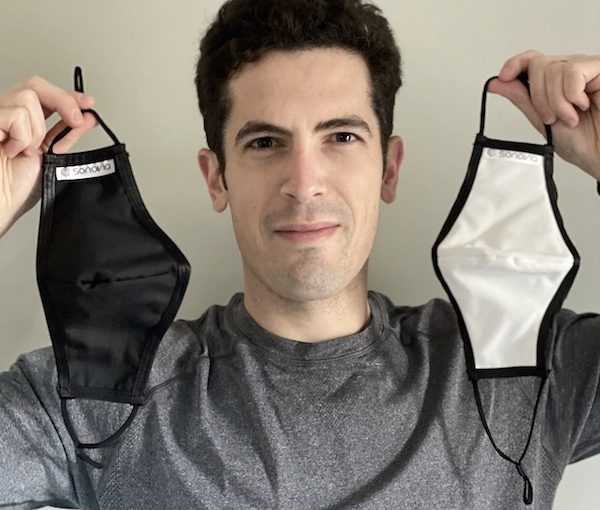
Brad Chenkis shows off a couple Sonovia masks. (photo from Tikva Housing)

It all began when Boris Chenkis, owner of After Five Fashions, was watching Israel Daily TV (ILTV) and saw an interview with Liat Goldhammer, the chief technology officer of an Israeli startup called Sonovia. She was talking about a new fabric-finishing technology for textile manufacturing developed at Bar-Ilan University, explaining that the technology could repel and kill bacteria located on clothing. Because it was in early January, a few weeks before COVID-19 became a worldwide pandemic, Chenkis just listened with interest.

On ILTV March 18, Dr. Jason Migdal, a microbiology researcher in Israel, discussed how the Sonovia technology mechanically impregnates metal nanoparticles into masks that destroy microorganisms in fabric. This was verified by two independent labs. It was also durable and washable. Now Chenkis was very interested.

With COVID becoming widespread, Sonovia had positively impacted Israeli doctors and health professionals by providing them with the technologically advanced masks. On May 12, Chenkis saw another interview about the Sonovia mask technology on ILTV – and an opportunity to get involved.

During his teenage years, Chenkis lived in Israel, studying and working at Kibbutz Rosh Hanikra. With this connection to Israel that never left his heart, he wanted to support an Israeli startup and so he purchased some masks to keep his family, friends and community safe. Soon after, he received an email from Sonovia, offering him an opportunity to help distribute the masks in Canada. Chenkis said yes. The masks were shipped from Ramat Gan to Vancouver and, within days, he was delivering hundreds to friends and family.

One of those who received the Sonovia mask was Yosef Wosk. Being both pleased and impressed with the technology, Wosk, like Chenkis, saw an opportunity to help not only the community here but also Israel. Wosk wondered how the masks could be made available locally to community members who might not be able to afford them, as they cost $65 each.

Wosk spoke with Shelley Karrel, chair of Tikva Housing, who contacted Tanja Demajo, chief executive officer of Jewish Family Services Vancouver. The need for the masks was confirmed and the shidduch almost complete.

Working with Chenkis’s son, Brad Chenkis, and with Wosk’s help, Tikva has acquired and will distribute 500 masks to residents of Tikva Housing, as well as clients of Jewish Family Services. It’s a win, win and win – tikkun olam, tzedakah and chesed.

For more information about the Sonovia masks, contact Brad Chenkis directly at [email protected].


Format ImagePosted on November 13, 2020November 11, 2020Author Tikva HousingCategories LocalTags After Five Fashions, Chenkis, coronavirus, COVID-19, health, Israel, Jewish Family Services, JFS, Shelley Karrel, Sonovia, Tanja Demajo, tikkun olam, Tikva Housing, tzedakah, Yosef Wosk
Must teach about Holocaust

Must teach about Holocaust

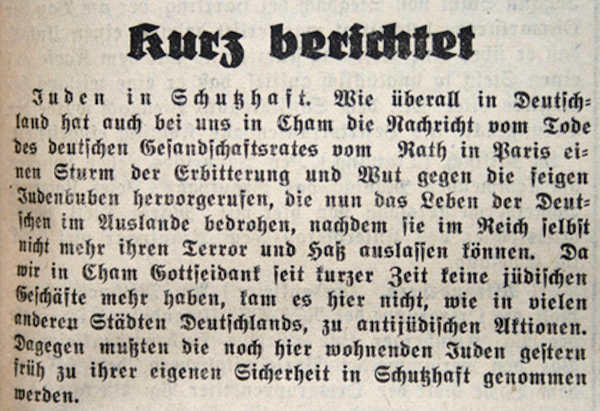
An item from the Nov. 10, 1938, newspaper in Helen Waldstein Wilkes’ mother’s hometown, Cham, Bavaria. It reads: “In Brief. Jews Taken into Protective Custody. As was the case everywhere in Germany, news of the death of the German Councilor von Rath in Paris unleashed a storm of bitterness and fury against the cowardly Jewboys who are now threatening the lives of Germans abroad because they can no longer unleash their terror and hatred within the Reich. Since, by the Grace of God, we no longer have any Jewish shops in Cham, anti-Jewish action did not take place as it did in so many other German cities. However, for their own safety, those Jews still living here had to be taken into custody yesterday morning.” (Translation by Waldstein Wilkes.)

As we have sat waiting to hear who will be president of the land that was once the beacon of hope for so many, we have asked ourselves, “What can I do? Are there meaningful avenues for action?”

Election day Nov. 3, Kristallnacht Nov. 9 and Remembrance Day Nov. 11 form a cluster. For Jews who became refugees or who lost family in the Holocaust and for all their descendants, Nov. 9 has particular resonance. Peter Gay was there. Here’s how he describes it:

“Synagogues were severely damaged or totally burnt out, sacred scrolls desecrated with the peculiar elation and ingenuity that the plunderers brought to their work. Businesses were destroyed, private houses and apartments were reduced to piles of rubble, with furniture, pictures, clothing and kitchen equipment thrown around so that they were barely recognizable. There was some looting…. But for the majority, the thrill lay in destruction for its own sake.

“The world watched, disapproved, and did almost nothing. In the United States, the public’s attention was still focusing on the midterm congressional elections of November 8, and the press was busy assessing the results.” (From Gay’s My German Question: Growing Up in Nazi Berlin, Yale University Press, 1998.)

For me, the parallels to today send shivers down my spine. The world must not be allowed to forget the depths to which humans can sink.

Awareness of the Holocaust is shrinking. In the United States, a 2018 survey showed that 66% of millennials could not identify what Auschwitz was. A recent survey revealed that about a third of 7,000 European respondents across seven countries knew “just a little or nothing at all” about the Holocaust.

Knowing about the Holocaust can provide a necessary understanding of how an entire population was bullied and manipulated by demagogues before succumbing to hate and fear-mongering. It can also serve as a blueprint for recognizing the dangers of demonization and incitement and help guard human rights and strengthen core democratic values.

Instead of endlessly fretting about social isolation and the threat of COVID-19, I’ve been seeking ways to make the gift of my days here on earth matter. I, a woman who calls herself “accidentally alive,” a woman who left her first home by horse and buggy, now count technology as among the miracles of my life. Recently, from out of the blue, the wife of a second cousin in New York, whom I’d met only once many years ago, decided to gather the extended family (all that’s left, thanks to Hitler and his efficient helpers) via Zoom. Welcoming me to this gathering of the mishpocha was a man in Israel claiming that his great-great-grandparent and mine had been siblings, and that he had read my book Letters from the Lost in connection with his volunteer work at a museum there. The museum used to be a kibbutz, founded by survivors from Theresienstadt, the concentration camp where both of my grandmothers perished and where most of my family suffered before being sent to their final destination, Auschwitz. Perhaps to distance itself from the German and to place upon it the stamp of renewal that Israel became for these lost souls, the kibbutz was named Beit Terezin.

Together with David, this fourth cousin in Israel, I am building a pathway for keeping alive that which we forget at our peril. Please, if you can, go to jgive.com and search for “Letters from Arnold.”

Using artwork and graphics contributed by those early survivors in Beit Terezin, alongside the words of my beloved Uncle Arnold, who spent 17 months in Theresienstadt before enduring the hellfires of Auschwitz, we hope to create a book that will find a home in every Holocaust museum in the world. If finances permit, we will use technology to bring the contents to life in new ways so that those who cannot visit a Holocaust museum in person nonetheless can receive our reminder that it must not happen again. Never Again.

I urge you to visit our website. And if you’d like to do an additional mitzvah, please forward the link to contacts near and far whose family members may once have lived through the hell of Theresienstadt – or worse.

Born in a country that no longer exists at a time hopefully never to be repeated, Helen Waldstein Wilkes describes herself as “accidentally alive” because she, too, was marked for eradication. Now an energized octogenarian with a richly rewarding life, she is author of two award-winning books, The Aging of Aquarius, an uplifting book that encourages people to live their passion by striving to effect change for the better, and Letters from the Lost (also available in German and Spanish translation), a moving memoir of how a box of letters from prewar and postwar Europe changed everything.

Format ImagePosted on November 13, 2020November 11, 2020Author Helen Waldstein WilkesCategories Op-EdTags Auschwitz, elections, history, Holocaust, Israel, Kristallnacht, Peter Gay, Remembrance Day, Shoah, Terezin, Theresienstadt, United States
Golden coins found

Golden coins found

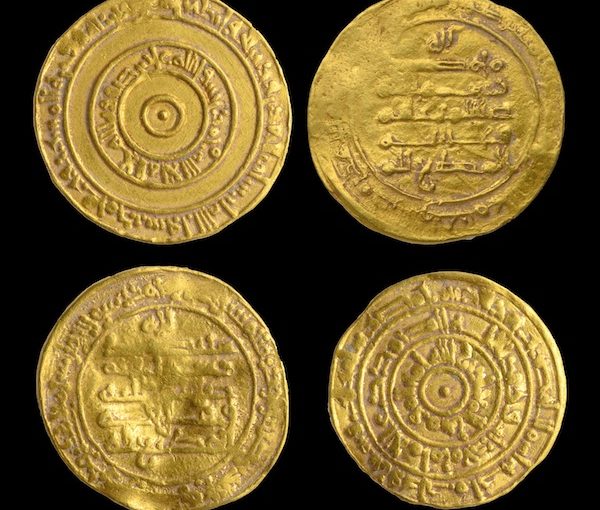
(photo by Shai Halevi/IAA via Ashernet)

A small pottery jar containing four pure gold coins dating from the Early Islamic period was unearthed during archeological excavations conducted by the Israel Antiquities Authority (IAA), as part of the Jewish Quarter Development Corporation’s plan to build an elevator and make the Western Wall Plaza more accessible. The jar was found by IAA inspector Yevgenia Kapil and, some weeks later, excavation director David Gellman found the coins inside it. “To my great surprise, along with the soil, four shiny gold coins fell into my hand,” said Gellman. “This is the first time in my archeological career that I have discovered gold, and it is tremendously exciting.”

According to IAA coin expert Dr. Robert Kool, “The coins date from a relatively brief period, from the late 940s to the 970s CE. This was a time of radical political change, when control over Eretz Israel passed from the Sunni Abbasid caliphate, whose capital was Baghdad, Iraq, into the hands of its Shiite rivals, the Fatimid dynasty of North Africa, who conquered Egypt, Syria and Eretz Israel in those years.”

According to Kool, “Four dinars was a considerable sum of money for most of the population, who lived under difficult conditions at the time. It was equal to the monthly salary of a minor official, or four months’ salary for a common labourer. Compared with these people, the small handful of wealthy officials and merchants in the city earned huge salaries and amassed vast wealth. A senior treasury official could earn 7,000 gold dinars a month and receive additional incomes from his rural estates amounting to hundreds of thousands of gold dinars a year.”

Format ImagePosted on November 13, 2020November 11, 2020Author Edgar AsherCategories IsraelTags antiquities, archeology, history, IAA, Israel

Khartoum changes tune

The latest Arab country to normalize relations with Israel is Sudan. It is the third Arab country in recent months to initiate bilateral relations with the Jewish state – and only the fifth in history.

In addition to the practical realities of the new relationship, there is also something symbolic about the announcement of mutual relations. It was in Sudan’s capital, Khartoum, that the Arab League met after the 1967 war and issued the “three nos” – no peace with Israel, no recognition of Israel, no negotiations with it.

After trouncing its invading neighbours in six days of war, Israel extended an olive branch, offering land for peace. In exchange for the Arab world’s recognition of Israel and its right to exist, Israel would return the land it obtained in the war to Egypt and Jordan. The response was the triple negative. The occupation of the West Bank and Gaza Strip began that year and could have ended that year, but Arab states were more opposed to any recognition of a Jewish state than they were concerned with the fate of the land Israel occupied or the people who lived there.

The seemingly sudden about-face by, first, the United Arab Emirates, then Bahrain and now Sudan has as much to do with regional geopolitics as it does with any Arab admiration for Israel. There is also the fact of the U.S. election in the timing of these announcements, and other international financial and defence features of these deals that are less clear in intent. In history, all things happen for a range of reasons – the end of apartheid, the collapse of the Soviet bloc, for example – but these various inputs do not distract from or diminish the larger outcome.

More than a half-century after the Arab world said no, no, no, so far in this year we have heard yes, yes, yes. And the rumours now are that Saudi Arabia will follow soon. This would be the most potentially significant development yet in this regard, even as there should be major questions about allying with another despotic regime.

What’s true is that the opening of relations with Israel represents an end to the effective Palestinian veto over Arab relations with Israel. And the radical departure of Arab states from the diplomatic status quo will likely alter the position of Palestinian leaders, as they realize their diminished standing in the Arab world’s regional calculation. That could result in the most substantial change of all.

Posted on October 30, 2020October 29, 2020Author The Editorial BoardCategories From the JITags Arab League, Israel, Khartoum, politics, Sudan
Tower of David conservation project underway

Tower of David conservation project underway

(photo from Tower of David Museum)

The Tower of David Museum has started one of the largest conservation projects in Israel, with work underway for a $40 million renewal plan led by the Clore Israel Foundation together with the support of the City of Jerusalem, the Ministry of Jerusalem and Heritage, and the Israel Ministry of Tourism. The Israel Antiquities Authority is supervising the archeological excavations and conservation of the project, which will double the current area of the museum to 20,000 square metres (more than 215,000 square feet). There will be a new sunken-entrance visitor centre, café, additional public bathrooms, as well as seven new galleries, additional exhibition spaces and two elevators, making the ancient citadel accessible to all. An educational complex of offices, classrooms and an auditorium will be constructed and a promenade added, which will be lined with archeological findings from the site.

Throughout the next two years, the museum will remain open (within the guidelines of the Ministry of Health), with temporary exhibitions, guided tours and cultural activities. A capital campaign has been initiated to complete the renewal project. At the same time, the museum continues to raise working capital to ensure that, even during the project and through the pandemic, the story of Jerusalem continues to be told. Last year, more than 500,000 people visited the museum, generating income for 80% of its budget, but the pandemic shutdown cut its income to zero, forcing the furlough of 85% of the working staff. Despite this, a small team is still creating live and virtual programming. In addition to fundraising, the museum has petitioned the government of Israel, including the Ministry of Culture, for support.


Format ImagePosted on October 30, 2020October 29, 2020Author Tower of David MuseumCategories IsraelTags conservation, history, Israel, Tower of David Museum

Historic win for Paul

In an historic victory, Annamie Paul was elected leader of the Green party of Canada Saturday, becoming the first Black person and the first Jewish woman to lead a federal political party. How historic this news is will depend on her impact on Canadian politics, beginning with her showing in a by-election in the riding of Toronto Centre at the end of this month.

Paul will also be challenged by some in her party who have taken exception not only to her moderate, conciliatory positions toward the Israeli-Palestinian issue but to her Jewishness itself. During the campaign, she was bombarded with antisemitic trolling, some from within her party, some from outside agitators. She overcame her nearest opponent, Dimitri Lascaris, on the eighth round of voting. Lascaris, one of Canada’s most vocal anti-Israel activists, was endorsed by a range of anti-Zionist figures, including Pink Floyd co-founder Roger Waters.

Lascaris has been a lightning rod in the party and the country for anti-Israel activists. When confronted during the campaign about the overt presence of antisemitic comments, ideas and harassment directed at Paul, Lascaris redirected, saying that antisemitism exists mostly on the right of the political spectrum.

Bigotry of every form must be acknowledged and condemned regardless of where it emerges. Pretending it does not exist and accusing one’s opponents of it while ignoring its presence in one’s own movement is a deeply unprogressive approach. Paul – as well as the Jewish community and all Canadians who seek justice and equality – must be vigilant and vocal as bigots react to the increased visibility of a Black Jewish woman leader.

The Green party has a history of problematic approaches to the Middle East, including a 2016 vote to endorse the BDS movement, later rescinded after then-leader Elizabeth May threatened to quit. That incident underscored the limited power of the leader’s role in the Green party. As Paul told the Independent in a recent interview (jewishindependent.ca/paul-hopes-to-make-history), she will not have the power, as leader, to make or alter party policy. May’s gambit – threatening to quit unless a position was reversed – is a rare tool in the kit.

Paul’s varied career has included roles as a director for a conflict prevention nongovernmental organization in Brussels, as an advisor at the International Criminal Court in The Hague and as a political officer in Canada’s mission to the European Union. She was co-founder and co-director of an innovation hub for international NGOs addressing global challenges and has worked with other NGOs, such as the Climate Infrastructure Partnership and Higher Education Alliance for Refugees. She was born in Toronto to a family that immigrated from the Caribbean and she converted to Judaism under a Hillel rabbi while studying at Princeton University.

In her interview with the Independent, Paul said she admires Canada’s politics of compromise, but that the climate crisis is an exceptional event that requires single-minded determination to address.

In her victory address Saturday, to a small group observing social distancing, she suggested the voting public is ready for politicians who look and think differently.

While British Columbians are focused on provincial politics with the Oct. 24 election – and the world awaits the outcome of perhaps the most consequential U.S. election in our lifetimes on Nov. 3 – we will keep an eye on the Oct. 26 Toronto Centre by-election to see the next step in the trajectory of this new leader on the federal scene.

Format ImagePosted on October 9, 2020October 8, 2020Author The Editorial BoardCategories From the JITags Annamie Paul, antisemitism, Canada, democracy, elections, governance, Green party, Israel, politics, racism
Unpacking Israel education

Unpacking Israel education

Dr. Noam Weissman, senior vice-president of OpenDor Media. (photo from OpenDor Media)

King David High School is one of 50 Jewish high schools worldwide participating in Unpacked for Educators, a series of educational videos and podcasts on Israel created by OpenDor Media with the goal of providing a nuanced, thoughtful and thorough approach to Israel education.

“Theirs is high-quality material available for free, and usually those two things don’t go hand in hand,” said Rabbi Stephen Berger, head of Jewish studies at KDHS. “OpenDor Media is passionate about education and Israel and we are blessed to be able to work with them.”

The videos, approximately 10 minutes each, deal with a wide range of material that ranges from lighthearted topics like falafel, Eurovision and hip-hop music to contemporary conflicts, terrorism and the Israeli settlements. The goal is for educators to select the subjects they want to address with their students and use the videos and podcasts as points for discussion, debate and engagement.

“For years, Israel education has been behind other education, so our goal here was to sandwich nuance with love and to educate rather than indoctrinate,” said Dr. Noam Weissman, senior vice-president of OpenDor Media. “We want our students to end their sentences with question marks, to foster curiosity and deepen exploration by showing multiple sides to an issue. We love Israel and, yes, it’s complicated and nuanced, with lots to debate. We have to allow our young people to make up their own minds and deliver good education.”

OpenDor’s mission is to change Israel education the world over and make Jewish and Israel education available and accessible to everyone, regardless of their location. Other participating schools are in South Africa, Australia, the United Kingdom, Israel, Hungary and the United States. In Canada, KDHS is among six participating schools.

OpenDor is working on increasing the number of podcasts and videos in its repertoire, and hopes to reach a point where Jewish schools, of all religious denominations, can be unified about how to engage their students with Israel education. To that end, in terms of sharing resources and improving pedagogy, Weissman said, “We make a whole suite of videos and podcasts you can pick from, so, if you don’t like one, pick another. We’re not telling schools what to teach – we’re trying to help them develop tools for how to teach.”

That’s a great resource at KDHS, Berger said. “Sometimes, our teachers don’t know all the information either, and these videos help our educators develop professionally. The videos are there to spark thought, and then to stop, explain and discuss with students. It’s not a movie. What OpenDor is doing is so well needed.”

Weissman said Seth Rogen’s opinions on the Israel education he received growing up in Vancouver are telling. “The Seth Rogen fiasco is another example of a Jew going through an educational institution and saying, ‘they did a disservice to me,’” he said, referring to a conversation between Rogen and Marc Maron in an episode of Maron’s WTF podcast in July. In that podcast, Rogen stated that he was “fed a huge amount of lies about Israel my entire life.”

“I don’t blame Seth Rogen, but I think the Jewish community needs to look inwardly and ensure Israel content and education is accessible to everyone,” Weissman said. “Israel education is at the point where we as a field know how to do this well. We have the resources, confidence and context to make a nuanced experience possible for all students.”

The videos and podcasts are targeted at ages 18 through 34. They are freely available on YouTube and are an educational resource for Jews of any age seeking to understand events in Israeli history. For more information, visit opendormedia.org.

Lauren Kramer, an award-winning writer and editor, lives in Richmond. To read her work online, visit laurenkramer.net.

Format ImagePosted on October 9, 2020October 10, 2020Author Lauren KramerCategories LocalTags education, Israel, KDHS, King David High School, Noam Weissman, OpenDor Media, Stephen Berger, Unpacked for Educators
Contemplating walls

Contemplating walls

The separation wall, Bayt Mirsim. (photo by Kevin Keystone)

In this three-part series, the author recounts some of his experiences on Masar Ibrahim Al-Khalil, the Path of Abraham the Friend, in the West Bank, which he visited in 2019. The articles have been adapted from a few of the letters he wrote home to family. The events and people described are real but, for reasons of privacy, the names are fictitious. To read Part 1, click here; for Part 2, click here.

Today was our last day on the trail. After many late nights of parlour games, beers and anticipation, we were tired. One of our fellow hikers, Felix, had to stop periodically: the soles of his shoes had worn through, he could feel the tiny stones biting underneath. Uncharacteristically, he was in pain, but he muscled through.

We descended into a valley, dotted with pale green brush, reminiscent of our first days on the trail. The valley opened into expansive views of olive groves, steppes cut into the hills, tidy rows of trees buttressed by stone walls. It could have been Tuscany but was the Middle East, with a warm breeze and soft, popcorn-shaped clouds overhead.

Admiring the scenery, I thought of what lay ahead. I would be spending tonight in Jerusalem. It was a place I hadn’t been since my Birthright trip eight years ago. My rabbi had once invited me on a congregational tour of Israel, in recognition of my service to the synagogue, but I turned it down. A friend rightly pointed out that, as an Arab Muslim, he couldn’t visit the Holy Land as readily as I could. In solidarity, he suggested I shouldn’t go. That seemed fair, so I didn’t. But here I was, so close to Jerusalem and the Wailing Wall. How could I not go?

* * *

It was a hot day on my Birthright tour. We weaved our way through the Old City, through its various souks and alleyways, to arrive at a platform high above the Wailing Wall plaza. Our guides wanted us to see it there first for a clear, unobstructed view. It wasn’t busy, just another day in Jerusalem at the Wall and the holiest site in Judaism. The wide-open plaza was sleek and clean, the great stone wall standing pink and golden.

We descended towards it, and I could feel the heat. I was dehydrated and a bit dizzy. Our guides released us and we ambled forward, dazed, in the wall’s general direction. A man stopped me and asked if I wanted to put on a prayer shawl. I did. He asked me if I wanted to lay tefillin. I had never done it before. He helped me. “Repeat after me,” he said. “Baruch atah Adonai …” as he wrapped the leather band around my forearm.

Prepared, I approached, pulled in by the wall’s gravity. I slipped off my sandals to stand on the ground with my bare feet. I pressed my hand to the mottled stone and closed my eyes. “Baruch atah Adonai,” I began. Strangely, I felt both heavy and light, a yearning and also a surrender. I said the Avot v’Imahot, the prayer that recognizes our descent from Abraham and Sarah, tracing us back through the generations. I didn’t know, then, how important that moment and that prayer would be.

When I was finished, I slipped on my sandals and stepped away.

* * *

“This might be the most beautiful day on the trail,” said Jane, a soft-spoken homeopath, a Mancunian and longtime friend of fellow hikers Eve and Oliver. Her husband George was in business software. He regularly meditated.

She was right. I was worn out but had to agree. It was beautiful. Picturesque, even. Idyllic. We pulled over, as we had during our first week, to have coffee with olive harvesters and help them rake the trees. A young mother with her toddler, husband and parents: harvesting is so often a family affair. Hospitable as ever, much coffee and tea was poured and drank, olives collected, tobacco rolled, puffed and exchanged. We waved our goodbyes – shukran, aleykum salaam – and continued on.

A stretch of valley gave off onto a final stretch of orchards and, as I clambered over the low stones, I looked up and saw the separation wall. From a distance, the 25-foot concrete wall, scrawled with barbed wire, rose through the canopy of the trees. Hesitatingly, I walked towards it, tracing its contour in my mind. In some parts of the West Bank, the barrier is composed of giant slabs of concrete dotted with military towers; in others, it is coiling pyramids of barbed wire or electrified fence bordered by wide swaths of sand to detect trespassers. Here, it is rebar and cement, two-and-a-half storeys high, and cuts through olive groves and the hills around it. I pressed my hand to it; it was cold and abraiding. I closed my eyes and said a prayer for a future without it.

photo - Dawn at the Dead Sea
Dawn at the Dead Sea. (photo from Kevin Keystone)

* * *

Compared to the West Bank, downtown Jerusalem feels like another planet. I spent that night in a small apartment hotel off Jaffa Street, a few blocks from the Old City. It was a one-bedroom suite with a fully equipped kitchen and three-piece bathroom. The water was hot, the shower had walls and a showerhead, and I could drink the water. It was unlike many nights on the Masar.

Jaffa Street reminded me of places like Vienna or Vancouver: the pavement was so clean you could eat off of it. The pedestrian walkways alongside were spacious and wide, paved with smooth and even slate-gray tiles. The streetcars were sleek and punctual. Art galleries and museums, ornamental lights and public transportation, urban and urbane. First world versus developing; moneyed versus struggling. The contrast was deeply uncomfortable.

My friend Marta and I wound our way through the narrow, dreamlike alleyways of Nakhalat Tziyon, the walls lined with thick slabs of golden Jerusalem stone. A playful breeze danced through the trees. We stopped for lunch at a picturesque café, complete with colourful outdoor seating and painfully handsome servers. The food was delicious and expensive; we ordered hummus that came with falafel and sweet lemonade.

“How is this real?” I asked her.

“I know,” she said. “It’s shocking.”

After lunch, I returned to the place I had been many years before. I followed the signs in the Old City, the pull magnetic, feeling a mix of dread and anticipation. I saw it first as before, from above, the top of the staircase leading down to the Kotel.

Few tourists were out today, just the heat and people praying. Orthodox tradition dictates separating the genders; indeed, on the women’s side, a fraction the size of the men’s, Torah scrolls are still officially prohibited. Today, the women’s side was packed, the men’s side dotted with the odd worshipper. At the tefillin tent, an old man shawled me in his tallit. A red-headed, black-hat wearing Charedi named Isaac helped me with the tefillin. He looked about my age, or a few years younger. In another life, I wondered, would I have been him?

“Did you do this yourself?” he asked, pointing to the forearm I had already bound.

“I did,” I said. For a month, in the intervening years, I had done it every morning. “I just can’t remember how to do the hand part.”

“I can help,” he said. Isaac said many things: about God, what God wanted, the prayers I could say at the Wall. “Sometimes, you might feel like the worst Jew ever,” he said. I didn’t. I never felt that way. I wasn’t a “good Jew” or a “bad Jew,” I was just Jewish.

“Say a prayer for all your loved ones, then say a prayer for yourself,” he said. “Then maybe you’ll say a prayer for me, too.”

Blocks of stone peppered with bits of paper: the wall hadn’t changed, but I had. I pressed my hand to it, feeling its soft, pockmarked face, and closed my eyes.

* * *

I’m home now, in Canada, and wonder about my travels. I came back “with eyes wide open,” as my rabbi had prayed: to the painful, joy-filled and resilient lives of the Palestinians I met. I think about the separation wall and the Kotel, how they’re connected and what it meant to pray at them, different but related prayers. If the Wailing Wall is part of us as Jews, then perhaps its future and our spiritual liberation is bound together with the separation wall. Perhaps the Kotel will never truly be honoured until we bring down the separation wall. As I contemplate the stories of our freedom from bondage, I’m reminded of the idea that our liberation, spiritual and otherwise, is bound up with the liberation of others.

Kevin Keystone is a Toronto-based freelance writer, editor and researcher. When not hiking long-distance trails, he can be found reading, spending time with friends and family, or with his beloved partner, Aaron. His writing has been published in the Literary Review of Canada, the Jewish Independent and Good Old Boat. For this series, he thanks the guides and staff of Siraj (the Masar Ibrahim Thru-Hike tour operator), the host families and locals he met along the way and his fellow hikers, as well as friend and editor Matt O’Grady.


Format ImagePosted on October 9, 2020October 8, 2020Author Kevin KeystoneCategories IsraelTags education, hike, Israel, Israeli-Palestinian conflict, Masar Ibrahim Al-Khalil, Palestine, Path of Abraham the Friend, peace, politics, separation wall, Siraj Centre

Posts pagination

Previous page Page 1 … Page 41 Page 42 Page 43 … Page 111 Next page
Proudly powered by WordPress