מנהיגי מדינות עמם שוחח הנשיא ביידן עד כה, שבוע אחרי ההשבעה, לפי סדר השיחות: טרודו קנדה, לופז אוברדור מקסיקו, ג׳ונסון בריטניה, מקרון צרפת, מרקל גרמניה, סטולטנברג נאטו, פוטין רוסיה ויושיהידה סוגה יפן.
גידול במספר העולים לישראל מקנדה
גידול משמעותי במספר העולים מאארצות הברית, קנדה ובריטניה וכעת הם באים גם מלב המיינסטרים.
על תנועת העליה מקנדה – נפש בנפש
נפש בנפש היא תנועת העליה מאצורת הברית, קנדה ובריטניה. לפני שנה פורסם על קפיצה במספר המתענינים בעליה לארץ. בגלל הקורונה רבים דחו את הגעתם. משרד הפנים בישראל דורש מהם יותר ויותר מסמכים שלא ניתן להנפיק בימי הסגרים. ומה מה שחדש פרופיל העולים לעתיד: עד כה היו כמעט כל העולים מהארצות האנגלו סקסיות ארה”ב, בריטניה וקנדה. בהם מהפריפריה שלהן: דתיים, חרדים, מהגרים (בני יורדים), רוסים, פרסים, וגם גרי צדק. פה ושם עוד כמה בוגרי תגלית.
לא רק בבני ברק
משטרת מונטריאול פיזרה מתפללים יהודים חרדים שהפרו את הנחיות הקורונה. חלק מהמתפללים תקפו את השוטרים באלימות וקראו להם נאצים. שארבעה שוטרים נפצעו קל באירועים חמורים אלה.
הקלות של רישום ברשות המיסים הקנדית
בניגוד למדינות אחרות, כמו קנדה למשל, שבה אדם צריך רק להירשם ברשות המיסים ולקבל מיד, בלחיצת כפתור, כאלפיים דולר לחשבונו. את מרבית הכסף לא צריך כלל להחזיר. בישראל זה אחרת: ולמה כוונה? בלחיצת כפתור אני מקבל כסף יפה מן הממשלה מתוך ידיעה ברורה שאני כורה בור לעצמי. כי אחרי כן יהיה עלי להשיבו לקופת האוצר בריבית דריבית.
סדאמן של קנאטק יבוא מאורורה קנדה
תמונות שמטופל שלח לי, אומר שנראה מדהים.עוד לא עישן את הקנאביס, אם מישהו לקח אשמח לחוות דעת?
הדרכון הפורטגלי עבר את הקנדי
ארה״ב, אנגליה, נורווגיה, אוסטרליה, קנדה ועוד קרוב למעלה ממאה ושמונים מדינות אחרות כולן נשארו מאחורי הדרכון הפורטוגלי – שדורג בתור אחד מששת הדרכונים המובילים בעולם.
אינוקאן הישראלית נסחרת בבורסת טורונטו
כבוד לאינוקאן הישראלית שנסחרת בבורסת טורונטו בקנדה על הדרך שהיא עושה. אני עוקבת אחר החברה שהשקעתי בה, עוד בהיותה סטארט אפ לפני כשנתיים. הסיבה שבחרתי להשקיע דווקא בה מכל הסטארטאפים האחרים היתה לאחר כנס משקיעים בו פגשתי את הנהלת החברה.
חברות ישראליות בקנדה
משהו יודע היכן ניתן למצוא חברות ישראליות שיש להם סניפים בקנדה?
מחפשת בתי גידול לכלבים בבריטיש קולומביה
מישהו מכיר בתי גידול בקנדה? רצוי באיזור ונקובר בבריטיש קולומביה?
מחפשים יועץ מס בקנדה
מחפשים יועץ מס שמבין בסוגיות מיסוי בין ישראל לקנדה רצוי ישראלי, אבל מניחה שלא חובה.
עזרה למובטלים נפגעי הקורונה
ביום שלאחר הקורונה נשאר עם אלפי מובטלים, אחוז ניכר מהם בעלי משפחות שחיו מעל קו העוני לפני המשבר. איך מחזירים אותם לעמוד על הרגליים?
למען היום שלאחר המשבר, צריך להקים כבר עכשיו תכניות שיקום כלכליות ותעסוקתיות שיחלצו את המשפחות מהעוני ויחזירו אותן למסלול העבודה במהירות.
בינתיים, הרמנו את הכפפה והתחלנו עם תכנית משלנו. קידום, תכנית חירום מבית ידידות טורונטו למשפחות שנפגעו כלכלית כתוצאה ממשבר הקורונה, מציעה להן ליווי כלכלי, תעסוקתי ומשפחתי מותאם אישית, באמצעות מלווה משפחות בעל הכשרה בתחום. התכנית מסובסדת באופן מלא, עם עלות דמי רישום בלבד.
אנו קוראים לממשלה להקים תכנית דומות שיחלצו את המשפחות מהעוני שנכפה עליהן, ויחזירו אותן ליציבות כלכלית.
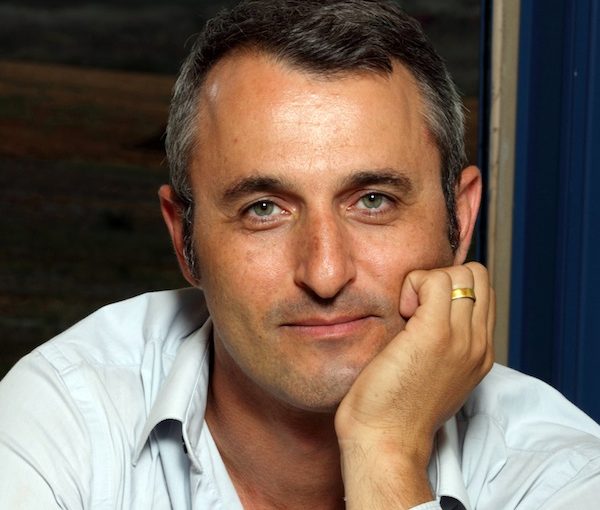
Israeli writer Eshkol Nevo, whose latest novel is The Last Interview, opens the JCC Jewish Book Festival Feb. 20. (photo from JBF)
This year’s Cherie Smith JCC Jewish Book Festival opens online Feb. 20, with Israeli writer Eshkol Nevo, whose latest novel, The Last Interview, brilliantly sprinkles facts amid a lot of fiction and interjects humour into much pathos. It entertains, of course, and, as all good books do, it raises many salient points that will get readers thinking – and feeling – about, in this case, storytelling, marriage, truth, parenting, friendship, lies, family, identity, media, politics and relationships. So, life.
In The Last Interview, the protagonist, who is suffering from a chronic form of depression and writer’s block, responds to an interview sent to him “by an internet site editor who collected surfers’ questions.” He later notes, “It was supposed to be only an interview, nothing else, but slowly – it seems I can’t do it any other way – I’ve been turning it into a story. I was supposed to leave Dikla and the kids and the dysthymia out of it. And all of them are in it.” This inability to stop himself from telling stories about others in his published writing is an Achilles’ heal in his personal life, but a boon to his professional one.
His interview answers are sometimes short and direct:
“How do you manage to deal with the loneliness that’s part of writing?
“I don’t.”
But, most often, they are quite involved, going into more detail, retrospection and introspection than the questioners would ever have expected. We learn about his failing marriage, but also its sweet beginnings. We are privy to his feelings about his best friend, who is dying of cancer. We see how he struggles to be a good father to his three kids. We hear some of his travel adventures. We witness his attempts to extricate himself from an unwanted speech-writing gig. We share his discomforts with the Israeli-Palestinian situation. We find out a bit about his motivations for writing:
“If I don’t write, I have nowhere to put my memories, and that’s dangerous. I have a problem. I don’t forget anything. My forgetting mechanism is completely screwed up. All the partings, the deaths, the unexploited opportunities. They are all trapped in my body, and writing is the only way to release them … if I don’t occasionally unburden myself of the weight of some of those memories, I won’t be able to breathe. No air will enter my body. Or leave it.”
Part of his current creative block – “I was supposed to be writing a novel this year. Instead, I’m writing answers to this interview” – is that he and his wife are becoming more distant. “I can’t say that I became a writer to win Dikla’s heart, but I can assume that with another, less stimulating woman, I wouldn’t be writing.” He notes that, since his first letter to her, “In fact, everything I’ve written since then, eight books, is one very long letter addressed to her.” At the end of a lengthy response to the question, “All of your books are written in the same style. Have you ever thought of writing something completely different? Maybe science fiction? Fantasy?” he says that genre wouldn’t make any difference: “In any case, it would turn out that, once again, I wrote about an impossible love.”
While the overall mood of The Last Interview is solemn, there are many funny parts. One especially hilarious section is the writer’s response to the question, “When will they produce a film adaptation of your latest book? When I read it, I could actually imagine the movie.” As the writer shares the details of an encounter with a filmmaker of a similar opinion, the conversation cynically – but with the ring of truth – moves from flattery to the many ways in which the movie will ultimately be unrecognizable from the book, yet concluding nonetheless with the filmmaker enthusing, “The minute I finished it, I said to my wife: This is a movie!”
With a writer as intelligent, sensitive and amusing as Nevo and an interviewer as experienced as the Globe and Mail’s Marsha Lederman, the book festival’s opening event should be well worth attending. For tickets to it, and for the full lineup of events, visit jccgv.com/jewish-book-festival. The festival runs to Feb. 25.
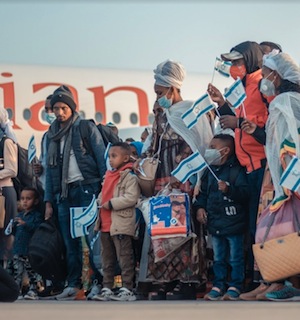
Israel’s Operation Tzur Israel, bringing olim from Ethiopia to Israel, began Dec. 3. (photo by Kassaw Molla)
It’s been almost 40 years since Israel coordinated the first airlift of Ethiopian Jews to Israel in 1984. The Beta Israel people, a citizenry of more than 100,000 at the time, were facing starvation in the midst of Ethiopia’s civil war. By the end of Operation Moses, some seven weeks and 30 clandestine flights later, more than 8,000 men, women and children had been airlifted to Israel. Since that time, Israel has rescued more than 30,000 Beta Israel from northern and central Ethiopia.
The impetus for saving Ethiopia’s fractured and often-persecuted Jewish populations goes back to 1921. Rabbi Abraham Isaac Kook, the then-Ashkenazi chief rabbi of British Mandatory Palestine, made an appeal for Jews to rescue the “holy souls of the House of Israel” from “extinction and contamination” in Ethiopia. His urging would be repeated by numerous other rabbis, including a former Sephardi chief rabbi, the late Ovadia Yosef, who, five decades later, declared the population eligible for aliyah to Israel. Nonetheless, there are thousands of Ethiopian families still waiting for their turn to move to the Jewish homeland.
Descendants of Beta Israel
The Jewish enclaves of Gondar City and the Ethiopian capital of Addis Ababa are home to the descendants of those first refugees of the 1980s and 1990s: grandchildren and great-grandchildren, fathers, mothers and children who were born while their parents waited for Israel to fulfil its stated promise to provide a new home. Their primitive living conditions, say aid workers, are often the product of circumstance. In a 2014 interview, Rabbi Sybil Sheridan (now Romain), a co-founder of the aid organization Meketa, told me that the Beta Israel moved to Gondar City from their ancestral farmlands decades ago due to persecution, with the implicit understanding that their next home would be in Israel.
“They gave up their things, they gave up their jobs, they left thinking they would actually be on the next plane,” Sheridan said. For many, those years of waiting for the next plane have resulted in a week-to-week existence, hinged on the assurances of a future that will reunite them with their now-Israeli families.
In 2003, the Israeli government announced that 20,000 Jews would be allowed to move to Israel, but that plan was later dropped when the Ethiopian government objected to the mass emigration. In 2015, when it became evident that Jewish populations were still at risk from persecution, the Knesset declared it would rescue 9,000 Ethiopian Jews, and would complete the airlifts by 2020. Fewer than 1,000 individuals have been admitted during that time.
In October 2020, Prime Minister Binyamin Netanyahu announced that 2,000 olim would be airlifted to Israel by the end of 2020. The deadline for Operation Tzur Israel (Rock of Israel) has been extended to the end of January 2021, and is gradually being fulfilled. Last month, roughly 700 olim arrived from Gondar and Addis Ababa. Another two airlifts this month have brought the total to roughly 1,500.
Israel’s Operation Tzur Israel has brought approximately 1,500 Ethiopians to Israel so far. (photo by Noga Melsa/Ministry of Absorption and Immigration)
Family members and aid groups in both countries say the 2,000-person limit is not enough. Those waiting in Israel to see their relatives say they are worried for their families’ safety with the risk of civil war and the coronavirus pandemic. Aid organizations argue that the country’s economic shutdown in March is still causing widespread unemployment. While Meketa and Struggle to Save Ethiopian Jewry (SSEJ), two aid groups that work to support the communities, have been shipping in food to the community synagogues, they warn that families are still at risk from famine.
Avi Bram, a trustee for Meketa, said conditions in Gondar are worrisome. “The community is in a very bad situation. Many, not all, but many are in a very, very poor and unsettled standard of living, especially now because of the pandemic.”
Bram said the original mandate of Meketa, which was established in 2013, was to reinforce independence for the community through training, conversational Hebrew classes and small business micro-loans. It was never designed to be a supplemental food program. But the aid is critical at this time. “It fills a humanitarian need,” he said.
SSEJ representative Jeremy Feit said the organization does what it can to support impoverished members of the Addis Ababa community. It arranges medical assistance for children under 5 and seniors, and hot meals for malnourished children and pregnant and nursing mothers.
“The end goal of the work is to limit needless suffering and deaths, while urging Israel to evaluate their claims and allow those eligible to make aliyah as soon as possible,” said Feit.
Aid groups Meketa and Struggle to Save Ethiopian Jewry provide emergency food to Ethiopian Jewish communities waiting for aliyah. (photo from Meketa)
Mengistu (no last name given), who lives in Ethiopia and has relatives in Israel from a previous aliyah, said the communities are facing increasing danger. “On one side, there’s coronavirus,” said Mengistu. On [another] side there’s the war,” coupled with endemic unemployment and famine.
According to Mengistu, the changing criteria for airlifts are only inciting more stress at home.
“[They] said they would bring 2,000 people at the end of this year,” Mengistu said. “We don’t know if they applied their decision [because] every time they decide [on a quota], they change it.
“So, who are they going to bring? Are they going to bring children? Are they going to [separate] brothers and sisters and leave [some] with their parents? Two thousand people, it’s nothing,” Mengistu said, “compared to the [actual number of] the people still in Ethiopia.”
A stalwart proponent
In May of last year, Pnina Tamano-Shata was appointed minister of absorption and immigration by the Likud-Blue and White coalition. The 38-year-old Ethiopian-born Israeli came with life experiences that made her an ideal candidate for the position. She and her family had immigrated during the 1980s rescue Operation Moses, during which an estimated 4,000 refugees died en route. She knows firsthand the conditions that today’s Ethiopian Jewish communities are forced to endure while they wait for aliyah.
She also isn’t bashful in her support for immigrant rights or services. In October, she negotiated an agreement with the Israeli nonprofit Shavei Israel to airlift approximately 700 Bnei Menashe Jews from North India. As part of the agreement, Shavei Israel would cover all transportation costs. The new immigrants will quarantine at a moshav before settling into their new homes and reuniting with their families.
Israel’s Minister of Absorption and Immigration Pnina Tamano-Shata is the first Ethiopian-born woman to hold a Knesset seat. (photo from Ministry of Absorption and Immigration)
As well, she has put forth a vision and a budget for how to finally resolve the humanitarian crisis in Ethiopia.
In August, Tamano-Shata proposed a plan that would allow, in her words, for Israel to “close the camps” in Gondar and Addis Ababa. Approximately 4,000 of 8,000 olim would be airlifted to Israel by year-end and the rest would follow by 2023. The NIS 1.3 billion ($380 million US at the time) proposal received support from all sides but was never adopted. The Netanyahu government later endorsed a limit of 2,000 by Dec. 31, with assurances of more immigrants at a later date.
Still, Tamano-Shata says she is committed to seeing the aliyah to its end. “[To] my dismay, we were unable to approve the national budget which was supposed to include the outline for the aliyah of those remaining in Ethiopia,” Tamano-Shata told the Jewish Independent in a recent email interview. “However, this does not prevent me from continuing to push for a comprehensive solution for this issue.”
To Mengistu, like many in Ethiopia’s Jewish enclaves, Tamano-Shata’s words are a hopeful sign. “Because now the help for the aliyah is Pnina,” said Mengistu. “She’s one of us. So maybe she will understand the situation and the [reason for] the protests [in Israel.] Maybe things will change.”
With Israel now set to face a fourth election in just two years, Tamano-Shata’s future as the next minister of absorption and immigration is yet to be determined, but her motivation to see the end of what is arguably Israel’s greatest humanitarian crisis remains firm. In 2016, the then-new minister was recognized by humanitarian activist Martin Luther King III for her efforts to establish better protections for Ethiopian immigrants in Israel. Last year, she toured the Addis Ababa enclave and handed out baskets of food to residents. She said she is committed to the rights of Israel’s olim, “despite the policies of lockdowns, shutting of flights and closing of the skies that exists in many countries due to COVID-19.”
At this point, all eyes are on Tamano-Shata. Few doubt that she will meet her stated commitment of 2,000 olim by Jan. 31. But can she, as well, engender better trust between Israel and those waiting for aliyah?
In a recent interview for the podcast One Jewish Family, Ambanesh Biru, former chair of the Gondar Jewish community, summarized the views of a hopeful community that knows its safety may rest in the Israeli government’s understanding of their predicament.
Don’t forget about the Ethiopian Jewish community, said Biru, “especially those [anticipating] aliyah. Because all of the Jews in Gondar and Addis Ababa came from villages expecting they would be going to Israel right away, not to live in Gondar [for the rest of their lives]. So, if anybody comes and talks about aliyah from Israel, please do your best [to follow through].”
Jan Lee’s articles and blog posts have been published in B’nai B’rith Magazine, Voices of Conservative and Masorti Judaism, Times of Israel, as well as a number of business, environmental and travel publications. Her blog can be found at multiculturaljew.polestarpassages.com.
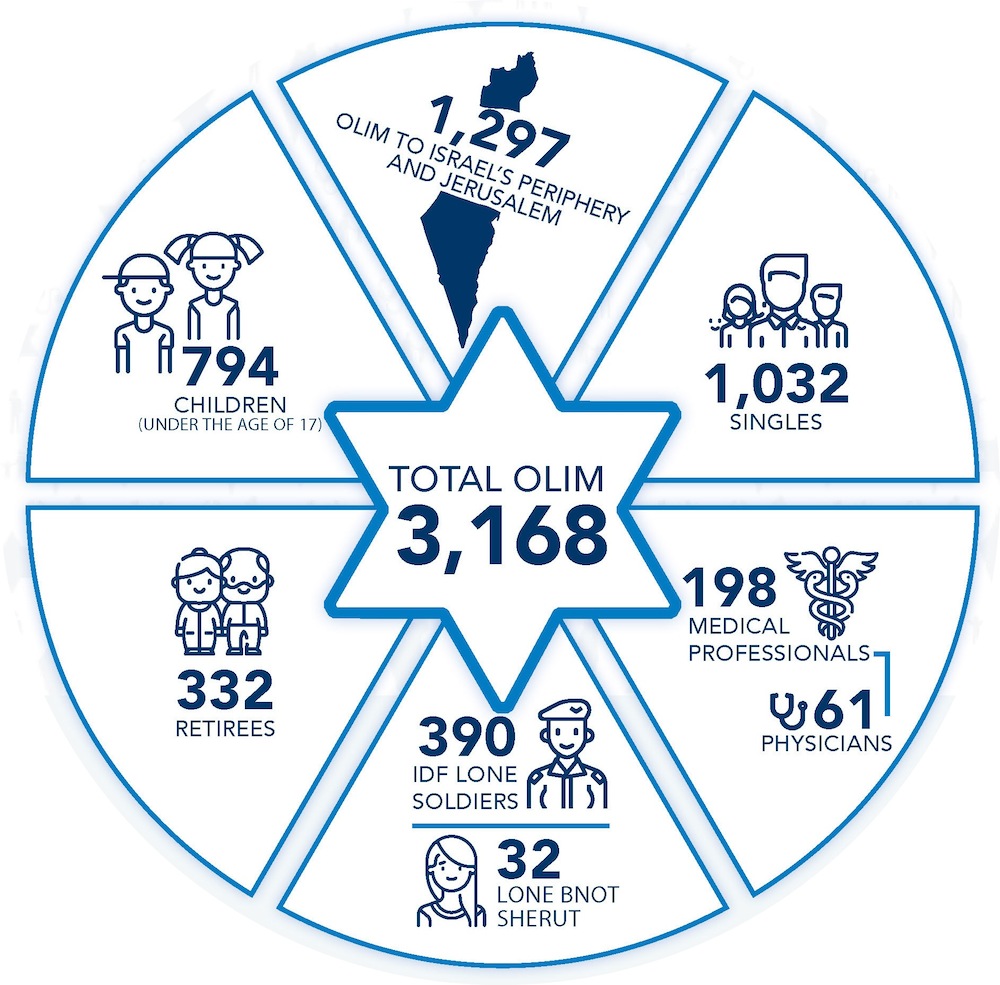
The breakdown of Nefesh B’Nefesh 2020 aliyah. (image from Nefesh B’Nefesh)
Despite a challenging and tumultuous 2020, 291 individuals from Canada decided to make aliyah and move to Israel with Nefesh B’Nefesh (NBN) over the past year. The Canadians were among the 3,168 individuals who moved to Israel from North America in 2020 – 2,625 since the COVID-19 pandemic hit.
Founded in 2002, Nefesh B’Nefesh, in partnership with Israel’s Ministry of Aliyah and Integration, the Jewish Agency for Israel, Keren Kayemeth LeIsrael and Jewish National Fund-USA, has assisted in easing the aliyah process for more than 65,000 olim since its inception. With the help of its partners, NBN assisted nearly 90% of the total number of olim that arrived in 2019.
Since January of 2020, Nefesh B’Nefesh olim have most often hailed from New York, New Jersey, California, Florida, Ontario, Illinois, Massachusetts, Maryland, Pennsylvania and Texas. Altogether in the past year, 811 families chose to move their lives to Israel, along with 1,032 singles and 332 retirees. There were 61 physicians among a total of 198 medical professionals who arrived in Israel in the last year, most of whom joined the frontlines in Israel’s fight against the coronavirus. And 390 young men and women stepped off the plane with the desire to serve Israel as lone soldiers.
In addition to the olim who arrived throughout 2020, Nefesh B’Nefesh received 6,704 aliyah applications, in contrast to 3,035 in 2019 – marking a 126% increase in interest in aliyah.
The breakdown of Nefesh B’Nefesh 2020 aliyah. (image from Nefesh B’Nefesh)
“From the earliest days of the Jewish state, no matter how trying or difficult the circumstances, aliyah has always continued in order to preserve what was once a distant dream for our parents and grandparents,” said Rabbi Yehoshua Fass, NBN co-founder and executive director. “As we look back at the challenges everyone faced in 2020, we are extremely proud of what we have accomplished together. We look forward to watching each oleh grow and build their new lives in Israel, and eagerly look ahead to 2021, a year with the potential to exceed all expectations in aliyah.”
“I welcome the dozens of new olim who chose to leave everything, especially during the time of a global epidemic, and fulfil their dreams of building new homes for themselves in Israel,” said Minister of Aliyah and Integration Pnina Tamano-Shata. “Many will surely remember 2020 as a challenging and complex year, but the olim who arrived [recently] from across the U.S. and are part of the last group of olim this year, are enabling it to be shaded in more encouraging and optimistic colours.
“Despite COVID-19, the Jewish nation is thriving and aliyah is continuing,” Tamano-Shata continued. “In the past year, more than 20,000 olim from 80 countries around the world made aliyah.”
“The thousands of new olim from North America and around the world, during a year of a global pandemic, lockdowns and almost complete paralysis of international air travel, emphasizes how much the longing for Zion is deeply ingrained in the hearts of the Jewish people around the world,” said Isaac Herzog, chair of the Jewish Agency.
The top 10 cities in Israel that new olim chose as their homes this year were Jerusalem, Tel Aviv, Beit Shemesh, Ra’anana, Haifa, Herzliya, Netanya, Modiin and Be’er Sheva. The olim most commonly worked as educators, physicians, nurses, social workers and lawyers, as well as in the fields of marketing, sales and business. The average age of an oleh this year is 30, with the oldest being a 97-year-old and the youngest being only 35 days old.
When the pandemic began in earnest in March 2020, Nefesh B’Nefesh adapted its various programming and transitioned into holding virtual meetings, webinars and informational sessions. The online seminars have allowed the organization to reach a much wider audience and have included a wide range of subjects, from choosing communities and special webinars for medical professionals, to how to pack and ship for aliyah.
The ongoing support after aliyah provided by NBN has meant that 90% of its olim have remained in Israel, leading to tens of thousands of new Israelis who go on to make significant contributions to the country.
The good diplomatic news keeps coming. Morocco and Israel have announced that they will begin normalizing bilateral relations. This comes on the heels of similar announcements between Israel and the United Arab Emirates, Bahrain and Sudan. There are rumours of more announcements to come.
More than 10% of Israel’s population has family roots in Morocco, adding to the emotional impact of the latest announcement.
In a year that has strained credulity in so many ways – few of them cheery – these diplomatic moves have been a bright spot. Even some longtime international observers and commentators are dumbfounded by the speed of the developments. For decades, the conventional wisdom of Middle East watchers has been that Arab recognition of and peace with Israel rests on a resolution of the Palestinian issue. Bypassing that step is a massive about-face for the countries that have made nice with Israel, and it is galling to the Palestinians and their representatives.
In most cases, the thaw in relations is a de jure recognition of de facto relations that have been in progress for years. Under-the-radar visits and economic ties have existed between Israel and some of these states long before they were officially acknowledged and celebrated. Bringing these relations out in the open was eased by a little self-interest, with a degree of cajoling and likely backroom dealing from the U.S. president and his administration.
The incentives for Arab and Muslim states to warm the cold shoulders they have given Israel include realities of geopolitics – countering the regional designs of Iran and Turkey – as well as the basket of inducements presented by the Americans. For example, the latest announcement – between Morocco and Israel – involves American recognition of Moroccan sovereignty over disputed territories of Western Sahara and American promises of billions of dollars of investments in the Moroccan economy.
Similarly, the American-brokered relationship between Israel and Sudan hinged on Sudan’s removal from the U.S. list of state sponsors of terrorism (contingent on Sudan’s provision of $335 million in compensation for victims of the Sudanese-related terrorist bombings against American interests and citizens).
The UAE and Bahrain agreements also had carrots attached. In exchange for their acquiescence, the UAE may obtain valuable American F-35 fighter jets.
All the states launching fresh relations with Israel open the opportunity for potentially lucrative deals with Israeli businesses and investors. In other words, the diplomatic thaw is not a consequence of a sudden awakening to the benign presence of what has been known by most of these states until recently as the “Zionist entity.” The trading of economic and military incentives – as well as the seemingly nonchalant abrogation of self-determination for the people of Western Sahara – suggest as much self-interest as affection for Israel.
The diplomatic isolation of Israel that began at the moment of its rebirth in 1948 was founded primarily on the rejection of the idea of Jewish self-determination – at least in the Jewish people’s ancient and modern homeland. The opposition to Israel’s existence was not premised on economic or diplomatic reasoning but, to a much greater extent, on anti-Jewish animus.
Israel’s isolation represented an abandonment of self-interest on the part of Arab and Muslim countries. Ghettoizing their own economies from the economic powerhouse of the region has been harmful to all people in the region. None have been harmed more than the Palestinians themselves, who have something to gain materially from good neighbourliness with Israel.
The series of announcements on diplomatic relations are not a result of any altruism. At least in part, they came about through old-fashioned horse-trading, including some morally questionable trade-offs, such as the forgiveness of terrorism and an internationally contentious occupation of a foreign territory, and weapons sales.
After 72 years of nearly universal rejection of Israel by its neighbours, a thaw motivated by self-interest is still a thaw. And it’s something about which to be cautiously optimistic. But it’s only a start, and there is much to be done to build the region into one that’s united in peace. It might be naive, but we still cling to the hope of Isaiah that all those weapons will eventually be exchanged for ploughshares and pruning hooks that, one day, the world over, “nation shall not lift up sword against nation; neither shall they learn war anymore.”
Uri Adoni shares “The Six Rules of Chutzpah” in his book The Unstoppable Startup. (photo from Uri Adoni)
Uri Adoni, author of The Unstoppable Startup – Mastering Israel’s Secret Rules of Chutzpah, is on a mission to teach businesspeople how to use chutzpah to their advantage.
Born and raised in Israel, Adoni was working at a large advertising agency when the internet was just starting to catch fire.
“I really remember the exact moment when I first saw the internet,” Adoni told the Independent. “It was back in 1995 and it really blew my mind. I said, ‘Wow! I can talk to somebody in Singapore!’ It was very slow, dial up. It took ages to download anything, but it was crazy for me. And then I realized I just had to be part of it.
“Funnily enough, one of the partners in the agency at the time, he said to me, ‘This internet thing, it’ll never catch on.’ But, I begged to differ! And the old advertising world, I think, it will change dramatically, because you have so much data and people will know exactly what you were doing. That’s when I joined Microsoft.”
Adoni was chief executive officer of MSN Israel, working for Microsoft, for about seven years. He then moved to managing venture capital, giving him a unique view as to why some venture owners succeed while others fail. After a decade on the job, he decided to share this knowledge in book form.
According to Adoni, “One of the questions we’ve been frequently asked by people from all over the world is, ‘What is the secret sauce behind the Israeli success?’… We’re the second-largest tech hub in the world, second only to Silicon Valley, the largest per capita. We have the highest density of startups per capita, the highest venture capital per capita.”
Adoni shared that Israel has the third most companies on the NASDAQ, after the United States and China, though, in terms of population and geography, Israel is tiny compared to these countries.
“The positive side of chutzpah is what makes the difference between Israeli entrepreneurs and other entrepreneurs from around the world,” said Adoni. “One of my hypotheses is that, unlike charisma, which you’re either born with or not, chutzpah is actually something you can teach. And, I’d say, more than that, by the way. I think that any entrepreneur in the world, whether Israeli or not, they all have chutzpah. They just don’t know how to define it this way. But, I really think it’s a key ingredient in any successful startup.
“I felt the best way to explain it is by demonstrating what it is, and that the best way to demonstrate it would be to interview very successful entrepreneurs who could relate to it – asking them how important chutzpah has been in the success of their startup. If they are Israelis, they’d know it, and be able to put their finger on it.”
In The Unstoppable Startup, Adoni delves into what he has dubbed, “The Six Rules of Chutzpah,” with plenty of examples. The first rule involves changing one’s mindset, which, in turn, enables you to challenge reality as you know it, by thinking ahead of the curve.
“One of the companies we invested in at the time was a company, called CyActive, in the computer anti-virus world,” he said. “Usually, the way it works is that you have a virus and then you have the anti-virus that comes up with some sort of virus blocking. But it’s a cat-and-mouse thing, because they have to come up with a new virus and the anti-virus has to block it.
“They came up with a really interesting approach by changing the paradigm,” he explained. “They took the existing virus and, with a very smart algorithm, they created tens of thousands of potential viruses that could be expanded or developed from the original virus. And then, once we had all these viruses, we could create a tool to block them, before they even existed. So, they actually built something that blocks viruses that no one had come up with yet, but that there’s a chance they’ll come up with.”
Another rule, Adoni said, is innovating in order to meet future demand. In this context, he gave the example of the navigation app, Waze. Users share real-time data about their travel location and speed, allowing Waze to calculate the quickest way from point A to B.
“Once they use the application, all of this data [is] collected and you can sometimes know and predict where there will be traffic jams, guiding people to different routes and getting them to the destination faster,” said Adoni. “A lot of people were very skeptical about it. They said nobody will share their data; privacy issues. But, they proved everybody wrong. The market actually needed that, but we needed to bring them the tool. Once the tool was introduced, it was adopted very quickly.
“By the way, [Apple’s] Steve Jobs was one of the best – all the way from the Macintosh to the iPhone, having this entrepreneurial mindset that says, ‘I know what people need and will introduce it to them.’”
While Adoni’s book is naturally geared to startups and tech companies, he is adamant that the principles are relevant for any company, “no matter if they are small, big, or what state they are in because, at the end of the day, if you’re just doing more of the same, you may sell, you may make a living, but not necessarily make it big, or breakthrough, or grow in a large way.
“Even if you just have a small coffee shop, you should have your own competitive advantage, whether that’s with your cakes, experience, prices, name, or community. You need to differentiate yourself, showing why people should choose you over others. Random choice will not build return business. Any company around the world, any business you can think of, must think in a mindset of how they can outpace their competition, figure out their competitive advantage.”
Adoni believes his book is also great for investors, as it will teach them what to look for in startups.
In non-pandemic restricted days, Adoni regularly travels the world, speaking with university students.
Not wanting to reveal much, Adoni said he is currently working on a venture to challenge the mindset of Americans about developing new high-tech hubs in places that many people would not even consider a possibility.
Yad Vashem holds an almost sacred place in the Jewish world. The foremost repository of materials relating to the Holocaust, and Israel’s official memorial to the victims of Nazism, the centre is practically an obligatory destination for visiting diplomats and foreign dignitaries. It is a solemn place dedicated to the terrible past, but with an explicit vision for a future without hatred and genocide.
Yad Vashem is rightly focused on the Jewish particularity of the Shoah. We take for granted the logic of Yad Vashem being located in Jerusalem. The capital of Israel and, spiritually, of the Jewish people seems a logical place to remember this massive cataclysm in Jewish history. But it commemorates a history that took place thousands of kilometres away, in Europe. Its presence in the Jewish state is itself a statement about Jewish particularism. But this does not erase the universal lessons Yad Vashem advances.
Since its founding in 1953, it has been a model for the world in commemorating and educating about the worst chapters in human history. The events of the 20th century that necessitated the invention of the word “genocide” did not end with the Holocaust. Genocides have occurred since 1945 – and before. Educators and others who strive to preserve and transmit these histories and their lessons struggle over the balance between respecting the very specific characteristics of the Holocaust, for example, with the broader messages for all humanity. At a time when antisemitism is experiencing a resurgence, it is essential that the role of Jew-hatred be addressed and confronted, at least in part with the recent past as a warning for the dangers of complacency.
While the struggle between universality and particularism is challenging, all can probably agree that Yad Vashem stands as a monument to human rights and the dignity of all people – and as a lesson to those in societies where those values are compromised. At the same time, the existence and focus of Yad Vashem safeguards the particular and monumental horrors of the genocide against the Jews.
This is why there is rightful concern over the proposed appointment of former brigadier general Effi Eitam as head of Yad Vashem. His proponents – including Prime Minister Binyamin Netanyahu, who nominated him for the position – contend that Eitam’s career has been spent defending the Jewish state. And among the lessons many people take from the exhibits of Yad Vashem is the necessity of a Jewish state as a bulwark against a world that has yet to cure itself of antisemitism.
But Eitam’s military record is more than troubling, and this is the main reason for concerns about his appointment. During the First Intifada, he brutally instructed his troops to break the bones of a 21-year-old Palestinian prisoner, Ayyad Aqel. The soldiers beat the young man to death. Four of Eitam’s soldiers were court-martialed and the Military Advocate General reprimanded Eitam and recommended he never be promoted. (He was.) In addition to his military career, he served two terms in the Knesset representing various religious parties, and held several cabinet portfolios.
Beyond Eitam’s record of heinous action is a record of deeply concerning and racist ideas. He has referred to Arab Israelis as a “cancer” and promoted ethnic cleansing of West Bank Palestinians: “We’ll have to expel the overwhelming majority of West Bank Arabs from here and remove Israeli Arabs from political system,” he said in 2006.
Referring to human beings with terms like “cancer” is precisely the sort of dehumanization that can be a precondition to genocide. In any society – including one as open as Israel, where diverse views and expressions are the norm – these statements must preclude someone from a role like head of the world’s foremost research centre about, and memorial to, the Shoah. Eitam’s military service – he was part of the raid on Entebbe, among other things – can be seen as evidence that a strong Israel is the best defence for the Jewish people in a world capable of genocide. But Eitam’s statements cannot be justified from the mouth of one who seeks to advance the lessons, particular or universal, that Yad Vashem is expected to convey.
The nomination is threatening to create yet another schism in the government, as Netanyahu’s coalition partner Benny Gantz opposes Eitam’s appointment. Ideally, a more suitable leader will be found for this important role, one who stands as a defender of the sanctity of the Shoah and its lessons for humanity.
The character of Guy Nehama, played by Reshef Levi, dreams of becoming a standup comic. (photo from Topic)
It took me a couple of episodes, but then I was hooked. Initially, most of the characters on the award-winning Israeli show Nehama – in particular the lead, Guy Nehama, played by Reshef Levi – are completely unappealing, even annoying. While they more or less stay that way, they do start to show shades of competence and compassion, and begin to use humour to salve as often as to stab. But, most importantly, their intrigues, become, well, intriguing, and more plentiful.
The series starts dramatically, to say the least. Guy’s wife careens off the road, the car rolls (if I’m remembering correctly – so much has happened since then). She manages to get out of the vehicle but doesn’t make it far, though she does manage to make a short phone call. Since it’s the starting point of everything and the main plot, it’s not too much of a spoiler to share that she dies, leaving Guy with their five children, ranging in age from baby to high schooler.
A tech guru working for a beast of a man, Guy – as he repeats often – is the household’s sole breadwinner. Before his wife’s death, he had little or no time for parenting. After she dies, he has no choice but to change his attitude and his approach. It’s difficult, though, not just because of his own self-absorption, but because of the people around him and their pressures and secrets.
Overarching all this is Guy’s dream of becoming a standup comic. He had been the more talented half of a comedy duo and the fact that his partner went on to become famous, while he became his family’s breadwinner in a “real” job, frustrates Guy to no end. In the first couple of episodes, where we don’t see Guy perform, it is hard to believe that this whiny, lacklustre man who constantly dictates ridiculous stories into a recorder could be funny, but turns out he is, which, combined with him trying to do right by his kids, makes him an underdog to root for, as he discovers his wife had lied to him on more than one account – and others, including his children, continue to lie to him.
There are 10 episodes in the first season of Nehama. The acting is superb, the comedy is dark; the hour-long shows go quickly. Topic, a streaming service launched last year by First Look Media, can be accessed on topic.com, AppleTV, Android, Roku, Amazon Prime and elsewhere.
Israel’s Hula Valley is a major stopping place for migrating birds. (photo by D.J. Tiomkin)
Jay Shofet, the director of partnerships and development for the Society for the Protection of Nature in Israel (SPNI), presented an overview of the broad range of work his organization does in addressing environmental issues in the Holy Land during a Nov. 19 webinar hosted by the Jewish Community Centre of Victoria with the Canadian SPNI.
With 35,000 member households in Israel and thousands more around the world, SPNI is the largest Israeli group of its kind. It engages in environmental lobbying of the Knesset and hopes to foster a love of nature through its endeavours. SPNI has delivered environmental education in the Israeli school system and is known for promoting the country’s hiking trails.
Shofet began with the history of the environmental movement in Israel and the “traditional Jewish call for wise environmental stewardship of the land.” It was from this concept that SPNI was founded, in 1953, by a group of scientists, teachers and kibbutzniks who were trying to prevent the draining of swamps in the Hula Valley in northern Israel.
Among the highlights of SPNI’s history is an initiative it spearheaded in the 2000s: a cross-border and environmentally friendly cooperation with Jordan and Palestine to use barn owls rather than pesticides to reduce the rodent populations in agricultural lands.
Israel houses what the United Nations refers to as a “global biodiversity hotspot,” Shofet said. “It’s important to note that Israel is a land bridge between three continents and four climatic zones.”
The numbers of bird and animal species in Israel exceed that of the United Kingdom; the country is also home to a wide variety of flora. Species from Europe, North Africa and Asia commingle with those native to Israel and the eastern Mediterranean. And, each year, Israel is a major migration route for hundreds of millions of birds, including pelicans, which makes the country a destination for birders.
Elsewhere, SPNI has been active in stopping what it believes to be the wrong type of afforestation, the introduction of trees in areas to which they are not ideally suited and that infringe on the natural habitat, such as the batha, a unique Mediterranean scrubland, or what Shofet called “the Serengeti of Israel.”
SPNI is in charge of blazing and maintaining the Israel National Trail and other parts of the more than 10,000 kilometres of trail systems in the country. “It’s a rite of passage for young Israelis to hike the Trail,” Shofet said about the INT.
Recently, the organization has focused on maintaining what Shofet described as a “sustainability mindset.”
“Renewable energy, moving away from fossil fuels, is what the environmental movement is about today,” he said. “Climate change is the organizing principle of the movement…. Our bottom line is to find nature-based solutions to mitigate climate change.”
At the top of current environmental issues for Israel is land-use planning, said Shofet. One of the densest populations of the OECD countries, Israel confronts obstacles in the use of its land. In 2015, SPNI lobbied to stop a group of business and political powerhouses, including former United States vice-president Dick Cheney and media tycoon Rupert Murdoch, from fracking in the centre of Israel.
Shofet emphasized that densely packed, sustainable cities like Tel Aviv are at the heart of protecting Israel’s biodiversity. “This is the only way to keep the open spaces open and to keep nature well-protected,” he said.
“Not all of Israel has to look like Tel Aviv, but Israel does have to build its cities in a smarter way and avoid suburban sprawl,” he told the audience. “Suburban sprawl is killing our open spaces and making life less interesting for people. Cities can be the solution to the environment. If the world had the global footprint of New York City, there would be no global warming.”
A niche for SPNI is urban nature. Such spaces are needed in green cities, said Shofet. To demonstrate this, he showed slides of the Jerusalem Bird Observatory near the Knesset, a place where schoolchildren and tourists alike visit and learn about ornithology up close, and Gazelle Valley Park, also in Jerusalem, Israel’s first urban nature reserve.
The final part of Shofet’s talk touched on the work SPNI is doing during the pandemic to try and ban Israel’s currently legal hunting season. As a start, SPNI has succeeded in getting the Ministry of Environmental Protection to call the laughing dove and the quail endangered species.
SPNI is also rehabilitating the nation’s rivers, trying to protect the diverse number of species and habitats found in its sea, promoting the use of solar energy, working to ensure that Israel has clean and accessible beaches, and encouraging the planting of trees in a way that is mindful of the country’s ecosystem.
Shofet’s concluding remarks offered a hopeful note to the current global environmental situation and Israel’s role in it, pointing out that the entrepreneurial spirit of the start-up nation is well-suited to tackling the challenges of adapting to the green economy.
Chanukah lights on Agron Road in Jerusalem, 2012. (photo from Djampa)
History tends to repeat itself or, as Sholem Aleichem put it, The Wheel Makes a Turn. In this story, he wrote about Chanukah, depicting a proud Jew lighting the nine-branched candelabrum, celebrating this festival of dedication and liberation with warmth and affection. Later in the story, this same Jew, now old and infirm, is barely allowed to light the chanukiyah by his assimilated son, while his grandson is not even allowed to watch. The story ends when the grandson is an adult, and celebrates Chanukah with his friends to the dismay of his “modern” parents who cannot understand why their son has rejected their assimilation and returned to his Jewish roots.
Chanukah is one of Israel’s favourite festivals, widely celebrated even by secular Jews. Unlike in the Diaspora, it doesn’t have to compete with the glamour of Christmas, with its shopping frenzy, Santa Claus, carols and other Christian symbols of the holiday, which can be very seductive, even to Jews.
In Jerusalem during the Festival of Lights, you can see chanukiyot and their tiny, multi-coloured candles on almost every windowsill and, at sunset, you’ll hear voices from quivering childish soprano to deep baritone, all singing “Maoz Tzur” (“Rock of Ages”). There is a candlelighting ceremony, as well as free sufganiyot (jelly doughnuts), in my local supermarket every evening for the whole eight nights, and a giant menorah burns atop the Knesset and many public buildings and water tower reservoirs throughout the country. Gifts are exchanged, children receive Chanukah gelt, often in the form of chocolate coins, and dreidels, spinning tops inscribed with the first letters of the Hebrew words for the phrase: “A great miracle happened here.”
The Zionist movement has used Chanukah as a symbol and historical precedent of national survival. The Maccabi sports organization was named after the Maccabees, who are the stars of the holiday, and it holds the Maccabiah Games every four years, just like the Olympics.
The singing of “Maoz Tzur” is a feature of the holiday with mysterious origins. The only clue to its composer is the acrostic of the first five stanzas, spelling out the name “Mordecai”; such naming was a common practice at the time and one used in a lot of zemirot (Sabbath songs). Many scholars believe the composer to be Mordecai ben Isaac, who lived in Germany in the 13th century.
There is a Chabad saying: “Song opens a window to the secret places of the soul.” It is hard to define what makes music specifically Jewish, and many categories exist, including Chassidic, Yiddish, Yemenite, Moroccan, Kurdish, Israeli, secular, religious … the list comprises a broad range.
There is nothing in Jewish law against creating new tunes for hymns. The Gerer Rebbe once stated: “Were I blessed with a sweet voice, I would sing you new hymns and songs every day, for, with the daily rejuvenation of the world, new songs are created.”
Rebbe Nachman of Bratslav wrote: “How do you pray to the Lord? Come, I will show you a new way … not with words or sayings, but with song. We will sing and the Lord on high will understand us.”
When we sing “Maoz Tzur” as a family, grouped around the candles, there is harmony of a special kind. The harmony is not just in the song, but in the sanctity and affection that binds the family and gives it a foundation as solid as a rock.
In painful times for Israel, which has seen so much suffering and loss throughout its history, it brings a measure of comfort to be able to recite the traditional blessing: “Blessed art Thou, O Lord our G-d, King of the Universe, who has kept us in life and hast preserved us, and enabled us to reach this season.” This year, amid the pandemic, the blessing resonates even more deeply. Happy Chanukah!
Dvora Waysman is a Jerusalem-based author. She has written 14 books, including The Pomegranate Pendant, which was made into a movie, and her latest novella, Searching for Sarah. She can be contacted at dwaysman@gmail.com or through her blog dvorawaysman.com.