Jenna and Gil Lewinsky with Israeli Ambassador to Canada Rafael Barak, who is holding one of the Lewinskys’ Jacob sheep. (photo from Friends of the Jacob Sheep)
Israeli Ambassador to Canada Rafael Barak was recently hosted by Friends of the Jacob Sheep, a Jewish organization in Abbotsford whose mandate is to conserve the endangered four-horned heirloom Jacob sheep and to send them to a future heritage park for their conservation in the Golan Heights. Barak visited the sheep barn on Feb. 16.
Barak came to give an endorsement of the Jacob sheep project – led by Gil and Jenna Lewinsky – and offered to continue to help facilitate the sheep’s return to Israel.
“The first thing I did when I heard of this [project] from Jenna, was I opened the Bible to see if this is a true story … and, behold, the story was there. It is real,” said the ambassador. “Our hope is found in our national anthem, a strong hope of 2,000 years. And then we heard about the Jacob sheep. We have been helping Jenna [and Gil] with connecting with the agricultural ministry … it is right for the Israeli culture to give the green light for this and to help it.”
The Israeli embassy in Ottawa further commented: “We follow the project and do our best to help more than a year after the Lewinskys contacted us. Now there has been great progress in bringing the sheep and it is evident that the ministry of agriculture is trying to help the issue. We hope that all the bureaucratic procedures required to bring the sheep will be completed soon and will be brought to the ground.”
The House of Commons this month voted overwhelmingly to condemn BDS, the movement that aims to boycott, divest from and sanction Israel.
The motion, put forward by Conservative members of Parliament Tony Clement and Michelle Rempel, reads fairly simply: “That, given Canada and Israel share a long history of friendship as well as economic and diplomatic relations, the House reject the BDS movement, which promotes the demonization and delegitimization of the state of Israel, and call upon the government to condemn any and all attempts by Canadian organizations, groups or individuals to promote the BDS movement, both here at home and abroad.”
The Liberal government backed the motion while the New Democrats and Bloc Quebecois opposed it, leading to a lopsided 229-51 victory.
A handful of Liberal MPs abstained and two voted against, but the vast majority of government members backed the Conservative motion. Two NDP MPs abstained from their party’s otherwise monolithic opposition to the motion. Both are Vancouver-area MPs – Vancouver Kingsway’s Don Davies and Port Moody-Coquitlam’s Fin Donnelly.
Supporters of the motion expressed views that have been prominent in these pages in recent weeks: that BDS unfairly targets one side in a conflict, that it is counterproductive and possibly based on bigotry. Opponents of the motion took a more novel approach.
NDP leader Thomas Mulcair said, “This goes against the freedom of expression we hold so dear in our society … to call upon the government to condemn someone for having that opinion, that’s unheard of.” He said the motion “makes it a thought crime to express an opinion” and contended that it is fair to disagree with BDS and still debate its arguments.
We like to think that you would be hard-pressed to find a more thoroughgoing defence of free expression than has appeared in this space over the past 20 years, and even longer. We have routinely taken a stand for open expression when some readers and community leaders urged variations on censorship. Yet the NDP leader’s defence of free expression is confused at best.
The motion does not make it illegal to support BDS. If it did, we would be out with our figurative pitchforks and torches opposing it. What the motion does is condemn a despicable idea. And here is where so many people who claim to support free expression in principle actually screw it up in the execution.
Mulcair argued that we should be able to debate BDS. That is precisely what Parliament did through this motion. He argued that his party does not support BDS, merely free speech. Leaving aside that several unions that support the NDP also support BDS, and that the NDP is the natural home in Canadian politics for anyone else who believes in BDS, his circumlocution on our sacred freedoms provides a tidy cover for avoiding the real issue that could paint his party into a corner: some – a few? a lot? a majority? – of his party members and MPs do, in fact, support the BDS movement. So, to avoid condemning BDS and perhaps alienating party members and supporters, he cloaked himself in a non sequitur of free expression, debasing the very value he claimed to be defending.
Too often, when unpopular views are expressed, those who might be counted upon to contest them abdicate that responsibility, defaulting to the argument that bad ideas are protected by our values of free expression. Indeed, they are. But so, too, are good ideas!
Supporters of BDS absolutely have a right to express their views. And, although it seems difficult for Mulcair to comprehend, so do its opponents. Every Canadian has a right to express their opinion within limitations around which our society has largely developed a consensus. Elected officials not only have a right, but an obligation to do so. A parliamentary motion condemning a terrible idea does not detract from anyone’s right to express and support that bad idea. In fact, it is the embodiment of free speech in action.
Bernie Sanders is the first Jew (and first non-Christian) ever to win a presidential primary and be seriously considered as a candidate for the American presidency. Reactions from the Jewish community have been mixed and mostly pretty quiet.
Sanders is very familiar to Ashkenazi Jews like myself: he is basically our socialist uncle. His passionate denunciations, clear-eyed vision of injustice and chutzpah are heimish, almost nostalgic. The progressive Jewish community has seemed hesitant to throw its weight behind him, perhaps because until recently they saw him as unlikely to succeed. Or, maybe, there is a fear of jinxing him: “Shhh, they haven’t really realized he’s Jewish yet.” As Sarah Tuttle-Singer wrote last month in the Times of Israel, one of the great things about Sanders’ ascension is that his Jewishness has been so irrelevant to Americans. Meanwhile, big Jewish financiers, such as George Soros and Donald Sussman, have been backing Hillary Clinton, not Sanders.
So, what is Sanders’ relationship to Judaism? He seems comfortable with his Jewishness and appreciative both of what he finds valuable in the tradition and of Jewish customs. Despite some claims that Sanders has downplayed his Jewishness, J.J. Goldberg recently proved otherwise in a comprehensive analysis published in the Forward Feb. 26. In an article on chabad,org, Dovid Margolin spoke of Sanders’ fight for Chabad’s right to light a public menorah on public property in a key court case, which paved the way for the now-common practice. And Sanders declared the Rebbe’s birthday Education Day in Vermont with words of praise for the Rebbe’s work to universalize education, as well as praising Maimonides (it happened also to be Maimonides’ 850th birthday).
Sanders himself, when asked, has made it clear that he is not a religious Jew. When late-night TV host Jimmy Kimmel asked Sanders last fall whether he believes in God, Sanders responded: “I am what I am … and what I believe in, and what my spirituality is about, is that we’re all in this together.”
“Bernie’s Jewishness is not the Judaism of the shul but of the street,” said Rabbi Dan Moskovitz of Temple Sholom. “It’s not the Judaism of rituals but of the ethical tenets of Judaism: about the holiness code and how you treat others. Bernie is Jewish in his kishkes.”
Sanders is relentless and consistent in his criticisms of the financial elite, his calls for a political system free of legal bribery, and his defence of education and the need for fair wages and medical care. He wants to free Americans from debt and modern slavery, and pull America away from militarism and hatred of the stranger. All of these themes echo in dozens of verses and laws structuring the political vision of the Torah and run deep in Jewish consciousness.
Sanders has called for tougher pressure on Israel to make concessions in peace talks and is known to take J Street seriously. On the other hand, he has defended Israel from attacks from the far left, saying it has a right to defend itself and must be able to establish its own security and long-term viability as a state. He has been among a handful of Senate regulars at the annual conference of the American Israel Public Affairs Committee. Recently, a video surfaced of Sanders giving a speech during the Gaza war in August 2014. Asked by an audience member about Israel’s shelling of Gaza, he agreed that too many civilians had died, but said Hamas had instigated the fighting by firing rockets at Israeli civilians and that Israel has a right to defend itself.
In Israel, Michael Oren has expressed concern about Sanders being overly critical of the Israeli government, while others, including Ravi Eitan, Dov Henin and Yoel Cohen Paran, have expressed a resonance with him, citing his social policies.
Clinton’s campaign has criticized Sanders for his pledge to “normalize” relations with Iran in the wake of the Iran nuclear deal. Sanders agrees that Iran is a “bad actor,” that it funds terrorism and human rights abuses and must not get the atomic bomb, and he has voted to condemn the behavior and rhetoric of the Iranian government several times. But, Sanders argues that normalization is likelier to create the conditions that would spur change. As he said in the last Democrat debate: “It is easy to talk to your friends. It is hard to talk to your enemies. I think we should do both.”
There is no question that ethics is central in Sanders’ mind. It is commonplace for him to make a point by citing a statistic about life in America and then ask rhetorically, “Is this right? Is this moral?”
The most common criticism leveled against Sanders is that he is unrealistic. In The Prophetic Imagination, Walter Brueggeman, a leading scholar of the Hebrew Bible, describes the prophets in words that could apply to Sanders: “The prophet does not ask if the vision can be implemented, for questions of implementation are of no consequence until the vision can be imagined…. The same royal consciousness that makes it possible to implement anything and everything is the one that shrinks imagination because imagination is a danger…. It is the vocation of the prophet to keep alive the ministry of imagination, to keep on conjuring and proposing futures alternative to the single one the king wants to urge as the only thinkable one.”
Sanders, of course, is trying to be king, as well. But the charges that he is not practical fail to adequately consider his decades of service as a senator and his time as an effective and popular mayor of Burlington. He was known both for idealistic stances and for taking care of the “nuts and bolts of the job,” as his former campaign manager Jim Schumacher stated. The real question is how Sanders would function in the presidency and with the Republicans in Congress. Time will tell whether we’ll have the chance to find out.
Matthew Gindinis a writer, lecturer and holistic therapist. As well as teaching holistic medicine, Gindin regularly lectures on topics in Jewish and world spirituality, and has a particular passion for making ancient wisdom traditions relevant in the modern world. His work has been featured on Elephant Journal, the Zen Site and Wisdom Pills, and he blogs at Talis in Wonderland (mgindin.wordpress.com) and Voices (hashkata.com).
Deborah French’s children – Henry, Elisheva, Amariah and Rafaella – about to enjoy the fruits of their labor, having made their first chocolate cake. French published The Cookbook for Children with Special Needs in 2015. (photo from Deborah French)
Deborah French’s rollercoaster ride began on June 14, 2004, when she gave birth to her second child, Amariah, who unexpectedly had Down syndrome. “Up until that point, we had absolutely no experience with special needs and never considered we ever would,” said French.
Growing up in northwest London, French made aliyah with her husband Johnny and their first two children in 2007. French chose to become a stay-at-home mom with the birth of Amariah. A year later, the couple’s eldest child, Henry, who was 2 years old at the time, was diagnosed with high-functioning autism.
“We felt incredibly alone and found those years extremely difficult,” French told the Independent.
Once a meticulous planner, these days, French finds that if she thinks too far ahead, she gets filled with anxiety and concern about how they will manage and how their children will fare in the future. “I don’t have the answers, so we don’t have expectations,” said French. “We take everything day by day, one step at a time…. We both only want our children to be happy and fulfilled.”
Going against the advice of many experts who said Henry could not concentrate on a single task for longer than five minutes and that he had poor motor skills, French set about baking cookies with her son one day when he was 4 years old.
“In the kitchen, his fine motor skills were excellent,” she said. “Henry worked solidly for an hour and, as freshly baked cookies with recognizable shapes came out the oven, I knew I was on to something. Being in the kitchen calmed Henry, channeled his energy and gave him a huge confidence boost, as he was able to provide food for others.”
French was asked if she would consider taking other kids into her kitchen. This paved the way for her cooking classes and, eventually, led to her compiling a comprehensive cooking course for children with special needs.
French, who is now the mother of five, has become an expert via life experience.
“After bringing my children into the kitchen, I saw firsthand the effect cooking had on their self-esteem and confidence,” she said. “I believe that any child suffering with learning or emotional difficulties will improve and develop their abilities at a faster rate if they are relaxed and participating in an activity that does not feel like therapy. This type of environment allows them to give of themselves to others and stimulates their creativity, giving them more chance to overcome their challenges.”
French is an advocate for families and their children with special needs in Israel. As well, she and her husband co-created the Chai on Life organization, which provides opportunities for such families to participate in regular activities while educating the wider community about children with special needs.
“We believe that education breaks down barriers and paves the way for acceptance and inclusion – a concept that benefits all children,” said French. “Our Mazal Le Chaim program takes children from mainstream to special needs schools to activities and events to encourage integration, teaching them to confront their fear of the unknown and embrace it.”
French’s first foray into writing was a memoir, A Brief Moment in Time (ASD Publishing, 2013), which won honorary mentions at Paris and New York book festivals. Her most recent publication is The Cookbook for Children with Special Needs (Jessica Kingsley Publishers, 2015).
French’s greatest pleasure comes from seeing how much Henry enjoys helping others who are struggling. “Many children with special needs are very in tune with the feelings of those around them,” she said. “And it is a wonderful feeling when my son notices that I’m tired and he responds by declaring, ‘Don’t worry, Mommy, I’m making lunch for everyone today. You sit down.’ Being able to help me in that situation gives him great satisfaction.”
Her cookbook is 200 pages and is geared toward children and young adults with special needs, their parents, caregivers and guardians. In essence, it is a cooking course to be followed from levels 1 through 3, with each level introducing additional foods, techniques and recipes.
Within each of the three levels, there are 10 recipes, seven of which are savoury and three of which are sweet. “The focus on savoury dishes reinforces the importance of moderation in our diet, ensuring that our primary foods are healthy ones, but that our indulgent foods are exactly that,” said French.
In the cookbook, she writes: “I was angst-ridden the day I allowed Henry to use a kitchen knife. After a month of continuously baking cookies, I took a giant leap of faith and watched as Henry followed my careful instruction and prepared a salad. There was not a chopped finger in sight! Henry sliced cucumbers, pepper and tomatoes. He was calm and attentive throughout. It was so exciting to see his elation after preparing the final dish. We ate salad for weeks after that day whether we wanted to or not!”
Said French, “Learning how to cook is an essential life skill that boosts self-confidence and develops individuality and creativity in all who try it. Those with special needs are no exception and proficiency in the kitchen will play a key role in their independence as adults.”
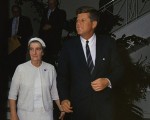
Foreign Minister of Israel Golda Meir meets with U.S. President John F. Kennedy on Dec. 27, 1962. (photo by Cecil Stoughton, National Archives and Records Administration, via commons.wikimedia.org)
Few people reach the pinnacle of power in their country of origin. Even fewer born outside their country of residence climb all the way up the political ladder of their adopted country. Finally, almost no women attain the highest positions of any national government. Yet one woman defied all these societal norms to become the fourth prime minister of the state of Israel – Golda Meir.
Meir (1898-1978) was born in Kiev, Ukraine, raised in the United States and lived in Israel for 56 years. Her long Israeli political career began in America in 1918 when she attended a Philadelphia conference. She wrote in her autobiography, My Life (G. P. Putnam’s Sons, 1975), that she “sat for hours listening, completely absorbed … [in] the excitement of the debates and of being able to cast my own vote.”
This American right to voice an opinion was a value she treasured all her political life. Hence, even in her later power-wielding positions as Israeli government minister, ambassador and prime minister, she sought the views of people from all walks of life. She saw it her duty to leave the door open to common citizens and diplomats alike. Life in the United States had given her “an understanding of the meaning of freedom, and awareness of the opportunities offered to the individual in a true democracy.”
At the time of the above conference, she was 20 years old. Though she was already planning to move to Palestine, it is unlikely she envisioned becoming an Israeli prime minister, as no Jewish state existed then. In fact, she believed young people did not need to pick a profession they would follow, so much as they needed to pick the way they would behave. When, in 1971, she met with students from her old Milwaukee, Wisc., elementary school – then called Fourth Street School, today named after her – she advised: “It isn’t really important to decide when you are very young just exactly what you want to become when you grow up. It is much more important to decide on the way you want to live.” She suggested it was enough for a young person “to be honest [and] to get involved with causes which are good for others, not only for yourselves.”
She put words into practice. By age 11, she was already involved in her first public service project. With a friend, she formed the American Young Sisters Society. The group’s goal was to raise money for youngsters who had difficulty paying for schoolbooks. With her school friends, she painted posters, held community meetings and raised the much-needed funds.
This obligation to assist others was a major part of Meir’s life. In Israel, her goal was to achieve social equality for all people, and she insisted that this would not happen unless she had the help of all citizens. She asserted that people of lesser means must not sit back and be “passive,” that they had to speak up for themselves and work to better their life situation. On the other hand, she held that people of greater means had to work to close the social and economic gaps. She believed that, for everyone’s lot to improve, there had to be a sharing of responsibility.
Still, Jewish-American feminist Letty Cottin Pogrebin criticizes Meir for not specifically advancing the case of women. On the Jewish Women’s Archive website, Pogrebin writes in the section on Meir: “She was, in current parlance, a ‘queen bee,’ a woman who climbs to the top, then pulls the ladder up behind her. She did not wield the prerogatives of power to address women’s special needs, to promote other women or to advance women’s status in the public sphere. The fact is that, at the end of her tenure, her Israeli sisters were no better off than they had been before she took office.
“Just as some Jews choose not to be Jewish-identified because they think they have the option to behave as if peoplehood doesn’t matter, Golda Meir chose not to be woman-identified and behaved as if gender doesn’t matter. But, of course, when one is Jewish and female, both facts matter.”
Meir’s career came to a relatively inauspicious end. After the Yom Kippur War, which was fought while Meir was prime minister, the government’s actions were questioned. Although the official investigation committee did not blame her for what had happened, she decided to resign. When she announced she was quitting in 1974, she said: “Five years are enough. I have come to the end of the road. It is beyond my strength to continue carrying the burden.” (reprinted in Front Page Israel: Major Events as Reflected in the Front Pages of the Jerusalem Post, edited by Ari Rath and Erwin Frenkel)
She later wrote that, while she did not feel guilty, she felt responsible for not having mobilized troops earlier in that conflict. She came to believe that she should have rejected the assessment of her military and intelligence staff. She writes in My Life: “That Friday morning, I should have listened to the warnings of my own heart and ordered a callup. For me, that fact cannot and never will be erased, and there can be no consolation…. I know that I should have done so, and I shall live with that terrible knowledge for the rest of my life. I will never again be the person I was before the Yom Kippur War.”
After 60-plus years of public service, Meir did what she had been doing since she lived in the United States. She listened to what people in the street were saying about the government’s actions, and she took responsibility for those actions.
Deborah Rubin Fields is an Israel-based features writer. She is also the author of Take a Peek Inside: A Child’s Guide to Radiology Exams, published in English, Hebrew and Arabic.
In New York City, there is Golda Meir Square. (photo by Billy Hathorn (talk) via commons.wikimedia.org)
More on Meir
Looking at the current state of Golda Meir’s former places of residence, one could say they reflect the mixed feelings Israelis harbor toward her. On the one hand, not too long ago, northern Kibbutz Merchavia turned her first apartment into a small museum. Southern Kibbutz Revivim, moreover, established the Golda Meir Cultural Centre and the Golda Meir Memorial Wing, as Meir was a founding member of the kibbutz.
Her later Ramat Aviv apartment, however, stands derelict – a grimy plaque mentions she once lived there and the guard post, which once protected her, stands abandoned. Meir’s home while prime minister – the home that once served as the official residence for
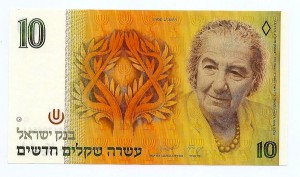
Golda Meir has been commemorated in Israel in various ways, including on the new sheqalim banknote in 1992, as well as in other countries. (photo by Berlin-George via commons.wikimedia.org)
Israel’s prime ministers – has fared a little better, perhaps because this prime piece of real estate is looking for a suitable buyer. While living at 46 Ben Maimon (Rambam) St., Meir customarily invited members of her inner cabinet – what became known as the “Kitchen Cabinet” – for advance briefing. She prepared the coffee and cake.
* * *
Interviewed in 1973 for Ms. Magazine, Meir said: “Fashion is an imposition, a rein on freedom.” She wore sturdy, black, tie shoes with a thick low heel. In the early days of statehood, women soldiers wore similar shoes. They became known as “Golda shoes.”
Farhad Sultanpour of the Kurdish Association of Manitoba speaks to members of the Winnipeg Jewish community and others. (photo by Yolanda Papini Pollock)
According to Farhad Sultanpour of the Kurdish Association of Manitoba, Kurds are the largest nation of people without a state. The majority of Kurdish people, he said, live in a strip of land that stretches through Iran, Iraq, Syria and Turkey.
Sultanpour was speaking to a Winnipeg audience about the connections between Kurds and Israel at an event organized by Winnipeg Friends of Israel (WFI).
Sultanpour came from Orumieh, in east Kurdistan, the northwest part of Iran, and was brought up as a Sunni Muslim. He made his way to Canada in the late 1980s.
“In 1979, during my mid-teens, the Islamic Revolution began and the Kurds fought adamantly to protect and liberate their towns and villages against Iran’s leader, Ayatollah Khomeini, who was rising to power,” said Sultanpour.
During this time, Khomeini was stalling in the negotiations with Dr. Abdul Rahman Ghassemlou, the Kurdish leader, regarding the creation of a Kurdish autonomous state. What was actually happening, said Sultanpour, was that “Khomeini was reinforcing his revolutionary army. He led the invasion of the Kurdish territories, while declaring jihad to all Kurds. In 1989, the agents of the Islamic Republic of Iran assassinated Dr. Ghassemlou in Vienna, Austria.”
Sultanpour, who was 19 at the time, needed to make a decision – join Khomeini’s army or join the Kurdish Peshmerga.
“I chose to be a Peshmerga, fighting against Khomeini’s regime,” said Sultanpour. “After a year and a half, I went to the United Nations office in Ankara, Turkey, to apply for refugee status. A year and a half later, I was granted a refugee visa by Canada.”
Integration into Canadian culture was challenging for Sultanpour, mainly due to the language barrier. At the time, he hardly understood or spoke English, and had made the move alone.
Sultanpour has nothing but good things to say about Canada and the second chance at life afforded to him by Canadians. “I painstakingly pursue my English class and university courses for self-improvement,” he said.
He and his wife feel it is time to raise awareness about the plight of the Kurds, especially with the rise of ISIS.
“In the last 10 years, my wife and I have built three public schools, purchased a prefabricated trailer home-style classroom, and built a community centre near the city of Orumieh, in east Kurdistan-Iran,” said Sultanpour. “For the last 20 years, we have been helping, financially, 65 to 100 very poor families in Kurdistan.”
Sultanpour is now working to strengthen the Kurdish-Jewish connection in Winnipeg. He is saddened by the lack of knowledge about the Kurdish situation in the general public, as well as with federal public servants who have not heard about Kurds or Kurdistan.
He referred to an article in the Dec. 29, 2015, issue of Time Magazine: “Alan Kurdi was one of a million. In the summer of 2015, the 3-year-old Syrian boy of Kurdish origins and his family fled the war engulfing their country, hoping to join relatives in the safety of Canada. They were part of a historic flow of refugees from the Middle East to Europe this year, and they followed the dangerous route taken by so many others. In the early hours of Sept. 2, the family crowded onto a small inflatable boat on the beach of Bodrum, Turkey. A few minutes into the journey to Greece, the dinghy capsized. Alan, his older brother, Ghalib, and his mother, Rihanna, all drowned, joining the more than 3,600 other refugees who died in the eastern Mediterranean this year.”
Sultanpour said, “Alan, his brother, Ghalib, and mother, Rihanna, were identified as Syrian when, in fact, they came from Kobane, the Kurdish town invaded by Syria. The tragedy of the death of these three Kurdish people made Alan’s father, Abdullah, prefer to bury his family in Kobane and stay in his beloved motherland, Kurdistan. Up to their dying day, Alan, Ghalib and Rihanna were stripped of their identity and state.
“In the heart of the Kurds, the Kurdi family are Kurds from Kobane, Kurdistan,” he continued. “Alan’s dead body was the only Kurdish child seen by the world, not knowing that there were hundreds of thousands of Kurdish men, women and children who are dead and are dying in Kurdistan – the biggest nation without a state.”
Sultanpour, like many other Kurds, sees Israel and the Jewish people as their only allies in the Middle East. He sees Kurdistan and Israel living in a very hostile region with common enemies, with both nations finding Iran and ISIS as threats to their existence.
With only about 500 members of the Kurdish community in Manitoba, the Kurdish Association of Manitoba is looking to network with the local Jewish community to have a larger impact.
“Both Yolanda Papini Pollock of the WFI and Bernie Bellan of the Jewish Post and News have been instrumental in the speedy interconnection of the Kurds and Jewish people in Manitoba,” said Sultanpour.
The approximately 35 attendees at the event had many questions for Sultanpour about Kurdish-Jewish connections, Kurdish political parties’ relationships with one another, and Palestinian-Kurdish relations.
According to Sultanpour, many in attendance were surprised to know that the present Kurdish capital of Erbil was the capital city of Jewish Kurds from the end of the first century when some Kurds converted freely to Judaism.
“There were numerous questions about political and religious issues regarding the Kurds,” said Sultanpour. “It was very obvious that the attendees were happy to welcome the Kurds and that they could have accepted them earlier had they known about them sooner. But, it’s not too late to develop a much stronger bond with the Jewish people here in Winnipeg and increase the connection globally.”
In related news, another manifestation of Kurdish-Jewish friendship occurred in January, when Israeli Justice Minister Ayelet Shaked called for an independent Kurdistan, saying, “The Kurds are an ancient, democratic, peace-loving people that have never attacked any country. It’s time to help them.”
March of the Living International (MOLI) has published a study examining the effects that the program has had on its participants. The educational program takes, on average, 10,000-20,000 students annually to Poland and Israel with the goal of educating and inspiring future generations to learn from the destruction of the European continent during the Second World War. MOLI accepts applicants from all walks of life and religions, hoping to ensure that not only is the Holocaust not forgotten, but also that it is never repeated.
The report studies the impacts that the program has on its Jewish participants, and highlights the educational and religious changes that the program has inspired since its creation in 1988. Of the population surveyed, most initially signed on to the program in order to better understand their Jewish culture. Many of the participants in the study said that the program has directly impacted them, leading many to visit, study in or move to Israel. Fifty percent of the respondents said that the program caused them to consider moving to Israel later in life.
The study was conducted by Prof. William Helmreich of CUNY Graduate Centre and the Colin Powell School at City College, a sociologist and expert on ethnic identity. “What’s most remarkable about the March is how deeply it impacts participants over a period of many years,” he states. “These include life choices like selecting a mate, moving to Israel and career choices. In addition, it greatly impacts not only on Jewish identity but also on compassion toward other people as well.”
Indeed, 54% of respondents said that the March had made them more tolerant towards other groups. And the effect increases over the years, as 66% of those who attended the March 10 years ago, reported it had made them more tolerant.
The study also found that 86% of the participants asserted the importance in their spouse being Jewish, and 91% in raising their children with some sort of Jewish education; 65% felt the importance of raising their children in a Jewish neighborhood.
Of those surveyed, 90% felt the March instilled in them the importance of reacting to confrontations with antisemitism, and 95% stated the March had strengthened their sense of Jewish identity.
“To think that the March is such a successful program in terms of ensuring and enhancing Jewish identity and in making people realize the importance of engaging as a Jew within their communities and caring for those outside of them, truly illustrates the goals that we had when initially forming the first March so many years ago,” said Dr. Shmuel Rosenman, MOLI chair.
March of the Living brings individuals to Poland and Israel to study the history of the Holocaust and to examine the roots of prejudice, intolerance and hate. Since the first March in 1988, more than 220,000 participants from 52 countries have marched down the same three-kilometre path leading from Auschwitz to Birkenau on Yom Hashoah as a silent tribute to all victims of the Holocaust. March of the Living is a partnership between March of the Living International, local MOTL foundations, the Claims Conference, individual donors, private philanthropists and Jewish communities around the world. Visit motl.org.
United Hatzalah of Israel and Artists 4 Israel distributed art therapy kits to families in southern Israel and held a program that included visits by graffiti artists who worked with teens to paint neighborhood bomb shelters. (photo from United Hatzalah of Israel)
At the end of last year, 75 families from southern Israel received specialized art therapy kits, thanks to a new project organized by United Hatzalah of Israel’s Team Daniel initiative. In conjunction with Artists 4 Israel, the art therapy kits were distributed Dec. 8-10, along with a program showing parents how to use the kits with their children and visits by graffiti artists who worked with teens to paint neighborhood bomb shelters. Various art therapists also participated in the events.
Last summer, during Operation Protective Edge, a group of Chicagoans was touring the Eshkol region as sirens blared. These community members were so moved by their experience and, after hearing about the death of 4-year-old Daniel Tragerman, decided to raise money to help the region. Some 50 Chicago families established Team Daniel to fund the training, placement and equipment needed for 100 United Hatzalah medics to service southern Israel. The new kits are given directly to the families of these volunteers, who often run out on a moment’s notice to attend to rocket attacks and other local emergencies.
“Because these particular families are committed to saving lives as United Hatzalah medics, it was important to us that we give them a way to cope,” said Brielle Collins, Chicago regional manager for United Hatzalah. “Art is such a powerful tool to give to people who are recovering from war, stress and tragedy.”
The arts kit was developed by experts from Israel and the United States in the mental health field in collaboration with the nonprofit Artists 4 Israel. It is hoped that the “first aid kit for young minds” will combat the effects of trauma and eliminate the chances of PTSD by up to 80% through self-directed, creative play therapies.
United Hatzalah, a community-based emergency medical response organization, has been distributing the kits in a pilot program throughout Israel since July.
Itai Erdal brings A Very Narrow Bridge to Chutzpah! March 5-13. (photo by Emily Cooper)
There’s the family into which you were born, and the families you create yourself. Itai Erdal has built a life in which he is surrounded by family, both on and off stage. He often shares vulnerable aspects of himself and his family in his work, and he is one of the more collaborative playwrights out there.
While A Very Narrow Bridge, which runs March 5-13 at this year’s Chutzpah! Festival, is about Erdal’s “relationship with his sisters, Judaism and the state of Israel,” it is written by Erdal, Anita Rochon (artistic director of the Chop theatre company) and Maiko Yamamoto (artistic director of Theatre Replacement), is directed by Rochon and Yamamoto, and co-stars Erdal, Anton Lipovetsky, Patti Allan and Tom Pickett. The original score is written and performed by Talia Erdal.
“It is a dream come true for me to work with my sister,” Erdal told the Independent. “She is a brilliant musician and I’ve always admired her talent and her spirit. Talia is much younger than me … and we’ve been very close from the day she was born. In the past few years, she has become religious and, since I am not religious at all, I was worried that it would pull us apart. This fear of mine is indeed addressed in this show, which makes her being here and participating in the show even more special.”
The play’s description is minimal: Erdal “relives a trial in order to obtain a get – a divorce document in Jewish religious law – where everything he knows is at stake.” Its title comes from a teaching of the founder of the Breslov Chassidic movement, Rabbi Nachman of Breslov (1772-1810): “All the world is a very narrow bridge, and the most important thing is not to be overwhelmed by fear.”
That certainly seems to be Erdal’s approach to creativity. A Very Narrow Bridge is not the first work in which he puts a part of his life on a public stage.
“I’ve always been a very candid and open person,” he said. “I am an extrovert and I enjoy telling stories and being the life of the party. Having said that, in all my shows I talk about very personal things and sometimes about things that are hard to reveal or even to admit to myself. But I’ve learned that when something is hard to talk about, it often makes for good dramatic material, and I really trust my collaborators, who are all brilliant and steer me in the right direction.”
And they have. How to Disappear Completely, which was also a collaborative writing effort, is a one-man show that deals with the last months of Erdal’s mother’s life before she passed away from lung cancer. First produced by Chop Theatre for Chutzpah! 2011, it has since been mounted in many other cities, and continues to tour. It was nominated for Jessie and Dora awards, which both honor excellence in theatre.
Rochon was one of the writers of How to Disappear Completely, and its producer. Erdal, who is also an award-winning lighting and set designer, has worked with Yamamoto before, as well.
“One of the things I like the most about theatre is the collaborative nature of the process, and knowing each other well and understanding each other’s strengths and weaknesses makes it that much more rewarding,” he said. “The three of us have done many shows together, in different capacities. I have lit five shows for Maiko’s company, Theatre Replacement, some of which she acted in, some of them she directed and all of them she produced…. All this familiarity makes for a very symbiotic process and a totally democratic room, where no one is precious about anything and the best idea always wins.”
Erdal is the artistic director of Elbow Theatre, which is presenting A Very Narrow Bridge. He explained how the collaboration with his fellow artistic directors on this work came about.
“I always wanted to do a show about my sisters and my complicated relationship with Judaism and the state of Israel, and I always wanted to work with my dear friend Maiko, so I approached her and pitched her this project about three years ago and we’ve been working on this project ever since.
“Initially, we thought that Maiko would be on stage with me, so we approached Anita, who is in my mind the most exciting director in Vancouver. When we started writing this play, the focus shifted from my sisters to a show about immigration and Judaism, we added the three rabbis and Maiko’s role has changed from performer to writer and director.
“Creating a show from scratch is very hard and you never know which direction it will take,” he added, “so it’s important to stay open and do whatever serves the play. The various directions this process took have led us to create an exciting piece of theatre that we are all proud of.”
Would A Very Narrow Bridge exist if Erdal had never left Israel?
“Since this play is about emigrating from Israel, I am sure I couldn’t have written it if I still lived there,” he said. “Even though I am very happy in Canada, immigration is a very hard thing to do and this show is about the lingering doubt in the back of every immigrant’s mind: Did I do the right thing? Would I have been happier had I stayed home?
“When I grew up in Israel, everybody around me was Jewish, so I never felt particularly Jewish. I knew that there were people in the world who weren’t Jews, but I had never met them. Since moving to Canada, I feel a lot more Jewish because I am defined as a Jew by my surroundings. It’s a bit like family: you take it for granted when it’s there and you start appreciating it when it’s gone. Moving to Canada made me appreciate my heritage and my family, and this show is about both.”
A Very Narrow Bridge runs March 5-10, 12-13, 7 p.m., in the Dayson Board Room of the Jewish Community Centre of Greater Vancouver. For tickets ($29/$25/$21), call 604-257-5145 or visit chutzpahfestival.com.
Recent Blue Box packages have included artisanal jams from Bustan Confiture. Each month, the featured products change. (photo from Emily Berg)
There are many ways to support Israel and Israeli businesses. A new concept, Blue Box Israel, connects artisan Israelis with Israel supporters abroad.
Blue Box Israel is the brainchild of Emily Berg, 29. Born and raised in Toronto in a secular, Zionist Jewish household, Berg made aliyah in 2012. In her first three years in Israel, she worked in fundraising and as a strategic consultant for several different nongovernmental organizations. It was during Operation Protective Edge (Tzuk Eitan) in 2014 that she saw a need for Blue Box.
“My fiancé was called to reserve duty and was basically gone from the first until the 40th and final day,” Berg told the Independent. “It was a very quiet period. People were not going out much. And, it was the first time I was able to really reflect on my life, purpose and future here.”
Emily Berg, founder and chief executive officer of Blue Box Israel. (photo from Emily Berg)
Berg received daily emails, calls and messages from friends and family abroad, asking how they could help.
“One day, my mother forwarded me an email she had received urging her to ‘buy Israeli products from the south,’” said Berg. “All of the links were either broken or led to Judaica sites that didn’t have the capacity to ship abroad.
“Having spent years here, I knew that there were dozens, if not hundreds, of great businesses in the south that could benefit from this type of transaction. I realized that Israel’s supporters want to buy products from Israel, but that there was not really any way to do so.”
With the Jewish National Fund’s blue and white tzedakah box etched into her mind since childhood, Berg saw it as a “portal to Israel.” In a similar vein, she wanted to give people around the world an opportunity to connect with small Israeli businesses and support them by buying their products.
“I decided to call it Blue Box, not in any way meant to be in competition with JNF; rather, to pay respect to this important artifact,” she said.
Fast forward a few months and the Blue Box concept developed into a subscription-based model, wherein customers pay a fixed price and receive a monthly package from Israel, with each focused on a different vendor.
“Blue Box is about giving Israel’s supporters a monthly taste of Israel, sending them high-quality, innovative and unique products, and giving them a chance to support a variety of hand-picked Israeli vendors,” said Berg.
Each box includes a postcard with the vendor’s story on it, written by Berg. “For me, Blue Box is first and foremost about supporting small business in Israel, but it’s also about sharing Israel’s treasures – its products and its people – with my customers.”
Berg is constantly searching for suppliers and personally visits the site of each business that she chooses to feature – whether it’s a farm, a studio or a home office. She enjoys seeing how and where the products are made, and speaking with the business owners and workers. These interactions help her get a sense of the business’ culture when writing the postcards.
“In the past, I have decided not to work with particular vendors, because I was not satisfied with the level of cleanliness or even the conditions of the workers,” said Berg. “Whether the business is run ethically is very important to me. I choose businesses with interesting stories behind them. I choose products that are well-made, suit the price point, and meet weight and customs requirements.”
The main thing for Berg is to send innovative, artisanal products (often organic or handmade) as opposed to just sending Bamba or random Judaica. And her focus is on products from Israeli-owned companies.
As the founder and chief executive officer of Blue Box, Berg has a wide network of support, most notably, a mentor via Keren-Shemesh, an organization that helps young entrepreneurs in their first two years of business.
“I also have a team of Israeli student interns from the Ruppin Academic Centre who help me with marketing, PR and social media,” said Berg. “Most people hear about the business, are so excited about it, and just want to help.”
There are many different companies that send gift baskets from Israel, mostly for the holidays, i.e. kosher items for Rosh Hashanah or Pesach. There are also a few subscription businesses in Israel that ship makeup samples or promotional items. Berg says that Blue Box is different because she features one handpicked vendor each month and includes not only a selection of their products but also their story.
“Israel is literally bursting at the seams with innovation, creativity, craft and talent,” she said. “Using fresh ingredients, high-quality materials and unique design methods, there are literally thousands of small businesses scattered throughout the country, tucked away in little-known moshavim or small studios.
“These businesses, of course, don’t necessarily have access to the global market, nor do they have the capacity to ship abroad. We work with small businesses, family businesses, kibbutzim, artists, designers, entrepreneurs, social businesses, NGOs and much more.”
Recent boxes have included items such as artisanal jams (from Bustan Confiture), honey (from Kibbutz Ein Herod), spices (from Derech HaTavlinim), organic soap and shampoo (from Arugot Habosem), hand-woven baskets (from Kuchinate, the African Refugee Women’s Collective), organic olive oil (from Rish Lakish) and organic dried fruits (from Kibbutz Neot Semadar).
The boxes are packaged at a space in southern Tel Aviv. They are shipped at the beginning of each month, and Canadian customers can expect them to arrive within 10 business days after shipping (around the middle of a month). During months with a Jewish or Israeli holiday, Berg takes special care to ensure the packages arrive on time.
Purchasing a one-time box will run you $50 (including taxes and shipping). If you choose to subscribe – and customers can cancel at anytime – the price drops. For a three-month plan, it’s $46/month, for a six-month plan, $40/month, and, for a 12-month plan, $36/month.
“We ship a different box each month,” said Berg, and “everyone receives the same box that month. So, for example, every January, a subscriber will receive organic desert-grown dates, raisins and fruit leather from Kibbutz Neot Semadar for Tu b’Shevat.
“I want Blue Box to become a household name and something that hundreds of thousands if not millions of subscribers look forward to each month. Eventually, I would like to create an online shuk [market] to sell and ship Israeli goods abroad.”



 French’s first foray into writing was a memoir, A Brief Moment in Time (ASD Publishing, 2013), which won honorary mentions at Paris and New York book festivals. Her most recent publication is The Cookbook for Children with Special Needs (Jessica Kingsley Publishers, 2015).