הישראלים יודעים הכל, מבינים בכל והם הכי טובים בכל דבר ועניין. ולמרות זאת שורת המחדלים הקשים של השבעה באוקטובר הוכיחה שבמציאות זה רחוק מהאמת
המודיעין לא תיפקד, השב”כ לא תיפקד, לקח לצה”ל 6-8 שעות להגיב על קריאת האזרחים (“הורגים אותנו”), החומה הטובה והטכנולוגית ביותר בעולם נפלה בתוך פחות מחמש דקות. צה”ל אישר לערוך מסיבת טבע ליד הגבול – שזה טמטום משווע. משאירים בסיסי צה”ל ריקים כי מדובר בחגים – וזה טמטום משווע נוסף. ממשלת המחדלים והשחיתות העבירה גדודים של חיילים לשמור על המתנחלים במקום על אזרחי העוטף. והיכן התצפיתניות שצפצפו על המידע שלהן כי הן “רק” חיילות
ומעל הכל התפיסה של ראש הממשלה בנימין נתניהו ורבים אחרים שעדיף “לשמן” את החמאס שישתוק במקום לקדם את הרשות הפלסטינית
ישראל של היום היא מדינה ימנית מתחרדת ומשיחית. ולאור האמור לעיל אינני חושב שהיא יודעת כיצד באמת להתמודד עם השכנים ולדאוג לאזרחים
בישראל שכחו כי מחר צריך לחיות עם השכנים האלה אחרי שהפציצו אותם יומם ולילה. ארה”ב עשתה זאת באפגניסטן, עיראק ווייטנאם – והיא מזמן לא נמצאת במקומות האלה שהם רחוקים מאוד מארה”ב. לעומת זאת, ישראל תאלץ להתמודד עם השכנים שלה כל העת. אני לא חושב שנתניהו שעומד בראש ממשלה כושלת, הוא זה שאפשר לסמוך עליו. הוא ובעיקר תומכיו הרבים לא הולכים לשום מקום. הם רק הורסים את דמוקרטיה יום יום (ממש כמו בארה”ב של הדיקטטור דונלד טראמפ)
הסכם הפסקת האש הנוכחי נכפה על ישראל על ידי המושחת השני טראמפ שרוצה פרס נובל (כי אובמה קיבל אותו) ובעיקר כי יש לו, למשפחתו ולחבריו עסקים ענפים בקטאר ובאזור כולו. את המלחמה המיותרת בעזה אפשר היה לעצור לפי חודשים ארוכים. את אותו הסכם הפסקת האש אפשר היה להשיג אז, להציל יותר חטופים, והרבה פחות חיילים היו נהרגים. אז גם השנאה לישראל בכל העולם הייתה פחותה
טראמפ ונתניהו קוראים להסדר – הסכם שלום. באמת? האם ישראל והפלסטינים יחליפו שגרירים? עתה יותר מתמיד העולם הערבי לא יקבל את העבודה שישראל מסרבת לתת לפלסטינים מדינה והיא ממשיכה לעבות את ההתנחלויות
ולסיום עוד נקודה: מדינה שיודעת מול מי היא מתמודדת לא היתה מאפשרת לרבים רבים (החרדים) להשתמט מהצבא. ולא הייתה נותנת למחנה המשיחי לשלוט בסדר היום הציבורי
ובנימה האישית: הפעם היחידה שפחדתי ב-20 השנים האחרונות (בהן אני גר בקנדה) הייתה דווקא בביקור בישראל ליומיים אשתקד. אירעה הפסקת חשמל ארוכה וחששתי שהאיראנים מתקיפים. חבר שלי עובר מרמת השרון לתל אביב כי נמאס לו לגור ליד הצבא ולהוות מטרה להתקפות בעתיד. הוא גם ציין בפניי שבישראל הסתירו את ממדי הנזק העצום של הטילים האיראנים
הפעם הקודמת שפחדתי בחיי הייתה בעת מלחמת המפרץ בעיראק הראשונה (1991) עת 40 טילים נפלו על אזור תל אביב שאז גרתי בה. לי זה הספיק לכל החיים
אינני יודע מה יהיה בעתיד ואני מודע לסכנה של האיסלאם הקיצוני. אני באופן אישי אתאיסט ומתנגד באופן עקרוני לדתות שמביאות רק נזק ושנאה. האם הותקף כאן ע”י מוסלמים? אולי? בשלב זה מרבית המוסלמים הגרים במחוז שלי (בריטיש קולומביה שמכילה כ-4.5 מיליון תושבים) ומספרם מגיע לפחות מ-200 אלף – הם איראנים – ואין בהם שום סכנה לנו
אני לא צופה עתיד טוב לעולם אשר נהיה קיצוני דתי, ימני וכוחני והדיקטטורים הולכים ומשתלטים על כל הדמוקרטיות שנשארו
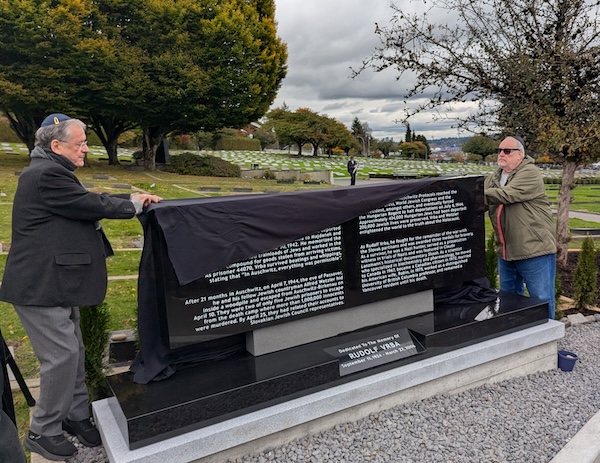
Robert Krell, left, founding president of the Vancouver Holocaust Education Centre, and Al Szajman, the current president, unveil the monument to Rudolf Vrba at Schara Tzedeck Cemetery. (photo by Pat Johnson)
Rudolf Vrba, a scientist who had a significant but comparatively quiet career in the laboratories and lecture halls of the University of British Columbia, enjoyed a comfortable life with his wife Robin in Vancouver before his death in 2006. Unbeknownst to thousands of his students over the years, Vrba may have saved more Jews during the Holocaust than any other individual. Despite this astonishing fact, his name has remained almost unknown not only among scholars of that history but even in his own adopted community of Vancouver.
At Schara Tzedeck Cemetery in New Westminster on Oct. 26, a monument was unveiled that seeks to remedy Vrba’s relative anonymity.
“Why do so few know his name?” asked Dr. Robert Krell, founding president of the Vancouver Holocaust Education Centre and a member of an ad hoc group that came together to recognize Vrba’s life and bravery. “Sir Martin Gilbert, the British historian, wrote that Vrba was directly responsible for saving at least 100,000 Jewish lives. Others now credit him with the preservation of as many as 200,000 Hungarian Jews.”
Before about 200 people gathered in the cemetery’s chapel prior to the monument’s unveiling, Krell recounted the exploits of Vrba and his co-conspirator, fellow Slovakian Jew Alfréd Wetzler, who were incarcerated in Auschwitz.
In April 1944, Vrba, just 19 at the time, and Wetzler, 25, contrived to conceal themselves within the Auschwitz compound, while, outside the camp, a massive search was undertaken by dogs and armed guards. After hiding silently in a woodpile for three days, the two men escaped and traveled for days by foot to Slovakia, where they shared all the information they had amassed about operations at the death camp. Vrba has been credited with having had an almost photographic memory and, over 22 months in Auschwitz, with Wetzler and he both having risen to positions of comparative privilege and trust in the camp, they were uniquely equipped to tell the world what was happening.
Vrba had worked on the arrival platforms at the camp, observing the incoming Jews and, later, in the “Kanada” compound, where the stolen valuables of arriving prisoners were stored. Wetzler was a registrar and clerk in the camp. The pair chose their moment to act because their vantage points alerted them to the imminent deportation of the last remaining large group of surviving Jews in Europe, those of Budapest.
Their account, which became known as the Auschwitz Protocols, or sometimes the Vrba-Wetzler Report, was the most credible and detailed information received to that moment about the extent of mass murder taking place in Auschwitz. More than 400,000 Hungarian Jews had already been murdered.
“The Jews of Budapest were next,” said Krell.
After dictating the report, Vrba joined the Slovakian army as a machine gunner and, later, joined the Slovak partisans, participating in 10 major battles and being awarded multiple medals for bravery.
After the war, Vrba completed a PhD in biochemistry at Charles University in Prague, then lived in Israel and England before serving as a research fellow at Harvard Medical School. He married Robin, an American, in 1975 and they made a home in Vancouver. Vrba was an associate professor in the department of pharmaceutical sciences at UBC for 30 years and Robin was a realtor.
The unfamiliarity with Vrba’s story in Israel, in particular, has been explored by Ruth Linn, a University of Haifa academic who first heard of Vrba when she was on sabbatical in Vancouver in the late 1990s. She returned to Israel and began asking if others with expertise in the field knew of Vrba, Wetzler and their escape. Her explorations led to her 2004 book Escaping Auschwitz: A Culture of Forgetting, which made the case that there was a deliberate effort in Israel to silence Vrba’s voice and obscure his history.
Vrba bore particular animus toward Rezső Kasztner, a leader of the Budapest Jewish community who went on to become a mid-level bureaucrat affiliated with the Israeli establishment and the Mapai party that led the country. Vrba – and others – viewed Kasztner’s actions as having saved the lives of Kasztner, his family and several hundred of his friends and associates at the possible expense of thousands of other Hungarian Jews. Vrba believed that, had ordinary Hungarian Jews been privy to the Auschwitz Protocols, as Kasztner was, they could have made their own decisions about whether to board the deportation trains.
The new monument and the unveiling ceremony were the culmination of several years of work by a group including Krell, Yosef Wosk, Geoffrey Druker, Joseph Ragaz, Arthur Dodek and Bernie Simpson, who formed a core committee advancing the project. Dodek, who emceed the Oct. 26 event, acknowledged additional contributions from the Kahn family, Ryan Davis, Marie Doduck and Jack Micner. Mayor Patrick Johnstone of New Westminster attended.
Organizers thanked the Schara Tzedeck Cemetery Board, including chairs Arnold Silber and Jack Kowarsky, and executive director Howard Jampolsky, as well as Schara Tzedeck’s Rabbi Andrew Rosenblatt.
Rosenblatt spoke of biblical and modern concepts of righteousness, citing Vrba as the definition of a hero.
“He did not escape from Auschwitz simply to save his own skin,” said the rabbi. “He escaped from Auschwitz to save Hungarian Jewry. He escaped from Auschwitz to warn the world.”
The monument, located adjacent to an area of the cemetery not yet open to burials, means that future generations who pass through mourning loved ones will have an opportunity to reflect on true heroism.
“I am struck anew by how singular his legacy was, how young he was, how hard he fought to bring the truth to the world,” said Hannah Marazzi, executive director of the Vancouver Holocaust Education Centre, which sponsored the ceremony. “It is a legacy of courage, brilliance, sorrow, resilience and endurance. But perhaps what I have treasured most is learning about his life and legacy from those here who have had the privilege of knowing him.”
Druker noted that the monument reflects an increased awareness of Vrba locally and hoped that the knowledge would expand beyond his hometown.
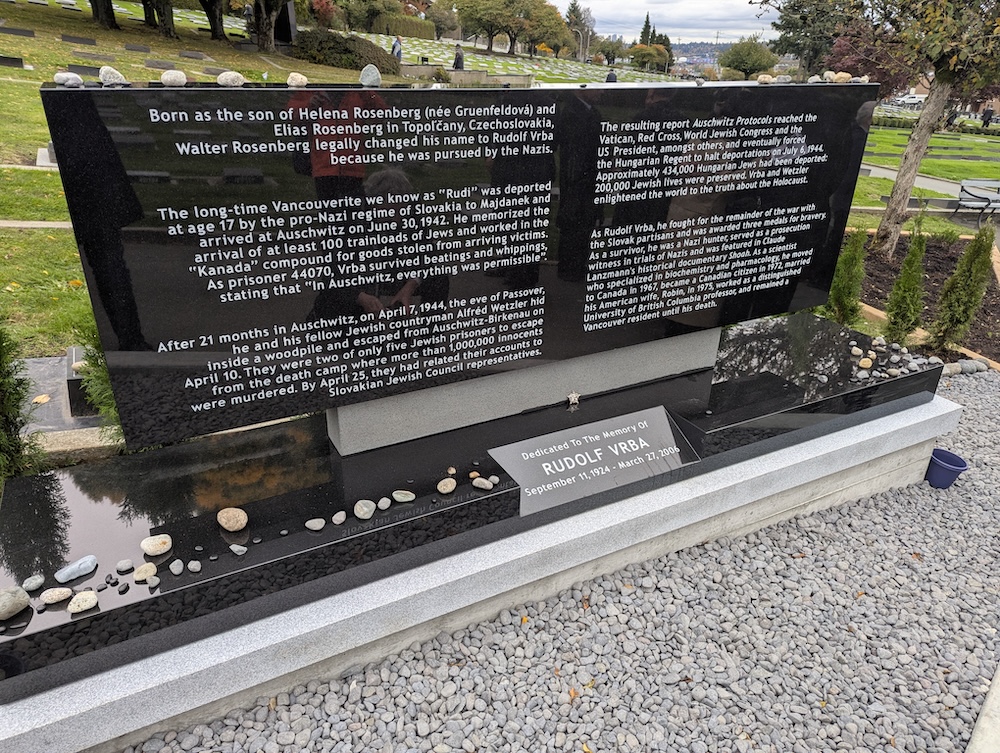
Druker read aloud the inscription, which recounts the details of Vrba’s life: his origins, his deportation to Majdanek and Auschwitz, his escape, his war heroism and his life as an academic.
“We hope that, in Israel, he will finally be recognized for what he is: a central hero that changed the course of the Holocaust for Hungarian Jews,” Druker said. “We want the world to recognize that too.”
The new monument to Rudolf Vrba at Schara Tzedeck Cemetery. (photo by Pat Johnson)
Chris Friedrichs, professor emeritus of history at UBC, put Vrba in the context of his times.
“The existence of Auschwitz was no secret to those leaders,” he said. “They knew that Auschwitz was the site of a vast industrial complex where German war production was being performed by forced labour. But, as we know, this report for the first time described the actual operations of the camp in terrifying detail, making clear that Auschwitz was not only a location of industrial activity, but also the site of mass extermination of human lives on a scale that nobody had previously fully grasped.
“A huge number of Hungarian Jews had already been sent to Auschwitz, but the approximately 200,000 Jews of Budapest had not yet been deported, and it was largely thanks to this warning that the deportations were halted and the lives of most of those 200,000 Jews were saved.”
The experiences Vbra underwent at a young age, as well as his anger that his escape and the report he helped draft did not save even more lives, affected him through his life. Friedrichs, who knew Rudi and Robin Vrba, said they enjoyed a happy life in Vancouver, but the past haunted Vrba.
“For, although he could escape from Auschwitz, Rudolf Vrba could never really escape from the Shoah,” said Friedrichs. “He knew too much and he cared too much to put what he had seen behind him.… Rudolf Vrba was dedicated to relating the facts, but there was also anger, and that anger was directed not just against the Nazis, but also against Jewish leaders during the war who could not bring themselves to inform their fellow Jews about what was happening in Auschwitz. He was like a biblical prophet who had inveigled against the wilful ignorance or stubborn disbelief of those who should have known better.”
Friedrichs credits Robin, who now lives in the United States and was not able to attend the unveiling, as “not only his cherished companion for over three decades,” but with ensuring that his legacy not be forgotten.
“In fact,” said Friedrichs, “that task is a challenge for all of us. Even the Jewish community of Vancouver never fully recognized the greatness of this man and the role he had played both in saving Jewish lives and in contributing to knowledge of the Shoah.”
The monument is a belated recognition, said Friedrichs.
“What we do today is overdue, but it is not too late,” he said. “Future generations will pass by this monument and realize how proud our community should have been that this man lived and worked for 30 years in our midst. As we watch the monument being unveiled, and if we gently lay some stones upon it, we will be paying a debt of gratitude to someone who is not only a hero of the 20th century, but should continue to be an inspiration for the 21st.”
Created in 1995, the traveling exhibit Anne Frank: A History for Today is on display roughly 300 times a year. Mainly for school groups, people can visit the exhibit at Seaforth Armoury Nov. 11. (photo from Anne Frank House)
The traveling exhibit Anne Frank: A History for Today, hosted by the Consulate General of the Netherlands, is at Seaforth Armoury until Nov. 21. An opportunity for school groups to learn about Anne’s story and the legacy of her diary, the exhibit tours have already sold out, but the public is welcome to visit on Remembrance Day, Nov. 11.
While this is not the first time the exhibit has been in Vancouver, its presence at the armoury and museum is poignant. Started in 1920 by Scottish Canadians, infantry from the Seaforth Highlanders were on the ground in Amsterdam on May 8, 1945. They entered the city as part of the Allies’ liberating force.
Following months of battles and Germany’s surrender, the Seaforth Highlanders offered humanitarian aid to the city’s population. The close ties between the regiment and the people of the Netherlands are commemorated every year.
The school tours at Seaforth Armoury are led by volunteers trained by Phyllis Lewis, a staff member of Anne Frank House, said the house’s director of Canadian activities, John Kastner.
Arriving on Nov. 5, the exhibit required about six people half a day to set up, then there was peer training. The response to the call for volunteers was excellent, said Kastner, as has been the level of interest from local schools.
“I think the premise is from Anne Frank House in Amsterdam – there’s real value for people to become ambassadors of the message. People that are close to the same age as Anne are particularly effective when it comes to relaying the message of the diary,” he said.
Not all the exhibit’s stops are in metropolitan areas. Kastner described its journey to Anne Frank Public School in Vaughan, part of the Greater Toronto Area, then it went to Marathon, a mining community on the shore of Lake Superior, then to All Saints High School in Toronto, before being displayed at Ottawa’s Beechwood Cemetery (Canada’s national military cemetery) and the Dutch consulate in Vancouver, which sponsored it.
And the exhibition will keep moving, said Kastner. “It’s been very busy in 2025 – demand has been very steady and it has hardly been in storage at all.”
Created in 1995, the Canadian exhibitions are just some of the many around the world, in languages including Albanian, Arabic, Bengali, Bosnian, Korean, Macedonian and two forms of Portuguese. In total, the exhibit is on display roughly 300 times a year.
Paired with a 30-minute film, Who was Anne Frank?, the tour takes about 90 minutes. It comprises 11 panels of information that are the same worldwide and the 12th panel is curated specifically for the region. The version that arrived in Vancouver this week references the liberation of Amsterdam and all the panels are in both English and French, which is the case for all the Canadian showings, though the exhibit for northern Ontario is also in Inuktitut.
The docents bear a responsibility as ambassadors for Anne’s legacy and message, said Kastner. “You want people who are in classrooms, at dinner tables, in peer groups at schools, who are aware of the story, that become advocates of fairness, opponents of racism, opponents of prejudice, and we really see it in real life – that those docents become docents of the message of Anne Frank House.
“Every generation that comes through, you create a new generation that becomes familiar with the story and the messaging of Anne Frank – not only what she went through, but her optimism in a world surrounded by hate, prejudice and violence…. As people go through the exhibit, they become aware of what an important story it is,” said Kastner. “They come to realize that it is, by definition, a history for today – that it has relevance in today’s society.”
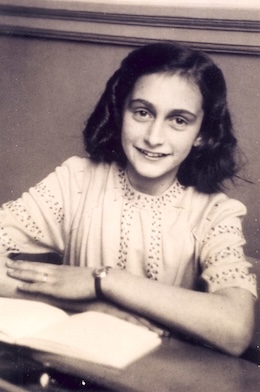
Anne Frank, in 1941. The traveling exhibit Anne Frank: A History for Today is at Seaforth Armoury until Nov. 21. (photo from Anne Frank House)
Kastner spoke about his personal connection to Anne’s remarkable outlook and values, referencing her often-quoted diary entry of July 15, 1944: “In spite of everything, I still believe that people are really good at heart.”
“I wish we could all be as optimistic as Anne was,” he said. “It was remarkable.
“There have been many periods since the Second World War when we’ve had many reasons to be pessimistic, and that’s why it’s a history for today. It’s a recurring message that continues. After 75 years, it still has relevance.”
Kastner praised the design of the exhibit, calling it “fantastic.”
“There’s a timeline ribbon that goes down the centre … the date and the year. Above the ribbon is what is happening in the world politically at the time. Below the ribbon is how it’s impacting people – Anne, her family and everybody else,” he explained. “The idea is that [some people think] what you see on the news doesn’t really matter…. This says, it should matter, it does make a difference. And that creates an awareness of current events, of being involved … of speaking out. Even in minor cases of prejudice, it’s problematic and [can lead] to a greater problem.”
When talking about this idea in Marathon, Kastner gave the example of name-calling. “Calling someone a name, a slur, we can see it as problematic but not the end of the world,” he said. Or, “graffiti on a kid’s locker, that’s not very nice, but it’s not the end of the world – but it leads to a huge problem when [such actions] become the norm.”
Kastner spoke highly of the 3D model of the house, which is “one of the great learning tools that goes with the exhibit.” There is power in asking teenagers, “Who can tell us where Anne slept?”
“When I went to Anne Frank House to work there, where my workspace was, I’d be looking at the courtyard and at the Annex, looking at the tree, and it’s absolutely surreal,” he said. “Being in the presence of that kind of history. There’s no replacement for that.”
It’s the same tree Anne would have seen.
“I’d be in her father’s office at the warehouse and there are all sorts of people traipsing through the house,” he said, and he’d think about “how you [would have] had to be deathly quiet, completely stationary, because people were using that office.”
Certain questions come up time and again. Students want to know how the Holocaust started, for example.
“The Holocaust didn’t start with people getting loaded on trains,” Kastner explains to the kids. “The Holocaust started with all sorts of things that Anne talks about – her bike being taken away, not being allowed to swim in the public pool, not being allowed to take public transit, then extended to larger things. Her dad not being allowed to have a job or own property.… It starts by slow increments.”
At Anne Frank Public School in Vaughan, the kids asked Kastner how Anne’s diary got published. He described the return of Anne’s father, Otto Frank, to the Annex, which had not changed since the day their hiding place was discovered. He told the students that Miep Gies, who had helped hide Anne and her family, “had taken the diary after the Nazis had left and kept it, gave it to Otto and he read through it and then said, I should publish this.”
Kastner said the kids marvel at the serendipity, the turn of events that led to “one of the most important books written by somebody under the age of 16.” He added, “The kids say that it’s amazing that [Otto] survived, that he got the book, that somebody wanted to publish it and then the idea that it’s become standard reading for millions of kids 70 years later.”
During the exhibition’s stop at Beechwood Cemetery, Kastner recalled two students asking him, “What is it about Jewish people? Why do they pick on Jewish people?” And, “Why didn’t somebody do something?
Kastner explained the scapegoat theory to these students. “It’s in Shakespearian plays, it’s throughout history: the idea of a common enemy often solidifies a group,” he said.
Each exhibition site brings different opportunities for learning, said Kastner. Getting it to remote locations can be tough but it’s worthwhile. Shipping the panels to Marathon, for example, was challenging, but Kastner applauded the motivation of the school there as “very noble and progressive.”
“Every place it goes, it has a different impact and it’s going there for a different reason,” said Kastner of the exhibition.
“The message,” he said, “is in Anne’s experience, Anne’s death – that has relevance in today’s society.”
Shula Klinger is an author and journalist living in North Vancouver.
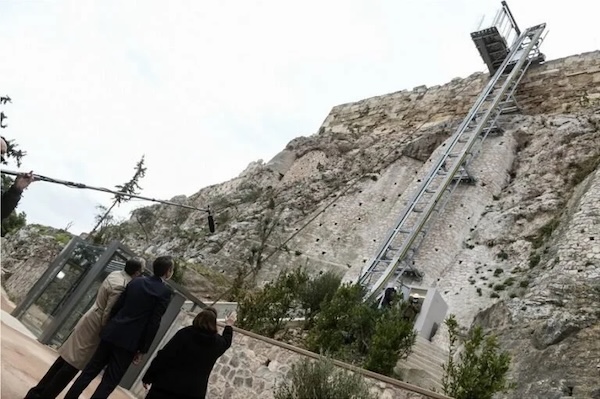
Before the 2004 Summer Paralympic Games in Athens, Greece, organizers installed an elevator in the Acropolis. (photo from greecehighdefinition.com)
What does sports have to do with human rights? This was the question posed by Vancouver Jewish community leader Zena Simces as she and her spouse Simon Rabkin launched the seventh annual Simces and Rabkin Family Dialogue on Human Rights Oct. 23 in a national online event.
There is evidence of discrimination and exclusion, racism, sexism, ableism, athlete exploitation and maltreatment, labour rights violations, sex eligibility and gender identity issues and safety concerns in sport, Simces said. There are also funding issues, such as the high cost of participation in sport, including at the community level.
Sport is about more than just an active and healthy lifestyle, Simces noted, though it is about that, too.
“It can help to address social isolation and loneliness, which have been identified as major health concerns, not only for older adults, but also for children and youth,” she said. “Sports can be democratic, as it invites everyone to belong and contribute to strengthening and building community, but there is a dark side.”
The dialogue was moderated by Wendy MacGregor, a consultant, educator and lawyer who is the founder and executive director of Athlete Zone, a nonprofit that provides Canadians with support, guidance and education in the pursuit of healthy sports environments.
“Unfortunately, with all those wonderful attributes that sports brings, it is not accessible to everyone worldwide and not even to all Canadians,” said MacGregor. She cited statistics indicating that youth participation numbers “are dropping off a cliff and especially girls are dropping out of sport.”
Some of the reasons for this include increased costs, travel time, difficulty of access to facilities, discrimination, maltreatment or abuse in sport and the increased commercialization of sport.
Panelist Bryan Heal, the social impact research lead at Maple Leaf Sports and Entertainment, spoke about a program his organization is involved with, called Change the Game, which advances youth access, equity and outcomes through sport.
Change the Game has engaged more than 25,000 young people around Ontario, he said, addressing factors of race, gender, ability, household income, geography and other factors around access and barriers.
More than 80% of young people who have participated in the program, he said, have experienced themselves or are aware of a problem in these areas but do not feel like they have anyone that they can talk to about it.
“There’s a culture and strategy of silence that is employed by default,” said Heal. “In a team environment, it can be incredibly isolating and deflating when you’re harbouring something like that. It draws people away to other sports, sometimes to leaving sports entirely.”
Jeff Adams, a lawyer specializing in labour, employment and human rights issues, is a decorated Paralympian, having won three gold medals in wheelchair races.
Accommodating different needs is fundamental and, too often, he said, excuses are made, such as the argument that sports facilities are often in buildings that are too old to be made fully accessible.
Before the 2004 Summer Paralympic Games in Athens, Greece, organizers installed an elevator in the Acropolis. “You want to talk about the most historically relevant building in the world,” he said. “It’s the cradle of civilization, and they put an elevator in it.”
An attitude exists that basic Canadian laws, embodied in the Charter of Rights and Freedoms, do not apply to the playing field, he argued.
“We are not applying the fundamental supreme law of Canada to athletes who are bleeding for their country in competition,” Adams said. “We have laws that work. We have anti-violence and harassment legislation baked into labour and employment laws.”
Amreen Kadwa, founder and executive director of Hijabi Ballers, a Toronto nonprofit creating positive experiences in sport for Muslim girls and women, said her group’s programs provide more than just access to sport.
“They create safe, culturally affirming spaces where women can play without judgment,” she said. “They can learn new skills, they can grow in their confidence and, beyond sport, we nurture leadership. It really is human rights in action.”
Female athletes face far more violence and discrimination in sport than their male counterparts, Kadwa said.
“But this number is even higher for racialized women,” she said. “Muslim women, a lot of them who are hijab-wearing Muslim women, are often seen as outsiders, whether through their outfits, their clothing, the stereotype, a lack of cultural understanding.”
The annual dialogue event is a partnership with the Canadian Museum for Human Rights and Equitas, an international centre for human rights education.
The Team Vancouver delegation at the 2025 JCC Maccabi Games in Pittsburgh, Pa. (photo fromJCCGV)
When the Jewish community of Greater Toronto hosts the JCC Maccabi Games this summer, it will mark the first time that the Jewish teen athletics event has taken place north of the border since Vancouver hosted in 2006. And Team Vancouver, based out of the Jewish Community Centre of Greater Vancouver, will bring a delegation of at least 20 athletes to be a part of it.
The JCCs of Toronto will welcome approximately 1,600 Jewish teens from around the world Aug. 2-7, 2026, for this annual Olympic-style sporting event. The games will take over venues around Greater Toronto, offering a variety of team and individual sports.
“With the political climate being what it is these days, it’s really fantastic timing to finally have a set of games in Canada again,” said Kyle Berger, delegation head for Team Vancouver. “I can feel the excitement already building and we expect to be taking our largest delegation since before COVID.”
The JCC Maccabi Games, which engages 3,000-4,000 Jewish teens each summer, is focused on athletic competitions, but, Berger said, the true meaning of the games lies in the unique Jewish peoplehood experience it offers.
“From the powerful opening ceremonies, with the parade of athletes, and through the week of competition and special events, there is nothing that brings Jewish teens together like the JCC Maccabi experience,” he said. “This will be my 23rd set of games, but, when Team Israel enters the opening ceremony, with 10,000 people all waving their Israeli flags, cheering and singing together in a safe environment, it gives me goosebumps every time.”
Berger was involved with the games when Vancouver hosted in 2006 and said he appreciates how much hosting this event can bring a community together.
“Much like the way hosting the Olympics in 2010 brought the cities of Vancouver and Whistler together, hosting the JCC Maccabi Games really is a full-community experience,” he said. “And anytime it is in Canada, it’s special to be part of it and show off our amazing country. We will enter the opening ceremony with extra pride this year.”
The games in Toronto, which will take place at the same time as another set of games in Kansas City, will be one of the larger sets of games in recent years. Athletes aged 13-17 as of the date of the games will be able to compete in their choice of team or individual sports that include ice hockey – with a girls division for the first time – baseball, basketball, softball, volleyball, soccer, tennis, swimming, dance, track and golf.
Aside from the opening ceremony, the games will feature social events for the athletes and coaches, as well as Jewish and Israeli cultural programming, social action projects and an emphasis on the six middot (Jewish values) of tikkun olam (repairing the world), respect, joy, pride, big-heartedness, and Jewish peoplehood.
JCC Maccabi, a signature program of the Jewish Community Centre Association of North America, is part of the overall umbrella of the Maccabi World Union, which also includes the Maccabiah Games in Israel.
OneTable dinners – a platform for young professionals to meet on Shabbat – are occurring in 700 cities, including Toronto, but not yet Vancouver. (photo from OneTable)
My son moved to Florida in August, choosing the Sunshine State for its large Jewish community, great weather and the many outdoor recreational possibilities it offers when Vancouver is soaked with rain. He quickly found opportunities to engage with young Jewish professionals like himself, through a synagogue, but also through OneTable Shabbat dinners.
“I had an amazing Shabbat experience,” he told me, as he explained how it works.
Someone agrees to host a Shabbat dinner for a certain number of people, who each bring an item to help with the meal. OneTable reimburses the host $10 per person, which doesn’t cover the costs, but it helps, particularly if the host is feeling cash-strapped.
In my son’s case, the meal was take-out sushi, which was completely fine with the 20-somethings gathered around that Florida table. They talked, laughed and ate together, kindling new friendships and inspiring my son to play host at a OneTable Shabbat soon.
My curiosity piqued, I started making inquiries about OneTable. What a great fit this would be for Vancouver, I thought, given how difficult it is to make new Jewish friends here. That’s especially true for young Vancouverites looking for Jewish partners in a city with an intermarriage rate of 43%, according to a 2011 study and intermarriage rates in Canada have increased, according to another study that came out this year, so likely Vancouver’s has, too.
But it’s also a challenge for Gen Xers like me. What an incredible idea, to surround yourself with potentially new Jewish friends at a home table defined by challah and shared food! Alas, OneTable is not offered here.
Irit Gross, chief advancement officer at OneTable, described how the organization began in 2014, when two philanthropists united to address the epidemic of loneliness that was occurring. Young Jewish adults were focusing heavily on their mobile phones, and disassociating themselves from the traditional Jewish institutions where their parents and grandparents had socialized.
OneTable sent out a survey, asking young people what it would take to get them to choose Shabbat on a Friday night, rather than another option.
“People were socializing online, so we knew we needed to meet them in a virtual space,” Gross said. “We began investing in a platform similar to Airbnb, where, as a host, you could go online and post your dinner and, as a guest, you could join one. That’s the essence of how we started, with the goal of people going online to be offline.”
The $10 per person remuneration was added when OneTable realized money was a barrier to millennials wanting to host five to 10 people in their homes. The reimbursement allows the host to elevate their offering; for example, by buying better wine, or a nicer tablecloth for the event.
That first year, OneTable began in the Jewish heartbeat of North America – New York City. As the organization fundraised and collaborated with local federations in other cities, it quickly expanded to Chicago, Los Angeles, Boston and Miami.
“We knew where the young adults were and went to set up shop in those locations,” said Gross. Today, OneTable dinners are occurring in 700 cities, including Toronto, and 49 states, as well as Washington, DC.
The organization has engaged 320,000 unique individuals, with many returning for more. “Those 320,000 people have come back and either guested or hosted two or three times. That engagement rate shows that our goal and mission of creating a Shabbat ritual is coming to fruition and happening in the community,” she said.
Prior to Oct. 7, 2023, OneTable was engaging 40,000 unique individuals annually. “After Oct. 7, that jumped to 82,000 unique people, meaning we doubled in 2023 and sustained that increase in 2024,” Gross noted. “It’s been a marker for our organization, catapulting us to really think not just about how we’re addressing millennials, but, also, bringing Gen Zs together.”
After reading reports about how Jews across many different age groups were looking for ways to find community, OneTable expanded its offerings, though its core audience remains the 20-to-30-something demographic, which accounts for 95% of its time and budget.
The organization’s research is far from over. “We’re still trying to figure out how to stay relevant and continue to be the number one choice for young adults in their 20s and 30s, so they can create their own Shabbat rituals,” said Gross.
Five years ago, the UJA Federation of Greater Toronto requested collaboration with OneTable, beginning a conversation that would take two years before the program launched. OneTable began operating in Toronto in 2023 with a three-year funding grant, and Gross said Toronto has been one of its most successful communities.
OneTable is not in Vancouver, and there seems to be no conversations about it coming here. Prior to Oct. 7, the Ronald S. Roadburg Foundation reached out to OneTable.
“I think it’s a great organization, but we’re not funding in the space of young adult engagement,” said Mark Gurvis, the foundation’s chief executive officer. “If we were funding young adult engagement, we’d fund this for sure. Federation’s involvement is the key for this, and whether we’ll step in with Federation remains to be seen.”
I asked the Jewish Federation of Greater Vancouver about the possibility.
“While Vancouver doesn’t have OneTable, we’re fortunate to have many organizations that host meaningful Shabbat dinners and gatherings that bring people together throughout the community,” said Caryl Dolinko, Federation’s communications and marketing director.
“We are continuing to develop a family-connector model to strengthen engagement. We’re also happy to explore other initiatives and opportunities that are out there in the community, as we would love to do with OneTable.”
She continued, “Our focus remains on supporting the many partnerorganizations and community initiatives that already create opportunities for meaningful Shabbat experiences and peer connection.”
Dolinko gave the example of Axis, a Federation initiative for Jews in their 20s and 30s. “Last year, Axis held 15 events for 682 unique participants, with 345 attending multiple events,” she told the Independent. The network connected 32 volunteers to community organizations and maintains active WhatsApp and Instagram engagement, she said.
“We are restructuring our PJ program to prioritize mixed-heritage families and have expanded PJ Library access into public school libraries, pediatrician offices and other community spaces,” she added.
With an intermarriage rate like ours in Vancouver, I’d argue that the current model is not working. But no one is asking me.
I moved to this city to start my family, in 2000. Now, a quarter-century later, three of my children have left for other cities and countries, where their odds of meeting Jewish partners are much better. My youngest will follow in two years. I miss them desperately, but I want them to spread their wings – and I want them to marry someone Jewish.
Gross understands all too well that funding dollars need to go to other worthy initiatives.
“There are a lot of people out there fighting against hate,” she noted. “I don’t know if there are enough people fighting for the joy of Jewishness, the special rituals that remind us why we love our traditions.”
Lauren Kramer, an award-winning writer and editor, lives in Richmond.
Editor’s note: This article has been updated from the print version to better reflect Jewish Federation of Greater Vancouver’s commitment to youth engagement in the community.
היום השאלה האם להמשיך ולגור בישראל, לעזוב או לחזור ולגור בה או לעשות עלייה -היא רלוונטית יותר מאי פעם. מצד אחד ישראל נמצאת במצב בטחוני, כלכלי וחברתי לא פשוטים, ומצד שני האנטישמיות ופגיעה בישראלים וביהודים היא ממשית ביותר
אני עזבתי את תל אביב ועברתי לגור בוונקובר שבמערב קנדה לפני למעלה מעשרים שנה. אני יכול רק להצטער שלא עזבתי שנים קודם לכן בעת היותי צעיר יותר כי זה היה חלום חיי. חברו לחלום ההרגשה שהפכתי להיות זר בישראל ולכן העדפתי להיות זר בחו”ל. בנוסף, המצב הבטחוני של ישראל גם הוא הטריד אותי. אילו הן שלוש הסיבות המרכזיות שהביאו אותי לעזוב את ישראל. כבר בראשית שנות השמונים (אחרי השירות הצבאי) התחלתי לחלום על מעבר לחו”ל ולצערי רק כעבור עשרים שנה הגשמתי זאת
לקום ולעזוב לחו”ל זה דבר לא פשוט שכרוך בהרבה מאוד סיכונים. וצריך גם אומץ רב והאמת שזה היה חסר במקרה שלי. רק בסוף שנת 2004 כאשר קיבלתי את הניירת ההגירה לקנדה החלטתי שהפעם אני לא נותן לעצמי שום הנחות ותירוצים – מדוע שלא לעזוב. כעבור שלושה חודשים סיימתי את כל ענייני בתל אביב ועליתי למטוס שהביא אותי לוונקובר, בה אני חי עד היום
בשנות השמונים והתשעים רציתי לעבור לאירופה (תחילה ללונדון ולאחר מכן לאמסטרדם). בראשית אלפיים זכיתי בגרין קארד ואז החלטתי לעבור לניו יורק. אך היעדר האומץ כפי שציינתי והעבודה שכל כך אהבתי בתחום המדיה: “החזיקו” אותי בישראל. עבדתי בעיתונות במשך שבעה עשרה שנים והיה לי מאוד קשה להיפרד ממנה. בשנים האחרונות למגורי בישראל קיבלתי הצעות מפתות מהעורכים המובילים בעיתונות אך דחיתי את כולן, כי אחרת הייתי מתקשה עוד יותר קשה לעזוב. משה ורדי הציע לי לעבוד בידיעות אחרונות, אמנון דנקנר – מעריב, גיא רולניק ואיתן אבריאל – דה מרקר (שהיה מופרד אז מהארץ) וחגי גולן – גלובס
לבסוף הצלחתי להתגבר על כל המכשולים הנפשיים ועזבתי את ישראל לטובת קנדה. מרבית בני משפחתי וחברי הבינו אותי, ותמכו בצעדי. כמובן שהיו בודדים שלא ראו בעין טובה את “ירידתי” מישראל ולאורך הזמן היחסים ביננו הפכו לקרירים ואף נותקו. הגעתי לוונקובר, ובשנותי הראשונות עבדתי כמחפש מידע בחברה כלכלית. לשמחתי במשך מרבית שנותי כאן כתבתי (כפרילנס) עבור ידיעות אחרונות ווינט על מה שקורה בקנדה. לפני למעלה מאחת עשרה שנים הצטרפתי לחברה הפיננסית המספקת הלוואות סאב-פריים, ואני משמש מבקר החברה ואף עובד מהבית בשמונה השנים האחרונות
עוד שגרתי בישראל ראיתי עתיד שחור למדינה שהופכת להיות יותר דתית-חרדית-ימנית-לאומנית. אז התחלתי לקלוט שאין לי יותר מקום במדינה בה נולדתי וגדלתי ושהייתה בית מצויין במשך שנים. לצערי המציאות השתנתה לרעה וכאמור התחלתי להרגיש זר בישראל. מצאתי את עצמי שייך למיעוט שהוא וקטן וכיום ההבדלים בין שני המחנות עצומים ולא ניתנים לגישור. מלחמת ששת הימים עם הניצחון הגדול הביאה את תחילתה של תנועת ההתיישבות בשטחים הכבושים. וכך גם החל לגדול המחנה המשיחי. ומטבע הדברים לדתיים וחרדים יש הרבה ילדים והמספרים מנצחים. מציאות זו לא מתיישבת עם עקרונותי ודרכי ועל כן מצאתי לי בית חדש בקנדה
כיום אני מנותק כמעט לחלוטין מהוויה והתרבות הישראלית ורק השפה העברית מקשרת אותי לישראל. הקשר עם בני משפחה וחברים בישראל עדיין חשוב לי אך במקביל המרחק ביני ובין המדינה הולך וגדל. ישראל לא תשוב עוד להיות ביתי
On the weekend of Oct. 11-12, the Okanagan Jewish Community Centre hosted a memorial exhibit to mark two years since Oct. 7. It was designed as a series of information booths, to allow visitors to engage with the material at their own pace. (photo from OJC)
On the weekend of Oct. 11-12, the Okanagan Jewish Community Centre (OJC) hosted a memorial exhibit to mark two years since the Oct. 7, 2023, massacre in Israel. The program brought together Kelowna, West Kelowna and Okanagan area residents, the Jewish community, other faith groups and allies, as well as local, provincial and federal elected representatives and some of their staff.
The exhibit, created by Mila Shapiro and Harley Kushmier, was designed as a series of information booths, to allow visitors to engage with the material at their own pace. Each station explained different parts of the story: the historical context, the scale of the violence and the hatred that drove it. Displays showed how people from all backgrounds – left or right, foreign nationals or Israelis – were targeted and suffered the same nightmare.
One of the most difficult-to-view sections showed video footage recorded by the Hamas terrorists during the attacks. The reaction from visitors was intense, with many saying it was overwhelming, but also something they needed to see to understand the scale of the cruelty.
(photo from OJC)
On the Saturday evening, the guest speaker, Nitzan, shared her story of Oct. 7 to a room filled to capacity.
Nitzan, who preferred to go by her first name for this article, grew up in a small northern town in Israel, where having to take refuge in a shelter wasn’t necessarily a scary experience.
“Back then, we didn’t have Iron Dome, we didn’t have an alarm system,” she said. “We heard the whistle and then the boom.
“As we grew older, my sister moved to the south of Israel, where she fell in love and built her life in Kibbutz Be’eri, an amazing peaceful, community. Be’eri made the desert bloom.”
On Oct. 7, Nitzan’s sister sent a photo of her and her family in their safe room. “I called her, asking why they were in the safe room, what’s happening. She said the amount of rockets is insane. We’re in the safe room, but I’m not sure what’s going to happen to the people partying at the music fest – they have nowhere to go.”
A few minutes later, “She was outside with the kids and, on a video call, I said to her, what if they come?”
The family returned to their safe room, said Nitzan. But the doors to safe rooms don’t lock. “You have to hold the handle up,” she explained.
Fifteen minutes later, texts started flooding in – attackers were in the kibbutz, they were breaking into people’s homes.
“As the night went on,” said Nitzan, “they, Hamas, were burning the houses, smoking people out of their homes, shooting, killing, murdering whoever they could. They broke into my sister’s house five times. She and her husband held onto the door, not letting go, not letting them in.
“As the night went on, her texts were begging for help, saying goodbye, not thinking they were going to make it through the night.
“Her husband’s family all live in the kibbutz – his two sisters and his mom. His mom was hosting her sister, her husband and son. They didn’t make it,” said Nitzan. His mom, Pessi, her sister Hanna, husband Zizi and son Tal were all killed.
“My friend Abouya answered my texts, saying he’s holding onto the door and then he stopped reading my messages. They had shot him in the stomach, and he died at home. He was a close family friend…. His grandkids,two 12-year-old-year-olds, a boy and girl, Ynai and Liel, were being held in Pessi’s house. They were murdered with her. The terrorists gathered 15 neighbours, murdering 12 of them.”
(photo from OJC)
Nitzan knew many others who were killed.
“I ended up in an emergency room,” she shared. “I couldn’t bear the horror. I was throwing up, sweating, shaking. When I got to emerg, the doctor told me he had to give me something to calm me down. I said, I can’t take it. If I need to make the decision to go home, I need to be able to make it. He looked at me and understood. When I saw him a few months after, he asked me, how are you doing? Did your family survive?
“They did, and I am so grateful for that.”
Nitzan spoke about the rising amount of antisemitism in Canada and around the world.
“We have to stick together, we have to find each other, support each other and find why,” she said, mentioning former hostage Eli Sharabi’s book, Hostage, in which he describes meeting Hersh Goldberg-Polin, another hostage, who was murdered in the tunnels of Gaza with five others in August 2024. Goldberg-Polin told Sharabi, “If you have the why, you’ll find the how” to survive. Sharabi talks about how this idea, also expressed by Friedrich Nietzsche (“he who has a why to live for can bear almost anything”) helped him survive 491 days in captivity.
“It has been two long years, years of hurt, of pain,” said Nitzan. “I wish for all our hostages to come home … victims’ bodies are still there. I wish for us to be united, to know that we are stronger together, that we have many friends that support us and that we are not alone.”
(photo from OJC)
The evening concluded with a Q&A session. Questions and comments ranged from the sharing of personal experiences, to questions for Nitzan, to concerns about antisemitism and the growing fear that many Jewish Canadians are now living with.
On Sunday, Liel, who also didn’t want her surname used for this article, shared her story about Oct. 7. She spoke about the loss of someone very close to her and the continuing impact that day has had on her perspective and sense of community. As well, she discussed the challenges on Canadian and American university campuses, describing how painful it has been to witness the reactions and divisions that have emerged.
“We can’t stop talking about the victims of the seventh of October,” said Liel, the more than 1,200 “innocent people who lost their lives in senseless violence,” and those who were kidnapped.
“We can’t forget about the heroes of that day,” she said, talking about the soldiers and civilians who fought hard that day, the “heroes that saved countless lives by sacrificing themselves. We must keep all of their memories alive by continuing to remember them and talk about them, and share their stories.”
“As a Jew, I carry the weight of my ancestors’ pain and resilience. Our voice must never be silent,” said Kushmier about why it was important for him to help create this exhibit. “The pain in Israel and in the Jewish diaspora has been profound, yet we rise above the hate. We stand as ourselves, stronger and united, showing the world that we will endure, heal and continue to thrive.
“Every generation of our people has faced hardship, but we have never been broken,” he said. “Through centuries of persecution, we have built communities, told our stories, and held onto our faith. Our people are strong, and our unity is our power. In the face of hatred, we choose love and life.”
Shapiro said the Oct. 7 massacre hit very close to home, and her family lost someone very close to them at the Nova music festival.
“My land and my people are suffering and I believe it’s critical to bring historical facts and context to the forefront, so others can truly understand the roots of this conflict,” she said. “Only through education and awareness can we make change toward truth and justice.
“In addition, in the aftermath of such a horrific tragedy, I believe it can be deeply healing to come together in mourning – to honour and remember those who were brutally murdered, massacred, burned and tortured. Their lives were taken in unimaginable ways, and we owe it to them and to ourselves to remember their names, their stories and their humanity. Mourning together is not just an act of remembrance – it’s an act of resistance against forgetting.”
In a city where the Jewish community is small but strong, the exhibit was a chance to learn, to bear witness and to connect, said Kushmier and Shapiro, who thank Nitzan for sharing her story.
They also thank their families and the volunteers, including Bitachon (security) members, who assisted with the two-day exhibit, which was funded by donations from the Okanagan Jewish Community Centre and the Jewish Federation of Greater Vancouver, and included material from StandWithUs.
Samantha Kushmier is a member of the Okanagan Jewish Community, and mother of exhibit organizer Harley Kushmier.
Orca Wiesblatt was to play for the ECHL’s Allen Americans this season. The 25-year-old died in a car accident on Vancouver Island Sept. 14. (photo from allenamericans.com)
A crowdfunding initiative is underway to honour the memory of Orca Wiesblatt, a professional hockey player who died in a car accident on Vancouver Island Sept. 14, and to help his family and friends navigate through the hardship of losing a loved one who was only 25.
Paula King, a family friend of the Wiesblatts, launched the GoFundMe campaign shortly after news of the tragedy broke last month. The goal is to raise $22,000. Thus far, more than $16,000 has been contributed.
“There has been such an outpouring of love for this young man in statements from so many fans, friends, former teammates and every organization he has played for. His talent, love of life and infectious smile never went unnoticed on or off the ice; it is one to be recognized and to be remembered with such a high regard,” King, who knew the Wiesblatt family through the hockey community in Calgary, says on the site.
“I want the Wiesblatt family to know that they are not alone,” writes King. “Every friend, teammate and fan that has come to know them, we are here, standing united as a deep-rooted hockey community from near or far away. It takes a village, and we are here for them now more than ever.”
Wiesblatt was one of four hockey-playing brothers born to deaf parents. The children learned American Sign Language before they could speak English, and each could communicate in French and Quebec Sign Language as well.
Raised in both Kelowna and Calgary, Wiesblatt’s skills as a hockey player were evident early. In 2007, at age 7, he was ranked the best player in his class in the Okanagan.
The family was featured in a Nov. 9, 2007, article by Kelley Korbin in the Independent. At the time, his father, Art Wiesblatt, said, “Orca’s able to steal the show. I feel bad for the other parents, but he just gets out there and he’s all over the ice and the other kids just can’t keep up. Like Ocean (his older brother), he’s beyond the age range of the other boys he’s playing with. He’s at a whole different level.”
Wiesblatt’s death has been met with shock and grief from the teams he played for in his professional career. The Calgary Hitmen of the Western Hockey League, where Wiesblatt got his start, said in a statement, “It is with great sadness that we mourn the tragic passing of [former Hitmen] Orca Wiesblatt. We are heartbroken for his family, friends and everyone who knew and loved him.
“On behalf of the ownership, management, coaches, players and staff of Calgary Sports and Entertainment, we extend our deepest heartfelt sympathies during this very difficult time.”
Scott Hull, president of the Athens (Ga.) Rock Lobsters of the Federal Prospects Hockey League (FPHL), where Wiesblatt spent the 2024-25 season, said, “Orca will always be remembered as one of the players who helped set the tone for our franchise in its very first season.
“His passion for the game and his infectious energy made him a fan favourite and a true teammate. But, more than that, Orca was an even better person off the ice – kind, humble, and someone everyone was grateful to know. We are devastated by this loss and our thoughts are with his family.”
Wiesblatt was slated to play for the Allen (Tex.) Americans of the ECHL (formerly called the East Coast Hockey League) for the 2025-26 season after the team signed him in August.
“We are all heartbroken,” said Steve Martinson, the Americans general manager and head coach. “Orca was really looking forward to this next step in his hockey career. He wasn’t just skilled, he was a momentum-changing hitter. I can still see his grin when he would return to the bench after one of his big hits. That is what we will miss the most, his infectious smile.”
The Americans will pay tribute to Wiesblatt during their home opener on Oct. 24.
According to Vancouver Island’s CHEK News, Wiesblatt was driving a vehicle that veered off the road in Nanaimo and struck a light pole during the early morning hours of Sept. 14. He died at the scene. A passenger was treated in hospital for minor injuries.
Wiesblatt and his brothers were the subject of a 2019 Sportsnet Home Team Heroes segment titled “The Remarkable Story of the Wiesblatt Family.” Done in English and ASL, the piece covered the determination of Wiesblatt’s mother, Kim White, to have her sons participate in sports.
In the video, Wiesblatt credits his mother for paving the way for their hockey careers. “You don’t hear of a lot of people that have five kids in their family, four of them playing high elite hockey. She sacrificed everything for us. She is a hero to us.”
Of his other brothers, Ocean Wiesblatt currently plays for the Danville Dashers of the FPHL,Oasiz Wiesblatt for the Milwaukee Admirals of the American Hockey League and Ozzy Wiesblatt for the National Hockey League’s Nashville Predators.
To learn more about the family and King’s fundraising effort, visit gofund.me/9000f7caf.
Sam Margolishas written for the Globe and Mail, the National Post, UPI and MSNBC.
Jewish agencies have filed a complaint against Sean Orr, a Vancouver city councilor who spoke earlier this month at an event they say has links to terrorism.
Orr was elected to council in a by-election last April, representing the Coalition of Progressive Electors. He spoke at the “Flood Vancouver for Palestine” rally at the Vancouver Art Gallery Oct. 4.
The protest was organized by Al-Awda Vancouver, an organization that the Centre for Israel and Jewish Affairs (CIJA) says has documented links to Samidoun: Palestinian Prisoner Solidarity Movement, which the Government of Canada last year designated as a terrorist entity under the Criminal Code.
CIJA identified Al-Awda Vancouver as being connected with Samidoun through Samidoun’s international coordinator, Charlotte Kates, who was listed as a member of Al-Awda’s national board as recently as Nov. 6, 2024, on a webpage that has since been deleted. Both Al-Awda and Samidoun are members of the NY4Palestine Coalition, according to CIJA, which noted that Dave Diewart, a director listed on Samidoun’s corporate filings, was seen working at the Oct. 4 event.
CIJA, with the Jewish Federation of Greater Vancouver, filed a formal complaint with the City of Vancouver’s integrity commissioner, Lisa Southern, regarding Orr’s participation in the protest.
“Sean Orr is an elected official of the city of Vancouver,” Nico Slobinsky, CIJA’s vice-president, Pacific region, told the Independent. “We strongly believe that those who hold public office should hold themselves, and should be held to, a higher standard. We believe that it is inappropriate for an elected official to use their public office, to use their platform, and to give legitimacy to organizations that have links to terrorist organizations, terrorist entities.”
The complaint was filed on Oct. 9, and an acknowledgment from the integrity commissioner’s office was received. The complainants are now waiting to hear back.
Sean Orr, a Vancouver city councilor, spoke at the “Flood Vancouver for Palestine” rally at the Vancouver Art Gallery Oct. 4. (photo from vancouver.ca/your-government/sean-orr)
Orr’s speech was shared on social media. The councilor insists there is nothing controversial in his remarks.
“Being against what the UN calls of a genocide is not controversial,” he said. “Being against apartheid is not controversial. Calling for an end to illegal settlements is not controversial. Being in favour of enforcing international law is not controversial. Condemning the murder of journalists, doctors and children is not controversial. Calling for an arms embargo is not controversial. Calling for a boycott on Israeli wines is not controversial. But here we are. I think silence is controversial. I think famines are controversial. I think blockades are controversial. I think intercepting aid ships is controversial.”
Orr cited his family’s history as explaining his position.
“As someone whose parents are from the north of Ireland, I’m deeply aware of the effects of colonialism, famine, checkpoints and collective punishment,” he said in the speech. “So, while some will criticize me for speaking here today, I will remember where I’m from.”
Slobinsky said Orr’s presence at the rally sends the wrong message.
“At a time when cities in our country are seeing an unprecedented rise in antisemitism,” said Slobinsky, “and when cities like Manchester … have come face-to-face with the deadly impacts of extremism and support for terrorism, our civic leaders in Vancouver should be a model for dialogue, for inclusion and for protection and safety for all communities. I would like to remind Sean Orr that that is his duty to the residents of the city.”
Prior to and after his election on April 5, Orr was called out by Jewish organizations and others for statements on social media, including statements after the 10/7 terror attacks in Israel.
“[M]erely 23 days after Hamas’s barbaric Oct. 7 massacre in which over 1,200 Israelis were murdered, Councilor Orr falsely accused the state of Israel of committing acts of genocide while it acted to defend its citizens and sovereign territory from terrorist aggression,” the Jewish Federation of Greater Vancouver and CIJA said in a joint statement three days after Orr was elected. “Such reckless and inflammatory language not only distorts reality but also endangers Jewish communities by further inflaming antisemitism and denying Israel’s right to defend itself.”