Samidoun was an organizer of an Oct. 7 rally celebrating Hamas’s terror attacks on Israel ayear earlier. Protesters tried to burn the Canadian flag while shouting that Israel should burn. They also chanted “death to” Canada, the United States and Israel. (screenshot Global News)
Last week, the Government of Canada designated Samidoun, a not-for-profit corporation based in Canada, as a terrorist entity under the Criminal Code. At the same time, the United States Department of the Treasury announced Samidoun is now a “specially designated global terrorist group.”
Also known as the Palestinian Prisoner Solidarity Network, Samidoun has close ties to the Popular Front for the Liberation of Palestine (PFLP), which has been designated by Canada and other countries as a terrorist group for many years.
At rallies in Vancouver and throughout Canada, Samidoun’s international coordinator, Charlotte Kates, has expressed open support for the Oct. 7 attacks on Israel. On the one-year anniversary of the attacks, she led a rally where chants of “death to Canada, death to the United States and death to Israel” were heard. Videos show rally participants setting fire to the Canadian flag, while shouting “Israel, burn, burn,” among other things.
“We’re very thankful for today’s decision by the Government of Canada to designate Samidoun as a terrorist entity under the Criminal Code,” said Nico Slobinsky, vice-president, Pacific Region, Centre for Israel and Jewish Affairs (CIJA). “For the past year, they’ve organized some of the most vicious protests in Canada, openly and explicitly celebrating the Oct. 7 attacks and, just last week, they were chanting ‘we are Hamas, we are Hezbollah’ at their rally.”
Kates was arrested after an April 26 rally, at which she called the Oct. 7 terrorist attacks “heroic and brave” and led chants of “Long live Oct. 7.” The conditions of her release order – which prohibited her participation or attendance at any protests, rallies or assemblies for a period of six months – expired Oct. 8 because the Crown had yet to file charges against her.
Slobinsky said CIJA called for the BC Prosecution Service (BCPS) to charge Kates under hate speech laws four months ago, so that she face the full consequences of her actions for glorifying terrorism. But just how long it will take for the BCPS to make a decision is unknown.
Damienne Darby, communications counsel for the BCPS, confirmed that the BCPS had received a Report to Crown Counsel in relation to Kates. “We are reviewing it for charge assessment, and I am unable to provide a timeline for completion,” she wrote in an email, declining to provide further comment.
In a statement, Shimon Koffler Fogel, president and chief executive officer of CIJA, said, “Listing the group as a terrorist entity means they will no longer be able to use our streets as a platform to incite hate and division against the Jewish community; this is a significant step toward ensuring the safety and security of Canada’s Jews.”
But, while the designation as a terrorist group will affect Samidoun’s ability to fundraise, recruit and travel, it is unclear whether it will affect their ability to hold rallies and further promulgate hatred.
CIJA has asked the federal government to re-examine whether Kates and her husband, Khaled Barakat, obtained Canadian citizenship fraudulently by failing to fully disclose their affiliation with the PFLP. The United States has put Barakat on a terrorism watch list for his connections with the PFLP.
Public Safety Canada notes that one of the consequences of being listed as a terrorist organization is that the entity’s property can be seized or forfeited. Banks and brokerages are required to report that entity’s property and cannot allow the entity to access their property. It’s an offence for people to knowingly participate in or contribute to the activity of a terrorist group. Including Samidoun, there are now 78 terrorist entities listed under the Criminal Code, according to Public Safety Canada.
This terrorist designation is long overdue, said Rabbi Jonathan Infeld, chair of the Rabbinical Association of Vancouver. “To have an organization that creates chaos, hatred and threatens the Jewish community operating freely in Vancouver and Canada was terrible,” he said. “When Samidoun burned the Canadian flag and called for the destruction of the US and Canada on Oct. 7, they demonstrated who they truly are. I hope this decision will give the Canadian government and the police the ability to prevent Samidoun from operating in the manner they have and to prosecute.”
Lauren Kramer, an award-winning writer and editor, lives in Richmond.
(Editor’s Note: For the CJN Daily podcast host Ellin Bessner’s conversation with NGO Monitor’s Gerald Steinberg about Samidoun’s terror links and more, click here.)
Gerald Steinberg, founder of the pro-Israel research institute NGO Monitor, recently spoke with Ellin Bessner, host of The CJN Daily podcast, about Samidoun being listed as a terrorist organization. (screenshot thecjn.ca)
Canada’s federal government has now formally listed Samidoun as a terrorist entity, effective Oct. 11.
“Violent extremism, acts of terrorism or terrorist financing have no place in Canadian society or abroad. The listing of Samidoun as a terrorist entity under the Criminal Code sends a strong message that Canada will not tolerate this type of activity, and will do everything in its power to counter the ongoing threat to Canada’s national security and all people inCanada,” read the Oct. 15 statement from Public Safety Minister Dominic LeBlanc.
Dominic LeBlanc, Canada’s minister of public safety, democratic institutions and intergovernmental affairs. (photo from pm.gc.ca)
The decision was formally announced as a joint action with the US Department of the Treasury, which called Samidoun “a sham charity” in a statement from its Office of Foreign Assets Control.
Jewish leaders had long been arguing that the Vancouver-based nonprofit organization has direct ties to known militant terrorist entities, including the Popular Front for the Liberation of Palestine (PFLP), which pioneered airplane hijackings, suicide bombings and assassinations of Israelis, and were directly involved in the Oct. 7, 2023, attacks on Israel.
The week prior to the government’s announcement, Pierre Poilievre, leader of the federal Conservatives, demanded Ottawa declare Samidoun a terrorist organization – as several other countries have already done. Doing so would block Samidoun’s ability to fundraise and would make it a crime for anyone to help it.
The PFLP is outlawed in Canada, the United States, the United Kingdom, Germany, Israel and many other countries, and some countries, including Germany and Israel, have banned Samidoun, too. The Netherlands has voted to consider doing the same.
Samidoun’s status in Canada fell under scrutiny after the group organized protests to coincide with the anniversary of the Oct. 7 Hamas terror attack on Israel. Some supporters in Vancouver tried to set fire to a Canadian flag, calling, “Death to Canada, death to the United States and death to Israel.”
Meanwhile, authorities in British Columbia were forced to lift bail conditions that had preventedSamidoun’s Vancouver-based international coordinator, Charlotte Kates, from participating in any protests for a period of six months. Vancouver police arrested Kates after she gave an antisemitic speech in April that praised the Oct. 7 massacre, but charges had not yet been laid before the bail deadline expired on Oct. 8. Kates is married to Khaled Barakat, suspected of being a high-ranking member of the PFLP, who also was granted Canadian citizenship.
Gerald Steinberg founded the pro-Israel research institute NGO Monitor, and is a professor emeritus at Bar-Ilan University. A former columnist for the Canadian Jewish News, he spoke to me earlier this month to explain more about Samidoun’s terrorist ties, including how they operate on Canadian campuses.
Gerald Steinberg: I stumbled into the world of NGOs, nongovernmental organizations, about 20 years ago, when Canada was one of the main funders of something called the UN Conference on the Elimination of Racism around the world – that’s the infamous Durban Conference. A lot of antisemitism there. They didn’t care about racism. It was about labeling Israel as an apartheid, genocide state.
That was in September 2001, 23 years ago. I began to see nongovernmental organizations as important players and nobody was looking at that. Why are they allowed to be? What is the reason that they have gained so much political influence? And I began to do research. We look at the impact, the capabilities, the funding … [of NGOs that advocate against Israel]. We do look at some other cases, for comparative purposes.
Samidoun was not high up on our radar. Samidoun was something that gradually we began to understand the importance of. It’s officially called the Palestinian Prisoner Solidarity Network. They’re a branch, as they make quite clear, and unusually clear, of the Popular Front for the Liberation of Palestine, which is a banned terror organization in the United States, in a number of European countries, in the UK and elsewhere.
So, what is this organization doing? Organizing these kinds of rallies and mob actions that label Israel as a genocidal state and call for the destruction of Israel, as we’ve seen around the world. And, as I began to look further and further into them, the Canadian connection became more dominant.
It wasn’t always like that. Samiduon operated out of Germany for a number of years. Khaled Barakat, who was the head of Samidoun, lived in Germany. Partly or significantly because of the work that NGO Monitor did vis-a-vis the German government – we said, “Look, they’re a terrorist front. Israel has officially labeled them a terrorist front and the evidence is clear, they’re connected to the PFLP” – the Germans then expelled Khaled Barakat and made Samidoun unable to function in Germany. They are banned. They can’t raise money. They can’t hold rallies. They can’t do anything in Germany.
There are other countries in Europe that are, at some level, looking at this, and have restricted their capabilities. Belgium is one of them. In Canada, they’re operated out of Vancouver, where Charlotte Kates lives. Basically, they went from Germany to Vancouver. Both Kates and Khaled Barakat, the two people who run Samidoun, are Canadian citizens. We don’t know anything really about how they became citizens or what they said in their application. Did they claim refugee status? At least, did he claim refugee status as a Palestinian who left Israel and is labeled as a terrorist agent by Israel?
Canada’s become the base of operations. And the question is, how did that happen? And what are Canadians doing about that? And then we began to look more and more at this network.
It’s important to understand that Samidoun is a worldwide network. They have branches that runanti-Israel public events, vicious anti-Israel public events, and recruit people and raise money in Brazil and other countries in South America, throughout Europe. They have operations in the United States – the United States has not banned them. Spain is a prominent place where they operate.
We mapped for the first time Samidoun’s international operations. And then the question comes up: who funds them? It has come up, particularly since Oct. 7, in the US Congress. And, just as there is a process in Canada, there is also a process in the United States, although less acute, because they are based out of Vancouver and not in the US.
Ellin Bessner: What evidence has your NGO monitor seen of what they’ve actually been doing here?
GS: The evidence is clear to everybody. You see the rallies that they are organizing. You see their posters. You see their events. I see a lot of them in Vancouver and I’ve talked to a number of people in Vancouver, and the Jewish community feels the threat there. They’ve had some very violent demonstrations in the last year…. I call them mob violence.
They’re quite visible and they’ve also had visibility in Toronto, I think in Montreal as well. They are on campuses where there are encampments, [and you see] Samidoun flags, Samidoun posters, and there is a Samidoun presence. That’s throughout North America, both in the United States and in Canada. They’re very visible.
EB: What are the benefits to them of operating in Canada?
GS: Well, they have citizenship. I’m not sure that Khaled Barakat would have gotten any kind of resident status in the United States. I think the rules for entry are tighter in the US if there is a possible terror connection. I think maybe that’s understated, but I’ll let you deal with that. Being in Canada as citizens gives them protection, gives them a place to operate from.
EB: Obviously that’s important for an organization like this. How much money do they get? And where does it come from?
GS: We have no idea. Either question. Because of the PFLP connection, because they run a lot of events, because this is what they live off of – there are other people as well, but Barakat and Charlotte Kates are the two most visible ones, this is their life – so, therefore, they must be drawing salaries. They must be able to get funding, and there’s probably more. Plus, they do a lot of traveling.
Maybe the Iranian government paid for Charlotte Kates to go to Tehran to do what she just did. [In August, she received an Islamic Human Rights and Human Dignity Award from the Islamic Republic of Iran.] It’s most likely. But they could be getting money from Qatar. There’s a lot of speculation.
The United States’s members of Congress have put Samidoun, as well as Students for Justice in Palestine and a few other groups, on a sort of watch list. And they’ve asked the Internal Revenue Service, which is the equivalent of the Canada Revenue Agency, to provide information that up until now Samidoun and other organizations have been allowed to hide – their anonymous donors. But it must be a significant amount of money to be able to pay for all these activities and their salaries and everything else.
Charlotte Kates, Samidoun’s Vancouver-based international coordinator, appeared on Iranian television in August. (screenshot MEMRI REPORTS)
EB: You mentioned the trip to Iran. We should remind our audience that the Iranian government issued an award on state television to Charlotte Kates, who had to wear a hijab over her hair to appear on television…. And so, she went and she was talking about how she was arrested in Canada, in Vancouver….And they were glorifying the words that she had said on the steps of the Vancouver Art Gallery. Do you want to remind us of some of the things they have been quoted as saying, that your NGO Monitor has kept track of?
GS: If we’re looking even in the last year, the very virulent attacks against Israel, against the right ofIsrael to exist, has been a repeated theme in all [their remarks], including what we heard from Kates in Tehran, what they call the right of resistance. Particularly, they make it very specific – they use the term that Hamas used, the Al-Aqsa Flood resistance operation.
And they condemned “The Zionist retaliatory strikes against Palestinian civilians in Gaza.” This is from Oct. 10, 2023. Just one example of many others. They talk repeatedly about the right of the Palestinians, the brave Palestinian people and their resistance movement, stop the Israeli genocide of Palestinians, support Palestinian resistance and revolution. There are many, many variations on that theme. That is very prominent in their, I was going to say propaganda, but it’s probably their hate campaigns.
One other aspect that I want to raise here is the connection to the PFLP that’s important. What is the PFLP? Some may remember that the PFLP was involved in airplane hijackings. They were the original airplane hijackers – the Entebbe hijacking of 1976.
And, even before that, the hijacking of planes in 1970, and blowing them up. There are a whole series of events, including just taking machine guns and going into synagogues in Jerusalem and killing people. There are a series of terrorist events. They are a terror organization. They are also members of the PLO [Palestine Liberation Organization]. They were founded probably in the 1960s, maybe earlier, as a Marxist, revolutionary, Palestinian movement, which means they’re not Islamic, they’re not Muslims.
Most of the people who are involved in the positions of power of the PFLP are Christian, they come from Christian families. They call themselves Marxists, but they are not part of the Fatah movement, which is the main part of the PLO, they are the Marxist liberation element and they’ve developed very close relationships – personal and political and ideological – with radical Christian groups across Europe and also, after that, they went out to North America. I think one of the questions is, who are their supporters and do they have those kinds of connections? We actually have those documented in Europe, less well known in Canada.
But they’ve been able to build on this. We usually associate the Palestinian terror movements with Hamas and, before that, the Fatah movement with [Yasser] Arafat, with fanatic Muslims who want to wipe Israel off the map. But this is a different organization and they were supported by the East Germans when East Germany existed, until 1990, and the West German far-left radicals who were connected to them. That’s the type of people that get attracted to this framework.
They are revolutionaries, and revolutionaries in the sense of blowing everybody up, not distinguishing between anybody, civilians, women, children, they kill everybody. And that’s the PFLP. And this [Samidoun] is one of their front organizations, maybe the most important front organization – they do the political aspect, they may also be involved in recruiting, they may also be involved in planning. We don’t know that, but that’s one of the reasons Israel banned them.
EB: It’s anarchy? And, the other day in Vancouver, on Oct. 7, I’m sure you may have seen the video now – Vancouver police are investigating – they were desecrating and ripping up a Canadian flag. It wasn’t just Israel that they were going after, and Zionists and Jews. It was also Canada. And I think that has crossed the line for people for whom going after Jews in Israel wouldn’t have crossed the line.
GS: That’s part of being this radical, Marxist organization. The term sounds so 1950s and Stalinist, but a radical Marxist, Palestinian liberation organization, that’s their name – the Popular Front for the Liberation of Palestine. The 1950s and ’60s were filled with popular fronts for the liberation of X, Y and Z, all supported by the Communist Bloc, in this case going through East Germany. Of all the organizations that the East Germans supported, one to eliminate Israel in the post-Shoah, post-Holocaust period, tells you quite a bit about that whole history.
Charlotte Kates was arrested after a Vancouver protest during which she praised the Oct. 7 terror attacks on Israel. Charges have not yet been laid. (screenshot facebook.com/FriendsofSimonWiesenthalCenter)
EB: Do you have any evidence that there is Russian money, Russian support going to Samidoun people anywhere else, but also in Canada?
GS: No.
EB: We’re having our own foreign influence problems right here in Canada.
GS: Yes. And it’s possible, but it’s much more likely to be the Muslim Brotherhood with Qatar and that part of the support group. Qatar supports Hamas. Qatar is, of course, Al Jazeera and all the other media platforms as well. But it’s the Muslim Brotherhood that’s so central here…. And then the PFLP is the other half of that formula. By the way, there are reports, and I’ve seen the reports, there are some connections to Iran. And then, the fact that Charlotte Kates got this award in Tehran makes one, I think, more than speculate that some of their funding may also come through, maybe a lot of it, comes through Iran.
EB: It walks like a duck, talks like a duck, must be a duck.
GS: So, here you have the strange situation, this very weird, absurd situation where you have what are essentially Christian, Marxist, radical Palestinians being allied with the Islamic Republic of Iran. Put those pieces together and explain to me how there’s any kind of logic except for the hate – hate of the West and hate of Israel. And the anarchy is very much part of that process.
EB: I want to bring it back to Canada because, earlier this month, the opposition leader, Pierre Poilievre, had a press conference in Ottawa on Oct. 8 [before the government’s Oct. 15 announcement] and vowed to, if he is elected as prime minister, one of his priorities will be to ban Samidoun, [have it] designated as a terrorist organization. The Canadian government’s been asked to do that by B’nai Brith [Canada], by many organizations, [Member of Parliament] Anthony Housefather, that’s one of his big priorities as [the federal government’s special advisor] on antisemitism, Vancouver’s Jewish community, CIJA [Centre for Israel and Jewish Affairs]. So many people have said it’s beyond time. What is the difficulty in your experience for a government to actually do something like that? Because, if it was easy, they would have done it a long time ago. And I’m just going to put in a caveat – it took the Liberals six years to ban the Iranian Revolutionary Guard in Canada. They just did so, but it took six years.
GS: I’m going to give you a generic answer. Each country has some specific aspects which make the process appropriate for its own legal and political system. But, generally, you start by having a member, usually an appointed official – it could come from a government minister, it could also come from a member of Parliament or a group of members of Parliament, particularly if it’s both parties. So, you have Anthony Housefather, then you have members of the Tories, including the leader, raising this issue and then getting somebody in the RCMP, the appropriate investigatory framework, to put together the evidence and to present it and reach a conclusion or a recommendation: this organization violates Canadian law in this way. Incitement to terror, support for terror, links to terror organizations, those are the questions that have to come up.
EB: For promotion of antisemitism is another one, Section 319 of the federal Criminal Code, right?
GS: Which is different from the United States, where there is no specific ban on antisemitism in the legal process. But that gets to the other aspect.
EB: There’s also hate symbol legislation. There’s a whole flag thing. You can’t be displaying Nazi flags or Confederate flags. They didn’t talk about these kinds of flags, but I wonder if that’s not far off. Of Hamas, which is a designated terror organization, or Hezbollah.
GS: All those questions are open questions. But there is also the issue of free speech. And that is something that is very important in the Western ideological political framework. The United States, in many ways, is slower and more reluctant to put limitations on organizations than Canada has been. I think that it’s pretty close, but the issue of free speech is very holy in the United States and that keeps coming up. Where does the line stop between allowing them to speak, hold rallies, which is part of free speech, and crossing over into support for terrorism, incitement and, in the case of Canada, antisemitism and the other aspects of the legal process? There’s always this balance.
And then there’s the question of constituencies. I would be surprised, maybe I could be naive on this, I don’t know enough about Canadian politics, but the constituency of support for Samidoun is not the same as, in terms of Canadian political support for the Liberals, is not nearly as deep and as wide as the general support for the Palestinian cause. They are a niche terror-linked organization and, politically, it should not be that difficult for a Liberal government to be able to say, “This crosses our red lines.”
You have the investigatory aspect of it, which is always done in Israel, too. I think there are at least three different levels of prosecutors and officials responsible for the process in Israel to designate an organization like Samidoun as a terror-linked organization. They all have to sign off on it and there have to be evidentiary processes. They don’t have to be made public, but there have to be people that can say, “We looked at the evidence, our job is to do that, and we are convinced.” There must be something similar in Canada. It takes somebody to start that process, to say we’re going to do this, we’re going to do it seriously, and we’re not going to take six years to do it, because, then, it’s meaningless.
EB: Lastly, what role, if any, did the PFLP play on Oct. 7 or is it playing now? Are they mostly in the West Bank and not in Gaza, or are they also in Gaza?
GS: The PFLP is strong, not in numbers, but in adherence, which means the terror agenda, both in Gaza and the West Bank. There were PFLP participants on Oct. 7. We have the details. We have names. We have the aspects. Some of them were killed. There was at least one case of an Israeli hostage that was held by people in the PFLP.
EB: Do you know the name?
GS: There was at least one case [the Bibas family] where it was acknowledged. There was at least one case where Israeli forces went in and found evidence that it was a PFLP [person] that was holding [a hostage] … and there were probably more. So, they are very much part of that broader terrorist process. We usually attribute it to Hamas, but there were others that joined on Oct. 7.
EB: And, in the West Bank, is there a constituency?
GS: They’re not a dominant organization. Again, they are a far-left non-Muslim, Christian [organization]. They do not come from the Muslim wing of the Palestinian liberation movement, but they are part of the PLO, so the terror links are also very much cemented in that framework. And I’ll just add that, when the Oslo Accords were signed in 1993 and a lot of people celebrated the beginning of peace, they [PFLP] condemned [former PLO leader Yasser] Arafat for having any kind of recognition of the Zionist entity. They did it loudly and clearly, and they sought to gain, and they probably did gain, recruits and support among Palestinians for having that position. So, they’re more radical than the Fatah movement. They are the opposition in the PLO to any kind of agreement or rapprochement or recognition of Israel.
EB: Is there anything that NGO Monitor has been doing recently to send briefs or information or papers to the Canadian government to share your information and call for changes?
GS: We share our information. We update our file on Samidoun whenever there’s something new … usually every two weeks worldwide, but specifically in Canada, including Charlotte Kates’s trip to Tehran. We put it all together in one package and we send it to a very broad list – to journalists, including the Canadian Jewish News, and also to members of Parliament, both sides … [for] anybody in Canada that’s interested, we make that information available…. Usually, [people will] have bits and pieces of it on their own, but, to see the bigger picture, all the things we just talked about, that’s part of our role.
EB: We should do another interview on all the other groups that are operating on campus.
GS: And the Toronto [District] School Board. There’s a whole bunch of NGOs doing [things]. They’re there. They’re pushing from behind, or not so from behind.
I’m going to give you one more sentence. It goes back to the basic question that Samidoun was expelled from Germany, Khaled Barakat was expelled from Germany – his visa was not renewed. Why is it that, in Canada, this process seems to be, not just taking so long, but it seems like the Canadian officialdom didn’t say, “Well, wait a minute, if the Germans are banning them, then maybe there’s something that we need to look at in more detail. Not just Israel, but the Germans as well, and other countries in Europe are also putting limitations on and opening investigations.”
EB: It wouldn’t be the first time in recent weeks that the Canadian immigration department came under fire for allowing terrorists in who claim asylum…. It’s very disturbing and disconcerting.
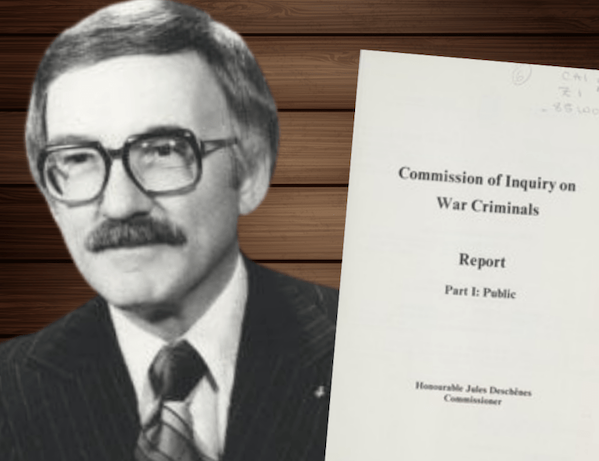
Justice Jules Deschênes, who was appointed by the Canadian government in February 1985 to oversee the Commission of Inquiry on War Criminals in Canada. (screenshot from B’nai Brith Canada)
For nearly four decades, Jewish human rights organizations have been trying to figure out how Nazi war criminals were able to gain citizenship and refuge in Canada following the Second World War. Why were high-ranking members of the Nazi Allgemeine Schutzstaffel (Nazi SS) and Waffen SS troops who fought on Germany’s behalf considered eligible for Canadian citizenship? And who were they? What were their names?
The answers to many of these questions can be found in an obscure list of reports held in government archives. Since 1985, when the Deschênes Commission was appointed to investigate allegations that Nazi war criminals were living in Canada, B’nai Brith Canada and other Jewish organizations have been urging the federal government to release all the commission’s findings. Those records include an historical account of Canada’s post-Second World War immigration policies, written by historian Alti Rodal (the Rodal Report).
“We have always felt that providing the general public with a greater understanding of Canada’s ‘Nazi past’ is a significant venture to providing closure to that time period,” explained Richard Robertson, B’nai Brith’s director of research and advocacy. “This is important because, at a time of rising antisemitism, where there are less and less survivors of the Holocaust around, it is essential that we furnish educators and advocates with as many tools as possible to enable as fulsome a teaching of the [history of the] Holocaust,” including, noted Robertson, those decisions that may have indirectly made it easier for Nazi perpetrators to escape prosecution.
The Hunka affair
Last September, a critical portion of the documentation was made public by the federal government after it was revealed that a former member of the Waffen SS Galicia Division, Yaroslav Hunka, had received a standing ovation in Parliament. Human rights advocates wasted no time in calling for the rest of the Deschênes Commission’s documents to be released, arguing that the unredacted reports could help further Holocaust education in Canada and avoid such mistakes. More than 15 groups, representing Jewish, Muslim, Iranian and Korean ethnic communities and interests, supported B’nai Brith’s petition and, on Feb. 1, the Trudeau government released the bulk of Rodal’s account.
That move has given human rights organizations access to a wealth of information about the politics, the thinking and the apprehensions that often steered the government’s decision not to prosecute or extradite war criminals. Compiled as an historical account of Canada’s post-Second World War policies, the 618-page redacted Rodal Report provides details that aren’t revealed in Deschênes’ deliberations.
Set against the backdrop of today’s rising antisemitism, the report illustrates that Canada’s current struggle to balance the needs of those targeted by antisemitism and discrimination with other democratic principles, like free speech and privacy, is nothing new.
Alti Rodal, author of the Rodal Report. (screenshot from Ukraine Jewish Encounter)
According to Rodal, Canada’s postwar immigration policies were heavily influenced by a belief that extraditing naturalized Canadian citizens for war crimes would be, in the words of Prime Minister Pierre Elliot Trudeau, “ill-advised.”
“Trudeau’s concern,” Rodal wrote, “was that the revocation [of citizenship of an alleged war criminal] could alarm large numbers of naturalized citizens who would be made to feel that their status in Canada could be insecure as a consequence of the politics and history of the country they left behind.”
And Pierre Trudeau was not alone in his reticence to bring Nazi war criminals to court.
“All those goals which Canadian society has set for itself can certainly not be achieved by short-circuiting the legal process in the hunt for Nazi war criminals,” the commission wrote, while examining whether a military court might be an appropriate venue for litigating charges of war crimes.
By the time the commission concluded its research, it had effectively struck down every available legal mechanism for pursuing action against most former Nazis living in Canada. The Deschênes Commission determined that war criminals could not be prosecuted under Canada’s Criminal Code, but neither could they be tried by military tribunal. Nor could they be successfully prosecuted under the Geneva Conventions for acts of genocide or crimes against humanity. And Canada’s extradition laws would be ineffectual in many instances, including when it came to approving requests from Israel. Israel didn’t exist at the time of the Holocaust, the commission reasoned, and thus didn’t meet Canada’s requirements for requesting extradition of Second World War criminals.
New laws, similar challenges
Canada’s only remedy would be to amend its laws going forward. In 2000, nearly 14 years after the release of the Deschênes Commission’s report, the Crimes Against Humanity and War Crimes Act was given Royal Assent. Antisemitism, hate speech and hate crimes are now federal offences as well, covered under Section 319 of the Criminal Code. However, some legal experts say the process of bringing charges of antisemitism or hate crimes to court remains too onerous.
In June, the Matas Law Society and B’nai Brith hosted an educational webinar on the legal strategies available to Canadian lawyers when pursuing charges of antisemitism. Gary Grill and Leora Shemesh, two Toronto-based lawyers who have recently represented victims of alleged antisemitism in Ontario, offered different views as to why it is so hard to bring a hate crime to court.
“We have the tools,” acknowledged Shemesh, “we’re just not effectively using them.” She said she has represented several alleged victims of antisemitism and, in each one of the cases, the charges were later dropped.
Grill, on the other hand, suggested that the issue had to do with initiative. “It’s about political will” when it comes, for example, to ensuring that prosecutors understand that “death to Zionists” is veiled hate speech and should be prosecuted as antisemitism. “The education is easy,” he said. “We can educate prosecutors. We can educate police. It’s not a problem. [But] this is about will. It’s not about law.”
“There are problems with certain [parts] of Section 319 and [its] enumerated defences,” Shemesh said. “Prosecutions under the Criminal Code for the promotion of hatred … require the approval of the attorney general to proceed, which, I say, has partially explained why such prosecutions have been rare in Canadian jurisprudence.”
In Robertson’s opinion, there can be value in legislative oversight. The attorney general’s sign-off “is a safeguard to ensure that our hate crimes legislation … is only utilized when warranted. I believe it is designed to prevent overuse,” he said. “Listen, there’s nothing wrong with that. There’s nothing wrong with having checks and balances to ensure that the proper charges are being laid and the severity of these charges warrant such. The issue is the reluctance of the attorney general to sign off on these charges and the procedural, I would say, slow-downs in effecting the sign-off. These are the issues. If we can perfect the procedures around the sign-off, then this is a completely fine check and balance.”
Richard Robertson, director of research and advocacy for B’nai Brith Canada. (photo from B’nai Brith Canada)
As for addressing the rise in antisemitism that Canada is experiencing today, Robertson believes the answer lies in ensuring Holocaust education is available and continues. That requires ensuring public access to the documents that most accurately tell the story – including those of Canada and other allied nations.
“With the recent issues that we’ve seen regarding immigration into Canada, I think [the Deschênes and Rodal reports serve as a] narrative that is more relevant than ever. I think it is important for us to understand our mistakes of the past so that we don’t repeat them in the future,” Robertson said. “And, as well, when it comes specifically to Holocaust education, I think it is important for Canadians to appreciate the level of complicity, if there was any complicity, in our government helping Nazis escape prosecution following the culmination of the Holocaust in World War II…. It helps to paint the totality of the picture of just how widespread the Holocaust was.”
Robertson said Canadians often think of the Holocaust as a “European issue,” that it only adversely impacted Jews in Europe. “So, understanding Canada’s role and [the Holocaust’s] aftermath helps to globalize the narrative, and perhaps that will help Canadians to better appreciate the truly global impact of the Holocaust [and the trauma] that is still ongoing.”
To date, most of the Deschênes documents have been made public, with the exception of Part II of the original report, containing the identity of members of the Nazi party who were granted immigration to Canada. The ancillary documents, such as the Rodal Report, also contain information that has not been made public. B’nai Brith Canada continues to lobby for their release.
Jan Lee is an award-winning editorial writer whose articles and op-eds have been published in B’nai B’rith Magazine, Voices of Conservative and Masorti Judaism and Baltimore Jewish Times, as well as a number of business, environmental and travel publications. Her blog can be found at multiculturaljew.polestarpassages.com.
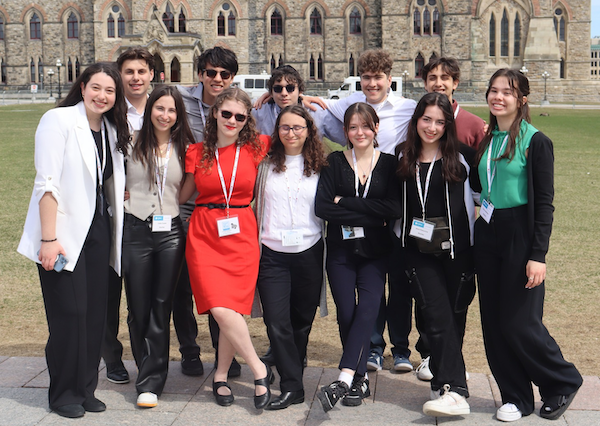
Students from CJPAC’s 2023/24 Generation: Student LeadersProgram cohort (photo from CJPAC)
It is Elul, the month before the Jewish new year. Traditionally, this is a time for cheshbon hanefesh, an accounting of one’s soul, before the reflection and repentance of Rosh Hashanah and Yom Kippur.
This year is not like years past. This year, our individual and community accounts are overdrawn. Instead of looking into how our souls spent 5784, instead of wondering what we could have done better, instead of cheshbon hanefesh, this year should be one of hashka’at hanefesh, investment in our souls.
As we move towards Rosh Hashanah, Jewish communities and individuals will blow the shofar and recite Psalm 27. This is a daily call to action and a recitation of a mantra that means so much more this year.
Of David: Hashem is my light and my salvation; whom should I fear?… Though an army may camp against me, my heart will not be afraid; though war rises against me, I will be confident…. Deliver me not to the will of my enemies, for false witnesses are risen against me and breathe out violence…. Look to Hashem; be strong and of good courage! Look to Hashem! (Psalm 27, excerpted)
The 14 verses of this psalm help us examine the past year and focus and inspire us for the coming one. Recited through the High Holy Days until Hoshannah Rabbah, it is a call to make that investment.
The year 5784 was a challenge. It was a year of pain. Through it, the worldwide Jewish community declared, “We will dance again.” Now, the shofar and the words of the psalm force us to confront metaphors made real. Though it seems like we are surrounded by enemies, these verses call upon us to act. If we do, our “head[s] will be lifted” and we will again “offer sacrifices of joy.” “We will dance again” will be realized when we stand up to say, “Hineini.”
Hineini – I am here. It is a word of intentional presence. When God approaches Avraham, Avraham answers, “Hineini.” When Moshe is called to lead, he responds, “Hineini.” Our leaders were not prepared. Nevertheless, when asked, they stepped up. This is the lesson of the High Holy Days. It is a call to action that begins with the individual and moves to the communal.
It is our time to answer that call. It is time for our community and our allies to stand up and step forward to make a difference and an impact. It is time to say, “Hineini. I am here, I am present.”
The Canadian Jewish Political Affairs Committee (CJPAC) is here and present to help Canadian Jews and their allies be seen and heard.
Now is the perfect time to get involved in politics, with the BC general election set for Oct. 19. You can make a real and tangible impact. CJPAC is here to guide you. In political campaigns, every single volunteer who steps up can be the deciding factor in a candidate’s success.
It is not the loud, angry voice that makes the lasting impact. The difference is made by people who show up and get the job done. Say “Hineini,” and sign up to volunteer for the candidate or party of your choice.
Sign up for CJPAC emails to stay informed about specialized training opportunities. From Politics 101 to the importance of running for a school board or campaign volunteering, CJPAC’s Advancing Campaign Training (ACT) program will help prepare and connect you.
In our tradition, what begins with the individual ultimately ends with the community. Sign up with friends for a CJPAC Day of Impact or create your own. By coming together, we inspire future generations. Volunteering with children not only teaches but empowers them to take action – and not just during difficult times.
If you have, or know, a teen in grades 10 to 12, be sure to check out CJPAC’s Generation: Student Leaders Program. Throughout the school year, teens engage in thoughtful discussions with peers, empowering them to participate in the democratic process.
CJPAC’s flagship Fellowship Program trains 50 of the top pro-Israel, politically engaged post-secondary students from across Canada to become the next generation of political leaders. Applications close on Sept. 18.
We make a difference when we show up. The more people who give of their time and efforts, the greater our impact. Connecting with the party or campaign of your choice through CJPAC offers you a tangible opportunity to support the community and build a better Canada.
Listen to the call this Elul. It is time for our community and our allies to stand up and step forward to make this difference.
Hineini – I am here.
Hineini – I am ready.
Hineini – Even if I am afraid, I will be an upstander. I will pray with my feet before and beyond the chaggim (holidays), acting for the future, the future of our children, and of our communities – both Jewish and more broadly Canadian.
Hineini.
Rabbi Jennifer Gormanis CJPAC national director of outreach & programming. To learn more about CJPAC or sign up to volunteer, visit cjpac.ca or contact Kara Mintzberg at [email protected].
Lance Davis, chief executive officer of JNF Canada. (photo from JNF Canada)
The Jewish National Fund of Canada is fighting the Canada Revenue Agency over the revocation of the organization’s charitable status, accusing the federal taxation department of “blindsiding” them and treating them differently than other charities. The head of JNF Canada sees bias at play.
“Do we think the CRA is antisemitic?” asked Lance Davis, JNF Canada’s chief executive officer, in an interview with the Independent. “No. Do we think there is bias involved here? Yes. That’s actually part of our court application. We have said in writing that we believe there is bias.”
The difference, Davis explained, is that, while CRA officials may not carry prejudice toward Jewish people, their decision may have been influenced by a concerted, multi-year campaign attacking JNF – Independent Jewish Voices Canada has a website dedicated to the campaign.
Through a Freedom of Information Act request, JNF Canada obtained the files used by CRA to make their determination.
“So we know what was written in the file that the CRA is using with respect to JNF Canada and it is littered with complaints in an organized and systematic way from anti-Israel groups, unions, political parties, etc.,” he said. “After you read all of this material, one can reasonably say that bias may have come to play into the decision-making process.”
Davis is emphatic that media have so far got the story wrong. The revocation is not about JNF Canada’s support for projects on Israel Defence Forces bases or on the other side of the Green Line, outside of Israel proper. CRA expressed concerns about these projects several years ago and JNF Canada immediately ended those undertakings, he said.
“Yes, we have over the last number of decades built all sorts of public amenities on IDF bases,” he said. “Those amenities include swing sets, playgrounds, parks, play areas … shaded areas, rest areas, all that kind of stuff. We disagree that that is not charitable. Helping the children who have to live on a base … we believe is charitable.”
Moreover, the money for such past projects did not flow to Israel’s military, said Davis. It went to a charity that built the projects.
“Nevertheless, when it was brought to our attention that this is a problem according to the CRA, we stopped doing it in order to be cooperative and collaborative with the CRA,” he said. “That’s not what this revocation is about. It might be an interesting subject for the media or those outside parties to conflate, but this issue that we’re dealing with the CRA is fundamentally about our founding charitable object. They’ve come to the conclusion that it is not charitable.”
The issue, Davis said, is that CRA, after 57 years, has abruptly reversed the 1967 acceptance of the organization’s charitable objective.
In 1967, said Davis, CRA’s predecessor agency accepted JNF Canada’s purpose of funding projects in which economically disadvantaged individuals in Israel, especially new immigrants as well as Palestinians, are hired to complete projects like tree-planting and digging reservoirs, with the intention of keeping them off welfare rolls and combating poverty.
The current troubles between CRA and JNF Canada started during an audit that began in 2014. When the auditor cited the original objective as incompatible, Davis said, the organization immediately set out to negotiate new charitable purposes that would satisfy CRA.
“We presented 10 of them in writing and said, please work with us, let’s pick any or all of these and we’ll get to work,” said Davis. “CRA did not negotiate with us at all about any of those charitable objects.”
Those objectives, he noted, were replicated by JNF Canada from other recognized charities that had received approvals from CRA.
The organization’s leaders say they were “blindsided” by the decision, which was released Aug. 10, via the Canada Gazette, the federal government’s avenue for publicizing legislation and government decisions.
The revocation is the culmination of a crisis that began at the end of June, when JNF was notified that CRA intended to revoke their charitable status. Within weeks, the organization’s lawyers had filed suit with the Federal Court of Appeal.
In every similar instance JNF’s lawyers reviewed, Davis said, CRA refrained from revoking the status at least until the organization had their day in court.
“There is this idea of a presumption of innocence until you’ve exhausted all your appeals,” said Davis. “Why weren’t we given a presumption of innocence? Why weren’t we given a chance to say our piece before the judge? It’s a right that every Canadian business, individual, charity is entitled to.”
For now, JNF Canada is not permitted to provide charitable receipts.
“We are still a nonprofit, we still exist, we’re still an entity,” Davis said.
If the Federal Court of Appeal sides with CRA, JNF could take the matter to the Supreme Court, Davis said. Alternatively, they could potentially restructure the way they do their work.
“We are working through thoughts and plans with our legal counsel as to how we could best continue the work of JNF in a legal, charitable manner,” he said. “But we are confident in our case and we feel that it’s vitally important for us to challenge the CRA and the facts that they’ve presented.”
JNF Canada has not yet publicly released documents relating to the matter, as they await their lawyers’ annotations to provide both the CRA’s perspective and the JNF’s replies to the government agency’s concerns.
In dealing with JNF Canada, Davis contends, CRA has behaved differently than they routinely do with other charities. The due process they should expect has not been forthcoming and the government agency has leapfrogged several steps that charities are generally provided in the progression of an issue, he said.
Over the years, Toronto-based educator Lisa Gelberman saw a consistent problem with the education system: it did not address the fact that a third of students in North America have various reading difficulties.
“When kids struggle academically, they struggle behaviourally, they struggle socially, and long-term success becomes more unlikely. It’s a huge spiral,” said Gelberman, principal at Kayla’s Children Centre (KCC).
In her view, the need was so great to help those falling through the literacy cracks, that she took matters into her own hands to find a way to solve the problem. Over time, she developed an online reading program called Literacy Decoded, which launched in 2022. Its aim is to train teachers to support students with learning disabilities, dyslexia and other developmental delays. Several Toronto Jewish schools (including Bais Yaakov High School and Eitz Chaim Schools) have purchased the course and adopted its curricula. She has sold it to hundreds of educators across North America.
Comprising mostly Jewish students, KCC is a school, therapy clinic, recreational centre and camp for children with special needs, and some students, including those who have extreme delays, have learned to read because of the program.
“The Jewish community sees the importance of supporting children with learning disabilities and dyslexia,” Gelberman said. “There are going to be fewer kids leaving the Jewish school systems for secular schools, because now their own schools have the training and resources needed. Now their needs are being met and [the program is] changing their educational outcome,” she contends.
The mother of five began her career as a teacher at a public school, teaching first grade for three years, then, having taken various course qualifications, she began teaching special education. Later, she led a class for students with learning disabilities, dyslexia or severe ADHD. Afterwards, she taught children with autism.
“I was always very passionate about teaching children to read,” she said. “Developing curricula and exploring different paths to teaching kids to read is my purpose.”
Up until about five years ago, Gelberman said, most schools across North America used a methodology called the “whole language approach.” But a full third of children do not pick up reading from this method, she argues. “So, kids struggle, and I just knew there’s something I had to do about it.
“Every year,” she continued, “I got so close to teaching this one child to read [but] he came back after the summer and it was like everything I taught him was lost. I didn’t understand why. That’s when I started to look for other programs to help.”
She discovered the Orton-Gillingham approach, and, on her own dime and with a year-and-a-half of study, she became certified to teach it.
After being hired by Kayla’s, Gelberman applied the Orton-Gillingham methods with the institution’s kids and found success in teaching children who previously had found it incredibly difficult to read.
Building upon the program, she videoed her own son, who showed signs of dyslexia and was having trouble reading, learning with the approach and used it to show teachers and parents how to implement it.
“He’s jumped three grade levels in six months. And even his teacher at the time couldn’t believe it,” she said.
“And that’s how I actually was able to improve upon the program…. I was training the teachers, and other schools were asking me to come in [to do] staff training, but I simply didn’t have the time. So, I decided to develop a course of my own.”
Lisa Gelberman has created an online teaching program, Literacy Decoded, based on the Orton-Gillingham method. (image from Lisa Gelberman)
It was important for Gelberman to gear her own program towards Jewish day schools, which she claims have fewer resources, in general, to divert to kids who are lagging. Particularly for the Jewish community, she’s made a special effort to ensure the content – words and images – is appropriate.
According to Gelberman, the two years of remote learning during COVID made the program more relevant and needed, given how so many children who require in-person interaction to absorb materials were denied this interaction during a critical time in their learning.
“I’m just so happy that the children who would have fallen through the cracks are now able to read,” she said, adding that KCC children are being mainstreamed, when they ordinarily would not be.
Four years in development, “huge pieces” of Gelberman’s program do not involve memorizing words, nor looking at pictures, tools she said have been relied upon heavily as teaching aids. Instead, in her course, what seems to work is the sounding out of words, learning different sound combinations, and learning syllable types.
The program is asynchronous, that is, it proceeds at the teacher’s pace, and each lesson is through video, so the lessons feel “live.” In addition, Gelberman offers monthly coaching sessions with teachers, where they share with each other their struggles and problem-solving methods.
“I truly feel the right training from the right teachers can and will teach kids to read,” she said.
Dave Gordon is a Toronto-based freelance writer whose work has appeared in more than 100 publications around the world. His website is davegordonwrites.com.
Kayemet LeYisrael – Jewish National Fund activities in Winnipeg took place at Brock Corydon school, Gray Academy (above) and Herzliya Synagogue. (photo from KKL-JNF)
A variety of educational and experiential activities conducted by teams from the department of Zionist education in the diaspora, part of the education division at Kayemet LeYisrael – Jewish National Fund, took place in Jewish communities around the world during “National Month,” which includes Memorial Day, Independence Day and Jerusalem Day. Activities took place at schools, kindergartens, Sunday schools, synagogues, Jewish organizations and elsewhere in 16 countries, including Canada.
A Kayemet LeYisrael – Jewish National Fund activity at Brock Corydon school in Winnipeg. (photo from KKL-JNF)
In Canada, teams conducted activities in Toronto, Windsor and London, Ont., and in Winnipeg, Man. Activities included a virtual art and graffiti tour of Tel Aviv-Jaffa, lectures on life in Israel post Oct. 7, a Kites for Hope event, and activities for children about Independence Day.
Kayemet LeYisrael – Jewish National Fund at Herzliya Synagogue. (photo from KKL-JNF)
“Activities organized with the envoys from Israel were incredibly meaningful to our communities here in Canada,” said Yifat Bear Miller, KKL-JNF envoy to Canada. “As we are distant from Israel here in Canada, such activities fostered a deep connection to Israel, Judaism and the current situation in the region.”
Len, Jeffrey, Sharon and Valerie on their family trip to China in 2009. (photo from Valerie [Chan] Hum)
Little did we realize when our son, Jeffrey, married Sharon Szmuilowicz in August 2008 that we would find ourselves visiting China nine months later as a family and visiting all our ancestral homes.
My family comes from the village of Sui Nam, Toi San district, Guangdong province. My grandfather was sponsored by a tailor and moved to Victoria in 1893 as a 16-year-old from a very poor family. He eventually married, started a restaurant business (the Panama Café) and fathered 12 children. Today, more than 140 Chan family members have been born in Canada over five generations and 131 years.
My husband Len’s family was from a small village of 30 houses in Chongkou, Kaiping district, Guangdong province. Len’s father traveled back and forth between China and New Westminster to earn money to support his family. In 1950, Len and his grandmother left China for Vancouver and then met up with Len’s father, who had moved to Ottawa. Two years later, the rest of Len’s family arrived in Canada. The family owned a number of restaurants over the years.
When our son married a Jewish woman from Toronto, we never thought we would learn that her family has ties to China as well.
The idea for the trip to China was initiated by Sharon. She felt it was important to learn about Jeffrey’s culture and family history. However, since the Szmuilowicz clan also had a direct link to China via Shanghai, it was an opportunity to explore both their histories.
On May 13, 2009, 62 years after Sharon’s family left China, our tour guide Hao brought us to the Shanghai Jewish Refugees Museum, the former Ohel Moishe Synagogue, at Sharon’s request, where we were able to access a computer database listing all the refugees who had lived in Shanghai. We were so pleased to see Sharon’s grandfather and great-grandfather listed in the database, including their former address. Jacob and Samuel Szmuilowicz, age 59 and 21, were listed as Polish refugees living at 30-50 Zangyang Rd. What a tremendous discovery! And, to top it off, 30-50 was next door to the synagogue and was still standing.
Valerie and Sharon outside the Shanghai Jewish Refugees Museum, the former Ohel Moishe Synagogue. (photo from Valerie [Chan] Hum)We decided to knock on their door and see if anyone remembered Sharon’s family. The present residents moved into the building in 1950 and had no recollection of the previous Jewish residents who had crammed into these small apartments more than 70 years ago. Although we could not find anyone who knew Sharon’s family, it was still a remarkable discovery to find the records and the home they had lived in.
For the purposes of our trip, Sharon’s story begins with her grandfather, Samuel. To escape conscription into the Russian army, Samuel and his father, Jacob, left their homes, by foot, in 1939, making their way to Japan via Manchuria. At the time, Samuel was at university in Vilna (now Lithuania; then under Polish occupation), studying mathematics, and Jacob was running a general store in Lida, then in Lithuania (now in Belarus).
Their transit visas were issued by Japanese diplomat Chiune Sugihara. He was giving out these visas without the knowledge of his government. It was dangerous for him to do so, but he knew that he needed to do something to save as many Jews as possible. In 1985, Sugihara was the first and only Japanese citizen to be listed by Yad Vashem as a Righteous Among the Nations.
With visas in hand, the journey took nearly two years to complete. They traveled by day and hid at night, finally arriving in 1941. In January 1942, they were transferred to Shanghai, where they joined the approximately 20,000 Jews who had migrated there in three waves beginning in the 1800s.
During their five years in Shanghai, Jacob sold rice while Samuel, who was attending the American School and learning English, ended up driving jeeps for the American army. They made enough money to leave for Mexico City in 1947, where they ran a textile factory that manufactured cotton goods, and started the Spanish-speaking arm of the Szmuilowicz clan. Sharon’s parents met in Mexico and moved to Canada, so her dad could pursue a career in medicine.
We learned that there were many Jews who fled Eastern Europe and ended up in Hong Kong or China.
The next part of our discovery trip found us traveling by ferry from Hong Kong over to the mainland city of Zha Hai, where we were then met by distant Hum clan relatives, who drove us to my paternal grandfather Chan’s hometown of Sui Nam. I suspect I am the only descendant who has made the trek back to the town of Sui Nam, which appears very old and somewhat decayed, but still standing.
In the village of Lohk Hing Leih, 90-year-old Mrs. Tam remembered Len, who used to play with her eldest son. (photo from Valerie [Chan] Hum)Half an hour later, we arrived in the small village of Lohk Hing Leih, a cluster of 27 buildings housing the remaining Hum clan. Len’s family left the village in 1949, spending a year-and-a-half in Hong Kong awaiting their papers for entry into Canada. The village remains very poor, comprised of mostly vacant buildings surrounded by rice paddies and vegetable gardens.
Ninety-year-old Mrs. Tam, looking remarkably spry and pleasant, incredibly, remembered Len, who used to play with her eldest son. The other village residents were too young to remember him, but they swiftly brought out some food offerings, the incense, paper money to burn before the family altar, and lit some Chinese firecrackers. These are age-old traditions, in honour of the Hum ancestors. There were no young people living in the village. They had all left to find jobs in the cities. We wonder if the village will even exist in 20 years’ time.
Call it fate or bashert that, from the 1940s, three different families who started off in China, one a Jewish refugee family in Shanghai and two native Chinese families living in small villages near Canton, would be reunited in Canada through marriage 70 years later. The biggest blessing is that, on May 11, 2024, a Szmuilowicz-Hum great-great-granddaughter celebrated her bat mitzvah in Toronto. We were all be thrilled to be there.
Valerie (Chan) Humlives in Ottawa. She was born in Victoria, where her family have lived since 1893. Her grandparents ran the Panama Café at 1407 Government St. for many decades. This article was originally published by the Ottawa Jewish Bulletin.
Richard Heideman, left, and Warren Kinsella participated in a B’nai Brith Canada virtual fireside chat on May 30. (photo from B’nai Brith Canada)
The League for Human Rights of B’nai Brith Canada hosted a virtual fireside chat with Canadian lawyer and author Warren Kinsella and American attorney Richard Heideman on May 30. The conversation largely focused on growing antisemitism and political passivity in North America in the wake of the Oct. 7 Hamas attacks on Israel.
Kinsella began by talking about his experiences over the past three decades, writing about neo-Nazism and antisemitism and how they never fully disappear, no matter what region of Canada one observes. However, he said, the present state of anti-Jewish feeling in the country is the worst he has witnessed.
“I never dreamed in my worst nightmare that we would actually have in a single week two schools in separate provinces shot at because they teach Jews. I never thought I would see the attacks on Jewish businesses, individuals and community centres,” he said.
Kinsella castigated elected representatives in Canada for their inaction and lack of leadership in the face of hate speech directed at Jews and the rising numbers of attacks, citing an abundance of laws to handle the problem effectively.
In the international arena, Heideman added, the silence from prime ministers, presidents and ambassadors after the Hamas attacks last fall has been “deafening.” No Western democracy, he said, would tolerate the atrocities committed during the Oct. 7 attacks on their own soil.
“The United Nations and its world courts must be held accountable for singling out Israel for multiple decades and playing into the biased hands of countries like Iran, which only months ago directed hundreds of drones and rockets at the sovereign state of Israel,” said Heideman.
Both men praised Israel for its commitment to human rights and agreed that the present demonization of the strongest democracy in the Middle East, and the concurrent calls for economic and academic boycotts, must come to an end.
Heideman argued that the lessons of recent history, namely the banning of Jews from all facets of everyday life in Nazi Germany in the 1930s – which was followed by the Holocaust – have not been learned. What’s more, he said, there is presently a blame-the-victim mentality at the international diplomatic level which faults Israel for the present situation.
On the bright side, Kinsella noted that polling after Oct. 7 would suggest that the vast majority of North Americans are on Israel’s side and believe it has a right to defend itself. They also welcome Jewish people into their communities. The problem, according to Kinsella, is with the younger segment of the population, the group which has taken to the streets, created encampments, and said and done terrible things to Jews.
“Eighteen-to-40-year-olds in Canada, the United States and Europe are presently a lost generation. You will find no constituency or demographic that believes more in Holocaust denial, that thinks Hamas was right and that Israel should be wiped off the map,” Kinsella said.
“When we have millions of young people who have embraced hatred, division and terrorism, we have a big, big problem,” he continued. “I think we are looking at something that is going to take a decade or more to fix because it’s taken us more than a decade to get us to this dark place.”
To Kinsella, the internet – the primary medium through which people, particularly the young, obtain information – is largely at fault. Despite improving the world in many respects, he said, the World Wide Web has enabled those intent on propagating hate to do so immediately and at no expense. Further, both Kinsella and Heideman said bad state actors are determined to exploit the internet to spread misinformation and hate speech.
Heideman said there was no place for timidity in the present environment and advocated examining each situation and acting accordingly – in other words, not remaining silent.
“Being quiet does not do us any good,” he said. “Being quiet leads to Holocaust denial, distortion and people not caring. We have to take action in a way that is targeted, strategic and powerful – that means in federal courts, state courts and international courts.”
Kinsella is president of the Daisy Group and a former special assistant to former prime minister Jean Chrétien. He has advised numerous political campaigns and is the author of several books, in addition to being a newspaper columnist.
Heideman, senior counsel at Heideman, Nudelman and Kalik PC, and chair of the US Holocaust Memorial Museum Lawyers Committee, is a specialist in American and international litigation.
Sam Margolis has written for the Globe and Mail, the National Post, UPI and MSNBC.
A federal bill to address online harassment, bullying and hate has aspects to admire and others to cause concern. What happens in the committee process will determine the success of the proposed law.
That is the take of two experts – including one who had a hand in drafting the legislation. The devil, as always, is in the details of balancing free expression with the right to be free from threats and harassment.
Dr. Michael Geist, the Canada Research Chair in Internet and E-commerce Law at the University of Ottawa, who also serves on the advisory board of the Electronic Frontier Foundation, was joined in a recent online panel by Dr. Emily Laidlaw, Canada Research Chair in Cybersecurity Law and associate professor in the faculty of law at the University of Calgary. Her recent work includes projects on online harms, misinformation and disinformation, and she co-chaired the expert group that advised the federal government on the development of the Online Harms Bill, which is known as Bill C-63. The virtual panel, on April 17, was presented by the Centre for Israel and Jewish Affairs and moderated by Richard Marceau, CIJA’s vice-president, external affairs, and general counsel. More than 850 people registered for the event, indicating what CIJA board chair Gail Adelson-Marcovitz indicated is a depth of interest, and perhaps concern, about the bill.
Geist explained that the new bill is a result of years of work, following the federal government’s withdrawal of an earlier attempt at addressing the problem of online harms.
Bill C-63 is really three separate concepts rolled into one. It would amend the Canadian Human Rights Act and the Criminal Code, as well as introduce a new Online Harms Bill. Together, the components would codify currently inconsistent approaches to the problems.
The bill would redefine “hatred” in the Criminal Code and define a new crime of “offence motivated by hatred.” That offence, as well as advocating or promoting genocide, could lead to life imprisonment.
Amendments to the Canadian Human Rights Act would add the “communication of hate speech” via the internet or other telecommunication technology as a discriminatory practice. Individuals would be empowered to bring a complaint before the Canadian Human Rights Commission, which could penalize offenders up to $50,000. The law, if passed, would affect public communications, like social media posts, not private messaging or emails.
Separate components of the bill would make it easier and quicker to address specific offensive content, such as “revenge porn” and posts that could harm children, encourage suicide or bullying or otherwise endanger young people.
A digital safety commissioner and ombudsperson would help guide individuals through the process of dealing with bullying or other issues related to the law.
On April 17, Dr. Michael Geist of the University of Ottawa spoke as part of a CIJA panel discussion on the Online Harms Bill. (screenshot)
Geist said many legal experts who seek to balance freedom of speech with freedom from abuse “breathed a sigh of relief” after the federal government abandoned earlier efforts and relied for the new bill on expert advice.
“It’s a pretty good starting point,” Geist said. “We know the broad brushstrokes of what that might include but there is a lot of uncertainty still, so it’s easy to like it when we don’t know the specifics.”
Geist and Laidlaw agreed on most points but had some differences around oversight. Geist said the bill appears to grant enormous powers to a new digital safety commissioner. The idea of life imprisonment for an online comment, he added, may be a sticking point. “I find that hard to justify,” he said.
Laidlaw said the new office of ombudsperson is an important step in helping individuals navigate online hate and harassment. The ombudsperson would be able to pass specific information on to the digital safety commission, whose mandate includes education and research supported by a digital safety office.
The bill would also place new obligations on corporations that run online platforms, like social media companies. At present, Laidlaw said, some companies, notably X (Twitter), are not taking the problem very seriously.
While Jewish advocacy organizations have long advocated for legal responses to hate speech, Geist warned of a double-edge sword.
“Could somebody who is supportive of Israel will be accused of promoting genocide?” he asked.
Geist upended the binary assumption of harassment and free expression, noting that the idea that limits on hate speech could chill expression ignores the existing, difficult-to-measure effects of online (as well as offline) harassment and bullying.
“There is already a chilling effect for anyone in our community and, frankly, in a number of communities, that speaks out on these issues,” he said. “The backlash that you invariably face causes, I think, many people to [reconsider] whether they want to step out and comment, and it’s not just online. There’s a chilling effect offline as well. These issues are very real and many of them will not be solved by legislation no matter what the legislation says.”
He fears a barrage of complaints, many vexatious, from all sides of many contentious issues.
While there is a needle-in-a-haystack challenge in addressing online harms, Geist said, addressing the problematic major players could have a broad impact, though no one believes online hate and bullying can be completely eradicated.
“The legislation talks about mitigating these harms, it doesn’t talk about eliminating them,” he said. Social media platforms, he believes, are looking for guidance on these issues and will be amenable to adhering to legislation. Moreover, he said, Canada’s proposals are somewhat belated responses that would put us roughly in line with the European Union, Australia, the United Kingdom and other jurisdictions.
Dr. Emily Laidlaw of the University of Calgary, who joined the CIJA panel discussion on April 17. (screenshot)
The inability to erase hate and harassment is not an excuse to do nothing, Laidlaw said.
“Enforcement has always been an issue,” she said. “But I don’t think it’s a reason not to pass laws.”
Laidlaw took exception to criticism that the new bill would represent government censorship. The proposed digital safety commissioner would be an independent body comparable with the existing privacy commissioner.
“Where there is some risk is in the fact that, in the end, government appoints the individuals,” she said. Still, the appointees would need to be approved by Parliament, not just the government in office.
“And remember,” she added, the commissioner’s “oversight is of companies, not of individuals. They’re not making individual content decisions or holding individuals accountable here.”
The commission would not be subject to legal rules of evidence, making it possible to immediately take down things such as child porn, encouraging suicide or other especially egregious posts.
Geist said this significant power demands that the government spell out more clearly the limitations of the commission.
“At a minimum, it seems to me that it is incumbent on the government to flesh out in far more detail where the limits, where the guardrails, are around the commission, so that we aren’t basically adopting a ‘trust us’ approach with respect to the commission,” said Geist.
Parliament is expected to take up consideration of the bill in committee soon and Laidlaw argued that some aspects deserve speedy passage while others require far more sober consideration.
“The Online Harms Bill could be passed with minor tinkering,” she said. The Criminal Code provisions, she said, give her serious concerns and deserve major revisions or complete scrapping. She also struggles with changing the Canadian Human Rights Act.
Geist agreed on taking the bill apart.
“I would separate out the bill,” he said. Criminal Code and Human Rights Act amendments deserve much deeper consideration, he said. The online harms piece, he said, could be tidied up and passed with tweaks.