I am a Canadian Jew with deep roots in Canada. My grandfathers, one from Winnipeg and the other from Toronto, helped build two of Vancouver’s prominent synagogues in the postwar era. I married a Canadian, also the descendent of Canadian Jewish leaders. Now that my wife and I are raising children south of the border, we frequently hear from my relatives in British Columbia about how much more enlightened Canadian society is. We often agree.
However, my perspective on Canada has been shifting as I’ve learned more about Canada’s ever-expanding Medical Assistance in Dying (MAID) program. Recent international media attention has focused on the fact that Canadians are choosing MAID at rates far beyond expectations, particularly as Canada has expanded eligibility to include non-terminal cases (“Track 2”). I am deeply concerned about this direction.
My message to Canadians, especially Canadian Jews, is this: please be more critical of your government. (Notice I said “please” – can’t shake those Canadian manners.) Just because MAID is legal does not mean it’s ethical. We Jews know all too painfully that the actions of Western, enlightened governments can be immoral.
Since I’m a rabbi, I’ll start with the ways I believe that MAID violates the most basic Jewish tenets. The Talmud teaches that three partners are involved in the creation of every human being: the two parents, and the Holy One. (Kiddushin 30b, Niddah 31a) This ancient teaching captures something profound about the limits of human authority over life and death – we are partners in creation, not owners of life itself.
Our tradition also teaches that “One who saves one life, it is as if he saved a whole world.” (Sanhedrin 37a) One of the most important theologians of our time, Rabbi Irving “Yitz” Greenberg, recently published Triumph of Life: A Narrative Theology of Judaism. In this book, a culmination of lifelong philosophical inquiry, Greenberg presents a theologically grounded vision of a world moving toward deeper recognition of the infinite value, equality and uniqueness of every person. I recommend reading it.
Judaism values protecting and supporting the vulnerable, not offering them death as a solution. Even Track 1 MAID presents complex questions within Jewish tradition. While Judaism prohibits hastening death, there is also a tradition against unnecessarily prolonging the dying process. Some Jewish authorities might find space within this framework for passive euthanasia for Track 1 cases; others maintain that any hastening of death crosses a fundamental line. But Track 2 MAID represents something categorically different and far more troubling from any Jewish perspective on the sanctity of life.
The Toronto Board of Rabbis wrote to Canadian senators in 2021 about MAID, expressing concern about “pressure, both subtle and overt” on vulnerable people to choose death. While this letter represented important rabbinic concern, it wasn’t enough. Canadian Jewish leaders from every denomination should articulate clearly that MAID’s existence and expansion fundamentally contradict Jewish values about infinite human worth.
Dr. Arielle Berger, a Toronto geriatrician studying for the rabbinate, writes about “fundamental ideas necessary for aging such as the centrality of gratitude to living a meaningful life, and the truth of interdependence, which allows us to both give and receive with generosity.” She notes the “transformative impact these counter-cultural ideas can have” on understanding worth beyond productivity. Berger uses a Jewish lens and Jewish texts to express that human worth isn’t contingent on productivity, independence or the absence of suffering. Dependence, weakness and need of others are universal features of being human.
I want to amplify voices like Berger’s and Greenberg’s, and urge more Canadian rabbis and other Jewish leaders in Canada to take a clear stance: MAID needs to be questioned on both societal and individual levels. Individual citizens should reject MAID. Rabbis and religious leaders should call on the Canadian government to repeal MAID, while also guiding congregants to choose life. Choosing to live, even when life is diminished or difficult, even when we might feel like “a burden,” remains sacred and valid.
Even non-religious people have good reasons for concern. When the government anticipates almost $150 million in annual savings from MAID, we’ve created a system where death becomes financially advantageous. The possibility of coercion is impossible to avoid.
It’s also deeply troubling for a government to play a role in killing citizens. Decriminalizing suicide is one thing; making death easily accessible through state systems is categorically different. And, if you wouldn’t end your own life directly, asking someone else to do it for you isn’t ethical either. It’s also unethical to be a doctor providing MAID; perhaps the people who do so need a new professional title – “euthanists” – since they’re no longer practising medicine in any traditional sense.
Additionally, MAID represents ageism and ableism dressed up in the language of autonomy and choice.
When my great-aunt Mona Winberg was born with cerebral palsy in Toronto in the 1930s, doctors told her mother to institutionalize her and forget her. The medical consensus was that her life would have no value. Her mother refused. Mona became a pioneering journalist and disability rights activist, receiving the Order of Canada, among other honours. But, even if Mona had never won awards or achieved public recognition, her life would have been important and worthwhile, just like my own.
If any of these more secular arguments speak to you, or if MAID just makes you uneasy, or if recent headlines feel like a dystopian novel, rest assured that you have support from Jewish wisdom that has guided our people for thousands of years.
The Canada my grandparents helped build was founded on the principle that society is judged by how it treats its most vulnerable members. Today’s Canada seems to have forgotten that value, bent on helping vulnerable members access easy death rather than better care. I’m not saying we in the United States have society all figured out; far from it. But Canadian Jews have an obligation to think and act critically, and to engage in this public conversation before MAID unravels in even more alarming ways.
Seth Winberg is executive director of Hillel at Brandeis and senior chaplain of Brandeis University. This article was originally published by the CJN. For more national Jewish news, go to thecjn.ca.
Gerald Steinberg, founder of the pro-Israel research institute NGO Monitor, recently spoke with Ellin Bessner, host of The CJN Daily podcast, about Samidoun being listed as a terrorist organization. (screenshot thecjn.ca)
Canada’s federal government has now formally listed Samidoun as a terrorist entity, effective Oct. 11.
“Violent extremism, acts of terrorism or terrorist financing have no place in Canadian society or abroad. The listing of Samidoun as a terrorist entity under the Criminal Code sends a strong message that Canada will not tolerate this type of activity, and will do everything in its power to counter the ongoing threat to Canada’s national security and all people inCanada,” read the Oct. 15 statement from Public Safety Minister Dominic LeBlanc.
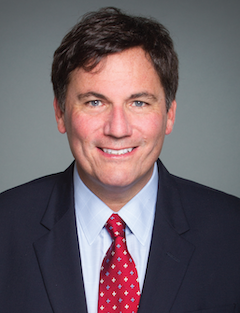
Dominic LeBlanc, Canada’s minister of public safety, democratic institutions and intergovernmental affairs. (photo from pm.gc.ca)
The decision was formally announced as a joint action with the US Department of the Treasury, which called Samidoun “a sham charity” in a statement from its Office of Foreign Assets Control.
Jewish leaders had long been arguing that the Vancouver-based nonprofit organization has direct ties to known militant terrorist entities, including the Popular Front for the Liberation of Palestine (PFLP), which pioneered airplane hijackings, suicide bombings and assassinations of Israelis, and were directly involved in the Oct. 7, 2023, attacks on Israel.
The week prior to the government’s announcement, Pierre Poilievre, leader of the federal Conservatives, demanded Ottawa declare Samidoun a terrorist organization – as several other countries have already done. Doing so would block Samidoun’s ability to fundraise and would make it a crime for anyone to help it.
The PFLP is outlawed in Canada, the United States, the United Kingdom, Germany, Israel and many other countries, and some countries, including Germany and Israel, have banned Samidoun, too. The Netherlands has voted to consider doing the same.
Samidoun’s status in Canada fell under scrutiny after the group organized protests to coincide with the anniversary of the Oct. 7 Hamas terror attack on Israel. Some supporters in Vancouver tried to set fire to a Canadian flag, calling, “Death to Canada, death to the United States and death to Israel.”
Meanwhile, authorities in British Columbia were forced to lift bail conditions that had preventedSamidoun’s Vancouver-based international coordinator, Charlotte Kates, from participating in any protests for a period of six months. Vancouver police arrested Kates after she gave an antisemitic speech in April that praised the Oct. 7 massacre, but charges had not yet been laid before the bail deadline expired on Oct. 8. Kates is married to Khaled Barakat, suspected of being a high-ranking member of the PFLP, who also was granted Canadian citizenship.
Gerald Steinberg founded the pro-Israel research institute NGO Monitor, and is a professor emeritus at Bar-Ilan University. A former columnist for the Canadian Jewish News, he spoke to me earlier this month to explain more about Samidoun’s terrorist ties, including how they operate on Canadian campuses.
Gerald Steinberg: I stumbled into the world of NGOs, nongovernmental organizations, about 20 years ago, when Canada was one of the main funders of something called the UN Conference on the Elimination of Racism around the world – that’s the infamous Durban Conference. A lot of antisemitism there. They didn’t care about racism. It was about labeling Israel as an apartheid, genocide state.
That was in September 2001, 23 years ago. I began to see nongovernmental organizations as important players and nobody was looking at that. Why are they allowed to be? What is the reason that they have gained so much political influence? And I began to do research. We look at the impact, the capabilities, the funding … [of NGOs that advocate against Israel]. We do look at some other cases, for comparative purposes.
Samidoun was not high up on our radar. Samidoun was something that gradually we began to understand the importance of. It’s officially called the Palestinian Prisoner Solidarity Network. They’re a branch, as they make quite clear, and unusually clear, of the Popular Front for the Liberation of Palestine, which is a banned terror organization in the United States, in a number of European countries, in the UK and elsewhere.
So, what is this organization doing? Organizing these kinds of rallies and mob actions that label Israel as a genocidal state and call for the destruction of Israel, as we’ve seen around the world. And, as I began to look further and further into them, the Canadian connection became more dominant.
It wasn’t always like that. Samiduon operated out of Germany for a number of years. Khaled Barakat, who was the head of Samidoun, lived in Germany. Partly or significantly because of the work that NGO Monitor did vis-a-vis the German government – we said, “Look, they’re a terrorist front. Israel has officially labeled them a terrorist front and the evidence is clear, they’re connected to the PFLP” – the Germans then expelled Khaled Barakat and made Samidoun unable to function in Germany. They are banned. They can’t raise money. They can’t hold rallies. They can’t do anything in Germany.
There are other countries in Europe that are, at some level, looking at this, and have restricted their capabilities. Belgium is one of them. In Canada, they’re operated out of Vancouver, where Charlotte Kates lives. Basically, they went from Germany to Vancouver. Both Kates and Khaled Barakat, the two people who run Samidoun, are Canadian citizens. We don’t know anything really about how they became citizens or what they said in their application. Did they claim refugee status? At least, did he claim refugee status as a Palestinian who left Israel and is labeled as a terrorist agent by Israel?
Canada’s become the base of operations. And the question is, how did that happen? And what are Canadians doing about that? And then we began to look more and more at this network.
It’s important to understand that Samidoun is a worldwide network. They have branches that runanti-Israel public events, vicious anti-Israel public events, and recruit people and raise money in Brazil and other countries in South America, throughout Europe. They have operations in the United States – the United States has not banned them. Spain is a prominent place where they operate.
We mapped for the first time Samidoun’s international operations. And then the question comes up: who funds them? It has come up, particularly since Oct. 7, in the US Congress. And, just as there is a process in Canada, there is also a process in the United States, although less acute, because they are based out of Vancouver and not in the US.
Ellin Bessner: What evidence has your NGO monitor seen of what they’ve actually been doing here?
GS: The evidence is clear to everybody. You see the rallies that they are organizing. You see their posters. You see their events. I see a lot of them in Vancouver and I’ve talked to a number of people in Vancouver, and the Jewish community feels the threat there. They’ve had some very violent demonstrations in the last year…. I call them mob violence.
They’re quite visible and they’ve also had visibility in Toronto, I think in Montreal as well. They are on campuses where there are encampments, [and you see] Samidoun flags, Samidoun posters, and there is a Samidoun presence. That’s throughout North America, both in the United States and in Canada. They’re very visible.
EB: What are the benefits to them of operating in Canada?
GS: Well, they have citizenship. I’m not sure that Khaled Barakat would have gotten any kind of resident status in the United States. I think the rules for entry are tighter in the US if there is a possible terror connection. I think maybe that’s understated, but I’ll let you deal with that. Being in Canada as citizens gives them protection, gives them a place to operate from.
EB: Obviously that’s important for an organization like this. How much money do they get? And where does it come from?
GS: We have no idea. Either question. Because of the PFLP connection, because they run a lot of events, because this is what they live off of – there are other people as well, but Barakat and Charlotte Kates are the two most visible ones, this is their life – so, therefore, they must be drawing salaries. They must be able to get funding, and there’s probably more. Plus, they do a lot of traveling.
Maybe the Iranian government paid for Charlotte Kates to go to Tehran to do what she just did. [In August, she received an Islamic Human Rights and Human Dignity Award from the Islamic Republic of Iran.] It’s most likely. But they could be getting money from Qatar. There’s a lot of speculation.
The United States’s members of Congress have put Samidoun, as well as Students for Justice in Palestine and a few other groups, on a sort of watch list. And they’ve asked the Internal Revenue Service, which is the equivalent of the Canada Revenue Agency, to provide information that up until now Samidoun and other organizations have been allowed to hide – their anonymous donors. But it must be a significant amount of money to be able to pay for all these activities and their salaries and everything else.
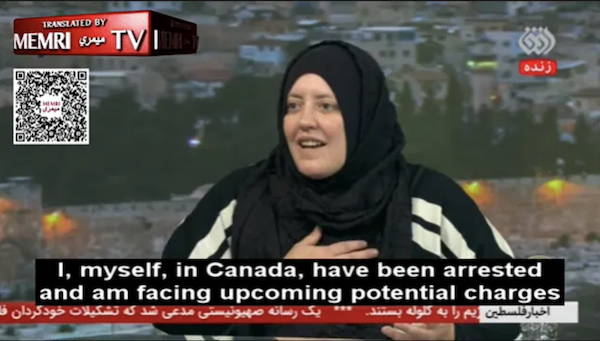
Charlotte Kates, Samidoun’s Vancouver-based international coordinator, appeared on Iranian television in August. (screenshot MEMRI REPORTS)
EB: You mentioned the trip to Iran. We should remind our audience that the Iranian government issued an award on state television to Charlotte Kates, who had to wear a hijab over her hair to appear on television…. And so, she went and she was talking about how she was arrested in Canada, in Vancouver….And they were glorifying the words that she had said on the steps of the Vancouver Art Gallery. Do you want to remind us of some of the things they have been quoted as saying, that your NGO Monitor has kept track of?
GS: If we’re looking even in the last year, the very virulent attacks against Israel, against the right ofIsrael to exist, has been a repeated theme in all [their remarks], including what we heard from Kates in Tehran, what they call the right of resistance. Particularly, they make it very specific – they use the term that Hamas used, the Al-Aqsa Flood resistance operation.
And they condemned “The Zionist retaliatory strikes against Palestinian civilians in Gaza.” This is from Oct. 10, 2023. Just one example of many others. They talk repeatedly about the right of the Palestinians, the brave Palestinian people and their resistance movement, stop the Israeli genocide of Palestinians, support Palestinian resistance and revolution. There are many, many variations on that theme. That is very prominent in their, I was going to say propaganda, but it’s probably their hate campaigns.
One other aspect that I want to raise here is the connection to the PFLP that’s important. What is the PFLP? Some may remember that the PFLP was involved in airplane hijackings. They were the original airplane hijackers – the Entebbe hijacking of 1976.
And, even before that, the hijacking of planes in 1970, and blowing them up. There are a whole series of events, including just taking machine guns and going into synagogues in Jerusalem and killing people. There are a series of terrorist events. They are a terror organization. They are also members of the PLO [Palestine Liberation Organization]. They were founded probably in the 1960s, maybe earlier, as a Marxist, revolutionary, Palestinian movement, which means they’re not Islamic, they’re not Muslims.
Most of the people who are involved in the positions of power of the PFLP are Christian, they come from Christian families. They call themselves Marxists, but they are not part of the Fatah movement, which is the main part of the PLO, they are the Marxist liberation element and they’ve developed very close relationships – personal and political and ideological – with radical Christian groups across Europe and also, after that, they went out to North America. I think one of the questions is, who are their supporters and do they have those kinds of connections? We actually have those documented in Europe, less well known in Canada.
But they’ve been able to build on this. We usually associate the Palestinian terror movements with Hamas and, before that, the Fatah movement with [Yasser] Arafat, with fanatic Muslims who want to wipe Israel off the map. But this is a different organization and they were supported by the East Germans when East Germany existed, until 1990, and the West German far-left radicals who were connected to them. That’s the type of people that get attracted to this framework.
They are revolutionaries, and revolutionaries in the sense of blowing everybody up, not distinguishing between anybody, civilians, women, children, they kill everybody. And that’s the PFLP. And this [Samidoun] is one of their front organizations, maybe the most important front organization – they do the political aspect, they may also be involved in recruiting, they may also be involved in planning. We don’t know that, but that’s one of the reasons Israel banned them.
EB: It’s anarchy? And, the other day in Vancouver, on Oct. 7, I’m sure you may have seen the video now – Vancouver police are investigating – they were desecrating and ripping up a Canadian flag. It wasn’t just Israel that they were going after, and Zionists and Jews. It was also Canada. And I think that has crossed the line for people for whom going after Jews in Israel wouldn’t have crossed the line.
GS: That’s part of being this radical, Marxist organization. The term sounds so 1950s and Stalinist, but a radical Marxist, Palestinian liberation organization, that’s their name – the Popular Front for the Liberation of Palestine. The 1950s and ’60s were filled with popular fronts for the liberation of X, Y and Z, all supported by the Communist Bloc, in this case going through East Germany. Of all the organizations that the East Germans supported, one to eliminate Israel in the post-Shoah, post-Holocaust period, tells you quite a bit about that whole history.
Charlotte Kates was arrested after a Vancouver protest during which she praised the Oct. 7 terror attacks on Israel. Charges have not yet been laid. (screenshot facebook.com/FriendsofSimonWiesenthalCenter)
EB: Do you have any evidence that there is Russian money, Russian support going to Samidoun people anywhere else, but also in Canada?
GS: No.
EB: We’re having our own foreign influence problems right here in Canada.
GS: Yes. And it’s possible, but it’s much more likely to be the Muslim Brotherhood with Qatar and that part of the support group. Qatar supports Hamas. Qatar is, of course, Al Jazeera and all the other media platforms as well. But it’s the Muslim Brotherhood that’s so central here…. And then the PFLP is the other half of that formula. By the way, there are reports, and I’ve seen the reports, there are some connections to Iran. And then, the fact that Charlotte Kates got this award in Tehran makes one, I think, more than speculate that some of their funding may also come through, maybe a lot of it, comes through Iran.
EB: It walks like a duck, talks like a duck, must be a duck.
GS: So, here you have the strange situation, this very weird, absurd situation where you have what are essentially Christian, Marxist, radical Palestinians being allied with the Islamic Republic of Iran. Put those pieces together and explain to me how there’s any kind of logic except for the hate – hate of the West and hate of Israel. And the anarchy is very much part of that process.
EB: I want to bring it back to Canada because, earlier this month, the opposition leader, Pierre Poilievre, had a press conference in Ottawa on Oct. 8 [before the government’s Oct. 15 announcement] and vowed to, if he is elected as prime minister, one of his priorities will be to ban Samidoun, [have it] designated as a terrorist organization. The Canadian government’s been asked to do that by B’nai Brith [Canada], by many organizations, [Member of Parliament] Anthony Housefather, that’s one of his big priorities as [the federal government’s special advisor] on antisemitism, Vancouver’s Jewish community, CIJA [Centre for Israel and Jewish Affairs]. So many people have said it’s beyond time. What is the difficulty in your experience for a government to actually do something like that? Because, if it was easy, they would have done it a long time ago. And I’m just going to put in a caveat – it took the Liberals six years to ban the Iranian Revolutionary Guard in Canada. They just did so, but it took six years.
GS: I’m going to give you a generic answer. Each country has some specific aspects which make the process appropriate for its own legal and political system. But, generally, you start by having a member, usually an appointed official – it could come from a government minister, it could also come from a member of Parliament or a group of members of Parliament, particularly if it’s both parties. So, you have Anthony Housefather, then you have members of the Tories, including the leader, raising this issue and then getting somebody in the RCMP, the appropriate investigatory framework, to put together the evidence and to present it and reach a conclusion or a recommendation: this organization violates Canadian law in this way. Incitement to terror, support for terror, links to terror organizations, those are the questions that have to come up.
EB: For promotion of antisemitism is another one, Section 319 of the federal Criminal Code, right?
GS: Which is different from the United States, where there is no specific ban on antisemitism in the legal process. But that gets to the other aspect.
EB: There’s also hate symbol legislation. There’s a whole flag thing. You can’t be displaying Nazi flags or Confederate flags. They didn’t talk about these kinds of flags, but I wonder if that’s not far off. Of Hamas, which is a designated terror organization, or Hezbollah.
GS: All those questions are open questions. But there is also the issue of free speech. And that is something that is very important in the Western ideological political framework. The United States, in many ways, is slower and more reluctant to put limitations on organizations than Canada has been. I think that it’s pretty close, but the issue of free speech is very holy in the United States and that keeps coming up. Where does the line stop between allowing them to speak, hold rallies, which is part of free speech, and crossing over into support for terrorism, incitement and, in the case of Canada, antisemitism and the other aspects of the legal process? There’s always this balance.
And then there’s the question of constituencies. I would be surprised, maybe I could be naive on this, I don’t know enough about Canadian politics, but the constituency of support for Samidoun is not the same as, in terms of Canadian political support for the Liberals, is not nearly as deep and as wide as the general support for the Palestinian cause. They are a niche terror-linked organization and, politically, it should not be that difficult for a Liberal government to be able to say, “This crosses our red lines.”
You have the investigatory aspect of it, which is always done in Israel, too. I think there are at least three different levels of prosecutors and officials responsible for the process in Israel to designate an organization like Samidoun as a terror-linked organization. They all have to sign off on it and there have to be evidentiary processes. They don’t have to be made public, but there have to be people that can say, “We looked at the evidence, our job is to do that, and we are convinced.” There must be something similar in Canada. It takes somebody to start that process, to say we’re going to do this, we’re going to do it seriously, and we’re not going to take six years to do it, because, then, it’s meaningless.
EB: Lastly, what role, if any, did the PFLP play on Oct. 7 or is it playing now? Are they mostly in the West Bank and not in Gaza, or are they also in Gaza?
GS: The PFLP is strong, not in numbers, but in adherence, which means the terror agenda, both in Gaza and the West Bank. There were PFLP participants on Oct. 7. We have the details. We have names. We have the aspects. Some of them were killed. There was at least one case of an Israeli hostage that was held by people in the PFLP.
EB: Do you know the name?
GS: There was at least one case [the Bibas family] where it was acknowledged. There was at least one case where Israeli forces went in and found evidence that it was a PFLP [person] that was holding [a hostage] … and there were probably more. So, they are very much part of that broader terrorist process. We usually attribute it to Hamas, but there were others that joined on Oct. 7.
EB: And, in the West Bank, is there a constituency?
GS: They’re not a dominant organization. Again, they are a far-left non-Muslim, Christian [organization]. They do not come from the Muslim wing of the Palestinian liberation movement, but they are part of the PLO, so the terror links are also very much cemented in that framework. And I’ll just add that, when the Oslo Accords were signed in 1993 and a lot of people celebrated the beginning of peace, they [PFLP] condemned [former PLO leader Yasser] Arafat for having any kind of recognition of the Zionist entity. They did it loudly and clearly, and they sought to gain, and they probably did gain, recruits and support among Palestinians for having that position. So, they’re more radical than the Fatah movement. They are the opposition in the PLO to any kind of agreement or rapprochement or recognition of Israel.
EB: Is there anything that NGO Monitor has been doing recently to send briefs or information or papers to the Canadian government to share your information and call for changes?
GS: We share our information. We update our file on Samidoun whenever there’s something new … usually every two weeks worldwide, but specifically in Canada, including Charlotte Kates’s trip to Tehran. We put it all together in one package and we send it to a very broad list – to journalists, including the Canadian Jewish News, and also to members of Parliament, both sides … [for] anybody in Canada that’s interested, we make that information available…. Usually, [people will] have bits and pieces of it on their own, but, to see the bigger picture, all the things we just talked about, that’s part of our role.
EB: We should do another interview on all the other groups that are operating on campus.
GS: And the Toronto [District] School Board. There’s a whole bunch of NGOs doing [things]. They’re there. They’re pushing from behind, or not so from behind.
I’m going to give you one more sentence. It goes back to the basic question that Samidoun was expelled from Germany, Khaled Barakat was expelled from Germany – his visa was not renewed. Why is it that, in Canada, this process seems to be, not just taking so long, but it seems like the Canadian officialdom didn’t say, “Well, wait a minute, if the Germans are banning them, then maybe there’s something that we need to look at in more detail. Not just Israel, but the Germans as well, and other countries in Europe are also putting limitations on and opening investigations.”
EB: It wouldn’t be the first time in recent weeks that the Canadian immigration department came under fire for allowing terrorists in who claim asylum…. It’s very disturbing and disconcerting.
Action over words was what was most needed at this week’s National Summit on Antisemitism, hosted by the federal government. That was the consensus at a July 14 townhall in the lead-up to the summit. Hosted by the Centre for Israel and Jewish Affairs (CIJA), the virtual meeting drew about 1,300 Canadian Jews, some of whom expressed outright fear at spiraling antisemitism in their communities and on campuses.
The July 21 summit, and one on Islamophobia the following day, were announced earlier this month by Bardish Chagger, minister of diversity and inclusion, in the wake of a surge in antisemitic incidents this spring and the hate-driven murder of a Muslim family in London, Ont.
Addressing the townhall, Chagger listed Liberal achievements on fighting antisemitism, including Canada’s adoption in 2019 of the International Holocaust Remembrance Alliance (IHRA) working definition of antisemitism, and the appointment last November of former justice minister and human rights advocate Irwin Cotler as Canada’s first special envoy on preserving Holocaust remembrance and combating antisemitism.
In a statement announcing the summits, Chagger said invitations to attend were extended to her cabinet colleagues, members of Parliament “and officials throughout all orders of government to hear directly from Muslim and Jewish community leaders.”
The meetings were to assemble “a diverse group of community and political leaders, academics, activists and members with intersectional identities within these communities.”
Both summits were to be held virtually and take place “in a closed door environment to ensure the safety of those participating,” a spokesperson for Chagger told The CJN.
Live-streaming details had not been confirmed by press time, and a list of invitees had not yet been finalized, the spokesperson said, adding, though, that the federal Anti-Racism Secretariat is working directly with “community stakeholders,” while Chagger is working with MPs “to ensure a wide range of voices are represented” at the summit.
Cotler, who was to co-chair the national summit with Chagger, pulled no punches at the townhall, warning of an “old-new, global, escalating, virulent, sophisticated, and even lethal antisemitism” that reached “a tipping point” during the Israel-Hamas war in May.
He pointed out that last year saw the highest levels of antisemitic hate crimes since being measured, and that those numbers have already been eclipsed this year.
He cited “incendiary” antisemitic hate on social media, where, in one week this past spring, there were 17,000 tweets saying “Hitler was right,” or some variation of it. This makes the national summit “as timely as it is necessary.”
Cotler said the framework for an action plan would have to include a mandate to teach about the Holocaust and antisemitism in public schools; enhancing the adoption and implementation of the IHRA definition of antisemitism; fighting all hate crimes; holding social media platforms accountable for their content; zero tolerance of antisemitism in any political party; and to “appreciate that Jews alone cannot fight antisemitism. We need a constituency of conscience and of action.”
The summit was to provide “not only an opportunity to address antisemitism in words, but it must be what it is intended to be: an action summit, where words are translated into action, and not as a one-time [event] but as an ongoing combating of the scourge of antisemitism.”
An informal poll conducted during the townhall suggested that most respondents believe Jewish university students will feel excluded when they return to class this fall. Another poll during the townhall had 25% of respondents saying the rise of antisemitism here has caused them to consider leaving Canada, while a third question revealed that 39% of those answering said they have recently removed outward signs of their Jewish identity, such as Stars of David and kippot.
One participant spoke of keeping his passport up to date and handy just in case, while others wondered about the role governments can play in fighting antisemitism.
In his remarks to the townhall, Shimon Koffler Fogel, chief executive officer of CIJA, noted that what distinguishes the challenge Jews face is that they face hatred “from all sides”: the far left, far right, and from segments of the Muslim community.
“We have to challenge where necessary. We have to educate where the opportunity exists. But what we cannot do is surrender. We cannot be passive,” Fogel said.
The national summit’s focus was to be security and public safety, education and “civil society – issues of inclusion, acceptance, of not invalidating or delegitimizing the Jewish lived experience. We want the capacity to take increased ownership of our own institutional and community safety and security,” said Fogel.
He also hopes the summit will lead to a national campaign to enhance social media literacy. What’s most important, he added, is to see all levels of government work together to combat antisemitism. The “unprecedented” summit is not the end of the process, Fogel said. “If anything, it is simply the beginning.”
B’nai Brith Canada said it received in advance ideas for discussion at this week’s summit. They included:
Combating antisemitism must go beyond the principles enshrined in the federal Anti-Racism Strategy;
An emphasis on the importance of fostering Jewish life in Canada, recognizing the historical and contemporary contributions of Canadian Jews;
Promoting positive narratives about the contribution of the Jewish community to Canadian society;
Recognition that new forms of antisemitism are distinct from the traditional antisemitism to which Canadians are more accustomed;
Acknowledgement that anti-Zionism is a main driver of the new antisemitism and must be vigorously countered;
A commitment to mainstream the fight against antisemitism across all federal departments and agencies. This would include the Canadian Human Rights Commission and, by extension, involve provincial human rights commissions;
A commitment to create a national Holocaust, genocide and antisemitism advisory commission;
A commitment to implement the IHRA definition of antisemitism (and the IHRA definition of Holocaust denial and distortion) in a meaningful way and to actively promote adoption by the provinces/territories and municipalities;
And a commitment to convening a special forum and ongoing dialogue with the Council of Ministers of Education Canada to work with schools to develop effective methods to combat antisemitism.
In a statement, Michael Levitt, chief executive officer of Friends of Simon Wiesenthal Centre, also stressed that it’s important the summit “leads to real action, not words, including clear and defined next steps and funding to support initiatives to combat Jew-hatred, whether it’s in education, law enforcement, social media or another area.”
The townhall took place just as the Inter-Parliamentary Task Force to Combat Online Antisemitism released an interim report on how social media giants should handle online hate. Read more about it in Janice Arnold’s story for The CJN, which can be found at thecjn.ca/international-lawmakers-urge-action-on-online-anti-semitism.