Skip to content
  • Home
  • Subscribe / donate
  • Events calendar
  • News
    • Local
    • National
    • Israel
    • World
    • עניין בחדשות
      A roundup of news in Canada and further afield, in Hebrew.
  • Opinion
    • From the JI
    • Op-Ed
  • Arts & Culture
    • Performing Arts
    • Music
    • Books
    • Visual Arts
    • TV & Film
  • Life
    • Celebrating the Holidays
    • Travel
    • The Daily Snooze
      Cartoons by Jacob Samuel
    • Mystery Photo
      Help the JI and JMABC fill in the gaps in our archives.
  • Community Links
    • Organizations, Etc.
    • Other News Sources & Blogs
    • Business Directory
  • FAQ
  • JI Chai Celebration
  • JI@88! video

Recent Posts

  • Story of Israel’s north
  • Sheltering in train stations
  • Teach critical thinking
  • Learning to bridge divides
  • Supporting Iranian community
  • Art dismantles systems
  • Beth Tikvah celebrates 50th
  • What is Jewish music?
  • Celebrate joy of music
  • Women share experiences 
  • Raising funds for Survivors
  • Call for digital literacy
  • The hidden hand of hate
  • Tarot as spiritual ritual
  • Students create fancy meal
  • Encouraging young voices
  • Rose’s Angels delivers
  • Living life to its fullest
  • Drawing on his roots
  • Panama City welcoming
  • Pesach cleaning
  • On the wings of griffon vultures
  • Vast recipe & story collection
  • A word, please …
  • מארק קרני לא ממתין לטראמפ
  • On war and antisemitism
  • Jews shine in Canucks colours
  • Moment of opportunity
  • Shooting response
  • BC budget fails seniors
  • Ritual is what makes life holy
  • Dogs help war veterans live again
  • Remain vital and outspoken
  • An urgent play to see
  • Pop-up exhibit popular
  • An invite to join JWest

Archives

Follow @JewishIndie
image - The CJN - Visit Us Banner - 300x600 - 101625

Byline: Cynthia Ramsay

Encouraging “another way”

Encouraging “another way”

Interim leader of the New Democratic Party of Canada Don Davies, centre, with Itai Bavli and Avril Orloff of Vancouver Friends of Standing Together. (photo from Vancouver FOST)

This summer, Vancouver Friends of Standing Together has been holding weekly vigils in front of City Hall to continue the call for the return of the hostages, an end to the war in Gaza and an end to settler violence against Palestinians in the West Bank.

“We organize rallies, vigils and information sessions to raise awareness of the situation in Israel/Palestine and promote ‘another way’ that is not exclusively pro-Israel or pro-Palestine but pro-humanity,” Avril Orloff, who started the Vancouver Friends of Standing Together (FOST) chapter, told the Independent.

Adi Keidar, one of the chapter’s co-administrators, said, “If you are willing to accept that both Israelis and Palestinians deserve to live freely and safely on this land, I will be standing with and supporting you. Someone told me, ‘if you need to choose between pro-Israel or pro-Palestine, it is obvious for me, as a Jew/Israeli where I stand. However, if I knew and trusted that there is another way, I would choose both.’ Standing Together, for me, brings that other voice.”

“I joined the FOST group in June 2024 because it reflects my values and my belief that finding a just solution to the conflict is the only way forward,” Itai Bavli, also a Vancouver FOST co-administrator, said. “I care about all people living between the river and the sea and believe that both peoples can thrive if given the chance. I support Israelis and Palestinians alike and believe they both have the right to live freely and safely. Which means ending the occupation and supporting a Palestinian state. For me, it’s a responsibility I carry.”

Currently, there are nine local co-administrators, who play active roles as their other work and responsibilities permit, Orloff explained. “We try to divide up responsibilities, so no one is overburdened,” she said, noting that everyone involved is a volunteer. “We meet on an ad hoc basis as needed to brainstorm ways to increase awareness, bring out the voice of Standing Together and address issues that come up.”

Standing Together is an Israeli grassroots social movement made up of Jewish and Palestinian citizens that, according to its website, “envision[s] a society that serves all of us and treats every person with dignity. A society that chooses peace, justice and independence for Israelis and Palestinians, Jews and Arabs. A society in which we all enjoy real security, adequate housing, quality education, good healthcare, a liveable climate, a decent salary and the ability to age with dignity.”

Since the Hamas terror attacks on Oct. 7, 2023, and the ensuing war, Standing Together in Israel has been organizing demonstrations – attended by tens of thousands – calling for a hostage deal and a ceasefire agreement. They also have been engaging in public campaigns “aimed at re-humanizing the discourse, retaining humanity, mourning all lives lost and rejecting violence on social media in Hebrew, Arabic, and English.” Last May, they launched the Humanitarian Guard initiative at Tarqumiyah checkpoint to protect “aid trucks headed to Gaza from attacks by extremist settlers that come out to attack the trucks.” This month, they started a campaign to collect food and humanitarian aid for residents of Gaza. 

In addition to the eight chapters of Standing Together that operate in Israel, there are Friends of Standing Together chapters worldwide that have formed since Oct. 7. The chapters in the diaspora raise awareness of and funds for Standing Together, as well as offer a local communal space for people who share the movement’s values and goals. Orloff is an ambassador for ST’s global crowdfunding campaign and recently surpassed her personal goal of raising $6,000 for the movement.

“I started the Vancouver FOST group in February 2024, when I first learned about Standing Together and discovered they had support groups around the world,” said Orloff. “I was drawn to ST because I felt that a lot of groups advocating for either Israel or Palestine focused on only one side or the other, which seemed short-sighted to me. Standing Together’s stance, by contrast, is that, with seven million Jews and seven million Palestinians living ‘between the river and the sea,’ none of whom are going anywhere, the only sustainable future is a shared one grounded in equality, security, peace and justice for all.”

Orloff, Keidar and Bavli said they appreciate that ST is about more than ending the war and that it’s “a broad-based social movement that goes beyond the specifics of Jewish/Palestinian issues to encompass social change at all levels of society, from the bottom up.”

“One of the biggest concerns and confusions I had on Oct. 7 and the events that followed was the rise of hate and polarization on both sides,” said Keidar. “It was rare that I could agree with much that was said, and I was constantly trying to hold two thoughts at the same time. I felt alone and was not seeing the benefit of supporting one side – it felt wrong and unjust and it didn’t fit my values.

photo - Adi Keidar at one of Vancouver Friends of Standing Together’s vigils
Adi Keidar at one of Vancouver Friends of Standing Together’s vigils. (photo from Vancouver FOST)

“When I learned about Standing Together, it was the closest group that I felt spoke to my values and beliefs, as their focus is not one side or the other but humanity, which was the voice I felt was drowning in the hate that was brewing. I wasn’t willing to accept just one side. I believe that the only way to get out of this cycle is by compassionately seeing both sides, taking responsibility, finding the people that speak these values and bringing their voices out.”

Keidar participates in the weekly Bring Them Home rallies. Both she and Bavli spoke at a BTH rally this summer to raise the voice of Standing Together, to show “that it’s possible (indeed, necessary) to support both Israel and Palestine, and remind people that the immediate end of this war is only the beginning of the work to build a shared society in which all peoples live in peace and security.”

Vancouver FOST does local community-building through their WhatsApp group, social events (for example, film evenings, picnics, in-home gatherings), rallies and other activities. They raise awareness on social media via Instagram and work to build their membership, liaising with Standing Together and FOST groups globally. They meet monthly on Zoom with other Canadian FOSTs and build relationships with groups that share ST’s values and principles, like Women Wage Peace and various faith organizations. They have started doing outreach to Canadian politicians.

“We have endorsed Canada FOST’s Call to Action to the Canadian government and politicians to advance key priorities,” said Orloff, “including taking urgent diplomatic action to permanently end the war in Gaza; providing long-term support for peace and equality, not war; and supporting solidarity and partnership in our own society.”

The group organized and hosted an event in June last year, which brought Raja Khouri and Jeffrey Wilkinson to Vancouver to talk about their book, The Wall Between: What Jews and Palestinians Don’t Want to Know About Each Other. (See jewishindependent.ca/not-such-a-great-divide.) They have plans to host an information table at the University of British Columbia in the fall.

In an email, Orloff, Keidar and Bavli described Vancouver FOST as being “for more than we’re against. We don’t argue about terminology or labels or traffic in simplistic black-and-white ‘solutions,’ but are comfortable living with complexity and difference. We love to have juicy discussions, but, more than talk, we’re about supporting action that will bring about real, practical, sustainable change. We aren’t pro-Israel or pro-Palestine but pro-humanity,” they reiterated, “and we don’t see this as a left-right divide or an Israel-Palestine divide, but a divide between those who want peace and life for everyone and those who traffic in death and destruction. We’re here to offer a different way of thinking about the conflict and a different path forward, not to convince people that we’re right.”

Orloff said group members aren’t “settling for simplistic, one-sided solutions that make heroes of one side and villains of the other, but recognize that geopolitical issues have history and context that create layers of complexity, compounded by historical and intergenerational trauma on both sides. What I tell people is that, in this ongoing conflict, there is no win/lose: it’s either win/win or lose/lose. If we don’t find a way to justice, equality, peace and security for all, there won’t be justice, equality, peace or security for anyone.”

“We are involved with Standing Together,” the three co-administrators stressed, “because of deep feeling for Israel and the people living in the land. Many of our FOST members are Israelis who are heartsick at what Israel is doing in Gaza, the West Bank, and to its own Palestinian Israeli citizens. We believe in Israel’s promise and want to hold Israel to its highest ideals. There is no other way. It’s our responsibility to bring about the change.” 
Format ImagePosted on August 22, 2025August 21, 2025Author Cynthia RamsayCategories LocalTags ceasefire, FOST, Friends of Standing Together, Israel, Israel-Hamas war, Oct. 7, politics, rallies, vigils
Hebrew Bible stories inspire

Hebrew Bible stories inspire

On Sept. 16, Stephen Schecter will retell three stories from the Hebrew Bible at the 40th anniversary celebration of L’Chaim Adult Day Centre. He promises the stories will bring laughter and tears. (photo from Stephen Schecter)

“I love the Hebrew Bible,” Stephen Schecter told the Independent. “It is, after all, the template of Western literature and the DNA of the Jewish people. Its stories are all told twice, inviting the reader to ask what is going on here. And the stories invariably end badly, teaching us the importance of getting a handle on our passions if we want to have a halfway decent life together.”

On Sept. 16, in celebration of L’Chaim Adult Day Centre’s 40th anniversary, Schecter will share a few of his favourite biblical tales. 

“Retelling these stories,” he said, “is my way of giving the Jews back their pride and their backbone, steeling them to be proud Zionists, once again going back to ‘In the beginning,’ which is the title of my show on Sept. 16. The stories – and I will be retelling three of them – when you examine them closely are rather funny, but this is no laughing matter. Some of them bring you even to tears.”

Schecter, who was a sociology professor at Université du Québec à Montréal, has always been interested in literature, but not necessarily the Hebrew Bible. 

“When my kids had their bat and bar mitzvahs, I started going to Shabbat services again, which meant I read the weekly Torah portion and, lo and behold, I was swept away,” he said. “When a friend put me on to a contemporary rewrite of some of the books of The Iliad, I thought I could do that too but within my tradition. The upshot turned out to be a 170-page poem called ‘David and Jonathan,’ published in 1996. 

“From there, I went on to lecturing about the Hebrew Bible to multiple audiences in Montreal and ended up doing a one-man show on the first half of the book of Genesis in 2003 at the Saidye Bronfman Centre theatre [now the Segal Centre for Performing Arts]. In 2005, I moved to Vancouver and gave a number of series of talks on the Hebrew Bible to seniors at the JCC.”

Schecter continued to write about sociology and, in 2012, published a book called Grasshoppers in Zion about Israel’s situation in the Middle East. In that book, he said, “I explained how a reading of the Hebrew Bible could help Jews immeasurably in dealing with the Palestinians. No one listened, but I continued to write and now do so on Substack at schecter.substack.com.”

He also noted how people don’t listen to – or even know about – the lessons of the Hebrew Bible. Hence, he quipped, “the constant rewrites. Steinbeck’s East of Eden retells Cain and Abel. Shakespeare’s Romeo and Juliet turns the Dinah story into a five-act play. The end of the Book of Judges replays Sodom and Gomorrah, which now finds its rehash on our TV screens in Gaza. Not for nothing is the Hebrew Bible laced with irony, engendering that particular form of Jewish humour Sholem Aleichem and S.Y. Agnon each captured.”

The English-speaking world once used the Hebrew Bible to learn to read, but people have stopped reading it altogether, said Schecter.

“Many Jewish day schools do not teach it, especially at the high school level, which is where Jewish youngsters could begin to immerse themselves in their tradition,” he said. “When I attend shul, I often hear more about food banks than the wild poetry of the parashah [weekly Torah portion]. The answer to antisemitism lies not in refuting the arguments of those who slander us; it is in asserting the timeless truths of this sacred text, which lay out the indissoluble link between the Hebrew Bible and the land of Israel and our identity as Jews.

“I am blown away every time I reread these stories,” he said. 

“So, I hope Jews come to see the show,” said Schecter. “I hope especially community leaders, activists, rabbis, principals and teachers come and hear these magnificent tales and see how they still speak to a modern audience. It is a show to celebrate the 40th anniversary of L’Chaim, the only adult Jewish day centre in the Lower Mainland, whose exceptional level of care would have well served even our founding patriarchs, all of whom could have used its services. Come and see why.”

“We are on our way to becoming the gold standard of adult day programs in Vancouver,” said L’Chaim executive director Leah Deslauriers of but one of the many reasons to celebrate the organization’s 40th year.

“L’Chaim is fortunate to have community support, from foundations to private donors, which allows us to offer an enriched program to our clients and their families. All of us at L’Chaim are forever grateful for this support,” she said, adding that “L’Chaim continues to grow, and shows no signs of slowing down.”

In the coming years, said Deslauriers, “L’Chaim will prepare to move into the new JWest building upon its completion. In the next 10 years, our hope is to increase our funded spaces from 16 to 22 each day. And, if demand increases, maybe even add an additional day and be open on Sundays.”

Tickets ($18) for In the Beginning, which takes place Sept. 16, 7 p.m., at the Rothstein Theatre, can be purchased at eventbrite.ca. 

Format ImagePosted on August 22, 2025August 21, 2025Author Cynthia RamsayCategories LocalTags Judaism, Leah Deslauriers, L’Chaim Adult Day Centre, seniors, Stephen Schecter, storytelling

From the JI archives … education

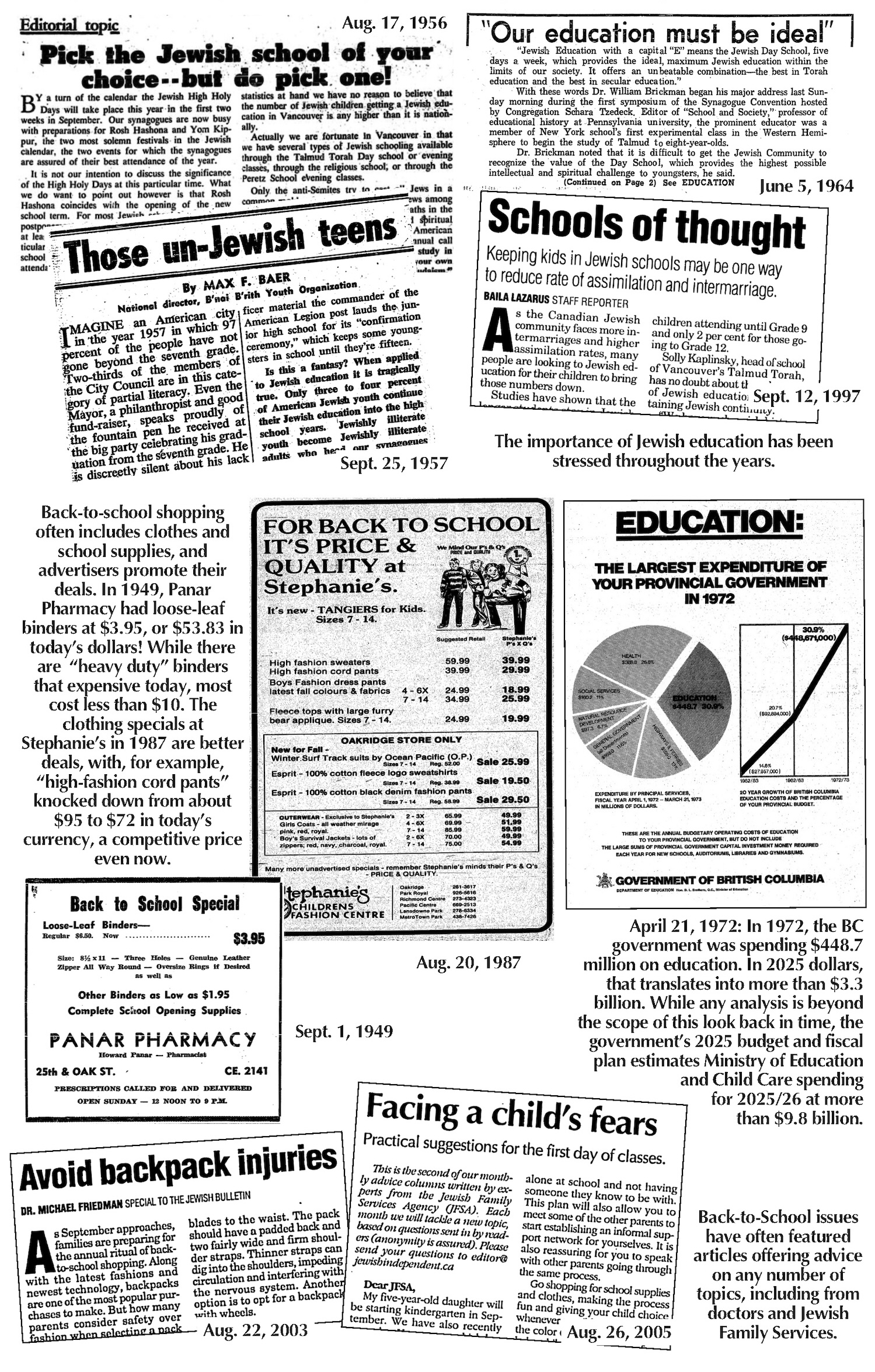
Not surprisingly – “People of the Book,” and all – education is an always-relevant topic that has been covered in the Jewish Independent / Jewish Western Bulletin. The paper seems to have steered clear of editorially supporting any particular Jewish school or type of Jewish schooling, but rather consistently stressed the need for Jewish education, especially for children, but also for youth and adults.

A 1956 editorial noted that “an estimated 50 percent of Jewish children in Canada do not get any Jewish education whatsoever.” While admitting that there were no data to suggest Vancouver fared better than other Canadian cities in this regard, it noted that there were several types of schooling available here, day school, evening classes, religious and secular options. “Only the anti-Semites try to cast all Jews in a common mold, a hateful mold,” it noted. “But the Jews among themselves have always followed diverse paths in the perpetuation of their history, ideals and spiritual heritage.” So, it concluded, “Register your child in the Jewish school of your choice. And, if your child is already enrolled, remind your friend or neighbor about enrolling his child.”

image - clippings from the JI at 95 years about education

Posted on August 22, 2025August 22, 2025Author Cynthia RamsayCategories From the JITags advertising, advice, archives, education spending, history, Jewish Independent, Jewish Western Bulletin, Judaism
Family Day at the farm

Family Day at the farm

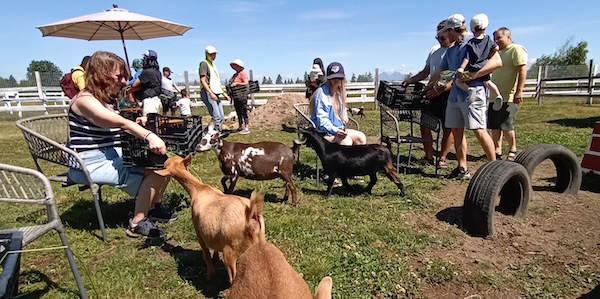
Family Day at Stable Harvest Farm was educational – and fun! (photo by Cynthia Ramsay)

Sunday, July 6, was a beautiful sunny day. Perfect for a visit to Stable Harvest Farms, in Langley, to enjoy one of its Family Days.

My wife and I joined the first tours of the morning. Our group of maybe 50 people, including lots of young children, was split into two, after a brief introduction by one of the university student interns who work on the farm over the summer. We were then led through some of the fields, where we learned a bit about the vegetables and flowers being grown there, while the other half of the group started at the petting zoo.

photo - two pigs at Stable Harvest Farm
Just two of the many animals at Stable Harvest Farm. (photo by Cynthia Ramsay)

Stable Harvest Farms, a nonprofit founded by Syd Belzberg, welcomes more than 15,000 visitors a year – families, educators, students, volunteers, members of various groups. Several Jewish organizations have participated in the educational offerings. For example, Vancouver Talmud Torah has been involved since the farm’s establishment five years ago, with students from grades 2 to 7 visiting once or twice a year.

“We continue to feed and support organizations both Jewish and non-Jewish through JFS [Jewish Family Services] and Meals on Wheels, and countless other nonprofit organizations,” Belzberg told the JI.

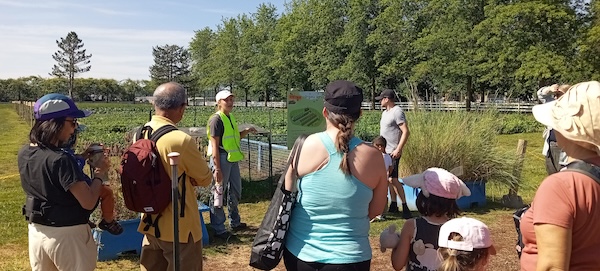
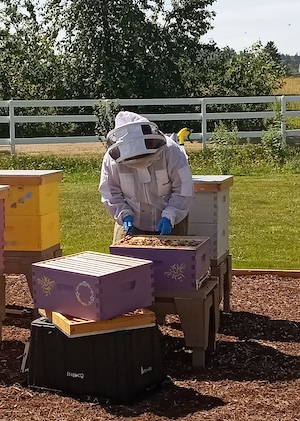
Stable Harvest has donated well over 360,000 pounds of produce since 2020 to various communities in Greater Vancouver. On our tour, we found out how that produce is grown and harvested organically, stopping at some of the 12 education stations that have been created for visiting schoolchildren and others. The stations cover a wide range, from what’s in a seed, to what organic agriculture is, to methods of irrigation. One of the coolest stops was the bat boxes, houses for owls and bug hotels station. But, I have to admit, feeding the sheep and the Nigerian dwarf goats was the most fun. And we got to see the beekeeper in action.

photo - On our tour, we found out how that produce is grown and harvested organically, stopping at some of the 12 education stations that have been created for visiting schoolchildren and others
On our tour, we found out how that produce is grown and harvested organically, stopping at some of the 12 education stations that have been created for visiting schoolchildren and others. (photo by Cynthia Ramsay)

In addition to the learning stations, there are signs everywhere. All the crops are labeled with what’s being grown and fun facts abound. Did you know that there are some 27 different types of broccoli, for instance? Or that snapdragons are edible, and can be used for dyeing cloth?

Farmer Maya led our group, making sure we all had enough water and were faring well in the heat. All the staff are “mentored by an experienced educator to develop and deliver impactful, age-appropriate learning experiences aligned with BC’s Ministry of Education goals,” Belzberg told me later. 

The focus, he said, has been making sure the learning stations “link directly to the BC curriculum’s ‘Big Ideas’ and core competencies (e.g., communication, thinking, social responsibility),” as well as being sensory- and inquiry-based.

photo - The beekeeper in action at Stable Harvest Farm
The beekeeper in action at Stable Harvest Farm. (photo by Cynthia Ramsay)

“Students engage through touch, smell, sight and movement – using storytelling, questioning and games to spark curiosity,” he said.

As our Family Day tour proved, the activities offered are inclusive and adaptable for diverse needs, and the staff are well-trained to keep visitors young and old, with varying levels of physical and mental nimbleness, engaged. My wife and I had both an educational and entertaining time. It was well worth the drive from North Vancouver, where we live. Most everyone would enjoy the fresh air and welcoming atmosphere, I think. 

To keep track of the many things going on at the farm, including volunteer opportunities, follow it on Instagram and check out the website, stableharvestfarm.com, every now and again. You can find out when the next Family Day is and book a visit on the website or by email, [email protected]. 

Format ImagePosted on July 25, 2025July 24, 2025Author Cynthia RamsayCategories LocalTags education, families, Stable Harvest Farm, Syd Belzberg, tours, Vancouver Talmud Torah, VTT
Sharing a personal journey

Sharing a personal journey

Son of a Seeker follows Kai Balin’s search for where he fits within Judaism and Jewish community. (still from Son of a Seeker)

Kai Balin’s documentary Son of a Seeker, which screened to a sold-out Rothstein Theatre last month, is an official selection of the 2026 Vancouver Jewish Film Festival, which will take place next April.

The very personal work that follows Balin’s search for where he fits within Judaism and Jewish community will be thought-provoking for viewers, generating questions about what religion, family and belonging mean to them.

“I think my mother, sister and even my brother have a more innate sense of security in who they are and in who they are as Jews,” Balin told the Independent. “My dad and I, on the other hand, have a more complex identity. It makes it harder to fully fit in or feel completely rooted. However, I see it – and I know my dad does too – as a kind of blessing. It’s ultimately who we are. And, while it comes with plenty of challenges, being a seeker is also a beautiful way to live.”

Balin dedicates the documentary to his grandparents, who survived the Holocaust. “But survival is not the same as security,” he narrates in the film. “My father and I have spent our lives trying to understand what it means to continue.”

Having grown up in a Jewish but not religious home, where his deeper questions were not answered, Balin’s father, Jeffrey, began looking for answers elsewhere, notably, in Buddhism. And, while Balin’s mother, Jennifer Shecter, grew up in a traditional Jewish family and attended Jewish school, “bringing a strong sense of Judaism into the home wasn’t a priority, but I knew I was a Jew,” says Kai Balin in the film. “And I got to create a version of Judaism that I owned and I loved.”

The home video clips in the film highlight this love. As a child, Balin plays at being a rabbi, wants to be one when he grows up. But, over the years, he loses this connection, just as his father begins to return to Judaism. How the father and son negotiate their respective paths, while being respectful of the other’s journey, is a key aspect of the documentary.

“When I first started making Son of a Seeker, I had no idea what the title would be, or even what the story really was,” said Kai Balin. “I knew I wanted to explore Judaism and what it means to be Jewish, but I didn’t expect it to become so personal. Early on, I interviewed a few dozen Jewish people from across the spectrum on camera. But, in the end, I realized I wanted this film to be something much more intimate.

“My dad initially thought he’d just be one of many voices in the film. He didn’t expect to become such a central figure in the story. It pushed him far beyond his comfort zone, but he ultimately believed in the project and gave me his full blessing to be a part of my documentary.”

Balin’s sister, Justine, and brother, Jackson, are also in the film, his brother in the background, while his sister is featured more prominently.

“My sister was my right-hand woman throughout the entire process – I truly couldn’t have made this film without her,” said Balin. “She filmed what’s arguably the most important scene in the movie, when I’m walking through the town where our grandfather was born and raised until he was sent away to a forced labour camp and had everything taken from him and his family. My sister also spent countless hours in the editing room, helping make the tough calls about what to cut and what to keep. Without her input, the film would’ve easily been two hours long and a lot less focused.

“My whole family really stood behind me on this project,” he said. “They gave me the strength, courage and confidence to see it through.”

Balin came to filmmaking somewhat organically.

“I was studying kinesiology at Western University. After my second year, I worked on an indie film, Volition, as part of the swing crew, helping with lighting and grip. Later that summer, I was the program director at Camp Hatikvah (2017), where the videographer/photographer, Denis Lipman, brought some super cool gear…. Right before my third year, I bought a camera – and, from then on, I started dedicating less and less time to what I was actually studying, and more time learning how to shoot and edit. 

“I was running a nonprofit at school that threw club and bar events for local charities, and the first video I ever made was a recap of one of those nights,” said Balin. “I started getting more involved on campus and around the city (London, Ont.), looking for any chance to shoot videos.

“My first paid gig was filming a club event that featured a guy in a robot suit on stilts. I was also on the rugby team, so I made a few hype-up videos for them whenever I was injured (which was quite a bit). Over the last two years at my time in university, I got more invested in videography and less focused on kinesiology. I ended up shooting videos for all sorts of events and student clubs.”

After graduating, Balin pursued videography full time. Not wanting to make corporate videos, he started making a documentary about his dad’s work.

“He was a leadership development coach working mostly with heads of NGOs and social enterprises,” explained Balin. “I lined up a plan to travel to different countries, mostly in East Africa and India, to film these organizations and their leaders. I started shooting, but I didn’t have a clear direction. Eventually, I lost the passion for the project – and for filmmaking altogether. I just wanted to travel.”

It would be almost five years before Balin made another video.

“It took about three months to put My 5 Year Video Project together – I wasn’t working any other job at the time – and we held a small premiere in August 2024 with around 70 people,” he said about the film, which can be seen on YouTube.

“I didn’t expect people to be so moved by what I had created,” he said. “That experience gave me the confidence to pursue my next film project. At the time, it was just a rough idea, and I had no clue it would eventually become something so personal – and so deeply centred around my father’s story as well.”

But, for Balin, it’s the personal aspects of art, films and books that draw him in, “even if I can’t directly relate to what the creator is going through,” he said. “I remember hearing years ago, from a few directors I really respect, that you ultimately have to make the film for yourself – something you’d enjoy watching a hundred times over, and something that excites you to work on every day.

“For me, that excitement comes from sharing something personal. It’s my life, my questions, my struggles, and I find them interesting. So maybe others will too.”

As for what comes next, Balin said, “One side of me just wants to let the river flow, follow life as it comes without getting too attached to any future outcomes. But the other side of me dreams of being a famous, successful filmmaker making big-budget movies. There’s still something in me that maybe wants to be a rabbi one day as well.”

He added, “I know my relationship with Judaism will continue to evolve, but, for now, I’ve found a sense of peace. I feel like I have a steady relationship with it, and I’m much more secure in who I am as a Jew than I was when I started this film.

“These days,” Balin said, “I find myself seeking something else: my soulmate. That might even be the focus of my next documentary – exploring the journey to find ‘the one’ – if that concept even exists.” 

Format ImagePosted on July 25, 2025July 24, 2025Author Cynthia RamsayCategories TV & FilmTags documentaries, Judaism, Kai Balin, Son of a Seeker, spirituality, Vancouver Jewish Film Festival, VJFF

From the JI archives … BC

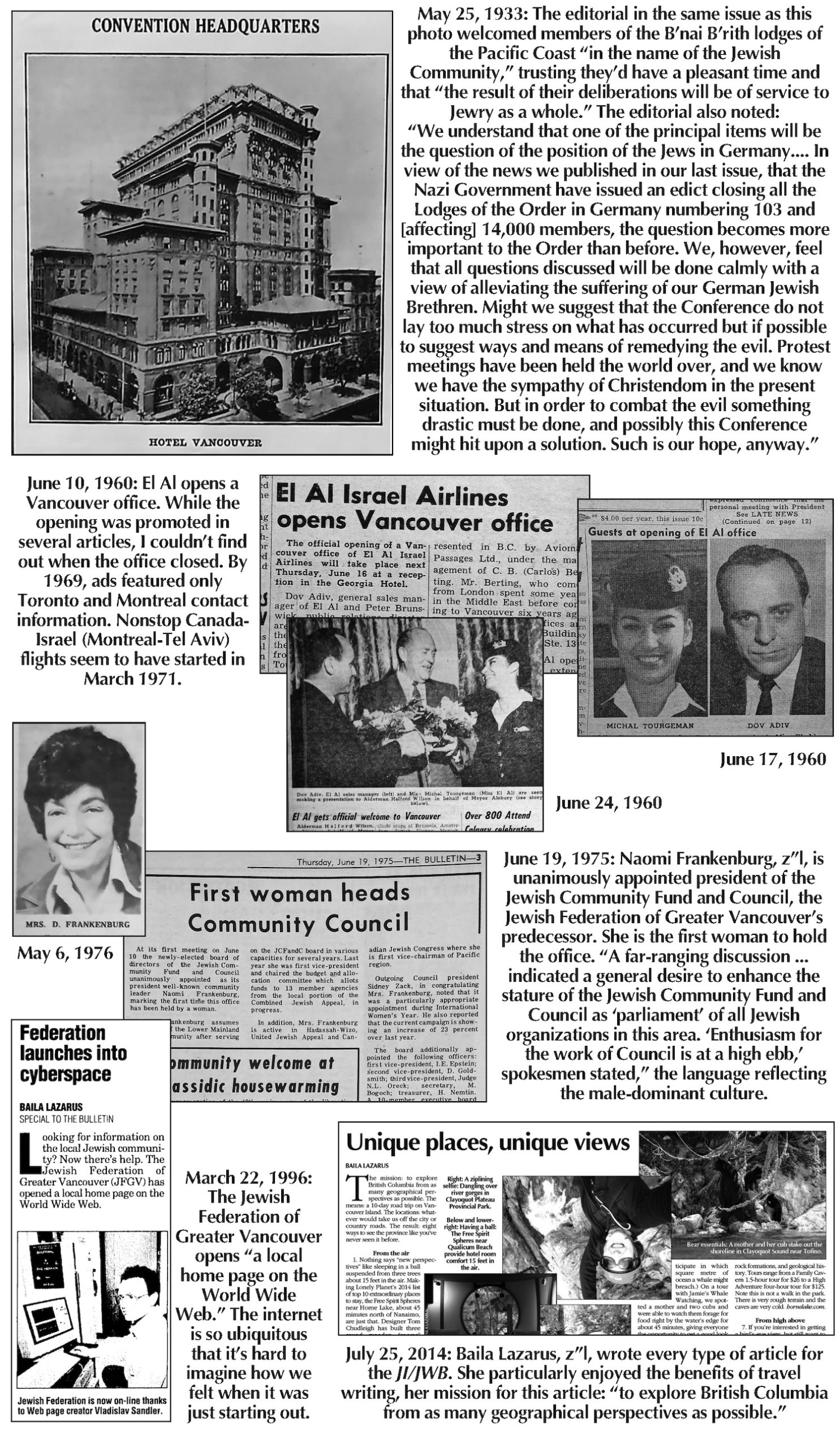
It is sometimes hard to look back over the pages of the Jewish Independent and its predecessor, the Jewish Western Bulletin, knowing what has happened since the articles were published. From the 1933 optimism that there was hope for German Jewry, to the enthusiastic welcome of a seemingly short-lived El Al office in Vancouver, to colleagues who have passed away.

images - From the JI archives … BC-related clippings

Posted on July 25, 2025August 22, 2025Author Cynthia RamsayCategories From the JITags B'nai B'rith, Baila Lazarus, British Columbia, El Al, history, Jewish Federation of Greater Vancouver, Jewish Independent, Jewish Western Bulletin, JI, JWB, Naomi Frankenburg, Second World War, travel

Enjoy the best of Broadway

“It may sound like a cliché, but I really believe that music is a unique language. You don’t have to know how to read it, you might not understand the lyrics, but it can still touch your heart and soul,” Omer Shaish told the Independent. “At the end of the day, it doesn’t matter what genre you listen to, it will always make you feel something. That’s what I always hope to do when I get on stage – use the music to touch people’s hearts and souls.”

photo - Omer Shaish brings My Broadway Shpiel – stories, Broadway tunes, popular Hebrew songs and original music – to Vancouver Aug. 21
Omer Shaish brings My Broadway Shpiel – stories, Broadway tunes, popular Hebrew songs and original music – to Vancouver Aug. 21. (photo from omershaish.com)

Shaish brings My Broadway Shpiel to Vancouver Aug. 21, 7:30 p.m., at Temple Sholom. In addition to offering a night of Broadway tunes, popular Hebrew songs and his own original music, the performance will raise money for Temple Sholom’s campership program.

While Shaish never attended summer camp growing up, he did talk about growing up in the Jewish community.

“We’re one big family and I love that about us,” said the singer, who was born and raised in Rishon LeZion, which is about 20 minutes south of Tel Aviv.

“I spent most of my teenage years and my early 20s in Tel Aviv, where I was surrounded by great art, amazing people and incredible food!” said Shaish, who knew from a young age that he was going to be a singer.

“My parents say that, as a toddler, I’d pick up anything that could resemble a microphone and sing at the top of my lungs – everywhere. I always loved having an audience,” he said. “Even though, in real life, I sometimes come across as a bit shy and introverted, having an audience to sing for always made me feel at home. Up until today, having an audience, no matter how big or small, brings me to life.”

Shaish started his career as a vocalist in the Israeli Air Force Band, performing on military bases and in Jewish communities in Europe and Canada. He also is an actor, performing in Israel before moving to New York City in 2007 and graduating from the American Musical and Dramatic Academy. He has numerous theatre, vocalist and soloist credits to his name, but mainly has been touring internationally as part of the classical vocal trio Kol Esperanza and with his self-produced, one-person show My Broadway Shpiel.

“Even though I love acting, I’ve been focusing on singing in the past few years,” he told the Independent. “I realized, throughout the years, that I feel more at home just being myself on stage. I enjoy sharing these moments with the audience and it makes every show feel different and so alive. Playing a character can be interesting, too, but, for me, there’s nothing better than simply being myself.”

At the moment, Shaish calls Baltimore, Md., home. Previously, he toured the United States for many years, and lived a few years in Los Angeles and in Miami.

“I absolutely love traveling, seeing the world and meeting lovely, interesting people,” he said. “My friends always make fun of me and say that they never know where I’m at, to which I reply with, ‘neither do I.’ It can be exhausting at times, but it’s always worth it. I feel very lucky to do what I love and that gives me a lot of energy to keep at it.”

He’s looking forward to performing here.

“I love Vancouver!” said Shaish. “I’ve been there many times and I think it’s one of the most beautiful places on earth. The last time was only a few months ago, for rehearsals and a recording session. I’ve performed in Vancouver before and I can’t wait to be back and enjoy the views, the fresh air and, of course, the wonderful people!”

About the show he’s bringing with him, My Broadway Shpiel, he said, “As I tell my story and share some anecdotes about the Jewish story of Broadway, I sing some classics from Fiddler on the Roof and West Side Story, and all the way to some surprises by ABBA and Elvis Presley!”

One of his favourite moments in the performance is when he shares the experience of living in the United States with a foreign name. 

“I have heard so many variations of my name from so many people that I have met,” he said. “‘Omer’ apparently isn’t very easy to pronounce. So, one day, I thought, why not write a song about it? I took Liza Minelli’s ‘Liza with a Z’ and turned it into ‘Omer with an E.’ At first, I wanted that to be the name of my show, but My Broadway Shpiel felt more fitting.”

As for the importance of music, he said, “This brings me back to how I see music as a language. It has superpowers. It can take us away from one reality and bring us to a completely different one within a split second. It triggers our emotions in such a powerful way. When people talk to me after a show and say that I made them laugh, made them cry, or made them forget about their day, I know I did something right.”

For tickets to My Broadway Shpiel, visit tickettailor.com/events/templesholom/1702794. 

Posted on July 11, 2025July 21, 2025Author Cynthia RamsayCategories Performing ArtsTags camperships, fundraising, Jewish summer camp, music, My Broadway Shpiel, Omer Shaish, storytelling, Temple Sholom
A melting pot of styles

A melting pot of styles

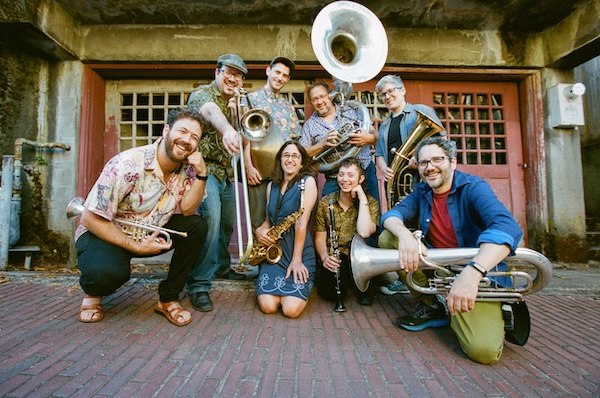
Seattle band Shpilkis helps open the Mission Folk Music Festival July 25. (photo from shpilkisseattle.com)

“We’re delighted to be featured at a folk music festival that understands the vast and expansive variety that makes up folk music, and to bring our unique sound to a community that may have never heard klezmer before,” Michael Grant of the band Shpilkis told the Independent. “We have a secret agenda to get hundreds of Mission Folk Fest enthusiasts into a Yiddish dance line! We love playing festivals and expect this to be a beautiful time.”

The Mission Folk Music Festival’s introduction to Shpilkis begins, “Are you ready to shake your tuchus, Mission folkies? Have we got the band for you!” Shpilkis is part of the weekend festival’s opening night lineup July 25. They play a midday concert on July 26 and share the stage for two different afternoon performances July 27. It’s the Seattle band’s first time participating in the festival, though trombone player Jimmy Austin has played it before, with a different group.

Grant plays the trumpet. He and Austin will be joined in Mission by Zimyl Adler (clarinet), Layne Benofsky (baritone), Stefanie Brendler (French horn), Nancy Hartunian (alto and soprano sax), Gary Luke (sousaphone) and Joey Ziegler (drum kit).

Shpilkis formed in 2017, originally convened by Brendler, said Grant. “The low brass players had been in a successful Seattle Balkan band together, and the rest of us knew each other from Jewish community and music spaces. In 2018, we added our sax and trombone players, and, in 2023, finally found a drummer!”

Some of the members play in other groups or musical projects, but Shpilkis is the primary band for all the musicians, he said.

Shpilkis plays traditional Eastern European Yiddish music, as well as more recent forms of it. The band’s description notes that “members come to this glorious music from a hodgepodge of backgrounds: religious, spiritual, secular, pagan; East Coasters, Midwesterners and Pacific Northwesterners born and raised; Jews and gentiles; music-educated and self-taught, with foundations in jazz, punk, folk, classical and pop.”

“Klezmer, particularly by the later 20th century, is a melting pot of styles – you can hear Greek, Balkan and Eastern European melodies mixed in with Americanish sounds – particularly jazz and even bluegrass,” Grant explained. “We love drawing from across the historical spectrum of klezmer music, from traditional 19th-century repertoire that’s been unearthed via the Kiselgof-Makonovetsky Digital Manuscript Project from a Kiev archive, to songs that were written in 1980s Brooklyn or Philadelphia, to fusion and contemporary repertoire. We always arrange songs to put our unique, raucous klezmer brass stamp on it, thinking, ‘How do we get our audience out of their seats and dancing to this?’ Klezmer is inherently dance music, so we prioritize songs that can both be played and danced to at a simcha or nightclub.”

But klezmer is even more than that. 

“Klezmer is the sound and musical language of our people,” said Grant. “It is exciting because it is inseparable from the Ashkenazi diaspora, as it integrates the musical influences of its changing environment and geographies while staying rooted in tradition. We as klezmorim love playing klezmer because it connects us to the past, present and future of Jewish cultural expression beyond borders.”

For the full Mission Folk Music Festival lineup – which features more than 20 acts, performing a range of genres – and tickets, visit missionfolkmusicfestival.ca. 

Format ImagePosted on July 11, 2025July 10, 2025Author Cynthia RamsayCategories MusicTags culture, folk music, klezmer, Michael Grant, Mission Folk Music Festival, Shpilkis

Love and learning 

People from many cultures show love via food and, of course, Jews are no exception. And what a palate our culture has, since we have lived in so many places. Two children’s books from Collective Book Studio, one new and one from recent years, highlight the flavourful diversity of Jewish culture, while teaching other valuable lessons.

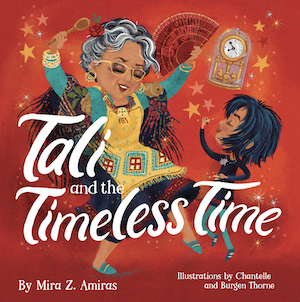
image - Tali and the Timeless Time book coverComing out this August, Tali and the Timeless Time by Mira Z. Amiras, with illustrations by Chantelle and Burgen Thorne, shares the love of a granddaughter for her grandmother, and vice versa. Every Friday, Tali helps her nona get ready for Shabbat. Nona gives hugs, tells stories, still tries to get Tali to nap, even though she’s older now. When Nona dozes off, Tali explores in the backyard, cleans up the small fountain there, feeds the goldfish. When Nona awakes, it’s time to cook.

“We bake!” says Tali. “Today, it’s bourekas, yummy for eating. Nona makes them with filo (which it turns out is cheating). She says her nona let her ’cause it doesn’t need kneading.”

The week before, the pair made stuffed grape leaves – yaprakas, dolma or dolmades. Nona’s favourite dish is huevos (eggs) cooked in tomatoes with feta and arroz (rice). 

While Tali’s grandmother might get Tali’s name wrong, or forget a word or two, she has these recipes ingrained in her. 

“I’m having big thoughts,” says Tali, “but Nona’s not listening – she’s singing ‘chakchouka,’ it’s sometimes called, not just huevos, in the Holy Land, Tunisia and the land of the pharaohs. In Mexico, it’s a lot like huevos rancheros….” But Nona loses focus, she starts dancing with “her zills and her fans.” Tali finishes making dinner, the pair eat together, then dance some more.

In another role reversal, Tali tucks Nona into bed for the night, not sure she should leave her alone. Luckily, Tali and her family live nearby.

It’s a lovely book, “timeless time” being a beautiful description of a day spent with a loved one, doing this and that, in no particular order, sharing stories, mixing up past with present, making memories that will adapt over time.

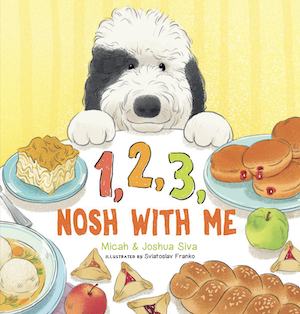
image - 1, 2, 3 Nosh with Me book coverFamily and food are also at the heart of 1, 2, 3 Nosh with Me, written by Micah and Joshua Siva, and illustrated by Sviatoslav Franko, which was published a couple of years ago. In it, the dog Buckwheat shows us the yummy food the family eats, starting with the “One golden challah, to celebrate Shabbat…” We work our way up to “Ten crispy latkes, served by candlelight.” In between, we have matzah balls, matzot, kugel, knishes, apples for a sweet new year, sufganiyot, bagels and hamantashen. (It’s not clear why the Hanukkah treats are separated, but that’s a quibble.)

Tali covers a few Sephardi staples and Buckwheat has the Ashkenazi favourites down. Between the two books, the breadth of world Jewry, as seen through just some of its traditional foods, is impressive. 

Posted on July 11, 2025July 17, 2025Author Cynthia RamsayCategories BooksTags aging, Ashkenazi, children's books, Collective Book Studio, counting, culture, education, food, generations, identity, learning, Sephardi, traditions

From the JI archives … yum

While the odd recipe or food-related article can be found in the Jewish Western Bulletin even before it became the Bulletin, regular food columns or special sections seemed to have become a part of the paper under Sam and Mona Kaplan, who owned the paper from 1960 to 1999. The Independent has carried on the tradition, with its annual Food & Drink issue, which you hold in your hand, and with the inclusion of recipes in our three holiday issues, Rosh Hashanah, Hanukkah and Passover. One thing that becomes apparent in flipping through the archives is that tastes change, and not every recipe, or recipe name­, withstands the test of time.

image - JI at 95 clippings related to food, part 1

image - JI at 95 clippings related to food, part 2

Posted on July 11, 2025July 10, 2025Author Cynthia RamsayCategories From the JITags food, history, Jewish Centre News, Jewish Western Bulletin, milestones

Posts pagination

Previous page Page 1 … Page 5 Page 6 Page 7 … Page 84 Next page
Proudly powered by WordPress