
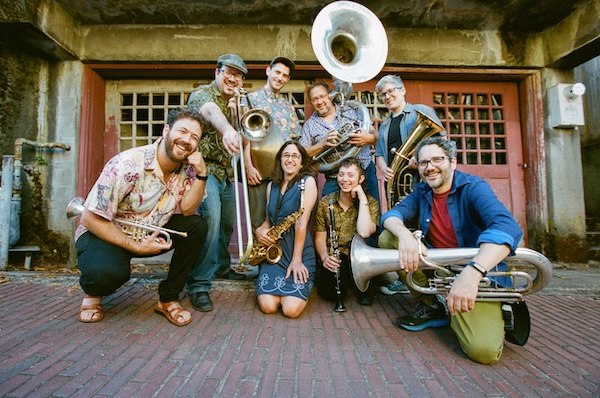

Seattle band Shpilkis helps open the Mission Folk Music Festival July 25. (photo from shpilkisseattle.com)
“We’re delighted to be featured at a folk music festival that understands the vast and expansive variety that makes up folk music, and to bring our unique sound to a community that may have never heard klezmer before,” Michael Grant of the band Shpilkis told the Independent. “We have a secret agenda to get hundreds of Mission Folk Fest enthusiasts into a Yiddish dance line! We love playing festivals and expect this to be a beautiful time.”
The Mission Folk Music Festival’s introduction to Shpilkis begins, “Are you ready to shake your tuchus, Mission folkies? Have we got the band for you!” Shpilkis is part of the weekend festival’s opening night lineup July 25. They play a midday concert on July 26 and share the stage for two different afternoon performances July 27. It’s the Seattle band’s first time participating in the festival, though trombone player Jimmy Austin has played it before, with a different group.
Grant plays the trumpet. He and Austin will be joined in Mission by Zimyl Adler (clarinet), Layne Benofsky (baritone), Stefanie Brendler (French horn), Nancy Hartunian (alto and soprano sax), Gary Luke (sousaphone) and Joey Ziegler (drum kit).
Shpilkis formed in 2017, originally convened by Brendler, said Grant. “The low brass players had been in a successful Seattle Balkan band together, and the rest of us knew each other from Jewish community and music spaces. In 2018, we added our sax and trombone players, and, in 2023, finally found a drummer!”
Some of the members play in other groups or musical projects, but Shpilkis is the primary band for all the musicians, he said.
Shpilkis plays traditional Eastern European Yiddish music, as well as more recent forms of it. The band’s description notes that “members come to this glorious music from a hodgepodge of backgrounds: religious, spiritual, secular, pagan; East Coasters, Midwesterners and Pacific Northwesterners born and raised; Jews and gentiles; music-educated and self-taught, with foundations in jazz, punk, folk, classical and pop.”
“Klezmer, particularly by the later 20th century, is a melting pot of styles – you can hear Greek, Balkan and Eastern European melodies mixed in with Americanish sounds – particularly jazz and even bluegrass,” Grant explained. “We love drawing from across the historical spectrum of klezmer music, from traditional 19th-century repertoire that’s been unearthed via the Kiselgof-Makonovetsky Digital Manuscript Project from a Kiev archive, to songs that were written in 1980s Brooklyn or Philadelphia, to fusion and contemporary repertoire. We always arrange songs to put our unique, raucous klezmer brass stamp on it, thinking, ‘How do we get our audience out of their seats and dancing to this?’ Klezmer is inherently dance music, so we prioritize songs that can both be played and danced to at a simcha or nightclub.”
But klezmer is even more than that.
“Klezmer is the sound and musical language of our people,” said Grant. “It is exciting because it is inseparable from the Ashkenazi diaspora, as it integrates the musical influences of its changing environment and geographies while staying rooted in tradition. We as klezmorim love playing klezmer because it connects us to the past, present and future of Jewish cultural expression beyond borders.”
For the full Mission Folk Music Festival lineup – which features more than 20 acts, performing a range of genres – and tickets, visit missionfolkmusicfestival.ca.



