

Byline: Cynthia Ramsay
Innovative approach to care
On Sept. 30, Canadian Friends of Sheba Medical Centre will host Medicine Reimagined, an evening with Prof. Amitai Ziv, deputy director of Sheba Medical Centre and head of its Rehabilitation Hospital, which is the national rehabilitation facility of Israel. Ziv is also the founder and director of the Israel Centre for Medical Simulation (MSR), an innovation hub for improving patient safety and clinical training.
Originally from Montreal, Ziv is spending his sabbatical in Vancouver at the University of British Columbia.
“This will be the first Canadian Friends of Sheba event in Vancouver, as we launch our chapter here, and we are truly thrilled to welcome Prof. Amitai Ziv,” Galit Blumenthal, manager of donor relations and events at Canadian Friends of Sheba Medical Centre, told the Independent. “Our goal is to raise awareness of Sheba Medical Centre and highlight its profound impact both in Israel and on the global stage.”

Sheba Medical Centre was established in 1948. Located in Tel HaShomer, near Tel Aviv, its website notes the facility has 159 medical departments and clinics, almost 2,000 beds and 75 laboratories, and receives about 1.9 million clinical visits and 200,000 emergency room visits a year. Its seven major facilities comprise a cancer centre, an academic campus, a research complex and four hospitals: children’s, women’s, acute care and rehabilitation. It also has several centres of excellence and institutes, notably for cancer, and heart and circulation. It counts 10,000 healthcare professionals, 1,700 physicians and 200 PhD research professionals.
“I support them, along with many other Israeli institutions, as I feel that this is at least some contribution that I can make during these difficult times,” said Tova Kornfeld, who connected Canadian Friends of Sheba Medical Centre (CFSMC), which is based in Toronto, with the Independent.
“I sometimes feel powerless living here in Canada when I see what is happening in Israel,” said Kornfeld. “If I can help in any way, whether by bringing awareness to the work being done by the various organizations or by making financial contributions, then I feel I must. As far as Sheba is concerned, it stepped up to the plate when Soroka Hospital was hit by an Iranian missile and took in all the ICU patients.
“It is also the biggest rehab hospital in Israel and is providing rehabilitation for thousands of soldiers who have been injured since Oct. 7,” she added. “I have family members in the IDF and it is comforting to know that, if something were to happen to any of them, there would be hospitals like Sheba to care for them.”
Ziv’s areas of expertise are medical education, simulation and rehabilitative medicine, and he has served as a consultant and speaker at academic and health institutions around the world. The event in Vancouver will offer a look at Sheba Medical Centre and its innovations in, among other things, the rehabilitation field.
On Sept. 30, Vancouverites will also get to meet Einat Enbar, chief executive officer of CFSMC, which was established in 2017 to raise awareness and funds for Sheba Medical Centre, the care it offers, the research it conducts and the educational training it provides.
For Kornfeld, there is another aspect to supporting Israeli organizations and institutions. She hopes that financial and other assistance from the diaspora “gives the Israelis caught in the fray the message that we have their backs and that we are all in this together regardless of where we live. I would hope that this would be comforting to them when it appears that most of the world is against not only Israel but the Jewish people themselves.”
For more information on CFSMC and SMC, visit shebacanada.org. To attend the Sept. 30, 7 p.m., event in Vancouver (location upon registration), go to weblink.donorperfect.com/ProfAmitaiZivInVancouver. While free to attend, donations are welcome. Readers can email Blumenthal at [email protected] with any questions.

Traveling as a woman
Caryl Eve Dolinko, author of A Woman’s Guide to World Travel, has been to 93 countries and counting. (photo from caryldolinko.com)
Caryl Eve Dolinko’s A Woman’s Guide to World Travel literally covers everything you need to know when traveling, from choosing where to go through to reacclimatizing when you get back home. Anyone, but especially women, about to take their first international trip should have this book handy. For people who have been a few places, and even for seasoned travelers, Dolinko’s latest also has snippets of history, many short, informative travel stories, an interesting perspective – and likely at least one point you’ve not thought of before.
Dolinko, who is a member of the Vancouver Jewish community, has been exploring the world for more than 40 years. She has been to 93 countries and counting. She has journeyed on her own and with others, as a young person and as an older person, as “a working professional, a mother with kids, as a straight and gay woman, and a daughter caring for an elderly parent.”
 A Woman’s Guide to World Travel, published by Whitecap Books earlier this year, is Dolinko’s third travel book, but the first as sole author. She co-wrote both The Complete Guide to Independent Travel (self-published) and The Globetrotter’s Guide: Essential Skills for Budget Travel (Red Deer Press), with Wayne Smits. The latter was a Canadian bestseller, notes Dolinko.
In the 25-plus years since The Globetrotter’s Guide came out, much has changed.
“The world’s population has almost doubled from over 4 billion in the early 1980s when I started to travel, to just over 8 billion today, putting a strain on finite resources,” writes Dolinko. “Many tourist attractions are now overused, overrun and exploited as a result of global tourism’s exponential growth. I believe it is past time for us to reconsider how we travel and become more aware of the impact we have.”
Her own approach to travel has changed since she started, at age 18, with a planned four-month trip to Europe that turned into “an epic eight-year odyssey.”
“When I first started traveling around the world in 1982, there was very little information available, especially for women, as very few were traveling the world alone,” she writes. “The internet didn’t exist, and neither did smartphones, digital cameras, selfies, social media, travel and hotel apps, GPS or texting. Lonely Planet was just starting to publish travel books and National Geographic was about the only magazine that showed exotic places around the world. Travel guides and literature were written with men in mind and, with so few women traveling, there was no need to address our particular issues and concerns. Only a small selection of useful advice was available to address women’s needs.”
That situation continues to change, with some studies estimating that “women are the primary decision-makers for travel in households, influencing up to 80% of all travel decisions. That’s a tremendous amount of buying power and it has influenced the tourism industry to change to meet our needs,” points out Dolinko, whose guide takes readers through some of the history leading to this development.
She briefly highlights six women “who dared to travel in their day,” starting with Ida Pfeiffer, who was born in Vienna in 1797. While Pfeiffer’s “travel stories and books inspired future generations of adventurers … her ethnocentric views frequently led her to be critical and intolerant of other cultures,” writes Dolinko. “As a result, she could be a harsh traveler, lacking the ability to appreciate other cultures on their own terms.”
Dolinko places great emphasis on what can be learned from other cultures, and stresses the importance of traveling with humility, not just for our own education, personal growth and safety, but for the benefit of the people and communities we encounter.
“Through our spending habits, we have the power to influence local economies and cultures, so it’s crucial to make informed decisions and be mindful of our impact,” she writes. “By supporting local businesses and organizations that prioritize sustainability and conservation efforts, we can make a positive difference and be a catalyst for change. Your actions have real consequences, so aim to leave a positive impact and a gentle footprint wherever you go.”
Elsewhere, she shares warnings, like “It’s strictly a cultural taboo or against the law in some cultures to be gay, and open displays of affection are discouraged”; “In some cultures, it’s expected and even considered impolite to accept the initial price offered by the seller without attempting to negotiate”; and “When communicating nonverbally, it is important to be aware of cultural differences and the meanings behind certain gestures. Pointing with your finger, for example, can be seen as rude or confrontational in many cultures.”
Dolinko spends time on photography in this context – reminding readers that some religious sites may prohibit photography, some people may not want to be on your social media feed and some cultures believe that a camera can steal a person’s soul. She talks about selfies, camera types and photo composition.
There is not a stone left unturned in A Woman’s Guide to World Travel. She covers factors to consider when deciding where to go (like safety, cultural norms and accessibility), budgeting (don’t forget admission fees, tips, snacks, SIM cards and so on), choosing luggage (suitcase vs backpack, for instance) and packing (she gives detailed lists of clothing, footwear, toiletries and medical supplies to bring, plus a host of other items to consider). She suggests where you should be in your preparedness two months out, one month out, a week before you leave and the day before you leave. She explains and lists the documents you’ll need, the insurance and vaccinations, how you should leave your home and office, and what the people you leave behind might need if something were to happen to you on your trip.
Specific to women, Dolinko talks about how to interact with men (“being aware of cultural differences that may affect communication and behaviour, as well as keeping an eye out for red flags and listening to your intuition”) and how to safely have a travel romance (with men or women), as well as what to do if, God forbid, you are sexually assaulted or raped. She lays out how to deal with some common gynecological issues while traveling. She offers advice on visiting religious buildings. She makes suggestions about traveling with kids. And she shares so much more.
To say that the 384-page A Woman’s Guide to World Travel is comprehensive is an understatement. It encompasses 40 years of experience traveling around the world, lots of photos (which I wish had been captioned, with some in colour) and relevant anecdotes. It’s a one-stop “shop” for anything you might want to know – and lots you didn’t know you needed to know – about travel.
Thriller delves into AI world
Daniel Kalla commands readers’ interest from the first sentence of his latest thriller, The Deepest Fake. And he keeps us turning pages straight to the end, not only as we contemplate who might be the culprit(s) of our hero’s apparent demise, but also as we consider the ideas Kalla puts forward about artificial intelligence, intellectual property, relationships, trust, measures of a successful life, and more.
Jewish Independent readers will be familiar with Kalla, who, in addition to being a writer of many international bestselling novels, is an emergency room physician here in Vancouver. The JI interviewed Kalla in 2023 and has reviewed of a few of his previous novels.
 The plot-driving topic of The Deepest Fake – artificial intelligence – is new territory for the doctor-writer, who has penned many medical and science thrillers, using his physician’s knowledge to powerful effect. But he also has written an historical fiction trilogy set in Shanghai during the Second World War, where thousands of Jews fleeing Europe found safe haven, even as China and Japan were at war, so we know Kalla’s not afraid to do the research necessary to create a realistic-seeming fictional world centred around places and concepts less familiar to him, and to most readers.
As much as The Deepest Fake highlights some of the moral issues surrounding AI, it also explores other big issues, like medical assistance in dying (MAiD), fidelity in marriage and business partnerships, the foundations of trust, and where the creative process begins and who owns it. Kalla manages to cover all this ground and raise so many relevant questions while telling a great story. The Deepest Fake begins with a bang – “Liam Hirsch never seriously contemplated dying before his forty-ninth birthday – until today” – and keeps up the pace throughout.
Liam, founder and chief executive officer of a thriving AI company, TransScend, is suffering from a mysterious medical condition that’s first diagnosed as an aggressive form of ASL (amyotrophic lateral sclerosis). His symptoms – twitches and challenges with movement – have been getting worse, and he’s likely to lose basic motor function within months, maybe a year.
Despite the seriousness of his illness, Liam hesitates to tell his wife and kids, the former not only because of the pain it will cause, but because, weeks before, he discovered, with the help of a private investigator, that his wife was cheating on him. Adding to Liam’s stresses and the book’s adventure are some accounting irregularities at his company, the competitive nature of the tech world and the potentially manipulative AI app that he helped create. So, when it becomes obvious that someone wants Liam gone, the suspects are numerous, including his wife, all his staff, an aggrieved former business partner, and the technology itself.
The Deepest Fake is a fun, satisfying read.
Two different kinds of magic
It’s almost a new year. We’ve been taking stock more than usual throughout the month of Elul. It’s a valuable skill – being able to do regular cheshbon hanefesh, accounting of the soul, reflecting on our views and actions, with an eye to self-improvement, maybe even creating a positive ripple effect that extends beyond ourselves.
Two new children’s picture books introduce – or reinforce – the Jewish values of Shabbat (taking a break from work and technology, thereby recharging our physical and mental selves) and tikkun olam (taking care of ourselves, our homes, our neighbourhoods, and so on). They remind us that making the world better starts with us, what we do, how we treat ourselves and others.
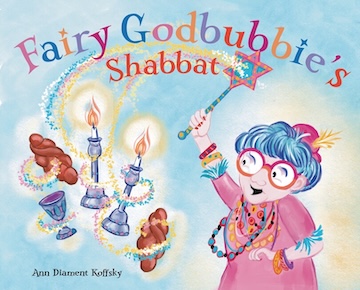
Seattle publisher Intergalactic Afikoman released Fairy GodBubbie’s Shabbat by Ann Diament Koffsky this month. Koffsky has written and illustrated more than 50 kids books, with many about Judaism, its holidays, foods and symbols. Her website is worth checking out: there are reading guides, you can see her many artistic styles, download colouring pages featuring scenes from her books, as well as other images, and, of course, there are links to purchase her books.
In Fairy GodBubbie’s Shabbat, the Mazel family is busy and seems happy enough, Dad on his laptop, Mom on her phone, Sara playing games on a tablet. But, “Why is no one schmoozing?” wonders Fairy GodBubbie. “Noshing?? Kibbitzing!”
“Unlike regular fairy godmothers who come only when called, Fairy GodBubbies just show up to fix things.
“Even when they’re not invited,” writes Koffsky.
So, poof! With a couple of Shabbat candles and a frequency jammer, Fairy GodBubbie helps the Mazels experience a different kind of Shabbat, a much more fulfilling one, a magical one. And readers can create the experience at their own homes, trying out what Koffsky calls a “a Tech Shabbat – a day away from screens.” She asks, “If your family does choose to try out a Tech Shabbat, what would you most like to do during that time?” And offers some choices – “Will you eat a family meal? … Curl up with a good book?” – and encourages readers to come up with their own ideas to make their “next Shabbat feel magical.”
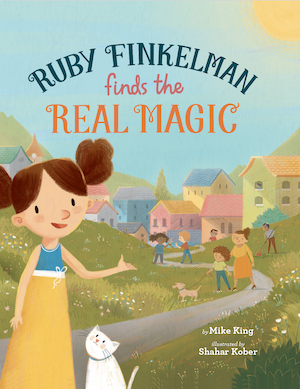 The Collective Book Studio’s Ruby Finkelman Finds the Real Magic, written by Mike King with illustrations by Shahar Kober, which came out earlier this year, also features a young heroine and, as the title indicates, “magic.” But there are no magical GodBubbies; rather, a self-realization that a beautiful village, a beautiful life, don’t just happen by magic – happiness, cleanliness, kindness, etc., require not only effort, but sometimes doing things you don’t enjoy doing. In Ruby’s case, she “especially didn’t like brushing her teeth,” so, one night, she decides, “I’m never going to brush my teeth again.”
Even such seemingly inconsequential actions have repercussions. Other kids stop brushing their teeth. Then they decide not to wash their faces, tidy up after themselves or treat one another kindly. Parents nag, children kvetch. The grownups become so exhausted, they have “no strength left to lift a toothbrush, do the laundry, take out the garbage, and on and on.” Kvellville soon turns into what neighbouring villages start calling “Schmutzville.” A town meeting devolves into several arguments, everyone turning on one another.
Seeing the madness, and realizing how it all started, Ruby sets about to right the situation.
“Mensch is a Yiddish word that means ‘human,’ but when used in the sense of ‘being a mensch,’ it means being a human in the best possible way, or being the best human that you can be,” writes King in an author’s note at the end of the story. “But it’s not only a Jewish thing – it’s a universal value, an idea of how to act in a way that makes the world a better place, simply because you behave in a good and kind way.”
While the toothbrushing premise is a little bit of a stretch, King is a pediatric dentist, so it’s no wonder, and he does manage to make the story work. It’s a wonderful message, of course, and Kober’s artwork is delightful.
About the Rosh Hashana 5786 cover art
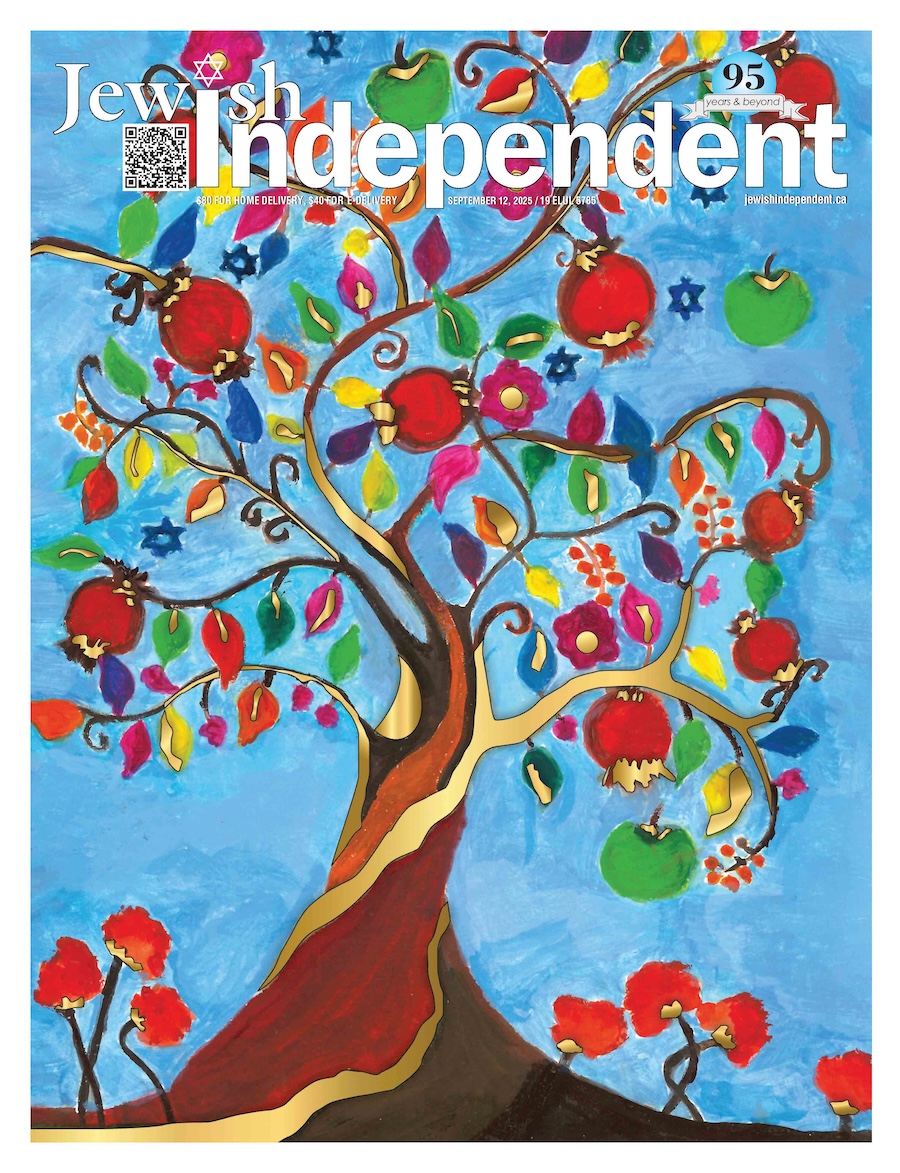 This year’s Rosh Hashanah cover art was created by Elaine Arenson in 2024 for Chai Cancer Care, the British Jewish community’s national cancer support organization. “This is my tree of Chai, my tree of light,” she wrote about the image. “Through the art group, we find creativity, renewal, community and exceptional care. We discover we are so much more than a cancer diagnosis.”
There is a story behind the centre’s annual card, which is selected from works created by Chai clients who attend art workshops. In 2013, a Chai client received a Rosh Hashanah card and told the centre: “It was so bright and cheerful. It lifted my spirits and gave me courage and strength when I needed it most.”
So, the brief to workshop participants is simple: create an image that reflects the warmth, light, joy and hope at this special time of year, and the tangible impact Chai support has on its clients. A quote from the artist always accompanies the image, explaining the sentiment and inspiration behind the design.
The centre’s Rosh Hashanah cards not only deliver good wishes but are also a source of income for Chai. They are available to buy blank or with a printed message and as ecards. To purchase some, email [email protected]. For more information about Chai Cancer Care, visit chaicancercare.org.
What’s old is new again
 “At a time when we are all wishing each other a Happy New Year we may well pause to consider what we mean by happiness and what we shall do to attain it. There is one thing that holds true of all of us: there is nothing that we think so much about, care so much for, aim so much at, as somehow to be happy. Yet happiness remains one of the most elusive objects in the world, and even when we stop chasing it long enough to think about it, we find ourselves confused as to what we mean by being happy, anyway.”
“Let us talk friendly with ourselves as we face the New Year,” continues Rabbi Samuel Cass, spiritual leader of Congregation Beth Israel from 1933 to 1941, writing in the Jewish Western Bulletin’s Sept. 26, 1935, Rosh Hashanah edition. “What is it that we’re trying to overcome? Why does that call of renewal of vitality come as a refreshing sound to our ears?”
Cass contends that “many of us” in that day and age were in a “state of boredom,” despite the “many avenues of excitement that modern civilization has to offer to us for the enjoyment of our leisure hours.” Hours that “ancient man” – who, “when he did not toil, he slept” – did not have.
“Modern man, thanks to a machine civilization with its labor-saving device, enjoys a greater amount of leisure than man had ever enjoyed before, aside from the enforced leisure of unemployment. Yet our leisure hours are the most boring we enjoy. Just an endless round of movies, cards, games.”
Cass goes on to recount a display at the World’s Fair a couple of summers earlier: “the electric marvel of our age, Captain Televox, the mechanical man. This electrical mechanism, when addressed in the proper pitch, gives correct information, and executes various commands. It can start a vacuum cleaner, turn on the electric lights, sets the radio at the proper station.”
The engineer who created “Mr. Televox” predicted “the day when housewives will be able to be away from the house all day and manage the household duties in absentia, by merely calling up the mechanical man and giving it orders.”
Cass laments that life in the 1930s was “reduced to a mechanical existence” with alarm clocks, radios, cars – even newspapers! “Our music comes from the radio, our dramatic entertainment from the motion picture, our philosophy from newspapers,” he writes.
His solution for happiness?
“Find an ideal somewhere and let it life [sic] you above the mechanics of living, let it give you true freedom and stir within you new fountains of personality. We need not seek very far for it. We are living in a world teething with problems, teething with causes that demand to be taken up!”
He asks readers to “embrace some great human ideal in the New Year, and in it experience the blessedness of a Happy New Year.”
This Rosh Hashanah message – and most of those throughout the JWB/Jewish Independent’s 95-year history – hold up remarkably to the test of time. The language differs, of course, but the problems are variants on sadly consistent themes: war, economics, technology, assimilation, antisemitism, etc. And the “solutions” are also relatively consistent over the years: the need for Jewish education, a renewed embrace of Judaism’s ideals, unity, engagement, financial and physical support of community institutions, self-reflection. This year’s missive contains some of these same ideas.
In addition to holiday-related articles and editorials, Rosh Hashanah papers over the years have featured local and Israel year roundups, games and puzzles for kids, crosswords, recipes, reflective pieces, and more. The front covers generally gave some indication that the New Year’s issue would be special in some way – another tradition we continue to uphold.



Campaign launch nears
Comedian Elon Gold will perform a full show of comedy at the launch of the Jewish Federation of Greater Vancouver’s annual campaign on Sept. 11. (photo by Limor Garfinkle)
Comedian Elon Gold helps the Jewish Federation of Greater Vancouver launch its annual fundraising campaign on Sept. 11.
The last time the Jewish Independent spoke with Gold, in 2019, he was driving from his home in Los Angeles to Las Vegas, with his family, for a Jewish National Fund event. This time, he had returned home from New York, where he performed gigs all over the East Coast, from DC to Jersey to the Catskills.
It’s a tradition for Gold and his family – wife Sasha and their four children – to spend summers in New York, though, this year, his oldest son, 24, has a job, so had to stay in Los Angeles.
“We all have really fun summers together because both of our families are from New York,” said Gold. All their oldest friends are also in New York, he added. “So, it’s like a summer of recharging, with our roots and our family and all that.”
Amid performing at various venues, working on a film, writing a TV series and creating a new comedy special, among other things, Gold gets great joy from doing shows for Jewish organizations.
“My motto is, ‘everything matters and nothing matters.’ That’s how you should look at life, and that’s how you should look at gigs,” he told the Independent.
The nothing matters isn’t about being “lackadaisical and lazy and dismissive,” he said, but more about reducing the stress level.
“It doesn’t really matter, it’s just a gig. If it doesn’t go well, I’ll have another one tomorrow, whatever, it’s fine. It takes the pressure off,” said Gold. “But everything matters is also a big part of it, because everything does matter, and every gig, to me, is important.
“It’s important for myriad reasons. The whole community is getting together and to let them down would be very upsetting, not just to them, but to me,” he said. “I always call these nights of community, unity and comedy. So, it does matter that you not just do well, but I try to hit it out of the park every time.”

Since the Oct. 7, 2023, Hamas terror attacks on Israel, community gatherings like the Federation’s campaign launch, are especially important, said Gold.
“We need these nights more than ever before,” he said. “We need these nights to forget that the world hates us, which also is perception, not reality…. The world doesn’t really hate us – there’s far too many people who do hate us, but the world as a whole?
“I was talking to my friend in Israel – I’m writing a TV series in Israel that we’re going to film there, hopefully in the spring – and he was saying he just went to Greece. All you see on social media is they hate the Israelis, [but] everyone we met said, ‘Oh, you’re Israeli? Wow, welcome,’ and gave us hugs.”
That being said, Gold acknowledged we’re living in a frightening time and antisemitism is prevalent.
“But it’s not omnipresent, it’s not everywhere,” he said. “It’s groups of people. There have always been groups of people who hate us, and I always say to Jews, don’t take it so personally. Usually, those groups hate other groups. It’s not just us that people hate. Racism doesn’t start and end with us, but, for some reason, we seem to be the favourite scapegoat of humanity and a lot of it is on us. And, again, I’m not dismissing antisemitism – it is so real.”
Referencing the Jewish man in Montreal who was beaten in front of his children, calling it “disgusting,” Gold said, “It’s really a constant, whether it’s Colorado or DC or wherever you look, there’s another attack, so that’s why we have to be strong and vigilant and stay safe, but also we can’t live our life through the prism of everybody hates us and everything’s terrible. The truth is, a lot of people have always hated us, and whether it’s, ‘they are drinking the blood of Christian children’ to ‘they’re starving Palestinian children,’ they’re blood libels. This is the latest iteration of a blood libel that gives the haters an excuse to hate.”
Gold pointed to inaccurate reporting by the media, including the New York Times’s use on its cover of a photo of a sick, emaciated child in Gaza, wrongly claiming the child was starving.
“It turns out it’s a genetic disease that he has,” said Gold, “and so many of the pictures have been falsified and misrepresented as starvation, when they are children with diseases, which is tragic in its own right, but to blame Israel … and to put that on the cover of the New York Times, that incites and emboldens the haters to hate us and attack us even more. So, it’s all based on lies. The only truth is that there is a war that Israel didn’t start or want and must fight to the end or there’ll be Oct. 7 every day until the last Jew standing. So, we shouldn’t apologize for defending ourselves ever again – but we do have to clarify all the mistruths out there that are representing the Jewish state, and thereby the Jewish people, in the worst light.”
After Oct. 7, Gold needed to step back from work. “For the first few weeks, I found no humour, I was in a state of shock and traumatized, like everybody,” he said. “I actually canceled gigs, I couldn’t do them.”
But one gig he wasn’t allowed to cancel was emceeing a Jewish Federation of Los Angeles event that happened in the shadow of Oct. 7.
“Steven Singer from the Federation in LA said, ‘No, no, we’re insisting that you do it, and that you do open with 10 minutes of comedy in a respectful way. We really need this and … even though we’re still mourning, we have to start healing…. It was the first time I went back on stage, almost a month in,” said Gold.
The terror attacks and the hostages are continually on his mind, he said, but he must pull himself back from those thoughts.
Fortunate to have had an “average to normal childhood,” with parents who “are amazing and brought us up in a loving, happy house … my comedy doesn’t come from pain,” he said. “And now, I’m in more pain emotionally than I’ve ever been with everything going on, but I push it away because, if I delve in too much for too long, I won’t be able to come out of it, I won’t be able to be the funny guy.
“And it’s not just my responsibility,” he said. “In life, I’m fulfilling my purpose by being light and fun and funny, and bringing that to other people, so I can’t get too into it because my rage for what happened and what’s happening and how the world is denying or excusing Oct. 7, the way the world’s demanding the end to the existence of our ancestral homeland – it’s so infuriating and so depressing. If I focus and harp on it too much, I won’t be able to deliver the goods.”
And delivering the goods is something he is compelled to do, by his very nature. When COVID-19 hit and the forecast was that it would last only a few weeks, Gold said his first thought was that he’d catch up on every TV streaming service, binge on shows he’d never been able to watch with four kids and a job that is pretty much 24/7. But, by Day 2 of the pandemic, he was doing a daily show on Instagram Live called My Funny Quarantine.
“Every day at 6:13, which is the number of mitzvahs in the Torah, I would do an 18-minute show, which is also, again, significant, 18 is chai [life],” he said. Most of Gold’s Instagram followers are Jewish, so the show had a lot of Jewish themes, though the guests were wide-ranging, including comedians from Jim Gaffigan to Bill Burr to Tiffany Haddish, Jay Leno and Michael Serra.
Gold’s friend, screenwriter and director Jeremy Garelick, loved My Funny Quarantine and suggested Gold do a Jewish dating show every Saturday night.
The Bachor (bachor is Hebrew for young man, guy) ran for a couple of years. “I made two shidduchim [matches],” said Gold.
“It was a way for people to connect, and no one was doing anything, no one could go anywhere, and I had so many people watching live,” he said.
Gold also did Zoom stand-up shows and outdoor performances during the pandemic. More recently, he worked on the film The Badchan, spending a month in Israel for it. He’s been to Israel four times in the last two years, he said, doing shows.
“Badchan is like a wedding jester,” Gold explained. The film was written by Shuli Rand and Gidi Dar, who did the 2004 film Ushpizin (Guests) together.
“To me, every decade has a seminal cultural Jewish film, like Yentl or Fiddler or The Chosen or their Ushpizin,” said Gold. “And I think this is going to be that film of this decade. It’s going to come out in November, hopefully.”
Gold is currently developing a new hour-long comedy special, which will come out sometime near the end of next year perhaps.
“It’s really exciting,” said Gold, “because Chris Rock, one of my comedy mentors, he said every special should be like a thesis and I have the thesis for this one, and I already have been closing for 20 minutes with this thesis. And so, now I’m just building it out, and I think it’s going to be very fun and relatable, because I’m getting more personal in my comedy.”
He said, “The more you reveal, the more they relate.”
“Little arguments with the wife, little stories that happen, when you share them, I have not just men but women coming over to me going, oh my God, are you in my house? How do you know this happens? I’m like, because it happens to me…. The comedian’s job is to relate and connect, to have this shared experience where you’re taking observations about human behaviour … and laughing about it.”
As for Gold’s performance here on Sept. 11, it represents more than just a good many laughs.
“I think everyone should come out,” he said. “I think we all need nights like this event, and supporting your local community and your local Federation, that’s one of the best ways to help us all get through these tough, insane times where the world feels upside down. I’ll try to turn the world right side up for even just a little bit, even just for one night.”
For tickets ($36) to Gold’s show on Sept. 11, go to jewishvancouver.com/faco25.
From the archives … JCC, 1937
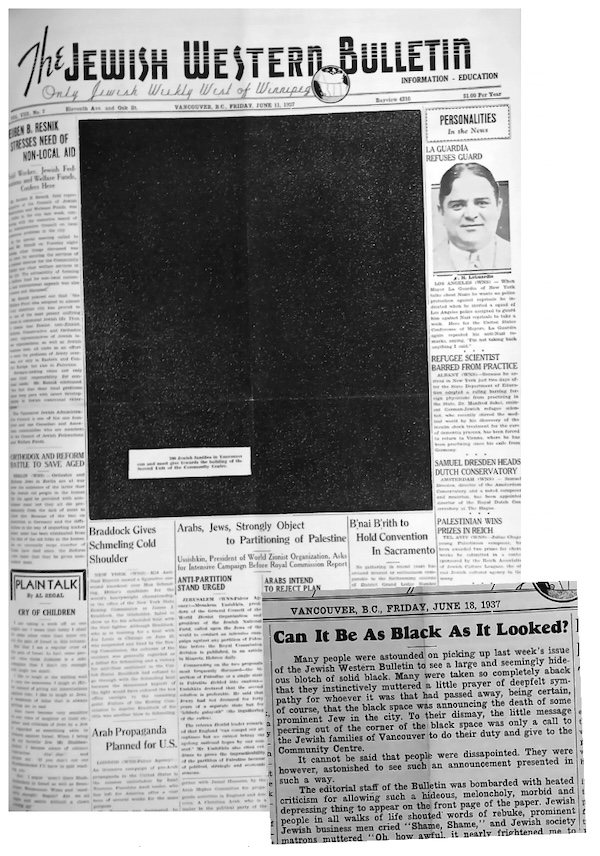 It was the big black square on the cover of the June 11, 1937, Jewish Western Bulletin that caught my attention initially. Then, as I flipped backwards and forwards through the archived papers, it was the weekly drama – that kind of left me hanging – and the sheer bluntness of tactics that drew me in to the JWB’s coverage of the 1937 campaign to raise funds for a second unit of the Jewish Community Centre, then located at Oak and 11th. (The building still exists, the home of the BC Lung Association for a long time now.)
The campaign action plan came out of a shareholders’ meeting in March of that year, at “which over one hundred men of the community were present,” according to the March 12, 1937, JWB, the JI ’s predecessor. I’ve no idea who the shareholders of the centre were. Nor if any women were at that planning meeting, but Lillian Freiman Hadassah, Council of Jewish Women and the Schara Tzedeck Auxiliary were among the organizations that helped solicit and collect pledges.
The appointed campaign committee set a quota of $12,500 (or $271,217 in today’s dollars) and collections were divided into three divisions: donors of $100-$250 (Group A), $25-$100 (Group B) and up to $25 (Group C). The “keynote” of the campaign was “that each give according to his ability,” and every organization on the committee committed “its intention of getting whole-heartedly behind the task ahead.” Meanwhile, “The proposal submitted to shareholders by Schara Tzedeck Congregation of taking over the building has been tabled for a period of three weeks.”
While that proposal obviously fizzled out, I couldn’t find any later mention of it. As I’ve often found when looking through the paper’s archives, it’s easy to find when things start, but harder to find out how they ended up. What is clear is that there was a hard push to raise the $12,500, and, while the March 12 article noted that, “possibly, for the first time in community history, there is no division of opinion concerning the necessity of and the urgent need for doing constructive work for [the] community Centre,” the JWB did feature some disparate views as soon as the next issue.
Rabbi J.L. Zlotnik summed up those concerns in a March 19 article: the quota was too much, given other community concerns and organizations that also needed financial support; and the quota was too little, given that actual building costs are almost always larger than planned, and the community would, therefore, become even more indebted as a result.
“After a period of ten years, twenty thousand dollars are still to be paid before this building can truly be called our own,” wrote Rabbi Samuel Cass in the March 31 issue, about the existing centre, while also pointing to the need for a second unit. He observed, “First, we must not repeat the mistakes of the past,” so the second unit should “be paid for in cash to the very last penny, before the first sod is turned. Second, the campaign must go beyond the amount necessary to erect the contemplated addition.” Lastly, he said, the whole community must agree that the debt on the first unit be paid off “even speedily, and at a near time.”
The advice seems to have gone unheeded. In the same March 31 paper as Cass’s article, the page 2 headline read, “All Organizations Endorse Second Unit Campaign.”
The next edition’s cover blared, “2ND UNIT CAMPAIGN IN FULL SWING,” with the news that more than $3,000 had come in on the campaign’s first day, “collected from twenty men.” The building plans were also outlined in the April 9 paper: a two-storey building with a balcony was envisioned. The lower floor would be a gymnasium and banquet room, with “kitchen, showers, wash room, steam rooms, cloak-room, etc.” The upper floor would house an “Auditorium and Ball Room, cloak-room and lounge.” The balcony would be divided into small meeting rooms. “This present building is 33 feet 11 inches on 11th Ave. The addition would be 47 feet 9 inches or more than 40% larger,” the article stated.
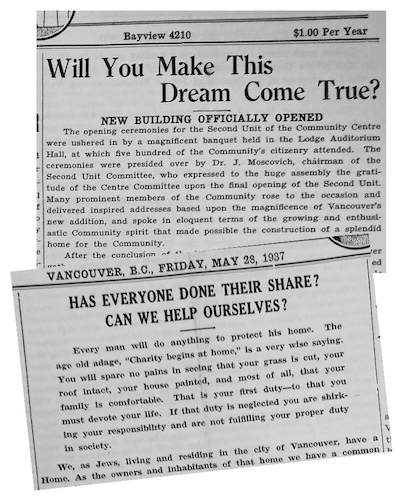
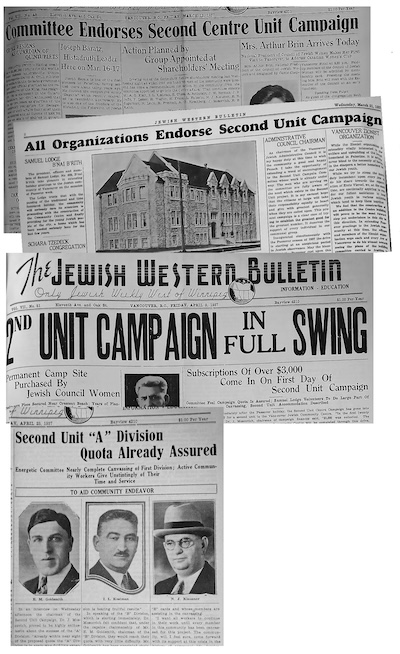 By the April 23 issue, the A Division quota was “already assured.” A couple of weeks later, in the May 7 paper, a completely fictional piece was published on the cover, titled “Will You Make This Dream Come True?” It was written as if the second unit of the centre had opened, with a banquet, a highlight of which was the announcement of a $5,000 gift from an anonymous donor to pay for all the unit’s furnishings and appliances. The article imagined what meetings and other banquets were already being held in the new building and the great number of athletics classes available now that “the use of the gymnasium was available to all persons in the Community.”
By the end of May, though, the JWB was asking whether everyone had “done their share.” By June, the optimism hit a wall.
The cover of the June 11 issue featured the large black square that caught my eye. The label-sized caption with a white background read: “700 Jewish families in Vancouver can and must give towards the building of the Second Unit of the Community Centre.”
The dramatic editorial choice was explained in the June 18 paper:
“The editorial staff of the Bulletin was bombarded with heated criticism for allowing such a hideous, melancholy, morbid and depressing thing to appear on the front page of the paper. Jewish people in all walks of life shouted words of rebuke, prominent Jewish business men cried ‘Shame, Shame,’ and Jewish society matrons muttered ‘Oh, how awful, it nearly frightened me to death.’
“No one, however, said ‘That little message in white, standing so pure, apart from that black hideousness was TRUE. Every body should give to the Centre – How we need that second unit – How essential it is to our Youth to have a proper meeting place.
“What our Community needs is more players, and less bench criticisizers. More workers, and less kickers.”
It concluded: “If you have a conscience, if you have the true community spirit – come through and show it. If you haven’t already given your contribution to the Second Unit – Mail it in to the Centre – tell them this article made you feel your responsibility. If you have given your donation, send in notification to the Centre to have it doubled. No matter what you give, make it as much as you can afford. Don’t let us be criticisers – LET’S BE BUILDERS.”
 Over the summer, a couple of meetings were held about the centre. There was a large notice on the cover of the July 2 paper about a July 5 meeting, but I couldn’t find a report in the paper about what transpired. Nor could I find out how the Sept. 22 “mass meeting” on “the Future of Vancouver Jewry” went – its Sept. 14 front-page notice declaring that “By your attendance … YOU SHALL BE JUDGED!”
There are no August or October 1937 papers in the bound archival collection I have, and I don’t know if they were lost to history or never published. Until June 1937, the reporting had been detailed and consistent, but the next mention of a campaign, in the Nov. 12 paper, is “the Recent Centre Drive” – not the second unit drive. In this campaign, there were seven grades, ranging from Grade A ($500 and up) to Grade G ($1 to $49). The Grade A donors were listed by name in that paper, the Grade Bs in the next issue, the Cs in the next, through to the Gs in the Dec. 24 issue, wherein the committee was congratulated for its work and the community for its “whole-hearted support to the campaign.”
Since there is no useable digital archive of the paper, sadly, my time-limited flipping came across no more mention of a second unit. The editorial two years after that campaign, on June 23, 1939, started, “Much water has gone under the bridge since our Centre Building has been re-financed. Inside and outside improvements on the building, in addition to the Amortization Plan itself has gone forward.
“Never have local Jewish efforts been more active, and the response greater, nor has the attendance within the building itself been so large. Much of the success is due to the liberal atmosphere of the Centre itself, which means the use of this building for any and all worthy Jewish efforts with but one thought – helping others to help themselves. One shudders to think of what might have happened to Jewish efforts in our city had not our fellow-Jews responded to the call for funds when it was made.”
The editorial also noted: “Some, however, have through oversight or neglect failed to send their payments in as yet.” It was hoped that “the pledgors in arrears will … see that their respective remittances are made … upon receipt of the notices.”
As far as I know, the second unit of the Oak and 11th JCC never materialized. It would be more than two decades later that a new centre would be built, at Oak and 41st, opening in 1962.
A complicated family legacy
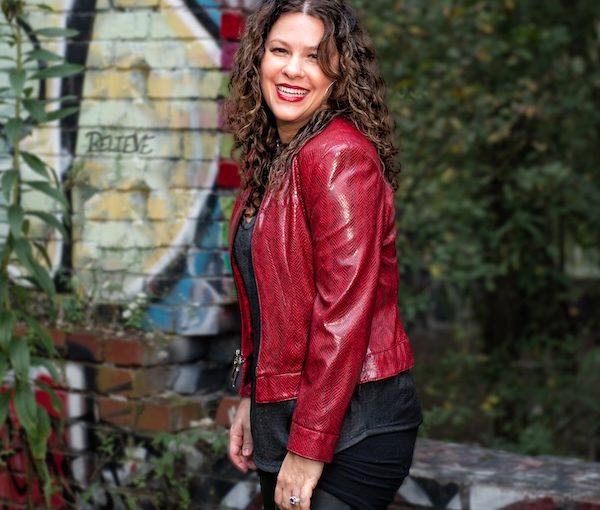
Neshama Carlebach comes to Vancouver for Selichot at Congregation Beth Israel on Sept. 13. (photo by Michael Albany)
After more than two decades, Neshama Carlebach returns to Vancouver. But not for a concert.
The award-winning singer-songwriter will lead, with her band, a musical service at Congregation Beth Israel for Selichot, the night of Sept. 13. The holiday – whose name translates as forgiveness, or pardon – marks the beginning of a period of penitential prayers that runs through Simchat Torah. In addition to participating in the service, Carlebach will speak with Rabbi Jonathan Infeld about her father, the late Rabbi Shlomo Carlebach, his spiritual and musical legacy, and also the pain caused by the sexual misconduct of which he was posthumously accused.
In January 2018, Carlebach wrote a blog on the Times of Israel that addressed the allegations against her father, who died in 1994. She also shared that she had been sexually abused as a child by one of her father’s friends. Writing that blog, she told the Jewish Independent, “was one of the most painful and soul-wrenching things I have ever done. I was standing at the edge of a precipice, holding the truth of my own pain, the pain of others, and the love I still carry for my father, who was no longer alive to respond. The world was shifting in the wake of the #MeToo movement, and I felt an overwhelming need to finally speak and honour the voices of those who had been hurt and silenced – including my own.
“Simultaneously, my career was, in many ways, canceled. Doors closed. Invitations disappeared. People I loved and trusted turned away from me in anger, some even accusing me of betraying my father and his legacy. Perhaps just as painful was watching my family’s music – music that has brought meaning to so many – be rejected and erased.
“Acknowledging my father’s transgressions broke my heart,” said Carlebach, “but it was time for me to speak out – to stand with those who were hurt and to be a part of the possibility of healing, and for the belief that we must be honest to be whole. We must hold space for truth, even when it shatters the fabric of the life we once clung to.”
From the age of 5, Carlebach’s father invited her to share Chassidic stories for his audiences and, by age 15, she was performing alongside him. Since her first album in 1996, she has released 10 records and, worldwide, is one of the bestselling Jewish artists. She is also an advocate for religious pluralism and human rights, as well as being a community leader in other respects. Living in New York with husband Rabbi Menachem Creditor and their five children, she is in the midst of writing a memoir, as well as studying to become a rabbi at the Academy for Jewish Religion.
In 2026, a documentary about Carlebach’s family will be released, with the support of Jewish Story Partners. The blurb on JSP’s website reads: “Rabbi Shlomo Carlebach, ‘the Singing Rabbi,’ ignited the spiritual landscape for legions of Jews in a post-Holocaust world. Soon after his death, he is accused of sexual abuse. Thirty years later, with intimate access to his family, inner circle, and his victims, Carlebach Project Untitled grapples with a complicated legacy and how – or whether – to separate the art from the artist.”
“I was just 20 when my father died and, in many ways, I was still a child,” Carlebach told the Independent. “He wasn’t just my father; he was my rabbi and my closest friend. Losing him was like losing my grounding in the world. And when, years later, I began to fully confront the complexities of his life and the pain that others experienced because of him, the grief became more complicated. My career crumbled. I lost community. I lost friends.
“I think what helped me to continue was the music and my connection to God. Even when I wasn’t able to sing professionally, within my own heart I sang and I prayed.
“I still carry and honour my father because I am his daughter and because I believe that love and accountability are not opposites,” she said. “Music has a life of its own, it has always been bigger than the entity which creates it. The legacy I hope I’m building now with my sons is one rooted in truth, in justice, in faith and in love. I choose to believe these are the things he wanted for me, and for the world.”
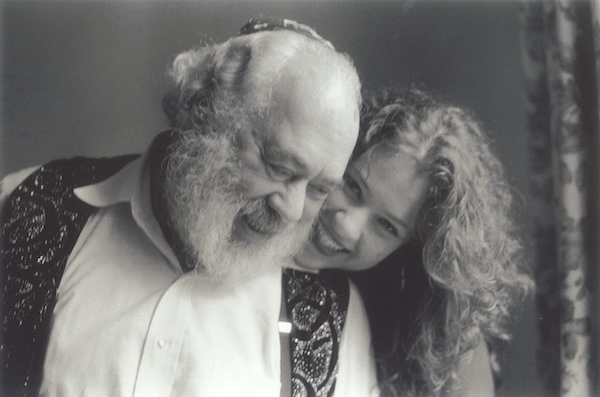
It was after the Hamas terror attacks on Oct. 7, 2023, that Carlebach began creating music with her sons, Rafael and Micah.
“To share the sacred legacy of our family with them, and to witness their light, their depth and their gifts has been one of the greatest blessings of my lifetime,” she said. “My Rafael sadly can’t be with us in Vancouver, as he is starting college, but my Micah will be! We will also be joined by my longtime musical collaborators, pianist and musical director Seth Farber, bass player Brian Glassman and drummer Joe Nero.”
The video Carlebach created with her sons – Invincible Spirit (In Solidarity with Israel), an interpretation of the song “Am Yisrael Chai” – is on YouTube.
“Originally written in support of the Soviet Jewry Movement, ‘Am Yisrael Chai’ has been an anthem of the Jewish people for over 50 years,” Carlebach wrote in a Times of Israel blog last year. “The melody and words have brought energy, sustenance and unity whenever it’s been sung, often in response to hardships facing the Jewish world. In times of need, it is simultaneously a call to action and a prayer, a defiant cry and a message of reassurance. The words, translated as ‘The People of Israel Live,’ were set to music by my father in the 1960s and embraced as part of the Jewish canon. Today, since the horrors of Oct. 7, they have once again become a constant refrain in the Jewish community.”
In another blog, Carlebach, who was born on Simchat Torah, explains why she decided to become a rabbi. “After Oct. 7, Simchat Torah, my heart, my essence and my birthday changed forever,” she wrote. “My Jewish identity and desire to learn have never been stronger. I feel a greater sense of urgency to do my part and bring meaning and holiness to our communities, both in the diaspora and Israel.”
She shared with the Independent the importance of participating in the event at Beth Israel.
“Selichot is the beginning of the High Holy Day season, our holiest time of year,” she said. “It is when we begin to turn inward and ask ourselves the hardest questions: Who have I been? Where have I fallen short? What do I need to repair – in myself, in my relationships, in the world? It’s a time of vulnerability, of accountability and of profound possibility.
“I’ve always envisioned that, on Selichot, the Great Gates of Teshuvah – of Return – first begin to creak open, but slowly, almost in a whisper. Selichot is softer than Rosh Hashanah, more intimate than Yom Kippur. We gather, often late at night, to begin to open our hearts as a community – with prayer, with song, with tears. It’s a time for truth and tenderness.
“It will be incredibly meaningful to gather with the Vancouver community in prayer and in conversation this Selichot. This is the kind of gathering I love most!” she said, commending Rabbi Infeld and the Beth Israel community for being “open and brave enough to engage in this complicated topic.”
“Every year, we work hard to make sure that our Selichot service and program makes a difference in people’s lives,” said Infeld. “The topics are often not easy to discuss, but, every year, people leave the synagogue looking at a situation from a different perspective and as better human beings because they came. We love when people discuss the content of what they heard at the synagogue after Selichot. We believe that this year that will happen as well. Shlomo Carlebach is extremely well known, but the underbelly of the person and his personality are extremely important for us all to discuss – and there is no one better in this world to do that than his daughter, who is also extremely musically talented.”
To invite Carlebach was “a natural choice,” he said, given that the event will honour Harley Rothstein.
“Since we had decided to honour Harley for his many years of service this year, I decided I wanted to do something very special from a musical perspective,” said the rabbi.
“Harley is one of the most humble and generous people I know. He is a constant supporter of our synagogue in many ways. We have been honoured to have him lead services over the years. He has a fabulous voice with great kavanah [intention/devotion],” explained Infeld. “He has a magical ability to engage people in congregational singing and to help engender a warm feeling among all the participants. Harley has gone above and beyond by helping to teach the next generation of service leaders. One of his most important aspects of leadership each year has been the Selichot service with our ba’alat tefillah [prayer leader], Debby Fenson.”
On Sept. 5, during the synagogue’s Shabbat with a Difference Kabbalat Shabbat service, the congregation will honour Fenson on her 20th anniversary with Beth Israel. On Sept. 13, she and Rothstein will lead Havdalah.
The Selichot event with Neshama Carlebach is open to the entire community. To attend, RSVP via bethisrael.ca.