Skip to content
  • Home
  • Subscribe / donate
  • Events calendar
  • News
    • Local
    • National
    • Israel
    • World
    • עניין בחדשות
      A roundup of news in Canada and further afield, in Hebrew.
  • Opinion
    • From the JI
    • Op-Ed
  • Arts & Culture
    • Performing Arts
    • Music
    • Books
    • Visual Arts
    • TV & Film
  • Life
    • Celebrating the Holidays
    • Travel
    • The Daily Snooze
      Cartoons by Jacob Samuel
    • Mystery Photo
      Help the JI and JMABC fill in the gaps in our archives.
  • Community Links
    • Organizations, Etc.
    • Other News Sources & Blogs
    • Business Directory
  • FAQ
  • JI Chai Celebration
  • JI@88! video

Recent Posts

  • Story of Israel’s north
  • Sheltering in train stations
  • Teach critical thinking
  • Learning to bridge divides
  • Supporting Iranian community
  • Art dismantles systems
  • Beth Tikvah celebrates 50th
  • What is Jewish music?
  • Celebrate joy of music
  • Women share experiences 
  • Raising funds for Survivors
  • Call for digital literacy
  • The hidden hand of hate
  • Tarot as spiritual ritual
  • Students create fancy meal
  • Encouraging young voices
  • Rose’s Angels delivers
  • Living life to its fullest
  • Drawing on his roots
  • Panama City welcoming
  • Pesach cleaning
  • On the wings of griffon vultures
  • Vast recipe & story collection
  • A word, please …
  • מארק קרני לא ממתין לטראמפ
  • On war and antisemitism
  • Jews shine in Canucks colours
  • Moment of opportunity
  • Shooting response
  • BC budget fails seniors
  • Ritual is what makes life holy
  • Dogs help war veterans live again
  • Remain vital and outspoken
  • An urgent play to see
  • Pop-up exhibit popular
  • An invite to join JWest

Archives

Follow @JewishIndie
image - The CJN - Visit Us Banner - 300x600 - 101625

Byline: Cynthia Ramsay

Story of Israel’s north

Story of Israel’s north

Kiryat Shmona musician Ben Golan will perform at the Yom Ha’atzmaut celebrations in Vancouver April 21. (photo from Ben Golan)

“Music for me is a way to say: we are still here, still alive, still building a future. It gives people a place to feel, and also the strength to keep going,” said Ben Golan, who will headline our local celebration of Israel’s 78th Independence Day, on April 21.

Golan is a musician and producer from Kiryat Shmona, a city in our community’s partnership region, the Upper Galilee, in Israel. He is the founder of the initiative Patifon.

“For 17 years,” he said, “I’ve been producing music and running a recording studio in the city. Over time, I realized that my work isn’t just about producing songs. It’s about building something that can sustain a real musical community in the north, giving a stage to local creators and creating a movement that feels connected to this place.”

Patifon, which means record player or turntable in Hebrew, serves as a hub for local artists.

“It all started simply, with jam sessions in the studio,” explained Golan. “People began coming to play, sing, meet and connect. Slowly, it grew, until the gatherings were too big for the studio to handle. There wasn’t enough space, but there was a hunger for music. Then, thanks to the youth centre and the amazing Elad Kozikaro, who gave us a budget and the perfect space, we got a shelter, which, in times like these, is a valuable commodity in the north. We moved in, completely renovated it and turned it into the most beautiful music lounge; a place where you can come and feel at home, even if it’s your first time there.”

The lounge morphed into Patifon.

“We started filming live sessions of artists and bands there, with proper sound and respect for the music,” Golan said. “All the sessions were uploaded to YouTube under Patifon and, over time, it started to catch on and reach more and more people. Suddenly, what began as a small local gathering became a stage watched by people outside the north.

“As the audience grew and we realized this needed more breathing room, we opened a community pub. Students from Tel-Hai College volunteer there as part of a scholarship program and help keep the place alive and running.”

For Golan, Kiryat Shmona is not just where he was born and grew up. He calls the city and the Upper Galilee his “inner language.” 

“In this city, I learned what the rhythm of a community really is: people who know each other, who will always help you when you need something. There’s a different kind of air here,” he said.

“I have a stream right by my house. It seeped into my music without me even intending it to – a mix of rough and tender, of truth and esthetics, of wanting to shout and needing a moment of quiet to breathe,” he explained. “The nature here, the open space and the distance from the centre taught me how to really listen – not to the noise, but to what lies underneath it.

“Continuing to create in the north, especially after Oct. 7, is not a romantic choice for me – it’s a stance,” he said. “The region went through a real upheaval: fear, evacuation, uncertainty and, also, a kind of pain that people who don’t live here sometimes don’t fully understand. Out of all of that, creativity becomes a tool for connection and healing.”

Golan chose to stay in Kiryat Shmona out of a sense of mission.

“I believe the periphery holds immense talent, real hunger and stories you can’t fake – it just needs infrastructure, a home and support,” he said. “I want the young people and artists here to feel that they don’t have to leave in order to become something. On the contrary – that this place itself can become a source of inspiration, an opportunity and a creative centre that generates culture rather than just consumes it.”

Coming to Vancouver for Yom Ha’atzmaut, Golan said he brings messages of resilience and hope – and he takes those words seriously.

“Independence, for me, is also the ability to choose to create despite the difficulty, to choose community, to choose light,” he said. “I want to bring the story of the north: people who continue to build, to organize events, to create music and to hold each other up even when reality is complicated. In my music, there is room for both joy and pain, because both are part of our lives – especially in this time.”

On April 21, Vancouver band HaOptziot will also take the stage at the community celebrations, playing covers of various Israeli hits.

For tickets ($36/adult, $12/youth, $75/family pack) to the Yom Ha’atzmaut celebrations, go to jewishvancouver.com/yh2026. 

Format ImagePosted on March 27, 2026March 26, 2026Author Cynthia RamsayCategories MusicTags Ben Golan, HaOptziot, Jewish Federation of Greater Vancouver, Kiryat Shmona, music, Patifon, Yom Ha'atzmaut
Raising funds for Survivors

Raising funds for Survivors

Artists Claire Kujundzic and Bill Horne have created a Bondi Beach memorial shirt. Monies raised are being donated to Bema Productions’ high school Holocaust education tours of Wendy Kout’s Survivors. (photo from Amazing Studios)

After the terror attack at Bondi Beach, Australia, on Dec. 14, in which two gunmen killed 15 people and wounded some 40 others who had gathered to celebrate the first night of Hanukkah, Victoria artist Bill Horne hosted a print-your-own glow-in-the-dark menorah shirt event at his and partner Claire Kujundzic’s Amazing Space Studio.

“Claire and I were very distressed by the antisemitic murders at Bondi Beach, and wanted to do something,” Horne told the Independent. “I’ve screen-printed with glow-in-the-dark ink before, e.g. images of aurora borealis, and the image of a glowing menorah popped into my mind. I thought it could symbolize the spirits of those killed at Bondi Beach, as well as literally ‘light up’ a menorah on a shirt this way.”

On Facebook, Horne invited anyone who wanted to print their own glow-in-the-dark menorah to bring a shirt to the Saanich studio before one of the Hanukkah light-up events in Victoria.

image - The front of the shirt features a menorah that glows in the dark
The front of the shirt features a menorah that glows in the dark. (photo from Amazing Studios)

“I had a few spare, unprinted black shirts in the cupboard, so I printed them,” he said. “When our visitors saw them, they asked if they were for sale. I hadn’t conceived of this as a commercial project, and that would have felt completely wrong, so I thought it could be a fundraiser. With Zelda Dean’s permission, I announced through word-of-mouth and our studio’s newsletter that we would be printing the shirts to raise funds for the high school tours of Bema theatre’s production of Survivors, as part of BC’s Holocaust education.”

Horne and Kujundzic, neither of whom is Jewish, have seen the play.

“It was an excellent production,” said Horne.

“The first production we attended at Bema was Si Kahn’s Stranger in a Strange Land,” he said. “I had heard Si sing at the Vancouver Folk Music Festival many years ago, and didn’t know he wrote plays. We saw a poster for this play of his at the [Victoria] Jewish Community Centre one day when we went for lunch. The musical was great, and Si was in attendance, which was a bonus.”

That was when the couple first met Dean, the founder and managing artistic director of Bema Productions, which is based in Congregation Emanu-El.

“We think she’s one of the best things about Victoria!” said Horne.

He and Kujundzic have since seen various plays and readings at Bema.

image - The back of the glow-in-the-dark menorah shirt lists the names of those murdered at Bondi Beach, Australia, on Dec. 14, while celebrating the first night of Hanukkah
The back of the glow-in-the-dark menorah shirt lists the names of those murdered at Bondi Beach, Australia, on Dec. 14, while celebrating the first night of Hanukkah. (photo from Amazing Studios)

The fundraising initiative is just starting, with $100 donated from that first, unplanned small batch of shirts.

“Once we receive enough orders to print and sell at least a few dozen more shirts, we’ll be able to make a larger contribution,” said Horne. “In terms of raising spirits, most people who see the shirt (especially with the lights out) have been moved or glad to see something positive in response to the Bondi Beach massacre. I also think it’s important for gentiles to wear a shirt like this in solidarity.”

“I am so grateful to my dear friends Claire and Bill for their tremendous generosity and their ongoing efforts to make the world a better place,” Dean told the Independent, noting that fundraising “becomes more difficult every year and we welcome donations toward this very important Grade 8 to 10 educational play, which is approved by the provincial government.”

Bema will be doing its fifth annual tour to BC schools with Survivors, which was written by Wendy Kout, based on recorded testimonies of 10 survivors talking about their experience as teens during the Holocaust, said Dean. “We have so far presented at 45 schools on Vancouver Island and in Greater Vancouver and hope to reach the Interior as well this year.”

Horne and Kujundzic operated Amazing Space Studio and Gallery in Wells, BC, for more than 25 years, before moving to Saanich in 2021. While not a retail gallery anymore, people can arrange a visit to the studio.

The Bondi Beach memorial shirt is completely in character for the couple, who have been involved in many causes and projects since they met in 1981. 

“Tools for Peace published two fundraising calendars of Claire’s Nicaragua-themed art in the late 1980s,” said Horne. “We’ve produced art and design for fundraising or promotion projects for groups such as BC Black History Awareness Society, the Wells Historical Society, Friends of Barkerville, families of Nicaraguan political prisoners, Ukrainian refugee families, RAVEN Trust and Treaty 8 First Nations (resisting the Site C dam), the United to End Racism delegation at the World Peace Forum (Vancouver, 2006) and the successful Wells Save Our School Campaign of 2002-2003.

“Claire has designed logos, graphics and posters for Pacific Post Partum Society, BC Organization to Fight Racism, Potters Without Borders, Nuu-Chah-Nulth Tribal Council, Kettle Friendship Society, International Women’s Day, many unions, including Union Women, and the International Metalworkers’ Federation.”

As a printmaker, Horne can silkscreen shirts, as well as editions of prints for exhibitions, he said. He has also designed books of poetry and photography. 

“Claire learned the printing trade in her 20s, worked as a designer doing layout and logos, and produced paintings, prints and sculptures as well,” he noted.

A reprint of the menorah shirts will take place this spring, with probably another run in the fall. Horne needs to first create a secure online order system.

If anyone wants a shirt, contact the studio for details of the next printing, shirt size/style options and prices: amazingspacestudio.com. To donate to Bema Productions’ high school tours of Survivors directly, go to holocausttheatre.com. 

Format ImagePosted on March 27, 2026March 26, 2026Author Cynthia RamsayCategories LocalTags antisemitism, Bill Horne, Bondi Beach, Claire Kujundzic, fundraising, Hanukkah, Holocaust education, tikkun olam, Victoria, Zelda Dean

On the wings of griffon vultures

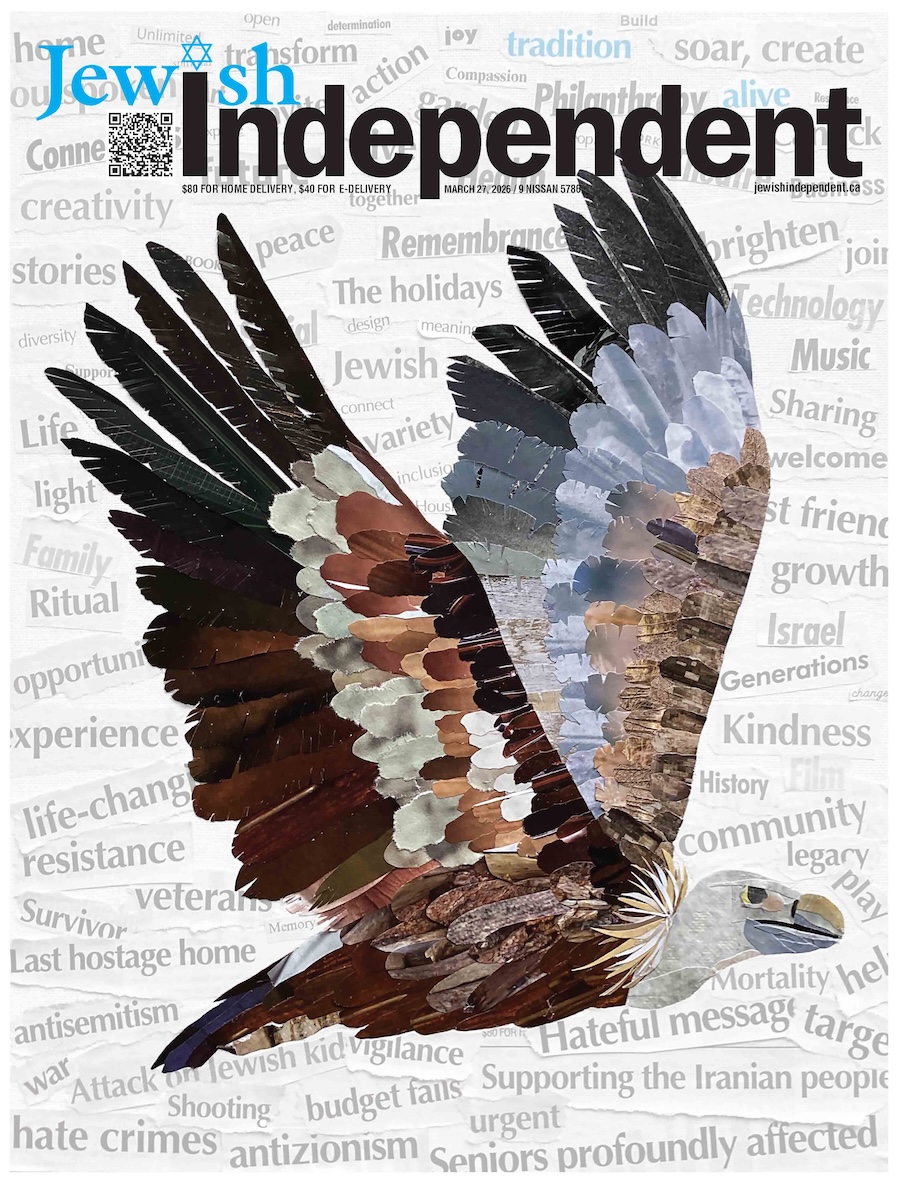
Liberation. Freedom. Renewal. Recalling our history, our stories. Passover’s themes are many, and the challenge every year is for us to interpret them in a meaningful way for our time.

image - JI Passover cover March 26 2026
This year’s cover of the JI’s Passover issue.

In making this special issue’s cover, I started with the idea that I would use artificial intelligence – one of the most contemporary tools – to create it. Would AI free me from the hours that art creation takes? Short answer: no.

I started with the directive to design a collage centred on the Jewish fight for freedom throughout history, and got lots of great feedback on how to arrange images to tell a powerful story. I could place “key representative figures or symbols at the forefront,” “use overlapping images to create dimension and a sense of ‘flow’” and incorporate “symbolism of ‘tikkun olam.’”

AI had recommendations for typography, what media I could use, what colour palette. It suggested historical struggles I might want to include in a spiral-shaped design: the Exodus and the Maccabees in the outer ring; Conversos and Partisans in the next ring; early kibbutzim and the Iron Dome in yet another ring; and the yellow ribbon for the Oct. 7 hostages or “street-art style seen in Tel Aviv or New York” in the centre.

I eventually figured out how to create an image in AI, but everything I tried looked horrible, so I decided to make my collage the old-fashioned way – with my own hands, using only paper, inspired by artist Deborah Shapiro (deborahshapiroart.com), whose art I’d used on the JI’s 2021 Rosh Hashanah cover. 

After what felt like forever, I figured out what my focus would be. I came across the verse in Exodus (19:4): “You have seen what I did to the Egyptians, how I bore you on eagles’ wings and brought you to Me.”

An article on aish.com by Rabbi Warren Goldstein, chief rabbi of South Africa, helped me think through the symbolism, from both a spiritual and secular perspective.

“Each year, we are told to relive the experience of leaving Egypt – and I imagine being lifted from slavery and oppression ‘on the wings of eagles,’” he writes. “What better way could there be to express our transition from the earthly bonds that constrain us to the spiritual transcendence that God gave us than through the exhilarating, soaring rush of the eagle’s flight.”

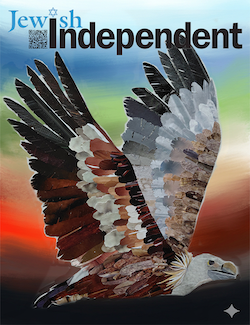
image - I tried two different backgrounds for the griffon vulture collage on this issue’s cover, before I decided to make my own. This one is an AI-generated image based on colour suggestions, going from darkness to light
I tried two different backgrounds for the griffon vulture collage on this issue’s cover, before I decided to make my own. This one is an AI-generated image based on colour suggestions, going from darkness to light.

Goldstein goes on to talk about Rashi’s interpretation that “the eagle’s wings represent the nature of God’s protection over us.” The rabbi notes the miracle that Jews are still here, despite a long history of various peoples trying to kill us. And he compares the “rush of the eagle’s flight” to “the speed with which God liberated us from Egypt” – so fast, of course, that our bread didn’t have time to rise, hence, the matzah we eat on seder night as a symbol of our “supernatural” redemption.

“This divine dynamism – depicted by the image of a soaring eagle – becomes a call to action: ‘Be light as an eagle,’ says the mishna in Pirkei Avot. Too often we get bogged down by life,” writes Goldstein. “We become consumed with angst, submerged in introspection and inertia. The mishna urges us to live life energetically and enthusiastically – like an eagle – with a sense of urgency for the task at hand, which is uplifting ourselves and our world through our mitzvot.”

I like this idea of living with a sense of energetic purpose, whether the motivation to improve ourselves and the world is inspired by Torah or other moral codes and teachings. Freedom and responsibility are inextricably intertwined in my view, but it is easy to get overwhelmed, and the thought of being carried sometimes, of soaring above the earth and gaining new perspective, appeals to me.

I decided I would “paint” an eagle.

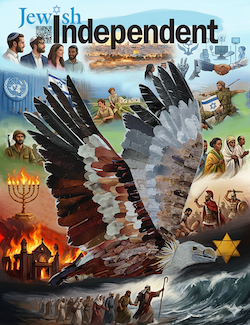
image - I also asked AI to design a collage of the Jewish fight for freedom, from the Exodus to modern days
I also asked AI to design a collage of the Jewish fight for freedom, from the Exodus to modern days.

As I searched online for what types of eagles would be at home in Egypt or Israel, I came across a few articles about the mistranslation of “nesherim” in Exodus 19:4. Apparently, we were most likely carried out of slavery on the wings of vultures, not eagles, and probably on the wings of griffon vultures specifically.

“Both the biblical nesher and ornithological griffon are known for their ‘bald’ head, enormous wingspan, effortless flight, cliff nesting, devoted nurturing, rapid descent and group feasting on carrion,” writes Dr. Fred Cannon, a professor emeritus at Pennsylvania State University, in Journal for the Study of the Old Testament. “From biblical times until the industrial age, griffons have been ubiquitous in the Middle East but absent in northern Europe or the Americas. However, eagles commonly resided in northern Europe but are uncommon residents or pass-through migrants in the Middle East. Through millennia, when northern Europeans sought translations for biblical plant and animal names, they sometimes replaced Middle Eastern meanings with recognizable northern European ones. So, the nesher became known as the eagle to many northern Europeans and North Americans. However, recent Hebrew-speaking ornithologists concur that the nesher is the griffon. This distinction becomes important when gleaning nuances from biblical metaphors, clarifying kosher dietary regulations and discerning genealogical connections among raptors.”

Natan Slifkin, director of the Biblical Museum of Natural History, in Israel, notes that another part of the verse – “va’esa etchem,” “I bore you,” or “I carried you” – can be translated as “I elevated you.”

“The explanation,” he writes about the symbolism, “is that the nesher is the highest-flying bird, and God raised the Jewish people to spiritual heights above anything in the natural world with His miraculous redemption. The highest-flying birds are griffon vultures.”

As well, he explains, “While people today view the vulture in a negative light, the Torah presents it as an example of a loving and caring parent. This also relates to the vulture’s entire parenting process. Female griffon vultures usually lay one egg, which both parents incubate for an unusually long period of around seven weeks until it hatches. The young are slow to develop and do not leave the nest until three or four months of age. The long devotion of the vulture to its young symbolizes God’s deep dedication to the Jewish people.”

Sadly, it’s more than time for us to dedicate ourselves to the griffon vulture. Only around 230 of them remain today, according to a brochure of the Society for the Protection of Nature in Israel (SPNI), which suggests helping save the griffon vulture as a b’nai mitzvah project. 

The word “nether” comes “from a Hebrew root that means ‘to shed’ or ‘to fall off,’” explains the brochure. “That’s because, as baby vultures grow up, they shed the feathers on their heads – an adaption that actually helps them stay clean! A bald head makes it easier for vultures to stick their heads into carcasses when they eat, without getting messy.”

The brochure notes that griffon vultures live in the Golan Heights, Negev Desert and Carmel Mountains. They have a wingspan of up to 2.65 metres and spend two to three hours a day combing their feathers. They can spot food from seven kilometres away, eating dead animals before the bodies rot, which helps prevent the spread of diseases.

Poisoning, electrolution, land loss, illegal hunting, and that griffon vultures only lay one egg a year, are all threats to their future. To help counter these pressures, SPNI has a breeding program, it is working with electric companies to insulate power poles, lobbying for stronger laws against poisons, and teaching farmers and others about more eco-friendly pest control.

That the griffon vulture is endangered made it, to me, an even more appropriate image for the JI’s Passover cover, underscoring the connection between freedom and responsibility. The words I chose for the cover’s background – cut and ripped from the last few issues of the JI – are my attempt to depict Goldstein’s commentary. While the eagle/vulture is protecting us as much as possible from that which bogs humanity down, giving us some respite and renewed strength, we must continue to try and uplift ourselves and the world around us, grateful for the blessings we have, and working to bring more of them into being.

Chag Pesach sameach. Happy Passover. 

Posted on March 27, 2026March 26, 2026Author Cynthia RamsayCategories Celebrating the HolidaysTags AI, art, collage, endangered animals, Exodus, griffon vultures, Hebrew Bible, Jewish life, Judaism, Passover
Vast recipe & story collection

Vast recipe & story collection

The Jewish Food Society’s website has many Passover options: salads, mains and desserts. For people who prefer cookbooks, the society has published The Jewish Holiday Table, which can be purchased online.

The Jewish Food Society was established in 2017. The nonprofit’s main purpose is “to build the largest archive of Jewish family recipes and stories attached to them in the world.” One can get lost for hours on its website, it’s so extensive. With Passover coming, several holiday stories are highlighted, along with some matzah recipes. It’s well worth a visit: jewishfoodsociety.org.

The society was founded by Naama Shefi, who was born and raised in Israel, on Kibbutz Givat Hashlosha, near Petah Tikva. She went to high school in Tel Aviv and did her army service before moving to New York in 2005. 

“My kibbutz life made me really understand the power of community. Because we are nothing without community,” she told Tablet Magazine in a 2024 interview.

It also made her crave a wider variety of foods and spices. In a 2021 interview with the Forward, she noted that the bland diet she and other former kibbutzniks grew up with led many of them to develop an interest in food. She was speaking to the Forward because another nonprofit she founded was about to launch – Asif: Culinary Institute of Israel, in Tel Aviv, whose “aim is to explore local food culture and provide a home for research, dialogue and a wide range of culinary experiences. Through a library with 1500+ culinary books, revolving exhibitions, cooking workshops, a rooftop farm, and pop-ups hosted by local and international chefs, Asif will help document and articulate the evolving Israeli kitchen.” You can also lose yourself on its website, perusing the online exhibit, going through its library, reading stories from its journal and, of course, trying out some of the many recipes. If you’re heading to Israel, definitely look at asif.org/en, heading to its “The Flavour Mosaic” section, which features a collection of food establishments “handpicked by culinary experts from across the country.”

image - The Jewish Holiday Table book coverFor people who prefer a tangible hold-in-your-hand cookbook, the Jewish Food Society has published The Jewish Holiday Table: A World of Recipes, Traditions & Stories to Celebrate All Year Long, by Shefi and the JFS, with Devra Ferst. It comprises 135 recipes, as well as stories from Jewish families. It’s organized by season and highlights the major Jewish holidays, including Shabbat. 

In that 2024 interview with Tablet, Shefi talked about the cookbook and what makes it unique.

“The concept of the book is really a celebration of Jewish holiday traditions from all around the world, from places as far apart as Ethiopia and Paris and Buenos Aires to here in Brooklyn,” she said. “So, it was very important for us to showcase the diversity of the Jewish experience. Also, the book follows the Jewish agricultural calendar, so it’s extremely seasonal, which I think is unique. And, for each holiday, we showcase four to five family tables and their menu alongside very personal essays with their history and journey.”

The diversity of Jewish experience is a focus of the cookbook.

“There is no one family with one single origin, so it really serves as evidence about our people,” Shefi told Tablet. “It shows how so many families were forced to flee one place and make a life in another place. And, sometimes, there were a few generations that were successful in the new environment and, then again, challenging circumstances forced them to keep going on their journey. That also affected the cuisine in a very substantial way.”

You can buy The Jewish Holiday Table at amazon.ca and other online bookstores – if you order today, it might even arrive before Passover ends. In the meantime, here are a couple of the approximately 10 recipes for charoset at jewishfoodsociety.org. The website has many options for the holiday: salads, mains and desserts.

CARROT CHAROSET
(This recipe was shared by chef Michael Solomonov. It takes about 15 minutes to make.)

4 carrots, peeled and grated
1/2 apple, peeled and grated
1/2 cup walnuts, chopped
1 cup fresh cilantro, chopped
2 tbsp fresh horseradish, grated
2 tbsp raisins
1 tbsp white vinegar
3/4 tsp kosher salt

Combine the carrots, apples, walnuts, cilantro, horseradish, raisins, vinegar and salt in a medium bowl. Toss to combine.

Set aside for at least 15 minutes to allow the flavours to combine. Serve.

APPLE AND ASIAN PEAR CHAROSET
(This recipe was shared by pastry chef Fany Gerson. It takes an hour and 15 minutes to make.)

1 cup honey
1 shallot, minced
3 celery stalks, minced
2 Honeycrisp apples, peeled and diced
1 Asian pear, diced
2 tsp fresh oregano, chopped (about 2 sprigs)
1/2 cup red wine vinegar
1 cup fresh squeezed orange juice, separated (about 3 medium oranges)
1 tbsp + 1 tsp fresh horseradish, grated

In a medium saucepan over low heat, gently warm the honey until it begins to bubble, about five minutes.

Add shallots and celery, stirring for one minute until well incorporated. Add vinegar and stir to combine.

Add apples and pears and reduce heat to very low stirring constantly and making sure the mixture does not get too hot. During this time, the fruit will release water. Continue to stir until the water is completely reduced/evaporated, 45 to 60 minutes. It is important to watch closely and stir often to keep the sugar from burning.

When the water has completely disappeared and the mixture is dark and caramelized, add 3/4 cup of orange juice and reduce again, mixing and smashing the fruit, about 10 minutes.

Remove from heat and stir in remaining 1/4 cup orange juice, chopped oregano and one tablespoon of fresh horseradish.

Transfer to small serving bowl. Garnish with one teaspoon fresh horseradish. Serve immediately. 

Format ImagePosted on March 27, 2026March 26, 2026Author Cynthia RamsayCategories Celebrating the HolidaysTags charoset, cooking, food, Jewish Food Society, Passover, recipes
Remain vital and outspoken

Remain vital and outspoken

The stars of Stacey Tenenbaum’s documentary Tough Old Broads, playing at VIFF Centre March 14 and 17: Kathrine Switzer, left, Sharon Farmer, centre, and Siila Watt-Cloutier. (screenshots from film)

If you’re feeling hopeless about the state of the world – or you just want to know more about some incredible people who have spent their lives making the world a better place – head to VIFF Centre March 14 or 17 to see Stacey Tenenbaum’s Tough Old Broads. 

The feature-length documentary features Sharon Farmer, the first woman and first person of colour to be director of White House photography; Kathrine Switzer, the first woman to officially run the Boston Marathon; and Siila Watt-Cloutier, the first woman to connect climate change to human rights (garnering a 2007 Nobel Peace Prize nomination for that work).

Watt-Cloutier, who calls Kuujjuaq, Que., home, also lived in Iqaluit, Nunavut, for 15 years or so. She was a pioneer in fighting for environmental protections, starting in earnest in the 1980s, when it was realized that pesticides and other toxic chemicals were poisoning the marine mammals that the Inuit were eating, ending up in the breast milk of Inuit women. At the time, Watt-Cloutier was head of the Inuit Circumpolar Council, which represents Inuit from Alaska, Canada, Greenland and Chukotka, Russia, on international matters. She has been instrumental in several actions that have changed how people think about climate justice.

In the documentary, she talks about negotiating with the United Nations from the perspective of being a mother. She says, “How could Inuit women be carrying this burden of, if I eat my country food, I’m going to poison myself and my children? At each UN talk, I continuously intervened to educate people on the importance of Inuit culture and how the world needs to do things differently.”

More than 40 years later, she continues to speak internationally, educating people about Inuit culture and the environment. In the film, at a conference, she shares one of the lessons she has learned: there will always be tough moments and “it is really about sticking with it and not giving up during those periods of time because those are the moments that you are meant to be at to raise your next level of consciousness, those are the moments that are making you, not breaking you.”

Not giving up is a key message from Farmer, too. The photographer was part of the civil rights movement in the 1970s, capturing images of the protests at Ohio State University; she was a student there at the time. Her career was spent fighting for social justice and documenting key moments in American history with her camera, including when she was at the White House (during the Clinton administration). She continues to do so.

Right after the 2024 election of Donald Trump, Farmer, who lives in Washington, DC, comments on the lack of people at the White House gates.

“If you don’t register displeasure,” she says, “everybody thinks what happens is OK – and I mean around the world, too. I don’t want that tale of woe to be our legacy. Our legacy should be we still have courage, we still don’t like what’s going on and we’re not giving up. I don’t see that happening down here today, and that’s the disappointing part.”

The third subject of Tough Old Broads is Switzer, who, while running the Boston Marathon in 1967, was literally attacked by race official Jock Semple, so outraged was he by her participation. Switzer’s coach, Arnie Briggs, running alongside her, body-checked Semple out of the way and she finished the race. This was the seminal moment in her life of activism, which has included helping bring the women’s marathon event to the Olympics (1984) and founding the nonprofit 261 Fearless, “261” having been her bib number in the 1967 marathon.

Switzer continues advocating for and mentoring women, pushing for equality. She says in the film: “There is so much to do and I still feel responsible…. It hasn’t been finished yet, and it is very simple. If you put the hard work in, if you pay attention, if you ‘work the phones,’ as we used to say, if you show up, is the biggest thing. That is the key point. It’ll happen. I’m not saying you have to be patient, I’m just saying we have to be persistent.”

Watt-Cloutier and Farmer would likely agree.

Tenenbaum, who is a member of the Montreal Jewish community, said in the press release: “I made this film to share the wisdom and experience of older women with a new generation and to inspire all people to remain vital and outspoken as they age.” 

At tougholdbroads.com, people can read more about the film, find some data on the status of women’s equality and download a discussion guide. It is hoped that the documentary “will spark a movement of women, both young and old, to embrace their power, speak out and demand attention.”

For tickets to the Vancouver 1 p.m. screenings, go to viff.org. 

Format ImagePosted on March 13, 2026March 12, 2026Author Cynthia RamsayCategories TV & FilmTags activism, centre, documentaries, Kathrine Switzer, left, Sharon Farmer, Siila Watt-Cloutierr, Stacey Tenenbaum, Tough Old Broads, VIFF, women
Pop-up exhibit popular

Pop-up exhibit popular

Jewish Museum and Archives of British Columbia director of programming Elana Wenner and JMABC executive director Eli Klasner at the Feb. 11 launch of the museum’s pop-up exhibit You Can’t Spell Delicious Without Deli. (photo from JMABC)

Omnitsky Kosher Delicatessen has been in business for more than 115 years. A community institution, it is the perfect location for the Jewish Museum and Archives of British Columbia’s pop-up exhibit You Can’t Spell Delicious Without Deli: A Look Behind the Counters of Vancouver’s Historic Jewish Delis.

Patrons can grab something to eat – at the restaurant or to take home – and peruse the photographs and blurbs about five different delis that have made their mark on Vancouver history. There’s a printed guide available, which has more information about the exhibit and the delis featured. There is also merch: T-shirts. One has a bowl of matzah ball soup, one a deli meat sandwich, another an assortment of containers, a cereal bowl and a block of cheese with the words, “I can tolerate a lot of things. Dairy is not one of them.” 

The exhibit launched Feb. 11, filling the restaurant, the night hosted by the current owner of Omnitsky, Richard Wood. The deli has seen only three owners in its long history: it was started in Winnipeg by Louis Omnitsky in 1910; bought some seven decades later by Eppy Rappaport, who brought it to Vancouver in the 1990s, running it here until 2023; and Wood. 

Omnitsky has been in a few locations in Vancouver, including on Oak Street near 41st, where it took over the space of Kaplan’s Deli, when that community institution closed in 2014. 

Kaplan’s was started by Ida and Abrasha Kaplan in the 1960s; Serge Haber ran it from 1981-2000, Marshall Kramer for a dozen-plus years and Howie English for its last year or so.

Kaplan’s is one of the five delis featured in the exhibit, along with Omnitsky, which is now on Fraser Street between 18th and 19th avenues. The others are Oscar’s (1943-1956), Rubin’s (1955-1981) and Max’s, which has been in operation since 1949 on Oak Street at 15th Avenue, with various owners over the years.

More than dates and names, the exhibit shares tidbits about each establishment, like where Ida Kaplan learned how to make her famous cinnamon buns, some of the many celebrities that visited Oscar’s and how Rubin’s was a late-night hotspot, open to as late as 3 a.m. in its heyday.

“Sometimes I find myself browsing through the stories of our past, and certain items or documents just speak to me in a way that screams, ‘Tell my story!’” Elana Wenner, director of programming at the Jewish Museum and Archives, told the Independent about the how the deli exhibit came about.

“In this case, I was visiting Omnitsky’s at their new location on Fraser Street, and I had just recently come across some photos in our archives of the old Kaplan’s Deli on Oak Street…. As I browsed the shelves in the new Omnitsky’s storefront, it occurred to me just how poignant it was to be living through this unique moment in Vancouver’s Jewish history. 

“As a Vancouver native and historian of local Jewish culture, the transitions of any local Jewish establishment always trigger a certain chord of interest for me,” she explained. “The major move of Omnitsky’s from Oak Street to Fraser Street was a transitional moment that would surely become a marker in the future telling of Vancouver’s many chapters of Jewish culture and growth.”

Wenner leads the museum’s walking tours of the Strathcona neighbourhood.

“I always conclude [them] with an ‘epilogue’ of where the community moved next, as there was a pretty abrupt collective move from Strathcona over to Fairview in the 1940s, and then a slow progression along Oak Street through to the new millennium,” she said.

The story is, of course, still being written.

“As young families continue to populate the areas east of Fraser, the residential centre of Jewish life in Vancouver is transitioning starkly eastward,” said Wenner. “So, while Omnitsky’s move from Oak to Fraser may have seemed like a shock to many of the old-timers … it makes a lot of sense in the grander scheme, in the way that the community seems to be moving now.”

The 2018 edition of the museum’s journal, The Scribe, had the theme of Jewish restaurants. Most of the original content for the pop-up exhibit came from this publication, said Wenner, “all based on oral history interviews with the restaurateurs themselves.”

The initial concept was to feature all the local Jewish-owned restaurants throughout Vancouver’s 140-year history, but there were simply too many, she said. “So, the project shifted to become focused on just Jewish-owned delis.

“As I put the word out that we were looking for more information, I quickly discovered that there had been many more delis owned by Jewish families in Vancouver than I had ever expected,” she said. “We chose the five featured in the current exhibit based on the extent of information available to us, both from existing archival materials, as well as new information collected from interviews with family members, descendants, and gleaned from secondary sources outside the museum.”

The museum’s archives include oral histories, copies of menus, newspaper articles and even some handwritten notes of sale and purchase lists, said Wenner. 

Response to the exhibit has been positive.

“On the one hand, we wish we had complete stories for each and every single deli,” said Wenner, “but it’s actually really satisfying when people pop out of the woodwork and say, ‘But wait! My grandparents owned this place!’ and then they have all this new information for us to delve into about a deli that had previously not even been on our list.”

As part of the exhibit, the museum asks visitors to share any information they may have on Pheasant Deli, Barer’s Deli, Lindy Fine Foods, Triangle Café, Moishe’s Deli and Leon’s Kosher.

“We wanted to highlight the fact that we do know they existed, but the archives are only as good as the material we receive, and these are stories we haven’t yet collected,” said Wenner, who expects more pop-ups in the museum’s future.

“What makes this exhibit so interesting,” noted Eli Klasner, executive director of the JMABC, “is the collaboration with a business that is such an important part of our local Jewish history. The museum is committed to preserving Jewish history and retelling our stories in unique and interesting ways, including with entertaining pop-up exhibits in a range of locations and venues.”

photo - Two of the T-shirts for sale at the exhibit, which runs to April 1
Two of the T-shirts for sale at the exhibit, which runs to April 1. (photo by Cynthia Ramsay)

The T-shirts are proving to be a popular aspect of the current exhibit, which runs to April 1.

“In terms of the T-shirts – honestly, people are obsessed,” Wenner said. “There’s been a lot of hype surrounding the deli exhibit in general, but the limited-edition T-shirts being sold alongside the display have garnered a lot of unexpected public attention. We keep receiving requests for more, and plan to release a new line of designs in the coming months to meet the demand.”

Wenner urged readers to check out the new JMABC website, jewishmuseum.ca, where there is information about upcoming programs, including for Jewish Heritage Month in May, as well as many online exhibits. 

“Our summer 2026 season of walking tours is coming up soon,” she said, noting that the tours sell out quickly. 

The museum offers four different tours throughout Vancouver and Victoria, she said, “each telling the fascinating stories of early Jewish life and community in BC, from 1858 to present day.” They also offer private tours, which can be booked by emailing [email protected]. 

Format ImagePosted on March 13, 2026March 12, 2026Author Cynthia RamsayCategories LocalTags delis, exhibits, history, Jewish Museum and Archives of British Columbia, JMABC, Omnitsky, restaurants

Personal stories, vital lessons

“In the pages of this book,” write Oga Nwobosi and Christina Myers, co-editors of Beyond Blue: Stories of Heartbreak, Healing and Hope in Postpartum Depression, “readers will find the personal stories of 26 writers who all encountered some variety of perinatal mood disorder, whether officially diagnosed at the time or identified only in retrospect many years after the fact. There is rage and sadness and tears and trauma; there is also hope and humour and healing. What these stories have in common is the vulnerability it requires to share out loud – one of the most powerful manifestations of courage.” 

image - Beyond Blue book coverNwobosi and Myers, who met in 2007 at a meet-up of new mothers facilitated by the Pacific Post Partum Support Society in Richmond, note that, while “perinatal mood disorders are better known and openly discussed today than they were then, there are still too many layers of stigma, shame, isolation and uncertainty. Many people still don’t get timely help; most don’t get any help at all.”

There is a lot to learn from reading Beyond Blue, notably that “depression,” or feeling “blue” doesn’t begin to cover the complexities of postpartum depression. It takes many forms – sadness, fear, pain, exhaustion, anger, some of the above, all the above, and so many other configurations. It’s not a matter of every woman feeling any one thing or all women experiencing the same range of emotions and physical sensations. Every instance is different, in both causes (to the extent they can be known) and effects. Every woman is different, not only in personality, but in health, social and other circumstances.

Leanne Charette, for instance, has cerebral palsy. “I pushed for many long months, trying to get apathetic, or downright ableist, doctors to help me achieve the dream of birthing children from my disabled body,” she writes. The doctors’ attitudes impacted her, of course, increasing her anxiety, among other things. She not only successfully conceived, but gave birth to twin boys.

“As my children were placed in my arms for the first time, their tiny fingers and IV tubes tangling with my own, a hypervigilance awoke alongside the all-consuming love in my heart,” writes Charette. “Sleep became impossible. For days, as we waited to be discharged from the hospital, I would hardly close my eyes, convinced my children might be taken away, starved or harmed in the space of a blink.”

Other women also write about the fear of someone, including themselves, harming their children. Sleeplessness is common, as are feelings of guilt about so many aspects of motherhood, such as having trouble during pregnancy, giving birth or breastfeeding.

Contributors talk about good and bad advice they received while struggling with postpartum depression. In a few instances, seeing a mental health professional was life-saving.

Jewish community member Kelley Korbin is one of the contributors. Her bio notes, “She is the proud mum of three thriving adults, but the early years were not easy as she experienced the shame, anxiety and confusion of postpartum depression following two of her pregnancies.” Her essay is about the first turbulent year of her son Jake’s life.

“Just half a day into motherhood I was doubting my ability to nurture,” writes Korbin. Weeks later, things were not going well. “If Jake was awake – and he was awake most of the time – he was either fitfully nursing or crying.”

Korbin mustered the courage to ask the public health nurse what she was doing wrong. “‘Colic,’ the nurse pronounced, and hastily retreated to the get-away car she had parked in the driveway. I was drowning, but she had thrown me the teeniest of life preservers,” writes Korbin. “Armed with a diagnosis, however vague, and the doggedness of my gritty pre-motherhood persona, I scoured the parenting sections of bookstores and libraries.”

What she found was that “evening colic” normally “vanishes after three months.” Even though Jake cried all day, not just at night, Korbin started the countdown. After “the promised three-month colic finish line” came and went, she took Jake back to the doctor for the “umpteenth visit.” He pronounced Jake healthy, but warned the colic wouldn’t end soon. Two months later, she started therapy. By Jake’s first birthday, “he was sleeping through the night,” and so was Korbin.

Beyond Blue should be read by anyone who’s thinking about having children, new parents, and everyone who knows someone who’s just had kids. So, basically, everyone. 

Posted on February 27, 2026February 26, 2026Author Cynthia RamsayCategories BooksTags Beyond Blue, education, family, health, Kelley Korbin, postpartum depression, women, women's health

Connecting generations

Shane Foxman’s idea for In Your Own Words, “a podcast for you and your family about you and your family,” came from a very personal place.

“My father passed away when my daughter was still very young. While I keep his memory alive by telling stories about him, I’ve often wished she could hear him tell his story himself – his voice, his memories, his reflections – rather than only hearing them from me,” said Foxman, who had an almost-30-year career in journalism before starting his own production company.

“As a storyteller by profession, that realization stayed with me,” he continued. “I began thinking about how many families wish they had asked more questions, recorded more conversations, or simply preserved a parent or grandparent’s voice while they still could.

“That wish is what led me to create In Your Own Words. It’s almost like a personal podcast – a guided, professionally produced conversation about someone’s life and journey. It’s about memory, voice and capturing the stories that might otherwise be lost. Because, when someone is gone, you don’t care how long the recording is. You just wish you had one.”

photo - Shane and Andrea Foxman
Shane and Andrea Foxman (photo from Shane Foxman)

Foxman was born and raised in Toronto. His career took him to many places in Canada, including British Columbia in 1998. 

“I was working at a television station in Edmonton when I was hired by Global Television to cover the legislature in Victoria,” he said. “After two years as bureau chief there, I was transferred to Vancouver, where I continued covering news and eventually began hosting and producing a variety of programs.

“In 2009, I hosted and co-produced Seeking Stanley, which became one of the most successful television programs in BC history. The live show aired after every Vancouver Canucks playoff game and during the team’s 2011 run to the Stanley Cup Final. Viewership topped one million people an episode in the Lower Mainland.”

Vancouver ultimately became home for Foxman. He met his wife Andrea here, and the couple has a 16-year-old daughter, Arlo. 

He is deeply connected to the Jewish community. Most Independent readers will have been at an event emceed by Foxman. He has been on various boards and worked for five years at Vancouver Talmud Torah as associate director of development, retiring from that position last year so he could focus on his company.

Foxman’s decision to switch from journalism to production came just over a decade ago, influenced in part by the changing media landscape.

“Newsrooms were shrinking and budgets were tightening,” he explained. “There was less time and space for deeper, long-form storytelling, the kind of work that really excites me.

“I found myself wanting more creative control and more depth in the kinds of stories I was telling. I wanted to slow things down, spend time with people, and really explore their journeys in a meaningful way.

“Opening my production company allowed me to focus on long-form storytelling. I picked my projects and they weren’t constrained by airtime. It also gave me the flexibility to build something sustainable while still doing what I love most: helping people tell their stories.”

He said, “Every person has a story – about where they came from, what shaped them, the obstacles and challenges they faced and the moments that defined them…. There’s something powerful about giving people space to speak in their own voice. At its best, journalism isn’t just about reporting facts – it’s about capturing humanity.”

One of the first things visitors to Foxman’s website will notice is the photo of him and Andrea (which accompanies this article). It was taken at a charity event they attended a few years ago. The photographer asked what kind of shot they wanted and the couple joked, “We want Andrea to photobomb me.”

“He took one click, dead serious, and said, ‘Got it,’” shared Foxman. “We didn’t believe him at first, but when we saw the picture, I just loved it. I immediately thought, if I ever needed an album cover, this would be it. It perfectly captures both seriousness and fun – two things I hope come through in my work and in life.”

Foxman Productions is “a small, hands-on company,” said Foxman, who is involved in every project, from concept development and interviewing, to editing and final delivery. 

“That said, one of the advantages of my years in television is the professional network I’ve built,” he said. “Depending on the project, I bring in experienced camera operators, editors, sound technicians and graphic designers – people I’ve worked with and trust. The team is top-notch.

“Every project is different, so I assemble the right people for the job. Clients get the personal attention of working directly with me, combined with the production quality of seasoned broadcast professionals.

“But, at its core, my role is listener,” he said. “That’s the most important part of the work.”

Foxman’s preparation for an interview involves research and conversation. 

“I spend time speaking with the person beforehand to understand the shape of their life – major chapters, turning points and family background. That way, when we sit down to record, the conversation can flow naturally rather than feeling like a checklist,” he explained.

“For the interviewee, it’s all about feeling comfortable and unpressured. It’s not an interrogation or a performance – it’s a guided conversation, often reflective, sometimes emotional, sometimes humorous. There’s no right or wrong way to tell your story – it’s your story.”

The final product can be audio only or video, which may include photos, documents or other visual elements.

“The goal is always to create something that families can return to again and again. It’s not just to remember facts, but to hear tone, laughter and personality,” said Foxman.

“I believe every person and/or family has stories that matter, and every voice deserves to be remembered. Preserving these conversations is more than just creating a record – it’s about connecting generations, sharing lessons, laughter and memories, and leaving something truly meaningful for the future.

For more information about In Your Own Words, go to foxmanproductions.com. 

Posted on February 27, 2026February 26, 2026Author Cynthia RamsayCategories LocalTags family history, Foxman Productions, memoir, Shane Foxman

Recipes a form of resistance

As part of its celebration of BC Heritage Week, the Vancouver Heritage Foundation held the online event Recipes of Resistance: Rebecca Teitelbaum and the Ravensbrück Recipe Book, presented by Lise Kirchner and Ellie Lawson of the Vancouver Holocaust Education Centre. Kirchner is the VHEC’s director of education, Lawson its education manager.

The theme of this year’s Heritage Week is “Stir the Pot,” explained VHF director of education Sarah Carlson. She encouraged viewers to “think about the ways that food brings us together, how it holds memory, and how it has contributed to the rich cultural tapestry of your community and beyond.”

Teitelbaum’s recipe book was donated to the VHEC by Teitelbaum’s nephew, Alex Buckman, also a Holocaust survivor, who died in 2023.

“He was Rebecca’s nephew, but he actually was raised as Rebecca’s son…. Rebecca was the only mother that Alex ever knew,” said Kirchner. “His parents perished in Auschwitz, and Rebecca made a promise to God that she would raise Alex as her own son, which she did.

“In the 1990s, Alex discovered this recipe book in the drawer of Rebecca’s home, and he asked her about it. He had never heard the story before. Apparently, she had never told anybody, but she explained to Alex the incredible story of this recipe book, how it was created and how it survived.”

Kirchner showed many archival photographs, including of Teitelbaum and one of Teitelbaum with her younger brother, Isaac Buckman, in the 1930s.

“Isaac is Alex’s father,” explained Kirchner. “These two siblings, Rebecca and Isaac, were very close. They also had a younger brother, Jacques.”

screenshot - Herman and Rebecca Teitelbaum, 1938
Herman and Rebecca Teitelbaum, 1938. (screenshot from VHEC presentation)

Rebecca and her husband Herman were married in 1938. “They had a daughter, Anny, in 1939, and they lived … near Brussels, before the Second World War. Rebecca worked in the accounting department of a department store in the city of Brussels.”

Kirchner also shared a photo of Isaac and Dworja Buckman, who married around the same time as the Teitelbaums.

“The same year that Rebecca’s daughter, Anny, was born, Isaac and Dworja had a son, Alex, in October 1939.”

In May 1940, Germany invaded Belgium and the Nazis set up a military occupation government. “Unlike many other countries where the civil administrations cooperated with Nazi deportations, the situation in Belgium was much different and, as a result, the survival rate of Belgian Jews was higher than many of the Western European countries,” said Kirchner.

Nonetheless, restrictions were placed on Jews and Kirchner went through the progression of anti-Jewish laws in Belgium. There were pogroms, as well, and, in May 1942, all Jews over the age of 6 had  to wear the yellow star to identify them as Jewish.

From 1941 to mid-1942, Anny and Alex were placed into hiding, which worked until their families ran out of money, said Kirchner. When the woman hiding the kids denounced them to the Nazi authorities, the families were in grave danger.

“Between 1942 and 1944, the German occupying forces deported around 25,000 Jews from Belgium to concentration and death camps in the east, primarily to Auschwitz, and only 2,000 of these survived – 43% of the Jewish population in Belgium was murdered,” said Kirchner.

Once the Belgian resistance became more organized, there were resistance networks focused on hiding Jewish children. The largest was the Committee for the Defence of Jews, she said, and it successfully hid some 2,400 Jewish children from the Nazis, including Anny and Alex.

Isaac and Dworja Buckman were deported to Auschwitz-Birkenau in 1943 and murdered. Rebecca and Herman Teitelbaum were deported to forced labour camps in Germany: Herman  to Buchenwald, and Rebecca to Ravensbrück.

“Rebecca spent 17 months in Ravensbrück concentration camp as a slave labourer,” said Kirchner. “She was first assigned to work hard labour, hauling wood and stone and heavy carts in very harsh outdoor conditions, but, because she had worked in that department store in Belgium and she had experience with accounting work, she was able to secure a much better work assignment in the office of the Siemens factory.”

Siemens was one of the private companies that used Jewish slave labour, explained Kirchner, before turning the floor over to Lawson to talk about Ravensbrück.

“It was originally built for a little over a thousand prisoners, but, at its peak in 1945, there were over 50,000 prisoners,” said Lawson, who went into some detail about the factory and Siemens’ cooperation with the Nazis.

Despite the unimaginable circumstances, resistance was evident. Lawson shared a quote from Lidia Beccia Rolfi, an Italian prisoner: “Even the theft of a piece of wire, a sheet of paper, of a cloth rag was seen as sabotage, but everyone committed that. Any form of friendship between inmates was seen as sabotage.”

Lawson played a clip from Alex Buckman’s video-recorded survivor testimony. He explained how Rebecca noticed there weren’t that many supervisors at night.

“And then she stole a piece of brown paper, and she put it in her dress,” he said. “And then she stole a little pencil and a pair of scissors. And, at night, she ran towards her barrack, very nervous because she knew that, if somebody would stop her with all these stolen goods, she would be in trouble and they probably would make an example of her, maybe either shoot her or hang her. But she did it.”

screenshot - A page from Rebecca Teitelbaum’s cookbook, which she compiled at great risk during her incarceration at Ravensbrück concentration camp
A page from Rebecca Teitelbaum’s cookbook, which she compiled at great risk during her incarceration at Ravensbrück concentration camp. (screenshot from VHEC presentation)

In the barrack, she cut the paper into smaller pieces and started to write recipes “of meals that she did for her husband and her daughter before the war…. With the help of other women, who gave her some of their own recipes, and many of hers, she wrote 110 recipes,” he said. “Even though food was very important to stay alive in the concentration camp, she actually traded some of her food for needles and thread, and she made a book so she could keep it.”

The recipes weren’t necessarily accurate, said Kirchner. “You’ll notice most of the recipes are very heavy on butter and sugar and luxury items like raisins and rum or cream. On the other hand, some of the recipes reflect wartime scarcity…. But the dominant theme of these recipes is one of abundance.”

The recipes reflect the cultural diversity of the women imprisoned in the camp, said Kirchner. “These were women from all over Europe … about half of them were Jewish, but many of them were not, and so the recipes reflect a cultural diversity that’s Jewish, Belgian, French, Spanish, Mediterranean.”

Teitelbaum completed three recipe books, giving two to other women in the camp.

“Rebecca also created another thin volume that contains poems and resistance songs,” said Kirchner, adding, “She also made two sets of playing cards, which the Roma women in the camp would use to tell the fortune of other prisoners. So, again, building community between not just the Jewish women in the camp, but across cultures. And this was an essential form of hope and community-building and resistance by the camp inmates.”

Teitelbaum was one of 2,000 women saved in a Red Cross mission that saw 36 buses take the women from Ravensbrück to safety in Denmark and Sweden. However, the area was still a war zone and one fleet was hit by friendly fire.

“This convoy carrying 706 women, including Rebecca, was attacked multiple times by fighter planes and, as a result, there were about 25 fatalities and numerous injuries among the rescued prisoners,” said Kirchner. “Rebecca herself survived the attack, but was hit by shrapnel and badly injured her left arm. And, in the scuffle and the mayhem that followed … she lost her bundle of belongings: a sack that contained her recipe book.”

Herman, Anny, Jacques and Alex also survived.

screenshot - Anny Teitelbaum and Alex Buckman, 1945
Anny Teitelbaum and Alex Buckman, 1945. (screenshot from VHEC presentation)

“Anny and Alex were raised as siblings,” said Kirchner, and Rebecca and Herman had another child after the war. “Rebecca named this baby Christian, in honour of King Christian … who had visited her in the hospital, and who had become a bit of a folk hero in the Jewish community in Denmark.

“In 1951, the family left Europe and they arrived at Pier 21 in Halifax in September of 1951 before making their way to Montreal, where they settled permanently,” continued Kirchner. “They had one last child, named Shirley, who was born in Montreal in 1953, and Rebecca Teitelbaum became a Canadian citizen in 1957. She lived the rest of her life in Montreal, and she died there in 1999.”

The sack Teitelbaum had lost was found near the site of the bombing and, because it contained letters that identified her, the person that found the bag tracked her down.

“Rebecca’s recipe book is one of six Holocaust recipe books that we’re aware of in museums around the world,” said Kirchner. “These artifacts have given historians greater understanding about the unique responses of women to their persecution…. Unlike traditional cookbooks, they’re not about cooking, in practice, they’re about maintaining identity, resisting dehumanization, transmitting a culture that the Nazis were attempting to destroy, and they also functioned as a psychological coping mechanism that forged group cohesion and a spirit of communal care. 

“The creation of these recipe books all came at great risk and sacrifice, and they’re important not only because they demonstrate the agency of female prisoners who were trying to assert control over their hunger by eating with words, but they also provide an archive of women’s communal responses to their persecution, which elevates women’s domestic expertise to the level of historical record.”

In his talks as an outreach speaker, Buckman would give students the Gâteau à l’orange recipe from Teitelbaum’s book.

“This was a cake,” said Kirchner, “that Rebecca would make for Alex every birthday, and he would encourage the children to make it at home with their own parents, to give their parents a hug, to make this orange cake in honour of his Aunt Rebecca, and also in memory of all of those who were murdered in the Holocaust, including his own parents, Isaac and Dworja.”

The recipe is on the VHEC’s website, vhec.org. 

Format ImagePosted on February 27, 2026February 26, 2026Author Cynthia RamsayCategories LocalTags Alex Buckman, BC Heritage Week, education, gateau a l'orange, Rebecca Teitelbaum, recipes, resistance, Vancouver Heritage Foundation, Vancouver Holocaust Education Centre, VHEC

A range of Jewish literature

The 41st annual Cherie Smith JCC Jewish Book Festival opens Feb. 21 with award-winning novelist John Irving and closes Feb. 26 with award-winning singer-songwriter, composer and author Peter Himmelman. In between, a range of writers and topics are presented. As always, this year’s festival fulfils its mission, as expressed by director Dana Camil Hewitt in the program: “to expose the general community to a curated snapshot of recent Jewish literature and ideas.”

image - Queen Esther book coverWhile Irving, the opening author, is not Jewish, his latest novel, Queen Esther, takes readers back to the era and place of one of his most popular stories, The Cider House Rules, which was made into a movie. He focuses this time on the Winslow family, who adopt Esther Nacht from St. Cloud’s orphanage in Maine. The 14-year-old Viennese Jew was born in 1905 and came to the United States with her parents, her father dying on the voyage, her mother a few years later. Esther was left at the orphanage as a little girl, but no one had wanted to adopt a Jewish child, until the Winslows. 

The Winslows are, to say the least, an unconventional family and, among other things, don’t adhere to the antisemitic attitudes of the times. The novel sheds light on Esther’s background and we witness a bit of her life with the Winslows, but then she mostly drops out of the story, returning to Europe to reconnect with her roots and then settling in Israel. The bulk of the novel centres on Jimmy, Esther’s son, born and raised in true Winslow style – unconventionally.

Truth be told, Queen Esther is not Irving’s best novel, it rambles and doesn’t quite hit the right message, but it’s written with heart and a seeming desire to counter antisemitism and change the narrative about Israel. Irving fans will enjoy reencountering some old “friends,” like St. Cloud’s Dr. Wilbur Larch, and recurring themes, including chosen family, Vienna, wrestling and sexual politics.

Irving is in conversation with Marsha Lederman Feb. 21, 7:30 p.m. Tickets are $36 ($65 with book).

* * *

image - Ayekha book coverPolitics and antisemitism are at the fore in Dr. Ted Rosenberg’s book Ayekha, Where Are You? Reading it will provide some healing for fellow members of the Jewish community, most of whom will know that Rosenberg resigned from the University of British Columbia’s faculty of medicine in 2024 (after a 30-year career there) because of the school’s refusal to do anything about the rampant antisemitism on campus, which escalated after Hamas’s massacre of Israelis on Oct. 7, 2023. The situation was so toxic that Rosenberg no longer felt safe.

In his resignation letter to the faculty’s dean, Dermot Kelleher – sent after other attempts to warn UBC leadership of the problems – Rosenberg wrote:

“I lament the carnage and deaths of both Israeli and Palestinian civilians during this horrific war and this seemingly insoluble and interminable complex tragedy. I also understand and appreciate the strong convictions held by people on both sides of this conflict. However, oversimplistic ahistorical demonizing narratives and rhetoric, by either side, will do nothing to deepen our understanding, empathy, respect, or trust of one another, nor hasten a resolution of this crisis. 

“One third of the medical students and some faculty have publicly expressed their contempt towards me, as a Jew. I cannot take the risk of being accused of implicit harassment or racism, which is indefensible, by a ‘triggered’ student. Unfortunately, I have no faith in due process in a faculty that does not even acknowledge the existence or presence of antisemitism/Jew-hatred, or my right to work in a depoliticized environment.”

The award-winning physician, who pioneered a home-based care model for the frail elderly and still practices medicine, wrote the dean, “It deeply saddens me to end my academic career on this note.”

There are so many Jewish academics, medical professionals and others who have been similarly mistreated, both by antisemitic actions and people’s fear of dealing with antisemitism. Reading more about Rosenberg’s experiences is akin to attending a group therapy session. We not only feel less alone afterward, but come away with some knowledge that might help us in processing all that’s happened in the last almost two-and-a-half years, and in confronting the antisemitism we continue to face.

Rosenberg talks at the Vancouver JCC Feb. 22, 1:30 p.m. (tickets are $18), and at the White Rock/South Surrey JCC at 4 p.m. 

* * * 

Since Oct. 7, it seems that learning more about Judaism, its tenets, its folklore, has been a common way for Jews to deal with the trauma inflicted by that day, the subsequent war and the increasingly open Jew-hatred globally. For anyone who likes graphic novels, The Writer might be an invigorating and educational salve.

image - The Writer book coverWritten and created by actor Josh Gad and the Berkowitz Bros. production company (founded by Ben and Max Berkowitz) with art by Ariel Olivetti and letters by Frank Cvetkovic, the four-part series stars disheveled English professor and unreliable divorced dad Stan Siegel, the writer of the series’ title, who looks a lot like Gad. Stan’s “sidekicks” are his kickass mom Liz and his daughter Izzy. They encounter all sorts of demons, dybbuks, golems and other characters out of Jewish mythology, as well as various historical figures, while Izzy also must confront current-day antisemitism and racism – harassed by classmates for being Jewish and for being Black.

The Writer is an homage to the creators’ Jewish identities, to the comic books, science fiction shows and adventure movies they loved, as well as to Gad’s Holocaust survivor grandparents and to Boston, where the Berkowitz brothers grew up. While they didn’t grow up surrounded by Jewish mysticism, they were inspired when they discovered it and it “felt like home,” notes the afterword. “This story became a way for them to celebrate that heritage – the rich tapestry of Jewish storytelling in all its forms, from Ashkenazic to Sephardic, Beta Israelite, Hispanic, Asian and beyond.”

The tapestry is so rich and deep that it is hard sometimes to follow all that’s going on in an “episode” of The Writer, but it’s a wild ride, a world that’s wonderfully and colourfully drawn, where good battles all sorts of evil and unlikely heroes prevail.

The Berkowitz brothers are at the festival Feb. 23, 7 p.m. Tickets are $18.

* * *

image - Suspended By No String book coverHimmelman closes the book festival on Feb. 26, 8 p.m. (tickets: $25), talking about his collection of essays, Suspended By No String: A Songwriter’s Reflections on Faith, Aliveness and Wonder, with Rabbi Dan Moskovitz. It might seem odd to have a rabbi lead a conversation with a musician, composer and visual artist, but Himmelman describes his book as being about faith, and shares what went into his decision to use the word “God” in it, as opposed to, say, “spirituality,” despite concerns from several people that its use might alienate readers. Hopefully, it won’t, as there is much insight to be gained from Himmelman’s observations, insights and perspectives on wonder, loss and gratitude. His playful sketches are a delightful complement to the text.

* * *

Also appearing at this year’s book festival are, in order of appearance, writers Carol Matas, Lihi Lapid, Aron Hirt-Manheimer, Douglas Century, Yishay Ishi Ron, Yardenne Greenspan, Sasha Senderovich, Marina Sonkina, Claire Sicherman, Danila Botha and Janet Horvath. For tickets and more information, visit jccgv.com/jewish-book-festival. 

Posted on February 13, 2026February 11, 2026Author Cynthia RamsayCategories Books, LocalTags Berkowitz Bros., JCC Jewish Book Festival, John Irving, Peter Himmelman, Ted Rosenberg

Posts pagination

Page 1 Page 2 … Page 84 Next page
Proudly powered by WordPress