Skip to content
  • Home
  • Subscribe / donate
  • Events calendar
  • News
    • Local
    • National
    • Israel
    • World
    • עניין בחדשות
      A roundup of news in Canada and further afield, in Hebrew.
  • Opinion
    • From the JI
    • Op-Ed
  • Arts & Culture
    • Performing Arts
    • Music
    • Books
    • Visual Arts
    • TV & Film
  • Life
    • Celebrating the Holidays
    • Travel
    • The Daily Snooze
      Cartoons by Jacob Samuel
    • Mystery Photo
      Help the JI and JMABC fill in the gaps in our archives.
  • Community Links
    • Organizations, Etc.
    • Other News Sources & Blogs
    • Business Directory
  • FAQ
  • JI Chai Celebration
  • JI@88! video

Recent Posts

  • Story of Israel’s north
  • Sheltering in train stations
  • Teach critical thinking
  • Learning to bridge divides
  • Supporting Iranian community
  • Art dismantles systems
  • Beth Tikvah celebrates 50th
  • What is Jewish music?
  • Celebrate joy of music
  • Women share experiences 
  • Raising funds for Survivors
  • Call for digital literacy
  • The hidden hand of hate
  • Tarot as spiritual ritual
  • Students create fancy meal
  • Encouraging young voices
  • Rose’s Angels delivers
  • Living life to its fullest
  • Drawing on his roots
  • Panama City welcoming
  • Pesach cleaning
  • On the wings of griffon vultures
  • Vast recipe & story collection
  • A word, please …
  • מארק קרני לא ממתין לטראמפ
  • On war and antisemitism
  • Jews shine in Canucks colours
  • Moment of opportunity
  • Shooting response
  • BC budget fails seniors
  • Ritual is what makes life holy
  • Dogs help war veterans live again
  • Remain vital and outspoken
  • An urgent play to see
  • Pop-up exhibit popular
  • An invite to join JWest

Archives

Follow @JewishIndie
image - The CJN - Visit Us Banner - 300x600 - 101625

Byline: Cynthia Ramsay

A concert of premieres

A concert of premieres

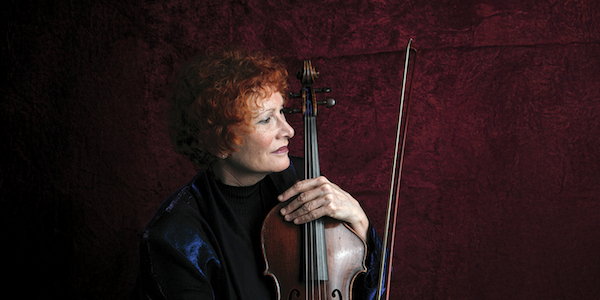
Violist Rivka Golani joins Turning Point Ensemble on Feb. 21 and 22 for Concerti Premiere, which features two works written especially for her. (photo by Peter Beal)

World-renowned violist Rivka Golani joins Turning Point Ensemble on Feb. 21 and 22 for Concerti Premiere, which features two works written especially for the Israeli musician, who currently calls London, England, home. 

The four main works comprising the ensemble’s program are the world premiere of Concerto for Viola – Rivka by TPE artistic director Owen Underhill, featuring Golani as soloist; the North American premiere of Musical Offering No. 2 “Golani” by Canadian composer Michael Pepa, also with Golani as soloist; the world premiere of Morning Twilight by Taiwanese-American composer Chichun Chi-Sun Lee, showcasing TPE bassoonist Ingrid Chiang; and the world premiere of Sauntersludge by Vancouver composer Eldritch Priest.

“TPE had a fantastic opportunity to perform with Rivka Golani on our May 2023 European tour,” explained Underhill as to how he and Golani first connected.

Pepa had proposed composing a new work for Golani and TPE for the ensemble’s concerts in Zagreb and Belgrade. “We were not able to rehearse with Rivka … prior to arriving on tour, so it was very exciting to put Michael’s piece together in the couple days prior to our first concert,” said Underhill. “Rivka was very interactive with and impressed by the ensemble, so you could say we hit it off together. She heard at that time in our concert a work of mine and asked whether I might be interested in composing a new work for her and TPE in the future. So, this is how the idea of working together again came about and my new concerto for her in particular.”

photo - Turning Point Ensemble artistic director Owen Underhill wrote Concerto for Viola - Rivka for violist Rivka Golani, who plays with the ensemble in concerts at the Annex Feb. 21 and 22
Turning Point Ensemble artistic director Owen Underhill wrote Concerto for Viola – Rivka for violist Rivka Golani, who plays with the ensemble in concerts at the Annex Feb. 21 and 22. (photo from TPE)

Golani, who was born in Tel Aviv, studied under violist and composer Oedoen Partos and became a member of the Israel Philharmonic, while also appearing as a soloist with other orchestras. She lived in Canada for more than a decade, from 1974 to 1987, growing her solo career and teaching at the University of Toronto (where she also taught in the 1990s) and the Royal Conservatory of Music. She still teaches, in London.

Over the years, Golani has performed widely as a soloist and as a member of various ensembles, and she has recorded extensively. She is also a recognized visual artist, with her paintings having been exhibited in several countries.

It was during Golani’s time in Canada that Pepa met her, so the two have known each other for decades.

“As a result, his piece and the solo viola part are very much in her character – dramatic, powerful and expressive,” said Underhill. “Also, there are two other important connections which are interwoven in the piece – references to J.S. Bach’s Art of the Fugue, which appears in a variety of ways through quotes and collages in his music, and also a second movement dedicated to his Ukrainian friends, which is based on the Ukrainian folksong ‘Plyve Kacha Po Tysyni’ (‘The Duck Swims Down the Tissina’) and a Serbian folk melody, ‘Kolika je Nočca.’”

As for his work featuring Golani, Underhill said, “It is always a wonderful thing for a composer to work closely with a performer for whom you are composing. It was also fundamental to Rivka’s process to make it a collaborative project. Therefore, beginning in the fall and over the several months I was composing the piece, I would send her instalments and we would meet over WhatsApp and she would play through the music, suggest detailed changes and improvements, and she also made a few gentle requests, including asking for a cadenza before I wrote the third movement.  As a result, I feel that the piece bears her signature and that it is also a unique work of mine that I could not have created without her input.”

According to Golani’s website, more than 350 works have been composed for her, including more than 80 concertos – “a record matched by no other violist in history.” Underhill’s Concerto for Viola – Rivka is the largest-scale work that he has written for TPE and the piece will be recorded by the ensemble after the live performances.

Concerti Premiere is Turning Point Ensemble’s third concert in their 2025/26 season. Written with bassoonist Chiang in mind, the piece Morning Twilight traces the emergence of the sun through five sections and two interludes. “Beyond its astronomical imagery, the concerto reflects Chiang’s personal journey of resilience in overcoming cancer, as well as Taiwan’s collective passage from historical darkness toward renewed international visibility,” notes the press release. Sauntersludge, which was written for the ensemble as a whole, is the only piece in the concert without a soloist.

“While we dedicate ourselves to performing works from the early 20th century to the present day, it is unusual for Turning Point Ensemble to have a concert consisting solely of premieres,” said Underhill in the press release. “It is a joy to be unveiling all this new music here in Vancouver.”

The Feb. 21 concert at the Annex starts at 7:30 p.m.; the Feb. 22 one at 4:30 p.m. For tickets ($45/adult, $33/senior, $19/student), go to turningpointensemble.ca. 

Format ImagePosted on February 13, 2026February 11, 2026Author Cynthia RamsayCategories MusicTags Concerti Premiere, concerts, Owen Underhill, Rivka Golani, TPE, Turning Point Ensemble
Life’s full range of emotions

Life’s full range of emotions

Bonny Reichert will be in Vancouver on March 4 to talk about her new memoir, How to Share an Egg, as an epilogue to the JCC Jewish Book Festival, which runs Feb. 21-26. (photo by Kayla Rocca)

When Bonny Reichert was a kid, living in Edmonton, her baba, who had come to Canada as a teen on her own in the early 1900s to escape pogroms in Ukraine, would come to stay with her family for the weekend and “the house brightened,” writes Reichert in How to Share an Egg: A True Story of Hunger, Love and Plenty. “She arrived as though she were fleeing all over again, with parcels and packages and a giant soup pot wrapped in a tea towel, knotted to make a handle. Things were hot or cold or frozen. I didn’t know to wonder if she’d stayed up all night rolling and pinching and stuffing for us. Pekeleh, she called her bundles, little packages. Pekeleh also means burdens. Yiddish is like that.”

As with pekeleh, meaning both treats and worries, there have been many contrasts in Reichert’s life, opposite things or states of being existing simultaneously. Her memoir is fascinating for the challenges she has faced and the way in which she has dealt with them. Readers can hear the award-winning writer in conversation with Marsha Lederman on March 4, 7:30 p.m., at the Jewish Community Centre of Greater Vancouver, in a JCC Jewish Book Festival epilogue event. 

image - How to Share an Egg book coverHow to Share an Egg is the telling of Reichert’s dad’s survival story – a story he so wanted her to share. Experiencing years of difficulty putting pen to paper, she approaches it through her own journey with intergenerational trauma, which she has felt deeply from childhood. Her mother grew up with “a dad who was quick to anger” and an “exacting” mother who taught there was only one way to do things. “That this was the same person who rubbed my feet as I fell asleep seemed impossible,” writes Reichert about her efforts to reconcile her beloved baba with her mother’s mother.

Reichert’s maternal grandfather, who had come to Canada in 1913, died before she was born. On her paternal side, she had no grandparents – her dad was a 17-year-old orphan when he came to Canada in 1947. His parents and five sisters were all killed in the Holocaust. He was one of the 1,123 war orphans Canadian Jewish Congress helped enter the country when the doors were only just starting to open again for Jews.

The Jewish Independent spoke with Reichert by email about her memoir.

JI: You were 9 when your dad first mentioned the possibility that you would write his story. Then there was the trip to Poland in 2015 that was a breakthrough. When did you actually write the first words and, from that point, about how long did it take for you to write How to Share an Egg?

BR: The very earliest work on the book started on that first trip to Warsaw with my dad. I took a few notes and some important photos, but I didn’t yet know where I was headed. After the second trip to Poland, in 2016,  I had even more research and notes, but I still wasn’t sure I had a book. The more formal outlining and writing began in late 2020, in the depths of the pandemic. Including the time I spent waiting for my editor’s feedback and the editing, the book took about four years to write. I was earning a master’s degree at the same time.

JI: You write about your personal journey with inherited trauma, and you share some of the healing milestones on that journey. In what ways was the process of writing the book cathartic?

BR: When you write a memoir like How to Share an Egg, your job is to look at yourself very closely, but with objectivity, because the self becomes the central character of the book. In that close examination, you come to name feelings you previously couldn’t name, and evaluate experiences and situations that your younger self might not have understood. All of this leads to greater understanding and greater self-compassion. This, coupled with the relief of finding a way to write this book my dad always wanted me to write, has indeed led to healing and catharsis.

JI: What does your dad think of the book?

BR: He loves it and says that it has given new meaning to his life at 95. A wonderful outcome.

JI: One theme of How to Share an Egg is you finding your voice, being able to stick up for yourself when bullied, to be yourself in the face of others’ expectations (notably, your father’s). From where did you get the courage to be this open?

BR: You can’t decide to write a memoir and then hide from the personal. Readers want to see all of that raw emotion on the page. For the memoir to be successful, the true, honest person in the book should resonate with the true person inside the reader. At a certain point, I realized all of this, and I came to see I was writing about the universal human experience and there is no shame in being human. In other words, I practised radical self-acceptance to get the job done.

JI: You comment in the book about pekeleh meaning both bundles and burdens. Judaism is full of those instances, holding joy and sorrow at the same time. Can you speak about that, in the context of How to Share an Egg?

BR: People often hold a pretty stereotypical idea of what Holocaust survivors and their families are like – severely traumatized, loaded down with psychological and emotional problems, etc. I wanted to address that – to challenge it and expand on it. There is sorrow and trauma, of course, but there is also so much joy and gratitude and celebration. So, the book is meant to express this fuller range of emotion. Part of my decision to write it as a food memoir was to offer the reader pleasure and comfort, even against the backdrop of the Holocaust. A Jewish approach, for sure.

JI: Hedy Bohm, who you mention in your memoir, just had her own survivor memoir published by the Azrieli Foundation. What is the importance of having these stories out in the world?

BR: Yes, I’m so happy for Hedy. She is a wonderful person. Preserving these stories has always been of the utmost importance – firsthand testimony is obviously critical. I also believe a plurality of stories and approaches brings the humanity back into the unfathomable numbers and statistics.

JI: How often have you been to Vancouver, and what are you looking forward to most about your March visit?

BR: I was just there in the fall for the Vancouver Writer Fest! I have friends I’m looking forward to seeing and I’m hoping for some nice weather so I can walk and admire your beautiful city.

For the full schedule and tickets to the book festival, go to jccgv.com/jewish-book-festival.

Format ImagePosted on February 13, 2026February 11, 2026Author Cynthia RamsayCategories Books, LocalTags Bonny Reichart, food, history, JCC Jewish Book Festival, memoir, survivors
The power of photography

The power of photography

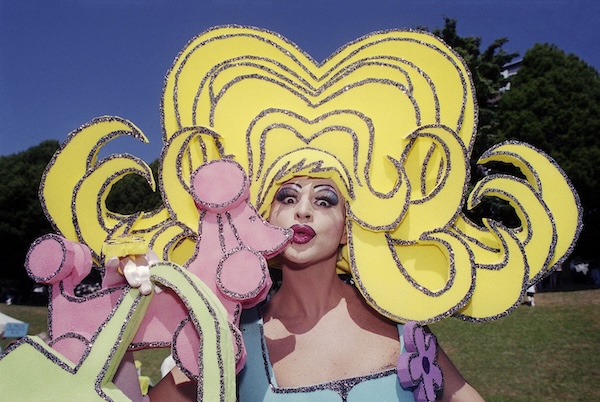
“Elaborate Pride Costume, Gay Pride,” Vancouver, 1996. (© Dina Goldstein)

One of the JCC Jewish Book Festival pre-festival events holds special meaning for the Jewish Independent. Photographer Dina Goldstein, whose artistry has focused on large-scale narrative tableaux the last many years, began her career with the JI’s predecessor, the Jewish Western Bulletin. She has compiled thousands of images from her work over the last three decades – as a photojournalist, editorial photographer, traveler and artist – for the recently published 400-page hard-cover The XXX Archive, which she will share with the community on Feb. 12, 7 p.m.

photo - Dina Goldstein talks about her new book, The Archive XXX, at a JCC Jewish Book Festival pre-festival event on Feb. 12
Dina Goldstein talks about her new book, The Archive XXX, at a JCC Jewish Book Festival pre-festival event on Feb. 12.  (© Dina Goldstein)

“I spent the pandemic going through containers of binders filled with negatives. Many of the images I remember snapping, but others that I found surprised me,” Goldstein told the Independent. “Editing the lot after 30 years of shooting was overwhelming at first. The process of archiving is slow and fastidious, often challenging my expeditious nature. I leaned in, not knowing how long or how many images I would be working with. Within two years, I scanned, photographed, numbered, printed and added over 3,000 images to a boxed and digital archive. The result left me relieved that my life’s work was now organized in a way that was documented and accessible.”

The word “herculean” is used in The Archive XXX to describe the task of creating the archive. Goldstein worked by year of creation, grouping the images by decades.

“I started with the early ’90s, when I first started my career and shot with black-and-white film,” she said. “Many of those images I had photographed for the Jewish Western Bulletin, my first job as an editorial shooter. I had special opportunities to meet and photograph many great people, like Elie Wiesel, Seth Rogen, Liz Taylor, Ruth Westheimer, Mordecai Richler, Jackie Mason, Bill Clinton.

“In the 2000s, I was working as a commercial and editorial photographer. I photographed mostly in colour and did some experimentation with processes. This is when I began crafting series of photographs. I spent two years at Hastings Racetrack and created Trackrecord. I expanded on my staged portraits with DAVID. 

photo - Comedian Seth Rogen in his early days, 1997. Rogen is just one of many famous people that Dina Goldstein has photographed
Comedian Seth Rogen in his early days, 1997. Rogen is just one of many famous people that Dina Goldstein has photographed. (© Dina Goldstein)

“By 2006, digital photography was introduced as consumer cameras. Art directors were passing along assignments to less-qualified shooters and/or having the writer also take the pictures. I felt that I needed to pivot,” Goldstein said, adding that, by then, she was also a new mother and things in general were shifting.

“In 2007,” she said, “I began to focus on a new series inspired by my toddler daughter, who suddenly became obsessed with Disney princesses. This was a new way of creating narrative within my imagery. The series was a critical success, giving me the confidence to continue with this methodology.”

Although Goldstein mentions the making of her tableaux projects in The Archive XXX, she decided not to include the staged works within the compilation. “This is also because I continued enthusiastically photographing street, documentary and portraiture,” she said.

Over the 2010s, Goldstein was invited to show her work internationally at galleries, photo festivals and museums, and traveled extensively – to Europe, India, China, Korea, Taiwan, New Zealand and Australia. “So many of The Archive images come from my travels around the world,” she said.

The Archive XXX ends at the start of the pandemic, in the early 2020s. Of course, she has continued to create. Last fall, she presented a new staged photography series: Mistresspieces. Each of the 10 works features a famous female portrait from history placed in a modern-day challenge. For example, the goddess of Sandro Botticelli’s “The Birth of Venus” floats alongside a beach piled with the life jackets of those who have fled to European shores and Salvador Dalí’s “Galatea at the Moment of Creation” has Galatea surrounded by Amazon packages and melting icebergs in Goldstein’s reimagining.

Mistresspieces is Goldstein’s eighth tableaux series, including Fallen Princesses.

“The idea for Fallen Princesses came to me intuitively, when I realized the way that Disney was influencing my daughter,” she explained. “I decided to select well-known female fairytale characters and parachute them into modernity. I gave them all relatable challenges that play out within a familiar location. The methodology, production-based, was novel, as I no longer just depended on myself and my camera. This format is more collaborative and filmic, with lighting as an intricate skill. Thankfully, the project was successful online, in the media and in education. So, I discovered that I could still create critical work, with specific messaging amplifying my voice in the form of visual social commentary…. Now, in light of AI and the quick accessibility of image-making, I am looking to the future, making some tough decisions.”

Goldstein recognized the power of images at a young age.

“As a child, I would go through my grandmother’s photographs for hours at a time,” she said. “The postcard-like black-and-white photos of her, as a young woman in Romania, were not only beautiful but a window into her life. I would stare at an image and take it all in, her outfit, her shoes, the people she was with, the buildings behind her. Within these images, I discovered people and places throughout the decades of her life. As an adult, I have kept my camera beside me, just in case, it was a compulsion of sorts. I wanted to make pictures that would tell the story of my life as well. Perhaps not as the subject, but as the narrator. Today, mostly everyone suffers from the same need, with the readiness and ease of using a smartphone camera to document or to create an image.”

In The Archive XXX, there are photographs of such a diverse range of people, from presidents to Pride paraders, the famous and the often-overlooked. That Goldstein is comfortable around people, no matter who they are, is partly because of her father.

“My father was a very charismatic figure,” she said. “He was a product of the Second World War, uneducated but street smart. He was able to connect with people, all sorts of people. I understood that there is always something that you may have in common with another person. That’s a good starting point.”

Travel has also contributed to Goldstein’s ease around almost everyone in almost every situation.

“Traveling as a young person allowed me to open up to others, and trust that most folks are good people,” she explained. “My positive experiences as a young photographer were foundational for what the next three decades would bring, working with various diverse personalities. Becoming a mother made me more cautious with my assignments and travel. I certainly didn’t take as many chances or put myself in danger while my girls were little. I remember traveling in India and Colombia, both places I had to be extra aware. 

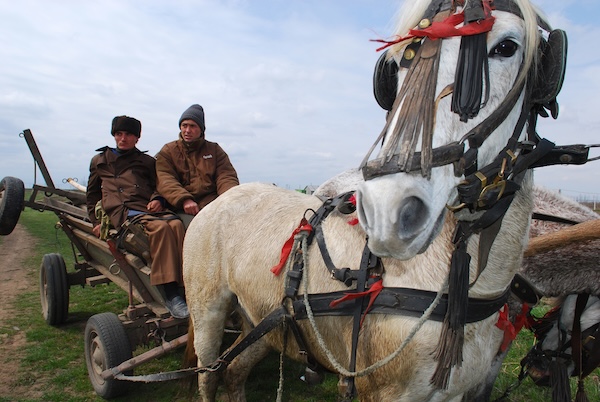
photo - “Horse and Carriage,” Romania, 2006
“Horse and Carriage,” Romania, 2006. (© Dina Goldstein)

“In general, I find that society is complex and divided. This became super-evident during the pandemic, and recently after Oct. 7, 2023. I was able to photograph the anti-vaxxer gang, where bizarre people came out of the woodwork. The Free Palestine bunch includes some of these types, and also an element of proud antisemites. When they first rallied, in big crowds, holding up signs ‘From the River to the Sea’ down Commercial Drive, I photographed it, slightly shocked, slightly sickened. I decided then that I could not personally or professionally continue to be there as a witness to this open hatred.”

A lot changed for Goldstein after Oct. 7, she said. “Losing friends that were once close, making new friends (mostly Jewish), actively fighting against anti-Jewish/Israel sentiment in my East Van neighbourhood and within the Vancouver arts community. This leads to the next chapter of my career, where I will focus more on my Jewish/Israeli identity and Ashkenazi Jewish heritage.”

Goldstein has written a TV series called Grimm Lane, which is based on Fallen Princesses. She is creating a new book with her narrative series Storyography and is also working on the TV series The Tribe, which is based on three Jewish families living in Toronto.

For more about The Archive XXX, Goldstein’s tableaux series and other work, visit dinagoldstein.com. To attend her JCC Jewish Book Festival talk, register at jccgv.com/jewish-book-festival-events/feb-12. The event is free to attend. 

Format ImagePosted on January 23, 2026January 21, 2026Author Cynthia RamsayCategories BooksTags archives, art, Dina Goldstein, JCC Jewish Book Festival, photography, politics, social commentary, travel
Guitar virtuosos play

Guitar virtuosos play

Itamar Erez performs with three other leading musicians on Feb. 1, 7:30 p.m., at Massey Theatre, as part of International Guitar Night. (photo from itamarerez.com)

International Guitar Night takes place on Feb. 1 at Massey Theatre. Once again, Jewish community member Itamar Erez, whose styles range from Middle Eastern, to jazz improv, to world music, is taking part.

“This unique project started with Brian Gore many years ago, when he had the vision to create these unique guitar tours. It’s been going on for over 20 years, with some of the best guitarists in the world,” Erez told the Independent.

“The idea is to put four guitarists on stage with a totally different style and sound,” he explained. “Each plays a solo set and introduces the next player – and, eventually, all four guitarists are playing together in duets and quartets. The audience loves the variety in the music and personalities and, often, there are interesting and funny stories that go with the music.”

Erez will be joined by Jocelyn Gould, a traditional jazz player and singer, Caroline Plante, who comes from the flamenco tradition, and Jamie Dupuis, who brings his harp guitar and Roma jazz influences.

“I’m playing my own mixture of Middle Eastern/Brazilian sounds,” said Erez, whose recent albums include Mi Alegria (2019), May Song (2022; for a review, go to jewishindependent.ca/erezs-new-cd-shows-mastery) and Migrant Voices (2024, with Hamin Honari).

“Migrant Voices was a unique album for me,” Erez said. “I had worked with Hamin for a few years already and we became really good friends. We worked on developing new material for the duet and, towards the recording date, we realized that this album will be mostly based on free improvisation. It just felt like the best approach and most authentic for us. Apart from the album title (Migrant Voices), that was composed by myself, all the tunes were basically improvised right there at the studio.

“In 2024,” he continued, “I also went to the studio with my piano trio (Jeff Gammon on bass and Kevin Romain, drums, and myself on piano) and we recorded in one afternoon a bunch of instrumental covers to tunes – this is something I never had done before, as I always was creating new original material. Among these tracks were Marina Maximilian’s beautiful song ‘Amok Batal,’ three Hanukkah tunes (‘Maoz Tzur,’ ‘Banu Hoshech,’ ‘Kad Katan’) and several other tunes, such as ‘Blue Bossa’ … all done with a very personal approach.

“Over the past year, I have released these tunes slowly as singles – and was overwhelmed with the warm response of audiences for these tracks.”

International Guitar Night is a touring festival, which has three iterations: Canadian, American and European.

“I did one full tour many years ago, in 2009/10, with many concerts in the US, Canada and Scotland,” said Erez. “I did the European version of the tour (Gitarren Nacht) a few years ago, with shows in Germany, Austria and France, and one more time in BC quite recently (2023), where I played for the first time with Jocelyn Gould…. My favourite part of these tours is making friendships with these musicians, some of them are friends for life. And making music with players that come from a totally different background is always fun and exciting.”

This year’s Canadian tour centred on British Columbia, with stops in Oliver, Campbell River, Duncan, Nanaimo and Victoria. The Feb. 1 performance at the 1,260-seat Massey Theatre in New Westminster caps it off.  For tickets, go to masseytheatre.com/event/ign-2026. 

Format ImagePosted on January 23, 2026January 21, 2026Author Cynthia RamsayCategories MusicTags British Columbia, concerts, International Guitar Night, Itamar Erez, Massey Theatre
Sesame’s breadth and depth

Sesame’s breadth and depth

I made my wife a rockstar carrot cake for her birthday last week. Thanks to the JCC Jewish Book Festival, I received a review copy of Sesame: Global Recipes & Stories of an Ancient Seed by Rachel Simons, which features a unique take on one of my wife’s favourite desserts. The Tahini Cream Cheese Frosting with Carrot Cake & Seed Brittle was a hit – as was every other recipe I tried from the book. Everything I made looked beautiful and tasted great. 

New York-based Simons, founder of Seed + Mill, the first store in the United States to focus solely on sesame products, will be in Vancouver for a JBF pre-festival event Feb. 8, 7 p.m. Tickets are $20. (Go to jccgv.com/jewish-book-festival.)

image - Sesame book coverSimons seems delightful, with a passion for gardening, family, travel and being an entrepreneur. In Sesame, she shares some of her background, what led her to become an expert in all things sesame – the seed, oil and paste (tahini). We also learn a bit about the history of sesame and tahini. There are 80-plus recipes, ranging in complexity, most accompanied by a brief introduction. The whole presentation is appealing: the book’s layout, the feel of its pages, the photography by Alan Benson and illustrations by Evelina Edens; credit is given to Maren Ellingboe King for some of the text.

Just before the recipe section, Simons notes how hard it was for her to write many of the recipes, as she tends not to follow recipes herself, and cooks more “by instinct and with lots of practice.” This is an important note because newbie cooks might have to Google pieces of information like how long it takes to bake a cake at 350˚F, because Simons doesn’t give any baseline, just writes “bake until a skewer … comes out clean.” Even with Google and Simons’ advice, I slightly undercooked my cakes. Yes, cakes. Somehow, though I’m positive I followed the recipe to a tee and the cake we ate tasted amazing, I had twice as much batter as I was supposed to have. (I froze the second cake.)

There were other, smaller surprises with each recipe. And every recipe took me longer to make than indicated. I often find that with cookbooks though – if I were to rinse and de-leaf my cilantro, parsley, etc., chop all the nuts, etc., in advance, then maybe I could make something within the allotted time, but instead I plan for it to take two to three times as long as suggested.

On the day I made the carrot cake, I wanted to leave as much guilt-free room as possible, so made the Thai-Inspired Tahini, Lime & Broccoli Salad. It was full of flavour, seasoned with tahini and lime, as per its name, as well as soy sauce, hot honey for a bit of bite, garlic, lots of cilantro and mint for freshness, peanuts and sesame seeds for protein and texture.

The next day, we had friends over and served Pistachio and Whipped Feta, with veggies and pita bread, as an appy. A couple of tablespoons of tahini, a bunch of cilantro, plus lemon juice and, especially, lemon zest made this dip disappear quickly.

Birthday day started with An Indulgent Middle Eastern Breakfast Toast, which was all its name promised. I couldn’t find labneh, so substituted in pressed yogurt. While the recipe said the sprinkle of Sweet Dukkah was optional, I’d argue it’s essential. All together, this rich, tangy, toasted, sweet treat demanded a second serving.

In all this cooking, I’ve stained several pages of Sesame and will, no doubt, stain others, as this book becomes one of my staples. I’ve already made a few other things that are not included here for space reasons, not taste reasons. It’s all yum.

AN INDULGENT MIDDLE EASTERN BREAKFAST TOAST
(serves one)

1 thick slice sourdough bread
1 tbsp labneh
1 to 2 tbsp tahini
1 tbsp honey or date syrup
1/8 tsp flaky salt
Shake of Sweet Dukkah (recipe below)

Toast the bread or leave it fresh, depending on your preference. Spread the labneh on the bread, then drizzle with the tahini and honey and finish with the flaky salt and Sweet Dukkah (if using). Serve immediately.
SWEET DUKKAH
(makes about 2.5 cups)

1 cup sesame seeds
1/2 cup pistachios, coarsely chopped
1/2 cup almonds, coarsely chopped
1/2 tsp ground cinnamon
1/2 tsp ground cardamom
1/2 tsp flaky salt
1/2 cup unsweetened coconut flakes
2 tbsp edible dried rose petals (optional)

1. Preheat the oven to 375˚F. Line a rimmed baking sheet with parchment paper.

2. Spread the sesame seeds, pistachios and almonds on the baking sheet. Sprinkle with the cinnamon, cardamom and salt and toss to evenly combine.

3. Bake for 6 minutes, then give the baking sheet a vigorous shake to move the nuts and seeds around. Add the coconut and shake the sheet again. Return the mixture to the oven and bake until the coconut has turned golden brown, 4 to 6 minutes. Check regularly to make sure the dukkah isn’t burning.

4. Cool the dukkah completely on the pan before adding the rose petals (if using). Store in an airtight container in the pantry for up to two months. 

Format ImagePosted on January 23, 2026January 21, 2026Author Cynthia RamsayCategories BooksTags baking, cookbooks, cooking, JCC Jewish Book Festival, Rachel Simons, sesame seeds
What should governments do?

What should governments do?

Left to right at the Jewish Seniors Alliance of BC Fall Symposium Nov. 23: Jeff Moss, Joyce Murray, Anthony Kupferschmidt, Dan Levitt and Isobel Mackenzie. (photo by Alex Roque Photography)

The Jewish Seniors Alliance of British Columbia’s fall symposium featured a panel discussion on the responsibilities of governments for seniors. The panelists discussed housing, transportation and healthcare services. They explored challenges in funding, staffing and service delivery, while also touching on topics such as the potential for community involvement in shaping senior support systems.

The Nov. 23 gathering, which took place at the Jewish Community Centre of Greater Vancouver, opened with Jeff Moss, executive director of JSABC. He said provincial advocacy is “at the heart” of what JSA does, “and bringing together politicians in this space is really important, because the conversations that we have when we meet with the provincial government, or when we’re meeting with the opposition, [are] where we are advocating strongly for universal free home support for seniors in British Columbia.”

JSA’s partners in this campaign are Council of Senior Citizens’ Organization (COSCO), the BC Health Coalition, the Independent Long-Term Care Councils Association of BC, Family Caregivers of British Columbia and the BC Care Providers Association (BCCPA), whose chief executive officer, Mary Polak, addressed those gathered. 

Polak shared that her father, who’s 96 years old, is in long-term care. He has some dementia issues and needs to have some specialized care, she said. “But in the time that he was at home with us and we were trying to give him the best quality of life we could in our own home, it was a real challenge to try and support that with home health services. And we were in a better place than many because at least we had some of the financial capacity to do that, and we had the family around us. But, for an increasing number of people, that’s becoming impossible, and it shouldn’t be that way.”

Ezra Shanken, CEO of the Jewish Federation of Greater Vancouver, which also is a partner and supporter of JSABC, introduced Shay Keil, who sponsored the event with the BCCPA and JSA, along with Michael and Sally Geller, and the Zalkow Foundation.

“Seniors are the foundation of who we are,” said Keil. “You’ve built our families, our traditions and our values, and you deserve to be honoured, supported and celebrated. We often speak of m’dor l’dor, from generation to generation, and that idea is very close to my heart. I strongly believe in the connection between seniors and children and everyone in between. That belief is why I’m here today, and why I’m deeply committed to community through volunteering, supporting and staying actively involved in the organizations that strengthen the lives of those around us, including JSA.”

Keil introduced the emcee of the panel, Isobel Mackenzie, “who served as British Columbia’s seniors advocate from 2014 to 2024, and has spent her career championing the well-being, safety and dignity of our seniors.”

Mackenzie asked each panelist to come to the stage: Anthony Kupferschmidt, strategic lead for aging and older persons with the City of Vancouver, who has worked in similar capacities with other cities and groups, and is also a gerontologist; Joyce Murray, who has served both as a member of the Legislative Assembly and as a member of Parliament; and Dan Levitt, a gerontologist who has worked 30-plus years in seniors care, and is the current seniors advocate for the province.

Each panelist gave an overview of their opinions, starting with Kupferschmidt, who noted that much of what a municipality can do for the aging population requires financial support from other orders of government. However, a city can impact seniors in such areas as “zoning and related development charges, making sure that we have the right type of housing and the right mix of housing  across the city.”

Municipalities can work with the provincial government, for example, on where care homes are located and support their development. Transportation is another key area, as are sidewalks and other “elements of an age-friendly city.” Cities have a role with respect to public libraries and the accessible services they offer, community centres, senior centres, pools, arenas, etc. 

Levitt was the next to speak. “Currently, there are 5.5 million people living in our province, 1.1 million people are over 65,” he said. “Today, there’s one in five – 20% of all people are seniors. Fast forward just a decade from now and it’ll be one in four, 25%…. We have more people who are living longer and more people who are seniors, so 400,000 more seniors in the next decade.”

Levitt’s office monitors five areas: health care, transportation, housing, income and community services.

“The general trend,” he said, “is that there are more seniors and there are more investments, but there’s less available per senior.”

As an example, he said, a quarter of all seniors are living on $23,000 a year, or less than $2,000 a month. “And it’s not that hard to go find people living in the West End in affordable housing living on less than $1,000 a month, so they really need that income support from all levels of government, they need those subsidies.”

Levitt said there were 13,000 people on the waitlist for affordable housing last year. “How many of them got a space?” he asked. “Six percent, just under 800 people have got a space for affordable seniors housing in our province. We haven’t built enough, and there is a call right now to build more, but we’re not keeping pace with that demand.”

As well, he said, the province has been taking money away from long-term care homes, no longer funding overtime and agency nurses, for example, and this affects places like the Louis Brier Home and Hospital.

“It means that an already very thin margin is now almost impossible to operate without that government subsidy,” said Levitt. 

“We haven’t invested enough either in seniors care,” he added. “We did a report in July, and our July report identifies that over 16,000 people are going to be short long-term care because we’re not building enough beds. There are 7,200 people on the waitlist today.” The burden of care, he said, is being transferred to families.

Murray took the conversation in a different direction.

“I was looking at the budget numbers about this when I was thinking about what I would be saying,” she said, “and the total new spending on OAS [Old Age Security] and medical care for seniors alone in the 2023 budget was $110 billion of new money…. Now, that’s going to tie into some of the demographics, for sure, but, when you break that down, that’s $4,300 per retiree 65 and older in new money in the 2023 federal budget versus $755 for younger Canadian under 45 in new money.”

She wondered about how well younger people were being supported. She also spoke of environmental concerns.

“What does it mean to be a good ancestor?” she asked. “And what do we think our society, our province, our country needs to do so that we collectively are good ancestors?”

“To govern is to choose,” said Mackenzie, noting that governments must make decisions about how “to allocate our finite resources to our infinite demands.”

The panelists talked more about that, as well as the way in which different levels of government work with one another. Murray said governments make policies they hope will attract voters, and seniors tend to vote more than younger people, so, for example, “a family with two members can earn up to $180,000 a year and still get their full OAS,” she said, asking, “Is that a good allocation of money?”

Mackenzie asked a variant of Murray’s question, considering how maximum monthly payments for public long-term care work.

“The person whose income is $200,000 a year is going to pay the same for their publicly funded long-term care plan as the person whose income is $70,000 a year,” said Mackenzie. “And so, if, on the one hand, we say, well, the people who have more should get less, which is the OAS argument, to what extent should we flip that and say, well, the people who have more should pay more when it comes to publicly subsidized long-term care? That’s, I think, missing from the discussion…. I think there are very uncomfortable conversations … that governments are going to have to have with their electorate and, as elected officials, you don’t like to have those uncomfortable conversations, for obvious reasons.”

Levitt thought the situation could be improved if governments helped people understand how much money they need to save to age well, what supports there would be for them as they age, and what people could do to support themselves. 

Murray suggested, “Maybe what we need is like a citizens’ assembly, to start out by identifying what are the key things that are maybe broken or need improvement so that we can be good ancestors. And then have a citizens’ assembly that looks at what are the best solutions in other countries … and then create a proposal on that. I think we have to crowdsource the solutions here…. We need citizens to help us solve this.”

Kupferschmidt brought up Better at Home, a basket of non-medical services that seniors can access. “There has been public engagement into what those services should be…. However, there are examples of the service that is offered in one neighbourhood in the city is different than another,” he said, explaining that a “model with all the best intentions can sometimes create some disparities as well.”

Mackenzie stressed the complexities, both because everyone’s needs and everyone’s solutions are different. “And, in the end, in those environments, generally, we try to come up with solutions that meet the greatest good for the greatest number, but that certainly doesn’t meet the need for everybody all the time and that is, I think, the political challenge at all levels of government, whether they be the local, the provincial or the federal.”

Posted on December 19, 2025December 18, 2025Author Cynthia RamsayCategories LocalTags Anthony Kupferschmidt, Dan Levitt, eff Moss, Ezra Shanken, funding, governance, government, government funding, health care, Isobel Mackenzie, Jewish Seniors Aliance, Joyce Murray, JSABC, long-term care, Mary Polak, policy, seniors, Shay Keil
Four Peretz pillars honoured

Four Peretz pillars honoured

As the owner of the 95-year-old Jewish Independent, I know full well that our Jewish community is built on the shoulders of those came before us. It is upon this foundation that we continue to grow, keeping our institutions going, while also starting new ventures and winding up groups that have served their purpose. Sometimes an organization will rebrand and recreate itself, sometimes it will reconnect with and reestablish its roots.

It is with these thoughts in mind that I watched the short documentary film Four Pillars of Peretz, which premiered last month at the Peretz Centre for Secular Jewish Culture. But it was also more personal than that, as I knew the four women being profiled: Bluma Field, Sylvia Friedman, Claire Klein Osipov and Gallia Chud, all of whom have passed away. To me, these women exemplified grace and grit. They were doers and they lived by their beliefs – most important, to me, though, was that they welcomed me, made a place for me, treated me as if I mattered, despite my holding very different views than they did on many things.

screenshot - Bluma Field, left, and Claire Klein Osipov
Bluma Field, left, and Claire Klein Osipov. (screenshot)

Nothing in filmmaker Michael Kissinger’s 36-minute documentary shattered the notion that they treated everyone with such respect, for which I’m grateful. I want to remember these women this way. A key element I feel is missing in the world today is this ability to be friends, or at least be civil to, people with different opinions. We are so polarized that our own views – and our need to express them – often take precedence over making another human feel, well, human.

I know that this phenomenon is nothing new. As is the case with most organizations, the Peretz Centre was started to fill a need that wasn’t being met by other groups at the time. Secular and socialist in nature, the Peretz has rarely “fit in” with the mainstream Jewish community over its 80-year history. While its politics held no interest for me, its focus on Yiddish culture, its choir in particular, did appeal to me and I was involved for some 30 years, having been introduced to the centre by Claire, who was the epitome of class – and, wow, what an incredible voice. She was close friends with my aunt, who also, sadly, has passed away. 

Going down memory lane with Four Pillars of Peretz was truly a pleasure. For people who don’t know the four women profiled, I would still recommend watching it, if only to demystify the Peretz Centre. Community unity shouldn’t mean community uniformity, and everyone should be so lucky as to have at least one place where they feel welcome. We don’t need to belong everywhere, but it’s vital to our health, I think, that we belong somewhere.

screenshot - Sylvia Friedman with her son, Michael Friedman
Sylvia Friedman with her son, Michael Friedman. (screenshot)

Four Pillars of Peretz is also an example of what other organizations could do to honour their founders. Keeping history alive is so important, in my view. It’s not an inexpensive endeavour, but it’s worthwhile. In the case of this documentary, Kissinger really captures the spirits of these women and the way in which they still inspire others. Bluma, Sylvia, Claire and Gallia were by no means the only pillars of the Peretz Centre, but they were particularly driving forces, and they were so for decades.

“These stubborn old ladies, you know, they get sh*t done,” says Faith Jones, providing the first comments in the film, which features clips from interviews with other Peretz members and with members of the women’s families. Through these snippets, as well as photographs and other archival material, you get a sense of the enormous amount of effort and love that it takes to start an organization and keep it running. 

The film starts with an overview of the four women, then each gets their own spotlight. The snappy music and the way in which Kissinger has edited the film makes it move along smoothly, both communicating the challenges these women – and others in their generation – faced with tenacity, but also with joy. 

“I think all of these women, if they were here today, would say that they got just as much out of it as they put into it, because it’s community,” says one of Gallia’s daughters, Rita Chudnovsky, near the end of the film. “And there’s no replacement for a sense of community, and that’s something that’s, I think, getting harder for people to find.”

For more about the film, go to peretz-centre.org/post/four-pillars-of-peretz-short-documentary-film-project.

Format ImagePosted on December 19, 2025December 18, 2025Author Cynthia RamsayCategories TV & FilmTags Bluma Field, Claire Klein Osipov, documentaries, films, Gallia Chud, history, Michael Kissinger, Peretz Centre, Sylvia Friedman

From the JI archives … camp

image - article from Sept. 3 1937 JWB
Sept. 3, 1937: “It is practically impossible in the space of a short article to fully describe the happy holiday enjoyed by eighty-five children at the Council of Jewish Women Camp at Crescent Beach this summer,” begins this article by Mrs. M. M. Grossman. I know the first “M” refers to Max, but I couldn’t find his wife’s name before we went to press.

What strikes me every time the Jewish Independent does a Camp Guide issue is the staying power of our Jewish summer camps.

Camp Hatikvah was started in 1937 at Crescent Beach by the National Council of Jewish Women. It was run under their auspices until 1944, when, according to the camp’s website, “members of the Young Judaea youth organization arranged to first rent, and then later acquire, the property to create Camp Hatikvah.” The camp is located on Lake Kalamalka in the Okanagan Valley.

The site quotes the Independent’s predecessor, the Jewish Western Bulletin, noting that a 1949 article in the JWB stated that “Camp Hatikvah provided early participants with a ‘place where they could live and express themselves as Jews, unhampered with fear of others and free from the out-of-place feeling that is so often a part of North American Jewishness.’ Developed in the aftermath of the Holocaust, Hatikvah existed to ‘produce proud, happy Jewish youth who were earnest and sincere in their beliefs’ and committed to the re-building of the Jewish people.”

image - April 22, 1955: Camp BB Riback comes into existence.
April 22, 1955: Camp BB Riback comes into existence.

And the camp wasn’t territorial, it appears. According to a 1948 article in the JWB, Camp Hatikvah allowed Habonim Machaneh (Camp) to use its facilities for two weeks. By 1949, Habonim was renting a camp on Gabriola Island and, by 1951, Habonim Camp Miriam was in its third year, but, it seems, its first with the name Camp Miriam.

Camp BB Riback, in Pine Lake, Alta., was founded in 1955, led by Ted Riback of Calgary, who was chair of the B’nai B’rith Camp committee. There were two articles in the April 22, 1955, JWB about it, one about the camp and one about the upcoming B’nai B’rith convention, the highlight of which was anticipated to be a discussion about the camp.

image - July 13, 1956: Kids from Vancouver have always attended Camp Solomon Schechter in Washington state.
July 13, 1956: Kids from Vancouver have always attended Camp Solomon Schechter in Washington state.

While Camp Solomon Schechter was established by rabbis Joshua Stampfer and Joseph Wagner in 1954, the first mention I could find of it in the JWB was in 1956. The week-long camp at Echo Lake, Wash., was also under the supervision of Rabbi Bert Woythaler of Vancouver’s Congregation Beth Israel and the Pacific Northwest Region of the United Synagogue sponsored it. The camp has been located near Olympia, Wash., since 1968.

image - Dec. 29, 2006: Even before Camp Kalsman had a summer session, they were part of the Jewish Western Bulletin’s Camp Guide
Dec. 29, 2006: Even before Camp Kalsman had a summer session, they were part of the Jewish Western Bulletin’s Camp Guide.

Relative newcomer Camp Kalsman started in 2007, and the JWB has followed it since its beginnings, as well. In 2006, the camp ran an ad looking for a director and, in our Dec. 29, 2006, Camp Guide, David Berkman, the newly appointed director, spoke to the paper about the Union for Reform Judaism camp, in Arlington, Wash. “The buildings are under construction. Staff and campers are being recruited; programs are being planned and we must buy everything – bunks, bats, balls, arts and crafts supplies, mops…. I have a long wish list,” he said.

As that 2006 article by Pearl Salkin noted, “The camps might not have big brass bands, but the excitement is already building. If you want your children to join in the fun, sign them up now, before the parade passes by.”


Posted on December 19, 2025December 18, 2025Author Cynthia RamsayCategories LocalTags history, Jewish summer camp, Jewish Western Bulletin, JI @ 95, JWB
Unique interview show a hit

Unique interview show a hit

Margaux Wosk is a cast member of The Assembly, currently streaming on CBC Gem. (photo by Erich Saide / The Assembly)

“I am so proud of what we accomplished,” Margaux Wosk told the Independent about The Assembly, which is now streaming on CBC Gem. “The show offers fresh perspectives on autism and highlights how diverse autistic experiences can be. It also makes for authentic interviews, because no questions are off the table, which is rare to see in mainstream programming.”

Having watched the show, I couldn’t agree more. Produced by Vancouver-based production company Small Army Entertainment, The Assembly is entertaining. The way in which everyone interacts is refreshingly respectful, the content of the questions is unexpected and the honesty from both the interviewers and interviewees makes for compelling viewing. Everyone comes off as down-to-earth, friendly, with joys and fears most of us have experienced, just in different ways. In the inaugural season, the cast comprises more than 40 autistic and neurodivergent British Columbians interviewing six celebrities – Howie Mandel (America’s Got Talent), Maitreyi Ramakrishnan (Never Have I Ever), singer-songwriter Jann Arden, Allan Hawco (Saint-Pierre), Arlene Dickinson (Dragon’s Den) and comedian Russell Peters – over the course of six episodes. 

According to CBC, the show is adapted from a French program, Les rencontres du Papotin, which started in 2022 on France 2 and became so popular that it has been commissioned in 19 countries to date. It was renamed The Assembly for British audiences, which is how it has been imported into Canada. But the origins go back even further, notes CBC – “The TV program was inspired by a real-life newspaper that has been written and published by autistic journalists since 1990.”

Wosk found out about the Canadian production via a Small Army Entertainment social media post.

The casting process took more than a year, according to CBC. “Producers worked with professional organizations within the autistic community to find people who would be interested in appearing on the show. Once selected, they were provided with some background information about each celebrity guest, but it was up to them to do their own research and decide how much or how little they would prepare,” says a Nov. 6 CBC Gem post.

“We received information about each guest and submitted about five questions each,” said Wosk. “These were then narrowed down to the best questions, and the team made sure there were no duplicates from other cast members. This process allowed us to craft questions that were both meaningful and unique.”

Filming took place in various places. “We filmed mostly during the summer at a few locations around the city that had natural lighting to accommodate people with light sensitivity, like myself,” said Wosk, who wanted to participate in the show for a few reasons.

“I love public speaking, and I wanted to help reduce the stigma around what autistic people are capable of,” they said. “I also wanted to reclaim my narrative. My childhood was difficult in many ways, so being able to feel empowered and share my perspective as an adult is really meaningful to me.”

Wosk serves as president of BC People First, where they support self-advocacy and inclusion for people with intellectual and developmental disabilities. They have written for or been featured in numerous publications and been interviewed for radio and other media many times. They received a BC Achievement Community Award this year, recognizing that their work with BC People First “breaks down barriers, fosters pride and amplifies underrepresented perspectives through creativity, advocacy and education”; that their business, Retrophiliac, empowers “others to express themselves, reduce stigma and build community”; that, in their leadership on accessibility, education and business development, their artwork and other initiatives, they are “a strong voice for inclusion, pride and important systemic change.”

Retrophiliac “sells items focused on disability, neurodiversity and self-expression, as well as communication cards that help people communicate,” and has a couple of access points: retrophiliac.etsy.com and shopretrophiliac.com. Wosk’s website is margauxwosk.com.

One particularly exciting moment for me as a viewer of The Assembly, though I only know Wosk slightly through some volunteer work we’ve done, was when Arden, as she was chatting with some of the interviewers after the main filming, said Wosk looked “kick ass.”

“It was amazing,” said Wosk when I asked how it felt to hear that. “I had planned my outfit weeks in advance for each taping, and my sense of style is really important to me. It is one of the ways I express my personality, so hearing Jann Arden compliment it felt very affirming and special.”

Wosk isn’t the only Jewish community member on The Assembly. I recognized Lyle Lexier and Wosk thought there might be another. CBC didn’t respond to my emails.

“I hope viewers have their assumptions about autism challenged and reduced,” said Wosk about the show. “I also hope they enjoy seeing Canadian celebrities and public figures answer questions in ways they probably have not seen elsewhere, giving a deeper sense of how human and relatable they are.”

To watch The Assembly, go to gem.cbc.ca. 

Format ImagePosted on December 5, 2025December 3, 2025Author Cynthia RamsayCategories TV & FilmTags autism, CBC, CBC Gem, Margaux Wosk, neurodivergent, Retrophiliac, Small Army Entertainment, The Assembly
See Annie at Gateway

See Annie at Gateway

Azaleah Korn, who plays the title role in Gateway Theatre’s production of the musical Annie, takes guidance from director Josh Epstein. (photo from Gateway Theatre)

Vancouver Jewish community member Azaleah Korn plays the title character in Gateway Theatre’s production of Annie, which opens Dec. 11 and runs through Jan. 3. The production is directed by another Jewish community member: Josh Epstein.

“When I found out I got the role of Annie, I cried and screamed and cried some more,” Korn told the Independent. “I was shocked, excited, crazy happy and a little nervous all at once! Being able to play the role of Annie is a huge honour and fills me with so much joy, excitement and inspiration.”

For the few readers unfamiliar with the Tony Award-winning musical, which has had several movie adaptations, Annie is set in New York City in the 1930s. It centres around Annie, an orphan who is eternally positive despite her harsh circumstances. Her luck – and that of her companion, the stray dog, Sandy – changes when she is invited to spend the holidays with billionaire Oliver Warbucks.

“I love singing all the songs in this play and I truly love diving deep into this complex human and figuring out how and why she does what she does and thinks what she thinks,” said Korn, who is a Grade 8 student at Eric Hamber Secondary School. 

photo - Azaleah Korn stars in Gateway Theatre’s Annie, which runs Dec. 11-Jan. 3. The role of Sandy is played by three dogs; pictured here is Poco
Azaleah Korn stars in Gateway Theatre’s Annie, which runs Dec. 11-Jan. 3. The role of Sandy is played by three dogs; pictured here is Poco. (photo by David Cooper)

“Playing Annie is challenging for me because it’s not a character that I innately identify with,” Korn said. “Her hope and upbeat attitude, even in her awful situation, isn’t my gut reaction. But playing her has inspired me to find the hope or silver lining in otherwise sad situations. The most fun part of being Annie is exploring the world through her eyes.”

At age 13, Korn has the training and experience to play such an iconic role and make it her own.

“I can’t remember a time when I wasn’t performing; whether it be for my parents, friends, family and/or my stuffed animals!!” she said. “I started training in musical theatre, dance and vocals at the age of 5. Funnily enough, my very first vocal performance, at the age of 5, were songs from Annie: ‘Maybe’ and ‘You’re Never Fully Dressed.’”

Korn played Tomika in School of Rock at Theatre Under the Stars in 2024 and Brigitta in the Sound of Music at Delta Youth Theatre in 2023. She competes vocally and, this past year, won first place in the musical theatre genre at Kiwanis Music Festival. For the last three years, she has been dancing competitively, with the Happening Dance Studio. A couple of years ago, she won a nationwide songwriting contest. She would like to study musical theatre in New York and perform on Broadway. 

“I prepare for my roles by learning the backstory of the show and my character. I really try to bring ‘me’ to the character I am playing, so, although I watch the musical or movie, I try not to copy or emulate exactly what I see. It is really important for me to bring my own authentic self to the character, so it feels and looks real,” she explained.

“To memorize my lines, I visualize the scene over and over. This technique helps me feel the beat of the scene and then the lines come more naturally.

“To calm my nerves,” she said, “I think, ‘what would Beyoncé do?’ I channel my inner courage and remember that musical theatre is my biggest passion and love. Reminding myself of my love for being on stage helps ease the nerves.”

Self-care is part of it, too. With Annie, for example, there are shows six days a week, and a matinée and evening performance on Saturdays.

“To have enough energy for the shows, I try to relax – when I’m not at school or rehearsing!” said Korn. “I like to zone out by watching TV or reading a book and keeping my talking to a minimum (which can be hard for me at times!), so I don’t wear my voice out. Luckily, my mum cooks me healthy meals so I have the energy to dance, sing and act my heart out on the stage. I warm up my body and voice. Cheryl Porter’s vocal warm-ups are amongst my favourite and have helped me keep my vocal cords safe throughout my singing years and daily shows.”

It was Korn’s mom who saw that Gateway Theatre was casting for Annie.

“She submitted me for the role of Annie and/or the orphans,” said Korn. “I practised the vocals for the audition with my vocal coach, Frederik Robert. My mum was my reader for the scene I had to practise. I guess she did an OK job! Mentally, I told myself to just go in there with all my confidence and courage and play the role and sing the best I could. And, like my mum always reminds me, ‘have fun!’”

This will be Korn’s first time working with Gateway Theatre. She is grateful to Epstein, choreographer Nicol Spinola, music director Sean Bayntum and the whole Gateway team for the “incredible opportunity.” Her parents have provided “endless support,” she said, also highlighting her vocal coach, Robert, and dance teacher, Kim Stevenson, “for pushing me and believing in me!”

Judaism is a fundamental aspect of Korn’s life. 

“My grandfather, David Solomon Korn (he is named after two kings, he likes to remind us), is a Holocaust survivor. He and his brother Yaakov, aged 6 and 7, survived the Nazis as they came through Europe, including Brno, Czechoslovakia, where my grandfather was born. Tragically, his parents died at the hands of the Nazis, leaving my grandfather and his brother orphans. He recently wrote his memoir, in a book called At Great Risk, with the assistance of the Azrieli Foundation. My grandmother, Yona, was born in Afula, Israel. My grandparents met in Montreal and, after marrying, lived in Haifa before immigrating to Canada. It is a story of survival, determination and hope.

“Playing the role of Annie causes me to pause often to reflect upon the injustices inflicted upon my grandfather, who himself was orphaned at a young age, and the resilience of the Jewish people,” Korn continued. “My Jewish identity is strong and it is an important part of who I am today.”

It is easy to see why Epstein told the Independent that everyone who sees Annie will “walk away drawn in to our Annie, rising star Azaleah Korn – she’s got a mix of undeniable star power and acting chops.”

Epstein is a multifaceted talent himself, being an actor, producer, director and writer. The almost-46-year-old is a theatre veteran. For him, directing at Gateway Theatre is special.

“I spent my Hanukkahs doing the seasonal show at the Gateway as a kid – five winters,” he said. “It was a training ground for me, and this is all full circle.”

He directed Gateway’s 2024 production of Oliver! (He was part of Gateway’s 1992 production of the musical, playing young pickpocket Charley Bates.)

“Coming off Oliver! last year was a real awakening for me,” Epstein told the JI. “I didn’t expect how joyful it would be to dust off a classic and rediscover how well these classics hold up when you approach them with imagination and depth. The Gateway encouraged us to dream big and take risks. Barb Tomasic (executive artistic director) is an extraordinary leader, and that attitude trickles through the entire company.

“On opening night, she asked me about returning, I was a quick yes. She had a list, I had a list, and Annie was at the top of both.”

When asked his favourite thing about Annie so far, Epstein said, “We’ve found fresh takes on every character.” As noted, he highlighted Korn. He also said, “I think audiences will see a Warbucks they’ve never seen before. Charlie Gallant brings something impulsive, surprising and emotionally alive. It reinvigorates the role and opens up the whole story.”

He added, “But, who am I kidding, the dog will undoubtedly get the most attention. Everyone loves Sandy.” 

Sandy is played by three dogs: Neko, Mylo and Poco. While there is the saying, “never work with kids or animals,” Epstein said, “It’s a myth. We had 70 kids audition. Seventy. Vancouver is full of incredible training programs … so the talent pool was unbelievable and our orphans are exceptional. The challenge is harnessing all that energy and potential inside a big, fast-moving machine.”

It’s been six to 10 months of planning, said Epstein, between “sets, costumes, props, auditions and logistics. Then, three intense weeks of rehearsal into tech. In that window, we have to teach all the music, choreograph huge numbers, stage transitions, build quick changes, run fight direction, intimacy work, dialect coaching, work with three dogs and a dog trainer, squeeze in costume fittings and lift calls, and prep special promo events. When you break it down, the number of actual hours we get for scene work is shockingly small, so my job is to move quickly while still hitting all the moments we want to savour.”

There is nothing like live theatre.

“Look,” said Epstein, “more and more, most of us are at home scrolling, streaming, consuming things alone. Theatre is one of the last places where you sit in a room with hundreds of strangers and feel something together. For this price, with this level of talent and this much energy poured into it, there’s nothing else quite like it.

“At its core, Annie is a story about chosen family, about finding the people who show you that love isn’t just something you give, but something you have to allow yourself to receive – Warbucks learns that, Annie teaches it – and I hope you leave the theatre optimistic about finding that kind of connection with your own chosen family, whoever they may be.”

For tickets to Annie, go to gatewaytheatre.com. 

Format ImagePosted on December 5, 2025December 3, 2025Author Cynthia RamsayCategories Performing ArtsTags Annie, Azaleah Korn, Gateway Theatre, Josh Epstein, musicals

Posts pagination

Previous page Page 1 Page 2 Page 3 … Page 84 Next page
Proudly powered by WordPress