The 41st annual Cherie Smith JCC Jewish Book Festival opens Feb. 21 with award-winning novelist John Irving and closes Feb. 26 with award-winning singer-songwriter, composer and author Peter Himmelman. In between, a range of writers and topics are presented. As always, this year’s festival fulfils its mission, as expressed by director Dana Camil Hewitt in the program: “to expose the general community to a curated snapshot of recent Jewish literature and ideas.”
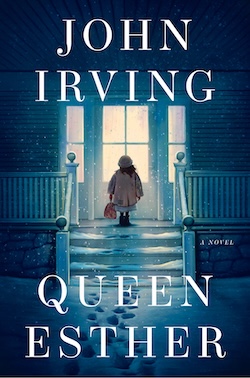 While Irving, the opening author, is not Jewish, his latest novel, Queen Esther, takes readers back to the era and place of one of his most popular stories, The Cider House Rules, which was made into a movie. He focuses this time on the Winslow family, who adopt Esther Nacht from St. Cloud’s orphanage in Maine. The 14-year-old Viennese Jew was born in 1905 and came to the United States with her parents, her father dying on the voyage, her mother a few years later. Esther was left at the orphanage as a little girl, but no one had wanted to adopt a Jewish child, until the Winslows.
The Winslows are, to say the least, an unconventional family and, among other things, don’t adhere to the antisemitic attitudes of the times. The novel sheds light on Esther’s background and we witness a bit of her life with the Winslows, but then she mostly drops out of the story, returning to Europe to reconnect with her roots and then settling in Israel. The bulk of the novel centres on Jimmy, Esther’s son, born and raised in true Winslow style – unconventionally.
Truth be told, Queen Esther is not Irving’s best novel, it rambles and doesn’t quite hit the right message, but it’s written with heart and a seeming desire to counter antisemitism and change the narrative about Israel. Irving fans will enjoy reencountering some old “friends,” like St. Cloud’s Dr. Wilbur Larch, and recurring themes, including chosen family, Vienna, wrestling and sexual politics.
Irving is in conversation with Marsha Lederman Feb. 21, 7:30 p.m. Tickets are $36 ($65 with book).
* * *
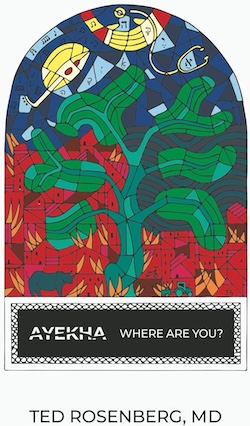 Politics and antisemitism are at the fore in Dr. Ted Rosenberg’s book Ayekha, Where Are You? Reading it will provide some healing for fellow members of the Jewish community, most of whom will know that Rosenberg resigned from the University of British Columbia’s faculty of medicine in 2024 (after a 30-year career there) because of the school’s refusal to do anything about the rampant antisemitism on campus, which escalated after Hamas’s massacre of Israelis on Oct. 7, 2023. The situation was so toxic that Rosenberg no longer felt safe.
In his resignation letter to the faculty’s dean, Dermot Kelleher – sent after other attempts to warn UBC leadership of the problems – Rosenberg wrote:
“I lament the carnage and deaths of both Israeli and Palestinian civilians during this horrific war and this seemingly insoluble and interminable complex tragedy. I also understand and appreciate the strong convictions held by people on both sides of this conflict. However, oversimplistic ahistorical demonizing narratives and rhetoric, by either side, will do nothing to deepen our understanding, empathy, respect, or trust of one another, nor hasten a resolution of this crisis.
“One third of the medical students and some faculty have publicly expressed their contempt towards me, as a Jew. I cannot take the risk of being accused of implicit harassment or racism, which is indefensible, by a ‘triggered’ student. Unfortunately, I have no faith in due process in a faculty that does not even acknowledge the existence or presence of antisemitism/Jew-hatred, or my right to work in a depoliticized environment.”
The award-winning physician, who pioneered a home-based care model for the frail elderly and still practices medicine, wrote the dean, “It deeply saddens me to end my academic career on this note.”
There are so many Jewish academics, medical professionals and others who have been similarly mistreated, both by antisemitic actions and people’s fear of dealing with antisemitism. Reading more about Rosenberg’s experiences is akin to attending a group therapy session. We not only feel less alone afterward, but come away with some knowledge that might help us in processing all that’s happened in the last almost two-and-a-half years, and in confronting the antisemitism we continue to face.
Rosenberg talks at the Vancouver JCC Feb. 22, 1:30 p.m. (tickets are $18), and at the White Rock/South Surrey JCC at 4 p.m.
* * *
Since Oct. 7, it seems that learning more about Judaism, its tenets, its folklore, has been a common way for Jews to deal with the trauma inflicted by that day, the subsequent war and the increasingly open Jew-hatred globally. For anyone who likes graphic novels, The Writer might be an invigorating and educational salve.
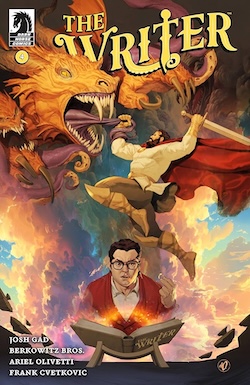 Written and created by actor Josh Gad and the Berkowitz Bros. production company (founded by Ben and Max Berkowitz) with art by Ariel Olivetti and letters by Frank Cvetkovic, the four-part series stars disheveled English professor and unreliable divorced dad Stan Siegel, the writer of the series’ title, who looks a lot like Gad. Stan’s “sidekicks” are his kickass mom Liz and his daughter Izzy. They encounter all sorts of demons, dybbuks, golems and other characters out of Jewish mythology, as well as various historical figures, while Izzy also must confront current-day antisemitism and racism – harassed by classmates for being Jewish and for being Black.
The Writer is an homage to the creators’ Jewish identities, to the comic books, science fiction shows and adventure movies they loved, as well as to Gad’s Holocaust survivor grandparents and to Boston, where the Berkowitz brothers grew up. While they didn’t grow up surrounded by Jewish mysticism, they were inspired when they discovered it and it “felt like home,” notes the afterword. “This story became a way for them to celebrate that heritage – the rich tapestry of Jewish storytelling in all its forms, from Ashkenazic to Sephardic, Beta Israelite, Hispanic, Asian and beyond.”
The tapestry is so rich and deep that it is hard sometimes to follow all that’s going on in an “episode” of The Writer, but it’s a wild ride, a world that’s wonderfully and colourfully drawn, where good battles all sorts of evil and unlikely heroes prevail.
The Berkowitz brothers are at the festival Feb. 23, 7 p.m. Tickets are $18.
* * *
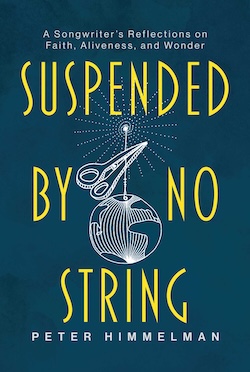 Himmelman closes the book festival on Feb. 26, 8 p.m. (tickets: $25), talking about his collection of essays, Suspended By No String: A Songwriter’s Reflections on Faith, Aliveness and Wonder, with Rabbi Dan Moskovitz. It might seem odd to have a rabbi lead a conversation with a musician, composer and visual artist, but Himmelman describes his book as being about faith, and shares what went into his decision to use the word “God” in it, as opposed to, say, “spirituality,” despite concerns from several people that its use might alienate readers. Hopefully, it won’t, as there is much insight to be gained from Himmelman’s observations, insights and perspectives on wonder, loss and gratitude. His playful sketches are a delightful complement to the text.
* * *
Also appearing at this year’s book festival are, in order of appearance, writers Carol Matas, Lihi Lapid, Aron Hirt-Manheimer, Douglas Century, Yishay Ishi Ron, Yardenne Greenspan, Sasha Senderovich, Marina Sonkina, Claire Sicherman, Danila Botha and Janet Horvath. For tickets and more information, visit jccgv.com/jewish-book-festival.