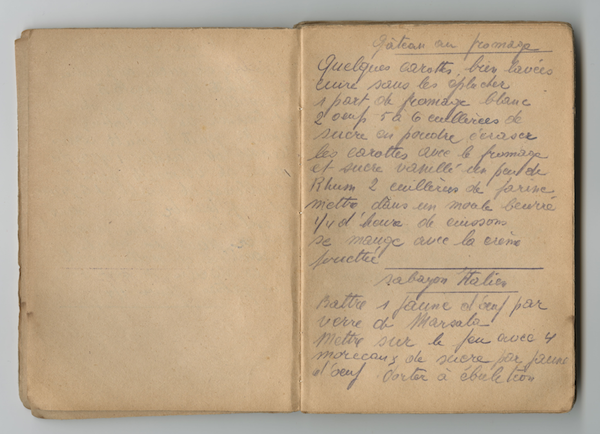
As part of its celebration of BC Heritage Week, the Vancouver Heritage Foundation held the online event Recipes of Resistance: Rebecca Teitelbaum and the Ravensbrück Recipe Book, presented by Lise Kirchner and Ellie Lawson of the Vancouver Holocaust Education Centre. Kirchner is the VHEC’s director of education, Lawson its education manager.
The theme of this year’s Heritage Week is “Stir the Pot,” explained VHF director of education Sarah Carlson. She encouraged viewers to “think about the ways that food brings us together, how it holds memory, and how it has contributed to the rich cultural tapestry of your community and beyond.”
Teitelbaum’s recipe book was donated to the VHEC by Teitelbaum’s nephew, Alex Buckman, also a Holocaust survivor, who died in 2023.
“He was Rebecca’s nephew, but he actually was raised as Rebecca’s son…. Rebecca was the only mother that Alex ever knew,” said Kirchner. “His parents perished in Auschwitz, and Rebecca made a promise to God that she would raise Alex as her own son, which she did.
“In the 1990s, Alex discovered this recipe book in the drawer of Rebecca’s home, and he asked her about it. He had never heard the story before. Apparently, she had never told anybody, but she explained to Alex the incredible story of this recipe book, how it was created and how it survived.”
Kirchner showed many archival photographs, including of Teitelbaum and one of Teitelbaum with her younger brother, Isaac Buckman, in the 1930s.
“Isaac is Alex’s father,” explained Kirchner. “These two siblings, Rebecca and Isaac, were very close. They also had a younger brother, Jacques.”
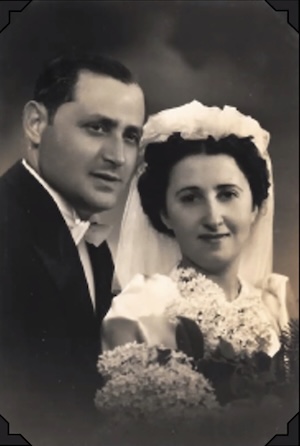
Rebecca and her husband Herman were married in 1938. “They had a daughter, Anny, in 1939, and they lived … near Brussels, before the Second World War. Rebecca worked in the accounting department of a department store in the city of Brussels.”
Kirchner also shared a photo of Isaac and Dworja Buckman, who married around the same time as the Teitelbaums.
“The same year that Rebecca’s daughter, Anny, was born, Isaac and Dworja had a son, Alex, in October 1939.”
In May 1940, Germany invaded Belgium and the Nazis set up a military occupation government. “Unlike many other countries where the civil administrations cooperated with Nazi deportations, the situation in Belgium was much different and, as a result, the survival rate of Belgian Jews was higher than many of the Western European countries,” said Kirchner.
Nonetheless, restrictions were placed on Jews and Kirchner went through the progression of anti-Jewish laws in Belgium. There were pogroms, as well, and, in May 1942, all Jews over the age of 6 had to wear the yellow star to identify them as Jewish.
From 1941 to mid-1942, Anny and Alex were placed into hiding, which worked until their families ran out of money, said Kirchner. When the woman hiding the kids denounced them to the Nazi authorities, the families were in grave danger.
“Between 1942 and 1944, the German occupying forces deported around 25,000 Jews from Belgium to concentration and death camps in the east, primarily to Auschwitz, and only 2,000 of these survived – 43% of the Jewish population in Belgium was murdered,” said Kirchner.
Once the Belgian resistance became more organized, there were resistance networks focused on hiding Jewish children. The largest was the Committee for the Defence of Jews, she said, and it successfully hid some 2,400 Jewish children from the Nazis, including Anny and Alex.
Isaac and Dworja Buckman were deported to Auschwitz-Birkenau in 1943 and murdered. Rebecca and Herman Teitelbaum were deported to forced labour camps in Germany: Herman to Buchenwald, and Rebecca to Ravensbrück.
“Rebecca spent 17 months in Ravensbrück concentration camp as a slave labourer,” said Kirchner. “She was first assigned to work hard labour, hauling wood and stone and heavy carts in very harsh outdoor conditions, but, because she had worked in that department store in Belgium and she had experience with accounting work, she was able to secure a much better work assignment in the office of the Siemens factory.”
Siemens was one of the private companies that used Jewish slave labour, explained Kirchner, before turning the floor over to Lawson to talk about Ravensbrück.
“It was originally built for a little over a thousand prisoners, but, at its peak in 1945, there were over 50,000 prisoners,” said Lawson, who went into some detail about the factory and Siemens’ cooperation with the Nazis.
Despite the unimaginable circumstances, resistance was evident. Lawson shared a quote from Lidia Beccia Rolfi, an Italian prisoner: “Even the theft of a piece of wire, a sheet of paper, of a cloth rag was seen as sabotage, but everyone committed that. Any form of friendship between inmates was seen as sabotage.”
Lawson played a clip from Alex Buckman’s video-recorded survivor testimony. He explained how Rebecca noticed there weren’t that many supervisors at night.
“And then she stole a piece of brown paper, and she put it in her dress,” he said. “And then she stole a little pencil and a pair of scissors. And, at night, she ran towards her barrack, very nervous because she knew that, if somebody would stop her with all these stolen goods, she would be in trouble and they probably would make an example of her, maybe either shoot her or hang her. But she did it.”
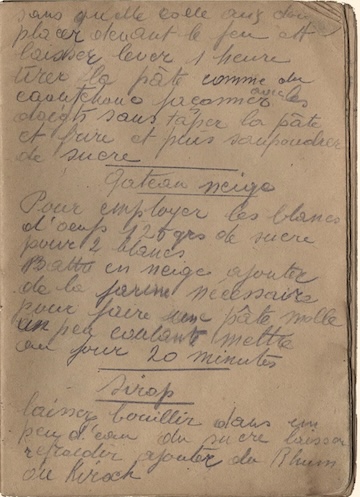
In the barrack, she cut the paper into smaller pieces and started to write recipes “of meals that she did for her husband and her daughter before the war…. With the help of other women, who gave her some of their own recipes, and many of hers, she wrote 110 recipes,” he said. “Even though food was very important to stay alive in the concentration camp, she actually traded some of her food for needles and thread, and she made a book so she could keep it.”
The recipes weren’t necessarily accurate, said Kirchner. “You’ll notice most of the recipes are very heavy on butter and sugar and luxury items like raisins and rum or cream. On the other hand, some of the recipes reflect wartime scarcity…. But the dominant theme of these recipes is one of abundance.”
The recipes reflect the cultural diversity of the women imprisoned in the camp, said Kirchner. “These were women from all over Europe … about half of them were Jewish, but many of them were not, and so the recipes reflect a cultural diversity that’s Jewish, Belgian, French, Spanish, Mediterranean.”
Teitelbaum completed three recipe books, giving two to other women in the camp.
“Rebecca also created another thin volume that contains poems and resistance songs,” said Kirchner, adding, “She also made two sets of playing cards, which the Roma women in the camp would use to tell the fortune of other prisoners. So, again, building community between not just the Jewish women in the camp, but across cultures. And this was an essential form of hope and community-building and resistance by the camp inmates.”
Teitelbaum was one of 2,000 women saved in a Red Cross mission that saw 36 buses take the women from Ravensbrück to safety in Denmark and Sweden. However, the area was still a war zone and one fleet was hit by friendly fire.
“This convoy carrying 706 women, including Rebecca, was attacked multiple times by fighter planes and, as a result, there were about 25 fatalities and numerous injuries among the rescued prisoners,” said Kirchner. “Rebecca herself survived the attack, but was hit by shrapnel and badly injured her left arm. And, in the scuffle and the mayhem that followed … she lost her bundle of belongings: a sack that contained her recipe book.”
Herman, Anny, Jacques and Alex also survived.
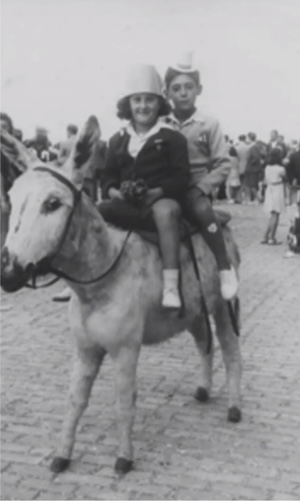
“Anny and Alex were raised as siblings,” said Kirchner, and Rebecca and Herman had another child after the war. “Rebecca named this baby Christian, in honour of King Christian … who had visited her in the hospital, and who had become a bit of a folk hero in the Jewish community in Denmark.
“In 1951, the family left Europe and they arrived at Pier 21 in Halifax in September of 1951 before making their way to Montreal, where they settled permanently,” continued Kirchner. “They had one last child, named Shirley, who was born in Montreal in 1953, and Rebecca Teitelbaum became a Canadian citizen in 1957. She lived the rest of her life in Montreal, and she died there in 1999.”
The sack Teitelbaum had lost was found near the site of the bombing and, because it contained letters that identified her, the person that found the bag tracked her down.
“Rebecca’s recipe book is one of six Holocaust recipe books that we’re aware of in museums around the world,” said Kirchner. “These artifacts have given historians greater understanding about the unique responses of women to their persecution…. Unlike traditional cookbooks, they’re not about cooking, in practice, they’re about maintaining identity, resisting dehumanization, transmitting a culture that the Nazis were attempting to destroy, and they also functioned as a psychological coping mechanism that forged group cohesion and a spirit of communal care.
“The creation of these recipe books all came at great risk and sacrifice, and they’re important not only because they demonstrate the agency of female prisoners who were trying to assert control over their hunger by eating with words, but they also provide an archive of women’s communal responses to their persecution, which elevates women’s domestic expertise to the level of historical record.”
In his talks as an outreach speaker, Buckman would give students the Gâteau à l’orange recipe from Teitelbaum’s book.
“This was a cake,” said Kirchner, “that Rebecca would make for Alex every birthday, and he would encourage the children to make it at home with their own parents, to give their parents a hug, to make this orange cake in honour of his Aunt Rebecca, and also in memory of all of those who were murdered in the Holocaust, including his own parents, Isaac and Dworja.”
The recipe is on the VHEC’s website, vhec.org.