Skip to content
  • Home
  • Subscribe / donate
  • Events calendar
  • News
    • Local
    • National
    • Israel
    • World
    • עניין בחדשות
      A roundup of news in Canada and further afield, in Hebrew.
  • Opinion
    • From the JI
    • Op-Ed
  • Arts & Culture
    • Performing Arts
    • Music
    • Books
    • Visual Arts
    • TV & Film
  • Life
    • Celebrating the Holidays
    • Travel
    • The Daily Snooze
      Cartoons by Jacob Samuel
    • Mystery Photo
      Help the JI and JMABC fill in the gaps in our archives.
  • Community Links
    • Organizations, Etc.
    • Other News Sources & Blogs
    • Business Directory
  • FAQ
  • JI Chai Celebration
  • JI@88! video

Recent Posts

  • Story of Israel’s north
  • Sheltering in train stations
  • Teach critical thinking
  • Learning to bridge divides
  • Supporting Iranian community
  • Art dismantles systems
  • Beth Tikvah celebrates 50th
  • What is Jewish music?
  • Celebrate joy of music
  • Women share experiences 
  • Raising funds for Survivors
  • Call for digital literacy
  • The hidden hand of hate
  • Tarot as spiritual ritual
  • Students create fancy meal
  • Encouraging young voices
  • Rose’s Angels delivers
  • Living life to its fullest
  • Drawing on his roots
  • Panama City welcoming
  • Pesach cleaning
  • On the wings of griffon vultures
  • Vast recipe & story collection
  • A word, please …
  • מארק קרני לא ממתין לטראמפ
  • On war and antisemitism
  • Jews shine in Canucks colours
  • Moment of opportunity
  • Shooting response
  • BC budget fails seniors
  • Ritual is what makes life holy
  • Dogs help war veterans live again
  • Remain vital and outspoken
  • An urgent play to see
  • Pop-up exhibit popular
  • An invite to join JWest

Archives

Follow @JewishIndie
image - The CJN - Visit Us Banner - 300x600 - 101625

Byline: Cynthia Ramsay

Unique, memorable travels

I know what my wife and I will do for at least part of our winter break – go through the latest edition of Robin Esrock’s The Great Canadian Bucket List: One-of-a-Kind Travel Experiences together and make plans. For when? I’m not sure. But plans. Wish lists.

Published by Dundurn Press, and released just last month, this is the third edition of Esrock’s popular book. I interviewed Esrock when the original book came out in 2013, and it has evolved substantially since then. Notably, as he points out in the introduction, this new list “casts an overdue lens on Indigenous tourism,” which he hopes will result in powerful and personal connections this country desperately needs.” 

New experiences have been added and some revisions have been made. In tandem with the books, there has always been a website, canadianbucketlist.com, because, as Esrock writes, “Tourism is a constantly evolving industry. Tour operators, restaurants and hotels often change names or ownership, adapt their services or cease operations altogether. Records fall, facts shift and practical information needs to be constantly updated.”
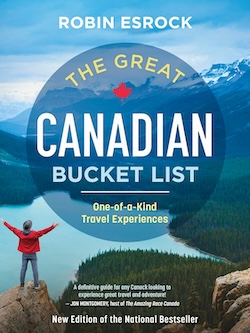
image - The Great Canadian Bucket List book coverThe Great Canadian Bucket List is organized by province, west to east, then up to Yukon, the Northwest Territories and Nunavut. It wraps up with a national section, which has some “Canada’s best” lists, among other things. There are fabulous colour photos throughout. Esrock highlights four to 17 experiences in each chapter, with his home province of British Columbia having the most entries. 

You will hear no complaints from me about this! During COVID, I saw more of British Columbia than I had in the previous 28 or so years of living here. What I love about Esrock’s bucket list choices is their range, from, for example, houseboating on Shuswap Lake, which I could see myself doing, to heli-skiing, which is a hard no, to visiting Haida Gwaii, which I hope to do next year, to things that I’ve done, like visit the Malahat Skywalk on Vancouver Island, and things that probably all of us have done, such as take a stroll along the Seawall. 

The range is as varied for the rest of Canada: there are places I’ve been, things I’d never do, and things I’d jump at the chance to do. 

Years ago, I visited Head-Smashed-in-Buffalo Jump in Alberta and found it fascinating, learning a lot about Indigenous hunting practices. According to Esrock, the “UNESCO World Heritage Site is the most significant and best-preserved buffalo jump site on the continent.”

I’m “hometown” proud of Magnetic Hill in Moncton, NB, where I was born. I’ve rolled “up” the hill more than once and still get a kick out of the cheesiness of it all. As Esrock explains, it’s all an optical illusion, but it’s still magic to me.

I’ve had the privilege of wandering, and occasionally buying something, in every one of Esrock’s best urban markets in Canada: Granville Island here, St. Lawrence Market in Toronto, ByWard Market in Ottawa and the Forks in Winnipeg.

I’m not a big risk taker, so won’t be leaning off the top of the CN Tower in Toronto anytime soon, even with all the safety cords in the world, or scaling a frozen waterfall in Mont-Sainte-Anne, Que. And I will never jump off anything much higher than a curb.

That said, there are so many experiences that I would like to have. In the context of Esrock’s book, one of the top ones is cycling the Kettle Valley Railway, especially now that I’ve learned from Esrock that there’s a company that will provide the bikes, accommodation – and carry our bags! I’d like to check out the tunnels in Moose Jaw, Sask., which “were access corridors for steam engineers, then used as a safe haven for Chinese migrants fearing for their lives, and finally by bootleggers and gangsters.” 

I would love to get to Churchill, Man., something I never managed to do when I lived in Winnipeg. Visiting L’Anse aux Meadows, in Newfoundland and Labrador, where there are the remains of a Norse settlement from 1000 CE, would be cool. Cruising the Northwest Passage would be a once-in-a-lifetime experience (hopefully). There are hikes and kayaking adventures that call to me….

But, for now, I will flip the pages of The Great Canadian Bucket List, contemplating all the possibilities. I’ll worry about what’s affordable, what’s doable physically and mentally, what’s possible time-wise, etc., later. 

Posted on December 5, 2025December 4, 2025Author Cynthia RamsayCategories BooksTags Canada, Great Canadian Bucket List, Robin Esrock, travel

Family memoir a work of art

Karen Bermann’s The Art of Being a Stranger: A Family Memoir, published by New Jewish Press, an imprint of University of Toronto Press, is a work of art. It is moving in ways hard to describe. It might not capture every detail of her family’s history – in fact, wide swaths of that history are missing. What’s not missing, what is powerful, are the feelings this book evokes.

Bermann, who lives in Rome, is professor emerita of architecture at Iowa State University. Her father, Fritz, was born into an Orthodox Jewish family in Vienna. At 15 years old, he and his younger sister, Elsa, who was 10, fled Europe, alone, in the late 1930s. They were separated in Haifa, his sister being taken to an orphanage with the other children who were too young to work. Fritz, as lucky as one can be after losing one’s family and home, ended up with a Russian farming family who treated him well. Nonetheless, at 18, he left the farm and headed off to live on a kibbutz.

image - The Art of Being a Stranger book coverThe way in which Bermann intertwines her father’s words with her own commentary and descriptions is so effective. For example, when Fritz tells her about getting in trouble, at 10 years old, for writing a story about building a bomb to blow up the school, Bermann writes, “‘Oh, Dad, that is really bad.’ Yes, that was a particularly bad one. ‘Were you always so angry?’ I was born angry. And scared. As was my father before me. ‘Even before the Nazis, you were so angry and scared?’ Well, yes. But the Nazis didn’t help.”

This dark sense of humour permeates The Art of Being a Stranger. Bermann doesn’t sentimentalize or sensationalize, she just tells us what her father tells her and sometimes shares her reactions. We also learn – and feel – what she went through as Fritz’s daughter. She writes succinctly, poetically, in both words and images. 

From pre-state Israel, Fritz went to New York City, where he worked in building maintenance. After an incident with an antisemitic boss, he found work at a company, where, over 20 years, he rose up the ladder. “Somehow from being a peasant in Palestine I found myself a bigshot in the world of New York building maintenance,” he tells his daughter. 

But New York never became, for him, a city of museums and operas, but remained one of crooks and bribes. Just like his Vienna wasn’t the city tourists visited to eat sachertorte and go skating, but rather was “a shtetl of poor religious Jews, a ghetto of ignorant bastards who beat their children for making noise on Shabbos, but who knew in their bones that they were not welcome, who recognized the stench of antisemitism in the street while others were perfuming their noses in the rose gardens.”

Fritz’s trauma, inherited from his ancestors, is passed on to his daughter in full force. Yet, Bermann, as a teenager, would defend her father against her friends’ calling him a Nazi, for instance. He was brutally abusive. She only talks about this in relation to herself, not others in the household. To survive, she built “a parallel structure to the one I live in my father’s house.” 

“Fritz was ruthlessly (one of his favorite words) honest about the danger of hope. Hope was more than pointless, it was stupid, and led to suffering,” writes Bermann. “People disappointed by life were stupid people; they made him angry…. He taught us about the strength of character that hopelessness required.”

In addition to sharing some of her childhood experiences, Bermann shares some of her experiences working, at the age of 19, on the rehabilitation of one of the more than 1,000 abandoned buildings on the Lower East Side that she and a group took over from the city: “Ditched by landlords who couldn’t squeeze a profit out of a tenement in need of heat, in need of maintenance, a building that leaked from every weak pore.”

We meet other family members, we find out how Fritz’s story ends. From fragments of a life, we see how complex we humans are, how many contradictions we hold within us, how we can be that which we hate, how we can hurt who we love and how we can love the broken, how beauty exists, sometimes inextricably with the ugly. The stranger of the title is Fritz, it’s Bermann, it’s us. Yet, experiencing The Art of Being a Stranger made me feel more part of humanity, kind of like when we chant Ashamnu together as a congregation: we have abused, we have betrayed, we have been cruel…. None of us is perfect, none of us gets through life unscathed or without hurting others. Yet, we keep getting up in the morning and living. Until we don’t. 

Posted on December 5, 2025December 4, 2025Author Cynthia RamsayCategories BooksTags Art of Being a Stranger, Holocaust, intergenerational trauma, Karen Bermann, memoirs

A little holiday romance

One of my guilty pleasures is Hallmark-style holiday movies. Fine, they’re Christmas movies mainly. But, whenever there is a Jewish character, plotline or, in rare instances, it’s a Hanukkah movie, I am even more a fan. Comfortable in their predictability, especially the happy ending, my body relaxes just thinking about the break from reality they offer. In the last few years, I’ve also read more than my share of  Hallmark-style novels, and this is why I was excited to receive an email from Amelia Doyle, author of Two Weeks in Toronto, which was published last year but was just named a finalist in the romance category of the Canadian Book Club Awards. The winners will be announced in February.

Doyle, a Jewish author based in Dublin, Ireland, has written a few romance novels and has another on the way for next year. Two Weeks in Toronto would make a wonderful holiday movie – and a welcome gift for anyone who’s admitted to you that they like romance novels. There’s no will-they-or-won’t-they-fall-in-love here, just how they will, what obstacles they will have to overcome, what role their best friends or family members will play.

image - Two Weeks in Toronto book coverIn Two Weeks in Toronto, our protagonists are Ciara and Ethan.  They live in Dublin and know each other because Ethan is Ciara’s dentist – and Ciara is terrified of the dentist. Not of Ethan, but of the dentist as a larger concept, its root canals, teeth-cleanings, etc. Ethan does what he can to help Ciara overcome her fears. So, though the two have known each other awhile, it’s been a professional relationship, and they don’t know each other well.

This changes when Ciara’s sister’s wedding requires Ciara to return to her family in Toronto, which she really doesn’t want to do because of a brutally harsh mother and a very difficult sister, and Ethan must go home for the celebration of his parents’ 40th anniversary and of his brother’s engagement, which will be awkward, to say the least, because his brother’s fiancée is Ethan’s former girlfriend.

Ethan suggests to Ciara that he join her in Toronto for the wedding (and Hanukkah) and she join him in Galway over New Year’s – as “boyfriend” and “girlfriend,” so neither will have to face their situations alone. While Ethan is not Jewish, he ends up feeling quite at home with Ciara’s family. Turns out her father, who’s from Ireland, knows Ethan’s parents, and there are connections with other folks in Ciara’s realm. Ciara’s dad also makes sure Ethan knows what’s going on with the candlelightings and what Hanukkah is all about.

I had some trouble believing the sheer horridness of Ciara’s mother and sister, in part because her dad and brother are so friendly and caring, but also because I’m lucky enough not to have such nasty people in my family. I would have been more heavy-handed in the editing process, but, overall, Two Weeks in Toronto is a light, fun read. I’ll keep Doyle in mind when I’m looking for my next escape. 

Posted on December 5, 2025December 4, 2025Author Cynthia RamsayCategories BooksTags Amelia Doyle, romance novels, Two Weeks in Toronto
From the archives … Hanukkah

From the archives … Hanukkah

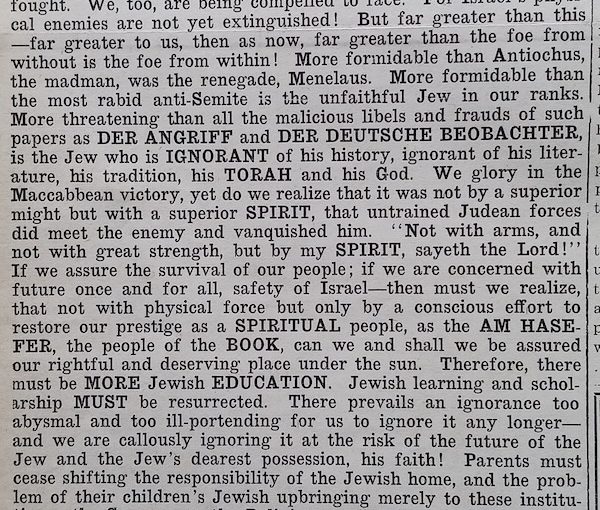
The editorial in the Dec. 8, 1939, issue of the Jewish Western Bulletin.

We’ve come a long way in many ways, though some readers may disagree. I read, kind of in horror, the newspaper’s Dec. 8, 1939, editorial in which the lesson drawn from Hanukkah was that, “More formidable than the most rabid anti-Semite is the unfaithful Jew in our ranks. More threatening than all the malicious libels and frauds of such papers as DER ANGRIFF and DER DEUTSCHE BEOBACHTER, is the Jew who is IGNORANT of his history, ignorant of his literature, his tradition, his TORAH and his God.”

I can appreciate the Maccabean victory “was not by a superior might but with a superior SPIRIT, that untrained Judean forces did meet the enemy and vanquished him.” I agree that Jewish education is vital to Jewish continuity, but yikes. I’m not sure all the “yelling” capital letters encourage the message that: “There must be a closer alliance, a sense of closer affinity, a warmer consciousness of brotherhood between Jew and Jew and between the individual Jew and Jewry at large if we are to succeed – nay, if we are to insure our future as a people!”

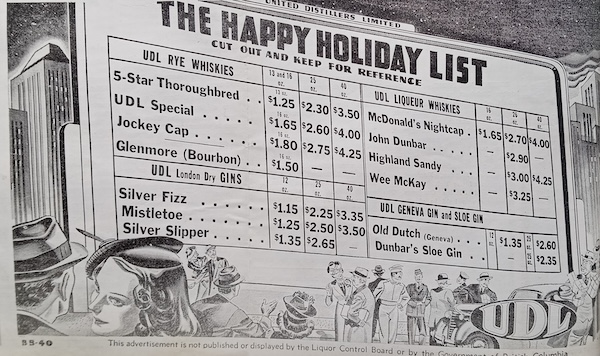
I am also always surprised at how much of the advertising in the early years of the Jewish Western Bulletin was for alcohol. As but one example, given the time of year, is the Dec. 24, 1941, ad from United Distillers Ltd., “The Happy Holiday List” that readers are asked to “cut out and keep for reference,” which I guess I’ve done, though I don’t think any of the brands still exist.

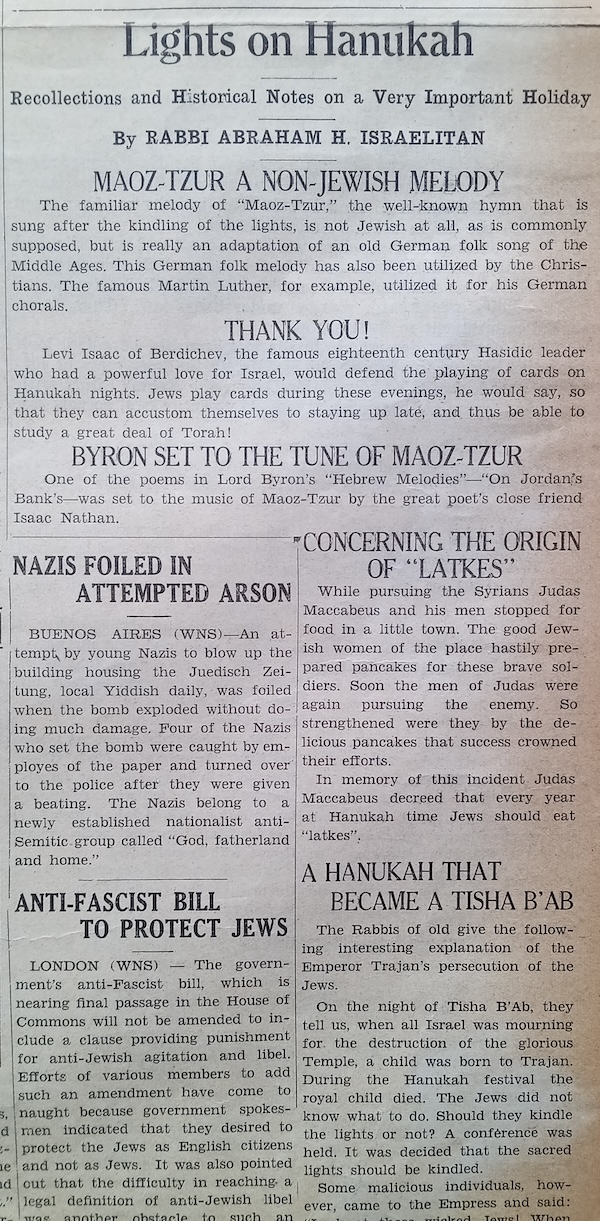
I did enjoy some of the Hanukkah trivia that made the front cover of the Dec. 11, 1936, paper, though it was a jarring juxtaposition with the world news. As it happens, the first item, on the melody of the traditional Hanukkah song “Maoz Tzur,” mentions Martin Luther, as does the article on the cemetery in the German City of Worms that is featured in this week’s issue – on this very page, in fact – which discusses briefly Luther’s legacy.

In his “Lights on Hanukah” article, Rabbi Abraham H. Israelitan points out: “The familiar melody of ‘Maoz-Tzur,’ the well-known hymn that is sung after the kindling of the lights, is not Jewish at all, as is commonly supposed, but is really an adaptation of an old German folk song of the Middle Ages. This German folk melody has also been utilized by the Christians. The famous Martin Luther, for example, utilized it for his German chorals.”

The rabbi also notes, “One of the poems in Lord Byron’s ‘Hebrew Melodies’ – ‘On Jordans Bank’s’ [sic] – was set to the music of Maoz-Tzur by the great poet’s close friend Isaac Nathan.” He goes on to reveal “the origin of latkes,” and a few more of what we now call “fun facts.” Israelitan was not a local rabbi. His article was distributed by Seven Arts Feature Syndicate, which, according to Google, was an American group that provided content to Jewish papers from the 1920s through the 1960s.

Holiday parties, concerts, menorah lightings and more have always been promoted or covered in the newspaper, of course. Almost every Hanukkah issue has included recipes, gift ideas, personal holiday stories. And pretty much every Hanukkah-themed editorial aims to point out what the Maccabees can teach us today or what light we can shine to diminish the darkness in the world – though we do it a little less harshly than the editors of 80, 90 years ago, I think. Most certainly, we do it with fewer capital letters. 

image - An adl in the Dec. 24, 1941, issue of the Jewish Western Bulletin
An ad in the Dec. 24, 1941, issue of the Jewish Western Bulletin.
image - An article on Hanukkah trivia in the Jewish Western Bulletin Dec. 11, 1936
An article on Hanukkah trivia in the Jewish Western Bulletin Dec. 11, 1936.
Posted on December 5, 2025December 4, 2025Author Cynthia RamsayCategories From the JITags archives, editorials, fun facts, Hanukkah, history, Maoz Tzur, trivia
West Van Story at the York

West Van Story at the York

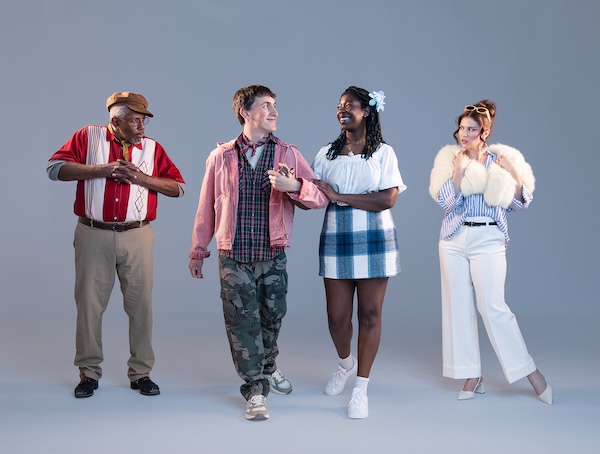
The cast of Theatre Replacement’s East Van Panto: West Van Story, left to right: Tom Pickett, Ben Brown, Ivy Charles and Meaghan Chenosky. (photo by Emily Cooper Photography)

If you want a ticket to East Van Panto: West Van Story, you’d better move fast. At press time, the show had just opened and most performances at the York Theatre were already sold out.

Theatre Replacement’s romp for all ages is inspired by Romeo and Juliet this year. The annual event is popular for many reasons, including a consistently stellar creative team and talented actors, its local flavour and political bent. 

In East Van Panto: West Van Story, written by Marcus Youssef with Pedro Chamale, a tsunami strands West Van influencer Holly and her curling team in East Van, where she falls for Joes – a member of their sworn rivals. Adding to her troubles is her mega-developer “motherfather,” Boberta Rainy. The question is will Holly “follow her heart – and Joes – into a new world of love, dance battles and civic resistance? Or will Boberta’s towers and renovictions crush everything in their path?”

“It’s really fun to be part of a show that takes being silly so seriously,” technical director Daniel O’Shea told the Independent in a recent interview.

O’Shea has been involved with the Panto for a few years now.

“The creative team will come up with such wacky characters and gags, and then we have to earnestly sit around the table and figure them out,” he said. “My first year with Theatre Replacement’s East Van Panto, we had to have the king of the skunks shoot a ‘Stink Canon 9000’ into the audience – who wouldn’t enjoy coming up with that?! Also, because the Panto is a new satire every year, getting to be part of a show that speaks to the current community concerns from a local perspective always feels like a breath of fresh air.”

O’Shea first worked with Theatre Replacement on a show called MINE, which, he said, “was a performance that took place half on stage and half in Minecraft. I was colleagues with a number of the devisors on the show and we needed to build some systems for controlling the projection integrating the video input from multiple gaming computers and building in game cues. As part of that show, we built a tech booth in Minecraft and I had little avatar who would run around and hit in game buttons to teleport people or spawn creatures; it was quite fun. I guess I mention it because the pleasure in working with Theatre Replacement is that I’ll often be solving unorthodox problems or working in novel ways.”

The biggest challenge of working on the Panto, he said, is its size.

“We want East Van Panto to feel like a big show, with clever sets and big costumes and arresting moments, and we often succeed, but all of that has to fit into quite a small container,” he explained. “The York Theatre is a wonderful home and we love being there, but we are often pushing the limit of what we can fit onto the stage. It often requires extremely thoughtful planning and clever technical solutions to achieve this big story book mise en scène in a converted movie theatre. We are grateful to our partners at the Cultch and the tech team there that help to pull it off each year.”

photo - Daniel O’Shea
Daniel O’Shea (photo from Theatre Replacement)

O’Shea has a bachelor of fine art from Simon Fraser University, where he majored in theatre performance and film production. 

“I’ve always had a love of both film and stage since I was a kid, fostered by my parents taking us out to shows, and a somewhat onerous VHS mail arrangement through which we received dozens of old back catalogue titles. Though they present quite differently now, both film and theatre share so much DNA, going to back to early cinema. That particular artist-alchemy of narrative, imagination, character, emotion, etc., that both seek has always been something I’ve been drawn to create.”

He gave a shout out to his high school, Burnaby North, and to Alison Schamberger and Phil Byrne, who ran the theatre and media arts program. “They were both instrumental to instilling the sense that creating in both fields was possible, valuable and worthy,” he said.

Career-wise, O’Shea has focused on lighting and projection design, filmmaking and technical direction. He has done some performing, but not for about 10 years now. Nonetheless, his acting experience continues to help his work, in that it allows him to have a fuller sense of the world a show creates.

“It’s possible to get overly engrossed in the issues that feel pertinent to one’s role, like the efficiency of technical rehearsal or the familiarity of ‘how things are done’ and miss the chance to allow for creative risk-taking and imagination,” he said. “Having that performance background helps remind me that achieving the desired audience experience during a show is the goal rather than whether your plan going into tech looks like what’s on stage opening night.”

O’Shea is also a founding member of A Wake of Vultures, with Nancy Tam and Conor Wylie. 

“It’s a vehicle for us to make work that is true to our artistic core,” said O’Shea. “The three of us work as freelance designers/ artists in the broader community and convene together when someone has a juicy idea. 

“Working as a freelancer, you are often given creative agency, I mean it’s clearly part of what you are there for, but it’s often within the constraints of the production or the shows’ genre/esthetics. If it’s a play about a character journey, then the design has to serve that. When we work together in A Wake of Vultures, we really get to dream wildly as designers/conceptual thinkers and follow our process…. That freedom to dream and build ways of affecting the audience before serving other elements of the show is deeply enjoyable.”

Currently, A Wake of Vultures is working on a piece called SweatCry, “which will be some sort of structured social experience investigating ecstasy, purgation and dance,” said O’Shea. “I’m also going on tour with Jade Circle, a show on which I did the projection design, made by Jasmine Chen, which is a beautiful show tracing the cascading chain of mother-daughter relationship and stories buried within our own families.”

O’Shea described his own connection to Judaism and Jewish community as “cultural and fostered through the deep networks that I’ve grown up a part of and, yet, it feels most represented by the Groucho Marx line, ‘I wouldn’t want to belong to a club that would have me as a member’ – a belonging and exclusion at the same time. That, or Moses’ line about being a ‘stranger in a strange land.’ There is a tension in being a tribe of the estranged that has meaning to me, both in the way that it seats one in relationship to the world and in how it asks of you to make kinship with ‘the stranger.’

“I think it is also the reason why I have such a love of ritual,” he concluded. “Whether it’s in a show or a meal of special ceremony, the sense that formal choices, of how to do things, can have deep symbolic and historical ties, and be a thread that links people across time really moves me … both of these facets of my Jewish identity shape my life and work.”

For tickets to East Van Panto: West Van Story, which is directed by Chelsea Haberlin, with music by Veda Hille, go to thecultch.com. There are shows through Jan. 4.

Format ImagePosted on November 21, 2025November 20, 2025Author Cynthia RamsayCategories Performing ArtsTags Daniel O'Shea, East Van Panto, musicals, panto

Life, beginning to end

Love is at the heart of three new children’s books that would make great Hanukkah gifts.

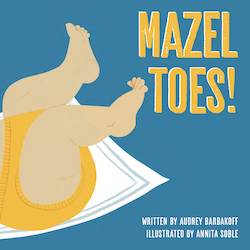
image - Mazel Toes! book coverMany different types of families welcome their newborns in Mazel Toes!, written by Dr. Audrey Barbakoff and illustrated by Annita Soble. Each set of pages is a work of art with a rhyming poem that highlights playful gestures of love, like a kiss on the pupik (belly button), and more serious ones, like making sure baby is safe and warm in their schmatte (rag or, in this case, “a well-loved baby blanket”). Multiple generations of Jews are depicted, multiple family configurations and multiple cultures. It is a fun board book for both reader and listener – and can be as interactive as you want it to be. You can read it quietly, all snuggled up, or more raucously, with tickles of “mazel toes” and other giggles.

image - Waiting for Max book coverA more serious but equally  adorable and educational book is Waiting for Max: A NICU Story, written by Emily Rosen and illustrated by Esther Diana. Based on Rosen’s own experiences of having had a baby who had to spend 16 days in the hospital’s neonatal intensive care unit (NICU), Waiting for Max centres around Louise, Max’s big sister, who is very keen to meet her new baby brother and doesn’t really understand why Max, who was born premature, can’t come home yet. So, she puts her mind to figuring out ways to help him escape from the “little plastic box” (incubator) he’s in. She puts a lot of imagination and work into drawing out her ideas. Each one she comes up with, she gives to her parents to take to Max, so that he can follow her instructions. She shows great perseverance, always thinking up a new idea when one doesn’t work. She keeps at it until Max eventually makes it home – no doubt, because of her idea.

Apparently, one in 10 babies in the United States must spend time in an NICU, and Rosen will donate a portion of her book’s proceeds, as well as copies of Waiting for Max, to NICU hospitals and nonprofits across the States.

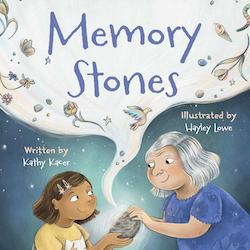
image - Memory Stones book coverAt the other end of the life spectrum, author Kathy Kacer, who specializes in writing books to educate younger readers about the Holocaust, has come out with a different kind of lesson. In Memory Stones, which is beautifully illustrated by Hayley Lowe, we meet Sophie, who has just lost her beloved grandmother. We see some of the many fun things Sophie and Granny would do together, and how heartbroken Sophie is when Granny dies. Sophie brings flowers to Granny’s grave, but they never last long. When Sophie’s mom shares that people in some cultures, including Jews, place stones on loved one’s graves, Sophie figures out a special way to remember her grandmother.

Memory Stones, published by Second Story Press, is intended for readers 6 to 8 years old. Published by the Collective Book Studio, Waiting for Max is for readers 4 to 8 years old, and Mazel Toes!, for babies to toddlers.

Posted on November 21, 2025November 20, 2025Author Cynthia RamsayCategories BooksTags Annita Soble, Audrey Barbakoff, children's books, Collective Book Studio, death, Emily Rosen, Esther Diana, Hayley Lowe, Kathy Kacer, kids books, life, Mazel Toes!, memory, Memory Stones, Second Story Press, Waiting for Max
From the archives … books

From the archives … books

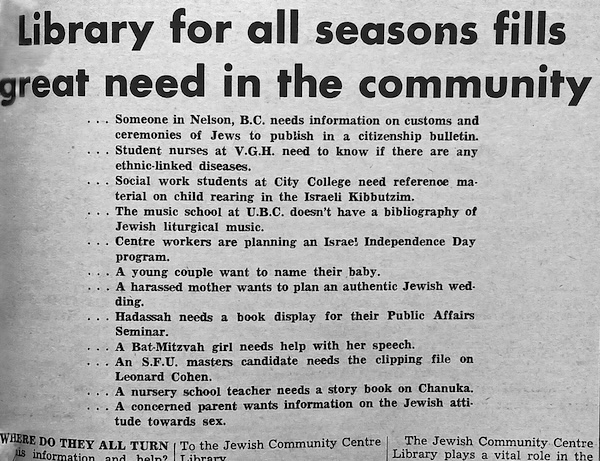
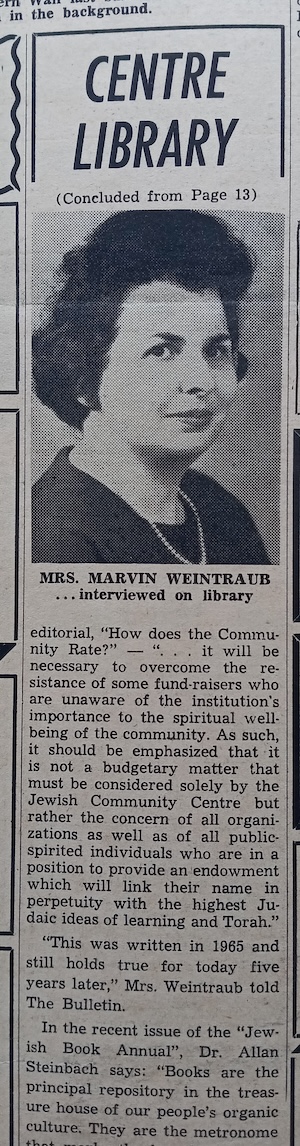
In honour of Jewish Book Month, which runs Nov. 13 to Dec. 13, I’m highlighting a short article that appeared in the Independent’s predecessor, the Jewish Western Bulletin, on Dec. 18, 1970.

image - Rita Weintraub photo in the article on the JCC Library from the Jewish Western Bulletin, on Dec. 18, 1970 The focus on the Jewish Community Centre Library, now called the Isaac Waldman Jewish Public Library, stressed the “vital role” the library plays “in the life of the Vancouver Jewish community” and how it serves “the community at large in a very meaningful and important way. At any time, one can pass by and see it being used for recreational reading, browsing or study.”

The article notes how a visiting professor who stopped in at the library remarked “how thoroughly cross-referenced it was.” 

“Mrs. Marvin Weintraub, hardworking and dedicated volunteer librarian,” aka Rita Weintraub, is interviewed for the story. Many in our community will have known Rita, who died in 2020. The library she was instrumental in building was a lifelong passion. In the article, she refers to the library as important for “the spiritual well-bring of the community.” As such, she said, it should be “the concern of all organizations as well as of all public-spirited individuals who are in a position to provide an endowment which will link their name in perpetuity with the highest Judaic ideas of learning and Torah.”

Posted on November 21, 2025November 20, 2025Author Cynthia RamsayCategories From the JITags history, Isaac Waldman Jewish Public Library, Jewish journalism, Jewish Western Bulletin, Rita Weintraub
Music to build bridges

Music to build bridges

On Nov. 29, sopranos Jaclyn Grossman, left, and Miriam Khalil will perform Salam-Shalom: Echoes of Home, a program they put together in an effort “to build bridges between our communities.”

“Salam-Shalom: Echoes of Home grew out of countless conversations between Miriam and me over the past few years – conversations that gave me a lot of hope during a difficult time,” Jaclyn Grossman told the Independent about her upcoming concert with fellow soprano Miriam Khalil.

“We shared what we were each experiencing, what our communities were going through, and how we might better understand and support one another,” said Grossman. “We both felt a deep need to do something meaningful and to use our voices and our art to foster empathy, connection and healing. This project is deeply meaningful to me because I hope it can create a space for reflection, healing and understanding for our communities, and for anyone who connects with its themes of home, acceptance and belonging. I truly believe we are stronger when we stand together, and I hope this concert helps build bridges that make that possible.”

Grossman and Khalil will be accompanied on piano by Gordon Gerrard, artistic director of City Opera Vancouver, which is presenting the concert. Idan Cohen (Ne.Sans Opera & Dance) will lend his experience in stage and movement, and Avideh Saadatpajouh has created projections that, among other things, highlight some of the textual elements.

“Jaclyn is a beautiful person and has always been someone that I have connected with,” said Khalil about why she wanted to be involved with the production. “Through many of our conversations, our shared dialogue grew and became something we realized we both needed in order to find healing. Jaclyn had mentioned that she had spoken to Gordon about the possibility of creating something together. What made this project so special was our dialogue from the very beginning. Through numerous meetings, we spoke about finding a way through song, language and poetry to create a space for healing and shared empathy and, most importantly, to build bridges between our communities. We longed for the same thing, peace and human connection – this recital is an extension of that longing and an expression of hope.”

As for his participation, Gerrard said he became interested after a conversation with Grossman more than a year ago. “I was distressed to hear that she had had several concert appearances canceled over recent months,” he said. “It seemed to me that many organizations seemed hesitant to present Jewish and Arab artists out of fear of controversy. The program was suggested by Jaclyn as a direct way to counteract this.”

photo - Pianist Gordon Gerrard, artistic director of City Opera Vancouver
Pianist Gordon Gerrard, artistic director of City Opera Vancouver. (photo from City Opera Vancouver)

About the risk of City Opera Vancouver being “canceled” for presenting Salam-Shalom, Gerrard said, “Certainly, we have committed to this special event after careful consideration of the charged environment that we are all a part of right now. We wanted to be sure that we acted responsibly, and that we would be able to create a respectful space for everyone involved. Because I trust Jaclyn, Miriam and Idan entirely, we’ve been able to have many helpful conversations about this event and how to go about it. This has given us at City Opera confidence that we are doing something that intends to create better understanding and, for us, this remains the priority.”

“Our goal with this project is to create a space for nuanced dialogue, where all voices can be heard and where empathy and understanding can grow,” said Grossman. “While this kind of work isn’t always easy, I believe it’s essential. In times like these, it’s more important than ever for communities to come together, listen to one another, and foster compassion. To me, standing together in empathy and respect for all people feels like the only path forward.”

“My concern,” said Khalil, “is that we have a responsibility to one another. If we keep being afraid, then no change will ever take place. We must unite and listen to each other. As Jaclyn mentioned, without compassion and empathy, the way forward feels unattainable. There is great growth in seeing and appreciating one another’s perspective.”

Grossman and Khalil chose the repertoire, and the result will be a concert of “beautiful and seldom performed works entirely curated by the two of them,” said Gerrard.

The hour-long program comprises melodies from myriad musical heritages, including Arabic, Hebrew, Ladino, Spanish and Yiddish. The concert’s press release highlights “Eli, Eli,” an arrangement of a poem by Jewish-Hungarian resistance fighter Hannah Szenes during the Second World War; “Mermaid Songs” by Palestinian-American composer Felix Jarrar; “Ukolebavka,” a lullaby by Jewish composer Ilse Weber, who wrote and performed songs to comfort children when she was interned in Terezín; “Ayre,” by Argentine Jew Osvaldo Golijov, which explores the themes of exile and belonging using the words of a Hebrew prayer and those of Palestinian writer Mahmoud Darwish; and “The New Colossus,” a setting of Emma Lazarus’s poem (inscribed on the Statue of Liberty) by pianist and composer Nate Ben-Horin, who is part of Grossman’s duo, the Likht Ensemble. Another of the songs on the program is “Mi Lo Yeshalach,” by contemporary Israeli composer Hana Ajiashvili. The complete repertoire, with all the lyrics, has been posted on cityoperavancouver.com.

“To me, Salam-Shalom: Echoes of Home is an urgent expression of a voice that feels increasingly silenced,” said Cohen. “I believe the growing calls to silence or divide rather than engage in dialogue are deeply troubling. When Jaclyn, Miriam and Gordon reached out, I immediately said yes. 

“This project also speaks to my responsibility to uphold these values and address the horrors we are living through, through art,” Cohen added. “It’s easy to see conflict in simple opposites – right and wrong, us and them – but true understanding asks us to face complexities.

“Art,” he said, “should remain a space for reflection and critical thought, not moral posturing. I believe in its power to unite, to reveal our shared humanity, and to keep hope for peace alive.”

For tickets to Salam-Shalom, go to cityoperavancouver.com. 

Format ImagePosted on November 7, 2025November 6, 2025Author Cynthia RamsayCategories MusicTags City Opera Vancouver, dialogue, Gordon Gerrard, Idan Cohen, Jaclyn Grossman, Miriam Khalil, peace, Salam-Shalom
Telling the story of an icon

Telling the story of an icon

Ronnie Marmo brings his one-man show I’m Not a Comedian … I’m Lenny Bruce to the Chutzpah! Festival Nov. 18. (photo from dorensorellphotography.com via Chutzpah!)

In 2017, with the expectation of a six-week run, creator and performer Ronnie Marmo and director Joe Mantegna brought I’m Not a Comedian … I’m Lenny Bruce to the stage. Now, celebrating eight years and 468 performances, Marmo told the Independent, “we can not wait to bring it up to Vancouver for 469!”

I’m Not a Comedian … I’m Lenny Bruce is part of this year’s Chutzpah! Festival, which runs Nov. 12-23. It’s being presented on Nov. 18, 7:30 p.m., at the Rothstein Theatre.

Bruce, a groundbreaking standup comedian and satirist, was born Leonard Alfred Schneider in Mineola, on Long Island, NY, in 1925. He consistently pushed social and legal boundaries, being arrested more than once for what was considered obscenity in his day, including a conviction in 1964 for a performance he gave at Café Au Go Go in New York City. Bruce died two years later, at age 40, from an accidental overdose. He was bankrupt, basically not having been employable after the conviction. It would be 37 years before he was posthumously pardoned, by then-governor George E. Pataki.

In I’m Not a Comedian … I’m Lenny Bruce, Marmo told the Independent, “We bookend the show with the final moments of his life and take you on a journey through his first performance all the way to his demise. We learn about his family, we see his charm and success, his struggle with addiction, his long-standing fight with the judicial system. We don’t hold back. You really get a full theatrical experience of his entire life.”

Bruce is one of Marmo’s heroes.

“What inspires me about Lenny is how ahead of his time he was and how passionate he was about his pursuit of the truth. I have so much respect for someone who is willing to sacrifice everything and put it all on the line just to make sure he didn’t fall into suit with everyone else. I’m proud to be entrusted by the family to be the one to tell his story to the next generation.”

Marmo landed on the title for the show after hearing Bruce say, in an audio clip, “I’m sorry I wasn’t funny tonight … I’m not a comedian, I’m Lenny Bruce.” For Marmo, that comment resonated. “He wasn’t a comedian – he was so much more than that,” said Marmo of Bruce. “He was a satirist, a social commentator and a true advocate for the freedom of expression.”

The show has evolved a lot since its creation.

“As the writer, I am always tinkering with the script,” said Marmo. “For example, I removed the famous ‘N-word’ bit when we came back after the pandemic. I felt as though, even though the bit itself was in support of removing power from words so we don’t give them the chance to harm us, I knew that people might have a hard time hearing what Lenny was actually trying to say. Plus, even though I loved the impact it had on an audience, it kept me up at night thinking about it even before events like what happened to George Floyd. I have a responsibility as an artist to tell the absolute truth but also to not be tone deaf to the world around me. I don’t believe Lenny would have done that bit today. 

“I also had long discussions with Kitty [Bruce, Lenny’s daughter] and my director, Joe Mantegna, who both agreed that it was best to remove it. So, I replaced it with ‘The Meaning of Obscenity,’ which, in my opinion, supports the show even more. So, I’m happy to make the switch, knowing it is not only the best fit culturally in this climate but also the strongest choice for the show overall. As a performer, my portrayal of Lenny evolves as I explore my own life and how I tell his story resonates differently depending on where I am in my life. I think it takes passion, dedication and an openness to watch it grow and evolve along with me.”

While I’m Not a Comedian … I’m Lenny Bruce premiered in 2017, Marmo said, “I’ve actually been with Lenny since 2005, when I did another show about him, called Lenny’s Back and Boy is He Pissed. On stage, I don’t separate us – it is my job as an actor to find where we meet in the middle. I try to focus on all the similarities that I identify with for Lenny. It is easy to keep it fresh because it is such an emotional ride and massive performance. I don’t feel like I ‘have it’ yet, which is refreshing, because it always feels just slightly out of reach.”

When Marmo did Lenny’s Back, which was brought to him by comedian Charlie Brill, he became “intimately involved with Lenny Bruce and his life.

“In getting to know him, I realized that there was so much of his story we weren’t telling. I wanted to get into the nitty gritty, I wanted to do his bits,” said Marmo. “So, I set out to write my own show. 

“We initially started the show anticipating a six-week run,” he said. “This thing has caught fire in the most incredible way. It is a testament to just how relevant Lenny is today – perhaps even more than he was over 60 years ago! It truly has been a perfect storm: free speech, first amendment, cancel culture and not to mention the success of the Amazon series The Marvelous Mrs. Maisel. They really helped catapult Lenny’s name back into pop culture and have sold thousands of tickets for us. We have, in some ways, come very far and, in others, not far at all.”

Marmo described Bruce as “a very proud Jewish man,” who often incorporated Judaism and his Jewish heritage into his material. “He openly incorporated his Yiddish vocabulary into his bits and there is quite a bit of familiar references sprinkled throughout the show,” said Marmo. “His relationship with religion overall was complex but, rather than hiding his heritage, he celebrated it.”

As for what he thought gave Bruce the courage to run up against the country’s obscenity laws, Marmo said, “The truth. He held a mirror up to society and asked questions that everyone wondered about but never found any resolution to. He also fervently believed in our judicial system and always believed that it would prevail and he would be redeemed – something that he, unfortunately, didn’t see in his lifetime, but did come to fruition with his posthumous pardon in 2003 – the first in New York history, in fact. He spoke out loud what everyone whispered to themselves and his popularity was proof of how profound he was.”

Even though Bruce wasn’t alive to receive the pardon, Marmo still believes it was an important action.

“It was a landmark symbolic victory for free speech,” he said. “I think it was redemption. It was validation that Lenny had something to say to this society and that we are free-thinking creatives entitled to our artistic expression.”

For tickets to I’m Not a Comedian … I’m Lenny Bruce or any other Chutzpah! show, go to chutzpahfestival.com or call 604-257-5145. 

Format ImagePosted on November 7, 2025November 6, 2025Author Cynthia RamsayCategories Performing ArtsTags Chutzpah!, comedy, free speech, history, Lenny Bruce, Ronnie Marmo, satire

From the archives … editorials

Almost every year that the Jewish Independent has entered the American Jewish Press Association’s Simon Rockower Awards for Excellence in Jewish Journalism competition, the paper has been recognized for its editorials. We have won for other articles, too, in several different categories, but have taken away the most honours for our editorials. This year, for instance, we took first and second place! (See jewishindependent.ca/ji-editorials-win-twice.)

The JI’s editorial board, Pat Johnson, Basya Laye and I, don’t always agree initially on what the editorial’s stance will be. Our back-and-forths, exchanging our different views and coming to a consensus, is one of my favourite parts of running the paper. It’s a key reason, I believe, that the editorials have been so award-winning.

Another reason is that the three of us have read and worked on the Jewish Independent for so many years, and we’ve been part of this community for so many years. We are grateful for those on whose shoulders we stand. The wisdom of previous generations, and that of our own generation, inspires how we look at what’s happening here and elsewhere in the world.

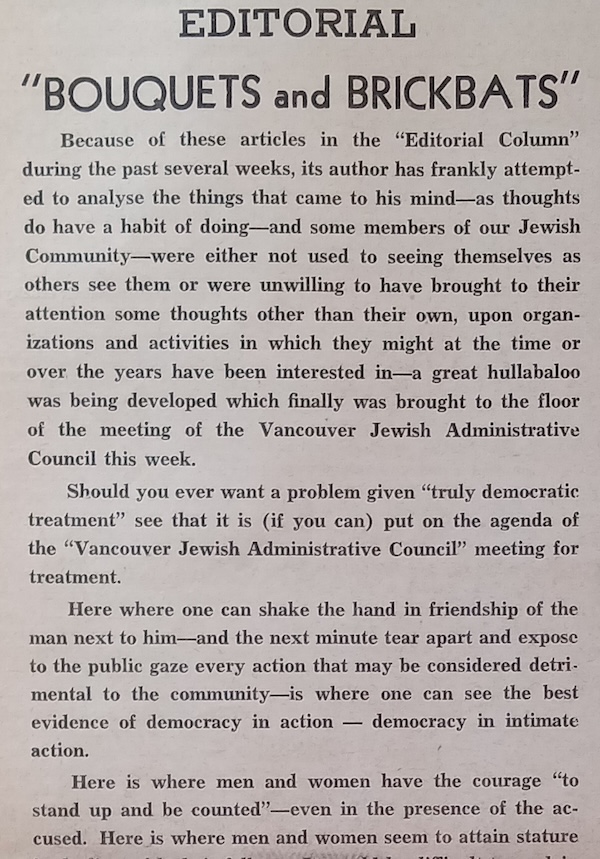
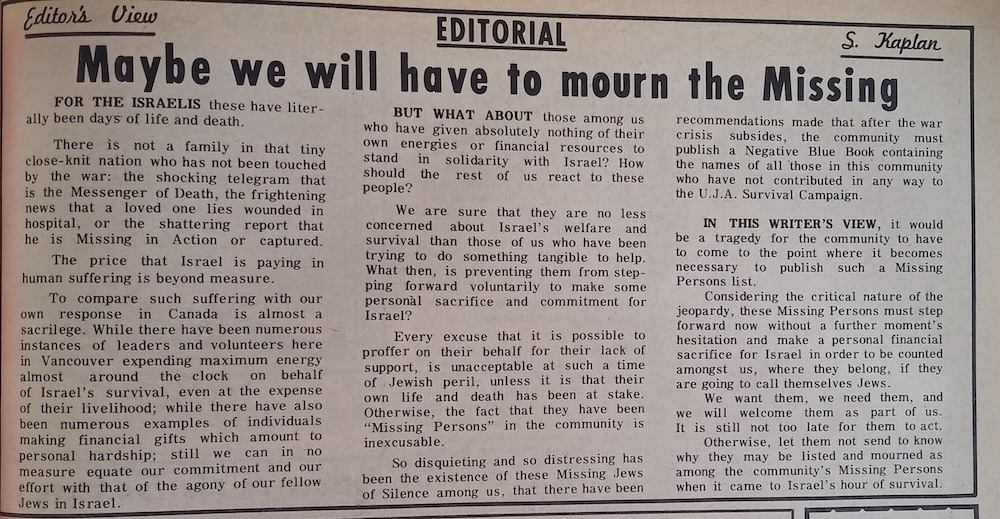
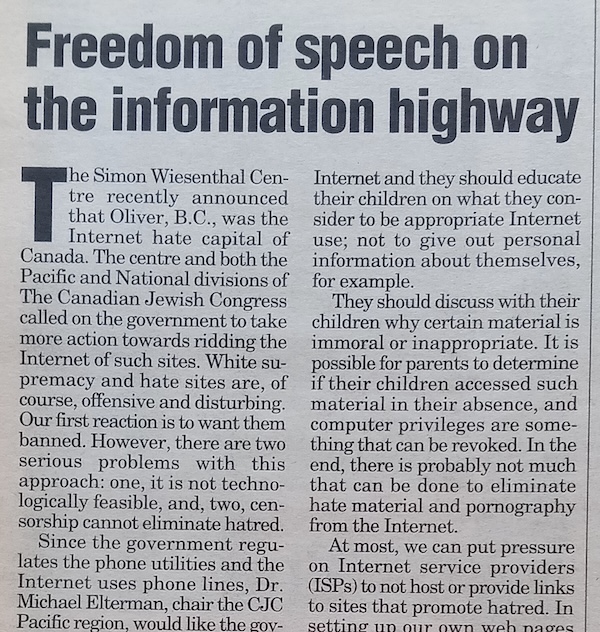
As I looked through the JI archives, I came across the first editorial I wrote for the paper, when it was still called the Jewish Western Bulletin, and before Pat, Basya and I became a team. I also clipped out just some of the thousands of editorials that have been written over the years. There are so many recurring themes, including communal and democratic responsibilities and the importance of free speech. The editorials variously try to calm, cajole, educate or empower readers. 

image - April 13, 1945, editorial in JWB
April 13, 1945: The paper’s editorials were brought under community review. Associate editor Goodman Florence describes the meeting that took place and comes to the conclusion that, “He who aspires to express himself must expect to receive both ‘bouquets and brick-bats’ – and if he is intelligent he will use them both.”
image - Oct. 26, 1973, editorial in JWB
Oct. 26, 1973: Jewish Western Bulletin editor Sam Kaplan calls out community members who’ve not contributed funds to Israel in the wake of the Yom Kippur War. The editorial floats the idea of publishing a list of these “Missing Jews of Silence.”
Feb. 6, 1998, editorial in the JWB
Feb. 6, 1998: My first editorial for the paper argued for limited  regulation of the internet, concluding that state censorship is more dangerous than free speech, including hate speech.
image - The JI editorial board’s first place Rockower Award winners from 2024
The JI editorial board’s first place Rockower Award winners from 2024 – and our many other missives – can be read at jewishindependent.ca.
Posted on November 7, 2025November 6, 2025Author Cynthia RamsayCategories From the JITags AJPA, American Jewish Press Association, editorials, history, Jewish Independent, Jewish Western Bulletin, journalism, Rockower Awards

Posts pagination

Previous page Page 1 Page 2 Page 3 Page 4 … Page 84 Next page
Proudly powered by WordPress