

“In the pages of this book,” write Oga Nwobosi and Christina Myers, co-editors of Beyond Blue: Stories of Heartbreak, Healing and Hope in Postpartum Depression, “readers will find the personal stories of 26 writers who all encountered some variety of perinatal mood disorder, whether officially diagnosed at the time or identified only in retrospect many years after the fact. There is rage and sadness and tears and trauma; there is also hope and humour and healing. What these stories have in common is the vulnerability it requires to share out loud – one of the most powerful manifestations of courage.”
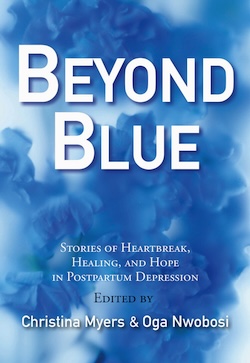 Nwobosi and Myers, who met in 2007 at a meet-up of new mothers facilitated by the Pacific Post Partum Support Society in Richmond, note that, while “perinatal mood disorders are better known and openly discussed today than they were then, there are still too many layers of stigma, shame, isolation and uncertainty. Many people still don’t get timely help; most don’t get any help at all.”
There is a lot to learn from reading Beyond Blue, notably that “depression,” or feeling “blue” doesn’t begin to cover the complexities of postpartum depression. It takes many forms – sadness, fear, pain, exhaustion, anger, some of the above, all the above, and so many other configurations. It’s not a matter of every woman feeling any one thing or all women experiencing the same range of emotions and physical sensations. Every instance is different, in both causes (to the extent they can be known) and effects. Every woman is different, not only in personality, but in health, social and other circumstances.
Leanne Charette, for instance, has cerebral palsy. “I pushed for many long months, trying to get apathetic, or downright ableist, doctors to help me achieve the dream of birthing children from my disabled body,” she writes. The doctors’ attitudes impacted her, of course, increasing her anxiety, among other things. She not only successfully conceived, but gave birth to twin boys.
“As my children were placed in my arms for the first time, their tiny fingers and IV tubes tangling with my own, a hypervigilance awoke alongside the all-consuming love in my heart,” writes Charette. “Sleep became impossible. For days, as we waited to be discharged from the hospital, I would hardly close my eyes, convinced my children might be taken away, starved or harmed in the space of a blink.”
Other women also write about the fear of someone, including themselves, harming their children. Sleeplessness is common, as are feelings of guilt about so many aspects of motherhood, such as having trouble during pregnancy, giving birth or breastfeeding.
Contributors talk about good and bad advice they received while struggling with postpartum depression. In a few instances, seeing a mental health professional was life-saving.
Jewish community member Kelley Korbin is one of the contributors. Her bio notes, “She is the proud mum of three thriving adults, but the early years were not easy as she experienced the shame, anxiety and confusion of postpartum depression following two of her pregnancies.” Her essay is about the first turbulent year of her son Jake’s life.
“Just half a day into motherhood I was doubting my ability to nurture,” writes Korbin. Weeks later, things were not going well. “If Jake was awake – and he was awake most of the time – he was either fitfully nursing or crying.”
Korbin mustered the courage to ask the public health nurse what she was doing wrong. “‘Colic,’ the nurse pronounced, and hastily retreated to the get-away car she had parked in the driveway. I was drowning, but she had thrown me the teeniest of life preservers,” writes Korbin. “Armed with a diagnosis, however vague, and the doggedness of my gritty pre-motherhood persona, I scoured the parenting sections of bookstores and libraries.”
What she found was that “evening colic” normally “vanishes after three months.” Even though Jake cried all day, not just at night, Korbin started the countdown. After “the promised three-month colic finish line” came and went, she took Jake back to the doctor for the “umpteenth visit.” He pronounced Jake healthy, but warned the colic wouldn’t end soon. Two months later, she started therapy. By Jake’s first birthday, “he was sleeping through the night,” and so was Korbin.
Beyond Blue should be read by anyone who’s thinking about having children, new parents, and everyone who knows someone who’s just had kids. So, basically, everyone.



