Skip to content
  • Home
  • Subscribe / donate
  • Events calendar
  • News
    • Local
    • National
    • Israel
    • World
    • עניין בחדשות
      A roundup of news in Canada and further afield, in Hebrew.
  • Opinion
    • From the JI
    • Op-Ed
  • Arts & Culture
    • Performing Arts
    • Music
    • Books
    • Visual Arts
    • TV & Film
  • Life
    • Celebrating the Holidays
    • Travel
    • The Daily Snooze
      Cartoons by Jacob Samuel
    • Mystery Photo
      Help the JI and JMABC fill in the gaps in our archives.
  • Community Links
    • Organizations, Etc.
    • Other News Sources & Blogs
    • Business Directory
  • FAQ
  • JI Chai Celebration
  • JI@88! video

Recent Posts

  • Sharing her testimony
  • Fall fight takes leap forward
  • The balancing of rights
  • Multiple Tony n’ Tina roles
  • Stories of trauma, resilience
  • Celebrate our culture
  • A responsibility to help
  • What wellness means at JCC
  • Together in mourning
  • Downhill after Trump?
  • Birth control even easier now
  • Eco-Sisters mentorship
  • Unexpected discoveries
  • Study’s results hopeful
  • Bad behaviour affects us all
  • Thankful for the police
  • UBC needs a wake-up call
  • Recalling a shining star
  • Sleep well …
  • BGU fosters startup culture
  • Photography and glass
  • Is it the end of an era?
  • Taking life a step at a time
  • Nakba exhibit biased
  • Film festival starts next week
  • Musical with heart and soul
  • Rabbi marks 13 years
  • Keeper of VTT’s history
  • Gala fêtes Infeld’s 20th
  • Building JWest together
  • Challah Mom comes to Vancouver
  • What to do about media bias
  • Education offers hope
  • Remembrance – a moral act
  • What makes us human
  • המלחמות של נתניהו וטראמפ

Archives

Follow @JewishIndie
image - The CJN - Visit Us Banner - 300x600 - 101625

Byline: Cynthia Ramsay

JI wins four Rockowers

JI wins four Rockowers

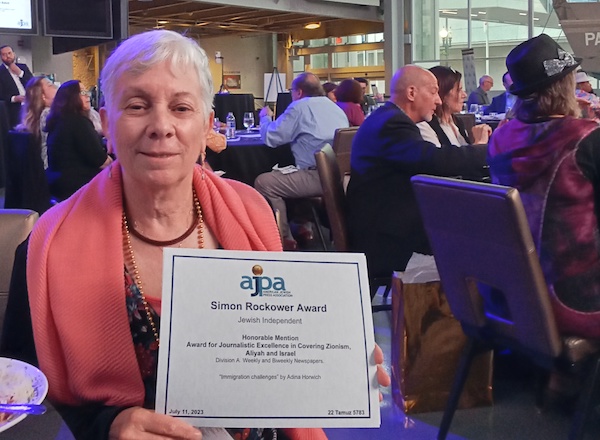
Adina Horwich at the 42nd annual Rockowers Awards. She received an honourable mention for journalistic excellence in covering Zionism, aliyah and Israel. (photo from Adina Horwich)

The Jewish Independent won four Simon Rockower Awards for Excellence in Jewish Journalism this year. The awards, which are given out by the American Jewish Press Association, were for work done in 2022. The JI has had a few Rockower hat tricks in its history, but this is the first time the paper has garnered four honours in one year.

The awards were presented on July 11 at the Higgins Hotel and Conference Centre in New Orleans, La., where the AJPA’s annual conference was held. The JI mainly competed in the division of weekly and biweekly newspapers, but there were some categories for which the competition was between all types of media (print and online); awards were given for first and second place, and sometimes honourable mention.

Writer Adina Horwich traveled from her home in Israel to New Orleans to receive her award in person. She won the JI an honourable mention for journalistic excellence in covering Zionism, aliyah and Israel for her article “Immigration challenges” (jewishindependent.ca/immigration-challenges-2). The piece both reviews Adi Barokas’s Hebrew-language graphic novel, The Journey to the Best Place on Earth (and Back), about Barokas’s experience trying to immigrate to Vancouver from Israel, and shares Horwich’s experience making aliyah from Canada. The jury commented: “Extremely readable story, that skilfully explores from a personal perspective the nitty gritty of making aliyah.”

The JI’s Pat Johnson also received an honourable mention – his article “Oasis in the Caucasus” (jewishindependent.ca/oasis-in-the-caucasus) garnered recognition for excellence in writing about Jewish heritage and Jewish peoplehood in Europe. The jury said about his piece:

“A terrific look into the Jewish community of Azerbaijan that most of us, unfortunately, don’t have on our ‘Must-Go Places to Visit.’ Pat Johnson’s very nice story strongly suggests otherwise. Johnson paints a wonderful picture of this tucked-away ‘shtetl’ where the residents say they have never faced antisemitism. If only we could feel so lucky here in the United States! And while most of us do well playing ‘Jewish geography,’ actual world geography is often more of a challenge. Having Johnson admit having to Google Azerbaijan before traveling there to report this story added a nice touch that connects with readers who may also be unfamiliar with the country – but now more knowledgeable thanks to this feature.”

Johnson was recognized for another of his articles, “Maus not too graphic” (jewishindependent.ca/maus-not-too-graphic), which placed second for excellence in education reporting. Johnson sat in on Anna-Mae Wiesenthal’s Holocaust and Genocide Studies class at King David High School, and listened as students discussed the graphic memoir Maus by Art Spiegelman.

“Lots of people laughed when a Tennessee school board pulled Maus from the curriculum because of the drawing of a naked cat. That was too much for board members and they banished the Pulitzer Prize-winning graphic novel,” wrote the Rockower jury. “Viewing the book through the eyes of five students at a Jewish high school subtly portrays the board decision’s absurdity.”

Rounding out the JI wins was a first place for excellence in editorial writing – where all entries competed in the same division. The JI editorial board of Johnson, Basya Laye and me were honoured for the set of editorials that included “Every person has a voice” (about Elon Musk, hatred and misinformation online, and how people can counter such forces), “Extremism not helpful” (about New Democratic Party leader Jagmeet Singh’s views on the Israeli-Palestinian conflict) and “New era in U.S. politics” (about the U.S. Supreme Court’s rejection of a woman’s right to reproductive self-determination, as well as the Jewish perspective on abortion).

About these editorials the Rockower jury wrote: “These pieces are good examples of what editorials should be – thoughtful examination of pressing issues, using clear reasoning in looking at both sides, then coming to a well-reasoned conclusion. Local tie-ins strengthen opinions.”

All of us at the JI appreciate the AJPA’s recognition of the hard work that goes into producing an independent Jewish newspaper, magazine or website, and we congratulate all of our colleagues on their achievements. For the full list of Rockower winners, visit ajpa.org.

The JI couldn’t do what we do without our subscribers, donors and advertisers – thank you for all your support. For readers who are thinking about subscribing, donating or advertising, please consider doing so to help us continue producing a high-quality, independent Jewish newspaper that connects community members from across the religious and political spectrums; covers lifecycle events and local, national and international news; and documents our community history as it happens. Visit jewishindependent.ca/support-the-ji, email [email protected] or call 604-689-1520.

Format ImagePosted on July 21, 2023July 20, 2023Author Cynthia RamsayCategories LocalTags Adina Horwich, AJPA, American Jewish Press Association, Basya Laye, Cynthia Ramsay, Jewish Independent, Jewish journalism, milestones, Pat Johnson, politics, Rockower Awards, social commentary
Love and concern for nature

Love and concern for nature

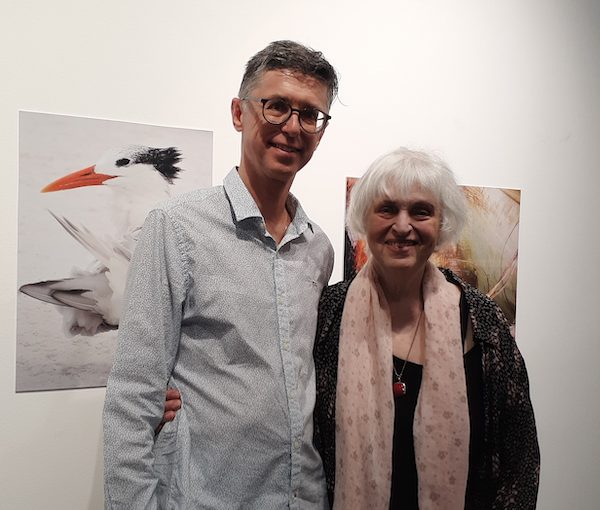
Nathan and Sidi Schaffer at the opening of their photography exhibit at the Zack Gallery June 22. (photo from the artists)

Painter, printmaker and mixed media artist Sidi Schaffer has a new show at the Zack Gallery – a photography exhibit with one of her sons, Nathan Schaffer. Eye Love Nature invites viewers to see the beauty and wonders of the natural world, and for us to recognize the dangers we pose to it.

photo - Embraced and Loved” by Sidi Schaffer
Embraced and Loved” by Sidi Schaffer

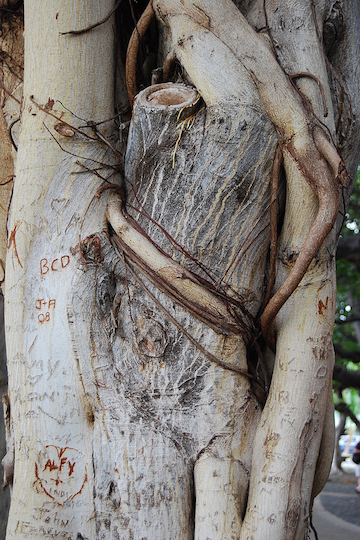
Rather than nature as something separate, we see ourselves in the Schaffers’ photos. Sometimes, the animals are doing something that we enjoy doing, like the three whales in Nathan’s “Family Swim,” only their fins visible in the misty ocean. Other times, we can empathize with what a tree has endured, but also our part in hurting it, as in Sidi’s “Embraced and Loved,” which shows a gnarled tree not only tightly wrapped by a vine, but also scarred by the initials, including a pair in a heart, that many people have carved into it.

The titles of some of the photos bring a smile, but also a sense of responsibility. The overall feeling of the exhibit, however, is uplifting, hopeful.

“I have a fondness for word play and puns as a way of expressing humour. I find it helps keep a positive environment when interacting with others and, at times, deal with sensitive issues in a less threatening manner,” Nathan told the Independent. “Artistically, my goal is to engage the audience both visually and with language. ‘The Pepsi Challenge’ [in which two horses tussle over a Pepsi cup] in my mind ‘can’didly raises concerns about human garbage and pollution straight from the ‘horse’s mouth,’ so to speak. In ‘I’m Stumped,’ there is also a bit of fishing line on the stump under the bird’s foot – again a reminder that human pollution is unfortunately prevalent in the lives of wildlife and sometimes it can feel like we are stumped trying to deal with it.”

photo - “The Pepsi Challenge” by Nathan Schaffer
“The Pepsi Challenge” by Nathan Schaffer

Eye Love Nature is the first photography exhibit for both Schaffers. Sidi said, “as I age, I wanted to see my photos on a gallery wall and share our joy creating them with the people in the community.” Nathan writes in his artist’s statement: “I very much hope the viewers enjoy the photos and that positive emotions arise and carry forth.”

Both Schaffers thanked Zack Gallery director Hope Forstenzer and the selection committee, as well as their friends and family, “for providing guidance and supporting this,” said Nathan, who works as a psychiatrist treating adults at a community mental health clinic.

“The resilience of many patients inspires me to search for strength and marvel at beauty in nature,” he said. “I often recommend spending time in nature as a way of reducing distress from inner turmoil, both to patients and family. I also enjoy my photography as a way of expressing latent artistic interests, as I haven’t improved my drawing beyond a rudimentary level. It is a counterweight to the stress associated with my work.”

For Sidi, who is a career artist, the skills involved in painting/printmaking and photography overlap to some extent.

“The combination of a good eye and imagination can help in both forms of art expression,” she said. “[But] the trigger when taking a photo is coming from outside. It is your sudden surprise of what your eye sees in front of you at a certain moment, in a certain light or shadow. It can be a landscape, people or clouds in the sky. It can be a design that the power of nature created on a tree bark, or a gentle breeze moving the petals of a flower. You can be enchanted by a flower’s seeds that hide themselves from the elements.

photo - “Burst of Colour” by Sidi Schaffer
“Burst of Colour” by Sidi Schaffer

“As compared to painting or printmaking, with photography, it’s presented to you, you only have to look and explore,” she said. “When I am in front of a canvas or paper, it’s usually in front of a white surface that waits for my imagination, for my expression of freedom to choose the subject or design that comes from inside me. It takes me even more into my inner self, into a world that brings me satisfaction, reflection and peace. Physically, painting is more challenging; my whole body is involved in the making. I love both mediums and hope to combine them in my mixed media works.”

While Eye Love Nature is Sidi’s first photography exhibit, she has been a photographer since childhood. Sidi was born in Romania – her mother studied photography before the Second World War.

“After the war, coming back home from the camps, my parents opened a photo studio,” said Sidi. “From then on, even as a little girl, I immersed myself in their world. I assisted my father in the dark room; I helped colour the black and white photos with watercolour. I learned from my mom how to touch up the negatives. Today, we would call it Photoshop. In my later years, here in Canada, at the University of Alberta, in addition to painting and printmaking, I also studied photography. I will always be thankful to my parents, who exposed me to the magic of photography.”

It was Sidi who gave Nathan his first camera when he was young. “But the love of nature, the curiosity, his investigative spirit and his good eye, he developed through his life, step by step,” she said. “He was always surrounded by art and love of the natural beauty of our world.”

When asked if he had been lucky enough to meet his grandparents, Nathan said, “Yes, I have vivid childhood memories of helping them develop negatives in a darkroom with a red light and strong vinegar-like smell. I very much enjoyed spending time with them while watching photos gradually appear during this process.”

Of course, photography has changed much since that time.

“Through the years, I’ve worked on film and in dark rooms,” said Sidi. “With the explosive development in photography these days, I switched very happily to the digital camera. This way, I have a more direct and faster approach to picture taking. My aim is to stay true to what I see and not manipulate the image except maybe to crop or lighten/darken if necessary. We are surrounded by enough fake images and news these days. I want to be far from all that. The truth gives us freedom.”

More than 40 photographs comprise Eye Love Nature.

“Some Days I’d Rather Be Fishing” by Nathan Schaffer

“For this show, we picked images where we were primarily appreciative observers rather than creators,” said Nathan. “We only attempted to correct minor blemishes, in keeping with our parenting style,” he said with a smile.

There were many candidates for inclusion in the exhibit. “Like in nature, Darwin’s rule of survival of the fittest was the main guiding force,” said Nathan. “Some couldn’t compete due to technical issues such as file size or being unfocused; others lost out due to not being as captivating. Hope, the JCC gallery director, also helped in selecting the final choices.”

As for the choice of where to direct any profits made from the show, the Schaffers have decided to divide them equally between the Canadian Cancer Society and the Canadian Parks and Wilderness Society.

Both organizations, said Nathan, “do their work in what appears to be very different areas; however, they share an important similarity. Cancer is essentially resident cells going rogue and taking over space and resources from the body, thereby putting it in serious danger. Civilization and humans can have a similar destructive impact on nature and wilderness by urban spread and taking of natural resources without limits. Controlling these rogue processes is needed in order to save and heal patients and nature. These organizations share in a mission of tackling some of the major problems we face.”

Eye Love Nature is at the Zack Gallery until July 24.

Format ImagePosted on July 7, 2023July 6, 2023Author Cynthia RamsayCategories Visual ArtsTags Audubon Photography Awards, environment, Nathan Schaffer, nature, Sidi Schaffer, Zack Gallery
Connect with music

Connect with music

The Oot n’ Oots band helps launch Mission Folk Music Festival. (photo from Mission Folk Music Festival)

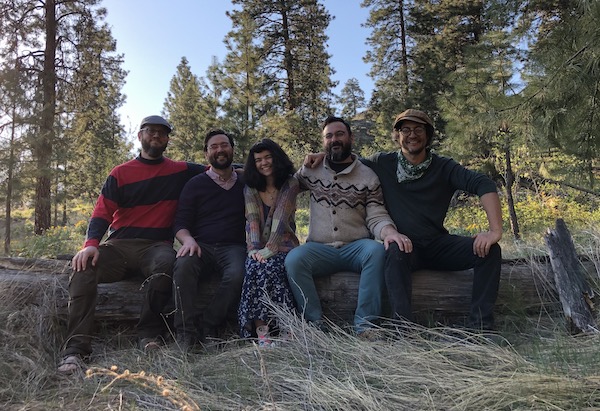
Family band the Oot n’ Oots helps kick off the Mission Folk Music Festival on July 21, as part of the main-stage lineup that opens the weekend of concerts and workshops. Several other Jewish community members are also participating over the weekend, including Boris Sichon, Jesse Waldman and Abigail Lapell, who helps close out the annual event on the evening of July 23.

The theme of this year’s festival builds on last year’s, said artistic director Michelle Demers Shaevitz, also a member of the Jewish community.

“In 2022,” she said, “I programmed a festival that reflected the experience of homecoming, the coming back together of our community, our festival family. This year, I’m digging into the process and ideas of connection and reconnection, as we move through our experiences beyond that initial homecoming and return to the festival. For me, the idea of reconnection speaks to getting to know who we are as a community post-pandemic and how we have changed/emerged as a result of our experiences.

“I was drawn to our 2023 artists through the ways they express their connection to their homelands, their languages, their heritage and cultures, and musical traditions,” she continued. “It’s how Okan celebrates their roots to their homeland of Cuba and her languages and stories, while Terra Spencer sings of the Maritime landscapes and communities around her.

“It could be reconnecting to language, as Cedric Watson and Jourdan Thibidoux explore their roots in the Creole community based in Louisiana alongside Wesli, who sings in his Haitian Creole of home and in French from his newly adopted community in Quebec.

“It’s the ways that Leonard Sumner and Twin Flames sing their connections to their heritage or how Alysha Brilla presents her identity in her songs.”

And, she said, it’s how the Jewish musicians weave their Jewishness into their stories and songs.

screenshot - Boris Sichon on TikTok, playing an instrument he made himself
Boris Sichon on TikTok, playing an instrument he made himself. (screenshot)

Sichon, a classically trained percussionist, plays more than 400 different instruments from around the world, many of which would send most of us to the internet to find out what they are, such as mayuri, zurna and agogo bells. He can also make music from wrenches, plastic containers, kitchen bowls and even rocks – basically, anything. His TikTok videos are quite entertaining and mind-broadening. It’s easy to see why he is in demand for school and other educational workshops. He told the Independent he is currently “in the process of preparing a new program with an accent on voice and wind instruments.”

“I love to perform for kids,” he said. “It gives them an opportunity to travel around the world with exotic musical instruments.”

In performances, Sichon sings songs about “love, friendship and freedom [in] Ukrainian, Gypsy, Russian and Yiddish.” He also plays klezmer, and has taken part in the International Klezmer Festival in Jerusalem for many years. He has played at and collaborated with the Mission folk fest many times and, at this year’s festival, he takes part in a Sunday afternoon session, called Global Routes, with Dongyang Gozupa and Robin Layne & the Rhythm Makers.

photo - Jesse Waldman
Jesse Waldman (photo from Mission Folk Music Festival)

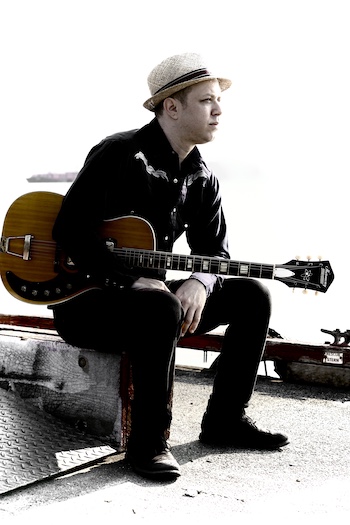
Earlier that Sunday afternoon, Waldman takes to the stage as well. A blues and folk artist, the Independent spoke with him ahead of his participation in the 2019 festival (jewishindependent.ca/blues-klezmer-at-mission). A couple of years ago, he shared more about himself and the importance of family in a piece for the JI about being inspired by his great-grandmother, Adele Waldman, to reimagine the Yiddish song “Papirosen” (jewishindependent.ca/a-great-grandmothers-song).

Making her debut at the Mission Folk Music Festival is Lapell, with a shared session on Saturday (with Alysha Brilla) and on Sunday (with Terra Spencer), as well as being part of the festival closing concert. She said “there’s so much great music on the lineup – personally, I’m especially excited for the workshop stages, to have a chance to collaborate with and get inspired by artists from across Canada and beyond.”

Based in Toronto, Lapell’s latest album, Stolen Time, which came out last year, earned her a 2023 Canadian Folk Music Award for English songwriter of the year. She was similarly recognized in 2020 for her album Getaway and she received a CFMA for contemporary album of the year in 2017 for Hide Nor Hair.

“I’m always trying to challenge myself as a writer and collaborator,” she said. “I’ve had the chance to work with so many great players and personnel on these albums and I think it’s really helped me grow from one project to the next.”

Lapell has always sung.

“Singing and writing songs is very intuitive to me and definitely a big source of comfort and community,” she said. “Ultimately, I think it’s such a primal thing, singing and sharing music – for me, it’s a way of connecting with myself, with nature and with the world at large.”

photo - Abigail Lapell
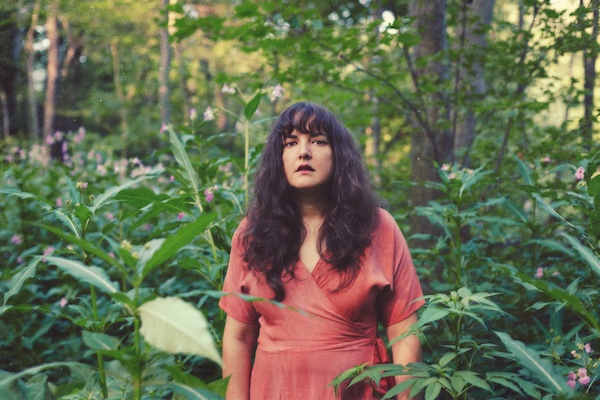
Abigail Lapell (photo by Jen Squires)

Her Jewishness finds its way into her work subtly.

“I find my writing is infused with a lot of biblical and natural imagery,” she said. “I’m very drawn to stylized, sometimes repetitive language, whether prayerful or playful or both. I was raised in a religious Jewish family, and I think there’s a reverent spirit to my music – and sometimes a touch of gentle dissonance or wry humour – that reflects some of the Hebrew and Yiddish traditions I grew up with.”

For the Oot n’ Oots – 16-year-old Ruthie Cipes (voice, ukulele) with her dad Ezra (voice, guitar, keys) and uncles Ari (voice, guitar, keys), Gabe (voice, bass) and Matthew (voice, drums) – Judaism and Jewish community are important parts of their lives, but don’t necessarily influence their music.

“We’re grateful for the wisdom of our ancestors and the culture bestowed since Abraham,” wrote Ezra and Ari in an email interview with the Independent. “It’s a great gift that makes our lives rich and meaningful. We’re members of the Okanagan Jewish Community and supporters of Chabad Okanagan.”

The family lives in Kelowna.

“Our parents moved us from Westchester County in New York to Kelowna, B.C., in 1987,” said the brothers. “They wanted to get off the money-go-round and be farmers living in connection with the earth. They ended up founding Summerhill Estate Winery.”

The Oot n’ Oots was formed in 2007, when Ruthie was born, “but it really got going in 2015 once Ruth joined the band. We released our first album in 2016, although it was mostly recorded back in 2007. Then we made two more albums after our elder brother Matthew joined the band on drums.”

The group is currently recording their fourth album. Their third album, Ponderosa Bunchgrass and the Golden Rule, was nominated for a 2023 CFMA for children’s album of the year and it also garnered a 2022 Juno Award nomination – they were named Children’s Artist of the Year at the 2022 Western Canadian Music Awards.

“We write songs to make each other laugh and to inspire each other. That’s what we’ve always done and it’s what we continue to do,” said the brothers. “It’s a practice that’s ongoing. We want it to continue to be meaningful as we all grow.”

While the awards may refer to children’s music, the Oot n’ Oots describe their music as “all generations together music.”

“That’s the sweet spot for us – when it’s toddlers, teenagers, parents and grandparents all on the dancefloor together,” said Ezra and Ari. “We have a couple of other musical projects that we do, but the Oot n’ Oots is our focus because it seems to provide the most tangible value, and it feels really good to bring that energy of joy to the world.”

In addition to the festival opener, the Oot n’ Oots play a few sessions with other musicians over the weekend, which takes place at Fraser River Heritage Park. The festival includes food and artisan market vendors, as well as a licensed bistro, and attendees can choose to camp in the park for an additional fee. For the full lineup and tickets, visit missionfolkmusicfestival.ca.

Format ImagePosted on July 7, 2023July 6, 2023Author Cynthia RamsayCategories MusicTags Abigail Lapell, Boris Sichon, Jesse Waldman, Michelle Demers Shaevitz, Mission Folk Music Festival, Oot n’ Oots
Going beyond numbers

Going beyond numbers

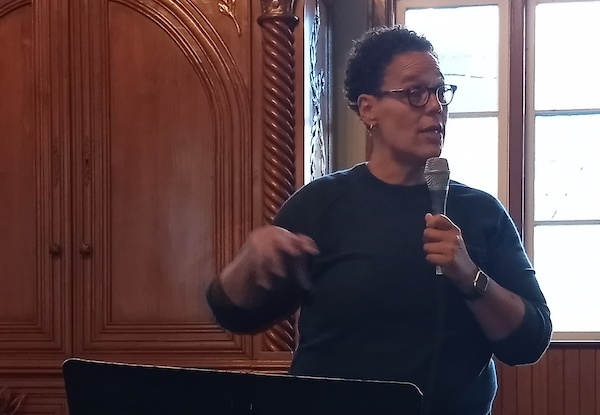
Jews of Colour Initiative chief executive officer Ilana Kaufman speaks at Or Shalom on June 6. (photo by Cynthia Ramsay)

On June 6 at Or Shalom, Jews of Colour Initiative chief executive officer Ilana Kaufman spoke about Beyond the Count: Perspectives and Lived Experiences of Jews of Colour. She said JoCI commissioned the survey to find out how many Jews of Colour there are in the United States, “what are our experiences, what are our perspectives, what are our beliefs, and then, how do you parlay that information into making the Jewish community, quite frankly, less racist, more inclusive.”

Kaufman was in Vancouver from Berkeley, Calif., where she is based, to share the survey results with “congregational rabbis, agency professionals, educators, board members, Jewish Federation staff, community members of colour and allies,” said Shelley Rivkin, vice-president of local and global engagement at the Jewish Federation of Greater Vancouver, which organized and funded the series of meetings. “Jewish Federation had been in conversation with Ilana about the work of the JoCI for over a year,” she said.

Or Shalom’s Rabbi Hannah Dresner introduced Kaufman at the shul talk, and Kaufman dove into the data.

“Depending on the age range you’re thinking about … between eight to 20% of the U.S. Jewish community are community of colour,” with the higher numbers being in the younger age groups, she said. “Every day in the U.S., the number of Jews of Colour is increasing, not decreasing. In terms of the data for multiracial families … 20% of U.S. Jewish families identify as multiracial. You may not see the family members of colour, but we’re there. And, if you’re on the coast, that number goes up to 25%, or one in four families. And that number, of course, is getting bigger every day, too.”

Kaufman is working with colleagues to figure out how many Jews of Colour there will be about 20 years from now. By 2042 or 2043, she said, “depending on immigration patterns, the U.S. will become half People of Colour. The majority of those folks will be multiracial and, in the U.S. Jewish community, we don’t know the date [that will happen], but those patterns map onto the U.S. Jewish community as well.”

While Beyond the Count is not a truly representative survey, as that would have cost about a million dollars, which was beyond JoCI’s capacity, the organization “cast the net as far as we could from the Jews of Colour Initiative perch,” said Kaufman. “We were able to have 1,118 qualified survey respondents in our study. It’s the largest dataset of Jews of Colour in the U.S., maybe anywhere in the world, and it’s not representative at all.” The interviewees over-represented in many areas, such as level of education attained and engagement in Jewish activities.

Regarding the methodology, Kaufman said the survey “is unapologetically framed with Critical Race Theory.”

“From our perspective,” she said, “we can’t do this work without framing it in a context where racism is real, and the effects of racism are real. And it doesn’t implicate white people, it doesn’t marginalize People of Colour, it just reveals the infrastructural truth that allows us then to leverage that truth to make change.”

Feminist pedagogy also informed the work, said Kaufman, and “we used a counter-storytelling approach, which means, instead of white folks saying, People of Colour, tell me your story … we had Jews of Colour, our community, centre the conversation and the work to create shape around that.”

JoCI doesn’t define the term “Jews of Colour,” both because race is a social construct and because identity “has to be owned and carried by the self and so we don’t want to be in the business of telling people how to self-identify,” said Kaufman. The organization uses “Jews of Colour” as an admittedly imperfect conceptual framework, she said, pointing out that, while race may be a fiction, racialization is real, and JoCI operates from that space. For those who self-identify as Jews of Colour, JoCI wants to be a space for resources and support.

Kaufman spoke about “whiteness,” also a social construct. Citing historian Karen Brodkin, Kaufman said the G.I. Bill – which offered home loans, college loans and other benefits to veterans after the Second World War – was one of the moments “when European Jews became white.” Instead of rejecting the benefits until their “black and brown family members in uniform” were offered the same opportunities, “there were moments of passive acceptance of the tools of upward mobility that were offered to Jews of European background that were not offered to People of Colour in the United States at that time,” said Kaufman. “And that’s one of the ways that Jews moved into whiteness, from being a highly ethnicized people in the United States.”

But it is a conditional whiteness, she said, and Jews who had lived with a passive acceptance of privilege had that comfort destroyed in 2016 with Charlottesville, “when white supremacists and neo-Nazis reminded Jews who had enjoyed the benefits of whiteness that they’re not safe…. And, in fact, that white identity is not seen as white in the eyes of white supremacists and neo-Nazis.”

Kaufman said one of the ways we can have a more dynamic and thoughtful conversation is to recognize the extent to which racism harms white people. “Even the concept of whiteness is such a flattened idea of who we’re talking about,” she said. “And so, when you think about Jewish ethnicity and you think just about Jewish European ethnicity, it is vast and it is diverse and, at least in the United States, it’s been boiled down to bagels … this caricature of who the Jewish people are.” When we celebrate diversity and grapple with intercultural dynamics, she said, “white folks have a stake in the conversation that’s not about being the target of opposition, but a collaborative part of the conversation” and, to do that, “we certainly have to recognize the privilege that comes with whiteness or being perceived as white…. When we get past our understanding of privilege, we need to get into who we are as ethnic, racial beings, and everybody has an equal stake in that conversation,” she said.

Almost half of survey respondents (45%) selected two or more racial categories. “And that’s the fastest growing population of People of Colour in the U.S., multiracial people, and that also maps onto the Jewish community,” said Kaufman.

One finding of the survey was that most JoCs feel more comfortable in an environment that’s multiracial. “Jews of Colour feel a tremendous amount of stress when [they’re] the only one in a situation…. We have to help people feel welcome without [them] feeling like we’re singling them out,” she said.

Respondents participated in a wide variety of Jewish activities and organizations, including formal Jewish education, attending synagogue, being part of a Jewish youth group and traveling to Israel: 63% of respondents participated in two or more Jewish activities. Yet most JoCs report having had a range of negative experiences in Jewish communal settings. At the top, 75% of respondents agreed or strongly agreed with the statement, “Others have made assumptions about me based on my skin tone,” and 74% with the statement, “I have felt burdened with explaining myself/my identity.” At the lower end, 60% agreed or strongly agreed that “I have felt tokenized” and 58% that “I have been treated as if I don’t belong.”

“A tip on that,” said Kaufman. “Of course, we want to welcome Jews of Colour into our committees to do things that matter…. If we’re reaching for someone because of what we think they look like, we have to stop ourselves. We just have say, we’d love to have you on our committee, but we want to know what you want to be on our committee for, instead of telling them … what we want them on our committee for.”

As an example, when she was asked to be on board, she made it a condition that she not have to talk about diversity. “And so,” she said, “how do you bring people in for why they want to be there, what they’re good at, how they want to grow? You just ask, how do you want to grow professionally, personally? Maybe I can give you that community opportunity if you join us, which is way better than saying, I don’t know you, I don’t know what you like, but I want you on my committee because of how I think you look.”

Overwhelmingly, survey respondents did not feel that American Jewish leaders are adequately addressing “the specific needs of members/participants who are Jews of Colour,” “the need for greater racial/ethnic diversity in Jewish organizational leadership” or “racism/white supremacy within the American Jewish community.” The numbers improve with regards to how these leaders are addressing “racism/white supremacy outside of the American Jewish community.”

“There’s deep comfort in helping those people outside,” said Kaufman. “What happens when those people are in all of us? And how do we collectively adopt a ‘those people’ identity so that we can actually dissolve this barrier between us and them?”

The study focused on racism, not antisemitism, said Kaufman. “Historically, when the U.S. has talked about antisemitism, they haven’t been including Jews of Colour in that conversation. And so, generally, when you hear about who’s being supported by the organizations fighting antisemitism in the U.S., you never see Jews of Colour included in that conversation.”

JoCI has had to be very careful, she said, so that the survey doesn’t become a tool to fight antisemitism among People of Colour. “The Jewish community and our colleague organizations who deal with antisemitism in the U.S. often use a dynamic of anti-Black racism to create support to fight antisemitism, and this has split People of Colour from Jewish people who [are] white.” She talked about the importance of taking on white supremacy. “Inside of white supremacy is both racism and antisemitism,” she said. “And I think it’s incumbent upon the U.S. Jewish community to look at racism and antisemitism side by side and, in our context, the container that holds that is white supremacy. So, I’m very interested in fighting antisemitism, I’m very interested in fighting racism and, I have to say that, in my family’s life and the lives of a million Jews of Colour in the United States, is for us to talk about white supremacy and to target racism and antisemitism in the same breath, at the same time. Because the piece is, we need to be in a relationship with our Muslim brothers and sisters, our Christian brothers and sisters, our family members all in between, because we’re all under threat from the white supremacists…. I’m very interested in fighting antisemitism but I’m not interested in fighting antisemitism if it only means we’re fighting for white, Jewish people.”

Beyond the Count makes four recommendations: support organizations and initiatives led by and serving Jews of Colour; shift organizational leadership to more accurately reflect the diversity of American Jews; prioritize creating spaces and places for discourse and dialogue with and among Jews of Colour; and promote further research by and about Jews of Colour.

Kaufman “helped us better understand the nuances and diversity of the JoC community and how systems of inequality are perpetuated in our own community,” said Rivkin in an email to the Independent. “The issues identified in Beyond the Count must be taken seriously, we can’t offer token solutions. We have to be intentional and first engage Jews of Colour to find out what they see as the key priorities and what path should be taken going forward.”

To do that, Rivkin said, “A key role of Jewish Federation is to bring stakeholders from across the community together to address critical issues and facilitate discussions…. One of our next steps is to explore the feasibility of conducting either a B.C. or Canada wide survey to gain a better understanding of the local JoC perspective.”

To read the full text of Beyond the Count, visit jewsofcolorinitiative.org.

Format ImagePosted on June 23, 2023June 22, 2023Author Cynthia RamsayCategories LocalTags diversity, equality, Ilana Kaufman, inclusion, Jewish Federation, Jews of colour, JoCI, racism, Shelley Rivkin, surveys, United States
Beautiful life despite illness

Beautiful life despite illness

Rachel Goldman and her husband, Geoff McLennan. (photo by Avi Dhillon)

Rachel Goldman is this year’s Courage to Come Back Award winner in the medical category. She couldn’t be there in person at the Vancouver Convention Centre June 9, but she did accept the honour virtually.

After introducing herself, Goldman said, “Forty months. Forty months! That’s 1,216 days or 29,200 hours. That’s the total amount of time I have spent secluded from the world, due to COVID. Can you even imagine? So, here I am, speaking before 1,700 of you, sharing my story. It’s a surreal and humbling experience, but one that I am striving to embrace with courage and gratitude.”

Goldman explained what it has been like to have been born with CVID, common variable immune deficiency.

“For 40 years, I have caught and recovered from thousands of illnesses – lived through years of isolation and endured the roller coaster that is chronic illness,” she said.

“A common cold is never just a cold. It’s a sinus infection that leads to intravenous antibiotics. It’s a kidney infection that leads to weeks or months in an isolated hospital room. It’s my body triggering anaphylaxis to the antibodies being infused into me. Challenging? Absolutely.

“Not being able to be with you tonight to receive this amazing award in person is just one more of these challenges. I have my incredible father [Paul Goldman] there to accept this award on my behalf. Now, due to his attendance in my place, we will have to stay apart for at least 72 hours in hopes of minimizing my infection risk.

“Life altering? Most definitely,” she said.

“What it hasn’t done is stopped me from doing the best I can to live my life within the realm of what I can make possible, not what seems impossible.”

Goldman and her husband, Geoff McLennan, live in New Westminster and have two young children. A typical day for her starts at 6 a.m. to get their kids ready to go to Vancouver Talmud Torah.

“Once they leave, I am pretty exhausted, so I have to go back to bed and lie down for a couple hours,” she told the Independent. “I try to get outside every day and go for walks around our neighbourhood. With the weather becoming nicer, sometimes I will see a friend very distanced outside on our patio. I get my kids’ stuff ready for the next day for school … try to exercise and rest. I often write and usually have lots of doctors’ appointments, for the most part, over the phone or via Zoom. Then I get ready for my kids to come home. We try to have a normal evening of homework, dinner, bedtime and then time with my husband. Then rest again.”

That’s if she’s feeling OK. “If I am unwell,” she said, “then antibiotics and the meds I have to take to ensure I don’t have an allergic reaction to the meds keeps me mostly in bed. The meds make me feel very ill.

“If the infection is severe, then the antibiotics will require hospitalization, either inpatient or day treatment, to be delivered intravenously through a PICC [peripherally inserted central catheter] line.

“In terms of treatment,” she said, “I give myself weekly subcutaneous intravenous immunoglobulin infusions, which I infuse into my stomach through four needles.”

Because of her health, Goldman, a sports radio and television producer, had to stop working in 2017. She also has had to adapt how she volunteers at VTT, something she loved doing in-person. Unable to go into the school anymore, she said, “I have spent a lot of time volunteering virtually and helping out at home. I think I have become a master at cutting out projects for the school.

“Our Jewish community has been integral to our family,” she said. “Our children’s school has been the one constant in their life when everything else has been very chaotic. We travel 45 minutes each direction every day to bring our kids into Vancouver to attend VTT. We are eternally grateful for the love, support and kindness that the Vancouver Jewish community and Vancouver Talmud Torah has shown our family. They have lifted us up when things couldn’t have been more difficult. In turn, my kids could not feel safer, more well-loved and more connected with the Vancouver Jewish community.”

Goldman is a lifetime member of CHW, formerly known as Canadian Hadassah-WIZO, and has been a supporter of Jewish Federation of Greater Vancouver’s Choices event. In her younger days, she attended VTT and went through the entire Young Judaea summer camp system.

Her parents, Paul and Claudia Goldman, are also involved in the local and national Jewish communities. Her mother has been a volunteer with CHW for four decades, in many capacities, including becoming a national president and its lead representative internationally. Her father has served on synagogue boards and as a member of the Federation task force that led to the establishment of the Richmond Jewish Day School; as well, he has been involved with the Centre for Israel and Jewish Affairs and its predecessor, the Canada-Israel Committee, including as a member of CIJA’s national board.

During the pandemic, said Rachel Goldman, “The only way I could maintain close contact with my parents and my extended family was for them to limit their own activities in compliance with my specialist’s immunological protocols in order to protect me from potential infection. Those precautions are only now being partially loosened by my specialists.

“I had to home-school my two kids for 22 months during the pandemic as per my medical team’s instructions,” she said. “The kids only returned to full in-person schooling in March of 2022.

“If anyone goes into a high-risk environment or is exposed to anyone with COVID, then there is an isolation period of at least 72 hours, as has happened since the gala.

“I am still not able to attend anything at my kids’ school, their birthday parties, dance recitals, etc., any situation that occurs indoors,” she said. “Also, I am not able to travel via commercial airlines currently, which is very difficult since my sister [Naomi] and her family made aliyah eight years ago.”

Goldman wears a mask anytime she leaves her home, which is rarely, unless she is outside with her kids.

“If anyone in the house is sick, masks go on and I am double-masked,” she said. “If anyone is COVID positive, as happened in the last week, I have to leave the house for an extended period of time and we will have to isolate. I have not been inside in public since the beginning of the pandemic outside of medical appointments. I am just starting to have very distanced visits with a few friends now that the weather is getting better. Outside is the best and safest place for me.”

Her immediate family only recently started to take their masks off and, if they go into crowded places, they continue to mask.

Goldman has been to Israel twice for treatment, most recently in January 2020, after two years of constant hospitalizations for infections that stemmed from a sinus surgery she had in the hope of reducing infections. She said her medical team concluded “that the complexity of my condition required highly specialized expertise to determine a plan for continuing treatment, but none was available in Canada…. I conducted an intensive investigation for the relevant expertise, both in the U.S. and internationally, and determined that my best choice was Jerusalem’s Hadassah Hospital. I chose Hadassah because of its reputation as one of the world’s best research hospitals and, in particular, its multidisciplinary approach to diagnosis and treatment.”

Unfortunately, the medical tests – including many not typically available in Canada, as well as a complete set of genome sequencing and genetic testing – were interrupted by COVID. Goldman was urged to return home immediately. “At the time, they did not divulge why but, as time progressed, it became clear that the reason was due to the start of the COVID-19 pandemic,” she said.

Next steps for Goldman would involve establishing a new baseline. Because her current treatment includes the introduction of immunoglobulins extracted from the blood cells of others to boost her immune system, she said many of the tests that look at antibodies give false readings, as they aren’t interpreting her own system. “As a result,” she said, “it will be necessary to take me off all medications in a closely monitored hospital setting to be able to zero in on precisely what is going on with my immune system, in order to determine the best course of treatment going forward.”

The risk of doing this during COVID – and an increase in other respiratory diseases being treated in hospitals – has been too high and Goldman’s medical team is not comfortable with her flying on a commercial flight.

“I am now in the process of working towards re-setting a timetable with Hadassah to continue the process that was interrupted in 2020,” she said. “The logistics are complicated, but I am hopeful that I’ll have some clarity on that very soon so I can restart this process in the hopes of regaining some of my life and freedom back.”

It had been five years that Goldman’s aunt had been wanting to nominate Goldman for a Courage to Come Back Award.

“Finally, while hospitalized over the winter holidays, I agreed,” said Goldman. “I got the call from [chair] Lorne Segal and the Courage to Come Back Awards about winning a few months later … right before my kids’ spring break. I was shocked at first because this was the first time I had ever shared anything about my illness publicly. Even people closest to me didn’t really know the details and extent of my health condition.

“I didn’t realize that the way in which I have dealt with my health condition was something to be celebrated. Once I started thinking about it some more, I was truly humbled and very grateful to be recognized. I realized that this process, for me, was really about giving me a voice and the ability to hopefully help and inspire others with complex chronic medical conditions who are suffering in silence.

“By getting my voice back, it has allowed me to do more than just survive,” she said. “I decided that courage is absolutely something to be celebrated. I want to show my kids that, despite all of the obstacles being thrown at me and our family, we can rise above it all and have a beautiful life.”

Format ImagePosted on June 23, 2023June 22, 2023Author Cynthia RamsayCategories LocalTags chronic illness, common variable immune deficiency, Courage to Come Back, COVID, CVID, family, health, Rachel Goldman
Honouring ancestors’ stories

Honouring ancestors’ stories

Juan Villegas rehearsing Edictum, choreographed by Vanessa Goodman, which is about Villegas’s Sephardi ancestry. The work is part of Dancing on the Edge’s EDGE One July 6 and 8 at the Firehall Arts Centre. (video still from Vanessa Goodman)

“I am very happy to be able to share my work and talk about Sephardic Jews, as I am doing a lot of research and I am discovering a lot about my own culture and where it comes from,” Juan Villegas told the Independent about Edictum, a new work with Vanessa Goodman about his family heritage, an excerpt of which he will perform at this year’s Dancing on the Edge July 6 and 8. “Throughout history, the Jewish community has suffered a lot and I am very happy to be able to pay respect, honour, shed some light and help tell the story of my ancestors,” he said.

Villegas and Goodman had already started their collaboration when Villegas found out that his ancestors were Spanish Jews who, following the Alhambra Edict of Expulsion in 1492 and the persecution of Jews by the Spanish Inquisition, sought refuge in Colombia.

In 2015, Spain passed legislation to offer citizenship to members of the Sephardi diaspora, but the window of opportunity to apply was only a handful of years and Villegas’s family missed it. However, they did apply to Portugal, which passed a similar law, also in 2015. Given the number of applicants, it could be several years before the family finds out. For the application, certified records were needed, so Villegas’s siblings hired a genealogist.

“They did both of my parents’ family trees and both ended up having the same ancestor – Luis Zapata de Cardenas, who came to Antioquia, Colombia, from Spain in 1578 and whose family had converted to Catholicism in Spain,” he said. “What is unclear to me is whether Luis Zapata de Cardenas was a practising Jew and was hiding it or if his family back in Spain became Catholic and raised him Catholic. I find it very hard to believe that people fully converted to Catholicism, as religion is so embedded in one’s culture and must be very difficult to switch by obligation. So, this is probably when they started disguising some Jewish rituals as Catholic, which happened a lot in Colombia.”

Villegas left Colombia in 2003, at the age of 18, concealing from his family his real reasons for leaving.

“I told them that I was going to only be in Canada for eight months to study English and then come back to Colombia,” he shared, “but deep inside I knew that I wanted to find a way to stay in Canada. I am gay and had a hard time growing up in Colombia – without realizing it, I was also escaping from a traumatic childhood, as I had been sexually abused and bullied at school. I was lucky enough that my parents helped pay for ESL studies in Canada and then I was able to do my university studies in Vancouver at Emily Carr University.”

After getting a bachelor’s degree in design from Emily Carr, Villegas worked at a design studio but was let go when the economy collapsed in 2008. He took about a year to figure out what he wanted to do next.

“I had a lot of unresolved trauma and I think it was a combination of having the time and (unconsciously) wanting to be healed from trauma that I started taking yoga and dance classes,” he said. “I met a dance artist named Desireé Dunbar, who had a community dance company called START Dance and she invited me to join her company. Vanessa [Goodman] had just graduated from the dance program at SFU and she was in the company also, this was back in 2009. Then, in 2010, I joined the dance program at SFU and Vanessa came to choreograph for us a couple of times. I always loved working with her and I felt like I connected with her.”

Graduating from SFU with a diploma in dance, Villegas moved to Toronto, where he danced for a few years. When he returned to Vancouver in 2017, he started following Goodman’s work. Intrigued, he asked if she would choreograph something for him and she agreed.

“And that piece that we created was about family,” he said, “but we left it at that, because I did not get the grants I needed to continue the work. So, when I discovered about my Sephardic Jewish ancestry, I pitched the idea to her and she agreed (without me knowing that she also has a Jewish background).”

video still - Juan Villegas rehearsing Edictum
Juan Villegas rehearsing Edictum. (video still from Vanessa Goodman)

Everything fell into place, he said, including some funding, so they took up work again this year on Edictum, which is Latin for order or command. The project was always intended to be a solo for Villegas, and they had started by “diving into his family history and the names of his ancestors to build movement language,” said Goodman.

“Since his family found that they have Jewish ancestry and were a part of the diaspora from Spain and Portugal in the 1400s, we found it very relevant to revisit the starting material and expand on this history inside the work,” she said. “I was raised Jewish culturally and we found, through conversations about our family rituals in relation to culture, food and celebration, there were some very interesting links between his family’s expressions of their identity and mine. We have woven these small rituals into the piece and have found a very touching cross-section of how this can be shared through our dance practice in his new solo.”

Goodman is also part of plastic orchid factory’s Ghost, an installation version of Digital Folk, which will be free to visit at Left of Main July 13-15. It is described on plastic orchid factory’s website as “a video game + costume party + music and dance performance + installation built around the desire to revisit how communities gather to play music, dance and tell stories.”

“I began working with plastic orchid factory on Digital Folk in the very early days of its inception,” said Goodman. “James [Gnam] and Natalie [Purschwitz] began researching the work in 2014 at Progress Lab, and I was a part of that initial research for the piece. Since then, the work has been developed over a long period of time with residency creation periods at the Cultch, at Boca del Lupo, at the Shadbolt, at SFU Woodward’s, and it has toured Calgary and northern B.C. This work lives in several iterations, but the Ghost project is a beautiful way for the work to live in a new way one more time. The cast got together at Left of Main in December of 2022 and filmed the piece for this upcoming iteration…. It is exciting to see a work have such a rich life with so many incredible artists who have been a part of this project.”

Dancing on the Edge runs July 6-15. It includes paid ticket performances at the Firehall Arts Centre, where Edictum will be part of EDGE One, and offsite free presentations, such as Ghost. For the full lineup, visit dancingontheedge.org.

Format ImagePosted on June 23, 2023June 22, 2023Author Cynthia RamsayCategories Performing ArtsTags ancestry, Catholicism, Colombia, dance, Dancing on the Edge, DOTE, Edictum, family, history, Juan Villegas, Judaism, Portugal, Spain, Vancouver, Vanessa Goodman
Immerse yourself in music

Immerse yourself in music

Screenshot from the video for the song “Medicine,” made by Gigi Ben Artzi, featuring Yonatan Gat and the Eastern Medicine Singers. “Medicine” comes off Gat’s album Universalists.

You never know when a life-changing moment will happen. For musician Yonatan Gat and members of the Eastern Medicine Singers, a chance encounter at the 2017 South by Southwest (SXSW) Music Festival in Austin, Tex., has led to a unique continuing collaboration that melds experimental and powwow music in a way that is simultaneously ancient and contemporary, energizing and hypnotic.

Fans of Gat and the Medicine Singers will be happy to know they are performing at this year’s Vancouver Folk Music Festival, which runs July 14-16 at Jericho Beach Park. They will be joined by Daniel Monkman (Zoon), an experimental Anishinaabe musician from Toronto (Tkaronto), and local oud player and guitarist Gord Grdina, who also mixes multiple musical styles. For newcomers to Medicine Singers’ music, definitely go down the internet rabbit hole. Chances are that you’ll want the in-person experience, to be immersed in the sound.

The Eastern Medicine Singers are an Algonquin drum group from Rhode Island “dedicated to keeping the eastern woodlands American Indian culture alive.” They sing and drum in the language of Massachuset and Wampanoag dialect, and have produced several CDs together. To differentiate from their traditional powwow style, they call themselves Medicine Singers for collaborative projects with musicians of other traditions, like Gat. Their debut full-length album in this capacity is the self-titled Medicine Singers, which came out in 2022 on Stone Tapes, a sub-label of Joyful Noise, and Mothland in Canada.

“The result is a spellbinding musical experience, cycling through a kaleidoscope of sounds, from psychedelic punk to spiritual jazz and electronic music,” reads the description on Joyful Noise’s website. “But the genre-smashing album remains firmly rooted in the intense physical power of the powwow drum and the Medicine Singers’ connection to their ancestral music, creating a daring and ambitious record that celebrates tradition, while boldly breaking away from its restrictions or, in the words of Medicine Singers’ leader Daryl Black Eagle Jamieson: ‘These two cultures can work together, and blend together, to show people how we can work together and make something beautiful.’”

Gat is accustomed to these kinds of partnerships and musical innovation. In Israel, he was part of the punk band Monotonix. In the United States, he has released a few full-length albums, each more varied than the last, with the latest being American Quartet (Stone Tapes, 2022), described as a “punk slash-and-burn reimagining of one of the defining works of the Western classical canon – Antonín Dvořák’s legendary string quartet – written while Dvořák was, like Gat, an expatriate living in New York City.”

A good place to start your exploration of Gat and the Medicine Singers is by watching the video of the 2018 track “Medicine,” which was included on Gat’s second album, Universalists (Joyful Noise, 2018). The fruit of an impromptu recording session, this release caught a larger public’s imagination and the rest, to be cliché, is history – yet continues to be groundbreaking.

The Jewish Independent had the chance to talk with Gat via email this week.

JI: What was it about the Medicine Singers’ performance/repertoire at SXSW 2017 that so mesmerized you?

YG: I was playing a show in a club during SXSW and Eastern Medicine Singers were playing outside. I didn’t know them personally and my band were watching them outside just before we went on. I thought their style (six people powerfully hitting a drum and singing call-and-response vocals) could mesh well with my trio and, also, just like them, we played on the floor in the middle of the audience. So, after they were done playing, I invited them to sit in with us. They famously said no at first and then changed their mind after they heard our music.

Our improvisation style leaves a lot of room for new musicians to join and freely do their thing. I think Eastern Medicine Singers noticed that, too, and when they joined us – it quickly became one of the most incredible shows we’ve ever played. The audience was feeling that as well. When I looked up, I noticed everyone in the crowd was crying, and that’s how our collaboration began, and we’ve been touring nonstop around the world since 2017.

JI: In an interview, you talked about taking piano lessons as a kid and, even then, improvising. What do you love about improvising?

YG: I took piano lessons as a kid but I never cared about learning to read sheet music. I just wanted to improvise. At some point, I started playing bass, but when we did Monotonix, we wanted a trio of guitar-drums-vocals, so I moved to a 77 Fender Mustang tuned two tones down to C with bass strings running through a custom-made humbucker pickup to make it sound more low-endy. I learned to play the harmony on the open strings while doing the lead on the highs.

We played 1,000 shows that way with Monotonix and I discovered myself as a guitarist along the way. I never practised or cared about technique, but being the only instrument except drums made me work hard and grow as a player. When I started my own band, I was able to build it around improvisation, which helped me learn even more about myself as a musician and human. Improvisation doesn’t have to be confined to jazz, long solos or anything like that – it’s more a way to live life, to respond to the world around you, get to know yourself better every night.

JI: From where do you draw inspiration for your compositions?

YG: When we record, we like to create a zone that’s radically free, where it’s all about the musician’s self-expression as it relates to the collective and we just let the tapes roll and have fun with it. Our studio days are very fun and wild and free. We also record other situations – practices, soundchecks, hangs. Sometimes, we record in some of the best or most interesting studios in the world, sometimes we record on iPhones or broken tape machines someone left behind.

It doesn’t matter what it is, we just gather material (usually hours of music) and then the process of editing begins, which is when the “composition” happens. In that way, most of the writing is actually the editing. Everything else is just about having a good time and making sure every musician gets documented the way they envisioned.

JI: You have played in Vancouver before. What are you most looking forward to on this upcoming visit?

YG: I was always lucky to play inspiring shows in Vancouver. My first time in town was a wild DIY punk show in a place called Emergency Room back in ’08. People were going crazy, falling on the band (we were playing on the floor). That vibe just continued to Biltmore Cabaret, where we played so many times after that. Just a sweaty haze with everyone losing their minds and melting into one another.

The last time I was in town was for Vancouver Jazz Fest back in 2019 with Medicine Singers. That was fun. I’m not used to playing jazz fests (they probably think we’re too loud or something) but it was so cool to play to an audience that was following the instrumental parts and appreciating the playing that comes with the freedom and energy.

Vancouver Folk will be a special one for sure. We don’t often play on the floor nowadays, but Medicine Singers transcend the stage. This show really creates a kind of connection between audience and musicians I’ve never seen before. It still has all the magic we discovered in 2017, the first time we played together.

My experience working and learning from Medicine Singers led us to start a label together, Stone Tapes, which is more like a community of musicians, or a collective. I think that represents what we do in the best way possible, and I’m looking forward to coming back to Vancouver and backing Medicine Singers along with other musicians from that collective.

For the full Vancouver Folk Music Festival lineup and tickets, visit thefestival.bc.ca.

Format ImagePosted on June 23, 2023June 22, 2023Author Cynthia RamsayCategories MusicTags Medicine Singers, Vancouver Folk Music Festival, Yonatan Gat
Honouring human spirit

Honouring human spirit

Lorne Segal, chair of the Courage to Come Back Awards. (photo from kingswoodproperties.com)

This year marked the 25th anniversary of the Courage to Come Back Awards – and 18 years since Lorne Segal has been chair of the event.

“The first year I attended Courage as my father’s guest, I thought it was just another event – until I saw the box of tissues on the table. That’s when I knew Courage was different,” Segal told the Independent.

“Courage is so important because of the stories,” he said. “They give us hope. The stories that are shared every year move me and the whole room to tears, they put our own lives into perspective, and remind us of what the human spirit is capable of.

“And, of course, there’s the fact that Courage raises funds for such important programs at Coast Mental Health, which simply wouldn’t happen if it weren’t for the generosity of those in the room, who are inspired to give thanks to the stories our recipients graciously share with us. Programs like peer-support training, brain training, meals, art therapy, therapeutic gardening and much more are only possible thanks to donations – and they truly make such a difference for those who are able to access them.”

This year, the awards dinner took place at the Vancouver Convention Centre on June 9, and the honourees were Jodi Gray (mental health category), Rachel Goldman (medical), John Oakley (addiction), Patricia Henman (physical rehabilitation) and Danielle Laviolette (youth). The event included a special tribute to Segal’s father, Joe Segal.

“Joe always said, ‘Give until it hurts.’ His commitment to giving back to his community was such an inspiration to me and to so many around him,” said Segal. “After he passed away last year at the age of 97, I wanted to create an opportunity to share his message one last time, and to honour his incredible work over his long life. It was really moving for me and my family to hear so many people talk about how my father had touched their lives – I continue to be inspired by him every day.”

Calling it “truly a family event,” Segal said his children Matthew and Chanelle have been coming with him since they were little, and “there’s no doubt the recipients’ stories have shaped their lives and inspired them in their own pursuits. My wonderful wife Melita’s unwavering support for Courage and Coast amazes me every day,” he continued. “She may not be officially chair but she has certainly played a big part in the success of the event – she is always talking about the event to anyone she meets and many who attend do so because of her word of mouth.”

Many other members of the family also attended on June 9, said Segal, including his brother Gary and wife Nanci. “My sisters Tracy and Sandra could not be there but were part of our family donation in Joe’s honour,” he said.

Reflecting on his 18 years as chair, Segal said, “Honestly, I didn’t realize it was going to be this long when I signed up for the job, but, every year, I am moved by the recipient’s stories and just know they need to be shared.

“Twenty-five years ago, people were not talking about mental health,” he added. “It wasn’t a ‘sexy’ cause, as my father would have said, and the Courage to Come Back Awards have helped to create a lot of awareness and conversation. It’s my hope that these awards continue to help make us all more understanding…. It’s hard to believe we had 1,700 in the ballroom this year after four years without an in-person event, when it wasn’t that long ago we were barely allowed 10 people in one room! But we have continued to innovate and find ways to share our recipient’s stories and raise funds for Coast Mental Health Foundation.”

For more information, visit coastmentalhealth.com.

Format ImagePosted on June 23, 2023June 22, 2023Author Cynthia RamsayCategories LocalTags Coast Mental Health, Courage to Come Back, fundraising, Lorne Segal, philanthropy
KDHS chai celebration

KDHS chai celebration

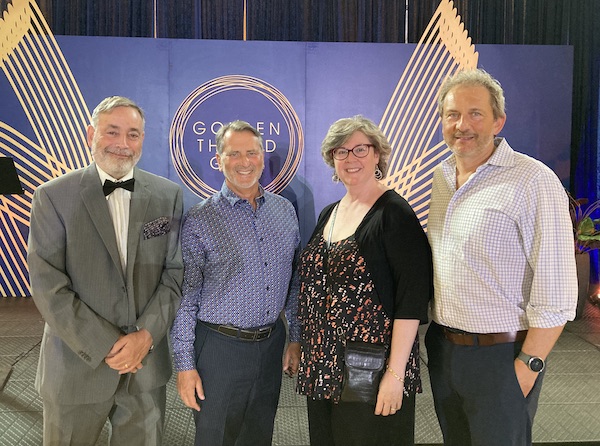
Left to right: Jeff Ross and Stephen Kaye, King David High School co-presidents in 2006, and Diane Friedman and Alain Guez, this year’s co-presidents. (photo from KDHS)

“At King David, Jewish memory and education intersect, creating a unique and powerful learning experience that prepares our students for a lifetime of meaning and purpose,” said King David High School board co-president Alain Guez in his closing remarks at the school’s Golden Thread Gala May 18.

The gala is KDHS’s primary fundraising event of the year, and more than 300 people filled the ballroom at Congregation Beth Israel, including some 50 King David alumni, to celebrate the school’s 18 years in its current building, at Willow Street and 41st Avenue. The school itself is double chai (36) years old, its origins being found in Maimonides Secondary School, which opened in September 1987.

“We would not be here today if Maimonides … had not started us on our path, our derech, to where we are now,” said head of school Russ Klein in his opening remarks.

“This evening is to celebrate what our community has built together,” he said. “The Diamond Foundation, who support so many of our community efforts, made King David possible with their generous support, belief in our importance, and their strong Jewish values.”

Rabbi Stephen Berger, head of Judaic studies at KDHS, noted that the event was taking place on erev Yom Yerushalayim. He compared Yerushalayim – “a holy place for all people, all people can worship G-d in this one place” – to KDHS, in that there are many different Jewish schools in Metro Vancouver but only one high school, and this one high school has to serve everybody across the religious and cultural spectrum. “We don’t always get it right, but it is a place where we can try, and respect and show love to everybody,” he said.

Event co-chairs Heidi Seidman and Sherri Wise said a few words about the school, as well. “It is important to note,” said Seidman, “that not one student is left behind and, when you look around the room tonight, you are all part of the village that makes that possible.”

As auctioneer, Fred Lee – who is a regular contributor to CBC, the Province, Boulevard and Vancouver Magazine – stressed this idea. He spoke about the Jewish community and the importance of the high school. He also helped raise funds that will go towards the school’s programs and students. There was a silent auction, a 50/50 draw and other opportunities to donate.

photo - Throughout the Golden Thread Gala, there were musical performances
Throughout the Golden Thread Gala, there were musical performances. (photo from KDHS)

The gala featured panelists Stephen Kaye, and Jeff Ross and Reisa Schwartzman, who were integral to the transition of the school from Maimonides to King David, and for taking the school from the portables it occupied on Baillie Street to having its own building on Willow. They were introduced in a video by their respective children, David Kaye and Zachary Ross, graduates of the inaugural KDHS Class of 2006.

Stephen Kaye came to Canada from South Africa, where there is a network of Jewish day schools called King David Schools. He described himself as “very passionate about Jewish education” and said, “The feedback we got from the community was that, if we could show enough commitment from parents to send their kids to a Jewish high school, there would be support from the community.” It was a hard sell, he said, but then the Diamonds bought the land at Willow and 41st.

Stephen and Sandy Kaye shlepped three kids from North Vancouver to King David in Vancouver, noted Klein, who emceed the panel discussion.

Ross spoke of studies showing that kids who have gone to a Jewish high school are more Jewishly knowledgeable and involved. And yet, he said that, in the beginning, there was almost a feeling that you were sacrificing your children to the experiment of a new high school, but that didn’t turn out to be the case. Ross gave Rabbi Mordechai Feuerstein, a co-founder of Maimonides, kudos for his efforts to keep the school going.

When the school was in “the shack” (portables) on Baillie Street, said Schwartzman, there were fewer than 60 kids and now there are more than 270. Back when she was helping bring KDHS into existence, she said she was confident this growth would happen, based on a survey that was conducted at Vancouver Talmud Torah, which would be the main feeder school into the high school. She was president of VTT at the time, and the survey of parents showed that about 50% of the kids from VTT would go to a Jewish high school if there were one.

Quality education was important to everyone, said Schwartzman, and one of the things the group behind KDHS did to ensure quality was to bring Perry Seidelman in as principal. Seidelman, who had some 30 years’ experience in teaching and administration at the time, had been contemplating retirement, but took on the principalship and held the position until 2008; he was succeeded by Klein.

In a video that featured Gordon and Leslie Diamond and their daughter Jill Diamond, as well as Class of 2023 students talking about how the school has positively impacted them, the Diamonds spoke of how proud they were of KDHS, its students, staff, and all the people who have given it its “personality” and contributed to its success. Calling the school “a labour of love for the Diamond Foundation,” Jill Diamond said, “And the most wonderful thing about King David is that it is teaching the Jewish values of tikkun olam, of chesed, of mitzvot and of tzedakah to the next generation of leaders of our community.”

Such has been the growth of the school that it added a modular unit last year, the building of which was funded by the Diamond Foundation. In her remarks with Guez, KDHS board co-president Diane Friedman spoke about how the addition is affectionately called the school’s “East Campus,” and thanked the foundation, as well as the donors who filled the modular with state-of-the art equipment, furniture and technology.

The evening came to a close with Klein and Seidelman. The former principal said he had worked at many schools before King David, and that he liked all of them – but he “loved King David.” He said he felt very proud as he looked around the room.

The gala also featured, under the direction of music teacher Johnny Seguin, the KDHS jazz band, who played at the cocktail reception – Luca Jeffery, Max Kimel, Jesse Millman and Nikki Wiseman – and performances throughout the night by singers Ella Ankenman, Kailey Bressler, Rachel Gerber, Mhairi Hemingson and Nikki Wiseman, with choreography credit given to Shai Rubin.

Gala committee members were Cyndi Ankenman, Dalia Bressler, Laura Feldman, Andrea Foxman, Nicole Ginsberg, Margaret Hemingson, Anna Herman, Ruth Jankelowitz, Joelly Simkin and Annie Simpson. Other volunteers were Lina Chernov, Kim Fisher, Jessica Forman, Simon Karsyente, Matilda Rosman Levsky, Melina Baum Singer, Gaenor Vaida, Jacqueline Wener and King David students Danielle Agulyansky, Eden Almog, Ali Fadida, Tamir Gini and Yuli Kabazo.

Format ImagePosted on June 9, 2023June 8, 2023Author Cynthia RamsayCategories LocalTags Alain Guez, Diamond Foundation, diamonds, Diane Friedman, Fred Lee, fundraising, Golden Thread Gala, Heidi Seidman, KDHS, King David High School, Russ Klein, Sherri Wise, Stephen Berger
Laugh for good causes

Laugh for good causes

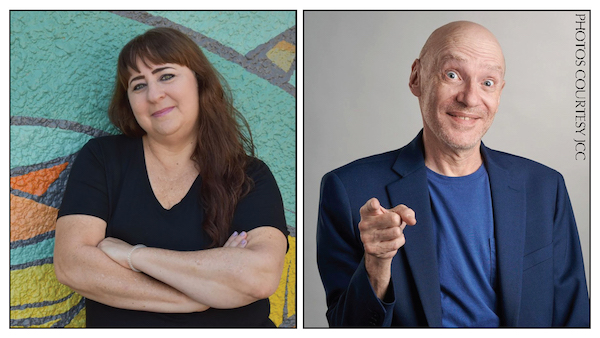
Helen Schneiderman headlines and David Granirer emcees the Stand Up for Mental Health show at the Jewish Community Centre of Greater Vancouver on June 1. (photos from JCC)

“There are many comedy shows out there, but not many like this one,” Kyle Berger told the Independent. “I keep saying that this will be the ‘feel-good comedy of the year,’ but it really will be. These comics will show us that we can laugh at just about anything and feel inspired at the same time – with all proceeds going to incredible causes. I can’t wait!”

Berger is the sports coordinator at the Jewish Community Centre of Greater Vancouver and the delegation head of JCC Maccabi. He is also a stand-up comic and a producer with Rise of the Comics. It is in all these capacities that he is participating in the Stand Up for Mental Health comedy show at the JCC on June 1, 7:30 p.m.

A joint fundraiser for the Stand Up for Mental Health (SMH) Comedy Society and JCC Maccabi Vancouver, Berger is producing the event, with the support of Stand Up for Mental Health, and will be performing a set himself. “It will be a huge honour for me to share the stage with this crew,” he said.

“This crew” includes SMH founder, counselor and comedian David Granirer.

“Stand Up for Mental Health is my program teaching stand-up comedy to people like myself with mental illnesses as a way of building confidence and fighting public stigma,” Granirer explained. “We have been around since 2004 and have trained approximately 300 comics and done hundreds of shows for government, corporations, the military, correctional facilities, medical schools, etc.”

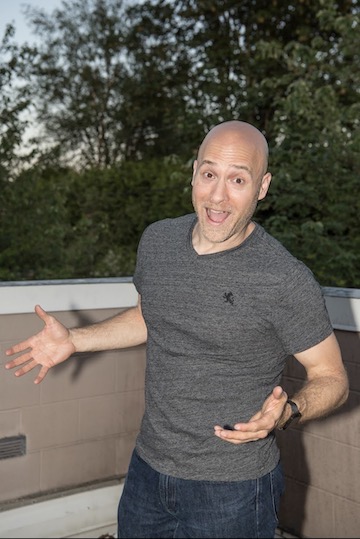
photo - Kyle Berger
Kyle Berger (photo from JCC)

Berger attended one of those performances last year, in which SMH Comedy Society showcased “their students’ incredible talents, and I absolutely loved it,” he said. “I knew some of the SMH Comedy board members from working together in the comedy scene and made the connection right away. They are always looking for venues and new audiences and I knew I wanted to do something with comedy as a JCC Maccabi Games fundraiser, so inviting them to team up seemed like a no-brainer to me.”

Also performing next week will be Helen Schneiderman, who headlines the show.

Schneiderman’s comic career began in 2018, when she took a comedy course at Langara College that was taught by Granirer. She said she did it, “mainly to get off the couch. I didn’t expect to love it so much, nor to continue doing it after the class. But, once I got my first few laughs, I was hooked. Over the past couple of years, I’ve gotten more comfortable sharing my experiences and perspectives, and I try to remember to always have fun up there.”

Being able to do stand-up comedy has influenced how Schneiderman navigates through life.

“I now see the world through ‘funny glasses,’” she said. “Every interaction and experience has the potential to be a joke – not always a good joke, but a joke nonetheless. My day job is delivering leadership training and so I get to have a captive audience, even at work.”

In addition to her day job and other involvements, Schneiderman has been on the board of SMH Comedy Society for four years, and board president for the past two years.

“I’m involved with the organization because it’s doing really important work to tackle the stigma of mental health,” she said. “It’s a fantastic program, and I am in awe of the comics who share their stories with so much vulnerability and smart humour.”

People can find out more about SMH at smhsociety.org. Post-pandemic, the society is once again holding live classes and shows, as well as continuing to put on Zoom shows. The pandemic, said Granirer, “made me realize that, by being creative on Zoom, we could reach people all over the English-speaking world. It also made me realize how much people need to have in-person contact in order to maintain their mental health.”

One of the reasons SMH is teaming up with JCC Maccabi Vancouver for this show, he said, is “because they’re a great organization and exercise is crucial to maintaining good mental health.”

The decision to partner was easy for Berger.

“As the delegation head for Vancouver’s JCC Maccabi squad, I am always looking for ways to raise money for scholarships so that anyone who wants to participate in the JCC Maccabi Games experience can do so,” he said. “At the same time, producing and performing stand-up is another hobby and passion of mine, so it always makes sense to me to raise money through laughter. I always love the opportunity to work with other causes or charities, and this one was a match made in heaven.”

The June 1 Stand Up for Mental Health show is being presented by JCC Maccabi Vancouver and Life is Still Funny, which Berger described as “a group of local comedians who might be considered, well, not particularly young, but still quite young at heart! Made up of locals like Helen, Ray [Morrison], as well as recent Canada’s Got Talent contestant Syd Bosel. They are all involved with SMH Comedy Society.”

In addition to Schneiderman, Berger and Granirer, Morrison will perform, as will a few SMH students. Tickets are $20 (plus fees) and are available at eventbrite.ca. There will be a cash bar and a raffle draw at the show. Berger said half of the proceeds will go to SMH Comedy Society and half to JCC Maccabi Vancouver.

Format ImagePosted on May 26, 2023May 25, 2023Author Cynthia RamsayCategories LocalTags comedy, David Granirer, fundraising, Helen Schneiderman, JCC, JCC Maccabi, Jewish Community Centre of, Kyle Berger, Stand Up for Mental Health, stand-up

Posts pagination

Previous page Page 1 … Page 21 Page 22 Page 23 … Page 85 Next page
Proudly powered by WordPress