The seventh annual Simces & Rabkin Family Dialogue on Human Rights, organized by the Canadian Museum for Human Rights, Vancouverites Zena Simces and Dr. Simon Rabkin, and Equitas-International Centre for Human Rights Education, takes place Oct. 23, at noon, via Zoom. It tackles the topic of The Match-up Between Human Rights and Sports: How Both Can Win Well in Today’s Landscape.
According to the Office of the High Commissioner for Human Rights, “sport is anchored in human rights values. It promotes fairness, non-discrimination, respect and equal opportunities for all. As it reaches billions, including young people, it is a conduit for societal change through empowerment and inclusion.” Despite being anchored in human rights values, sport also faces human rights-related challenges through various forms of discrimination be it sexism, racism, ableism, classism or others. The Oct. 23 dialogue will explore the benefits of sport as a force for good in upholding human rights, the challenges currently faced by the Canadian sport system, and pathways to strengthen the balance between sports and human rights so that both win by promoting well-being for all.
The expert panelists featured will be Bryan Heal, Jeff Adams and Armeen Kadwa. Attendees will have the opportunity to ask questions and share comments.
Heal is social impact research lead with Maple Leaf Sports & Entertainment (MLSE), heading such initiatives as the MLSE Foundation’s Change the Game research program for youth in Ontario.
Adams, a labour, employment and human rights lawyer, is a Canada’s Sports Hall of Fame inductee. He won three gold medals in the Paralympics: twice in the 800-metre (1996 and 2000) and once in the 1,500-metre (2000) wheelchair racing events.
Kadwa is founder and executive director of the nonprofit Hijabi Ballers, which is dedicated to creating positive sport experiences for Muslim girls and women.
The panel will be moderated by Wendy MacGregor, a consultant, educator and lawyer, and founder and executive director of Athlete Zone. She has a master’s in law on abuse and maltreatment of athletes. Her published work focuses on the root causes of sport violence, maltreatment prevention, power imbalance and wellness in sport.
From Oct.31 to Nov. 8, the Heart of the City Festival features more than 100 events – music, stories, poetry, theatre, ceremony, film, dance, readings, workshops, discussions, art talks, history walks and more – all rooted in Vancouver’s Downtown Eastside (DTES). Among the performers is award-winning counselor and stand-up comic David Granirer, founder of Stand Up for Mental Health, which teaches stand-up comedy to people with mental illness as a way of building confidence and fighting stigma.
Counselor and stand-up comic David Granirer will perform, with other comedians from Stand Up for Mental Health, on Nov. 5, as part of the Dowtown Eastside Heart of the City Festival. (photo from Heart of the City Festival)
On Nov. 5, 4 p.m., at Carnegie Community Centre’s theatre, Granirer, with comedians from Stand Up for Mental Health, will look at the lighter side of taking meds, seeing counselors, getting diagnosed and surviving the mental health system.
The festival kicks off on Oct. 31 at Carnegie’s theatre with a Halloween event. Dress in costume, walk the red carpet, enter the costume contest to win a prize, and gear up for disco-ball dancing with DJ Maxi and crew spinning tunes. Hosted by Lance Lim of the Pigeon Den Art Collective, there will be masquerade magic and community fun for friends and families alike, refreshments provided.
Some other highlights in the upcoming festival are:
• Gerardo Avila’s theatrical performance Spirit Encounters celebrates Día de Muertos and features shadow puppetry, comedy, flamenco and Mexican dancing and music.
• Indigenous Cultural Exhibition with dancing, drumming and community, featuring Two-Spirit grass dancer Larissa Healey and Powwow dancer Pavel Desjarlais.
• Finding My Own Voice, a new folk opera work-in-progress presentation by Beverly Dobrinsky.
• Theatre in the Raw presents staged readings of two award-winning plays from their Biennial One-Act Playwriting Contest.
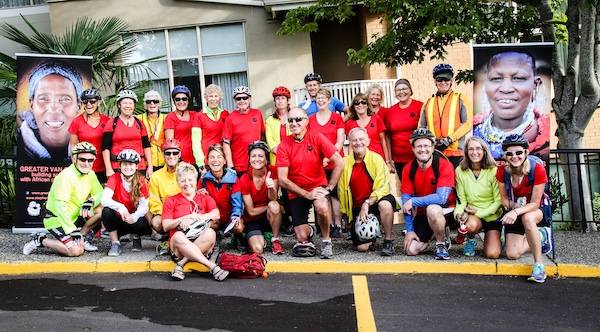
The inaugural Solidarity Cycle, in 2017. (photo by P. Simson)
We didn’t ride 100 kilometres, or even quite 50. It was a glorious symbolic ride in celebration of the many years of Solidarity Cycle, a much-beloved event that has seen dozens of cyclists and hundreds of supporters unite bike and heart to raise more than $400,000 for the Stephen Lewis Foundation Grandmothers to Grandmothers Campaign.
Even though Solidarity Cycle has pushed its last pedal – the event having been canceled this year – three members of Tikun Olam Gogos, who rode in the inaugural event back in 2017 and have served in numerous capacities every year since, just couldn’t let go.
Monday, Sept. 8 was a perfect day as Marie Henry, Darcy Billinkoff and I set out: not a drop of rain, not a wisp of smoke, just sunny skies with occasional clouds and a light breeze.
Nothing could keep us down, not Darcy’s fractured ribs, Marie’s stress injuries or my right hip, waitlisted for replacement. Could this “Wride of the Wrecked” be a clue to Solidarity Cycle’s demise?
There were more portents to come, but first it was time to ride.
Many features of our route to Westham Island came with joyful reminders of the previous cycles: cornfields reminiscent of the years of Chilliwack corn and chili celebration dinners, acres of sunflowers like those popping the Pemberton Valley ride the year of pandemic and big smoke, and kilometres of dike trails like those we traveled in Pitt Meadows. The one-lane, wood-deck river crossing onto the island was a refreshing antidote to that !@#$%!!! (oops, I mean challenging-but-fun) Golden Ears Bridge.
We reached our designated turn-around point, the Reifel Bird Sanctuary, to find the birds behind locked gates.
Even more dismaying, Emma Lea’s dairy bar was shut tight. NO ICE CREAM?! Clearly, the closed signs said it was time to wave a regretful goodbye to the ride that has fueled our summers and our love for the grannies these past eight years.
But, still, we weren’t quite done.
We topped off our ride with Heineken and lunch on the deck of the Riverhouse Restaurant and Pub, an indulgent reminder of many post-cycle beer and burger banquets. We always suspected we consumed more calories than we burned.
In the absence of a formal event this year, I did not solicit sponsorships. However, I set up a fundraising page to show my appreciation for the many people who have supported Solidarity Cycle over the years. Please do visit the page because there is a message there for you: slf.akaraisin.com/ui/grandmotherscampaign2025/p/BarbaraHalparin.
Without the yearly opportunity Solidarity Cycle has afforded you, I urge you not to forget the grandmothers and grand-others aiming to alleviate the scourge of HIV/AIDS that continues to significantly impact Africa. Here are some other ways you can continue your steadfast support for them, now that crucial international aid has been withdrawn.
First, attend Tikun Olam Gogos’ other fundraising events. Second, be on the lookout for another in our fabulous concert series in the near future. Third, buy our merch! We sell our signature tote bags, pouches and other items, including our special edition O Canada line, at Fancy This Gifts (5044 48 Ave., in Ladner), by appointment at Joyce Cherry’s home boutique (604-261-5454) and on our website, tikunolamgogos.org.
You can also find our goods at several upcoming craft fairs: St. Thomas Aquinas Secondary School (Nov. 2); Dunbar Community Centre, St. Faith’s Church and St. Thomas More Collegiate (all Nov. 22); St. James Community Square (Nov. 30); and Kensington Community Centre (Nov. 30).
And, please – share your fundraising brainwaves with us because, of course, we are looking for a successor to Solidarity Cycle!
This year, I volunteered to help during High Holidays at my congregation. As a result, I became one of the “ticket ladies” on Rosh Hashanah. I used a cellphone that scanned bar codes on service tickets. When I first saw this being done on a holiday, I was surprised because of the technology use at a Conservative congregation on a day when some might not carry a phone. My family chose to print out our tickets, but times change. Even though everyone in my family had a printed ticket, we carried our cellphones anyway as we volunteered. It seemed safer to have our phones while walking to synagogue and while we were there. After all, that’s what the tickets are for, too. They indicate that the person belongs or has a spot and that the person is “safe.”
The police and private security guards asked where they should position themselves. More than once, they indicated that being indoors in the lobby might be a good spot. Instead, they were asked to stand outside, in autumn’s sunny weather, guarding the doors and/or directing traffic. I heard only one incident of loud, angry shouts on the street, near the police officer there. That was enough for me. I was relieved police were there, and that there were master lists of everyone who might be in the building that day, just in case.
While outsiders might think that this security is new, this is just the usual necessity at Jewish gatherings, though admittedly now more than ever. At odd moments between ticket scans, I thought of a dear family friend named Marge, who passed away in her 90s. Marge was a venerable and respected volunteer at the temple where I grew up. She was famous for her High Holiday ticket lady efforts. Marge was all business at the front door, a big smile for those she knew as they flashed their tickets. Yet, even if Marge knew you for 50 years, if you forgot your ticket, that grin vanished. A stern reprimand ensued. Marge kept us safe, and she wasn’t playing. She took that job seriously.
The congregation where I grew up, Temple Rodef Shalom in Falls Church, Va., is right near Washington, DC. Rodef Shalom started out small in the 1960s, when my paternal grandparents were founding members. It grew rapidly, along with the Washington area. My mom started its preschool, ran the entire education program, and ended her career there as the administrator/executive director. As a Jewish professional’s kid, I knew where the emergency alarm buttons were and that synagogues near DC were frequent targets of hate. Congregation members who worked for the FBI or CIA formed part of the volunteer security patrol for the High Holidays, too. Everyone smiled as they said that “no-nonsense” Marge ran a tight ship. She was their best line of defence.
Nobody knew this history in Winnipeg when I was given the ticket lady designation. I’d emailed with Marge right up until her passing. I tried to see her at every family visit. She loved to tell me about her Canadian grandfather, a fur trader whose family came from Sault Ste. Marie. The whole holiday, in between wishing everyone gut yontif, shana tova or sweet new year, I longed to tell Marge all about how I was a ticket lady now. I knew she’d love it. When I mentioned this to my mother, we both smiled over the phone. I’d never be as good at it as Marge was, but my mom also said, “Don’t worry, I’m sure Marge knows. She’s proud of you.”
Being a ticket lady was an education. I’ve been in Winnipeg 16 years, so I recognized many names on the tickets, but definitely not all the faces. As people rolled in, I also recognized how diverse we are as a people. Some of us are early, others right on time – and then, there are the rest.
This experience let me greet new people and hold on to lifelong connections. It made me think about a grammar term that’s fallen out of use. I wondered at how, as individuals, we are also dependent clauses. For years, we have seen news, books and other sources where the editing allows a sentence to start with “and” or “but” in a way that’s clearly dependent on the prior sentence. When I see this, I want to chastise, just as Marge might have. To me, that editorial choice still grates, but the volunteer experience made me see how the Jewish community works together. At the best of times, we are an enormous team, dependent on one another to function at our best.
Volunteering is an important part of Canadian identity. It was a required topic to study for my Canadian citizenship test, and I wondered why more congregants hadn’t volunteered. It was a vital part of my holiday this year. It reminded me how reliant we are on one another, as well as on our allies, our laws and law enforcement. Dependent clauses aren’t full sentences on their own. We, too, must remain connected to maintain meaning as Jews in Canada.
In the Babylonian Talmud’s tractate of Zevachim, which I’m now studying, there’s a lot of time spent on what happens when a Temple (animal) sacrifice goes wrong. If the priests in the Temple had the wrong intention or person in mind when performing a sacrifice, it could mean the person’s sacrifice wasn’t valid. We don’t sacrifice at the Temple in Jerusalem anymore, but our intentions, towards ourselves, the community and the world, still matter. Volunteering wasn’t a sacrifice for me. It felt like I was fulfilling my role with the best intentions while I depended on others to keep me safe at that open door. Instead of any kind of sacrifice, it was a High Holy Day bonus.
Joanne Seiff has written regularly for the Winnipeg Free Press and various Jewish publications. She is the author of three books, including From the Outside In: Jewish Post Columns 2015-2016, a collection of essays available for digital download or as a paperback from Amazon. Check her out on Instagram @yrnspinner or at joanneseiff.blogspot.com.
Oct. 10, 1935: This week, 90 years ago, community members were coming and going from the city. There was a Folk Song and Dance Festival and Arts and Crafts Exhibition coming up. Beth Israel, Young Judaea, AZA, BB Junior Auxiliary, Junior Council and Sub-Junior Council all had meetings and other events. China Seas and Page Miss Glory were screening at the Capitol Orpheum and Heart’s Desire was playing at the Strand.
The Jewish Western Bulletin / Jewish Independent has always covered the arts and culture scene. Amid the harder-hitting news, there have been society and social notes columns, social and club news sections, synagogue calendars, event listings, notices and advertisements, as well as articles promoting, reviewing or otherwise profiling various creatives (including community organizers) or their creations/events.
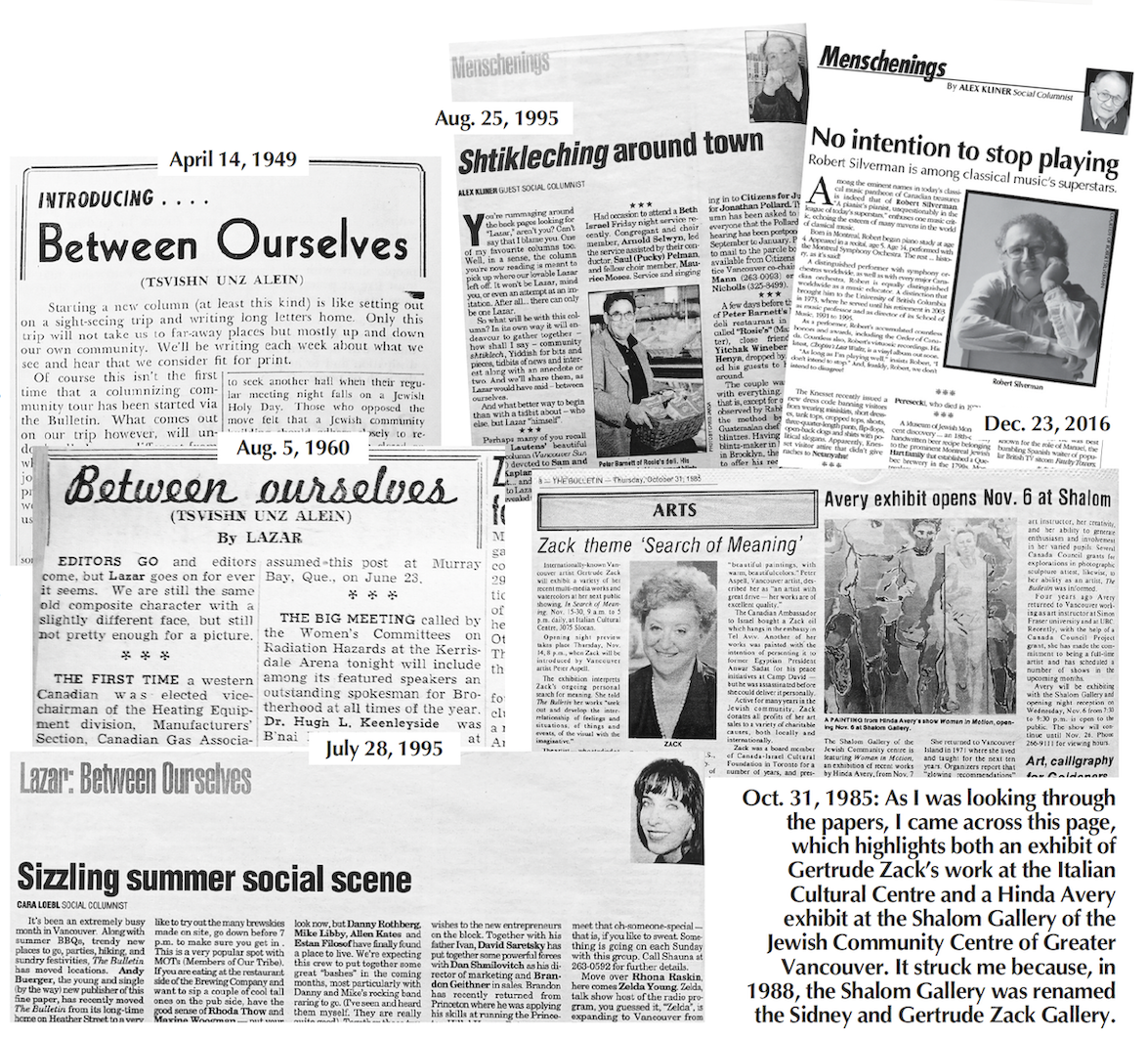
One of the longest-lasting social columns is Between Ourselves (Tsvishn Unz Alein) by Lazar, which started on April 14, 1949, when the JWB was run by the Vancouver Jewish Administrative Organization (akin to our Jewish Federation of Greater Vancouver) and Abraham Arnold was managing editor. When Sam and Mona Kaplan took over the paper in 1960, Mona Kaplan penned her first Between Ourselves (Tsvishn Unz Alein) by Lazar columns, in the Aug. 5 issue of that year, and she continued to be “Lazar” until the paper again sort of changed hands in mid-1995. While the Kaplans still owned the JWB, it came under new management, as they were beginning their retirement journey. At first, the new publisher, Andrew Buerger, kept the Lazar column – minus its Yiddish flavour – but editor Ariela Friedmann bid “Farewell to Lazar” (then written by Cara Loebl) a couple of months’ later, on Aug. 18, 1995.
Its replacement was Menschenings, which, Friedmann noted, would “give voice to all ages and aspects of the community, from social news, to what’s new, who’s new, some schmoozing, a bit of this and that.”
Initially, the column was alternately written by two different writers, Jacqui Roitman and Alex Kliner, both of whom had experience intheatre and film. As many readers will know, Alex became the sole face of Menschenings, continuing through the Kaplans’ sale of the paper in mid-1999 to Kyle Berger, Pat Johnson and me. From his first column to his last, in 2016, when he retired, Alex’s writing was infused with Yiddish, having a heimishe (homey and familiar) quality like Lazar’s, meaning that Between Ourselves/Menschenings lasted some 67 years.
On Sunday, Prime Minister Mark Carney issued a statement on Canada’s recognition of Palestine as a state.
“Recognizing the state of Palestine, led by the Palestinian Authority, empowers those who seek peaceful coexistence and the end of Hamas,” said Carney. “This in no way legitimizes terrorism, nor is it any reward for it. Furthermore, it in no way compromises Canada’s steadfast support for the state of Israel, its people and their security – security that can only ultimately be guaranteed through the achievement of a comprehensive two-state solution.”
Prime Minister Mark Carney announced on Sunday that Canada would recognize Palestine as a state. (photo from Office of the Prime Minister)
Carney noted: “Since 1947, it has been the policy of every Canadian government to support a two-state solution for lasting peace in the Middle East.” He said there was an “expectation that this outcome would be eventually achieved as part of a negotiated settlement,” but “this possibility has been steadily and gravely eroded” by several factors.
In addition to other criticisms of both Hamas and Israel, Carney lists the “pervasive threat of Hamas terrorism to Israel and its people, culminating in the heinous terrorist attack of Oct. 7, 2023,” and Hamas’s rejection of Israel’s right to exist; “accelerated settlement building across the West Bank and East Jerusalem, while settler violence against Palestinians has soared”; “the E1 Settlement Plan and this year’s vote by the Knesset calling for the annexation of the West Bank”; and the “Israeli government’s contribution to the humanitarian disaster in Gaza, including by impeding access to food and other essential humanitarian supplies.”
Carney said the Palestinian Authority “has provided direct commitments to Canada and the international community on much-needed reforms, including to fundamentally reform its governance, to hold general elections in 2026 in which Hamas can play no part, and to demilitarize the Palestinian state.”
In reaction to the prime minister’s Sept. 21 statement, Noah Shack, chief executive officer of the Centre for Israel and Jewish Affairs, said, “Hamas is not an isolated phenomenon. It is a violent manifestation of the rejection of the right of the Jewish people to a state in our ancestral home – a rejection that runs deep within Palestinian society.
“As Prime Minister Carney himself has noted, a Palestinian state must be a Zionist state. Today’s announcement undermines that objective and gives Hamas and other Palestinian rejectionists a sense of victory. This will only make it harder to secure the release of hostages and build a better future for Israelis and Palestinians.”
Shack acknowledged that, while the “announcement does not come as a surprise, the details are important. The government has stated that, while it is extending recognition, normalization of relations with a ‘state of Palestine’ is an ongoing, long-term process…. We will argue that this must not proceed so long as hostages are in tunnels, Hamas remains in power and the Palestinian leadership rejects Israel’s existence as a Jewish state.
“And we will continue,” said Shack, “to make it clear that, with anti-Jewish hate escalating, our government must recognize the unintended effect foreign policy has on the climate in our own country.”
B’nai Brith Canada also issued a response to Carney’s statement.
“The PA has shown, time and again, that it cannot be trusted,” said Richard Robertson, director of research and advocacy for B’nai Brith Canada. “It is unable to govern the Palestinian Territories and has repeatedly demonstrated it is unwilling to deliver on the very commitments upon which Canada’s recognition is supposed to be predicated.
“The commitments include democratic reform, free and fair elections in 2026 without Hamas, and the full demilitarization of the Palestinian Territories.
“None of these conditions have been met. Hamas continues to arm itself, hold hostages and carry out terror attacks. Recognition under these circumstances does not bring us any closer to lasting peace, it only further compromises the prospect of a two-state solution.”
Robertson said the “government has chosen appeasement over principle.”
On Sunday, the United Kingdom, Australia and Portugal made similar announcements to that of Canada. Reaction from Israel was critical.
“After the atrocities of Oct. 7, while Hamas continues its campaign of terror, and while it continues to cruelly hold 48 hostages in the tunnels and dungeons of Gaza, the recognition of a Palestinian state by some nations today is, not surprisingly, cheered by Hamas,” wrote Israel’s President Isaac Herzog in an X post.
“It will not help one Palestinian, it won’t help free one hostage, and it will not help us reach any settlement between Israelis and Palestinians. It will only embolden the forces of darkness.
“This is a sad day for those who seek true peace,” he concluded.
Israel’s Prime Minister Binyamin Netanyahu said he will release a formal response after he returns from the United States. However, in a widely reported Hebrew-language video statement, he said, “I have a clear message to those leaders who recognize a Palestinian state after the horrific massacre on Oct. 7 – you are handing a huge reward to terror.
“It will not happen,” he added. “A Palestinian state will not be established west of the Jordan.”
According to various news reports, Hamas did indeed applaud the recognition announcements, as did the Palestinian Authority.
At the Canadian Shaare Zedek Hospital Foundation (CSZHF) event on Sept. 7, which marked the foundation’s 50th anniversary: left to right, Col. Ilan Or, Israeli defence attaché to Canada; Rafi Yablonsky, CSZHF national director; Dr. Marla Gordon, CSZHF Western region board member; Dr. Arthur Dodek, CSZHF Western region board member; former prime minister Stephen Harper; Dr. Robert Krell, 2025 Western Region recipient of the Kurt and Edith Rothschild Humanitarian Award; Rabbi Andrew Rosenblatt of Schara Tzedeck Synagogue; Ilan Pilo, CSZHF Western Canada director; and Sam Sapera, CSZHF board chair. (photo by Alina Ilyasova)
Former prime minister Stephen Harper was on friendly ground when he addressed a packed sanctuary at Congregation Schara Tzedeck earlier this month. The former Conservative leader, who led the country from 2006 to 2015, is known as a stalwart ally of Israel and the audience of mostly Jewish Vancouverites welcomed him heartily.
The Sept. 7 event was the first fundraising gala for the newly formed Western region of the Canadian Shaare Zedek Hospital Foundation. The event and the surrounding campaign succeeded in funding nine incubators for the hospital’s pediatric department.
The event featured Harper in conversation with former BC premier Gordon Campbell, who told the audience that, of the prime ministers he served with concurrently when he was premier from 2001 to 2011, Harper was his favourite.
Harper said people ask him why he supports Israel so strongly.
“Has it got to do with religion or your view of the Jewish community?” he asked rhetorically. “I mean, there are a million reasons, but, as prime minister of Canada, the reasons were really simple. Here is this one country in the Middle East that shares our values and that is a friend of this country – and the people who are the enemies of that country are enemies of this country.”
Harper told the audience that there are a lot of loud voices condemning Israel and threatening Jewish Canadians, but, he said, they are not unanimous. “There are still a lot of people in this country that understand the value of our Jewish community, that are friends of the state of Israel, and that thank you for everything you do,” he said.
Harper lauded Israel for its actions to set back Iran’s nuclear program, arguing that the brief Israel-Iran conflict has positively realigned the region. People had warned that Israel’s attack on Iran’s nuclear capability was a dangerous escalation that could “lead to World War Three,” he said.
“We know that not only was [the nuclear program] set back considerably, but the United States and Israel sent a real message that, if we see it again, we’re going to do the same thing again.”
The results of the Israeli actions were overwhelmingly positive, Harper said. There was a very limited Iranian response – and, notably, no other nations coming to Iran’s aid, he said.
There were broader repercussions around Israel’s action against Iran and in the larger regional conflict, he added. Hezbollah was decapitated and the Lebanese government is now trying to push Hezbollah out. Hezbollah’s allies in Syria lost power. Hamas is massively degraded.
Campbell expressed dismay at Prime Minister Mark Carney’s statement that Canada would recognize Palestinian statehood at the United Nations if the Palestinians meet a number of conditions.
“My problem with that … the Palestinian Authority has never done one of the things that the prime minister said,” Campbell said.
“I’m trying to give the new government a chance,” Harper replied, calling the Carney government a “kind of improvement” on the previous administration. “The only interpretation you can put on it is in fact rewarding the events of Oct. 7th.”
Harper said he cannot recall any precedent for Canada, or any other country, recognizing a state that does not exist.
“But, on top of that,” he said, “Who exactly are you? … There is no leadership among the Palestinian populations, including the [Palestinian Authority], that actually unequivocally recognizes the right of a Jewish state to exist. It’s great to say, ‘I favour theoretically a two-state solution,’ but the problem is this other state would be a state that does not support a two-state solution. You’d actually be moving further away from that objective.”
While Israel’s military actions have improved the geopolitical situation in the Middle East, Harper acknowledged there has been a concurrent spike in antisemitism in Canada.
“I really feel a lot of sympathy for ordinary Jewish people who face this in their private [and] professional lives and feel intimidated,” he said. “I guess that the only advice I can give you is to be resolute.… You can’t let those occasions slip. You can’t let them go by.”
Harper said he has been accused of dismissing criticism of Israel as antisemitic, an assertion he rejects.
“Being opposed to policy of the government of Israel is not antisemitic,” he said. “But being opposed to Israel because it is the only Jewish state in the world is the definition of antisemitism.”
Harper spoke, as he has previously to Jewish audiences, of his father, Joseph, who came of age during the Second World War, when the world was existentially threatened by fascism.
“One of the consequences of that is he grew up just as a very determined opponent of antisemitism in a period – we’re talking the ’40s, ’50s – where some of these things were expressed openly. He was very vocal in opposing that. And, frankly, he is just turning over in his grave watching some of what is happening today.”
Despite almost a decade out of office, the former Conservative prime minister did not shy away from politics, crediting the Liberal party with running an excellent campaign earlier this year and identifying shortcomings in the Conservative party’s approach.
Harper cited Donald Trump’s intervention in the campaign as a factor and anxieties around the Canada-US relationship for upending conventional wisdom, including polls that had predicted a Conservative landslide before former prime minister Justin Trudeau resigned.
“I do think the [Conservative] party has to take a hard look at what went right and what went wrong,” said Harper. “The Liberals displayed incredible tactical flexibility, and we did not show the same level of flexibility.”
Of the Conservatives, he said: “We ran a very principled campaign, but we need to show a lot more adaptability when circumstances change.”
Harper and Campbell also addressed economic issues. The former prime minister said the challenges presented by the current American administration are a chance to diversify Canada’s trade relationships.
“If we have an opportunity to be a genuine globally connected economy, instead of just kind of an economic appendage to the United States, which in some ways we have become, I [see] opportunity,” he said.
Both Harper and Campbell, in their time, were advocates for the economic benefits of resource extraction.
“Resources are not the only thing we have, but it’s a big, big comparative advantage,” Harper said. “We’re the country that has an unlimited range of natural resources in a rule-of-law environment, far removed from conflict zones. Do you know how rare that is in the world when it comes to vital resources? And that’s what we have. And we’re not getting them out of the ground, and we’re not getting them around the world.… We’ve got to get our energy to Asia. We’ve got to get our energy to Europe.… It will bring billions of dollars into Canada, create thousands and thousands of jobs in Canada. We are up against the clock, and the clock doesn’t care much about us.”
The Sept. 7 program began with a video showcasing Shaare Zedek Hospital’s achievements in maternal and neonatal care, as well as the range of advanced medical procedures for which the hospital is known. The religious and ethnic diversity of the hospital’s staff and patients is a particular source of pride for the facility’s leadership and their Canadian supporters.
Harper spoke highly of the hospital, which treats more than a million patients a year.
“The Shaare Zedek Hospital is, to me, emblematic of just so much of what has made Israel a remarkable country,” he said. “[It has] become a world-leading institution that services people beyond politics, race, religion, ethnicity … just a tremendous institution.”
The event was presented by the Canadian Shaare Zedek Hospital Foundation in partnership with the Jewish Federation of Greater Vancouver, Congregation Schara Tzedeck, the Jewish Independent and the Jewish Medical Association of British Columbia. Organizers expressed special thanks to CJPAC, the Canadian Jewish Political Affairs Committee, for their community support.
Ilan Pilo, Western Canada executive for Canadian Shaare Zedek Hospital Foundation, announced the success of the event, which resulted in funding for nine “Giraffe” incubators – each one costing $50,000 – for the hospital where 22,000 Israeli babies are born annually.
Dr. Robert Krell was awarded the Kurt and Edith Rothschild Humanitarian Award. (See jewishindependent.ca/harper-speaks-at-gala.) The award was presented by Dr. Arthur Dodek, a member of the board of the Jewish Medical Association and of the CSZHF, and Sam Sapera, chair of the board of the CSZHF, which marks its 50th anniversary this year.
The event was co-emceed by the Jewish Medical Association’s Dr. Marla Gordon and Zach Segal, who was a Conservative candidate in this year’s federal election.
In the Gaza Youth Committee campaign We Live Together, We Die Together, young Gazans hold, in a show of solidarity with Israelis, photographs of Israeli children who were killed on Oct. 7, 2023. (photo from Rami Aman)
“People must understand that the people of Gaza are not victims and they are not superheroes. We are human beings, a group of people like any other society. We love life and hate death, we love singing and we hate violence. We are not terrorists. Parents pay to educate their sons and daughters in medicine, engineering, pharmacy, art, business, English and other languages. Gaza is not Hamas, and Hamas is not Gaza – Hamas is part of the Muslim Brotherhood,” Palestinian journalist Rami Aman, founder of the Gaza Youth Committee, told the Independent in a recent interview.
JI readers may have seen on social media one of the latest Gaza Youth Committee (GYC) campaigns, called We Live Together, We Die Together. Its images feature young Gazans holding, in a show of solidarity with Israelis, photographs of Israeli children who were killed on Oct. 7, 2023. The Gazans stand amid buildings and neighbourhoods destroyed in the Israel-Hamas war. The Independent was connected with Aman by Vancouver Friends of Standing Together.
“As the months of war passed, many voices increased within Israeli society opposing the killing of Gaza’s children, expressing solidarity with their families, and calling for an end to the war,” he explained about the social media campaign. “In Gaza, we saw tens of thousands of Israeli demonstrators carrying pictures of child victims in the Gaza war. Therefore, despite the killing, hunger, siege and shortages in Gaza, it was important for us to prove that, in Gaza, there are Palestinians who object to the killing of any child, and to show their solidarity with all the child victims who have fallen in the war, Israeli or Palestinian.
“We have lost a large number of Muslim, Christian and Jewish children because of this war between Hamas and the Israeli army,” he said. “This campaign emerged from Gaza to emphasize the people’s rejection of the war and the killing of children, and the need to release the Israeli hostages, end the war and provide medical treatment for the children of Gaza.”
Palestinian journalist Rami Aman, founder of the Gaza Youth Committee, speaking at an event. One of his goals is to hold meetings between Palestinians and Israelis to help them respect one another and determine their own fate. (photo from Rami Aman)
Aman started the GYC after the first Israel-Hamas war, which he described as “a turning point” in his life.
“I began thinking about trying to do something two months after the end of the war in 2009. I decided to look for a place to establish an FM radio station in Gaza that would emphasize the voice of the peaceful people of Gaza,” said Aman, who has a bachelor’s degree in electronics and communication engineering. “At the beginning of August 2009, I received my first request from Hamas security. They interrogated me for long hours, and I was subjected to repeated assaults by Hamas members in the following days. They warned me against broadcasting any radio station or publishing any media content about Gaza without their permission.”
Realizing that Hamas wanted no other voice from Gaza than their own, Aman said, “At the beginning of 2010, I decided to form an independent youth group whose goal was to spread awareness internally and to strengthen our relations externally. Our first meeting included 30 young men and women from Gaza, and we agreed on the need to form an independent youth body that would advocate for Palestinian reconciliation and spread the voice of peace from Gaza to the entire world.”
The Gaza Youth Committee currently has more than 300 members inside and outside Gaza, said Aman, “and we are still trying to reach our goals.”
“We are all working to convey the true image of the people of Gaza and to build genuine partnerships with Israelis to help Palestinians and Israelis understand and respect each other,” he said.
Over the past 15 years of activities and meetings, Aman said he has learned a lot, “including how to influence public opinion within Gaza and how to build pressure and advocacy campaigns.
“Over these years,” he said, “I’ve realized the importance of inviting enemies to dialogue, instead of fighting, and trying to shape a different image of the other. These years have helped me differentiate between the Palestinian who wants to build their society for the better and the Palestinian who seeks to achieve their own interests from the Israelis or Palestinians at the expense of others.
“After many different activities between the Gaza Youth Committee and several Israeli movements and organizations, we have built many bridges and created a lot of connections and relations.”
GYC initiatives have included the release of 200 doves from Gaza with messages of peace, Skype calls between Gazans and Americans, and Gazans and Israelis, and a cycling marathon along the border in which both Israelis and Gazans participated.
This work has not been without risk. Aman has been arrested and tortured by Hamas more than once for his peace initiatives with Israelis, as have people with whom he has worked. After a GYC Zoom call in April 2020, he was arrested, Hamas apparently being alerted by the social media post of journalist Hind Khoudary, who was consulting for Amnesty International at the time.
According to a 2020 Jerusalem Post article, “she did not tag Hamas officials in her Facebook posts against Rami Aman to get him arrested but as a protest against normalization activities.
“‘I want all the normalization activities he is doing with Israel from Gaza to stop immediately because any joint activities, cooperation or dialogue with Israelis is unacceptable, even engaging with Israeli ‘peace activists,’” she said in an interview with the Post.
To secure his release, Aman was told he’d have to divorce his then-wife, the daughter of a Hamas official, who was also among those arrested. He eventually signed the papers in August of that year. His wife had already been released at that point, but Aman remained in prison, despite what he’d been told. He was prosecuted in September 2020 for “weakening revolutionary spirit,” and ultimately convicted. After international pressure, he was released in late October, with a suspended sentence, according to a 2021 article in the Times of Israel.
His former wife traveled with a Hamas escort to Cairo while Hamas released Aman from prison one day later. The couple kept in touch after Aman’s release from prison and subsequent move to Cairo in 2021, but have drifted apart for various reasons. Intending to return to Gaza in late 2023, the war caused Aman to change his plans.
“When I first started working for Gaza from abroad, I felt strong and free, and I regained my energy,” he said. “With the outbreak of the war, I began to feel stuck. I couldn’t call on people to demonstrate to end the war while I was on Facebook. People in Gaza trusted me because I was always the first to demonstrate against Hamas, from 2011 until before I left Gaza. If I were in Gaza, I would certainly demonstrate, even for an hour every day, to end the war. Then I would call on people to demonstrate while I was on the street.”
While he would prefer to be in Gaza, Aman said technology has helped GYC’s activism greatly, even before he had to leave his homeland.
“From 2007 until now, Israel has consistently imposed blockades on the residents of the Gaza Strip,” he explained, “while Hamas remained unaffected by any crises and received hundreds of millions of dollars with the help of the Qataris and [Israeli Prime Minister Binyamin] Netanyahu, in addition to Hamas’s control over travel through the Rafah crossing.
“The real blockade was imposed on us in the Gaza Youth Committee and the majority of Palestinians, so we used Skype and Zoom to communicate with our friends and partners outside Gaza, the most famous of which was the Skype with Your Enemy initiative in 2014.
“We also organized hundreds of meetings that helped introduce me to the world and led several organizations to extend invitations to visit them abroad. I traveled to India because of these meetings, which led to me meeting with the Dalai Lama. A few months ago, I was in Europe to speak about Gaza in several European cities.
“Most of the news coming from media outlets and news agencies will not present the truth to anyone, and it is better to communicate directly with the people in Gaza,” said Aman. “Israel has not provided us with permits to enter the West Bank and Jerusalem. Since 2010, the Israeli authorities have only granted me a 12-hour permit to attend a workshop in 2014 and permits to transit to Jordan when traveling from Gaza. For me and others, these applications have resulted in the building of a large number of personal friendships that continue to this day because they have been created between people, both Palestinians and Israelis.”
Aman has strong criticisms of the media in general, and Al Jazeera in particular, as well as UNRWA (the United Nations Relief and Works Agency for Palestine Refugees in the Near East).
“No Palestinian in Gaza watches Al Jazeera. No Palestinian in Gaza trusts in UNRWA. No Palestinian in Gaza trusts in all of these media,” Aman told UN Watch in an interview earlier this month.
In this atmosphere, the GYC continues its efforts.
“We at the Gaza Youth Committee work to strengthen the capacities of Palestinian youth, develop their skills and create a Palestinian movement from Gaza, the West Bank and the diaspora that expresses the aspirations of the independent Palestinian people,” said Aman. “At the Gaza Youth Committee, we always strive to hold meetings between Palestinians in Gaza and Israelis, helping them respect each other and determine their own fate by implementing joint initiatives and conveying their voices to the Americans and Europeans.
“Before the war,” he said, “we always tried to organize demonstrations to demand that Hamas hold elections, resolve the unemployment and electricity crises, and step back from governing Gaza. Even now, during the war, we are working to direct the people of Gaza to demand an end to the war.”
Aman contends that most Gazans want peace, despite polls that indicate the opposite.
“I don’t believe that much in polls,” he said, “but I understand Palestinian and Israeli public opinion. The two societies have been at war for years and have seen nothing but bloodshed and destruction, and wars only create enemies. Trust was lost before Oct. 7 and the distrust increased after the war.
“I have always believed in the importance of talking to enemies and engaging in dialogue instead of fighting. This is what I do through Zoom and Skype meetings. If there is one Palestinian and one Israeli who believe in a peaceful solution, then there is hope. We need courageous decision-makers who can lead their societies toward peace, not lead them toward fighting, hostage-taking and spreading hatred.”
Given his years of organizing video conferences, Aman said, “I have considerable experience, gained from speaking with thousands of Palestinians and thousands of Israelis. Their beliefs and opinions differ, but the common humanity that unites them always remains. They don’t know each other because of the media, and I believe in what I do and in every person’s right to life and safety, regardless of their religious or political beliefs.”
Working with “the enemy” has become Aman’s life mission. This, despite having been imprisoned and tortured by Hamas, having had loved ones killed or taken away from him by both Israeli forces and Hamas, and his neighbourhood in Gaza being destroyed by Israeli bombs.
“It’s true that, as a person, I suffer every day from this news and all the memories,” he admitted. “In addition to what Hamas did to me, it was horrific and psychologically and physically painful. However, there are people around me from whom I get this energy, and I always feel that I must be their partner in promoting dialogue and respect between Palestinians and Israelis.
“With every loss of a person, I always feel that they are advising me to continue my path and take care of their children,” he said. “Therefore, in my activities, I always aim to help families and individuals I know well, and I don’t want them to feel that I am far away from them. That is why I do my best to make their voices heard and that is from where my sense of responsibility for this matter comes.”
Aman is certain there are partners for peace on both sides.
“I consider myself a partner to any Israeli who seeks peace and an end to the war,” he said. “I know that there are Israelis who consider themselves peace partners with the Palestinians. I know Palestinians and Israelis who have lost their children and parents and still believe in peace, so that no more victims fall.”
He stressed the need to stand together.
“Our voices must unite to stop the war, free the Israeli hostages, protect the Palestinians in Gaza and help them rebuild their society,” he said. “We must find 50 Palestinian and Israeli leaders who will work to bring Palestinians and Israelis together.”
As Aman responded to the Independent’s questions, he said Israel Defence Forces tanks were “stationed hundreds of metres away from where my family and friends are. But I always know,” he said, “that life exists and so does death. Anyone can be the next hope and anyone can be the next victim.”
Rumours were that the federal government was about to table “bubble zone” legislation last week, which, if passed, would have criminalized protests in specific locations such as places of worship, community centres and schools.
That didn’t happen.
While the almost-proposed legislation was to be universal in terminology, there were few doubts that its intent was really to limit protests at synagogues, Jewish community centres and Jewish day schools. This was a response to concerns from Jewish organizations about persistent and often aggressive targeting at community institutions.
Bill C-9, which saw first reading Sept. 19, proposes amending the Criminal Code to add new hate-related offences and to criminalize obstruction or intimidation that prevents people from accessing certain places, like those mentioned. It does not include the “bubble zone” provision, at least not as most advocates had envisioned it. It would proscribe not mere “protests” but criminal behaviours such as obstructing or intimidating people accessing community spaces. However, if such obstruction or intimidation is already criminal behaviour, we’re not sure why new legislation is needed. In fact, this is the larger issue with this whole approach.
The so-called “bubble zone” idea was mooted alongside another piece of legislation being considered. In the last Parliament, the Liberal government had proposed an online harms bill that was wide-reaching, emphasizing content that could lead, for example, to young people self-harming, but also addressing racist ideas that foment hatred. This died on the order paper when the election was called, as all incomplete legislation does.
Both of these proposals elicited concerns from civil libertarians, and rightly so. The right to free expression, while not as unrestrained in Canada as it is in the United States, is, we assume most Canadians agree, a sacrosanct characteristic of Canadian society. Canadians also, though, have tended to accept some limitations on individual expression for what is perceived as the greater good. For example, limiting hateful commentary in the interest of intercultural harmony.
In the case of the bubble zone approach, there is at least one court case that will presumably help determine the balance between free expression and the ability of identifiable groups to be protected from harassment. The Canadian Civil Liberties Association is challenging a municipal bubble zone bylaw in Vaughan, Ont. Some commentators believe the bylaw – and, by extension, the concept – will be determined to be excessive and an unnecessary impediment to legitimate protest under Canada’s Charter of Rights and Freedoms.
One’s hearts and minds can be at odds on this issue, as they can be on so many things. The infuriating and deliberately taunting protests we have seen adjacent Jewish institutions belies the idea, in many cases, that these protests and protesters are always operating in good faith. But people being deliberately provocative and mean isn’t the legal litmus test here.
While the Liberal party made commitments during last spring’s federal election to introduce bubble zone legislation, we do not fault them for awaiting relevant legal decisions. (If we fault them, it would be on making promises in a campaign that they might have known would be subject to Charter challenge.) Here, though, we come back to what we consider the larger issue: we already have laws.
The Criminal Code has prohibitions against harassment, incitement to hatred, uttering threats, intimidation, mischief motivated by hate targeting religious property, schools, community centres and so on. And yet, too often these laws act neither as a deterrent nor as a form of accountability and consequences, perhaps because they don’t seem to be enforceable or enforced. For example, it has been noted that police hesitate to recommend charges because Crown prosecutors don’t lay charges. Crown doesn’t recommend charges, we are told, because they have wasted too many resources on cases courts throw out.
A particular case that has upset and disturbed Jewish community members involves a Vancouver woman who led a shameful chant of “Long live October 7” and called the perpetrators of those atrocities “heroic and brave.”
This case seems, to many of us, an example of incitement to hatred. And yet, no charges have been laid, a reality that some observers have attributed to a lack of political will at the top of the province’s law enforcement bureaucracy – that is, the attorney general’s office.
When a case like this languishes for more than a year without charges, is the problem the people in charge, or the system more broadly? Given the multiplicity of laws already on the books, is the answer to this problem more laws? Or is the problem something related to the human, political and judicial forces that are responsible for enforcing and judging those laws that leads to frustration in communities like ours?
This is the national conversation we would like to see as the new-ish Parliament approaches these topics in the coming weeks.