Skip to content
  • Home
  • Subscribe / donate
  • Events calendar
  • News
    • Local
    • National
    • Israel
    • World
    • עניין בחדשות
      A roundup of news in Canada and further afield, in Hebrew.
  • Opinion
    • From the JI
    • Op-Ed
  • Arts & Culture
    • Performing Arts
    • Music
    • Books
    • Visual Arts
    • TV & Film
  • Life
    • Celebrating the Holidays
    • Travel
    • The Daily Snooze
      Cartoons by Jacob Samuel
    • Mystery Photo
      Help the JI and JMABC fill in the gaps in our archives.
  • Community Links
    • Organizations, Etc.
    • Other News Sources & Blogs
    • Business Directory
  • FAQ
  • JI Chai Celebration
  • JI@88! video

Recent Posts

  • Eby touts government record
  • Keep lighting candles
  • Facing a complex situation
  • Unique interview show a hit
  • See Annie at Gateway
  • Explorations of light
  • Help with the legal aspects
  • Stories create impact
  • Different faiths gather
  • Advocating for girls’ rights
  • An oral song tradition
  • Genealogy tools and tips
  • Jew-hatred is centuries old
  • Aiding medical research
  • Connecting Jews to Judaism
  • Beacon of light in heart of city
  • Drag & Dreidel: A Queer Jewish Hanukkah Celebration
  • An emotional reunion
  • Post-tumble, lights still shine
  • Visit to cradle of Ashkenaz
  • Unique, memorable travels
  • Family memoir a work of art
  • A little holiday romance
  • The Maccabees, old and new
  • My Hanukkah miracle
  • After the rededication … a Hanukkah cartoon
  • Improving the holiday table
  • Vive la différence!
  • Fresh, healthy comfort foods
  • From the archives … Hanukkah
  • תגובתי לכתבה על ישראלים שרצו להגר לקנדה ולא קיבלו אותם עם שטיח אדום
  • Lessons in Mamdani’s win
  • West Van Story at the York
  • Words hold much power
  • Plenty of hopefulness
  • Lessons from past for today

Archives

Follow @JewishIndie
image - The CJN - Visit Us Banner - 300x600 - 101625

Author: David J. Litvak

Going to shul in Las Vegas

Going to shul in Las Vegas

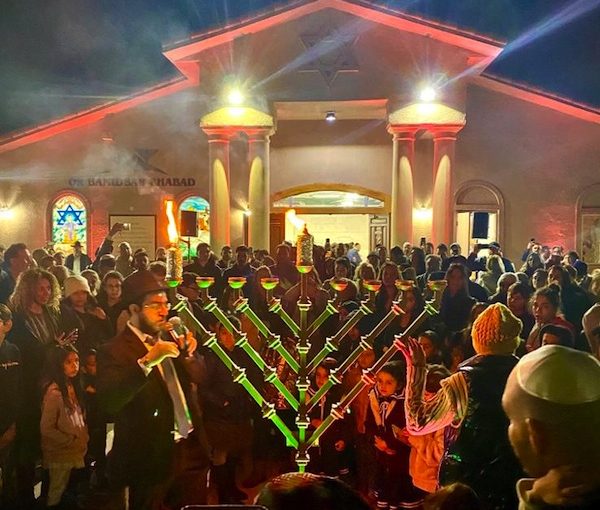
Las Vegas’s Or Bamidbar Chabad Sephardi synagogue at Chanukah. (photo from Rabbi Yossi Shuchat)

The Las Vegas Strip is where all of the action is, an endless sea of attractions and hotels with casinos, exhibits and more. These hotels cater to a tourist’s every whim. However, during my last trip to Vegas, several years ago, I spent a majority of my time off the strip, away from the bright lights and glitz.

I met up with a group of friends who I had spent a year with in Arad, Israel, in 1990-91, on a World Union of Jewish Students (WUJS) program that was for young Jewish professionals thinking of making aliyah. This was our second excursion to Las Vegas and members of our group hailed from Paris, New York, Boston, Toronto and Seattle. On our first trip, we stayed in the Egyptian-themed Luxor Hotel; this time, we stayed at Bally’s Hotel, in the heart of the strip.

We spent our first night wandering around the area near our hotel. The next day, on Friday afternoon, we ventured further afield to eat a fabulous lunch at an Israeli kosher restaurant called the Jerusalem Grill, which also offers pre-Shabbat delivery to hotels. As we dined on authentic Israeli dishes that could have come straight from the Holy Land, we reminisced about the good times we had had on our program and the many trips we took to explore Israel together.

We then explored the Palms Casino Resort and the Rio Hotel and Casino, which were near the restaurant. The Rio, where we would be going to see magicians Penn and Teller perform on Saturday night, after Shabbat, was also hosting the World Series of Poker.

On the Friday night, a few of my WUJS friends and I went to Or Bamidbar Chabad – East Las Vegas, a unique Sephardi synagogue, whose Chassidic spiritual leader, Rabbi Yosef Yitzchok (Yossi) Shuchat, is from Venezuela. I had made arrangements with the rabbi prior to Shabbat to attend services and he graciously invited my friends and I to dinner at his house afterwards.
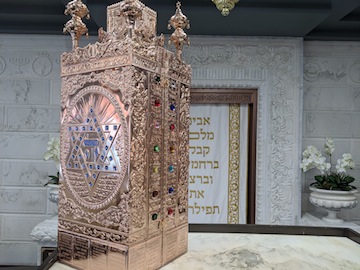
photo - A Sephardi Torah case at Or Bamidbar Chabad
A Sephardi Torah case at Or Bamidbar Chabad. (photo from Rabbi Yossi Shuchat)

The synagogue features a picture of the Rebbe (Rabbi Menachem Mendel Schneerson) but, other than that, it is a typical Sephardi house of worship, with the bimah in the middle, and Sephardi prayer books and a Sephardi Torah case. I felt right at home, as I have prayed at Sephardi and Chassidic congregations all over the world and have an affinity for the customs and traditions of both streams of Judaism.

After some spirited davening and a great drash by the rabbi, we and a few members of the congregation followed the rabbi to his home, where we were treated to a scrumptious Shabbat meal by his wife, Miriam Bryna Shuchat, who is co-director of Or Bamidbar.

Most of the guests were Sephardi and from Las Vegas, but there was also Baruch, a visitor from New York who was in town to play at the poker tournament. There was also Walter, a Jew who had moved to Las Vegas from Boston and, at one time, was a boxer and a blackjack dealer. After great conversation and food, I retired to a recently renovated mobile home right across from the synagogue, which was reserved for guests – and I had the honour of being the first one!
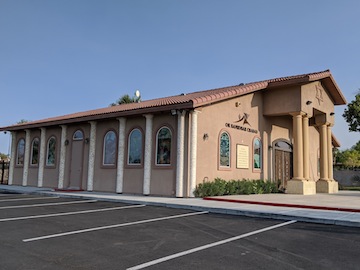
photo - Or Bamidbar Chabad – East Las Vegas
Or Bamidbar Chabad – East Las Vegas. (photo from Rabbi Yossi Shuchat)

The next morning, I participated in the services and got to chant Birkat HaKohanim, the ancient priestly blessing that Sephardi shuls – including Beth Hamidrash in Vancouver – do every day, but Ashkenazi ones do not. At lunch, I had a lively discussion with a former Vancouverite who was encouraging me to leave Canada and move to Las Vegas’s thriving Jewish community, with its approximately 80,000 Jews, 20 synagogues, many Jewish schools and several kosher restaurants. When they had lived in Vancouver, both he and his mom had attended services at the Kollel and are fans of Rabbi Shmulik Yeshayahu. Interestingly, since my Vegas visit, the Pacific Torah Institute, which was located in Vancouver, has relocated to Las Vegas and merged with a local yeshivah.

After services, I was contemplating walking back to the hotel in the sweltering 32°C heat, but Walter, the former blackjack dealer, invited me to spend the afternoon at his house. It was a relaxing, enlightening and cool afternoon. Walter regaled me with stories about what Vegas was like when he arrived there in 1956. At that time in the city, which was founded by notorious Jewish gangster Bugsy Siegel, most of the hotels were owned by Jews and, so, as a blackjack dealer – at a variety of casinos, including the Flamingo and Desert Inn – Walter got to know many of them. He also got to know Frank Sinatra, Dean Martin, Sammy Davis Jr., and other members of the Rat Pack, as well as boxer Rocky Marciano. (When Walter was a boxer himself, he also met Muhammad Ali.)

After my stay at Walter’s – where I even got a Shabbat nap in – he gave me a lift to the Rio, where I met my friends to see the Penn and Teller show. The poker tournament was also in full swing, of course, but I don’t know how Baruch fared.

I spent my last night in Vegas before returning home to Vancouver with my friends at a glitzy hotel watching a magic show. However, while I enjoyed all that I did, the highlight of my trip – in addition to hanging out with friends – was the gracious hospitality of the folks in the Jewish community. I will always remember my wonderful Shabbat in Las Vegas at Or Bamidbar Chabad.

David J. Litvak is a prairie refugee from the North End of Winnipeg who is a freelance writer, former Voice of Peace and Co-op Radio broadcaster and an “accidental publicist.” His articles have been published in the Forward, Globe and Mail and Seattle Post-Intelligencer. His website is cascadiapublicity.com.
Format ImagePosted on December 4, 2020December 2, 2020Author David J. LitvakCategories TravelTags Chassidic, history, Judaism, Las Vegas, Miriam Bryna Shuchat, Or Bamidbar Chabad, Sephardi, Shabbat, Yossi Shuchat
Pandemic rouses memories

Pandemic rouses memories

Simon Fraser University’s Prof. Lauren Faulkner Rossi, left, interviews child survivor Marie Doduck in a Zoom presentation Nov. 5. (screenshot)

For some survivors of the Holocaust, the COVID pandemic has brought back the traumas of the past. Marie Doduck spoke recently at a virtual event, recounting her survival story and her life in Canada, including her response to the initial lockdown in the spring. It is a response, she said, that is paralleled by many others in Vancouver’s group of child survivors of the Shoah.

Born in Brussels, the youngest of 11 children, Doduck spent most of her childhood hiding in orphanages, convents and strangers’ homes. In 2020, she found herself opening her front and back doors, reminding herself that she was free to go for a walk, yet haunted by the long-ago memory of hiding.

“It brought back a terrible time for us at the beginning of COVID,” she said during an interview that was webcast as part of Witnesses to History, a series presented by the Simon Fraser University department of history in partnership with the Vancouver Holocaust Education Centre. “I know the other survivors feel the same way. I would say that was the hardest of all.”

When the war began, Doduck (then Mariette Rozen) was 4 years old. Her father died when she was a toddler and some of her older siblings were already married and had their own families. After the occupation of Belgium, those who remained at home set out on foot headed for Paris, where a sister lived, unaware that Paris, too, was under occupation. She remembers riding on the shoulders of her brother Henri and seeing what she thought was a magnificent sight.

“I saw this beautiful silver bird in the sky and I thought that was so beautiful,” Doduck recalled. It was surrounded by stars. “The next thing I know, I was flying into the ditch on the side of the road. Of course, the bird and those stars were planes diving and, even now, I can hear the whistle of the diving and the shooting. They were killing people on the road. That was my first contact with death and blood. It was all over the place.”

Soon, the family dispersed and Mariette began a years-long succession of shuttling between hiding places in various countries of northwestern Europe. A facility for languages began then and Doduck is now working on learning Mandarin, her 10th tongue.

In some homes where she was hidden, she would sit under the table while the family’s children did their homework. Then, after others had gone to bed, she scoured the homework to educate herself.

She also has something of a photographic memory and she realizes now that she served as a messenger, repeating what she had been told when asked by siblings who had joined the resistance and who could make occasional contact while she was in hiding.

As is the case with many survivors, Doduck has stories of almost-miraculous near-misses.

As is the case with many survivors, Doduck has stories of almost-miraculous near-misses.

While being hidden in a convent, she was exposed. The mother superior of the convent knew that Mariette was Jewish, but presumably most of the nuns did not. When one sister discovered her secret, she denounced the child to the Gestapo.

“Being a good nun, she went to the mother superior and told the mother superior what she had done,” Doduck recounted. “The mother superior had woken me up and taken me to the centre of the convent to the sewers and dumped me in the sewer. They came to the convent to search for me and they didn’t find me.”

In the sewer, filled with fetid water and rats, Mariette held her breath as she heard the boots of the Gestapo officers above her.

“I killed some rats to make a mountain so I didn’t have to stand in the cold water,” she said. “The mother superior saved me and that night I left and went to another place.”

Even more frighteningly, Mariette was rescued from a train almost certainly headed to catastrophe in the east.

“I was caught and I was put on a train,” she said. “I was the last one put on a cattle car and I was lucky because the cattle car had slats so I was able to breathe because they pushed us like sardines.… I remember the gate shouting and the clang, clang, clang, I can hear it now, and the lock.… Then the train stopped. I have no knowledge of places.”

The gate opened and Mariette saw a Gestapo officer.

“Black uniform, black hat, swastikas on his lapel, black boots, a leather strap with a revolver, a leather strap attached to a baton,” she recalled. “And, in German, he said, ‘What is my sister doing on this train?’ I looked left and I looked right. There was no other child but me.… This Gestapo that had probably killed hundreds of people, children as well probably, took me off the train, put me on his motorcycle and took me [away]. Years later, I found out that this Gestapo went to school with my brother Jean and used to come to my house on Friday to have dinner with us and he recognized me, that I was Jean’s sister.”

In the course of research for her memoir, Doduck recently discovered that her mother and one brother, Albert, were arrested and sent first to a transit camp and then on to Auschwitz. Her brother Jean, who was in the French resistance, was arrested elsewhere but was on the same train. Another brother, Simon, survived the war but died at Auschwitz in the weeks after liberation. Like thousands of others, he succumbed after well-intentioned Allied officials provided food to the starving inmates, whose stomachs could not assimilate it.

Including Doduck, eight siblings survived and somehow found one another after the war. One brother, Jule, chose to remain in Brussels with his family. Charles, who was also married before the war, moved to Brazil. Sister Sara went to the United States. Brother Bernard went to Palestine with Hashomer Hatzair, the socialist-Zionist youth movement.

Doduck, aged 12 at the time, and the three other siblings – Esther, Henri and Jack – were four of 1,123 Jewish child survivors of the Holocaust sponsored to come to Canada under the auspices of Canadian Jewish Congress in 1947.

Her recollections of arrival in her new homeland are not warm.

As the children disembarked the ship in Halifax, they found themselves in a compound surrounded by barbed wire, as though they would try to escape. From there, they were moved to a room with bars on the windows.

“I wasn’t called by my name,” she said. Each refugee had a number pinned to their chest. Hers was 73, she thinks, or possibly 74.

“Nobody talked to us,” she said. “Nobody really welcomed [us]. We were just a bunch of probably wild children. I can only describe that I had an adult’s mind in a child’s body. We survivors saw too much dirt, too much killing, too much that a child should ever see.

“We were treated like we were nothing at all,” she recalled.

She wanted to go to Vancouver. She had seen a map and knew that there were beaches there.

“I remember as a child we used to go to la plage, the beach, with the family,” she said. “That was happy times.

“And just like Brussels, it rains a lot too,” she added, laughing.

The four siblings were fostered by four different families in Vancouver. While not all the 1,123 children who were sponsored found loving homes, Doduck believes that she and her brother Jack were among the luckiest.

Doduck was taken in by a couple, Joseph and Minnie Satanov, who had no children and, weeks after Mariette arrived, celebrated their 30th wedding anniversary. The couple would become surrogate grandparents to Doduck’s three daughters and Doduck would care for them in their old age.

Still, the early months were difficult. The Satanovs spoke Yiddish, but it was a “highbrow” variation, Doduck said. Hers was “street Yiddish” and the initial communication was largely pointing and miming.

While her foster family was wonderful, Doduck, like some other survivor refugees, said their treatment by the broader Jewish community was inhospitable. Asked if the community welcomed her and her peers, she replied: “I hate to say it, they didn’t.”

As a child, she didn’t understand it. As an adult, especially now, as she plumbs her experiences in the process of writing her history, she thinks she understands and empathizes.

“The community did not accept us,” she said. “They were fearful. I understand this now. They were fearful of what we knew, of what we saw. As a child, I didn’t understand that. As an adult, I understand it today.”

Her process of assimilation is akin to a split personality, she explained. She encompasses both the child Mariette and the adult Marie.

“Survivors – this is a secret but I’ll tell the world today – survivors are two people. Mariette is the child who is still in me and is trying to come out, and Marie [is] the person I created to become a Canadian and to fit into our society here in Vancouver.”

“Mariette is a child from Europe. Marie is the name I took in Canada to hide who Mariette was,” said Doduck. “Survivors – this is a secret but I’ll tell the world today – survivors are two people. Mariette is the child who is still in me and is trying to come out, and Marie [is] the person I created to become a Canadian and to fit into our society here in Vancouver.”

That internal dichotomy is most evident when she speaks with school groups and others about her war-era experiences.

“When I do outreach speaking, I speak as Mariette,” she said. “When I leave the school, Mariette is put on a shelf and Marie takes over and becomes a Canadian. Marie cannot survive with the memories if I don’t put Mariette on the shelf…. I can’t live the memories. It takes a lot out of me to relive.”

The stories she has to share can be harrowing and there are still details that she is only now learning as she works on writing her memoirs. Lauren Faulkner Rossi, an assistant professor at SFU’s department of history interviewed her for the Nov. 5 event and is collaborating on the memoir.

While the pandemic may have jogged loose deep-seated memories, Doduck sees other alarming parallels in the world today that hearken to the dark past.

“We are again being persecuted, we are again being hated, we are again being hit, we are again being abused constantly,” she said of rising authoritarianism and antisemitism in parts of the world. “I see what I saw as a 4-year-old, 5-year-old. I’m seeing it around the world and nobody seems to see it, that the hate is coming again.”

Format ImagePosted on November 27, 2020November 25, 2020Author Pat JohnsonCategories LocalTags child survivor, coronavirus, COVID-19, Holocaust, Lauren Faulkner Rossi, Marie Doduck, memoir, SFU, Shoah, survivor, VHEC
How Nazis stole assets

How Nazis stole assets

Prof. Chris Friedrichs speaks at the annual Kristallnacht Community Commemoration, on Nov. 9. (screenshot)

Under the Nazi regime, almost all personal property and wealth owned by German Jews was either explicitly confiscated or, in the case of bank accounts, effectively frozen. Yet, while Jewish property was stolen without compunction, the Reich had scrupulous records and systems in place to ensure that no Aryan German who was owed money by those Jews was deprived of their due.

Chris Friedrichs, professor emeritus of history at the University of British Columbia and himself the son of a couple who fled Germany ahead of the Holocaust, delivered the lecture at the 2020 annual Kristallnacht Community Commemoration, Nov. 9. The event was recorded and presented virtually due to the pandemic. His lecture, How to Steal from Jews: A Story from Nazi Germany and What it Teaches Us, explored the history of the family of Friedrichs’ late wife, Rhoda (Lange) Friedrichs, as a microcosm of the sprawling bureaucracy the Reich put in place to manage the stolen property.

Rhoda Friedrichs’ grandparents, Carl and Thekla Rosenberg, lived comfortably in Berlin. Their two daughters grew up and migrated to the United States. By the time the Nazis came to power and the Rosenbergs might have been able to escape, Carl was already experiencing dementia.

Because there was no room in the Jewish nursing home in Berlin, he was moved to a facility in Koblenz, hundreds of kilometres away. Thekla was forced from their home and ordered into a sort of dormitory for older Jews, where she shared a single room with five or more other Jewish women. From there, she was assigned to forced labour in a factory.

Eventually, consistent with the plan for the “Final Solution,” almost all the Jews remaining in Germany were transported to Nazi-occupied Poland.

“Every time a Jew was put on a list to be deported to the east, he or she first had to fill out what was called a property declaration, a complete list of all his or her property, which would now become the property of the German Reich,” said Friedrichs.

In the spring of 1942, Carl Rosenberg and the other residents of the Koblenz care home were deported to a death camp in Poland.

In November 1942, Thekla and 997 other Berlin Jews were transferred to a train station and deported directly to Auschwitz.

“Who suffered most on these trains to Poland?” Friedrichs wondered. “Was it Carl Rosenberg, his mind clouded by confusion and dementia, suddenly removed from the caring place where he had lived for two years and put on a train for reasons no one could explain to him? Or was it his wife, her mind clear to the last, not knowing the exact destination but almost certainly able to guess what lay ahead for her? This, like much else, we will never know. But we do know that both of their lives ended in unspeakable misery in 1942.”

Their lives ended, Friedrichs noted, “but their victimization did not.”

The German Reich claimed to own whatever property the Rosenbergs still had at the time of their deportation. Like that of the other German Jews who were deported, the assets came under the authority of German finance offices in cities and towns across the country.

“One might think that this was an uncomplicated matter,” said Friedrichs. “Well, no. There was a problem. If a Jew owned a house or a piece of land, there might be a mortgage on it. The mortgage-holder might be a German, who expected his regular interest payments. If a Jew had any debts or obligations, they might be owed to some German, who expected those debts to be honoured and paid. If a Jew still owed some rent or had not yet paid the last gas bill or electric bill before being taken to the station, the landlord or utility company waited impatiently for that payment. You could steal every penny from a Jew, but you still had to be careful not to deprive even a single penny from a German who was entitled to it. So, all the local offices of the ministry of finance had to handle all these matters with scrupulous bureaucratic precision. Otherwise, they might be accused of cheating Germans of what was due to them.”

In files Friedrichs has copies of, the respective finance offices in Berlin and Koblenz had extensive back-and-forths about which office was responsible for settling outstanding obligations from the Rosenbergs’ estates.

The documentation of the officials was meticulous, something Friedrichs credits more to the nature of bureaucrats than to the Nazis specifically.

“Most of the thousands of people who worked for the German ministry of finance or the local finance offices were not hard-core Nazis,” he said. “The majority of them had been working in those offices for many years, usually starting long before the Nazis came to power.… As long as it was clear which ordinances or decrees were pertinent to the work at hand, they carried on as usual.”

Historians have found several instances of officials defying orders and returning stolen property to their Jewish owners, but this was exceedingly rare, said Friedrichs. “Did they ever wonder if they were in fact facilitating or cooperating with a process of mass murder?” he asked.

As the Nazis’ defeat approached, high-ranking officials circulated an order to the local finance offices in Germany, demanding that all records pertaining to the disposition of Jewish property be destroyed rather than fall into the hands of the invading Allied armies.

Again, behaving more like bureaucrats than Nazis, few offices complied. “The work of the finance offices would be carried on right to the bitter end,” said Friedrichs. “This is how bureaucrats reacted when they were taught what to do but not to think about why they were doing it.”

The care the German officials took with Jewish property juxtaposes bleakly with the fate of the Jewish people themselves.

“It teaches us something not just about the fate of two of the victims, but also about those who participated in the victimization,” said Friedrichs. “The Holocaust, in its fullest sense, was not only the murder of Jews. It was also a relentless project to take whatever the Jews had and make it the property of the German Reich or in some cases of their accomplices in other parts of Europe. After all, the Nazis valued everything the Jews owned, everything, that is, except their lives, which the Nazis regarded as worthless.”

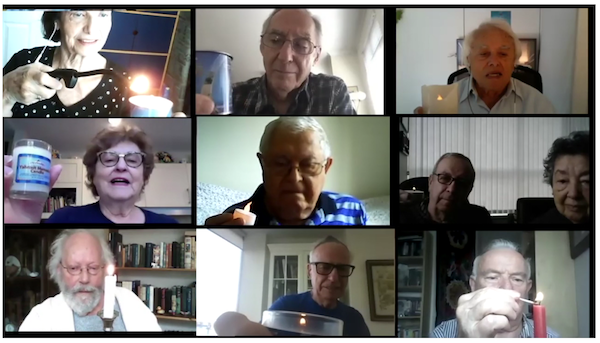
screenshot - As part of the Nov. 9 Kristallnacht commemoration, candles of remembrance were lit by Holocaust survivors in their homes
As part of the Nov. 9 Kristallnacht commemoration, candles of remembrance were lit by Holocaust survivors in their homes. (screenshot)

Friedrichs’ lecture dovetailed with the theme of the exhibition currently ongoing at the Vancouver Holocaust Education Centre. Treasured Belongings: The Hahn Family & the Search for a Stolen Legacy tells the history of Max and Getrud Hahn, whose collection of Judaica and other artwork was stolen by the Nazis, and the efforts by their descendants, including their grandson Michael Hayden, a UBC professor, to locate and restitute some of the artifacts.

Friedrichs’ talk paid tribute not only to his wife’s grandparents, Thekla and Carl Rosenberg, but also to his wife Rhoda, who, he said, had hoped to pursue the research on this aspect of history and share it with the public herself, but who passed away due to cancer in 2014.

The lecture was presented by the VHEC and Congregation Beth Israel. It was made possible with support from the Robert and Marilyn Krell Endowment Fund at the VHEC and contributions to the Jewish Federation of Greater Vancouver annual campaign.

Beth Israel’s Rabbi Jonathan Infeld thanked Friedrichs and reflected on his words and their meaning. Nina Krieger, executive director of the VHEC, read a proclamation from the City of Vancouver on behalf of Mayor Kennedy Stewart.

Corrine Zimmerman, president of the board of directors of the VHEC, introduced the event, which took place on the 82nd anniversary of Kristallnacht, Nov. 9-10, 1938. That date is seen by many as the beginning in earnest of the Holocaust. The well-orchestrated pogrom, planned to appear like a spontaneous anti-Jewish uprising, saw violence across Germany and Austria that night. Rioters destroyed 267 synagogues, damaged or destroyed 7,000 Jewish businesses and 30,000 Jewish men were arrested and incarcerated.

Candles of remembrance were lit by Holocaust survivors in their homes and incorporated via video into the commemorative program. Cantor Yaacov Orzech chanted El Moleh Rachamim.

Format ImagePosted on November 27, 2020November 25, 2020Author Pat JohnsonCategories LocalTags Beth Israel, Carl Rosenberg, Chris Friedrichs, Holocaust, Nazis, Rhoda Friedrichs, Shoah, Thekla Rosenberg, VHEC

Scientific breakthroughs

Scanning Israeli news this week has a feel of a sci-fi fantasy. Most eye-catching of all is the assertion by a Tel Aviv University researcher, in a peer-reviewed article, that hyperbaric oxygen therapy can “reverse aging” by lengthening telomeres, the structures found at the ends of chromosomes, by more than 20% on average.

“This means we can start to look at aging as a reversible disease,” Prof. Shai Efrati said, as reported in the Times of Israel. Some gerontologists are skeptical of the claims and some suggest it could open a Pandora’s box of related health issues, but, from ancient times through the 16th-century conquistador Juan Ponce de León to, apparently, contemporary Israel, humankind has dreamed of and sought out a figurative or literal fountain of youth. Whether Efrati’s research will fulfil that dream will be watched closely.

And there are other scientific headlines this week.

Also coming out of Tel Aviv University is news that scientists have destroyed cancerous cells in mice by pinpointing affected cells with “tiny scissors,” while leaving everything around them intact and with no side effects. With trials possibly to begin in humans within two years, they are hopeful that this could be a revolution that could effectively cure cancer.

A third scientific bombshell comes from Israelis in Canada. Eliav Shaked and Roy Kirshon, expatriate biomedical engineers working in Toronto, are developing a speedy, non-invasive diagnostic for patients who are likely decades away from showing symptoms of dementia. While there is no cure yet for dementias like Alzheimer’s disease, the pair believe that an early diagnosis will not only permit individuals to prepare for eventual care but allow doctors to study the progression of the disease and thereby gain valuable insights.

In these pages, we frequently highlight Israeli technological and medical advancements but the news this week really seemed like a dream sequence from a futuristic utopia. Of course, none of these initiatives is a sure bet but they read like a hat trick against some of the most damning health challenges facing our generations.

Is it a coincidence that these are all emerging from Israel? It is no secret that the tiny state is a locus of a massively disproportionate amount of the world’s achievements in a range of fields.

Some books, like Start-up Nation: The Story of Israel’s Economic Miracle, by Dan Senor and Saul Singer, and many other observers have posited that Israel’s successes are achieved not in spite of the adversities the country and its people have faced, but as a direct result of them. So many of the scientific, social and economic advances that have come out of Israel in recent decades are civilian benefits redounding from military research and development, though Israel is by no means the only country for which this is case.

No less significant are the social impacts of compulsory service in a national defence force that some have called the least hierarchical in the world. Individuals who made life-and-death choices for themselves and their colleagues at age 19 or 20 may be less timid in taking major entrepreneurial or other life risks at 25 or 30 than an average North American or European at that age. Not to discount the value of peace and all the benefits it would bring, the circumstances in which Israel exists have created a thoroughly unique social and economic environment.

Coincidentally or not, also in the news this week was a vote at the United Nations in which 163 countries, including Canada, voted for a condemnatory resolution against Israel; five voted against. It is one of 17 resolutions expected in this General Assembly session targeting Israel, while just seven country-specific resolutions are expected to be aimed at condemning every other injustice on the planet. Canadian Jewish organizations and pro-Israel commentators are furious at Canada’s vote, which directly contradicts pledges made by Prime Minister Justin Trudeau, including during the last election campaign.

While many are appalled at the hypocritical obsession with Israel, and certainly Israeli diplomats are in the fray denouncing the vote, average Israelis, it is safe to say, remain sanguine. They have seen far worse attacks than that by the world community in the comparatively impotent global parliament that the UN General Assembly has become.

While it would be nice if the world judged Israel with moral measuring sticks commensurate with those we use for every other country, in the end it doesn’t seem to make much difference, thankfully. Even through the pandemic, Israelis have continued to try and turn science fiction into scientific reality. This week’s news alone included the possibility of cures for cancer, dementia and aging itself. And the benefits of such research do not accrue solely to Israelis, but to all of us – whether the nations of the world at the General Assembly recognize and appreciate that fact or not.

Posted on November 27, 2020November 25, 2020Author The Editorial BoardCategories From the JITags aging, Alzheimer's, anti-Israel, antisemitism, dementia, Eliav Shaked, health, Israel, Justin Trudeau, Roy Kirshon, science, Shai Efrati, technology, Tel Aviv University, United Nations

Harris-Emhoff’s significance

After the election of Joe Biden and Kamala Harris, many Jews were quick to celebrate that Harris’s husband Doug Emhoff is Jewish. Indeed, it is a win given the sharp rise in antisemitic expression and white supremacy we’ve seen in the United States, and which is bleeding over into Canada.

Jews often celebrate when someone like us makes it into a position of some influence. This time, it isn’t any particular achievement of Emhoff’s but, rather, his proximity to someone powerful.

Harris represents so many firsts: the first woman, the first person of South Asian and of Black heritage, and the first person married to a Jew to reach the vice-presidency. Her family is a positive representation of the dream of the United States, where anyone can become anything and where, crucially, diversity is a strength.

In open and free democracies, intermarriage is inevitable. If we are to live and work alongside each other, we will fall in love with each other. This isn’t a bad thing. Given how many people seem to hate Jews, it is nice that some people actually love us. I realize intermarriage is a perceived threat to Judaism; fears of assimilation are very real. And yet, Emhoff is proudly Jewish. His identity is not threatened by the multiple identities of his partner – they celebrate the many elements of who they are and where they come from.

Since the election, there have been many pieces published about how nice it is to see one’s intermarried family represented in the White House. Jewish communities have spent the past several decades trying to stop intermarriage. These efforts have failed and have even driven some Jews and their loved ones away from Judaism.

If we care about Jews and Judaism, including challenging the multiple threats we face, this kind of infighting really needs to stop. It’s time we embrace our pluralistic and diverse families, celebrate all those who wish to be and do Jewish, and recognize that there is so much in Judaism that is beautiful and meaningful, joys that can be experienced by all who are part of the wide web of Jewish families.

Rabbi Denise Handlarski lives in Toronto. She is the author of The A-Z of Intermarriage, published by New Jewish Press, and the leader of the online community Secular Synagogue.

***

Editor’s Note: For a response to Rabbi Denise Handlarski’s opinion piece, see “We Jews Are a People of Destiny” by Rabbi Ari Federgrun.

Posted on November 27, 2020December 16, 2020Author Rabbi Denise HandlarskiCategories Op-EdTags democracy, diversity, Doug Emhoff, family, intermarriage, Joe Biden, Judaism, Kamala Harris

Past helps decode present

My husband saw the pair of decoder rings in a catalogue, long before our twins were old enough for them. Still, he ordered them and put them away. At the time, it amused me. How could he predict the future? Would our kids want these someday?

Fast forward to one October 2020 pandemic weekend. I’m not sure how he knew it was the right time. Before I knew it, two 9-year-olds were whizzing around the house, holding onto rings much too large for their fingers, and sending each other secret messages in code.

When they returned to school that Monday, they continued with the crazy codes, trying to teach their classmates about it. Unfortunately, this fun was short-lived. About a week later, we got an email from the school. It said that remote learning “may” be offered, and that we could sign up if we “might” be interested.

The situation was worsening in Manitoba, so we clicked through late on a Saturday night. This seemed wise, if we indeed understood the confusing letter correctly, that this remote learning might be happening. In any case, if some people signed up for the remote learning, it would allow more room in our older, smaller school building for others to social distance. Well, surprise! We were contacted on Monday morning and, by that Wednesday, our kids were at home again, learning with us. In the long run, this is the right choice – Judaism teaches us to value life above all else.

Both my husband and I are already working from home. At the beginning of my career, I used to teach school. Although I’ve never taught Grade 4 before, we’re muddling through. The remote learning we’re offered doesn’t continue the Hebrew curriculum we had before. It started with a single Hebrew packet, but, when it looked like we were nearing the end and I asked the school if it had more to share, I got a stern “no” in response. Remote learning offers only the basics, even if we can see via Instagram that, in class, the kids’ schoolmates are still doing fun projects without us.

It’s hard on children to feel left out. However, since there’s already been a COVID virus exposure at the school, we made the safe choice for us. My kids are lonely for their friends. My husband, a biology professor, thinks that schools should shut down now, until the infection rate lessens and the health system isn’t so overburdened.

Yet, here we are, with an everyday virtual, multi-age “school lesson” that lasts an hour. We do the reading, writing, math and science on our own. We also do something Jewish. One night, it was a discussion about Mezritch, which was a centre of Chassidism. Another day we talked about tefillin. On a third day, we learned about Sigd, the Ethiopian Jewish holiday celebrated 50 days after Yom Kippur, which is now a national holiday in Israel. The kids keep up their Hebrew as best we can, with my support and by using a free language program online.

Today, we hit the very last page of the Hebrew packet sent home by the school a couple weeks ago. There were moans about how hard it was and further cries when they realized there was no more of the “packet Hebrew.” For me, the last page left a special, coded gift.

This page taught about how each letter of the aleph bet, the Hebrew alphabet, also signified a number. Aleph is one, for instance. The numerical values of the letters of chai, the word for life, add up to 18.

My kids struggled with this page for entirely different reasons. But, if we can learn to write the numbers in Arabic numerals (also called the Hindu-Arabic system), we can learn the Hebrew ones. We’ll learn to spell out the number names in Hebrew. Like magic, I’d been given a gift, a secret decoder system to share. We just have to learn all the symbols together!

I won’t lie. I wish my kids’ class had all gone “remote” together, so they could see their classmates for an hour a day. I wish the pandemic hadn’t happened. I wish I’d gone to bed earlier over the weekend, instead of staying up late, reading the huge obituary section – but wait, that’s not right.

My biggest wish that puts all these little ones to shame? I want to honour every life that’s in those obits, every life that has been lost. There’s so much suffering, death and loss right now, and we’re all working our way through it.

I also want to honour the diverse positive ways we’ve innovated and managed during a scary, singular experience. Studying a textual tradition like ours, that’s thousands of years old, means we have deep resources. We can hear about deaths and the first obituaries in the Torah portions this time of year. We imagine similar chaotic experiences like Noah’s ark in the flood, or the destruction of Sodom and Gomorrah. There are plenty of opportunities to think through our rich history during remote or home school.

On the plus side? It also means that I have a Hebrew lesson plan for tomorrow and beyond. We have access to an ancient, special Hebrew numerical code, called Gematria, and a mom teacher who now gets to figure out how to use that, along with those fancy decoder rings, for good – for the twins to learn math, puzzles, Hebrew and more … in Grade 4.

Joanne Seiff has written regularly for CBC Manitoba and various Jewish publications. She is the author of three books, including From the Outside In: Jewish Post Columns 2015-2016, a collection of essays available for digital download or as a paperback from Amazon. Check her out on Instagram @yrnspinner or at joanneseiff.blogspot.com.


Posted on November 27, 2020November 25, 2020Author Joanne SeiffCategories Op-EdTags coronavirus, COVID-19, education, family, Gematria, Judaism, kids, lifestyle, parenting
Panel on shared legacy

Panel on shared legacy

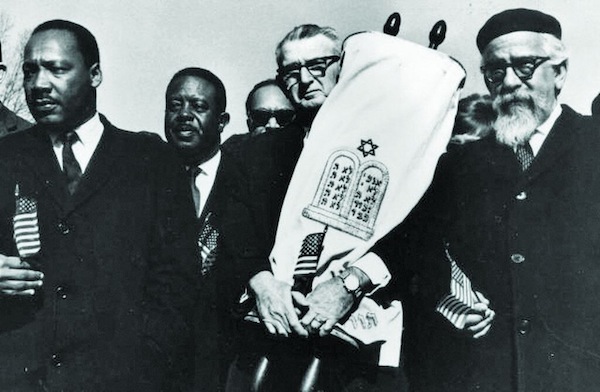
A still from the documentary Shared Legacies: From the left are Martin Luther King Jr., Ralph Abernathy, Maurice Eisendrath and Abraham Joshua Heschel during the march from Selma to Montgomery, 1965.

The Victoria Shoah Project held a panel discussion on Oct. 20, following an online showing of the documentary Shared Legacies: The African American-Jewish Civil Rights Alliance.

The 2020 film, part of the sixth annual Victoria International Jewish Film Festival, chronicles the common history of prejudice and hardships each group has faced, and features footage of the relationships of such luminaries as Dr. Martin Luther King and Rabbi Abraham Joshua Heschel. Included are interviews with many prominent civil rights leaders of the time, such as Andrew Young, John Lewis, Rabbi Alvin Sugarman and Rabbi Peter S. Berg.

After the screening, there was a Vancouver Island-based panel discussion with Adrienne and Barrie Carter, Paul Winn and the Victoria Shoah Project’s Robert Oppenheimer. From their own experiences, they each spoke about African-Canadian and Jewish-Canadian relations. They also talked about the film, and the events from 1960s America that it depicts, from personal, historical, present-day and Canadian perspectives. Rick Kool, also of the Shoah Project, served as moderator.

Adrienne Carter was born in Hungary in 1944, as the Nazis marched into the country and were increasing their campaign to exterminate the Jews. Many in her extended family died in Auschwitz. She and her family moved to Canada in 1956, following the Hungarian Revolution. “The whole stateless experience is very well known to me,” she recalled. “I married Barrie in 1965, at a time when Blacks and whites rarely ever connected, let alone married, and at a time when many Southern states had laws against interracial marriages.”

A co-founder and the director of services at the Vancouver Island Counseling Centre for Immigrants and Refugees, she has spent much of her working life helping immigrants by providing therapy to those who have experienced trauma, including intergenerational trauma.

Barrie Carter, who was a special needs education assistant until his retirement, told the audience of his early years. Born in Jacksonville, Fla., he moved to the northeastern part of the country where, in his teens, he volunteered with the NAACP in Bridgeport, Conn., and in New York and picketed Walgreens to challenge their segregationist luncheonette policies in the South. He immigrated to Canada on a bicycle in 1963. “While I was riding north, people were taking the bus south to the March on Washington. But I just had to get away,” he said.

Both Barrie and Adrienne Carter have traveled around the world, providing services to victims of torture and genocide.

Winn, whose work experience includes having been the executive director of the Canadian Race Relations Foundation, followed by recounting his experiences growing up in Toronto’s diverse Kensington Market neighbourhood.

“When I was 10 or 11, I was a Shabbos goy. I would do some things for the neighbours on Saturdays because they were unable to perform those tasks for religious reasons,” Winn recalled. “I got invited to bar and bat mitzvahs.”

He said, “It was natural for the Black and Jewish communities to support each other when there were struggles with such things as immigration. When I watched the film, I remembered how the connection between the religious Black and Jewish communities helped bring about a lot of activities in Canada, as well.”

Oppenheimer, a clinical psychologist with a focus on traumatized children and youth, a human rights activist and a staunch promoter of Holocaust education, also shared some information about his career. Reflecting on the 28 years he spent working in Detroit, he said, “It was an interesting experience for me. I was the only non-African-American on the staff and I was impressed with how welcoming the community was to me.

He added, “One of the things that impressed me about the movie was when Heschel said ‘not to be a bystander to history.’ I think that is central to my idea of human rights, that we cannot just stand by.”

“One of the things that really hit me in the film,” said Kool, “was a pastor standing in a church with a rabbi who said, ‘Reverend King isn’t here anymore, Rabbi Heschel isn’t here anymore, but are their children here now?’”

Barrie Carter observed that the youth in activist groups today “have the same dynamism as we did. They have an energy and a knowledge of concepts. It isn’t just a blind following. It is a positive morality.”

“They seem to believe it is part of their responsibility to make things better,” added Winn about today’s activists. “They want to make things better.”

Sam Margolis has written for the Globe and Mail, the National Post, UPI and MSNBC.

***

Note: This article has been amended to reflect the correct name of the film festival. It is the Victoria International Jewish Film Festival.

Format ImagePosted on November 27, 2020December 7, 2020Author Sam MargolisCategories TV & FilmTags Abraham Joshua Heschel, activism, Adrienne Carter, African-American, Barrie Carter, civil rights, immigration, Jewish-Canadian, Martin Luther King, Paul Winn, racism, Rick Kool, Robert Oppenheimer, Vancouver Island Jewish Film Festival, Victoria Shoah Project, VIJFF

Trying to protect cyberspace

As the use of the internet has grown, so has the need to protect data stored online, as well as prevent an organization’s website or social media platforms from being hacked. Since COVID-19 has hit, that need has increased manifold, as businesses, communal agencies, schools and synagogues have moved most of their activities online.

Cybersecurity, and security in general, is an area on which the Jewish Federation of Greater Vancouver has focused attention and resources for years. In 2015, it formed a security advisory committee, headed on a volunteer basis by Vancouver lawyer Bernard Pinsky.

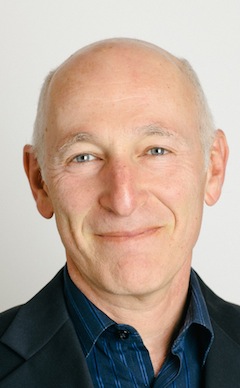
photo - Bernard Pinsky, head of Jewish Federation of Greater Vancouver’s security advisory committee
Bernard Pinsky, head of Jewish Federation of Greater Vancouver’s security advisory committee. (photo from Jewish Federation)

Pinsky, who was born and raised in Winnipeg, has been involved in the local Jewish community in various ways since he and his wife, Daniella Givon, an Israeli, moved here in 1981.

“Since the first war in Lebanon, I got involved in the Jewish community in a very big way … because I was concerned that the Jewish community in Vancouver was way too reluctant to get involved and raise their head and fight anti-Israel sentiment, both in Vancouver and across Canada,” said Pinsky.

Pinsky has volunteered with and supported many charitable organizations, both in the Jewish and general communities, and his efforts were recognized with a Queen Elizabeth II Diamond Jubilee Medal in 2012.

Over three years ago, the Jewish Community Centre of Greater Vancouver was one of almost 150 North American Jewish institutions that received a bomb threat. All of these threats ended up being traced to an Israeli teen and no one was hurt, but the potential harm raised concerns higher than they’d been in the past.

“In 2015, the Jewish Federation of Greater Vancouver decided we need to start a security committee, which was focused on physical security,” said Pinsky. “They asked me to be the committee chair.

“We started a physical security committee, which would train some volunteers, send people to events and help some of the synagogues train their people in security – not to carry weapons or actually try to take down terrorists, but to be extra eyes and ears before police are necessary … and to know how to defuse situations, if possible.”

The idea was to work with an overarching communal view and pool resources, rather than having each organization have to take on their own security initiatives. Jewish Federation annual campaign funds have since helped with security-related equipment, policies and programs. In 2017, Daniel Heydenrich was hired by Federation as director of security and he has coordinated efforts, trained volunteers and staff, worked with community members and law enforcement, as well as helped procure federal government Security Infrastructure Program grants.

About a year ago, when cyber-attacks on companies and institutions worldwide started involving ransom demands after systems were hacked, it became obvious that, in addition to physical security, cybersecurity was also an issue that needed to be addressed. And, in 2019, a cybersecurity and information protection subcommittee was created.

“We spent the first few months determining what our mandates were, who we were going to be helping, how we’d help, and how much would be as volunteer work and how much would be referring people out,” said Pinsky. “Then, COVID-19 hit. Very quickly after, we started making all of these decisions. With COVID-19, everybody had to be working from home, all of a sudden … people weren’t going to work in the office. So, the fact that you had office cybersecurity protocols … from home, this could be completely different – your own personal computer could be hacked.

“We realized that what we really needed to do was to offer to go into organizations and help them determine how well-protected they were. One committee volunteer decided to create an assessment tool, where we’d go through a series of questions with the organization and could tell them how weak or strong they were in different areas of cybersecurity and information protection.”

After making that assessment, the committee would then provide a list of recommendations to bridge any security gaps.

The mandate of the subcommittee, wrote Pinsky in Federation chief executive officer Ezra Shanken’s Sept. 25 Shabbat message, “is to recommend and communicate to Jewish community agencies information about specific cyberthreats and guidance that is published by recognized authoritative sources regarding cybersecurity (e.g., best practices, assessment tools, educational/training materials and policies/procedures); to provide training sessions; and to help Jewish community agencies work together to procure and implement cybersecurity services from commercial providers, where available. A key aspect of the subcommittee’s work is to help our partner agencies understand their level of exposure to cybercrime and to make recommendations on how to reduce the risk.”

So far, the cybersecurity experts on the committee have conducted six or seven assessments. Not wanting these volunteers to be overtaxed in the long run, Pinsky said, “We’re starting to train some additional people now. Hopefully, we’ll have some people qualified to do [assessments] within a month or so.”


Rebeca Kuropatwa is a Winnipeg freelance writer.

Posted on November 27, 2020November 25, 2020Author Rebeca Kuropatwa and Cynthia RamsayCategories LocalTags Bernard Pinksy, coronavirus, COVID-19, cybersecurity, internet, Jewish Federation, volunteerism
Rebuilding Volozhin Yeshivah

Rebuilding Volozhin Yeshivah

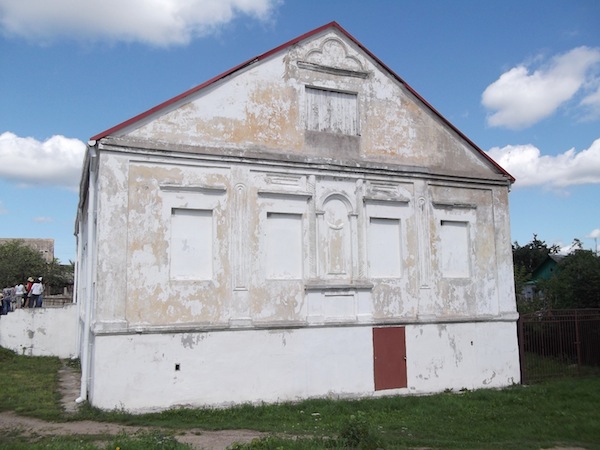
Volozhin Yeshivah in Belarus, 2017. In learning about the institution, Mark Weintraub was moved to sponsor a lecture on it, in honour of his mother, and to champion restoration efforts. (photo by Da voli)

“How did I not know about this?” That was the question echoing through the mind of Vancouver lawyer Mark Weintraub, a longtime student of Jewish intellectual history, when he first learned about Volozhin Yeshivah, a once-illustrious place of study that he describes as “the Harvard, MIT and Yale of the Jewish people rolled into one.”

Once Weintraub understood the influence Volozhin – which was open from 1806 to 1892 in what was then Russia – had on the Jewish world, he was stunned that it was so little known. His passion about this treasure of Jewish history led to his participation in organizing a recent online class, From Volozhin to Vancouver, taught by Rabbi Yitzchak Breitowitz, the rav and a teacher of Ohr Samayach Yeshivah in Israel, whose resumé includes having been a professor of law at the University of Maryland. It led, as well, to Weintraub’s championing of an effort to restore the still-standing building of the yeshivah, which is in Belarus.

To spread knowledge of Volozhin and to honour his late mother, Rita Weintraub, z”l, a lifelong devotee of Jewish learning, Weintraub helped organize and sponsor the online class with Congregation Beth Hamidrash, Congregation Schara Tzedeck, Vancouver Hebrew Academy and Shalhevet Girls High School. On Oct. 18, more than 60 people gathered to learn from Breitowitz on Zoom. Weintraub introduced the lecture, dedicating it to his mother, and Rabbi Ari Federgrun of Schara Tzedeck moderated the discussion. Breitowitz had risen at 5:30 a.m. in Israel to give the lecture about the legend and history of Volozhin, whose very name, he said, “carries an aura of mystery and delight.”

Volozhin is sometimes called “the mother of yeshivot,” since it was the first modern, institutionalized yeshivah, explained Breitowitz. It was established by Rav Chaim Volozhiner (1749-1821), a famed kabbalist and Torah scholar. Rav Chaim was a student of the Vilna Gaon (1720-1797), a towering figure at the time and the leader of non-Chassidic Jewry in Eastern Europe. The Vilna Gaon had led the Orthodox opposition to Chassidism, concerned about its radical theological ideas and the possibility that Chassidim might transgress Jewish law and lead to extremist mystical movements that would disrupt or damage the Jewish community. Followers of the Vilna Gaon came to be known as Misnagdim (Opponents), as the Chassidic movement grew to become the dominant force in Eastern European Jewish life.

Rav Chaim, who did not sign the Gaon’s writ of excommunication against the Chassidim, took a gentler stance towards the movement than his teacher. He focused his efforts on teaching an intellectually intense absorption in Torah study for its own sake and a fierce devotion to the observance of halachah (Jewish law) as a form of devotion to God.

Rav Chaim formed the Volozhin yeshivah to create a new kind of environment for study. Instead of the local learning that took place in small houses of study in the shtetls, Volozhin was a large institution that provided both housing and food to its students, and taught young Jewish men from near and far. “The Volozhiner wanted yeshivahs to be non-local institutions which all of Israel had a stake in,” explained Breitowitz. “He didn’t like a few large donors but many small donors.”

The yeshivah had 24-hour learning that was intended to sustain the world with the power of Torah and de-emphasize practical legal rulings for the sake of pure disinterested study. Volozhin – and its immediate offspring in the form of other similar yeshivot started by its graduates – created both a new model of Jewish learning and a generation of non-Chassidic luminaries with a far-ranging and decisive influence on orthodoxy and beyond. A short list of the graduates it produced, or who taught there, included Rav Chaim Soloveitchik (the Brisker Rav, 1853-1918), Rav Nafatli Yehuda Berlin (the Netziv, 1816-1891), Rav Abraham Isaac Kook (1865-1935) and many others, including both Zionists and anti-Zionists, mystics, ethicists and legalists.

The yeshivah environment encouraged creative ferment and demanded intellectual rigour, and Volozhin was not only famed for the Orthodox leaders it produced. Some of the students became leaders in the Haskalah, or Jewish Enlightenment, and it was rumoured that secret books were passed among students and housed in a hidden library full of philosophy, science and secular language texts. Among its luminaries in this regard was Chaim Nachman Bialik (1873-1934), the renowned Israeli poet and writer.

In 1892, the Russian government closed Volozhin when the heads of the yeshivah refused to change the daily schedule to curtail Torah study and include hours of government-approved secular studies. While it reopened in 1899 on a smaller scale, its glory days had passed.

Volozhin functioned until 1939, when the Second World War broke out. During the war, German soldiers used the building as a stable; later, it was a canteen and deli. The site was returned to the Jewish community of Belarus in 1989. In 1998, it was registered on the State List of Historical and Cultural Monuments of the Republic of Belarus.

It was the discovery of this history that so excited Weintraub. His mother had been a devotee of learning, libraries and study. “I wanted to have lectures to honour her, since it was difficult to communally mourn her during COVID,” said Weintraub. “I approached Rabbi [Don] Pacht at Vancouver Hebrew Academy about bringing in Rabbi Breitowitz.”

Wondering if the topic was too Orthodox for his mother, Weintraub, who has been involved in the Conservative movement for years, decided, “Nothing was ever too Jewish for her. She saw the goodness in everyone’s Judaism, no matter what it was, so I went ahead to tell this fascinating story of Jewish learning in her honour.”

For his part, Breitowitz has taken on a project to raise awareness and money for the reconstruction of Volozhin. He has begun organizing a group to work on it and is beginning “to raise momentum and find a way.”

“Five hundred years from now, Harvard, Yale and MIT are in ruins and everyone just walks by it?” he challenged. Volozhin, he said, “is a place that needs special attention from the Jewish community.”

Matthew Gindin is a freelance journalist, writer and lecturer. He has been published in Philosophy Now, Tricycle, the Forward and elsewhere. He blogs on Medium and is master teacher at Or Shalom Synagogue in Vancouver.

Format ImagePosted on November 27, 2020November 25, 2020Author Matthew GindinCategories LocalTags Belarus, Beth Hamidrash, education, history, Israel, Judaism, Mark Weintraub, Ohr Samayach Yeshivah, restoration, Rita Weintraub, Schara Tzedeck, Shalhevet Girls High School, Vancouver Hebrew Academy, VHA, Volozhin Yeshivah, Yitzchak Breitowitz
Litman shares stories

Litman shares stories

Storyteller Shoshana Litman. (photo from maggidah.com)

Shoshana Litman, Canada’s first ordained maggidah (storyteller), kicked off Kolot Mayim Reform Temple’s 2020-21 monthly lecture series on Nov. 1 with a talk entitled Building Jewish Culture Through Stories and Song.

“We humans are a storytelling species,” Litman told the Zoom audience. “That’s what we do. Whether it’s the conversations we have with each other about what’s going on in our lives or the stories we tell ourselves in our own minds, whether they’re true or false, we are always doing this.

“And we Jews are a storytelling people,” she said. “This is what we do, too. If you look at our core text, it is full of stories. The first two Books of Moses are full of stories.”

Litman’s path towards being a maggidah began as her children grew older and she rejoined the workforce. At the time, she started to become ba’al teshuvah (a secular person who “returns” to Judaism). Based in Victoria, she attended conferences run by the Mussar Institute, which was founded by Vancouverite Alan Morinis, and, ultimately, located a program that trains maggidim.

In the mid-2000s, Litman connected with maggid Yitzhak Buxbaum, a student of Rabbi Shlomo Carlebach, in Brooklyn, and she embarked on a two-year program that was taught via conference calls and semi-annual workshops. Upon completing the program in 2008, Buxbaum said to her, “Shoshana, I see how good you are. Now go, save our people.”

Litman regaled attendees of the Victoria synagogue’s event with a story about the Baal Shem Tov from Buxbaum’s Storytelling and Spirituality in Judaism. It happens in the time just before the Baal Shem Tov’s passing, when he told his disciples what they should do when he was no longer with them.

To his follower Rabbi Yaakov, the Baal Shem Tov advises that he go off and become a storyteller. Rabbi Yaakov is skeptical. How can someone make his living as a storyteller? he wonders.

After two-and-a-half years as a peripatetic purveyor of tales following his teacher’s death, Rabbi Yaakov gets wind of a magnate in Italy who would give a gold coin for each story of the Baal Shem Tov he heard.

When Rabbi Yaakov arrives at the gate of the rich man’s villa, he says to the servant, “Tell your master that the personal assistant of the Baal Shem Tov has come, and I have many wonderful stories to tell from experience and not from hearsay.”

The rabbi is invited in and, after a week of good food and relaxation, Shabbat comes. Following a festive meal replete with songs, it is time for stories. But, just then, something peculiar takes place. All recollections of the Baal Shem Tov evaporate from Rabbi Yaakov’s memory. Every trick he tries to elicit the stories fails. The host tells him not to worry, to go to sleep and try again the next morning.

The next day arrives and nothing has changed. Shabbat passes. The other guests at the magnate’s home grow increasingly doubtful. As it comes time to leave, still no tales have sprung from Rabbi Yaakov’s mouth, yet the magnate gives him a bag of gold anyway.

When the rabbi suddenly recalls everything, as he enters his carriage, the magnate asks him to return and Rabbi Yaakov tells the story of a journey he had taken with the Baal Shem Tov.

The group ended up in a town where angry crowds were drawing lots to carry out violent acts against Jews. Everyone was scared, except the Baal Shem Tov. They came to their lodgings in the town and the great Chassidic master went upstairs and opened a window looking out to the main square. The Baal Shem Tov pointed to a house across the square and out of that house walked a bishop, the man responsible for inciting the townspeople against Jews. The Baal Shem Tov told Rabbi Yaakov to bring the bishop to him.

Rabbi Yaakov went to the stage where the bishop was speaking and told him that the Baal Shem Tov wanted to talk to him. At first, the bishop refused, but, after much pressing, the bishop relented and went to see the Baal Shem Tov.

Rabbi Yaakov admits that he doesn’t know what the bishop and his master discussed. Nonetheless, as he finishes his story, tears are streaming down the rich man’s face.

“I can tell you exactly what the Baal Shem Tov said, for, you see, I was that bishop,” says the magnate. “Fortunately, I had holy relatives who convinced the Baal Shem Tov to save my soul. To do so, I had to do many mitzvot. He said I would know when I had been forgiven when someone comes to me and tells me my story.”

During non-pandemic times, Litman performs at schools (from nursery to university), libraries, senior facilities, theatres, houses of worship and other local, national and international venues. To hear her recent talk in full, including the entire Baal Shem Tov story, visit kolotmayimreformtemple.com/shoshana-litman. For more information on her, visit maggidah.com.

The next Kolot Mayim lecture, which takes place Dec. 6, at 11 a.m., features Jonathon Orr-Stav on the topic Arabic Hebrew: An Introduction to How Modern Israelis Really Speak. For more information, visit kolotmayimreformtemple.com/lectures.

Sam Margolis has written for the Globe and Mail, the National Post, UPI and MSNBC.

Format ImagePosted on November 27, 2020November 25, 2020Author Sam MargolisCategories Performing ArtsTags Baal Shem Tov, education, Judaism, Kolot Mayim, maggidah, Shoshana Litman, storytelling, Vancouver Island, Yitzhak Buxbaum

Posts pagination

Previous page Page 1 … Page 225 Page 226 Page 227 … Page 649 Next page
Proudly powered by WordPress