A roadmap to remembering

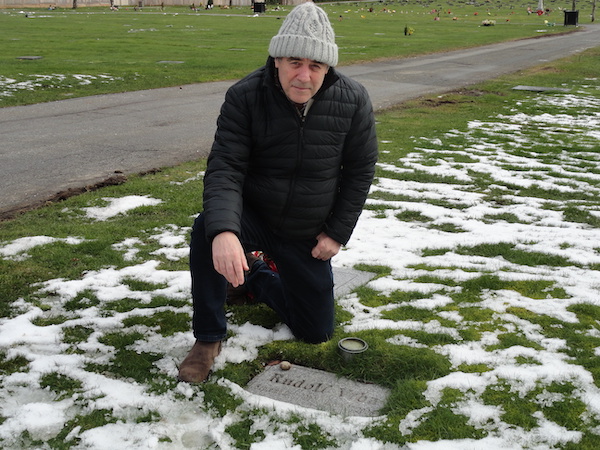
Alan Twigg, author of Out of Hiding: Holocaust Literature of British Columbia, at the gravesite of Rudolf “Rudi” Vrba, who died in 2006. (photo from JCC Jewish Book Festival)

Fittingly for a man who has dedicated his life’s work to the written word, Alan Twigg has compiled a fascinating bibliography. Out of Hiding: Holocaust Literature of British Columbia is one of two books to be launched in a JCC Jewish Book Festival epilogue event on April 5. The other is Sounds from Silence: Reflections of a Child Holocaust Survivor, Psychiatrist and Teacher by Dr. Robert Krell, to whom Twigg’s book is dedicated.
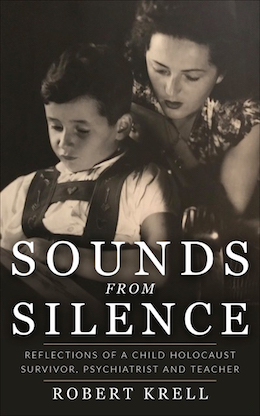
image - Sounds from Silence book cover“More than anyone in Canada, Robert Krell has continuously carried the torches of healing, investigation and discourse about the Shoah since the 1970s to counteract ever-encroaching racism, denial and wilful ignorance,” writes Twigg, whose book is also dedicated to the late publisher and editor Ronald Hatch, who died last November. Hatch and his wife Veronica co-managed Ronsdale Press, which published Out of Hiding.

Among other things, Twigg is the founder of the BC BookWorld newspaper, The Ormsby Review (now called The British Columbia Review), the ABCBookWorld reference site, the Literary Map of BC and the Indigenous Literary Map of BC, as well as many of the province’s literary prizes. He has published 20 books and made seven literary documentaries.

Twigg wrote Out of Hiding with the help of many, including, notably, Yosef Wosk, who wrote the book’s afterword, in which Wosk discusses various kinds of hiding – from one’s mission, from persecution, in dreams, in silence, from truth. Wosk notes that the perpetrators of the Holocaust also tried to hide: “The Nazis engaged in fraud, deception and secrecy on a massive scale,” he writes.

“The secrecy was complete and, to a large extent, effective,” he adds. “The very monstrosity of the crime made it unbelieveable. In fact, the Nazis speculated that the unimaginability of their Aktionen would work in their favour.” But this expectation “was frustrated by the Allied victory. [What remained of] Nazi archives were opened, contemporary Jewish documents were discovered, and facts were ferreted out by courts and scholars. Moreover, by 1942, the Free World had gradually learned the truth, albeit not always complete and precise.”

Wosk concludes, “There is much to remember and even more to know as the Holocaust comes out of hiding.”

And this is one of the reasons Twigg compiled this collection.

“I am not a Jew. I am not a German. I simply believe it is the responsibility of everyone on the planet to know more than just a little about the Holocaust,” begins Twigg in the foreword. “It is our collective responsibility to teach our children – with details – about why the Shoah is unique among the many genocides.”

He points out: “No other political regime has ever systematically murdered at least 1.5 million babies and children.”

As well: “Never before or after has a modern, industrial state mobilized all of its resources to systematically commit murder at least six million times in about eight years (from Kristallnacht in 1938 to 1945) and no other government has established a separate killing ground to murder approximately 50,000 women (at Ravensbruck, north of Berlin).

“No other regime has so thoroughly and consistently degraded its victims,” writes Twigg. “Estimates vary but the United States Holocaust Memorial Museum claims Germans created 980 concentration camps, 30,000 slave labour camps, 1,150 Jewish ghettos, 1,000 prisoner-of-war camps and 500 brothels where women were sex slaves.” And yet, Holocaust education surveys have shown that most people would struggle to name one or two camps, other than perhaps Auschwitz.

Twigg believes that, “if the most-heinous, most-planned and most extensive genocide can be deep-sixed by mankind, all genocides thereafter can be shrugged off as natural – as inevitable as forest fires, plagues, droughts, locusts or tidal waves.” If that happens, he argues, then genocide becomes “someone else’s problem.” As for something the magnitude of the Holocaust, he writes, “Most certainly it can happen again.”
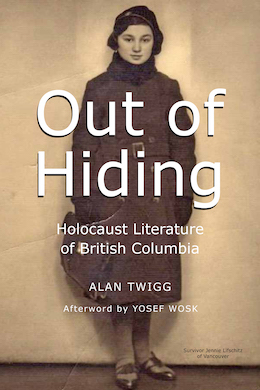
image - Out of Hiding book coverOut of Hiding is an intensely personal project for Twigg. He describes the book as “a roadmap back to places and experiences that must never be forgotten, offering a wide range of perspectives from the Holocaust-related books of British Columbian authors.” In total, he covers some 160 books in four sections. Some authors have written, edited or otherwise helped bring into being more than one memoir, novel, report or study; some of the people discussed are the subjects of the publications, rather than the writer.

Part One features relatively long expositions on Rudolf Vrba, Robert (Robbie) Waisman and Krell.

Twigg considers Vrba – who lived in Vancouver for the last few decades of his life – the “most important author of British Columbia.”

Writes Twigg in Out of Hiding, “Historian Ruth Linn estimates there were about 500-700 attempts to escape from Auschwitz-Birkenau, and most failed. Some 75 of these attempts were made by Jews; only five Jews made it successfully to freedom. The most significant of these five was Rudolf ‘Rudi’ Vrba, the main author of the most authoritative report on the true nature of the concentration camps, co-authored with co-escapee Alfred Wetzler.”

The Vrba-Wetzler Report, dated April 25, 1944, “finally revealed to the Allies the true nature and extent of the Holocaust.”

Twigg provides a biography of Vrba and some of what he learned from him as a friend. He also shares that Vrba, who died in 2006, was buried in a “seldom-visited cemetery, known to few people, where there is only a simple headstone.”

The April 5 event will include a video of Wosk chanting a Jewish blessing for Vrba at the graveside – something that apparently has not been done before.

Both Waisman and Krell are discussed in as much depth as Vrba, from their brief childhoods before the Holocaust through to recent history, sharing some of their writings and accomplishments, giving readers a sense of who they are and why their contributions are so vital.

Part Two offers shorter personal summaries on dozens of authors and publications. This section includes Lillian Boraks-Nemetz, Claudia Cornwall, Peter Hay, David Lester, Robert Mermelstein, Heather Pringle, Peter Suedfeld, Mark Zuehlke and many others. It features survivors of the Holocaust, as well as researchers, educators, journalists, graphic artists and editors who have studied the Holocaust, members of the Second or Third Generation, and a few non-Jews.

Part Three features an eclectic mix of 26 writers/artists, including Olga Campbell, Esi Edugyan, Jean Gerber, Rabbi Marvin Hier, Nikolaus Martin, Isa Milman, Norman Ravvin, Colin Upton and others.

Part Four:  One Doctor, Two Rabbis comprises three essays. The first is on Dr. Tom Perry, who served with the U.S. Army Medical Corps in the Second World War, and “took a series of rarely seen photos that his widow Claire Perry donated to the Vancouver Holocaust Education Centre in 1994 along with a five-page letter he wrote to her from ‘somewhere in Germany,’ describing his feelings and impressions of Buchenwald.” The letter is included in this section – and it is a powerful testament, though words don’t capture the horror as much as do his photographs.

The second essay, “Lulek’s Story,” flows from a well-known photo taken by Tim Gidal on July 17, 1945, in a refugee compound near Haifa – front and centre is Israel Meir “Lulek” Lau, holding a Buchenwald banner. Rabbi Meir Lau, who became Ashkenazi chief rabbi of Israel, was the youngest survivor of Buchenwald and his story is moving and inspirational.

Wosk’s afterword rounds out the collection with his thought-provoking reflections on hiding.

“Soon all witnesses will be gone,” concludes Twigg in his author’s statement. “The Holocaust must not be relegated to being merely the psychic preserve of Jews and Germans.”

The double-book launch event is presented with the Vancouver Holocaust Education Centre and takes place at the Rothstein Theatre. Admission is free but registration via jccgv.com/jewish-book-festival/events or at eventbrite.ca is required. To read a discussion of Krell’s Sounds from Silence, visit jewishindependent.ca/a-child-survivor-reflects.
Diverse and innovative films

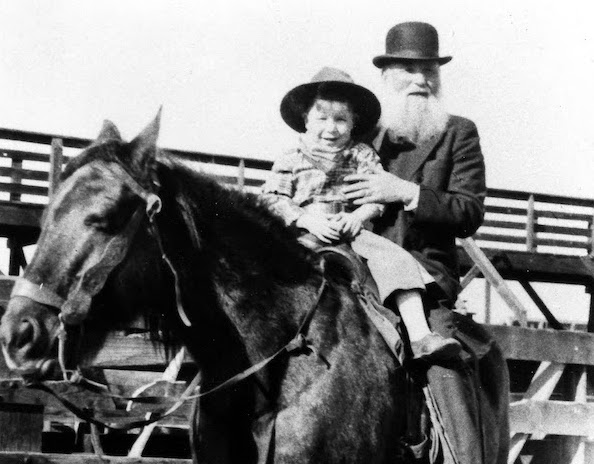
A still from Amanda Kinsey’s documentary Jews of the Wild West, a series of vignettes that shines a light on a noteworthy and usually overlooked history.

The Wild West, Jews in Germany and a surprisingly vivacious Israeli seniors home feature among the diverse films at the Vancouver Jewish Film Festival this year.

Somehow, we tend not to associate Jews with the legends that have built up around the development of the American West, a serious oversight that is in the crosshairs of filmmaker Amanda Kinsey’s documentary Jews of the Wild West.

The mythology of the Wild West is perhaps as much an invention of Hollywood as of history, so it is notable that the 1903 film The Great Train Robbery, which introduced the genre of the cinematic Western, featured Gilbert “Broncho Billy” Anderson – né Max Aronson.

The myth of the West was no less inspiring to Jews than to other Americans and dreamers from around the world. Perhaps one of the most famous names in the lore was Wyatt Earp. The film introduces us to Josephine Marcus, who fled her family in San Francisco to become an actress and ended up being Earp’s wife. Earp himself is buried along with the Marcus family in a Jewish cemetery.

The gold rush drew Jewish peddlers and merchants to the West Coast in the late 19th century including, most famously, Levi Strauss, who left the Lower East Side and, via Panama, arrived in San Francisco. His brothers sent dry goods from New York and Levi sold them up and down the coast. When Jacob Davis, a tailor, was asked by a woman to construct pants that her husband wouldn’t burst out of, he imagined adding rivets. He took the idea to Strauss and the rest is American clothing history. As one historian notes, it was a Jew who invented “the most American of garments.”

The rapid industrialization in the mining sector is where the Guggenheim family got its start and so, while the name is now most associated with Fifth Avenue, the finest address in New York City, their start was in the gritty West of the 19th century.

We meet Ray Frank, the first woman said to have preached from a bimah. Called the “golden girl rabbi,” she was not ordained, but was apparently a phenomenon that drew crowds to her sermons.

Many people will know that Golda (Mabovitch/Meyerson) Meir spent formative years as an immigrant from Russia in Milwaukee and then Denver. This footnote to her history is often considered curious and interesting, but in this film it integrates the Jewish experience of the 20th century and its roots in the American West with the development of the Jewish state – the opening up of another frontier, one might say.

The Hebrew Immigrant Aid Society, seeing the poverty in the Lower East Side, actively encouraged migration to the West. The film introduces families who have worked the land for generations, some of whom have maintained their Jewish identity and at least one of whom was raised Methodist. But, it suggests, the thriving Jewish community of Denver owes much to the failed farmers of the West who made their way to the nearest metropolis to salvage their livelihoods.

The documentary is really a series of vignettes and at times the shift from one story to another is confusing but, as a whole, Jews of the Wild West successfully shines a light on a noteworthy and usually overlooked history.

* * *

The festival features two German films that complement each other in interesting ways.

In Masel Tov Cocktail, a short (about 30 minutes) film, high schooler Dima (Alexander Wertmann) welcomes viewers into his life just as he is suspended for a week as a result of punching a classmate in the face during an altercation in the washroom. The “victim,” Tobi (Mateo Wansing Lorrio), had taunted the Jewish Dima, graphically play-acting a victim in a gas chamber, a performance enhanced by the austere, sterile setting of the restroom’s porcelain-tiled walls. So begins an interplay of victim and perpetrator that is just one of several provocative themes weaving through this powerful short.

Dima’s family, it turns out, heralds from the former Soviet Union, like 90% of Jews in today’s Germany. After the fall of the Soviet Union and the reunification of Germany, the German government actively encouraged migration of Jews to revitalize Jewish life in the country. This fact, like other statistics and tidbits, is flashed across the screen.

Juxtapositions pack a punch, including Dima’s switching between a baseball cap and a kippa, perhaps reflecting his complex identities, as well as the schism in the identities of post-Holocaust Jews more broadly in a society that struggles to assimilate the idea of contemporary, living Jews in the context of the blood-soaked soil of their state. A shift from colour to black-and-white also evokes the stark break between the present and the past.

But the present and the past are themselves in conflict as Dima recounts how other Germans react when they learn he is Jewish. Why does he only meet Germans whose grandparents weren’t Nazis, he wonders. Statistic: a survey indicates that 29% of Germans think their ancestors helped Jews during the Holocaust, while the screen text helpfully informs us the number was more like 0.1%.

Dima’s teacher, who can’t utter the word Jew and struggles to get the word Shoah out of her mouth, wants Dima to share his family’s Holocaust story with the class. The film’s implication is that Dima’s family was largely spared the trauma of the Holocaust, but he decides to play along because, “There’s no business like Shoah business.”

Dima’s grandfather is taken in by the AfD, the neo-fascist Alternative for Germany party, convinced that their pro-Israel and anti-Muslim rhetoric means that they are defenders of the Jewish people. In a moment that confounds the AfD campaigner (and causes the viewer to reflect), Dima drags his grandfather away from the campaigner while yelling: “Don’t let foreigners take away your antisemitism.”

The film is kooky, funny and light, while also serious, dark and thoughtful throughout.

That description applies to the similarly named feature film Love and Mazel Tov, which features Anne, a non-Jewish bookstore owner who has Munich’s largest selection of Jewish titles and who herself is more than a little obsessed with all things Jewish – including potential romantic partners.

“Some are into fat. Some are into thin. Anne is into Jews,” a friend explains. This turns out to be more than a romantic or erotic attraction, perhaps a disordered response to national and family histories.

Thinking she has found not only a Jewish boyfriend but a doctor at that, Anna (Verena Altenberger) courts Daniel (Maxim Mehmet), who in typical cinematic fashion lets her believe what she wants to believe until the inevitable mix-up explodes in a farcical emotional explosion – though not before an excruciating family dinner.

Parts of the film exist on a spectrum between cringey and hilarious. The film features (at least) two fake Jews who don this identity for extremely different reasons, inviting reflections on passing, appropriation and the fine line between veneration and fetishization.

Both of these films use humour to excavate deeply troubling concepts of identity and addressing horrors of the past. They approach these challenging themes in truly innovative and entertaining ways.

* * *

Understated comedy is key to the success of Greener Pastures, an Israeli film in which Dov, a retired postal worker, has lost his home after a “pension fiasco” involving the privatization of the postal service.

He is a curmudgeonly old square when it comes to marijuana, which the government has decided should be available to anyone 75 and over, but he sees a moneymaking opportunity. Dov (Shlomo Bar-Aba) enlists a network of seniors to order medicinal cannabis and mail it to him so he can distribute it to his “connection,” who shops it around to younger consumers. This “kosher kush,” guaranteed “Grade A government-approved stuff” sold in tahini bottles, brings Dov into conflict with a two-bit drug kingpin in a wheelchair and, of course, a snooping police officer.

There is romance and suspense in this madcap caper, but there is also the theme of elder empowerment, along with the laughs.

The Vancouver Jewish Film Festival runs online only March 3-13. For the full festival lineup and tickets, visit vjff.org.

Working for human rights

A gift of Elie Wiesel’s Night was among the forces that influenced Madeleine Schwarz’s career path.

Madeleine Schwarz is one of the kindest people I’ve ever met. Not the kind you would expect to build much of her career prosecuting or aiding in the prosecution of war criminals around the world, including the Nazi war criminal known as the “Beast of Bolzano,” who was living on Commercial Drive in Vancouver.

Now based in Toronto, working with the Refugee Board of Canada, Schwarz spoke with the Jewish Independent about a few of her accomplishments.

Raised Catholic, Schwarz was one of seven kids on the block who frequented our house in Vancouver back in the 1960s and early ’70s. Little did we know that she would soon be making history.

She told the Independent that her passion for international criminal law began when she was a teenager and learned about the genocide of the Jewish people.

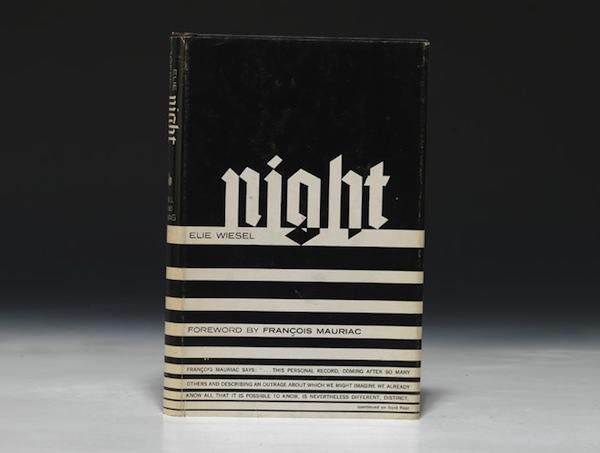
My parents, Joyce and Bernie Freeman, helped her along her journey by giving her Night by Elie Wiesel, an account of his terrifying time in Auschwitz.

“Your house was very much an introduction to Judaism,” she said. “Yours was a very open, friendly Jewish family. I recall coming to your house for Shabbat dinner in my convent school uniform.”

While studying international relations at the University of British Columbia, Schwarz had a number of Chilean friends who had family members in camps under the dictator Augusto Pinochet. That was her “introduction” to contemporary war crimes and crimes against humanity.

In 1994, Schwarz graduated with her bachelor of laws at Dalhousie University. In 2003, she obtained her master of laws at the University of Ottawa, specializing in international criminal law.

Her first job involving war crimes was at the Canadian Department of Justice. From 1999 to 2005, she worked closely with RCMP officers on investigations into crimes against humanity, war crimes and genocide in Ukraine, Belarus, Italy and Rwanda.

When Italy found Michael Siefert, a former S.S. guard at a transit camp in Bolzano, guilty in absentia of 11 murders during the Holocaust, Schwarz put together the case to revoke his Canadian citizenship. She interviewed many people in Italy, including former resistance fighters who had witnessed his crimes.

“Seifert was quite a young man during the war. He was an old man during the proceedings. But he had committed horrendous crimes,” she said.

One of the documents Schwarz saw during the investigation made the Holocaust all so terribly real.

“I remember that we had an invoice confirming the transfer of a number of people to Auschwitz. That was one of the most horrific pieces of evidence I’ve ever seen.”

In 2003, as a result of her work and that of the legal teams who came afterwards, the B.C. Supreme Court ordered Siefert’s extradition and, in 2007, the Federal Court upheld a decision to strip him of his Canadian citizenship. In 2008, Siefert, aged 83, was sent back to Italy. His residence in Vancouver as a free man for more than 50 years was over.

During her time with the Department of Justice, Schwarz interviewed many victims and witnesses of war crimes. She said that, even when, after 15 minutes, she knew that she couldn’t use their story, she would sit there and listen for the whole two hours.

“When I’ve asked someone to tell me their story,” she said, “it’s incumbent on me to listen.… I might be the only person they will be able to tell their story to [in their lifetime].”

From 2006 to 2010, Schwarz lived in Tanzania, where she was one of the trial attorneys on the largest multi-accused trial for the United Nations International Criminal Tribunal for Rwanda. Part of her work there was interviewing perpetrators of the genocide in the Butare prefecture.

She confided that this part of her job was very hard on her. “I remember interviewing three suspects alleged to have committed genocide in a row. I told my colleague – I need a break before I can talk to the fourth man.”

When it came to the trial, Schwarz and her team secured convictions of all six accused, including the first woman charged with ordering rape as a war crime.

“I think, as a lawyer and particularly a prosecutor, you are assessing the evidence and being critical. You have to be pretty surgical about it,” said Schwarz.

A few years later, at a UN conference, a co-presenter from Butare approached her and told her that his entire family had been wiped out by the genocide there. “And he said thank you very much for your work. And I practically burst into tears because I felt humbled that somebody would say that … it was not something I felt I should be thanked for, nor any of us should be thanked for because it shouldn’t have happened in the first place.”

As a commissioner looking into the killings in Les Cayes prison in Haiti during 2010, Schwarz led an international team and supervised the final report with recommendations on future prosecutions, penal reform, justice reform and police training.

Schwarz was in Kenya in 2013, working as the human rights and justice advisor to the UN Special Envoy in the Great Lakes region of Africa, a region encompassing 13 countries, including the Democratic Republic of the Congo, Rwanda, Uganda and Burundi. With a team of experts, she collaborated with myriad different organizations to create strong networks of people who would work together to promote better communication, peace and understanding in the region.

“There are so many layers that need to be addressed if you are ever going to deal with root causes of conflict, that range from ensuring people have access to clean water, food, lodging and education, to building trust and confidence among the leaders and civil society, to advocating for accountability for past crimes…. It takes a lot of time,” she said.

From 2016 to 2019, Schwarz worked as a trial lawyer and deputy team leader at the International Criminal Court in The Hague. It was there that she prepared arrest warrants for individuals alleged to have committed crimes in Libya since 2011.

Despite seeing the very worst of humanity, Schwarz still has hope for the human race. “I’ve seen some pretty horrible things,” she acknowledged. “I’ve also seen people who do tremendous things to try and make change or try and help people.”

And she had this to say about the International Criminal Court.

“I think that investigations and prosecutions of individuals for war crimes, crimes against humanity and genocide are incredibly important,” said Schwarz. “I wouldn’t necessarily say we’re always getting the complete truth and I do not think we always get it right. However, I do think we get some truth and some accountability that is important for victims, as well as for countries moving out of conflict. I think that is important. And it’s a different way of telling the story than a novelist or historian.”

Cassandra Freeman is a freelance writer living in Vancouver. During the early 1980s, she was part of the Jewish student movement that called for the extradition of Nazi war criminals living in Canada.

Secret Jewish fighters

Leah Garrett has pieced together the most comprehensive story yet of a little-known but fascinating footnote to the Second World War, and she shares her findings in her new book, X Troop. (photo by Deb Caponera / Hunter College)

Using recently declassified military records and interviewing family members, author Leah Garrett has pieced together the most comprehensive story yet of a little-known but fascinating footnote to Second World War history – and the role that a few score of Jewish men played at pivotal moments in the conflict.

Garrett is a professor at Hunter College, in New York City. As part of the Cherie Smith JCC Jewish Book Festival, she will speak about her new book, X Troop: The Secret Jewish Commandos of World War Two, in a virtual event on Feb. 6.

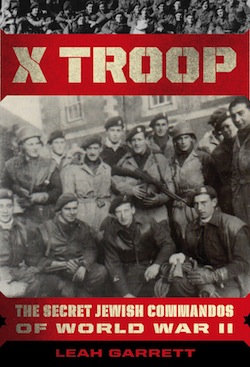
X Troop tells of the 87 men – 83 of them Jewish – who made up the No. 10 (Inter-Allied) Commando, 3 Troop. The secret weapon X Troop members shared was that most of them were from German-speaking parts of Europe, had escaped occupied countries and, as Jews, had a deeply personal drive to defeat the Nazis.

Formed officially on July 2, 1942, the unique commando unit would, among other things, allow British forces to expedite interrogation of captured Axis soldiers.

“X Troop would be Britain’s secret shock troop in the war against Germany,” Garrett writes. “They would kill and capture Nazis on the battlefield. But that would not be all. They would also immediately interrogate captured Germans, be it in the heat of battle or right afterward. The men’s fluency in German would enable them to get essential intelligence that would guide the next moment’s choices rather than having to wait to interview prisoners until they were back at headquarters.”

No less than Winston Churchill himself gave the group their nickname.

“Because they will be unknown warriors … they must perforce be considered an unknown quantity. Since the algebraic symbol for the unknown is X, let us call them X Troop,” declared the then-prime minister of the United Kingdom.

One of the many consequential incidents, which could have turned disastrous, was when two troop members, whose anglicized noms de guerre were Roy Wooldridge and George Lane, were captured by the Germans and taken to a command post. The next day, they were driven to the French countryside and, instead of being summarily executed as they had feared, found themselves in the château that was serving as headquarters for field marshal Erwin Rommel.

“During his training … Lane had been taught to give only his (fake) name, rank and serial number if he was captured,” writes Garrett. “But instead he found himself having an extended conversation with the field marshal over tea. Lane fortunately recovered his composure and didn’t say anything that would give him and his comrade away.”

Later, when they were transferred to a POW camp in central Germany, which was filled with 300 British officers, the pair was able to share their knowledge of Rommel’s location – information that was surreptitiously conveyed back to London through a hidden homemade wireless radio.

“A few months later … during the Normandy campaign, Rommel’s staff car was strafed by RAF Spitfires as he drove from Château de La Roche-Guyon to the front near Saint-Lô. The attack left Rommel, one of Germany’s best and most creative generals, with serious injuries, and from that moment on his participation in the war was effectively over,” notes Garrett.

The irony was that some of the members of X Troop suddenly transformed from prisoners of war – Jews of German or Austrian origin, who were viewed as “enemy aliens” – to members of an elite British military troop.

image - X Troop book cover“I found it rather odd that one day I could not be trusted with anything more lethal than a broomstick and the next I was told that I was going to be a spy for the British,” said one member, Tony Firth. “But who said that the English are logical?”

The men faced a fourfold risk if captured. Hitler had ordered Allied commandos to be shot on sight. As refugees from Europe who may have still had family in Nazi-occupied areas, they risked not only their own lives, but those of their families. As Jews, they were the explicit target of state-sanctioned murder and, as German or Austrian nationals, they would be considered traitors to their homelands if captured.

The commandos were trained in a Welsh village and, though each had each created a false persona, it took wilful blindness for the village folk to not realize there was something odd about these particular British soldiers. Recalled one townswoman, “… when we would ask them what nationality they were, they would say: ‘Vee are English.’” (A memorial to X Troop in that Welsh village today ostentatiously omits the fact that almost all of them were Jewish.)

Though trained together and with a tight-knit sense of camaraderie, the troop was deployed not as a group but across the British military. The book follows members of the troop through heroics and horrors at Normandy and in Egypt, Italy, Greece and Yugoslavia. In the end, half of the men would be killed, wounded or forever missing in action.

Some reviewers have drawn parallels between the real-life exploits of X Troop and a 2009 Hollywood blockbuster, but Garrett contrasts the facts and fictions. “Whenever possible, the X Troopers used their intelligence to outmanoeuvre the Nazis and to capture them before a shot was fired,” she writes. “In this regard, the X Troopers were the opposite of Quentin Tarantino’s vengeful Jews in his film Inglourious Basterds. Rather than wreaking personal revenge on the Germans, they followed the rules of war. They coolly collected battlefield intelligence from the enemy and outwitted them using their intellect rather than brute force. And even in extreme instances, such as when Colin Anson confronted the man who had been responsible for his own father’s death, they refused to compromise their own moral standards.”

Among the lessons the author aims to convey is the heroism of Jews in the fight against Nazism, adding a new layer to a growing literature on resistance of various forms.

“Through their exemplary and courageous service,” Garrett writes, “their story challenges the idea that only in Israel did the Jews become armed warriors who fought to try to establish a safe life for themselves and their families.”

Garrett’s Feb. 6 book festival event starts at 3:30 p.m. For tickets, visit jccgv.com/jewish-book-festival.

Horn co-launches book fest

Dara Horn and David Baddiel open the Cherie Smith JCC Jewish Book Festival on Feb. 6. (photos from JBF)

Early in her new book, People Love Dead Jews: Reports from a Haunted Present, Dara Horn reflects on a controversy at the Anne Frank House museum in Amsterdam, where an employee who wore a kippa to work was told by his employers to hide it under a baseball cap because it might interfere with the museum’s “independent position.”

“The museum finally relented after deliberating for four months, which seems like a rather long time for the Anne Frank House to ponder whether it was a good idea to force a Jew into hiding,” writes Horn.

The snappy summation is typical of the author’s approach: biting wit in the face of affronts of various dreadfulness. And the affronts pile up, supporting the incendiary thesis of the title.

Horn discusses the world’s interest in Anne Frank’s story, including the insistence on repeating the line from her diary, “I still believe, in spite of everything, that people are truly good at heart.” Leaving aside the fact that Frank wrote these words before she experienced how truly evil at heart some people can be, Horn writes, the line provides a “gift of grace and absolution from a murdered Jew (exactly the gift that lies at the heart of Christianity).”

Horn, who is part of the Feb. 6 launch event for the 2022 Cherie Smith JCC Jewish Book Festival, is a novelist with a PhD in Yiddish and Hebrew comparative literatures. Her take on contemporary antisemitism is suffused with her understanding of how Western audiences expect “coherence” and often an uplifting ending to the stories in our literature or other entertainment.

“Holocaust novels that have sold millions of copies both in the United States and overseas in recent years are all ‘uplifting,’ even when they include the odd dead kid,” she writes. “The Tattooist of Auschwitz, a recent international mega-bestseller touted for its ‘true story,’ manages to present an Auschwitz that involves a heartwarming romance. Sarah’s Key, The Book Thief, The Boy in [the] Striped Pyjamas, and many other bestsellers, some of which have even become required reading in schools, all involved non-Jewish rescuers who risk or sacrifice their own lives to save hapless Jews, thus inspiring us all.”

These uplifting stories, she points out, make up a large chunk of Holocaust-related literature, yet illustrate phenomena that were almost nonexistent during the Holocaust: non-Jews risking their lives to save Jews.

“Statistically speaking, this was not the experience of almost any Jews who endured the Holocaust,” she writes. “But for literature in non-Jewish languages, that grim reality is both inconvenient and irrelevant.”

She summarizes: “Dead Jews are supposed to teach us about the beauty of the world and the wonders of redemption – otherwise, what was the point of killing them in the first place?”

On the subject of non-Jewish rescuers, Horn goes into an extensive exploration of the life of Varian Fry, an American man who worked for the Emergency Rescue Committee, a group of American intellectuals that, beginning in 1940, distributed emergency American visas to endangered European artists and thinkers. What they envisioned rescuing was not so much the individuals themselves, but the very concept of European civilization, which they correctly believed to be in mortal danger from the Nazis. But, rescuing a culture’s greatest artists, writers and thinkers and sequestering them to safety in America, Horn posits, is itself “a sort of eugenics.”

For someone with an explicit distaste for disproportionate attention to rescue stories, Horn devotes a significant chunk in the middle of the book to what amounts to a biography of Fry. As the reader starts wondering how this fits into the larger thesis, Horn points out how the veneration of the more universal European culture for which Fry and his colleagues risked their lives was not extended to the particular Jewish culture that was the expressed target of the Nazis.

“Fry tried to save the culture of Europe, and for that he should be remembered and praised,” Horn writes. “But no one tried to save the culture of Hasidism, for example, with its devotion to ordinary, everyday holiness – or Misnagdim, the opposing religious movement within traditional Eastern European Judaism, whose energy in the years before the war was channeled into the rigourous study of musar, or ethics. Entire academies devoted to the Musar Movement were destroyed, their books burned out of the world, their teachers and leaders and scholars murdered – all the things that everyone feared would happen to the vaunted culture of Europe. No rescue committee was convened on behalf of the many people who devoted their lives and careers to … the actual study of righteousness. For them, there were no Varian Frys.”

Horn notes that, in the 1990s, there was a burgeoning of Holocaust museums and exhibitions all over the United States, including the opening of the United States Holocaust Memorial Museum in Washington, D.C.

“The idea was that people would come to these museums and learn what the world had done to the Jews, where hatred can lead. They would then stop hating Jews.

“It wasn’t a ridiculous idea, but it seems to have been proven wrong. A generation later, antisemitism is once again the next big thing, and it is hard to go to these museums today without feeling that something profound has shifted.”

She suggests that the lesson some people take from these exhibitions is the opposite of what was intended. The idea of the museums is that everyone should learn the depths to which humanity could skin sink, she writes.

“But this has come to mean that anything short of the Holocaust is, well, not the Holocaust. The bar is rather high.”

Therefore, when people are shot in a synagogue in Pittsburgh or San Diego, this is “not the Holocaust” and, presumably, nothing to get too concerned about in the greater scheme of Jewish victimization. Harassing Jewish college students is not the Holocaust. Lobbing missiles at sleeping children in Israeli cities is not the Holocaust. Even hounding ancient Jewish communities out of entire countries and seizing their assets is not the Holocaust. Horn does not mention Martin Niemöller, but she seems to be suggesting that, if “they” are coming for “the Jews,” most people will not speak up until it reaches something akin to the Holocaust, which we may have unwittingly recast not as the endpoint of hatred and antisemitism but as the stick by which the world measures threats to Jewish people.

An antisemitic attack in Jersey City, N.J., provides Horn with insights into how mainstream audiences try to make sense of antisemitic violence.

New Jersey’s flagship newspaper, the Star-Ledger, noted that “the attack that killed two Orthodox Jews, an Ecuadorian immigrant and a Jersey City police detective has highlighted racial tension that had been simmering ever since ultra-Orthodox Jews began moving to a lower-income community.”

Horn points out a few of the factual and logical inconsistencies in the media’s coverage, including that the assailants had never lived in Jersey City, so they weren’t reacting to any state of tension there. Moreover, the community that was attacked was accused of “gentrifying” a “minority” neighbourhood.

“This was remarkable, given that the tiny Hasidic community in question, highly visible members of the world’s most consistently persecuted minority, in fact came to Jersey City, fleeing gentrification, after being priced out of long-established Hasidic communities in Brooklyn,” she writes.

The book concludes rather unexpectedly, not with recipes for solving the contemporary crisis or explicit calls to action, but rather with reflections of her experience with Daf Yomi, the page-a-day, seven-and-a-half-year journey through the Babylonian Talmud. She provides a lovely and succinct explanation of Rabbinic Judaism.

“Until the year 70 CE, Judaism had been centred at the ancient temple in Jerusalem, where worship was mediated through priests offering sacrifices,” writes Horn. “After the Romans destroyed this temple and exiled the people, there was no particular reason for this religion, or even simply this people, to survive in any form. But on the eve of this temple’s destruction, one sage, Rabbi Yochanan ben Zakkai, had himself smuggled out of the besieged city of Jerusalem in a coffin, after which he convinced the Roman general Vespasian to allow him to open an academy for Torah scholars in a small town far from Jerusalem. Both Rabbi Yochanan ben Zakkai and Judaism faked their own deaths in order to survive this cataclysm. The small cadre of scholars in that small town reinvented this religion by turning it into a virtual-reality system, replacing temple rituals with equally ritualized blessings and prayers, study of Torah, and elaborately regulated interpersonal ethics. The sages frantically arguing about when and how to recite which prayers are survivors and descendants of survivors, remnants of a destroyed world. They are anxious about remembering every last detail of that lost connection to God, like mourners obsessing over the tiniest memories of a beloved they have lost. One might expect that this memory would eventually fade, that people would ‘move on.’ Instead the opposite happens. Once the process of memory becomes important, the details do not fade but rather accrue – because the memory itself becomes a living thing, enriched by every subsequent generation that brings new meaning to it.”

Without batting readers over the head, Horn seems to be advocating what Jews have always done – finding meaning, comfort and guidance by interrogating ideas and arguing across centuries with the greatest minds of the tradition. She may be, as she says, “part of a ridiculously small minority that nonetheless played a behemoth role in other people’s imaginations,” but her Daf Yomi practice reminds her that she is far from alone.

“I turn the page and return, carried by fellow readers living and dead, all turning the pages with me,” she concludes.

Horn will be joined at the virtual festival opening Feb. 6, 1 p.m., by David Baddiel, whose book Jews Don’t Count shares themes and emotions with Horn’s. Baddiel’s book, like others in this (sadly) flourishing genre, was reviewed in these pages recently (jewishindependent.ca/ tackling-the-hatred-head-on). They will be in conversation with Marsha Lederman, Western arts correspondent for the Globe and Mail.

For the full book festival schedule, visit jccgv.com/jewish-book-festival.

Faux freedom fighters

Last week, a cluster of protesters, including at least two medical doctors, demonstrated on the lawn of the B.C. Legislature, reciting the now-boring litany of justifications for putting others at risk by refusing to be vaccinated against the coronavirus.

Griping from anti-vaxxers has become routine online and, for the most unfortunate among us, in family discussions and among friends. Invoking high ideals of freedom and dredging up quotes from great people in history to reinforce their narrative, many anti-vaxxers claim victimhood, driven either by ignorance of science or obstinacy.

What happened at the legislature last week was more galling than other such incidents, however. On a spectrum from the fairly innocuous act of an individual making ignorant remarks on social media to the atrocious behaviour of impeding emergency vehicles and making a ruckus outside hospitals, this one fell somewhere in the middle.

The demonstration was organized by Common Ground, a free distribution magazine originally focused on natural health and wellness but which has lately gone down conspiracy rabbit holes. The most recent issue warns: “Parents – Protect your children.” The sage advice on how to protect your kids includes rejecting the advice of every legitimate medical professional in North America.

There is also a rambling, full-page open letter to B.C. Attorney-General David Eby from anti-gay activist Kari Simpson, who runs  a group called Culture Guard, which seems determined to guard a culture that most of us would prefer to see vanish. A centrefold of the Canadian Charter of Rights and Freedoms, along with multiple calls for the preservation of free speech, position conspiracy theorists as downtrodden voices of reason and goodness pluckily standing up to tyranny.

And here is where the Common Ground crowd goes particularly off course. The demonstration was specifically linked to the 75th anniversary of the Nuremberg trials. The unsubtle messages at the protest were that modern medical experts and those who follow their advice are ideological descendants of the Nazis and those who refuse the vaccines are defenceless voices of righteousness and reason, equivalent to the victims of the Holocaust.

The demonstrators hanged in effigy Health Minister Adrian Dix, Solicitor General and Public Safety Minister Mike Farnworth and Premier John Horgan. The effigies were a nod to the fact that, as a result of the Nuremberg trials, nine Nazi doctors were hanged for their participation in medical experimentation and other atrocities. Common Ground is, and the protest was, rife with assertions that the vaccines are a form of human medical experimentation. As one doctor who addressed the crowd said, the anti-coronavirus vaccines are “the most dangerous injection in the history of vaccination.” Uh-huh.

The invocation of the Holocaust and Nazism has been a pandemic within a pandemic. People have donned yellow stars to portray their perceived victimization and have shamelessly exploited the language and imagery of that epoch.

In an era when cultural appropriation is a cancelable offence, it seems Jewish history remains the ethical equivalent of public domain. Note that the grievous historical experiences of other peoples with traumatic histories are rarely, if ever, trotted out in quite this way.

If privileged, sanctimonious North Americans wanted to find a reason for justifiable indignation, they wouldn’t have to pick at the scabs of Jewish trauma. They could look at the real tragedy and injustice in the world today: global inequality in vaccination status. While many Canadians now expect a third dose, there are 1.4 billion people in Africa and only 7.8% are double-vaxxed.

But why focus on genuine, contemporary atrocities when one can play a victim in the crudest historical reenactment of the Holocaust and, somehow, incredibly, face the mirror and see a freedom fighter?

Book festival is shaping up

The 37th annual Cherie Smith JCC Jewish Book Festival takes place Feb. 6-10 at both the Jewish Community Centre of Greater Vancouver and online, with authors joining from across Canada, the United States, Israel, Australia and Great Britain.

“We look forward to welcoming our live audiences to the joyful experience of a shared literary event,” said festival director Dana Camil Hewitt. “The Jewish Book Festival strives to reflect and showcase recent literature that revels in the lively and pivotal ideas stemming from the modern world and, in the process, expose our city and community to meaningful and captivating conversations about the written word in every shape and form.

“And, while the nucleus of our festival is Jewish-themed, our speakers, events and audience happily represent a diversity of experiences and cultures that defy narrow categorization. We are attuned to timely and universal themes and we thrive on the interdisciplinary, always inviting visual arts and performance art into our events.”

Opening the festival are American novelist and journalist Dara Horn, with her book People Love Dead Jews: Reports from a Haunted Present, and British comedian and writer David Baddiel, with his book Jews Don’t Count. On the closing night, Daniel Sokatch, an expert who understands both sides of the Israeli-Palestianian conflict, will present his book Can We Talk About Israel? A Guide for the Curious, Confused and Conflicted.

Winner of the Canadian Jewish Literary Award for fiction Gary Barwin joins the festival with Nothing the Same, Everything Haunted: The Ballad of Motl the Cowboy, together with U.S. author Jai Chakrabarti, who brings A Play for the End of the World.

Short stories will be celebrated in an event with Vancouver’s Rachel Rose and her collection The Octopus Has Three Hearts, long-listed for the Scotiabank Giller Prize, together with Montreal’s Ami Sands Brodoff presenting her intricately linked stories in The Sleep of Apples. From Toronto, novelist and cultural critic Hal Niedzviecki discusses his latest novel, The Lost Expert.

Stories of artists in the Second World War era are presented by two U.S. writers: Meg Waite Clayton (The Postmistress of Paris) and painter/writer Michaela Carter (Leonora in the Morning Light). History also has an important place in the work of Leah Garrett, who presents X-Troop: The Secret Jewish Commandos of World War II (who were the inspiration for Quentin Tarantino’s Inglourious Basterds), and Menachem Kaiser, whose Plunder: A Memoir of Family Property and Nazi Treasure won the Canadian Jewish Literary Award for non-fiction.

The annual Book Clubs event features Australian author Heather Morris, with her novel Three Sisters, the last in the Tattooist of Auschwitz trilogy.

Among the B.C. authors represented are Isa Milman, with her memoir Afterlight: In Search of Poetry, History and Home, and Rachel Mines, with her translation of Jonah Rosenfeld’s The Rivals and Other Stories. An epilogue event (i.e. after the festival run) moderated by Yosef Wosk features Robert Krell and his memoir Sounds from Silence and Alan Twigg’s Out Of Hiding: Holocaust Literature of British Columbia.

Regular updates can be found at jccgv.com/jewish-book-festival, where the digital program guide will be available after Dec. 28.

– Courtesy JCC Jewish Book Festival

Four solos and a duet

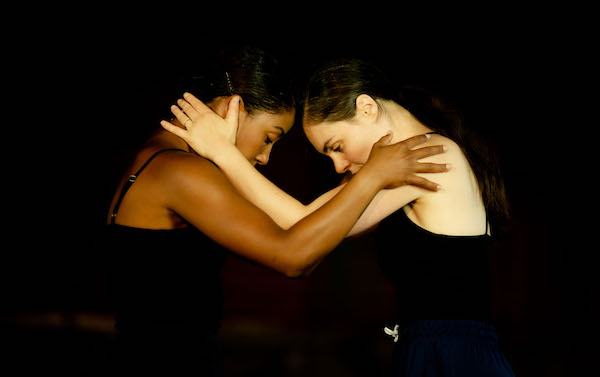
Livona Ellis, left, and Rebecca Margolick, right, perform together Dec. 17 and 18 at Scotiabank Dance Centre. (photo by Faviola Perez)

Next weekend, choreographers and dancers Livona Ellis and Rebecca Margolick will première their first collaboration, a duet called Fortress. The Dec. 17 and 18 performances at the Scotiabank Dance Centre also feature four solo works.

Ellis performs Unmoved, “a response to the idea of overcoming the limitations we place on ourselves,” and Margolick’s solo Bunker draws “on themes of memory and the shared history of previous generations of women.” The other two solo pieces were revived last season specifically for them: Peter Bingham’s Woman Walking (away) (1997), danced by Ellis, and Allen Kaeja’s Trace Elements (2000), performed by Margolick. (See jewishindependent.ca/albert-solos-reimagined.)

Both dancers have had the chance to perform for live audiences recently and both have been touring – New York-based Margolick internationally with her own work and locally based Ellis with Ballet BC, for audiences in Ottawa and Montreal.

“From these past two years of experiencing how quickly it can be taken away and experiencing how deeply I miss it when it’s gone, performing has a renewed sense of urgency and importance for me,” Margolick told the Independent. “I’m so excited to perform for a live audience here in Vancouver, especially because last year, when we were about to do this show for a live audience, on the day of the show, we had to switch to livestream only. A lot of energy has been built in this show over the past three years, and I’m looking forward to being able to share it live.”

While Margolick and Ellis have known each other for a long time, Fortress is their first duet together.

“Livona has always been one of the best dancers and performers I know. We trained at Arts Umbrella together all through high school, but, since then, we hadn’t danced together, until now. So much of collaboration happens outside of the studio and so, in a way, I feel like through our friendship and conversations over the past number of years, the work and ideas were already starting to form and it felt natural to transition to a studio together.

“At the time we decided to work together, I had been creating a solo titled Harbour, which was about my grandmother and my relationship to her both in life and death. One day, Livona and I had a conversation about it and she began talking about her grandmother. I was moved by this, and this conversation naturally spiraled into how we’ve started to see our mothers and grandmothers differently; how we see their influence on us; our desires to become mothers one day, being in our 30s now; how dance has changed for us, etc. The conversation was vibrant and honest and there’s a lot of history and love between us and I just asked if she wanted to create together, and she said yes.”

Ellis added, “One of the silver linings about the pandemic is that we both found ourselves in Vancouver at the same time…. I have always admired Rebecca’s work from afar but we’ve never been in the same place long enough to even begin to think about a collaboration. She was working on Harbour and we started speaking about our family and our grandmothers. This sparked the inspiration for Fortress. We were both doing a lot of reflecting during our various lockdowns and quarantines and found we were thinking a lot about who we are as artists and as women. How does our matriarchal lineage affect who we are today?

“We both feel like we are in a moment of change or transformation,” Ellis continued. “We can feel our experience settling in and grounding us in a way that allows us to move forward into the next chapter of our careers. This felt like the perfect jumping off point to create a duet.”

The pair started creating that work this past August 2021, with a residency hosted by the B.C. Movement Arts Society, rehearsing at the Athletic Hall in Sointula. “We are now working with composer Ivan Shopov from Bulgaria to develop the music, and Mimi Abrahams to develop the lighting,” said Margolick.

For Margolick, while both Bunker and Trace Elements haven’t seen any changes choreographically, “as time goes on, and as I evolve, they naturally do as well.”

“Especially for Trace Elements,” she explained, “it’s been a journey since I began working on it with Allen Kaeja. I started to learn more about Jewish history and specifically Jewish leftist and Jewish resistance history, both in the U.S. and Europe. Specifically, in Trace Elements, there is a spirit of resistance and remembrance in the work, countering the text we hear out loud, text of German propaganda and generational indifference to the history of the Holocaust. In that, I think about resistance fighters, countering the narrative that Jews went quietly towards death – they didn’t. That is a history we’re not often told of, and it’s been a part of my Jewish education to learn that history. The work is really spiritual for me and every time I perform it, I feel the spirit of those who fought and those who keep fighting and inspire me to as well.

“More recently,” she said, “I’ve been learning about Jewish women activists and fighters, especially women like Hannah Senesh, Faye Schulman, Bella Abzug, Emma Goldman, Anna Sokolow and others. I can’t really explain into words how this knowledge affects my performance, but I feel it, and it gives me a sense of grounding and inspiration.”

Margolick highlighted the Jewish Women’s Archive and Judy Batalion’s book The Light of Days: The Untold Story of Women Resistance Fighters in Hitler’s Ghettos as resources.

Bunker is also steeped in research. While she premièred the full-length version of the piece (titled Bunker + Vault, which runs 35 minutes) a few weeks ago in San José, Costa Rica, the December performances will include only the first 10 minutes of the work.

“A part of my research for this piece included looking through the archives of the Clara de Hirsch Home for Working Girls at the 92nd Street Y from the late-1800s to mid-1900s,” said Margolick. “The Clara de Hirsch Home was a place where young, poor, mostly Jewish immigrant women were housed and supported with educational resources as they found jobs and worked towards being able to support themselves. These archives were records kept by the staff, with observations and notes about the women who resided there. These observations gave me a window into the lives of the women who lived there, ranging from extreme hardship, repression, mental health issues, Jewish culture, camaraderie, acts of extreme kindness and on and on. Some of these women informed the movements, and spirit of resilience and care in the work.”

Fortress + Four Solos is presented by the Dance Centre and B.C. Movement Arts Dec. 17, 8 p.m., and Dec. 18, 1 p.m. and 8 p.m. For tickets, visit thedancecentre.ca.

Legacy of the “Ghetto girls”

The Vancouver Holocaust Education Centre’s Dr. Abby Wener Herlin, left, interviews author and historian Dr. Judy Batalion at this year’s Kristallnacht commemorative event on Nov. 4. (screenshot)

Jewish girls and young women in Poland were uniquely positioned to play major roles in the resistance to Nazism – and the stories of countless young heroines have been too long overlooked.

This was a key message at the Kristallnacht commemorative event Nov. 4. Held virtually for the second year in a row, it featured Canadian historian Judy Batalion. Dr. Abby Wener Herlin, program and development manager of the Vancouver Holocaust Education Centre, introduced the author and posed questions.

Jewish girls and women were not subject to the irrefutable proof of Jewishness that Jewish men were, said Batalion.

“Women were not circumcised, so they didn’t risk being found out in a pants-drop test,” she said. “If a man on the outside [of the ghettos] was suspected of being Jewish, he would be told at gunpoint to drop his pants, and women didn’t have that physical marker of their Jewishness on their body.”

A secondary reason women could play such an important role in the resistance was that, at that time in Poland, education was mandatory to Grade 8. Many Jewish families sent their sons to Jewish schools or yeshivot. “But, to save on tuition, they sent girls to Polish public schools,” Batalion explained. “In these public schools, girls became more acculturated and … more assimilated women. They were girls and teenagers who had Catholic friends. They were aware of Christian rituals, habits, nuances, behaviour.”

Resistance fighters and underground operatives might have dyed their hair blonde or otherwise altered their outward appearance to pass as Christians. But there was more to it, the author said.

“Gesticulation was very Jewish,” she said. “So one woman had to wear a muff when she went undercover, to control her hands.”

Batalion’s book The Light of Days: The Untold Story of Women Resistance Fighters in Hitler’s Ghettos is the culmination of 12 years of research, which had its beginnings in another project.

Batalion was in the British Library doing research for a performance piece she was working on about Hannah Senesh, a young female hero of the resistance whose story is perhaps among the more well known. Senesh was born in Hungary and had made aliyah to Mandate Palestine in the 1930s, but she returned from that comparatively safe haven to join the fight against the Nazis.

“She joined the Allied forces, became a paratrooper and volunteered to return to Nazi-occupied Europe,” Batalion said of Senesh, who the author first learned about in Grade 5 in Montreal. “She was caught quite early on but legend has it she looked her executioners in the eye when they shot her.

“I grew up with Hannah Senesh as a symbol of Jewish courage,” she said. There were not many books on Senesh at the renowned London library, however. “So, I simply ordered whatever they had. I picked up my stack of books and noticed that one of them was a bit unusual. It was an old book with yellowing pages bound in a worn blue fabric with gold letters and it was in Yiddish.”

Batalion speaks Yiddish, in addition to English, French and Hebrew.

“I flipped through these 200 pages looking for Hannah Senesh, but she was only in the last 10. In front of her [were] dozens of other young Jewish women who defied the Nazis, mainly from the ghettos in Poland.”

The stories featured guns, grenades, espionage. “This was a Yiddish thriller,” she said.

As Batalion soon discovered, it was young Jewish women who were disproportionately represented in some of the most daring acts of resistance of the time.

“These ghetto girls hid revolvers in teddy bears, built elaborate underground bunkers, flirted with Nazis, bought them off with wine and whiskey and shot them,” she said. “They planned uprisings, carried out intelligence missions and were bearers of the truth about what was happening to the Jews. They helped the sick and taught the children, they organized soup kitchens, underground schools and printing presses. They flung Molotov cocktails in ghetto uprisings and blew up Nazi supply trains.

“I had never read anything like this,” said Batalion. “I was astonished and equally baffled. Who were these women? What made them act as they did? Aside from the Warsaw Ghetto Uprising, which I’d heard of, what was the story of Jewish resistance in the Holocaust?… And why had I, who grew up in a survivor family and community, who was so involved in Jewish arts and culture – I even have a PhD in women’s history – how had I never heard this story?”

Thus began a dozen years of research in Poland, Israel, England and across North America, in archives and living rooms, memorial monuments and the streets of former ghettos, she said. “I trod through testimonies, letters, photographs, obscure documentaries and the towns where these heroines were born and raised,” she said.

“Reading through all this material, I was astonished to learn of the scope of the underground,” she said. “Over 90 European ghettos had armed Jewish resistance units … 30,000 Jews enlisted in the partisans. Rescue networks supported 12,000 Jews in hiding in Warsaw alone. Uprisings occurred in ghettos, in labour camps and death camps, all this alongside daily acts of resilience – smuggling food, making art, hiding, hugging a barrack-mate to keep her warm, even telling jokes during transports to relieve fear. Women were at the helm of so many of these personal and organized efforts, women aged 16 to 25. Hundreds of them, possibly even thousands of them.”

The ability to do such things, under unimaginably dangerous conditions, was aided by a social phenomenon that predated the Nazi occupation.

The early 20th century in Poland was a time of extraordinary Jewish intellectual ferment. Making up about 10% of the country’s population, Jews had a profound social infrastructure, including 180 Yiddish newspapers in Warsaw alone. Jewish political movements proliferated – left, right, religious, secular, Zionist and non-Zionist – creating a vibrant discourse and networks of interrelated groups across the country. By the 1930s, almost all Polish Jews were wondering if this was a country where they could continue to thrive, whether they belonged to the country where their ancestors had lived for 1,000 years.

“As part of this identity struggle, 100,000 young Jews were members of Jewish youth movements – that’s a huge proportion,” said Batalion. “These were values-driven groups that were affiliated with these varying political parties and stances.”

For example, when war broke out, Frumka Plotnicka was 24 years old. Her youth movement urged their members to flee east – “That’s also how my grandparents survived,” noted Batalion – but fleeing a crisis did not suit Plotnicka.

“Stunning her comrades in her movement, she was the first to smuggle herself back into Nazi-occupied Poland,” she said. “She went to Warsaw and became a leader in the Warsaw Ghetto. She ran soup kitchens for hundreds of Jews, she organized classes, discussions and performances. She negotiated with German, Polish and Jewish councils, she helped extract Jews from forced labour.

“She covered her Jewish features with a kerchief and makeup and left the ghetto, traveling across Poland, keeping communities connected. She brought with her information, inspiration and books,” Batalion said. “They had a secret printing press. She ran seminars across Nazi-occupied Poland.

“In late 1941, the youth movements acknowledged the truth of the Nazis’ genocidal plans and they transformed from education hubs into these underground militias. Frumka still traveled to disseminate information. Now, it was about mass executions. She was one of the first to smuggle weapons into the Warsaw Ghetto. She had two guns in a sack of potatoes.”

She was killed while firing at Nazis from a bunker in 1943.

While disguised as non-Jews, some of the woman warriors were able to exploit the prejudices of their tormentors.

“Nazi culture was classically sexist,” said Batalion. “They never suspected that a sweet-looking girl had a pocket full of ammunition. Jewish women played to this underestimation. One courier … was once carrying a valise full of contraband material and she was getting on a train and noticed they were checking bags. She was very beautiful and bashed her eyelashes and went up to the Gestapo man and said, ‘My bag is so heavy, can you carry it for me?’ He was being chivalrous, ‘Of course, I’ll carry it for you,’ and he took it on the train for her and, of course, they didn’t check the bag.”

These young Jewish fighters had lost everything and still soldiered on, the author said.

“They knew they wouldn’t topple the German army, yet risked their lives time and time again to fight for justice and liberty,” she said. “Small victories are achievable and necessary for great change. It is through these young women that I learned that not only is trauma passed through generations of Jewish women but so is courage and daring, strength and resilience, passion and compassion.”

Batalion’s book won the 2021 Canadian Jewish Literary Award in the Holocaust category and has been optioned for a Steven Spielberg film, for which Batalion is working on the screenplay.

The annual Kristallnacht commemorative lecture is presented by the Vancouver Holocaust Education Centre in partnership with Congregation Beth Israel, with support from the Robert and Marilyn Krell Endowment of the VHEC, and funded through the Jewish Federation of Greater Vancouver annual campaign.

Prior to the keynote address, Holocaust survivors lit candles in their homes. Kennedy Stewart, mayor of Vancouver, offered reflections and Nina Krieger, executive director of the VHEC, read a proclamation from the city. Beth Israel’s Rabbi Jonathan Infeld thanked the speaker.

Our obligation to remember

Isa Milman, a member of the Second Generation, lights a candle of remembrance at the Victoria Shoah Project’s Kristallnacht commemoration Nov. 9, accompanied by grandson Isaac Phelan. (screenshot)

In a Kristallnacht commemoration no less poignant because it was held virtually, speakers emphasized the responsibility to remember.

“Why do we keep remembering?” asked Isa Milman, a Victoria writer and artist who is the daughter of Holocaust survivors. “Why does it matter? Isn’t it time to let go, to move on, to stop looking back and turn instead to the present and the future?

“We believe that the lessons of the Shoah, the Hebrew term for the Holocaust, are more important than ever,” she said. “We must speak out against injustice wherever we find it and as soon as we find it.”

Milman was speaking Nov. 9, the 83rd anniversary of Kristallnacht, at the commemoration organized by the Victoria Shoah Project. It was the second annual such event held virtually in the city of Victoria, because of the pandemic.

“Every day, I am filled with grief when I think of my murdered family, shot into pits,” said Milman, “and my 2-year-old cousin Mordecai, who was buried alive because a bullet would be wasted on him.”

As she leaned in to light a candle of remembrance for family members, Isaac Phelan, Milman’s grandson, six days shy of his second birthday, ambled to his grandmother’s side.

“But here I am appearing before you, throbbing with life despite everything,” said Milman. “Tonight, we are reminded of our moral imperative to remember, to speak out and join together in the strength of community to protect everyone from harm, wherever and however it arises. That is the lesson of the Shoah we must never forget.”

Rabbi Lynn Greenhough of Victoria’s Kolot Mayim Reform Temple spoke of the precedents that allowed an event like Kristallnacht to occur.

“Kristallnacht reminds us every year that those buildings, those synagogues, those shops that burned across Germany were what was seen above ground,” she said. “Underneath that same ground were seams of hatred and fear of ‘those people,’ those ‘not Christians,’ that existed and smouldered for centuries and for generations. Hitler was not an anomaly.

“Tonight, we remember,” she went on. “And, tomorrow, we continue to do the work of bringing greater peace and greater justice into this world. We stand for our place in this world as Jews, as Israel, to ensure those underground seams of hatred never burst through the ground again.”

Congregation Emanu-El’s Rabbi Harry Brechner said he misses the power of having religious, ethnic and communal leaders stand with him on the bimah on the anniversary of Kristallnacht, something that has not been possible since the beginning of the pandemic.

“Kristallnacht is really about the entire city coming together to say: not here. I think that we are in a time now where so many injustices of our past are coming up, not just in Kamloops but all around us…. And, really, for us to really talk about reconciliation, we do need to face really difficult truths,” said Brechner.

Highlighting the theme of this year’s commemoration – “Communities standing together” – Richard Kool spoke of an encounter, when he was a young adult, with a figure who may have been the Prophet Elijah. Kool lent the man a copy of The Atlantic magazine and, when the man returned it, it included a handwritten note with a surah (chapter) from the Koran, in Arabic, and, in Hebrew, the words of Leviticus 19:33-34, which is a directive about the treatment of sojourners in your midst, because “for sojourners were you in the land of Egypt.”

Dr. Kristin Semmens, an assistant teaching professor in the department of history at the University of Victoria, noted that it was her sixth year participating in the commemoration, but the first time she shared her personal motivations.

“The Nazis sent my maternal grandfather, a 17-year-old Ukrainian boy, to be a forced labourer on a farm in Austria during the war,” she said. “He never saw his family again. My maternal grandmother was an ethnic German growing up in the former Yugoslavia. She fled the advancing Red Army to end up on that same farm. She also never saw her village again.”

Semmens’ mother was born in 1949, in a refugee camp for displaced Germans.

“My family’s experiences were, of course, nothing like the suffering of the Jews of Europe during the Shoah,” she said. “I mention them now only to tell you why I became an historian. I wanted to know more about that time. And I did learn more. As an historian of Nazi Germany and the Holocaust, I know more than I ever wanted to about how awful human beings can be to one another. Every year, I stand before you and recount the events that are themselves horrific, but which only preceded far worse horrors to come. This year, given our world’s current challenges, I want to do something different. I want to highlight those who stood up to the Nazis at each stage, no matter in how small a way. I must stress at the outset they were exceedingly few. One of the most upsetting outcomes of my research is endless evidence about how ordinary Germans not only passively accepted but also often enthusiastically supported Hitler’s persecution of other Germans.”

In response to the 1935 Nuremberg Laws, there was precious little opposition. A rare exception, she said, was Carl Friedrich Goerdeler, the mayor of Leipzig, who expressed outright criticism of the laws. In 1944, he would be executed for his part in the plot to kill Hitler.

She also cited Otto Wels, chairman of the Social Democratic Party, who spoke out in parliament, but who soon had to flee the country as the Nazis cracked down on their opponents.

“The regime imposed a boycott on Jewish-owned stores, businesses and practices. Brown-shirted Stormtroopers and Hitler Youth stood outside, refusing customers entry. Many ordinary Germans obliged and even openly jeered the humiliated shop owners,” Semmens said. “Others, though, bypassed the … sentries and went shopping. They apologized to Jewish business owners. They brought flowers to their Jewish doctors to express compassion. That they rejected injustices directed at individual Jews was encouraging, yet it must be said that they almost never openly criticized the Third Reich’s newly realized systemic racism.”

While the murder of almost 100 Jews, the arrest of 30,000 more and the destruction of hundreds of synagogues and thousands of Jewish-owned businesses over that one night is widely known, she said, extensive damage to private residences is less well remembered. Semmens spoke of survivor testimonies of the night.

“They recalled spilled ink on paintings, rugs and tablecloths, and that blankets were cut with glass shards. Many dwellings were now uninhabitable,” she said. “Though such wanton damage and public violence upset many Germans, there were almost no cases of open opposition to Kristallnacht – but some defied the Nazis’ intentions in other ways. They denounced assailants, vandals and thieves to the police – not surprisingly, to no avail. Others assisted Jewish Germans directly by providing food, shelter and loans of household objects to replace those destroyed or stolen. They warned Jewish neighbours about impending arrests and even, albeit infrequently, hid them from the Gestapo. Some brave police officers and firefighters protected synagogues and doused their flames against the Nazis’ orders to refrain.”

Despite these anecdotes, important and uplifting as they may be, Semmens said, “Far, far too many merely stood by.”

She said, “It is easier to turn a deaf ear or a blind eye to discrimination and defamation – yet we must find courage to challenge the wrongs of our society.”