Skip to content
  • Home
  • Subscribe / donate
  • Events calendar
  • Business Directory
  • FAQ
  • News
    • Local
    • National
    • Israel
    • World
    • עניין בחדשות
      A roundup of news in Canada and further afield, in Hebrew.
  • Opinion
    • From the JI
    • Op-Ed
  • Arts & Culture
    • Performing Arts
    • Music
    • Books
    • Visual Arts
    • TV & Film
  • Life
    • Celebrating the Holidays
    • Travel
    • The Daily Snooze
      Cartoons by Jacob Samuel
    • Mystery Photo
      Help the JI and JMABC fill in the gaps in our archives.
  • Community Links
    • Organizations, Etc.
    • Other News Sources & Blogs
  • JI Chai Celebration
  • JI@88! video

Recent Posts

  • Or Shalom reopens its doors
  • JFS from past to future
  • Need holistic approach
  • Sharing stories, advice
  • Journalist shares fears
  • Skills to live together
  • Road to independence
  • Cutting grass with scissors
  • Zionism as a solution
  • Deceit, desire & the divine
  • Reclaiming sacredness
  • Creative project ideas
  • Summer squares and cobbler
  • Thou shalt … summer commandments
  • Legal help for students
  • Revisiting myth of Lilith
  • Wrong person rebuked
  • Canada’s mixed messages
  • Questions for museum
  • Symposium on antizionism
  • Making soccer political
  • CJPAC lauds Pulver’s impact
  • City recognizes Vrba’s legacy  
  • Organ donation saves lives
  • Theodore’s March premiere
  • A healing Shabbaton
  • Supplying healthy food
  • A chime of metal tags
  • Yellowknife seder a first
  • Ishai energizes, unifies
  • A Lag b’Omer to remember
  • Expanding the healing
  • Hannah Senesh – a unique hero
  • Community milestones … May 2026
  • Sharing her testimony
  • Fall fight takes leap forward

Archives

Follow @JewishIndie
image - The CJN - Visit Us Banner - 300x600 - 101625

Tag: Holocaust

Government to target hate

Government to target hate

Irwin Cotler spoke Sunday at a virtual event convened by National Council of Jewish Women of Canada. (photo from raoulwallenbergcentre.org)

Canada is set to make a number of significant commitments to combat antisemitism, as are other countries that participated in a summit on the issue last week in the Swedish city of Malmö.

Irwin Cotler, Canada’s special envoy on preserving Holocaust remembrance and fighting antisemitism, spoke Oct. 17 at a virtual event convened by National Council of Jewish Women of Canada. The human rights lawyer and former federal justice minister, who is also international chair of the Raoul Wallenberg Centre for Human Rights, said that, in the aftermath of the conference, the Canadian government would announce a number of pledges.

These will include enhanced teaching and learning about the Holocaust across generational lines, combating the increasing Holocaust denial and distortion, and battling hatred on social media. Reducing an alarming rise in hate crimes will also be among the pledges Prime Minister Justin Trudeau is set to make, according to Cotler.

“Twenty-twenty was the year for the highest rise in hate crimes targeting Jews ever,” he said. “But, by May 2021, we had reached the level then of all the hate crimes in all of 2020.”

The government will recommit itself to protecting the security of Jewish institutions, he said.

“Here, the government recently made commitments in financial terms for this purpose,” said Cotler.

Zero tolerance for antisemitism in the political discourse is also an objective, he added.

“That means not just calling out antisemitism in the other’s political party but calling out antisemitism in our own,” Cotler said. “In other words, not weaponizing antisemitism or politicizing it, but holding each of us, respectively, our own political parties, accountable.”

In addition to Trudeau, Israeli President Isaac Herzog, French President Emmanuel Macron and U.S. Secretary of State Antony Blinken were among the leaders who addressed the conference. The Malmö International Forum on Holocaust Remembrance and Combating Antisemitism was hosted by Sweden’s Prime Minister Stefan Löfven. Trudeau announced at the conference that Cotler’s role of special envoy would be made permanent.

Cotler contextualized the Malmö forum in a two-decade era of what he calls “demonological antisemitism,” which began at the 2001 Durban conference against racism that devolved into an antisemitic carnival.

“What happened at Durban was truly Orwellian,” said Cotler. “A world conference against racism and hate turned into a conference of racism and hate against Israel and the Jewish people. A conference that was to commemorate the dismantling of apartheid in South Africa turned into a conference calling for the dismantling of the ‘apartheid state’ Israel.

“Those of us who personally witnessed this Durban festival of hate have been forever transformed by the pamphlets and posters of hatred and antisemitism, by the cartoons and the leaflets portraying not only the Jews as Nazis, but the classical antisemitic tropes of Jews with hooked noses, with fangs, with fingers dipped in blood from the killing of children. Where we were accosted with pamphlets of the Protocols of the Elders of Zion. Where we witnessed demonstrators with signs – incredibly for a human rights conference or for any conference – signs which said, ‘Too bad Hitler didn’t finish the job.’ Where we witnessed Jewish students – and I witnessed this personally – being physically assaulted and being told, ‘You don’t belong to the human race,’” said Cotler.

Durban was the first tipping point and the global surge of antisemitism during last spring’s conflict between Hamas and Israel was a second, he said.

“Jews were targeted and threatened in their own neighbourhoods and on their own streets,” said Cotler. During and after that conflict, Cotler said, Jewish memorials were defaced, synagogues were torched, cemeteries were vandalized, Jewish institutions found themselves under assault and incendiary hate speech – such as 17,000 tweets that “Hitler was right” – exploded.

The COVID-19 pandemic has exacerbated antisemitism, or at least has been exploited by antisemites, who have “instrumentalized one of the more ancient tropes of the Jews as the poisoners of wells,” said Cotler. The health crisis has also seen conspiracies of Jews profiting from vaccines and anti-vaxxers posing “as if they were victims of Nazi persecution,” he added.

Cotler lamented what he calls “the mainstreaming, the normalization – in effect, the legitimization of antisemitism in the political culture.” During the conflict last spring, convoys of vehicles in London, U.K., drove through Jewish neighbourhoods screaming, “F–k the Jews, rape their daughters!” This was a convoy and a message that was replicated in Toronto days later and which resulted in, Cotler said, an “utter absence of outrage.”

The legalist also spoke of the International Holocaust Remembrance Alliance Working Definition of Antisemitism.

“If you can’t define it, you can’t combat it,” he said. The IHRA definition was adopted after 15 years of discussion and debate by intergovernmental bodies, governments, parliaments, scholars and civil society leaders, he said.

The task of fighting antisemitism must not fall only to Jews, Cotler  stressed.

“As we’ve learned only too painfully, and have repeated too often, that, while it begins with Jews, it doesn’t end with Jews,” he said. “Therefore, we need this collective global constituency of conscience to combat it.”

Format ImagePosted on October 22, 2021October 21, 2021Author Pat JohnsonCategories NationalTags Academic Advisory Council, antisemitism, Canada, Durban, government, Holocaust, Irwin Cotler, Malmö International Forum, National Council of Jewish Women of Canada, politics
Impactful works at Chutzpah!

Impactful works at Chutzpah!

After COVID-19 hit, The Eichmann Project – Terminal 1 evolved into a per- formance directed to a camera. (photo from Pathos-Mathos Company)

Art has many facets, forms and reasons for being. As much as it can be an escape from our daily realities, it can help us process and understand them, sometimes in vastly different ways. The Chutzpah! Festival, which opens Nov. 4 with City Opera Vancouver singers performing to the Marx brothers’ A Night at the Opera, features many examples of entertainment with multiple purposes.

On the face of it, Project InTandem’s dance double bill (Nov. 6-7) might seem to have nothing in common with the theatre work The Eichmann Project – Terminal 1 (Nov. 8). Yet both deal with, among other things, trauma and post-traumatic stress disorder, as well as our ability to change ourselves and even our circumstances.

The Eichmann trial

Lilach Dekel-Avneri and the Pathos-Mathos Company’s Terminal 1 examines the 1961 trial, in Israel, of Adolf Eichmann, one of the main perpetrators of the Holocaust. The books of attorney-general Gideon Hausner, political theorist Hannah Arendt and journalist and poet Haim Gouri, “with their testimonies on the trial, were the inspiration for the three main ‘characters’” of the theatre work, explained Dekel-Avneri. “My dramaturg, Liat Fassberg, and I, like in a Greek tragedy, positioned the two main characters with opposing worldviews, one against of the other. The words by poet Haim Gouri, who was present at the courtroom and reported daily from there, were composed and treated as a chorus. The chorus tries to advance in telling the tale of the trial while providing a dramatic lament on the happenings.

“It is actually a trial of the trial,” said Dekel-Avneri, “dotted with texts from researchers of the Holocaust and post-traumatic stress disorder, poets, philosophers, and performers’ live comments between those three main voices. The COVID-19 epidemic presents itself in the team’s testimonies and actions, erasing all plans and forcing project evolution into a digital performance to the camera.”

Dekel-Avneri refers to the Eichmann trial as “the first reality show in Israel.”

“A lot has been said about the connection between trials and performance,” she explained. “The Eichmann trial was the first trial-show recorded in front of a live audience, that actually bought tickets, and was projected live on the radio, later on television, with the full documentary show now available on the internet.”

Terminal 1 explores the concepts of collaboration and obedience, and asks, “What is our responsibility as citizens, as artists?”

“It’s an extension of Arendt’s brilliant manifest evoking the citizens to think by themselves and not to obey automatically. Not to automatically be part of horrific systems, just because they say: do this and not that,” said Dekel-Avneri. “We are thinking creatures, the least we can do is use our heart and brain, take responsibility for our actions, and not collaborate with demons.”

The show initially was created to be interactive with an audience and then remade for film because of COVID.

“During 2020, at the beginning of the outbreak, the Israel Festival, where we premièred, decided to move online, so I made my choice,” said Dekel-Avneri. “Since I do not believe in shooting a theatre show and screening it, I had to let go of my vision for the full project I was working on for six years, and re-create it as something new, made especially for the camera.

“The Eichmann Project – Terminal 1 is, for me, the first station, like its name,” she continued. “The last station may be completed in the future, or not. It will need to start almost from the beginning. We hope that one day we will find a sponsor or a theatre to collaborate with and fulfil the vision of this Via Dolorosa of 21 live scenes. The trial is not going anywhere and, unfortunately, we, by ‘we’ I mean humanity, do not learn from our past mistakes, so it looks like it will remain relevant for awhile.”

photo - Lilach Dekel-Avneri
Lilach Dekel-Avneri (photo by Shachaf Dekel)

Dekel-Avneri recently premièred Crowned, which she described as “a performative portrait, broken by the encounter with time, shattered in the prism of the plague, emerging through a web of video and audio testimonies by seven women at different decades of their lives, which coalesce into a course of a lifetime. An attempt to leave a monument to the voice of femininity at the current time, femininity striving, despite everything, to see the opportunity for growth within the crisis and wonder about the intersection between life and art at a time of change. These women take responsibility of their actions, future and well-being,” she said.

“In a way,” she added, “Crowned is a post-traumatic response to what COVID did to The Eichmann Project. After being torn apart from my original vision and separated from the audience, I prepared a show for any situation – we are not afraid from lockdowns or the camera anymore. The camera became a friend, a tool and a partner, to continue creating performative works.”

Struggle, empowerment

Project InTandem – which was cofounded by Calgary-based producers and choreographers Sylvie Moquin and Meghann Michalsky in 2017 – brings two works to the Chutzpah! Festival: Deep END by Michalsky and moving through, it all amounts to something by Moquin.

“This double-bill,” explains the press material, “explores themes of female struggle and empowerment…. Michalsky investigates how movement can accumulate and evolve through set rounds and repetition. Moquin’s work is inspired by the concept of neuroplasticity and the journey of rewiring one’s patterning.”

photo - Project InTandem – Meghann Michalsky and Sylvie Moquin – bring two works to the Chutzpah! Festival
Project InTandem – Meghann Michalsky and Sylvie Moquin – bring two works to the Chutzpah! Festival. (photo by Tim Nguyen)

The pair met for the first time when they both created short works for a production at the University of Calgary, eventually forming Project InTandem “to share workload, resources, and to create an opportunity for emerging artists to produce evening length work.”

“Having Meghann as a collaborator has always pulled me to a higher standard,” Moquin told the Independent. “I think we work together in a way that elevates us to achieve more than what might be possible on our own. It also makes the journey of being an artist less lonely.”

“Our approaches to dance can sometimes overlap because we have had similar experiences or opportunities, or trained within similar methods,” they said in their email interview with the JI. “All of our accumulated experiences as dancers and movers inform us as creators; those experiences become like an inventory of information.”

Moquin has been a dancer within Michalsky’s choreographic works since 2018, so that also informs their relationship.

“Some of our shared values include creating work with visceral physicality, creating opportunities within our city, elevating the production value of contemporary dance work, and always prioritizing integrity,” they said.

Each has her own interests, though.

“I am really interested in exploring what the body can endure in this work,” said Michalsky. “We push and we push again. As performers, we pass through movements and states and eventually surrender to things that are no longer needed. I am interested in seeing the dancer go through something tangible in real time, something that is honest and showcases risk and vulnerability. As a choreographer, I play with conflict from both internally in the body and externally in the space and I desire for both of these things to be felt by the audience.”

About her piece, moving through, Moquin said, “When creating this work, I was completely immersed with investigating partner work (the way bodies engage and interact) as well as being upside down. I used these primary desires to dig into the concept of neuroplasticity – the way we adapt, the way we can gain governance over our thinking; sometimes even the feeling of being trapped in our own mind and thoughts.

“I am a big believer that we must fail in order to succeed,” she continued. “As a choreographer, I use the sensing body to somatically approach theories I find fascinating in the world. I am especially interested in how bodies interact with one another, how they can support each other to fly, spin, and find themselves upside down effortlessly. I am keenly interested in the effects of the mind, the power of our thoughts, and the ability for change and growth. I would say that my research and choreography seeks to find a sense of hope within a world of chaos.”

The initial vision of moving through included the use of “walls.”

“I couldn’t get the idea out of my mind, and so I finally started looking into building/creating something to fulfil these ideas,” said Moquin. “The material used (a form of Plexiglass) was almost a happenstance. I became fascinated by the translucent quality. I had no way of knowing how this material would have such an impact within our world merely months after creating and premièring the work in March 2020. As I watch this work now, two years later, after a global pandemic, it is almost startling to watch the dancers engaging with these Plexiglass structures.”

The Chutzpah! Festival runs Nov. 4-24. For tickets and the full lineup, visit chutzpahfestival.com or call 604-257-5145.

Format ImagePosted on October 8, 2021October 6, 2021Author Cynthia RamsayCategories Performing ArtsTags Chutzpah!, dance, Eichmann, health, Holocaust, Israel, Lilach Dekel-Avneri, Meghann Michalsky, Pathos-Mathos, post-traumatic, Project InTandem, Sylvie Moquin, theatre
Jewish take on bomb

Jewish take on bomb

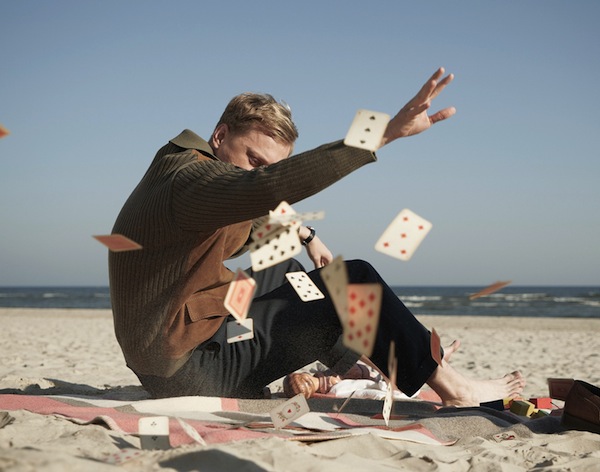
Philippe Tlokinski stars in Adventures of a Mathematician. (photo from Samuel Goldwyn Films)

Forgotten your calculus? Simple geometry is more than sufficient to follow the triangular saga of Polish-Jewish brainiac Stanislaw Ulam from the cloistered classrooms of Harvard to Robert Oppenheimer’s atomic-bomb “startup” in dusty New Mexico.

The third point on Ulam’s map is Lvov, Poland, where his parents, sister and niece live in tenuous safety. Until the Nazis blast across the border and blow down the doors of every Jewish home.

Adventures of a Mathematician opens in Cambridge on the eve of the Second World War, where Stan (Philippe Tlokinski) lives with his younger brother Adam. The news trickling out of Poland gets objectively worse, but going back to Europe is out of the question. So Stan Ulam embraces another way of combating the Nazis, proffered by his best friend and fellow emigré scientist, Johnny von Neumann (Fabian Kocieki) – join a bunch of other geniuses on the top-secret Manhattan Project.

Writer-director Thor Klein’s intelligent, efficient script relies on our knowledge of the war and the Holocaust (and countless movies on those subjects) to concisely convey the gravity of the situation and, importantly, avoid the familiar clichés. At the same time, Klein skilfully involves us in Ulam’s personal life – he’s a witty man with an appreciation for gambling odds, who knows a smart woman when he meets her at a party – without trivializing the larger historical events.

Klein’s other great achievement, because of its U.S.-centred subject matter, is making Adventures of a Mathematician, which he shot in Germany and Poland with local crew, European actors and German, Polish and British financing, totally look and feel like an American film. It’s a masterful trick, which requires dedication and skill at every level of the production.

Klein makes his job easier, admittedly, by depicting Ulam as an acclimated, assimilated American rather than a European fish out of water.

Where Adventures of a Mathematician (which takes its title from Ulam’s memoir) veers from traditional Hollywood filmmaking is in the dramatic conflict. It’s not the war, which is always off-screen. Tension enters Ulam’s marriage later in the film, and we care about that relationship, but that’s not the movie’s motor, either.

Instead, Klein has made a film about philosophical and existential dilemmas, internalized in the person of Ulam – a cerebral, introverted man who largely keeps his emotions to himself, even when he is debating technical solutions with his equally stubborn boss, Edward Teller (Joel Basman).

Not many Hollywood executives would back a film whose protagonist is pitched on the horns of another triangle, namely the conflicting pulls of intellectual satisfaction, personal morality and professional ambition. Stanislaw Ulam, action hero, isn’t the easiest sell to North American audiences.

But, once you get hooked by this utterly accessible film and its remarkable central character, you’re in for a rewarding and thought-provoking experience.

A likable character for much of the film, Ulam becomes more solitary as his doubts grow about devising and building a weapon of mass destruction – especially after the Nazis are defeated.

Tlokinski’s performance, which does incorporate a ridiculous (by modern measures) amount of cigarette smoking, is never less than compelling.

Adventures of a Mathematician trusts the audience enough to omit most of the melodramatic conversations and passages endemic to a Second World War-era scenario. I’m thinking specifically of Ulam’s survivor’s guilt, which is palpable without him needing a speech or a scene to convey it.

A 2020 film whose release was delayed by the pandemic and limited to a handful of festival appearances (including the Toronto and New York Jewish film festivals), Adventures of a Mathematician solves for x with nary a misstep. It can be rented via Apple TV, and possibly other platforms.

Michael Fox is a writer and film critic living in San Francisco.

Format ImagePosted on October 8, 2021October 6, 2021Author Michael FoxCategories TV & FilmTags Adventures of a Mathematician, atomic bomb, Holocaust, Manhattan Project, Philippe Tlokinski, Stanislaw Ulam, Thor Klein
Creating life in face of death

Creating life in face of death

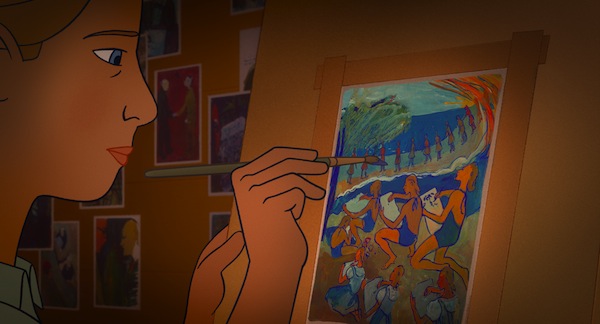
A still from the feature film Charlotte, about artist Charlotte Salomon.

The creative drive that some people have astounds me. In about a year-and-a-half, as the Holocaust closed in on her – and her family’s history of depression became known to her – Charlotte Salomon painted hundreds of works, telling her life story in images and words, in what is considered by many, apparently, as the first graphic novel.

Somehow, despite the artist having inspired a live action film, a documentary feature, an opera, a novel, a ballet and several plays, I’d never heard of her, or of her masterpiece, Life? Or Theatre? That is, until I watched the animated feature film Charlotte, a Canada-France-Belgium collaboration that was just released. Featured at the Toronto International Film Festival earlier this month, Charlotte has two screenings at the Vancouver International Film Festival: Oct. 3, 3 p.m., and Oct. 6, 9:15 p.m., at Vancouver Playhouse.

Based on the story and the cast, the Jewish Independent chose to be a media sponsor of the local screenings. And, on these points, the film scores high. Led by Oscar nominee Keira Knightley as the voice of Charlotte, the actors do a formidable job with dialogue that is, at times, stilted and animation that is pretty basic, with the exception of the scenes and transitional pieces that depict Salomon’s artwork. These parts of the film are sumptuous and give the most sense of Salomon as a person and artist.

The film begins near the end of Salomon’s life, as she is handing over her paintings to a man, who we find out later is a local doctor and friend, in what we later find out is the south of France. She asks him to guard the paintings for her, as they are her life, almost literally, given their content. The narrative then jumps to Berlin, to a young Charlotte trying to comfort a woman who is ill and sad. The woman turns out to be Charlotte’s mother, who dies, the young girl is told, of influenza.

Jumping ahead, still in Berlin, Charlotte’s father, Albert, has married Paula Lindberg, an opera singer, through whom, incidentally, a teenage Charlotte meets her first love, Alfred Wolfsohn, who is a singing teacher. He is also a veteran of the First World War.

Wolfsohn has a lot of personal issues, to say the least, and he ultimately betrays Charlotte, but he is also strongly supportive of her being an artist. While she gains entrance to Berlin’s art academy, despite being Jewish – it is 1933 and the Nazis are now in power – she is expelled pretty soon thereafter, though whether that’s because of her nonconformity to the artistic norms taught at the school, her Jewishness or both, is not clear.

What is certain is that, after Kristallnacht, the violence against Jews in Berlin has become unavoidable and Charlotte’s parents send her to the south of France to take refuge, and care for her maternal grandparents. Her grandmother is a troubled woman and her grandfather is, in a word, an asshole, but Charlotte finds beauty in her friendship with a wealthy American, Ottilie Moore, who owns a villa in Villefranche, and in her relationship with fellow refugee Alexander Nagler, whom she marries eventually.

image - In a scene from the film, Charlotte stares into the water, thinking about her aunt, who had drowned
In a scene from the film, Charlotte stares into the water, thinking about her aunt, who had drowned.

When Moore returns to the United States, she offers to try and take Charlotte and Alexander with her, but they stay in France – Charlotte because of her sense of duty to her grandparents. It is in caring for them that she witnesses the tragedy of her grandmother’s suicide and finds out from her grandfather that mental illness runs in the family, having claimed the lives of Charlotte’s mother, aunt and several other relatives.

Spurred on by the potential that she, too, will fall ill, as well as by the Nazis’ proximity, Charlotte turns her focus to creating the almost 800 paintings that comprise Life? or Theatre? She manages to give them (and other works, it seems) to Dr. Georges Moridis, who she had consulted about her own health and who had tried to help her grandparents, before she and Alexander are seized by the Nazis. Both Charlotte and Alexander are killed at Auschwitz; Charlotte five months pregnant.

The film, which isn’t shy about showing some of the brutality of the Holocaust, does step back from showing the deaths in Auschwitz, leaving viewers instead with an image of the idyllic setting in which they lived in France, as we hear the noises of their arrest, then silence.

Before the credits, the filmmakers tell us what happened to Charlotte, Alexander and Ottolie, and show us clips of a real-life archival interview with Charlotte’s father and stepmother, who survived the Holocaust, as well as a sampling of Charlotte’s paintings.

As depressing as Charlotte’s story is, it is not a depressing movie. That she anticipated her demise and created an artistic legacy in the face of death is somehow uplifting. As producer Julia Rosenberg states in the film’s production notes, “… hope isn’t rainbows and unicorns. It’s finding the courage to see beauty despite suffering.

“Charlotte Salomon’s ability to do just that is exceptional and inspiring.”

Indeed, it is.

Charlotte is a worthy introduction to a person we all should know.

For the full Vancouver International Film Festival schedule and tickets, visit viff.org. To potentially get free tickets to the Oct. 6 screening of Charlotte, email [email protected]. Tickets will be available as supplies last (there are 10 to giveaway).

Format ImagePosted on September 24, 2021September 23, 2021Author Cynthia RamsayCategories TV & FilmTags animation, art, Charlotte Salomon, Holocaust, neurodevelopmental disorders, painting, Vancouver International Film Festival, VIFF

Novels miss the mark slightly

I was very much looking forward to two recent novels. Both are love stories, but unconventional ones. I enjoyed them, and read them cover to cover – generally, I allow myself to stop reading, watching or listening to whatever it is I’m not enjoying, so that I wanted to know how the stories ended is a compliment to the writers. But I was disappointed in the novels, ultimately. In both instances, I felt a little robbed of emotional impact.

Perhaps, given their protagonists, I shouldn’t have been surprised that the cerebral aspects of the books would outweigh, even quash, the heart-rending effects. Morningside Heights by Joshua Henkin (Pantheon Books, 2021) is about an uber-accomplished, hyper-intelligent professor who is struck by early-onset Alzheimer’s. Never Anyone But You by Rupert Thomson (Other Press, 2020) is about two real-life cultural icons who were in the same social circles as people the likes of Ernest Hemingway and Salvador Dalí.

Love faces adversity

Within the first 20 pages of Morningside Heights, I didn’t particularly like either Prof. Spence Robin or his wife, Pru. He is an all-star academic, winning awards and grants of all sorts; he has ambition and has achieved some power in his world, and carries himself as such. He is Jewish but changed his name early in life, “to escape the Lower East Side.” He is Pru’s teacher, though only six years her senior, and downplays her concerns of being seen on campus as just his girlfriend, not as a person in her own right. And it is only after he semi-proposes that he tells her he has a sister with brain damage, who he visits rarely, and that he’d been married before and has an estranged son from that marriage.

For her part, Pru lets Spence get away with all these things. Worse, she abandons her own beliefs and dreams, basically, to be with him. For example, she keeps kosher before she meets him and in their early days together, but lets that go by the wayside. She has her own promising career that she gives up because her own areas of interest overlap with his award-winning expertise. He lets her become his shadow. He lets her main purpose become supporting him, while not reciprocating or appreciating that support at all, it seems.

So, it’s hard to empathize with the individual characters when their lives are completely upturned by Spence’s Alzheimer’s, which begins to affect him in his late 50s. That said, one doesn’t wish ill on anyone. The challenges both Spence and Pru face are severe, and Henkin brilliantly communicates the difficulties on both sides. Spence’s confusions and his not being able to understand fully the state he’s in are as heart-wrenching as his strong will and refusal to step down from work or admit his frailties are frustrating. Pru’s sadness at the loss of her partner and the heavy responsibilities of caring for him are palpable.

Perhaps the weight of these feelings and circumstances is part of what inspired Henkin to give – in my opinion – too much ink to Spence’s troubled son. Spence and Pru’s daughter Sarah doesn’t figure as prominently, but a lot of time is spent on Arlo and, in some respects, Arlo allows readers to get to know more about Spence. But those story threads interrupted, for me, the potential intensity of the Spence-Pru storyline, which, I have to admit, was both a relief and a letdown. I wasn’t surprised that Henkin has personal experience with dementia. In an online interview with the publication Shelf Awareness, he shares, “Although much of Morningside Heights is invented, it is, in many ways, my most autobiographical novel to date. My father, like Spence, was a professor at Columbia who developed Alzheimer’s, though my father developed it much later in life than Spence did. In writing about the ways Pru lost Spence, I was re-experiencing my mother’s loss, and my brothers’ and my loss.”

The rawness of that real pain is tempered in the novel, perhaps out of personal necessity. And perhaps most readers will appreciate that emotional distance, but I was hoping for a more intimate portrayal.

Not-so secret love

Never Anyone But You also lacks intimacy, even though it is about Suzanne Malherbe and Lucie Schwob, who fall in love and become both personal and professional partners. Thomson writes about the real-life French artists in a somewhat didactic and distanced way. He has done all his research but never fully inhabits or gives full life to his characters, who must have been quite passionate and committed people to have accomplished what they did under the circumstances in which they did it.

The women knew each other from childhood but end up becoming stepsisters when Lucie’s father (who was Jewish) connects with and eventually marries Suzanne’s mother (who was Catholic). Suzanne is immediately captivated by Lucie when they meet more formally; Suzanne is almost 17 years old and Lucie a couple years older than that. Never Anyone But You is told from the perspective of Suzanne.

Early on, the two decide to collaborate – Lucie’s words and Suzanne’s drawings. Lucie transforms herself into Claude Cahun before Suzanne reinvents herself as Marcel Moore. But the new persona cannot heal Claude’s bouts of depression and, throughout her life, she struggled to stay alive.

Claude and Marcel were unofficially (because they weren’t men) part of the Surrealist scene in 1920s Paris but their artistic (notably, photographic) success was tempered by the Second World War. They leave Paris in the late 1930s and take refuge in Jersey, where they use their talents to unsettle and educate the Nazi soldiers who occupied the island from 1940. It was their hope that their leaflets would demoralize the soldiers, and even cause some of them to desert. Marcel was fluent in German, so they could make the subversive material appear as if it were coming from one of the soldiers. Eventually, the two would be discovered and arrested. Though they would suffer imprisonment, they survived the war.

The bravery of Claude and Marcel is remarkable, as is their dedication to each other, though Claude is depicted as being unlikeable at times, between her mental health issues and her being more fluid with her sexuality than Marcel, ie. she had other relationships. Nonetheless, for Marcel, there was never anyone but Claude, though it is difficult to see why there was such devotion and loyalty on her side, and Thomson’s novel doesn’t answer that question. Ultimately, the two were together for more than 40 years, until Claude’s death in 1954, so there was, I guess, really never anyone but Marcel for Claude, either.

Posted on September 24, 2021September 23, 2021Author Cynthia RamsayCategories BooksTags Alzheimer's, Claude Cahun, dementia, fiction, historical fiction, Holocaust, Joshua Henkin, Marcel Moore, Morningside Heights, Never Anyone But You, photography, Rupert Thomson

Heroic work continues

An important – and surprising – court decision in Poland last month is a small victory in a longer battle over the history of Polish behaviour during the Second World War.

On appeal, two Holocaust scholars had an earlier decision reversed. University of Ottawa professor Jan Grabowski and Barbara Engelking, a Polish historian of the Holocaust, had earlier been ordered to apologize to a Polish woman who brought a suit against the two, arguing that her family’s name had been tarnished by the historians’ depictions of her uncle’s actions during the war. The case was watched closely, and its appeal is significant, as it could portend how Poland’s judiciary approaches a comparatively new law that proscribes negative depictions of Polish complicity during the war.

Poland’s ruling Law and Justice party is a right-wing nationalist movement that seeks to glorify Polish heroism during that era and erase – indeed, outlaw – records that demonstrate the complicity in atrocities by individual Poles and segments of that society during the Holocaust.

Grabowski and Engelking are on the frontlines of that conflict. They head a team of researchers that produced Night Without End: The Fate of Jews in Selected Counties of Occupied Poland, a compendious 1,700-page documentation of Polish atrocities during the war. The researchers, at risk to themselves, delved into often-untouched archival records in small and remote communities across Poland. In a presentation in Vancouver three years ago, Grabowski explained that, after the war, a surprising number of Poles felt no obligation to hide or embroider their activities during that period, content that their neighbours, if not history, would judge them kindly. The researchers plumbed files that had not been opened since 1945 and discovered harrowing tales of neighbour turning on neighbour, of Jews in hiding listening as their former friends pointed out their whereabouts to the Nazis and their collaborators.

The work is monumental and is being translated into English. It also indicates the breadth and depth of Holocaust history that has yet to be even remotely explored. The big picture, certainly, is well known – to the extent that plenty of people complain that it is time to move on from the topic. But the work of Grabowski et al reminds us that, in terms of millions of stories of individuals, heroic and wicked, we have hardly scratched the surface.

This is why the Polish law, and the intent behind it, is so dangerous. The problem is not merely the suppression of what we already know to be true, it is the very tangible possibility that current scholarship will be curtailed and that potential future scholars will choose less arduous fields of study. In either case, the crucial primary research still underway could be squelched.

This urgency was underscored by the publication Tuesday of a new book, Into the Forest: A Holocaust Story of Survival, Triumph and Love by Rebecca Frankel, former executive editor of Foreign Policy magazine. Writing in the New York Times Sunday, Frankel shared the story of one family who survived the war in Poland by hiding in the forests. The “Jews of the forest,” as she calls them, are an example of a massively underexplored facet of Holocaust history. The narratives of these Jews – some of whom survived the war, many or most of whom apparently did not – are absent from most chronologies because, by definition, those who survived (or did not) by disappearing into the forests were not included in the record-keeping of the Nazis and their collaborators.

We know from opinion surveys that there is an enormous amount of ignorance, particularly among the young in North America and Europe, about the Holocaust. In a notable irony, a major survey of European societies discovered that the countries where the largest number of people believes that there is too much emphasis on the Holocaust are the same countries where ignorance of the facts is greatest. In other words, it seems that those who know the least about that history are the ones most determined to close their ears to it.

Prof. Grabowski, who was born in Poland, was evasive in his visit to Vancouver in 2018, deflecting assertions that his work is heroic. Instead, he credited the courage of the on-the-ground researchers in Poland. There should be enough admiration to go around for the researchers, historians, writers and teachers who continue the necessary work of studying and sharing knowledge of that time.

As we have seen from the past seven decades, knowledge of the past does not preclude repetitions of genocide. But ignorance will almost certainly hasten its frequency and severity.

Posted on September 10, 2021September 9, 2021Author The Editorial BoardCategories From the JITags Barbara Engelking, education, education antisemitism, genocide, Holocaust, Jan Grabowski, law, Rebecca Frankel
Exploring her family’s past

Exploring her family’s past

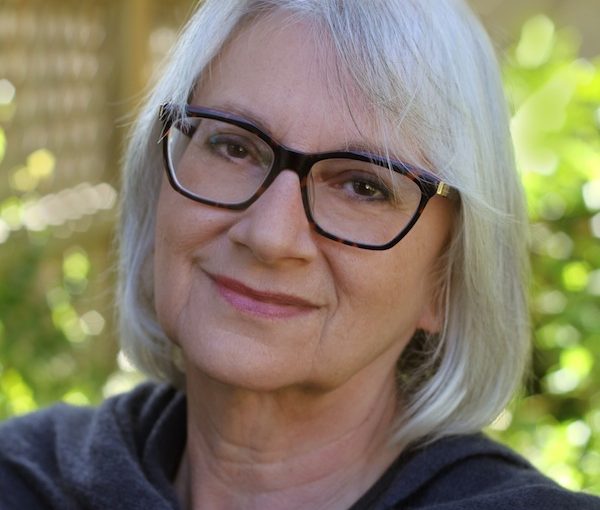
Afterlife is Isa Milman’s first work of nonfiction. (photo by Shea Lowry)

Midway through Isa Milman’s Afterlight, which came out this week, the author cites Reb Nachman of Breslov, who said, “The whole world is a very narrow bridge.” In Victoria-based Milman’s new work, we encounter bridges of various sorts: those that serve as a crucial lifeline to the survival of the denizens of cities, particularly at a time of war, and the bridges that bring together people from different continents in the pursuit of understanding an unconscionably horrific time in Eastern Europe.

And then there are the bridges that link us poignantly to our past – to those we know through words and photos but have never met. In Afterlight, one such bridge connects Milman to her mother’s twin sister, her aunt Basia, who perished in the Holocaust, and who, like Milman, wrote poetry. (Milman is a recipient of the Canadian Jewish Book Award for poetry.)

Milman’s journey began in 2013, when, following her mother’s death, she sought to find Basia’s poems from the 1930s. The book alternates between the present and the past (the war years), as Milman tries to uncover a layered tale. She travels to Europe where, at times, her quest for information leads to dead ends and, at other times, she finds details in unlikely places – a photograph in Amsterdam, for example.

At one stage, Milman finds poetry written in a Polish publication from the 1930s. She writes, “Reading the children’s poems, I felt a terrible nostalgia rise up – a dangerous nostalgia. Even now it hurts too much, this intense longing for a conversation with Basia, for a meeting, a recognition that we’ve lived on the same planet, come from the same earth, share blood and bone. We share a love of poetry, but I shall never know her, not even as smudged ink on a page.”

At one point in her exploration, Milman pens a poem to her aunt. “How many tiny flowers make one lilac sprig? / How many stars in the night sky have names? / How many yet to be seen? They disappear with morning sun too soon but in darkness or in light tucked in their beds they remain,” the poem reads.

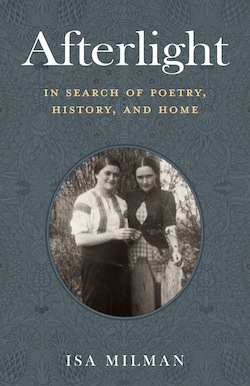
image - Afterlife book coverBasia’s story is but one piece of the book. Afterlight also traces the journey of Milman’s parents and her other surviving aunts through the Holocaust and examines questions about the trauma, displacement and identity caused by the Holocaust to succeeding generations.

“I’d lived my life in a black hole of absence, of never having the experience of grandparents, of feeling rooted and at home with extended family. And this was not because of a tsunami, an earthquake, forest fire or plague. It was because of tribal hatred,” Milman writes.

As well, she explores the issue of reconciling the Poland that Jews thought of as their home with rampant antisemitism and the brutality of the war years. “Why couldn’t I choose how to think about Poland, even if it meant going against most everything I’d learned?” Milman asks. “Why couldn’t I revise my notion and accept that Poland is a place that I can love as well as despise and fear? Why must it be either/or? Was it possible to live in the uncomfortable in-between, where both realities coexist?”

Afterlight is Milman’s first work of nonfiction. At first, Milman, whose collections of poetry include Prairie Kaddish, Between the Doorposts and Something Small to Carry Home, was reluctant to write a nonfiction account of the Holocaust. However, recent surges in antisemitism around the world led her to change her mind.

“The lessons of the Holocaust need to be taught, and not just by citing facts and reportage,” she said. “Telling stories about real people and their experiences is the most effective way of reaching and teaching people about how evil can happen, and how we must fight our worst human inclinations and speak out against hatred and inhumanity.”

A big part of her decision to write a memoir was realizing that her family’s story did not match a more common Holocaust narrative. Hers is a lesser-told account of Jews from eastern Poland, some murdered in what’s known as “the Holocaust of Bullets” and others, like her parents, who survived because of deportation by the Soviets to the Gulag.

“I loved entering the world of creative nonfiction,” she said. “Using my imagination to create scenes where I clearly was not present enabled me to inhabit the places and people I needed to describe. Everything became more real as I entered into the minds of my characters, who happened to be my parents and close family.”

Sam Margolis has written for the Globe and Mail, the National Post, UPI and MSNBC.

Format ImagePosted on September 10, 2021September 9, 2021Author Sam MargolisCategories BooksTags Afterlight, history, Holocaust, Isa Milman, memoir, Poland
Animatedly tackling issues

Animatedly tackling issues

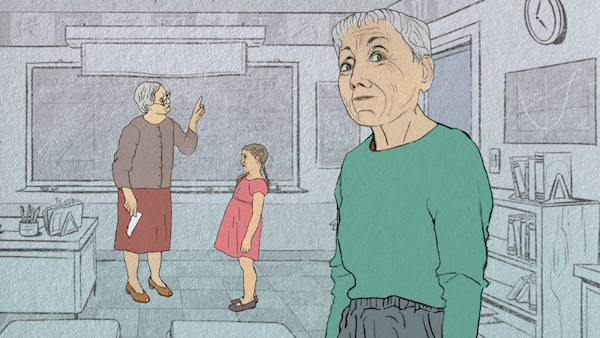
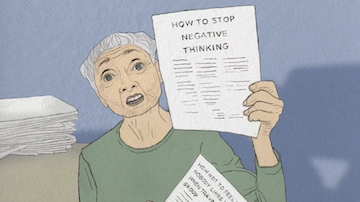
In Bayla’s Issues, the title character is plagued by the travails of aging and anxiety, and a desire for acknowledgement in the art world.

Bayla’s Issues, a 2020 animated short based on the comic strip Bayla’s Comics by Vancouver artist Hinda Avery, has been making the Jewish film festival circuit, with a recent stop in Washington, D.C. The 15-minute film, which follows the story of its title character and her quest to be recognized as an artist, was directed and edited by Victoria’s Michael Kissinger, and is voiced by Ellen Kennedy and animated by Marty Emanuel.

Divided into eight chapters, Bayla’s Issues delves into the inner thoughts – a turbulent sea of doubts, fears and anxieties – of its heroine and her conversations with an expensive and expletive-laden therapist, who is neither encouraging nor helpful.

The character of Bayla came into being after Avery retired from her career in academia. At the time, she wanted to do two things: return to painting after a long break and establish a means of connecting with family who died in the Holocaust.

“Clearly, the only way for me to make this connection would be through an imaginary process, and painting seemed a tangible tool,” Avery told the Independent. “I decided to paint myself with my late mother and, with the help of only two motley photographs, my murdered aunt and grandmother. This would suffice as a way of spending time with them.”

Avery’s mother had left Poland before the start of the Second World War, but was severely traumatized by the murder of her family by the Nazis.

“The atrocity affected both her mental and physical health; her trauma was passed down to me, hence my close connection to the Holocaust,” Avery said.

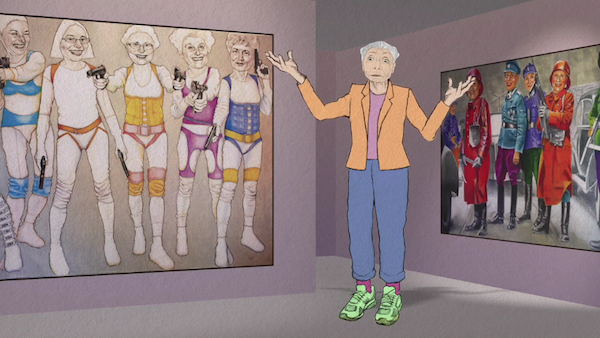
Over time, in a process that began in 2005 and lasted 13 years, Avery was able to separate herself from, as she puts it, “an overt depiction of the Holocaust experience – an event too catastrophic for me to depict using conventional representation – and instead depicted it as a phantasmagoric event. I added more women and called us all ‘The Rosen Sisters.’” Rosen was her mother’s family name.

The paintings feature strong, confident women resisters in situations that are both humorous and dark. Avery found it therapeutic and liberating “to fight the Nazis in this vicarious method.” Still, she said, “beneath the surface of all the paintings, the calamity and horror of the Holocaust is ever present.”

screenshot - In Bayla’s Issues, Bayla must deal with her past
In Bayla’s Issues, Bayla must deal with her past.

When the paintings, in her view, had run their course, she was “desolate” and expressed this by drawing a comic about a befuddled, unfulfilled older Jewish woman who is plagued by the travails of aging and anxiety, and a desire for acknowledgement in the art world.

“In many of the comics, Bayla expresses her angst about being Jewish. Her Jewishness has never been a joy for her. In one of the comics, she says it feels like a huge lead-heavy Star of David, attached to a thick chain-link, hanging from her neck – it weighs her down, she can’t pull it off,” said Avery.

Kissinger’s collaboration with Avery can be traced to 2015, when he served as the editor of the now-defunct Vancouver Courier. “She left a message on my work phone about an upcoming art exhibit of her paintings and I, of course, never returned her call…. But she left another message, and another message,” Kissinger recounted.

“We didn’t do a lot of art exhibit coverage,” he explained. “But, for some reason, I decided to Google her name and up came these paintings of elderly women in bikinis holding automatic weapons and swearing and taking down Hitler and having a great time while they were at it. From that point on, I was in.”

Kissinger went on to write a story and created a five-minute video to accompany it on the newspaper’s website.

screenshot - Hinda Avery’s cartoon strip has been transformed into film about an “‘old, neurotic Jewish woman’ who wants to be an old, famous painter, but is hampered by her own demons”
Hinda Avery’s cartoon strip has been transformed into film about an “‘old, neurotic Jewish woman’ who wants to be an old, famous painter, but is hampered by her own demons.”

A year later, Avery reached out again – this time to share that she had obtained a Canada Council grant and to ask Kissinger if he would be interested in making a documentary about her, her paintings, and her journey in dealing with the Holocaust and depression.

A 27-minute documentary, Hinda and Her Sisterrrz, ensued. That 2018 film screened at a number of Jewish film festivals, including those of San Francisco, Toronto, Boston, Vancouver and Victoria.

“The documentary ends with Hinda talking about retiring the characters in her paintings and moving on to working on a comic strip about an ‘old, neurotic Jewish woman’ who wants to be an old, famous painter, but is hampered by her own demons,” said Kissinger.

“Because I know Hinda’s work and backstory and she trusts me with it and was happy with the documentary, she asked me if I could help her animate her comic strip,” he added.

“Bayla lends herself to being animated. I love seeing her come alive!” Avery said.

The original strip, Bayla’s Comics, appeared in Jewish Currents. More episodes about Bayla’s tribulations – under the title Bayla’s Got Problems – are currently underway.

To watch the trailer for Bayla’s Issues, visit vimeo.com/439541618.

Sam Margolis has written for the Globe and Mail, the National Post, UPI and MSNBC.

Format ImagePosted on August 27, 2021August 25, 2021Author Sam MargolisCategories TV & FilmTags animation, Bayla's Issues, cartoon, film, Hinda Avery, Holocaust, Michael Kissinger, painting
Edmonton’s Anne Frank statue

Edmonton’s Anne Frank statue

Officials in Edmonton unveil the first sculpture of Anne Frank in Canada. (photo by John Stobbe/Dutch Canadian Centre)

On Aug. 8, 2021, officials in Edmonton unveiled the first sculpture of Anne Frank anywhere in Canada. The world’s newest memorial to her – a life-sized bronze sculpture gifted by the Dutch Canadian Club, based in Alberta – now sits in a park in Edmonton. It is a replica of one that stands in Utrecht, Netherlands.

The unveiling marks the 75th anniversary of the liberation of Holland in the Second World War, and gives thanks to the Canadian soldiers who freed their country from Nazi Germany in 1945. But there’s a second meaning behind the timing – and it’s a strange coincidence. On this August weekend, 77 years ago, Nazis raided the secret annex in Amsterdam, where Frank and her family had been hiding for nearly two years, and arrested them. A few days later, they were sent to the Westerbork transit camp and, later, they would be shipped to Auschwitz.

On the Aug. 9 CJN Daily Podcast (ellinbessner.com/the-cjn-daily-podcast), readers can hear from the people who pushed for the statue and raised $75,000 to create and erect it, as well as from Gillian Horwitz, who runs Holocaust programming for the Jewish Federation of Edmonton, and Steve Shafir, the federation’s president, who were at the unveiling ceremony in person.

– For more Jewish national news, visit thecjn.ca


Format ImagePosted on August 20, 2021August 20, 2021Author Ellin Bessner THE CJNCategories NationalTags Anne Frank, Edmonton, Holocaust, memorial, podcasts
Future of Film Showcase starts July 9

Future of Film Showcase starts July 9

A still from Max Shoham’s animated film Sophie and Jacob.

The Future of Film Showcase, an annual short film festival and professional development conference dedicated to fostering the future of emerging Canadian filmmakers, features 11 shorts from Canada’s most promising new voices aged 40 and younger. This year’s slate includes Toronto Jewish community member Max Shoham’s animated film Sophie and Jacob, based on the true story of his great-grandparents, who find love while fleeing Nazi-occupied Romania in 1939. Shoham is a graduate of Etobicoke School of the Arts, where he majored in film, and is currently at Concordia University studying film animation.

The Future of Film Showcase takes place July 9 to 22, with films available to stream for free on the CBC Gem streaming service.

– Courtesy Future of Film Showcase

Format ImagePosted on July 9, 2021July 9, 2021Author Future of Film ShowcaseCategories TV & FilmTags animation, CBC, FOFS, Future of Film Showcase, Gem, Holocaust, Max Shoham

Posts pagination

Previous page Page 1 … Page 12 Page 13 Page 14 … Page 44 Next page
Proudly powered by WordPress