Never waste life’s many gifts

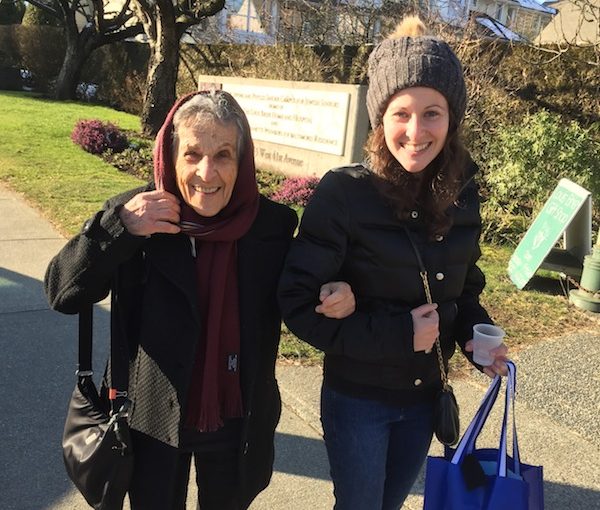
The author with her grandmother. (photo from Becca Wertman-Traub)

In the story of the Jewish people, it is not just about our patriarchs but the matriarchs, too. I grew up knowing that both my grandparents, Babi and Zaida, were Holocaust survivors. Zaida would tell me his stories – I know them backwards and forwards from how he spoke about them. But Babi, who was just 13 when the Second World War began, did not really tell hers.

She did talk about her brother – Shaike – who was taken to his death by the Nazi SS when he came out of the house to help young Frieda carry a pail of water. He was taken to a police station and killed in its basement along with numerous other Jews from the town. And she told us that her father, mother, sister and another brother all perished in the Holocaust. But not much else. She was too busy making blintzes, perogies, chicken patties, chicken soup with kreplach and more for her family.

Thankfully, though, she did have the extreme courage to tell her full story to the University of Southern California Shoah Foundation, where I learned the details of how she survived. Frieda’s childhood home in Kamionka-Strumilowa, Poland, became part of a ghetto. During the liquidation of the ghetto, Frieda and her brother, sister and mother hid in a hiding space in the wall and managed to survive, when the rest of the Jews of the town were taken to their deaths at Belzec extermination camp.

Following the liquidation, the German’s declared the town “Judenfrei,” free of Jews, but Frieda and her remaining family were still there. Since their home was located on the edge of the ghetto, they jumped off the balcony, surpassing the ghetto’s fence, and walked to Busk, a town 30 kilometres away, where they had heard that Jews were still living. They went to the Busk ghetto and lived with an aunt. Frieda’s mother died of typhoid there, and Frieda was left with her brother and sister. Unannounced, the Nazis started liquidating the ghetto, and Frieda again hid but was separated from her brother and sister – she never saw them again.

While in the Busk ghetto, Frieda worked as a gardener for a German man who said, if she returned to Kamionka-Strumilowa, he would help hide her. At the time, Frieda did not believe such a thing was possible and simply mentioned it to her cousins. However, after the liquidation, with no immediate family, she decided to give it a shot and walked back to her hometown by herself. The man took her to the village of Obydiv, where she met Mr. Svets, a Polish farmer. Frieda hid in this Polish farmer’s barn for 12 months and, today, his sister-in-law Janina Pelc is listed among Yad Vashem’s Righteous Among the Nations.

Frieda was one of just 20 from a town of 3,000 Jewish people who survived the Holocaust and lived to tell her story.

And did she live!

Babi and Zaida met after the war and moved to Vancouver in 1949. Babi was always walking, or speed-walking, usually leaving Zaida behind so she could do laps back and forth around him. She just could not sit still, whether it was cooking for her three children and, later, eight grandchildren, or cleaning the entire kitchen with a single square of paper towel – there could never be any waste. I remember sitting at Babi and Zaida’s kitchen counter as a little kid and Babi giving me milk in a tiny shot glass because “if you finish this, you get some more.”

Babi played tennis at Richmond Country Club, exercised at the Jewish Community Centre of Greater Vancouver, and dined at the finest restaurants and cafés in downtown Vancouver.

Even when Zaida passed away, she was not done living. Right up until the end, my dad took her out for coffee.

In September, just a few days before my wedding, we were out for coffee and she took my left hand, looked at me and said, “Is he Jewish? Is he from a good family?” I said yes, and reminded her that she was coming to the wedding.

At 95, she came to my wedding. And she danced at it – to none other than “Od Lo Ahavti Di,” Hebrew for “I have not loved enough.”

Babi appreciated life and everything it had to offer to its fullest, never allowing any of its gifts to go to waste. We mustn’t either.

May her memory be for a blessing.

Becca Wertman-Traub grew up in Vancouver and currently lives and works in Jerusalem.

A story of two families

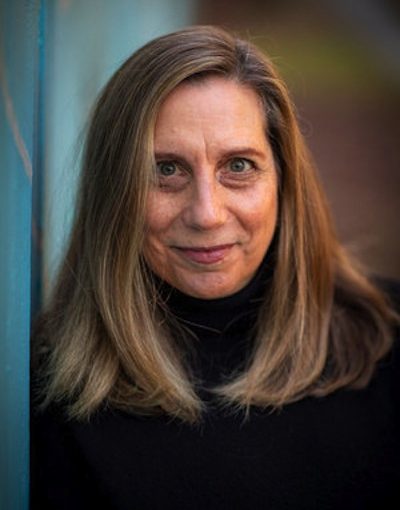
Marsha Lederman’s Kiss the Red Stairs begins in 1919, when her father was born, on erev Yom Kippur. (photo by Ben Nelms)

In the last couple of decades, researchers have identified traits that affect many children of Holocaust survivors. There remains much left to uncover, including how much is epigenetic – that is, whether and how the genes of people like survivors, who have undergone extreme trauma, work differently than other people’s – and how much might be a result of the parenting styles of people who, in many instances, were ripped from their own parents in the most brutal circumstances. The old issue of nature versus nurture, in other words.

While psychologists and scientists try to unravel those mysteries, a genre of second generation memoirs is exploring the deeply personal experiences of being raised by survivors of the Shoah. A page-turning, sometimes shocking and nakedly vulnerable volume has recently added much to the growing library.

Vancouver journalist Marsha Lederman, Western arts correspondent for the Globe and Mail, has written Kiss the Red Stairs: The Holocaust, Once Removed. The book begins in 1919, when Jacob Meier Lederman was born on erev Yom Kippur. The auspicious timing of the birth of this baby, who would grow to become Marsha Lederman’s father, portended great things.

“[T]his was an occasion, an omen – a very good one, the hugest of deals,” she writes. “This person was special, he was going to be something, do something very important with his life.”

Indeed, he did. He survived the Holocaust – the only person in his immediate family to do so and one of only 10% of the Polish Jews alive in 1939 who survived to 1945.

Marsha Lederman’s mother was also a survivor, and one who participated in Steven Spielberg’s Shoah Foundation testimony project, video-recording her Holocaust experiences. This recording would become a touchstone because, despite the journalist daughter’s career asking questions of strangers, there were many unanswered questions in the family. This was due in part to the harrowing, abrupt response to a childish inquiry about the absence of grandparents, an early lesson that unexpected answers can have catastrophic emotional impacts.

Well into adulthood, Lederman decided to visit her mother during a snowbird retreat in Florida. But instead of sitting across the kitchen table learning about her mother’s darkest moments, she was instead living one of her own – delivering her mother’s eulogy. She had waited a day too long to fly south.

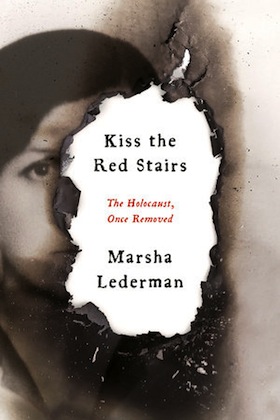
image - Kiss the Red Stairs book coverLederman’s book is the story of a family – two families, really. A family that in some ways never came together quite right, the author’s birth family with its silences about the past, and another that fell apart, that of her marriage. Kiss the Red Stairs, in fact, is a sort of applied case study in second generation (shorthanded “2G”) neuroses, as they distort the author’s reactions and coping mechanisms in a time of personal crisis.

As her marriage collapses, Lederman recognizes, on the one hand, that her responses may not be commensurate with actual events but are exacerbated by a lifetime of fears around loss and abandonment. On another hand, the undeniable anguish of her marital breakdown evokes an added burden of guilt, her own trauma juxtaposed with her parents’ experiences. Given what their mothers and fathers endured, do children of survivors have a right to feel the pain that other people seem to validly experience?

Lederman acknowledges that she was always ready for everything to fall to pieces. She inherited – or developed – an existential pessimism and a catastrophizing worldview: “The glass wasn’t just half-empty; it was half-full of poison,” she writes. “Or Zyklon B.”

The history that has formed Lederman’s identity was not imprinted on her at home only. It was in the zeitgeist of her coming-of-age as a young Canadian Jew in the 1970s and ’80s.

“The slogan ‘Never Again’ was drilled into us, implying – to me, anyway – that there was always the potential for an again, for another catastrophe. What would we do when the Nazis came back and came for us, like they came for our parents?

“This happened to us. This could happen to us again. I was one of the us. On some level I believed, from a very young age, that this could happen to me. I understood the need to be on guard, that we weren’t really safe. We needed to be on alert. Have a plan.”

For whatever were their good intentions, the organizers of a youth trip to Israel reinforced Lederman’s anxieties. Intending to instil in the participants the need for one solitary Jewish state in the world, they reminded their young charges that, in the absence of Israel, Jews would have nowhere to go should the need arise, “if the world once again turned on – or turned its back on – the Jews.”

She doesn’t disagree with the premise. “But the exercise scared the hell out of me. Don’t be so comfortable in that Canada you think of as home; you never know what could happen.”

That awareness of the unimaginable human capability for inhumanity had imprinted on her to the extent that everyday life became a gauntlet of inevitable disaster, misery the preordained endpoint of any happiness. When her marriage broke down, her reaction was extreme, “As if divorce, for instance, were some kind of death camp.”

Having consciously tried to eradicate (second-hand) Holocaust memory from its constant intrusion into her mind, Lederman finally faces the core question of her life, and of the book: “Could I possibly be a victim of the Holocaust, once removed?”

Now a mother, her obsessive worry has a new object, not only in terms of the world into which that child was born, but the potential for epigenetic inheritance. Will the baggage of the past be passed along to another descendant of survivors?

At the same time, Lederman is careful not to ascribe her challenges to the overburdened couple who raised her.

“I am not comfortable blaming what happened to my parents – and, in effect, blaming them – for my little problems. It feels self-indulgent, unfair and actually untrue,” she writes. What they accomplished after the war was almost as miraculous as their survival during it. “The fact that after such tragedy my parents were able to build new lives – purchase and set up a home, go to night school to learn English, buy a business, raise children – seems astonishing to me, as I contemplate it all as an adult. How on earth did they manage to do it, manage to be so normal?”

She quotes Elie Wiesel who, in 1984, told children of Holocaust survivors: “That your parents were not seized by an irrepressible anger … remains a source of astonishment to me. Had they set fire to the entire planet, it would not have surprised anyone.”

Elsewhere in Lederman’s book, Wiesel appears again, seemingly underscoring the legitimacy of second generation complexes by noting that it was they, not their parents, who were the ultimate target of Hitler’s plan.

“You were the enemy’s obsessions,” Wiesel told the children of survivors. “In murdering living Jews, he wished to prevent you from being born.”

Lederman confronts the reader with things she has learned from research, rather than from firsthand experience or from stories her parents shared (because they didn’t). The Holocaust experiences of her parents may be the impetus for her lifelong sense of danger, she seems to suggest, but the larger history of that era should be a warning shot for all humans – because it was humans who perpetrated everything that happened to her parents and to the millions of others of the Nazis’ victims.

In one of several graphic segments, she demands that the reader ponder how ordinary people could throw babies in the air and practise a merciless form of skeet shooting.

There are other psychological conundrums in the book. Reading her father’s journal of a trip back to Europe, Lederman confronts what reads like a cognitive rupture: her father’s love for and comparatively happy memories of Germany.

Rather than remain in Nazi-occupied Poland, young Jacob audaciously crossed into the belly of the beast, into Germany, posing as a Polish peasant boy, and got work as a farmhand, surviving until the end of the war. As a result, he took a perversely positive view. In a travel diary entry, he wrote, “I had a wonderful exciting day and my motto stands again forever: I will never forget you Germany and the peace and security I found here among these fields, meadows and trees in those murderous inhuman times of the year 1942.”

Of all the happenstances in the book – some life-altering and, in several instances, life-saving – there is a particularly poignant one that happened on her father’s trip back to his hometown. On that trip, her father found out that his parents had left a letter for him before they had been evacuated from the ghetto and shortly thereafter murdered.

“A Polish woman who lived there at the time, or moved in after the liquidation – I’m not sure which – had come into possession of that letter. There were photos in this packet and some other family keepsakes,” she writes. “The woman said she had held onto these items for a long time, but after so many years without word, she lost all hope that my father had survived; she figured nobody from the family had. She threw the packet away.

“What was that like for him – to learn that his parents had left him something: a declaration of their love, a wish for his future, some unknown secret, an explanation of what was happening to them? And to learn that those things once touched and left for him by his parents – a written document, photographs, who knows what else – proof that his parents had existed, evidence of their love – had survived, only to be discarded?”

On her own ventures to the blood-soaked continent, Lederman is reminded that the past has not passed. She sees antisemitic graffiti on abandoned synagogues, Polish youths giving obscene gestures to participants during the March of the Living. Lederman and four family members are paying tribute at a Holocaust memorial while a group of boys nearby chant something in Polish, something menacing that included one term she recognized: “Auschwitz-Birkenau.”

“It didn’t sound like they were expressing their condolences,” she writes.

After a lifetime of mostly solitary rumination and fears, Lederman has several epiphanies during the World Federation of Child Survivors of the Holocaust annual conference, held in 2019 in Vancouver. Here, she finds others who share her view that “the other shoe is always about to drop and the world is not safe”; “being plagued with obsessive doubt”; “a heightened ability – one might call it a curse – to observe and engage others”; “A constant expectation that someone is going to get you.”

There, she finds she is not alone.

“I had found my people,” she writes.

Maus not too graphic

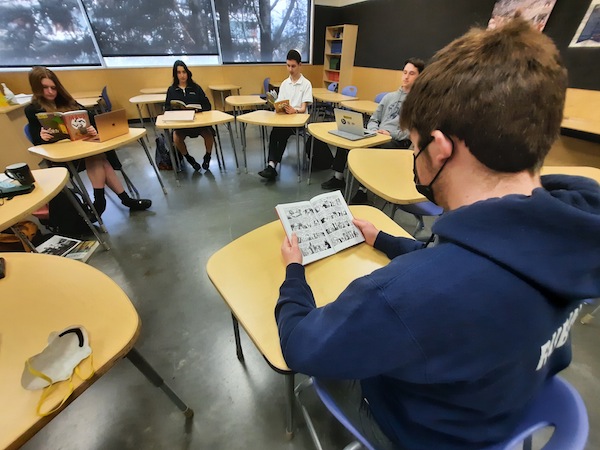
Students in Anna-Mae Wiesenthal’s Holocaust and Genocide Studies class at King David High School discuss the graphic memoir Maus. (photo by Pat Johnson)

In January, the school board in McMinn County, Tenn., voted to remove the graphic novel Maus from its eighth grade curriculum.

The book by Art Spiegelman won a Pulitzer Prize in 1992 under a special category created specifically for Maus. The two-volume collection of previously serialized comic-style narratives was viewed at the time as revolutionary for its approach to a subject like the Holocaust in a medium more commonly associated with superheroes and humour.

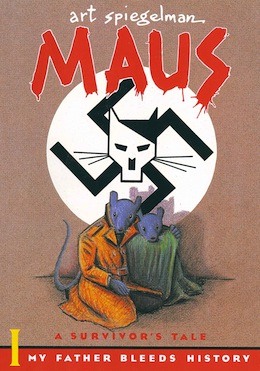
In the books, racial and national identities are represented through anthropomorphized animals. Jews are depicted as mice, Germans as cats, Poles as pigs, Americans as dogs, British as fish and so on. In each instance, the characters have the bodies of humans and the heads of the respective animals. This form has been criticized by some critics over the decades as overly simplistic but has caused particular discomfort to many Poles, who do not appreciate being depicted as pigs.

Spiegelman, the author, called the McMinn County decision “Orwellian,” but has seen sales of his books skyrocket since the ban thrust the works back into the spotlight.

The Independent joined in a class discussion with the five students in the Holocaust and Genocide Studies course at King David High School, led by teacher Anna-Mae Wiesenthal. Discussing the Tennessee book banning, students questioned the sincerity of the school board’s grounds for opposing the book.

In a graphic memoir dealing with the attempted annihilation of a people and which touches on history’s most horrific acts of inhumanity, students found it “absurd” that the board’s primary concerns appeared to be a couple of instances of mild profanity and the depiction of a nude cartoon cat.

The book follows the true journey of the author in pressing his father, Vladek, to share his Holocaust experiences openly for the first time.

Nitzan Berger, a great-granddaughter of a Holocaust survivor, observed that many survivors hesitated to share their narratives and that the graphic novels capture the challenges of the younger generation in approaching the subject, as well as the reticence on the part of the older generation to relive the horrors of their past. While the passing down of these stories is important, it can be painful for both generations.

“It’s interesting for us to hear about the stories, but we don’t think about the other side,” she said.

Ethan Dreyshner was struck by the speed with which an entire society, down to its youngest members, could be transformed.

“It just really shows how this whole society was changed to think the Jews were terrible people,” he said. “Six years earlier, Jews were regular citizens. It’s crazy to think that a whole society, a whole population, can just turn on their neighbours that quickly.”

Noting that young people need to begin learning about this challenging subject at some point, students contrasted Maus with Anne Frank’s diary, which for generations has been an entry point to discussion of the topic.

Olivia Levsky said a graphic novel that is intense but not particularly long may be a good starting point as well, especially for young people who rebel against assigned readings.

“It’s a very interesting way to learn something that’s very important to learn,” she said. “I didn’t feel like it was incredibly graphic or too much when I was reading it. It was graphic at times, but the Holocaust was graphic. I didn’t feel it was overly triggering or traumatizing. I didn’t feel it was inappropriate.”

Levsky also noted that Spiegelman, in some respects, depicted the national groups through the eyes of the victimizer.

“He drew each character and each race in the way that the Nazis saw them,” she said, noting particularly the Nazis’ association of Jews with vermin. “I imagine toward the end [of the war], the Americans felt like threatening dogs to the Nazis.”

image - cover of Maus I by Art SpiegelmanStudents concurred with Wiesenthal that there also may have been a practical purpose to depicting each group as a type of animal. It made each character’s identity more immediately understandable to the reader without having to repeatedly point out the race or nationality of each individual – in one instance, a Jew (mouse) hides in plain sight with the mask of a pig (Pole).

Wiesenthal noted that the second volume, which the class has not read together, is somewhat more explicit in its violence.

The teacher also stressed that the book tells the story of the Holocaust experience and intergenerational trauma through one family.

“We often talk about numbers – six million – which can serve to depersonalize what is really an impossible number to grasp,” the teacher said. “I think that we need to remember each of them had a name, each of them had a family. It’s very impersonal, often, the way we attach the number to the Holocaust.”

Maus includes situations in which non-Jewish people assisted in the survival of Jews. While it is not addressed in the book, students discussed the fact that Yad Vashem’s criteria for designation as Righteous Among the Nations excludes people who received compensation for their often-life-endangering efforts.

Shai Rubin noted that, in some cases, Jews may have given valuables voluntarily as gratitude to their rescuers. He also noted that, in addition to risking their lives, many non-Jewish helpers were experiencing economic destitution due to the war and what small amount of food they could provide to Jews in hiding may have come at a great price to their own families.

Of one woman in the story, Rubin said: “There’s a difference between doing something for money and doing something and getting money for it. She did it out of the goodness of her heart.”

In what was a shocking sequence for students, Art, the author, discovers that his father has burned the diaries of Art’s mother, Anja, who committed suicide. In response, the son lashes out at his father: “Murderer!”

This opened a discussion of what Wiesenthal called “the murder of memory” and raised the quote by Elie Wiesel (not mentioned explicitly in the book), who said of the Holocaust and its victims, “If we forget, the dead will be killed a second time.”

The Grade 12 students analyzed the content, style and medium of Maus. They observed that, often when the wrought iron gate to Auschwitz is pictured, the focus is on the words themselves, Arbeit Macht Frei, while, in this book, the eye is drawn to the individual people in the frame, a reminder that the Holocaust can often be depicted in broad strokes but it is, ultimately, about the killing of individuals.

On the medium itself, all the students concurred that it is an effective avenue for conveying challenging material.

“I think this is a really effective form of teaching the Holocaust, especially to kids,” said Dreyshner. “Something like the diary of Anne Frank, you might feel a little disconnected, you can’t see it, you can’t understand it because it’s hard to show actual images of the Holocaust to children. I think a graphic novel really does the job because you can see what happened, you can get a sense of what happened, without seeing the horrific things exactly.”

Richard Helper agreed, but subtly criticized those who are concerned about the graphic nature of the book.

“This is easily digestible, it’s effective, it has quite a bit of information on the specifics of the Nazis’ war machine as well,” he said. “While some people, I think, try and attack it for being either too simplistic or too graphic, we’re teaching a book on the Holocaust.… It’s the Holocaust.”

Wiesenthal, who has a master’s in Holocaust and genocide studies and is pursuing a PhD in the same field, pioneered the course three years ago. Until then, the Holocaust was dealt with as part of the larger Jewish history curriculum.

She acknowledged that most King David students come to the subject with some familial or other knowledge of the subject, whereas non-Jewish students, such as those in places like Tennessee, might have no knowledge of the history.

“It’s important to contextualize it,” she said.

“Never again” still resonates?

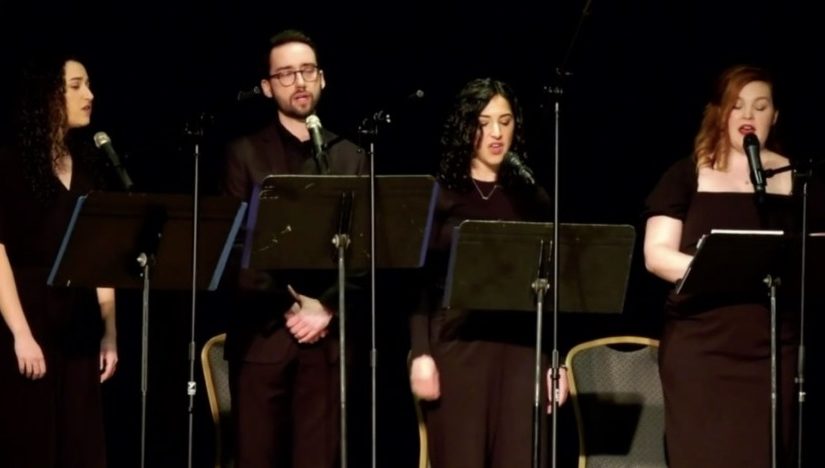
Left to right: Mia Givon, Lorenzo Tesler-Mabe, Kat Palmer and Erin Aberle-Palm. (screenshot from Kat Palmer)

Holocaust survivors and their descendants were joined by top elected officials and Jewish community leaders in a series of commemorations marking Yom Hashoah, Holocaust Remembrance Day, across Canada last week.

In Vancouver, community members gathered together at the Jewish Community Centre of Greater Vancouver April 27, while scores more watched remotely as the traditional in-person ceremony returned for the first time since the beginning of the pandemic.

Marcus Brandt, vice-president of the presenting organization, the Vancouver Holocaust Education Centre, welcomed guests and invited Holocaust survivors to light Yahrzeit candles.

“On Yom Hashoah, we join as a community to remember the six million Jews who perished in the Holocaust at the hands of Nazi Germany and its co-conspirators between 1933 and 1945,” he said. “It is also a day to pay tribute to the Jewish resistance that took place during the Holocaust.”

This year marks the 79th anniversary of the Warsaw Ghetto Uprising, which is the most notable of many acts of Jewish resistance to Nazism.

Marsha Lederman, a journalist who is the daughter of two Holocaust survivors, spoke of the importance of telling our stories.

“When I was growing up,” she said, “the Holocaust was everywhere and nowhere. As far back as I can remember, there were hints and references. My parents talked about things happening in camp. What was this camp? I knew it wasn’t like the summer camp that I went to. I knew a lot of their friends were also at these camps, but I didn’t know the details.”

At the age of 5, Marsha met a new friend whose home was filled with laughter and extended family.

“One day, when I came home from a visit at my friend’s house, I asked my mother what was really a simple, innocent question,” said Lederman. “She has grandparents, why don’t I? My poor mother. She was caught off guard and her answer was truly horrifying – at least as I remember it, because I know memory is very faulty. But, as I recall, she said I didn’t have grandparents because the Germans hated Jews and they killed them by making them take gas showers.”

This response raised more questions than answers for the young girl, not least of which was: “What did we do to make the Germans hate us so much and do they still hate us? It was a horrible introduction to the details of the tragedy of my family and it taught me another terrible lesson: be careful about asking questions because the answers could be murder.”

As a result, much of Lederman’s Holocaust education was gained “through osmosis, rather than sitting down and asking questions,” she said.

Her father died when Lederman was a young woman and, in a tragic turn of events, her mother died just as Lederman had bought a ticket to visit her in Florida, armed with a recorder to finally ask the questions she had hesitated to broach in earlier years.

“It’s taken me years to try to figure out what I could have learned in an afternoon at my mother’s kitchen table,” she said. “I have no way of knowing these things because I didn’t ask. We need to ask and we need to tell.”

Lederman explores these questions in a book being released this month, titled Kiss the Red Stairs: The Holocaust, Once Removed.

Amalia Boe-Fishman (née van Kreveld) was the featured survivor speaker at the Vancouver event. Born in the Netherlands, she was less than a year old when the Germans invaded her country. Her grandparents were soon transported to Auschwitz and murdered.

In what is an extremely rare phenomenon, Amalia, her parents and her brother all survived the war years because a Dutch Christian resistance fighter, Jan Spiekhout, and his family hid members of the de Leeuw family in a variety of hiding places over the course of years. Amalia’s mother even gave birth to another child in 1944. (That child, as well as Boe-Fishman’s oldest son, are both named Jan in honour of their rescuer.) Their survival was a statistical miracle. The Netherlands had among the lowest Jewish survival rate of any country during the Holocaust. Of 140,000 Dutch Jews in 1939, only 38,000 were alive in 1945.

Boe-Fishman recalled the day Canadian forces liberated the Netherlands – it was one of the only times in three years that she had set foot outdoors.

“It was strange and frightening outside and close to so many strangers,” she said. “The Canadian soldiers came rolling in on their tanks, handing out chocolates, everyone smiling, dancing, waving Dutch flags. Then I was told I could go home to my real family. But who were these strangers? I did not want to leave the family Spiekhout. They were my family. After all, I had not seen my real family for three years.”

In 1961, she traveled to Israel to meet members of her family who had made aliyah before the war and to reconnect with her Jewish identity. There, on the kibbutz she was staying, she met a Canadian, whom she married and they subsequently moved to Vancouver and had three children.

In 2009, Boe-Fishman and her three sons traveled to The Hague for the investiture of Jan Spiekhout and his late parents, Durk and Froukje Spiekhout, as Righteous Among the Nations by Yad Vashem.

“To be together with my children, my brother, and the grown children of the Spiekhout family, this was such a moving event in our lives,” she said.

As part of the Vancouver ceremony, Councilor Sarah Kirby-Yung read a proclamation from the City of Vancouver. Cantor Yaakov Orzech chanted El Moleh Rachamim. Lorenzo Tesler-Mabe, Mia Givon and Kat Palmer, members of the third generation, as well as Erin Aberle-Palm, sang and read poetry, accompanied by Vancouver Symphony Orchestra violinist Andrew James Brown and pianist Wendy Bross Stuart, who was also music director of the program.

The following day, a hybrid in-person and virtual event was held at the British Columbia legislature, featuring Premier John Horgan.

“On Yom Hashoah, we are challenged to ensure the words ‘never again’ are supported by action,” he said. “Over the past few years, there has been an increase in antisemitism in B.C., and the Jewish community is one of the most frequently targeted groups in police-reported hate crimes. That’s why our government will continue working to address racism and discrimination in all its forms.… Today, as we remember and honour those who were lost and those who survived, we must recommit to building a more just and inclusive province, where everyone is safe and the horrors of the past are never repeated.”

Michael Lee, member of the legislature for Vancouver-Langara, spoke on behalf of the B.C. Liberal caucus.

“Every year, we commemorate this day and remember the heroes and the Righteous Among Nations who stood up to oppose the most vile, hateful oppression,” Lee said. “We recognize the victims and survivors of the Holocaust, we make a solemn promise to never forget and never again allow such horrific actions to take place. This is a responsibility that we all must carry with us not only today but every day. It is a responsibility we must be better at upholding, as soldiers at this very moment commit war crimes once again in Europe. We have not done enough. Right here in Canada, we see another year of record rises in antisemitism. We have to do better.”

Lee called on the province to adopt the International Holocaust Remembrance Alliance Working Definition of Antisemitism.

MLA Adam Olsen represented the Green party.

“While time distances us from the horrific events, the memories and the stories remain steadfast in our mind and are carried and passed from one generation to the next,” said Olsen. “The Holocaust was an ultimate form of evil, persecution, oppression, genocide, complete disregard for human life, pushed to the most appalling degree…. The Holocaust is a stark reminder of the darkness, the wickedness, that can exist among us. However, it is also important to acknowledge that this is a story of strength, resilience and humanity and, to that, I raise my hands to all of the survivors, the Jewish community, that have ensured that the world knows and hears the stories. As difficult as it is to continue sharing them, we cannot stop hearing them or else we will fall victim to thinking that we have passed that now.”

Rabbi Harry Brechner of Congregation Emanu-El lamented the deaths of Holocaust survivors in the current war in Ukraine, “who died when they were cold, again, and hungry, again, and who died in the face of violence.”

“That never should happen and we all know that,” the rabbi said. “I don’t know how to make those big changes. I’m not a world leader. I’m the leader of a small congregation. But I think we are all leaders of our hearts and if each of us can make that difference, it’s got to have a huge ripple effect.”

Holocaust survivor Leo Vogel said that history records the end of the Holocaust in 1945. “But, for the people who lived through it and survived that horrible blight of human history, for them, 1945 is not when the Holocaust ended,” he said. “It continues to this very day to live in memories and nightmares and ongoing health problems.… The fascist attempt to eradicate the Jewish people must never be forgotten. The memory of the tortured and murdered cannot be shoveled underground as the Nazis did with the ashes. As children in the Holocaust, we were the youngest and, now, in our older years, we are at the tail end of those who can still bear witness.”

Vogel spoke of the unfathomable choice his parents made to hand him over, as a child, to a Christian family for hiding.

“Not long after that deeply painful decision to separate me from them, they were deported to Auschwitz and there they were murdered without ever knowing whether their desperate act to allow me to go into hiding saved my life,” he said. “I get cold chills when I think of the intense agony they went through in making their decision. It would have been their hope, I’m sure, that one day we would once again get together. That day never happened. Their pain must have been overwhelming. Many times, I have wondered what they said to each other and to me the night before they gave me away and, countless times, I have asked myself whether I would have had the strength to do an equal act when my children were young.”

In Ottawa, earlier on April 27, Prime Minister Justin Trudeau touted his government’s steps in fighting antisemitism, including the creation of a special envoy on preserving Holocaust remembrance and combating antisemitism, currently held by Irwin Cotler, and proposed legislation to make denying or diminishing the Holocaust a criminal offence.

“Earlier this year, our country and people around the world were shocked and dismayed to see Nazi imagery displayed in our nation’s capital,” the prime minister said, referring to trucker protests in Ottawa. “For the Jewish community, and for all communities, those images were deeply disturbing. Sadly, this wasn’t a standalone instance. Jewish people are encountering threats and violence more and more both online and in person. This troubling resurgence of antisemitism cannot and will not be ignored. The atrocities of the Holocaust cannot be buried in history.… We must make sure that ‘never again’ truly means never again.”

Shimon Koffler Fogel, chief executive officer of the Centre for Israel and Jewish Affairs, picked up on that theme, noting that the term “never again” was “born out of the Jewish experience but was always intended to be universal in its application.”

“How can we witness the atrocities visited on the Rohingya, the Uighurs or the Yazidi and claim the cry of ‘never again’ has meaning?” he asked. “How can we observe the unvarnished aggression against Ukraine and assert we have taken the lessons of the Holocaust to heart?”

He said he derives hope from the fact that Canada seems to have learned the lesson of the MS St. Louis, the ship filled with Jewish refugees that was turned away from Canada and other safe havens in 1939. Now, Canada is a place, he said, “where fleeing Syrian and Iraqi refugees can rebuild their lives, where Afghani women and girls can fulfil their dreams, where displaced, wartorn Ukrainians can find safe harbour.”

“I take great pride that Canada is so committed to Holocaust remembrance and education,” said Michael Levitt, president and chief executive officer of the Friends of the Simon Wiesenthal Centre, “A major reason is because of the survivors who, after suffering unthinkable adversity in Europe, rebuilt their shattered lives here, in our great country. Their strength, resilience and willingness to share their deeply personal and harrowing stories have been a gift and a source of inspiration to all Canadians.”

Dr. Agnes Klein, a Holocaust survivor, spoke of her family’s wartime experiences. Israel’s ambassador to Canada, Ronen Hoffman, commended Canada on adopting the International Holocaust Remembrance Alliance’s Working Definition of Antisemitism.

A day earlier, at another virtual commemoration from the Montreal Holocaust Museum, Holocaust survivor Max Smart told of his family’s harrowing Holocaust experiences.

Paul Hirschson, consul general of Israel in Montreal, compared the loss of Jewish life, with its incalculable loss of talent, in the Holocaust with the explosion of Jewish talent taking place in this century.

“Jewish talent lost was one of history’s greatest tragedies,” said the diplomat. “The talent emerging is perhaps the most exciting story of the 21st century…. Antisemitism is still widespread, also here in Canada. Montreal, where many survivors found a home, is no exception. We will defeat hate every time. Hatred will never again rob the world of Jewish talent.”

Health workers’ courage

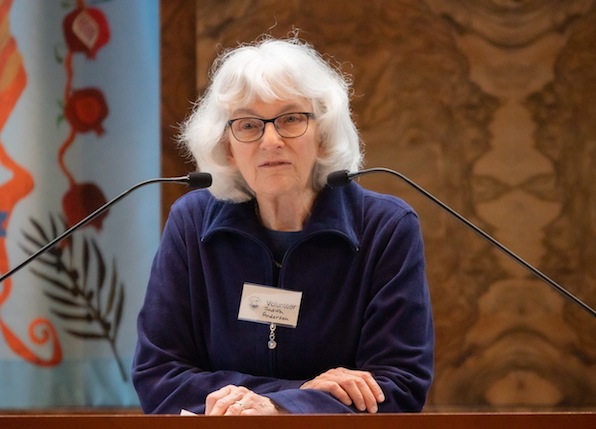
Judith Anderson speaks at the Wallenberg-Sugihara Civil Courage Society’s Raoul Wallenberg Day event last month. (photo by Masumi Kikuchi)

This year’s commemoration of Raoul Wallenberg Day took place April 10 at Congregation Beth Israel because COVID-19 restrictions prevented the gathering in January. The event honoured the courage of B.C. frontline healthcare providers during the pandemic.

Hosted by the Wallenberg-Sugihara Civil Courage Society, Judith Anderson welcomed attendees. She asked them to take a moment of silence to think about Ukraine and “all the victims of this humanitarian crisis, and to thank the countries welcoming refugees, especially Ukraine’s closest neighbours – Poland, Romania, Slovakia, Moldova and Hungary. In addition, let’s remember the many organizations and volunteers who are stepping forward to help.”

Anderson spoke about gratitude. “We are blessed to live in a peaceful society, where threads of various cultures are woven together to make a fabric that is stronger and warmer than any of the threads would be alone. Let’s recognize two special qualities of that fortunate fabric that we are thankful for today.

“First, we appreciate our shared land. Here in Vancouver, we are meeting on the unceded territories of Musqueam, Squamish and Tsleil-Waututh people. We thank them for sharing, and for having cared for these lands and waters for thousands of years.

“Second, we are thankful for our health care. Modern medicine has developed from diverse cultural threads, including science, people skills, systems management and the professional commitment of thousands of healthcare providers. Our routine expectations of health and longevity could scarcely have been imagined, just 100 years ago.

“And today,” she continued, “we are thankful, in particular, for the civil courage of those who have provided health care to British Columbians during the COVID-19 pandemic. They have faced a new, deadly, communicable disease with unknown risks to their own and their families’ health. They have worked to exhaustion under the most stressful conditions, saving lives and comforting families. Then, when vaccines became available, healthcare workers extended themselves yet more to immunize us all. Unfortunately, as some people have tired of public health restrictions, medical workers have been subjected to harassment and threats. And still they are there for us when we need health care, whatever the problem might be.”

Deputy Mayor Christine Boyle read the Raoul Wallenberg Day proclamation from the City of Vancouver, recognizing Jan. 17 as the day of its commemoration.

The Civil Courage Society’s Alan Le Fevre introduced the three speakers: Barb Nederpel, president of the Hospital Employees Union of British Columbia; Sherri Kensall, board chair of the Nurses and Nurse Practitioners of British Columbia; and Dr. Ramneek Dosanjh, president of the Doctors of British Columbia. They described the challenges and courageous responses of hospital workers, nursing professionals and doctors during the COVID pandemic.

The one-hour documentary Zero to Zero was screened at the event. Filmed over 15 months, it offers an unfiltered look at what it’s like to be a healthcare worker during the COVID-19 pandemic. It follows the staff of a hospital from the moment they admit their first patient in June 2020, till after the third wave. Filmed by a healthcare worker with unprecedented access to the hospital frontline, it deals with patients during life-and-death situations, but the focus remains on the indomitable strength of the human spirit.

After the screening, the guest speakers fielded questions from the audience about what they thought of the documentary, about long-COVID in healthcare workers and about the harassment they faced and how they responded to it.

The annual commemoration is held in memory of Raoul Wallenberg, a Swedish architect, businessman, diplomat and humanitarian, who became Sweden’s special envoy to Hungary in summer 1944 and, at great personal risk, saved tens of thousands of Jews from deportation and death. He disappeared into Soviet captivity on Jan. 17, 1945, and his fate remains unknown.

Wallenberg has been made an honorary citizen of Canada, the United States, Hungary, Australia and Israel. In 2000, the Canadian government proclaimed Jan. 17 as Raoul Wallenberg Day.

The event is also in memory of Chiune Sugihara, a Japanese diplomat who served as vice-consul in Lithuania during the Second World War. He chose to act, at clear professional and personal risk to himself and his family, issuing transit visas that allowed about 2,000 Jews, more than 90% from Poland, to escape almost certain death.

Both Wallenberg and Sugihara have been designated by Israel as Righteous Among the Nations.

The Wallenberg-Sugihara Civil Courage Society, said Anderson, defines “civil courage as an act entailing personal risk or sacrifice, intended to improve or save the lives of others who endure misfortunes attributable to social context. In even the best-managed societies, some people may suffer from conflict, injustice or threats to health and well-being – such as the COVID pandemic – that are intimately tied to our social structures. And those who help despite personal risk, show the same inner strength as wartime role models like Wallenberg and Sugihara.

“In 2006,” she continued, “the former honorary Swedish consul to Vancouver, Anders Neumuller, began Vancouver’s annual commemoration of Wallenberg Day. He later envisaged a nonprofit society dedicated to honouring acts of civil courage. And so the Wallenberg-Sugihara Civil Courage Society was formed in 2013 by members of the Swedish and Jewish communities in Vancouver.”

The Civil Courage Society honours the legacy of Wallenberg and Sugihara by acknowledging British Columbians who have demonstrated civil courage and by promoting civil courage.

“To that end, each year, we formally recognize a person or group of people who have displayed civil courage in British Columbia,” said Anderson. “We also screen a film intended to get the audience thinking about the importance of civil courage and how to encourage it.”

For more information, including photos and video of the commemoration, visit wsccs.ca.

– Courtesy Wallenberg-Sugihara Civil Courage Society

A grandfather’s story – available online to May 7

The documentary How Saba Kept Singing had its world première last weekend as part of HotDocs. It can be accessed online until May 7.

The film starts with David Wisnia preparing for his return to Auschwitz-Birkenau after 70 years. Traveling with his grandson and musical partner, Avi, David reveals some new stories about his survival journey. Throughout his life, he had selectively shared details about his war experience, mentioning that his singing voice provided him with privileges that aided in his survival. However, he omitted a major detail – a love affair with a fellow prisoner is what actually helped save his life. Told through David’s perspective, the truth regarding his survival some 75-plus years ago is uncovered.

The film is written, directed and produced by Sara Taksler. It is executive produced by Hillary Rodham Clinton and Chelsea Clinton, and produced by Retro Report, HiddenLight Productions, in association with Burnt Umber Productions.

To buy a ticket to watch the documentary online, go to hotdocs.ca/whats-on/hot-docs-festival/films/2022/how-saba-kept-singing. 

– Courtesy HotDocs

Orcas inspire creative music

The creation of Songs for a Lost Pod helped singer/songwriter Leah Abramson explore her family’s Holocaust history. (photo by Angela Fama)

The world première of Leah Abramson’s Songs for a Lost Pod was supposed to be part of this year’s PuSh Festival three months ago. Delayed because of COVID restrictions at the time, it now will debut May 28-29, 7:30 p.m., at Studio T, SFU Goldcorp Centre for the Arts.

Songs for a Lost Pod is a “nine-song cycle [that] makes spectacular use of orca vocalizations, transforming them into rhythmic beats in a musical exploration of historical trauma, environmental crisis and communication between species.” The theatrical production is the most recent development in a process that includes an album by the same name, released in 2017.

“It was just an outward spiral, really. The project started with dreams I had about whales, which turned into researching whales for fun, which then turned into a master of fine arts thesis, an album, a comic book, and now a stage show!” said Abramson when the Independent interviewed her in anticipation of the PuSh festival. “When I made the album, I knew there was so much research and information behind the lyrics and music of each song, and I felt like I wanted people to understand that context, so I made the comic book to highlight some of the research and stories. Then, as I was arranging the music to be performed live, I realized that I wanted people to have that context, too, so I’ve turned the research and background into a script. Then we decided that adding visuals would really help immerse the audience in the material. The project has just been expanding from the beginning.”

Abramson, who grew up in Burnaby, said she has been interested in music from a young age. “My grandma sang in her synagogue’s choir and my dad played the piano, so they tell me it runs in the family,” she said. “But I was also told that music was only for fun, and not a real career, unless you were a concert pianist or something like that. So, I tried to do other things, but I was miserable unless I was making music.

“Over the years, I’ve done lots of touring and playing in bands and teaching, but writing and composing has always been what I love the most. I have pretty varied interests – I’m fascinated by marine biology and I love learning about the environment, as well as human history. The great thing about writing songs is that you can research anything and put it into your work. Right now, I’m really excited about writing music for the stage, as well as choral music.”

Along with her MFA in creative writing (with a focus on lyrics) from the University of British Columbia, Abramson studied classical music at Capilano University, and also has studied traditional Appalachian balladry.

In addition to the song-cycle, Songs for a Lost Pod features the narrative script that Abramson mentioned, which “juxtaposes the whale histories with Leah’s own family and their experience surviving the Holocaust and its aftermath,” according to the program description. “Mind of a Snail’s handmade projections create an impressionistic and largely non-representational visual world to support the songs and narration, guiding the audience into a space of contemplation.”

“When I first started looking into whale histories, the parallels presented themselves pretty quickly,” Abramson told the Independent. “It was not my intention to delve into my family’s past, but, while learning about captures and commercial whaling practices, it was hard not to look at the bigger picture of human behaviour throughout history – aspects of cruelty and destruction that manifest in heartbreaking ways. But also, whales are similar to humans – whale intelligence is extremely high, and whale families are extremely tight knit.”

It was difficult for Abramson to explore her family’s Holocaust history – “the loss and pain are pretty overwhelming,” she said, “and it’s not always easy to find a way forward when that intensity is present. Whale families became a mirror for me, a way to understand and experience intergenerational trauma at a greater distance. The project allowed me to deal with my feelings in a more manageable way, through empathy for another species. And it provided a space for my grief, but also helped me find a way through it. Trauma is so common in families of all different backgrounds. Our ancestors may have lived through wars or other calamities and there are so many people living through these things right now. I think learning others’ stories can help people start to process their own family’s pain, even if the details are different. I felt like whale stories did that for me.”

Credit for Songs of a Lost Pod’s music and lyrics go to Abramson in collaboration with Antoine Bédard, J.J. Ipsen, Andrew Lee (Holy Hum), Aidan O’Rourke (Lau), Sandro Perri, Arliss Renwick and Marten Timan. The program notes that credit also could be given to the A5 whale pod, as the musicians “were given selected A5 pod orca vocalizations, along with Abramson’s other field recordings, to turn into beats and tracks, which formed the backbone of Abramson’s songwriting process, and the rhythms behind much of the music.”

Fellow Jewish community member Barbara Adler also has contributed to the project, and is the show’s narrator.

“Barbara and I have known each other for so long that we can’t remember when or how we officially met,” said Abramson. “It’s like that with people in creative community sometimes – you grow up making art alongside each other. We have shared some special experiences and projects over the years, and continue to work together and in parallel. We have some shared Czech-Jewish roots, which makes Barbara a really good fit for this project in particular. She’s working on a lot of interesting projects of her own, and I’m also happy to be one of her composer-collaborators for Mermaid Spring, which is a musical she’s making with Kyla Gardiner (who also happens to be our lighting designer).

“Barbara has been sending me song lyrics over the last few years, which I have been setting to music. I love working with the characters she has created, and it has truly been a joy to work on those songs. I also really admire Barbara’s artistic process. When she writes, she really digs into all the nuances of a situation or character. She welcomes complexity and the messy underside of creation. I think Barbara balances my impulsivity, and helps me step out from the shadows in my shyest moments. She’s also a great performer!”

Co-presented by Music on Main and SFU School for the Contemporary Arts, tickets for Songs for a Lost Pod ($15) can be purchased from musiconmain.ca/event/songs-for-a-lost-pod.

Celebrate Israel with joy

In the coming days, we celebrate the 74th anniversary of the rebirth of Jewish sovereignty in the land of Israel. By press time, we were still anticipating the first local in-person celebration in three years, a coming together that, if all goes to plan, will be cause for great joy.

Those immersed in the daily news from Israel can lose sight of the forest for the trees. We celebrate the scientific advances, the medical breakthroughs, the cultural triumphs coming out of the small but astoundingly creative Jewish state. Yet it may be only on occasions like Independence Day that we step back to observe the big picture.

The creation and flourishing of the Jewish state is a modern miracle – not only because every advancement has taken place within the context of a nation routinely under siege, but because these accomplishments would be exceptional even in the most conducive situations. There may be no other country that emerged in the postwar period of decolonization that has created a greater model for national development – lessons (like the oft-referenced act of making the desert bloom) that were widely shared with other emerging countries until after 1967, when the anti-Zionist movement snuffed out much of that international cooperation.

As a result of that anti-Zionism, our Zionism sometimes takes on a defensive tone. Young Israelis, traveling after their military service, meet young people from around the world in hostels and on hiking trails and are expected to justify their nation’s policies. Never mind Israelis, Jews in Canada and elsewhere are subjected to litmus tests to determine whether they are, by the standards of the interlocutor, a “good Jew” (anti-Zionist) or a “bad Jew.” (Of course, Zionists also engage in the good Jew/bad Jew game.)

Anti-Zionist voices dismiss claims that hyper-criticism of Israel endangers Jews in countries where mobs condemn the Jewish state in ferocious terms. These dismissals are disprovable through statistics. One could claim that the spike in antisemitic incidents in the Western world is unrelated to the precipitous rise in anti-Israel activism. But is there another case of a group of people in Canada or the United States or Europe telling people that their inflammatory rhetoric risks real-life violence only to have those concerns dismissed as a coincidence or as a trick to divert attention from alleged “war crimes”?

Aside from the physical dangers created by anti-Israel rhetoric, the insistence that none of this is aimed at Jews outside Israel is nonsense. Intent does not trump effect. The vast majority of Jews have familial, historical, religious and/or emotional connections to this land and the agitation against Israel is felt by Jews everywhere, no matter their views or feelings about Israel. Whether the mobs intend to strike fear in the Jews along the parade route is irrelevant – they do. Does this scenario constitute antisemitism? Well, if you seek the destruction of the world’s only Jewish state while striking fear in Jews worldwide and chanting “anti-Zionism is not antisemitism,” you have already demonstrated a spectacular indifference to the well-being of Jews everywhere. Does it really matter what we call that?

The trope that Israel was a consolation prize from the world to the Jews for the Holocaust is perhaps the most common misconception surrounding the history of the region. The world gave Israel nothing but a vote at the United Nations. After that, the Jews of the Levant were left to their own devices to build a state while under internal and external bombardment from neighbours.

Where the creation of the Jewish state intersects with the history of the Holocaust is in the collective global renaissance that the proclamation of the Jewish state meant for Jewish people. As the scope of the Shoah became known, Jews turned collective horror and grief into the constructive project of building a new country. Whether that was direct – fighting in the War of Independence or tilling the soil on a kibbutz – or indirect – supporting Zionist organizations abroad – this was an almost universal mobilization by the Jewish world. The agony of all the irredeemable losses of the past was channeled into reviving Jewish life in a sovereign state. Fairly or not, when Israel is attacked, it is received not, as the perpetrators insist, as “criticism of government policies,” but as an assault on the memory of all those who redirected what could have been existential collective despair into something redemptive.

As we begin the 75th year of Jewish sovereignty, let us situate the celebration in the biggest picture possible: despite all the naysaying, the war of words and the war of bullets and blades, the achievements of Israel are a source of pride for almost every Jew. Israelis, with the support of people like we who will gather at the Vogue Theatre on May 4, have made the desert bloom with agriculture, music and dance, science, medicine, high tech, art and almost every imaginable outlet of human creativity.

This is worth celebrating with unbridled joy.

Again: war triggers memories

Again and again the world does not learn. The ego of dictators and high-ranking politicians is inflated, bordering on insanity. There are many conflicts in the world, but it is Russia’s war on Ukraine that I’m thinking of at this moment.

Who is suffering from all this? The mother with her scared child in her arms, the father who is forced to stay behind and fight, the old and frail, the children in the orphanage who have nowhere to go, the 36-day-old baby boy who does not have yet an identification paper, a name of his own. Who is suffering? The expecting mother who is running, injured, between the ruins of the hospital; the children, scared, hiding in the bomb shelters, hearing explosions and not knowing if they will have a home to return to.

Again and again, people are running in fear, looking for safe shelter. All around them, shelling, sirens, bombardment, hundreds of tanks parading on main city streets, explosions, ruins and distraction.

All this is taking me back decades to another time, the Second World War: Romania, 1940. It triggers memories of my early childhood journey of displacement, fear, cold and hunger. Then 2 years old, my family and I – and thousands of other Jews from northern Romania – were driven out of our homes to the unknown. For one year we were forced to live in a ghetto in a city called Czernowitz (now in Ukraine) in terrible conditions.

After one year, the ghetto was dissolved and we were forced for days to walk by foot in deep mud, carrying bundles of our meagre belongings on our backs toward an area called Transnistria. Long lines of frightened people, old and young, crying babies, the sick and those with disabilities. Those who could not walk were left behind or shot. The Romanian or German soldiers riding on their horses where shouting and beating up anyone who did not comply with their orders.

They forced us to walk from village to village until we arrived in a place called Djurin, where we settled down. There, we lived for four years in terrible condition. My father was taken from us to a work camp. My mother collected dry wood bunches from the nearby forest and exchanged them for food with the Ukrainian women who felt sorry for us. Toward the end of the war, my mother was injured in a bombardment when the Germans were retreating.

I am glad that I was too young to remember most of my fears, but I can’t escape the ripples of horror from those times. They are engraved in my psyche, in my pores. I tremble now when I see the young children on the TV screen with their big, scared eyes. Maybe they are hungry, cold or frightened. I wish I could hug and console them and feed them with my special chicken soup.

image - “Earth Don’t Cover Their Blood” by Sidi Schaffer, Gesher Project, 1998, mixed media
“Earth Don’t Cover Their Blood” by Sidi Schaffer, Gesher Project, 1998, mixed media.

For us, there was no place to seek shelter, nobody wanted us, and nobody cared. The world was silent to our plight. We were denied refuge from most countries. We should remember the destiny of the St. Louis ship, which carried Jewish refugees trying to escape the terror of the war in Europe but was not allowed to enter Cuba, the United States or Canada. The ship had to return to Germany, where 254 of the passengers were murdered by the Nazis. Nor should we forget the ship Struma’s disaster – it was torpedoed and sunk with 800 Jewish refugees, who were on their way from Romania to Palestine. We should not forget Canada’s Frederick Blair, who was in charge of the immigration branch at the time, or then-prime minister William Lyon MacKenzie King’s immigration policy “None is too many,” just when the Jews of Europe were in despair and looking for shelter.

War is evil, then and now and always. Still, I can’t stop being amazed at the differences I see in the world’s reaction of kindness and compassion toward the Ukrainian refugees these days. Moldova, one of the poorest countries in Europe, Poland, Romania and Germany – all have opened their gates with outstretched arms to help the tired mothers, scared children, orphans, the sick and the old. The world’s reaction shows me that the world is changing – including Canada – and that gives me hope.

Israel is bringing in thousands of people from the war zone. They give humanitarian assistance wherever needed. Synagogues in Ukraine, and Jewish congregations from around the world, help bring people to safety, like the Odessa orphanage children that were taken to Berlin.

Still, millions of people suffer because of politics and a madman who wants to expand his territory and his pockets.

I wish that we had in our camps some support, food and warm clothing, medical attention and safety. For us, the world was blind. Only the ones who survived live to tell.

We child survivors are now home for one another.

Sidi Schaffer was born in northern Romania. In 1940, she and her family were put into a ghetto in Czernowitz and, one year later, they were driven toward a concentration camp named Djurin, in northwestern Ukraine. There, in terrible conditions, they survived for four years. In 1945, they returned to Romania and, in 1959, they immigrated to Israel, where she received her degree in art education. In 1975, with husband David and their three sons, she came to Canada. In Edmonton, she went back to her studies and graduated with a bachelor of fine arts from the University of Alberta. In 1998, she and her family settled in Vancouver. Schaffer is a proud member of the Child Survivor Group of Vancouver.

Dutch family’s secrets

“Twins run in the family, you know,” Stella ter Hart’s mother, Sophia, said to her nonchalantly when Stella was pregnant with her first child. That this was news to Stella is a first sign that there was a great deal about her family she did not know. In fact, she wasn’t aware she had much family at all.

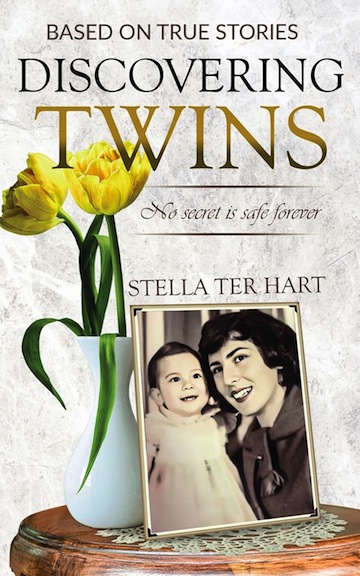
image - Discovering Twins book coverThus begins Stella ter Hart’s book Discovering Twins: A Journey into Lives.

As a high school graduation gift, Stella and her mother made the trip from Estevan, Sask., to Holland. There, she meets an endless web of confusingly related kin – almost all on her father’s side. A visit to the home of family on her mother’s side raises questions in the teenager’s mind.

“‘Oom Jacob and Tante Becca are Jewish,’ I stated rather than questioned, ‘no one other than Jewish people are named Jacob and Rebecca.’

“And, in a style completely out of character for her, almost resignedly, my mother replied, ‘Yes, they are.’

“There was no further clarification of her answer, no offering up of a tidbit of a childhood memory, as might be expected when revealing so vast a thing as religiously specific relatives for the first time.

“‘So, if Oom Jacob is your first cousin, and he has the same last name as your mother’s maiden name, then he is the son of your mother’s brother,’ my new skill of dissecting family relationships now sharply honed, I added, ‘so your mother must have been Jewish, too.’

“In a split second, she came back at me, her voice strident with an unexpected, insistent, and lashing response, ‘NO! My mother was NOT Jewish. According to the Germans, she was Italian because she married an Italian.’”

Whether that logic ever truly convinced her mother, Sophia, it did not sit well with ter Hart. After her mother’s death, ter Hart began a genealogical quest. Slowly and excruciatingly, she pieces together the tragic fates of almost the entire maternal line.

“Our extended circle of family, formerly numbering over 1,200, was reduced to the less than 20 who returned, or were known to have survived, creating a psychological tsunami shock-wave impacting existing and future generations,” writes ter Hart.

The book recreates ter Hart’s prewar extended family, flashing back from postwar comfort in Canada. She captures what must have been a dawning realization among Dutch Jews in the earliest months of what became the Holocaust, as relatives who were relocated to the east inexplicably never wrote back.

“How many ‘workers’ did this totalitarian German regime require for its slave labour force? Where was the food to feed them all going to come from and the rooms to house them all? Supplies were already hitting dangerous lows in the cities, and rationing was strictly enforced.

“The unsettling sentiment echoing throughout the community for months raised its voice again. What in heaven’s name would the Germans do with grandparents and babies? This didn’t seem like a necessary part of war. This was something else.”

As ter Hart’s research expands, numbers and dates leap off the page.

“The ages and dates are, each time, an emotional shock. The eye at first does not even see, let alone accept, the horrific truths the numbers expose. Mothers with all their young children around them all killed at the same time, or an elderly couple, obviously arrested and deported together, also murdered together. The gruesomeness and cruelty of it all is staggering and overwhelming,” she writes.

On Sept. 30, 1942, 103 family members were murdered at Auschwitz, the youngest 15 years old, the oldest 54. On June 11, 1943, 64 family members were gassed at Sobibor, aged 2 to 68.

The author seeks to build suspense, but her discoveries are, generally, no surprise to those with knowledge of the history. The emphasis on twins – across generations, the family seems to have an occurrence of twins about twice the average – gives the reader an anxious sense that, at some point, some family members are going to fall into the hands of the monstrous Dr. Josef Mengele.

“Not wanting to know, but needing to know, I researched the lists of Mengele Twins, now publicly available. None of our family were on that list, as most had been deported and killed before Mengele began his murderous experimentations. Small comfort,” she writes.

The narrative at the beginning of the book devolves near the end into something of a genealogist’s notebook, with records, short biographies and charts. Generally, the book hangs together, though an editor’s hand could have been firmer, to avoid easily avoidable clangers like misspelling Anne Frank’s name.