Skip to content
  • Home
  • Subscribe / donate
  • Events calendar
  • Business Directory
  • FAQ
  • News
    • Local
    • National
    • Israel
    • World
    • עניין בחדשות
      A roundup of news in Canada and further afield, in Hebrew.
  • Opinion
    • From the JI
    • Op-Ed
  • Arts & Culture
    • Performing Arts
    • Music
    • Books
    • Visual Arts
    • TV & Film
  • Life
    • Celebrating the Holidays
    • Travel
    • The Daily Snooze
      Cartoons by Jacob Samuel
    • Mystery Photo
      Help the JI and JMABC fill in the gaps in our archives.
  • Community Links
    • Organizations, Etc.
    • Other News Sources & Blogs
  • JI Chai Celebration
  • JI@88! video

Recent Posts

  • Or Shalom reopens its doors
  • JFS from past to future
  • Need holistic approach
  • Sharing stories, advice
  • Journalist shares fears
  • Skills to live together
  • Road to independence
  • Cutting grass with scissors
  • Zionism as a solution
  • Deceit, desire & the divine
  • Reclaiming sacredness
  • Creative project ideas
  • Summer squares and cobbler
  • Thou shalt … summer commandments
  • Legal help for students
  • Revisiting myth of Lilith
  • Wrong person rebuked
  • Canada’s mixed messages
  • Questions for museum
  • Symposium on antizionism
  • Making soccer political
  • CJPAC lauds Pulver’s impact
  • City recognizes Vrba’s legacy  
  • Organ donation saves lives
  • Theodore’s March premiere
  • A healing Shabbaton
  • Supplying healthy food
  • A chime of metal tags
  • Yellowknife seder a first
  • Ishai energizes, unifies
  • A Lag b’Omer to remember
  • Expanding the healing
  • Hannah Senesh – a unique hero
  • Community milestones … May 2026
  • Sharing her testimony
  • Fall fight takes leap forward

Archives

Follow @JewishIndie
image - The CJN - Visit Us Banner - 300x600 - 101625

Tag: Holocaust

The repackaging of a hero

The repackaging of a hero

Anyone who knows more than a little bit about Holocaust hero Rudolf Vrba – a Vancouverite for 31 years – will approach Jonathan Freedland’s The Escape Artist: The Man Who Broke Out of Auschwitz to Warn the World (London, UK: John Murray, 2022) with delight and apprehension.

Will this Guardian journalist and thriller writer take the high road, encouraging everyone to seek out Vrba’s own fascinating, still-in-print memoir? Or will he be more like Elvis swinging his hips, simulating Black-style music, because, hey, most people won’t know the difference?

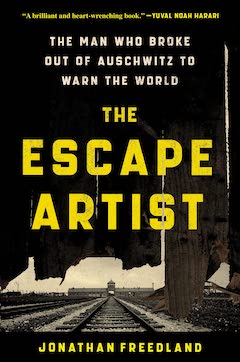
Rudolf Vrba’s name is nowhere to be found on the cover. At the top of the jacket is the subtitle. At the bottom, Freedland’s name. The main title, front and centre, implies 19-year-old Vrba was Houdini-like but, as Freedland well knows, Vrba and his co-escapee Alfred Wetzler took advantage of an escape plan and a hideout conceived and built by others.

The pair’s report on Auschwitz was by far Vrba’s greater achievement – exposing the vast scale of murder at Auschwitz to the world-at-large, convincing everyone who read it. The pair is now credited with saving 200,000 lives.

* * *

As someone who knew Vrba, I am sympathetic to Freedland’s undertaking. How do we get more people, including academics and even Jewish community members, to celebrate one of the greatest heroes of the 20th century?

Thankfully, The Escape Artist is clear and precise storytelling. With access to Vrba’s archival materials in New York’s Franklin Delano Roosevelt Library and input from both of Vrba’s wives, Freedland has also been able to add a good deal of fresh information to the public record.

It will be enlightening for most readers to learn that four other men actually planned and built Vrba’s getaway hideout (where Vrba and his cohort Wetzler hid for three days). This seldom-cited quartet tested it for real, escaping for several days before being caught and tortured, but not killed.

Vrba’s own narrative – first entitled I Cannot Forgive and later changed to I Escaped From Auschwitz – omitted crediting the extreme courage of these men. Without them, Vrba would never have reached Slovakia and co-written the Vrba-Wetzler Report, intended to forewarn 800,000 Jews of Hungary not to get on those trains. From Freedland, not from Vrba, we also learn how one of the tortured members of that quartet was able to assure Vrba that he and his escapees had not divulged their undiscovered hideout in the “Mexico” section of the camp.

“Mexico” was so-named, Freedland tells us, because poor souls marooned in the construction zone with makeshift shelters were not given clothes; consequently, naked prisoners had to drape themselves in blankets and other prisoners at Auschwitz-Birkenau thought they looked like New Mexico Indians.

Vrba did make clear, however, that in order to travel over land through hostile territory for a grueling 14 days, he and Wetzler had followed explicit directives that Vrba had received from a Russian prisoner named Dimitri Volkov. Hence, it was Volkov who was the master of escapology; Vrba was his disciple.

image - The Escape Artist book coverFor virtually all of the people on the planet who have not sought out the two volumes of fascinating, self-published memoirs by Vrba’s first wife, Gerta, The Escape Artist will be welcomed for divulging details of Vrba’s first marriage. Gerta had to take her leave, penniless, with their two daughters, to escape from a philandering and distrustful husband who was clearly still in recovery after almost two years in Auschwitz.

The extent to which both his daughters felt estranged from him is touched upon. We also learn more about his eldest daughter Helena’s apparent suicide in Papua New Guinea in 1982 (an overdose of chloroquine in response to her love affair with a married man who left her) after she had all but severed ties with her father three years earlier.

As well:

  • Freedland notes there is a distinct possibility that Vrba’s father might have died by suicide as a failed businessman (when Vrba was aged 4).
  • Vrba was his mother’s only child (he had two, much older step-brothers and a step-sister from his father’s previous marriage).
  • After his father’s death, Vrba’s mother was a traveling saleswoman for much of his early childhood, absent for much of his formative years.
  • Vrba’s penchant for science might have emerged after all Jewish children were told to return their textbooks, but a friend named Erwin Eisler managed to keep his organic chemistry text by Czech scientist Emil Votocek.

Gerta’s books have already revealed that Vrba, as a youth, emerged as a leader in a self-teaching circle of friends and that, when Gerta was 13, she was enraptured by his precocious intelligence and confidence. Vrba was 15 and sometimes dismissed her as childish.

Gerta Vrbova and Vrba’s second wife, former Vancouver realtor Robin Vrba, were invaluable informants for Freedland but we have no idea who told him what. Their contributions to history are invisiblized, not unlike what could have happened to Vrba and Wetzler, who were advised by Jewish elders in their native Slovakia not to have their names attached to their momentous reportage.

* * *

One error must be cited: on page 8, Freedland states that Vrba and Wetzler were “the first Jews to break out of Auschwitz.” Freedland later devotes three pages to Siegfried Lederer’s marvelous escape on April 5, 1944, when Lederer [tattoo # 170521] outwitted Nazi guards by donning an SS uniform provided by SS officer Viktor Pestek.

Google will tell you that Siegfried Lederer, aka Vítězslav Lederer (March 6, 1904-April 5, 1972), was born to a Jewish family in Písařova Vesce in the Sudetenland. Czech sites convey he was a Resistance fighter who was transported from the Terezín Ghetto to Auschwitz-Birkenau (arrival on Dece. 18, 1943). He was forced to wear both yellow and red triangles, marking him as a Jew and as a political prisoner. After he escaped, he warned Judenrat elders at Theresienstadt about the mass murder of Jews at Auschwitz – but he was both disbelieved and told to remain quiet.

If Freedland has some contradictory information to prove that Lederer is not Jewish, he might well have provided it. Certainly, for marketing purposes, it sounds better to imply Vrba and Wetzler were first. Sure enough, an uncredited review now permanently appears on the Guardian/Observer website and it baldly asserts: it took until 10 April, 1944, but eventually Vrba and fellow prisoner Alfred Wetzler “achieved what no Jew had ever done before: they had broken out of Auschwitz.”

One has to wonder who wrote that uncredited summary. On page 171 of his book, Freedland slyly covers himself by saying, “Fred Wetzler and Walter Rosenberg [Vrba’s birth name] were on their way to becoming ‘the first Jews to engineer their own escape from Auschwitz.’” Trouble is, he has already told us that four prisoners – named Citrinm, Eisenbach, Gotzel and Balaban – ought to be chiefly credited for building (ie. engineering) the hideout, not Vrba and Wetzler.

We like to assume people who write for the Guardian must have higher standards, but, hmm, maybe not. Now people all over the world can watch Freedland’s June 18th promotional video on YouTube in which he self-assuredly states, “I know, since I’ve nailed this down, that only four Jews ever escaped from Auschwitz, and Vrba and Wetzler were the first.” Either this is a lie or research standards at the Guardian have drastically plummeted.

Overall, The Escape Artist is an intelligent, valuable and easy-to-read account by someone who is bright enough to know that a warts-’n’-all portrayal of Vrba’s life is the best possible way to get the world interested.

If Freedland treads lightly when it comes to defending Vrba and foremost Vrba expert Ruth Linn in their battle with Yad Vashem historian Yehuda Bauer, well, perhaps he can be excused for wanting as many readers as possible in Israel. Robert Krell, as the founding force behind the Vancouver Holocaust Education Centre, was interviewed but he appears on only one page. Two other Vancouverites, Dr. Joseph Ragaz and Prof. Chris Friedrichs, were interviewed by Freedland, but their input is not cited except in an acknowledgements section. Linn, an Israeli academic and a part-time Vancouverite, who was for eight years the only scholar that Vrba permitted to interview him, declined to be interviewed. Linn and Freedland both first became aware of Vrba’s existence by watching Claude Lanzmann’s nine-and-a-half-hour documentary Shoah.

* * *

I greatly appreciate the effort it took to fashion a potential bestseller for a new generation that knows increasingly less about the Holocaust. I am certain Vrba’s co-author Alan Bestic, who overcame different obstacles for his time, would likewise approve. Unfortunately, the bibliography omits any mention of Bestic’s co-writing of the memoir I Cannot Forgive and it’s only mentioned once in the text, on page 272. For that matter, Vrba’s own book, with its current title, is cited precisely once in small print within the depths of a seven-page bibliography. (There it is, on page 358, included alongside a scientific paper Vrba published about his research on rat brains.)

London-based Bestic was a fantastic writer. Freedland is a very fine one, too. He can turn a phrase. He can step back and be invisible. He has poise and tact. It is unfortunate, therefore, that Bestic’s essential role as Vrba’s co-writer has been ignored and even somewhat denigrated (“a supremely skilled Fleet Street journalist of the old school”). We don’t learn anything about him. If Freedland has the means to undertake research in New York and Vancouver, why is there no apparent digging to tell us anything about the man who wrote most of the text upon which The Escape Artist itself is necessarily based?

As a writer, Freedland has a very cool, even calculating hand. That’s good for journalism; it might even be good for thriller writing. But the drama of Vrba’s story has been subdued in this modern version. The Escape Artist is nonetheless an essential and welcome work, if it gets the world aware of one of the greatest whistleblowers of the 20th century. Ideally, the book will lead more people to seek out the latest version of Vrba’s own narrative, I Escaped From Auschwitz: The Shocking True Story of the World War II Hero Who Escaped the Nazis and Helped Save Over 200,000 Jews, released in 2020, co-edited by Nikola Zimring and Robin Vrba, minus its original opening chapter.

Alan Twigg’s 20th book is Out of Hiding: Holocaust Literature of British Columbia (Ronsdale Press, 2022). This year, he received an honorary doctorate from Simon Fraser University.

Format ImagePosted on October 7, 2022October 5, 2022Author Alan TwiggCategories BooksTags biography, Guardian, history, Holocaust, Holocaust literature, Jonathan Freedland, Rudolf Vrba
Albania’s many legends

Albania’s many legends

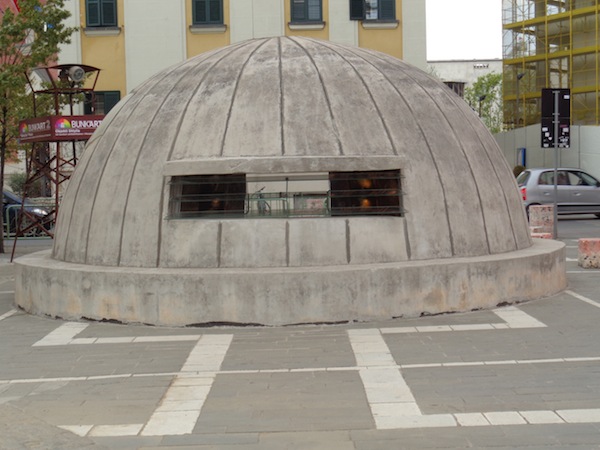
A bunker in Tirana, Albania, that is now the Bunk’Art art and history museum. (photo by Deborah Rubin Fields)

Albania is a country of great contrasts. It has stunning, clean beaches, so gorgeous that locals refer to them as the Albanian Riviera, and it also has hills and mountains that spring up in all directions. The contrasts seem to extend to Albanians themselves – Enver Hoxha, Albania’s longtime communist dictator, who died in 1985, started off as a partisan fighting the Italians and Germans in the Second World War.

Until not too long ago, Albania existed in isolation. Long before COVID-19 raised its head, Hoxha had kept the country shut off from the world. This is remarkable, given that Hoxha had at various periods aligned his Marxist-Leninist politics with the Soviet Union and China.

As in other communist regimes, many Albanian citizens became suspect during Hoxha’s 40-year reign. They were imprisoned, tortured and murdered. Further, over a 20-year period, Hoxha went on a bunker-building spree. He worried that Albania might be invaded by its neighbouring countries and by the Soviet Union. Between 1971 and 1983, at extreme cost to the general economy, Hoxha had more than 173,000 bunkers constructed. Hundreds of soldiers and civilians died in work accidents. Once the bunkers were built, local citizens as young as 12 years of age were expected to defend them from invaders. The bunkers were only abandoned in 1992, seven years after Hoxha died.

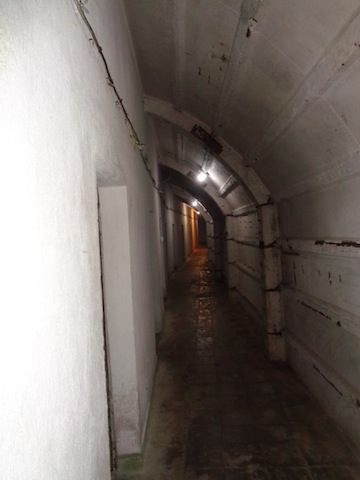
Today, some of the bunkers have other uses. In the capital of Tirana, for example, one series of bunkers has been converted into the Bunk’Art, an art and history museum. In Gjirokastra, there is the Cold War Tunnel Museum.

photo - Part of the Cold War Tunnel Museum in Gjirokastra, Albania
Part of the Cold War Tunnel Museum in Gjirokastra, Albania. (photo by Deborah Rubin Fields)

Hiking is also a fantastic way to see this beautiful country, although, in more remote parts of the country, older Albanians do not speak English and the younger, English-speaking generation is leaving Albania to seek their fortunes in other parts of Europe. Also be aware that even visiting castles requires a bit of hiking over either loose or highly polished stone, so it may be advisable to use walking sticks.

Generally, when people talk about blue eyes, they mean the eye colour of other humans or of their pets. But, in Albania, the Blue Eye is a lovely nature site. Reaching unknown depths (divers have gone down as far as 50 metres without reaching the bottom), the Blue Eye is more accurately a blue hole fed by an underground spring.

Albanian mythology recalls mountain spirits who live near springs and torrents in the northern Albanian Alps. These spirits or zanas are courageous and often protect Albanian warriors, but they can also go the other way, doing evil.

Even some of Albania’s mountains have stories. Take Mt. Tomor, for instance. Baba Tomor, or Father Tomor, is the personification of the mountain, a range whose highest peak is in central Albania. Baba Tomor appears as an older man with a long white beard that reaches his belt. Four eagles serve as his assistants. His bride is the young Earthly Beauty. When his territory is threatened, Tomor battles his enemy, Mt. Shpirag. The furrows running down Shpirag’s mountainside are said to be the knocks Tomor gave to Shpirag. Ultimately, the two fought to their deaths. The young bride is said to have drowned in her tears, which then became the Osum River.

Indeed, this is a country with many local legends. Take the story related to Shkoder’s Rozafa Castle. Apparently, the walls of this ninth-century BCE castle kept collapsing. Only when Rozafa (the wife of one of the three brothers building the castle) was enclosed in the castle walls did it stabilize and remain standing. Booker Prize-winning Albanian writer Ismail Kadare based his book The Three-Arched Bridge on this legend.

One of the spots to visit in Gjirokastra is called Sokaku i te Marreve, or Mad People Street. On this street, there is the reconstructed home of the above-mentioned – but sane – writer Kadare.

More interesting things about Gjirokastra include the Gjirokastra Castle, which houses the remnants of a U.S. Air Force Lockheed T-33. Some claim Albanian forces downed the jet during the Cold War (1957). Others say the plane was an American spy jet forced to land at Tirana’s Rinas Airport in December 1957 after developing mechanical problems and flying off course. Both scenarios are unlikely, but they make for good stories.

In a country that has almost no Jews, it is intriguing to know that (protectively covered by sand) Sarande has mosaics containing images of a shofar, a menorah and an etrog. Apparently, back in the fourth- or fifth-century CE, the Jewish community had its own synagogue in Sarande. According to the late Ehud Netzer and the late Gideon Foerster – the Israeli archeologists who dug there (along with an Albanian team) – this synagogue even had a ritual bath.

In contrast to radical Islam, there is Albania’s Bektashi Order, a Sufi Islamic creed with a long mystic tradition in Albania. The Sufi faith does not force devotees to observe the basics of traditional Islam. For example, the Bektashi creed allows for the drinking of alcohol and does not demand men and women be segregated, nor that women wear a veil. Curiously, this order appreciates Sabbatai Zvi, who was a false messiah, according to most Jews. Baba Mondi, the spiritual leader of the Bektashi sect, calls Sabbatai Zevi a dervish – a Farsi word for a spiritual Muslim who ascetically devotes his life to serving Allah; the term has also been used to describe, in rare instances, a Jew.

Ironically, Berat, the city of 1,001 windows, has a Jewish history museum established by the late Prof. Simon Vrusho, who wasn’t Jewish. Since his passing, the small Solomon Museum has been run by his widow. This museum exemplifies the good relations Albanian Jews had with both the Muslim and Christian community. Amazingly, local non-Jews saved almost 2,000 Jews during the Holocaust.

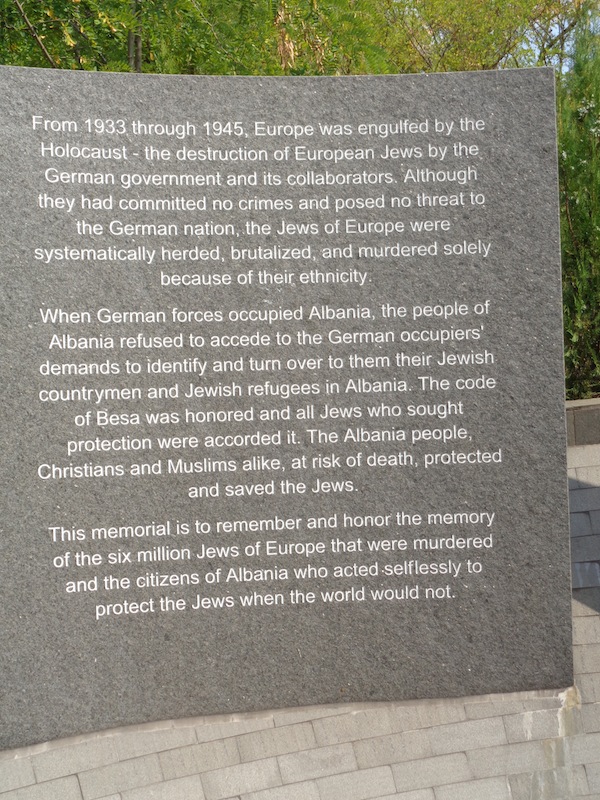
In Tirana’s Grand Park, there is a newly installed Holocaust memorial. It consists of three large plaques in Albanian, English and Hebrew, highlighting the stories of Albanians who saved Jews during the war.

photo - The English plaque of the Holocaust memorial in Tirana
The English plaque of the Holocaust memorial in Tirana. (photo by Deborah Rubin Fields)

Relatively unknown is an Albanian tragedy that exemplifies the worldwide refugee problem. In 1997, the ship Katër i Radës departed from the Albanian port city of Vlora, carrying 120 refugees fleeing the violence that had engulfed the country following that year’s massive collapse of pyramid schemes. On March 28, 1997, the Italian navy warship Sibilla – acting in accordance with an Italian blockade of Albania (designed to prevent refugees from entering the country) – intercepted, rammed and sunk the Katër i Radës in the strait of Otranto, killing 81 of the refugees aboard. Among the victims were many women and children.

Since ancient times, Jews have lived in Albania. However, there are a few theories about how and when Jews arrived there. According to historian Apostol Kotani, Jews may have first arrived in Albania as early as 70 CE, as captives on Roman ships that washed up on the country’s southern shores. Others report that, in Roman times, Jews already lived in the port of Durres. The Jewish population has fluctuated over the centuries, but most of the Jewish population made aliyah in the 1990s and, today, only a few Jews remain.

Deborah Rubin Fields is an Israel-based features writer. She is also the author of Take a Peek Inside: A Child’s Guide to Radiology Exams, published in English, Hebrew and Arabic.

Format ImagePosted on September 16, 2022September 14, 2022Author Deborah Rubin FieldsCategories TravelTags Albania, Bunk’Art, Cold War, history, Holocaust, legends

Must confront lies

Leslyn Lewis, a candidate for the Conservative Party of Canada leadership that will be decided in the coming days, made a stir last week when she invoked the Nuremberg Code, apparently with regard to coronavirus vaccines.

The Nuremberg Code is a postwar set of principles on medical ethics arising from the horrific medical experimentations of the Nazi era. Although Lewis did not explicitly mention COVID-19, the issue was clear in context. She warned of government overreach, saying, “even in modern times the tenets of informed consent and voluntary participation in scientific experiments can be easily undermined by even our modern governments.”

If for no better reason than avoiding a communications crisis, reasonable candidates for elective office should avoid comparing things to Nazism. In almost every instance, there is nothing to be gained. In this instance, where the candidate appeared to be referring to a vaccine that can prevent or seriously reduce the impacts of a potentially deadly virus, the comparison is irresponsible and base.

Around the same time as Lewis was causing controversy here in Canada, Mahmoud Abbas, the Palestinian president, stood next to the German chancellor, Olaf Scholz, and declared that Israel had perpetrated “50 holocausts” on the Palestinians. Scholz has been criticized for not immediately condemning Abbas’s atrocious act of Holocaust desecration – words that took place on German soil.

This incident was a flashback to the time, in 1999, when Hillary Clinton, then the U.S. first lady, got in trouble for standing on stage with Suha Arafat, wife of Yasser, when Mrs. Arafat accused Israel of poisoning the Palestinian water supply. This accusation, an unoriginal claim pilfered straight from antisemitic Medieval European well-poisoning canards, was akin to the latest outrage from Abbas in both form and international reaction.

About the only time the West expresses any concern about such defamations is when they are uttered in the presence of world leaders in front of less credulous media than the Palestinian leaders face at home. While Clinton and Scholz certainly deserve some censure for not speaking out instantly in the face of such overt libels, their presence is a sideshow to the main event: a narrative that is founded on grotesque demonizations.

Abbas is no newcomer to Holocaust revisionism and defilement. His PhD dissertation at a Soviet university contests the number of Jewish dead and accuses Zionists of participating in the Shoah to advance their nefarious aims.

These sorts of lies – “holocausts,” poisonings, genocide, even Zionist sharks attacking tourists – are routine fodder for Palestinian leaders, newscasters, media and even the United Nations-funded Palestinian education system. It is the nature of dictatorial leaders and undemocratic movements that they grow intellectually lazy, having groomed an audience so inured to lies and exaggerations that they will accept, or at least not contest, the most depraved allegations. After 70-plus years of exposure to increasingly preposterous conspiracies like Zionist-trained sharks snapping at European tourists at beach resorts, many are ready to accept and repeat them.

“A lie gets halfway around the world before the truth has a chance to get its pants on,” Winston Churchill colourfully said. Churchill died before the internet was born. Today, a lie gets even farther even faster.

Mix the range and speed of the internet with millennia of conspiracies about Jews and the reality that most people are inundated with Israel-Palestine news without context, and it is easier to understand why people who are overwhelmed by complexity and who seek simple solutions don’t resist or even question such lies.

For similar reasons, we must both keep a critical eye on how science evolves with coronavirus and vaccines, as well as encourage people to get vaccinated, to reduce the risks of disease. Terrible experiments have been done on marginalized populations so, as a society, we must be sensitive to these experiences and traumas. The mistrust has a real history, but some people are using this fact to sow more mistrust in institutions and governments, which adds to the fires of conspiracy, which is bad for everyone, but in particular marginalized and minority populations.

While miles apart in quality, the remarks by Lewis and by Abbas deserve condemnation. The world, especially now, tends to move on quickly from one moral atrocity to the next, from this outrage to the next. But we cannot let these things go unchallenged – whether they come from dictators or from potential leaders in a democracy. The job of decent people is to come along and clean things up. It’s a dirty job. But somebody has got to do it.

Posted on September 2, 2022September 1, 2022Author The Editorial BoardCategories From the JITags antisemitism, Conservative Party, coronavirus, Holocaust, Leslyn Lewis, Mahmoud Abbas, Nazis, Nuremberg Code, Olaf Scholz, politics, vaccines
Revisiting oral histories

Revisiting oral histories

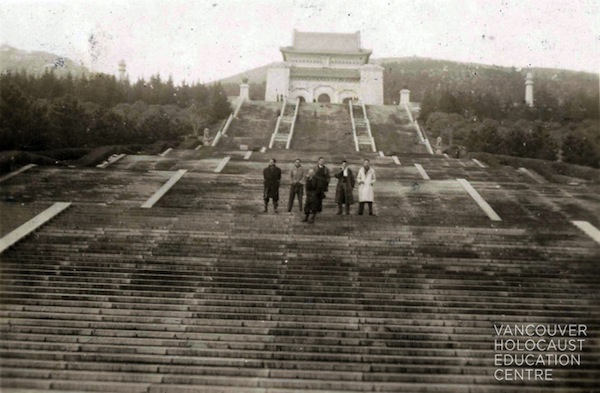
Manfred Gottfried and a group of men on the stairs to the Dr. Sun Yat-sen mausoleum. (photo from VHEC: RA001-5-o7-5-9-0339x)

A little over 20 years ago, the Vancouver Holocaust Education Centre started the Shanghai Oral History Project. Led by Roberta Kremer and Daniel Fromowitz, the project recorded the oral histories of Vancouver’s small Shanghai Jewish survivor community. They interviewed 10 survivors and/or their descendants, learning about their rich and unique experiences of survival in Shanghai.

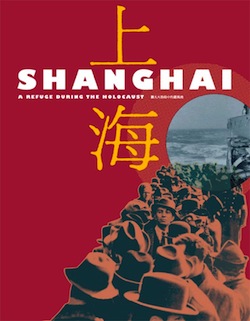
This project, along with loaned artifacts and memorabilia, became the basis for VHEC’s 1999 exhibition Shanghai: A Refuge During the Holocaust. It opened alongside another exhibition, Visas for Life: The Story of Feng Shan Ho. Both were well received, and included film screenings on the topic of Jewish refugees in Shanghai, and a demonstration of mahjong, a game which remains popular in the Jewish community in Vancouver. Once the exhibitions concluded, materials were returned to their lenders or safely placed under the VHEC’s care, and the interviews were catalogued and filed away.

In January 2022, I began my co-op position as digital projects coordinator with the VHEC. One of the first tasks assigned to me was to help improve accessibility to the Shanghai interviews and the audiotape transcriptions. In the 20 years since these oral history transcriptions were created, the VHEC has changed its digital file management and storage system. Some files were missing while others were mislabeled. Many files would no longer open within the current version of Microsoft Word. At the top of some transcriptions was a disclaimer: “The whole tape is not transcribed, only that which is related to Shanghai.” Throughout the transcriptions, comments like “(side discussions)” denote what the original transcriber believed to be unrelated to the subject matter.

image - In 1999, the Vancouver Holocaust Education Centre held the exhibit Shanghai: A Refuge During the Holocaust
In 1999, the Vancouver Holocaust Education Centre held the exhibit Shanghai: A Refuge During the Holocaust. (image from VHEC)

Rummaging through these transcriptions, it became apparent that I would not simply be “tidying up.” By revisiting the Shanghai Oral History Project, my goal was to do more than just emphasize the unique experiences of this small group of individuals. As I listened to their interviews and transcribed their words, I wanted to offer a glimpse into how Shanghai Jewish survivors expressed themselves and reflected on their time in Shanghai, while also highlighting things that weren’t considered when the exhibition first opened 20 years ago.

On the list of possible interviewees for the Shanghai Oral History Project, George Melcor’s was the only name with “very elderly” added beside it in parentheses. Listening to George’s interview, it became clear that this would be a challenging transcription. George sometimes mumbled, which made it difficult to comprehend his words, or he would mix up his stories. But, for 88-year-old George, Shanghai left an impression. When asked by interviewer Daniel Fromowitz what memories of Shanghai come to mind, George lit up with excitement. “Shanghai was alive all the time. Never closed, always open.… Clubs and gambling, everything was free. Shanghai was a very free city.” At this point, the slow progression of the interview sped up: the emotions in George’s voice suggest that he was reliving his 16-year-old self. For a moment, George was not elderly.

What is striking listening to the Shanghai audiotapes is the dialogue between the interviewer and interviewee. Lore Marie Wiener was interviewed about her experiences in Shanghai by both Roberta and Daniel. But rather than just giving answers, Lore proceeded to converse with both interviewers, asking about where they were born, their experiences growing up and whether they faced antisemitism. Lore was also very reflective. She questioned the nature of Jewishness and what it consists of; she questioned “… why did we not interfere in Rwanda, and we do interfere in Yugoslavia?” With the former, there was a back-and-forth between Roberta and Lore, but, with the latter, Daniel was not sure how much to engage. These side stories provide a picture of Lore that is more than just her experiences of escaping the threat of Nazi violence and survival in Shanghai; it is the continuation of her life after the Holocaust.

Lastly, how did the interviewees recall, if any, their connection to the local Chinese and Japanese communities? In general, although interviewees were in Shanghai, Chinese people featured only in the background. They were acquaintances, as was the case for Anne Chick and the two Chinese kids living in her neighbourhood. For most interviewees who did interact with Chinese people, it was through a working relationship with Chinese servants, workers or amahs.

For Lore, she employed several Chinese tailors in her shop, as well as a chauffeur and a cook called Dun-zen. Interracial relationships were also possible. Kurt Weiss noted that, after divorcing his first wife, he had a Chinese girlfriend until he left Shanghai. Gerda Gottfried Kraus mentioned in passing how, in postwar Shanghai, one of her acquaintances married a Chinese woman and wanted to bring her with him to the United States. Knowledge of some Chinese, particularly Shanghainese, was also a common theme found in these interviews, though many interviewees state that they’ve either forgotten it after not using it for so long, or knew only the absolute basics. Additionally, they never learned how to read Chinese characters.

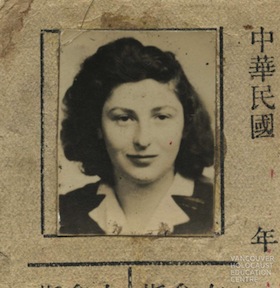
photo - Gerda Gottfried Kraus, 1940s
Gerda Gottfried Kraus, 1940s. (photo from VHEC: RA0001-05-00-02-0099)

Knowledge of Japanese people was more limited. Kurt’s success as a suit salesman was due to his patron relationship with a Japanese engineer named Kato. Lore mentioned she was helped by a Japanese engineer when she and her mother were stranded in Harbin. But the one individual whom most interviewees referenced was Ghoya, the Japanese commandant of Hongkew ghetto. Ghoya developed a reputation as an unpredictable ruler: while Lore mentioned that her father and husband were treated well by Ghoya due to their academic connections, other interviewees mentioned episodes of violence committed by Ghoya and his guards against the Hongkew inhabitants. Their brutality is matched only by their treatment of the local Chinese. Most interviewees mentioned the mistreatment that local Chinese faced.

The experiences of Shanghai Jewish survivors are often overlooked when compared to those who survived in Europe. Lore was very concerned about this. At the end of her interview, she stated: “I’m not uncomfortable with anything. [But] … just try to be careful about the parts where I am too pleased with my life because there are so many people who suffered.” With the “global turn” in academic research into the Holocaust, the sub-category of “Shanghai survivor” has been gaining strength. It is a term that validates the experiences of refugee Jews and others who survived the Holocaust in Shanghai, while also acknowledging the unique circumstances and challenges they faced.

It is heartening to know that, in the 20-plus years since the VHEC’s Shanghai exhibition, research into this dimension of the Holocaust and the voices of these survivors have not been obscured, but, instead, have expanded into a vibrant subfield. By revisiting past projects and exhibitions, and making them more accessible, we can hopefully gean new information about the Holocaust and the multiplicity of survivors’ experiences.

 Ryan Cheuk Him Sun is a PhD candidate in the University of British Columbia department of history. His research examines the entangled histories between Jewish refugees escaping Nazi oppression and the British colonies of Hong Kong and Singapore. He is also interested in the journeys that took Jewish refugees to East Asia, and their experiences in transit onboard ships and trains. He can be reached at [email protected]. This article was originally published in the VHEC’s Spring 2022 issue of Zachor.

Format ImagePosted on September 2, 2022September 1, 2022Author Ryan Cheuk Him SunCategories Local, WorldTags history, Holocaust, oral history, refugees, research, Shanghai, survivors, VHEC

Belief in a future Poland

Editor:

Your editorial of Aug. 19 entitled “Does history matter?” recounts some of the terrain of recent right-wing Polish political machinations against an open, self-critical approach to Shoah research and discourse in the country. It is sad, unfortunate and, I dare say, stupid of many Polish politicians to think that avoiding rigorous debate will somehow improve the standing of Poland and Polish culture internationally.

I am a proud Polish Canadian, raised in an amazing, secular Catholic family, and now for the last decade-and-a-half (officially, anyway): a Jew. I love the choice I made and I love Judaism, however the world does look very odd from where I stand. I am often too Jewish for Poles and too Polish for Jews.

An artist by schooling and a software engineer by profession, I am not an historian. However, I have to be one just to muddle through my own life. Poland has always been a cultural floodplain between great powers. Most Poles, perhaps like most Israelis, have to be very finely tuned both to history and to current geopolitical rumblings. To be otherwise would be existentially precarious. Because of my conversion to Judaism, a significant portion of the last two decades of my life has been spent studying topics relating to Polish Jewish history, Polish/Jewish relations, Israeli history and contemporary Polish politics (especially as they relate to Israel, the diaspora and the history of the Shoah).

It is quite exhausting to sit between two communities that I love very much (the now thinly overlapping Polish and Jewish Venn diagram) and have to read occasional inaccuracies, such as the one sadly published in your fine publication in an otherwise excellent text.

When your editorial asserted that Poland is “the society that bears more blame for complicity with the Nazis than any other,” I got quite angry. It is simply not true. This claim is pernicious misinformation that Poles regularly have to dissipate. It is not true on the level of governance, nor is it true on the level of day-to-day street life at the time. Poland was the only Allied force to fight Germany from the very first day of the war to the very last. It never surrendered to Germany as did France. It never made any secret collaborative pacts with Germany as did Russia. Poland knew that Germany was planning the Shoah and it shared solid evidence with Allied command as early as 1942. That the Allies did not act upon this is another story.

Poland was a massive net contributor to the Allied war effort. One source I read suggested that over half of British wartime intelligence reports came from Polish field agents. The Polish army was very active outside of Poland as a key member of the Allied forces during the war, commanded from their government-in-exile in London. The Polish army under General Wladyslaw Anders in fact made a famous march all the way to Israel, where its Jewish soldiers were offered the option of decommissioning and settling down there. The Polish resistance effort was also very active throughout the war throughout occupied Polish territory, where they applied lethal punishments upon those who collaborated with the Germans – matching the brutality that the Germans applied to any Pole who provided shelter to their Jewish neighbours. It was a dangerous time for everyone.

To your editorial’s point about Poland’s historical reputational ranking, I submit here a few other societies that “bear more blame for complicity with the Nazis” than Poland: Italian, Japanese, Spanish, Greek, Romanian, Hungarian, Bulgarian, Croatian, Slovakian, Danish, Finnish, Burmese, Thai, Iraqi, Russian, French. Oh, and German.

Perhaps some of these are debatable, others much less so. I certainly agree with your editorial that history is important and should be open to public argument.

We live in different times today. To remember is important and we must remember well, but we must also be nimble enough not to get stuck in the ruts of history. One of my favourite Polish Jews, Shimon Peres, once said: “don’t be like us. Be different…. I have very little patience for history. I believe that to imagine is more important than to remember.” In that vein, I would like to echo the words of another Polish Jew I admire. Julian Tuwim, one of Poland’s best writers. He dared imagine: “I believe in a future Poland in which that star of your armbands will become the highest order bestowed upon the bravest among Polish officers and soldiers. They will wear it proudly upon their breast next to the old Virtuti Militari.”

I, too, believe in a future Poland. With criticism, I imagine that it could be something very good indeed.

Ian Wojtowicz
Vancouver

Posted on September 2, 2022September 5, 2022Author Ian WojtowiczCategories Op-EdTags history, Holocaust, Poland

Does history matter?

The promise of the internet was that people could access unprecedented volumes of information for the benefit of themselves and society as a whole. What has regrettably proven to be the case is that it is a fount from which people draw to “prove” falsehoods they choose to believe – or, for nefarious reasons, claim to believe.

Amid the oceans of “information” online, it is sometimes difficult to tell what people genuinely believe as opposed to what they say they believe in public to mislead their audiences. For example, does the U.S. member of Congress Marjorie Taylor Greene actually believe that reliance on solar energy means the lights will go out when the sun goes down? Or is her apparent stupidity a deliberate foil for her support of polluting energy sources? If she believes what she said, this is misinformation. If she knows she is telling a lie, it is disinformation.

The terms “misinformation” and “disinformation” are sadly necessary to understand what is happening in our era, as we have said in this space before and feel moved to repeat. In few places is this difference as consequential as in discussions of the history of the Holocaust.

Correspondence between Polish Prime Minister Mateusz Morawiecki and right-wing journalist Bronislaw Wildstein (and two others) leaked last week defines some of the world’s foremost Holocaust scholars as “enemies of the entire Polish nation.” There is other chilling language in the back-and-forth, detailing how top Polish authorities are expending enormous energies to rewrite the history of Polish collaboration in the Shoah.

A 2018 law forbids any suggestion that the Polish state or Polish people participated in Nazi crimes against Jews. International pressure saw the penalties for breaking this law reduced from a criminal conviction to a civil matter potentially resulting in a fine. But the intent and impact remain clear. Prof. Jan Grabowski, a Polish-born Canadian academic, and a Polish colleague, Barbara Engelking, were victorious in a 2021 appeal that saw an earlier court decision order to apologize to a descendant of a Shoah-era perpetrator for betraying Jewish neighbours to the German Nazis. But this court decision has not quenched the thirst for revisionism.

The obsession among top Polish officials on this subject is unabated. The email exchange includes the suggestion that Polish authorities should strategically coopt the Jewish experience in the Holocaust to their own benefit, recasting Poles as the Nazis’ primary targets and victims.

Poland also recently extended its Holocaust-related legislation to explicitly forbid financial restitution or compensation to survivors or their heirs.

The Polish government has steadfastly asserted that Nazi atrocities catastrophically affected non-Jewish Poles, which is plainly true. But two things can be true simultaneously. Many Poles were victimized by the Nazis and many Poles collaborated with the Nazis – and, in some cases, both involved the same individuals.

Wildstein, the journalist who seems to have the prime minister’s ear, makes threatening noises about top Holocaust research and archival bodies, including the Jewish Historical Institute, in Warsaw, and the POLIN Museum of the History of Polish Jews, and mentions “the possibility of introducing our people into their midst.” He accuses the Polish Centre for Holocaust Research of presenting “an almost obsessive hatred of Poles.”

There is paranoia in the idea that exposing historical truth is identical to hatred. Ironically, while Germany is the European country that has engaged in the most introspective contrition, as much as a society can hope to do for so unparalleled a crime, Poland has steadfastly dug in its heels. The society that bears more blame for complicity with the Nazis than any other is the one that is not only refusing to confront its grotesque past but most stridently whitewashing it.

All of this has led to strained relations between Israel and Poland. It should also be a source of friction with other countries, including Canada, partly because it is a Canadian citizen, Grabowski, who is among the most targeted objects of Polish scorn, and partly because all democracies should stand up to this appalling historical revisionism.

There is a grim silver lining in this “debate.” The Polish authorities understand, as too few in the world seem to, that history matters. What happened in the past informs our present and future. If they can recast the past, they can affect the future.

The question for us is whether we, as a society, have the same understanding of and commitment to historical power. Are those who seek truth as motivated as those whose goal is to subvert it?

Editor’s Note: For a contrary point of view, click here to read the letter to the editor that was published in the Jewish Independent’s Sept. 2/22 issue.

Posted on August 19, 2022September 1, 2022Author The Editorial BoardCategories From the JITags antisemitism, disinformation, history, Holocaust, Jan Grabowski, justice, law, misinformation, Poland, Shoah
Remembering the Great Roundup

Remembering the Great Roundup

Entire Jewish families were rounded up and interned in the Vel d’Hiv and other places in France, when La Grande Rafle began on July 16, 1942. (unattributed image)

It is 80 years this summer since La Grande Rafle (the Great Roundup) took place in France. It is not only a significant, tragic anniversary for the Jewish people, but one that impacted me directly.

“Happy like God in France” was a saying sometimes heard among Yiddish-speaking Jews of Eastern Europe a century ago, even though antisemitism was fairly widespread in France and few years had passed since the Dreyfus Affair. Falsely accused of selling military secrets to Germany, Capt. Alfred Dreyfus was publicly humiliated and sentenced to Devil’s Island in French Guiana. However, in the end, justice prevailed: Dreyfus was proven innocent and restored to his rank. Jewish loyalty to France remained unshaken. In 1939, as in 1914, Jewish men, citizens and immigrants alike, volunteered to fight in the defence of France, but the country for which they spilled blood betrayed their trust.

The humiliating defeat of 1940 led to the division of the country into two main zones, a Germany-occupied zone in the north and a so-called “free zone” in the south. It also led to the collapse of democracy and a replacement of the republic with a fascist regime, called Etat Français, in Vichy, headed by Marshall Philippe Petain. That regime enacted the sweeping antisemitic Statute des Juifs, the most racist legislation in occupied Europe. Its application was entrusted to a special commissariat for Jewish affairs, of which the first incumbent was Xavier Vallat, who declared to the younger hauptsturmführer (captain) in the SS, Theodor Dannecker, in Paris, “ I am an older antisemite than you are: I could be your father in these matters.”

Vallat was soon replaced by the more vicious Louis Darquier de Pellepoix, a gutter journalist, who, as early as 1937, proposed in one of his screeds to “solve the Jewish problem in France” by wholesale extermination.

At the time, there were 300,000 Jews living in France, who represented less than one percent of the population. Their origins were diverse; Ashkenazim, Sephardim, immigrants from a variety of European and Mediterranean countries, religious and non-practising, etc. That population was composed of native and naturalized citizens. The Census of 1940 placed French Jews under the protection of the Vichy government, while at the same time expelling them from the professions, civil and military. Non-naturalized Jews were liable to internment at the discretion of regional police prefects. Instinctively respectful of the laws of France, even Jews who bore French surnames and spoke fluent French obeyed the order to register.

The regime created a Gulag-type network of internment camps that covered both major zones of the country. Beginning in 1941, Jewish men were summoned by groups, depending on their nationality, to present themselves at the police commissariat nearest to their places of residence (there were no ghettos in France). They were sent to hard labour in camps, of which the most notorious were Pithiviers and Beaune-la-Rolande, northeast of Orléans, and Drancy, a transit camp in a suburb of Paris, from where departed the deportation cattle car trains bound for Auschwitz. Naturalizations granted after 1927 were ordered rolled back.

Beginning on July 16, 1942, a dramatic change in the deportation policy was initiated: La Grande Rafle. Entire families were now targeted, regardless of age or sex. Beginning at 4 a.m., police squads bearing lists of the names and addresses of about 27,000 Jewish immigrants fanned across Paris in vans and requisitioned urban buses, knocking at countless apartment doors. About half of the targeted victims, warned by the Jewish communist underground, were able to escape arrest and find shelter among gentiles, mainly in rural areas. Arrested during that roundup were 3,118 men, 5,019 women and 4,115 children (3,000 of them born in France and, therefore, French citizens).

The Grande Rafle, codenamed by the police Vent Printanier (Spring Wind), was the greatest mass persecution in the city of Paris since 1572, when thousands of Protestants were murdered on the night of St. Bartholomew by Catholic mobs unleashed by Queen Catherine of Medici.

The 1942 military-style operation against the Jews in Paris was carried out from start to finish by French policemen, with no German participation, as they did not have sufficient resources. In fact, the Germans had ordered the French not to arrest children below the age of 16 for the time being, since, as stated, 3,000 of them were born in France. However, then-prime minister of France Pierre Laval averred that it would be “inhuman” to separate children from their parents. On his own initiative, he declared that he assumed the burden of “ridding France of its Jews.”

Laval ordered that entire families be rounded up and, pending deportation to the east, interned in the Winter Circus (Vel d’Hiv), Drancy, Pithiviers and Beaune-la-Rolande. Conditions of interment in the Vel d’Hiv were hellish: suffocating heat, the stench of public latrines, next to no medical attention, and scant distribution of food and drink. Many people went mad, some died. In the end, families were split all the same: adults were transported from Drancy to Auschwitz, while children initially sent to Pithiviers were next carried in the cattle car trains, along the same harrowing itinerary of death, with almost no adult supervision. Many of those children were brutalized by French policeman, who even robbed them of what their parents gave them.

One month after the Grande Rafle, similar atrocities were perpetrated in the free zone of the south, where there was no German occupation and the French government retained complete sovereignty over internal affairs, bearing no obligation other than supplying the Nazis with the products and produce that they demanded.

Caught when we illegally crossed the demarcation line, which divided France’s two major zones, my parents and I were among those “assigned to residence” in a requisitioned hotel of the small town of Lons-le-Saunier, near the Swiss border.

On the morning of Aug. 26, a rafle collected hundreds of Jews across the city, including my mother and me; happening to be on an errand, my father escaped. A pitiful column, we were marched across the city – hurried along by policeman who brutalized and insulted us, calling us “dirty Jews” – to the railway station, where a train awaited to transport us to the gruesome concentration camp of Rivesaltes, near the Spanish border.

The railway station became a scene of unrestrained police brutality, which spared neither adults nor children. I was seized by the hair and the seat of my pants by a brute who was about to throw me on the train, when I was saved by my maternal aunt, a French citizen, who, through personal contacts, obtained my release thanks to the timely intervention of a gendarmerie officer. I last saw my mother as she was being violently dragged along the floor of the station, then waved to me from a window, as the train departed for Rivesaltes. From there, with fellow victims of the rafle, she was transported several days later in a train that traveled north, this time to Drancy. And, there, she was squeezed into a cattle car train bound for Auschwitz. At least two-thirds of the women who left in that convoy either perished along the way, or were gassed following the selection on arrival.

Few of the Vichy regime organizers, policemen and other perpetrators of the summer 1942 and subsequent rafles paid for their crimes. Laval was tried and sentenced to death by firing squad in 1946; Petain was sentenced to life exile on a small island in the Atlantic Ocean; René Bousquet, chief of the national police, was briefly deprived of citizenship rights by General Charles de Gaulle and then resumed his functions, until he was mysteriously assassinated in his Paris apartment shortly before he was to be tried for crimes against humanity in 1980.

Obsessed by his wish for national reconciliation of the French, de Gaulle put a stop to any prosecution of persons who had collaborated with the Nazis. Throughout the postwar decades, the French deluded themselves with the myth that most of them supported or joined the resistance.

It was not until 1995 that then-president Jacques Chirac publicly declared that the opposite was the case – that “France had committed the irreparable,” that at least some financial compensation should be awarded to the survivors of the Holocaust, who had suffered or lost relatives to French collaboration with the Nazi action.

It should be noted, however, that nearly 75% of the Jewish population of France survived the Holocaust, thanks to the assistance offered by French citizens, both urban and rural, who sympathized with the Jewish people. Also, unlike Holland or Belgium, small, crowded countries, the French countryside offered vast areas of wilderness in which many Jews found shelter or joined the resistance.

René Goldman is professor emeritus at the University of British Columbia.

Format ImagePosted on July 22, 2022July 20, 2022Author René GoldmanCategories Op-EdTags France, Grande Rafle, history, Holocaust, memoir, Shoah

Different horror, same hell

As soon as they got into power, German Nazis began to make life hell for German-Jewish men – partly to promote their sadistically comic-book ideal of “Aryan” masculine supremacy, and partly out of a desire to plunder valuables and property. And also, it must be said, out of simple criminal/pathological malice.

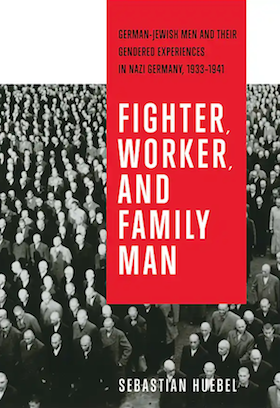
image - Fighter, Worker and Family Man book coverFighter, Worker and Family Man: German-Jewish Men and Their Gendered Experiences in Nazi Germany, 1933-1941 (University of Toronto Press, 2022) is a thoroughly researched book. In it, Sebastian Huebel – a sessional instructor in the history department at University of the Fraser Valley – depicts various strategies used by the Nazis to isolate and degrade German-Jewish men in the years prior to the concentration camps. His metaphor for this program of debasement and humiliation is “emasculation,” and the word identifies the book’s focus: how the Jewish-German (heterosexual) male was shamed by the dispossession of any masculine identity as “fighters, workers or family men” – the traditional markers of masculinity in Europe in those days.

Gender is a rare focus in Holocaust literature and, when the topic of gender arises there, it is almost always about women, and written by feminist scholars, as Huebel notes.

But men’s victimization, as Huebel demonstrates, also deserves scrutiny. During the 1930s, the overwhelming percentage of camp internees were male (“cheats,” “traitors,” “greedy bankers,” “race defilers,” “manipulators of international capitalism,” etc.): in other words, women did not fit the Nazi stereotype of the gendered male Jewish fifth-column “enemy.”

The Jewish male “enemy” was uniformly forced out of work, his business expropriated; he was excluded from the military, and his military service in the First World War ignored. In public, he was ridiculed, he was caricatured in propaganda and openly derided – all, as mentioned, to further the absurd Nazi fantasy of the “Aryan” übermensch. For what reason? Simply to “justify the need for protecting Germany from within” by inventing a supposed internal threat – to this day, a tried-and-true strategy practised by would-be and extant dictators.

(It’s worth noting that Huebel does not address the perceived threat emanating from the predominance of Jewish men in the German Communist and Social Democratic parties, in labour unions, and among other dissidents.)

In private, the Jewish father/husband paradigm crumbled under the weight of Nazi deprecation. With no work, no “bread being won,” the only way the Jewish father/husband could show his worth to the family was to arrange for emigration. But, as Holocaust historians have amply shown, by the time it was clear to the German Jews that the Nazis were not going to go away, the “free world” had closed its doors to them. (Canada’s famous response to the question of how many Jewish refugees should be admitted was “None is too many!”)

On a more positive note, Huebel notes that the at-home father model led to increased bonding – unusual for the time – between father and family, and Huebel offers lots of documentary evidence of signs of love and affection between the unemployed father and his children. As well, fathers frequently became at-home teachers to their expelled children – more evidence of “a new presence at home” that led to a reaffirmation of men’s role as father/mentor-educators.

On the streets, as Nazi violence against men increased, men were often coated with tar, made to walk barefoot over broken glass, made to stand for attention for long hours in bitter cold, and forced to open their mouths for Nazis to spit in. As a result, women were more and more often required to go out in public for menial chores.

The gender-specific treatment of men in the camps has not, Huebel says, been examined as closely as has been the treatment of women. To illustrate his point, he stresses how forced labour demanded of men, particularly in brickworks and quarries, led to disfigured bodies, “violated psyches” and premature death. Those who survived returned home like ghosts, permanently traumatized both physically and mentally, tortured by nightmares and often considering (and committing) suicide.

At no point in his book does Huebel denigrate the experiences of Jewish women under Nazism: “different horrors, same hell,” as Myra Goldenberg and Amy Shapiro said in the title of their excellent 2013 book.

Huebel’s oft-stated intention is to draw attention to the specific way men were abused, from beard-pulling to climbing up and down rock quarries until death. Jewish males were, as mentioned, typically regarded by Nazis as the “greater threat,” and were victimized accordingly.

Overall, Huebel shares the hope, in his conclusion, that a study of the erosion of Jewish male masculinity under Nazism can “sharpen our understanding of contemporary issues related to gender.”

This is a daunting objective, if not fulfilled, at least boldly addressed in this groundbreaking book.

Graham Forst, PhD, taught literature and philosophy at Capilano University until his retirement and now teaches in the continuing education department at Simon Fraser University. From 1975 to 2010, he co-chaired the symposium committee of the Vancouver Holocaust Education Centre.

Posted on July 22, 2022July 20, 2022Author Graham ForstCategories BooksTags education, gender, history, Holocaust, men, Nazis, Sebastian Huebel, Shoah
Never waste life’s many gifts

Never waste life’s many gifts

The author with her grandmother. (photo from Becca Wertman-Traub)

In the story of the Jewish people, it is not just about our patriarchs but the matriarchs, too. I grew up knowing that both my grandparents, Babi and Zaida, were Holocaust survivors. Zaida would tell me his stories – I know them backwards and forwards from how he spoke about them. But Babi, who was just 13 when the Second World War began, did not really tell hers.

She did talk about her brother – Shaike – who was taken to his death by the Nazi SS when he came out of the house to help young Frieda carry a pail of water. He was taken to a police station and killed in its basement along with numerous other Jews from the town. And she told us that her father, mother, sister and another brother all perished in the Holocaust. But not much else. She was too busy making blintzes, perogies, chicken patties, chicken soup with kreplach and more for her family.

Thankfully, though, she did have the extreme courage to tell her full story to the University of Southern California Shoah Foundation, where I learned the details of how she survived. Frieda’s childhood home in Kamionka-Strumilowa, Poland, became part of a ghetto. During the liquidation of the ghetto, Frieda and her brother, sister and mother hid in a hiding space in the wall and managed to survive, when the rest of the Jews of the town were taken to their deaths at Belzec extermination camp.

Following the liquidation, the German’s declared the town “Judenfrei,” free of Jews, but Frieda and her remaining family were still there. Since their home was located on the edge of the ghetto, they jumped off the balcony, surpassing the ghetto’s fence, and walked to Busk, a town 30 kilometres away, where they had heard that Jews were still living. They went to the Busk ghetto and lived with an aunt. Frieda’s mother died of typhoid there, and Frieda was left with her brother and sister. Unannounced, the Nazis started liquidating the ghetto, and Frieda again hid but was separated from her brother and sister – she never saw them again.

While in the Busk ghetto, Frieda worked as a gardener for a German man who said, if she returned to Kamionka-Strumilowa, he would help hide her. At the time, Frieda did not believe such a thing was possible and simply mentioned it to her cousins. However, after the liquidation, with no immediate family, she decided to give it a shot and walked back to her hometown by herself. The man took her to the village of Obydiv, where she met Mr. Svets, a Polish farmer. Frieda hid in this Polish farmer’s barn for 12 months and, today, his sister-in-law Janina Pelc is listed among Yad Vashem’s Righteous Among the Nations.

Frieda was one of just 20 from a town of 3,000 Jewish people who survived the Holocaust and lived to tell her story.

And did she live!

Babi and Zaida met after the war and moved to Vancouver in 1949. Babi was always walking, or speed-walking, usually leaving Zaida behind so she could do laps back and forth around him. She just could not sit still, whether it was cooking for her three children and, later, eight grandchildren, or cleaning the entire kitchen with a single square of paper towel – there could never be any waste. I remember sitting at Babi and Zaida’s kitchen counter as a little kid and Babi giving me milk in a tiny shot glass because “if you finish this, you get some more.”

Babi played tennis at Richmond Country Club, exercised at the Jewish Community Centre of Greater Vancouver, and dined at the finest restaurants and cafés in downtown Vancouver.

Even when Zaida passed away, she was not done living. Right up until the end, my dad took her out for coffee.

In September, just a few days before my wedding, we were out for coffee and she took my left hand, looked at me and said, “Is he Jewish? Is he from a good family?” I said yes, and reminded her that she was coming to the wedding.

At 95, she came to my wedding. And she danced at it – to none other than “Od Lo Ahavti Di,” Hebrew for “I have not loved enough.”

Babi appreciated life and everything it had to offer to its fullest, never allowing any of its gifts to go to waste. We mustn’t either.

May her memory be for a blessing.

Becca Wertman-Traub grew up in Vancouver and currently lives and works in Jerusalem.

Format ImagePosted on July 22, 2022July 20, 2022Author Becca Wertman-TraubCategories Op-EdTags Frieda Wertman, Holocaust, lifestyle, memoir, reflections, Vancouver
A story of two families

A story of two families

Marsha Lederman’s Kiss the Red Stairs begins in 1919, when her father was born, on erev Yom Kippur. (photo by Ben Nelms)

In the last couple of decades, researchers have identified traits that affect many children of Holocaust survivors. There remains much left to uncover, including how much is epigenetic – that is, whether and how the genes of people like survivors, who have undergone extreme trauma, work differently than other people’s – and how much might be a result of the parenting styles of people who, in many instances, were ripped from their own parents in the most brutal circumstances. The old issue of nature versus nurture, in other words.

While psychologists and scientists try to unravel those mysteries, a genre of second generation memoirs is exploring the deeply personal experiences of being raised by survivors of the Shoah. A page-turning, sometimes shocking and nakedly vulnerable volume has recently added much to the growing library.

Vancouver journalist Marsha Lederman, Western arts correspondent for the Globe and Mail, has written Kiss the Red Stairs: The Holocaust, Once Removed. The book begins in 1919, when Jacob Meier Lederman was born on erev Yom Kippur. The auspicious timing of the birth of this baby, who would grow to become Marsha Lederman’s father, portended great things.

“[T]his was an occasion, an omen – a very good one, the hugest of deals,” she writes. “This person was special, he was going to be something, do something very important with his life.”

Indeed, he did. He survived the Holocaust – the only person in his immediate family to do so and one of only 10% of the Polish Jews alive in 1939 who survived to 1945.

Marsha Lederman’s mother was also a survivor, and one who participated in Steven Spielberg’s Shoah Foundation testimony project, video-recording her Holocaust experiences. This recording would become a touchstone because, despite the journalist daughter’s career asking questions of strangers, there were many unanswered questions in the family. This was due in part to the harrowing, abrupt response to a childish inquiry about the absence of grandparents, an early lesson that unexpected answers can have catastrophic emotional impacts.

Well into adulthood, Lederman decided to visit her mother during a snowbird retreat in Florida. But instead of sitting across the kitchen table learning about her mother’s darkest moments, she was instead living one of her own – delivering her mother’s eulogy. She had waited a day too long to fly south.

image - Kiss the Red Stairs book coverLederman’s book is the story of a family – two families, really. A family that in some ways never came together quite right, the author’s birth family with its silences about the past, and another that fell apart, that of her marriage. Kiss the Red Stairs, in fact, is a sort of applied case study in second generation (shorthanded “2G”) neuroses, as they distort the author’s reactions and coping mechanisms in a time of personal crisis.

As her marriage collapses, Lederman recognizes, on the one hand, that her responses may not be commensurate with actual events but are exacerbated by a lifetime of fears around loss and abandonment. On another hand, the undeniable anguish of her marital breakdown evokes an added burden of guilt, her own trauma juxtaposed with her parents’ experiences. Given what their mothers and fathers endured, do children of survivors have a right to feel the pain that other people seem to validly experience?

Lederman acknowledges that she was always ready for everything to fall to pieces. She inherited – or developed – an existential pessimism and a catastrophizing worldview: “The glass wasn’t just half-empty; it was half-full of poison,” she writes. “Or Zyklon B.”

The history that has formed Lederman’s identity was not imprinted on her at home only. It was in the zeitgeist of her coming-of-age as a young Canadian Jew in the 1970s and ’80s.

“The slogan ‘Never Again’ was drilled into us, implying – to me, anyway – that there was always the potential for an again, for another catastrophe. What would we do when the Nazis came back and came for us, like they came for our parents?

“This happened to us. This could happen to us again. I was one of the us. On some level I believed, from a very young age, that this could happen to me. I understood the need to be on guard, that we weren’t really safe. We needed to be on alert. Have a plan.”

For whatever were their good intentions, the organizers of a youth trip to Israel reinforced Lederman’s anxieties. Intending to instil in the participants the need for one solitary Jewish state in the world, they reminded their young charges that, in the absence of Israel, Jews would have nowhere to go should the need arise, “if the world once again turned on – or turned its back on – the Jews.”

She doesn’t disagree with the premise. “But the exercise scared the hell out of me. Don’t be so comfortable in that Canada you think of as home; you never know what could happen.”

That awareness of the unimaginable human capability for inhumanity had imprinted on her to the extent that everyday life became a gauntlet of inevitable disaster, misery the preordained endpoint of any happiness. When her marriage broke down, her reaction was extreme, “As if divorce, for instance, were some kind of death camp.”

Having consciously tried to eradicate (second-hand) Holocaust memory from its constant intrusion into her mind, Lederman finally faces the core question of her life, and of the book: “Could I possibly be a victim of the Holocaust, once removed?”

Now a mother, her obsessive worry has a new object, not only in terms of the world into which that child was born, but the potential for epigenetic inheritance. Will the baggage of the past be passed along to another descendant of survivors?

At the same time, Lederman is careful not to ascribe her challenges to the overburdened couple who raised her.

“I am not comfortable blaming what happened to my parents – and, in effect, blaming them – for my little problems. It feels self-indulgent, unfair and actually untrue,” she writes. What they accomplished after the war was almost as miraculous as their survival during it. “The fact that after such tragedy my parents were able to build new lives – purchase and set up a home, go to night school to learn English, buy a business, raise children – seems astonishing to me, as I contemplate it all as an adult. How on earth did they manage to do it, manage to be so normal?”

She quotes Elie Wiesel who, in 1984, told children of Holocaust survivors: “That your parents were not seized by an irrepressible anger … remains a source of astonishment to me. Had they set fire to the entire planet, it would not have surprised anyone.”

Elsewhere in Lederman’s book, Wiesel appears again, seemingly underscoring the legitimacy of second generation complexes by noting that it was they, not their parents, who were the ultimate target of Hitler’s plan.

“You were the enemy’s obsessions,” Wiesel told the children of survivors. “In murdering living Jews, he wished to prevent you from being born.”

Lederman confronts the reader with things she has learned from research, rather than from firsthand experience or from stories her parents shared (because they didn’t). The Holocaust experiences of her parents may be the impetus for her lifelong sense of danger, she seems to suggest, but the larger history of that era should be a warning shot for all humans – because it was humans who perpetrated everything that happened to her parents and to the millions of others of the Nazis’ victims.

In one of several graphic segments, she demands that the reader ponder how ordinary people could throw babies in the air and practise a merciless form of skeet shooting.

There are other psychological conundrums in the book. Reading her father’s journal of a trip back to Europe, Lederman confronts what reads like a cognitive rupture: her father’s love for and comparatively happy memories of Germany.

Rather than remain in Nazi-occupied Poland, young Jacob audaciously crossed into the belly of the beast, into Germany, posing as a Polish peasant boy, and got work as a farmhand, surviving until the end of the war. As a result, he took a perversely positive view. In a travel diary entry, he wrote, “I had a wonderful exciting day and my motto stands again forever: I will never forget you Germany and the peace and security I found here among these fields, meadows and trees in those murderous inhuman times of the year 1942.”

Of all the happenstances in the book – some life-altering and, in several instances, life-saving – there is a particularly poignant one that happened on her father’s trip back to his hometown. On that trip, her father found out that his parents had left a letter for him before they had been evacuated from the ghetto and shortly thereafter murdered.

“A Polish woman who lived there at the time, or moved in after the liquidation – I’m not sure which – had come into possession of that letter. There were photos in this packet and some other family keepsakes,” she writes. “The woman said she had held onto these items for a long time, but after so many years without word, she lost all hope that my father had survived; she figured nobody from the family had. She threw the packet away.

“What was that like for him – to learn that his parents had left him something: a declaration of their love, a wish for his future, some unknown secret, an explanation of what was happening to them? And to learn that those things once touched and left for him by his parents – a written document, photographs, who knows what else – proof that his parents had existed, evidence of their love – had survived, only to be discarded?”

On her own ventures to the blood-soaked continent, Lederman is reminded that the past has not passed. She sees antisemitic graffiti on abandoned synagogues, Polish youths giving obscene gestures to participants during the March of the Living. Lederman and four family members are paying tribute at a Holocaust memorial while a group of boys nearby chant something in Polish, something menacing that included one term she recognized: “Auschwitz-Birkenau.”

“It didn’t sound like they were expressing their condolences,” she writes.

After a lifetime of mostly solitary rumination and fears, Lederman has several epiphanies during the World Federation of Child Survivors of the Holocaust annual conference, held in 2019 in Vancouver. Here, she finds others who share her view that “the other shoe is always about to drop and the world is not safe”; “being plagued with obsessive doubt”; “a heightened ability – one might call it a curse – to observe and engage others”; “A constant expectation that someone is going to get you.”

There, she finds she is not alone.

“I had found my people,” she writes.

Format ImagePosted on July 8, 2022July 7, 2022Author Pat JohnsonCategories BooksTags Holocaust, Marsha Lederman, memoir, second generation, survivors

Posts pagination

Previous page Page 1 … Page 9 Page 10 Page 11 … Page 44 Next page
Proudly powered by WordPress