Skip to content

  • Home
  • Subscribe / donate
  • Events calendar
  • News
    • Local
    • National
    • Israel
    • World
    • עניין בחדשות
      A roundup of news in Canada and further afield, in Hebrew.
  • Opinion
    • From the JI
    • Op-Ed
  • Arts & Culture
    • Performing Arts
    • Music
    • Books
    • Visual Arts
    • TV & Film
  • Life
    • Celebrating the Holidays
    • Travel
    • The Daily Snooze
      Cartoons by Jacob Samuel
    • Mystery Photo
      Help the JI and JMABC fill in the gaps in our archives.
  • Community Links
    • Organizations, Etc.
    • Other News Sources & Blogs
    • Business Directory
  • FAQ
  • JI Chai Celebration
  • JI@88! video
image - Weizmann Canada Physics Tournament 2025
image - The CJN - Visit Us Banner - 300x600 - 101625

Recent Posts

  • Vrba monument is unveiled
  • Music to build bridges
  • A better future possible
  • Anne Frank exhibit on now
  • Human rights in sport
  • Telling the story of an icon
  • Crawl bigger than ever
  • JCC Maccabi in Toronto
  • A way to meet fellow Jews
  • Time to include
  • Add Jewish joy to the mix
  • Reminder of humanity’s light
  • From the archives … editorials
  • Year-round holiday recipes
  • מדוע עזבתי את ישראל ואינני חושב לחזור ארצה
  • OJC hosts Oct. 7 memorial
  • A journey beyond self
  • Antisemitism a problem
  • Young man is missed
  • Orr action sparks complaint
  • Prison sentence for hate
  • Etgar Keret comes to Vancouver
  • New fall lecture series
  • Series explores music
  • Doc on Zapiro screens Nov. 6
  • Joy of shared existence
  • Community milestones … October 2025
  • MAID vs Jewish values
  • Cheshvan a great month, too
  • Bull, bear or bubble?
  • From the archives … a coin, etc.
  • מדוע האנטישמיות הולכת וגואה בעולם
  • New bio gives Vrba his due
  • Joy brighter than ever
  • When approaches differ
  • New leadership at the JCCV

Archives

Follow @JewishIndie

Tag: oral history

New archive launched

New archive launched

The Jewpanese Project Archives was launched online earlier this month.

I grew up in a mixed Jewish and Japanese Canadian family. My Jewish grandparents were Holocaust survivors from Poland and what is now Belarus, and my Japanese Canadian grandparents were survivors of the New Denver internment camp here in British Columbia.

Earlier this month – which is Asian Heritage Month and Jewish Heritage Month – I launched on my website the Jewpanese Project Archives, which highlights a selection of 35 US-based interviews, which were collected between May 2022 and April 2025. (See carmeltanaka.ca/jewpanese-project-archives.)

The collection phase of the interviews was funded by my year-long fellowship with the Anti-Defamation League – the Collaborative for Change Fellowship – and the aggregation of data from the US-based interviews was funded by a Jews of Colour Initiative research grant.

Each profile in the Jewpanese Project Archives contains the name of the interviewee and a photo of them; the place and date of their interview; their Jewpanese connection and birthplace; a link to a short video and a written paragraph on being Jewpanese; a link to the full audio and written interview; a link to the Instagram writeup with pictures; and archive notes.

The Jewpanese Project evolved organically. In my early 30s, I started to learn about what happened to my families (as I didn’t know much) and, then, the opportunity fell into my lap to find and interview fellow Jewpanese in Canada, the United States, Japan and Israel. Originally intended to be a 20-interview endeavour, it turned into an 85-plus interview community archive.

The project also has grown into a comic about a kimono heirloom in my Jewish family, an animated film about my journey to Białystok, and a play about being Jewpanese, for which I received an artist grant from the Japanese Canadian Legacies Society (JCLS). I also received an intergenerational wellness grant from JCLS to record the forgotten Japanese Canadian history of the Okanagan Landing Station House in Vernon, BC, which is also available on my website, carmeltanaka.ca.

Growing up, I thought it was just my sister and me who had Japanese and Jewish heritage. Never in my wildest dreams did I think I would be connected to 230-plus Jewpanese community members worldwide. And there must be more, which is an exciting thought. Many of us in North America hadn’t met another Jewpanese person – other than our siblings – until this project, which was birthed out of our monthly community Zoom calls during the pandemic.

While you peruse the archives, I welcome you to listen and read through the interviews and Instagram highlights to learn about the experiences of being mixed in Japanese and Jewish communities in the United States, which are comparable to those in Canada. Whether it’s language, culture, rituals, identity or traditions, Jewpanese people have a wide spectrum of lived experiences, but one thing is pretty constant – our love of food. We have a number of Jewpanese fusion recipes!

One of the questions I ask in the interviews is whether or not participants have done “roots trips,” going to their ancestral homelands. Many of us haven’t, and many of our parents (including mine) haven’t either, especially here in North America. My first trip to Japan was last year, at the age of 37, as part of this project, and it was life-changing. Even though the collection phase funding has ended, I have used my Avion points to go to Europe to retrace the steps of my Jewish family – and that’s where I am now. I experienced firsthand how healing my Japan trip was for me and for my dad, whom I dragged along virtually, as his health is declining, so I am doing the same for my mom, whose health is also deteriorating.

My journey to Japan inspired a number of Jewpanese and Nikkei people to seek out family members there through a process to obtain one’s koseki (family register document), and I hope that my journey to Poland also will motivate my Jewpanese and Jewish communities to do the same. It can be inspiring to know our history and where we come from.

Many Jewpanese families are asking when the rest of the interviews (all the non-US-based interviews) will be processed, and my answer is “when I get funding.” I never expected this project to blossom as it has. It’s been the project of a lifetime and deeply personal. If you are in a position to support it, please do reach out. It would be wonderful to have the Canadian, Israeli and Japanese interviews processed for the archives, as well. 

If you are a Jewpanese person, couple or family and would like to participate in this project, I am still accepting written interviews. Please contact me for an interview package. 

Todarigato! (Toda + arigato, “thank you” in Hebrew and Japanese!) 

Carmel Tanaka is the founder and executive director of JQT Vancouver, and curator of the B.C. Jewish Queer & Trans Oral History Project (jqtvancouver.ca/jqt-oral-history-bc) and the Jewpanese Oral History Project (Instagram: @JewpaneseProject). A version of this article was published in the Victoria Nikkei Forum.
Format ImagePosted on May 30, 2025May 29, 2025Author Carmel TanakaCategories WorldTags archives, Asian Heritage Month, culture, history, Jewpanese Project, online archives, oral history

Scribe camp issue launches

The Jewish Museum & Archives of British Columbia (JMABC) is releasing the 41st edition of The Scribe – which has a summer camps theme – on April 24, 6 p.m., at the Peretz Centre for Secular Jewish Culture.

The JMABC’s flagship publication celebrates the lives and traditions of British Columbia’s Jewish residents by focusing on one sector each edition. This year’s journal features personal memories from seven Jewish summer camps in the Pacific Northwest, highlighting the lasting impact that camp experiences have had on the development of lifelong connections to Jewish culture and community. 

First published in 1989, The Scribe’s mandate is to link the Jewish community’s past with the present to inspire future generations. The publication has documented all aspects of the Jewish experience in British Columbia. Past issues have focused on prominent medical pioneers who have improved the lives of Canadians; top restaurateurs who cultivated Vancouver’s social scene; and ready-to-wear icons who helped British Columbia become an international fashion centre.

“The Scribe: Summer Camps Issue is by far one of the most endearing and nostalgic issues in [the journal’s] 41-year history,” said Daniella Givon, president of the JMABC. “Jewish summer camps have long represented a unique form of organic community-building and Jewish connection. Through the iconic summer camp experience, generations of Jewish youth have developed a sense of resilience and belonging that has strengthened their own connections to Jewish community, personal identity and cultural continuity.”

“The impact and success of Jewish communities in Canada have been significantly enhanced by the collective experiences of summer camp attendees,” said Elana Wenner, JMABC director of programming and development. “We look forward to taking a walk down memory lane with Jewish communities throughout BC with this new issue!”

The launch at the Peretz Centre will be an immersive evening of nostalgia, song and stories, as the summer camp communities of the Pacific Northwest are brought together under one roof.

Tickets are $54 each, and include dinner, a program and a keepsake T-shirt. All proceeds are in support of the JMABC. Copies of The Scribe: Summer Camps Issue will be available for purchase at the event for $20 each. (JMABC members in good standing will receive one free copy per family.) For tickets, visit tinyurl.com/ANightAtCamp. 

– Courtesy Jewish Museum & Archives of British Columbia

Posted on April 11, 2025April 10, 2025Author Jewish Museum and Archives of British ColumbiaCategories BooksTags Daniella Givon, Elana Wenner, events, history, oral history, summer camp, The Scribe
Revisiting oral histories

Revisiting oral histories

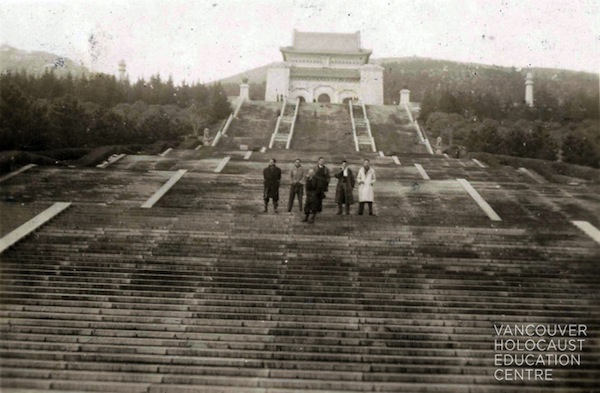
Manfred Gottfried and a group of men on the stairs to the Dr. Sun Yat-sen mausoleum. (photo from VHEC: RA001-5-o7-5-9-0339x)

A little over 20 years ago, the Vancouver Holocaust Education Centre started the Shanghai Oral History Project. Led by Roberta Kremer and Daniel Fromowitz, the project recorded the oral histories of Vancouver’s small Shanghai Jewish survivor community. They interviewed 10 survivors and/or their descendants, learning about their rich and unique experiences of survival in Shanghai.

This project, along with loaned artifacts and memorabilia, became the basis for VHEC’s 1999 exhibition Shanghai: A Refuge During the Holocaust. It opened alongside another exhibition, Visas for Life: The Story of Feng Shan Ho. Both were well received, and included film screenings on the topic of Jewish refugees in Shanghai, and a demonstration of mahjong, a game which remains popular in the Jewish community in Vancouver. Once the exhibitions concluded, materials were returned to their lenders or safely placed under the VHEC’s care, and the interviews were catalogued and filed away.

In January 2022, I began my co-op position as digital projects coordinator with the VHEC. One of the first tasks assigned to me was to help improve accessibility to the Shanghai interviews and the audiotape transcriptions. In the 20 years since these oral history transcriptions were created, the VHEC has changed its digital file management and storage system. Some files were missing while others were mislabeled. Many files would no longer open within the current version of Microsoft Word. At the top of some transcriptions was a disclaimer: “The whole tape is not transcribed, only that which is related to Shanghai.” Throughout the transcriptions, comments like “(side discussions)” denote what the original transcriber believed to be unrelated to the subject matter.

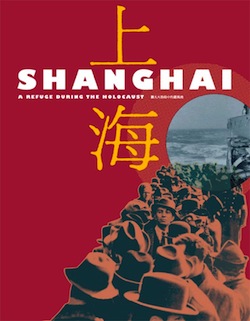
image - In 1999, the Vancouver Holocaust Education Centre held the exhibit Shanghai: A Refuge During the Holocaust
In 1999, the Vancouver Holocaust Education Centre held the exhibit Shanghai: A Refuge During the Holocaust. (image from VHEC)

Rummaging through these transcriptions, it became apparent that I would not simply be “tidying up.” By revisiting the Shanghai Oral History Project, my goal was to do more than just emphasize the unique experiences of this small group of individuals. As I listened to their interviews and transcribed their words, I wanted to offer a glimpse into how Shanghai Jewish survivors expressed themselves and reflected on their time in Shanghai, while also highlighting things that weren’t considered when the exhibition first opened 20 years ago.

On the list of possible interviewees for the Shanghai Oral History Project, George Melcor’s was the only name with “very elderly” added beside it in parentheses. Listening to George’s interview, it became clear that this would be a challenging transcription. George sometimes mumbled, which made it difficult to comprehend his words, or he would mix up his stories. But, for 88-year-old George, Shanghai left an impression. When asked by interviewer Daniel Fromowitz what memories of Shanghai come to mind, George lit up with excitement. “Shanghai was alive all the time. Never closed, always open.… Clubs and gambling, everything was free. Shanghai was a very free city.” At this point, the slow progression of the interview sped up: the emotions in George’s voice suggest that he was reliving his 16-year-old self. For a moment, George was not elderly.

What is striking listening to the Shanghai audiotapes is the dialogue between the interviewer and interviewee. Lore Marie Wiener was interviewed about her experiences in Shanghai by both Roberta and Daniel. But rather than just giving answers, Lore proceeded to converse with both interviewers, asking about where they were born, their experiences growing up and whether they faced antisemitism. Lore was also very reflective. She questioned the nature of Jewishness and what it consists of; she questioned “… why did we not interfere in Rwanda, and we do interfere in Yugoslavia?” With the former, there was a back-and-forth between Roberta and Lore, but, with the latter, Daniel was not sure how much to engage. These side stories provide a picture of Lore that is more than just her experiences of escaping the threat of Nazi violence and survival in Shanghai; it is the continuation of her life after the Holocaust.

Lastly, how did the interviewees recall, if any, their connection to the local Chinese and Japanese communities? In general, although interviewees were in Shanghai, Chinese people featured only in the background. They were acquaintances, as was the case for Anne Chick and the two Chinese kids living in her neighbourhood. For most interviewees who did interact with Chinese people, it was through a working relationship with Chinese servants, workers or amahs.

For Lore, she employed several Chinese tailors in her shop, as well as a chauffeur and a cook called Dun-zen. Interracial relationships were also possible. Kurt Weiss noted that, after divorcing his first wife, he had a Chinese girlfriend until he left Shanghai. Gerda Gottfried Kraus mentioned in passing how, in postwar Shanghai, one of her acquaintances married a Chinese woman and wanted to bring her with him to the United States. Knowledge of some Chinese, particularly Shanghainese, was also a common theme found in these interviews, though many interviewees state that they’ve either forgotten it after not using it for so long, or knew only the absolute basics. Additionally, they never learned how to read Chinese characters.

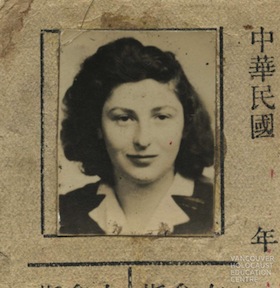
photo - Gerda Gottfried Kraus, 1940s
Gerda Gottfried Kraus, 1940s. (photo from VHEC: RA0001-05-00-02-0099)

Knowledge of Japanese people was more limited. Kurt’s success as a suit salesman was due to his patron relationship with a Japanese engineer named Kato. Lore mentioned she was helped by a Japanese engineer when she and her mother were stranded in Harbin. But the one individual whom most interviewees referenced was Ghoya, the Japanese commandant of Hongkew ghetto. Ghoya developed a reputation as an unpredictable ruler: while Lore mentioned that her father and husband were treated well by Ghoya due to their academic connections, other interviewees mentioned episodes of violence committed by Ghoya and his guards against the Hongkew inhabitants. Their brutality is matched only by their treatment of the local Chinese. Most interviewees mentioned the mistreatment that local Chinese faced.

The experiences of Shanghai Jewish survivors are often overlooked when compared to those who survived in Europe. Lore was very concerned about this. At the end of her interview, she stated: “I’m not uncomfortable with anything. [But] … just try to be careful about the parts where I am too pleased with my life because there are so many people who suffered.” With the “global turn” in academic research into the Holocaust, the sub-category of “Shanghai survivor” has been gaining strength. It is a term that validates the experiences of refugee Jews and others who survived the Holocaust in Shanghai, while also acknowledging the unique circumstances and challenges they faced.

It is heartening to know that, in the 20-plus years since the VHEC’s Shanghai exhibition, research into this dimension of the Holocaust and the voices of these survivors have not been obscured, but, instead, have expanded into a vibrant subfield. By revisiting past projects and exhibitions, and making them more accessible, we can hopefully gean new information about the Holocaust and the multiplicity of survivors’ experiences.

 Ryan Cheuk Him Sun is a PhD candidate in the University of British Columbia department of history. His research examines the entangled histories between Jewish refugees escaping Nazi oppression and the British colonies of Hong Kong and Singapore. He is also interested in the journeys that took Jewish refugees to East Asia, and their experiences in transit onboard ships and trains. He can be reached at [email protected]. This article was originally published in the VHEC’s Spring 2022 issue of Zachor.

Format ImagePosted on September 2, 2022September 1, 2022Author Ryan Cheuk Him SunCategories Local, WorldTags history, Holocaust, oral history, refugees, research, Shanghai, survivors, VHEC
Proudly powered by WordPress